anaheim-gazette 1899-02-23
Scanned page
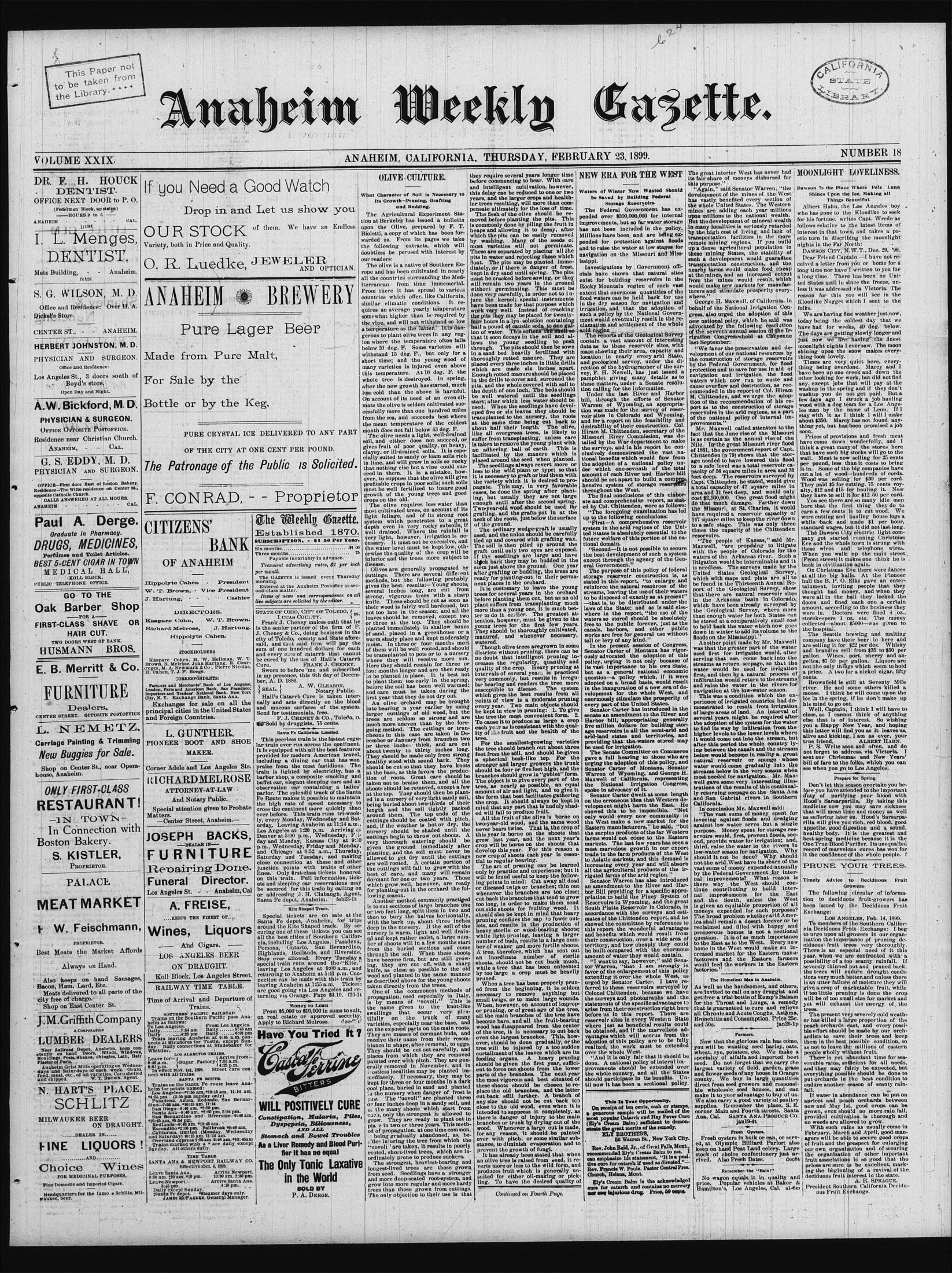
Searchable text
This Paper not to be taken from the Library.
VOLUME XXIX.
DR. F. H. HOUCK
DENTIST.
OFFICE NEXT DOOR to P. O.
(Federman Block, up stairs)
HOURS 9 to 5
ANAHEIM CAL.
jy184
I. L. Menges,
DENTIST.
Metz Building, Anaheim.
feb24
S. G. WILSON, M. D.
Office and Residence: Over H. A. Dickel's Store.
CENTER ST., Anaheim.
HERBERT JOHNSTON, M. D.
PHYSICIAN AND SURGEON.
Office and Residence:
Los Angeles St., 3 doors south of Boyd's store.
Open Day and Night.
A.W. Bickford, M. D.
PHYSICIAN & SURGEON.
Office opposite Postoffice.
Residence near Christian Church.
ANAHEIM, Cal.
G. S. EDDY, M. D.
PHYSICIAN AND SURGEON.
If you Need a Good Watch
Drop in and Let us show you
OUR STOCK of them. We have an Endless Variety, both in Price and Quality.
O. R. Luedke, JEWELER AND OPTICIAN.
ANAHEIM BREWERY
Pure Lager Beer
Made from Pure Malt,
For Sale by the Bottle or by the Keg.
PURE CRYSTAL ICE DELIVERED TO ANY PART OF THE CITY AT ONE CENT PER POUND.
The Patronage of the Public is Solicited
Los Angeles St., 3 doors south of Boyd's store.
Open Day and Night.
A.W. Bickford, M.D.
PHYSICIAN & SURGEON.
Office Opposite Postoffice.
Residence near Christian Church.
ANAHEIM, CAL.
G.S. EDDY, M.D.
PHYSICIAN AND SURGEON.
OFFICE—First door East of Boston Bakery.
Residence—The Wilte residence on Center St., opposite Catholic Church.
CALLS ANSWERED AT ALL HOURS.
ANAHEIM, CAL.
Paul A. Derge.
Graduate in Pharmacy.
DRUGS, MEDICINES,
Perfumes and Toilet Articles.
BEST 5-CENT CIGAR IN TOWN
MEDICAL HALL,
KOLL BLOCK.
PUBLIC TELEPHONE OFFICE.
GO TO THE Oak Barber Shop
FOR A FIRST-CLASS SHAVE OR HAIR CUT.
TWO DOORS WEST OF BANK.
HUSMANN BROS.
E.B. Merritt & Co.
FURNITURE
Dealers.
CENTER STREET. OPPOSITE POSTOFFICE
L.NEMETZ,
Carriage Painting & Trimming
New Buggies for Sale.
Shop on Center St., near Opera-house, Anaheim.
ONLY FIRST-CLASS RESTAURANT!
IN TOWNIn Connection with Boston Bakery.
S.KISTLER,
PROPRIETOR.
PALACE
For Sale by the Bottle or by the Keg.
PURE CRYSTAL ICE DELIVERED TO ANY PART OF THE CITY AT ONE CENT PER POUND.
The Patronage of the Public is Solicited.
F.CONRAD, - - Proprietor
CITIZENS' BANK
OF ANAHEIM
Hippolyte Cahen President
W.T. Brown Vice President
J.Hartung Cashier
DIRECTORS:
Kaspare Cohn, W.T. Brown
Richard Melrose, J.Hartung
Hippolyte Cahen.
STOCKHOLDERS:
Kaspare Cohen, H.W. Hellman, W.T. Brown, R.Melrose, John Hartung, R.Courreges, M.A.Newmark & Co., Pierre Nicolas, H.Cahen, T.J.F.Boege.
CORRESPONDENTS:
Farmers and Merchants' Bank of Los Angeles; London, Paris and American Bank; San Francisco; Importers and Traders' National Bank; New York City, N.Y. Exchange Bank; Santa Ana.
Exchanges for sale on all the principal cities in the United States and Foreign Countries.
L.GUNTHER.
PIONEER BOOT AND SHOE MAKER.
Corner Adele and Los Angeles Sts.
RICHARDMELROSE
ATTORNEY-AT-LAW
And Notary Public.
Special attention given to Probate Matters.
Center Street, Anaheim.
JOSEPH BACKS,
DEALER IN
FURNITURE
Repairing Done.
Funeral Director.
Los Angeles St. - - Anaheim, Cal
The Weekly Gazette
Established 1870
SUBSCRIPTION, - $1 50 Per Year
Six months... $1
Three months... $1
Payable invariably in advance.
Transient advertising rates, $1 per inch per month.
The GAZETTE is issued every Thursday morning.
Entered at the Anaheim Postoffice as second-class matter.
Items of news and correspondence on all live subjects are solicited by the editor.
STATE OF OHIO, CITY OF TOLEDO,
LUCAS COUNTY.
Frank J. Cheney makes oath that he is the senior partner of the firm of J. Cheney & Co., doing business in the city of Toledo, county and State afloat said, and that said firm will pay the sum of one hundred dollars for each and every case of catarrh that cannot be cured by the use of Hall's Catarh Cure.
FRANK J. CHENEY.
Sworn to before me and subscribe in my presence, this 6th day of December, A.D. 1886.
A.W.GLEASON,
Notary Public.
Hall's Catarrh Cure is taken intently and acts directly on the bloody and mucous surfaces of the system Send for testimonials, free.
F.J.CHENEY & Co., Toledo,
Sold by druggists, 75 cents.
Santa Fe California Limited.
This peerless train is the fastest regular train ever run across the continent. It is equipped with all the best features provided for modern American travel including a dining car that has no praise from the most fastidious. The train is lighted by electricity, has a barber shop, a composite smoking and buffet car, elegant sleeping cars and a observation car containing a ladie parlor. The splendid track of the San Fe Route makes it possible to maintain the high rate of speed necessary to cross the continent more quickly than ever before. This train runs tri-weekly, every Monday, Wednesday and Saturday. Leaving Anaheim at 11:14 a.m. Los Angeles at 1:20 p.m. Arriving Denver at 5:00 p.m., Wednesday, Friday and Monday, Kansas City at 9:00 p.m., Wednesday, Friday and Monday and Chicago at 9:52 a.m., Thursday Saturday and Tuesday, and making close connection at these and other junction points with trains of other lines. Only first-class tickets honor on this train. Full information, tickets and sleeping car reservations may be secured for this train by calling or addressing J.H. Clabaugh, Agent
RESTAURANT!
IN TOWNIn Connection with Boston Bakery.
S. KISTLER,
PROPRIETOR.
PALACE
MEAT MARKET
H. W. Feischmann,
PROPRIETOR.
Best Meats the Market Affords
Always on Hand.
Also keeps on hand Sausages, Bacon, Ham, Lard, Etc.
Meats delivered to all parts of the city free of charge.
Shop on East Center St.
J.M.Griffith Company
A CORPORATION
LUMBER DEALERS
Neer Railroad Depot, Anaheim, keep constantly on hand Doors, Blinds, Windows, Mouldings, Posts, Shakes, shingles, Lath, Hair Plaster of Paris.
Anaheim Grist Mills operating on Wednesdays and Saturdays of each week. Grain feed, meal, etc., of all varieties. Corn shelled and shipped.
W. T. Brown, Agent.
N. HART'S PLACE.
SCHLITZ
MILWAUKEE BEER ON DRAUGHT.
DEALER IN...
FINE LIQUORS!
AND...
Choice Wines FOR MEDICINAL PURPOSES.
Fine Domestic and Imported Cigars.
Headquarters for the famo & Schlitz, Milwaukee, beer.
And Notary Public.
Special attention given to Probate Matters.
Center Street, Anaheim.
JOSEPH BACKS,
DEALER IN
FURNITURE
Repairing Done.
Funeral Director.
Los Angeles St. Anaheim, Cal A. FREISE,
...KEeps THE FINEST OF....
Wines, Liquors
And Cigars.
LOS ANGELES BEER ON DRAUGHT.
Koll Block, Los Angeles Street.
RAILWAY TIME TABLE.
Time of Arrival and Departure of Trains.
SOUTHERN PACIFIC RAILROAD.
Trains on the Southern Pacific pass Anaheim as follows:
To Los Angeles.
Daily.....7:54 am Daily.....9:45 am
Daily.....4:25 pm Daily.....6:01 pm
Train leaving Anaheim at 9:45 a.m. connects at Miraflores for Tustin, except Sunday. Daily connections at Studebaker for Whittier.
LOS ALAMITOS TRAINS.
Leave for—
9:48 a.m. Sugar Factory 7:52 a.m.
6:01 p.m. 4:25 p.m.
In effect Nov. 1st, 1898. Street cars connect with all trains.
SANTA FE ROUTE.
Trains on the Santa Fe route leave Anaheim for points named:
Los Angeles—7:55 am.*10:15 am, 11:14 am.*4:55 pm. (3:55 pm Sunday only)
Pasadena, Azusa, Redondo. San Bernardino—7:55 am.*10:15 am, 11:14 am
San Diego—9:46 am.*2:50 pm.
Santa Ana—9:46 am.*2:50 pm, 5:54 pm.
San Bernardino and Riverside—9:46 am.*10:45 am.*6:54 pm.
Redlands—9:46 am.*10:45 am.
Escondido*2:50 pm. Fallbrook*9:46 am.
California limited (Monday, Wednesday and Saturday) 10:15 am, 11:14 am.
Overland express 7:55 am.*9:46 am.*10:45 am
Trains marked with a * are daily except Sunday. All others daily.
TIME TABLE
SANTA ANA & NEWPORT RAILWAY CO.
Effective Oct. 4, 1898.
Leave Santa Ana. Arrive Newport.
9:50 am.*10 am.*2:28 pm 10:30 am.*2:30 pm
Leave Newport. Arrive Santa Ana.
3:45 pm 4:15 pm
Daily except Sunday.
Santa Fe depot. Steamer days only.
JAMES McFADDEN, General Manager.
Kite Shaped Track.
Special tickets are on sale at the Santa Fe depot, Anaheim, for trips around the Kite Shaped track. By securing one of these tickets you can all the best cities of Southern California, including Los Angeles, Pasadena, Pomona, Ontario, San Bernardino Highlands, Redlands, and Riverside. Stop over allowed. Every Tuesday special train runs around the "Kite" leaving Los Angeles at 9:00 a.m., after returning to Anaheim at 5:41 p.m. Connection can be made with this train leaving Anaheim at 7:55 a.m. Tickets are good going via Los Angeles and turning via Orange. Fare $4.10.
Money to Loan
From $5,000 to $10,000 in sums to sundown real estate or approved security Apply to Richard Melrose.
Have You Tried It?
Constipation, Malaria, Pile Dyspepsia, Billiousness,
AND ALL
Stomach and Bowel Troubles
As a Liver Remedy and Blood Purifier it has no equal
The Only Tonic Laxative in the World
SOLD BY
P.A.DERGE.
Wein Weekly Gazette
ANAHEIM, CALIFORNIA, THURSDAY, FEBRUARY 23, 1899.
I Watch us show you We have an Endless WELER AND OPTICIAN.
BREWERY Beer
VERED TO ANY PART NT PER POUND.olic is Solicited.
OLIVE CULTURE.
What Character of Soil is Necessary to Its Growth—Pruning, Grafting and Budding.
The Agricultural Experiment Station at Berkeley has issued a bulletin upon the Olive, prepared by F. T. Bioletti, a copy of which has been forwarded us. From its pages we take the following extracts, which will doubtless be perused with interest by our readers:
The olive is a native of Southern Europe and has been cultivated in nearly all the countries surrounding the Mediterranean from time immemorial. From there it has spread to various countries which offer, like California, similar climatic conditions. It requires an average yearly temperature somewhat higher than is required by the vine, and will not withstand so low a temperature as the latter. It is dangerous to plant olive trees in any region where the temperature often falls below 20 deg. F. Some varieties will withstand 15 deg. F., but only for a short time; and the young wood of many varieties is injured even above this temperature. At 10 deg. F. the whole tree is destroyed. In spring, after the new growth has started, much less cold than the above is harmful. On account of its need of an even climate the olive is seldom cultivated successfully more than one hundred miles from the sea, and succeeds best where the mean temperature of the coldest month does not fall below 43 deg. F.
The olive needs a light, well-drained soil, and either does not succeed, or gives fruit of poor quality, on heavy, clayey, or ill-drained soils. It is especially suited to sandy or loam soils rich in lime, and will grow in soils so rocky that nothing else but a vine could succeed in them. It is a mistake, how they require several years longer time before commencing to bear. With care and intelligent cultivation, however, this delay can be reduced to one or two years, and the larger crops and healthier trees resulting, will more than compensate ultimately for the loss of time.
The flesh of the olive should be removed before planting the pits. This is commonly done by piling the fruit in heaps and allowing it to decay, after which the pits can be easily removed by washing. Many of the seeds of most varieties will not germinate. These are separated by placing all the pits in water and rejecting those which float. The pits may be planted immediately, or if there is danger of frost, kept in dry sand until spring. The pits must be cracked before sowing, or they will remain two years in the ground without germinating. This must be done very carefully, in order not to injure the kernel; special instruments have been made for that purpose which work very well. Instead of cracking the pits they may be placed for twenty-four hours in a lye solution containing half a pound of caustic soda to one gallon of water. This softens the shell so that it soon decays in the soil and allows the young seedling to push through. The pits should then be sown in a sand bed heavily fertilized with thoroughly rotted manure. They are placed every three inches in little drills which are made six inches apart. Enough rotted manure should be placed in the drills to cover and surround the pits, and the whole covered with soil to the depth of one inch. The beds should be well watered until the seedlings start; after which less water should be used. When the seedlings have developed five or six leaves they should be transplanted to the nursery, the roots at the same time being cut back to about half their length. The olive, like evergreen trees, is likely to suffer from transplanting, unless care is taken to remove the young plant with an adhering ball of earth. This is facilitated by the manure which is placed around the seed when planted.
The seedlings always revert more or less to the wild plant or type; so that they require several years longer time before commencing to bear. With care and intelligent cultivation, however, this delay can be reduced to one or two years, and the larger crops and healthier trees resulting, will more than compensate ultimately for the loss of time.
NEW ERA FOR THE WEEK
Waters of Winter Now Wasted Should be Saved by Building Federal Storage Reservoirs.
The Federal Government has suspended over $300,000,000 for interim improvements, but so far water storage has not been included in the policy. Millions have been and are being pended for protection against floods and to raise the water at low stages of navigation on the Missouri and Mississippi.
Investigations by Government officials have shown that natural data as to these reservoir sites, maps showing their area, capacity location in nearly every arid South and geological survey, under the section of the hydrographer of thevey, F. H. Newell, has just issued pamphlet giving many details about these matters, under a Senate resolution calling for the information.
Under the last River and Harbor bill, through the efforts of Sen Warren of Wyoming, an appropriation was made for the survey of river sites in Colorado and Wyoming and for a report on the feasibility of their construction.
Hiram M. Chittenden, secretary of Missouri River Commission, was tailed by the War department to review the surveys, and in his report he included visually demonstrated the various benefits which would flow from the adoption of a national policy der which one-seventh of the amount of each River and Harbor...
Whole tree is destroyed. In spring, after the new growth has started, much less cold than the above is harmful. On account of its need of an even climate the olive is seldom cultivated successfully more than one hundred miles from the sea, and succeeds best where the mean temperature of the coldest month does not fall below 43 deg. F.
The olive needs a light, well-drained soil, and either does not succeed, or gives fruit of poor quality, on heavy, clayey, or ill-drained soils. It is especially suited to sandy or loam soils rich in lime, and will grow in soils so rocky that nothing else but a vine could succeed in them. It is a mistake, however, to suppose that the olive will give profitable crops in poor soils; such soils must be well fertilized to insure good growth of the young trees and good crops on the old.
The olive requires less water than most cultivated trees, on account of its light foliage, and of its strong root system which penetrates to a great depth even in very rocky subsoils, if well drained. Where the rainfall is very light, however, irrigation is necessary. It must not be excessive, and the water level must be kept low, otherwise the quality of the crop will be inferior and the trees more subject to disease.
Olives are generally propagated by cuttings. There are several different methods, but the following probably gives the best results: Young shoots, several inches long, are cut from strong, vigorous trees with a sharp knife. These should be cut as soon as their wood is fairly well hardened, but not too late in the season; and all the leaves should be removed, except two or three at the top. They should be planted immediately in shallow boxes of sand, placed in a greenhouse or a warm shady place and kept moderately moist. In three or four months most of them will be well rooted, and should be transplanted to pots or to a nursery where they will receive more sun. Here they should remain for three or four months longer and it then ready to be planted in place. It is best not to plant them too early in the spring, before the soil has been well warmed; and care must be taken during the first year that they do not dry out.
An olive orchard may be brought into bearing a year earlier by using larger cuttings of old wood, but the trees are seldom so strong and are much more uneven than by the foregoing method. The cuttings or truncheons in this case are taken in December or January from branches two or three inches thick, and are cut about twenty to thirty inches long. They should be made only from healthy wood with sound bark. They should be cut so that they have knots at the base, as this favors the production of roots. Great care should be taken not to bruise them, and all the shoots should be removed, except a few at the top. They should then be planted in a nursery of very light sandy soil, being buried about two-thirds of their length and the soil tightly packed around them. The top ends of the cuttings should be coated with pitch, and if the weather is hot or dry, the nursery should be shaded until the cuttings begin to throw out shoots. A very thorough watering should be given the ground immediately after planting, and the soil must never be allowed to get dry until the cuttings are well rooted. A certain portion of the cuttings will fail to grow with the best of care, and many will remain dormant for one or two years. Those which grow well, however, are ready for planting out in the orchard the following season.
The art of pruning can be learned only by practice and experience; but it will be found useful to keep the following points in mind: Cut away all dead or diseased twigs or branches; thin out whenever the branches are too close; cut back the branches that tend to grow enough rotted manure should be placed in the drills to cover and surround the pits, and the whole covered with soil to the depth of one inch. The beds should be well watered until the seedlings start; after which less water should be used. When the seedlings have developed five or six leaves they should be transplanted to the nursery, the roots at the same time being cut back to about half their length. The olive, like all evergreen trees, is likely to suffer from transplanting, unless care is taken to remove the young plant with an adhering ball of earth. This is facilitated by the manure which is placed around the seed when planted.
The seedlings always revert more or less to the wild plant or type; so that it is necessary to graft or bud them with the variety which it is desired to propagate. This may, in very favorable cases, be done the spring after planting, but usually they are not large enough until after the second spring. Two-year-old wood should be used for grafting, and the grafts put in at the neck of the roots, just below the surface of the ground.
The ordinary wedge-graft is usually used, and the union should be carefully tied up and covered with grafting wax. The soil is then piled up around the graft until only two eyes are exposed. If the seedlings are large and have thick bark they may be budded in the stem just above the ground. One year after grafting or budding, the trees are ready for planting-out in their permanent places in the orchard.
It is customary to leave the young trees for several years in the orchard before planting them out, but as an old plant suffers from transplanting much more than a young one, it is much better to do it earlier. The greatest attention, however, must be given to the young trees for the first few years. They should be thoroughly cultivated, manured, and whenever necessary, watered.
Though olive trees are grown in some districts without pruning, there can be no doubt that intelligent pruning increases the regularity, quantity and quality of the crop. Heavy pruning at intervals of several years is practiced very commonly, but results in irregular bearing and renders the tree more susceptible to disease. The system which gives the best results from all points of view is a moderate pruning every year. Two main objects should be kept in view in pruning: 1. To give the tree the most convenient form. 2. To cause it to produce as large a crop each year as is consistent with the quality of the fruit and the health of the tree.
For the smallest-growing varieties the树 should branch out about three feet from the soil, and should be given a spherical bush-like top. For the stronger and larger growers the trunk should be four or five feet high, and the branches should grow in "goblet" form. The object is to give every part of the tree, as nearly as possible, an equal amount of air and light, and to give it the form that best facilitates gathering the crop. It should always be kept in mind that any part that is unduly shaded will fail to produce fruit.
All of fruit of the olive is borne on two-year-old wood, and the same wood never bears twice. That is, the crop of this year is borne on the shoots that grew last year, and the next year's crop will be borne on the shoots that develop this year. For this reason a new crop of shoots each year is essential to regular bearing.
The art of pruning can be learned only by practice and experience; but it will be found useful to keep the following points in mind: Cut away all dead or diseased twigs or branches; thin out whenever the branches are too close; cut back the branches that tend to grow enough rotted manure should be placed in the drills to cover and surround the pits, and the whole covered with soil to the depth of one inch. The beds should be well watered until the seedlings start; after which less water should be used. When the seedlings have developed five or six leaves they should be transplanted to the nursery, at the same time being cut back to about half their length. The olive, like all evergreen trees, is likely to suffer from transplanting, unless care is taken to remove the young plant with an adhering ball of earth. This is facilitated by the manure which is placed around the seed when planted.
The seedlings always revert more or less to the wild plant or type; so that it is necessary to graft or bud them with the variety which it is desired to propagate. This may, in very favorable cases, be donethe spring after planting, but usually they are not large enough until after the second spring.
Two-year-old wood should be used for grafting, and the grafts put in at the neck of the roots, just below the surface of the ground.
The ordinary wedge-graft is usually used, and the union should be carefully tied up and covered with grafting wax. The soil is then piled up around the graft until only two eyes are exposed. If the seedlings are large and have thick bark they may be budded in the stem just above the ground. One year after grafting or budding, these are ready for planting-out in their permanent places in the orchard.
It is customary to leave the young trees for several years in the orchard before planting them out, but as an old plant suffers from transplanting much more than a young one, it is much better to do it earlier. The greatest attention, however, must be given tothe young trees forthe first few years. They shouldbe thoroughly cultivated,andwhenevernecessary,水edted.
Though olive trees are grownin some districts without pruning,the caneis regularly quantifyandqualityofthecrop.Hewypruningatintervalsofseveralyearispracticedverycommonly,butresultsinirregularbearingandrenderthetreemuscepittodisease.ThesystemwhichgivesthebestresultfromallpointsofviewisamoderatepruningeverypartoftheUnitedStates.
Senator Carter has introduced senate an amendment to Rivers Harbor bill, appropriating genie five million dollars for building five million dollars for building arid-land states and territories providing thatthewaters storedbeusedforirrigation.
The Senate Committee on Commerce has a full hearing to those who urgingthe adoptionofthispolicySenator CarterofMontana,SenWarrenofWyoming,andGeorgeMaxwellofCaliforniarepresenttheNationalIrrigationConspokeinadvocacyofit.
Senator Carter dwelt at some lionontheerroneousideathatWestervelopmentmightharmtheEastershowthistobeimpossibleonlywouldeverynewcommunitytheWestmakeanewmarketforEasternmanufacturers,"he said,surplusproductsofthefarWayfarmswouldnotcometotheEastmarkets.Thelastfewyearshasmostmarvelousgrowthinoure tradeinthefarmproductsoftheEasttoAslantic markets,andthisdemaincreasingeveryyearandwillallacquireallagriculturalproductsoftherigatedfarmsofthearidregion."
Senator Warren has also introduced senate an amendmenttoRiversHarborBillprovidingfora specificapplicationtobuildthePineySystem
Kite Shaped Track.
Tail tickets are on sale at the depot, Anaheim, for trips of the Kite Shaped track. By some of these tickets you can see cities of Southern California, Los Angeles, Pasadena, Ontario, San Bernardino, Riverside, or allowed. Every Tuesday a train runs around the "Kite" Los Angeles at 9:00 a.m., and to Anaheim at 5:41 p.m. Concant be made with this train by Anaheim at 7:55 a.m. Tickets going via Los Angeles and receiving Orange. Fare $4.10. f23-1t
Money to Loan
$5,000 to $10,000 in sums to suit estate or approved security to Richard Melrose.
Are You Tried It?
Positively Cure Deposition, Malaria, Piles, Suspepsia, Billiousness, AND such and Bowel Troubles over Remedy and Blood Purifier it has no equal Only Tonic Laxative in the World
SOLD BY
P. A. DERGE.
The most common methods of propagation, used especially in Italy, is by means of "uovoli." This is the name given to the knot-like swellings that occur very plentifully on the trunk of many varieties, especially near the base, and on the exposed parts on the main roots. They are masses of dormant buds, and receive their name from their resemblance in shape, after removal, to eggs. They should be cut out carefully, and places from which they are removed painted over with pitch. They are generally removed in November, and in hostless localities may be planted immediately. If necessary, they may be kept for three or four months in a dark cool place, buried in sand and planted in the nursery when danger of frost is past. The "uovoli" are planted three or four inches deep in a sandy soil, and of the many shoots which start from each, only the strongest is allowed to grow. They are ready to plant out in place in two or three years. This method of propagation, at one time common, being gradually abandoned, as besides injuring the tree from which the "uovoli" are taken, it results in poorly rooted, short-lived trees, which are ordinarily prone to produce suckers.
The strongest, heaviest-bearing and longest-lived trees are those grown from seed. Seedlings have a stronger and more deep-seated root-system, and grow into more regular and more hardy trees than those grown from cuttings. The only objection to their use is that
All the fruit of the olive is borne on two-year-old wood, and the same wood never bears twice. That is, the crop of this year is borne on the shoots that grew last year, and the next year's crop will be borne on the shoots that develop this year. For this reason a new crop of shoots each year is essential to regular bearing.
The art of pruning can be learned only by practice and experience; but it will be found useful to keep the following points in mind: Cut away all dead or diseased twigs or branches; thin out whenever the branches are too close; cut back the branches that tend to grow too long, in order to make them send out side shoots for fruiting wood. It should also be kept in mind that heavy pruning confines the sap to fewer outlets, and results in the production of heavy sterile or wood-bearing shoots; while light pruning, leaving a larger number of buds, results in a large number of weaker and more fertile shoots. A tree, therefore, which has sent out an inordinate number of sterile shoots, should not be cut back much, while a tree that has been enfeebled by too large a crop must be heavily pruned.
When a tree has been properly pruned from the beginning, it is seldom necessary to remove anything but small twigs, or to make large wounds. When, however, on account of improper pruning, or of great age of the tree, all the main branches of the tree have become bare, and all the fruit-bearing wood has disappeared from the center of the tree; it is necessary to cut back even the largest branches. This, however, should be done gradually, or the tree will be injured by a too sudden curtailment of the leaves which are its feeding organs. A heavy pruning should be given the first year, sufficient to force out shoots from the lower parts of the branches. The next year the most vigorous and best situated of these shoots should be chosen to replace the old branches, and the latter cut back still further. A branch of any size should not be cut back too close to the old wood, even when it is intended to suppress it completely, as there is danger of injury to the main branches or trunk by drying out of the wood. Whenever a large cut is made for any reason, it should be painted over with pitch, or some similar substance, to diminish evaporation and to prevent the growth of fungi.
It has already been stated that when an olive tree is raised from seed, it reverts more or less to the wild form, and produces fruit which is generally unsuited for either oil-making or pickling. To have the desired quality of
Continued on Fourth Page.
NEW ERA FOR THE WEST
Federal Government has ex- over $300,000,000 for internal investments, but so far water storage not been included in the policy. Issues have been and are being ex- for protection against floods raise the water at low stages for action on the Missouri and Miss- istigations by Government off- have shown that natural sites for building reservoirs in the Mountain region of such vast that enormous quantities of the waters can be held back for use during season for navigation and colon, and that the adoption of policy by the National Govern- would eventually result in the region and settlement of the whole region.
Reports of the Geological Survey on a vast amount of interesting sites to these reservoir sites, with showing their area, capacity and in nearly every arid State, geological survey, under the di- of the hydrographer of the sur- H. Newell, has just issued a bullet giving many details as to matters, under a Senate resolu-lling for the information.
Under the last River and Harbor through the efforts of Senator Ben of Wyoming, an appropria- was made for the survey of reserves in Colorado and Wyoming, or a report on the feasibility and viability of their construction. Col. M. Chittenden, secretary of theouri River Commission, was de- by the War department to make surveys, and in his report he con-诚ly demonstrated the vast nati- benefits which would flow from adoption of a national policy un-which one-seventh of the total amount of each River and Harbor bill
The great interior West has never had its fair share of moneys disbursed for this purpose."
"Again," said Senator Warren, "the development of the mines of the West has vastly benefited every section of the whole United States. The Western mines are adding each year millions upon millions to the national wealth. But the development of mineral wealth in many localities is seriously retarded by the high cost of living and lack of transportation facilities in the more remote mining regions. If you build up a dense agricultural population in these mining States, the stability of such a development would guarantee transportation construction, and the nearby farms would make food cheap at the mines, and an increased output from the mines would result, which would make new markets for manufacturers and stimulate prosperity everywhere."
George H. Maxwell, of California, in behalf of the National Irrigation Congress, also urged the adoption of this new national policy, which he said was advocated by the following resolution of the seventh annual session of the Irrigation Congress held at Cheyenne last September:
"We favor the preservation and develop-ment of our national resources by the construction of storage reservoirs by the Federal Government, for flood protection and to save for use in aid of navigation and irrigation the flood waters which now run to waste and cause overflow and destruction, as recommended in the report of Col. Hiram M. Chittenden, and we urge the adoption of the recommendation of his report as to the construction of storage reservoirs in the arid regions, as part of the national policy of internal improvements."
Mr. Maxwell called attention to the fact that the June rise of the Missouri is as certain as the annual rise of the Nile. In the great Missouri river flood of 1881, the government report of Capt. Chittenden (p 79) shows that the storage needed to have lowered this flood to a safe level was a total reservoir capacity of 56 square miles in area and 31 million acres.
MOONLIGHT LOVELINESS.
Dawson Is the Place Where Pale Luna Shines Upon the Ice, Making all Things Beautiful.
Albert Hahn, the Los Angeles boy who has gone to the Klondike to seek for his fortune, writes Capt. Wrede as follows relative to the latest items of interest in that town, and takes a poetic turn in describing the moonlight nights in the Far North:
DAWSON CITY, N.W.T., Dec. 29, '98.
Dear Friend Captain.—I have not received a letter from you or home for a long time nor have I written to you for a long time. There has been no United States mail in since the freeze, unless it was addressed via Victoria. The reason for this you will see in the Klondike Nugget which I sent to the folks.
We are having fine weather just now, today being the coldest day that we have had for weeks, 40 deg. below. The days are getting slowly longer and just now we are having the finest moonlight nights I ever saw. The moon shining upon the snow makes everything look lovely.
Times are very quiet here, everything being overdone. Marcy and I have been up one creek and down the other looking for work, but did not find any, except jobs that will pay at the washup in the spring and if they don't washup you do not get paid. But a few days ago I struck a job hauling wood with a dog team for a Los Angeles man by the name of Leon. If I stay with it as I think I will I make about $350. Marcy has not found anything yet, but has been promised a job soon.
Prices of provisions and fresh meat have come down wonderfully, and I think a great many of the stores here that have such big stocks will go to the wall. Meat is now selling for 25 cents per pound, less than it costs to bring it in. Some of the big companies have cut a lot of wood—hundreds of cords.
The last River and Harbor through the efforts of Senator Menon of Wyoming, an appropriation made for the survey of reservoirs in Colorado and Wyoming, for a report on the feasibility and stability of their construction. Col. M. Chittenden, secretary of the Missouri River Commission, was directed by the War department to make surveys, and in his report he concludes demonstrated the vast benefits which would flow from adoption of a national policy unchanged one-seventh of the total amount of each River and Harbor bill. He set apart to build a comprehensive system of storage reservoirs throughout the West.
The final conclusions of this elaborate and comprehensive report, as stated by Col. Chittenden, were as follows: The foregoing examination has led to the following conclusions:
First—A comprehensive reservoir in the arid regions of the United States is absolutely essential to the welfare of this portion of the national domain.
Second—It is not possible to secure best development of such a system not through the agency of the Gen-Government.
The purpose of this policy of federal large reservoir construction is, as indicated in this report, "to enlarge and force the natural resources of the states, leaving the use of their waters disposed of exactly as at present." This is to be distributed under the state of the State; and as is said elsewhere in the report, "the use of the rivers so stored should be absolutely to the public forever, just as the hills, harbors, and other public areas are free for general use without any levy of any kind."
The present session of Congress, Senator Carter of Montana has vigorously advocated the adoption of this policy, urging it not only because of its importance to his own State, but also a general national economic ration—a policy which, if it were used on a broad basis, would result in the inauguration of a new era of development for the whole West, and seriously stimulate the prosperity of every part of the United States.
Senator Carter has introduced in the state an amendment to the River and Water bill, appropriating generally million dollars for building storeroirs in all the semi-arid and island states and territories, and holding that the waters stored may need for irrigation.
The Senate Committee on Commerce has full hearing to those who are engaging the adoption of this policy, and Senator Carter of Montana, Senator Brown of Wyoming, and George H. Well of California, representing National Irrigation Congress, have advocated it.
Senator Carter dwelt at some length on erroneous idea that Western development might harm the East. He decided this to be impossible. "Not would every new community in West make a new market for the western manufacturers," he said, "but surplus products of the far Western states would not come to the Eastern markets. The last few years have seen a marvelous growth in our export业 in the farm products of the West elastic markets, and this demand is easing every year and will absorb one agricultural product of the irrigated farms of the arid region."
Senator Warren has also introduced amendment to the River and Harbor Bill providing for a specific approval to build the Piney System of navigation and irrigation the hood waters which now run to waste and cause overflow and destruction, as recommended in the report Col. Hiram M. Chittenden, and we urge the adoption of the recommendation of his report as to the construction of storage reservoirs in the arid regions, as a part of the national policy of internal improvements."
Mr. Maxwell called attention to the fact that June rise of the Missouri is as certain as the annual rise of the Nile. In the great Missouri river flood of 1881, the government report of Capt. Chittenden (p. 79) shows that the storage needed to have lowered this flood to a safe level was a total reservoir capacity of 56 square miles in area and 31 feet deep. The reservoirs surveyed by Capt. Chittenden, he stated, would give a total capacity of 47 square miles in area and 31 feet deep, and would only cost $2,500,000. One great flood might do that much damage. Farther down the Missouri, at St. Charles, it would have required a reservoir capacity of 147 square miles to keep the river down to a safe stage. This was only three times the capacity of the Chittenden reservoirs.
"The people of Kansas," said Mr. Maxwell, "are proposing to litigate with the people of Colorado for the waters of the Arkansas river. Such a litigation would be interminable and it is needless. The surveys made by the United States Geological Survey, which with maps and plats are all to be found in the Thirteenth Annual Report of the Geological Survey, show that there are natural reservoir sites in the Arkansas basin in Colorado, which have been already surveyed by the Geological Survey, where more than enough water for both States can be stored at a comparatively small cost to hold back the water which now goes down in winter to add its volume to the floods on the Mississippi."
Another point made by Mr. Maxwell was that the greater part of the water used first for irrigation would, after serving that use, come back into the streams as return seepage, so that water would be used for irrigation first, and then by a natural process of infiltration would return to the streams and raise the water in the rivers for navigation at the low-water season.
This was a condition which the experience of irrigated countries had demonstrated to result from irrigation of large areas of land. An interval of several years might be required after the adoption of the system for the water to find its way by infiltration from the higher levels to the lower levels where it would come out into the stream, but after this period the whole country lying between the canals and the streams below would become in reality a great natural reservoir or sponge whose water would come gradually into the streams below in very season when most needed for navigation. Mr. Maxwell gave some very interesting illustrations of the results of this continually returning seepage on the Santa Ana and San Gabriel rivers in Southern California.
In conclusion Mr. Maxwell said:
"The vast sums of money spent for leveeing against floods and dredging against low water serve but a single purpose. Money spent for storage reservoirs would, first, prevent floods, second, provide water for irrigation; and third, raise the water in the rivers in low-water season for navigation. Why should it not be done? Why should not the arid West have its share of the vast sums of money expended annually by the Federal Government for internal improvements?" What reason is there why the West should continue contributing to build internal improvements for the East and Southwest areas?
Prices of provisions and fresh meat have come down wonderfully, and I think a great many of the stores here have such big stocks will go to the wall. Meat is now selling for 25 cents per pound, less than it costs to bring it in. Some of the big companies have cut a lot of wood—hundreds of cords. Wood was selling for $30 per cord. They paid $5 for cutting. 75 cents royalty, $12 and $15 for hauling it. Now they have to sell it for $12 50 per cord.
You see there are so many idle men here that first thing they do to earn a few cents is to cut wood. We were cutting and hauling house logs a while back and made $1 per hour, standard wages, but it did not last long.
The Dawson City electric light company got started running Christmas Eve and the whole town is strung with these wires and telephone wires. When you walk up the main street (Front street) it makes one think he is back in civilization again.
On Christmas Eve there were dances at all the big halls. At the Pioneer hall B.P.O Elks gave an entertainment, inviting people that they thought had money, and when they were all in the hall they locked doors and fined each one a certain amount, according to the business they were in. Doctors were fined 1 oz., storekeepers 1 oz., etc. The money collected—about $5000—was given to the hospital.
The Seattle brewing and malting company have their beer in here and are selling it for $22 per doz. Whisky and brandies sell from $35 to $50 per gallon. Wines, port, sherry and angelica, $7 50 per gallon. Liquors are not only things which seem to hold a price. A two for a nickel cigar, fifty cents.
Brownfield is still at Seventy Mile river. He and some others killed a moose. I think he will come up on ice in the spring, if he don't make up his mind to go out.
Well, Captain I think I will have to close, as I cannot think of anything else that is of interest. So wishing you a Happy New Year, and hoping this letter will find you as it leaves us alive and kicking, I am as ever your true friend.
ALBERT HAHN.
P.S. Write soon and often, and do not forget to address via Victoria. I sent our Christmas and New Years' bill of fare to the folks, which you can see when you go to Los Angeles.
Prepare for Spring
Don't let this season overtake you before you have attended to the important duty of purifying your blood with Hood's Sarsarparilla. By taking this medicine now you may save sickness that will mean time and money as well as suffering later on. Hood's Sarsarparilla will give you rich, red blood, good appetite, good digestion and a sound healthy body. It is the greatest and best spring medicine because it is the One True Blood Purifier. Its unequalled record of marvelous cures has won for it the confidence of the whole people.
PRUNE YOUR TREES.
Timely Advice to Deciduous Fruit Growers.
The following circular information to deciduous fruit-growers has
The erroneous idea that Western development might harm the East. He believed this to be impossible. "Not would every new community in West make a new market for the Western manufacturers," he said, "but surplus products of the far Western was would not come to the Eastern markets. The last few years has seen a marvelous growth in our export in the farm products of the West. Resilient markets, and this demand is increasing every year and will absorb the agricultural products of the irrigated farms of the arid region."
Senator Warren has also introduced amendment to the River and Harbill providing for a specific application to build the Piney System of reservoirs in Wyoming, and the great Platte Reservoir in Colorado, in accordance with the surveys and estimates of the Chittenden report, and he agreed the committee by references to report the wonderful advantages benefits which would result from construction, over a wide area of history, and how cheaply they could built compared with the enormous amount of water they would contain.
Want to say, however," said Sena-Warren, "that I am strongly in favor of the enlargement of this policy pending it over the whole West, as laid by Senator Carter. I have read to these reservoirs surveyed by Senel Chittenden, because we have surveys and photographs and the elements of the specific advantages to from their construction right here are us in this report. There are reservoir sites in every Western State that just as beneficial results could be obtained, and if the marvellous adages which will accrue from the nation of this policy are to be fully realized, the work must be extended to the whole West.
And it is only fair that it should be. A national policy of internal improvements should be extended over whole country, and all the States would participate in its benefits. Unknow it has been a sectional policy.
This Is Your Opportunity.
A receipt of ten cents, cash or stamps, numerous sample will be mailed of the most popular Catarrh and Hay Fever Cure's Oream Balm sufficient to demon-ize the great merits of the remedy.
ELY BROTHERS,
56 Warren St., New York City.
Rev. John Reid, Jr., of Great Falls, Mont.
Commended Ely's Cream Balm to me. I emphasize his statement, "It is a posi-cure for catarrh if used as directed."—Francis W. Poole, Pastor Central Pres. Arch, Helena, Mont.
Ely's Cream Balm is the acknowledged remedy for catarrh and contains no mercury or any injurious drug. Price, 50 cents.
In conclusion Mr. Maxwell said:
"The vast sums of money spent for leveeing against floods and dredging against low water serve but a single purpose. Money spent for storage reservoirs would, first, prevent floods, second, provide water for irrigation; and, third, raise the water in the rivers in low-water season for navigation. Why should it not be done? Why should not the arid West have its share of the vast sums of money expended annually by the Federal Government for internal improvements? What reason is there why the West should continue contributing to build internal improvements for the East and the South, unless the West is given an equitable proportion of all moneys expended for such purposes?
The broad problem whether arid America shall remain a desert forever or be reclaimed and filled with happy and prosperous homes is not a sectional question. It is of as much importance to the East as to the West. Every new home in the West would make an increased market for the Eastern manufacturers and the Eastern farmers would feed the workers in the Eastern factories."
The Homeliest Man in Anaheim.
As well as the handsomest, and others, are invited to call on any druggist and get free a trial bottle of Kemp's Balsam for the Throat and Lungs, a remedy that is guaranteed to cure and relieve all Chronic and Acute Coughs, Asthma, Bronchitis and Consumption. Price 25c. and 50c.
Farmers.
Now that the glorious rain has come, you will be wanting seed barley, oats, wheat, rye, potatoes, etc. We make a specialty of alfalfa and imported beet seed. Do not forget that we carry the largest variety of field, garden, grass and flower seeds of any house in Orange county. We buy in large quantities direct from seed growers and responsible wholesale seed houses, and can make it to your advantage to buy of us. We also carry a good variety of poultry supplies. Remember the place, S.E. corner Main and Fourth streets, Santa Ana, Cal. SANTA ANA PRODUCE Co.
Fresh Oysters.
Fresh oysters in bulk or can, or served at Olympic Billiard Parlor; also keep on hand Peat Land celery. Large stock of choice confectionery just arrived. Also Fresh Dates.
Remember the "Bain!"
No wagon equals it in quality and price. Popular vehicles at Baker & Hamilton's, Los Angeles, Cal. sl-6m
Hood's Sarsarparilla. By taking this medicine now you may save sickness that will mean time and money as well as suffering later on. Hood's Sarsarparilla will give you rich, red blood, good appetite, good digestion and a sound, healthy body. It is the greatest and best spring medicine because it is the One True Blood Purifier. Its unequalled record of marvelous cures has won for it the confidence of the whole people.
PRUNE YOUR TREES.
Timely Advice to Deciduous Fruit Growers.
The following circular information to deciduous fruit-growers has been issued by the Deciduous Fruit Exchange:
LOS ANGELES, Feb. 14, 1899.
To members of the Southern California Deciduous Fruit Exchange: I beg to urge upon all growers in our organization the importance of pruning deciduous fruit trees very thoroughly. There is an especial need of it this year, when we are confronted with a possibility of a too scanty rainfall. If severely thinned out and pruned back, the trees will endure drought conditions very much better, and unless there is an utter failure of moisture they will give a crop of marketable fruit, while if too little pruning is done the crop will be of too small size for market and yet will exhaust the energy of the trees.
The present very severely cold weather has killed a large proportion of the peach orchards east, and every possible effort should be made by our orchardists to save their trees and keep them in the best possible condition, so as not to leave the millions of eastern people wholly without fruit.
There is yet abundant time for seasonal rains, sufficient for all needs, and they may fairly be expected, but everything possible should be done to put orchards in the best condition to endure another season of scanty rainfall.
If water in abundance can be put on apricot and peach orchards between now and May 1st, good crops can be grown, even should no more rain fall. Provided cultivation is thorough and no weeds are allowed to grow.
With such rains as usually come in February, March and April, good managers will be able to secure good orops of fruit and the prospect for enlarging our own organization and of securing the organization of other important fruit associations is so good that the prices are sure to be excellent, marking the beginning of a revival of the deciduous fruit interest in the state.
A.R.SPRAGUE.
President Southern California Deciduous Fruit Exchange.