anaheim-gazette 1899-02-16
Scanned page
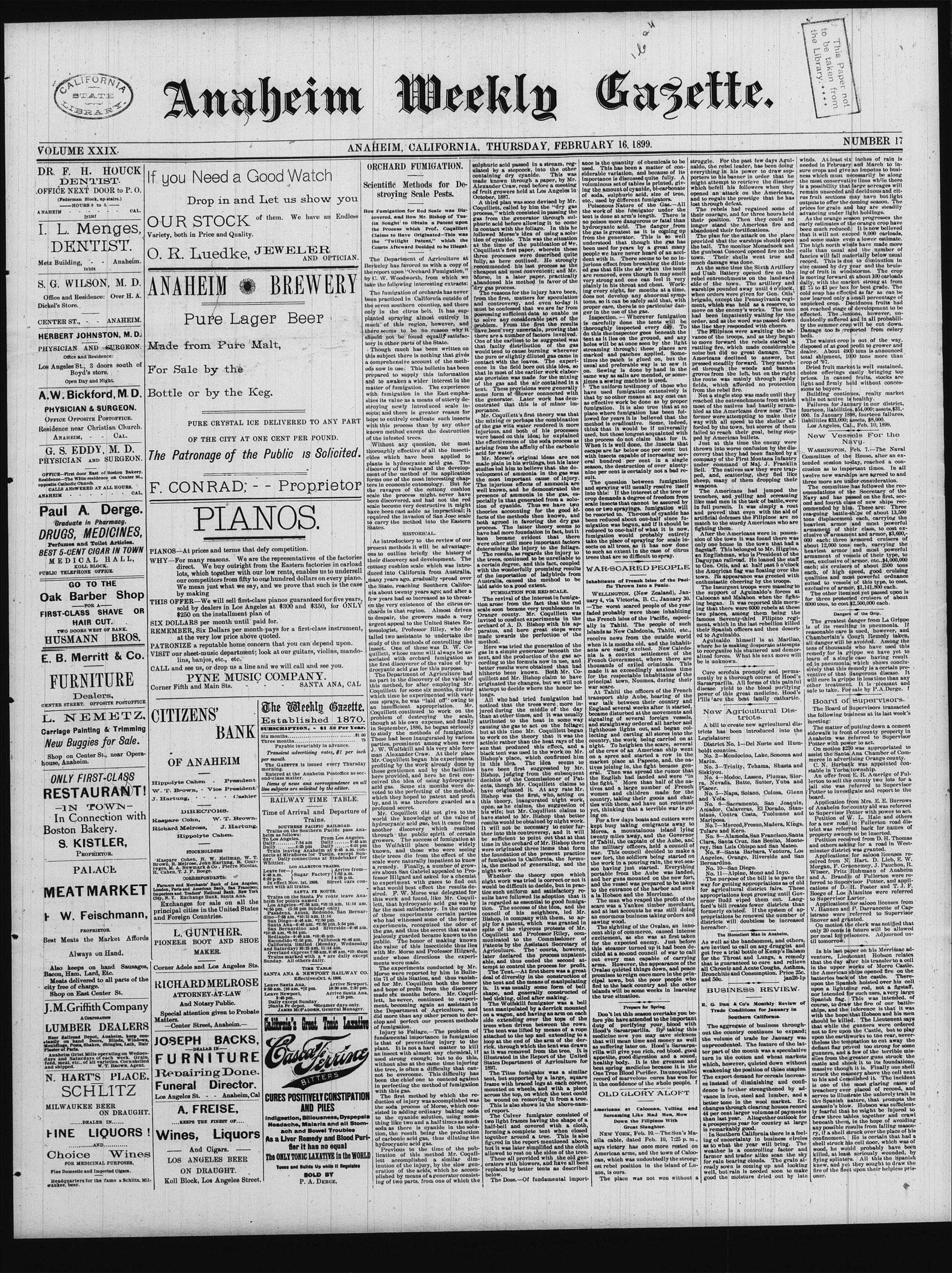
Searchable text
CALIFORNIA
STATE
LIBRARY.
VOLUME XXIX.
DR. F. H. HOUCK
DENTIST.
OFFICE NEXT DOOR to P. O.
(Federman Block, up stairs.)
HOURS 9 to 5.
ANAHEIM CAL.
jy154t
I. L. Menges,
DENTIST.
Metz Building, Anaheim.
feb24
S. G. WILSON, M. D.
Office and Residence: Over H. A. Dickel's Store.
CENTER ST., Anaheim.
HERBERT JOHNSTON, M. D.
PHYSICIAN AND SURGEON.
Office and Residence:
Los Angeles St., 3 doors south of Boyd's store.
Open Day and Night.
A.W. Bickford, M. D.
PHYSICIAN & SURGEON.
Office Opposite Postoffice.
Residence near Christian Church.
ANAHEIM, CAL.
G. S. EDDY, M. D.
PHYSICIAN AND SURGEON.
If you Need a Good Watch
Drop in and Let us show you
OUR STOCK of them. We have an Endless Variety, both in Price and Quality.
O. R. Luedke, JEWELER AND OPTICIAN
ANAHEIM BREWERY
Pure Lager Beer
Made from Pure Malt,
For Sale by the Bottle or by the Keg.
PURE CRYSTAL ICE DELIVERED TO ANY PART OF THE CITY AT ONE CENT PER POUND.
The Patronage of the Public is Solicited
A.W. Bickford, M.D.
PHYSICIAN & SURGEON.
OFFICE OPPOSITE POSTOFFICE.
Residence near Christian Church.
ANAHEIM, CAL.
G. S. EDDY, M.D.
PHYSICIAN AND SURGEON.
OFFICE—First door East of Boston Bakery.
Residence—The Wilte residence on Center St., opposite Catholic Church.
CALLS ANSWERED AT ALL HOURS.
ANAHEIM, CAL.
Paul A. Derge.
Graduate in Pharmacy.
DRUGS, MEDICINES,
Perfumes and Toilet Articles.
BEST 5-CENT CIGAR IN TOWN
MEDICAL HALL,
KOLL BLOCK.
PUBLIC TELEPHONE OFFICE.
GO TO THE
Oak Barber Shop
FOR A
FIRST-CLASS SHAVE OR
HAIR CUT.
TWO DOORS WEST OF BANK.
HUSMANN BROS.
E. B. Merritt & Co.
FURNITURE
Dealers.
CENTER STREET. OPPOSITE POSTOFFICE
L. NEMETZ,
Carriage Painting & Trimming
New Buggies for Sale.
Shop on Center St., near Opera-house, Anaheim.
ONLY FIRST-CLASS
RESTAURANT!
-IN TOWNIn Connection with Boston Bakery.
S. KISTLER,
PROPRIETOR.
PALACE
MEAT MARKET
Bottle or by the Keg.
PURE CRYSTAL ICE DELIVERED TO ANY PARIS
OF THE CITY AT ONE CENT PER POUND.
The Patronage of the Public is Solicited
F. CONRAD, - Proprietor
PIANOS.
PIANOS—At prices and terms that defy competition.
WHY—For many reasons. We are the representatives of the factory direct. We buy outright from the Eastern factories in carolls, which together with our low rents, enables us to undersee our competitors from fifty to one hundred dollars on every piano. We mean just what we say, and we prove that such is the case by making THIS OFFER—We will sell first-class pianos guaranteed for five years sold by dealers in Los Angeles at $300 and $350, for ONLY $250 on the installment plan of SIX DOLLARS per month until paid for.
REMEMBER, Six Dollars per month-pays for a first-class instrument at the very low price above quoted.
PATRONIZE a reputable home concern that you can depend upon.
VISIT our sheet-music department; look at our guitars, violins, mandolin lins, banjos, etc., etc.
CALL and see us, or drop us a line and we will call and see you.
PYNE MUSIC COMPANY.
Corner Fifth and Main Sts. SANTA ANA, CA
CITIZENS'
BANK
OF ANAHEIM
Hippolyte Cahen President
W. T. Brown, Vice President
J. Hartung, Cashier
DIRECTORS:
Kaspare Cohn, W. T. Brown.
Richard Melrose, J. Hartung.
Hippolyte Cahen.
STOCKHOLDERS:
Kaspare Cohen, H. W. Hellman, W. T. Brown, R. Melrose, John Hartung, R. Courreges, M. A. Newmark & Co., Pierre Nicolas, H. Cahen, T. J. P. Boege.
CORRESPONDENTS:
Farmers and Merchants' Bank of Los Angeles; London, Paris and American Bank; San Francisco; Importers and Traders' National Bank; New York City, N.Y. Exchange Bank; Santa Ana.
RAILWAY TIME TABLE
Time of Arrival and Departure Trains.
SOUTHERN PACIFIC RAILROAD.
Trains on the Southern Pacific pass hemlm as follows:
To Los Angeles.
From Los Angles
Daily.....7:54 am Daily.....9:48 am
Daily.....4:25 pm Daily.....6:00 am
Train leaving Anaheim at 9:48 a.m. nects at Miranores for Tustin, except day. Dally connections at Studebaker Whittier.
LOS ALAMITOS TRAINS.
Leave for—
9:48 a.m.
Sugar Factory 7:52 a.m.
6:02 p.m.
In effect Nov. 1st, 1898. Street cars nect with all trains.
SANTA FE ROUTE.
Trains on the Santa Fe route leave
IN TOWNIn Connection with Boston Bakery.
S. KISTLER,
PROPRIETOR.
PALACE
MEAT MARKET
H. W. Feischmann,
PROPRIETOR.
Beat Meats the Market Affords
Always on Hand.
Also keeps on hand Sausages, Bacon, Ham, Lard, Etc.
Meats delivered to all parts of the city free of charge.
Shop on East Center St.
J.M.Griffith Company
A CORPORATION
LUMBER DEALERS
Neer Railroad Depot, Anaheim, keep constantly on hand Doors, Blinds, Windows, Mouldings, Posts, Shakes, Shingles, Lath, Hair Plaster of Paris.
Anaheim Grist Mills operating on Wednesdays and Saturdays of each week. Grain, feed, meal, etc., of all varieties. Cornshellled and shipped.
W. T. Brown, Agent.
N. HART'S PLACE.
SCHLITZ
MILWAUKEE BEER ON DRAUGHT.
DEALER IN...
FINE LIQUORS!
AND...
Choice Wines FOR MEDICINAL PURPOSES,
Fine Domestic and Imported Cigars.
Headquarters for the famo s Schlitz, Milwaukee, beer.
DIRECTORS.
Kaspare Cohn, W. T. Brown.
Richard Melrose, J. Hartung.
Hippolyte Cahen.
STOCKHOLDERS
Kaspare Cohen, H. W. Hellman, W. T. Brown, R. Melrose, John Hartung, R. Courreges, M. A. Newmark & Co., Pierre Nicolas, H. Cahen, T. J. F. Boege.
CORRESPONDENTS:
Farmers and Merchants' Bank of Los Angeles; London, Paris and American Bank, San Francisco; Importers and Traders' National Bank. New York City, N.Y. Exchange Bank, Santa Ana.
Exchanges for sale on all the principal cities in the United States and Foreign Countries.
L. GUNTHER.
PIONEER BOOT AND SHOE MAKER.
Corner Adele and Los Angeles Sts.
RICHARDMELROSE
ATTORNEY-AT-LAW
And Notary Public.
Special attention given to Probate Matters.
—Center Street, Anaheim—
JOSEPH BACKS,
DEALER IN--
FURNITURE
Repairing Done.
Funeral Director.
Los Angeles St. - Anaheim, Cal
A. FREISE,
KEeps THE FINEST OF...
Wines, Liquors
And Cigars.
LOS ANGELES BEER ON DRAUGHT.
Koll Block, Los Angeles Street.
RAILWAY TIME TABLE
Time of Arrival and Departure Trains.
SOUTHERN PACIFIC RAILROAD.
Trains on the Southern Pacific pass heim as follows:
To Los Angeles.
Daily...7:54 am Daily...9:45 am
Daily...4:25 pm Daily...6:00 am
Train leaving Anaheim at 9:45 a.m. nects at Mirandares for Tustin, except day. Daily connections at Studebaker Whittler.
LOS ALAMITOS TRAINS.
Leave for—
9:48 a.m.
Sugar Factory
7:52 a.m.
6:02 p.m.
In effect Nov. 1st, 1898. Street cars nect with all trains.
SANTA FE ROUTE.
Trains on the Santa Fe route leave heim for points named:
Los Angeles—7:55 am.*10:15 am, 11:14 am*4:55 pm. (3:55 pm Sunday only)
Pasadena, Azusa, Redondo, San Benito—7:55 am.*10:15 am, 11:14 am
San Diego—9:46 am.*2:50 pm.
Santa Ana—9:46 am.*2:50 pm, 5:54 pm.
San Bernardino and Riverside—9:46 am.*10:45 am.*5:54 pm.
Redlands—9:46 am.*10:45 am.
Escondido*2:50 pm. Fallbrook*2:46 am.
California limited (Monday Wednesday and Saturday) 10:15 am, 11:14 am.
Overland express 7:55 am, 9:46 am.*10:45 am.*Trains marked with a * are daily ea Sunday. All others daily.
TIME TABLE
SANTA ANA & NEWPORT RAILWAY
Effective Oct. 4, 1898.
Leave Santa Ana,
9:50 am., 110 am., *2 p.m.
Leave Newport,
2:45 p.m.
Daily except Sunday.
Santa Fe depot.*Steamer days only
JAMES McFADDEN, General Manager.
CALIFORNIA'S Great Tonic Laxatives
Indigestion, Billiousness, Dyspnea Headache, Malaria and all Staph and Bowel Troubles As a Liver Remedy and Blood Filler it has no equal The ONLY TONIC LAXATIVE in the Wones and Bullds Up while it Regulates
SOLD BY
P.A.DERGE.
Heim Weekly Gazette
ANAHEIM, CALIFORNIA, THURSDAY, FEBRUARY 16, 1899.
D Watch us show you
We have an Endless
WELER AND OPTICIAN.
BREWERY Beer
DEVERED TO ANY PART
ENT PER POUND.
Public is Solicited.
ORCHARD FUMIGATION.
Scientific Methods for Destroying Scale Pests.
How Fumigation for Red Scale was Discovered, and How Mr. Bishop of Tustin Sought to Obtain a Patent upon the Process which Prof. Coquillett Claims to Have Originated—This was the "Twilight Patent," which the Courts Afterward Decided to be Illegal.
The Department of Agriculture at Berkeley has favored us with a copy of the report upon "Orchard Fumigation," by C. W. Woodworth, from which we take the following interesting extracts:
The fumigation of orchards has never been practiced in California outside of the seven southern counties, and there only in the citrus belt. It has supplanted spraying almost entirely in much of this region, however, and there seems to be no reason why it should not be found equally satisfactory in other parts of the State.
Though much has been written on this subject there is nothing that gives a comprehensive account of the methods now in use. This bulletin has been prepared to supply this information and to awaken a wider interest in the matter of fumigation. The experience with fumigation in the East emphasizes its value as a means of utterly destroying newly introduced scale insects; and there is greater reason for hope to entirely eradicate such insects with this process than by any other known method except the destruction of the infested trees.
Without any question, the most thoroughly effective of all the insecticides which have been applied to plants is hydrocyanic acid gas. The discovery of its value and the development of the method of its application sulphuric acid passed in a stream, regulated by a stopcock, into the other containing dry cyanide. This was made known through a paper, by Mr. Alexander Craw, read before a meeting of fruit growers held at Los Angeles in October, 1887.
A third plan was soon devised by Mr. Coquillett, called by him the "dry gas process," which consisted in passing the gas from the generator through sulphuric acid before allowing it to come in contact with the foliage. In this he followed Morse's idea of using a solution of cyanide. This was the situation at the time of the publication of Mr. Coquillett's first paper, wherein these three processes were described quite fully, as here outlined. He strongly recommended his last process as the cheapest and most convenient; and Mr. Morse, in a later paper, practically abandoned his method in favor of the dry gas process.
The reasons for the injury have been, from the first, matters for speculation and controversy, and even to-day it must be confessed that we are far from possessing sufficient data to enable us to solve any considerable part of the problem. From the first the results have been very uncertain, proving that there are a number of factors involved. One of the earliest to be suggested was that faulty distribution of the gas would tend to cause burning wherever the pure or slightly diluted gas came in contact with the leaves. The experience in the field bore out this idea, so that in most of the earlier work elaborate provision was made for the mixing of the gas and the air contained in a tent. These provisions were generally some form of flower connected with the generator. Later work has demonstrated that this is of minor importance.
Mr. Coquillett's first theory was that the mixing or perhaps the combination of the gas with water rendered it more injurious, and both of his processes were based on this idea; he explained the effectiveness of the soda process as arising from the affinity of the carbonic acid for water.
Mr. Morse's original ideas are not made plain in his writings, but his later studies led him to believe that the development of ammonia in the gas wasance is the quantity of chemicals used. This has been a matter of siderable variation, and because of importance is discussed quite fully voluminous set of tables is printed, ing the amount of cyanide, bi-carbofibrate of soda, sulphuric acid, size of etc., used by different fumigators.
Poisonous Nature of the Gas: The work of the fumigator underwent is done at arm's length. The no poison more dangerous or fatal hydrocyanic acid. The danger that the gas is greatest as it comes from the generator. This is so understood that though the gas been used for years by a great people we have never heard of and dent with it. There seems to be no jurious effect from breathing the cured gas that fills the air when they are removed, even though it may be very strong and one can feel it plainly in his throat and chest. Working every night, for months at a does not develop any abnormal symptoms, so it can be safely said that, proper care, there is no particular ger in the use of the gas.
Inspection. — Wherever fumigation is carefully done the tents will thoroughly inspected every day; do this the inspector goes beneath tent as it lies on the ground, and holes will be at once seen by the streaming through; these places marked and patches applied. Sometimes the patch is glued on, but usual and preferable way is to sew on. Sewing is done by hand in same way as sapliers are mended, or times a sewing machine is used.
The uniform testimony of those have used fumigation extensive that by no other means at any cost as effective work be done as by pumigation. It is also true that place where fumigation has been lowed for years it is believed that method is eradicative. Some, in think that it would be if univeral used, but those longest acquainted with the process do not claim that for When it is well done, the insects escape are far below one per cent with insects capable of increasing oral hundred per cent in a season, the destruction over ninine per cent is certainly not a b
PREVIEWED TO ANY PART
RENT PER POUND.
Public is Solicited.
Competition.
Presentatives of the factories in carload events, enables us to undersell hundred dollars on every piano. We prove that such is the case nos guaranteed for five years, $300 and $350, for ONLY for a first-class instrument, that you can depend upon. Our guitars, violins, mandolos will call and see you.
COMPANY.
SANTA ANA, CAL
The Weekly Gazette.
Established 1870.
SCRIPTION. - $1 50 Per Year.
months. $1 00 months. 75 payable invariably in advance.
present advertising rates, $1 per inch.
GAZETTE is issued every Thursday.
ed at the Anaheim Postoffice as secmatter.
of news ana correspondence on all insects are solicited by the editor.
AILWAY TIME TABLE.
of Arrival and Departure of Trains.
SOUTHERN PACIFIC RAILROAD.
on the Southern Pacific pass Ana- follows:
Angeles.
From Los Angeles.
7:54 am 9:45 am
Daily
4:25 pm Dally
6:01 pm leaving Anaheim at 9:45 a.m. control Miracles for Tustin, except Sunday connections at Studebaker for er.
LOS ALAMITOS TRAINS.
Arrive from—
Sugar Factory
7:52 a.m.
Daily
2:52 p.m.
Detect Nov. 1st, 1898.
Street cars continue all trains.
SANTA PE ROUTE.
is on the Santa Fe route leave Anacompetition.
HISTORICAL.
As introductory to the review of our present methods it will be advantageous to outline briefly the history of their discovery and development. The cottony cushion scale which was introduced into California from Australia, many years ago, gradually spread over the State, reaching Southern California about twenty years ago; and after a few years had so increased as to threaten the very existence of the citrus orchards in that region. Almost driven to despair, the growers made a very urgent appeal to the United States Entomologist, Professor Riley, who detailed two assistants to undertake the study of the methods of controlling the insect. One of these was D. W. Coquillett, whose name will always be associated with orchard fumigation as the first discoverer of the value of hydrocyanic acid gas for this purpose.
The Department of Agriculture had no part in the discovery of the value of this method, for after employing Mr. Coquillett for some six months, during which time he experimented with various sprays, he was "laid off" owing to an insufficient appropriation. Mr. Coquillett continued to work on the problem of destroying the scale, though at his own expense, and finally in September, 1886, he began seriously to study the methods of fumigation. These had been inaugurated by various parties, prominent among whom were J. W. Wolfskill and his very able foreman Alexander Craw. At their place Mr. Coquillett began his experiments, profiting by the work already done by these gentlemen and by the facilities here provided, and here he first conceived the idea of using hydrocyanic acid gas. Some six months were devoted to the perfecting of the method, which they hoped to patent and profit by, and it was therefore guarded as a profound secret.
Mr. Coquillett did not give to the world the knowledge of the value of hydrocyanic acid gas, but it came from another discovery which resulted through the public spirit of certain growers. The success of fumigation at the Wolfskill place became widely known, and those who were seeing their trees die from the effect of the scale were naturally impatient to know a remedy. Finally, a number of growers about San Gabriel appealed to Professor Hilgard and asked for a chemist to experiment with gases to find out what would best effect the results desired. F. W. Morse was delegated for this work and found, like Mr. Coquillett prepared to supply this information and to awaken a wider interest in the matter of fumigation. The experience with fumigation in the East emphasizes its value as a means of utterly destroying newly introduced scale insects; and there is greater reason for hope to entirely eradicate such insects with this process than by any other known method except the destruction of the infested trees.
Without any question, the most thoroughly effective of all the insecticides which have been applied to plants is hydrocyanic acid gas. The discovery of its value and the development of the method of its application forms one of the most interesting chapters in economic entomology. But for the ravages of the cottony cushion scale the process might never have been discovered, and had not the red scale become very destructive it might have been cast aside as impractical; it required the invasion of San Jose scale to carry the method into the Eastern States.
HISTORICAL.
As introductory to the review of our present methods it will be advantageous to outline briefly the history of their discovery and development. The cottony cushion scale which was introduced into California from Australia, many years ago, gradually spread over the State, reaching Southern California about twenty years ago; and after a few years had so increased as to threaten the very existence of the citrus orchards in that region. Almost driven to despair, the growers made a very urgent appeal to the United States Entomologist, Professor Riley, who detailed two assistants to undertake the study of the methods of controlling the insect. One of these was D. W. Coquillett, whose name will always be associated with orchard fumigation as the first discoverer of the value of hydrocyanic acid gas for this purpose.
The Department of Agriculture had no part in the discovery of the value of this method, for after employing Mr. Coquillett for some six months, during which time he experimented with various sprays, he was "laid off" owing to an insufficient appropriation. Mr. Coquillett continued to work on the problem of destroying the scale, though at his own expense, and finally in September, 1886, he began seriously to study the methods of fumigation. These had been inaugurated by various parties, prominent among whom were J. W. Wolfskill and his very able foreman Alexander Craw. At their place Mr. Coquillett began his experiments, profiting by the work already done by these gentlemen and by the facilities here provided, and here he first conceived the idea of using hydrocyanic acid gas. Some six months were devoted to the perfecting of the method, which they hoped to patent and profit by, and it was therefore guarded as a profound secret.
Mr. Coquillett did not give to the world the knowledge of the value of hydrocyanic acid gas, but it came from another discovery which resulted through the public spirit of certain growers. The success of fumigation at the Wolfskill place became widely known, and those who were seeing their trees die from the effect of the scale were naturally impatient to know a remedy. Finally, a number of growers about San Gabriel appealed to Professor Hilgard and asked for a chemist to experiment with gases to find out what would best effect the results desired. F. W. Morse was delegated for this work and found, like Mr. Coquillett prepared to supply this information and to awaken a wider interest in the matter of fumigation. The experience with fumigation in the East emphasizes its value as a means of utterly destroying newly introduced scale insects; and there is greater reason for hope to entirely eradicate such insects with this process than by any other means at any cost as effective work be done by any fumigation. It is also true that place where fumigation has been lowed for years it is believed that method is eradicative. Some, in think that it would be if univ., used, but those longest acquainted with the process do not claim that for When it is well done, the insect escape are far below one per cent with insects capable of increasing eral hundred per cent in a season, the destruction of over nine per cent is certainly not a bult.
The question between fumigation and spraying will usually resolve into this: If the interest of the crop demands a degree of freedom scale insects that cannot be assume one or two sprayings, fumigation be resorted to. The cost of cyanide been reduced about one-half since migration was begun, and if it should reduce to one-half of what it is fumigation would probably extend take place of spraying for secrets on all trees, as it has now so much extent in the case of trees that are so difficult to spray.
WAR-SCARED PEOPLE
Inhabitants of French Isles of thie file Thrown Into a Panic.
WELLINGTON, (New Zealand) uary 4, via Victoria, B.C., Janu- —The worst scared people of thief faded probably were those inhale French Isles of the Pacific,
ally in Tahiti. The people on islands as New Caledonia, Tahiti receive news from the outside when it is months old, and the in- nia is a convict settlement. French Government, where thousands of exiled criminals made it an exceedingly anxious for the respectable inhabitant principal town, Noumea, during war scare.
At Tahiti the officers of thie transport ship Aube, hearing war talk between their count England several weeks after it became disturbed at the movement signaling of several foreign straightway ordered all hard-lighthouse lights out, and beg lecting and carting all stores in country, the work being carried night. To heighten the scare of the crew of an American ship on a spree and started a row market place at Papetea,and lives joining in,the fight became eral. Then was spread rune English had landed and wreathing it." More than half of tives and a large number of women and children made t countries taking their goods and ties with them,and have not yet thinking that a terrible wring on.
For a few days boats and cutters kept busy taking emigrants at Morea,a mountainous island twenty miles away,and the Gade Tahiti,the captain ofthe Army military officers,became a co war.The council decided to new fort,the soldiers being stored in work in a pouring rain,the son having just started.Every portable from the Aube was and her guns mounted on her rind and she vessel was prepared toto entrance of the harbor and la Hobson and she Merrimaca
Mr. Coquillett did not give to the world the knowledge of the value of hydrocyanic acid gas, but it came from another discovery which resulted through the public spirit of certain growers. The success of fumigation at the Wolfskill place became widely known, and those who were seeing their trees die from the effect of the scale were naturally impatient to know a remedy. Finally, a number of growers about San Gabriel appealed to Professor Hilgard and asked for a chemist to experiment with gases to find out what would best effect the results desired. F.W. Morse was delegated for this work and found, like Mr. Coquillett, that hydrocyanic acid gas was far the most satisfactory. In the course of these experiments certain parties who had witnessed some of the former experiments, recognized the odor of the gas, and thus the secret that was so jealously guarded became known to the public. The honor of making known the value of this insecticide thus lies with Mr. Morse and Professor Hilgard, under whose directions the experiments were made.
The experiments conducted by Mr. Morse were reported by him in Bulletin 71 of this Station, and thus vanished for Mr. Coquillett both the honor and hope of profit from the discovery made six months before. Mr. Coquillett, however, continued to experiment, becoming again an assistant in the Department of Agriculture, and did more than any other person to develop and perfect our present methods of fumigation.
Injury to Foliage.—The problem of fundamental importance in fumigation is that of preventing injury to the plant. It is not a hard matter to kill an insect with almost any chemical, if used strong enough; but to do this, without also at the same time injuring the tree, is often a difficulty that cannot be overcome. This difficulty has been the chief one to contend against in perfecting the method of fumigation with this gas.
The first method by which the reduction of injury was accomplished was the soda process of Morse, which consisted in adding ordinary baking soda to the cyanide solution, using something like two and a half times as much soda as there is cyanide in the solution, the result being the production of carbonic acid gas.
Previous to the time of the publication of this method Mr. Coquillett accomplished a similar diminution of the injury, by the slow generation of the acids; which he accomplished by means of a generator consisting of two parts, from one of which the this theory, inaugurated night work upon, as he claims, the suggestion of his wife; but Mr. Coquillett claims to have stated to Mr. Bishop that better results would be obtained by night work. It will not be necessary to enter further into this controversy, and it will be sufficient to point out that at that time in the orchard of Mr. Bishop there were originated three items that form the foundation of the present practice of fumigation in California, the formula, the method of generating, and the night work.
Whether the theory upon which night work was tried is correct or not it would be difficult to decide, but in practice such uniform and satisfactory results have followed its adoption that it is regarded as essential to good fumigation. The success of the idea, and the council of his neighbors, led Mr. Bishop, in company with them, to apply for a patent, which was granted in spite of the vigorous protests of Mr. Coquillett and Professor Riley, communicated to the Commissioner of Patents by the Assistant Secretary of Agriculture. The courts, however, later declared the process unpatentable, and thus ended the second attempt to control the process for profit.
The Tent.—At first there was a great deal of diversity in the construction of the tent and the means of manipulating it. It was usually some form of bell shape, and generally constructed of bed tickling, oiled after making.
The Wolfskill fumigator was a bell tent manipulated by a derrick mounted on a wagon, and having an arm on each side extending over the tops of the trees when driven between the rows. The tent was lifted by means of a rope attached to the top and extending to a loop at the end of the arm of the derrick, through which the tent was drawn as it was removed from the tree. It is illustrated in the Report of the United States Department of Agriculture for 1897.
The Titus fumigator was a similar tent, but supported by a large, square frame with braced legs at each corner, mounted on wheels, and with a piece across the top, on which the tent could be wound on removing it from a tree.
This is also shown in the above-named report.
The Culver fumigator consisted of two light frames having the shape of a half-bell and covered with a cloth, forming a complete tent when closed together around a tree. This is also figured in the report mentioned above, but it was later simplified and the cloth allowed to rest on the sides of the tree.
These all provided with the old generators with blowers, and have all been replaced by better tents as described below.
The Dose.—Of fundamental import-
Americans at Caloocan, Yelp,
Screaming Like Mad Men,
Down the Fillipinos Wife,
Great Slaughter.
NEW YORK, Feb. 10.—The nila cable, dated Feb. 10, says victory has once more American arms, and the town can, which was undoubtedly the best rebel position in the island zone, is ours.
The place was not won
This has been a matter of considerable variation, and because it is discussed quite fully, a serious set of tables is printed, giving the amount of cyanide, bi-carbonate acid, sulphuric acid, size of tree, caused by different fumigators. The nature of the Gas—All work of the fumigator under the gas done at arm's length. There is no more dangerous or fatal than oxyanic acid. The danger from gas is greatest as it is coming up in the generator. This is so well understood that though the gas has used for years by a great many we have never heard of an accident with it. There seems to be no insignificant effect from breathing the dilutious that fills the air when the tents removed, even though it may smell strong and one can feel it very easily in his throat and chest. Work every night, for months at a time, not develop any abnormal symptoms so it can be safely said that, with care, there is no particular danger in the use of the gas.
Inspection. — Wherever fumigation were fully done the tents will be thoroughly inspected every day. To this the inspector goes beneath the tents it lies on the ground, and any will be at once seen by the light coming through; these places are used and patches applied. Some of the patch is glued on, but the and preferable way is to sew it. Sewing is done by hand in the way as sails are mended, or some sewing machine is used.
The uniform testimony of those who used fumigation extensively is by no other means at any cost can effective work be done as by proper operation. It is also true that at no where fumigation has been followed for years it is believed that the food is eradicated. Some, indeed, fear that it would be if universally used but those longest acquainted with process do not claim that for it. On it is well done, the insects that come are far below one per cent; but insects capable of increasing seven hundred per cent in a single ton, the destruction of over ninety percent is certainly not a bad result.
For the past few days Aguinaldo, the rebel leader, has been doing everything in his power to draw supporters to his banner in order that he might attempt to retrieve the disaster which befell his followers when they opened an attack on the Americans, and to regain the prestige that he has lost through defeat.
The rebels had regained some of their courage, and for three hours held their position. Then they could no longer stand the American fire and abandoned their fortifications.
The plan for the attack on the place provided that the warships should open the ball. The monitor Monadnock and the gunboat Concord opened fire on the town. Their shells went true and much damage was done.
At the same time the Sixth Artillery and Utah Battery opened fire on the rebel entrenchments on the landward side of the town. The artillery and warships pounded away until 4 o'clock, when orders were given for Gen. Otis' brigade, except the Pennsylvania regiment, which was held as a reserve, to move on the enemy's works. The men had been impatiently waiting for the order, and as the word was passed down the line they responded with cheers.
The Filipinos were awaiting the advance of the troops, and as they began to move forward the rebels started a rattling fire, which made considerable noise but did no great damage. The Americans declined to answer, but pressed steadily forward. They marched through the woods and banana groves from the left, but on the right the route was mainly through paddy fields, which afforded no protection from the rebel fire.
Not a single stop was made until they reached the entrenchments from which most of the natives had hastily scrambled as the Americans drew near. The former were attempting to make their way with all speed to the shelter afforded by the town, but scores of them failed to reach their goal, being stopped by American bullets.
Just at this time the enemy were thrown into worse confusion by the discovery that they had been flanked by a company of the First Montana Infantry under command of Maj. J. Franklin Bell. The natives saw they were trapped and scattering, they fled like winds. At least six inches of rain is needed in February and March to insure crops and give an impetus to business which must necessarily be along the most conservative lines while there is a possibility that large acreages will remain unseeded and deciduous and citrus fruit sections may have but light outputs to offer the coming season. The prices for grain and hay are steadily advancing under light holdings.
As the orange season progresses the early estimates of the orange crop have been much reduced. It is now believed that it will not exceed 9,000 carloads, and some make even a lower estimate. The high north winds have made more culls than usual and the number of fancies will fall materially below usual record. This is due to diminution in size caused by dry year and the bruising of fruit in windstorms. The crop is moving forward at about 100 carloads daily, with the market strong at from $2.75 to $3 per box for best grade. The cold snap has effected as far as can be now learned only a small percentage of unpicked crop. Deciduous fruits had not reached stage of development to be effected. The lemons, however, undoubtedly suffered and in all probability the summer crop will be cut down. Damage too is reported from celery beds.
The walnut crop is out of the way, disposed of at good profit to grower and dealer. About 4900 tons is announced total shipment, 1000 tons more than crop of '97.
Dried fruit market is well sustained, choice offerings easily bringing top prices. In canned fruits, stocks are light and firmly held without concessions to buyers.
Building continues, realty market while not active is healthy.
Failures for January in our district, fourteen liabilities.$54,000; assets,$31,-000. In January 1898, fourteen failures, liabilities$33,000; assets,$8,000.
Los Angeles, Cal., Feb. 10, 1899.
New Vessels For the Navy.
WASHINGTON, Feb. 7.-The Naval Committee of the House, after an extended session to-day, reached a conclusion as to important times. In all new warships are agreed to and
The uniform testimony of those who used fumigation extensively is by no other means at any cost can effective work be done as by proper operation. It is also true that at no where fumigation has been followed for years it is believed that the good is eradicative. Some indeed, but that it would be if universally applied, but those longest acquainted with process do not claim that for it. When it is well done, the insects that cope are far below one per cent; but insects capable of increasing sewage hundred per cent in a single hour, the destruction of over ninety percent is certainly not a bad result.
The question between fumigation spraying will usually resolve itself this: If the interest of the tree or bush demands a degree of freedom from insectes that cannot be assured by two sprayings, fumigation will be assigned to. The cost of cyanide has reduced one half since fumigation was begun, and if it should be placed to one-half of what it is now, fumigation would probably entirely place the place of spraying for scale in all trees, as it has now done which an extent in the case of citrus trees that are so difficult to spray.
NEW SCARED PEOPLE
Habitants of French Isles of the Pacific Thrown Into a Panic.
VELLINGTON, (New Zealand), January 4, via Victoria, B. C., January 30. The worst scared people of the year and probably were those inhabiting French isles of the Pacific, especially in Tahiti. The people of such lands as New Caledonia, Tahiti, etc., receive news from the outside world when it is months old, and the inhabitants are easily excited. New Caledonia is a convict settlement of the French Government, where there are thousands of exiled criminals. This made it an exceedingly anxious time for the respectable inhabitants of the municipal town, Noumea, during their scare.
At Tahiti the officers of the French transport ship Aube, hearing of the war talk between their country and England several weeks after it started, came disturbed at the movements and snatching of several foreign vessels, and straightway ordered all harbor and wharfhouse lights out, and began collecting and carting all stores into the country, the work being carried on at night. To heighten the scare, several of the crew of an American ship went a spree and started a row in the market place at Papeete, and, the natives joining in, the fight became genial. Then was spread the rumor that the English had landed and were "in the fight." More than half of the natives and a large number of French men and children made for the country, taking their goods and chatting with them, and have not returned thinking that a terrible war is going on.
For a few days boats and cutters were kept busy taking emigrants away to areas, a mountainous island lying twenty miles away, and the Governor Tahiti, the captain of the Aube, and the military officers, held a council of war. This council decided to make a new fort, the soldiers being started on the work in a pouring rain, the wet sea having just started. Everything portable from the Aube was landed, and her guns mounted on the new fort, and the vessel was prepared to be taken into the entrance of the harbor and sunk in Hobson and the Merrimac.
NEW AGRICULTURAL DISTRICTS.
A bill to create new agricultural district has been introduced into the Legislature:
District No. 1—Del Norte and Humboldt counties.
No. 2—Mendocino, Lake, Sonoma and Marin.
No. 3—Trinity, Tehama, Shasta and Siskiyou.
No. 4—Modoc, Lassen, Plumas, Sierra, Nevada, Butte, Sutter, Yuba and Placer.
No. 5—Napa, Solano, Colusa, Glenn and Yola.
No. 6—Sacramento, San Joaquin, Amador, Calaveras, El Dorado, Stanislaus, Contra Costa, Tuolumne and Mariposa.
No. 7—Merced,Fresno,Madera, Kings,Tulare and Kern.
No. 8—Alameda,San Francisco,Santa Clara,Santa Cruz,San Benito,Montey,San Luis Obispo and San Mateo.
No. 9—Santa Barbara,Ventura,Los Angeles Orange,Riverside and San Bernardino.
No. 10—San Diego.
No. 11—Alpine,Mono and Inyo.
The purpose of the bill is to pave the way for getting appropriations as old for agricultural district fairs. These appropriations kept growing until Gov. Budd wined them out.Langhews were made until they reached the entrenchments from which most of the natives had hastily scrambled as the Americans drew near. The former were attempting to make their way with all speed to the shelter afforded by the town, but scores of them failed to reach their goal, being stopped by American bullets.
Just at this time the enemy were thrown into worse confusion by the discovery that they had been flanked by a company of the First Montana Infantry under command of Maj.J. Franklin Bell. The natives saw they were trapped,and scattering,they fled like sheep,many of them dropping their weapons.
The Americans had jumped the trenches,and yelling and screaming like mad men in the task of battle,were in full pursuit. It was simply a rout and proved that even with the aid of artificial defenses the Fillipinos are no match to the sturdy Americans who are fighting them.
After the Americans were in possession of the town it was found there was only one house in the town that had a flagstaff. This belonged to Mr.Higgins,nan Englishmanwho is President ofthe Daguypan railroad. He loaned the staff to Gen.Otis,and at half past 5 o'clockthe American flag was floating overthe town. Its appearance was greeted with enthusiastic cheering by the troops.
The insurgent troops were massing to support of Aguinaldo's forces at Caloocan and Malabon when the fighting began. It was reported this morning that there were 6000 rebels at these two places among them beingthe famous Seventy-third Filipino regimentwhich in the last rebellion killed their Spanish officers and then deserted to Aguinaldo.
Aguinaldo himself is at Marilaowhere he is making desperate attempts to reorganize his shattered and demoralized forces. What his next move will be is unknown.
Cure scrofula promptly and permanently by a thorough course of Hood's Sarsarparilla.All forms of this painful disease yield to the blood purifying power of this great medicine.Hood's Pills are the best family cathartic.
BOARD OF SUPERVISORS.
The Board of Supervisors transactedthe following business at its last week's meeting:
The matter of putting down a cement sidewalk in front of county property in Anaheim was referred to Supervisor Potter with power to act.
On motion $250 was appropriated to assistthe Santa Ana Chamber of Commerce in advertising Orange county.
C.N.Burbank was appointed constable in Yorba township.
An offer from E.R.Amerige of Fullerton to sell the county two lots for a jail site was referred to Supervisor Potter to investigate and report to the board.
Application from Mrs.E.E.Burrows of Anaheim for county aid was referred to Supervisor Potter with power to act.
Petition of W.L.Hale and others for a new road in Fullerton road district was referred back for names of property owners to be inserted.
Petition received from D.H.Thomas and others asking for a road in Westminster district was granted.
Applications for saloon licenses received from N.Hart.D.LiebE.W.Morgau,F.GruenemeyJ.PauchonR.Wisser,Fritz Ruhmann of Anaheimand A.Brandle of Fullerton were referred to Supervisor Potter,and applications of D.H.Foster和T.J.F.Boege of Los Alamitos were referred to Supervisor Larter.
For a few days boats and cutters were kept busy taking emigrants away to Korea, a mountainous island lying twenty miles away, and the Governor Tahiti, the captain of the Aube, and the military officers, held a council of war. This council decided to make a new fort, the soldiers being started on the work in a pouring rain, the wet seabird having just started. Everything portable from the Aube was landed, and her guns mounted on the new fort, and the vessel was prepared to be taken into the entrance of the harbor and sunk by Hobson and the Merrimac.
The man who reaped the profit of the share was a Yankee timber merchant, and at last accounts he was still doing enormous business taking orders and sawing wood.
The sighting of the Ovalau, an innocent ship of commerce, caused intense excitement, as she was at first taken over the expected enemy. Just before this steamer turned up it had been deeded at a second council of war to call out every man capable of carrying arms. However, the appearance of the Ovalau quieted things down, and peace promises to reign once more in the principal town, but the poor people who need to the back country and the other lands will be some weeks in learning the true situation.
Prepare for Spring.
Don't let this season overtake you before you have attended to the important duty of purifying your blood with good's Sarsarparilla. By taking this medicine now you may save sickness that will mean time and money as well as suffering later on. Hood's Sarsarparilla will give you rich, red blood, good appetite, good digestion and a sound, healthy body. It is the greatest and best spring medicine because it is the one True Blood Purifier. Its unequalled record of marvelous cures has won for the confidence of the whole people.
OLD GLORY ALOFT
Americans at Caloocan, Yelling and Screaming Like Mad Men, Mow Down the Filipinos With Great Slaughter.
NEW YORK, Feb. 10.—The Sun's Mailla cable, dated Feb. 10, 7:25 p.m., says victory has once more rested on American arms, and the town of Caloocan, which was undoubtedly the strongest rebel position in the island of Luon, is ours.
The place was not won without a No. 6—Sacramento, San Joaquin, Amador, Calaveras, El Dorado, Stanislaus, Contra Costa, Tuolumne and Mariposa.
No. 7—Merced, Fresno, Madera, Kings, Tulare and Kern.
No. 8—Alameda, San Francisco, Santa Clara, Santa Cruz, San Benito, Monterey, San Luis Obispo and San Mateo.
No. 9—Santa Barbara, Ventura, Los Angeles, Orange, Riverside and San Bernardino.
No. 10—San Diego.
No. 11—Alpine, Mono and Inyo.
The purpose of the bill is to pave the way for getting appropriations as of old for agricultural district fairs. These appropriations kept growing until Governor Budd wiped them out. Langford's bill creates fewer districts than formerly existed. If the system of appropriations be renewed the number of districts will doubtless be increased hereafter.
The Homeliest Man in Anaheim,
As well as the handsomest, and others, are invited to call on any druggist and get free a trial bottle of Kemp's Balsam for the Throat and Lungs, a remedy that is guaranteed to cure and relieve all Chronic and Acute Coughs, Asthma, Bronchitis and Consumption. Price 25c. and 50c. jan26-1p
BUSINESS REVIEW.
R. G. Dun & Co.'s Monthly Review of Trade Conditions for January in Southern California.
The aggregate of business throughout the country continues to expand; the volume of trade for January was unprecedented. The feature of the latter part of the month was a speculative turn in the cotton and wheat markets which, however, quieted down without weakening the position of those staples. The export demand for cereals increases instead of diminishing and confidence is further strengthened by advance in iron, steel and lumber, and a better tone in the wool market. Exchanges through clearing houses record 44 per cent larger volumes of payments than last year. Altogether outlook for a prosperous year for country at large is remarkably good.
In Southern California there is a feeling of uncertainty in business circles as to what the year will bring. The weather is a controlling factor and farmer and trader alike scan the sky for rain bearing clouds. The grain already sown is coming up and looking well, but rain is needed soon to make good the moisture dried out by late application from Mrs. E. E. Burrows of Anaheim for county aid was referred to Supervisor Potter with power to act.
Petition of W. L. Hale and others for a new road in Fullerton road district was referred back for names of property owners to be inserted.
Petition received from D. H. Thomas and others asking for a road in Westminster district was granted.
Applications for saloon licenses received from N. Hart. D. Lieb, E.W. Morgan, F. Graenemey, J. Pauchon, R. Wisser, Fritz Ruhmann of Anaheim and A. Brandle of Fullerton were referred to Supervisor Potter, and applications of D. H. Foster and T.J.F. Boege of Los Alamitos were referred to Supervisor Larter.
Applications for saloon licenses from V. Hannen and P. Darrancette of Capistrano were referred to Supervisor Snover and granted.
On motion the clerk was notified that only 20 cents in future will be allowed per meal for prisoners. Adjourned until tomorrow.
In his last paper on his Merrimac adventure, Lieutenant Hobson relates that day after his transfer to a cell in the upper works of Morro Castle, the American ships opened fire on the batteries back of the castle. Thereupon the Spanish hoisted over his cell upon a lightning rod, not a figstaff, nor intended for such uses, a very large Spanish flag. This was intended, of course, to draw the fire of our battleships, and the inference is that it was with the hope that Hobson and his men should be killed. The Lieutenent says that while the gunners were ordered not to fire upon the Castle, but to play upon the earthworks to the rear, nevertheless the temptation to cut away the defiant flag proved too strong for some gunners, and a few of the terrible missiles from the greater guns struck the castle and shook it to its foundations, massive though it is. Finally one shell struck the masonry above the cell next to his demolished it. The incident is one of the most glaring cases of treachery ever placed of record, and serves to illustrate the unlovely trait in the Spanish nature, that prompts the assassin's blow. Hobson was sufficiently fearful that he might be injured to draw three tables together and crawl beneath them, in the hope of avoiding any possible results from falling masonry; if a shell struck over the place of his confinement. He is certain that had a shell struck his cell door, which was of wood, he would probably have been killed, at least seriously wounded, by flying splinters. All this the Spanish knew, and yet they sought to draw the fire of the fleet upon their helpless prisoner.