anaheim-gazette 1898-12-22
Scanned page
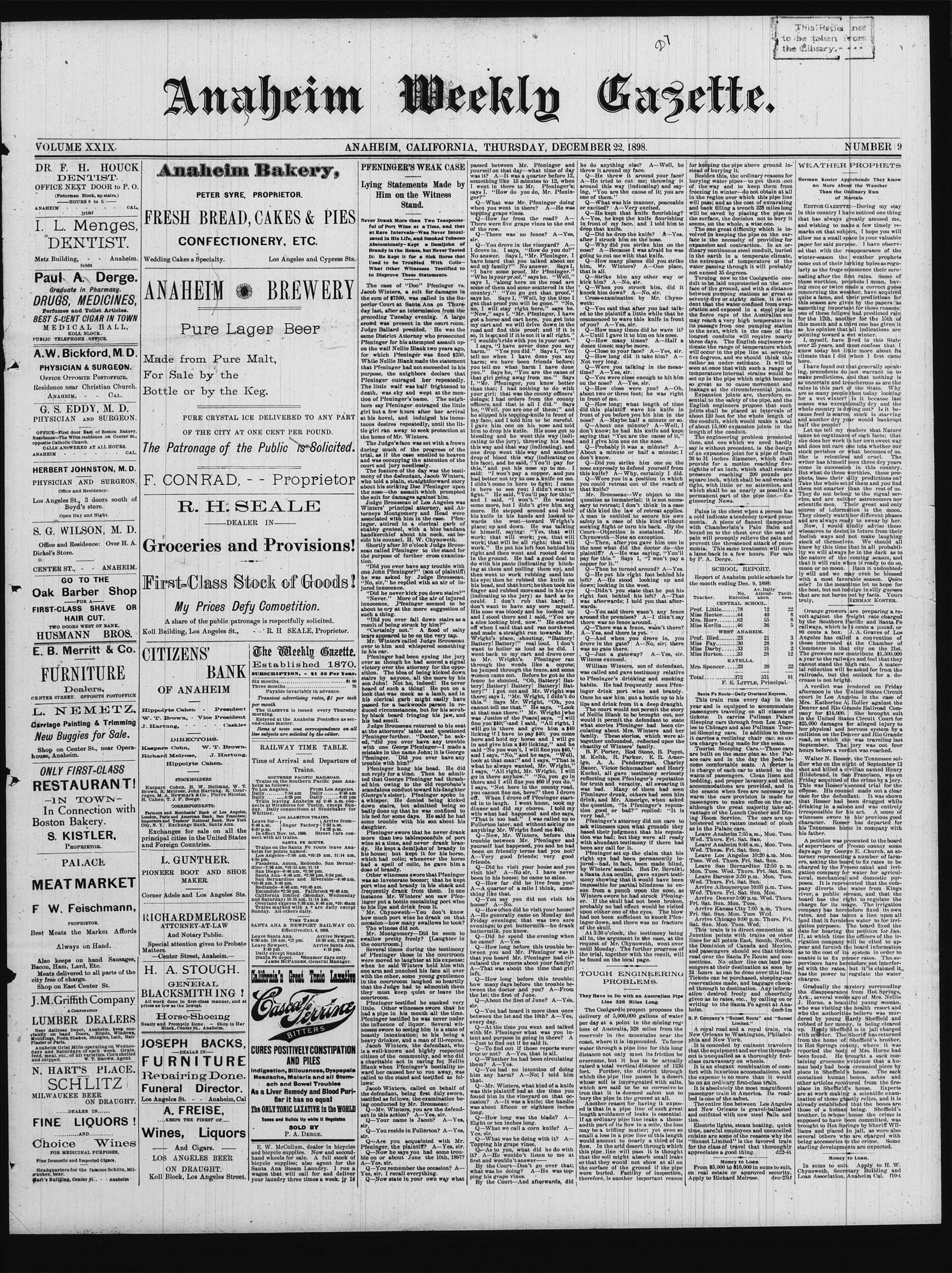
Searchable text
Anaheim
VOLUME XXIX.
DR. F. H. HOUCK
DENTIST.
OFFICE NEXT DOOR to P. O.
(Federman Block, up stairs.)
HOURS 9 to 5
ANAHEIM CAL.
jy15tt
I. L. Menges,
DENTIST.
Metz Building, Anaheim.
feb24
Paul A. Derge.
Graduate in Pharmacy.
DRUGS, MEDICINES,
Perfumes and Toilet Articles.
BEST 5-CENT CIGAR IN TOWN
MEDICAL HALL,
KOLL BLOCK.
PUBLIC TELEPHONE OFFICE.
A.W. Bickford, M.D.
PHYSICIAN & SURGEON.
Office Opposite Postoffice.
Residence near Christian Church.
ANAHEIM, CAL.
G. S. EDDY, M.D.
PHYSICIAN AND SURGEON.
OFFICE—First door East of Boston Bakery.
Residence—The Witte residence on Center St., opposite Catholic Church.
CALLS ANSWERED AT ALL HOURS.
ANAHEIM CAL.
HERBERT JOHNSTON, M.D.
Anaheim Bakery,
PETER SYRE, PROPRIETOR.
FRESH BREAD, CAKES & PIES
CONFECTIONERY, ETC.
Wedding Cakes a Specialty. Los Angeles and Cypress Sts.
ANAHEIM BREWERY
Pure Lager Beer
Made from Pure Malt,
For Sale by the
Bottle or by the Keg.
PURE CRYSTAL ICE DELIVERED TO ANY PART
OF THE CITY AT ONE CENT PER POUND.
The Patronage of the Public is Solicited.
OFFICE OPPOSITE POSTOFFICE.
Residence near Christian Church.
ANAHEIM, CAL.
G. S. EDDY, M. D.
PHYSICIAN AND SURGEON.
OFFICE—First door East of Boston Bakery.
Residence—The Witte residence on Center St., opposite Catholic Church.
CALLS ANSWERED AT ALL HOURS.
ANAHEIM, CAL.
HERBERT JOHNSTON, M. D.
PHYSICIAN AND SURGEON.
Office and Residence:
Los Angeles St., 3 doors south of Boyd's store.
Open Day and Night.
S. G. WILSON, M. D.
Office and Residence: Over H. A. Dickel's Store.
CENTER ST., CALAHEIM.
GO TO THE Oak Barber Shop
FOR A FIRST-CLASS SHAVE OR HAIR CUT.
TWO DOORS WEST OF BANK.
HUSMANN BROS.
E. B. Merritt & Co.
FURNITURE
Dealers,
CENTER STREET. OPPOSITE POSTOFFICE
L. NEMETZ,
Carriage Painting & Trimming
New Buggies for Sale.
Shop on Center St., near Opera-house, Anaheim.
ONLY FIRST-CLASS RESTAURANT!
IN TOWN—In Connection with Boston Bakery.
S. KISTLER,
PROPRIETOR.
PALACE
MEAT MARKET
CITIZENS' BANK
OF ANAHEIM
Hippolyte Cahen - President
W. T. Brown, Vice President
J. Hartung, Cashier
DIRECTORS:
Kaspare Cohn, W. T. Brown.
Riohard Melrose, J. Hartung.
Hippolyte Cahen.
STOCKHOLDERS:
Kaspare Cohen, H. W. Hellman, W. T. Brown, R. Melrose, John Hartung, R. Courreges, M. A. Newmark & Co., Pierre Nicolas, H. Cahen, T. J. F. Boege.
CORRESPONDENTS:
Farmers and Merchants' Bank of Los Angeles; London, Paris and American Bank, San Francisco; Importers and Traders' National Bank, New York City, N.Y.; Exchange Bank, Santa Ana.
Exchanges for sale on all the principal cities in the United States and Foreign Countries.
L. GUNTHER.
PIONEER BOOT AND SHOE MAKER.
Corner Adele and Los Angeles Sts.
The Weekly Gazette.
Established 1870.
SUBSCRIPTION, $1 50 Per Year.
Six months...$1 00
Three months...$70
Payable invariably in advance.
Transient advertising rates,$1 per inch per month.
The GAZETTE is issued every Thursday morning.
Entered at the Anaheim Postoffice as second-class matter.
Items of news and correspondence on all live subjects are solicited by the editor.
RAILWAY TIME TABLE.
Time of Arrival and Departure of Trains.
SOUTHERN PACIFIC RAILROAD.
Trains on the Southern Pacific pass Anaheim as follows:
To Los Angeles....From Los Angeles.
Daily.....7:54 am Daily.....9:45 am
Daily.....4:25 pm Daily.....6:01 pm
Train leaving Anaheim at 9:45 a.m. connects at Miraflores for Tustin, except Sunday.
Daily connections at Studebaker for Whittier.
LO ALAMITOS TRAINS.
Leave for...Arrive from...
9:48 a.m.Sugar Factory 7:52 a.m.
6:02 p.m.(4:25 p.m.)
In effect Nov. 1st, 1898. Street cars connect with all trains.
SANTA FE ROUTE.
Trains on the Santa Fe route leave Anaheim for points named:
Los Angeles—7:55 am.*10:15 am, 11:14 am,
4:55 pm.
Pasadena, Azusa, Redondo, San Bernardino—7:55 am.*10:15 am, 11:14
San Diego—9:46 am.*2:50 pm,
Santa Ana—9:46 am.*2:50 pm, 5:54 pm,
San Bernardino and Riverside—9:46 am.*10:45 am, 5:45 pm,
Redlands—9:46 am.*10:45 am,
Escondido*2:50 pm.Fallbrook*9:46 am.
California limited (Monday, Wednesday and Saturday).
IN TOWNIn Connection with Boston Bakery.
S. KISTLER,
PROPRIETOR.
PALACE
MEAT MARKET
F W. Feischmann,
PROPRIETOR.
Best Meats the Market Affords
Always on Hand.
Also keeps on hand Sausages,
Bacon, Ham, Lard, Etc.
Meats delivered to all parts of the city free of charge.
Shop on East Center St.
J.M.Griffith Company
A CORPORATION
LUMBER DEALERS
Neer Railroad Depot, Anaheim, keep constantly on hand Doors, Blinds, Windows, Mouldings, Posts, Shakes, Shingles, Lath, Hair Plaster of Paris.
Anaheim Grist Mills operating on Wednesdays and Saturdays of each week. Grain, feed, meal, etc., of all varieties. Cornshellled and shipped.
W.T.BROWN, Agent.
N.HART'S PLACE.
SCHLITZ
MILWAUKEE BEER
ON DRAUGHT.
DEALER IN...
FINE LIQUORS!
AND...
Choice Wines
FOR MEDICINAL PURPOSES,
Fine Domestic and Imported Cigars.
Headquarters for the famous Schlitz, Milwaukee, beer.
Hart's Building, Center St., ... Anaheim
L. GUNTHER.
PIONEER BOOT AND SHOE MAKER.
Corner Adele and Los Angeles Sts.
RICHARDMELROSE
ATTORNEY-AT-LAW
And Notary Public.
Special attention given to Probate Matters.
—Center Street, Anaheim.—
H. A. STOUGH.
GENERAL BLACKSMITHING!
All work done in first-class manner, and at prices as low as the lowest.
Horse-Shoeing
Neatly and Promptly Done. — Shop in Har Block, Center St., Anaheim.
JOSEPH BACKS,
DEALER IN...
FURNITURE
Repairing Done.
Funeral Director.
Los Angeles St. - Anaheim, Cal
A. FREISE,
KEEPS THE FINEST OF...
Wines, Liquors
And Cigars.
LOS ANGELES BEER
ON DRAUGHT.
Koll Block, Los Angeles Street.
CORRESPONDENTS:
Farmers and Merchants' Bank of Los Angeles, London, Paris and American Bank, San Francisco; Importers and Traders' National Bank. New York City, N.Y. Exchange Bank, Santa Ana.
Exchanges for sale on all the principal cities in the United States and Foreign Countries.
L. GUNTHER.
PIONEER BOOT AND SHOE MAKER.
Corner Adele and Los Angeles Sts.
RICHARDMELROSE
ATTORNEY-AT-LAW
And Notary Public.
Special attention given to Probate Matters.
—Center Street, Anaheim.—
H. A. STOUGH.
GENERAL BLACKSMITHING!
All work done in first-class manner, and at prices as low as the lowest.
Horse-Shoeing
Neatly and Promptly Done. — Shop in Har Block, Center St., Anaheim.
JOSEPH BACKS,
DEALER IN...
FURNITURE
Repairing Done.
Funeral Director.
Los Angeles St. - Anaheim, Cal
A. FREISE,
KEEPS THE FINEST OF...
Wines, Liquors
And Cigars.
LOS ANGELES BEER
ON DRAUGHT.
Koll Block, Los Angeles Street.
Train leaving Anaheim at 9:45 a.m. connects at Mirafores for Tustin, except Sunday. Daily connections at Studebaker for Whittier.
LOS ALAMITOS TRAINS.
Leave for—
9:48 a.m. — Sugar Factory
7:52 a.m. — 4:26 p.m.
In effect Nov. 1st, 1898. Street cars connect with all trains.
SANTA FE ROUTE.
Trains on the Santa Fe route leave Anaheim for points named:
Los Angeles—7:55 am. *10:15 am, 11:14 am, 4:55 pm.
Pasadena, Azusa, Redondo, San Bernardino—7:55 am. *10:15 am, 11:14
San Diego—9:46 am. *2:50 pm.
Santa Ana—9:46 am. *2:50 pm, 5:54 pm.
San Bernardino and Riverside—9:46 am. *10:45 am, 5:45 pm.
Redlands—9:46 am. *10:45 am.
Escondido*2:50 pm. Fallbrook*9:46 am.
California limited (Monday, Wednesday and Saturday) 10:15 am, 11:14 am.
Overland express 7:55 am. 9:46 am. *10:45am Trains marked with a * are daily except Sunday. All others daily.
TIME TABLE
SANTA ANA & NEWPORT RAILWAY CO.
Effective Oct. 4, 1898.
Leave Santa Ana.
9:50 am. $10 am. *$2 pm.
Leave Newport,
3:45 pm.
Daily except Sunday.
Santa Fe depot.* Steamer days only.
JAMES MCFADDEN, General Manager.
California's Great Tonic Lazative
Cascalegine
BITTERS
CURES POSITIVELY CONSTIPATION AND PILES
Indigestion, Billiousness, Dyspepsia Headache, Malaria and all Stomach and Bowel Troubles
As a Liver Remedy and Blood Purifier it has no equal
The ONLY TONIC LAXATIVE in the WORLD
Tones and Builds Up while It Regulates
SOLD BY
P.A.Derge.
E.W.McCollum, dealer in bicycles and bicycle supplies. New and second-hand wheels for sale. A full stock of bicycle supplies; also agent for the Santa Ana Steam Laundry. I run a wagon that will call for and deliver your laundry three times a week. jy 14
NEIM Weekly Gazette
ANAHEIM, CALIFORNIA, THURSDAY, DECEMBER 22, 1898.
PFENINGER'S WEAK CASE
Lying Statements Made by Him on the Witness Stand.
Never Drank More than Two Teaspoonsful of Port Wine at a Time, and that at Rare Intervals—Was Never Intoxicated in His Life, and Smoked Tobacco Abstemiously—Kept a Demijohn of Brandy in the House, but Never Tasted It: He kept it for a Sick Horse that Used to be Troubled With Colic—What Other Witnesses Testified to Disprove These Statements.
The case of "Doc" Pfeninger vs. Jacob Winters, a suit for damages in the sum of $7500, was called in the Superior Court at Santa Ana on Thursday last, after an intermission from the preceding Tuesday evening. A large crowd was present in the court room. Judge Ballard presided. He was the same District Attorney who prosecuted Pfeninger for his attempted assault upon the walt Nellie Blank two years ago, for which Pfeninger was fined $250. While Nellie Blank made the statement that Pfeninger had not succeeded in his purpose, the neighbors declare that Pfeninger outraged her repeatedly. The little waif was half frightened to death, was shy and wept at the mention of Pfeninger's name. The neighbors say Pfeninger outraged the little girl but a few hours after her arrival at his hotel, and indulged his incestuous desires repeatedly, until the little girl ran away to seek protection at the home of Mr. Winters.
The Judge's face was set with a frown during much of the progress of the trial, as if the case smelled to heaven and was occupying the attention of the court and jury needlessly.
The feature of the day was the testimony between Mr. Pfeninger and yourself on that day—what time of day was it? A—It was a quarter before 12, something like 15 minutes to 12, when I went in there to Mr. Pfeninger's; says I, "How do you do, Mr. Pfeninger?"
Q—What was Mr. Pfeninger doing when you went in there? A—He was topping grape vines.
Q—How far from the road? A—There were five grape vines to the end of the row.
Q—There was no fence? A—Yes, sir.
Q—You drove in the vineyard? A—I drove in. I says, "How do you do?" No answer. Says I, "Mr. Pfeninger, I have heard that you talked about me and my family?" No answer. Says I, "I have some proof, Mr. Pfeninger."
"Who is your proof," says he. "Well," says I, "along here on the road are some of them and some scattered in the country." "You go get that proof," says he. Says I, "Well, by the time I get that proof you will be gone." "No, no, I will stay right here," says he. "Now," says I, "Mr. Pfeninger, I have got a horse and cart here, you get into my cart and we will drive down in the road and find this proof; and if it is so, it is so; and if it is not it is all right." "I wouldn't ride with you in your cart."
I says, "I have never done you any harm." "Yes you did." Says I, "You tell me when I have done you any harm; we have been friends before; you tell me what harm I have done you." Says he, "You are the cause of that girl going away from me." Says I, "Mr. Pfeninger, you know better than that; I had nothing to do with your girl; that was the county officers' doings; I had orders from the county officers, and that is all I did." Says he, "Well, you are one of them;" and he slipped his topping-knife in front of my face, and I told him to be careful. I gave him one on his nose and told him to drop his knife. His nose got to bleeding and he went this way (indicating to the jury), throwing his head this way and that way (indicating on his face), and he said, "You'll pay for this," and put his nose up to me. I said: "I won't pay a copper, and you do anything else? A—Well, threw it around my face.
Q—He threw it around your face.
A—He tried to cut me; throwing around this way (indicating) and lying, "You are the cause of it; you one of them."
Q—What was his manner, peace or excited? A—Very excited.
Q—He kept that knife flourish.
A—Yes, he kept the knife flourish in front of my face, and I told him drop that knife.
Q—Did he drop the knife?
A—After I struck him on the nose.
Q—Why did you strike him on the nose?
A—Because I was afraid he going to cut me with that knife.
Q—How many places did you stitch him, Mr. Winters?
A—One place that is all.
Q—Strike him any other way kick him?
A—No, sir.
Q—When you struck him, did knock him down?
A—No, sir.
Cross-examination by Mr. Chyweth:
Q—You said that after you had tended to the plaintiff a little while that commenced to wave this knife in front of you?
A—Yes, sir.
Q—How many times did he wave?
A—Until I gave it to him on his nose.
Q—How many times?
A—Had no dozen times; maybe more.
Q—Close to your face?
A—Yes,
Q—How long did it take him?
Not very long.
Q—Were you talking in the middle?
A—Yes, sir.
Q—You were close enough to hit on the nose?
A—Yes, sir.
Q—How close were you?
A—a about two or three feet; he was rinsed of me.
Q—How long; what length of this plaintiff wave his knife front of you before you hit him in nose?
A—Maybe half a minute or less.
Q—About one minute?
A—We don't know; he had his knife and saying that "You are the cause of it and give him one on the nose."
Q—Probably it was a minute? About a minute or half a minute don't know.
Q—Did you strike him one on nose expressly to defend yourself from this knife?
A—Why certainly!
Pfeninger's attorney did not care ask witnesses upon what grounds to based their judgment that his rep was bad; but they were all relied on with abundant testimony if there been any call for it.
Pfeninger set up the claim that right eye had been permanently jured—had, in fact, been made by Winters' assault. But Dr. Berrie a Santa Ana oculist, gave expert testimony that it would have been impossible for partial blindness to sue from a punch upon the nose Winters swore he had struck Pfeninger purpose, the neighbors declare that Pfeninger outraged her repeatedly. The little waif was half frightened to death, was shy and wept at the mention of Pfeninger's name. The neighbors say Pfeninger outraged the little girl but a few hours after her arrival at his hovel, and indulged his incestuous desires repeatedly, until the little girl ran away to seek protection at the home of Mr. Winters.
The Judge's face was set with a frown during much of the progress of the trial, as if the case smelled to heaven and was occupying the attention of the court and jury needlessly.
The feature of the day was the testimony of the defendant, Jacob Winters, who told a plain, straightforward story about his striking Doc Pfeninger upon the nose—the assault which prompted the suit for damages against him.
Judge Brousseau of Los Angeles was Winters' principal attorney, and Attorneys Montgomery and Head were associated with him in the case. Pfeninger, attired in a clerical garb of shabby genteel, with a blue bandana handkerchief about his neck, sat beside his counsel, H. W. Chynoweth.
Shortly after 10 o'clock Judge Brosseau called Pfeninger to the stand for the purpose of further cross examination.
"Did you ever have any trouble with one John Pfeninger?" (son of plaintiff) he was asked by Judge Brosseau. "No, sir," he replied with an air of injured innocence.
"Did he never kick you down stairs?"
"Never." More of the air of injured innocence. Pfeninger seemed to be about to cry at the mere suggestion of such a thing.
"Did you ever fall down stairs as a result of being struck by him?"
"Certainly not." A flood of salty tears appeared to be on the very tap.
Mr. Winters called Judge Brosseau over to him and whispered something in his ear.
Pfeninger had been eyeing the jury over as though he had scored a signal victory over the attorney for the opposition. The idea of being kicked down stairs by anyone, all the more by his son John! Not he, indeed! He never heard of such a thing! He put on a look that meek as a lamb, and in his clerical garb might easily have passed for a backwoods parson in reduced circumstances, but for his scrub-by black beard fringing his jaw, and his bad smell.
Judge Brosseau returned to his seat at the attorneys' table and questioned Pfeninger further. "Doctor," he asked, "did you ever have any trouble with one George Pfeninger—I made a mistake in the name John; it is George Pfeninger. Did you ever have any trouble with him?"
Pfeninger hung his head. He did not reply for a time. Then he admitted that George Pfeninger had thrashed him owing to the old reprobate's scandalous conduct toward his daughter (George's sister). Pfeninger spoke in a whisper, he denied being kicked down stairs, but admitted being so badly done up that he was confined to his bed for some days. He said he had some trouble with his son about his daughter.
Pfeniger swore that he never drank more than two tablespoonfuls of port wine at a time, and never drank brandy. He kept a demiljohn of brandy in his house; but kept it for his horse, which had colic; whenever the horse had a spell of colic, he gave him a dose of brandy.
Other witnesses swore that Pfeniger was an inveterate boozer; that he kept port wine and brandy in his shack and frequently drank from them. In one instance Mr. Winters' son saw Pfeninger outraged her repeatedly.
The little waif was half frightened to death, was shy and wept at the mention of Pfeninger's name. The neighbors say Pfeninger outraged the little girl but a few hours after her arrival at his hovel, and indulged his incestuous desires repeatedly, until the little girl ran away to seek protection at the home of Mr. Winters.
The Judge's face was set with a frown during much of the progress of the trial, as if the case smelled to heaven and was occupying the attention of the court and jury needlessly.
The feature of the day was the testimony of the defendant, Jacob Winters, who told a plain, straightforward story about his striking Doc Pfeninger upon the nose—the assault which prompted the suit for damages against him.
Judge Brosseau of Los Angeles was Winters' principal attorney, and Attorneys Montgomery and Head were associated with him in the case. Pfeninger, attired in a clerical garb of shabby genteel, with a blue bandana handkerchief about his neck, sat beside his counsel, H. W. Chynoweth.
Shortly after 10 o'clock Judge Brosseau called Pfeninger to the stand for the purpose of further cross examination.
"Did you ever have any trouble with one John Pfeninger?" (son of plaintiff) he was asked by Judge Brosseau. "No, sir," he replied with an air of injured innocence.
"Did he never kick you down stairs?"
"Never." More of the air of injured innocence. Pfeninger seemed to be about to cry at the mere suggestion of such a thing.
"Did you ever fall down stairs as a result of being struck by him?"
"Certainly not." A flood of salty tears appeared to be on the very tap.
Mr. Winters called Judge Brosseau over to him and whispered something in his ear.
Pfeninger had been eyeing the jury over as though he had scored a signal victory over the attorney for the opposition. The idea of being kicked down stairs by anyone, all the more by his son John! Not he, indeed! He never heard of such a thing! He put on a look that meek as a lamb, and in his clerical garb might easily have passed for a backwoods parson in reduced circumstances, but for his scrub-by black beard fringing his jaw, and his bad smell.
Judge Brosseau returned to his seat at the attorneys' table and questioned Pfeninger further. "Doctor," he asked, "did you ever have any trouble with one George Pfeninger—I made a mistake in the name John; it is George Pfeninger. Did you ever have any trouble with him?"
Pfeninger hung his head. He did not reply for a time. Then he admitted that George Pfeninger had thrashed him owing to the old reprobate's scandalous conduct toward his daughter (George's sister). Pfenenger spoke in a whisper, he denied being kicked down stairs, but admitted being so badly done up that he was confined to his bed for some days. He said he had some trouble with his son about his daughter.
Pfeniger swore that he never drank more than two tablespoonfuls of port wine at a time, and never drank brandy. He kept a demiljohn of brandy in his house; but kept it for his horse, which had colic; whenever the horse had a spell of colic, he gave him a dose of brandy.
Other witnesses swore that Pfeniger was an inviterate boozer; that he kept port wine and brandy in his shack and frequently drank from them. In one instance Mr. Winters' son saw Pfeninger outraged her repeatedly.
The little waif was half frightened to death, was shy and wept at the mention of Pfeninger's name. The neighbors say Pfeninger outraged the little girl but a few hours after her arrival at his hovel, and indulged his incestuous desires repeatedly, until the little girl ran away to seek protection at the home of Mr. Winters.
The Judge's face was set with a frown during much of the progress of the trial, as if the case smelled to heaven and was occupying the attention of the court and jury needlessly.
The feature of the day was the testimony of the defendant, Jacob Winters, who told a plain, straightforward story about his striking Doc Pfeninger upon the nose—the assault which prompted the suit for damages against him.
Judge Brosseau of Los Angeles was Winters' principal attorney, and Attorneys Montgomery and Head were associated with him in the case. Pfeninger, attired in a clerical garb of shabby genteel, with a blue bandana handkerchief about his neck, sat beside his counsel, H. W. Chynoweth.
Shortly after 10 o'clock Judge Brosseau called Pfeninger to the stand for the purpose of further cross examination.
"Did you ever have any trouble with one John Pfeninger?" (son of plaintiff) he was asked by Judge Brosseau. "No, sir," he replied with an air of injured innocence.
"Did he never kick you down stairs?"
"Never." More of the air of injured innocence. Pfeniger seemed to be about to cry at the mere suggestion of such a thing.
"Did you ever fall down stairs as a result of being struck by him?"
"Certainly not." A flood of salty tears appeared to be on the very tap.
Mr. Winters called Judge Brosseau over to him and whispered something in his ear.
Pfeninger had been eyeing the jury over as though he had scored a signal victory over the attorney for the opposition. The idea of being kicked down stairs by anyone, all the more by his son John! Not he, indeed! He never heard of such a thing! He put on a look that meek as a lamb, and in his clerical garb might easily have passed for a backwoods parson in reduced circumstances, but for his scrub-by black beard fringing his jaw, and his bad smell.
Judge Brosseau returned to his seat at the attorneys' table and questioned Pfeninger further. "Doctor," he asked, "did you ever have any trouble with one George Pfeninger—I made a mistake in the name John; it is George Pfeninger. Did you ever have any trouble with him?"
Pfeninger hung his head. He did not reply for a time. Then he admitted that George Pfeninger had thrashed him owing to the old reprobate's scandalous conduct toward his daughter (George's sister). Pfenenger spoke in a whisper, he denied being kicked down stairs, but admitted being so badly done up that he was confined to his bed for some days. He said he had some trouble with his son about his daughter.
Pfeniger swore that he never drank more than two tablespoonfuls of port wine at a time, and never drank brandy. He kept a demiljohn of brandy in his house; but kept it for his horse, which had colic; whenever the horse had a spell of colic, he gave him a dose of brandy.
Other witnesses swore that Pfeniger was an inviterate boozer; that he kept port wine and brandy in his shack and frequently drank from them. In one instance Mr. Winters' son saw Pfeninger outraged her repeatedly.
The little waif was half frightened to death, was shy and wept at the mention of Pfeninger's name. The neighbors say Pfeninger outraged the little girl but a few hours after her arrival at his hovel, and indulged her incestuous desires repeatedly until the little girl ran away to seek protection at the home of Mr. Winters.
The Judge's face was set with a frown during much of the progress of the trial, as if the case smelled to heaven and was occupying the attention of the court and jury needlessly.
The feature of the day was the testimony of the defendant, Jacob Winters, who told a plain, straightforward story about his striking Doc pfensinger upon the nose—the assault which prompted the suit for damages against him.
Judge Brosseau of Los Angeles was Winters' principal attorney, and Attorneys Montgomery and Head were associated with him in the case. Pfeninger, attired in a clerical garb of shabby genteel, with a blue bandana handkerchief about his neck, sat beside his counsel, H. W. Chynoweth.
Shortly after 10 o'clock Judge Brosseau called pfensinger to the stand for the purpose of further cross examination.
"Did you ever have any trouble with one John pfeninger?" (son of plaintiff) he was asked by Judge Brosseau. "No, sir," he replied with an air of injured innocence.
"Did he never kick you down stairs?"
"Never." More of the air of injured innocence. Pfeniger seemed to be about to cry at the mere suggestion of such a thing.
"Did you ever fall down stairs as a result of being struck by him?"
"Certainly not." A flood of salty tears appeared to be on the very tap.
Mr. Winters called Judge Brosseau over to him and whispered something in his ear.
Pfeniger had been eyeing the jury over as though he had scored a signal victory over the attorney for the opposition. The idea of being kicked down stairs by anyone, all the more by his son John! Not he, indeed! He never heard of such a thing! He put on a look that meek as a lamb, and in his clerical garb might easily have passed for a backwoods parson in reduced circumstances, but for his scrub-by black beard fringing his jaw, and his bad smell.
Judge Brosseau returned to his seat at the attorneys' table and questioned pfensinger further. "Doctor," he asked, "did you ever have any trouble with one George pfeninger—I made a mistake in the name John; it is George pfeninger. Did you ever have any trouble with him?"
Pfeniger hung his head. He did not reply for a time. Then he admitted that George pfeninger had thrashed him owing to the old reprobate's scandalous conduct toward his daughter (George's sister). Pfenenger spoke in a whisper, he denied being kicked down stairs, but admitted being so badly done up that he was confined to his bed for some days. He said he had some trouble with his son about his daughter.
Pfeniger swore that he never drank more than two tablespoonfuls of port wine at a time, and never drunk brandy. He kept a demiljohn of brandy in his house; but kept it for his horse, which had colic; whenever the horse had a spell of colic, he gave him a dose of brandy.
Other witnesses swore that Pfeniger was an inviterate boozer; that he kept port wine and brandy in his shack and frequently drank from them. In one instance Mr. Winters' son saw Pfenenger outraged her repeatedly.
The little waif was half frightened to death, was shy and wept at the mention of Pfennger's name. The neighbors say PFENGER'S NAME is SOLID AMOUNT: 45 pts per inch
A SEALEY PROPERTY PUBLISHED 1870.
APPLICATION IS Solved.
SEALEY RELIEF.
Arrival AND Departure OF Trains.
SHARELITERAL TRAINING.
OSALAMITOS TRAINS.
MISSING FOOTBALL TRAINS.
SALAMITOS TRAINS.
WEEKLY GAZETE.
BILLET LINE.
ARRIVAL AND DEPARTURE OF Trains.
LOS ALAMITOS TRAINS.
MISSING FOOTBALL TRAINS.
SALAMITOS TRAINS.
WEEKLY GAZETE.
BILLET LINE.
ARRIVAL AND DEPARTURE OF Trains.
LOS ALAMITOS TRAINS.
MISSING FOOTBALL TRAINS.
SALAMITOS TRAINS.
WEEKLY GAZETE.
BILLET LINE.
ARRIVAL AND DEPARTURE OF Trains.
LOS ALAMITOS TRAINS.
MISSING FOOTBALL TRAINS.
SALAMITOS TRAINS.
WEEKLY GAZETE.
BILLET LINE.
ARRIVAL AND DEPARTURE OF Trains.
LOS ALAMITOS TRAINS.
MISSING FOOTBALL TRAINS.
SALAMITOS TRAINS.
WEEKLY GAZETE.
BILLET LINE.
ARRIVAL AND DEPARTURE OF Trains.
LOS ALAMITOS TRAINS.
MISSING FOOTBALL TRAINS.
SALAMITOS TRAINS.
WEEKLY GAZETE.
BILLET LINE.
ARRIVAL AND DEPARTURE OF Trains.
LOS ALAMITOS TRAINS.
MISSING FOOTBALL TRAINS.
SALAMITOS TRAINS.
WEEKLY GAZETE.
BILLET LINE.
ARRIVAL AND DEPARTURE OF Trains.
LOS ALAMITOS TRAINS.
MISSING FOOTBALL TRAINS.
SALAMITOS TRAINS.
WEEKLY GAZETE.
BILLET LINE.
ARRIVAL AND DEPARTURE OF Trains.
LOS ALAMITOS TRAINS.
MISSING FOOTBALL TRAINS.
SALAMITOS TRAINS.
WEEKLY GAZETE.
BILLET LINE。
ARRIVAL AND DEPARTURE OF Trains。
LOS ALAMITOS TRAINS。
MISSING FOOTBALL TRAINS。
SALAMITOS TRAINS。
WEEKLY GAZETE。
BILLET LINE。
ARRIVAL AND DEPARTURE OF Trains。
LOS ALAMITOS TRAINS。
MISSING FOOTBALL TRAINS。
SALAMITOS TRAINS。
WEEKLY GAZETE。
BILLET LINE。
ARRIVAL AND DEPARTURE OF Trains。
LOS ALAMITOS TRAINS。
MISSING FOOTBALL TRAINS。
SALAMITOS TRAINS。
WEEKLY GAZETE。
BILLET LINE。
ARRIVAL AND DEPARTURE OF Trains。
LOS ALAMITOS TRAINS。
MISSING FOOTBALL TRAINS。
SALAMITOS TRAINS。
WEEKLY GAZETE。
BILLET LINE。
ARRIVAL AND DEPARTURE OF Trains。
LOS ALAMITOS TRAINS。
MISSING FOOTBALL TRAINS。
SALAMITOS TRAINS。
WEEKLY GAZETE。
BILLET LINE。
ARRIVAL AND DEPARTURE OF Trains。
LOS ALAMITOS TRAINS。
MISSING FOOTBALL TRAINS。
SALAMITOS TRAINS。
WEEKLY GAZETE。
BILLET LINE。
ARRIVAL AND DEPARTURE OF Trains。
LOS ALAMITOS TRAINS。
MISSING FOOTBALL TRAINS。
SALAMITOS TRAINS。
WEEKLY GAZETE。
BILLET LINE。
ARRIVAL AND DEPARTURE OF Trains。
LOS ALAMITOS TRAINS。
MISSING FOOTBALL TRAINS。
SALAMITOS TRAINS。
WEEKLY GAZETE。
BILLET LINE。
ARRIVAL AND DEPARTURE OF Trains。
LOS ALAMITOS TRAINS)。
MISSING FOOTBALL TRAINS)。
SALAMITOS TRAINS)。
WEEKLY GAZETE)。
BILLET LINE。
ARRIVAL AND DEPARTURE OF Trains)。
LOS ALAMITOs TRAINES)。
MISSING FOOTBALL TRAINES)。
SALAMITOs TRAINES)。
WEEKLY GAZETE)。
BILLET LINE。
ARRIVAL AND DEPARTURE OF Trains)。
LOS ALAMITOs TRAINES)。
MISSING FOOTBALL TRAINES)。
SALAMITOs TRAINES)。
WEEKLY GAZETE)。
BILLET LINE。
ARRIVAL AND DEPARTURE OF Trains)。
LOS ALAMITOs TRAINES)。
MISSING FOOTBallTraines)。
SALAMITOs TRAINES)。
WEEKLY GAZETE)。
BILLET LINE。
ARRIVAL AND DEPARTURE OF Trains)。
LOS ALAMITOs TRAINES)。
MISSING FOOTBallTraines)。
SALAMITOs TRAINES)。
WEEKLY GAZETE)。
BILLET LINE。
ARRIVAL AND DEPARTURE OF Trains)。
LOS ALAMITOs TRAINES)。
MISSING FOOTBallTraines)。
He denied being kicked down stairs, but admitted being so badly done up that he was confined to his bed for some days. He said he had some trouble with his son about his daughter.
Pfeninger swore that he never drank more than two tablespoonfuls of port wine at a time, and never drank brandy. He kept a demijohn of brandy in his house; but kept it for his horse, which had colic; whenever the horse had a spell of colic, he gave him a dose of brandy.
Other witnesses swore that Pfeninger was an inveterate booster; that he kept port wine and brandy in his shack and frequently drank from them. In one instance Mr. Winters' son saw Pfeninger put a bottle containing port wine to his lips and drink from it.
Mr. Chynoweth—You don't know how much port wine he drank on that occasion—how many swallows he took?
The witness did not.
Mr. Montgomery—Did he seem to swallow pretty freely? [Laughter in the courtroom.]
Several times during the testimony of Pfeninger those in the courtroom were moved to laughter at his expense; when he said Winters held him with one arm and punched his face all over with the other, some young gentlemen in the courtroom laughed so heartily that the Judge had to admonish them they must keep quiet or leave the courtroom.
Pfeninger testified he smoked very little. Other witnesses swore that he had a pipe in his mouth all the time. Pfeninger testified he was never under the influence of liquor. Several witnesses swore to seeing him in a state of beastly intoxication; to his being a heavy drinker, and a man of ill-repute.
Jacob Winters, the defendant, who is a well-known and highly respected citizen of the community, who did a charitable act in caring for Nellie Blank when Pfeninger's bestiality toward her caused her to run away, was called to the stand and testified as follows:
Jacob Winters, called on behalf of the defendant, being first duly sworn, testified as follows; the examination being conducted by Mr. Broussseau:
Q—Mr. Winters, you are the defendant in this action? A—Yes, sir.
Q—Your name is Jacob? A—Yes, sir.
Q—You reside in Fullerton? A—Yes, sir.
Q—Are you acquainted with Mr. Pfeninger, the plaintiff? A—Yes, sir.
Q—Now he says you had some trouble on or about June the 10th, 1897? A—Yes, sir.
Q—You remember the occasion? A—Yes, sir, I recall everything.
Q—Now state in your own way what
When I wore on Pfeninger scarred in to laugh. I went home, took my dinner and did my chores. I told my wife what had happened and she says, "That is too bad." I was called up to Fullerton later, and without asking me anything Mr. Wright fined me $40.
Q—Now, Mr. Winters, before this trouble between Mr. Pfeninger and yourself had happened, you and he had been on friendly terms had you not? A—Very good friends; very good friends.
Q—Did he visit your house and you visit his? A—No sir, I have never been in his house; he came to mine.
Q—How far did he live from you? A—a quarter of a mile I think, something like that.
Q—You say you did not visit his house? A—No.
Q—How often did he visit your house? A—He generally came on Monday and Friday evenings; that was two sure evenings; to get buttermilk—the drank buttermilk, you know.
Q—Did he spend the evening when he came? A—Yes.
Q—How long before this trouble between you and Mr. Pfeninger was it that you heard Mr. Pfeninger had circulated the reports about your family? A—That was about the time that girl left.
Q—How long before this trouble; how many days before the trouble between the doctor and you? A—From the 1st; the first of June.
Q—About the first of June? A—Yes, sir.
Q—You had heard it more than once between the 1st and the 10th? A—Yes, every day.
Q—At the time you went and talked with Mr. Pfeninger what was you intent and purpose in going there? A—Just to find out if he said it.
Q—To find out if those reports were true or not? A—Yes, that is all.
Q—Whether he had been circulating them? A—Yes.
Q—You had no intention of doing him any harm? A—No; I told him that.
Q—Mr. Winters, what kind of a knife was this plaintiff had at the time you found him in the vineyard on that occasion? A—It was a knife; the handle was about fifteen or eighteen inches long.
Q—How long was the blade? A—Eight or ten inches long.
Q—What we call a corn knife? A—Yes, sir.
Q—What was he doing with it? A-Topping his grape vines.
Q—As to you, what did he do with it? A-Hec wouldn't listen to me at first and wouldn't answer——
By the Court-Dont go over that; what was he doing? A-He was tapping his grape vines.
By the Court—and afterwards, did
They Have to Do with an Australian Line 328 Miles Long.
The Coolgardie project proposes delivery of 5,000,000 gallons of water per day at a point in the mining lions of Australia, 328 miles from reservoir in the mountains near coast, where it is impounded. To feed water through a pipe line for this distance not only must its friction overcome, but it has to be actually raised a total vertical distance of five feet. Further, the district throws which the pipe line passes is a deform whose soil is impregnated with sand which are said to be so corrosive iron that it is deemed safest not burry the pipe in the ground at all.
Another reason for having it extended is that in a pipe line of such length avoidance of leaks is essential. If an ordinary pipe line leaks a thunderdash part of its flow in a mile, then may be a trifling matter; yet even small loss in a pipe line of this length would amount to nearly a third of flow. In the arid desert through which this pipe line will pass it is thought that the soil might absorb small leaks so that they would not show at all the surface of the ground if the pipe were buried. Facility of inspecting therefore, is another important reason.
Gazette.
MER 22, 1898.
NUMBER 9
Is anything else? A—Well, he hit around my face.
He threw it around your face?
He tried to cut me; throwing it this way (indicating) and say: You are the cause of it; you are them."
What was his manner, peaceable ited? A—Very excited.
He kept that knife flourishing?
Yes, he kept the knife flourishing at of my face, and I told him to that knife.
Did he drop the knife? A—Yes, struck him on the nose.
Why did you strike him on the A—Because I was afraid he was to cut me with that knife.
How many places did you strike Mr. Winters? A—One place, all.
Strike him any other way or him? A—No, sir.
When you struck him, did it him down? A—No, sir.
Examination by Mr. ChynoYou said that after you had talkhe plaintiff a little while that he enced to wave this knife in front? A—Yes, sir.
How many times did he wave it? till I gave it to him on his nose.
How many times? A—Half a times; maybe more.
Close to your face? A—Yes, sir.
How long did it take him? A—Ary long.
Were you talking in the mean-A—Yes, sir.
You were close enough to hit him nose? A—Yes, sir.
How close were you? A—Oh, two or three feet; he was right at of me.
How long; what length of time is plaintiff wave his knife in if you before you hit him in the A—Maybe half a minute or so.
About one minute? A—Well, I know; he had his knife and kept that "You are the cause of it," give him one on the nose.
Probably it was a minute? A—a minute or half a minute; I know.
Did you strike him one on the expressly to defend yourself from life? A—Why, certainly I did.
for keeping the pipe above ground instead of burying it.
Besides this, the ordinary reasons for burying water pipes—get them out of the way and to keep them from freezing in winter—do not obtain at all in the region over which this pipe line will pass; and as the cost of excavating and back filling a trench 328 miles long will be saved by placing the pipe on the surface, the decision not to bury it seems, on the whole, a wise one.
The one great difficulty which is involved in keeping the pipe on the surface is the necessity of providing for expansion and contraction. In an ordinary continuous steel conduit, buried in the earth in a temperate climate, the extremes of temperature of the water passing through it will probably not exceed 35 degrees.
Turning now to the Coolgardie conduit to be laid unprotected on the surface of the ground, and with a distance between pumping stations as great as seventy-five or eighty miles, it is evident that the water confined from evaporation and exposed in a steel pipe to the fierce rays of the Australian sun may reach a very high temperature in its passage from one pumping station to the next, which in the case of the longest conduits will require nearly three days. The English engineers estimate the range of temperature which will occur in the pipe line at seventy-five degrees, and we should think this rather an under estimate. It will be seen at once that with such a range of temperature internal strains would be set up in the pipe which might become so great as to cause movement and leakage at the circumferential joints.
Expansion joints are, therefore, essential to the safety of the pipe, and the English engineers propose that such joints shall be placed at intervals of about 120 feet for the whole length of the conduit, which would make a total of about 15,000 expansion joints in the length of the conduit.
The engineering problem presented then, and one which we need hardly say is without precedent, is the design of an expansion joint for a pipe of from 26 to 31 inches diameter, which shall provide for a motion reaching five-eighths of an inch, which shall sustain pressure reaching 200 pounds per
WEATHER PROPHETS
Herman Koster Apprehends They Know no More About the Weather Than the Ordinary Run of Mortals.
EDITOR GAZETTE—During my stay in this country I have noticed one thing that has always greatly amused me, and wishing to make a few timely remarks on that subject, I hope you will allow me a small space in your valuable paper for said purpose. I have observed that with the reappearance of the winter-season the weather prophets come out of their lurking holes as regularly as the frogs commence their serenading after the first rains. Some of these worthies, prophets I mean, having once or twice made a correct guess concerning the weather, have acquired quite a fame, and their predictions for this season are given by the papers as something important for these reasons: one of these fellows had predicted rain for the 12th, another for the 15th of this month and a third one has given it as his opinion that all indications are pointing toward a wet winter.
I myself, have lived in this State over 25 years, and must confess that I know today but little more about its climate than I did when I first came here.
I have found out that generally speaking, precedents do not warrant us to make predictions, and that nothing is as uncertain and treacherous as are the rains in this part of the State. Why are so many people then today looking for a wet winter? Is it because last season was exceptionally dry and the whole country is drying out? Is it because feed is scarce, stock is starving and another dry year would bankrupt half the people?
Let me tell my readers that Nature takes no cognizance of such facts; that she does her work in her own sweet way and does not care one iota whether our stock perishes or what becomes of us. She is relentless and cruel. The writer has himself seen three dry years come in succession in this country. But what do these worthies, these pro-
You were close enough to hit him nose. A—Yes, sir.
How close were you? A—Oh, two or three feet; he was right at of me.
How long; what length of time is plaintiff wave his knife in of you before you hit him in the A—Maybe half a minute or so. About one minute? A—Well, I know; he had his knife and kept that "You are the cause of it," give him one on the nose.
Probably it was a minute? A—a minute or half a minute; I know.
Did you strike him one on the expressly to defend yourself from sniff? A—Why, certainly I did. Were you in a position in which could retreat out of the reach of sniff?
Brousseau—We object to the son as immaterial; it is not necessary to retreat; I don't think in a case kind the law of retreat applies.
It is entitled to secure his own in a case of this kind without flight or turn his back. By the Objection is sustained. Mr. weth—Note an exception.
Then, after you gave him one in case what did the doctor do—theiff? A—He was saying, "You'll be this." Says I, "I won't pay a for it."
Then he turned around? A—Yes.
He put his right foot behind his A—He stood looking up and looking in the west.
Didn't you state that he put his foot behind his left? A—That afterwards; I told you that afterwards; I told you that there wasn't any fence and the premises? A—I didn't say was no fence around.
There was a fence, wasn't there? Yes, and there is yet.
And when you drove in, you in the gate? A—No, sir; there gate there.
Just a gateway? A—Yes, sir; less excused.
William Winters, son of defendant, killed and gave testimony relative singer's drinking and smoking. He had frequently seen Pfendrink port wine and brandy.
He saw him put a bottle up to his head drink from it a deep draught. Court would not permit the story lie Blank to be brought out, nor it permit the defendant to state stories Pfeninger had been circling about Mrs. Winters and her.
These stories, which were altered unfounded, reflected upon the city of Winters' family.
Porter, Rod Stone, B. Poyet, Smith, R. Parker, E. R. AmeriA. A. Pendergrast, Charley Victor Schumacher and Henry Hill, all gave testimony seriously lying upon Pfeninger's reputation with and veracity, all swearing it road. Many of them had seen anger drunk, others had seen him and Mr. Ameriage, when asked question, "Is Pfeninger's reputation good or bad?" replied: "It is road."
Singer's attorney did not care to witnesses upon what grounds they their judgment that his reputation was bad; but they were all ready abundant testimony if there had any call for it.
Singer set up the claim that his eye had been permanently injured, in fact, been made blind, intersal assault. But Dr. Berniki, a Ana oculist, gave expert testimony that it would have been able for partial blindness to enoom a punch upon the nose, as swine he swore he had struck Pfeninger's nose.
The engineering problem presented then, and one which we need hardly say is without precedent, is the design of an expansion joint for a pipe of from 26 to 31 inches diameter, which shall provide for a motion reaching five-eighths of an inch, which shall sustain pressure reaching 200 pounds per square inch, which shall be and remain tight, with little or no attention, and which shall be as nearly as possible a permanent part of the pipe line.—Engineering News.
Pains in the chest when a person has a cold indicate a tendency toward pneumonia. A piece of flannel dampened with Chamberlain's Pain Balm and bound on to the chest over the seat of pain will promptly relieve the pain and prevent the threatened attack of pneumonia. This same treatment will cure a lame back in a few hours. For sale by P. A. Derge.
SCHOOL REPORT.
Report of Anaheim public schools for the month ending Dec. 9, 1898:
Av. Daily No. Attendance Tardiness.
CENTRAL SCHOOL.
Prof. Little.....78 72 22
Miss Rector.....44 40 8
Mrs. Horr.....62 55 8
Miss Kerlin.....46 36 5
WEST ANAHEIM.
Prof. Bird.....23 21 3
Miss Fay.....30 28 9
Miss Darby.....33 31 2
Miss Burton.....33 28 12
KATELLA.
Mrs. Spencer.....23 20 22
Total.....372 331 91
F. E. LITTLE, Principal.
Santa Fe Route—Daily Overland Express.
This train runs every day in the year and is equipped to accommodate passengers traveling on all classes of tickets. It carries Pullman Palace Sleeping cars through Los Angeles to Chicago and also Pullman Tourist Sleeping cars. In addition to these it carries a reclining chair car, no extra charge being made for the seats.
Tourist Sleeping Cars.—These cars are built on the same plan as the Palace cars and in the day the beds become comfortable seats. A porter is in charge of each car to attend to the wants of passengers. Clean linen and bedding, and proper lavatory and toilet accommodations are provided, and in the season when fires are necessary to warm the cars provision is made for passengers to make coffee on the car, although the great majority take advantage of the Lunch Counter and Dining Room Service. The cars are upholstered with rattan instead of plush as in the Palace cars.
Leave Anaheim 7:55 a.m., Mon. Tues. Wed. Thurs. Fri. Sat. Sun.
Leave Anaheim 9:46 a.m., Mon. Tues. Wed. Thurs. Fri. Sat. Sun.
Leave Los Angeles 10:20 a.m. Mon. Tues. Wed. Thurs. Fri. Sat. Sun.
Leave San Bernardino 12:50 p.m. Mon.Tues.WedThurs.Fri.Sat.Sun.
Leave Barstow 3:50 p.m.Mon.Tues.WedThurs.Fri.Sat.Sun.
Arrive Albuquerque 10:05 p.m.Tues.WedThurs.Fri.Sat.Sun.
Arrive Denver 5:00 p.m.WedThurs.
Orange growers are preparing a revolt against the freight rate charged by the Southern Pacific and Santa Fe railways, which is $1 cents a pound, or 90 cents a box. J.A.Graves of Los Angeles has called a convention of those interested at the Chamber of Commerce in that city on the 21st. The growers now contribute $1,500,000 a year to the railways and feel that they cannot stand the high rate. A material reduction will be asked for from the railroads, but the outlook for a decrease is not bright.
A verdict was rendered on Friday afternoon in the United States Circuit court in Los Angeles in the case of Mrs. Katherine A.Roller against the Denver and Rio Grande Railroad Company for $14,000. She brought suit in the United States Circuit Court for $25,000 damages for alleged injury to her physical and nervous system by a collision on the Denver and Rio Grande road, on which she was traveling last September. The jury was out four hours before a verdict was reached.
Walter N. Rosser, the Tennessee soldier who on the night of September 13 shot and killed a civilian named Henry Hildebrand, in San Francisco, was on Friday acquitted of the crime by a jury. This was Rosser's second trial for the offense. His counsel made out a clear case for the defendant. It was shown that Rosser had been drugged while drinking in a saloon and was entirely irresponsible for his act. A score of witnesses swore to his previous good character. Rosser has departed for his Tennessee home in company with his father.
A petition was presented to the board of supervisors of Fresno county some days ago by George E.C Church, an attorney representing a number of farmers, asking the board to fix rates to be charged by the Fresno canal and irrigation company for water for agricultural, mechanical and domestic purposes. It is represented that the company diverts the water from Kings river, a public stream, and that the board has the right to regulate
and Mr. Amerige, when asked question, "Is Pfeninger's reputation or bad?" replied: "It is bad."
Singer's attorney did not care to witnesses upon what grounds they their judgment that his reputation was bad; but they were all ready abundant testimony if there had any call for it.
Singer set up the claim that his eye had been permanently in-had, in fact, been made blind, enters' assault. But Dr. Berniki, a Ana oculist, gave expert testifying that it would have been visible for partial blindness to enom a punch upon the nose, as swore he had struck Pfeninger the skull had not been broken, only no bad effect would be visited either one of the eyes. The blow at been sufficient to knock Pfenown, and there was no fracture skull.
3:30 o'clock, the testimony being the argument in the case, at the time of Mr. Chynoweth, went over Monday. The further progress of trial, together with the result, will end on the local page.
Coolgardie project proposes the day of 5,000,000 gallons of water at a point in the mining regif Australia, 328 miles from the pair in the mountains near where it is impounded. To force through a pipe line for this long pipe line passes is a desert soil is impregnated with salts, are said to be so corrosive to that it is deemed safest not to pipe in the ground at all.
Other reason for having it exposed in a pipe line of such great avoidance of leaks is essential. Ordinary pipe line leaks a thousand of its flow in a mile, the loss is a trifling matter; yet even so a loss in a pipe line of this length amount to nearly a third of its In the arid desert through which pipe line will pass it is thought the soil might absorb small leaks they would not show at all on surface of the ground if the pipe buried. Facility of inspection, more, is another important reason
Money to Loan.
From $5,000 to $10,000 in sums to suit, on real estate or approved security. Apply to Richard Melrose.
Money to Loan.
In sums to suit. Apply to H. W. Chynoweth, Secretary Building and Loan Association, Anaheim Cal. f10-t