anaheim-gazette 1898-12-08
Scanned page
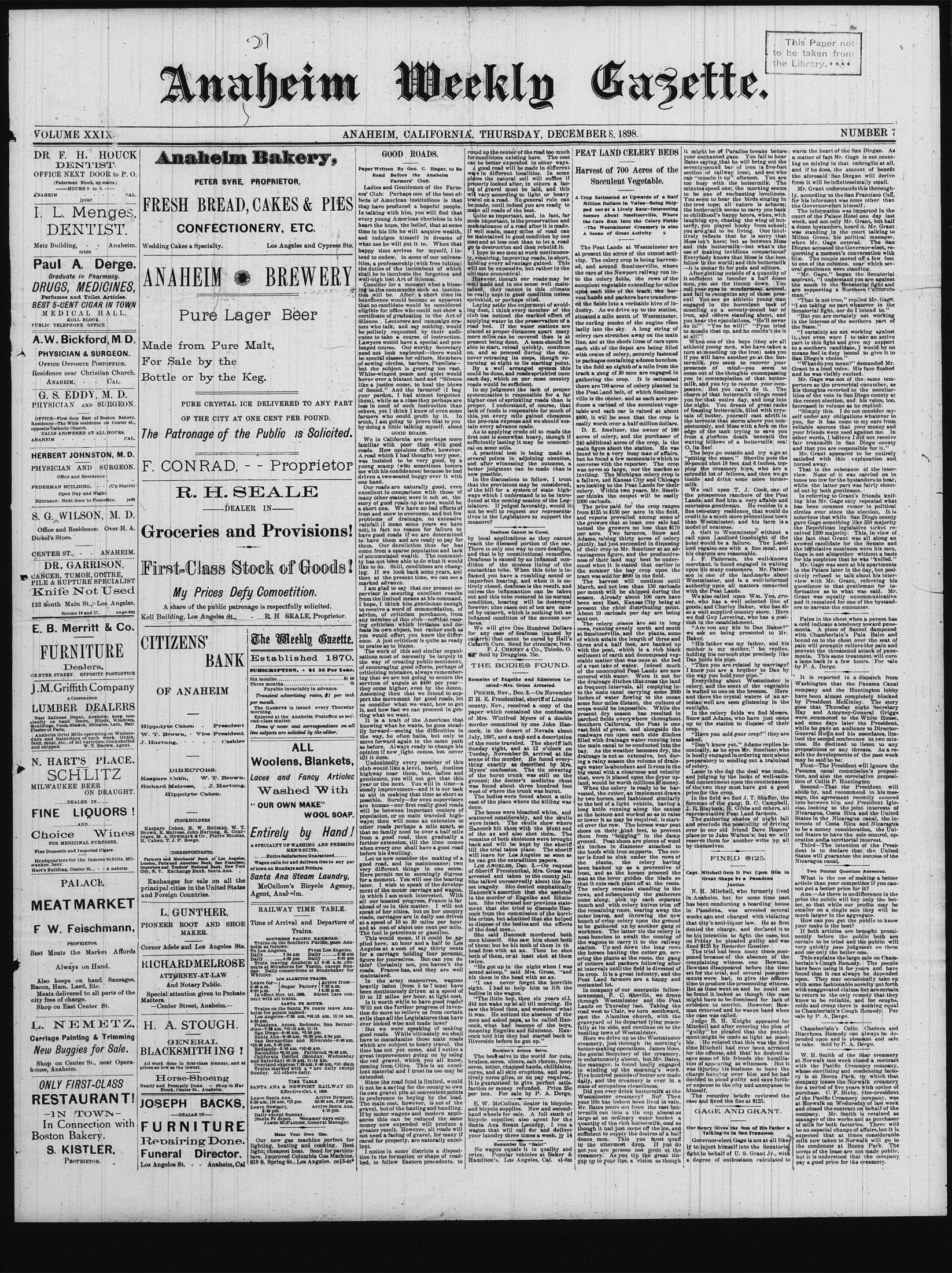
Searchable text
Anaheim
VOLUME XXIX.
DR. F. H. HOUCK
DENTIST.
OFFICE NEXT DOOR to P. O.
(Federman Block, up stairs.)
HOURS 9 to 5.
ANAHEIM CAL.
jy1544
I. L. Menges,
DENTIST.
Metz Building, Anaheim.
feb24
Paul A. Derge.
Graduate in Pharmacy.
DRUGS, MEDICINES,
Perfumes and Toilet Articles.
BEST 5-CENT CIGAR IN TOWN
MEDICAL HALL,
KOLL BLOCK.
PUBLIC TELEPHONE OFFICE.
A.W. Bickford, M.D.
PHYSICIAN & SURGEON.
OFFICE OPPOSITE POSTOFFICE.
Residence near Christian Church.
ANAHEIM, CAL.
G. S. EDDY, M.D.
PHYSICIAN AND SURGEON.
OFFICE—First door East of Boston Bakery.
Residence—The Witte residence on Center St., opposite Catholic Church.
CALLS ANSWERED AT ALL HOURS.
ANAHEIM CAL.
HERBERT JOHNSTON, M.D.
PHYSICIAN AND SURGEON.
Anaheim Bakery,
PETER SYRE, PROPRIETOR,
FRESH BREAD, CAKES & PIES
CONFECTIONERY, ETC.
Wedding Cakes a Specialty. Los Angeles and Cypress Sts.
ANAHEIM BREWERY
Pure Lager Beer
Made from Pure Malt,
For Sale by the
Bottle or by the Keg.
PURE CRYSTAL ICE DELIVERED TO ANY PART
OF THE CITY AT ONE CENT PER POUND.
The Patronage of the Public is Solicited.
F. CONRAD, - Proprietor
G. S. EDDY, M. D. PHYSICIAN AND SURGEON.
OFFICE—First door East of Boston Bakery. Residence—The Witte residence on Center St., opposite Catholic Church.
CALLS ANSWERED AT ALL HOURS. ANAHEIM CAL.
HERBERT JOHNSTON, M. D. PHYSICIAN AND SURGEON.
Office and Residence:
FEDERMAN BUILDING, - (Up Stairs)
Open Day and Night.
Entrance: Next door to Postoffice. je30
S. G. WILSON, M. D.
Office and Residence: Over H. A. Dickel's Store.
CENTER ST., - ANAHEIM.
DR. GARRISON.
CANCER, TUMOR, GOITRE,
PILE & RUPTURE SPECIALIST
Knife Not Used
123 South Main St., Los Angeles.
Rooms 16 and 17. aug4-8m
E. B. Merritt & Co.
FURNITURE Dealers.
CENTER STREET. OPPOSITE POSTOFFICE
J.M.Griffith Company
A CORPORATION
LUMBER DEALERS
Neer Railroad Depot, Anaheim, keep constantly on hand Doors, Blinds, Windows, Mouldings, Posts, Shakes, Shingles, Lath, Hair Flaster of Paris.
Anaheim Grist Mills operating on Wednesdays and Saturdays of each week. Grain, feed, meal, etc., of all varieties. Cornshellled and shipped.
W.T.BROWN, Agent.
N. HART'S PLACE.
SCHLITZ
MILWAUKEE BEER ON DRAUGHT.
DEALER IN....
FINE LIQUORS!
AND...
Choice Wines FOR MEDICINAL PURPOSES.
Fine Domestic and Imported Cigars.
Headquarters for the famous Schlitz, Milwaukee, beer.
Hart's Building, Center St., - Anaheim
PALACE
Bottle or by the Keg.
PURE CRYSTAL ICE DELIVERED TO ANY PART OF THE CITY AT ONE CENT PER POUND.
The Patronage of the Public is Solicited.
F. CONRAD, - Proprietor
R. H. SEALE
DEALER IN
Groceries and Provisions!
First-Class Stock of Goods!
My Prices Defy Competition.
A share of the public patronage is respectfully solicited.
Koll Building, Los Angeles St., - R.H. SEALE, Proprietor.
CITIZENS' BANK
OF ANAHEIM
Hippolyte Cahen President
W.T.Brown Vice President
J.Hartung Cashier
DIRECTORS:
Kaspare Cohn, W.T.Brown.
Richard Melrose, J.Hartung.
Hippolyte Cahen.
STOCKHOLDERS:
Kaspare Cohen, H.W.Hellman, W.T.Brown, R.Melrose, John Hartung, R.Courreges, M.A.Newmark & Co., Pierre Nicolas, H.Cahen, T.J.F.Boege.
CORRESPONDENTS:
Farmers and Merchants' Bank of Los Angeles; London, Paris and American Bank; San Francisco; Importers and Traders' National Bank; New York City, N.Y. Exchange Bank; Santa Ana.
Exchanges for sale on all the principal cities in the United States and Foreign Countries.
The Weekly Gazette.
Established 1870.
SUBSCRIPTION, - $1 50 Per Year.
Six months... $1 00
Three months... 75
Payable invariably in advance.
Transient advertising rates, $1 per inch per month.
The GAZETTE is issued every Thursday morning.
Entered at the Anaheim Postoffice as second-class matter.
Items of news and correspondence on all live subjects are solicited by the editor.
ALL Woolens, Blankets,
Laces and Fancy Articles
Washed With
"OUR OWN MAKE"
WOOL SOAP.
Entirely by Hand!
A SPECIALTY OF WASHING AND PRESSING MEN'S SUITS.
Entire satisfaction guaranteed.....
Wagon calls for and delivers free to any par of town on Mondays and Fridays.
Santa Ana Steam Laundry,
McCullom's Bicycle Agency,
Agent, Anaheim.
FINE LIQUORS!
AND
Choice Wines
FOR MEDICINAL PURPOSES.
Fine Domestic and Imported Cigars.
Headquarters for the famous Schlitz, Milwaukee, beer.
Hart's Building, Center St., Anaheim
PALACE
MEAT MARKET
F W. Feischmann,
PROPRIETOR.
Best Meats the Market Affords
Always on Hand.
Also keeps on hand Sausages, Bacon, Ham, Lard, Etc.
Meats delivered to all parts of the city free of charge.
Shop on East Center St.
L. NEMETZ,
Carriage Painting & Trimming
New Buggies for Sale.
Shop on Center St., near Opera-house, Anaheim.
ONLY FIRST-CLASS RESTAURANT!
— IN TOWN —
In Connection with Boston Bakery.
S. KISTLER.
Proprietor.
STOCKHOLDERS
Kaspare Cohen, H. W. Hellman, W. T. Brown, R. Melrose, John Hartung, R. Courreges, M. A. Newmark & Co., Pierre Nicolas, H. Cahen, T. J. F. Boege.
CORRESPONDENTS:
Farmers and Merchants' Bank of Los Angeles; London, Paris and American Bank, San Francisco; Importers and Traders' National Bank, New York City, N.Y. Exchange Bank, Santa Ana.
Exchanges for sale on all the principal cities in the United States and Foreign Countries.
L. GUNTHER.
PIONEER BOOT AND SHOE MAKER.
Corner Adele and Los Angeles Sts.
RICHARDMELROSE
ATTORNEY-AT-LAW
And Notary Public.
Special attention given to Probate Matters.
—Center Street, Anaheim—
H. A. STOUGH.
GENERAL BLACKSMITHING!
All work done in first-class manner, and at prices as low as the lowest.
Horse-Shoeing
Neatly and Promptly Done. — Shop in Har Block, Center St., Anaheim.
JOSEPH BACKS,
DEALER IN
FURNITURE
Repairing Done.
Funeral Director.
Los Angeles St. ... Anaheim, Cal
"OUR OWN MAKE"
WOOL SOAP.
Entirely by Hand!
A SPECIALTY OF WASHING AND PRESSING MEN'S SUITS.
Entire Satisfaction Guaranteed.....
Wagon calls for and delivers free to any par of town on Mondays and Fridays.
Santa Ana Steam Laundry,
McCullom's Bicycle Agency,
Agent, Anaheim.
RAILWAY TIME TABLE.
Time of Arrival and Departure of Trains.
SOUTHERN PACIFIC RAILROAD.
Trains on the Southern Pacific pass Anaheim as follows:
To Los Angeles.
Daily...7:54 am Daily...9:45 am
Daily...4:25 pm Daily...6:01 pm
Train leaving Anaheim at 9:45 a.m. connects at Miraflores for Tustin, except Sunday. Daily connections at Studebaker for Whittler.
LOS ALAMITOS TRAINS.
Leave for—
9:48 a.m. Sugar Factory Arrive from—
6:02 p.m. 4:25 p.m.
In effect Nov. 1st, 1898. Street cars connect with all trains.
SANTA FE ROUTE.
Trains on the Santa Fe route leave Anaheim for points named:
Los Angeles—7:55 am.*10:15 am, 11:14 am, 4:55 pm.
Pasadena, Azusa, Redondo, San Bernardino—7:55 am.*10:15 am, 11:14 pm.
San Diego—9:46 am.*2:50 pm.
Santa Ana—9:46 am.*2:50 pm, 5:54 pm.
San Bernardino and Riverside—9:46 am.*10:45 am, 5:45 pm.
Redlands—9:46 am.*10:45 am.
Escondido—9:50 pm. Fallbrook*9:46 am.
California limited (Monday, Wednesday and Saturday) 10:15 am, 11:14 am.
Overland express 7:55 am; 9:46 am.*10:45 am
Trains marked with a * are daily except Sunday. All others daily.
TIME TABLE
SANTA ANA & NEWPORT RAILWAY CO.
Effective: Oct. 4, 1898.
Leave Santa Ana. Arrive Newport,
9:50 am; 10 am.*2 ppm. 10:30 am; 2:30 pm.
Leave Newport. Arrive Santa Ana,
9:45 ppm. 4:15 ppm.
Daily except Sunday.
Santa Fe depot. *Steamer days only.
JAMES McFADDEN, General Manager.
Make Your Own Gas.
Our new gas machine perfect for lighting, heating and cooking. Best light; cheapest heat. Send for particulars. Improved Columbia Gas Machine,
618 S. Spring St., Los Angeles, oo13-4t*
ANAHEIM, CALIFORNIA. THURSDAY, DECEMBER 8, 1898.
GOOD ROADS.
Paper Written By Geo. C. Hagar, to Be Read Before the Anaheim Farmers' Club.
Ladies and Gentlemen of the Farmers' Club: Perhaps one of the best effects of American institutions is that they have produced a hopeful people. In talking with him, you will find that every young American cherishes in his heart the hope, the belief, that at some time in his life he will acquire wealth, and indulges himself in dreams of what use he will put it to. When that happy time arrives for myself, I intend to endow, in some of our universities, a professorship (with free tuition) the duties of the incumbent of which shall be to inculcate the forgotten and well-nigh lost Art of Silence.
Consider for a moment what a blessing to the community such an institution will be. After a short time its beneficence would become so apparent that no candidate would be considered eligible for office who could not show a certificate of graduation in the Art of Silence. Lecturers and campaign orators who talk, and say nothing, would be politely requested by their audiences to take a course of instruction. Lawyers would have a special and prolonged course. Our worthy Secretary need not look neglected—there would be special classes for editors. Members of sewing circles, barbers, Populists—but the subject is growing too vast. White-winged peace and quiet would hover over a blatant land and "Silence like a justice come, to heal the blows of Sound." And the farmers? (I beg your pardon, I had almost forgotten them), while as a class they perhaps are less in need of such instruction than others, yet I think I know of even some farmers who could profit by it. In truth, I am going to prove that to you by doing a little talking myself, about GOOD ROADS.
We in California are perhaps more familiar with poor than with good roads. How opinions differ, however. A road which I had thought very poor, was insisted to be very good, by a young scamp (who sometimes honors me with his confidence) because he had round up the center of the road too much for conditions existing here. The cost car be better expended in other ways.
A good road will be made in different ways in different localities. In some places the natural soil will suffice if properly looked after, in others a facing of gravel must be laid, and this will vary according to light or heavy travel on a road. No general rule can be made, until indeed you are ready to make all roads of the best.
Quite as important, and in fact, far more important, is the preservation and maintenance of a road after it is made. If well made, many miles of road can be maintained in good condition by one man and at less cost than to let a road go to destruction and then rebuild it.
I hope to see men at work continuously, repairing, improving roads, in short, holding every advantage gained. This will not be expensive, but rather in the ultimate economical.
However, though our roads may be well made and in one sense well maintained, they cannot in this climate be really kept in good condition unless sprinkled, or perhaps oiled.
Laying aside the enjoyment of avoiding dust, I think every member of the club has noticed the marked effect of applying water in the preservation of a road bed. If the water stations are placed at proper distances apart many more miles can be covered than is at present being done. A team should be able to start, reload quickly, continue on, and so proceed during the day, never retracing its steps, though returning at night to its starting point.
By a well arranged system this could be done, and roads sprinkled once each day, which on our most country roads would be sufficient.
In my judgment the lack of proper systemization is responsible for a far higher cost of sprinkling roads than is proper. I understand, of course, that lack of funds is responsible for much of this, yet every mile gained cheapens the pro-rata expense and we should sustain every advance made.
As to applying crude oil to roads the first cost is somewhat heavy, though if sufficiently lasting it may be economical on some soils.
A practical test is being made at several points in adjoining counties, and after witnessing the outcome, a better judgment can be made than is now possible.
PEAT LAND CELERY BED
Harvest of 700 Acres of the Succulent Vegetable.
A Crop Estimated at Upwards of a Million Dollars in Value—Being Shipped out at a Lively Rate—Interesting Scenes About Smeltzerville, Where the Cars Run Into the Celery Field—The Westminster Creamery is all A Scene of Great Activity.
The Peat Lands at Westminster are at present the scene of the utmost activity. The celery crop is being harvested, and around Smeltzerville, where the cars of the Newport railway run into the celery fields, the rows of succulent vegetable extending for miles upon each side of the track, the hardest hands and packers have transformed the fields into a veritable hive of industry. As we drive up to the station situated a mile south of Westminster, the curling smoke of the engine rises lazily into the sky. A long string of celery cars stretches away on the main line, and at the sheds lines of cars up each side of the depot are being filled with crates of celery, securely fastened in packages containing a dozen bunches. In the field an eighth of a mile from the track a gang of 30 men are engaged in gathering the crop. It is estimated there are 700 acres of celery planted on the Peat Land belt, of which Smeltzerville is the center, and as each acre produces a carload of the succulent vegetable and each car is valued at about $800, it will be seen that the crop is easily worth over a half million dollars.
D. E. Smeltzzer, the owner of 12 acres of celery, and the purchaser of 240 additional acres of the crop, is to main figure about the station. He found to be a very busy man of affairs but he found a few moments in which converse with the reporter. The crop was never so large nor the market inviting.
We in California are perhaps more familiar with poor than with good roads. How opinions differ, however. A road which I had thought very poor, was insisted to be very good, by a young scamp (who sometimes honors me with his confidence) because he had driven a two-seated buggy over it with one hand.
Our roads are naturally good, even excellent in comparison with those of many other states; were it not so, the story of good roads up to now, would be a short one. We have no bad effects of frost and snow to overcome, but few problems of drainage, no excessive rainfall (I mean some years we have not), in fact no reason for failure to have good roads if we are determined to have them and are ready to pay for them. Our dereliction thus far has come from a sparse population and lack of accumulated wealth. The community has not been able to do what it would like to do. Still, conditions are changing. If we look back some years, and then at the present time, we can see a marked advance.
I am glad to say that our present supervisor is seuring excellent results from the limited means at his command. I hope, I think him gentleman enough to receive a word of commendation, of advice, of criticism perchance, from any member of this club—not that rasping criticism which irritates and defeats its own object, but rather such as you would offer; you know the difference. A just criticism is quite as ready to praise as to blame.
The work of this and similar organizations must of necessity be largely in the way of creating public sentiment, of encouraging good efforts, perhaps of criticizing mistakes, always remembering that we are not going to secure the services of angels at $400 per year—they come higher, even by the dozen. Assuming then that we intend to support the movement for good roads, let us consider what we want, how to get it, and how fast we can proceed in getting what we want.
It is a trait of the American that knowing what he wants, he goes steadily forward—seeing the difficulties in the way, he often halts, but only to move forward again in the same path as before. Always ready to change his opinion if new light comes, but never till it does.
Undoubtedly every member of this club would like a level, hard, dustless highway near them, but, ladies and gentlemen, you will not get that this year or the next. You will in time—a steady improvement—and it is our task to aid in making that time as short as possible. Surely—for even supervisors are human—our first really good roads will be between important centers of population, or on main traveled highways; then will come an extension to other roads perhaps a mile apart, so that no family need be over a half mile from a good road, then gradually a further extension, till the time comes when every one shall have a good road before his dwelling.
Let us now consider the making of a good road, and its maintenance; two very different things in one sense. Here permit me to seemingly digress for a moment. You will see the bearing later. I wish to speak of the development of the motor carriage and wagon, in which I am much interested. With white-winged peace and quiet would hover over a blatant land and "Silence like a justice come, to heal the blows of Sound." And the farmers? (I beg your pardon, I had almost forgotten them), while as a class they perhaps are less in need of such instruction than others, yet I think I know of even some farmers who could profit by it. In truth, I am going to prove that to you by doing a little talking myself, about GOOD ROADS.
We in California are perhaps more familiar with poor than with good roads. How opinions differ, however. A road which I had thought very poor, was insisted to be very good, by a young scamp (who sometimes honors me with his confidence) because he had driven a two-seated buggy over it with one hand.
Our roads are naturally good, even excellent in comparison with those of many other states; were it not so, the story of good roads up to now, would be a short one. We have no bad effects of frost and snow to overcome, but few problems of drainage, no excessive rainfall (I mean some years we have not), in fact no reason for failure to have good roads if we are determined to have them and are ready to pay for them. Our dereliction thus far has come from a sparse population and lack of accumulated wealth. The community has not been able to do what it would like to do. Still, conditions are changing. If we look back some years, and then at the present time, we can see a marked advance.
I am glad to say that our present supervisor is seuring excellent results from the limited means at his command. I hope, I think him gentleman enough to receive a word of commendation, from any member of this club—not that rasping criticism which irritates and defeats its own object, but rather such as you would offer; you know the difference. A just criticism is quite as ready to praise as to blame.
The work of this and similar organizations must of necessity be largely in the way of creating public sentiment, of encouraging good efforts, perhaps of criticizing mistakes, always remembering that we are not going to secure the services of angels at $400 per year—they come higher, even by the dozen. Assuming then that we intend to support the movement for good roads, let us consider what we want, how to get it, and how fast we can proceed in getting what we want.
It is a trait of the American that knowing what he wants, he goes steadily forward—seeing the difficulties in the way, he often halts, but only to move forward again in the same path as before. Always ready to change his opinion if new light comes, but never till it does.
Undoubtedly every member of this club would like a level, hard, dustless highway near them, but, ladies and gentlemen, you will not get that this year or the next. You will in time—a steady improvement—and it is our task to aid in making that time as short as possible. Surely—for even supervisors are human—our first really good roads will be between important centers of population, or on main traveled highways; then will come an extension to other roads perhaps a mile apart, so that no family need be over a half mile from a good road, then gradually a further extension, till the time comes when every one shall have a good road before his dwelling.
Let us now consider the making of a good road, and its maintenance; two very different things in one sense. Here permit me to seemingly digress for a moment. You will see the bearing later. I wish to speak of the development of the motor carriage and wagon, in which I am much interested. With White-winged peace and quiet would hover over a blatant land and "Silence like a justice come, to heal the blows of Sound."
And the farmers? (I beg your pardon, I had almost forgotten them), while as a class they perhaps are less in need of such instruction than others, yet I think I know of even some farmers who could profit by it. In truth, I am going to prove that to you by doing a little talking myself, about GOOD ROADS.
We in California are perhaps more familiar with poor than with good roads. How opinions differ, however. A road which I had thought very poor, was insisted to be very good, by a young scamp (who sometimes honors me with his confidence) because he had driven a two-seated buggy over it with one hand.
Our roads are naturally good, even excellent in comparison with those of many other states; were it not so, the story of good roads up to now, would be a short one. We have no bad effects of frost and snow to overcome, but few problems of drainage, no excessive rainfall (I mean some years we have not), in fact no reason for failure to have good roads if we are determined to have them and are ready to pay for them. Our dereliction thus far has come from a sparse population and lack of accumulated wealth. The community has not been able to do what it would like to do. Still, conditions are changing. If we look back some years, and then at the present time, we can see a marked advance.
I am glad to say that our present supervisor is seuring excellent results from the limited means at his command. I hope, I think him gentleman enough to receive a word of commendation, from any member of this club—not that rasping criticism which irritates and defeats its own object, but rather such as you would offer; you know the difference. A just criticism is quite as ready to praise as to blame.
The work of this and similar organizations must of necessity be largely in the way of creating public sentiment, of encouraging good efforts, perhaps of criticizing mistakes, always remembering that we are not going to secure the services of angels at $400 per year—they come higher, even by the dozen. Assuming then that we intend to support the movement for good roads, let us consider what we want, how to get it, and how fast we can proceed in getting what we want.
It is a trait of the American that knowing what he wants, he goes steadily forward—seeing the difficulties in the way, he often halts, but only to move forward again in the same path as before. Always ready to change his opinion if new light comes, but never till it does.
Undoubtedly every member of this club would like a level, hard, dustless highway near them, but,ladies and gentlemen,you will not get that this year or the next. You will in time—a steady improvement—and it is our task to aid in making that time as short as possible. Surely—for even supervisors are human—our first really good roads will be between important centers of population,or on main traveled highways;then will come an extension to other roads perhaps a mile apart,so that no family need be over a half mile from a good road,then gradually a further extension,till the time comes when every one shall have a good road before his dwelling.
Let us now consider the making of a good road,and its maintenance; two very different things in one sense. Here permit me to seemingly digress for a moment. You will see the bearing later. I wish to speak of the development of the motor carriage and wagon,in which I am much interested.With White-winged peace and quiet would hover over a blatant land and "Silence like a justice come,to heal the blows of Sound."
And the farmers? (I beg your pardon,I had almost forgotten them),while as a class they perhaps are less in need of such instruction than others,yet I think I know of even some farmers who could profit by it. In truth,I am going to prove that to you by doing a little talking myself,about GOOD ROADS.
We in California are perhaps more familiar with poor than with good roads. How opinions differ,however. A road which I had thought very poor,was insisted to be very good,by a young scamp (who sometimes honors me with his confidence) because he had driven a two-seated buggy over it with one hand.
Our roads are naturally good,even excellent in comparison with those of many other states; were it not so,the story of good roads up to now,would be a short one. We have no bad effects of frost和 snow to overcome,but few problems of drainage,no excessive rainfall(I mean some years we have not),in fact no reason for failure to have good roads if we are determined to have them and are ready to pay for them. Our dereliction thus far has come from a sparse population and lack of accumulated wealth. The community has not been able to do what it would like to do. Still,conditions are changing. If we look back some years,and then at the present time,我们 can see a marked advance.
I am glad to say that our present supervisor is seuring excellent results from the limited means at his command. I hope,I think him gentleman enough to receive a word of commendation,from any member of this club—not that rasping criticism which irritates and defeats its own object,but rather such as you would offer;you know the difference. A just criticism is quite as ready to praise as to blame.
The work of this and similar organizations must of necessity be largely in the way of creating public sentiment,of encouraging好 efforts,perhaps of criticizing mistakes,always remembering that we are not going to secure the services of angels at $400 per year—they come higher,even by the dozen. Assuming then that we intend to support the movement for good roads,let us consider what we want,how to get it,and how fast we can proceed in getting what we want.
It is a trait of the American that knowing what he wants,he goes steadily forward—seeing the difficulties in the way,he often halts,but only to move forward again in the same path as before. Always ready to change his opinion if new light comes,但 never till it does.
Undoubtedly every member of this club would like a level,hard,dustless highway near them,但 ladies and gentlemen,你 will not get that this year or the next. You will in time—a steady improvement—and it is our task to aid in making that time as short as possible.Surely—for even supervisors are human—our first really good roads will be between important centers of population,or on main traveled highways;then will come an extension to other roads perhaps a mile apart,so that no family need be over a half mile from a good road,then gradually a further extension,till the time comes when every one shall have a good road before his dwelling.
Let us now consider the making of a good road,and its maintenance; two very different things in one sense.Here permit me to seemingly digress for a moment.You will see the bearing later.I wish to speak of the development of the motor carriage and wagon,在which I am much interested.With White-winged peace and quiet would hover over a blatant land and "Silence like a justice come,to heal the blows of Sound."
And the farmers? (I beg your pardon,I had almost forgotten them),while as a class they perhaps are less in need of such instruction than others,yet I think I know of even some farmers who could profit by it. In truth,I am going to prove that to you by doing a little talking myself,about GOOD ROADS.
D.E. Smeltzer,the owner of 125 acres of celery,和报者 prevailed among some growers that at least one sale hitherto了得的 growers no less than $per acre.Two farmers。 Snow adams,raising thirty acres of celery jointly,胡 just succeeded in disposing.of their crop to Mr.Smeltzer at an advantage figure,and their productivity of their land may best be understood when it is stated that earlierthe summer she hay crop upon her tract was sold for $600 in the field.
The harvest will continue until March,and not less than 150 carrots per month will be shipped during this season.Already about 100 cars have been sent East.Kansas City being presentthe chief distributing pointAbout 10 carloads per day are best sent out.The celery plants are set in loos rows,running evenly north and southAt Smeltzerville,and the plants,southern attainmentthe length of three three and half feet,the bankwith pea叶,是 rich blue sedimentof earth and decomposed vietable matter that was once at the bottomof an vast lake of water.Indeed mostof unoccupied Peat Lands are met covered with water.Were it not there,the drainage ditches that cross lace at frequent intervals,全 emptyingto main canal carrying some 28 inchesof water flowing到coastsome four miles distant,the culture crops would be impossible。Whilepresent dry season has resultedparched fields everywhere through Southern California,the Peat is ovalfieldof green,and alongsideroadways run upon each sideditching filled with drainage water running intothe main canalbe conducted into bay.As weather becomes dry,the drainage is not so extensive,但dinga rainy seasonthe volumeof drainagewater is abundant and runs intobig canal with a clearnessand velocitythat were placed uponthe dryerland.would be worth millionsof moons.
When the celery is readyto be hiveded,the cutter,nan implement drawnby two horses,and fashionedsimilarlyto bedofa light vehicle,havinglong knife running alongthe centerat bottomand worked so asto raiseloweritas may be required.is stagedoverthe latteritas may be required.is stagedoverthe latteritas may be required.is stagedoverthe latteritas may be required.is stagedoverthe latteritas may be required.is stagedoverthe latteritas may be required.is stagedoverthe latteritas may be required.is stagedoverthe latteritas may be required.is stagedoverthe latteritas may be required.is stagedoverthe latteritas may be required.is stagedoverthe latteritas may be required.is stagedoverthe latteritas may be required.is stagedoverthe latteritas may be required.is stagedoverthe latteritas may be required.is stagedoverthe latteritas may be required.is stagedoverthe latteritas may be required.is stagedoverthe latteritas may be required.is stagedoverthe latteritas may be required.is stagedoverthe latteritas may be required.is stagedoverthe latteritas may be required.is stagedoverthe latteritas may be required.is stagedoverthe latteritas may be required.is stagedoverthe latteritas may be required.is stagedoverthe latteritas may be required.is stagedoverthe latteritas may be required.is stagedoverthe latteritas may be required.is stagedoverthe latteritas may be required.is stagedoverthe latteritas may be required.is stagedoverthe latteritas may be required.is stagedoverthe latteritas may be required.is stagedoverthe latteritas may be required.is stagedoverthe latteritas may be required.is stagedoverthe latteritas may be required.is stagedoverthe latteritas may be required.is stagedoverthe latteritas may be required.is stagemediatedoverthe latter.itas may be required.is stagemediatedoverthe latter.itas may be required.is stagemediatedoverthe latter.itas may be required.is stagemediatedoverthe latter.itas may be required.is stagemediatedoverthe latter.itas may be required.is stagemediatedoverthe latter.itas may be required.is stagemediatedoverthe latter.itas may be required.is stagemediatedoverthe latter.itas may be required.Is stagemediatedoverthe latter.itas may be required.Is stagemediatedoverthe latter.itas may be required.Is stagemediatedoverthe latter.itas may be required.Is stagemediatedoverthe latter.itas may be required.Is stagemediatedoverthe latter.itas may be required.Is stagemediatedoverthe latter.itas may be required.Is stagemediatedoverthe latter.itas may be required.Is stagemediatedoverthe latter.itas maybe recommended.Is stagemediatedoverthe latter.itas maybe recommended.Is stagemediatedoverthe latter.itas maybe recommended.Is stagemediatedoverthe latter.itas maybe recommended.Is stagemediatedoverthe latter.itas maybe recommended.Is stagemediatedoverthe latter.itas maybe recommended.Is stagemediatedoverthe latter.itas maybe recommended.Is stagemediatedoverthe latter.itasmaybe recommended.Is stagemediatedoverthe latter.itascymbered-overthisparticular.Is stagemediatedoverthisparticular.Is stagemediatedoverthisparticular.Is stagemediatedoverthisparticular.Is stagemediatedoverthisparticular.Is stagemediatedoverthisparticular.Is stormmediated-overthisparticular.Is stormmediated-overthisparticular.Is storm mediated-overthisparticular.Is storm mediated-overthisparticular.Is storm mediated-overthisparticular.Is storm mediated-overthisparticular.Is storm mediated-overthisparticular.Is storm mediated-overthisparticular.Is storm mediated-overthisparticular.Is storm mediated-overthisparticular.Is storm mediated-overthisparticular.Is storm mediated-overthisparticular.Is storm mediated-overthisparticular.Is storm mediated-overthisparticular.Is storm mediated-overthisparticular.Is storm mediated-overthisparticular.Is storm mediated-overthisparticular.Is storm mediated-overthisparticular.Is storm mediated-overthisparticular.Is storm mediated-overthisparticular.Is storm mediated-overthisparticular.Is storm mediated-overthisparticular.Is storm mediated-overthisparticular.Is storm mediated-overthisparticular.Is storm mediated-overthisparticular.Is storm mediated-overthisparticular.Is storm mediated-overthisparticular.Is storm mediated-overthisparticular.Is storm mediated-overthisparticular.Is storm mediated-overthisparticular.Is storm mediated-overthisparticular.Is storm mediated-overthisparticular.Is storm mediated-overthisparticular.Is storm mediated-overthisparticular.Is storm mediated-overthisparticular.Is storm mediated-overthisparticular.Is storm mediated-overthisparticular.Is storm mediated-overthisparticular.Is storm mediated-overthisparticular.Is storm mediated-overthisparticular.Is storm mediated-overthisparticular.Is storm mediATEDOverThisParticularIs Storm MediatorIs Storm MediatorIs Storm MediatorIs Storm MediatorIs Storm MediatorIs Storm MediatorIs Storm MediatorIs Storm MediatorIs Storm MediatorIs Storm MediatorIs Storm MediatorIs Storm MediatorIs Storm MediatorIs Storm MediatorIs Storm MediatorIs Storm MediatorIs Storm MediatorIs Storm MediatorIs Storm MediatorIs Storm MediatorIs Storm MediatorIs Storm MediatorIs Storm MediatorIs Storm MediatorIs Storm MediatorIs Storm MediatorIs Storm MediatorIs Storm MediatorIs Storm MediatorIs Storm MediatorIs Storm MediatorIs Storm MediatorIs Storm MediatorIs Storm MediatorIs Storm MediatorIs StormMediatorIs Storm MediatorIs Storm MediatorIs Storm MediatorIs Storm MediatorIs Storm MediatorIs Storm MediatorIs Storm MediatorIs Storm MediatorIs Storm MediatorIS Storm MediatorIS Storm MediatorIS Storm MediatorIS Storm MediatorIS Storm MediatorIS Storm MediatorIS Storm MediATORIS Storm MediATORIS Storm MediATORIS Storm MediATORIS Storm MediATORIS Storm MediATORIS StORMMediATORIS STORMMediATORIS STORMMediATORIS STORMMediATORIS STORMMediATORIS STORMMediATORIS STORMMediATORIS STORMMediATORIS STORMMediATORIS STORMMediATORIS STORMMediATORIS STORMMediATORIS STORMMediATORIS STORMMediATORIS STORMMediATORIS STORMMediATORIS STORMMediATORIS STORMMediATORIS STORMMediATORIS STORMMediatoriois STORMMediatoriois STORMMediatoriois STORMMediatoriois STORMMedicatoriois STORMMedicatoriois STORMMedicatoriois STORMMedicatoriois STORMMedicatoriois STORMMedicatoriois STORMMedicatoriois STORMMedicatoriois STORMMedicatoriois STORMMedicatoriois STORMMedicatoriois STORMMedicatoriois STORMMedicatoriois STORMMedicatoriois STORMMedicatoriois STORMMedicatoriois STORMMedicatoriois STORMMedicatoriois STORMMedicatoriois STORMMedicatoriois STORMMedicatoriois STORMMedicatoryis STORMMedicatoryis STORMMedicatoryis STORMMedicatoryis STORMMedicatoryis STORMMedicatoryis STORMMedicatoryis STORMMedicatoryis STORMMedicatoryis STORMMedicatoryis STORMMedicatoryis STormsmedicatoryis STormsmedicatoryis STormsmedicatoryis STormsmedicatoryis STormsmedicatoryis STormsmedicatoryis STormsmedicatoryis STormsmedicatoryis STormsmedicatoryis STormsmedicatoryis STormsmedicatoryis STormsmedicatoryis STormsmedicatoryis STormsmedicatoryis STormsmedicatoryis STormsmedicatoryis STormsmedicatoryis STormsmedicatoryis STormsmedicatoryisSTormsmedicatoryisSTormsmedicatoryisSTormsmedicatoryisSTormsmedicatoryisSTormsmedicatoryisSTormsmedicatoryisSTormsmedicatoryisSTormsmedicatoryisSTormsmedicatoryisSTormsmedicatoryisSTormsmedicatoryisSTormsmedicatoryisSTormsmedicatoryisSTormsmedicatoryisSTormsmedicatoryisSTormsmedicatoryisSTormsmedicatorylisSTormsmedicatoriaislSTormsmedicaislSTormsmedicaislSTormsmedicaislSTormsmedicaislSTormsmedicaislSTormsmedicaislSTormsmedicaislSTormsmedicaislSTormsmedicaislSTormsmedicaislSTormsmedicaislSTormsmedicaislSTormsmedicaislSTormsmedicaislSTormsmedicaislSTormsmedicaislST尔斯medicaislSt尔斯medicaislSt尔斯medicaislSt尔斯medicaislSt尔斯medicaislSt尔斯medicaislSt尔斯medicaislSt尔斯medicaislSt尔斯medicaislSt尔斯medicaislSt尔斯medicaislSt尔斯medicaislSt尔斯medicaislSt尔斯medicaislSt尔斯medicaislSt尔斯medicaislSt尔斯medicaislSt尔斯medicaislSt尔斯medicaislSt尔斯medicaislSt尔斯mediaSlSt尔斯mediaSlSt尔斯mediaSlSt尔斯mediaSlSt尔斯mediaSlSt尔斯mediaSlSt尔斯mediaSlSt尔斯mediaSlSt尔斯mediaSlSt尔斯mediaSlSt尔斯mediaSlSt尔斯mediaSlSt尔斯mediaSlSt尔斯mediaSlSt尔斯mediaSlSt尔斯mediaSlSt尔斯mediaSlSt尔斯mediaSlSt尔斯mediaSlSt尔斯mediaSlSt尔斯mediaSlSt尔斯mediaSlSt尔斯mediaSlSt尔斯mediaSlSt尔斯mediaSlSt尔斯mediaSlSt尔斯mediaSlSt尔斯mediaSlSt尔斯mediaSlSt尔斯mediaSlSt尔斯mediaSlSt尔斯mediaSlSt尔斯mediaSlSt尔斯mediaSlSt尔斯mediaSlSt尔斯mediaSlStilles mediaSlStilles mediaSlStilles mediaSlStilles mediaSlStilles mediaSlStilles mediaSlStilles mediaSlStilles mediaSlStilles mediaSlStilles mediaSlStilles mediaSlStilles mediaSlStilles mediaSlStilles mediaSlStilles mediaSlStilles mediaSlStilles mediaSlStilles mediaSlStilles mediaSlStilles mediaSlStilles mediaSlStilles mediaSlStilles mediaSlStilles mediaSlShestiles mediaShestiles媒体Shestiles媒体Shestiles媒体Shestiles媒体Shestiles媒体Shestiles媒体Shestiles媒体Shestiles媒体Shestiles媒体Shestiles媒体Shestiles媒体Shestiles媒体Shestiles媒体Shestiles媒体Shestiles媒体Shestiles媒体Shestiles媒体Shestiles媒体Shestiles媒体Shestiles媒体Shestiles媒体Shestiles媒体Shestiles媒体Shestiles媒体Shestiless媒体ShestILEss媒体ShestILEss媒体ShestILEss媒体Shest
Surely—for even supervisors are human—our first really good roads will be between important centers of population, or on main traveled highways; then will come an extension to other roads perhaps a mile apart, so that no family need be over a half mile from a good road, then gradually a further extension, till the time comes when every one shall have a good road before his dwelling.
Let us now consider the making of a good road, and its maintenance; two very different things in one sense. Here permit me to seemingly digress for a moment. You will see the bearing later. I wish to speak of the development of the motor carriage and wagon, in which I am much interested. With all our boasted progress, France is far ahead of us in this matter. I will not speak of her cities, but on her country roads, carriages are in daily use driven at a speed of 18 to 20 miles per hour and at cost of about one cent per mile. The fuel is petroleum or gasoline.
This would mean, if it could be applied here, an hour and a half to Los Angeles at a cost of say thirty cents for a carriage holding four persons; figure for yourselves. But can you do this? Certainly not, you haven’t the roads. France has, and they are well maintained.
In the army maneuvers, wagons heavily laden (from 5 to 7 tons) have been continuously driven at a speed of 10 to 12 miles per hour, at light cost. Is it worth while to have good roads? Will not the further progress of invention do more to relieve us from certain evils than all the Legislatures that have ever looked wise and made laws?
But we were speaking of making good roads. While ultimately we shall have to macadamize those main roads which are subject to heavy travel, the time has not yet come, and I notice a great improvement going on by using the red gravel, which you all know, coming from Olive. This is an excellent material and I trust its use may be extended.
Since the road fund is limited, would it not be a saving for the county to own its own gravel pits at convenient points in preference to buying by the load. The main cost, however, is not of the gravel, but of the hauling and handling. If by motor wagons and modern appliances this can be reduced the same money now expended will produce a greater result. However, all roads will not need a facing of gravel, for many if cared for properly, are naturally excellent.
I notice in some districts a disposition in the formation or shape of roadbed, to follow Eastern precedents, to east of the place where the killing was done.
The bones were bleached white, and scattered considerably, and the skulls were intact. The skulls show where Hancock hit them with the blunt end of the ax and also shot them. The remains of both skeletons were brought back and will be kept by the sheriff till the trial takes place. The sheriff will leave for Los Angeles as soon as he can get the extradition papers.
LOS ANGELES, Dec. 2. On request of Sheriff Freudenthal, Mrs. Gross was arrested and taken to the county jail. She talked unreservedly about the desist tragedy. She denied emphatically Hancock’s assertion that she assisted in the murder of Engelke and Edmiston. She reiterated her previous statement that she tried to dissuade Hancock from the commission of the horrible crime, but admitted that she helped to dispose of the bodies and the effects of the dead men.
She said Hancock murdered both men himself. She saw him shoot both of them; but he hit both of them in the head first with an ax. Then he shot both of them, or at least shot at them twice.
“He got up in the night when I was sound asleep,” said Mrs. Gross, “and hit them in the head with an ax.
“I can never forget the horrible sight. I had to help him to lift the bodies in the wagon.
“The little boy, then six years old, did not wake up at all till morning. He saw the blood then, and wondered what it was. He noticed the absence of the men and asked papa, as he called Hancock, what had become of the boys, meaning Engelke and Edmiston. Hancock told him they had started back to Riverside before he got up.”
Bucklen’s Arnica Salve.
The best salve in the world for cuts, bruises, sores, ulcers, salt rheum, fever sores, tetter, chapped hands, chilblains, corns, and all skin eruptions, and positively cures piles, or no pay required. It is guaranteed to give perfect satisfaction or money refunded. Price 25c per box. For sale by P. A. Derge.
E. W. McCollum, dealer in bicycles and bicycle supplies. New and second-hand wheels for sale. A full stock of bicycle supplies; also agent for the Santa Ana Steam Laundry. I run a wagon that will call for and deliver your laundry three times a week. jy 14
Remember the “Bain!”
No wagon equals it in quality and price. Popular vehicles at Baker & Hamilton’s, Los Angeles, Cal. sl-6m
by two horses, and fashioned similar to the bed of a light vehicle, having long knife running along the center at the bottom and worked so as to rake lower it as may be required; is staged over the row. The horses wear pads shoes on their hind feet, to prevent them from “bogging” in the dark ground. Peat shoes are pieces of wool six inches in diameter attached to the hoofs with iron supports. The coaster is fixed to sink under the rows; the plants, the celery have been banked up as a preventive frost, and as the horses proceed to man at the lever guides the blade that it cuts each plant off at the rooftop.
The celery remains standing in the rows, and subsequently the gathering bunch and with celery knives trimming the remaining roots, tearing away from outer leaves, and throwing the munch of crisp celery upon the ground to be gathered up by another gang workmen. The latter tie the celery neat bunches to tie the coming of the wagons to carry it to the railway station. Up and down the long rods the horses hauling the cutter go, securing the plants at the roots, the gears of cutters and packers following afternoons at intervals until the field is divested its crop. It is a great industry, and Peat Land farmers are a happy source contented lot.
In company of our energetic fellow townsman, F. C. Shevlin, we drove through Westminster and the Park Lands on Thursday last. Taking our road west to Clairmont, we turn southward past the Alamitos church, with its graveyard of its departed lying peacefully at its side, and continue on to bustling town of Westminster.
Here we drive up to the Westminster creamery, just through its morning butter-making operations. James Moore is unfortunately absent, but Mr. Bates manager is found busily engaged in winding up the morning’s work. Five hundred pounds of butter are made daily, and the creamy is ever in state of scrupulous cleanliness.
Did you ever drink buttermilk at Westminster creamery? No? Your life has indeed been lived in vain Mr. Bates pours out from the vast bermilk can into a tin cup almost large as an ordinary water bucket quantity of the rich buttermilk cake though it had just off the ice; sufficient to supply the desires of a hot dozen men. This you must quip to the uttermost drop. If you not you are persona non grata at creamery. As you tip the great cup up to your lips, a vision as though
LAND CELERY BEDS
of 700 Acres of the Succulent Vegetable.
Estimated at Upwards of a Half Ton Dollars in Value—Being Shipment at a Lively Rate—Interesting Issues About Smeltzerville, Where Years Run Into the Celery Fields. Westminster Creamery is also one of Great Activity.
Great Lands at Westminster are at the scene of the utmost activity—the celery crop is being harvested around Smeltzerville, where of the Newport railway run in celery fields, the rows of the vegetable extending for miles each side of the track, the hardads and packers have transformed fields into a veritable hive of industry. As we drive up to the station, a mile south of Westminster, smoking smoke of the engine rises into the sky. A long string of cars stretches away on the main road at the sheds lines of cars upon which the depot are being filled with the celery, securely fastenedages containing a dozen bunches. Field an eighth of a mile from the gang of 30 men are engaged in digging the crop. It is estimated that 700 acres of celery planted in Land belt, of which Smeltzerville center, and as each acre pro- carload of the succulent vegetaed each car is valued at about $10 will be seen that the crop is worth over a half million dollars.
Smeltzer, the owner of 160 feet of celery, and the purchaser of national acres of the crop, is the sureture about the station. He was to be a very busy man of affairs, bound a few moments in which to meet with the reporter. The crop never so large, nor the market so large.
The Michigan celery crop is it might be of Paradise breaks before your enchanted gaze. You fail to hear Bates saying that he will bring out the seventy-pound bar of iron (a five-foot section of railway iron), and see who can "muscle it up" oftenest. You are too busy with the buttermilk. The minutes speed one; the morning seems to be one of enchanting loveliness. You seem to hear the birds singing in the tree tops; all nature is acharm; the buttermilk seems to carry you back to childhood's happy hours, when, with laughing eye, chasing the wing of butterfly, you played hooky from school; you are glad to be living. One intuitively reflects that he is sorry that Moss isn't here; but as between Moss and this buttermilk—but what's use of making invidious comparisons? Everybody knows that Moss is the best fellow in the world; and this buttermilk—it is nectar fit for gods and editors.
After getting outside of a quantity of it sufficient to founder a half dozen men, you set the tincup down. You roll your eyes in wondermeat around, and fail to recognize any of those present! You see an athletic young man engaged in the herculean task of muscling up a seventy-pound bar of iron, and others standing about, and you hear the ejaculations, "He'll never do it!" "Yes he will!" "Pyne tried to muscle that up, and he couldn't do it at all!"
When one of the boys (they are all athletic young men, who have taken a turn at muscling up the iron) asks you if you will have another go at the buttermilk, you seem to recover your presence of mind—you seem to come out of the thoughts encompassing you in contemplation of that buttermilk, and you try to resume your composure. But you can't do it. The charm of that buttermilk clings round you for that entire day, and long into the night. You dream of great casks of foaming buttermilk, filled with crystals of butter, yourself cast adrift in the torrents that storm above you tempestuously, and Moss with a fork on the edge of the tank trying to save you from a glorious death beneath the waving billows of a buttermilk sea! O, its fine!
The boys go outside and try a go at "pitting the stane." Shevlin puts the 50-pound shot 18 feet and 6 inches, toping the creamy boys, who are a splendid lot of fellows, and then go warm the heart of the San Diegan. As a matter of fact Mr. Gage is not counting on mixing in that imbroglio at all, and if he does, the amount of benefit the aforesaid San Diegan will derive from it will be infinitessimally small.
Mr. Grant understands this thoroughly, according to the San Francisco Call, for his informant was none other than the Governor-elect himself.
The information was imparted in the court of the Palace Hotel one day last week, and not only Mr. Grant, but half a dozen bystanders, heard it. Mr. Grant was standing in the court talking to Milton Green, his political manager, when Mr. Gage entered. The San Diegan accosted the Governor-elect, requesting a moment's conversation with him. The couple moved off a few feet to one of the columns near which several gentlemen were standing.
"Mr. Gage," began the Senatorial aspirant, "I understand you are against the south in the Senatorial fight and are supporting a Northern California man."
"That is not true," replied Mr. Gage. "I am taking no part whatever in the Senatorial fight, nor do I intend to."
"But you are certainly not working in the interest of the southern part of the State."
"I certainly am not working against it, but even were I to take an active part in this fight and give my support to a southern candidate, I would by no means feel in duty bound to give it to San Diego's choice."
"What do you mean?" demanded Mr. Grant in a loud voice. His face flushed and he was visibly excited.
Mr. Gage was not of the same temperance as the proverbial cucumber, as his thoughts reverted to the peculiarities of the vote in San Diego county at the recent election, and his voice, too, increased in volume as he replied:
"Simply this. I do not consider myself under any obligations whatever to you, for it has come to my ears from reliable sources that your money and your friends were used against me. In other words, I believe I did not receive fair treatment in San Diego county and that you are responsible for it."
Mr. Grant appeared to be entirely satisfied with this explanation and turned away.
That is the substance of the interview. None of it was carried on in
It is estimated that 700 acres of celery planted in the Land belt, of which Smeltzer the center, and as each acre proclaimed each car is valued at about $150 per acre in the field. Born so large over a half million dollars. Smeltzer, the owner of 160 acres of celery, and the purchaser of national acres of the crop, is the picture about the station. He was to be a very busy man of affairs, found a few moments in which he met with the reporter. The Michigan celery crop is rare, and Kansas City and Chicago bring to the Peat Lands for their harvest. Will continue until it is not less than 150 carloads with will be shipped during the harvest. Will continue until it is not less than 150 carloads with will be shipped during the harvest.
Already about 100 cars have been East, Kansas City being at the chief distributing point. 10 carloads per day are being celery plantare set in long running evenly north and south tzerville, and the plants, some attain the length of three and a half feet, are banked up on peat, which is a rich black out of earth and decomposed vegetation that was once at the bed at lake of water. Indeed much unoccupied Peat Lands are now with water. Were it not for climate ditches that cross the land moment intervals, all emptying in main canal carrying some 2000 feet of water flowing to the ocean four miles distant, the culture of would be impossible. While the dry season has resulted in fields everywhere throughout North California, the Peat is one kind of green, and alongside the rows run upon each side ditches with drainage water running into canal to be conducted into the basin the weather becomes dry, the ice is not so extensive, but durability season the volume of drainer is abundant and it runs in the canal with a clearness and velocity where it placed upon the dryer up should be worth millions of money. In the celery is ready to be harried by the cutter, an implement drawn horses, and fashioned similarly used of a light vehicle, having a sniff running along the center bottom and worked so as to raise it as may be required, is started by the row. The horses wear peat on their hind feet, to prevent from "bogging" in the damp Peat shoes are pieces of wood shines in diameter attached to fists with iron supports. The cutxed to sink under the rows of plants, the celery having banked up as a preventive of land as the horses proceed the lever guides the blade so cuts each plant off at the roots. Celery remains standing in the land subsequently the gatherers long pick up each separate come out of the thoughts encompassing you in contemplation of that buttermilk, and you try to resume your composure. But you can't do it. The charm of that buttermilk clings round you for that entire day, and long into the night. You dream of great casks of foaming buttermilk, filled with crystals of butter, yourself cast adrift in the torrents that storm above you tempestuously, and Moss with a fork on the edge of the tank trying to save you from a glorious death beneath the waving billows of a buttermilk seal. O, its fine!
The boys go outside and try a go at "plitting the stane." Shevlin puts the 50-pound shot 18 feet and 6 inches, toping the creamy boys, who are a splendid lot of fellows, and then we go inside and drink some more buttermilk.
We call upon T. J. Cook, one of the prosperous ranchers of the Peat Lands, and find him a very affable and courteous gentleman. He resides in a fine two-story residence, that would do credit to a much more pretentious town than Westminster, and his farm is a model of neatness.
A visit to Westminster without a call upon Landlord Goodnight of the hotel would be a failure. The Landlord regales one with a fine meal, and his charges are reasonable.
J. F. Patterson, the well-known merchant, is found engaged in waiting upon his many customers. Mr. Patterson is one of the landmarks about Westminster, and is a well-informed authority upon all matters connected with the Peat Lands.
We also called upon Wm. Yeo, grocer, who has a well selected line of goods, and Charley Baker, who has also a well supplied country store. Here we find Guy Lovering, who has a position in the establishment.
"Are you any kin to Dan Baker?" we ask on being presented to Mr. Baker.
"His father was my father, and his mother is my mother," he replies, holding his corncob pipe precisely like Dan holds his pipe.
"Then you are related by marriage? I know you are a brother to Dan by the way you hold your pipe."
Everything about Westminster is celery, and the scent of the vegetable is wafted to one on the breezes. Here and there the crystal waters of an artesian well are seen glistening in the sunlight.
In the celery fields we find Messrs. Snow and Adams, who have just come up to the station to dispose of their crop.
"Have you sold your crop?" they are asked.
"Don't know yet." Adams replies laconically, as he eyes Mr. Smeltzer, who is busily engaged in ordering men about preparatory to sending out a trainload of celery.
Later in the day the deal was made, and judging by the looks of well-satisfied contentment upon the countenances of the two they must have got a good price for the crop.
In the field we find J. T. Shaffer, the foreman of the gang; B. C. Campbell, J. R. Blaylock, H. Gibbs and others, all representative Peat Land farmers.
The gathering shades of night fall and preclude the possibility of driving over to our old friend Dave Rogers' place or to Jake Walton's; but we will reserve them for another write up all by themselves.
FINED $125.
Capt. Mitchell Gets It Put Upon Him in Great Shape by a Pasadena Justice.
N. H. Mitchell, who formerly lived in Anaheim, but for some time past come out of the thoughts encompassing you in contemplation of that buttermilk, and you try to resume your composure. But you can't do it. The charm of that buttermilk clings round you for that entire day, and long into the night. You dream of great casks of foaming buttermilk, filled with crystals of butter, yourself cast adrift in the torrents that storm above you tempestuously, and Moss with a fork on the edge of the tank trying to save you from a glorious death beneath the waving billows of a buttermilk seal. O, its fine!
The boys go outside and try a go at "plitting the stane." Shevlin puts the 50-pound shot 18 feet and 6 inches, toping the creamy boys, who are a splendid lot of fellows, and then we go inside and drink some more buttermilk.
We call upon T. J. Cook, one of the prosperous ranchers of the Peat Lands, and find him-a very affable and courteous gentleman. He resides in a fine two-story residence, that would do credit to a much more pretentious town than Westminster, and his farm is a model of neatness.
A visit to Westminster without a call upon Landlord Goodnight of the hotel would be a failure. The Landlord regales one with a fine meal, and his charges are reasonable.
J. F. Patterson, the well-known merchant, is found engaged in waiting upon his many customers. Mr. Patterson is one of the landmarks about Westminster, and is a well-informed authority upon all matters connected with the Peat Lands.
We also called upon Wm. Yeo, grocer, who has a well selected line of goods, and Charley Baker, who has also a well supplied country store. Here we find Guy Lovering, who has a position in the establishment.
"Are you any kin to Dan Baker?" we ask on being presented to Mr. Baker.
"His father was my father, and his mother is my mother," he replies, holding his corncob pipe precisely like Dan holds his pipe.
"Then you are related by marriage? I know you are a brother to Dan by the way you hold your pipe."
Everything about Westminster is celery, and the scent of the vegetable is wafted to one on the breezes. Here and there the crystal waters of an artesian well are seen glistening in the sunlight.
In the celery fields we find Messrs. Snow and Adams, who have just come up to the station to dispose of their crop.
"Have you sold your crop?" they are asked.
"Don't know yet." Adams replies laconically, as he eyes Mr. Smeltzer, who is busily engaged in ordering men about preparatory to sending out a trainload of celery.
Later in the day the deal was made, and judging by the looks of well-satisfied contentment upon the countenances of the two they must have got a good price for the crop.
In the field we find J. T. Shaffer, the foreman of the gang; B. C. Campbell, J. R. Blaylock, H. Gibbs and others, all representative Peat Land farmers.
The gathering shades of night fall and preclude the possibility of driving over to our old friend Dave Rogers' place or to Jake Walton's; but we will reserve them for another write up all by themselves.
Mr. Gage was not of the same temperature as the proverbial cucumber, as his thoughts reverted to the peculiarities of the vote in San Diego county at recent election, and his voice too increased in volume as he replied:
"Simply this. I do not consider myself under any obligations whatever to you, for it has come to my ears from reliable sources that your money and your friends were used against me. In other words I believe I did not receive fair treatment in San Diego county and that you are responsible for it."
Mr. Grant appeared to be entirely satisfied with this explanation and turned away.
That is the substance of the interview. None of it was carried on in tones too low for the bystanders to hear; while latter part was fairly shouted out by both gentlemen.
In referring to Grant's friends knifing him Mr. Gage only repeated what has been common rumor in political circles ever since the election. It is notorious that while San Diego county gave Gage something like 350 majoritythe Republican legislative ticket received 1200 majority. This, in view of the fact that Grant was all along an avowed candidate for the Senate andthe legislative nominees were his men,Gage is not altogether without a basis for his suspicion that he was "knilled."
Mr. Gage was seen at his apartments in the Palace later in the day,但 positively refused to talk about his interview with Mr. Grant,the referring his questioner to that gentleman for information as to what was said.Mr.Grant was equally uncommunicative and it remained for one ofthe bystanders to narratethe encounter.
Pains inthe chest whena personhasa cold indicatea tendency towardpneumonia.A pieceof flanneldamponedwithChamberlain's Pain Balmandboundontothechestovertheseandpreventthethreatenedattackofpneumonia.Thesametreatmentwillcurea lamebackinafewhours.ForsalebyP.A.Derge.
It is reported ina dispatchfromWashingtonthatthePanama CanalcompanyandtheHuntington lobbyhavebeen almost completelyblockedbyPresidentMcKinley.The storygoesthatThursdaynightSecretaryHayandAttorney-GeneralGriggswere summonedtotheWhiteHouse,andsomedayslaterthePresident,而hegavean audiencetoDirectorGeneralHutinandhisassociates,limitedthesecond conferencetotwominutes.Hedeclinedtolistetowanypropositionsoranythreats.Asresultthedevelopmentsofthepastweekmaybe saidtobe:
First—The President willignorethePanama canal commission's proposition,andalsothecorrelativepositionofCollisP.Huntington
Second—ThatthePresidentwillabideby,andrecommendinhismessage,theagreementrecententlyenteredintobetweenhimandPresidentIglesiaslookingtothejointinterestsofNicaragua,CostaRicaandtheUnitedStatesintheNicaraguacanal,theinterestsofCostaRicaandNicaraguatobea moneyconsideration,theUnitedStatestohavethesolecontrol,operationanda territorialinterest.
Third—TheintentionofthePresidentistodeclarethattheUnitedStateswillguaranteethesuccessoftheNicaraguacanal.
Two Pointed Questions Answered.
Whatistheuseofmakingabetterarticlethanyourcompetitorifyou cannotgetabetterpriceforit?
Ans.-Asthereisnodifferenceinthepriceofthepublicwillbuyonly,thebet
FINED $125.
Capt. Mitchell Gets It Put Upon Him in Great Shape by a Pasadena Justice.
N. H. Mitchell, who formerly lived in Anaheim, but for some time past has been conducting a boarding house in Pasadena, was arrested several weeks ago and charged with violating that city's anti-liquor law. He at first denied the charge, and declared it to be his intention to fight the case, but on Friday he pleaded guilty and was fined $125 by Recorder Rossiter.
The trial had been many times postponed because of the absence of the complaining witness, one Bowman. Bowman disappeared before the time set for the trial, and several postponements were had, to give the officers time to produce the prosecuting witness. But as time went on and he could not be found it looked as though the case might have to be dismissed for lack of evidence to convict. However, Bowman returned and he was on hand when the case was called.
Judge R. H. Knight appeared for Mitchell and after entering the plea of "guilty" he pleaded that the punishment might be made as light as possible. He related that this was the first time Mitchell had ever been arrested for the offense, and that he desired to save some of his friends the humiliation of appearing as witnesses. But it was injuring his business to have the charge hanging over him and he had decided to plead guilty and say further expense to the city and annoyance to himself.
The recorder briefly reviewed the case and fixed the fine at $125.
GAGE AND GRANT.
Our Henry Gives the Son of His Father a Talking-to in San Francisco.
Governor-elect Gage is not at all likely to inject himself into the Senatorial fight in behalf of U.S. Grant Jr., with a degree of enthusiasm calculated to