anaheim-gazette 1898-12-01
Scanned page
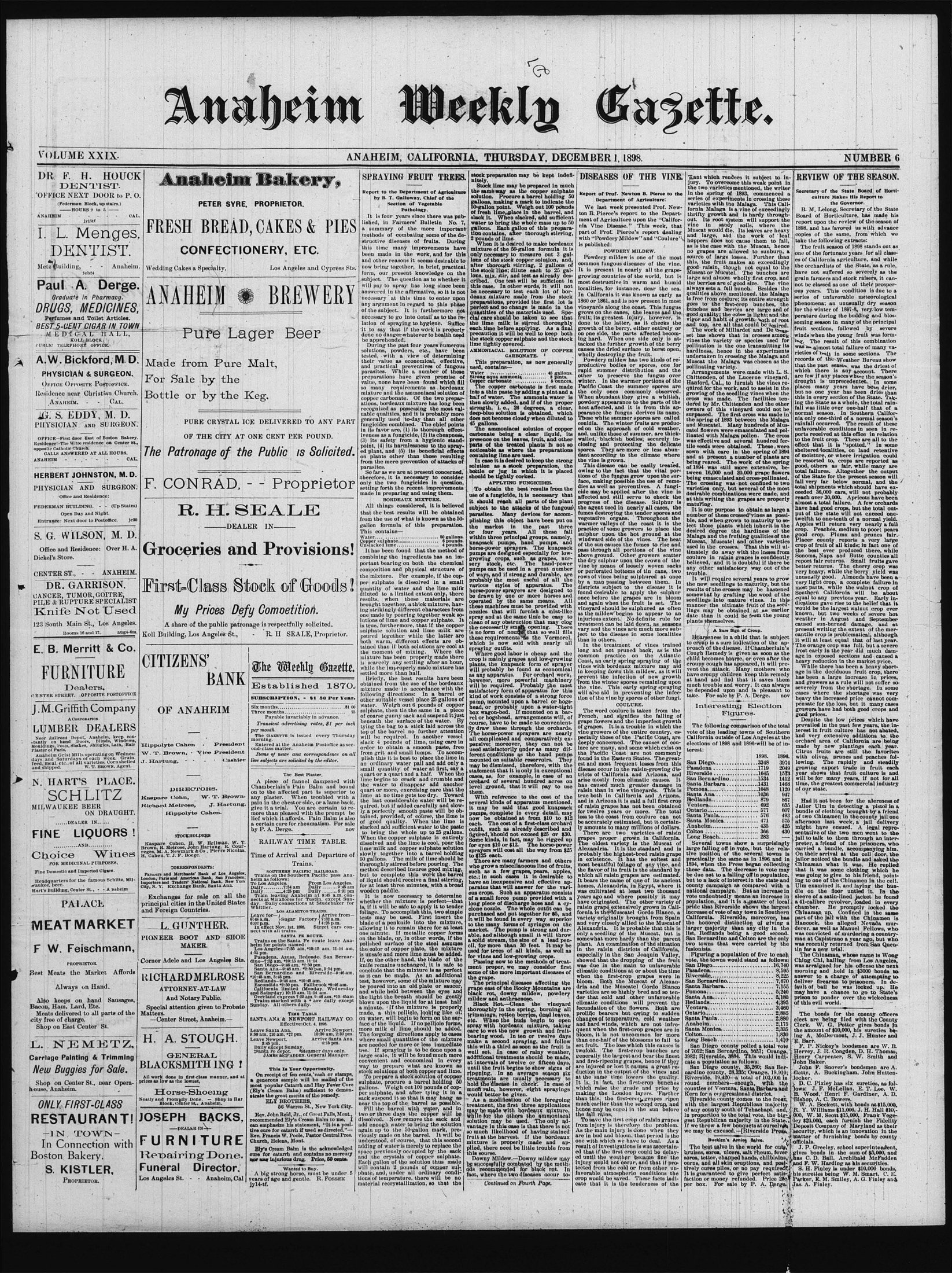
Searchable text
Anaheim
VOLUME XXIX.
DR. F. H. HOUCK
DENTIST.
OFFICE NEXT DOOR to P. O.
(Federman Block, upstairs.)
HOURS 9 to 5
ANAHEIM CAL.
jy15tf
I. L. Menges,
DENTIST.
Metz Building, Anaheim.
feb24
Paul A. Derge.
Graduate in Pharmacy.
DRUGS, MEDICINES,
Perfumes and Toilet Articles.
BEST 5-CENT CIGAR IN TOWN
MEDICAL HALL,
KOLL BLOCK.
PUBLIC TELEPHONE OFFICE.
A.W. Bickford, M.D.
PHYSICIAN & SURGEON.
Office Opposite Postoffice.
Residence near Christian Church.
ANAHEIM, CAL.
G. S. EDDY, M.D.
PHYSICIAN AND SURGEON.
OFFICE—First door East of Boston Bakery.
Residence—The White residence on Center St., opposite Catholic Church.
CALLS ANSWERED AT ALL HOURS.
ANAHEIM CAL.
Anaheim Bakery,
PETER SYRE, PROPRIETOR.
FRESH BREAD, CAKES & PIES
CONFECTIONERY, ETC.
Wedding Cakes a Specialty. Los Angeles and Cypress Sts.
ANAHEIM BREWERY
Pure Lager Beer
Made from Pure Malt,
For Sale by the
Bottle or by the Keg.
PURE CRYSTAL ICE DELIVERED TO ANY PART
OF THE CITY AT ONE CENT PER POUND.
The Patronage of the Public is Solicited.
PHYSICIAN & SURGEON.
OFFICE OPPOSITE POSTOFFICE.
Residence near Christian Church.
ANAHEIM.
G. S. EDDY, M. D.
PHYSICIAN AND SURGEON.
OFFICE—First door East of Boston Bakery.
Residence—The Wilte residence on Center St., opposite Catholic Church.
CALLS ANSWERED AT ALL HOURS.
ANAHEIM
HERBERT JOHNSTON, M. D.
PHYSICIAN AND SURGEON.
Office and Residence:
FEDERMAN BUILDING. - (Up Stairs)
Open Day and Night.
Entrance: Next door to Postoffice. je30
S. G. WILSON, M. D.
Office and Residence: Over H. A. Dickel's Store.
CENTER ST., - - ANAHEIM.
DR. GARRISON.
CANCER, TUMOR, GOITRE,
PILE & RUPTURE SPECIALIST
Knife Not Used
123 South Main St., Los Angeles.
Rooms 16 and 17. aug4-6m
E. B. Merritt & Co.
FURNITURE
Dealers.
CENTER STREET. OPPOSITE POSTOFFICE
J.M.Griffith Company
A CORPORATION
LUMBER DEALERS
Neer Railroad Depot, Anaheim, keep constantly on hand Doors, Blinds, Windows, Mouldings, Posts, Shakes, shingles, Lath, Hair Plaster of Paris.
Anaheim Grist Mills operating on Wednesdays and Saturdays of each week. Grain, feed, meal, etc., of all varieties, Cornshellled and shipped.
W.T.BROWN, Agent.
N. HART'S PLACE.
SCHLITZ
MILWAUKEE BEER ON DRAUGHT.
DEALER IN...
FINE LIQUORS!
AND...
Choice Wines
FOR MEDICINAL PURPOSES.
Fine Domestic and Imported Cigars.
Headquarters for the famous Schlitz, Milwaukee, beer.
Hart's Building, Center St., - - Anaheim
For Sale by the Bottle or by the Keg.
PURE CRYSTAL ICE DELIVERED TO ANY PART OF THE CITY AT ONE CENT PER POUND.
The Patronage of the Public is Solicited.
F. CONRAD, - Proprietor
R. H. SEALE
DEALER IN
Groceries and Provisions!
First-Class Stock of Goods!
My Prices Defy Competition.
A share of the public patronage is respectfully solicited.
Koll Building, Los Angeles St., - R.H. SEALE, Proprietor.
CITIZENS' BANK
OF ANAHEIM
Hippolyte Cahen - President
W.T.Brown, Vice President
J.Hartung,
DIRECTORS.
Kaspare Cohn, W.T.Brown.
Richard Melrose, J.Hartung.
Hippolyte Cahen.
STOCKHOLDERS
Kaspare Cohen, H.W. Heijman, W.T.Brown, R.Melrose, John Hartung, R.Courreges, M.A.Newmark & Co., Pierre Nicolas,H.Cahen,T.J.F.Boege.
CORRESPONDANTS:
Farmers and Merchants' Bank of Los Angeles; London, Paris and American Bank; San Francisco; Importers and Traders' National Bank; New York City, N.Y. Exchange Bank; Santa Ana.
Exchanges for sale on all the
The Weekly Gazette.
Established 1870.
SUBSCRIPTION, - $1 50 Per Year.
Six months... $1 00
Three months... 75
Payable invariably in advance.
Transient advertising rates, $1 per inch per month.
The Gazette is issued every Thursday morning.
Entered at the Anaheim Postoffice as second-class matter.
Items of news and correspondence on all live subjects are solicited by the editor.
The Best Plaster.
A piece of flannel dampened with Chamberlain's Pain Balm and bound on to the affected part is superior to any plaster. When troubled with a pain in the chest or side, or a lame back, give it a trial. You are certain to remove than pleased with the prompt be lief which it affords. Pain Balm is also a certain cure for rheumatism. For sale by P.A.Derge.
RAILWAY TIME TABLE.
Time of Arrival and Departure of Trains.
SOUTHERN PACIFIC RAILROAD.
Trains on the Southern Pacific pass Anaheim as follows:
To Los Angeles.
Daily... 7:54 am Daily... 9:45 am
Daily... 4:25 pm Daily... 6:01 pm
Train leaving Anaheim at 9:45 am concludes at Miramar for Tustin Excursion.
MILWAUKEE BEER ON DRAUGHT.
DEALER IN...
FINE LIQUORS!
AND...
Choice Wines FOR MEDICINAL PURPOSES.
Fine Domestic and Imported Cigars.
Headquarters for the famous Schlitz, Milwaukee, beer.
Hart's Building, Center St., - Anaheim.
PALACE
MEAT MARKET
F.W. Feischmann,
PROPRIETOR.
Best Meats the Market Affords
Always on Hand.
Also keeps on hand Sausages, Bacon, Ham, Lard, Etc.
Meats delivered to all parts of the city free of charge.
Shop on East Center St.
L. NEMETZ,
Carriage Painting & Trimming
New Buggies for Sale.
Shop on Center St., near Opera-house, Anaheim.
ONLY FIRST-CLASS RESTAURANT!
IN TOWNIn Connection with Boston Bakery.
S. KISTLER,
PROPRIETOR.
SOUTHERN PACIFIC RAILROAD.
Trains on the Southern Pacific pass Anaheim as follows:
To Los Angeles. From Los Angeles.
Daily...7:54 am Daily...9:45 am
Daily...4:25 pm Daily...6:01 pm
Train leaving Anaheim at 9:45 a.m. connects at Miramores for Tustin, except Sunday. Dally connections at Studebaker for Whittler.
L. GUNTHER.
PIONEER BOOT AND SHOE MAKER.
Corner Adele and Los Angeles Sts.
RICHARD MELROSE
ATTORNEY-AT-LAW
And Notary Public.
Special attention given to Probate Matters.
—Center Street, Anaheim.
H. A. STOUGH.
GENERAL BLACKSMITHING!
All work done in first-class manner, and at prices as low as the lowest.
Horse-Shoeing
Neatly and Promptly Done. Shop in Har Block, Center St., Anaheim.
JOSEPH BACKS,
DEALER IN
FURNITURE RepairingDone.
Funeral Director.
Los Angeles St. - Anaheim, Cal
STOCKHOLDERS
Kaspare Cohen, H. W. Hejlman, W. T. Brown, R. Melrose, John Hartung, R. Courreges, M.A. Newmark & Co., Pierre Nicolas, H. Cahen, T.J.F. Boege.
CORRESPONDENTS:
Farmers and Merchants' Bank of Los Angeles, London, Paris and American Bank, San Francisco; Importers and Traders' National Bank, New York City, N.Y. Exchange Bank, Santa Ana.
Exchanges for sale on all the principal cities in the United States and Foreign Countries.
TIME TABLE
SANTA ANA & NEWPORT RAILWAY CO.
Effective: Oct. 4, 1898.
Leave Santa Ana. Arrive Newport.
9:50 am, 10 am, *2 p.m. 10:30 am, 2:39 pm.
Leave Newport. Arrive Santa Ana.
3:45 pm.
Daily except Sunday.
Santa Fe depot. Steamer days only.
JAMES MCFADDEN General Manager.
This Is Your Opportunity.
On receipt of ten cents,'cash or stamps,
a generous sample will be mailed of the most popular Catarrh and Hay Fever Cure (Ely's Cream Balm) sufficient to demonstrate the great merits of the remedy.
ELY BROTHERS,
56 Warren St., New York City.
Rev. John Reid, Jr., of Great Falls, Mont., recommended Ely's Cream Balm to me. I can emphasize his statement, "It is a positive cure for catarrh if used as directed." Rev. Francis W. Poole, Pastor Central Pres. Church, Helena, Mont.
Ely's Cream Balm is the acknowledged cure for catarrh and contains no mercury nor any injurious drug. Price, 50 cents.
Wanted to Buy.
A big strong horse, must be under 5 years of age and gentle. R. FOSSEK jy14-tf.
ANAHEIM, CALIFORNIA, THURSDAY, DECEMBER 1, 1898.
Bakery,
BREWERY
Beer
SPRAYING FRUIT TREES.
Report to the Department of Agriculture by B. T. Galloway, Chief of the Section of Vegetable Pathology.
It is four years since there was published, in Farmers' Bulletin No. 7, a summary of the more important methods of combating some of the destructive diseases of fruits. During this time many improvements have been made in the work, and for this and other reasons it seems desirable to now bring together, in brief, practical form, our present knowledge on the subject. The question as to whether it will pay to spray has long since been answered in the affirmative, so it is not necessary at this time to enter upon any argument in regard to this phase of the subject. It is furthermore not necessary to go into detail as to the relation of spraying to hygiene. Suffice it to say that if the work is properly done no danger whatever to health need be apprehended.
During the past four years numerous solutions, powders, etc., have been tested, with a view of determining their value as economical, effective, and practical preventives of fungous parasites. While a number of these preparations have given promise of value, none have been found which fill so many requirements as bordeaux mixture and the ammoniacal solution of copper carbonate. Of the two preparations, bordeaux mixture has long been recognized as possessing the most valuable qualities, and it is probably more generally used to-day than all other fungicides combined. The chief points in its favor are, (1) its thorough effectiveness as a fungicide, (2) its cheapness, (3) its safety from a hygienic standpoint, (4) its harmlessness to the sprayed plant, and (5) its beneficial effects on plants other than those resulting from the mere prevention of attacks of parasites.
So far as we are at present concerned,
stock preparation may be kept indefinitely.
Stock lime may be prepared in much the same way as the copper sulphate solution. Procure a barrel holding 50 gallons, making a mark to indicate the 50-gallon point. Weigh out 100 pounds of fresh lime, place in the barrel, and slack it. When slacked, add sufficient water to bring the whole mass up to 50 gallons. Each gallon of this preparation contains, after thorough stirring, 2 pounds of lime.
When it is desired to make bordeaux mixture of the 50-gallon formula it is only necessary to measure out 3 gallons of the stock copper solution, and, after thorough stirring, 2 gallons of the stock lime; dilute each to 25 gallons, mix, stir, and test as already described. One test will be sufficient in this case. In other words, it will not be necessary to test each lot of bordeaux mixture made from the stock preparations, provided the first lot is perfect and no change is made in the quantities of the materials used. Special care should be taken to see that the lime milk is stirred thoroughly each time before applying. As a final precaution it will be well to keep both the stock copper sulphate and the stock lime tightly covered.
AMMONIACAL SOLUTION OF COPPER CARBONATE.
This preparation, as now generally used, contains—
Water 45 gallons.
Strong aqua ammonia 3 pints.
Copper carbonate 5 ounces.
The copper carbonate is first made into a thin paste by adding a pint and a half of water. The ammonia water is then slowly added, and if of the proper strength, i.e., 26 degrees, a clear, deep-blue solution is obtained, which does not become cloudy when diluted to 45 gallons.
The ammoniacal solution of copper carbonate being a clear liquid, its presence on the leaves, fruit, and other parts of the treated plants is not so noticeable as where the preparations containing lime are used.
In case it is desired to keep the strong solution as a stock preparation, the bottle or jug in which it is placed
DISEASES OF THE VINE.
Report of Prof. Newton B. Pierce to the Department of Agriculture:
We last week presented Prof. Newton B. Pierce's report to the Department of Agriculture upon the "California Vine Disease." This week, the part of Prof. Pierce's report dealt with "Powdery Mildew" and "Couluris" is published:
POWDERY MILDEW.
Powdery mildew is one of the most common fungous diseases of the vines. It is present in nearly all the grazing countries of the world, but most destructive in warm and humid localities, for instance, near the sea. In California it was known as early 1860 or 1861, and is now present in many vineyards along the coast. This fungus grows on the canes, the leaves and fruit; its greatest injury, however, done to the latter, as it checks growth of the berry, either entirely on one side, the parts affected becoming hard. When one side only is attacked the further growth of the berries causes the dried surface to burst open wholly destroying the fruit.
Powdery mildew has two kinds of productive bodies or spores, one rapid summer distribution and another to preserve the fungus on winter. In the warmer portions of Pacific Coast the summer spores are only ones commonly observed. When abundant they give a whitish powdery appearance to the parts of the host affected, and it is from this appearance the fungus derives its name. These white summer spores are called conidia. The winter fruits are produced on the approach of cold weather and unlike those of summer, are thick-walled, blackish bodies; securely closing and protecting the delicate spores. They are more or less abrupt according to the climate where the vine is grown.
This disease can be easily treating owing to the fact that the vital
PROPRIETOR
ALE
provisions!
of Goods!
petition.
fectfully solicited.
I SEALE, Proprietor.
Weekly Gazette.
Published 1870.
PITION, - $1 50 Per Year.
$1 00
75
le invariably in advance.
advertising rates, $1 per inch
TTE is issued every Thursday
at the Anaheim Postoffice as sectter.
uses and correspondence on all
are solicited by the editor.
The Best Plaster.
of flannel dampened with
pin's Pain Balm and bound
affected part is superior to
r. When troubled with a
chest or side, or a lame back,
sial. You are certain to repleased with the prompt be
it affords. Pain Balm is also
sure for rheumatism. For sale
merge.
WAY TIME TABLE.
Arrival and Departure of Trains.
MERCHANT PACIFIC RAILROAD.
the Southern Pacific pass Anaows:
From Los Angeles.
Daily.
9:45 am
Daily.
6:01 pm
piming Anaheim at 9:45 am.
Connexion to Tustin except Superior.
preparations have given promise of value, none have been found which fill so many requirements as bordeaux mixture and the ammoniacal solution of copper carbonate. The two preparations, bordeaux mixture has long been recognized as possessing the most valuable qualities, and it is probably more generally used to-day than all other fungicides combined. The chief points in its favor are (1) its thorough effectiveness as a fungicide, (2) its cheapness, (3) its safety from a hygienic standpoint, (4) its harmlessness to the sprayed plant, and (5) its beneficial effects on plants other than those resulting from the mere prevention of attacks of parasites.
So far as we are at present concerned, therefore, it is necessary to consider only the two fungicides in question, setting forth the recent improvements made in preparing and using them.
BORDEAUX MIXTURE.
All things considered, it is believed that the best results will be obtained from the use of what is known as the 50-gallon formula of this preparation. This contains—
Water.....50 gallons.
Copper sulphate.....6 pounds.
Unslacked lime.....4 pounds.
It has been found that the method of combining the ingredients has an important bearing on both the chemical composition and physical structure of the mixture. For example, if the copper sulphate is dissolved in a small quantity of water and the lime milk diluted to a limited extent only, there results, when these materials are brought together, a thick mixture, having strikingly different characters from one made by pouring together weak solutions of lime and copper sulphate. It is true, furthermore, that if the copper sulphate solution and lime milk are poured together while the latter are both warm, different effects are obtained than if both solutions are cool at the moment of mixing. Where the mixture has been properly made there is scarcely any settling after an hour, while the improperly made mixture has settled more than half.
Briefly, the best results have been obtained from the use of the bordeaux mixture made in accordance with the following directions: In a barrel or other suitable vessel place 25 gallons of water. Weigh out 6 pounds of copper sulphate, then tie the same in a piece of coarse gummy sand and suspend just beneath the surface of the water. By tying the bag to a stick laid across the top of the barrel no further attention will be required. In another vessel slack 4 pounds of lime, using care in order to obtain a smooth paste, free from grit and small lumps. To accomplish this it is best to place the lime in an ordinary water pail and add only a small quantity of water at first, say a quart or a quart and a half. When the lime begins to crack and crumble and the water to disappear add another quart or more, exercising care that the lime at no time gets too dry. Toward the last considerable water will be required, but if added carefully and slowly a perfectly smooth paste will be obtained, provided, of course, the lime is of good quality. When the lime is slacked add sufficient water to the paste to bring the whole up to 25 gallons. When the copper sulphate is entirely dissolved and the lime is cool, pour the lime milk and copper sulphate solution slowly into a barrel holding 50 gallons. The milk of lime should be thoroughly stirred before pouring. The method described insures good mixing, but to complete this work the barrel of liquid should receive a final stirring, for at least three minutes, with a broad wooden paddle.
It is now necessary to determine preparations have given promise of value, none have been found which fill so many requirements as bordeaux mixture and the ammoniacal solution of copper carbonate. The two preparations, bordeaux mixture has long been recognized as possessing the most valuable qualities, and it is probably more generally used to-day than all other fungicides combined. The chief points in its favor are (1) its thorough effectiveness as a fungicide, (2) its cheapness, (3) its safety from a hygienic standpoint, (4) its harmlessness to the sprayed plant, and (5) its beneficial effects on plants other than those resulting from the mere prevention of attacks of parasites.
So far as we are at present concerned, therefore, it is necessary to consider only the two fungicides in question, setting forth the recent improvements made in preparing and using them.
BORDEAUX MIXTURE.
All things considered, it is believed that the best results will be obtained from the use of what is known as the 50-gallon formula of this preparation. This contains—
Water.....50 gallons.
Copper sulphate.....6 pounds.
Unslacked lime.....4 pounds.
It has been found that the method of combining the ingredients has an important bearing on both the chemical composition and physical structure of the mixture. For example, if the copper sulphate is dissolved in a small quantity of water and the lime milk diluted to a limited extent only, there results, when these materials are brought together, a thick mixture, having strikingly different characters from one made by pouring together weak solutions of lime and copper sulphate. It is true, furthermore, that if the copper sulphate solution and lime milk are poured together while the latter are both warm, different effects are obtained than if both solutions are cool at the moment of mixing. Where the mixture has been properly made there is scarcely any settling after an hour, while the improperly made mixture has settled more than half.
Briefly, the best results have been obtained from the use of the bordeaux mixture made in accordance with the following directions: In a barrel or other suitable vessel place 25 gallons of water. Weigh out 6 pounds of copper sulphate, then tie the same in a piece of coarse gummy sand and suspend just beneath the surface of the water. By tying the bag to a stick laid across the top of the barrel no further attention will be required. In another vessel slack 4 pounds of lime, using care in order to obtain a smooth paste, free from grit and small lumps. To accomplish this it is best to place the lime in an ordinary water pail and add only a small quantity of water at first, say a quart or a quart and a half. When the lime begins to crack and crumble and the water to disappear add another quart or more, exercising care that the lime at no time gets too dry. Toward the last considerable water will be required, but if added carefully and slowly a perfectly smooth paste will be obtained, provided, of course, the lime is of good quality. When the lime is slacked add sufficient water to the paste to bring the whole up to 25 gallons. When the copper sulphate is entirely dissolved and the lime is cool, pour the lime milk and copper sulphate solution slowly into a barrel holding 50 gallons. The milk of lime should be thoroughly stirred before pouring. The method described insures good mixing, but to complete this work the barrel of liquid should receive a final stirring, for at least three minutes, with a broad wooden paddle.
It is now necessary to determine preparations have given promise of value, none have been found which fill so many requirements as bordeaux mixture and the ammoniacal solution of copper carbonate. The copper carbonate is first made into a thin paste by adding a pint and a half of water. The ammonia water is then slowly added, and if of proper strength, i.e., 26 degrees, a clear, deep-blue solution is obtained, which does not become cloudy when diluted to 45 gallons.
The ammoniacal solution of copper carbonate being a clear liquid, its presence on the leaves, fruit, and other parts of the treated plants is not so noticeable as where the preparations containing lime are used.
In case it is desired to keep the strong solution as a stock preparation, the bottle or jug in which it is placed should be tightly corked.
APPLYING FUNGICIDES.
To obtain the best results from the use of a fungicide, it is necessary that it should reach all parts of the plant subject to the attacks of the fungous parasites. Many devices have been put on the market in the past three or four years. All these fall within three principal groups, namely, knapsack pumps, hand pumps, and horse-power sprayers. The knapsack pumps are designed especially for low-growing crops such as grapes, nursery stock, etc. The hand-power pumps can be used in a great number of ways, and if strong and durable, are probably the most useful of all various styles of apparatus. The horse-power sprayers are designed to be drawn by one or more horses and operated by the same means. All these machines must be provided with nozzles that will furnish a mist-like spray and at the same time be easy to clean of any obstruction that may clog the necessarily small opening. There is no form of nozzles that so well fills these requirements as the Vermorel, which is now sold with nearly all spraying outfit.
Where good labor is cheap and the crop is mainly grapes and low-growing plants, the knapsack form of sprayer will probably be found as economical as any apparatus. For orchard work, however, more powerful machinery will be required. Probably most satisfactory form of apparatus for this kind of work consists of a strong force pump, mounted upon a barrel or hoghead, or probably upon a water-tight box wagon-bed. If mounted on a barrel or hoghead, arrangements will, of course, have to be made to conveniently draw these through the orchards. The horse-power sprayers are nearly all complicated and comparatively expensive; moreover they cannot be used satisfactorily under as many different conditions as the hand pumps mounted on suitable reservoirs. They may be dismissed Therefore with the statement that it is only in exceptional cases as, for example in case of an archoid of several hundred acres on level ground, that it will pay to use them.
With reference to the cost of the several kinds of apparatus mentioned it may be said that good knapsack pumps complete in every detail may now be obtained at from $10 to $12 each. The cost of a first-class archord outfit such as already described and figured, should not exceed $25 or $30. Some kinds in fact may be rigged up for even $10 or $12. The horse-power sprayers will cost all the way from $25 to $125 each.
There are many farmers and others who grow miscellaneous line of fruits such as a few grapes, pears,apples,etc.; in such cases it is desirable to have an inexpensive and effective apparatus that will answer for the various crops. Such an apparatus consists of a small force pump provided with a other to preserve the fungus or other winter. In warmer portions of this Pacific Coast the summer spores are only ones commonly observed When abundant they give a whitish powdery appearance to the parts of this host affected and still serve to check off progress of the disease. Sulphur used in nearly all cases,fumes destroying the tender spores are vegetative organs. Throughout warmer valleys of the coast it is possible some growers to place sulphur upon-the hot ground at windward side of the vines.The hortof sun causes them to find desirable for applying the sulphur once before the grapes are in bloom and again when the fruit is set.Tree vineyard should be sulphured as often as during injurious extent.No definite rule treatment can be laid down as seasonally and vane are much so subject to disease in some localities than in others.
In the treatment of vines trained long and not pruned back,as is common practice on the Atlantic Coast,an early spring spraying of vines with bordeaux mixture may be kept down this mildew,as it prevents infection of new growth from winter spores remaining up until twelve years or more.The young vine loss also aid in preventing infection of vine by spores of other fungi.
COULURE.
The word coulure is taken from French,and signifies the falling grape flowers and the imperfect growth of grapes。它 is a trouble in which vine growers of entire country,especially those of Pacific Coast,deeply concerned.The causes of oculure are many,and some which exist on Pacific Coast are not common in Eastern States。The greatest pest and most frequent losses from raisin disease occur in raisin-growing tribes of California and Arizona,arise mostly from climatic causes.His caused much greater damage raisin than in wine vineyards。这真 both in California and Arizona,and in Arizona it is said full first crop of raisin grapes has not been cultivated for twelve years or more.The young vine loss also aid in preventing infection of vine by spores of other fungi.
There are two varieties-of raisin grapes proper grown in California.Alexandria。它是 standard和 probably highest-bred raisin grown in existence。它 has softest foliage of any vine,andthe flavor of its fruit isthe standard which all raisin grapes are estimated.I bears name one of its ancestorsAlexandria,在 Egyptwhere was cultivated at least two thousand years ago,and possibly since it moths
WAY TIME TABLE.
Arrival and Departure of Trains.
NORTH PACIFIC RAILROAD.
The Southern Pacific pass Analamoses.
From Los Angeles.
7:54 am Daily.....9:45 am
4:25 pm Daily.....6:01 pm
ing Anaheim at 9:45 a.m. connances for Tustin, except Sunconnections at Studebaker for
SANTA FE ROUTE.
The Santa Fe route leave Analamoses at 7:55 am, 10:15 am, 11:14 am,
Azusa, Redondo, San Bernara, 10:14 am, 11:14 am,
9:46 am, 2:50 pm, 5:54 pm,
4:25 pm, Fallbrook, 9:46 am,
limited (Monday, Wednesday),
10:15 am, 11:14 am,
express 7:55 am, 9:46 am, 10:45 am
worked with a * are daily except
others daily.
TIME TABLE.
& NEWPORT RAILWAY CO.
Effective: Oct. 4, 1898.
ARRIVE NEWPORT,
am,*2 ppm.
10:30 am, 2:39 pm.
ort.
Arrive Santa Ana,
4:15 pm.
CEPT SUNDAY.
Steamer days only.
MCFADDEN, General Manager.
IS Your Opportunity.
of ten cents,'cash or stamps,
sample will be mailed of the
ear Catarrh and Hay Fever Cure
(am Balm) sufficient to demonment merits of the remedy.
BROTHERS,
56 Warren St., New York City.
Reid, Jr., of Great Falls, Mont.
and Ely's Cream Balm to me. I
make his statement, "It is a poscatarrh if used as directed."—
W. Poole, Pastor Central Pres.
Penn, Mont.
Balm is the acknowledged
catarrh and contains no mercury
virious drug. Price, 50 cents.
Wanted to Buy.
long horse, must be under 5
and gentle. R. FOSSEK
IN THE LAST considerable water will be required, but if added carefully and slowly a perfectly smooth paste will be obtained, provided, of course, the lime is
of good quality. When the lime is slacked add sufficient water to the paste
to bring the whole up to 25 gallons.
When the copper sulphate is entirely dissolved and the lime is cool, pour the
lime milk and copper sulphate solution slowly together into a barrel holding
50 gallons. The milk of lime should be thoroughly stirred before pouring. The method described insures good mixing,
but to complete this work the barrel
of liquid should receive a final stirring,
for at least three minutes, with a broad wooden paddle.
It is now necessary to determine whether the mixture is perfect—that is, if it will be safe to apply it to tender foliage. To accomplish this, two simple tests may be used. First insert the blade of a penknife into the mixture,
allowing it to remain there for at least one minute. If metallic copper forms on the blade, or in other words, if the polished surface of the steel assumes the color of copper plate, the mixture is unsafe and more lime must be added.
If, on the other hand, the blade of the knife remains unchanged, it is safe to conclude that the mixture is as perfect as it can be made. As an additional test, however, some of the mixture may be poured into an old plate or saucer, and while held between the eyes and the light the breath should be gently blown upon the liquid for at least half a minute. If the mixture is properly made, a thin pellicle, looking like oil on water, will begin to form on the surface of the liquid. If no pellicle forms, more milk of lime should be added. The forgoing directions apply to cases where small quantities of the mixture are needed for more or less immediate use. If spraying is to be done upon a large scale, it will be found much more convenient and economical in every way to prepare what are known as stock solutions of both copper and lime.
To prepare a stock solution of copper sulphate, procure a barrel holding 50 gallons. Weigh out 100 pounds of copper sulphate, and after tying it in a sack suspend it so that it may hang as near the top of the barrel as possible.
Fill the barrel with water, and in two or three days the copper will be dissolved. Now remove the sack and add enough water to bring the solution again up to the 50-gallon mark, previously made on the barrel. It will be understood, of course, that this second addition of water is merely to replace the space previously occupied by the sack and the crystals of copper sulphate. Each gallon of the solution thus made will contain 2 pounds of copper sulphate, and under all ordinary conditions of temperature, there will be no material recrystallization, so that the several kinds of apparatus mentioned,
it may be said that good knapsack pumps, complete in every detail, may now be obtained at from $10 to $12 each. The cost of a first-class orchard outfit, such as already described and figured, should not exceed $25 or $30. Some kinds, in fact, may be rigged up for even $10 or $12. The horse-power sprayers will cost all the way from $25 to $125 each.
There are many farmers and others who grow a miscellaneous line of fruits, such as a few grapeps, pears, apples, etc.; in such cases it is desirable to have an inexpensive and effective apparatus that will answer for the various crops. Such an apparatus consists of a small force pump provided with a long piece of discharge hose and a cyclone nozzle. The whole outfit can be purchased and put together for $5, and it will be found in every way superior to the many forms of syringes on the market. The pump is strong and durable, and although small it will throw a solid stream, the size of a lead pencil, for more than 30 feet. It may be used for trees of all kinds, as well as for vines and low-growing crops.
Passing now to the methods of treatment proper, we may consider first some of the more important diseases of the grape.
The principal diseases affecting the grape east of the Rocky Mountains are black rot, downy mildew, powdery mildew and anthracnose.
Black Rot.-Clean the vineyard thoroughly in the spring, burning all trimmings, rotten berries, dead leaves, etc. When the buds begin to open spray with bordeaux mixture, taking care to wet the new growth and fruit-bearing wood. In ten or twelve days make a second spraying, and follow this with a third as soon as the fruit is well set. In case of rainy weather, additional treatments should be made at intervals of twelve or fifteen days, until the fruit begins to show signs of ripening. In an average season six treatments are usually necessary to hold the disease in check. In case of much rain, however, eight sprayings would better be given.
As a modification of the foregoing treatment, the first three applications may be made with bordeaux mixture, while for the others the ammoniacal solution may be used. The only advantage in this case is that there is not so much likelihood of having stained fruit at the harvest. If the bordeaux mixture is properly made and applied, there need be little trouble from this source.
Downy Mildew.-Downy mildew may be successfully combated by the methods recommended for black rot. In fact, where the two diseases occur to fall rains,
To save the first crop of raisin grapes from injury is therefore the problem. As the main injury is done when they are in bud and bloom, that period is too long one with which we have to deal. As result of investigations is was ascertain ed that if the first crop could be delayed until the weather became fine that injury would not occur, and that if pro-tected from the cold or from other w favorable atmospheric conditions th crop would be saved. These facts lea cate that it is the tenderness of th
CASES OF THE VINE.
of Prof. Newton B. Pierce to the Department of Agriculture:
last week presented Prof. New-Pierce's report to the Depart- of Agriculture upon the "Califor- ne Disease." This week, that Prof. Pierce's report dealing Powdery Mildew" and "Coulure" is-ished:
POWDERY MILDEW.
Hery mildew is one of the most in fungous diseases of the vine. Present in nearly all the grape-g countries of the world, but is destructive in warm and humid climates, for instance, near the sea. California it was known as early as 1861, and is now present in most roads along the coast. This fungus on the canes, the leaves and the greatest injury, however, is so the latter, as it checks the berry, either entirely or side, the parts affected becom- ed. When one side only is at- the further growth of the berry the dried surface to burst open, destroying the fruit.
Hery mildew has two kinds of re-ceive bodies or spores, one for summer distribution and the other to preserve the fungus over.
In the warmer portions of the Coast the summer spores are only ones commonly observed. Abundant they give a whitish appearance to the parts of the infected, and it is from this ap- pice the fungus derives its name. White summer spores are called The winter fruits are produc- he approach of cold weather, like those of summer, are thick- blackish bodies; securely in- and protecting the delicate They are more or less abun- cording to the climate where we are grown.
disease can be easily treated, to the fact that the vital por- tion which renders it subject to inju-ry. To overcome this weak point in the two varieties mentioned, the writer in the spring of 1893, commenced a series of experiments in crossing these varieties with the Malaga. This Cali-forna Malaga is a vine of exceedingly thrifty growth and is hardy throughout. Its root system will support the vine in sandy soils, where the Muscat would die. Its leaves are heavy and large, and the work of leaf hoppers does not cause them to fall, as is the case with the Muscat, hence no grapes are allowed to sunburn, a source of large losses. Further than this, the fruit makes an exceedingly good raisin, though not equal to the Muscat or Muscatel. The bunches are large and almost wholly first crop, and the berries are of good size. The vine always sets a full bunch. Besides the qualities above mentioned, the Malaga is free from coulure; its entire strength goes to the first-crop bunches, the bunches and berries are large and of good quality; the color is light; and the vigor and habit of growth both of root and top, are all that could be desired.
The work of Millardet and De Gasset has shown that in crosses among vines the variety or species used for pollination is the one transmitting its hardiness, hence in the experiments undertaken in crossing the Malaga and Muscat the Malaga was chosen as the pollinating variety.
Arrangements were made with L. S. Chittenden, of the Lucerne vineyard, Hanford, Cal., to furnish the vines required for the work, and to assist in the growing of the seedling vines when the cross was made. The facilities tendered by Mr. Chittenden and the other owners of this vineyard could not be surpassed. The first cross was made in the spring of 1893 between the Malaga and Muscatel. Many hundreds of Muscatel flowers were emasculated and pollinated with Malaga pollen. The cross was effective and several hundred fertile seeds were obtained. These were sown with care in the spring of 1894 and at present a number of plants are being reared. The work of the spring of 1894 was still more extensive, between 16,000 and 20,000 grape flowers.
REVIEW OF THE SEASON.
Secretary of the State Board of Horticulture Makes His Report to the Governor.
B. M. Lelong, Secretary of the State Board of Horticulture, has made his report upon the review of the season of 1898, and has favored us with advance copies of the same, from which we take the following extracts:
The fruit season of 1898 stands out as one of the fortunate years for all classes of California agriculture, and while the orchardists of the State, as a rule, have not suffered so severely as the grain farmers and stock raisers, it cannot be classed as one of their prosperous years. This condition is due to a series of unfavorable meteorological phenomena; an unusually dry season for the winter of 1897-8, very low temperature during the budding and blossoming season in many of the principal fruit sections, followed by severe winds when the young fruit was forming. The result of this combination was almost total failure of many varieties of fruit in some sections. The records of the Weather Bureau show that the past season was the driest of which there is any account. There are few if any places where the season's drought is unprecedented. In some places many years have been drier, but no one year has been drier than this in every section of the State. Taking the State as a whole, the total rainfall was little over one-half that of a normal season. In Southern California only one-third of a normal season's rainfall occurred. The result of these unfavorable conditions in seen in reports received at this office in relation to the fruit crop. These are all to the effect that it is "spotted." In some sheltered localities, on land retentive of moisture, or where irrigation could be resorted to, crops are reported as good, others as fair, while many are total failures. Altogether the output
In the warmer portions of the Coast the summer spores are only ones commonly observed. Abundant they give a whitish appearance to the parts of the infected, and it is from this apiece the fungus derives its name. White summer spores are called The winter fruits are produce the approach of cold weather, like those of summer, are thick-blackish bodies; securely inland and protecting the delicate They are more or less abounding to the climate where life is grown.
Disease can be easily treated, so the fact that the vital porosity of the fungus grow upon the surreaking possible the use of remewell as preventives. A fungi may be applied after the vine is dried and still serve to check the loss of the disease. Sulphur is not used in nearly all cases, the destroying the tender spores and active organs. Throughout the valleys of the coast it is the case of some growers to place the vine upon the hot ground at the hard side of the vines. The heat sun causes the fumes to rise and through all portions of the vine ground. Other growers scatter sulphur upon the crown of the vine means of loosely woven sacks formed bottoms of tin cans, two of vines being sulphured at once when passing between them. In this subject to the disease it is desirable to apply the sulphur before the grapes are in bloom when the fruit is set. The seed should be sulphured as often as milddew begins to appear to an extent. No definite rule for consent can be laid down, as seasons and the vines are much more subdued the disease in some localities others.
The treatment of vines trained and not pruned back, as is in the practice on the Atlantic coast early spring spraying of the with bordeaux mixture may aid in doing down this mildew, as it will in the infection of new growth in winter spores remaining upon ice. This early spring spraying do not in preventing the infective vine by spores of other fungi.
COULURE.
Word coulure is taken from the word, and signifies the falling of flowers and the imperfect growth of trees. It is a trouble in which theowers of the entire country, esthose of the Pacific Coast, are concerned. The causes of coulure many, and some which exist on Pacific Coast are not commonly seen in Eastern States. The greatest most frequent losses from this occur in the raisin-growing district California and Arizona, and mostly from climatic causes. It caused much greater damage than in wine vineyards. This is both in California and Arizona, Arizona it is said a full first crop on grapes has not been obtained five years or more. The total coast from coulure can not craterly estimated, but it certainly amounts to many millions of dollars. We are two varieties of raisin proper grown in California. Best variety is the Muscat ofodia. It is the standard and is only the highest-bred raisin grape vitence. It has the softest and beautiful foliage of any vine, and proof of its fruit is the standard by all raisin grapes are estimated. The name of one of its ancient Alexandria, in Egypt, where it activated at least two thousand ago and where possibly it may
Chittenden, of the Lucerne vineyard, Hanford, Cal., to furnish the vines required for the work, and to assist in the growing of seedling vines when the cross was made. The facilities tendered by Mr. Chittenden and the other owners of this vineyard could not be surpassed. The first cross was made in the spring of 1893 between the Malaga and Muscatel. Many hundreds of Muscatel flowers were emasculated and pollinated with Malaga pollen. The cross was effective and several hundred fertile seeds were obtained. These were sown with care in the spring of 1894 and at present a number of plants are being reared. The work of the spring of 1894 was still more extensive, between 16,000 and 20,000 grape flowers being emasculated and cross-pollinated. The crossing was not confined to two varieties only, but several of the most desirable combinations were made, and at this writing the grapes are properly maturing.
It is our purpose to obtain as large a number of these crossed vines as possible, and when grown to maturity to select those plants which inherit in the desired degree the hardiness of the Malaga and the fruiting qualities of the Muscat, Muscatel and other varieties used in the crosses. That this will ultimately do away with the losses from coulure in raisin grapes is confidently believed, and it is doubtful if there be any other satisfactory way out of the trouble.
It will require several years to grow the new seedlings to maturity, but the results of the crosses may be hastened somewhat by grafting the wood of the seedlings into mature vines. In this manner the ultimate fruit of the seedlings may be obtained at an earlier date than it could be from the young plants themselves.
A Sure Sign of Croup.
Hoarseness in a child that is subject to croup is a sure indication of the approach of the disease. If Chamberlain's Cough Remedy is given as soon as the child becomes hoarse, or even after the croupy cough has appeared, it will prevent the attack. Many mothers who have croupy children keep this remedy at hand and find that it saves them much trouble and worry. It can always be depended upon and is pleasant to take. For sale by P. A. Derge.
Interesting Election Figures.
The following comparison of the total vote of the leading towns of Southern California outside of Los Angeles at the elections of 1898 and 1896 will be of interest:
1898: 1896
San Diego: 3348 3974
Pasadena: 1719 2049
Riverside: 1645 1573
San Bernardino: 1534 1412
Santa Barbara: 1431 1468
Pomona: 1048 1120
Santa Ana: 1036 947
Redlands: 879 867
Ventura: 692 655
Ontario: 577 607
Santa Paula: 576 493
Santa Monica: 471 575
Anaheim: 435 425
Colton: 366 430
Long Beach: 282
Several towns show a surprisingly large falling off in vote, but the relative position of the several towns is practically the same as in 1896 and in 1894, when the Press began collecting these data. The decrease in vote may be due not to a falling off in population, but to a lack of interest in state and county campaign as compared with a national campaign. But an increase in vote undoubtedly means an increase in are few if any places where the season's drought is unprecedentee. In some places many years have been drier, but no one year has been drier than this in every section of the State. Taking the State as a whole, the total rainfall was little over one-half that of a normal season. In Southern California only one-third of a normal season's rainfall occurred. The result of these unfavorable conditions in seen in reports received at this office in relation to the fruit crop. These are all to the effect that it is "spotted." In some sheltered localities, on land retentive of moisture, or where irrigation could be resorted to, crops are reported as good, others as fair, while many are total failures. Altogether the output of the State for the present season will fall very far below normal, and the total shipments which should have exceeded 36,000 cars, will not probably reach over 30,000. Apricots have been almost a total failure. A few orchards have had good crops, but the total output of the state will not exceed one-twelfth to one-tenth of a normal yield. Apples will return very nearly a full crop. Peaches, medium to poor; pears good crop. Plums and prunes fair. Placer county reports a very large crop of fruit of all kinds; in fact one of the best ever produced there, while Sonoma, Napa and Butte counties all report fair returns. Small fruits gave better returns. The cherry crop was very heavy, while the berry yield was unusually good. Almonds have been a very light crop, a complete failure in most parts, while the walnut crop of Southern California will be about equal to any previous year. Early indications gave rise to the belief that it would be the largest walnut crop ever known, but two weeks of severe hot weather in August and September caused sun-burned damage, and at present writing the extent of the mercantile crop is problematical, although it will at least equal that of last year. The orange crop was full, but a severe frost early in the year did much damage in exposed sections and caused a heavy reduction in the market price.
While there has been a heavy shortage in the deciduous fruit crop, there has been a large increase in prices, and growers as a rule will not suffer so severely from the shortage. In some cases where the shortage was very heavy the increased price cannot compensate for the loss, but it many cases growers have had both good crops and good prices.
Despite low prices which have prevailed in the past few years, the interest in fruit culture has not abated, and very extensive additions to the orchard area of California are being made by new plantings each year. Citrus fruits are stillthe favorites with olives, prunes and peaches following. The rapidly and steadily growing export trade in fruit each year shows that fruit culture is and will be for many years, if not for all time, the greatest commercial industry of our state.
Had it not been for the alertness of Jail Ulm in detecting a pistol in a bundle of clothing brought by a friend of two Chinamen in the county jail one afternoon last week, a jail delivery might have ensued. A legal representative ofthe two men went tothe jail to talk to them through an interpreter,a friendofthe prisoners,the carrieda bundle,accompanyinghim.On their arrival atthe cell door,the jail noticedthe bundleandaskedthe Chinaman what it was.He repliedthat it wassome clothingwhichhewasgoingtogivetothisfriendtooneoftheChinameninthecell.Ulmexaminedit,andlayingthebundleontheflooruntiedit.Inthe sleeveofa satin-linedjackethefound
Arizona it is said a full first crop in grapes has not been obtained five years or more. The total of the coast from coulure can not critically estimated, but it certainly amounts to many millions of dollars. We are two varieties of raisin proper grown in California. The best variety is the Muscat of Adelbert. It is the standard and is only the highest-bred raisin grape existence. It has the softest and beautiful foliage of any vine, and color of its fruit is the standard by all raisin grapes are estimated. The name of que of its ancient Alexandria, in Egypt, where it activated at least two thousand ago and where possibly it may originated. The other variety of raisin extensively grown in California is the Muscatel Gordo Blanco, a originally brought from Spain very closely allied to the Muscat of Adelbert. It is probable that this is seedling of the Muscat, but is that more hardy than the parent An examination of the situation raisin districts of California, really in the San Joaquin Valley, that the dropping of the fruit in the main to unfavorable conditions at or about the time the first-crop grapes were in Both the Muscat of Alexandria and the Muscatel Gordo Blanco are so highly bred and so tenet cold and other unfavorable conditions will prevent the formation of the flowers. Both are bearers but owing to sudden temperature, cold weather and winds, which are not infrequent the first-crop grapes are in fact, the first-crop bunches raise the grade and price by the London layers. Further, the first-crop grapes ripen earlier than the second crop, and may be owed in the sun before rains. The first crop of raisin grapes injury is therefore the problem. Main injury is done when they cool and bloom, that period is the day which we have to deal. As a investigations is was ascertain if the first crop could be delay-the weather became fine the would occur, and that if promenade the cold or from other unpleasant atmospheric conditions the would be saved. These facts indicate it is the tenderness of the
Several towns show a surprisingly large falling off in vote, but the relative position of the several towns is practically the same as in 1896 and in 1894, when the Press began collecting these data. The decrease in vote may be due not to a falling off in population, but to a lack of interest in the state and county campaign as compared with a national campaign. But an increase in vote undoubtedly means an increase in population, and it is a matter of local pride that Riverside shows the largest increase of vote of any town in Southern California. Riverside, moreover, has the honored distinction of giving a larger majority than any city in the list. Redlands being a good second. San Bernardino and Colton are the only two towns that were carried by the fusionists.
Figuring a population of five to each vote, the towns would stand as follows: San Diego...16,740 Pasadena...8,595 Riverside...8,225 San Bernardino...7,670 Santa Barbara...7,155 Pomona...5,240 Santa Ana...5,180 Redlands...4,395 Ventura...3,460 Ontario...2,885 Santa Paula...2,880 Anaheim...2,175 Santa Monica...2,335 Colton...1,830 Long Beach...1,410 San Diego county polled a total vote of 7052; San Bernardino, 5657; Orange, 3982; Riverside, 3984. This would indicate a population as follows:
San Diego county, 35,260; San Bernardino county, 28,335; Orange, 19,910; Riverside, 19,420—a total of 103,000 in round numbers—enough, with the counties of Ventura, Santa Barbara and Kern for a congressional district.
Riverside county comes to the front with the largest Republican majority of any county south of Tehachapi, and in proportion to the total vote, the biggest Republican majority in the State. If we throw a few bouquets at ourselves we may be excused.—[Riverside Press]
Bucklen's Arnie Salva.
The best salve in the world for cuts bruises, sores, ulcers, salt rheum, fever sores, tetter, chapped hands, chillblains, corns, and all skin eruptions, and positively cures piles, or no pay required. It is guaranteed to give perfect satisfaction or money refunded. Price 28 per box. For sale by P. A. Derge.
Had it not been for the alertness of Jailor Ulm in detecting a pistol in a bundle of clothing brought by a friend of two Chinamen in the county jail one afternoon last week, a jail delivery might have ensued. A legal representative of the two men went to the jail to talk to them through an interpreter, a friend of the prisoners who carried a bundle, accompanying him. On their arrival at the cell door, the jailor noticed the bundle and asked the Chinaman what it was. He replied that it was some clothing which he was going to give to his friend, pointing to one of the Chinamen in the cell. Ulm examined it, and laying the bundle on the floor untied it. In the sleeve of a satin-lined jacket he found a 41-calibre revolver, loaded in every chamber. He promptly locked the Chinaman up. Confined in the same part of the jail with the Chinamen is Hancock, the alleged Nevada murderer, as well as Manuel Fellows, who was convicted of murdering a countryman at Capistrano a year ago, but who was recently returned from San Quentin for a new trial.
The Chinaman whose name is Wong Ching Chi, hailing from Los Angeles was arraigned for his offense next morning and held in $3000 bonds to answer to a charge of attempting to deliver firearms to prisoners. In default of ball he was locked up. He may have a chance to go to State's prison to ponder over the wickedness of this evil world.
The bonds for the county officers elect are being filed with the County Clerk. W. G. Potter gives bonds in the amount of $10,000 his sureties being A., McDermont, J. J. Hunter and F. Barr.
F. P. Nickey's bondsmen are W. B. Hervey, J. R. Congden, D. H. Thomas Henry Carpenter, S. W. Smith and John Baker.
John F. Snover's bondsmen are A. Getty, A. Buckingham, John Huttenlocher.
D. C. Pixley has six sureties as follows: J. F. McLellan, E. T. Lee, W. B. Wood, Henri F. Gardiner, A. D. Bishop, A. C. Bowers.
W. A. Beckett, with bonds at $15,000, R. Y. Williams $11,000, J. H. Hall $10,000, W. M. Scott $15,000, Frank Vegeley $20,000 each furnish the Fidelity Deposit Company of Maryland as their security which is an innovation in the matter of furnishing bonds by county officials.
J.P.Greeley school superintendent gives bonds in the sum of $5,000 and has C.D.Ball Archibald McFadden and F.W.Harding as his securities.
S.H.Finley is under $10,000 bonds his sureties being W.M.Smart,C.E.Parker,M.M.Smiley,A.G.Finley and Jas.A.Finley.