anaheim-gazette 1898-11-24
Scanned page
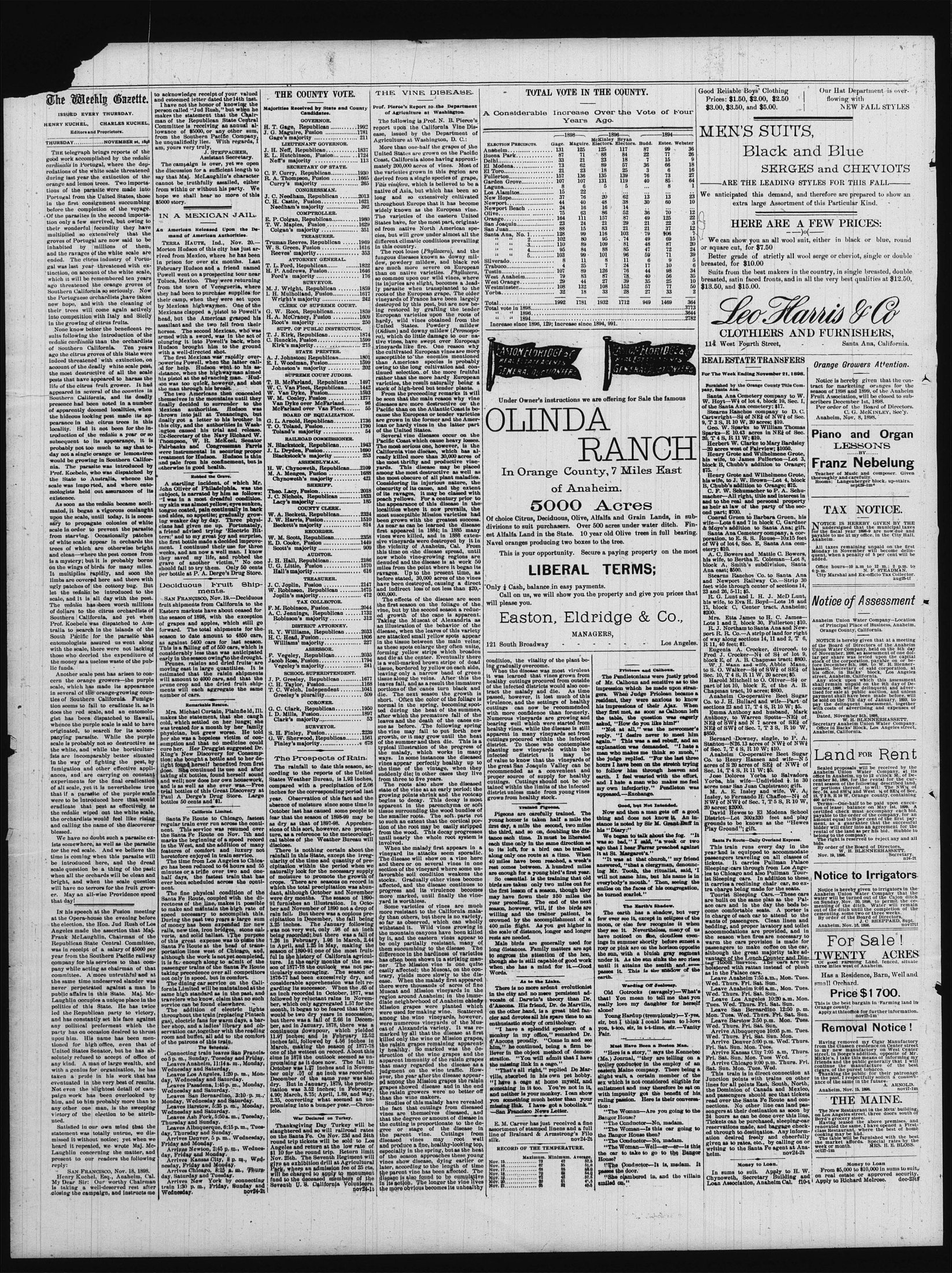
Searchable text
The Weekly Gazette.
ISSUED EVERY THURSDAY.
HENRY KUCHEL, CHARLES KUCHEL,
Editors and Proprietors.
THURSDAY... NOVEMBER 24, 1808
The telegraph brings reports of the good work accomplished by the vedalia cardinalis in Portugal, where the depredations of the white scale threatened during last year the extinction of the orange and lemon trees. Two importations of the parasite were made into Portugal from the United States, those in the first consignment succumbing before the completion of the voyage. Of the parasites in the second importation only a few survived, but owing to their wonderful fecundity they have multiplied so extensively that the groves of Portugal are now said to be inhabited by millions of them, and the ravages of the white scale are ended. The citrus industry of Portugal was last year threatened with extinction, on account of the white scale, which it will be remembered ten years ago threatened the orange groves of Southern California so seriously. Now the Portuguese orchardists have taken new hope, and with the cleaning of their trees will come again actively into competition with Italy and Sicily in the growing of citrus fruits.
None know better the beneficent results following the introduction of the vedalia cardinalis than the orchardists of Southern California. Ten years ago the citrus groves of this State were indeed threatened with extinction, on account of the deadly white scale pest, the most destructive of all the scale pests that have appeared to harass the life of the citrus fruit grower. It had appeared in several of the counties in Southern California, and its deadly presence had been noted in a number of apparently doomed localities, when the hideous looking pest made its appearance in the citrus trees in this locality. Had it not been for the introduction of the vedalia a year or so subsequent to its appearance, it is probably not too much to say that today not a single orange or lemon tree would be growing in Southern California. The parasite was introduced by Prof. Koebele, who was dispatched by to acknowledge receipt of your valued and esteemed letter dated the 14th inst.
I have not the honor of knowing the person called "Jud Rush," but when he makes the statement that the Chairman of the Republican State Central Committee is receiving an annual allowance of $5000, or any other sum, from the Southern Pacific Company, he unqualifiedly lies. With regards, I am, yours very truly,
J. STEPPACHER,
Assistant Secretary.
The campaign is over, yet we open the discussion for a sufficient length to say that Maj. McLaughlin's character cannot be truthfully assailed, either from within or without his party. We hope we shall hear no more of this $5000 story.
IN A MEXICAN JAIL.
An American Released Upon the Demand of American Authorities.
TERRA HAUTE, Ind., Nov. 20.—Morton Hudson of this city has just arrived from Mexico, where he has been in prison for over six months. Last February Hudson and a friend named Powell went on a prospecting tour near Toluca, Mexico. They were returning from the town of Veregueria, where they had been to purchase supplies for their camp, when they were set upon by Mexican highwaymen. One of the Mexicans clapped a pistol to Powell's head, but the American grasped his assailant and the two fell from their horses. The second Mexican, who was armed with a sword, was in the act of plunging it into Powell's back, when Hudson brought him to the ground with a well-directed shot.
The first Mexican was rapidly overpowering Powell, when the latter called for help. Hudson went to his assistance, when the highwayman aimed his pistol at the advancing man. Hudson was too quick, however, and shot the man through his breast.
The two Americans then concealed themselves in the mountains until they finally decided to surrender to the Mexican authorities. Hudson was thrown into jail at Tenancingo, but finally got a letter to his brother in this city, and the authorities in Washington caused his trial and release. Ex-Secretary of the Navy Richard W. Thompson, W. R. McKeel, Senator Fairbanks and Congressman Farris were instrumental in securing proper treatment for Hudson. Hudson is thin and pale from his confinement, but is otherwise in good health.
THE COUNTY VOTE.
Majorities Received by State and Candidates.
GOVERNOR.
H. T. Gage, Republican
J. G. Maguire, Fusion
Gage's majority
LIEUTENANT GOVERNOR.
J. H. Neff, Republican
E. L. Hutchinson, Fusion
Neff's majority
SECRETARY OF STATE.
C. F. Curry, Republican
R. A. Thompson, Fusion
Curry's majority
CONGRESSMAN.
J. C. Needham, Republican
C. H. Castle, Fusion
Needham's majority
COMPTROLLER.
E. P. Colgan, Republican
T. W. Maples, Fusion
Colgan's majority
TREASURER.
Truman Reeves, Republican
W. S. Green, Fusion
Reeves' majority
ATTORNEY GENERAL.
T. L. Ford, Republican
H. P. Andrews, Fusion
Ford's majority
SURVEYOR.
M. J. Wright, Republican
1. H. Mulholland, Fusion
Wright's majority
CLERK OF SUPREME COURT.
G. W. Root, Republican
H. A. McCraney, Fusion
Root's majority
SUPT. OF PUBLIC INSTRUCTIO
T. J. Kirk, Republican
C. Runckle, Fusion
Kirk's majority
STATE PRINTER.
A. J. Johnston, Republican
E. I. Woodman, Fusion
Johnston's majority
SUPREME COURT JUDGES.
T. B. McFarland, Republic
W. C. Van Fleet, Republic
W. Van Dyke, Fusion
W.M. Conley, Fusion
Van Dyke over McFarland
McFarland over Van Fleet.
BOARD OF EQUALIZATION.
G. L. Arnold, Republican
T. O. Toland, Fusion
Toland's majority
RAILROAD COMMISSIONER.
N. Blackstock, Republican
J. L. Dryden, Fusion
Blackstock's majority
ASSEMBLYMAN.
H. W. Chynoweth, Republican
M.A. Menges, Fusion
pests that have appeared to harass the life of the citrus fruit grower. It had appeared in several of the counties in Southern California, and its deadly presence had been noted in a number of apparently doomed localities, when the hideous looking pest made its appearance in the citrus trees in this locality. Had it not been for the introduction of the *vedalia* a year or so subsequent to its appearance, it is probably not too much to say that today not a single orange or lemon tree would be growing in Southern California. The parasite was introduced by Prof. Koebele, who was dispatched by the State to Australia, whence the scale was imported, and where entomologists held out assurances of its existence.
As soon as the *vedalia* became accelerated, it began a vigorous onslaught upon the scale, until today. It is necessary to propagate colonies of white scale in order to prevent the parasite from starving. Occasionally patches of white scale appear in orchards the trees of which are otherwise bright and clean—where the pest comes from is a mystery; but it is probably borne on the wings of birds for many miles. It multiplies rapidly, and soon the limbs are covered here and there with ugly patches of the cottony bug. But let the *vedalia* be introduced to the scale, and it is all day with the pest. The *vedalia* has been worth millions of dollars to the citrus orchardists of Southern California, and yet when Prof. Koebele was dispatched to Australia to search in the islands of the South Pacific for the parasite that entomologists assured us went along with the scale, there were not lacking those who decried the expenditure of the money as a useless waste of the public funds.
Another scale pest has arisen to concern the orange growers—the purple scale, which has made its appearance in several of the orange-growing counties of Southern California. Fumigation seems to fail to eradicate it, as it does the red scale, and an entomologist has been dispatched to Hawaii, whence the purple scale is said to have originated, to search for its accompanying parasite. While the purple scale is probably not so destructive as the white, and while the horticulturists are incomparably better situated in the way of fighting the pest, by fumigation and other effective appliances, and are carrying on constant experiments for the final eradication of all scale, yet it is nevertheless true that if a parasite of the purple scale were to be introduced here that would eradicate that pest as effectively as the *vedalia* wiped out the white scale, the orchardists would feel like rising and calling the name of the discoverer blessed.
We have no doubt such a parasite exists somewhere, as well as the parasite for the red scale. And we believe the time is coming when this parasite will be introduced here, and the dread scale question be a thing of the past; when all the orchards will be clean and bright, and when the scale question will have no terrors for the fruit grower. May an all-wise Providence speed up these pests that have appeared to harass the life of the citrus fruit grower. It had appeared in several of the counties in Southern California, and its deadly presence had been noted in a number of apparently doomed localities, when the hideous looking pest made its appearance in the citrus trees in this locality. Had it not been for the introduction of the *vedalia* a year or so subsequent to its appearance, it is probably not too much to say that today not a single orange or lemon tree would be growing in Southern California. The parasite was introduced by Prof. Koebele, who was dispatched by the State to Australia, whence the scale was imported, and where entomologists held out assurances of its existence.
As soon as the *vedalia* became accelerated, it began a vigorous onslaught upon the scale, until today. It is necessary to propagate colonies of white scale in order to prevent the parasite from starving. Occasionally patches of white scale appear in orchards the trees of which are otherwise bright and clean—where the pest comes from is a mystery; but it is probably borne on the wings of birds for many miles. It multiplies rapidly, and soon the limbs are covered here and there with ugly patches of the cottony bug. But let the *vedalia* be introduced to the scale, and it is all day with the pest. The *vedalia* has been worth millions of dollars to the citrus orchardists of Southern California, and yet when Prof. Koebele was dispatched to Australia to search in the islands of the South Pacific for the parasite that entomologists assured us went along with the scale, there were not lacking those who decried the expenditure of the money as a useless waste of the public funds.
Another scale pest has arisen to concern the orange growers—the purple scale, which has made its appearance in several of the orange-growing counties of Southern California. Fumigation seems to fail to eradicate it, as it does the red scale, and an entomologist has been dispatched to Hawaii, whence the purple scale is said to have originated, to search for its accompanying parasite. While the purple scale is probably not so destructive as the white, and while the horticulturists are incomparably better situated in the way of fighting the pest, by fumigation and other effective appliances, and are carrying on constant experiments for the final eradication of all scale, yet it is nevertheless true that if a parasite of the purple scale were to be introduced here that would eradicate that pest as effectively as the *vedalia* wiped out the white scale, the orchardists would feel like rising and calling the name of the discoverer blessed.
We have no doubt such a parasite exists somewhere, as well as the parasite for the red scale. And we believe the time is coming when this parasite will be introduced here, and the dread scale question be a thing of the past; when all the orchards will be clean and bright, and when the scale question will have no terrors for the fruit grower. May an all-wise Providence speed up these pests that have appeared to harass the life of the citrus fruit grower. It had appeared in several of the counties in Southern California, and its deadly presence had been noted in a number of apparently doomed localities, when the hideous looking pest made its appearance in the citrus trees in this locality. Had it not been for the introduction of the *vedalia* a year or so subsequent to its appearance, it is probably not too much to say that today not a single orange or lemon tree would be growing in Southern California. The parasite was introduced by Prof. Koebele, who was dispatched by the State to Australia, whence the scale was imported, and where entomologists held out assurances of its existence.
As soon as the *vedalia* became accelerated, it began a vigorous onslaught upon the scale, until today. It is necessary to propagate colonies of white scale in order to prevent the parasite from starving. Occasionally patches of white scale appear in orchards the trees of which are otherwise bright and clean—where the pest comes from is a mystery; but it is probably borne on the wings of birds for many miles. It multiplies rapidly, and soon the limbs are covered here and there with ugly patches of the cottony bug. But let the *vedalia* be introduced to the scale, and it is all day with the pest. The *vedalia* has been worth millions of dollars tothe citrus orchardists of Southern California,and yet when Prof.Koebele was dispatched to Australia to search inthe islandsoftheSouthPacificfortheparasitethatentomologistsassureduswentalongwiththescale,thesewerenotlackingthosewhodecriedtheexpenditureofthemoneyasauselesswasteofthepublicfunds.
Anotherscalepesthasarisentoconserntheorangegrowers—thepurplescalewhichhasmadeitsappearanceinaseveranceoftheorange-growingcountiesofSouthernCalifornia.Fumigationseemstofailtoeradicateit.asitdoestheredscale,andanentomologisthasbeendispatchedtoHawaiiwhencethepurplescaleissaidtohavemigratedtoresearchforitsaccompanyingparasite.Whilethepurplescaleisprobablynotsodestructiveasthewhite,andwhilethehorticulturistsareincomparablybettersituatedinthewayoffightingthepest,beyumigationandothereffectiveapplications,andarecarryingonconstantexperimentsforthefinaleradicationofallscale,yetitisneverthelesstruethatifaparasiteofthepurplescaleweretobeintroducedherethatwoulderadicatethatpestasaffectivelyasthevedaliawipedoutthewhitescale,theorchardistswouldfeellikingandcallingthenameofthediscovererblessed.
Wehaveno doubtsuchaparasitesexistssomewhere,aswellastheparasitesfortheredscale.Andwebelievethetimeiscomingwhenthisparasitewillbeintroducedhere,andthedreadscalequestionbeathingofthepast;whenalltheorchardswillbecleanandbright,andwhenthescalequestionwillhavenoterrorsforthefruitgrower.Mayanall-wiseProvidencepeedupthispestthathaveappearedtoharassthelifeofthecitrusfruitgrower.HadappearedinseveralofthecountiesinSouthernCalifornia,anditsdeadlypresencehadbeennottoo muchto saythat todaysnottoo muchto saythat todaysnottoo muchto saythat todaysnottoo muchto saythat todaysnottoo muchto saythat todaysnottoo muchto saythat todaysnottoo muchto saythat todaysnottoo muchto saythat todaysnottoo muchto saythat todaysnottoo muchto saythat todaysnottoo muchto saythat todaysnottoo muchto saythat todaysnottoo muchto saythat todaysnottoo muchto saythat todaysnottoo muchto saythat todaysnottoo muchto saythat todaysnottoo muchto saythat todaysnottoo muchto saythat todaysnottoo muchto saythat todaysnottoo muchto saythat todaysnottoo muchto saythat todaysnottoo muchto saythat todaysnottoo muchto saythat todaysnottoo muchto saythat todaysnottoo muchto saythat todaysnottoo muchto saythat todaysnottoo muchto saythat todaysnottoo muchto saythat todaysnottoo muchto saythat todaysnottoo muchto say that todaysnottoo muchto say that todaysnottoo muchto say that todaysnot.tooo muchto say that todaysnot.tooo muchto say that todysnot.tooo muchto say that todysnot.tooo muchto say that todysnot.tooo muchto say that todysnot.tooo muchto say that todysnot.tooo muchto say that todysnot.tooo muchto say that tedysnot.tooo muchto say that tedysnot.tooo muchto say that tedysnot.tooo muchto say that tedysnot.tooo muchto say that tedysnot.tooo muchto say that tedysnot.tooo muchto say that tedysnot.tooo muchto say that tedysnot.tooo muchto say that tedysnot.tooo muchto say that tedysnot.tooo much TOOO MORE THAN 100% OF THE PEST CONTROL IS REQUIRED FOR THE ORANGE GROWER'S USE IN A PARTICULAR WEATHER SYSTEM WHICH IS DESIGNED TO HANDLE THE PEST CONTROL IN A PARTICULAR WEATHER SYSTEM WHICH IS DESIGNED TO HANDLE THE PEST CONTROL IN A PARTICULAR WEATHER SYSTEM WHICH IS DESIGNED TO HANDLE THE PEST CONTROL IN A PARTICULAR WEATHER SYSTEM WHICH IS DESIGNED TO HANDLE THE PEST CONTROL IN A PARTICULAR WEATHER SYSTEM WHICH IS DESIGNED TO HANDLE THE PEST CONTROL IN A PARTICULAR WEATHER SYSTEM WHICH IS DESIGNED TO HANDLE THE PEST CONTROL IN A PARTICULAR WEATHER SYSTEM WHICH IS DESIGNED TO HANDLE THE PEST CONTROL IN A PARTICULAR WEATHER SYSTEM WHICH IS DESIGNED TO HANDLE THE PEST CONTROL IN A PARTICULAR WEATHER SYSTEM WHICH IS DESIGNED TO HANDLE THE PEST CONTROL IN A PARTICULAR WEATHER SYSTEM WHICH IS DESIGNED TO HANDLE THE PEST CONTROL IN A PARTICULAR WEATHER SYSTEM WHICH IS DESIGNED TO HANDLE THE PEST CONTROL IN A PARTICULAR WEATHER SYSTEM WHICH IS DESIGNED TO HANDLE THE PEST CONTROL IN A PARTICULAR WEATHER SYSTEM WHICH IS DESIGNED TO HANDLE THE PEST CONTROL IN A PARTICULAR WEATHER SYSTEM WHICH IS DESIGNED TO HANDLE THE PEST CONTROL IN A PARTICULAR WEATHER SYSTEM WHICH IS DESIGNED TO HANDLE THE PEST CONTROL IN A PARTICULAR WEATHER SYSTEM WHICH IS DESIGNED TO HANDLE THE PEST CONTROL IN A PARTICULAR WEATHER SYSTEM WHICH IS DESIGNED TO HANDLE THE PEST CONTROL IN A PARTICULAR WEATHER SYSTEM WHICH IS DESIGNED TO HANDLE THE PEST CONTROL IN A PARTICULAR WEATHER SYSTEM WHICH IS DESIGNED TO HANDLE THE PEST CONTROL IN A PARTICULAR WEATHER SYSTEMWHICH IS DESIGNED TO HANDLE THE PEST CONTROL IN A PARTICULAR WEATHER SYSTEMWHICH IS DESIGNED TO HANDLE THE PEST CONTROL IN A PARTICULAR WEATHER SYSTEMWHICH IS DESIGNED TO HANDLE THE PEST CONTROL IN A PARTICULAR WEATHER SYSTEMWHICH IS DESIGNED TO HANDLE THE PEST CONTROL IN A PARTICULAR WEATHER SYSTEMWHICH IS DESIGNED TO HANDLE THE PEST CONTROL IN A PARTICULAR WEATHER SYSTEMWHICH IS DESIGNED TO HANDLE THE PEST CONTROL IN A PARTICULAR WEATHER SYSTEMWHICH IS DESIGNED TO HANDLE THE PEST CONTROL IN A PARTICULAR WEATHER SYSTEMWHICH IS DESIGNED TO HANDLE THE PEST CONTROLINA PARTICULARWEATHERSYSTEMWHICHISDESIGNEDTOHANDLETHEPESTCONTROLINA PARTICULARWEATHERSYSTEMWHICHISDESIGNEDTOHANDLETHEPESTCONTROLINA PARTICULARWEATHERSYSTEMWHICHISDESIGNEDTOHANDLETHEPESTCONTROLINA PARTICULARWEATHERSYSTEMWHICHISDESIGNEDTOHANDLETHEPESTCONTROLINA PARTICULARWEATHERSYSTEMWHICHISDESIGNEDTOHANDLETHEPestCONTROLINA PARTICULARWEATHERSYSTEMWHICHISDESIGNEDTOHANDLETHEPestCONTROLINA PARTICULARWEATHERSYSTEMWHICHISDESIGNEDTOHANDLETHEPestCONTROLINA PARTICULARWEATHERSYSTEMWHICHISDESIGNEDTOHANDLETHEPestCONTROLINA PARTICULARWEATHERSYSTEMWHICHISDESIGNEDTOHANDLETHEPestCONTROLINA PARTICULARWEATHERSYSTEMWHICHISDESIGNEDTOHANDLETHEPestCONTROLINA PARTICULARWEATHERSYSTEMWHICHISDESIGNEDTOHANDLETHEPestCONTROLINA PARTICULARWEATHERSYSTEMWHICHISDESIGNEDTOHANDLETHEPestCONTROLINA PARTICULARWEATHERSYSTEMWHICHISDESIGNEDTOHANDLETHEPestCONTROLINA PARTICULARWEATHERSystemWHICHISDESIGNEDTOHANDLETHEPestCONTROLINA PARTICULARWEathersystemWHICHISDESIGNEDTOHANDLETHEPestCONTROLINA PRIMARYWEathersystemWHICHISDESIGNEDTOHANDLETHEPestCONTROLINA PRIMARYWEathersystemWHICHISDESIGNEDTOHANDLETHEPestCONTROLINA PRIMARYWEathersystemWHICHISDESIGNEDTOHANDLETHEPestCONTROLINA PRIMARYWEathersystemWHICHISDESIGNEDTOHANDLETHEPestCONTROLINA PRIMARYWEathersystemWHICHISDESIGNEDTOHANDLETHEPestCONTROLINA PRIMARYWEathersystemWHICHISDESIGNEDTOHANDLETHEPestCONTROLINA PRIMARYWEathersystemWHICHISDESIGNEDTOHANDLETHEPestCONTROLINA PRIMARYWEathersystemWHICHISDESIGNEDTOHANDLEThePestCONTrolInA PRIMARYWEathersystemWHICHISDESIGNEDTOHANDLEThePestCONTrolInA PRIMARYWEathersystemWHICHISDESIGNEDTOHANDLEThePestCONTrolInA PRIMARYWEathersystemWHICHISDESIGNEDTOHANDLEThePestCONTrolInA PRIMARYWEathersystemWHICHISDESIGNEDTOHANDLEThePestCONTrolInA PRIMARYWEathersystemWHICHISDESIGNEDTOHANDLEThePestCONTrolInA PRIMARYWEathersystemWHICHISDESIGNEDTOHANDLEThePestCONTrolInA PRIMARYWEathersystemWHICHISDESIGNEDTOHANDLEThePestControllInA PRIMARYWEathersystemWHICHISDESIGNEDTOHANDLEThePestControllInA PRIMARYWEathersystemWHICHISDESIGNEDTOHMLEWathersystemWHICHISDESIGNEDTOHMLEWathersystemWHICHISDESIGNEDTOHMLEWathersystemWHICHISDESIGNEDTOHMLEWathersystemWHICHISDESIGNEDTOHMLEWathersystemWHCHISHESNDERTHENCHESNDERTHENCHESNDERTHENCHESNDERTHENCHESNDERTHENCHESNDERTHENCHESNDERTHENCHESNDERTHENCHESNDERTHENCHESNDERTHENCHESNDERTHENCHESNDERTHENCHESNDERTHENCHESNDERTHENCHESNDERTHENCHESNDERTHENCHESNDERTHENCHESNDERTHENCHESNDERTHENCHESNDERTHENCHESNDERTHENCHESNDERTHENCHESNDERTHENCHESNDERTHENCHESNDERTHENCHESNDERTHENCHESNDERTHENCHESNDERTHENCHESNDERTHENCHESNDERTHENCHESNDERTHENCHESNDERTHENCHESNDERTHENCHESNDERTHENCHESNDERTHENCHESNDERTHENCHESNDERTHENCHESNDERTHENCHESNDERTHENCHESNDERTHENCHESNDERTHENCHESNDERTHENCHESNDERTHENCHESNDERTHENCHESNDERTHENCHESNDERTHENCHESNDERTHENCHESNDERTHENChhesnderthhesnderthhesnderthhesnderthhesnderthhesnderthhesnderthhesnderthhesnderthhesnderthhesnderthhesnderthhesnderthhesnderthhesnderthhesnderthhesnderthhesnderthhesnderthhesnderthhesnderthhesnderthhesnderthhesnderthhesnderthhesnderthhesnderthhesnderthhesnderthhesnderthhesnderthhesnderthhesnderthhesnderthhesnderthhesnderthhesnderthhesnderthhesnderthhesnderthhesnderthhesnderthhesnderthhesnderthhesnderthhesnderthhesnderthhesnderthhesnderthhesnderthhssnsnsnsnsnsnsnsnsnsnsnsnsnsnsnsnsnsnsnsnsnsnsnsnsnsnsnsnsnsnsnsnsnsnsnsnsnsnsnsnsnsnsnsnsnsnsnsnsnsnsnesnsnesnesnesnesnesnesnesnesnesnesnesnesnesnesnesnesnesnesnesnesnesnesnesnesnesnesnesnesnesnesnesnesnesnesnesnesnesnesnesnesnesnesnesnesnesnesnesnesnesnesnesnesnesnesnesnesnesnesmesnesmesmesmesmesmesmesmesmesmesmesmesmesmesmesmesmesmesmesmesmesmesmesmesmesmesmesmesmesmesmesmesmesmesmesmesmesmesmesmesmesmesmesmesmesmesmesmesmesmesmesmesmesmesmesmesmesmesmesmesmesmesmes mesmesmes mes mes mes mes mes mes mes mes mes mes mes mes mes mes mes mes mes mes mes mes mes mes mes mes mes mes mes mes mes mes mes mes mes mes mes mes mes mes mes mes mes mes mes mes mes mes mes mes mes mes mes mes mes mes mes mes mes mes mes ms ms ms ms ms ms ms ms ms ms ms ms ms ms ms ms ms ms ms ms ms ms ms ms ms ms ms ms ms ms ms ms ms ms ms ms ms ms ms ms ms ms ms ms ms ms ms ms ms ms ms ms ms ms ms ms ms ms ms ms ms ms ms ms ms ms ms ms msmsmsmsmsmsmsmsmsmsmsmsmsmsmsmsmsmsmsmsmsmsmsmsmsmsmsmsmsmsmsmsmsmsmsmsmsmsmsmsmsmsmsmsmsmsmsmsmsmsmsmsmsmsmsmsmsmsmsmsmsmsmsmsmsmsmsmsmsmsmsmsmsmsMSMSMSMSMSMSMSMSMSMSMSMSMSMSMSMSMSMSMSMSMSMSMSMSMSMSMSMSMSMSMSMSMSMSMSMSMSMSMSMSMSMSMSMSMSMSMSMSMSMSMSMSMSMSMSMSMSMSMSMSMSMSMSMSMSMSMSMSMSMSMSMSMSMsMsMsMsMsMsMsMsMsMsMsMsMsMsMsMsMsMsMsMsMsMsMsMsMsMsMsMsMsMsMsMsMsMsMsMsMsMsMsMsMsMsMsMsMsMsMsMsMsMsMsMsMsMsMsMsMsMsMsMsMsMsMsMsMsMsMsMs Ms Ms Ms Ms Ms Ms Ms Ms Ms Ms Ms Ms Ms Ms Ms Ms Ms Ms Ms Ms Ms Ms Ms Ms Ms Ms Ms Ms Ms Ms Ms Ms Ms Ms Ms Ms Ms Ms Ms Ms Ms Ms Ms Ms Ms Ms Ms Ms Ms Ms Ms Ms Ms Ms Ms Ms Ms Ms Ms Ms Ms Mrs Mrs Mrs Mrs Mrs Mrs Mrs Mrs Mrs Mrs Mrs Mrs Mrs Mrs Mrs Mrs Mrs Mrs Mrs Mrs Mrs Mrs Mrs Mrs Mrs Mrs Mrs Mrs Mrs Mrs Mrs Mrs Mrs Mrs Mrs Mrs Mrs Mrs Mrs Mrs Mrs Mrs Mrs Mrs Mrs Mrs Mrs Mrs Mrs Mrs Mrs Mrs Mrs Mrs Mrs Mrs Mrs Mrs Mrs Mrs Mrs Mrs Mrs Mrs Mrs Mrs Mrs Mrs Mrs Mrs Mr Mr Mr Mr Mr Mr Mr Mr Mr Mr Mr Mr Mr Mr Mr Mr Mr Mr Mr Mr Mr Mr Mr Mr Mr Mr Mr Mr Mr Mr Mr Mr Mr Mr Mr Mr Mr Mr Mr Mr Mr MrMrMrMrMrMrMrMrMrMrMrMrMrMrMrMrMrMrMrMrMrMrMrMrMrMrMrMrMrMrMrMrMrMrMrMrMrMrMrMrMrMrMrMrMrMrMrMrMrMrMrMrMrMrMrMrMrMrMrMrMrMrMrMrMrMrMrMrMrMRMRMRMRMRMRMRMRMRMRMRMRMRMRMRMRMRMRMRMRMRMRMRMRMRMRMRMRMRMRMRMRMRMRMRMRMRMRMRMRMRMRMRMRMRMRMRMRMRMRMRMRMR MRM MRM MRM MRM MRM MRM MRM MRM MRM MRM MRM MRM MRM MRM MRM MRM MRM MRM MRM MRM MRM MRM MRM MRM MRM MRM MRM MRM MRM MRM MRM MRM MRM MRM MRM MRM MRM MRM MRM MRM MRM MRM MRM MRM MRM MRM MRM MRM MRM MRM MRM MRM MRM MRM MRM MRM MRM MRM MRM MRM MRM MRM MRM MRM MRM MRM MRM MRM MRM MRM MRM MRM MRM
```
were to be introduced here that would eradicate that pest as effectively as the *vedalia* wiped out the white scale, the orchardists would feel like rising and calling the name of the discoverer blessed.
We have no doubt such a parasite exists somewhere, as well as the parasite for the red scale. And we believe the time is coming when this parasite will be introduced here, and the dread scale question be a thing of the past; when all the orchards will be clean and bright, and when the scale question will have no terrors for the fruit grower. May an all-wise Providence speed that day!
In his speech at the Fusion meeting at the Opera-house the evening before the election, the Hon. Jud Rush of Los Angeles made the assertion that Maj. Frank McLaughlin, Chairman of the Republican State Central Committee, was in receipt of a salary of $5000 per year from the Southern Pacific railway company for his services to that company while acting as chairman of that committee. A more untruthful and at the same time undeserved slander was never perpetrated against a man in public affairs in this State. Maj. McLaughlin occupies a unique place in the politics of this State. He has twice led the Republican party to victory, and has constantly set his face against any political preferment which the party has on occasion desired to thrust upon him. His name has been mentioned for high office, even that of United States Senator, but he has absolutely refused to accept of office of any kind. A man of large wealth, and with a genius for organization, he has taken a pride in his work that has eventuated in the very best of results. Not even the slightest detail of campaign work has been overlooked by him, and to him probably more than to any other one man, is the sweeping victory of the election to be attributed.
Satisfied in our own mind that the statement was totally untrue, we dismissed it without notice; yet when we heard it repeated, we wrote Maj. McLaughlin concerning the matter, and present to our readers the following reply:
SAN FRANCISCO, Nov. 18, 1898.
Henry Kuchel, Esq., Anaheim, Cal.
My Dear Sir: Our worthy Chairman is taking a well-deserved rest after closing the campaign, and instructs me
California Limited.
Santa Fe Route to Chicago, fastest regular train ever run across the continent. This service was resumed over the Santa Fe Route on Nov. 7th and marks the beginning of a speed record in the West, and the addition of many features of comfort and luxury not heretofore enjoyed in train service.
The time from Los Angeles to Chicago has been reduced to 64 hours and 55 minutes or a trifle over two and one-half days, the fastest train that has ever been scheduled across the continent.
The fine physical condition of the Santa Fe Route, coupled with the directness of the line, makes it possible to make and maintain the high rate of speed necessary to accomplish this. During the past two years a large sum of money has been expended for new rails, new ties, iron bridges, stone culverts, and solid ballast. The purpose of this great expense was to place the Santa Fe Route at the head of transportation lines west of Chicago, and although the work is not yet completed, it is far enough along to admit of passenger trains of the Santa Fe Route taking precedence over all competitors not only in speed, but in comfort.
The dining car service on the California Limited will be maintained at the same high standard as in the past, and travelers who know, claim that no such service can be found elsewhere.
The addition of electric lights throughout the train (replacing Pintsch gas), electric fans for warm days, a barber shop, and a ladies' library and observation car together with the reading room and buffet, all add to the comfort of the patrons of this train.
The Schedule.
Connecting train leaves San Francisco 5 p.m., Sunday, Tuesday and Friday,
Leaves Anaheim, 11:14 a.m., Monday, Wednesday and Saturday,
Leaves Los Angeles, 1:20 p.m., Monday, Wednesday and Saturday,
Leaves Pasadena, 1:45 p.m., Monday, Wednesday and Saturday,
Leaves San Bernardino, 3:10 p.m., Monday, Wednesday and Saturday,
Leaves Barstow, 5:35 p.m., Monday, Wednesday and Saturday,
Leaves Ash Fork, 5:50 a.m., Tuesday, Thursday and Sunday,
Leaves Albuquerque, 6:15 p.m., Tuesday, Thursday and Sunday,
Arrives Denver, 5 p.m., Wednesday, Friday and Monday,
Arrives Newton, 2:45 p.m., Wednesday, Friday and Monday,
Arrives Kansas City, 8 p.m., Wednesday, Friday and Monday,
Arrives Chicago, 8:15 a.m., Thursday, Saturday and Tuesday,
Arrives New York by connecting train 1:30 p.m., Friday, Sunday and Wednesday.
The season of 91 furnishes an illustration. In October and November of 1890 not a rain fell. But there was a copious citation in December, the fall 3.25 inches. The January folly was not very wet, only .98 of being recorded; but there was a 7.26 in February. 1.96 in March in April, and 1.25 in May, making season of 1890-91 one of the most ful in the history of California and nature. In the early months of the son of 1877-78 the outlook was particularly encouraging. The season 1876-77 had been excessively dry considerable apprehension was growing its successor. When there was an inch recorded in October, 1878 followed by reluctant rains in November which only aggregated 1.57 month; it began to be feared that would be two dry years in succession but there was a fall of 2.66 in November, and in January, 1878, there were continuous downpour which yielded 11.97 inches; and in February inches fall followed by 4.56 inch March, making the season of one of the wettest on record. Above time in 1878 the outlook seemed promising as it does now. The October was 1.27 inches and in November only .57 of an inch was read December of the same year with dry. But in January, 1879,the citation was 3.52 inches; in February 4.90; March 8.75; April 1.89,and 2.35 converting what seemed promising into a bumper year—icle.
War Declared on Turkey.
Thanksgiving Day Turkey was slaughtered and so will railroad on the Santa Fe. On Nov. 23rd all round trip tickets will be sold at Angles and return at the low price $1 10 for the round trip. Return Nov. 25th. The Seventh Regiment gives an exhibition drill at Agricola Park where an admission fee will be charged to apply to more find to the deceased members Seventh U.S. California Volunteer Corps
THE COUNTY VOTE.
Cities Received by State and County Candidates.
GOVERNOR.
Gage, Republican...1992
Maguire, Fusion...1781
Kees' majority...211
LIEUTENANT GOVERNOR.
Neff, Republican...1837
Hutchinson, Fusion...1724
Ft's majority...113
SECRETARY OF STATE.
Curry, Republican...1930
Thompson, Fusion...1665
Brys' majority...265
CONGRESSMAN.
Needham, Republican...2013
Castle, Fusion...1621
Edham's majority...392
COMPTROLLER.
Colgan, Republican...1980
Maples, Fusion...1629
Gagan's majority...351
TREASURER.
Reeves, Republican...1969
Green, Fusion...1616
Reeves' majority...353
ATTORNEY GENERAL.
Ford, Republican...1822
Andrews, Fusion...1646
Drd's majority...176
SURVEYOR.
Wright, Republican...1859
Mulholland, Fusion...1617
Wright's majority...242
CLERK OF SUPREME COURT.
V. Root, Republican...1859
McCraney, Fusion...1609
Bot's majority...250
DEPUTY OF PUBLIC INSTRUCTION.
Kirk, Republican...1874
Unckle, Fusion...1599
Kirk's majority...275
STATE PRINTER.
Johnston, Republican...1801
Woodman, Fusion...1599
Janston's majority...202
SUPREME COURT JUDGES.
McFarland, Republican...1497
C. Van Fleet, Republican...1442
Van Dyke, Fusion...1593
M. Conley, Fusion...1277
An Dyke over McFarland...96
McFarland over Van Fleet...55
BOARD OF EQUALIZATION.
Arnold, Republican...1736
Toland, Fusion...1790
Island's majority...54
RAILROAD COMMISSIONER.
Blackstock, Republican...1943
Dryden, Fusion...1690
Blackstock's majority...253
ASSEMBLYMAN.
W. Chynoweth, Republican...2109
L. Menges, Fusion...1688
THE VINE DISEASE.
Prof. Pierce's Report to the Department of Agriculture at Washington.
The following is Prof. N. B. Pierce's report upon the California Vine Disease, issued by the Department of Agriculture at Washington, D. C:
More than one-half the grapes of the United States are grown on the Pacific Coast, California alone having approximately 200,000 acres of vines. Most of the varieties grown in this region are derived from a single species of grape, Vitis vinifera, which is believed to be a native of Asia, but which has been so long and so extensively cultivated throughout Europe that it has become widely known as the European vine.
The varieties of the eastern United States have, for the most part, originated from native North American species, but will grow under almost all the different climatic conditions prevailing in this country.
The root louse (Phylloxera), and the fungous diseases known as downy mildew, powdery mildew, and black rot are much more severe on European than on native varieties. Phylloxera, so common upon our wild vines, where its injuries are slight, becomes a deadly parasite when transplanted to the roots of the European grape. The older vineyards of France have been largely destroyed by this pest, but are now being restored by grafting the tender European varieties upon the roots of hardy, wild vines obtained from the United States. Powdery mildew (Oidium) and downy mildew (Peronospora), which do little damage to our native vines, have swept over European vineyards like fire. One reason why the cultivated European vines are more susceptible to the enemies mentioned than American species is probably owing to the long cultivation and continued selection of the more fruitful rather than the more hardy European varieties, the result naturally being a stock of high-bred but tender plants.
From the preceding remarks it will be seen that the main reason why vine diseases are more destructive on the Pacific than on the Atlantic Coast is because the European or tender varieties are grown in the former and the American or hardy vines in the latter part of the United States.
Several vine diseases occur on the Pacific Coast which cause heavy losses. The most serious one, however, is the California vine disease, which has already killed more than 30,000 acres of the most thrifty and productive vineyards. This disease may be placed among the most destructive as well as
SUPREME COURT JUDGES.
M. McFarland, Republican ... 1497
M. Fleet, Republican ... 1442
Van Dyke, Fusion ... 1583
M. Conley, Fusion ... 1277
Van Dyke over McFarland ... 96
Farland over Van Fleet ... 55
BOARD OF EQUALIZATION.
A. Arnold, Republican ... 1736
T. Toland, Fusion ... 1790
Island's majority ... 54
RAILROAD COMMISSIONER.
Blackstock, Republican ... 1943
Dryden, Fusion ... 1690
Blackstock's majority ... 253
ASSEMBLYMAN.
W. Chynoweth, Republican ... 2109
M. Menges, Fusion ... 1688
Chynoweth's majority ... 421
SHERIFF.
D. Lacy, Fusion ... 2018
Nichols, Republican ... 1833
Clyce's majority ... 185
COUNTY CLERK.
A. Beckett, Republican ... 2324
V. Harris, Fusion ... 1510
Rockett's majority ... 814
RECORDER.
M. Scott, Republican ... 2358
Cooke, Fusion ... 1449
Scott's majority ... 909
AUDITOR.
H. Hall, Republican ... 2186
Little, Fusion ... 1570
All's majority ... 616
TREASurer.
J. Joplin, Fusion ... 2147
Robinson, Republican ... 1675
Spinl's majority ... 472
TAX COLLECTOR.
B. Robinson, Fusion ... 2044
Jennings, Republican ... 1732
Robinson's majority ... 312
DISTRICT ATTORNEY.
W. Williams, Republican ... 2033
Head, Fusion ... 1806
Williams' majority ... 227
ASSESSOR.
Vegeley, Republican ... 2035
Rob Ross, Fusion ... 1794
Vegeley's majority ... 241
SCHOOL SUPERINTENDENT.
G. Greeley, Republican ... 1677
Taylor, Fusion ... 1188
Welch, Independent ... 1041
Greely's plurality ... 509
CORONER.
Clark, Republican ... 1950
Mills, Fusion ... 1897
Mark's majority ... 53
SURVEYOR.
Finley, Fusion ... 2239
Sherwood, Republican ... 1561
Uncley's majority ... 678
The Prospects of Rain.
The rainfall to date this season, according to the reports of the United States Weather Bureau, is 1.92 inches, prepared with a precipitation of 2.08 inches for the corresponding period last year.
Observation of this fact and the presence of moisture since some people to that the season of 1898-99 may be dry as that of 1897-98. Apprehension of this sort, however, are preamble as a reference to the meteorological tables of the Weather Bureau will close.
There is nothing certain about the fall in this State, except the irregularity of the time and quantity of precipitation within the period when we usually look for the necessary supply of moisture to promote the growth of crops. There are seasons on record in which the total precipitation was abundant, although October and November dry months. The season of 1890-91 rather than the more hardy European varieties, the result naturally being a stock of high-bred but tender plants.
From the preceding remarks it will be seen that the main reason why vine diseases are more destructive on the Pacific than on the Atlantic Coast is because the European or tender varieties are grown in the former and the American or hardy vines in the latter part of the United States.
Several vine diseases occur on the Pacific Coast which cause heavy losses. The most serious one, however, is the California vine disease, which has already killed more than 30,000 acres of the most thrifty and productive vineyards. This disease may be placed among the most destructive as well as the most obscure of all plant maladies. Considering its injurious nature, the obscurity of its cause, and the extent of its ravages, it may be classed with peach yellows. For a century prior to the appearance of this disease in the localities where it now prevails, the most susceptible Mission varieties had been grown with the greatest success. As near as can be learned the disease first appeared in 1884; in 1885 many vines were killed, and in 1886 extensive vineyards were destroyed by it in the vicinity of Anaheim, Cal. From this time on the disease spread, until now whole vine-growing regions are denuded and the disease is at work 50 miles from the point where it began its ravages. Up to the present time, as before stated, 30,000 acres of the vines have been destroyed, causing a direct and indirect loss of not less than $20,-000,000.
The effects of the disease are seen the first season on the foliage of the vine, but by the second season a reduced growth of the cane is apparent. Taking the Muscat of Alexandria as an illustration of the behavior of the disease, when the leaves of this variety are attacked small yellow spots appear in the tissue between the main veins; as these spots enlarge they often unite, forming yellow strips which broaden and die at the center. Eventually there is a well-marked brown stripe of dead tissue, bordered by yellow on each side, leaving only a narrow band of green tissue along the veins. After this the leaves fall, and as a result the immature portions of the canes turn black and die. The next season the growth is short. Often the color of the foliage is normal in the spring, becoming spot-tied during the heat of the summer, after which the premature fall of the leaves and death of the canes ensue as before. The following spring the vine may fail to put forth new growth, or it may grow until the heat of the summer and then die. This is a typical illustration of the progress of the malady which works in many ways. In some instances the diseased vines appear perfectly healthy up to the time of the vintage, when they suddenly die; in other cases they live from three to five years.
The roots also show the diseased state of the vine at an early period; the growing points shrink and the rootcap begins to decay. This decay is most apparent in the parenchyma or soft tissue surrounding the wood bundles of the smaller roots. The soft parts rot to such an extent that the cortical portion of the root may be easily stripped from the wood. This decay progresses until nearly the whole root system is involved.
When the malady first appears in a vineyard its attacks seem sporadic. The disease will show on a vine here and there or on several vines in one section of the vineyard where some unfavorable soil condition weakens the stocks. Gradually other vines become affected, and the disease continues to progress and its virulence becomes more marked, until finally the vine-condition, the vitality of the plant being gradually overcome.
When the disease was most virulent it was learned that vines grown from healthy cuttings procured from outside of the infected districts would also contract the malady and die. As time passed, however, it lost much of this virulence, and the settings of healthy cuttings can now be recommended with more confidence than formerly. Numerous vineyards are growing and bearing well which were started from healthy vines, while the disease is still apparent in many vineyards set from cuttings procured within the infected district.
To those who contemplate planting new vineyards within the infected district it may be of value to know that the vineyards of the great San Joaquin Valley can be recommended as a convenient and proper source of supply for healthy cuttings. Cuttings should not be obtained within the limits of the infected district unless made from young vines grown from healthy stock.
Trained Pigeons.
Pigeons are carefully trained. The young homer is taken half a mile first day, a mile second two miles third, and so on doubling the distance each time. It must be liberated each time only in the same direction as to its loft, for a bird can be trained along only one route at a time. When 40 miles have been reached, a week's rest comes between. A hundred miles are enough for a young bird's first year.
So essential is the training that old birds are taken only two miles out for the first lesson of a season, though they may have flown their 250 milesthe condition,the vitalityoftheplantbeinggraduallyovercome.
Under Owner's instructions we are offering for Sale from Olinda Ranch.
In Orange County, 7 Miles East of Anaheim.
5000 Acres
Of choice Citrus, Deciduous, Olive, Alfalfa and Grain Lands; divisions to suit purchasers. Over 500 acres under water ditches Alfalfa Land in the State. 10 year old Olive trees in full Navel oranges producing two boxes to the tree.
This is your opportunity. Secure a paying property on LIBERAL TERMS;
Only Cash balance in easy payments.
Call on us, we will show you the property and give you please you.
Easton, Eldridge & Co.
MANAGERS,
121 South Broadway Los Angeles
Observation of this face and the presence of moisture since some time in October last has caused some people to believe that the season of 1898-99 may be dry as that of 1897-98. Apprehension of this sort, however, are preeminent, as a reference to the meteorological tables of the Weather Bureau will close.
There is nothing certain about the fall in this State, except the irregularity of the time and quantity of precipitation within the period when we naturally look for the necessary supply of moisture to promote the growth of crops. There are seasons on record in which the total precipitation was abnormally low, although October and November are dry months. The season of 1890-urnishes an illustration. In October and November of 1890 not a drop of rain fell. But there was a copious pre-annulation in December, the fall being too inches. The January following it not very wet, only .98 of an inch being reported; but there was a fall of it in February, 1.96 in March, 2.44 in April, and 1.25 in May, making the season of 1890-91 one of the most fruitful in the history of California agriculture. In the early months of the season of 1877-78 the outlook was not particularly encouraging. The season of 1877 had been excessively dry, and considerable apprehension was felt reading its successor. When the .65 of inch recorded in October, 1877, was bowed by reluctant rains in November, which only aggregated 1.57 for the month, it began to be feared that there would be two dry years in succession, there was a fall of 2.66 in December, and in January, 1878, there was a continuous downpour, which yielded 37 inches; and in February 12.52 inches fall, followed by 4.56 inches in March, making the season of 1877-78 one of the wettest on record. About this year in 1878 the outlook seemed as unmising as it does now. The fall in October was 1.27 inches and in November only .57 of an inch was recorded. Member of the same year was also. But in January, 1879, the precipitation was 3.52 inches; in February, 8; March, 8.75; April, 1.89, and May, converting what seemed an unwillingly into a bumper year.
War Declared on Turkey.
Thanksgiving Day Turkey will be celebrated and so will railroad rates be raised for the Santa Fe. On Nov. 23d and 24th and trip tickets will be sold to Los Angeles and return at the low rate of $10 for the round trip. Return limit is 25th. The Seventh Regiment will be an exhibition drill at Agricultural Park, where an admission fee of 25 cents will be charged to apply to monument to the deceased members of the seventh U.S. California Volunteers.
Nov24-1t
Trained Pigeons.
Pigeons are carefully trained. The young homer is taken half a mile the first day, a mile the second, two miles the third, and so on, doubling the distance each time. It must be liberated each time only in the same direction as to its loft, for a bird can be trained along only one route at a time. When 40 miles have been reached, a week's rest comes between. A hundred miles are enough for a young bird's first year.
So essential is the training that old birds are taken only two miles out for the first lesson of a season, though they may have flown their 250 miles the year preceding. The end of the next season, however, will if the birds are willing and the trainer patient, be crowned by the accomplishment of a 400 mile flight. As you get higher in the scale of distance, longer and longer rests are needed.
Male birds are generally used for long distances. Family matters are apt to engross the attention of the hen, though she is still capable of good work when she has a mind for it.—Good Words.
As to the Links.
There is no more ardent evolutionist in the city and no more persistent advocate of Darwin's theory than Dr. d'Ancona. His friend, Dr. de Marville, on the other hand, is a great bird fancier and devotes all his spare time to an enthusiastic study of ornithology.
"I have a splendid specimen of a monkey in my office," remarked Dr. d'Ancona proudly. "Come in and see him," he continued, being a firm believer in the object method of demonstration." You will admit that I have the missing link in a cage."
"That's all right," replied De Marville, absorbed in his own pet hobby. "I have a cage at home myself, and something in it too. You're not in it, and neither is your monkey. I can show you something much better than your missing link. I have got a bobolink."
—San Francisco News Letter.
E.M.Carver has just received a fine assortment of stamped linens and a full line of Brainard & Armstrong's Filo silk.
RECORD OF THE TEMPERATURE.
Maximum: Minimum: Average.
Nov.15: 73:42:57.5
Nov.16: 67:51.0
Nov.17: 63:52:60.0
Nov.18: 79:52:60.0
Nov.19: 72:48:57.5
Nov.20: 63:41:45.5
Nov.21:65:42:48.5
THE COUNTY.
Over the Vote of Four Ago.
1896
Kinley Electors.
Bryan Electors.
Budd.
Estee.
Webster
125 117 87 99 36
88 84 22 77 26
23 18 7 15 9
89 57 36 66 18
18 25 3 6 16
135 139 76 73 27
131 119 40 85 64
5 5 ... 8 1
... ... ... ... ...
20 62 13 13 23
48 38 30 60 10
16 14 ... ... ...
86 52 36 70 12
157 87 49 125 22
21 29 21 22 3
83 21 21 37 12
116 103 79 106 7
95 74 49 69 15
109 81 48 87 20
88 85 47 72 24
101 96 59 71 39
8 11 6 9 5
7 24 17 10 6
126 76 44 98 34
87 78 40 56 35
27 39 35 25 10
108 152 57 77 50
33 28 27 33 2
1932 1712 949 1469 364
3773
3644
2782
CLOTHIERS AND FURNISHERS,
114 West Fourth Street,
Santa Ana, California.
REALESTATE TRANSFERS
For The Week Ending November 21, 1898.
Furnished by the Orange County Title Company, Santa Ana.
Santa Ana Cemetery company to W. W. Hoyt—W of lot 4, block I0, Sec. I, of the Santa Ana cemetery; $17.
Stearns Ranchos company to D. C. Cartwright—S of NE‡ of NW‡ of Sec. I, T S, R I0 W, 20 acres; $10.
Geo. W. Sparks to William Thomas Sparkes—E I0.43 acres in NE‡ of Sec. I, T S, R I1 W; $10.
Herbert W. Clarke to Mary Bardsley—20 acres west of Fairview; $1050.
Henry Grote and Wilhelmene Grote, his wife, to James Fullerton—Lot III, block B, Chubb's addition to Orange; $75.
Orange Growers Attention.
Notice is hereby given that the contract for marketing oranges for the season of l898 and l899, of the Anaheim Fruit Association, will be closed to subscribers December Ist, l898.
Per order of the Board of Directors.
C. G. McKINLEY, Sec'y.
Anaheim, Nov. U, l898.
Piano and Organ LESSONS
Franz Nebelung
Teacher of Music and composer. Given
The Pendletonians were justly proud of Mr. Calhoun and sensitive to the impression which he made upon strangers. When Judge Priolean became a president, they were anxious to know his impressions of their Ajax. When they first met, as soon as Calhoun left the table, the question was eagerly asked, "How do you like him?"
"Not at all," was the newcomer's reply. "I desire never to meet him again." This was a sad rebuff, and an explanation was demanded. "I hate a man who makes me think so much," the judge replied. "For the last three hours I have been on the stretch trying to follow him through heaven and earth. I feel wearied with the effort, and I hate a man who makes me feel my own inferiority." Pendleton was appeased—Exchange.
Good, but Not Intended.
Now and then a man gets off a good thing and does not know it. An instance is noted by Sir M. Grant Duff in his "Diary:"
We began to talk about the fog. "It was so bad," I said, "a week or two ago that I hear Farrar preached against it at St. Margaret's."
"It was at that church," my friend answered, "that a clergyman, denouncing Mr. Toot, the ritualist, said, 'I will not name him, but his name is in everybody's mouth.' Then, seeing the smiles on the faces of his congregation, he turned scarlet."
Furnished by the Orange County Title Company, Santa Ana.
Santa Ana Cemetery company to W. W. Hoyt—W½ of lot 4, block 10, Sec. I, of the Santa Ana cemetery; $17.
Stearns Ranchos company to D.C. Cartwright—S½ of NE½ of NW½ of Sec. 9, T 3 S, R 10 W, 20 acres; $10.
Geo. W. Sparks to William Thomas Sparka—E 10.43 acres in NE½ of Sec. 20, T 4 S, R 11 W; $10.
Herbert W. Clarke to Mary Bardsley—20 acres west of Fairview; $1050.
Henry Grote and Wilhelmene Grote, his wife, to James Fullerton—Lot 3, block B, Chubb's addition to Orange; $75.
Henry Grote and Wilhelmene Grote, his wife, to J.W. Brown—Lot 4, block B, Chubb's addition to Orange; $75.
C.F. W. Schumacher—All right, title and interest in and to the real and personal property as heir at law of the party of the second part; $700.
Conrad Gruen to Barbara Gruen, his wife—Lots 6 and 7 in block C, Gardner & Moye's addition to Santa Ana; gift.
Santa Ana Cemetery company, a corporation, to E.S. S.Rouse—10x15 feet of W½ of lot 4, Sec.E., Santa Ana cemetery; $10.
A.C. Bowers and Mattie C. Bowers, his wife, to Bertha E. Coleman—Lot 8, block A, Smith's subdivision, Santa Ana east; $500.
Stearns Ranchos Co. to Santa Ana and Newport Railway Co.—Strip 30 feet wide through center of sections 14, 23 and 26, 5-11; $5.
R.G.Lunt and L.H.J.McD Lunt, his wife, to Eva H.Boyd—Lots 16 and 17, block C, Center tract, Anaheim; $200.
Mrs.Etta James to H.C.James—Lots 1 and 2, block 30, Fullerton; $10.
R.J.Northam to Santa Ana and Newport R.R.Co.—A strip of land for right of way along sections 14, 11 and 2, T 6, R 11, 40 feet; $1.
Eugenia A.Crocker, divorced, to Fred J.Crocker—N½ of S½ of lot 9, block E, of A.B. Chapman tract; $800.
W.J.Mann and wife,Abbie Mann, to S.O.Walker—S½ of SW½ of SE½ of Sec. 10,T 4 S,R 11 W,20 acres;$5.
Harold Mitchell to O.Oliver—S½ or part of lot 10, block E, of the A.B. Chapman tract, 10 acres;$800.
Anaheim Co-operative Beet Sugar Co.to J.H.Bullard and wife—Part of sections 23 and 17,T 4 S,R 10 W;$5.
Emma Anthony and husband,Mark Anthony, to Warren Spotts—NE½ of NE½ of SW½ and N 7 acres of SE½ of NE½ of SW½ of Sec.7,T 3 S,R 10 W,$850.
Bernard Downey,single,tp.A.A.Stanton—N26.13 acres of NW½ of NW½ of Sec.7,T 4 S,R 10 W;$10.
Anaheim Co-operative Beet Sugar Co.to Henry Hansen and wife-N5 acres of S 20 acres of SE½ of NW½ of Sec.14,T 4 S,R 11 W;$5.
Jose Dolores Yorba to Salvadora Yorba,his wife-Undivided % in 30 acres near San Juan Capitrancho; gift.
M.A.E.Insley and wife.W.A.Insley to Fernando H.Charfee-N½ of NW½ of Sec.7,T 5 S,R 10 W,20 acres;$2000.
David Hewes to El Modena School District—Lot 300x320 feet and play grounds to be known as the "Hewes Play Ground"; gift.
Santa Fe Route—Daily Overland Express.
This train runs every day in the year and is equipped to accommodate passengers traveling on all classes of tickets. It carries Pullman Palace Sleeping cars through from Los Angeles to Chicago and also Pullman Tourist Sleeping cars. In addition these it carries a reclining chair car, no extra charge being made for the seats.
Tourist Sleeping Cars—these cars are built on the same plan as the Palm.
Notice is hereby given that the contract for marketing oranges for the season of 1898 and 1899,of the Anaheim Fruit Association,will be closed to subscribers December 1st,1898.
Per order of the Board of Directors.
C.G.McKINLEY,Sec'y.
Anaheim,Nov.8,1898.
Piano and Organ LESSONS
Franz Nebelung
Teacher of Music and composer.Given thoroughly and carefully.
Rooms: Langenberger block.up-stairs.sept-29-im*
TAX NOTICE.
NOTICE IS HEREBY GIVEN BY THE undersigned that the municipal taxes for the fiscal year 1898-9 are now due and payable to me at my office,在the City Hall,
Anaheim.
All taxes remaining unpaid on the first Monday in November will become delinquent when a penalty of 5 per cent will be added.
Office hours—10 a.m to 12 m.;2 p.m.to4 p.m.
N.F. STEADMAN.
City Marshal and Ex-officio Tax Collector.
aug25-tf
Notice of Assessment
Anaheim Union Water Company—Location of Principal Place of Business,Anaheim,
Orange County,California.
NOTICE is hereby given that at a meeting of the Board of Directors of the Anaheim Union Water Company,Held on the 5th day of November,1898,nan assessment of one dollar per share was levied upon the capital stock of the corporation,payable on or before December 8th,1898,Hennessy Secretary of said corporation,his office,Backs'block,Los Angeles street,Anaheim,California.
Any stock upon which this assessment shall remain unpaid on the 9th day of December,1898 will be delinquent and advertisement at public auction,and payment shall have been made before.will be sold on the 7th day of January,1899.to pay the delinquent assessment,together with costs of advertising and expenses of sale.
Dated,November5th,1898.
W.H.BLENNERHASSETT.
Secretary Anaheim Union Water Company.
Office in Back's Block,Los Angeles street,Anaheim,California.
Land FOR Rent
Sealed proposals will be received by the Anaheim Union Water Company.at its office in Anaheim up to 2 oclock.Mk Decent for sale for public auction undresses payment shall have been made before.will be sold on the 7th day of January,1899.to pay the delinquent assessment,together with costs of advertising and expenses of sale.
Officer-one-half to be paid upon executional balance on May lst,1899.A certified check must accompany each bid.payable to the order of the company.for an amount equal to 25 per cent of the first payment.as a guarantee that the successful bldder will enter into an agreement for the rental of the land as per his bid.Shuffle to belong to the company.The right is reserved to reject any and all bids.
By order of the Board of Directors.
W.H.BLENNERHASSETT.
Nov.19,1898.
Secretary
n24-2t
Notice to Irrigators
Notice is hereby given to irrigators in the Anaheim Union Water Company that the water will be turned out of the Cajon ditch
Good, but Not Intended.
Now and then a man gets off a good thing and does not know it. An instance is noted by Sir M. Grant Duff in his "Diary:"
We began to talk about the fog. "It was so bad," I said, "a week or two ago that I hear Farrar preached against it at St. Margaret's."
"It was at that church," my friend answered, "that a clergyman, denouncing Mr. Tooth, the ritualist, said, 'I will not name him, but his name is in everybody's mouth.' Then, seeing the smiles on the faces of his congregation, he turned scarlet."
The Earth's Shadow.
The earth has a shadow, but very few ever see it, except in eclipses of the moon, or else few recognize it when they see it. Nevertheless, many of us have noticed on me, cloudless evenings in summer shortly before sunset a rosy or pink arc on the horizon opposite the sun, with a bluish gray segment under it. As the sun sinks the arc rises until it attains the zenith and passes it. This is the shadow of the earth.
Warding Off Sealousy.
Old Gotrocks (savagely)—What's that! You mean to tell me that you really love my daughter for herself alone?
Young Hardup (tremuloualy)—Y-yes, sir, but I think I could learn to l-love you, t-too, sir, in t-t-time, sir.—Vanity Fair.
Must Have Been a Boston Man.
"Here is a story," says the Kennebec (Me.) Journal, "they are telling on a trolley conductor in the employ of an eastern Maine company. There being a alight wait, a certain member of the sex which is not considered eligible for enlistment and may therefore be sat on with impunity got the benefit of his ruling passion. Here is their conversation:
"The Woman—Are you going to the Bangor House?
"The Conductor—No, madam.
"The Woman—Is this car going to the Bangor House then?
"The Conductor—No, madam.
"The Woman—Well—er—er—is this the car to take to go to the Bangor House?
"The Conductor—It is, madam. It passes the door.
"She clambered in, and the villain smiled on.""
Santa Fe Route—Daily Overland Express.
This train runs every day in the year and is equipped to accommodate passengers traveling on all classes of tickets. It carries Pullman Palace Sleeping cars through from Los Angeles to Chicago and also Pullman Tourist Sleeping cars. In addition to these it carries a reclining chair car, no extra charge being made for the seats.
Tourist Sleeping Cars.—These cars are built on the same plan as the Palace cars and in the day the beds become comfortable seats. A porter is in charge of each car to attend to the wants of passengers. Clean linen and bedding, and proper lavatory and toilet accommodations are provided, and in the season when fires are necessary to warm the cars provision is made for passengers to make coffee on the car, although the great majority take advantage of the Lunch Counter and Dining Room Service. The cars are upholstered with rattan instead of plush as in the Palace cars.
Leave Anaheim 7:55 a.m., Mon. Tues. Wed. Thurs. Fri. Sat. Sun.
Leave Anaheim 9:46 a.m., Mon. Tues. Wed. Thurs. Fri. Sat. Sun.
Leave Los Angeles 10:20 a.m. Mon. Tues. Wed. Thurs. Fri. Sat. Sun.
Leave San Bernardino 12:50 p.m. Mon. Tues. Wed. Thurs. Fri. Sat. Sun.
Leave Barstow 3:50 p.m. Mon. Tues. Wed. Thurs. Fri. Sat. Sun.
Arrive Albuquerque 10:05 p.m. Tues. Wed. Thurs. Fri. Sat. Sun.Mon.
Arrive Denver 5:00 p.m. Wed. Thurs. Fri. Sat. Sun.Mon.
Arrive Kansas City 7:05 a.m., Thurs. Fri. Sat. Sun.Mon.Tues.Wed.
Arrive Chicago 9:00 p.m. Thurs.Fri.Sat.Sun.Mon.Tues.Wed.
This train is in direct connection at Junction points with trains on other lines for all points East, South, North, the Dominion of Canada and Mexico, and passengers should see that tickets read over the Santa Fe Route and connections. No other line can land passengers at their destination as soon by 24 hours as can be done over this line. Tickets can be purchased, sleeping-car reservations made, and baggage checked through to destination. Any information desired freely and cheerfully given as to rates, etc., by calling on or writing to the Santa Fe agent at Anaheim.
Nov24-2t
Money to Loan.
In sums to suit. Apply to H.W. Chynoweth, Secretary Building and Loan Association, Anaheim Cal.
f10-t
400 acres.
Terms: One-half to be paid upon execution of lease; balance on May 1st, 1899. A certified check must accompany each bid, payable to the order of the company, for an amount equal to 25 per cent of the first payment, as a guarantee that the successful bidder will enter into an agreement for the rental of the land as per his bid. Stubble to belong to the company.
The right is reserved to reject any and all bids.
By order of the Board of Directors,
W.H.BLENNERHASSETT.
Nov.19, 1898.
Secretary.
n24-2t
Notice to Irrigators
Notice is hereby given to irrigators in the Anaheim Union Water Company that the water will be turned out of the Cajon ditch on Sunday, Nov. 20, 1898, to permit the cementing of the ditch. Water will remain out of the ditch until the completion of the cementing, some two or three weeks.
By order of the Board of Directors,
J.C.SHEPPARD,Supt.
Anaheim,Nov.15,1898.
nov17tf
For Sale!
Twenty Acres
Of good farming Land, fenced, situated three miles west of Anaheim.
Has a Residence, Barn, Well and small Orchard.
Price $1700.
This is the best bargain in Farming land in Orange county.
Apply at this office for further information.
Removal Notice!
Having removed my Cigar Manufactory from the Classen residence on Center street to my new manufactory on West Center street, in Boege's addition, opposite of Mr.Mickle's, I take this means of informing my friends and the public generally that I will continue the manufacture of the best cigars, of the purest tobacco.
Thanking the public for their patronage in the past, I respectfully solicit a continuance of the same in the future.
A.RARNOLD.
Anaheim,Nov.15,1898.
nov17tf
THE MAINE.
The New Restaurant in the Metz' building, on Los Angeles street, three doors south of Boyd's grocery store.
Having leased the above premises, and renovated the same, I have opened a First-class Restaurant, where the best of home cooking may be had.
The table will be furnished with the best market affords. Special rates by the week or month.
MRS.H.E.BLOSS.
oct27-1m
Money to Loan
From $5,000 to $10,000 in sums to suit; on real estate or approved security.
Apply to Richard Melrose.
dec-23tf