anaheim-gazette 1898-11-10
Scanned page
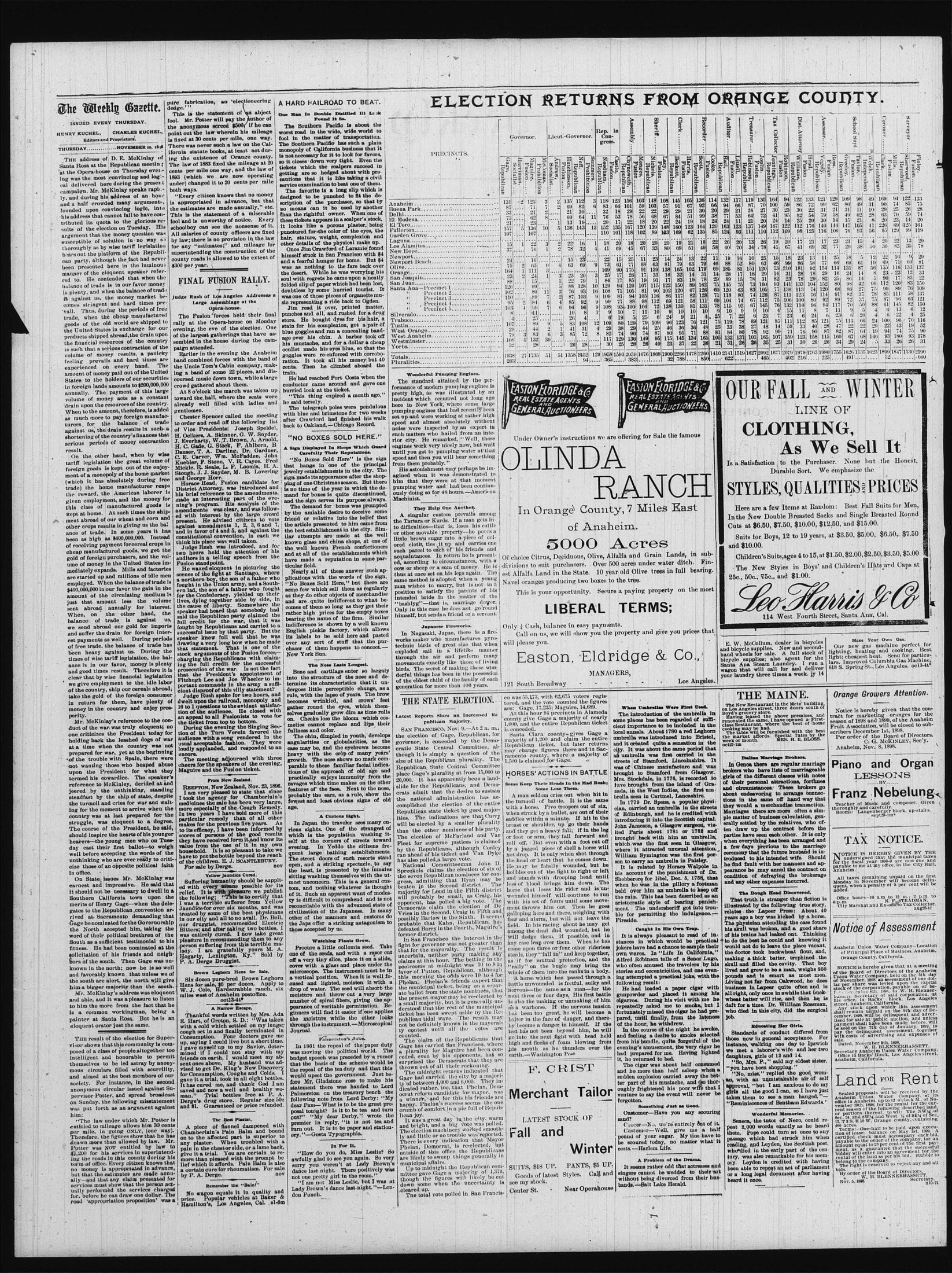
Searchable text
The Weekly Gazette.
ISSUED EVERY THURSDAY.
HENRY KUCHEL, CHARLES KUCHEL,
Editors and Proprietors.
THURSDAY.....NOVEMBER 10, 1838
THE address of D. E. McKinlay of Santa Rosa at the Republican meeting at the Opera-house on Thursday evening was the most convincing and logical delivered here during the present campaign. Mr. McKinlay speaks rapidly, and during his address of an hour and a half crowded many arguments, founded upon convincing logic, into his address that cannot fail to have contributed its quota to the glorious results of the election on Tuesday. His argument that the money question was susceptible of solution in no way so thoroughly as by wise tariff legislation bears out the platform of the Republican party, although the fact had never been presented here in the luminous manner of the eloquent speaker referred to. He contended that when the balance of trade is in our favor money is plenty, and when the balance of trade is against us, the money market becomes stringent and hard times prevail. Thus, during the periods of free trade, when the cheap manufactured goods of the old world are shipped to the United States in exchange for our products shipped abroad, the drain upon the financial resources of the country is such that a serious contraction of the volume of money results, a panicky feeling prevails and hard times are experienced on every hand. The amount of money paid out of the United States to the holders of our securities in foreign lands amounts to $200,000,000 annually. The payment of this large volume of money acts as a constant drain upon the resources of the country. When to the amount, therefore, is added as much more to pay foreign manufacturers for the balance of trade against us, the drain results in such a shortening of the country's finances that serious periods of money contraction result.
On the other hand, when by wise tariff legislation the great volume of foreign goods is kept out of the enjoyment of a monopoly of the home market pure fabrication, an 'electioneering dodge.' This is the statement of an abject fool. Mr. Potter will pay the author of the anonymous screed $500; if he can point out the law wherein his mileage is fixed at 30 cents per mile, one way. There was never such a law on the California statute books, at least not during the existence of Orange county. The law of 1883 fixed the mileage at 20 cents per mile one way, and the law of 1893 (which we are now operating under) changed it to 20 cents per mile both ways.
"Every citizen knows that no money is appropriated in advance, but that the estimates are made annually," etc. This is the statement of a miserable fool and is unworthy of notice. Every schoolboy can see the nonsense of it. All salaries of county officers are fixed by law; there is no provision in the law for any "estimates;" and mileage for superintending the construction of the county roads is allowed to the extent of $300 per year.
FINAL FUSION RALLY.
Judge Rush of Los Angeles Addresses a Large Assemblage at the Opera-house.
The Fusion forces held their final rally at the Opera-house on Monday evening, the eve of the election. One of the largest gatherings that have assembled in the house during the campaign attended.
Earlier in the evening the Anaheim band combined forces with the band of the Uncle Tom's Cabin company, making a band of some 22 pieces, and discarded music down town, while a large crowd gathered about them.
At 8 o'clock the march was taken up toward the hall, where the seats were already well filled with ladies and gentlemen.
Chester Spencer called the meeting to order and read off the following list of Vice Presidents: Joseph Speidel, H. Oelkers, A. Skinner, G. W. Snyder, J. Everharty, W. T. Brown, A. Arnold, H. C. Gade, G. Stock, F. Ahlborn, B Dauser, T. A. Darling, Dr. Gardner, C. E. Carver, Wm. McFadden, John Kuebler, F. Stone, V. R. Cayce. Fred Mickle, R. Seale, L. F. Loomis, H. A. Stough, J. J. Snyder, M. B. Lovering
A HARD RAILROAD TOO
One Man In Double Distilled Found It So.
The Southern Pacific is a worst road in the wide, wide fool in the matter of transpole The Southern Pacific has such monopoly of California business is not necessary for it to look so it closes down very tight tickets which the scalpers getting are so hedged about cautions that it is like taking service examination to beat one.
The favorite is a long slider designed to be punched to describe of the purchaser, no means can it be used than the rightful owner. With these tickets appears in a scalpel it looks like a porous plate punctured for the color of tha hair, stature, weight, complication details of the physical nature.
Once Jim Crawford of Laredo himself stuck in San Francisco and a fearful hunger for home was as nothing to the far end of the desert. While he was wary with regrets he came up folded slip of paper which had doubtless by some hurried was one of those pieces of organic representing a ride back.
Jim read it over, printed punches and all, and rushed store. He bought dyes for stain for his complexion, got blue goggles and ran a conceal age over his chin. A barbell his mustache, and for a dolphin made his eyes blue, goggles were re-enforced with ration. It took all his money then he climbed a train.
He had reached Port Coste conductor came around and hurried look at the ticket.
"This thing expired a month he said tersely.
The telegraph poles were with blue and brimstone for after Crawford had finished back to Oakland.-Chicago."
"NO BOXES SOLD"
A Sign Displayed In Shops Wear Carefully Their Reprints
That hangs in one of these jewelry establishments in tha
States to the holders of our securities in foreign lands amounts to $200,000,000 annually. The payment of this large volume of money acts as a constant drain upon the resources of the country. When to the amount, therefore, is added as much more to pay foreign manufacturers for the balance of trade against us, the drain results in such a shortening of the country's finances that serious periods of money contraction result.
On the other hand, when by wise tariff legislation the great volume of foreign goods is kept out of the enjoyment of a monopoly of the home market (which it has absolutely during free trade) the home manufacturer reaps the reward, the American laborer is given employment, and the money for this class of manufactured goods is kept at home. At such times the shipment abroad of our wheat and corn and other crops results in giving us the balance of trade. In some years it has been as high as $400,000,000. Instead of receiving payment for cereal crops in cheap manufactured goods, we get the gold of foreign purchasers, and the volume of money in the United States immediately expands. Mills and factories are started up and millions of idle men employed. When the balance of trade is $400,000,000 in our favor the gain in the amount of the circulating medium is just that amount less the volume sent abroad annually for interest. When, on the other hand, the balance of trade is against us, we send abroad our gold for imports and suffer the drain for foreign interest payments as well. During periods of free trade, the balance of trade has been heavy against us. During the times of wise tariff legislation, the balance is in our favor, money is plenty and good times result. Therefore it is clear that by wise financial legislation we give employment to the idle labor of the country, ship our cereals abroad, take the gold of the foreign consumer in return for them, have plenty of money in the country and enjoy prosperity.
Mr. McKinlay's reference to the conduct of the war was truly eloquent; no one criticizes the President today for holding back the leashed dogs of war at a time when the country was not prepared for war, yet at the beginning of the trouble with Spain, there were not wanting those who heaped abuse upon the President for what they termed his cowardice. The speaker's reference to McKinley, derided at and jeered by the unthinking, standing steadfast by the ship of state, despite the turmoil and cries for war and waiting for the moment to arrive when the country was at last prepared for the struggle, was eloquent to a degree. The course of the President, he said, should inspire the hearts of his younger hearers—the young men who on Tuesday cast their first ballot—to weigh well before accepting the words of the unthinkable who are ever ready to criticize those of an opposite political faith in office.
On State issues Mr. McKinlay was earnest and impressive. He said that it should not be necessary to dwell in a Southern California town upon the
At 8 o'clock the march was taken up toward the hall, where the seats were already well filled with ladies and gentlemen.
Chester Spencer called the meeting to order and read off the following list of Vice Presidents: Joseph Speidel, H. Oelkers, A. Skinner, G. W. Snyder, J. Everharty, W. T. Brown, A. Arnold, H. C. Gade, G. Stock, F. Ahlborn, B Dauser, T. A. Darling, Dr. Gardner, C. E. Carver, Wm. McFadden, John Kuebler, F. Stone, V. R. Cayce. Fred Mickle, R. Seale, L. F. Loomis, H. A. Stough, J. J. Snyder, M. B. Lovering and George Horr.
Horace Head, Fusion candidate for District Attorney, was introduced and his brief reference to the amendments made an interesting part of the evening's program. His analysis of the amendments was clear, and was followed with interest by the large crowd present. He advised citizens to vote against amendments 1, 2, 3, 6 and 7, and in favor of 4 and 5, and against the constitutional convention, in each we think his place was well taken.
Judge Rush was introduced, and for two hours held the attention of his auditors in a telling speech from the Fusion standpoint.
He waxed eloquent in picturing the scenes of the fight at Santiago, where a northern boy, the son of a father who fought in the Union army, and a Southern lad, the son of a father who fought for the Confederacy, yielded up their lives, dying together side by side, in the cause of liberty. Somewhere the speaker had heard that somebody had said the Republican party claimed the full credit for the war, that it was fought by Republicans and carried to a successful issue by that party. But the speaker knew full well that he was drawing a very long bow when he made that statement. That is one of the stock arguments of the Fusion forces—charging the Republicans with claiming the full credit for the successful prosecution of the war. Is not the fact that the President's appointment of Fitzhugh Lee and Joe Wheeler to important commands in the army a sufficient disproof of this silly statement?
Judge Rush spoke for two hours, and dwelt upon the railroad, monopoly and 16 to 1 questions to the evident satisfaction of the audience. He closed with an appeal to all Fusionists to vote for the ticket from top bottom.
During the evening the Singing Section of the Turn Verein favored the audience with a song rendered in the usual acceptable fashion. They were loudly applauded, and responded to an encore.
The meeting adjourned with three cheers for the speakers of the evening, Maguire and the Fusion ticket.
From New Zealand.
REEFTON, New Zealand, Nov. 23, 1896.
I am very pleased to state that since I took the agency for Chamberlain's medicines she has been very large more especially of the Cough Remedy.
In two years I have sold more of this particular remedy than all other makes for previous five years. As to its efficacy I have been informed by scores of persons of the good results they have received form it, and know its value from the use of it in my own household. It is so pleasant to take we have to put the bottle beyond the reach of the children. E. J. SCANTLEBURY.
For sale by Derge.
Yellow Jaunce Cured.
Suffering humanity should be supplied with every means possible for its relief. It is with pleasure we publish this; "This is to certify that
He had reached Port Coste conduct came around and hurried look at the ticket.
"This thing expired a month he said tersely.
The telegraph poles were with blue and brimstone for after Crawford had finished back to Oakland.-Chicago.
"NO BOXES SOLD
A Sign Displayed In Shops Ware
Carefully Their Reputation
"No Boxes Sold Here"
that hangs in one of their jewelry establishments in this sign made its appearance after piling of one Christmas season is no time of year in which mand for boxes is quite difficult and sign serves its purpose.
The demand for boxes was by amiable desire to do friend or relative into this article presented to him;the best establishment in this ilar attempts are made known glass and china shop;the well known French shop;and at all of the establishments have made a reputation in ticular field.
Nearly all of these applications with words "No Boxes Sold Here,"be some few which sell them as they do other objects or are quite indifferent comes of them so long as they bearing the name of the fil indifference is shown by an English pickle factory;wits labels to be sold here over any sort of stuff chaser of them happens tha New York Sun.
The Nose Lasts Long
Bone and cartilage enter into the structure of this termine its characteristics dergoes little perceptible rule;with the lapse of years becomes wrinkled,and gather roundthe eyes,solves gradually grow dim.Cheeks losethe bloom metics cannot replace an fullness and color.
The chin,dimpled in your angularities or globular case may be,andthe eyebrow heavy withthe cropof growth.The nose shows parable to these familiaritiesofthe approachofthis practically enjoys immunavageswhich time makes featuresofthe face.Nex probablythe ears,arauf fewestand least obvious age.
A Curious Sight
In Japan,the traveler rious sights Oneofthe whichisthepopulation selfatthe cornersofseven evening.In Yeddothe quentlarge bathingeastThe street doorsofsuchopen,anda strikingspeechthe least.ispresentedbettiningwashingthemselvesmostunconcern Thisisanatom,andnothingwhateverofit.Suchanapparentwaveis difficulttocomprehend
the turmoll and cries for war and waiting for the moment to arrive when the country was at last prepared for the struggle, was eloquent to a degree. The course of the President, he said, should inspire the hearts of his younger hearers—the young men who on Tuesday cast their first ballot—to weigh well before accepting the words of the unthinking who are ever ready to criticize those of an opposite political faith in office.
On State issues Mr. McKinlay was earnest and impressive. He said that it should not be necessary to dwell in a Southern California town upon the merits of Henry Gage—when the delegates to the Republican convention arrived at Sacramento demanding that Gage be nominated for the Governorship the North accepted him, taking the word of their political brethren of the South as a sufficient testimonial to his fitness. He had been nominated at the solicitation of his friends and neighbors of the south. Then Gage was unknown in the north; now he is so well and favorably known that unless we of the south are alert, the north will give him a bigger majority than the south.
Mr. McKinlay's address was eloquent and able, and it was a pleasure to listen to him the more from the fact that he is a common workingman, being a painter at Santa Rosa. But he is an eloquent orator just the same.
The result of the election for Supervisor shows that this community is composed of a class of people altogether too intelligent and honorable to permit themselves to be led astray by anonymous circulars filled with scurrility, and aimed at the best members of our society. For instance, in the second anonymous circular issued against Supervisor Potter, and spread broadcast on Sunday, the following misstatement was put forth as an argument against him:
"The law under which Mr. Potter is entitled to mileage allows him 30 cents per mile, in going ONLY, (one way). Therefore, the figures show that he has drawn more than allowed by law. Mr. Potter was NOT entitled by law to $1,200 for his services in superintending the roads in this county during his term of office. Every citizen knows that no money is appropriated in advance, but that the estimates are made annually—and that any claim presented for services must show that the person actually performed the services charged for, before he can draw one dollar. The road 'appropriation proposition' was a
Yellow Jaundice Cured.
Suffering humanity should be supplied with every means possible for its relief. It is with pleasure we publish the following: "This is to certify that I was a terrible sufferer from Yellow Jaundice-for over six months, and was treated by some of the best physicians in our city and all to no avail. Dr. Bell, our druggist, recommended Electric Bitters; and after taking two bottles, I was entirely cured. I now take great pleasure in recommending them to any person suffering from this terrible malady. I am gratefully yours M. A. Hogarty, Lexington, Ky." Sold by P. A. Derge Druggist.
Brown Leghorn Hens for Sale.
Six dozen pure-bred Brown Leghorn Hens for sale, $6 per dozen. Apply to W. J. Cole, Hardscrabble ranch, six miles west of Anaheim postoffice.
A Narrow Escape,
Thankful words written by Mrs. Ada E. Hart, of Groton, S. D.: "Was taken with a cold which settled on my lungs; cough set in and finally terminated in Consumption. Four doctors gave me up, saying I could live but a short time. I gave myself up to my Savior, determined if I could not stay with my friends on earth, I would meet my absent ones above. My husband was advised to get Dr. King's New Discovery for Consumption, Coughs and Colds. I gave it a trial, took in all eight bottles. It has cured me, and thank God I am saved and now a well and healthy woman." Trial bottles free at P. A. Derge's drug store. Regular size 50c and $1. Guaranteed or price refunded.
The Best Plaster.
A piece of flannel dampened with Chamberlain's Pain Balm and bound on to the affected part is superior to any plaster. When troubled with a pain in the chest or side, or a lame back, give it a trial. You are certain to remove than pleased with the prompt be lief which it affords. Pain Balm is also a certain cure for rheumatism. For sale by P. A. Derge.
Remember the "Bain!"
No wagon equals it in quality and price. Popular vehicles at Baker & Hamilton's, Los Angeles, Cal. s1-6m
A Curious Sight.
In Japan the traveler is curious sights. One of the which is the population self at the corners of six evening. In Yeddo they frequent large bathing esse.The street doors of such open, and a striking speech the least is presented by sitting washing themselves most unconcern. This is a tom, and nothing whatever of it. Such an apparent worry is difficult to comprehend reconcilable with the advice civilization of the Japanese other of the manners and the Japs offer a striking those accepted by us.
Watching Plants
Procure a little collomino one of the seeds, and write off a very tiny slice, place cover with a glass and ply microscope. The instrument a vertical position. When onsed and lighted, molts drop of water. The seed w moisture and throw out number of spiral fibers, givearance of veritable germ ginnies will find it easier the moisture while thence through the instrument.
Palmerston's J.
In 1861 the repeal of was moving the political budget speech was preceded that the basis of the scheme would upset the governmenr Mr. Gladstone rose statement there was haw Palmerston on the treasury following note from Lord dear Pam—What is to be posal tonight? Is it to be out?" "My dear Derby premier in reply," "it is turn out. It is to be papery."—Gesta Typographi
In For It,
"How do you do, Mr awfully glad to see you as sorry you weren't at dance last night. There not one pretty girl in the"I am not Miss Leslie Lady Brown's dance last don Punch."
A HARD RAILROAD TO BEAT.
One Man In Double Distilled Ill Lack Found It So.
The Southern Pacific is about the worst road in the wide, wide world to fool in the matter of transportation. The Southern Pacific has such a plain monopoly of California business that it is not necessary for it to look for favors, so it closes down very tight. Even the tickets which the scalpers succeed in getting are so hedged about with precautions that it is like taking a civil service examination to beat one of them. The favorite is a long slip which is designed to be punched to fit the description of the purchaser, so that by no means can it be used by another than the rightful owner. When one of these tickets appears in a scalper's stock, it looks like a porous plaster, being punctured for the color of the eyes, the hair, stature, weight, complexion and other details of the physical make up.
Once Jim Crawford of Laramie found himself stuck in San Francisco with $4 and a fearful hunger for home. But $4 was as nothing to the fare back over the desert. While he was worrying his soul with regrets he came upon a neatly folded slip of paper which had been lost, doubtless by some hurried tourist. It was one of those pieces of organette music representing a ride back to Ogden.
Jim read it over, printed matter, punches and all, and rushed for a drug store. He bought dyes for his hair, a stain for his complexion, got a pair of blue goggles and ran a concealing bandage over his chin. A barber took off his mustache, and for a dollar a cheap oculist made his eyes blue, so that the goggles were re-enforced with corroboration. It took all his money but 40 cents. Then he climbed aboard the train.
He had reached Port Costa when the conductor came around and gave one hurried look at the ticket.
“This thing expired a month ago,” he said tersely.
The telegraph poles were pendulous with blue and brimstone for two weeks after Crawford had finished his walk back to Oakland. — Chicago Record.
“NO BOXES SOLD HERE.”
A Sign Displayed In Shops Which Guard Carefully Their Reputations.
“No Boxes Sold Here” is the sign that hangs in one of the principal jewelry establishments in the city. The
He had reached Port Costa when the conductor came around and gave one hurried look at the ticket.
“This thing expired a month ago,” he said tersely.
The telegraph poles were pendulous with blue and brimstone for two weeks after Crawford had finished his walk back to Oakland.—Chicago Record.
“NO BOXES SOLD HERE.”
A Sign Displayed In Shops Which Guard Carefully Their Reputations.
“No Boxes Sold Here” is the sign that hangs in one of the principal jewelry establishments in the city. The sign made its appearance after the shopping of one Christmas season. But there is no time of the year in which the demand for boxes is quite discontinued, and the sign serves its purpose always.
The demand for boxes was prompted by the amiable desire to deceive some friend or relative into the belief that the article presented to him came from the best establishment in the city. Similar attempts are made at the well known glass and china shops, at one of the well known French confectioners and at all of the establishments which have made a reputation in some particular field.
Nearly all of these answer such applications with the words of the sign, “No Boxes Sold Here,” but there are some few which sell them regularly as they do other objects of merchandise and are quite indifferent to what becomes of them so long as they get their rather high prices for the empty boxes bearing the name of the firm. Similar indifference is shown by a well known English pickle factory, which allows its labels to be sold here and pasted over any sort of stuff that the purchaser of them happens to concoct.—New York Sun.
The Nose Lasts Longest.
Bone and cartilage enter so largely into the structure of the nose and determine its characteristics that it undergoes little perceptible change, as a rule, with the lapse of years. The brow becomes wrinkled, and crows’ feet gather round the eyes, which themselves gradually grow dim as time rolls on. Cheeks lose the bloom which cosmetics cannot replace and lips their fullness and color.
The chin, dimpled in youth, develops angularities or globularities, as the case may be, and the eyebrows become heavy with the crop of many years’ growth. The nose shows no mark comparable to these familiar facial indications of the approach of old age and practically enjoys immunity from the ravages which time makes on the other features of the face. Next to the nose, probably the ears, as a rule, show the fewest and least obvious signs of old age.
A Curious Sight.
In Japan the traveler sees many curious sights. One of the strangest of which is the population washing itself at the corners of streets toward evening. In Yeddo the citizens frequent large bathing establishments. The street doors of such resorts stand open, and a striking spectacle, to say the least, is presented by the inmates sitting washing themselves with the utmost unconcern. This is a general custom, and nothing whatever is thought of it. Such an apparent want of modesty is difficult to comprehend and is not
Wonderful Pumping Engines.
The standard attained by the performance of modern pumping engines is pretty high, as was illustrated by an incident which occurred not long ago here in New York, where some large pumping engines that had recently been set up and were working at rather high speed and almost absolutely without noise were inspected by an expert in such matters who hailed from an interior city. He remarked, “Well, those engines work very nicely now, but wait until you get to pumping water at that speed and then you will hear something from them probably.”
His astonishment may perhaps be imagined when it was demonstrated to him that they were at that moment pumping water and had been continuously doing so for 48 hours.—American Machinist.
They Help One Annotes.
A singular custom prevails among the Tartars or Kurds. If a man gets into difficulties—that is, loses his cattle or other movable property—the poets a little brown sugar into a piece of colored cloth, ties it up and carries one such parcel to each of his friends and acquaintances. In return he is presented, according to circumstances, with a cow or sheep or a sum of money. He is thus at once set on his legs again. The same method is adopted when a young man wishes to marry, but is not in a position to satisfy the parents of his intended bride in the matter of the “bashlyg”—that is, marriage dowery. Only in this case he does not go round himself, but sends a friend or a servant.
Japanese Fireworks.
In Nagasaki, Japan, there is a fireworks maker who manufactures pyrotechnic birds of great size that when exploded sail in a lifelike manner through the air and perform many movements exactly like those of living birds. The secret of making these wonderful things has been in the possession of the eldest child of the family of each generation for more than 400 years.
THE STATE ELECTION.
Latest Reports Show an Increased Republican Majority.
SAN FRANCISCO, Nov. 9.—At 2 a.m., m., the election of Gage, Republican, for governor, is conceded by the Democratic State Central Committee, although it is simply a question of the size of the Republican plurality. The Republican State Central Committee place Gage’s plurality at from 15,000 to 20,000. It has apparently been a landslide for the Republicans, and Democrats admit that the desire to sustain the national administration has accomplished the election of the entire Republican state ticket by good majorities. The indications are that Curry will be elected by a smaller plurality than the other nominees of his party. The election of McFarland and Van Fleet for supreme justices is claimed by the Republicans, although Conley ran ahead of his ticket and Van Dyke has also polled a large vote.
National Committeeman John D. Speckels claims the election of six of the seven Republican nominees for congress, admitting that Ryan may be beaten in the Second district. The majority for Loud in the Fifth district will probably be small, as Craig, his co was 55,173, with 62,675 voters registered, and the vote counted the figures are: Gage, 17,235; Maguire, 14,689.
At this hour 94 precincts in Alameda county give Gage a majority of nearly 1,000, and the entire Republican ticket is conceded.
Santa Clara county gives Gage a majority of 1,200 and claim the entire Republican ticket, but later returns may change figures there and in Sacramento county, where a majority of 1,500 is claimed for Gage.
HORSES’ ACTIONS IN BATTLE
Some Keep Their Heads In The Mad Rush; Some Lose Them.
A man seldom cries out when hit in the turnoil of battle. It is the same with a horse. Five troopers out of six when struck by a bullet, are out of their saddles within a minute. If hit in the breast or shoulder, up their hands and they get a heavy fall; if in the leg or foot or arm, they fall forward and roll off. But even with a foot cut off by a jagged piece of shell a horse will not drop. It is only when shot through the head or heart that he comes down. He may be fatally wounded, but he holbles out of the fight to right or left and stands with drooping head until loss of blood brings him down. The horse that loses his rider and is unwounded himself will continue to run
When Umbrellas We
The introduction of some places has been reintroduced important to be local annals. About 178 umbrella was introduced and it created quite a city. It was about an umbrella was first streets of Stamford, I was of Chinese manual brought to Stamford Mrs. Stockdale, in 1774 have brought from therada in the West Indian brella seen in Cartmel.
In 1779 Dr. Spena, cian, carried an umbrella of Edinburgh, and he introducing it into therJohn Jameson, a Glasgowited Paris about 178 brought back with him which was the first where it attracted un William Symington we son to carry an umbrella.
It is related by Hc his account of the pub Shebberere for libel, I when he was in therheld over him an umbrella rain. This has been
A Curious Sight.
In Japan the traveler sees many curious sights. One of the strangest of which is the population washing itself at the corners of streets toward evening. In Yeddo the citizens frequent large bathing establishments. The street doors of such resorts stand open, and a striking spectacle, to say the least, is presented by the inmates sitting washing themselves with the utmost unconcern. This is a general custom, and nothing whatever is thought of it. Such an apparent want of modesty is difficult to comprehend and is not reconcilable with the advanced state of civilization of the Japanese. In many other of the manners and customs do the Japs offer a striking antagonism to those accepted by us.
Watching Plants Grow.
Procure a little collomia seed. Take one of the seeds, and with a razor cut off a very tiny slice, place it on a slide, cover with a glass and place under the microscope. The instrument must be in a vertical position. When it is well focused and lighted, moisten it with a drop of water. The seed will absorb the moisture and throw out a very large number of spiral fibers, giving the appearance of veritable germination. Beginners will find it easier if one applies the moisture while the other looks through the instrument.—Microscopical Journal.
Palmerston's Joke.
In 1861 the repeal of the paper duty was moving the political world. The budget speech was preceded by a rumor that the basis of the scheme would be the repeal of the tea duty and that this would upset the government. Just before Mr. Gladstone rose to make his statement there was handed to Lord Palmerston on the treasury bench the following note from Lord Derby: "My dear Pam—What is to be the great proposal tonight? Is it to be tea and turn out?" "My dear Derby," wrote the premier in reply, "it is not tea and turn out. It is to paper and stationery."—Gesta Typographia.
In For It,
"How do you do, Miss Leslie? So awfully glad to see you again. So very sorry you weren't at Lady Brown's dance last night. There positively was not one pretty girl in the room."
"I am not Miss Leslie, but I was at Lady Brown's dance last night."—London Punch.
National Committeeman John D. Spreckels claims the election of six of the seven Republican nominees for congress, admitting that Ryan may be beaten in the Second district. The majority for Loud in the Fifth district will probably be small, as Craig, his opponent, has polled a big vote. The Democrats claim the election of De Vries in the Second, Craig in Fifth and possibly Barlow in the Sixth. It seems probable that Kahn, Republican, has defeated Barry in the Fourth, Maguire's former district.
In San Francisco the interest in the fight for governor was not greater than that for the mayoralty. The result is uncertain, neither party making any claims at this hour. The betting in the poolrooms at midnight was 10 to 8 in favor of Patton, Republican, although this morning the odds were 10 to 4 for Phelan. Phelan's friends expect that the municipal ticket, being on a separate ballot from the state nominees, that the present mayor may be re-elected by a small majority, but it is generally understood that the rest of the municipal ticket has been swept aside by the Republican tidal wave. The result may not be definitely known in the mayoralty contest until all the votes are counted.
The claim of the Republicans that Gage has carried San Francisco, where a plurality for Maguire had been conceded, even by his opponents, has surprised the Demoerats that they are thrown out of all their reckoning.
The midnight returns indicated that Gage had carried the city by a majority of between 4,000 and 6,000. They indicated rather, too, that Phelan, Democrat reform candidate for mayor, was a winner, and for this his friends are happy. Phelan's success seems the one crumb of comfort in a pie full of Republican joy.
It was a great day in the city, warm and bright, and a big vote was polled. The election machinery worked smoothly and little or no trouble was reported. There is every indication that Mayor Phelan, Democrat, is re-elected, but outside of this office the Republicans are likely to sweep things generally in municipal affairs.
Up to midnight the Republican committee gave Gage a majority of 4,379, though the figures will likely be cut down some when the uncertainty is cleared up.
The total vote polled in San Francisco with a horse. Five troopers out of six when struck by a bullet, are out of their saddles within a minute. If hit in the breast or shoulder, up go their hands and they get a heavy fall; if in the leg or foot or arm, they fall forward and roll off. But even with a foot cut off by a jagged piece of shell a horse will not drop. It is only when shot through the head or heart that he comes down. He may be fatally wounded, but he holds out of the fight to right or left and stands with drooping head until loss of blood brings him down. The horse that loses his rider and is unwounded himself will continue to run with his set of fours until some movement throws him out. Then he goes galloping here and there, neighing with fear and alarm, but will not leave the field. In his racing about he may get among the dead and wounded, but he will dodge them, if possible, and in any case leap over them. When he has come upon three or four other riderless steeds, they "fall in" and keep together, as if for mutual protection, and the "rally" on the bugle may bring the whole of them into the ranks in a body.
A horse which has passed through a battle unwounded is freetful, sulky and nervous—the same as a man—for the next three or four days. His first battle is also the making or unmaking of him as a warhorse. If the nervous tension has been too great, he will become a bolter in the face of danger, and thereby become a danger in himself. If the test has not been beyond him, he will go into the next fight with head held high and flecks of foam blowing from his mouth as he thunders over the earth.—Washington Post
F. CRIST
Merchant Tailor
LATEST STOCK OF Fall and Winter
SUITS, $18 UP. PANTS, $5 UP.
Goods of latest Styles. Call and see my stock.
Center St. Near Operahouse
In 1779 Dr. Spens cian, carried an umbrella of Edinburgh, and he introducing it into the John Jameson, a Glass-lined Paris about 1779 brought back with him which was the first saint where it attracted un William Symington son to carry an umbrella.
It is related by Hex his account of the purist Shebberere for libel. In when he was in the hold over him an umbrella rain. This has been aristocratic style of ment. The undersheen ble for permitting th Fireside.
Caught In His
It is always pleasant stances in which young jokers have had a chance wares. In "Life Alfred Robinson tells who often amused these stories and eccentricity ing attempted a practical following result:
He had loaded a gunpowder and placed cigarros. During his repeatedly asked me fortunately missed me pared, until finally, faded of the hour, he withdrew.
In the course of time and feeling a desire from his bundle, quilt evening's amusement had prepared for me; it, he returned to bed.
The cigar was about and he more than has sudden explosion carrier part of his mustoughly frightened his venture to say the event forgotten.
Something Juice
Customer—Have you sand?
Cooper—No, we're Customer—Well,
pound of your sugar be scoured today; no costs.—Harlem Life.
A Problem Of
It seems rather odd singers cannot be we without being divorced bands.—Salt Lake H
BURNS FROM ORANGE COUNTY.
Rep. in Congress.
Assembly
Chynoweth, Republican
Menges, Fusion
Castle, Fusion
Needham, Republican
Sheriff
Lacy, Fusion
Nichols, Republican
Bockett, Republican
Tax Collector
Robinson, Republican
Jenning, Republican
Auditor, Hall, Republican
Recorder, Cooke, Fusion
Scott, Republican
Harris, Fusion
Bockett, Republican
School Supt.
Weld, Independent
Taylor, Fusion
Greely, Republican
Assessor
Ross, Fusion
Vegely, Republican
Head, Fusion
Williams, Republican
Robinson, Republican
Joplin, Fusion
Litell, Fusion
Robinson, Republican
118 123 156 103 148 108 145 105 136 114 132 117 119 130 164 94 122 133 121 129 109 98 49 169 94 122 133
83 66 101 59 103 57 91 67 92 66 94 66 87 70 100 59 86 72 90 62 80 49 31 90 74 85 75
32 18 29 22 29 29 21 30 20 30 27 41 27 23 25 30 22 31 21 31 10 25 25 59 28
76 53 56 18 68 24 19 18 24 24 14 24 24 14 25 20 30 14 15 21 8 20 23 14
20 17 22 22 22 22 19 18 24 24 14 14 17 176 140 144 147 105 41 226 69 125
152 135 167 120 139 148 160 123 164 120 163 93 111 110 167 122 98 125 116 106
110 101 118 102 89 169 62 135 85 124
18 20 18 20 20
45
67
33
80
69
21
18
49
58
40
70
34
78
19
67
41
69
32
77
21
38
50
30
83
35
78
22
15
25
11
23
14
23
79
46
88
52
80
63
46
99
86
58
77
66
69
61
19
69
71
60
81
73
67
77
68
63
81
79
46
88
52
80
63
46
99
86
58
77
66
69
61
19
69
71
133
137
169
90
175
91
139
138
165
102
79
69
185
81
151
120
73
210
181
92
154
114
131
87
56
155
123
137
25
17
26
17
32
16
32
19
78
29
89
15
78
31
82
23
78
29
82
25
86
4
5
90
73
22
129
94
120
107
115
122
150
89
75
75
73
60
93
141
133
104
52
80
98
4
95
89
70
-
-
-
-
-
-
-
-
-
-
-
-
-
-
-
-
-
-
-
-
-
-
-
-
-
-
-
-
-
-
-
-
-
-
-
-
-
-
-
-
-
-
-
-
-
-
OUR FALL AND WINTER LINE OF CLOTHING,
As We Sell It
Is a Satisfaction to the Purchaser. None but the Honest,
Durable Sort. We emphasize the
OUR FALL AND WINTER
LINE OF
CLOTHING,
As We Sell It
Is a Satisfaction to the Purchaser. None but the Honest,
Durable Sort. We emphasize the
STYLES, QUALITIES AND PRICES
Here are a few Items at Random: Best Fall Suits for Men,
In the New Double Breasted Sacks and Single Breasted Round
Cuts at $6.50, $7.50, $10.00, $12.50, and $15.00.
Suits for Boys, 12 to 19 years, at $3.50, $5.00, $6.50, $7.50
and $10.00.
Children's Suits, ages 4 to 15, at $1.50, $2.00, $2.50, $3.50, $5.00
The New Styles in Boys' and Children's Hats and Caps at
25c., 50c., 75c., and $1.00.
Leo Harris & Co
114 West Fourth Street, Santa Ana, Cal.
E. W. McCollum, dealer in bicycles
and bicycle supplies. New and secondhand wheels for sale. A full stock of
bicycle supplies; also agent for the
Santa Ana Steam Laundry. I run a
wagon that will call for and deliver
your laundry three times a week. jy 14
Make Your Own Gas.
Our new gas machine perfect for
lighting, heating and cooking. Best
light; cheapest heat. Send for particulars. Improved Columbia Gas Machine,
618 S. Spring St., Los Angeles. oc13-1t*
When Umbrellas Were First Used.
The introduction of the umbrella in some places has been regarded of suficient importance to be included in the local annals. About 1780 a red Leghorn umbrella was introduced into Bristol,
and it created quite a sensation in the city. It was about the same period that an umbrella was first carried in the streets of Stamford, Lincolnshire. It was of Chinese manufacture and was brought to Stamford from Glasgow.
Mrs. Stockdale, in 1776, is recorded to have brought from the island of Granada, in the West Indies, the first umbrella seen in Cartmel, Lancashire.
In 1779 Dr. Spens, a popular physician, carried an umbrella in the streets of Edinburgh, and he is credited with introducing it into the Scottish capital.
John Jameson, a Glasgow surgeon, visited Paris about 1781 or 1782 and brought back with him an umbrella,
which was the first seen in Glasgow,
where it attracted unusual attention.
William Symington was the first person to carry an umbrella in Paisley.
It is related by Horace Walpole in his account of the punishment of Dr.
Shebberefer for libel, Dec. 5, 1758, that when he was in the pillory a footman held over him an umbrella to keep off the rain. This has been described as an
THE MAINE.
The New Restaurant in the Metz' building,
on Los Angeles street, three doors south of Boyd's grocery store.
Having leased the above premises, and renovated the same, I have opened a Firstclass Restaurant, where the best of home cooking may be had.
The table will be furnished with the best market affords. Special rates by the week or month.
MRS. H.E.BLOSS.
oct27-1m
Italian Marriage Brokers.
In Genoa there are regular marriage brokers who have lists of marriageable girls of the different classes with notes of their personal attractions, fortunes and circumstances. These brokers go about endeavoring to arrange connections in the same off hand way that they would a merchandise transaction.
Marriages there are more often a simple matter of business calculation, generally settled by the relatives, who often draw up the contract before the parties have seen each other. It is only when everything has been arranged and a few days previous to the marriage ceremony that the future husband is introduced to his intended wife. Should he find fault with her manners and appearance he may annul the contract on condition of defraying the brokerage and any other expenses incurred.
The Dough Head Discovered.
Orange Growers Attention.
Notice is hereby given that the contract for marketing oranges for the season of 1898 and 1899, of the Anaheim Fruit Association, will be closed to subscribers December 1st, 1898.
Per order of the Board of Directors.
C. G. McKINLEY, Sec'y.
Anaheim, Nov. 8, 1898.
Piano and Organ
LESSONS
BY...
Franz Nebelung
Teacher of Music and composer. Given thoroughly and carefully.
Rooms: Langenberger block, up-stairs.
sept23-1m*
TAX NOTICE.
NOTICE IS HEREBY GIVEN BY THE undersigned that the municipal taxes for the fiscal year 1888-9 are now due and payable to me at my office. In the City Hall,
Anaheim.
All taxes remaining unpaid on the first Monday in November will become delinquent when a penalty of 5 per cent will be added.
Office hours—10 a.m to 12 p.m.; 2 p.m. to
In 1779 Dr. Spens, a popular physician, carried an umbrella in the streets of Edinburgh, and he is credited with introducing it into the Scottish capital. John Jameson, a Glasgow surgeon, visited Paris about 1781 or 1782 and brought back with him an umbrella, which was the first seen in Glasgow, where it attracted unusual attention. William Symington was the first person to carry an umbrella in Paisley.
It is related by Horace Walpole in his account of the punishment of Dr. Shebberere for libel, Dec. 5, 1758, that when he was in the pillory a footman held over him an umbrella to keep off the rain. This has been described as an aristocratic style of bearing punishment. The undersheriff got into trouble for permitting the indulgence—Fireside.
Caught In His Own Trap.
It is always pleasant to read instances in which would be practical jokers have had a chance to sample their own wares. In "Life In California," Alfred Robinson tells of a Senior Lugo, who often amused the travelers by his stories and eccentricities, and one evening attempted a practical joke, with the following result:
He had loaded a paper cigar with gunpowder and placed it among his cigarros. During his visit with me he repeatedly asked me to smoke, but I fortunately missed the cigar he had prepared, until finally, from the lateness of the hour, he withdrew.
In the course of the night he awoke, and feeling a desire to smoke selected from his bundle, quite forgetful of the evening's amusement, the very cigar he had prepared for me. Having lighted it, he returned to bed.
The cigar was about half consumed and he more than half asleep when a sudden explosion carried away the better part of his mustache, and so thoroughly frightened his poor wife that I venture to say the event will never be forgotten.
Something Just as Good.
Customer—Have you any scouring sand?
Crecer—No, we're entirely out of it.
Customer—Well, give me a half pound of your sugar. My tins have to be scoured today, no matter what it costs.—Harlem Life.
A Problem of the Drama.
It seems rather odd that actresses and singers cannot be wedded to their husbands.—Salt Lake Herald.
That truth is stranger than fiction is illustrated by the following true story, relates the Lapeer Press: About 40 years ago a boy was kicked by a horse. The physician attending the case found his skull was broken, and a good share of his brains had leaked out. Thinking to do the best he could and knowing it would not do to leave the place vacant, the doctor took buckwheat flour, and making a thick batter, trephined the akull and filled the cavity. That boy lived and grew to be a man, weighs 250 pounds and is smart as most men. Living not far from Oakwood, he does business in Lapeer quite often and is all right, only once in awhile that buckwheat batter will rise, and then he is daft for a time. Dr. William Rossman, who died in this city, did the surgical job.
Educating Her Girl.
Standards of conduct differed from those now in general acceptance. For instance, walking one day to Ipswich we met a laborer's wife and her two daughters, girls of 12 and 14.
So, Mrs. P.," said my eldest sister,"you have been shopping."
"No, miss," replied the good woman, with an unmistakable air of self approval,"but I am anxious to do my girls all the good I can, so I have just taken them to see a man hanged."—"Reminiscences of Bentham Edwards."
Wonderful Memories.
Seneca, the tutor of Nero, could repeat 2,000 words exactly as he heard them. Pope could turn at once to any passage which had struck him when reading, and Leyden, the Scottish poet, who died in the early part of the century, was also remarkable for his memory. Leyden is credited with having been able to repeat an act of parliament or a long legal document after having heard it once.
Notice of Assessment
Anaheim Union Water Company—Location of Principal Place of Business, Anaheim, Orange County, California.
NOTICE is hereby given that at a meeting of the Board of Directors of the Anaheim Union Water Company, held on the 9th day of November, 1898, an assessment of one dollar per share was levied upon the capital stock of the corporation, payable on or before December 8th, 1898, to W. H. Blennnerett. Secretary of said corporation, at his office in Backs' block, Los Angeles street, Anaheim, California.
Any stock upon which this assessment shall remain unpaid on the 9th day of December, 1898, will be delinquent and advertised for sale at public auction, and unless payment shall have been made before, will be sold on the 7th day of January, 1899, to pay the delinquent assessment, together with costs of advertising and expenses of sale.
Dated November 8th, 1898.
W.H.BLENNERHASSETT.
Secretary Anaheim Union Water Company.
Office in Backs' Block, Los Angeles street,
Anaheim, California.
Land for Rent
Sealed proposals will be received by the Anaheim Union Water Company; at its office in Anaheim, up to 12 o'clock M., of November 19th, 1898; for the rental for the current season of the following described land or portions thereof; to wit: The NW46 of Sec. 24; and SW43 and West. 16 of SEQ of Sec. 13; T3 S; R 10 W. Orange county; containing 400 acres.
Terms: One-half to be paid upon execution of lease; balance on May 1st, 1899. A certified check must accompany each bid; payable to the order of the company; for an amount equal to 25 per cent of the first payment; as a guarantee that enter into an agreement for the rental of the land as per his bid. Stubble to belong to the company.
The right is reserved to reject any and all bids.
By order of the Board of Directors.
W.H.BLENNERHASSETT.
Nov. 5, 1898.
Secretary n10-2t