anaheim-gazette 1898-09-08
Scanned page
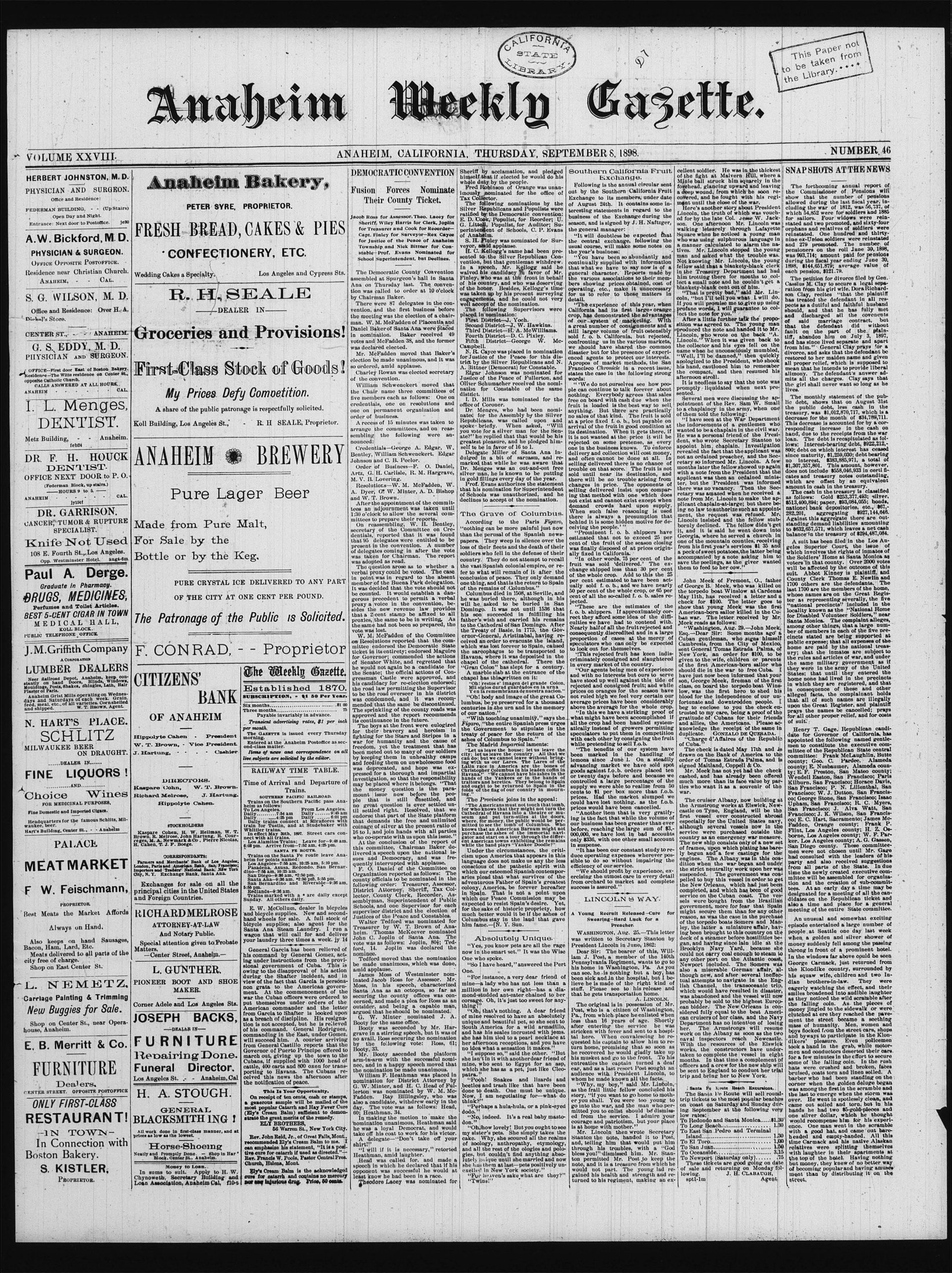
Searchable text
Anaheim
VOLUME XXVIII.
HERBERT JOHNSTON, M.D.
PHYSICIAN AND SURGEON.
Office and Residence:
FEDERMAN BUILDING. - (Up Stairs)
Open Day and Night.
Entrance: Next door to Postoffice. je30
A.W. Bickford, M.D.
PHYSICIAN & SURGEON.
OFFICE OPPOSITE POSTOFFICE.
Residence near Christian Church.
ANAHEIM, CAL.
S. G. WILSON, M.D.
Office and Residence: Over H. A. Dickel's Store.
CENTER ST., ANAHEIM.
G. S. EDDY, M.D.
PHYSICIAN AND SURGEON.
OFFICE—First door East of Boston Bakery.
Residence—The Witte residence on Center St., opposite Catholic Church.
CALLS ANSWERED AT ALL HOURS.
ANAHEIM CAL.
I. L. Menges,
DENTIST.
Metz Building, Anaheim.
feb24
DR. F. H. HOUCK
DENTIST.
Anaheim Bakery,
PETER SYRE, PROPRIETOR.
FRESH BREAD, CAKES & PIES
CONFECTIONERY, ETC.
Wedding Cakes a Specialty. Los Angeles and Cypress Sts.
R. H. SEALE
DEALER IN
Groceries and Provisions!
First-Class Stock of Goods!
My Prices Defy Competition.
A share of the public patronage is respectfully solicited.
Koll Building, Los Angeles St., R. H. SEALE, Proprietor.
ANAHEIM BREWERY
I. L. Menges,
DENTIST.
Metz Building, Anaheim.
feb24
DR. F. H. HOUCK
DENTIST.
OFFICE NEXT DOOR to P.O.
(Federman Block, up stairs.)
HOURS 9 to 5.
ANAHEIM
CAL.
jy154f
DR. GARRISON.
CANCER, TUMOR & RUPTURE SPECIALIST.
Knife Not Used
108 E. Fourth St., Los Angeles.
Opp. Westminster Hotel.
Paul A. Derge.
Graduate in Pharmacy.
DRUGS, MEDICINES,
Perfumes and Toilet Articles.
BEST 5-CENT CIGAR IN TOWN
MEDICAL HALL,
KOLL BLOCK.
PUBLIC TELEPHONE OFFICE.
J.M.Griffith Company
A CORPORATION
LUMBER DEALERS
Neer Railroad Depot, Anaheim, keep constantly on hand Doors, Blinds, Windows, Mouldings, Posts, Shakes, shingles, Lath, Hair Plaster of Paris.
Anaheim Grist Mills operating on Wednesdays and Saturdays of each week. Grain, feed, meal, etc., of all varieties. Cornshellled and shipped.
N. HART'S PLACE.
SCHLITZ
MILWAUKEE BEER ON DRAUGHT.
DEALER IN.....
FINE LIQUORS!
AND....
Choice Wines
FOR MEDICINAL PURPOSES,
Fine Domestic and Imported Cigars.
Headquarters for the famous Schlitz, Milwaukee, beer.
Hart's Building, Center St., Anaheim
PALACE
MEAT MARKET
F. W. Feischmann,
My Prices Defy Competition.
A share of the public patronage is respectfully solicited.
Koll Building, Los Angeles St., - R. H SEALE, Proprietor.
ANAHEIM BREWERY
Pure Lager Beer
Made from Pure Malt,
For Sale by the Bottle or by the Keg.
PURE CRYSTAL ICE DELIVERED TO ANY PART OF THE CITY AT ONE CENT PER POUND.
The Patronage of the Public is Solicited.
F. CONRAD, - Proprietor
CITIZENS'
BANK
OF ANAHEIM
Hippolyte Cahen - President
W. T. Brown, Vice President.
J. Hartung, Cashier
DIRECTORS.
Kaspare Cohn, W. T. Brown.
Richard Melrose, J. Hartung.
Hippolyte Cahen.
STOCKHOLDERS
Kaspare Cohen, H. W. Hellman, W. T. Brown, R. Melrose, John Hartung, R. Courreges, M. A. Newmark & Co., Pierre Nicolas, H. Cahen, T. J. F. Boege.
CORRESPONDENTS:
Farmers and Merchants' Bank of Los Angeles, London, Paris and American Bank, San Francisco; Importers and Traders' National Bank, New York City, N.Y. Exchange Bank, Santa Ana.
Exchanges for sale on all the principal cities in the United States and Foreign Countries.
The Weekly Gazette.
Established 1870.
SUBSCRIPTION, - Q1 50 Per Year.
Six months... $1 00
Three months... 75
Payable invariably in advance.
Transient advertising rates, $1 per inch per month.
The GAZETTE is issued every Thursday morning.
Entered at the Anaheim Postoffice as second-class matter.
Items of news and correspondence on all live subjects are solicited by the editor.
RAILWAY TIME TABLE.
Time of Arrival and Departure of Trains.
SOUTHERN PACIFIC RAILROAD.
Trains on the Southern Pacific pass Anaheim as follows:
To Los Angeles... From Los Angeles.
Dally... 7:54 am Dally... 9:45 am Dally... 4:25 pm Dally... 6:01 pm
Daily trains connect at Miramarres with train for Tustin, and at Studebaker with Whittier trains.
In effect May 30th, 1897. Street cars connect with all trains.
Los Alamitos Trains; Leave for-9:48 am 6:08 pm. Arrive from-7:58 am 4:25 pm.
SANTA FE ROUTE.
Trains on the Santa Fe route leave Anaheim for points named:
Los Angeles-7:58 am 10:25 am 5:10 pm.
Pasadena, Anasu, Redondo. San Bernardo-dino-7:58 am 10:25 am 5:10 pm.
San Diego-9:36 am *2:50 pm.
Santa Ana-9:36 am *2:50 pm.
San Bernardino and Riverside-9:36 am 5:55 pm.
Redlands-9:36 am.
Trains marked with a * are daily except
FOR MEDICINAL PURPOSES,
Fine Domestic and Imported Cigars.
Headquarters for the famous Schlitz, Milwaukee, beer.
Hart's Building, Center St., Anaheim
PALACE
MEATMARKET
F. W. Feischmann,
PROPRIETOR.
Best Meats the Market Affords
Always on Hand.
Also keeps on hand Sausages, Bacon, Ham, Lard, Etc.
Meats delivered to all parts of the city free of charge.
Shop on East Center St.
L. NEMETZ,
Carriage Painting & Trimming
New Buggies for Sale.
Shop on Center St., near Opera-house, Anaheim.
E. B. Merritt & Co.
FURNITURE
Dealers.
CENTER STREET. OPPOSITE POSTOFFICE
ONLY FIRST-CLASS RESTAURANT!
IN TOWNIn Connection with Boston Bakery.
S. KISTLER.
PROPRIETOR.
Hippolyte Cahen.
STOCKHOLDERS
Kaspare Cohen, H. W. Heilman, W. T. Brown, R. Melrose, John Hartung, R. Courreges, M. A. Newmark & Co., Pierre Nicolas, H. Cahen, T. J. F. Boege.
CORRESPONDENTS:
Farmers and Merchante' Bank of Los Angeles; London, Paris and American Bank, San Francisco; Importers and Traders' National Bank, New York City, N.Y. Exchange Bank, Santa Ana.
Exchanges for sale on all the principal cities in the United States and Foreign Countries.
RICHARDMELROSE
ATTORNEY-AT-LAW
And Notary Public.
Special attention given to Probate Matters.
—Center Street, Anaheim.
L. GUNTHER.
PIONEER BOOT AND SHOE MAKER.
Corner Adele and Los Angeles Sts.
JOSEPH BACKS,
DEALER IN
FURNITURE
Repairing Done.
Funeral Director.
Los Angeles St., Anaheim, Cal
H. A. STOUGH.
GENERAL BLACKSMITHING!
All work done in first-class manner, and at prices as low as the lowest.
Horse-Shoeing
Neatly and Promptly Done. — Shop in Har' Block, Center St., Anaheim.
Money to Loan.
In sums to suit. Apply to H. W. Chynoweth, Secretary Building and Loan Association, Anaheim Cal., f10-t
Trains on the Southern Pacific pass Anaheim as follows:
To Los Angeles.
Daily...7:54 am Daily...9:45 am Daily...4:25 pm Daily...6:01 pm
Daily trains connect at Mirafores with train for Tustin, and at Studebaker with Whittier trains.
In effect May 30th, 1897. Street cars connect with all trains.
Los Alamitos Trains; Leave for-9:48 am. 6:08 pm. Arrive from-7:52 am. 4:25 pm.
SANTA FE ROUTE.
Trains on the Santa Fe route leave Anaheim for points named:
Los Angeles-7:55 am, 10:25 am, 5:10 pm.
Pasadena, Azusa, Redondo, San Bernardo-7:55 am, 10:25 am.
San Diego-9:36 am, *2:50 pm.
Santa Ana-9:36 am, *2:50 pm.
San Bernardino and Riverside-9:36 am, 5:55 pm.
Redlands-9:36 am.
Trains marked with a * are daily except Sunday. All others daily.
E. W. McCollum, dealer in bicycles and bicycle supplies. New and second-hand wheels for sale. A full stock of bicycle supplies; also agent for the Santa Ana Steam Laundry. I run a wagon that will call for and deliver your laundry three times a week. jy 14
General Garcia has been relieved of his command by General Gomez, acting under instructions from the provisional government of Cuba. This is owing to the disapproval of his action during the Shafter incident, and in view of the fact that Garcia is personanon grata to the American government. At the commencement of the war the Cuban officers were ordered to put themselves under orders of the American commander and the letter from Garcia to Shafter is looked upon as a breach of discipline. His resignation is not accepted, but he is relieved of his command. General Rodriguez, commanding in the East, under Gomez, will succeed him. A courier arriving from General Castillo reports that the Governor of Puerto Principe offered to march out, giving up the town to the Cubans, if supplied with 1000 head of cattle, 400 carts and 800 oxen for transporting to Havana. The Cubans received this news the afternoon after the notification of peace.
This Is Your Opportunity.
On receipt of ten cents, cash or stamps, a generous sample will be mailed of the most popular Catarrh and Hay Fever Cure (Ely's Cream Balm) sufficient to demonstrate the great merits of the remedy.
ELY BROTHERS,
56 Warren St., New York City.
Rev. John Reid, Jr., of Great Falls, Mont., recommended Ely's Cream Balm to me. I can emphasize his statement, "It is a positive cure for catarrh if used as directed."—Rev. Francis W. Poole, Pastor Central Pres. Church, Helena, Mont.
Ely's Cream Balm is the acknowledged cure for catarrh and contains no mercury nor any injurious drug. Price, 50 cents.
ANAHEIM, CALIFORNIA, THURSDAY, SEPTEMBER 8, 1898.
DEMOCRATIC CONVENTION
Fusion Forces Nominate Their County Ticket.
Jacob Ross for Assessor, Theo. Lacey for Sheriff, Wiley Harris for Clerk, Joplin for Treasurer and Cook for Recorder—Capt. Finley for Surveyor—Rex Caycee for Justice of the Peace of Anaheim Township and Nick Bittner for Constable-Prof. Evans Nominated for School Superintendent, but Declines.
The Democratic County Convention assembled at Spurgeon’s hall in Santa Ana on Thursday last. The convention was called to order at 10 o’clock by Chairman Baker.
There were 87 delegates in the convention, and the first business before the meeting was the election of a chairman. W. M. McFadden of Placentia and Daniel Baker of Santa Ana were placed in nomination. Baker received 49 votes and McFadden 38, and the former was declared elected.
Mr. McFadden moved that Baker’s election be made unanimous, and it was so ordered, amid applause.
Charley Rowan was elected secretary of the convention.
William Schwenckert moved that the Chair name three committees of five members each as follows: One on credentials, one on resolutions and one on permanent organization and order of business.
A recess of 15 minutes was taken to arrange the committees, and on reassembling the following were announced:
Credentials—George A. Edgar, W. Bentley, William Schwenckert, Edgar Johnson and C. B. Peelor.
Order of Business—F. O. Daniel, Artz, G. H. Carlisle, R. M. Hargrave,
Sheriff by acclamation, and pledged himself that if elected he would do his whole duty by the people.
Fred Robinson of Orange was unanimously nominated for the office of Tax Collector.
The following nominations by the Silver Republicans and Populists were ratified by the Democratic convention: E. D. Cook, Populist, for Reorder; U. G. Littell, Populist, for Auditor; Superintendent of Schools, C. P. Evans of Anaheim.
S. H. Finley was nominated for Surveyor, amid applause.
H. C. Kellogg’s name had been presented to the Silver Republican Convention, but that gentleman withdrew. In a speech, Mr. Kellogg said he waived his candidacy in favor of Mr. Finley, who was at the front in behalf of his country, and who was deserving of the honor. Besides, Kellogg’s time was taken up by his present surveying engagements, and he could not very well accept of the nomination.
The following Supervisors were placed in nomination:
First District—J. Yoch.
Second District—J. W. Hawkins.
Third District—H. A. McWilliams.
Fourth District—D. C. Pixley.
Fifth District—George W. McCampbell.
N. R. Cayce was placed in nomination for Justice of the Peace for this district by the Silver Republicans and N. A. Bittner (Democrat) for Constable.
Elgar Johnson was nominated for Justice of the Peace of Fullerton, and Oliver Schumacher received the nomination for Constable of the same district.
I. D. Mills was nominated for the office of Coroner.
Dr. Menges, who had been nominated for the Assembly by the Silver Republicans, was called upon and spoke briefly. When asked, “Will you vote for a silver man for the Senate?” he replied that that would be his greatest pleasure, and he pledged himself to be in favor of 16 to 1.
Delegate Miller of Santa Ana indulged in a bit of sarcasm, and remarked that while he was aware that Dr. Menges was an out-and-out free silver man, he is known to be putting Southern California Fruit Exchange.
Following is the annual circular sent out by the Southern California Fruit Exchange to its members, under date of August 24th. It contains some interesting statements in regard to the business of the Exchange during the season, and is signed by J. H. Naftzger, the general manager:
“It will doubtless be expected that the central exchange, following the usual course, will make some notes on the year’s business:
“You have been so abundantly and continually supplied with information that what we have to say now is of a general character. Reports made by the various associations to their members showing prices obtained, cost of operating, etc., make it unnecessary for us to refer to these matters in detail.
“The experience of this year, when California had its first large-orange crop, has demonstrated the advantages of our system of marketing. With a great number of consignments and a still larger volume of fruit ostensibly sold f. o. b. California, but rejected, confronting us in the various markets, we should have shared the common disaster but for the presence of experienced agents to protect our interests.
Apropos of market methods, the San Francisco Chronicle in a recent issue states the case in the following strong words:
“‘We do not ourselves see how people can continue to talk forever about nothing. Everybody agrees that sales free on board with cash due when the fruit is loaded is the best way to sell anything. But there are practically no sales of that kind. The fruit is sold at a price fixed f. o. b., but payable on arrival of the fruit in good condition at its destination. When it gets there, if it is not wanted at the price it will be rejected on some pretense, as every one in the business knows. To enforce delivery and collection will cost money, and often cannot be done at all. In selling delivered there is no chance of trouble on that score. The fruit is not sold until near its destination, and
William Schwenckert moved that the Chair name three committees of five members each as follows: One on credentials, one on resolutions and one on permanent organization and order of business.
A recess of 15 minutes was taken to arrange the committees, and on reassembling the following were announced:
Credentials—George A. Edgar, W. Bentley, William Schwenckert, Edgar Johnson and C. B. Peelor
Order of Business—F. O. Daniel, Artz, G. H. Carlisle, R. M. Hargrave, M. V. B. Lovering.
Resolutions—W. M. McFadden, W. A. Dyer, G. W. Miner, A. D. Bishop and W. T. Brown.
After the appointment of the committees an adjournment was taken until 1:30 o'clock to allow the several committees to prepare their reports.
On reassembling, W. H. Bentley, secretary of the Committee on Credentials, reported that it was found that 95 delegates were entitled to be present in the convention. A number of delegates coming in after the vote was taken for Chairman. The report was adopted as read.
The question arose as to whether a verbal proxy could be voted. The case in point was in regard to the absent member of the Buena Park delegation. It was decided that the vote should not be counted. It would establish a dangerous precedent to permit a verbal proxy a voice in the convention, besides the new revenue law provides that a 2 cent stamp be affixed to all proxies, the same to be in writing. As the same had not been so prepared, the vote was lost.
W. M. McFadden of the Committee on Resolutions reported that the committee endorsed the Democratic State ticket in its entirety; endorsed Maguire for Governor; commended the actions of Senator White, and regretted that he would not again be a candidate for the Senate; the official actions of Congressman Castle were approved, and his candidacy for re-election endorsed; the road law permitting the Supervisor to be the road overseer in his district was condemned, and it was recommended that the same be discontinued.
The sprinkling of the county roads was approved and the report recommends its continuance in the future.
The boys at the front were eulogized for their bravery and heroism in fighting for the Stars and Stripes in a war for humanity and the cause of freedom, yet the treatment that has been meted out to many of our soldiers by keeping them in unhealthy camps and feeding them on unwholesome food was deprecated, and hope was expressed for a thorough and impartial investigation, so that the responsibility may be placed where it belongs.
That the money question is the paramount issue now before the people that is still unsettled, and no great question is ever settled until settled right. Resolved, that we endorse part of the State platform that demands the free and unlimited coinage of silver at the present ratio of 16 to 1, and join hands with all parties who co-operate with us upon this issue.
At the conclusion of the report of this committee, Chairman Baker delivered a speech upon the national issues and Democracy, and was frequently interrupted with applause.
F. O. Daniel of the Committee on Organization reported as follows: The county officials to be nominated in the following order: Treasurer, Assessor, District Attorney, Sheriff, Tax Collector, County Clerk, Recorder.
Under the circumstances, the criticism upon America that appears in this language does not make us any less conscious of the pathetic spirit with which our esteemed Spanish contemporaries plead that what survives of the adventurous Father of Spain's greatest colony, America, be forever hereafter in Spain. That is not a point upon which our Peace Commission may be
Justice of the Peace of Fullerton, and Oliver Schumacher received the nomination for Constable of the same district.
I. D. Mills was nominated for the office of Coroner.
Dr. Menges, who had been nominated for the Assembly by the Silver Republicans, was called upon and spoke briefly. When asked, "Will you vote for a silver man for the Senate?" he replied that that would be his greatest pleasure, and he pledged himself to be in favor of 16 to 1.
Delegate Miller of Santa Ana indulged in a bit of sarcasm, and remarked that while he was aware that Dr. Menges was an out-and-out free silver man, he is known to be putting in gold fillings every day of the year.
Prof. Evans authorizes the statement that his nomination for Superintendent of Schools was unauthorized, and he declines to accept of the nomination.
The Grave of Columbus.
According to the Paris Figaro,
"nothing can be more painful just now than the perusal of the Spanish newspapers. They weep in silence over the loss of their fleets and the death of their soldiers who fell in the defense of their country. They do not attempt to recall the vast Spanish colonial empire, or refer to what will remain of it after the conclusion of peace. They only demand one thing, and that is the return to Spain of the remains of Columbus."
Columbus died in 1508 at Seville, and he was buried there, although in his will he asked to be buried in San Domingo. It was not until 1536 that his son succeeded in fulfilling his father's wish and carried his remains to the Cathedral of San Domingo. After the Treaty of Basle, in 1775, the Governor-General, Aristizabal, having received an order to evacuate the island, which was lost forever to Spain, caused the sarcophagus to be transported to Havana, where it was deposited in the chapel of the cathedral. There the "Gran Colon" has slept for a century.
A marble slab at the entrance of the chapel has this written on it:
"Oh restos imagen del grande Colon. Mi siglo durad guardado en la urua. Yen la remembranza denuestra nacion."
"Oh body and image of the great Columbus, be ye preserved for a thousand centuries in the urn and in the memory of our nation."
"With touching unanimity," says the Figaro,
"The entire Spanish press urges the Government to stipulate in the treaty of peace for the return of the ashes of Columbus to Spain."
The Madrid Imparcial lamentes:
"Let us leave the house; let us leave the city; let us leave the country. All that we do cannot leave without bringing with us our Lares. The Lares of the Mall are made up of doors which may not open when they are closed." We cannot have his ashes in the hands of the Yankees or in the hands of traitors and heretics. They belong to Spain and ought to be returned to Spain in the folds of the nag of our country in mourning.
The Provincia joins in the appeal:
"The Americans must not touch tomb, for who knows that they turn to the Cathedral of Havana into a theatre or museum and put their souls down doors which may not open when they are closed." We know that an American Barnmight not purchase the ashes of the immortal navigator and start on a tour through different American towns exhibiting remains while she plays "Yankee Doodle."
Under the circumstances, the criticism upon America that appears in this language does not make us any less conscious of the pathetic spirit with which our esteemed Spanish contemporaries plead that what survives of the adventurous Father of Spain's greatest colony, America, be forever hereafter in Spain. That is not a point upon which our Peace Commission may be
"We do not ourselves see how people can continue to talk forever about nothing. Everybody agrees that sales free on board with cash due when the fruit is loaded is the best way to sell anything. But there are practically no sales of that kind. The fruit is sold at a price fixed f.o.b., but payable on arrival of the fruit in good condition at its destination. When it gets there, if it is not wanted at the price it will be rejected on some pretense, as every one in the business knows. To enforce delivery and collection will cost money, and often cannot be done at all. In selling delivered there is no chance of trouble on that score. The fruit is not sold until its destination, and there will be no trouble arising from changes in price. The opponents of selling delivered insist upon comparing that method with one which does not exist and cannot exist except when demand crowds hard upon supply. When such false reasoning is used there is always a presumption that behind it is some hidden motive for deceiving people."
"Prominent f.o.b. shippers have estimated that not to exceed 25 percent of the fruit of the season closing was finally disposed of at prices originally fixed in California."
In other words, 75 percent of the fruit was sold 'delivered.' The exchange shipped less than 30 percent of whole crop. Add to this 25 per cent estimated to have been actually sold f.o.b., and we have nearly 50 per cent of the whole crop, or 65 per cent of all the so-called f.o.b. sales rejected.
These are the estimates of f.o.b. shippers. If approximately correct they afford some idea of difficulties we have had to contend with. Nearly half of all the fruit rejected and consequently discredited and in a large proportion of cases at the mercy of speculators who can only be expected to look out for themselves.
This rejected fruit has keen inscrimities consigned and slaughtered in every market of the country.
Our agents being men of experience and with no interests but ours to serve have stood up well against this tide of rejected and consented fruit; and while prices on oranges for the season have not ruled high we feel very certain our average prices have been considerably above the average for the whole crop.
In this we have a striking proof of what might have been accomplished if all the crop had been handled systematically instead of growers permitting speculators to put them in competition with each other by consigning the fruit while pretending to sell f.o.b.
The benefits of our system have been marked in the handling of lemons since June 1. On a steadily advancing market we have sold spot goods against f.o.b. orders placed ten or twenty days before and because we controlled a large percentage of the supply we were able to realize from 50 cents to $1 per box more than f.o.b. prices. Had market slumped we could have lost nothing, as the f.o.b. prices would have been cancelled.
Another item that is very gratify ing is fact that while the volume of our business has been greater than ever before, reaching large sum of $300,000, we have lost in bad account only $336, with one other small account in suspense.
"It has been our constant study to reduce operating expenses wherever possible to do so without impairing the efficiency of our service."
"We should profit by experience, exercising the utmost care in every detail from orchard to market and complete success is assured."
Pollum, dealer in bicycles supplies. New and second for sale. A full stock of dies; also agent for the Steam Laundry. I run a will call for and deliver three times a week. jy 14
Garcia has been relieved by General Gomez, actructions from the provi-ment of Cuba. This is disapproval of his action shafter incident, and in fact that Garcia is persona-ble the American govern-ence commencement of the officers were ordered to res under orders of the commander and the letter to Shafter is looked upon discipline. His resigna-cepted, but he is relieved and General Rodriguez in the East, under Gomez, him. A courier arriving Castillo reports that the Puerto Principe offered to give up the town to the supplied with 1000 head of pets and 800 oxen for trans-avana. The Cubans re-views the afternoon after enon of peace.
Your Opportunity.
For ten cents, cash or stamps, simple will be mailed of the Catarrh and Hay Fever Cure (Balm) sufficient to demon-nt merits of the remedy.
ROTHERS,
Warren St., New York City.
Id, Jr., of Great Falls, Montlys Cream Balm to me. I his statement, "It is a posi-tarrh if used as directed."—7. Poole, Pastor Central Presa, Mont.
Balm is the acknowledged orchard contains no mercuryous drug. Price, 50 cents.
Theodore Lacey was nominated for The Provincia joins in the appeal:
"The Americans must not touch tomb, for who knows that they might not turn the Cathedral of Havana into a theatre or museum and put turn-stiles at the doors, where, for money, the public would be per-mitted to see the tomb of Columbus. Who knows that an American Barn might not purchase the ashes of the immortal navigator and start on a tour through the differ-ent American towns exhibiting the remains while the band plays "Yankee Doodle!"
Under the circumstances, the criti-cism upon America that appears in this language does not make us any the less conscious of the pathetic spirit with which our esteemed Spanish contemporaries plead that what survives of the adventurous Father of Spain's greatest colony, America, be forever hereafter in Spain. That is not a point upon which our Peace Commission may be expected to resist Spain's desire. Yet, for the sake of historic propriety, how much better would it be if the ashes of Columbus stay in the land that gave him fame.[N. Y. Sun.
Absolutely Unique.
"Yes, you know pets are all the rage now in the smart set." It was the Wise One who spoke.
"So I have heard," answered the Pert One.
"For instance, a very dear friend of mine—a lady who has not less than a million in her own right—has a diamond-studded ant-eater chained to her corsage. Oh, it's just too sweet for anything!"
"Oh, that's nothing. A dear friend of mine resolved to have an absolutely unique and beautiful pet, so she sent to South America for a wild armadillo, and has his scales incrusted with jems. she has him tied to a pearl necklace at her afternoon receptions, and you have no idea what a sensation it makes."
"I suppose so," said the other. "But she isn't in it with another dear friend of mine, who sent to Egypt for an asp, which she has as a pet, just like Cleopatra."
"Pooh! Snakes and lizards and beetles and trash like that have been done to death. One must be unique. Now, I am negotiating for—what do think?"
"Perhaps a hula-hula, or a pink-eyed dodo."
"No, indeed. It's a real baby masto-don."
"Oh, how lovely! But you ought to see my sister's pets. She simply takes the cake. Why, she scoured all the realms of zoology, anthropology, etymology, and all the rest of the ologies and polio-ges, but couldn't find anything absolutely unique until she married and now she has at last—pets positively unexelled in New York society."
"For heaven's sake what are they?"
"Twins!"
MORN California Fruit Exchange.
It is the annual circular sent to its members, under date 24th. It contains some statements in regard to the of the Exchange during the sale, will make some notes on business:
have been so abundantly and supply with information we have to say now is of a character. Reports made by associations to their memining prices obtained, cost of etc., make it unnecessary refer to these matters in experience of this year, when had its first large orange demonstrated the advantages system of marketing. With number of consignments and a volume of fruit ostensibly b. California, but rejected, us in the various markets, have shared the common effort for the presence of experients to protect our interests. Of market methods, the San Chronicle in a recent issue, cause in the following strong not ourselves see how peo-tinue to talk forever about Everybody agrees that sales hard with cash due when he added is the best way to sell. But there are practically that kind. The fruit is sold mixed f. o. b., but payable on the fruit in good condition ation. When it gets there, if wanted at the price it will be on some pretense, as every business knows. To enforce and collection will cost money, cannot be done at all. In covered there is no chance of that score. The fruit is not near its destination, and cellent soldier. He was in the thickest of the fight at Malvern Hill, where a Minnie ball struck him squarely in the forehead, glancing upward and leaving a deep wound, from which he soon recovered, and he fought with his regiment until the close of the war.
Here's another story about President Lincoln, the truth of which was vouched for by the late Col. Jesse W. Jackson. One afternoon Mr. Lincoln was walking leisurely through Lafayette Square when he noticed a young man who was using sulphurous language in a manner calculated to alarm the natives. Mr. Lincoln stopped the young man and asked what the trouble was. Not knowing Mr. Lincoln, the young fellow said that a blankety-blank clerk in the Treasury Department had had him trotting there for months to collect a small note and he couldn't get a blankety-blank cent out of him.
"That is pretty bad," said Mr. Lincoln, "but I'll tell you what I will do. If you will promise me to give up using profane words, I will guarantee to collect the note for you."
After a little further talk the proposition was agreed to. The young man produced the note and handed it to Mr. Lincoln, who wrote on the back "A. Lincoln." When it was given back to the collector and his eyes fell on the name when he unconsciously mumbled, "Well, I'll be damned," then quickly apologized to the President, who shook his hand, cautioned him to remember the compact, and then resumed his afternoon stroll.
It is needless to say that the note was promptly liquidated when next presented.
Several men were discussing the appointment of the Rev. Sam W. Small to a chaplaincy in the army, when one of them told the following:
"I have seen at the War Department the indorsements of a gentlemen who wanted to be a chaplain in the civil war. He was a personal friend of the President, who wrote Secretary Stanton to appoint him, chaplain. Investigation revealed the fact that the applicant was not an ordained preacher, and the Secretary so informed Mr. Lincoln. A few months later the fellow showed up again with a note from the President that the SNAP SHOTS AT THE NEWS
The forthcoming annual report of the Commissioner of Pensions will show that the number of pensions allowed during the last fiscal year, including the war of 1812, was 56,737, of which 54,852 were for soldiers and 1885 for sailors. Four widows were rein-stated and two promoted, and sixty-four orphans and relatives of soldiers were rein-stated. One hundred and thirty-nine ex-Union soldiers were rein-stated and 279 promoted. The number of pensioners on the roll June 30, 1898, was 993,714; amount paid for pensions during the fiscal year ending June 30, 1898, $144,651,879; average value of each pension, $121.79.
The petition for divorce filed by Gen. Cassius M. Clay to secure a legal separation from his girl wife. Dora Richardson Clay, recites "that the plaintiff has treated the defendant in all respects as a dutiful and faithful husband should, and that he has fully met and discharged all the covenents of said marriage contract, but that the defendant did without fault on the part of the plaintiff, abandon him on July 3, 1897, and has since lived separate and apart from him." General Clay prays for a divorce, and asks that the defendant be restored to her maiden name and given all proper relief, which is supposed to mean that he intends to provide liberal alimony. The defendant's answer admits all the charges. Clay says that the girl shall never want so long as he lives.
The monthly statement of the public debt, shows that on August 31st the public debt, less cash in the treasury, was $1,012,870,717, which is a decrease for the month of $34,789,711. This decrease is accounted for by a corresponding increase in the cash on hand, due to the receipts from the war loan. The debt is recapitulated as follows: Interest-bearing debt, $922,212,-800; debt on which interest has ceased since maturity, $1,259,030; debt bearing no interest, $383,885,971; a total of $1,307,357,801. This amount, however, does not include $558,046,933 in certi fi-
not ourselves see how peo-tinue to talk forever about Everybody agrees that sales card with cash due when theaded is the best way to sell. But there are practically that kind. The fruit is sold mixed f. o. b., but payable on the fruit in good condition at location. When it gets there, if wanted at the price it will be on some pretense, as every business knows. To enforce and collection will cost money, cannot be done at all. In delivered there is no chance of that score. The fruit is not near its destination, and can be no trouble arising from its price. The opponents of delivered insist upon comparison with one which does not exist except when crowds hard upon supply. Always a presumption that has some hidden motive for deceive people."
ment f. o. b. shippers have not not to exceed 25 per cent of the fruit of the season closing disposed of at prices origin- in California.
over words, 75 per cent of the sold 'delivered.' The shipped less than 30 per cent cattle crop. Add to this the 25 estimated to have been act- f. o. b., and we have nearly out of the whole crop, or 65 per cent so-called f. o. b. sales re- are the estimates of the shippers. If approximately cor- fford some idea of the diff- have had to contend with all of all the fruit rejected and truly discredited and in a large number of cases at the mercy of us who can only be expected for themselves.
jected fruit has keen indis- cious consigned and slaughtered market of the country.
ents being men of experience who interests but ours to serve up well against this tide of and consigned fruit; and while oranges for the season have high we feel very certain our services have been considerably coverage for the whole crop. We have a striking proof of that have been accomplished if cup had been handled system- stead of growers permitting us to put them in competition other by consigning the fruit spending to sell f.o.b.
benefits of our system have worked in the handling of since June l. On a steadily market we have sold spot inst f.o.b. orders placed ten days before and because we are a large percentage of the were able to realize from 50 per box more than f.o.b. had the market slumped we lost nothing. as the f.o.b. could have been cancelled.
er item that is very gratify- fact that while the volume of asses has been greater than ever teaching the large sum of $3.-he have lost in bad accounts with one other small account.
been our constant study to reat ing expenses wherever pos- so without impairing the use of our service.
could profit by experience, ex- the utmost care in every detail hard to market and complete assured.”
It is needless to say that the note was promptly liquidated when next presented.
Several men were discussing the appointment of the Rev. Sam W. Small to a chaplaincy in the army, when one of them told the following:
"I have seen at the War Department the indorsements of a gentlemen who wanted to be a chaplain in the civil war. He was a personal friend of the President, who wrote Secretary Stanton to appoint him, chaplain. Investigation revealed the fact that the applicant was not an ordained preacher, and the Secretary so informed Mr. Lincoln. A few months later the fellow showed up again with a note from the President that the applicant was then an ordained minister, but the President was informed there was no vacancy. Then the Secretary was amazed when he received a note from Mr. Lincoln to make the applicant chaplain-at-large; but there being no law to authorize such an appointment, the request was refused. Mr. Lincoln insisted and the fellow stubbornly declined. The fellow didn't get it, and it is said he went down into Georgia, where he served a church in one of the mountain counties, receiving from his first year's services $1.35 and a peck of sweet potatoes, the latter being accompanied by a note asking him to save the peelings, as the giver wanted them to feed to her cow."
John Meek of Fremont, O., father of George B. Meek, who was killed on the torpedo boat Winslow at Cardenas May 11th, has received a letter and a check for $100. The letter goes to show that young Meek was the first American-born sailor killed in the Cuban war. The letter received by Mr. Meek reads as follows:
"Washington, Aug. 29.__John Meek, Esq.__Dear Sir: Some months ago a Cuban gentleman, who signs himself Cambrisis, from the City of Mexico, sent General Tomas Estrada Palma, of New York, an order for $100, to be given to the wife, children or parents of the first American-born sailor who should die in the war to free Cuba. I have just now been informed that your son, George Meek, fireman of the first class, on board the torpedo boat Winslow, was the first hero to shed his blood for the independence of our unfortunate and downtrodden people. I beg to enclose to you the check entrusted to my care, being a proof of the gratitude of Cubans for their friends and allies, the Americans. Please acknowledge the receipt of the same in duplicate.
GONZALO DE QUESADA.
"Charge d'Affaires of the Republic of Cuba."
The check is dated May 17th and is drawn on the Bank of America to the order of Tomas Estrada Palma, and is signed Maitland, Coppell & Co.
Mr. Meek has not yet had the check cashed, and has already been offered much more than its face value by parties who want it as a souvenir of the war.
The cruiser Albany, now building at the Armstrong works at Elswick, Newcastle on Tyne, England, will be the first vessel ever constructed abroad especially for the United States navy, although several vessels now in the service were purchased outside the country as an emergency war measure. The new ship consists only of a new set of frames, upon which plating has barely begun and a few castings for the engines. The Albany was in this condition when the war began and under the strict neutrality work upon her was suspended.
The government was compelled to buy this vessel in order to get the New Orleans, which had just been completed, and which has been of good service on the Cuban coast. The ves-
aimony. The delegate's answer admits all the charges. Clay says that the girl shall never want so long as he lives.
The monthly statement of the public debt, shows that on August 31st public debt, less cash in the treasury, was $1,012,870,717, which is a decrease for the month of $34,788,711. This decrease is accounted for by a corresponding increase in the cash on hand, due to the receipts from the war loan.
The debt is recapitulated as follows: Interest-bearing debt,$922,212,-800; debt on which interest has ceased since maturity,$1,259,030; debt bearing no interest,$383,885,971, a total of $1,307,357,801. This amount, however, does not include $558,046,933 in certi- fates and treasury notes outstanding, which are offset by an equivalent amount in cash in the treasury.
The cash in the treasury is classified as follows: Gold $253,377,493; silver $513,400,894; paper,$93,084,055; bonds national bank depositories, etc., $67,-282,201; aggregating $927,144,646.
Against this aggregate there are outstanding demand liabilities amounting to $632,657,571, which leaves a net cash balance-in-the treasury of $294,487,084.
A suit has been filed in the Los Angeles Superior Court, the issue of which involves the rights of inmates of the Soldiers' Home at Santa Monica as voters in that county. Over 2000 votes will be affected by the outcome of this suit. Abbot Kinney is plaintiff, and County Clerk Thomas E.Newlin and 1700 others are the defendants. The last 1700 are the members of the home whose names are on the Great Register as representing severally, the five "national precincts" included in the locality known as the "National Home for Disabled Volunteer Soldiers," near Santa Monica.
The complaint alleges among other things that a large number of members in each of five precincts stated are being supported at public expense; that all expenses ofthe home are paid by the national treasury; that the inmates are subject tothe rules and articles of war,and underthe same military government as if they were in army ofthe United States; that until they enteredthe home none had lived inthe precincts in which they are registered,and that in consequenceof these and other alleged facts,the complainant holdsthat all of such names are illegallyuponthe Great Register,and plaintiff praysthe names be cancelled;praysfor all other proper relief,and for costsof suit.
Henry T. Gage,Republican candidate for Governor of California,has appointedthe following named gentlemento constitutethe executive committeeofthe Republican State central committee: Frank McLaughlin,Butte county; Geo.C.Pardee.Alameda county;E.Nusbaunner,Alameda county;E.F.Preston,San Matee county;Wendell Easton,San Francisco;Paris Kilburn,San Francisco;Horace DavisSan Francisco;P.N.Lillenthal,San Francisco;W.J.Dutton,San Francisco;George Stone,San Francisco;R.R.C.Myers,San Francisco;J.Alva Watt,San Francisco;J.K.Wilson,San Francisco;E.C.Hart,Sacramento;James McFaddenOrange county;Frank P.Flint,Los Angeles county;H.Z.OsborneLos Angeles county;W.F.ParkerLos Angeles county;A.G.GassenSan Diego countyThesecommittee-menwere not chosen until Mr.Gagehad consultedwiththe leadersofhispartandalsoreceivedsuggestionsfromallpartsoftheState.Indue timethe newly created executive committeewill be assembledfororganizationandthecreationofsub-committees.At an early daya time maybe designatedforallthe candidatesontheRepublican ticketand
Recruit Released—Cure for Searing-Hard Luck for a Preacher.
INGTON, Aug. 25.—This letter been to Secretary Stanton by Lincoln in June, 1862:
Mr: The bearer of this, Will-post, a member of the 140th Annapolis Regiment, wants to go to Washington, Pa. As you see is nothing but a boy, has landed in the hospital, but I be made of the right kind of disease see to his release and gets transportation home.
A. LINCOLN.
Original is in possession of Mr. is a citizen of Washington, which place he enlisted when he was 16 years of age. Shortly after the service he was with fever and sent to a hospice. When convalescing he re-claims captain to allow him to return, promising that so soon as he would gladly take up and go to the front. To his aid the captain turned a deaf as a last resort Post sought an aid with President Lincoln, to make known all the facts.
My boy," said Mr. Lincoln, "will little fellow concluded his wish to go home to mothball. You were too young to die war, and the man who peru to enlist should be dismissed the service. I admire your and patriotism, but your place is with mother."
Lincoln then wrote Secretary the note, handed it to Post, giving him that would put him this troubles, with a "God" dismissed him. Mr. Stanfield Mr. Post to keep the it is a treasure from which he got part. The young lad resides health and strength and re-his regiment, making an ex-
The cruiser Albany, now building at the Armstrong works at Elswick, Newcastle on Tyne, England, will be the first vessel ever constructed abroad especially for the United States navy, although several vessels now in the service were purchased outside the country as an emergency war measure. The new ship consists only of a new set of frames, upon which plating has barely begun and a few castings for the engines. The Albany was in this condition when the war began and under the strict neutrality work upon her was suspended. The government was compelled to buy this vessel in order to get the New Orleans, which had just been completed, and which has been of good service on the Cuban coast. The vessels were bought from the Brazilian government, more for fear that Spain might secure them than for any other reason, as was the case in the purchase of the torpedo boats Somers and Manley, the latter a miniature affair, having been brought to this country on the deck of a steamer before hostilities began, and having since lain idle at the Brooklyn Navy Yard, because she could not carry coal enough to steam to any other port on the Atlantic coast. Newport included. The Somers was also a miserable German affair, although new, and after several ineffectual attempts to navigate in the English Channel, the transoceanic trip, which would have resulted in disaster, was abandoned and the vessel will now probably be sold to the highest European bidder. The New Orleans is considered fully equal to the best American cruisers of her class, and the Navy Department has no intention of losing her. The Armstrongs will resume work on the Albany as soon as the two naval inspectors reach Newcastle. With the resources of the Elswick works, the constructors have undertaken to complete the vessel in eight months. In that time a complement of officers and a crew for the new ship will be sent to England to conduct her trial trip and bring her to New York.
Santa Fe Route Beach Excursions.
The Santa Fe Route will sell round-trip tickets to the most popular beaches on coast on Saturday and Sunday during September at the following very low rates:
To Redondo and Santa Monica.....$1.30
To Long Beach.....1.30
To East San Pedro and Terminal Island.....1.30
To El Toro.....1.00
To San Juan.....1.50
To Oceanside.....3.15
To Newport (Saturday only).....75
These tickets are good going on date of sale and returning on Monday following.
J. H. CLABAUGH,
agent