anaheim-gazette 1898-09-01
Scanned page
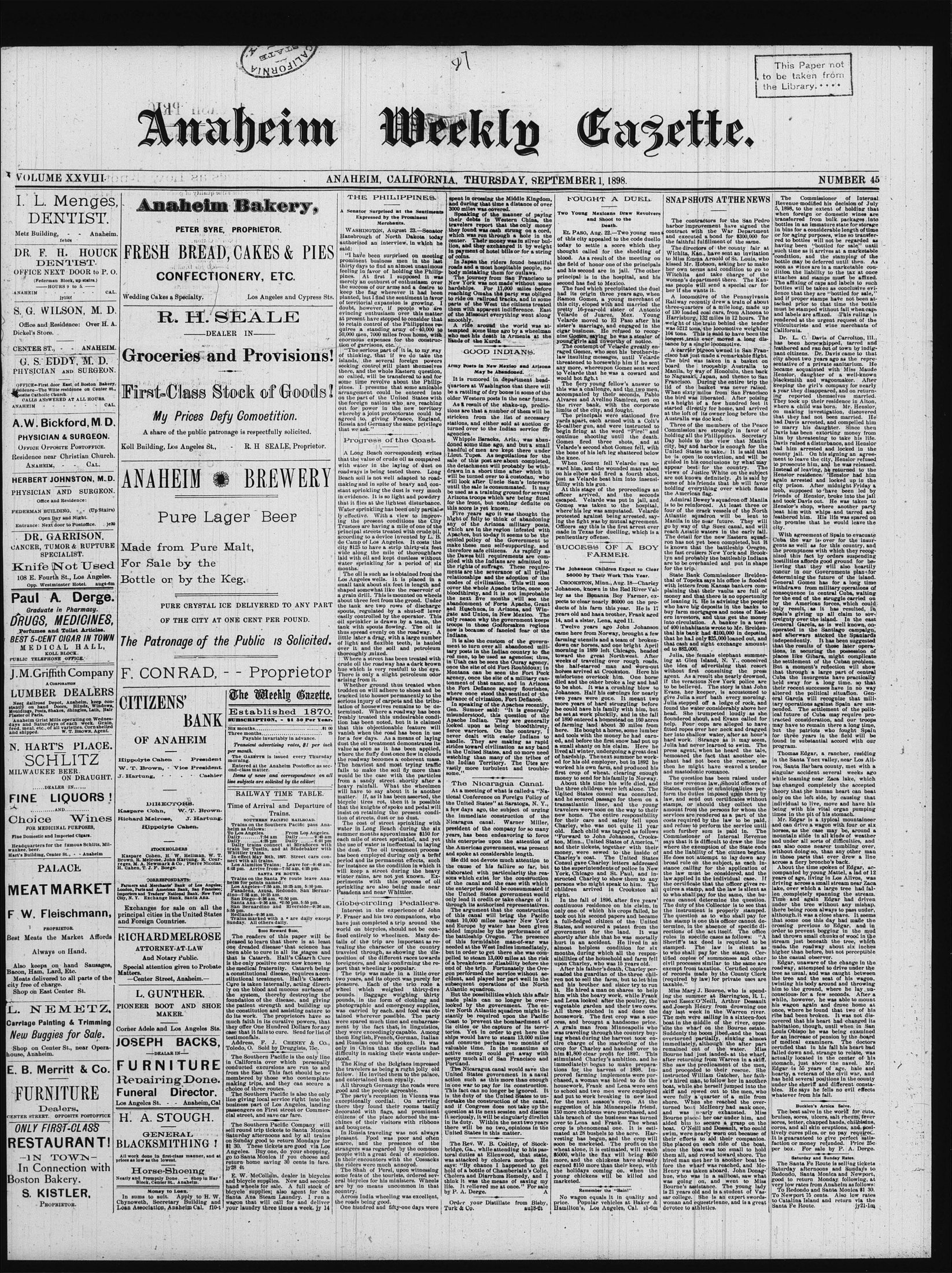
Searchable text
Anaheim
VOLUME XXVIII.
ANAHEIM
I. L. Menges,
DENTIST.
Metz Building, Anaheim.
feb24
DR. F. H. HOUCK
DENTIST.
OFFICE NEXT DOOR to P. O.
(Federman Block, up stairs.)
HOURS 9 to 8
ANAHEIM CAL.
jy154t
S. G. WILSON, M. D.
Office and Residence: Over H. A. Dickel's Store.
CENTER ST., Anaheim.
G. S. EDDY, M. D.
PHYSICIAN AND SURGEON.
OFFICE—First door East of Boston Bakery.
Residence—The Witte residence on Center St.
opposite Catholic Church.
CALLS ANSWERED AT ALL HOURS.
ANAHEIM CAL.
A.W. Bickford, M.D.
PHYSICIAN & SURGEON.
OFFICE OPPOSITE POSTOFFICE.
Residence near Christian Church.
ANAHEIM, CAL.
Anaheim Bakery,
PETER SYRE, PROPRIETOR.
FRESH BREAD, CAKES & PIES
CONFECTIONERY, ETC.
Wedding Cakes a Specialty. Los Angeles and Cypress Sts.
R. H. SEALE
DEALER IN
Groceries and Provisions!
First-Class Stock of Goods!
My Prices Defy Competition.
A share of the public patronage is respectfully solicited.
Koll Building, Los Angeles St., R. H. SEALE, Proprietor.
OFFICE—First door East of Boston Bakery.
Residence—The Wilte residence on Center St.
Postite Catholic Church.
CALLS ANSWERED AT ALL HOURS.
ANAHEIM
A.W. Bickford, M.D.
PHYSICIAN & SURGEON.
Office Opposite Postoffice.
Residence near Christian Church.
ANAHEIM, CAL.
HERBERT JOHNSTON, M.D.
PHYSICIAN AND SURGEON.
Office and Residence:
FEDERMAN BUILDING. (Up Stairs)
Open Day and Night.
Entrance: Next door to Postoffice. je30
DR. GARRISON.
CANCER, TUMOR & RUPTURE SPECIALIST.
Knife Not Used
108 E. Fourth St., Los Angeles.
Opp. Westminster Hotel. aug4-6m
Paul A. Derge.
Graduate in Pharmaoy.
DRUGS, MEDICINES,
Perfumes and Toilet Articles.
BEST 5-CENT CIGAR IN TOWN
MEDICAL HALL,
KOLL BLOCK.
PUBLIC TELEPHONE OFFICE.
J.M.Griffith Company
A CORPORATION
LUMBER DEALERS
Neer Railroad Depot, Anaheim, keep constantly on hand Doors, Blinds, Windows, Mouldings, Posts, Shakes, Shingles, Lath, Hair Plaster of Paris.
Anaheim Great Mills operating on Wednesdays and Saturdays of each week. Grain, feed, meal, etc., of all varieties. Cornshellled and shipped.
W.T. BROWN, Agent.
N. HART'S PLACE.
SCHLITZ
MILWAUKEE BEER.
ON DRAUGHT.
DEALER IN...
FINE LIQUORS!
AND...
Choice Wines
FOR MEDICINAL PURPOSES,
Fine Domestic and Imported Cigars.
Headquarters for the famous Schlitz, Milwaukee, beer.
Hart's Building, Center St., - Anaheim
PALACE
MEAT MARKET
First-Class Stock of Goods!
My Prices Defy Competition.
A share of the public patronage is respectfully solicited.
Koll Building, Los Angeles St., R.H SEALE, Proprietor.
ANAHEIM BREWERY
Pure Lager Beer
Made from Pure Malt,
For Sale by the Bottle or by the Keg.
PURE CRYSTAL ICE DELIVERED TO ANY PART OF THE CITY AT ONE CENT PER POUND.
The Patronage of the Public is Solicited.
F. CONRAD, - Proprietor
CITIZENS'
BANK
OF ANAHEIM
Hippolyte Cahen President
W.T. Brown Vice President.
J. Hartung Cashier
DIRECTORS.
Kaspare Cohn, W.T. Brown.
Richard Melrose, J. Hartung.
Hippolyte Cahen.
STOCKHOLDERS
Kaspare Cohen, H.W. Hellman, W.T. Brown, R.Melrose, John Hartung, R.Courreges, M.A.Newmark & Co., Pierre Nicolas, H.Cahen, T.J.F.Booge.
CORRESPONDENTS:
Farmers and Merchants' Bank of Los Angeles; London, Paris and American Bank, San Francisco;
Importers and Traders' National Bank, New York City, N.Y. Exchange Bank, Santa Ana.
The Weekly Gazette.
Established 1870.
SUBSCRIPTION, - $1 50 Per Year.
Six months.....$1 00
Three months.....75
Payable invariably in advance.
Transient advertising rates,$1 per inch per month.
The GAZETTE is issued every Thursday morning.
Entered at the Anaheim Postoffice as second-class matter.
Items of news and correspondence on all line subjects are solicited by the editor.
RAILWAY TIME TABLE.
Time of Arrival and Departure of Trains.
SOUTHERN PACIFIC RAILROAD.
Trains on the Southern Pacific pass Anaheim as follows:
To Los Angeles...From Los Angeles.
Daily...7:54 am...Daily...9:45 am
Daily...4:25 pm...Daily...6:01 pm
Daily trains connect at Mirairores with train for Trustin, and at Studebaker with Whittler trains.
In effect May 30th, 1897. Street cars connect with all trains.
Los Alamitos Trains; Leave for-9:48 am.
6:08 pm. Arrive from-7:52 am; 4:25 pm.
SANTA FE ROUTE.
Trains on the Santa Fe route leave Anaheim for points named:
Los Angeles-7:55 am; 10:25 am; 5:10 pm.
Passadena, Aruna; Redondo, San Bernardo-7:55 am; 10:25 am.
San Diego-9:38 am; 2:50 pm.
FINE LIQUORS
Choice Wines
FOR MEDICINAL PURPOSES,
Fine Domestic and Imported Cigars.
Headquarters for the famous Schlitz, Milwaukee, beer.
Hart's Building, Center St., - Anaheim
PALACE
MEATMARKET
F. W. Fleischmann,
PROPRIETOR.
Best Meats the Market Affords
Always on Hand.
Also keeps on hand Sausages, Bacon, Ham, Lard, Ete.
Meats delivered to all parts of the city free of charge.
Shop on East Center St.
L. NEMETZ,
Carriage Painting & Trimming
New Buggies for Sale.
Shop on Center St., near Opera-house, Anaheim.
E. B. Merritt & Co.
FURNITURE
Dealers.
CENTER STREET. OPPOSITE POSTOFFICE
ONLY FIRST-CLASS RESTAURANT!
IN TOWNIn Connection with Boston Bakery.
S. KISTLER,
PROPRIETOR.
DIRECTORS.
Kaspare Cohn, W. T. Brown.
Richard Melrose, J. Hartung.
Hippolyte Cahen.
STOCKHOLDERS
Kaspare Cohen, H. W. Hellman, W. T. Brown, R. Melrose, John Hartung, R. Courreges, M. A. Newmark & Co., Pierre Nicolas, H. Cahen, T. J. F. Boege.
CORRESPONDENTS:
Farmers and Merchants' Bank of Los Angeles; London, Paris and American Bank, San Francisco; Importers and Traders' National Bank, New York City, N.Y. Exchange Bank, Santa Ana.
Exchanges for sale on all the principal cities in the United States and Foreign Countries.
RICHARDMELROSE
ATTORNEY-AT-LAW
And Notary Public.
Special attention given to Probate Matters.
—Center Street, Anaheim.
L. GUNTHER.
PIONEER BOOT AND SHOE MAKER.
Corner Adele and Los Angeles Sts.
JOSEPH BACKS,
DEALAR IN
FURNITURE
Repairing Done.
Funeral Director.
Los Angeles St. - Anaheim, Cal
H. A. STOUGH.
GENERAL BLACKSMITHING !
All work done in first-class manner, and at prices as low as the lowest.
Horse-Shoeing
Neatly and Promptly Done. — Shop in Har Block, Center St., Anaheim.
Money to Loan.
In sums to suit. Apply to H. W. Chynoweth, Secretary Building and Loan Association, Anaheim Cal. f10-t
Time of Arrival and Departure of Trains.
SOUTHERN PACIFIC RAILROAD.
Trains on the Southern Pacific pass Anaheim as follows:
To Los Angeles.
Daily...7:54 am Dally...9:45 am Dally...4:25 pm Dally...6:01 pm
Daily trains connect at Miraflores with train for Tustin, and at Studebaker with Whittier trains.
In effect May 30th, 1897. Street cars connect with all trains.
Los Alamitos Trains; Leave for—9:48 am 6:03 pm. Arrive from—7:52 am 4:25 pm.
SANTA FE ROUTE.
Trains on the Santa Fe route leave Anaheim for points named:
Los Angeles—7:55 am 10:25 am 5:10 pm Pasadena, Azusa Redondo, San Bernardo—7:56 am 10:25 am San Diego—9:36 am *2:50 pm Santa Ana—9:36 am *2:50 pm San Bernardino and Riverside—9:36 am 5:55 pm Redlands—9:36 am
Trains marked with a • are daily except Sunday. All others daily.
$100 Reward $100.
The readers of this paper will be pleased to learn that there is at least one dreaded disease that science has been able to cure in all its stages and that is Catarrh. Hall's Catarrh Cure is the only positive cure now known to the medical fraternity. Catarrh being a constitutional disease, requires a constitutional treatment. Hall's Catarrh Cure is taken internally, acting directly on the blood and mucous surfaces of the system, thereby destroying the foundation of the disease, and giving the patient strength and building up the constitution and assisting nature to do its work. The proprietors have so much faith in its curative powers, that they offer One Hundred Dollars for any case that it fails to cure. Send for list of testimonials.
Address, F. J. CHENEY & Co., Toledo, O. Sold by Druggists, 75c.
The Southern Pacific is the only line in California over which personally conducted excursions are run to and from the East. This fact should be remembered by those who contemplate making trips, and they can secure a choice of three routes.
The Southern Pacific is also the only line giving local service right into the business part of Los Angeles, landing passengers on First street or Commercial street, and save car fare.
The Southern Pacific Company will sell round trip tickets to Santa Monica Saturday afternoons and by all trains on Sunday good to return Mondays for $1 30. These tickets are good via Los Angeles. Buy one, do your shopping, go to Santa Monica if you choose and return home saving 30 cents in fare. jy28 4t
E. W. McCollum, dealer in bicycles and bicycle supplies. New and second-hand wheels for sale. A full stock of bicycle supplies; also agent for the Santa Ana Steam Laundry. I run a wagon that will call for and deliver your laundry three times a week. jy 14
Weekly Gazette
ANAHEIM, CALIFORNIA, THURSDAY, SEPTEMBER 1, 1898.
THE PHILIPPINES.
A Senator Surprised at the Sentiments Expressed by the Prominent Merchants.
WASHINGTON, August 23.—Senator Hansbrough of North Dakota today authorized an interview, in which he said:
"I have been surprised on meeting prominent business men in the last thirty days to find an almost unanimous feeling in favor of holding the Philippines. At first I supposed it was merely an outburst of enthusiasm over the success of our arms and a desire to keep the flag wherever it had been planted, but I find the sentiment in favor of territorial expansion is growing. I doubt, however, if people who are evincing enthusiasm over this matter at present have stopped to consider that to retain control of the Philippines requires a standing army of 40,000 to 50,000 men, 7000 miles from home, with enormous expenses for the construction of garrisons, etc.
"The serious part of it is, to my way of thinking, that if we do take the islands, the several foreign powers seeking control will plant themselves there, and the whole Eastern question, so called, will be transferred to and for some time revolve about the Philippines. I presume that some amicable arrangement could be entered into on the part of the United States with the foreign nations who are reaching out for power in the new territory whereby a joint protectorate could be agreed to, giving France, England, Russia and Germany the same privilege that we ask."
Progress of the Coast.
A Long Beach correspondent writes that the value of crude oil as compared with water in the laying of dust on roadways is being tested there. Long spent in crossing the Middle Kingdom, and during that time a distance of over 3000 miles was covered.
Speaking of the manner of paying their debts in Western China, the travelers report that the only money they found was cash strung on a cord, which was run through a hole in the center. Their money was in silver bullion, and they exchanged it by weight in payment of hotel bills or for a string of coins.
In Japan the riders found beautiful roads and a most hospitable people, nobody mistaking them for outlaws.
The journey from San Francisco to New York was not made without some hardships. For 17,000 miles before reaching Omaha the party was obliged to ride on railroad tracks, and in some parts of the West the citizens treated them with apparent indifference. East of the Missouri everything went along smoothly.
A ride around the world was attempted some time ago by a wheelman who met his death in Armenia at the hands of the Kurds.
GOOD INDIANS.
Army Posts in New Mexico and Arizona May be Abandoned.
It is rumored in department headquarters at Washington that there will be a rattling of dry bones in some of the older Western posts in the near future.
As a result of the shake-up, predictions are that a number of them will be stricken from the list of necessary stations, and either sold at auction or turned over to the Indian service for agencies.
Whipple Baracks, Ariz., was abandoned some time ago, and but a small handful of men are kept there under Lieut. Tupes. As negotiations for the sale of this post are about completed, the detachment will probably be withdrawn in a short time after which it
FOUGHT A DUEL.
Two Young Mexicans Draw Revolvers and Shoot to the Death.
El Paso, Aug. 22.—Two young men of this city appealed to the code duello today to settle a score which they thought called for the shedding of blood. As a result of the meeting on the field of honor one of the principals and his second are in jail. The other principal is in the hospital, and his second has fled to Mexico.
The fued which precipitated the duel had its origin three years ago, when Ramon Gomez, a young merchant of this city, eloped with and married the pretty 16-year-old sister of Antonio Velarde of Juarez, Mex. Young Velarde moved to El Paso after his sister's marriage, and engaged in the cigar business. He refused to recognize Gomez, saying he was a stealer of young girls and unworthy of notice.
The contempt of Velarde greatly enraged Gomez, who sent his brother-in-law insulting messages, until Velarde threatened to horsewhip him if he sent any more, whereupon Gomez sent word to Velarde that he was a coward and would hot fight.
The fiery young fellow's answer to this was a challenge, and the two men, accompanied by their seconds, Pablo Alvarez and Avelino Ramirez, met on the river bank, with the corporate limits of the city, and fought.
The principals were stationed five yards apart, each armed with a Colt's 45-caliber gun, and were instructed to begin firing at the word "Fire!" and continue shooting until the death. Gomez fired three shots, and at Velarde's second shot Gomez fell, with the bone of his left leg shattered below the knee.
When Gomez fell Velarde ran toward him, and the wounded man raised on his elbow and fired a fourth shot.
Progress of the Coast.
A Long Beach correspondent writes that the value of crude oil as compared with water in the laying of dust on roadways is being tested there. Long Beach soil is not well adapted to road-making and in spite of heavy and constant sprinkling the dust is very much in evidence. It is so light and powdery that it flies at the lightest disturbance. Water sprinkling has been only partially effective. With a view to improving the present conditions the City Trustees are having a mile of one of the principal streets treated with crude oil, according to a device invented by L. B. de Camp of Los Angeles. It costs the city $125 to have a strip thirty-six feet wide along the mile of thoroughfare laid with oil and kept dustless without water sprinkling for a period of six months.
The oil is such as is obtained from the Los Angeles wells. It is placed in a small tank about six feet in length and shaped somewhat like the reservoir of a grain drill. This is mounted on wheels about three feet from the grond. Under the tank are two rows of discharge spouts, regulated by a shut-off lever easily controlled by the operator. This oil sprinkler is drawn by a team, the tank with spouts flowing. The oil is thus spread evenly on the roadway. A little later a drag, with a large number of light and flexible teeth, is hauled over it and the soil and petroleum thoroughly mixed.
Where a street has been treated with crude oil the roadway has a dark brown hue which is very restful to the eye. There is only a slight petroleum odor arising from it.
Whether ground thus treated when trodden on will adhere to shoes and be tracked into houses permanently to the serious injury of carpets and the tribulation of housewives remains to be determined. Where a roadway has been freshly treated this undesirable condition has been noted, but it is claimed that this objectionable feature will vanish when the road has been in use for a few days. As a means of laying dust the oil treatment demonstrates its value as soon as it has been applied, where the fluffy dust once flew in clouds the roadway becomes a coherent mass. The heaviest and most trying traffic fails to make the soil fly more than would be the case with the particles from a sandy street shortly after a heavy rainfall. What the wheelmen will have to say about it is another matter. If, as it has been asserted, the bicycle tires rot, then it is possible that the knights of spoke and pedal will insist on retaining the present condition of streets, dust or no dust.
The cost of street sprinkling with water in Long Beach during the six summer months approximates $150 for each mile of street sprinkled, and yet the use of water is ineffectual in laying the dust. The oil treatment process has been employed during only a brief period and its permanent effects, such for instance as the condition in which it will keep a street during the heavy winter rains, are not yet known. Experiments with this process of oil sprinkling are also being made near Pasadena and near Whittier.
It is rumored in department headquarters at Washington that there will be a rattling of dry bones in some of the older Western posts in the near future.
As a result of the shake-up, predictions are that a number of them will be stricken from the list of necessary stations, and either sold at auction or turned over to the Indian service for agencies.
Whipple Baracks, Arlz., was abandoned some time ago, and but a small handful of men are kept there under Lutus. Tupes. As negotiations for the sale of this post are about completed, the detachment will probably be withdrawn in a short time after which it will be turned over to a custodian, who will look after Urcie Sam's interests until the sale is consummated. It may be used as a training ground for several Arizona troops which are being fitted for the front, but nothing definite on this score is yet known.
Five years ago it was thought the height of folly to think of abandoning any of the Arizona military posts, which are in the region infested with Apaches, but to-day it seems to be the settled policy of the Government to make these men self-supporting, and therefore safe citizens. As rapidly as the Dawes bill requirements are complied with the Indians are admitted to the rights of suffrage. These requirements are the severance of all tribal relationships and the adoption of the modes of civilization. This will soon cover the whole Apache tribe, once so bloodthirsty, and it is not improbable that next five months will see the abandonment of Forts Apache, Grant and Huachuca, in Arizona, and Wingate and Union, in New Mexico. The only reason why the government keeps troops in those Godforsaken regions now is because of fancied fear of the Indians.
It is also custom of the government to turn over all abandoned military posts in the Indian country to the red men, to be used as agencies; thus, in Utah can be seen the Ouray agency, once the site of old Fort Roudidoux; in Montana can be seen the Fort Peck agency, once the site of a military cannonment of that name, and in Arizona the Fort Defiance agency flourishes, where once stood sentinel of the advance of civilization, Fort Defiance.
In speaking of the Apaches recently, Gen. Sumner said: "It is generally misunderstood, this question of the Apache Indian. They are generally looked upon as being bloodthirsty, fierce warriors. On the contrary, I never dealt with easier Indians to handle. They are making as rapid strides toward civilization as any band in the United States, and no more need watching than many of the tribes of the Indian Territory. The Utes are vastly more turbulent and troublesome."
The Nioaragua Canal.
At a meeting of what is called-a "National Conference on Foreign Policy of the United States" at Saratoga, N.Y., a few days ago, the subject of urging the immediate construction of the Nicoaragua canal. Warner Miller, president of the company for so many years, has been endeavoring to force this enterprise upon the attention of the American government, was present and spoke at considerable length.
He did not devote much attention to the cause of his failure so far, but elaborated with particularity the reasons which exist for the construction of the canal and ease with which the enterprise could be consummated if the United States government would only lend it credit or take charge of it.
The fiery young fellow's answer to this was a challenge, and the two men, accompanied by their seconds, Pablo Alvarez and Avellino Ramirez, met on the river bank, with the corporate limits of the city, and fought.
The principals were stationed five yards apart, each armed with a Colt's 45-calliber gun, and were instructed to begin firing at the word "Fire!" and continue shooting until the death. Gomez fired three shots, and at Velarde's second shot Gomez fell, with bone of his left leg shattered below the knee.
When Gomez fell Velarde ran toward him, and the wounded man raised on his elbow and fired a fourth shot, just as Velarde beat him into insensibility with his gun.
At this stage of the proeredings an officer arrived, and the seconds escaped. Velarde was put in jail, and Gomez was taken to the hospital, where his leg was amputated. Velarde protested against being arrested, saying the fight was by mutual agreement. Officers say this is the first arrest ever made in Texas for duelling, which is a penitentiary offense.
SUCCESS OF A BOY FARMER.
The Johanson Children Expect to Clear $6000 by Their Work This Year.
CROOKSTON, Minn., Aug. 18—Charley Johanson, known in the Red River Valley as the Bonanza Boy Farmer, expects to clear nearly $6000 on the products of his farm this year. He is 17 years old and has a brother, Frank aged 14, and a sister, Lena, aged 11.
Twelve years ago John Johanson came here from Norway, brought a few farming utensils and a team of broken-down car horses, and one bright April morning in 1889 left Chicago, headed toward the great Northwest. After weeks of traveling over rough roads, half-starved man and worn-out horses arrived at Crookston. Here his misfortune overtook him. One horse died and the other broke a leg and had to be shot. It was a crushing blow to Johanson. Half his earnings for nearly two years were gore. It meant two more years of hard struggling before he could have his family with him, but he set at work pluckily, and in fall 1890 entered a homestead on 160 acres of farming land about 30 miles from here. He bought a horse, some lumber and tools with the money he had earned, and before the first snow had put up a small shanty on his claim. Here he lived all winter, undergoing a great deal of hardship. The next summer he worked for his old employer, but in 1892 he worked his own farm, and produced his first crop of wheat, clearing enough money to send for his family in Norway.
About this time his wife died, and the three children were left alone. The United States consul was consulted, and he secured passage for them on a transatlantic liner, and the young travelers were soon on their new home. The entire responsibility for their care and safety fell upon Charley, who was not quite 11 year old. Each child was tagged as follows "Forward to John Johanson, Crookston, Minn., United States of America," and their tickets, together with their money, were sewed to the inside of Charley's coat. The United States Consul gave Charley letters addressed to the superintendents of police in New York, Chicago and St. Paul, and instructed Charley to show them to any persons who might speak to him. The children arrived in Crookston all right.
In
Globe-circling Pedallers.
Interest in the experience of John F. Fraser and his two companions, who have just completed a trip around the world on bicycles, should not be confined entirely to wheelmen. Many details of the trip are important as revealing the character of the country traveled through, as showing the disposition of the different races towards foreigners, and also confirming the report that wheeling is popular.
The trip was made in a little over two years, and its object was purely for pleasure. Each of the trio rode a wheel which weighed thirty-five pounds. Baggage weighing thirty pounds, in the form of clothing and photographic and emergency supplies, was carried by each, and food was obtained wherever possible. The party were spared much time and embarrassment by the fact that, in linguistics, they were exceedingly capable. Among them English, French, German, Italian and Russian could be spoken. It was only in China that the cyclists had difficulty in making their wants understood.
The King of the Belgians impressed the travelers as being a right jolly old fellow. He invited them to the palace, and entertained them royally.
All through Germany the roads were good and the people agreeable.
The party's reception in Vienna was exceptionally cordial. On arriving there they found their rooms tastily decorated with flags, and prominent citizens of the place adorned the machines of their visitors with ribbons and bouquets.
In Russia traveling was not always pleasant. Food was poor and often scarce, and the presence of the strangers was regarded by the common people with a great deal of suspicion. In their encounters with the Cossacks the riders were much annoyed.
The Shah of Persi, upon witnessing some feats of the tourists, ordered several bicycles for his ministers. Wheels are by no means uncommon in that country.
Across India wheeling was excellent, the roads being good.
One hundred and fifty-one days were
The cost of street sprinkling with water in Long Beach during the six summer months approximates $150 for each mile of street sprinkled, and yet the use of water is ineffectual in laying the dust. The oil treatment process has been employed during only a brief period and its permanent effects, such for instance as the condition in which it will keep a street during the heavy winter rains, are not yet known. Experiments with this process of oil sprinkling are also being made near Pasadena and near Whittier.
He did not devote much attention to the cause of his failure so far, but elaborated with particularity the reasons which exist for the construction of the canal and the ease with which the enterprise could be consummated if the United States government would only lend it credit or take charge of it through its authorized representatives.
The argument that the construction of this canal will bring the Pacific coast 10,000 miles nearer New York and Europe by water has been given added impulse by the performance of the battleship Oregon. The presence of this formidable man-of-war was needed at the West Indies immediately, but in order to get there she was compelled to steam 13,000 miles at the risk of a breakdown or disability before the end of the trip. Fortunately the Oregon performed the service without accident, and played her part well in the subsequent operations of the North Atlantic squadron.
But the possibilities which this affair made plain can no longer be overlooked by the government. The entire North Atlantic squadron might instantly be required upon the Pacific Coast to prevent the bombardment of its cities or the capture of its territories. Yet in order to get here the ships would have to steam 13,000 miles and consume perhaps two months of valuable time. In the meantime an active enemy could get away with pretty much all of San Francisco and Portland.
The Nicaragua canal would save the United States government in a naval action such as this more than enough in one war to pay for its construction. This fact can no longer be ignored. It is the duty of the United States to undertake the construction of the canal, and if Congress does not take up the question at its next session and discuss it seriously, it will be singular direlict in its duty. Within the next two years there will be no two opinions in the United States in this matter.
The Rev. W. B. Costley, of Stockbridge, Ga., while attending to his pastoral duties at Ellenwood, that state, was attacked by cholera morbus. He says: "By chance I happened to get hold of a bottle of Chamberlain's Colic, Cholera and Diarrhoea Remedy, and I think it was the means of saving my life. It relieved me at once." For sale by P. A. Derge.
Order your Distillate from Bisby, Turk & Co.
A few days ago, the subject of urging the immediate construction of the Nicaragua canal. Warner Miller, president of the company for so many years, has been endeavoring to force this enterprise upon the attention of the American government, was present and spoke at considerable length.
He did not devote much attention to the cause of his failure so far, but elaborated with particularity the reasons which exist for the construction of the canal and the ease with which the enterprise could be consummated if the United States government would only lend it credit or take charge of it through its authorized representatives.
The argument that the construction of this canal will bring the Pacific coast 10,000 miles nearer New York and Europe by water has been given added impulse by the performance of the battleship Oregon. The presence of this formidable man-of-war was needed at the West Indies immediately, but in order to get there she was compelled to steam 13,000 miles at the risk of a breakdown or disability before the end of the trip. Fortunately the Oregon performed the service without accident, and played her part well in the subsequent operations of the North Atlantic squadron.
But the possibilities which this affair made plain can no longer be overlooked by the government. The entire North Atlantic squadron might instantly be required upon the Pacific Coast to prevent the bombardment of its cities or the capture of its territories. Yet in order to get here the ships would have to steam 13,000 miles and consume perhaps two months of valuable time. In the meantime an active enemy could get away with pretty much all of San Francisco and Portland.
The Nicaragua canal would save the United States government in a naval action such as this more than enough in one war to pay for its construction. This fact can no longer be ignored. It is the duty of the United States to undertake the construction of the canal, and if Congress does not take up the question at its next session and discuss it seriously, it will be singular direlict in its duty. Within the next two years there will be no two opinions in the United States in this matter.
The Rev. W. B. Costley, of Stockbridge, Ga., while attending to his pastoral duties at Ellenwood, that state, was attacked by cholera morbus. He says: "By chance I happened to get hold of a bottle of Chamberlain's Colic, Cholera and Diarrhoea Remedy, and I think it was the means of saving my life. It relieved me at once." For sale by P. A. Derge.
Order your Distillate from Bisby, Turk & Co.
A few days ago, the subject of urging the immediate construction of the Nicaragua canal. Warner Miller, president of the company for so many years, has been endeavoring to force this enterprise upon the attention of the American government, was present and spoke at considerable length.
He did not devote much attention to the cause of his failure so far, but elaborated with particularity the reasons which exist for the construction of the canal and the ease with which the enterprise could be consummated if the United States government would only lend it credit or take charge of it through its authorized representatives.
The argument that the construction of this canal will bring the Pacific coast 10,000 miles nearer New York and Europe by water has been given added impulse by the performance of the battleship Oregon. The presence of this formidable man-of-war was needed at the West Indies immediately, but in order to get there she was compelled to steam 13,000 miles at the risk of a breakdown or disability before the end of the trip. Fortunately the Oregon performed the service without accident, and played her part well in the subsequent operations of the North Atlantic squadron.
But the possibilities which this affair made plain can no longer be overlooked by the government. The entire North Atlantic squadron might instantly be required uponthe Pacific Coast to preventthe bombardmentofitscitiesorthecaptureofitsterritories.Yetinordertogetheretheshipswouldhavetosteam13,000milesandconsumeperhapstwomonthsofvaluabletime.InthemeantimeanactiveenemycouldgetawaywithprettymuchallofSanFranciscoandPortland.
The Nicaragua canal would savetheUnitedStatesgovernmentinnavailactionsuchasmorethanenoughinonewartopayforitsconstruction.这点可以no longerbeignoted.它是thedutyoftheUnitedStatestoundertaketheconstructionofthecanal,andifCongressdoesnottakeupthequestionatitsnextsessionanddiscussitseriously.itwillbesingulardirelictinitsduty.Withinthenexttwoyearstherewillbeno twoweopinionsinthenitedStatesinthismatter.
TheRev.W.B.Costley.ofStockbridge,Ga.,whileattendingtohispastoraldutiesatEllenwood,thestatewasattackedbycholera morbus.Hesays:"BychanceIhappenedtogetholdofabottleofChamberlain'sColic,CholeraandDiarrhoeaRemedy,andIthinkitwasthemeansofsavingmylife.Irelievedmeatatonce."ForsalebyP.A.Derge.A
OrderyourDistillatefromBisby,Turk&Co.aul8-2t
andhesecuredpassagefortheon:atranslatilanticliner,andtheyouracelisterviewthelawstandservcostandsuchConspyswhereandHebrookstarmainthelawthechildrenarrivedinCrookstonallright.
Inthefallof1896,afterfiveyears'continuousresidenceonhisclaim.inonlyoneofwhichhiscropsfailed,hewookouthissecondpapersandbecameafull-fledgedcitizenoftheUnitedStates,andsecuredapatientfromthegovernmentfortheland.ltwasshortlyafterthisthathewasmortallyhurtinanaccident.H livedinan almosthelplessconditionforsixmonths,duringwhichalltheresponsibilitiesofthehouseandfarmfelluponCharley,thewisdomoldn(ren)afterhisfather'sdeath.Charleypersuadedtheguardianofthethreechildernotto sellthe farm,buttolethimandhisbrotherandsistertrytorunit.He hiredamanonsharestohelphimwiththeheavywork,whileFrankandLenalookedafterthepuiltry,thevegetablegardenandtheirtwocows.Allthreepitchedinanddonethehousework.Thefirstcropwasasuccess,andbroughtahandsomeprice.AgraindmanfromMinneapoliswhowastravelingthroughthecountrybuyingwheatduringtheharvest tookentirechargeofthemarketingofthecropforCharleyand handedovertohim$1,800clearg profitfor1897.ThestimulatedCharley'sambition,andheimmediatelybegantomakepreparationsfortheharvestof1898.Inprovedfarmingimplementswerepurchased,awomanwashiredtodothehousework,FrankandLenawere senttowchoolandtwomenwereemployedandputtocowbreakinginnewlandfordthenextseason'scrop.AtthesuggestionofhisMinneapolisfriend,150morechickenswerepurchased,andthisbranchofthebusinessturnedovertoLenaandFrank.Thewheatcropisphenomenalone.itIsestimatedat28bushelstotheacre.Havestringhasbegun,andthecropwillsoonbemarketed.Theprofitonthewheatalone,它isestimated,会reach$5000,而theflaxwillbring$650more,andthechickenshavealreadyearned$150morethan theirkeep,以theholidayscomingon,当theyoungchickenswillbekilledandmarketed.
Rememberthe"Bain!"
No wagon equals it in quality and price.Popular vehicles at Baker & Hamilton's,Los Angeles,Cal.sl-6m
Gazette.
1, 1898. NUMBER 45
SNAP SHOTS AT THE NEWS
The contractors for the San Pedro harbor improvement have signed the contract with the War Department and executed a bond for $300,000 for the faithful fulfillment of the same.
The directors of the county fair at Wichita, Kan., have sent an invitation to Miss Emma Arnold of St. Louis, who kissed Mr. Hobson, asking her to make her own terms and condition to go to Witchita and take charge of the women's department there. The Kansas people will send a special car for her if she wants it.
A locomotive of the Pennsylvania Railway recently drew a train of about three-quarters of a mile long, made up of 130 loaded coal cars, from Altoona to Harrisburg, 132 miles in 12 hours. The weight of the train behind the tender was 5212 tons, the locomotive weighing 104 tons. This is said to have been the longest train ever moved a long distance by a single locomotive.
A carrier pigeon owned in San Francisco has just made a remarkable flight. The bird was taken in a basket on board the troopship Australia to Manila, by way of Honolulu, then back to Nagasaki, Japan, and thence to San Francisco. During the entire trip the lid of the basket was never raised. When sixty miles from San Francisco the bird was liberated. After polishing at a height of a few hundred feet it started directly for home, and arrived at the loft of its owner long before the Australia was docked.
Three of the members of the Peace Commission are strongly in favor of holding all the Philippines. Secretary Day holds to the view that Manila city, bay and harbor is enough for the United States to take. It is said that he is open to conviction, and will be guided in his conclusions by what may appear best for the country. The views of Justice White on the subject
The Commissioner of Internal Revenue modified his decision of July 5, 1898, to the extent of holding that when foreign or domestic wines are transferred from bulk packages into bottles in an immature state for storage in bins for a considerable length of time or for aging purposes, wine so transferred to bottles will not be regarded as having been "bottled for sale" until such time as it arrives at a marketable condition, and the stamping of the bottle may be deferred until then. As soon as wines are in a marketable condition the liability to the tax at once attaches and stamps must be affixed. The affixing of caps and labels to such bottles will be taken as conclusive evidence that they are "bottled for sale," and if proper stamps have not been attached prior to that time the bottle must be stamped without fail when caps and labels are affixed. This ruling is rendered at the urgent request of the viticulturists and wine merchants of California.
Dr. L. C. Davis of Carrolton, Ill., has been horsewhipped, tarred and feathered and ran out of town by indignant citizens. Dr. Davis came to that city about two years ago as the representative of a private sanitarium. He became acquainted with Miss Maude Henslor, daughter of a well-known blacksmith and wagonmaker. After keeping the girl's company for nearly a year they disappeared, and on returning reported themselves married. They took up their residence in Alton, where a child was born. Mr. Henslor, on making investigation, discovered that they had not been married. He had Davis arrested, and compelled him to marry his daughter. Since then Davis has been extorting money from him by threatening to take his life. Davis raised a disturbance, and Henslor had him arrested and locked in the county jail. On his signing an agreement to leave the city, Henslor refused to prosecute him, and he was released. Instead of leaving, he returned to the Henslor residence."
Children Expect to Clear their Work This Year.
Minn., Aug. 18—Charley
own in the Red River Valanza Boy Farmer, exspecially $6000 on the promium this year. He is 17
was a brother, Frank aged
Lena, aged 11.
Ago John Johanson
Norway, brought a few
and a team of broken,
and one bright April
left Chicago, headed
at Northwest. After
going over rough roads,
and man and worn-out
at Crookston. Here his
took him. One horse
broke a leg and had
was a crushing blow to
his earnings for nearly
the gore. It meant two
hard struggling before
his family with him, but
buckledly, and in the fall
a homestead on 160 acres
about 30 miles from
about a horse, some lumber
the money he had earned the first snow had put up
on his claim. Here he
undergoing a great deal
next summer he workployer, but in 1892 he
farm, and produced his
heat, clearing enough
for his Norway. Some his wife died,
and were left alone. The consul was consulted,
passage for them on a miner, and the young moon on the way to their entire responsibility and safety fell upon
was not quite 11 year and was tagged as follows John Johanson, Crooked-St. Paul, and in order to show them to any kind of speech to him. The resident in Crookston all
The United States barley letters addressed incidents of police in New England St. Paul, and in order to show them to any kind of speech to him. The resident in Crookston all
Three of the members of the Peace Commission are strongly in favor of holding all the Philippines. Secretary Day holds to the view that Manila city, bay and harbor is enough for the United States to take. It is said that he is open to conviction, and will be guided in his conclusions by what may appear best for the country. The views of Justice White on the subject are not known definitely. It is said by some of his friends that he will favor holding everything over which floats the American flag.
Admiral Dewey's squadron off Manila is to be reinforced. At least three or four of the crack vessels of the North Atlantic squadron will be sent to Manila in the near future. They will go by way of the Suez canal, and will reach Asiatic waters in the early fall. The detail for the new Eastern squadron has not yet been completed, but it is known that the battleship Oregon, the fast cruisers New York and Brooklyn and probably the battleship Indiana are to be overhauled and put in shape for the trip.
State Bank Commissioner Breidenthal of Topeka says his office is flooded with letters from Kansas bankers complaining that their vaults are full of money and that there is no opportunity of loaning it. He is advising the people who have big deposits in the banks to buy farm mortgages and notes of Eastern investors, and thus get the money into circulation. A banker in a town of 400 inhabitants wrote to Mr. Breidenthal his bank had $100,000 in deposits, that he had only $25,000 loaned out, and that cash and sight exchange amounted to $82,000.
Julia, the female elephant summering at Glen Island, N.Y., conceived the idea of advertising that resort without first consulting the press agent. As a result she nearly drowned, if the veracious New York police are to be believed. The story is that John Evans, her keeper, is accustomed to give Julia a surf bath every morning. Julia stepped off a ledge of rock, and found the water considerably above her head. She trumpeted loudly as she floundered about, and Evans called for help. Four cops are alleged to have fitted ropes over her neck and dragged her into shallow water, after an hour's hard work. Strange as it may seem, Julia had never learned to swim. The press agent, when he heard the tale, bemoaned the fact that another elephant had not been the rescuer, as then he might have weaved a tender and mastodonic romance.
The question has been raised under the new revenue law. Should officers of States, counties or municipalities perform the duties imposed upon them by law, and send out certificates without stamps, or should they collect the amount from the persons for whom the services are rendered as a part of the costs required by the law to be paid, and refuse to perform the service until such further sum is paid in. The Commissioner of Internal Revenue says that it is difficult to draw the line where the exemption of the State ends and the liability of the citizen begins. He does not attempt to lay down any broad rule on the subject, as each instance calling for the application of the law must be considered, and the law applied in the individual case. If the certificate that the officer gives requires a stamp, and the law is silent as to who shall pay for the same, the bureau cannot determine the question.
Hensler, daughter of a well-known blacksmith and wagonmaker. After keeping the girl's company for nearly a year they disappeared, and on returning reported themselves married. They took up their residence in Alton, where a child was born. Mr. Hensler, on making investigation, discovered that they had not been married. He had Davis arrested, and compelled him to marry his daughter. Since then Davis has been extorting money from him by threatening to take his life. Davis raised a disturbance, and Hensler had him arrested and locked in the county jail. On his signing an agreement to leave the city, Hensler refused to prosecute him, and he was released. Instead of leaving, he returned to the Henslor residence. Henslor had him again arrested and locked up in the city prison. After midnight Friday a mob, supposed to have been led by friends of Henslor, broke into the jail and took Davis out. He was taken to Henslor's shop, where another party beat him with whips and tarred and feathered him. His life was spared on the promise that he would leave the city.
With agreement of Spain to evacuate Cuba the war is over for the insurgents as well as for this country, and the promptness with which they recognized this fact by orders suspending hostilities affords good ground for believing that they will also heartily concur in our Governments plan for determining the future of the island. General Gomez has for a long time withdrawn from military operations of consequence in central Cuba, waiting for the end of the struggle carried on by the American forces, which could only result, as it has resulted, in Spain's giving up all claim to sovereignty over the island. In the east General Garcia, as is well known, operated in the Santiago campaign, and afterwards attacked Spaniards independently. It has been suggested that the results of these later operations, in securing the possession of places like Gibara, might complicate the settlement of the Cuban problem. But a moment's reflection will show that through a large part of central Cuba the insurgents have practically held sway for a long time so that their recent successes have in no way altered the political situation. General Garcia will recognize that military operations against Spain are suspended. The settlement of the political future of Cuba may require protracted consideration, and our troops may have to remain there a long time, but the patriots who fought Spain for three years in the field will be found in substantial accord with our program.
Thomas Edgar, a rancher, residing in the Santa Ynez valley, near Los Alivos, Santa Barbara county, met with a singular accident several weeks ago while teaming near Zaca lake, which has changed completely the accepted theory that the human heart can beat only on the left side, by causing that individual to live, move and have his being with his vital organ pumping times in the pit of his stomach.
Mr. Edgar is a typical mountaineer and can drive a wagon with four or six horses, as the case may be, around a mountain slide in all kinds of weather and under all sorts of difficulties, and can also come nearer tumbling over, without doing so, than any other man in those parts that ever drew a line across a fiery broncho's back.
About the time spoken of Edgar, accompanied by young Mattel, a lad of 12 years of age, living in Los Alivos, was driving across a small stream near Zaca lake, over which a large tree had fallen completely spanning the stream.Time and again Edgar had driven
passage for them on a
trainer, and the young
boy on the way to their
entire responsibility
and safety fell upon
was not quite 11 year
old was tagged as follows
John Johanson, Crookston,
States of America."
ties, together with their
newed to the inside of
The United States
Harley letters addressed
students of police in New
and St. Paul, and intry to show them to any
night speak to him. The
need in Crookston all
1896, after five years' evidence on his claim, in which his crops failed, he found papers and became citizen of the United States a patent from the land. It was said that he was mortally injured. He lived in an old house condition for six years which all the responsible household and farm fell who was 15 years old.
Her death, Charley perkidan of the three children farm, but to let him her and sister try to run man on shares to help him work, while Frank had after the poultry, the men and their two cows. In and done the first crop was a success a handsome price. From Minneapolis who brought the country buying the harvest took en- tment the marketing of the hay and handed over to profit for 1897. This Harley's ambition, and he began to make prepara-harvest of 1898. Implementments were pur- pune was hired to do the bank and Lena were sent to men were employed breaking in new land season's crop. At the Minneapolis friend, who were purchased, and the business was turned into Frank. The wheat general one. It is esti-hels to the acre. Har- gun, and the crop will need. The profit on the estimates, will reach the flax will bring $650 thickens have already more than their keep, with coming on, when the will be killed and
over the "Bain!"
equals it in quality and vehicles at Baker & Los Angeles, Cal. s1-6m law, and send out certificates without stamps, or should they collect the amount from the persons for whom the services are rendered as a part of the costs required by the law to be paid, and refuse to perform the service until such further sum is paid in. The Commissioner of Internal Revenue says that it is difficult to draw the line where the exemption of the State ends and the liability of the citizen begins. He does not attempt to lay down any broad rule on the subject, as each instance calling for the application of the law must be considered, and the law applied in the individual case. If the certificate that the officer gives requires a stamp, and the law is silent as to who shall pay for the same, the bureau cannot determine the question. The duty of the Collector is to see that the instrument is properly stamped. The question as to who shall pay for the stamp is one this officer cannot determine, in the absence of specific directions of the act itself. The office rules in specific cases as follows: "A Sheriff's tax deed is required to be stamped. The law is silent as to who shall pay for the stamp. Certified copies of summonses and other civil processes similar to the same are exempt from taxation. Certified copies of records made by the County Clerk (required by law) for private uses are taxable."
Miss Mary J. Bourne, who is spending the summer at Barrington, R.I., saved Essex O'Neill, Arthur Dessault and Joseph Henry from drowning one day last week in the Warren river. The men were sailing in a sixteen-foot boat in the middle of the river, opposite the wharf on the Bourne estate. Suddenly the boom jibed, and the boat overturned partially, sinking almost immediately, although the after part remained out of the water. Miss Bourne had just landed at the wharf, after returning from Warren in a skiff. She saw the predicament of the men, and proceeded to their rescue. She instructed William Gatcher, her father's hired man, to follow her in another boat, while she herself jumped into the skiff and rowed out to the men, who were fully a quarter of a mile from shore. When she reached the overturned boat McHenry had sank once, and was nearly exhausted. Miss Bourne placed her oar under him, and aided him to secure a grasp on the boat. O'Neill and Dessault, who could swim, were nearly worn out because of their efforts to aid their companion. She placed on each side of the boat, since the boat was too small to hold them all, and rowed toward shore. The hired man met her in another boat before the wharf was reached, and McHenry was taken aboard. John Donaghue, who was in a sailboat, saw what was going on, and went to Miss Bourne's assistance. The young lady is 21 years old and is a student of Vassar college. She is an expert swordwoman and equestrienne, and is a great devotee to athletics.
Mr. Edgar is a typical mountaineer and can drive a wagon with four or six horses, as the case may be, around a mountain slide in all kinds of weather and under all sorts of difficulties, and can also come nearer tumbling over, without doing so, than any other man in those parts that ever drew a line across a fiery broncho's back.
About the time spoken of Edgar, accompanied by young Mattel, a lad of 12 years of age, living in Los Alivos, was driving across a small stream near Zaca lake, over which a large tree had fallen completely spanning the stream. Time and again Edgar had driven under the tree without any mishap, there being room always to pass under, although it was a close shave. It seems that some one this day had made the crossing previous to Edgar, and in order to prevent bogging in the mud had thrown small chunks of wood in the stream just beneath the tree, which made the roadway about six inches higher than before, but not perceptible to the casual observer.
Edgar, unaware of the change in the roadway, attempted to drive under the tree as usual, and was caught between the tree and the seat of his wagon, twisting his body around and throwing him to the ground, where he lay unconscious for a few seconds. After a while, however, he was able to mount his wagon again and drove home at once, where he found that two of his ribs had been broken. It was not discovered that his heart had changed its habitation, though, until when in San Louis Obispo he was being examined for an increase of pension by the board of medical examiners. The doctors certified that in his fall his heart had fallen down and strange to relate, was actually located in the center of his stomach, just above the navel. Mr. Edgar is 55 years of age, hale and hearty, a veteran of the civil war, and has held several positions in the county under the sheriff and different constables. He says he fells no evil effects whatever from his fall.
Bucklen's Arnica Salve.
The best salve in the world for cuts,
brushes, sores, ulcers, salt rheum; fever sores, tetter, chapped hands, chilblains,
corns, and all skin eruptions, and positively cures piles, or no pay required.
It is guaranteed to give perfect satisfaction or money refunded. Price 25c per box. For sale by P. A. Derge.
Saturday and Sunday Rates.
The Santa Fe Route is selling tickets Saturday afternoons and Sundays to Redondo, Santa Monica and Newport,
good to return Monday following, at very low rates from Anaheim as follows:
To Redondo and Santa Monica $1 30.
To Newport 75 cents. Also low rates to Catalina Island and return via the Santa Fe Route.
jy21-1m