anaheim-gazette 1898-08-18
Scanned page
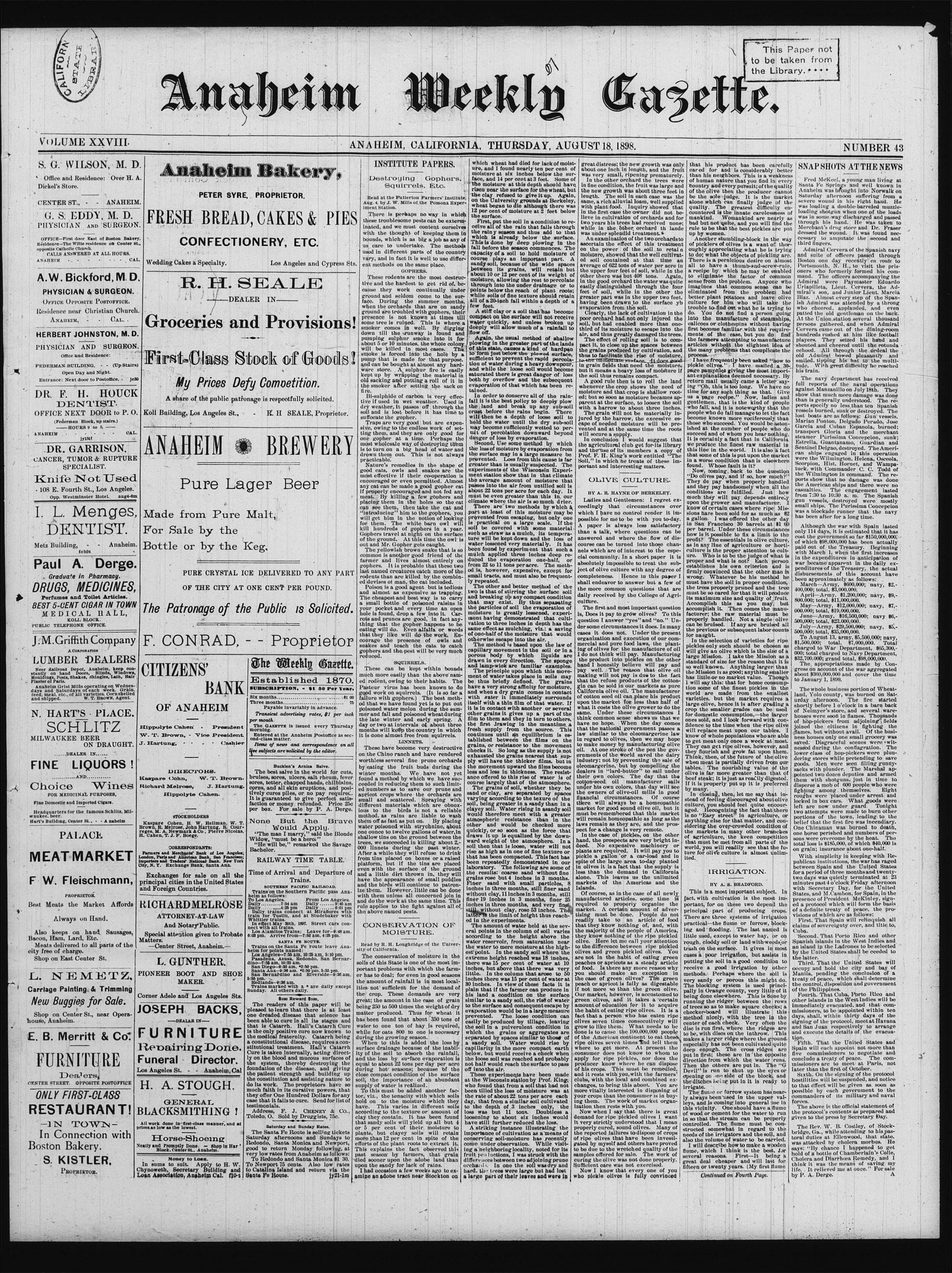
Searchable text
CALIFORN STATE LIBRARY
Anaheim
VOLUME XXVIII.
S. G. WILSON, M. D.
Office and Residence: Over H. A. Dickel's Store.
CENTER ST., - - ANAHEIM.
G. S. EDDY, M. D.
PHYSICIAN AND SURGEON.
OFFICE—First door East of Boston Bakery.
Residence—The Witte residence on Center St., opposite Catholic Church.
CALLS ANSWERED AT ALL HOURS.
ANAHEIM . . . CAL.
A.W. Bickford, M. D.
PHYSICIAN & SURGEON.
OFFICE OPPOSITE POSTOFFICE.
Residence near Christian Church.
ANAHEIM , . . . CAL.
HERBERT JOHNSTON, M. D.
PHYSICIAN AND SURGEON.
Office and Residence:
FEDERMAN BUILDING, - - (Up Stairs)
Open Day and Night.
Entrance: Next door to Postoffice. je30
DR. F. H. HOUCK
DENTIST.
OFFICE NEXT DOOR to P. O.
(Federman Block, up stairs.)
HOURS 9 to 5
ANAHEIM . . . CAL.
DR. GARRISON.
CANCER, TUMOR & RUPTURE SPECIALIST.
Anaheim Bakery,
PETER SYRE, PROPRIETOR.
FRESH BREAD, CAKES & PIES CONFECTIONERY, ETC.
Wedding Cakes a Specialty. Los Angeles and Cypress Sts
R. H. SEALE
DEALER IN
Groceries and Provisions!
First-Class Stock of Goods!
My Prices Defy Competition.
A share of the public patronage is respectfully solicited.
Koll Building, Los Angeles St., - R. H SEALE, Proprietor.
ANAHEIM BREWERY
DR. F. H. HOUCK
DENTIST.
OFFICE NEXT DOOR to P. O.
(Federman Block, up stairs.)
HOURS 9 to 6
ANAHEIM
jy1841
DR. GARRISON.
CANCER, TUMOR & RUPTURE SPECIALIST.
Knife Not Used
• 108 E. Fourth St., Los Angeles.
Opp. Westminster Hotel. aug4-6m
I. L. Menges,
DENTIST.
Metz Building, Anaheim.
feb24
Paul A. Derge.
Graduate in Pharmaoy.
DRUGS, MEDICINES,
Perfumes and Toilet Articles.
BEST 5-CENT CIGAR IN TOWN
MEDICAL HALL,
KOLL BLOCK.
PUBLIC TELEPHONE OFFICE.
J.M.Griffith Company
A CORPORATION
LUMBER DEALERS
Neer Railroad Depot, Anaheim, keep constantly on hand Doors, Blinds, Windows, Mouldings, Posts, Shakes, shingles, Lath, Hair Plaster of Paris.
Anaheim Grist Mills operating on Wednesdays and Saturdays of each week. Grain, feed, meal, etc., of all varieties. Cornshelled and shipped.
W.T. Brown, Agent.
N. HART'S PLACE.
SCHLITZ
MILWAUKEE BEER ON DRAUGHT.
DEALER IN...
FINE LIQUORS!
AND...
Choice Wines FOR MEDICINAL PURPOSES,
Fine Domestic and Imported Cigars.
Headquarters for the famous Schlitz, Milwaukee, beer.
Hart's Building, Center St., Anaheim
PALACE
MEAT MARKET
F.W. Fleischmann,
PROPRIETOR.
My Prices Defy Competition.
A share of the public patronage is respectfully solicited.
Koll Building, Los Angeles St., K.H. SEALE, Proprietor.
ANAHEIM BREWERY
Pure Lager Beer
Made from Pure Malt,
For Sale by the Bottle or by the Keg.
PURE CRYSTAL ICE DELIVERED TO ANY PART OF THE CITY AT ONE CENT PER POUND.
The Patronage of the Public is Solicited.
F.CONRAD, - - Proprietor
CITIZENS'
BANK
OF ANAHEIM
Hippolyte Cahen - President
W.T. Brown - Vice President.
J.Hartung, Cashier
DIRECTORS:
Kaspare Cohn, W.T. Brown.
Richard Melrose, J.Hartung.
Hippolyte Cahen.
STOCKHOLDERS:
Kaspare Cohen, H.W. Hellman, W.T. Brown, R.Melrose, John Hartung, R.Courreges, M.A.Newmark & Co., Pierre Nicolas, H.Cahen, T.J.F.Booge.
CORRESPONDANTS:
Farmers and Merchants' Bank of Los Angeles; London, Paris and American Bank; San Francisco; Importers and Traders' National Bank. New York City, N.Y. Exchange Bank, Santa Ana.
Exchanges for sale on all the principal cities in the United States and Foreign Countries.
The Weekly Gazette.
Established 1870.
SUBSCRIPTION, - $1 50 Per Year.
Six months... $1 00
Three months... 75
Payable invariably in advance.
Transient advertising rates, $1 per inch per month.
The GAZETTE is issued every Thursday morning.
Entered at the Anaheim Postoffice as second-class matter.
Items of news and correspondence on all live subjects are solicited by the editor.
Bucklen's Arnica Salve.
The best salve in the world for cuts,
brushes, sores, ulcers, salt rheum, fever
sores, tetter, chapped hands, chilblains,
corns, and all skin eruptions, and positively cures piles, or no pay required.
It is guaranteed to give perfect satisfaction or money refunded. Price 25c per box. For sale by P.A.Derge.
None But the Brave Would Apply.
"The man I marry," said the Blonde Widow, "must be a hero!"
"He will be," remarked the Savage Bachelor.
RAILWAY TIME TABLE.
Time of Arrival and Departure of Trains.
SOUTHERN PACIFIC RAILROAD.
Trains on the Southern Pacific pass Anaheim as follows:
PALACE
MEAT MARKET
F. W. Fleischmann,
PROPRIETOR.
Best Meats the Market Affords
Always on Hand.
Also keeps on hand Sausages,
Bacon, Ham, Lard, Etc.
Meats delivered to all parts of the city free of charge.
Shop on East Center St.
L. NEMETZ,
Carriage Painting & Trimming
New Buggies for Sale.
Shop on Center St., near Opera-house, Anaheim.
E. B. Merritt & Co.
FURNITURE
Dealers,
CENTER STREET. OPPOSITE POSTOFFICE
ONLY FIRST-CLASS RESTAURANT!
IN TOWNIn Connection with Boston Bakery.
S. KISTLER,
PROPRIETOR.
STOCKHOLDERS
Kaspare Cohen, H. W. Hellman, W. T. Brown, R. Melrose, John Hartung, R. Courreges, M. A. Newmark & Co., Pierre Nicolas, H. Cahen, T. J. F. Boege.
CORRESPONDANTS:
Farmers and Merchants' Bank of Los Angeles; London, Paris and American Bank, San Francisco; Importers and Traders' National Bank, New York City, N. Y. Exchange Bank, Santa Ana.
Exchanges for sale on all the principal cities in the United States and Foreign Countries.
RICHARDMELROSE
ATTORNEY-AT-LAW
And Notary Public.
Special attention given to Probate Matters.
—Center Street, Anaheim.
L. GUNTHER.
PIONEER BOOT AND SHOE MAKER.
Corner Adele and Los Angeles Sts.
JOSEPH BACKS,
DEALER IN
FURNITURE
Repairing Done.
Funeral Director.
Los Angeles St. - Anaheim, Cal
H. A. STOUGH.
GENERAL BLACKSMITHING!
All work done in first-class manner, and at prices as low as the lowest.
Horse-Shoeing
Neatly and Promptly Done. — Shop in Har' Block, Center St., Anaheim.
Money to Loan.
In sums to suit. Apply to H. W. Chynoweth, Secretary Building and Loan Association, Anaheim Cal.
It is guaranteed to give perfect satisfaction or money refunded. Price 25¢ per box. For sale by P. A. Derge.
None But the Brave Would Apply.
"The man I marry," said the Blonde Widow, "must be a hero!"
"He will be," remarked the Savage Bachelor.
RAILWAY TIME TABLE.
Time of Arrival and Departure of Trains.
SOUTHERN PACIFIC RAILROAD.
Trains on the Southern Pacific pass Anaheim as follows:
To Los Angeles.
Daily...7:54 am Dally...9:45 am
Daily...4:25 pm Dally...6:01 pm
Daily trains connect at Miramaroes with train for Tustin, and at Studebaker with Whittier trains.
In effect May 30th, 1897. Street cars connect with all trains.
Los Alamitos Trains; Leave for—9:48 am 6:03 pm Arrive from—7:52 am 4:25 pm.
SANTA FE ROUTE.
Trains on the Santa Fe route leave Anaheim for points named:
Los Angeles—7:55 am 10:25 am
Pasadena, Azusa, Redondo, San Bernardino—7:55 am 10:25 am
San Diego—9:36 am *2:50 pm
Santa Ana—9:36 am *2:50 pm
San Bernardino and Riverside—9:36 am 5:55 pm
Redlands—9:36 am.
Trains marked with a * are daily except Sunday. All others daily.
$100 Reward $100.
The readers of this paper will be pleased to learn that there is at least one dreaded disease that science has been able to cure in all its stages and that is Catarrh. Hall's Catarrh Cure is the only positive cure now known to the medical fraternity. Catarrh being a constitutional disease, requires a constitutional treatment. Hall's Catarrh Cure is taken internally, acting directly on the blood and mucous surfaces of the system, thereby destroying the foundation of the disease, and giving the patient strength and building up the constitution and assisting nature to do its work. The proprietors have so much faith in its curative powers, that they offer One Hundred Dollars for any case that it fails to cure. Send for list of testimonials.
Address, F. J. CHENEY & Co., Toledo, O. Sold by Druggists, 75c.
Saturday and Sunday Rates.
The Santa Fe Route is selling tickets Saturday afternoons and Sundays to Redondo, Santa Monica and Newport, good to return Monday following, at very low rates from Anaheim as follows:
To Redondo and Santa Monica $1.30.
To Newport 75 cents. Also low rates to Catalina Island and return via the Santa Fe Route.
Wein Weekly Gazette
ANAHEIM, CALIFORNIA, THURSDAY, AUGUST 18, 1898.
Bakery,
BISTOR.
KES & PIES
Y, ETC.
Los Angeles and Cypress Sts.
SALE
provisions!
of Goods!
petition.
pectfully solicited.
SEALE, Proprietor.
REWERY
INSTITUTE PAPERS.
Destroying Gophers, Squirrels, Etc.
Read at the Fullerton Farmers' Institute, Aug. 4, by J. W. Mills of the Pomona Experiment Station.
There is perhaps no way in which these troublesome pests can be exterminated, and we must content ourselves with the thought of keeping them in bounds, which is as big a job as any of us care to undertake. The methods used in different parts of the country vary, and in fact it is well to use different methods on the same place.
GOPHERS.
These rodents are the most destructive and the hardest to get rid of, because they work continually under ground and seldom come to the surface. During the summer months, when the orchards that are on sandy ground are troubled with gophers, their presence is not known at times till some tree is ruined. This is where a smoker comes in well. By digging down till the runway is found and pumping sulphur smoke into it for about 5 or 10 minutes, the whole colony will be killed in most cases. The smoke is forced into the hole by a pump that is made for that purpose, and can be bought at almost any hardware store. A sulphur fire is easily kept up by wrapping the material in old sacking and putting a roll of it in the smoker after setting the sack on fire.
Bi-sulphide of carbon is very effective if used in wet weather. Used in dry weather, it passes off through the soil and is lost before it has time to suffocate the gopher.
Traps are very good but are expensive, owing to the endless work of setting them, and they are only good for one gopher at a time. Perhaps the most wholesale way of destroying them is to turn on a big head of water and drown them out. This is not always practicable.
Nature's remedies in the shape of good cats, owls and snakes are the most effective if their operation is which wheat had died for lack of moisture, and I found nearly ten per cent of moisture at six inches below the surface, and 14 per cent at 3 feet. Some of the moisture at this depth should have risen near the surface for the wheat, but the clay refused to give it up. Again, on the University grounds at Berkeley, wheat began to die although there was 12 per cent of moisture at 2 feet below the surface.
First, put the soil in a condition to receive all of the rain that falls through the rainy season and thus add to that which is already below the surface. This is done by deep plowing in the fall before the season commences. The capacity of a soil to hold moisture of course plays an important part. A sandy soil, because of the wide spaces between its grains, will retain but about 10 or 12 per cent of its weight of moisture, allowing the rest to percolate through into the under drainage or to points below the reach of plant roots; while soils of fine texture should retain all of a 20-inch fall within a depth of a few feet.
A stiff clay or a soil that has become compact on the surface will not receive water quickly, and unless broken up deeply will allow much of a rainfall to flow off.
Again, the usual method of shallow plowing in the greater part of the lands of this state, causes a kind of hardpan to form just below the plowed surface, sufficient to prevent the rapid percolation of water during a heavy downpour, and while the loose soil would become saturated there is great danger of loss both by overflow and the subsequent evaporation of that which has been retained.
In order to conserve all of the rainfall it is the best policy to deeply plow the land and break up any sub-soil crust before the rains begin. There will then be a depth of loose soil to hold the water until the dry sub-soil may become sufficiently wetted to permit of percolation downward beyond danger of loss by evaporation.
Second, Use some method by which the loss of moisture by evaporation from the surface may in a large measure be prevented. Loss from this cause is far greater than is usually suspected. The experiments of the Wisconsin Experiment station show that in that climate great distress; the new growth was about one inch in length, and the soil was very small, ripening premature.
In the other orchard the trees were in fine condition, the fruit was larger than the new growth was about three feet length. The soil in each case was same, a rich alluvial loam, well supplied with plant food. Inquiry showed that in first case the owner did not lie in cultivation of orchards and two years his trees had received no while in the other orchard thail was under splendid treatment.
An examination of the two orchards ascertain the effect of this treatment on the power of the soil to retain moisture, showed that the well cultivated soil contained at that time average of 622 tons of water per square foot; the upper four feet of soil, while in other there was but 408 tons. Aged in the good orchard the water was easily distinguished through the feet of soil, while in the other part it was greater part was in the upper two feet having been drawn to the surface evaporation from the soil.
Clearly, the lack of cultivation in poor orchard had not only injured soil, but had enabled more than third of its moisture to escape into air, and thus greatly damaged the tree.
The effect of rolling soil is to compact it, to close up the spaces between the grains produced by cultivation, thus facilitate the rise of moisture to immediate surface. It does give in grain fields that need the moisture but it means a heavy loss of moisture to the soil thus remains compact.
A good rule then is to roll the whenever the crop shows the needed moisture and that crop is shallow reed; but so soon as moisture becomes parent at the surface, to loosen them with a harrow to about three inches jured by the harrow, the excessive cape of needed moisture will be prevented and at the same time the rooftwill secure a supply.
In conclusion I would suggest that the agricultural club get for-its library and use its members a copy Prof. F. H. King's work entitled "Soil," in which he treats of these important and interesting matters.
kept up by wrapping the material in old sacking and putting a roll of it in the smoker after setting the sack on fire.
Bi-sulphide of carbon is very effective if used in wet weather. Used in dry weather, it passes off through the soil and is lost before it has time to suffocate the gopher.
Traps are very good but are expensive, owing to the endless work of setting them, and they are only good for one gopher at a time. Perhaps the most wholesale way of destroying them is to turn on a big head of water and drown them out. This is not always practicable.
Nature's remedies in the shape of good cats, owls and snakes are the most effective if their co-operation is encouraged or even permitted. Almost any cat can be made a good gopher cat if properly encouraged and not fed any meat. By killing a few gophers and placing them in the holes so the cat can see them, then take the cat and "introducing" him to the gophers, you will get him in the notion of looking for them. The white barn owl will kill hundreds of gophers in a year. Gophers travel at night on the surface of the ground. At this time the owl is out and Mr. Gopher gets caught.
The yellowish brown snake that is so common is another good friend of the farmer and lives almost entirely on gophers. It is probable that these two last named creatures catch more of the rodents than are killed by the combined devises of man, the cat included.
Poison is a good agent but is tedious and almost as expensive as trapping. The cheapest and best way is to carry a small bottle of poisoned raisins in your pocket and every time an open hole is found, drop a few into it. Carrots and prunes are good, in fact anything that the gopher happens to be eating will do. Even alfalfa or weeds that they like will do the work. Encourage the presence of owls and snakes and teach the cats to catch gophers and the pest will be very much reduced.
SQUIRRELS.
These can be kept within bounds much more easily than the above named rodent, owing to their habits. The Pasteur virus has been known to do good work on squirrels. (It is so far a failure with gophers.) The best method that we have found yet is to put out poisoned water melon during the summer and fall and poisoned wheat during the late winter and early spring. A day or two at intervals of about three months will keep the country in which it is done almost free from squirrels.
LINNETS.
These have become very destructive on the Chino ranch and have rendered worthless several fine prune orchards by eating the fruit buds during the winter months. We have not yet found a method by which we have succeeded in reducing them to such limited numbers as to save our prune and apricot crops where the orchards are small and scattered. Spraying with different materials which are obnoxious to the birds is not a reliable method, as rains are liable to wash them off as fast as put on. By placing water poisoned with strychnine, about one ounce to twelve gallons of water, in shallow tins on the ground between the trees, we succeeded in killing about 2,000 linnetes during the past winter. After a while they will refuse to drink from tins placed on boxes or a raised platform, but if the tins are placed even with the surface of the ground and a little dirt thrown in, they will have the appearance of small puddles and the birds will continue to patronize them. However, little can be done with them unless all concerned join in saturated there is great danger of loss both by overflow and the subsequent evaporation of that which has been retained.
In order to conserve all of the rainfall it is the best policy to deeply plow the land and break up any sub-soil crust before the rains begin. There will then be a depth of loose soil to hold the water until the dry sub-soil may become sufficiently wetted to permit of percolation downward beyond danger of loss by evaporation.
Second, Use some method by which the loss of moisture by evaporation from the surface may in large measure be prevented. Loss from this cause is far greater than is usually suspected. The experiments of the Wisconsin Experiment station show that in climate the average amount of moisture that passes into the air from untilled soil is about 22 tons per acre for each day. It must be even greater than this in our climate where the air is so much drier.
There are two methods by which a part at least of this moisture may be prevented from escaping, but only one is practical on a large scale. If the soil be covered with some material such as straw as a mulch, its temperature will be kept down and the loss of water lessened very materially. It has been found by experiment that such a mulch applied three inches deep reduced the evaporation one-half, or from 22 to 11 tons per acre. The method is, however, expensive, except for small tracts, and must also be frequently repeated.
The other and better method of the two is that of stirring the surface soil and breaking up any compact condition that may exist. By thus separating the particles of soil the evaporation of moisture is greatly lessened, experiment having demonstrated that cultivation to three inches in depth has the same effect as mulching, viz: a saving of one-half of the moisture that would otherwise escape into the air.
The method is based upon the law of capillary movement in the soil or in a porous body by which liquids are drawn in every direction. The sponge and lamp-wick are familiar examples.
The principle upon which this movement of water takes place in soils may be thus briefly defined. The grains have a very strong affinity for moisture, and when a dry grain comes in contact with water it immediately surrounds itself with a thin film of that water. If it is in contact with another or several other grains it gives up a part of the film to them and they in turn to others, the first drawing in the meantime a fresh supply from the source. This continues until an equilibrium is established between the films on the grains, or resistance to the movement checks it. So long as the supply is not exhausted the grains nearest that supply will have the thicker films, but in the movement upward the films become less and less in thickness. The resistance offered to this rise of water is of course largely that of the atmosphere.
The grains of soil, whether they be sand or clay, are separated by spaces varying according to the texture of the soil, being greater in a sandy than in a clayey soil. Water rising in asandy soil would therefore meet with a greater atmospheric resistance than in the other and would be checked more quickly, or so soon as the force that draws it up is equalized by the downward weight of the atmosphere. In a soil then that is loose, water will not rise as high as in one of fine texture or that has been compacted. This fact has been repeatedly demonstrated in our laboratory. The following are some of the results: coarse sand without fine grains rose but 4 inches in 3 months. Finer sand with small particles, 8 inches in three months, still finer sand without clay, 11 inches in 3 months, still finer 19 inches in 3 months, finer 25 inches.
A good rule then is to roll the whenever the crop shows the need moisture and that crop is shallow red; but so soon as moisture becomes parent at the surface, to loosen them with a harrow to about three inch.
The grain will not be materially jured by the harrow, the excessive cape of needed moisture will be prevented and at the same time the rott will secure a supply.
In conclusion I would suggest that the agricultural club get for its library and use its members a copy Prof. F. H.King's work entitled "Soil," in which he treats of these important and interesting matters.
OLIVE CULTURE.
BY A. R. HAYNE OF BERKELEY.
Ladies and Gentlemen: I regretedly that circumstances owe which I have no control render it possible for me to be with you to do paper is always less satisfactory than a talk, where questions can answered and where the flow of course can be turned into those chinels which are of interest to the essential community. In a short paper it absolutely impossible to treat this subject of olive culture with any degree completeness. Hence in this paper shall endeavor to answer but a few more common questions that daily received by the College of Agriculture.
The first and most important question is, Does it pay to grow olives? To answer I answer "yes" and "no." Under some circumstances it does. In many cases it does not. Under the press organization and execution of our commercial and pure food laws, the playing of olives for the manufacture of I do not think will pay. Manufacturing product into pickles on other hand I honestly believe will pay well. The reason that olive making will not pay is due to the fact that the refuse products of the cottin gin can be sold in our markets as pure California olive oil. The manufacture of cotton seed oil can place his product upon the market for less than half what it costs the olive grower to do same. Under these circumstances think common sense shows us that have no hope. When day comes that national government passes law similar to the oleomargarine law in regard to olives, then we may have to make money by manufacturing olive oil. At one stroke of the pen gree governments of the world saved the day industry; not by preventing the sale oleomargarine, but by compelling dealers in "lard-butter" to sail under their own colors. The day that they棉纺织品 manufacturer sailed under his own colors; day will under his owners of olive-oil mills in groe financial circumstances. Of course there will always be a homeopathic market for good sound olive oil, but must be remembered that this mark will remain homeopathic as long as its laws remain as they are, and the perfect for a change is very remote.
In case of pickles, on other hand, the prospects are very bright if deed. No expensive machinery plants are required. It will pay you pickle a gallon or a car-load and spite of large area to-day plants in olives it is a fact that the supply less than the demand in California alone. This leaves us the unlimited markets ofthe Americas and tbe Islands.
Of course, as in case of all new manufactured articles, some time
CONSERVATION OF MOISTURE.
Read by R. H. Loughridge of the University of California.
The conservation of moisture in the soils of this State is one of the most important problems with which the farmer has to deal; for even in good seasons the amount of rainfall is in most localities not sufficient for the demand of the crop. These demands are very great; the amount in the case of grain being 250 to 500 times the weight of dry matter produced. Thus for wheat it has been found that about 350 tons of water to one ton of hay is required, while for oats 800 to one is necessary during the growing season.
When to this is added the loss by surface drainage because of the inability of the soil to absorb the rainfall, and the loss by surface evaporation is equal to about 22 tons per day per acre during hot seasons; because of the close compact condition of the surface soil, the importance of an abundant supply of water is realized.
To this must be added another factor, viz., the tenacity with which soils hold on to the moisture which they have. This varies in different soils according to the texture or amount of clay they contain. It has been found that sandy soils will yield up all but 4 or 5 per cent of their moisture to plants, but clayey soils will retain more than 12 per cent in spite of the efforts of the plant roots to extract it. This explains the fact observed this past season by farmers, that grain died sooner upon the adobe land than upon the sandy for lack of rains.
I had occasion a few weeks ago to examine an adobe tract near Stockton on varying according to the texture of the soil, being greater in a sandy than in a clayey soil. Water rising in asandy soil would therefore meet with a greater atmospheric resistance than in the other and would be checked more quickly, or so soon as the force that draws it up is equalized by the downward weight of the atmosphere. In a soil then that is loose, water will not rise as high as in one of fine texture or that has been compacted. This fact has been repeatedly demonstrated in our laboratory. The following are some of the results: coarse sand without fine grains rose but 4 inches in 3 months. Finer sand with small particles, 8 inches in three months, still finer sand without clay, 11 inches in 3 months, still finer 19 inches in 3 months, finer 25 inches in three months, and very fine still without clay, rose 53 inches. The latter is the limit of height thus reached in the experiments.
The amount of water held at the several points in the column of soil varies according to the height above the water reservoir, from saturation near the water to mere moisture at the highest point. In the sandy soil where the extreme height reached was 18 inches, there was 15 per cent of water at 10 inches, but above that there was very little. In the column that arose to 50 inches there was 15 per cent of water at 30 inches. In view of these facts it is plain that if the farmer can produce in his land a condition on the surface similar to a sandy soil, the rise of water to the surface and consequent escape by evaporation would be in a large measure prevented. The loose condition can easily be produced by tillage, leaving the soil in a pulverulent condition in which the grains or aggregates are separated by spaces similar to those of a sandy soil. Water would rise by capillarity in the more compact earth below, but would receive a check when the loose soil was reached and probably not half would reach the surface to pass off into the air.
These experiments have been made at the Wisconsin station by Prof. King, who found that from a soil that had not been tilled the loss of moisture was at the rate of about 22 tons per acre each day, that from a similar soil cultivated to the depth of 3 inches only, the loss was but 11 tons. Doubtless a loosening to about six inches would have still further reduced the loss.
A striking instance illustrating the importance of cultivation as a means of conserving soil-moisture has recently come under observation. While visiting a neighboring locality, noted for its fruit productions, I was struck with the differences between two adjoining prune orchards. In one the soil was dry and hard, the trees were large but had lost a large part of their leaves and were in
Of course, as in the case of all new manufactured articles, some time may be required to properly organize the market. A certain amount of advice tising must be done. People do not readily take to an article of food that they know nothing of, and, with the majority of the people of America they know nothing of the ripe pickle olives. Here let me call your attention to the difference between ripe pickle olives and green pickled olives. You are not in the habit of eating green peaches or apricots as a steady article of food. Is there any more reason why you should make an exception to the case of green olives? The green peach or apricot is fully as digestable if not more so than the green olives. Our market, however, is accustomed to green olives, and it takes a certain amount of education for it to acquire the habit of eating ripe olives. It is fact that a person who has eaten ripe olives seven times consecutively will grow to like them. What needs to be done is to cause the 100,000,000 people of the American continent to eat ripe olives seven times and tell them where to get more. At present the consumer does not know to whom you apply for ripe pickles, nor does the producer know where he can dispose of his crops. This must be remedied and it rests with you, with the farmer clubs, with the local and combined changes, to bring this about. You are more vitally interested in disposing of your crops than the consumer is in buying them. The work of market organization then rests with you.
Now when I say that there is great demand for ripe pickled olives I want it very strictly understood that I mean properly cured, sound olives. Many of the reported failures to dispose of crops of ripe olives that have been investigated by myself and others have proved to be due to the wretched quality of these samples offered for sale. The work of curing the olive was not done properly. Sufficient care was not exercised.
Now I know that every one of you who pickle olives is fully convinced
Tuesday, 18, 1898.
Gazette.
EXamination of the two orchards to gain the effect of this treatment on the power of the soil to retain moisture, showed that the well cultivated contained at that time an amount of 622 tons of water per acre in four feet of soil, while in the other there was but 408 tons. Again, good orchard the water was quite distinguished through the four soils, while in the other the part was in the upper two feet. It been drawn to the surface ybation from the soil.
Morely, the lack of cultivation in the orchard had not only injured the crop but enabled more than one of its moisture to escape into the and thus greatly damaged the trees. Effect of rolling soil is to come to close up the spaces between grains produced by cultivation, and facilitate the rise of moisture, immediate surface. It does good on fields that need the moisture, means a heavy loss of moisture if it thus remains compact.
Good rule then is to roll the land over the crop shows the need of care and that crop is shallow rooted so soon as moisture becomes apparent at the surface, to loosen the soil harrow to about three inches. Grain will not be materially injury by the harrow, the excessive eschewed moisture will be pre- and at the same time the roots secure a supply.
Inclusion I would suggest that cultural club get for its library use of its members a copy of "The man which he treats of these imprints and interesting matters."
Now, coming back to the question that his product has been carefully cared for and is considerably better than his neighbors. This is a weakness of human nature that you find in every country and every pursuit; of the quality of the olive then the producer cannot be the sole judge. It is the market alone which can finally judge of the quality. The greatest difficulty encountered is the innate carelessness of mankind. Womankind are nearly as bad but not quite, and you will find the rule to be that the best pickles are put up by women.
Another stumbling-block in the way of picklers of olives is a want of thoroughly appreciating what he is trying to do; what the objects of pickling are. There is a pernicious desire on almost all to have a thumb-and-screw-rule, a recipe by which he may be enabled to eliminate the factor of common sense from the problem. Anyone who imagines that common sense can be eliminated from the problem had better plant potatoes and leave olive culture for him who will take the trouble to find out what he is trying to do. You do not find a person going into the manufacture of steamships, calicoes or clothespins without having first become familiar with the requirements of the case, but you do find the farmers attempting to manufacture articles without the slightest idea of the many problems that complicate the process.
I have frequently been asked "how to pickle olives." I have mailed a 30-page pamphlet giving the most important explanations deemed necessary. By return mail usually came a letter saying "Oh, this is too long. We have no time for any such thing as that. Give us a page recipe." Now, ladies and gentlemen, that is the kind of people who fail, and it is noteworthy that the people who do fail manage to let the fact become known more vociferously than those who succeed. You would be astonished at the number of people who do succeed and of whom you hear nothing.
It is certainly a fact that in California we produce the finest raw material in this line in the world. It is also a fact that some of this is put upon the market in a worse condition than is elsewhere found. Whose fault is it?
SNAP SHOTS AT THE NEWS
Fred McKeel, a young man living at Santa Fe Springs and well known in Anaheim was brought into Norwalk on Saturday afternoon suffering from a severe wound in his right hand. He was loading a double-barreled muzzle-loading shotgun when one of the loads was in some way discharged and passed through his hand. He was taken to Merchant's drug store and Dr. Fraser dressed the wound. It was found necessary to amputate the second and third fingers.
Admiral Cervera of the Spanish navy and suite of officers passed through Boston one day recently en route to Portsmouth, N. H., to visit the prisoners who formerly formed his command. The officers accompanying the Admiral were Paymaster Eduardo Uriapilleta, Lieut. Cervera, the Admiral's son, and Junior Lieut. Marcia Blaz. Almost every step of the Spanish Admiral was attended by a strong who cheered, applauded, and even patted the old gentleman on the back. At the Union station several thousand persons gathered, and when Admiral Cervera came out of the dining-room hundreds rushed at him like football players. They seized his hand and shouted and cheered until the rotunda echoed. All through the ordeal the old Admiral bowed pleasantly and smiled, tipping his hat to the multitude. With great difficulty he reached his train.
The navy department has received full reports of the naval operations against Manzanillo on July 18th. They show that much more damage was done than is generally understood. The reports specify no less than ten Spanish vessels burned, sunk or destroyed. The lost boats are as follows: Marian Ponton, Delgado Perado, Jose Garcia and Cuban Espanola, burned; transport Gloria and the merchant steamer Parissima Concepcion, sunk; Estrella, Guantanamo, Guardian and Sentinel Deigao, destroyed. The American ships engaged in this operation were Wilmington, Helena, Osceola, Scorpion, Hist, Hornet, and Wampauck, with Commander C. C. Todd of the Wilmington in command. The re
IRRIGATION.
BY A. S. BRADFORD.
This is a most important subject. In fact, with cultivation is the most important explanations deemed necessary. By return mail usually came a letter saying "Oh, this is too long. We have no time for any such thing as that. Give us a page recipe." Now, ladies and gentlemen, that is the kind of people who fall, and it is noteworthy that the people who do fail manage to let the fact become known more vociferously than those who succeed. You would be astonished at the number of people who do succeed and of whom you hear nothing. It is certainly a fact that in California we produce the finest raw material in this line in the world. It is also a fact that some of this is put upon the market in a worse condition than is elsewhere found. Whose fault is it?
Now, coming back to the question "Do olives pay, and if so, how much?" They do pay when properly handled and they pay handsomely when all the conditions are fulfilled. Just how much they will pay depends entirely upon the grower and manufacturer. I know of certain cases where ripe Missions have been sold for as much as $2 a gallon. I was offered the other as day in San Francisco 30 barrels at $160 per barrel. Under these circumstances how is it possible to fix a limit to the profit? The essentials in olive culture, as in any line of agriculture or horticulture is the proper attention to culture. Who is to be the judge of what is proper and what is not? Each person establishes his own criterion and is firmly convinced that the other man is wrong. Whatever he his method he must have the soil in proper condition, the trees properly pruned and the tree must be so cared for that it will produce its maximum size and quality of fruit. Accomplish this as you may but accomplish it. Then comes the manufacturer; the raw material must be properly handled. Not a single olive can be bruised. If any are bruised all the previous or subsequent labor counts for naught.
In the selection of varieties for ripe pickles only such should be chosen as will give an olive which is the size of a large Mission. I take the Mission as a standard of size for the reason that it is so well known. Anything larger than the Mission is as good; anything smaller has little or no market value. Though I will say this: that for home consumption some of the finest pickles in the world are made from the smallest varieties, but the market requires a large olive, hence it is after grading a crop the smaller grades can be used for domestic consumption—the larger ones sold, and I look forward with confidence to the time when the ripe olive will replace meat upon our tables. I know of whole populations who are able to get meat only once a week at most. They can get ripe olives, however, and they flourish and grow fat upon them. Think, then, of the future of the olive when meat is partially driven from our tables. The nourishing value of the olive is far more greater than that of beef steak; it is just as readily digested. If it is properly put up it is preferred by many.
In closing, then, let me say that instead of feeling discouraged about olive culture, you should feel quite encouraged. Recognizing the fact that there is no "Easy street" in agriculture, or anything else for that matter, and considering the over-crowded condition of the markets in many other branches of agriculture, the keen competition that must be met from all parts of the world, you will readily see that the future for olive culture is almost unlimited.
The navy department has received full reports of the naval operations against Manzanillo on July 18th. They show that much more damage was done than is generally understood. The reports specify no less than ten Spanish vessels burned, sunk or destroyed. The lost boats are as follows: Gun vessels, Marian Ponton, Delgado Perado, Jose Garcia and Cuban Espanola, burned; transport Gloria and the merchant steamer Parissima Concepción, sunk; Estrella, Guantanamo, Guardian and Sentinel Deigao, destroyed. The American ships engaged in this operation were the Wilmington, Helena, Osceola, Scorpion, Hist, Hornet, and Wampauck, with Commander C. C. Todd of the Wilmington in command. The reports show that no damage was done the American ships and there were no casualties. The engagement lasted from 7:30 to 10:30 a.m. The Spanish gun vessels, destroyed were mostly small ships. The Purissina Concepción was a blockade runner that the navy has been after for a long time.
Although the war with Spain lasted only 114 days, it is estimated that it has cost the government so far $150,000,000, of which $98,000,000 has been actually paid out of the Treasury. Beginning with March 1, when the first increases in the expenditures in anticipation of war became apparent in the daily expenditures of the Treasury, the actual disbursements of this account have been approximately as follows:
March—Army, $600,000; navy, $2,-400,000; total, $3,000,000.
April—Army, $1,200,000; navy, $9,-800,000; total, $11,000,000.
May—Army, $12,000,000; navy, $7,-000,000; total, $19,000,000.
June—Army, $16,500,000; navy $6,-500,000; total, $23,000,000.
July—Army, $29,500,000; navy, $5,-500,000; total, $35,000,000.
To August 13, army, $5,500,000; navy,$1,500,000; total.$7,ooo,ooo.Total charged to War Department.,$65,30o.o;total charged to Navy Department.,$27,7oO.o grand total,$98,ooO.o
The appropriations made by Congress on account of the war aggregated about $9oO,ooO,and cover the time to January 1,1899.
The whole business portion of Wheatland, Yolo county, was burned on Saturday afternoon. The fire started shortly before 1 o'clock in a barn back of Neimyer's store,and several warehouses were soon in flames. Thousands of hop-pickers from adjoining fields joined the citizens in fighting flames,but without avail.Of the business houses only one small grocery was saved.Disgraceful scenes were witnessed during the conflagration.The lower class of hop-pickers were plundering stores while pretending to save goods.Men were seen filling gunnysacks with plunder.The Marshal appointed two dozen deputies and armed them with shotguns,just in time to disperse a mob of 6oO people who were fighting among themselves.Eight roughs were placed under arrest and locked in box cars.What goods were left are now under guard.Tonight two attempts were made to burn other portions of the town leading to the belief that the first fire was incendiary.One Chinaman was burned to death,一 horse perished and numbers of persons were overcome by the heat.The total loss is $185,ooo.of which $4oO.is on grain; insurance about one-half.
With simplicity in keeping with Republican institutions,the war has raged between Spain and the United States for a period of three months and twenty-two days was quietly terminated at 23 minutes past 4 o'clock Friday afternoon with Secretary Day,forke United States,and M.Cambon,pfor Spain,the presence of President McKinley,sign-
IRRIGATION.
BY A. 8. BRADFORD.
This is a most important subject. In fact, with cultivation is the most important, for on these two depend the principal part of producing crops. There are three systems of irrigation practical—the flume or furrow, blocking and flooding. The last named is little used, except to water hay, or on rough, cloddy soil or land with weeds or trash on the surface. It gives in most cases a poor irrigation, but assists in putting the soil in a good condition to receive a good irrigation by other methods. Perhaps where the soil is very sandy or porous this might do. The blocking system is used principally in Orange county, very little of it being done elsewhere. This is done by running the ridger between the rows of trees so as to make square checks; a checker-board will illustrate this method nicely, with the tree in the center of each check. Very often the disc is run first, where the ridges are to be, with discs on the inthrow. This makes a larger ridge where the ground especially has not been cultivated quite deep enough. The cross ridges are put in first; these are in the opposite direction from which the water runs. Then the others are put in. The "G Devil" is run to shut up the eyes or opening on one side of the block, and the ditches being put in it is ready to irrigate.
The flume or furrow system has nearly always been used in the upper valleys, and is coming into general use in this vicinity. One should have a flume of wood or cement for the water to run in so that the stream can be properly controlled. The flume must be constructed somewhat in regard to the needs of the irrigators and the soil, and also the volume of water to be carried.
I will describe how to make a wooden flume, which I think is the best, for several reasons. First—It being a great deal cheaper and will last for fifteen or twenty years. (My first flume
With simplicity in keeping with Republican institutions, the war has raged between Spain and the United States for a period of three months and twenty-two days was quietly terminated at 23 minutes past 4 o'clock Friday afternoon with Secretary Day, for the United States, and M.Cambon, for Spain, in the presence of President McKinley, signed a protocol which will form the basis of a definite treaty of peace, the provisions of which are as follows:
First That Spain will relinquish all claims of sovereignty over, and title to, Cuba.
Second That Porto Rico and other Spanish islands in the West Indies and an island in the Ladrones to be selected by the United States shall be ceeded to the latter.
Third That the United States will occupy and hold the city and bay of Manila, pending the conclusion of a treaty of peace, which shall determine the control, disposition and government of the Philippines.
Fourth That Cuba, Porto Rico and other islands in the West Indies will be immediately evacuated, and that commissioners, to be appointed within ten days, shall, within thirty days of the signing of the protocol, meet at Havana and San Juan respectively to arrange and execute the details of the evacuation.
Fifth That the United States and Spain will each appoint not more than five commissioners to negotiate and conclude a treaty of peace. The commissioners are to meet at Paris, not later than the first of October.
Sixth On the signing of the protocol hostilities will be suspended, and notice to that effect will be given as soon as possible by each government to the commanders of its military and naval forces.
The above is the official statement of the protocol's contents as prepared and given to the press by Secretary Day.
The Rev. W. B. Costley, of Stockbridge, Ga., while attending to his pastoral duties at Ellenwood, that state, was attacked by cholera morbus. He says: "By chance I happened to get hold of a bottle of Chamberlain's Colie, Cholera and Diarrhoea Remedy, and I think it was the means of saving my life. It relieved me at once." For sale by P. A. Derge.