anaheim-gazette 1898-05-26
Scanned page
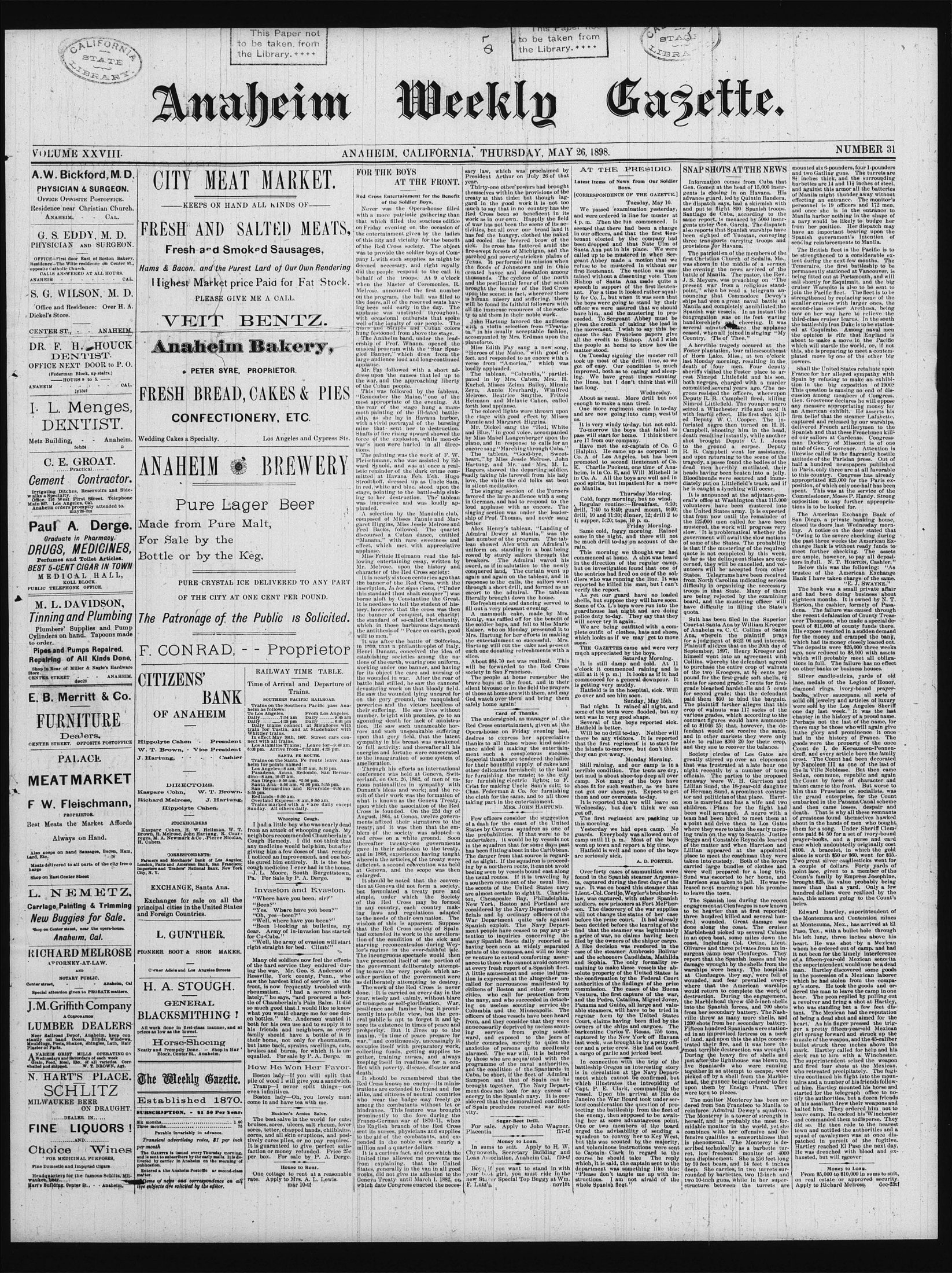
Searchable text
CALIFORNIA
STATE
LIBRARY.
This Paper not to be taken from the Library.
Anaheim
VOLUME XXVIII.
A.W. Bickford, M.D.
PHYSICIAN & SURGEON.
Office Opposite Postoffice.
Residence near Christian Church.
ANAHEIM, CAL.
G.S. EDDY, M.D.
PHYSICIAN AND SURGEON.
OFFICE—First door East of Boston Bakery.
Residence—The Witte residence on Center St., opposite Catholic Church.
CALLS ANSWERED AT ALL HOURS.
ANAHEIM, CAL.
S.G. WILSON, M.D.
Office and Residence: Over H.A. Dickel's Store.
CENTER ST., ANAHEIM.
DR.F.H. HOUCK
DENTIST.
OFFICE NEXT DOOR to P.O.
(Federman Block, up stairs.)
HOURS 9 to 5.
ANAHEIM, CAL.
I.L. Menges,
DENTIST.
Metz Building, Anaheim.
feb24
C.E. GROAT.
Practical...
CITY MEAT MARKET.
KEeps on hand all kinds of
FRESH AND SALTED MEATS,
Fresh and Smoked Sausages,
Hams & Bacon, and the Purest Lard of Our Own Rendering
Highest Market price Paid for Fat Stock.
PLEASE GIVE ME A CALL.
VEIT BENTZ.
Anaheim Bakery,
• PETER SYRE, PROPRIETOR.
FRESH BREAD, CAKES & PIES CONFECTIONERY, ETC.
Wedding Cakes a Specialty. Los Angeles and Cypress Sts.
ANAHEIM BREWERY
I. L. Menges,
DENTIST.
Metz Building, Anaheim.
feb24
C. E. GROAT.
Cement Contractor.
Irrigating Ditches, Reservoirs and Sidewalks a Specialty.
Office, 216 West First Street. Telephone Main 927. Los Angeles, Cal.
Anaheim orders promptly attended to.
Paul A. Derge.
Graduate in Pharmacy.
DRUGS, MEDICINE8,
Perfumes and Toilet Articles.
BEST 5-CENT CIGAR IN TOWN
MEDICAL HALL,
KOLL BLOCK.
PUBLIC TELEPHONE OFFICE.
M. L. DAVIDSON,
Tinning and Plumbing
Plumbers' Supplies and Pump Cylinders on hand. Tapoons made to order.
Pipes and Pumps Repaired.
Repairing of All Kinds Done.
Shop in Rear of Miller & Nagle's Hardware Store.
CENTER STREET
dec23
ANAHEIM.
E. B. Merritt & Co.
FURNITURE
Dealers.
CENTER STREET. OPPOSITE POSTOFFICE
PALACE
MEAT MARKET
F W. Fleischmann,
PROPRIETOR.
Best Meats the Market Affords
Always on Hand.
Also keeps on hand Sausages, Bacon, Ham, Lard, Etc.
Meats delivered to all parts of the city free o harge
Shop on East Center Street
L. NEMETZ.
FRESH BREAD, CAKES & PIES
CONFECTIONERY, ETC.
Wedding Cakes a Specialty. Los Angeles and Cypress Sts.
ANAHEIM BREWERY
Pure Lager Beer
Made from Pure Malt,
For Sale by the Bottle or by the Keg.
PURE CRYSTAL ICE DELIVERED TO ANY PART OF THE CITY AT ONE CENT PER POUND.
The Patronage of the Public is Solicited.
F. CONRAD, - Proprietor
CITIZENS'
BANK
OF ANAHEIM
Hippolyte Cahen President
W. T. Brown, Vice President
J. Hartung, Cashier
DIRECTORS.
Kaspare Cohn, W. T. Brown
Richard Melrose, J. Hartung,
Hippolyte Cahen.
STOCKHOLDERS
Kaspare Cohen, H. W. Hellman, W. T. Brown, R. Melrose, John Hartung, R. Courreges, M. A. Newmark & Co., Pierre Nicolas, H. Cahen.
CORRESPONDENTS:
Farmers and Merchants' Bank of Los Angeles; London, Paris and American Bank; San Francisco; Importers and Traders' National Bank; New York City, N.Y.
EXCHANGE, Santa Ana.
RAILWAY TIME TABLE.
Time of Arrival and Departure of Trains.
SOUTHERN PACIFIC RAILROAD.
Trains on the Southern Pacific pass Anaheim as follows:
To Los Angeles... From Los Angeles.
Daily..... 7:54 am Daily..... 9:45 am
Daily..... 4:25 pm Daily..... 6:01 pm
Daily trains connect at Mirrafores with train for Tustin, and at Studebaker with Whittier trains.
In effect May 30th, 1897. Street cars connect with all trains.
Los Alamitos Trains; Leave for-9:48 am.
6:03 pm. Arrive from-7:52 am. 4:25 pm.
SANTA FE ROUTE.
Trains on the Santa Fe route leave Anaheim for points named:
Los Angeles-8 am, 10:27 am, 5:10 pm.
Pasadena, Azusa, Redondo, San Bernardino-8 am, 10:27 am.
San Diego-9:50 am, *2:50 pm.
Santa Ana-9:50 am, 5:55 pm.
San Bernardino and Riverside-9:50 am.
5:55 pm.
Redlands-9:50 am.
Overland Express-8 am, 9:50 am.
Trains marked with a * are daily except Sunday. All others daily.
Whooping Cough.
I had a little boy who was nearly dead from an attack of whooping cough. My neighbors recommended Chamberlain's Cough Remedy. I did not think that any medicine would help him, but after giving him a few doses of that remedy I noticed an improvement, and one bottle cured him entirely. It is the best cough medicine I ever had in the house.
—J. L. Moore, South Burgettstown, Pa. For Sale by P. A. Derge.
Invasion and Evasion.
"Where have you been, sir?"
F W. Fleischmann,
PROPRIETOR.
Best Meats the Market Affords
Always on Hand.
Also keeps on hand Sausages, Bacon, Ham,
Lard, Etc.
Meats delivered to all parts of the city free o
charge
Shop on East Center Street
L. NEMETZ.
Carriage Painting & Trimming
New Buggies for Sale.
Shop on Center street, near the opera-house.
Anaheim, Cal.
RICHARD MELROSE
ATTORNEY-AT-LAW.
AND
NOTARY PUBLIC.
Center street,
Anaheim, Cal.
Special attention given to PROBATE matters.
J.M.Griffith Company
A CORPORATION
LUMBER DEALERS
Near Railroad Depot, Anaheim, keep constantly on hand Doors, Blinds, Windows,
Mouldings, Posts, Shakes, Shingles, Lath, Hair
Plaster of Paris.
ANAHEIM GRIST MILLS OPERATING ON
Wednesdays and Saturdays of each week
Grain, Feed, Meal, Etc. of all varieties. Corn
shalled and shipped.
N. HART'S PLACE.
SCHLITZ
MILWAUKEE BEER
ON DRAUGHT.
DEALER IN.....
FINE LIQUORS!
AND
Choice Wines
FOR MEDICINAL PURPOSES,
Fine Domestic and Imported Cigars.
Headquarters for the famous Schlitz, Milwaukee, beer.
Hart's Building. Copter St., ... Anaheim,
Richard Melrose,
J. Hartung,
Hippolyte Cahen.
STOCKHOLDERS
Kaspare Cohen, H. W. Hellman, W. T.
Brown, R. Melrose, John Hartung, R. Courreges, M. A. Newmark & Co., Pierre Nicolas,
H. Cahen.
CORRESPONDENTS:
Farmers and Merchants' Bank of Los Angeles;
London, Paris and American Bank, San Francisco;
Importers and Traders' National Bank, New York City, N.Y.
EXCHANGE, Santa Ana.
Exchanges for sale on all the principal cities in the United States and Foreign Countries.
L. GUNTHER.
PIONEER BOOT & SHOE MAKER.
Corner Adele and Los Angeles Streets
H. A. STOUGH.
GENERAL BLACKSMITHING!
All work done in first-class manner, and at prices as low as the lowest.
Horse-Shoeing
Neatly and Promptly Done. - Shop in Har'
Block, Center St., Anaheim.
The Weekly Gazette.
Established 1870.
SUBSCRIPTION, - $1 50 Per Year.
Six months... 1 00
Three months... 75
Payable invariably in advance.
Transient advertising rates, $1 per inch per month.
The Gazette is issued every Thursday morning,
and is sent to subscribers by the early mails. It is delivered by carrier in Anaheim on the morning of publication.
Entered a the Anaheim Postoffice as second-class matter.
Items of news and correspondence on all live subjects are solicited by the editor.
Whooping Cough.
I had a little boy who was nearly dead from an attack of whooping cough. My neighbors recommended Chamberlain's Cough Remedy. I did not think that any medicine would help him, but after giving him a few doses of that remedy I noticed an improvement, and one bottle cured him entirely. It is the best cough medicine I ever had in the house.
—J. L. Moore, South Burgettstown,
Pa. For Sale by P. A. Derge.
Invasion and Evasion.
"Where have you been, sir?"
"Been?"
"Yes. Where have you been?"
"Oh, yes—been?"
"Well, where have you been?"
"Been l-looking at bulletins, my dear. Army of in-invasion has started for Cu-Cuba."
"Well, the army of evasion will start right straight for bed. Climb!"
Many old soldiers now feel the effects of the hard service they endured during the war. Mr. Geo. S. Anderson of Rossville, York county, Penn., who saw the hardest kind of service at the front, is now frequently troubled with rheumatism. "I had a severe attack lately," he says, "and procured a bottle of Chamberlain's Pain Balm. It did so much good that I would like to know what you would charge me for one dozen bottles." Mr. Anderson wanted it both for his own use and to supply it to his friends and neighbors, as every family should have a bottle of it in their home, not only for rheumatism, but lame back, sprains, swellings, cuts, bruises and burns, for which it is unequalled. For sale by P. A. Derge: m
How He Won Her Favor.
Boston lady—If you will split that pile of wood I will give you a sandwich.
Tramp—I never split things—not even infinitives.
Boston lady—Oh, you lovely man! come in and have tea with me.
Bucklen's Arnica Salve.
The best salve in the world for cuts; bruises, sores, ulcers; salt rheum; fever sores, tetter; chapped hands; chilblains; corns; and all skin eruptions; and positively cures piles; or no pay required.
It is guaranteed to give perfect satisfaction or money refunded. Price 25c per box. For sale by P. A. Derge.
House to Rent.
One cottage to rent at a reasonable rate. Apply to Mrs. A. L. Lewis.
mar 10-tf
FOR THE BOYS
AT THE FRONT.
Red Cross Entertainment for the Benefit of the Soldier Boys.
Never was the Opera-house filled with a more patriotic gathering than that which filled the spacious edifice on Friday evening on the occasion of the entertainment given by the ladies of this city and vicinity for the benefit of the Red Cross society. The object was to provide the soldier boys of Company L with such supplies as might be deemed necessary, and right royally did the people respond to the call in behalf of the troops. At 9 o'clock when the Master of Ceremonies, R. Melrose, announced the first number on the program, the hall was filled to the doors, all of the reserved seats having been sold early in the day. The applause was unstinted throughout, with occasional outbursts that spoke well of the loyalty of our people. The Stars and Stripes and Cuban colors hung festooned from above the stage.
The Anaheim band, under the leadership of Prof. Whann, opened the musical program with the "Star Spangled Banner," which drew from the large audience loud and long-continued applause.
Mr. Fay followed with a short address upon the causes that led up to the war, and the approaching liberty of the Cuban people.
This was followed by the tableau, "Remember Maine," one of the most appropriate of the evening. At the rear of the stage hung a mammoth painting of the ill-fated battle-ship, as she lay in Havana harbor, with a vivid portrayal of the bursting mine that sent her to destruction. Shafts of fire rising upward showed the force of the explosion, while men-of-war's men were hurled in all directions.
The painting was the work of F. W. Fleischmann, who was assisted by Edward Synold, and was at once a realistic reminder of the dark crime committed.
At THE PRESIDIO.
Latest Items of News from Our Soldier Boys.
[CORRESPONDENCE OF THE GAZETTE]
Tuesday, May 10.
We passed examination yesterday and were ordered in line for muster at 4 p.m. Then the fun commenced. seemed that there had been a change in our officers, and that the first lieutenant elected by the company has been dropped and that Nate Ulm of Santa Ana put in his place. We were called up to be mustered in when Sergeant Abbey made a motion that we refuse to be mustered in without our first lieutenant. The motion was sustained without a dissenting vote. The Bishop of Santa Ana made quite a speech in support of the first lieutenant. For a time it looked rather squatly for Co. L, but when it was seen that the boys were going to stand by the officer we were assured that we should have him, and the mustering in proceeded. To Sergeant Abbey must give the credit of taking the lead in the movement. I wish to say this because the San Francisco papers give all the credit to Bishop. And I wish the people at home to know how much matter stood.
On Tuesday signing the muster roots took up most of the drill time, so we got off easy. Our condition is much improved, both as to eating and sleeping. We have great times running the lines, but I don't think that will last long.
Wednesday.
About as usual. More drill but not enough to make a man tired.
One more regiment came in to-day and are now going into camp west us.
It is very windy to-day, but not cold.
To-morrow the boys that failed pass will start for home. I think there are 17 from our company.
Have met the ex-captain of Co. (Halpin). He came up as corporal Co. A of Los Angeles, but has been promoted to second lieutenant of Co. K. Charlie Puckett, one time of Anheim, is in Co. E, and Will Mitchell
Over forty cases of ammunition were found in the Spanish steamer Argona ta, captured during the first days of war. It was on board this steamer Lieut.-Col. Cortijo, Weyler's brother-bearer, was captured with other ships.
The painting was the work of F. W. Fleischmann, who was assisted by Edward Synold, and was at once a realistic reminder of the dark crime committed at Havana Feb. 15th. Hugo Strodthoff, dressed up as Uncle Sam, in red, white and blue, stood upon the stage, pointing to the battle-ship sinking to her destruction. The tableau was impressive and was loudly applauded.
A selection by the Mandolin club, composed of Misses Fannie and Margaret Higgins, Miss Jessie Melrose and Fred Backs, followed. The quartet discoursed a Cuban dance, entitled "Manana," with rare sweetness and effect, which met with appreciative applause.
Miss Fritzie Heimann read the following entertaining essay, written by Mr. Melrose, upon the history and character of the Red Cross society:
It is nearly sixteen centuries ago that the banner of the Red Cross, with the inscription, In hoc signo vincens, ("Under this standard thou shalt conquer") was borne aloft by Constantine the Great. It is needless to tell the student of history, however, that the cross was then the banner of conquest, not charity; the standard of so-called Christianity, which in those barbarous days meant the antithesis of "Peace on earth, good will to men."
It was after the battle of Solferino, in 1839, that a philanthropist of Italy, Henri Dunant, conceived the idea of establishing societies among the nations of the earth, wearing one uniform, working under one banner, and having for its object the care and nursing of the wounded in war. After the roar of battle had stilled, he saw the cannons' devastating work on that bloody field. He saw the wounded lying uncaused for on the gory ground, the vanquished powerless and the victors hedless of their suffering. He saw lives without number, bright with promise, go to an agonizing death for lack of ministration. He saw such unnameable horrors and such unspeakable suffering upon that gory field, that the latent sympathy in his breast was awakened to full activity; and thereafter all his energies and fortune were consecrated to the inauguration of some system of amelioration.
Through his efforts an international conference was held at Geneva, Switzerland, on Oct. 26, 1862, of men of various nationalities in sympathy with Dunant's ideas and work; and the result of their work was the formation of what is known as the Geneva Treaty, upon which the association of the Red Cross is founded. On the 22d day of August, 1864, at Genoa, twelve governments affixed their signatures to the treaty, and it was then that the emblem of the society was adopted—a red cross on a white ground. Soon thereafter twenty-two governments gave in their adhesion to the treaty, and in 1868, experience having taught wherein the articles of the treaty were deficient, a second convention was held at Geneva, and the scope was then enlarged.
It should be noted that the convention at Geneva did not form a society, but formulated a treaty pure and simple, under which the Society tableau, Columbia, participated in by Mrs. Cahen, Mrs. H. Kuchel, Misses Zelma Bailey, Minnie Zeyn, Annie Everhardy, Winfred Melrose, Beatrice Smythe, Fritzie Heimann and Melanie Cahen, called forth loud applause.
The colored lights were thrown upon the stage with good effect by Misses Fannie and Margaret Higgins.
Mr. Dickel sang the "Red, White and Blue," in good voice, accompanied by Miss Mabel Langenberger upon the piano, and in response to calls for an encore sang "Marching through Cuba."
The tableau, "Good-bye, Sweet-heart," by Miss Jessie Melrose, John Hartung, and Mr. and Mrs. M. L. Rogers showed the departing soldier; sadly taking his farewell from his lady love, while the old folks sat bent in silent meditation.
The singing section of the Turners favored the large audience with a song in German, and had to respond to the loud applause with an encore. The singing section was under the leadership of Prof. Thomas, and never sang better.
Alex Henry's tableau, "Landing of Admiral Dewey at Manila," was the last number of the program. The tableau showed Alex with an Admiral's uniform on standing in a boat being rowed by sturdy sailors through the breakers. The Admiral waved his sword, as if in salutation to the newly conquered land. The curtain went up again and again on the tableau, and in response to the calls, the sailors went through a short drill, and formed an escort to the admiral. The tableau literally brought down the house.
Refreshments and dancing served to fill out a very pleasant evening.
A mammoth cake, made by Mrs. Konig, was rallied off for the benefit of the soldier boys, and fell to Miss Marie Kaiser, who on Monday presented it to Mrs. Hartung for her efforts in making the entertainment so successful. Mrs. Hartung will cut the cake and present each one donating refreshments with a slice.
About $84.70 net was realized. This will be forwarded to the Red Cross society in San Francisco.
The people at home remember the brave boys at the front, and in their silent bivouac or in the field the prayers of those at home are with them, and may God watch over them and bring them safely home again!
Card of Thanks
The undersigned, as manager of the Red Cross entertainment, given at the Opera-house on Friday evening last, desires to express her appreciative thanks to all those whose kind assistance aided in making the entertainment such a conspicuous success. Especial thanks are tendered ladies for their bountiful supply of cakes and other delicacies furnished; to the band for furnishing the music; to the city for furnishing electric lights; to F. Crist for making Uncle Sam's suit; to Chas. Federman & Co. for furnishing the cloth for the same; and to all those taking part in the entertainment.
MRS. JOHN HARTUNG.
Few officers consider the suggestion of a dash for the coast of the United States by Ceveras squadron as one of the probabilities. If that were to be undertaken, it would be by vessels not in the squadrond that for some days past has been flitting about in the Caribbean. The danger from that source is regarded as slight. If the squadron is proceeding by a northern route, it cannot avoid beeing seen by vessels bound cast along usual routes. If it is traveling by a southern route out of the usual line, the scouts of the United States navy are almost certain to sight it. Charles Chesapeake Bay, Philadelphia.
The tableau is partied in by Mrs. Cahen, Mrs. H. Kuchel, Misses Zelma Bailey, Minnie Zeyn, Annie Everhardy, Winfred Melrose. Beatrice Smythe, Fritzie Heimann and Melanie Cahen, called forth loud applause.
The colored lights were thrown upon the stage with good effect by Misses Fannie and Margaret Higgins.
Mr. Dickel sang the "Red, White and Blue," in good voice, accompanied by Miss Mabel Langenberger upon the piano, and in response to calls for an encore sang "Marching through Cuba."
The tableau, "Good-bye, Sweet-heart," by Miss Jessie Melrose, John Hartung, and Mr. and Mrs. M. L. Rogers showed the departing soldier; sadly taking his farewell from his lady love, while the old folks sat bent in silent meditation.
The singing section of the Turners favored the large audience with a song in German, and had to respond to the loud applause with an encore. The singing section was under the leadership of Prof. Thomas, and never sang better.
Alex Henry's tableau, "Landing of Admiral Dewey at Manila," was the last number of the program. The tableau showed Alex with an Admiral's uniform on standing in a boat being rowed by sturdy sailors through the breakers. The Admiral waved his sword, as if in salutation to the newly conquered land. The curtain went up again and again on the tableau, and in response to the calls, the sailors went through a short drill, and formed an escort to the admiral. The tableau literally brought down the house.
Refreshments and dancing served to fill out a very pleasant evening.
A mammoth cake, made by Mrs. Konig, was rallied off for the benefit of the soldier boys, and fell to Miss Marie Kaiser, who on Monday presented it to Mrs. Hartung for her efforts in making the entertainment so successful. Mrs. Hartung will cut the cake and present each one donating refreshments with a slice.
About $84.70 net was realized. This will be forwarded to the Red Cross society in San Francisco.
The people at home remember the brave boys at the front, and in their silent bivouac or in the field they prayers of those at home are with them, and may God watch over them and bring them safely home again!
Card of Thanks
The undersigned as manager of the Red Cross entertainment given at the Opera-house on Friday evening last,desires to express her appreciative thanks to all those whose kind assistance aided in making the entertainment such a conspicuous success.Especial thanks are tendered ladies for their bountiful supply of cakes and other delicacies furnished; to band for furnishingthe music;tocityforfurnishingthelectriclights;toF.CristformakingUncleSam'ssuit;toChas.Federman&Co.forfurnishingtheclothforthesame,andtoallthosetakingpartintheentertainment.
MRS.JOHNHARTUNG.
Few officers consider the suggestion of a dash forthecoastoftheUnitedStatesbyCeverasquadronasoneofprobabilities.Ifthatweretobeuninthesoldierboysandfitforsuchweatheraswehavatnotgotourshoesyet.Expecttogethemandovercoverstotday.
ItisreportthatwewillleaveWednesdaybutdon'tthinkwecangetoff.
Thefirstregimentarepackingtowhise morning.
Yesterdaywehadopencamp.Maigures.Weverybodywasallowedoutcampuntil11p.m.Mostoftheboyshoweffitforsuchweatheraswehavatnotgotourshoesyet.Expecttogethemandovercoverstotday.
Hattfieldiswellandnoneoftheboysareseriouslysick.
A.D.PORTER.
OverfortypasesammunitionwerefoundintheSpanishsteamerArgonauta,capturedduringthefirstdaysofthewar.WitoboardthissteamerWeyler'sbrother-blaw.Lieut.-Col.Cortijo.Weyler'sbrother-blaw.wascapturedwithotherSpiers
Whooping Cough.
The little boy who was nearly dead trick of whoooping cough. My recommended Chamberlain's remedy. I did not think that he would help him, but after a few doses of that remedy improvement, and one botom entirely. It is the best medicine I ever had in the house. South Burgettstown, by P. A. Derge.
Soldiers now feel the effects service they endured during Mr. Geo. S. Anderson of York county, Penn., who best kind of service at the frequently troubled city. "I had a severe attack says, 'and procured a boterlain's Pain Balm.' It did that I would like to know would charge me for one doz-Mr. Anderson wanted it down use and to supply it to and neighbors, as every child have a bottle of it in not only for rheumatism,ick, sprains, swellings, cuts, burns, for which it is unfor sale by P. A. Derge.
Be Won Her Favor.
If you will split that I will give you a sandwich. Never split things—not lives.
Oh, you lovely man! Have tea with me.
Kleen's Arnica Salve.
Salve in the world for cuts, ulcers, salt rheum, fever, chapped hands, chilblains, full skin eruptions, and posi-piles, or no pay required. Need to give perfect satis-foney refunded. Price 25c for sale by P. A. Derge.
House to Rent.
Gege to rent at a reasonable price to Mrs. A. L. Lewis.
Mrs. John Hartung.
Few officers consider the suggestion of a dash for the coast of the United States by Caveras squadron as one of the probabilities. If that were to be undertaken, it would be by vessels not in the squadron that for some days past has been flitting about in the Caribbean. The danger from that source is regarded as slight. If the squadron is proceeding by a northern route, it cannot avoid being seen by vessels bound cast along the usual routes. If it is traveling by a southern route out of the usual line, the scouts of the United States navy are almost certain to sight it. Charleson, Chesapeake Bay, Philadelphia, New York, Boston and Portland are considered by the Navy Department officials and by ordinary officers of the War Department quite safe against Spanish exploit. The Navy Department people have ceased to pay any attention to inquiries concerning the many Spanish fleets daily reported as having been seen at widely separated points of the compass, and will no longer venture to extend comforting assurances to those who cannot avoid concern at every fresh report of a Spanish fleet. A little amusement and some indignation is expressed at the altogether uncalled for nervousness manifested by citizens of Boston and other eastern cities, who call for protection from the navy, and who succeeded in detaching on useless scouting service the Columbia and the Minneapolis. The officers of those vessels have been heard from, and they consider that they were unnecessarily deprived by useless scouting service from going southward, and exposed to the jeers of their comrades, merely to quiet the anxieties of persons quite needlessly alarmed. The war will, it is believed by those who are acquainted with the programme of the naval authorities, and the condition of the Spaniards in Cuba, be short, if the fleet of Admiral Sampson and that of Spain can be brought together. The Navy Department does not look for any excess of energy in the Spanish navy. It is considered that the demoralized condition of Spain precludes renewed war activity.
Sugar-Beet Drill.
For sale. Apply to John Wagner, Placentia
Money to Loan.
In sums to suit. Apply to H. W. Chynoweth, Secretary Building and Loan Association, Anaheim Cal.
Boya, if you want to stand in with your best girl, you must ride in the new Stayer Special Top Buggy at Wm. F. Lutz's.
Over forty cases of ammunition were found in the Spanish steamer Argona ta, captured during the first days of the war. It was on board this steamer at Lieut-Col. Cortijo, Weyler's brother-blaw, was captured, with other Spanish soldiers, now prisoners at Fort McPherson. The discovery of the war supplies will not change the status of her cargo before the prize court. It had already been decided before the learning of the find that the steamer was legitimated a prize of war, no claims having been filed by the owners of the ship or cargo. A like decision was rendered in the case of the steamer Ambrosio Bolivar and the schooners Candidata, Mathilda and Sophia. The only formality was mainting to make these vessels the sole property of the United States authorities of the findings of the prize commission. The cases of the Buen Ventura, the first capture of the war and the Pedro, Catalina, Miguel Jove Panama and Guido, all large and valuable steamers, will have to be tried in regular form by the United States Court, claims having been filed by the owners of the ships and cargoes. The barkentine Carlos T. Rosas, 750 ton captured by the New York off Havana last week, was brought in by a petty officer and a prize crew. She had on board a cargo of garlic and jerked beef.
In connection with the trip of the battleship Oregon an interesting story is in circulation at the Navy Department which cannot be confirmed, but which illustrates the intrepidity of Capt. P. E. Clark, commanding the vessel. Upon his arrival at Rio Janeiro the War Board took under serious consideration the question of protecting the battleship from the enemy; then supposed to be awakened her at some advantageous point. One or two members of the board urged the advisability of sending a squadron to convoy her to Key West but this was scouted by the major and voluminous instructions were sent to Captain Clark in regard to this course he should take. The republic which it is said, the captain sent to this department was something like that: "Please don't tangle me up with these instructions. I am not afraid of this whole Spanish fleet."
Gazette.
AT THE PRESIDIO.
News of News from Our Soldier Boys.
DEPENDENCE OF THE GAZETTE.
Tuesday, May 10.
Passed examination yesterday,
to ordered in line for muster at
Then the fun commenced. It
that there had been a change
of officers, and that the first Neulected by the company had
sapped and that Nate Ulm of
Nana put in his place. We were
to be mustered in when Serobey made a motion that we
be mustered in without our
tenant. The motion was suswithout a dissenting vote. Then
of Santa Ana made quite a
support of the first lieutenana time it looked rather squalL, but when it was seen that
were going to stand by their
we were assured that we should
and the mustering in proTo Sergeant Abbey must be
the credit of taking the lead in
ment. I wish to say this bethe San Francisco papers give
credit to Bishop. And I wish
me at home to know how the
ood.
Wednesday.
as usual. More drill but not
to make a man tired.
More regiment came in to-day
now going into camp west of
very windy to-day, but not cold.
Arrow the boys that failed to
start for home. I think there
from our company.
Met the ex-captain of Co. G.
He came up as corporal in
Los Angeles, but has been
led to second lieutenant of Co.
Arlie Puckett, one time of Ananin Co. E, and Will Mitchell is
SNAP SHOTS AT THE NEWS
Information comes from Cuba that Gen. Gomez at the head of 15,000 insurgents is closing in on Havana. His advance guard, led by Quintin Bandera, the dispatch says, had a skirmish with and put to flight 800 Spanish troops. Santiago de Cuba, according to the same report, is menaced by 5000 insurgents under Gen. García. The dispatch also reports that Spanish warships have been sighted off Yucatan, convoying three transports carrying troops and provisions for Havana.
The patriotism of the members of the first Christian Church of Sedalia, Mo., was shown in the middle of a sermon the evening the news arrived of the battle of Manila. The pastor, the Rev. J. S. Meyers, was preaching on "The present war from a religious standpoint," when he read a telegram announcing that Commodore Dewey's ships had won a great naval battle at Manila and completely annihilated the Spanish war vessels. In an instant the congregation was on its feet waving handkerchiefs and cheering. It was several minutes before the applause ceased, when all joined in singing "My Country, Tis of Thee."
A horrible tragedy occurred at the Foster plantation, four miles southeast of Horn Lake. Miss., at ten o'clock last Monday morning, resulting in the death of four men. Four deputy sheriffs visited the Foster place to arrest Nimrod Littlefield and his son, both negroes, charged with a murder committed several years ago. The negroes resisted the officers, whereupon Deputy R.B. Campbell fired, killing Nimrod Littlefield. The younger negro seized a Winchester rifle and used it with fearful effect. His first shot killed Deputy W.C. Cooper. The infuriated negro then turned on H.R. Campbell, shooting him in the head, death resulting instantly, while another shot brought Deputy C.I. Jones to the ground a corpse. Deputy R.B. Campbell went for assistance, and upon returning to the scene of the tragedy, a posse found the bodies of the dead men horribly mutilated, their heads having been beaten into a jelly.
mounted six 6-pounders, four 1-pounders and two Gatling guns. The turrets are 81 inches thick, and the surrounding barbettes are 14 and 11¼ inches of steel, and against this armor all the batteries of Manila might thunder away without effecting an entrance. The monitor's personnel is 19 officers and 172 men, and once she is in the entrance to Manila harbor nothing in the shape of a navy would be likely to budge her from her position. Her dispatch may have an important bearing upon the Spanish government's intention of sending reinforcements to Manila.
The British fleet in the Pacific is to be strengthened to a considerable extent during the next few months. The Temeraire, the first battleship to be permanently stationed at Vancouver, is being fitted out at Portsmouth, and will sail shortly for Esquimalt, and the big cruiser Warspite is also to be sent to join the Pacific fleet. The fleet is to be strengthened by replacing some of the smaller cruisers with larger ones, the second-class cruiser Arethusa, being now on her way here to relieve the third-class cruiser Learus. In the south the battleship Iron Duke is to be stationed at Coquimbo. Among naval men the opinion is rife that England is about to make a move in the Pacific which will startle the world, or, if not this, she is preparing to meet a contemplated move by one of other big powers.
Shall the United States retaliate upon France for her alleged sympathy with Spain by refusing to make an exhibition in the big exposition of 1900? This question is causing no end of discussion among members of Congress. Gen. Grosvenor declares he will oppose any measure appropriating money for an American exhibit. He asserts his firm belief that the steamer Lafayette, captured and released by our warships, delivered French artillerymen to the Spanish and that these Frenchmen killed our sailors at Cardenas. Congressman Dockery of Missouri is of one mind of Gen. Grosvenor. Attention is likewise called to the flagrantly hostile attitude of the Parisian press. Out of half a hundred newspapers published in Paris, only three are at all favorable to this country. Congress has already
Wednesday.
as usual. More drill but not to make a man tired.
more regiment came in to-day now going into camp west of every windy to-day, but not cold. Arrow the boys that failed to start for home. I think there from our company.
met the ex-captain of Co. G.
He came up as corporal in Los Angeles, but has been told to second lieutenant of Co. Charlie Puckett, one time of Ana-na Co. E., and Will Mitchell is. All the boys are well and in its, but impatient for a move on.
Thursday Morning.
foggy morning, but no wind.
war routine: Breakfast, 6:10; 8:40 to 8:40; guard mount, 9:40; and 11:30; dinner, 12; drill 2 to war, 5:20; taps, 10 p.m.
Friday Morning.
cold, foggy morning. Rained the night, and there will not drill to-day on account of the morning we thought war had occurred at home. A shot was heard direction of the regular camp, investigation found that one of the troops had fired on one of the soldiers was running the line. It was the killed his man, but I can't see report.
At our guard have no loaded out suppose they will have soon. Co. L's boys were run into the house last night and are doing duty to-day. They say that they never try it again.
We being out fitted with a com-fit of clothes, hats and shoes, looks as if we may get to move Gazettes came and were very appreciated by the boys.
Saturday Morning.
still damp and cold. At 11 it commenced raining and is (4 p. m.) It looks as if it had needed for a general downpour. It big very muddy. Old is in the hospital, sick. Will and see him soon.
Sunday, May 15th.
night. It rained all night, and the tents were flooded, but my in very good shape. All of the boys reported sick is better.
No drill to-day. Neither will be any visitors. It is reported first regiment is to start forads to-morrow, but don't think get away.
Monday Morning.
raining, and our camp is in a condition. The tents are dry, is about shoe-top deep all over. Not many of the boys have for such weather, as we have our shoes yet. Expect to get aid our overcoats to day. Reported that we will leave on day, but don't think we can first regiment are packing up ning.
Day we had open camp. No Everybody was allowed out of till 11 p.m. Most of the boys town and report a big time. Old is well and none of the boys usually sick.
A. D. PORTER.
Forty cases of ammunition were in the Spanish steamer Argonautured during the first days of the was on board this steamer that Mol Cortijo, Weyler's brother-incaptured, with other Spanish rest Nimrod Littlefield and his son, both negroes, charged with a murder committed several years ago. The negroes resisted the officers, whereupon Deputy R.B. Campbell fired, killing Nimrod Littlefield. The younger negro seized a Winchester rifle and used it with fearful effect. His first shot killed Deputy W.C. Cooper. The infuriated negro then turned on H.R. Campbell, shooting him in the head, death resulting instantly, while another shot brought Deputy C.I. Jones to the ground a corpse. Deputy R.B. Campbell went for assistance, and upon returning to the scene of the tragedy, a posse found the bodies of the dead men horribly mutilated, their heads having been beaten into a jelly. Bloodhounds were secured and immediately put on Littlefield's track, and if he is caught a lynching will occur.
It is announced at the adjutant-general's office at Washington that 115,000 volunteers have been mustered into the United States army. It is expected that from now until the remainder of the 125,000 men called for have been mustered, the work will progress very slow. It is problematical whether the government will await the slow motions of some of the States. The probability is that if the mustering of the required quote is not completed by this week, so far as the delinquent States are concerned, they will be cancelled, and volunteers will be accepted from other States. Telegrams have been received from North Carolina indicating serious difficulty in organizing the necessary troops in that State. Many of them are being rejected by the examining board, and the mustering officer will have difficulty in filling the State's quota.
Suit has been filed in the Superior Court at Santa Ana by William Kroeger of Anahiem vs. C.C. Collins of Santa Ana, wherein the plaintiff prays for a judgment of $622 06 and interest. Plaintiff alleges that on the 20th day of September, 1897, Henry Kroeger and himself went into an agreement with Collins, whereby the defendant agreed to purchase the entire crop of walnuts of the two Kroegers, at 84 cents per pound for the first-grade soft shells, 61 cents for second grade; 7 cents for first-grade bleached hardshells and 5 cents for second grade; that the defendant paid them $50 to bind the bargain. The plaintiff further alleges that this crop of walnuts was 117 sacks of the various grades, which according to the contract figures would have amounted to $1046 25; that, however, the defendant would not receive the same, and in other markets they were only able to realize $360 20 for their crop, and they sue to recover the balance.
Society circles of Los Gatos are greatly stirred up over an element that was frustrated at a late hour one night recently by a number of town officials. The parties to the proposed runaway were W.H.Garrison and Lillian Sund, the 18-year-old daughter of Herman Sund, a prominent contractor and politician of that place. Harrison is married and has a wife and two children. Plans for the flight had been well arranged. A negro with a team had been hired to meet them at a point and drive them to Los Gatos where they were to take the early morning train on the way to Seattle. Justice Beggs and Constable Reynolds learned of the matter and when Harrison and Lillian appeared at the appointed place to meet the coachman they were taken into custody. Both of the loyers carried large bundles of clothes and were well prepared for a long trip. Sund was escorted to her home, and Harrison was taken to jail. He was released next morning upon his promise to leave the town.
France for her alleged sympathy with Spain by refusing to make an exhibition in the big exposition of 1900? This question is causing no end of discussion among members of Congress. Gen.Grosvenor declares he will oppose any measure appropriating money for an American exhibit. He asserts his firm belief that the steamer Lafayette captured and released by our warships, delivered French artillerymen to the Spanish and that these Frenchmen killed our sailors at Cardenas. Congressman Dockery of Missouri is of one mind of Gen.Grosvenor. Attention is likewise called to the flagrantly hostile attitude of the Parisian press. Out of half a hundred newspapers published in Paris, only three are at all favorable to this country. Congress has already appropriated $25,000 for the Paris exposition, of which only one-half has been spent. This was at the service of the Commissioner, Moses P.Handy. Strong opposition to any further appropriations is to be looked for.
The American Exchange Bank of San Diego, a private banking house, closed its doors last Wednesday morning. A notice on the door stated that "Owing to the severe checking during the past three weeks the American Exchange Bank is without ready funds to meet further checking. The assets are ample, however, to pay all depositors in full. N.T.HORTON,Cashier."
Below this was the following: "As trustee of the American Exchange Bank I have taken charge of the same." "E.J.SWAYNE."
The bank was a small private affair and had been doing business about eighteen months. It is owned by N.T.Horton, the cashier, formerly of Pasadena. The failure was caused through recent defalcation of County Treasurer Thompson, who made a special deposit of $11,000 of county funds there. His expose resulted in a sudden demand for the money and cramped the bank, which had its money closely loaned out. The deposits were $26,000 three weeks ago, now reduced to $8,000 with assets which will probably meet all obligations in full. The failure has no effect on other banks or business houses.
Silver candle-sticks, yards of old lace, medals of the Legion of Honor, diamond rings, ivory-bound prayer-books, silver saucepans, all sorts of solid old jewelry and articles of luxury were sold by the Los Angeles Sheriff one day last week. It was the last chapter in the history of a proud name. Perhaps not the last of the name, for there may be those who will again give it glory and prominence it once had in the history of France. The goods were the property of once Count de I., de Kersaussen-Pennendreff, and every article bore the family crest.
The Count had been decorated by Napoleon III as one of the last of la la Noblesse. But then came Sedan, commune, republic and again the Count by force of character and talent came to the front. But worse to him than Prussians or socialists, was the grand enterprise, for the Count embarked in the Panama Canal scheme and then came losses, despair and death. That is why all these remnants of greatness found themselves hawked about in the hands of men who bought them for a song. Under Sheriff Clements paid $4 50 for a set of ivory-bound prayer-books, and a purse and card case which undoubtedly originally cost $100. A bracelet, in which the gold alone is worth $50 or $60, went for $15.-Two great silver candlesticks went for a couple of dollars. Forty yards of point lace, given to a member of the Count's family by Empress Josephine,brought $25,其价值 probably being more than that a yard. Only a few hundred dollars were realized bythe sale,这amountgoingtotheCount's
Forty cases of ammunition were sent to the Spanish steamer Argonauta during the first days of the war on board this steamer that took Cortijo, Weyler's brother-in-law captured, with other Spanish prisoners at Fort McPherie. The discovery of the war supplies change the status of her case and the prize court. It had already been avoided before the learning of the fact that the steamer was legitimately at war, no claims having been made by the owners of the ship or cargo. Decision was rendered in the steamer Ambrosio Bolivar schooners Candidata, Mathilda Chia. The only formality required to make these vessels the abstraction of the United States is formation by the Federal Court of the findings of the prize conviction. The cases of the Buena Vista, the first capture of the war, Pedro, Catalina, Miguel Jover, and Guido, all large and valuamers, will have to be tried in form by the United States claims having been filed by the owner of the ships and cargoes. The name Carlos T. Rosas, 750 tons, by the New York off Havana, was brought in by a petty officer and a prize crew. She had on board garlic and jerked beef.
Connection with the trip of the U.S. War Board took under seriation the question of prosecution at the Navy Department which cannot be confirmed, but illustrates the intrepidity of E. E. Clark, commanding the U.S. Upon his arrival at Rio de Janeiro, the War Board took under seriation the question of prosecution at the Navy Department which cannot be confirmed, but illustrates the intrepidity of E. E. Clark, commanding the U.S. Upon his arrival at Rio de Janeiro, the War Board took under seriation the question of prosecution at the Navy Department which cannot be confirmed, but illustrates the intrepidity of E. E. Clark, commanding the U.S.
The monitor Monterey has been ordered from San Francisco to Manila to reinforce Admiral Dewey's squadron. The Monterey is a tower of strength in herself, and is probably the most formidable monitor in the world, yet she combines with her offensive and defensive qualities a seaworthiness that is phenomenal. The Monterey is described technically as a barbette turret, low freeboard monitor of 4000 tons displacement. She is 256 feet long by 59 feet beam, and 14 feet 6 inches deep. She carries, in two turrets surrounded by barbettes, two 12-inch and two 10-inch guns, while in her superstructure between the turrets are embarked in the Panama Canal scheme and then came losses, despair and death. That is why all these remnants of greatness found themselves hawked about in the hands of men who bought them for a song. Under Sheriff Clements paid $4 50 for a set of ivory-bound prayer-books, and a purse and card case which undoubtedly originally cost $100. A bracelet, in which the gold alone is worth $50 or $60, went for $15. Two great silver candlesticks went for a couple of dollars. Forty yards of point lace, given to a member of the Count's family by Empress Josephine, brought $25, its value probably being more than that a yard. Only a few hundred dollars were realized by the sale, this amount going to the Count's heirs.
Edward Hartley, superintendent of the Montezuma and Contention mines at Montezuma, Mex., has arrived at El Paso, Tex., with a bullet hole through his left lung, three inches above his heart. He was shot by a Mexican whom he ordered out of camp, and had it not been for the timely interference of a fifteen-year-old Mexican senorita the superintendent would now be a dead man. Hartley discovered some goods in the possession of a Mexican laborer which he had stolen from the company's store. He took the goods and ordered the man to leave the camp in one hour. The peon replied by pulling out a revolver and firing a shot at Hartley, who was standing but a few feet distant. The Mexican had the reputation of being a dead shot and aimed for the heart. As his finger pressed the trigger a pretty fifteen-year-old Mexican girl sprang forward and struck up the muzzle of the weapon, and the 45-caliber bullet struck three inches above the mark. Hartley called for help and his clerk ran to him with a Winchester. The superintendent seized the weapon and fired four shots at the Mexican, who retreated precipitately. The fugitive continued his flight into the mountains and a number of his friends followed him. Hartley mounted his horse and started for the telegraph office to notify the authorities, but a dozen friends of his assailant drew their weapons and halted him. They ordered him not to leave camp. He cooked his Winchester and commanded them to disperse. They did so. He then rode to the nearest town and notified the authorities and a squad of cavalrymen was at once dispatched in pursuit of the fugitive. Hartley reached El Paso next day. He was drenched with blood and exhausted, but will recover.
Money to Loan.
From $5,000 to $10,000 in sums to suit, on real estate or approved security.
Apply to Richard Melrose dec-23tf