anaheim-gazette 1898-04-21
Scanned page
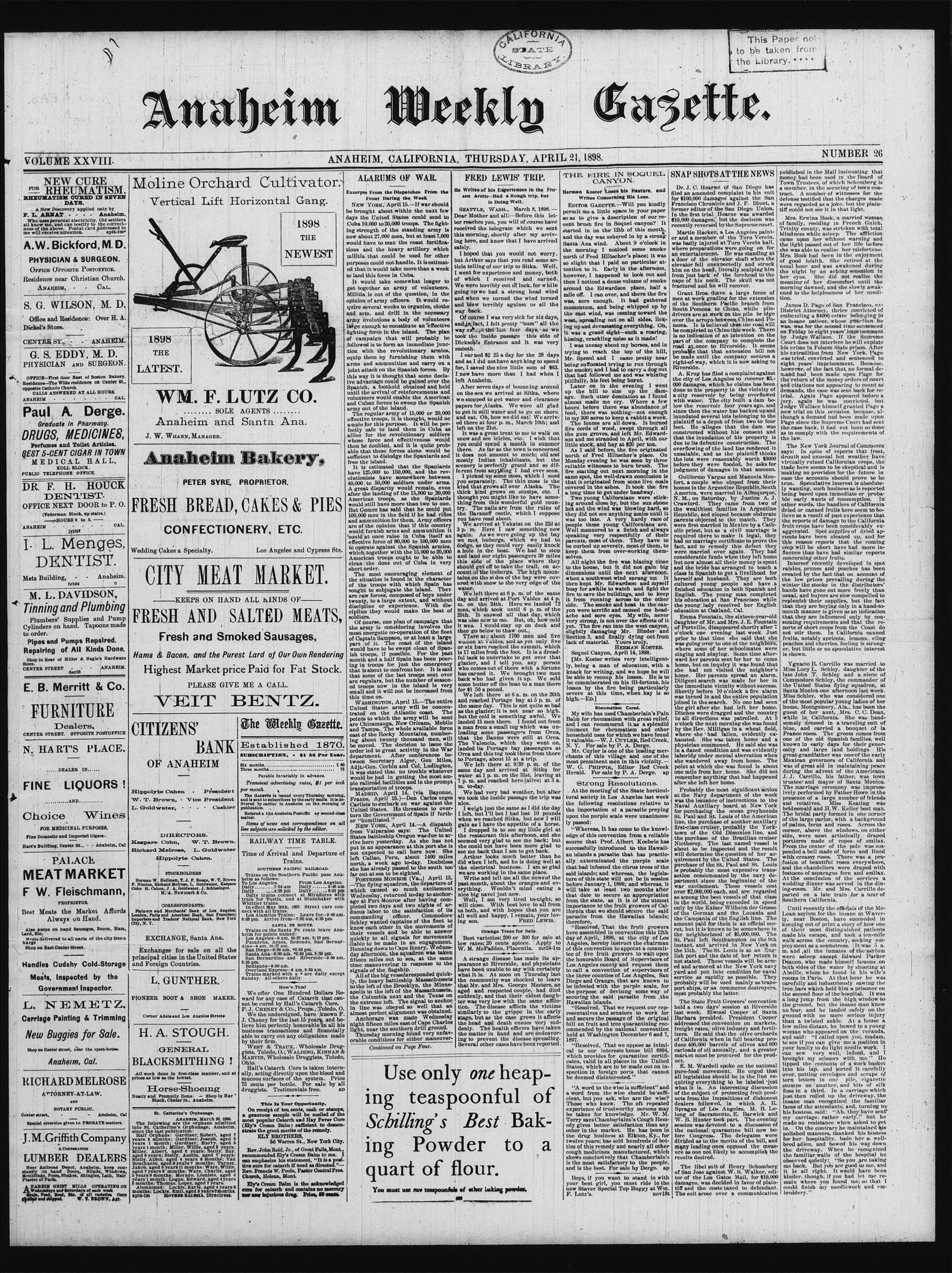
Searchable text
Anaheim
VOLUME XXVIII.
NEW CURE FOR RHEUMATISM. RHEUMATISM CURED IN SEVENT DAYS.
A New Discovery applied only by F. L. ARNAT - Anaheim.
Who uses personal electricity. Old settlers all know me, and can testify to the correctness of the above. Postal card addressed to me will receive attention.
A.W. Bickford, M.D.
PHYSICIAN & SURGEON.
Office Opposite Postoffice.
Residence near Christian Church.
ANAHEIM, CAL.
S. G. WILSON, M.D.
Office and Residence: Over H. A. Dickel's Store.
CENTER ST., ANAHEIM.
G. S. EDDY, M.D.
PHYSICIAN AND SURGEON.
OFFICE—First door East of Boston Bakery.
Residence—The White residence on Center St., opposite Catholic Church.
CALLS ANSWERED AT ALL HOURS.
ANAHEIM CAL.
Paul A. Derge.
Graduate in Pharmacy.
DRUGS, MEDICINE8,
Perfumes and Toilet Articles.
BEST 5-CENT CIGAR IN TOWN MEDICAL HALL,
KOLL BLOCK.
Moline Orchard Cultivator.
Vertical Lift Horizontal Gang.
1898 THE NEWEST
1898 THE LATEST.
WM. F. LUTZ CO.
SOLE AGENTS ...
Anaheim and Santa Ana.
J. W. WHANN, MANAGER.
Anaheim Bakery,
OFFICE—First door East of Boston Bakery.
Residence—The Witte residence on Center St,
opposite Catholic Church.
CALLS ANSWERED AT ALL HOURS.
ANAHEIM CAL.
Paul A. Derge.
Graduate in Pharmacy.
DRUGS, MEDICINES,
Perfumes and Toilet Articles.
BEST 5-CENT CIGAR IN TOWN
MEDICAL HALL,
KOLL BLOCK.
PUBLIC TELEPHONE OFFICE.
DR. F. H. HOUCK
DENTIST.
OFFICE NEXT DOOR to P. O.
(Federman Block, up stairs.)
HOURS 9 to 8
ANAHEIM CAL.
I. L. Menges,
DENTIST.
Metz Building, Anaheim.
feb24
M. L. DAVIDSON,
Tinning and Plumbing
Plumbers' Supplies and Pump
Cylinders on hand. Tapoons made
to order.
Pipes and Pumps Repaired.
Repairing of All Kinds Done.
Shop in Rear of Miller & Nagle's Hardware
Store.
CENTER STREET Anaheim.
E. B. Merritt & Co.
FURNITURE
Dealers.
CENTER STREET. OPPOSITE POSTOFFICE
N. HART'S PLACE.
DEALER IN...
FINE LIQUORS!
AND.....
Choice Wines
FOR MEDICINAL PURPOSES,
Fine Domestic and Imported Cigars
Hart's Building, Center St., Anaheim, Cal.
PALACE
MEAT MARKET
F W. Fleischmann,
WM. F. LUTZ CO.
SOLE AGENTS...
Anaheim and Santa Ana.
J. W. WHANN, MANAGER.
Anaheim Bakery,
PETER SYRE, PROPRIETOR.
FRESH BREAD, CAKES & PIES
CONFECTIONERY, ETC.
Wedding Cakes a Specialty. Los Angeles and Cypress Sts.
CITY MEAT MARKET.
KEEPS ON HAND ALL KINDS OF
FRESH AND SALTED MEATS,
Fresh and Smoked Sausages,
Hams & Bacon, and the Purest Lard of Our Own Rendering
Highest Market price Paid for Fat Stock.
PLEASE GIVE ME A CALL.
VEIT BENTZ.
CITIZENS'
BANK
OF ANAHEIM
Hippolyte Cahen - President
W. T. Brown - Vice President.
L. Goldwater, Cashier
DIRECTORS.
Kaspare Cohn, W. T. Brown.
Richard Melrose, L. Goldwater
Hippolyte Cahen.
STOCKHOLDERS
Herman W. Hellman, T.J. F. Boege, W.T. Brown
P. Nicolus, Richard Melrose, L. Goldwater, Kaspare
Cohn H. Cahen, J. A. Goldwater, J. Schlesinger.
M. A. Newmark & Co.
The Weekly Gazette.
Established 1870.
SUBSCRIPTION, - $1 50 Per Year.
Six months... 1 60
Three months... 75
Payable invariably in advance.
Transient advertising rates, $1 per inch per month.
The GAEMTE is issued every Thursday morning,
and is sent to subscribers by the early malls. It is delivered by carrier in Anaheim on the morning of publication.
Entered a the Anaheim Postoffice as second-class matter.
Items of news and correspondence on all live subjects are solicited by the editor.
RAILWAY TIME TABLE.
Time of Arrival and Departure of Trains.
SOUTHERN PACIFIC RAILROAD.
Trains on the Southern Pacific pass Anaheim as follows:
To Los Angeles... From Los Angeles.
Daily... 7:54 am Daily... 9:45 am
Daily... 4:25 pm Daily... 6:01 pm
Daily trains connect at Mirrors with train at Studebaker with
Choice Wines
FOR MEDICINAL PURPOSES,
Fine Domestic and Imported Cigars
Hart's Building, Center St., Anaheim, Cal.
PALACE MEAT MARKET
F W. Fleischmann,
PROPRIETOR.
Best Meats the Market Affords Always on Hand.
Also keeps on hand Sausages, Bacon, Ham, Lard, Etc.
Meats delivered to all parts of the city free o charge
Shop on East Center Street.
Handles Cudahy Cold-Storage
Meats, Inspected by the Government Inspector.
L. NEMETZ,
Carriage Painting & Trimming
New Buggies for Sale.
Shop on Center street, near the opera-house.
Anaheim, Cal.
RICHARD MELROSE
ATTORNEY-AT-LAW.
AND
NOTARY PUBLIC.
Center street, Anaheim, Cal.
Special attention given to PROBATE matters.
J.M. Griffith Company
A CORPORATION
LUMBER DEALERS
Neer Railroad Depot, Anaheim, keep constantly on hand Doors, Blinds, Windows, Mouldings, Posts, Shakes, Shingles, Lath, Hair Plaster of Paris.
ANAHEIM GRIST MILLS OPERATING ON Wednesdays and Saturdays of each week
Grain, Feed, Neal, Ebol. of all varieties Corn spelled and shipped.
W. T. Brown, Vice President.
L. Goldwater, Cashier
DIRECTORS.
Kaspare Cohn, W. T. Brown.
Richard Melrose, L. Goldwater
Hippolyte Cahen.
STOCKHOLDERS
Herman W. Hellman, T.J. F. Boege, W.T. Brown
P. Nicolus, Richard Melrose, L. Goldwater, Kaspare Cohn H. Cahen, J. A. Goldwater, J. Schlessinger.
M. A. Newmark & Co.
CORRESPONDENTS:
Farmers and Merchants' Bank of Los Angeles; London, Paris and American Bank; San Francisco; Importers and Traders' National Bank, New York City, N.Y.
EXCHANGE, Santa Ana.
Exchanges for sale on all the principal cities in the United States and Foreign Countries.
L. GUNTHER.
PIONEER BOOT & SHOE MAKER.
Corner Adele and Los Angeles Streets
H. A. STOUGH.
GENERAL BLACKSMITHING!
All work done in first-class manner, and at prices as low as the lowest.
Horse-Shoeing
Neatly and Promptly Done. — Shop in Har' Block, Center St., Anaheim.
St. Catherine's Orphanage.
ANAHEIM, March 20, 1898.
The following are the orphans admitted into St. Catherine's Orphanage, Anaheim, since the last publication:
Half Orphans: Gardiner, Robert, aged 7 years 3 months; Gardiner, Joseph, aged 5 years 1 month; Gardiner, Harry, aged 5 years 1 month; Miller, Willie, aged 9 years; Miller, Albert, aged 6 years; Stelly, Ray, aged 8 years; Stelly, Austin, aged 7 years; Stelly, Athol, aged 4 years 6 months; Van Bouchante, aged 8 years 7 months; Turner, Jakob, aged 5 years 11 months; Warre Willie, aged 7 years 9 months; Warre Charlie, aged 5 years 9 months; Morado Lionisio, aged 4 years 1 month; Logan Edward, aged 4 years 5 months; Thomas Lopez, aged 7 years.
Abondoned: Lockie, Earle, aged 4 years 8 months; Lockie Emil, aged 3 years 2 months.
MOTHER SALESAI Directress.
RAILWAY TIME TABLE.
Time of Arrival and Departure of Trains.
SOUTHERN PACIFIC RAILROAD.
Trains on the Southern Pacific pass Anaheim as follows:
To Los Angeles. From Los Angeles.
Daily...7:54 am Daily...9:45 am
Daily...4:25 pm Daily...6:01 pm
Daily trains connect at Miraflores with train for Tustin, and at Studebaker with Whittier trains.
In effect May 30th, 1897. Street cars connect with all trains.
Los Alamitos Trains: Leave for—9:48 am.
6:08 pm. Arrive from—7:52 am, 4:25 pm.
SANTA FE ROUTE.
Trains on the Santa Fe route leave Anaheim for points named:
Los Angeles—8 am, 10:27 am, 5:10 pm.
Pasadena, Azusa, Redondo; San Bernardino—8 am, 10:27 am.
San Diego—9:50 am.*2:50 pm.
Santa Ana—9:50 am.*2:50 pm.
San Bernardino and Riverside—9:50 am.
5:55 pm.
Redlands—9:50 am.
Overland Express—8 am, 9:50 am.
Trains marked with a * are daily except Sunday. All others daily.
How's This?
We offer One Hundred Dollars Reward for any case of Catarrh that cannot be cured by Hall's Catarrh Cure.
F. J. CHENEY & Co., Props., Toledo, O.
We the undersigned have known F. J. Cheney for the last 15 years,and believe him perfectly honorable in all his business transactions and financially able to carry out any obligations made by their firm.
WEST & TRAUX,. Wholesale Druggists, Toledo, O.; WALDING, KINNAN & MARVIN, Wholesale Druggists, Toledo, Ohio.
Hall's Catarrh Cure is taken internally acting directly upon the blood and mucous surfaces of the system. Price 75 cents per bottle. For sale by all druggists. Testimonials free.
This Is Your Opportunity.
On receipt of ten cents,cash or stamps,a generous sample will be mailed of the most popular Catarrh and Hay Fever Cure (Ely's Cream Balm) sufficient to demonstrate the great merits of the remedy.
ELY BROTHERS,
56 Warren St., New York City.
Rev.John Reid Jr.,of Great Falls,Mont., recommended Ely's Cream Balm to me.I can emphasize his statement,"It is a positive cure for catarrh if used as directed."—Rev.Francis W.Poole,Pastor Central Pres. Church,Helena,Mont.
Ely's Cream Balm is the acknowledged cure for catarrh and contains no mercury nor any injurious drug.Price 50 cents.
in Weekly Gazette
ANAHEIM, CALIFORNIA, THURSDAY, APRIL 21, 1898.
Altrator.
al Gang.
1898
THE
NEWEST
ALARUMS OF WAR.
Excerpts From the Dispatches From the Front During the Week
New York, April 15.—If war should be brought about within the next few days the United States could send to Cuba 10,000 to 20,000 troops. The fighting strength of the standing army is now about 27,000 men, but at least 7,000 would have to man the coast fortifications and the heavy artillery which militia that could be used for other purposes could not handle. It is estimated that it would take more than a week to land this force in Cuba.
It would take somewhat longer to get together an army of volunteers. Militia is out of the question, in the opinion of army officers. It would require several weeks to organize, clothe and arm, and drill in the necessary army evolutions a body of volunteers large enough to constitute an effective fighting force in the island. The plan of campaign that will probably be followed is to form an immediate junction with the revolutionary armies, equip them by furnishing them with arms and ammunition and carry on a joint attack on the Spanish forces. By this way it is thought that some decisive advantage could be gained over the Spanish, a foothold obtained and held until the arrival of reinforcements and volunteers would enable the American and Cuban forces to sweep the Spanish army out of the island.
The regular army of 15,000 or 20,000 effective troops, it is thought, would be ample for this purpose. It will be perfectly safe to land them in Cuba as allies for the revolutionary soldiers whose force and effectiveness would then be doubled, and it is quite probable that these forces alone would be sufficient to dislodge the Spaniards and free the island.
It is estimated that the Spaniards have 125,000 to 150,000, and the revival of Weekly Gazette.
FRED LEWIS' TRIP.
He Writes of his Experiences in the Frozen Arctic—Had a Kough trip, but is Doing Well.
SEATTLE, WASH., March 8, 1898.—Dear Mother and all:—Before this letter reaches you, you will of course have received the telegram which we sent this morning, shortly after my arriving here, and know that I have arrived safely.
I hoped that you would not worry, but Arthur says that you read some article telling of our trip to Sitka. Well, I went for experience and money, both of which I received and earned. We were terribly out of luck, for while going up we had a strong head wind and when we turned the wind turned and blew terribly against us all the way back.
Of course I was very sick for six days, and in fact, I felt pretty "bum" all the way except the last four days, as we took the inside passage this side of Dickson's Entrance and it was very smooth.
I earned $2 25 a day for the 28 days and as I did not have any thing to spend for, I saved the nice little sum of $63. I now have more than I had when I left Anaheim.
After seven days of bouncing around on the sea we arrived at Sitka, where we stopped to get water and clearance papers for Alaska. We were all glad to get in still water and go on shore and eat. Oh, how we did eat! We arrived there at four p.m., March 19th; and left on the 21st.
It was a great treat to me to walk on snow and see icicles, etc. I wish that you could spend a month in summer there. As far as the town is concerned it does not amount to much; old and mostly Indian inhabitants, but the scenery is perfectly grand and so different from anything I had ever seen.
THE FIRE IN SOQUEL CANYON.
Herman Koster Loses his Pasture, and Writes Concerning His Loss.
EDITOR GAZETTE.—Will you kindly permit me a little space in your paper so as to give a description of our recent brush fire in Soquel canyon? It started in on the 12th of this month, and the day was ushered in by a strong Santa Ana wind. About 9 o'clock in the morning I noticed some smoke north of Fred Hiltscher's place; it was so slight that I paid no particular attention to it. Early in the afternoon, however, I happened to look out and then I noticed a dense volume of smoke around the Edwardson place, half a mile off. I ran over, and there the fire was, sure enough. It had gathered momentum, and being whipped up by the east wind, was coming toward the west, spreading out on all sides, licking up and devastating everything. Oh, it was a grand sight—such a roaring, hissing, crackling noise as it made!
I was uneasy about my horses, and in trying to reach the top of the hill, Mr. Sproul and I came pretty near being suffocated trying to run through the smoke; and I had to carry a dog out that had followed me and was whining pitifully, his feet being burnt.
Later on in the evening I went up the hill to size up the damage. Such utter desolation as I found almost made me cry. Where a few hours before there was abundance of feed, there was nothing—not enough in my 300 acres to keep a rabbit a week.
The fences are all down. It burned five cords of wood, swept through all the gum groves, and left Mr. Edwardson and me stranded in April, with our little stock, and hay at $20 per ton.
As I said before, the fire originated north of Fred Hiltscher's place. On Monday evening he was seen by three reliable witnesses to burn brush. The fire starting out next morning in the
this way it is thought that some decisive advantage could be gained over the Spanish, a foothold obtained and held until the arrival of reinforcements and volunteers would enable the American and Cuban forces to sweep the Spanish army out of the island.
The regular army of 15,000 or 20,000 effective troops, it is thought, would be ample for this purpose. It will be perfectly safe to land them in Cuba as allies for the revolutionary soldiers whose force and effectiveness would then be doubled, and it is quite probable that these forces alone would be sufficient to dislodge the Spaniards and free the island.
It is estimated that the Spaniards have 125,000 to 150,000, and the revolutionists have somewhere between 40,000 to 50,000 soldiers under arms. A great disparity would remain, even after the landing of the 15,000 to 20,000 American troops, as the Spaniards would still have more than two to one. But Gomez has said that he could put 100,000 men in the field if he had rifles and ammunition for them. Army officers are of the opinion that if this country would furnish arms and ammunition it could at once raise in Cuba itself an effective force of 80,000 to 100,000 men to operate against the Spanish armies, which together with the 15,000 to 20,000 American troops ought to be able to clean the dons out of Cuba in very short order.
The most encouraging element of the situation is found in the character of the troops with which Spain has sought to subjugate the island. They are raw forces, composed of boys under twenty, to a large extent, and without discipline or experience. With discipline they would make the best of soldiers.
Of course, one plan of campaign that the army is considering involves the most energetic co-operation of the fleet of Captain Sampson, or at least a large part of it. The coast of the island would have to be swept clean of Spanish troops, if possible. For the past month and a half Spain has been pouring in troops for just the emergency that is about to confront her. It is said that some of the last troops sent over are regulars, but the number of seasoned troops now in the island is very small and it will not be increased from this time on.
WASHINGTON, April 15.—The entire United States army will be concentrated on the Atlantic coast. The points to which the army will be sent are Chichamauga, New Orleans, Mobile and Tampa. The whole available force east of the Rocky Mountains, numbering about twenty thousand men, will be moved. The decision to issue the order led to great activity in the War department. After conferences between Secretary Alger, Gen Millis, Adj-Gen. Corbin and Col. Ludington, it was stated that no trouble whatever would be had in getting the most ample railroad facilities and in the prompt transportation of troops.
MADRID, April 14. (via Bayonne, France, April 15.)—Don Carlos urges Carlists to embark on war against the United States. He threatens to overturn the Government of Spain if further "humiliated."
NEW YORK, April 14.—A dispatch from Valparaiso says: The United States battleship Oregon was due to arrive here yesterday. As she has not put in an appearance at this port she is not expected to call here now. She left Callao, Peru, about 1400 miles north, a week ago to-day. Doubler she has already passed to the south too far out at sea to be sighted.
FORTRESS MONROE (Va.), April 15.—The flying squadron, the departure of which caused so much excitement Wednesday, returned to day to anchor after having come
After seven days of bouncing around on the sea we arrived at Sitka, where we stopped to get water and clearance papers for Alaska. We were all glad to get in still water and to go on shore and eat. Oh, how we did eat! We arrived there at four p.m., March 19th; and left on the 21st.
It was a great treat to me to walk on snow and see leicles, etc. I wish that you could spend a month in summer there. As far as the town is concerned it does not amount to much; old and mostly Indian inhabitants, but the scenery is perfectly grand and so different from anything I had ever seen.
I picked up some moss, which I send you separately. The thin moss is the kind that grows all over Alaska. The thick kind grows on stumps, etc. I thought you might like to have something from this wonderful gold country. The nails are from the ruins of the Baranoff castle, which I suppose you read about.
We arrived at Yakatat on the 22d at 3 p.m. Here I saw something new again. As we were going up the bay we met icebergs, which we had to dodge, as they could very easily knock a hole in the boat. We had to stop and land our eight passengers 30 miles this side of the place where they should get off to take the trail, on account of the icebergs. The high mountains on the sides of the bay were covered with snow to the very edge of the water.
We left there at 6 p.m. of the same day and arrived at Port Valdez at 4 p.m. on the 24th. Here we landed 72 men, which took until 6 p.m. of the 25th. It snowed all that day, which was also new to me. But, oh, how cold it was. I would stay up on deck and then go below to thaw out.
There are about 1700 men and five women at Valdes, and as yet only five or six have reached the summit, which is 17 miles from the foot. It is a dreadful task to undertake to get over that glazier, and I tell you, any person who comes out of there with a fortune has earned it. We brought two men back who had given it up. We sold some butter off the boat to a man there for $150 a pound.
We left there at 6 a.m. on the 26th and reached Portage bay at 5 p.m. of the same day. This is not quite so bad as the glazier; it is not near so high. But the cold is something awful. We landed 15 men there. I found out from a man from a small tug which unloading some passengers from Orca, that the Baums were still at Orca. The Valencia, which they went on, landed its Portage bay passengers at Orca and this tug took them from there to Portage, about 15 at a trip.
We left there at 9:30 p.m. of the same day and arrived at Sitka for water at 1 p.m. on the 31st, leaving at 7 p.m. and reached here (alive) at 3 a.m.-to-day.
We had very bad weather, but after we took the inside passage the trip was nice.
I weigh just as I did the day I left, but I bet I had lost 10 pounds when we reached Sitka, but now I will gain as I have the appetite of a horse.
I dropped in to see my little girl at the restaurant this afternoon, and she seemed very glad to see me back; but she could not have been more glad to see me back than I am to get back.
Arthur looks much better than he did when I left, and he is doing well at the electrical business. I am so glad we are working in the same place.
Write and tell me all the news of the past month, about the oranges and everything. Wouldn't mind eating a big navel just now.
Well I am very tired to night so
Use only one heaping teaspoonful of Schilling’s Best Baking Powder to a quart of flour.
You must use two teaspoonfuls of other baking powder.
Gazette.
SNAP SHOTS AT THE NEWS
Dr. J. C. Hearne of San Diego has filed an amended complaint in his suit for $100,000 damages against the San Francisco Chronicle and J. F. Blunt, a former editor of the San Diego Union. In the first trial Hearne was awarded $10,000 damages, but the decision was recently reversed by the Supreme court.
Martin Hacker, a Los Angeles painter and a member of the Turn Verein, was badly injured at Turn Verein hall where preparations were going on for an entertainment. He was standing at a door of the elevator shaft when the elevator fell unexpectedly and struck him on the head, literally scalping him from just back of the forehead to the nape of his neck. The skull was not fractured and he will recover.
Grant Bros. have a large force of men at work grading for the extension of the Southern Pacific branch from South Pomona to Chino, while pile-drivers are at work on the pile bridge over the arroyo between Chino and Pomona. It is believed that the road will be completed to Chino this week. There is no indication of an intention on the part of the company to complete the road at once to Riverside. It seems probable that that extension bill not be made until the company secures a right-of-way, which it is now asking to Riverside.
A. Krug has filed a complaint against the city of Los Angeles to recover $3,000 damages, which he claims has been done to his property in the vicinity of a city reservoir by being overflowed with water. The city built a dam below the reservoir four years ago, and since then the water has backed up and inundated several lots belonging to the plaintiff to a depth of from two to four feet. He alleges that the dam was constructed without his consent and that the inundation of his property is due to its defective construction. The overflowing of the land has rendered it unsalable, and as the plaintiff thinks the lots were reasonably worth $3000 before they were flooded, he asks for judgment of damages in that amount.
published in the Mail insinuating that money had been used in the Board of Town Trustees, of which Schomberg is a member, in the securing of town contract. A number of witnesses for the defense testified that the charges made were regarded as a joke, but the plaintiff could not see it in that light.
Mrs. Erwina Busk, a married woman of family, residing in French Gulch, Trinity county, was stricken with total blindness while asleep. The affliction came upon her without warning and the light passed out of her life before she was able to realize her misfortune. Mrs. Busk had been in the enjoyment of good health. She retired at the usual hour and was awakened during the night by an aching sensation in her eyes. She did not realize the meaning of her discomfort until the morning dawned, and she slowly awakened to the helplessness of her condition.
James D. Page of San Francisco, ex-District Attorney, thrice convicted of embezzling a $4000 estate belonging to an insane patient, whose guardian he was, was for the second time sentenced on Friday to eight years' imprisonment by Judge Wallace. If the Supreme Court does not interfere he will expiate his crime in Folsom State prison. After his extradition from New York, Page was tried, convicted and sentenced to eight years' imprisonment. Because, however, of the fact that, no formal demand had been made upon Page for the return of the money orders of court and citations not appearing to count as demands, the case was sent back for trial. Again Page appeared before a jury, again he was convicted, but Judge Wallace himself granted Page a new trial on this occasion because, although a demand had been made upon Page since the Supreme Court had sent the case back, it had not been so done as to comply with the requirements of the law.
The New York Journal of Commerce says: In spite of reports that frost, drought and unusual hot weather have virtually ruined Californian crops, the trade here seems to be skeptical and is making no provision for the future in
In the evening I went to size up the dambutter desolation as I found me cry. Where a few there was abundance of was nothing—not enough grass to keep a rabbit a week. We are all down. It burned off wood, swept through all moves, and left Mr. Edward-stranded in April, with our hand hay at $20 per ton.
Before, the fire originated in the Hilteacher's place. On morning he was seen by three messes to burn brush. The out next morning in the well-drawn conclusion is animated from some live coals the ashes. It took the fire to get under headway.
Californians were sticky close by, but the sun shone wind was blowing hard, so see anything amiss until it die. A very hardy race of young Californians are armed to a finish and always respectfully of their best of them. They have to stop severely, most of them, to from over-working them.
The fire was blazing close, but it did not gain big until the next afternoon. The west wind sprang up. It Mr. Edwardson and myself will watch and fight the buildings, and to keep running across to the other smoke and heat in the cannery and caused me headore eyes. My wife, never is not over the effects of it we ran into the west canyon, imaging Mr. Binder and finally dying out from serial. Yours truly,
HERMAN KOSTER.
January, April 14, 1898.
Her writes very intelligent man of education, with a writing, and we hope he will recoup his losses. He is to be treated on his ill-fortune, his fire being particularly this time, when hay is so rare.
Chamberlain's Pain Neumatism with great relief, recommend it as a splendid for rheumatism and other diseases for which we have found — W.J.Cuyler, Red Creek, sale by P.A.Derge.
Or is one of the leading merchants' village and one of the ment men in this vicinity. — HIPPIN, Editor Red Creek for sale by P.A.Derge.
Resolutions.
Setting of the State horticulture in Los Angeles last week resolutions relative to creation of a parasite preying purple scale were unanimous.
It has come to the knowl-convention from a reliable Prof. Albert Koebele has introduced to the Hawaii-parasite that has practicinated the purple scale tested the citrus trees of the land whereas, the legislature will not be in session January 1, 1899; and whereas, it must least two months after to secure an appropriation.
A.Krug has had a complaint against the city of Los Angeles to recover $3,000 damages, which he claims has been done to his property in the vicinity of a city reservoir by being overflowed with water. The city built a dam below the reservoir four years ago, and since then the water has backed up and infunded several lots belonging to the plaintiff to a depth of from two to four feet. He alleges that the dam was constructed without his consent and that the inundation of his property is due to its defective construction. The overflowing of the land has rendered it unsalable, and as the plaintiff thinks the lots were reasonably worth $3000 before they were flooded, he asks for judgment of damages in that amount.
Guillermo Vargas and Manuela Monfort, a couple who eloped from their homes in the Argentine Republic, South America, were married in Albuquerque, N.M., on Saturday, by Justice A.J. Crawford. They came from two of the wealthiest families in Argentine Republic, and eloped because obdurate parents objected to the match. They were first married in Mexico by a Catholic priest, but as a civil marriage is required there to make it legal, they had no marriage certificate to prove the fact, and to remedy this defect they were married over again. They had considerable funds when they left home but now almost all their money is spent and the bride has arranged to teach a class in Spanish to get a livelihood for herself and husband. They are both cultured young people and have a finished education in both Spanish and English. The young man completed his education at San Francisco while the young lady received her English education at Oakland, Cal.
Emma Fountain, the sixteen-year-old daughter of Mr. and Mrs. J.E.Fountain of Portville, disappeared shortly after 7 o'clock one evening last week. Just prior to that time she said that she was going over to one of the neighbors, where some of her schoolmates were singing and playing. Some time afterward her parents sent for her to come home, but on inquiry it was found that she had not visited the neighbor's home. Her parents spread an alarm. Diligent search was made for her in the immediate vicinity without success. Shortly before 10 o'clock a fire alarm was turned in and the entire population joined in the search. No one had seen the girl after she had left her home. Ditches were dragged and the country in all directions was patrolled. At 5 o'clock the next morning she was found by the Rev. Milligan in a wheat field, where she had fallen, evidently exhausted. She was taken home and a physician summoned. He said she was in a dazed condition and was evidently laboring under mental aberration when she wandered away from home. The point at which she was found is about one mile from her home. She did not remember anything that had happened after she left her home.
Probably the most significant action at the Navy department of the week was the issuance of instructions to the Naval Auxiliary board at New York for purchasing the ocean greyhounds St. Paul and St. Louis of the American line, the purchase of another auxiliary first-class cruiser, probably the Yorktown of the Old Dominion line, and the purchase of the Brazilian cruiser Niethoy. The last named vessel is about to be inspected and the result will determine the question of her acquirement by the United States. The purchase of the St. Paul and St. Louis is probably the most expensive transaction consummated by the navy department since the beginning of the war excitement. These vessels cost over $2,000,000 each, and are regarded as among the best vessels of that class.
Ygnacio R. Carrillo was married to Miss Lucy L. Schley, daughter of the late John T. Schley and a niece of Commodore Schley, the commander of the United States flying squadron, at Santa Monica one afternoon last week. Miss Schley, who was considered one of the most popular young ladies of her home, Montgomery, Ala., has been the guest of her aunt, Mrs. C.C. Dean, while in California. She was handsomely dressed in a traveling suit of blue, and carried a bouquet of la France roses. The groom comes from one of the old Spanish families, well known in early days for their generosity and large land holdings. His great-grandfather was one of the early Mexican governors of California and was of great aid in maintaining peace during the advent of the Americans. J.J.Carrillo, his father, was town trustee and mayor of Santa Monica.
The marriage ceremony was impressively performed by Father Howe in the presence of a large number of friends and relatives. Miss Keating was bridesmaid and H.W.Keller best man. The bridal party formed in one corner of the large parlor, with a background of palms, ferns and roses. Across the corner, above windows, on either side, were most artistically draped portieres made of ropes of smilax. From the center of the pole was suspended a bell made of ferns and lined with creamy roses. There was a profusion of beautiful roses everywhere, and the chandeliers were draped with festoons of asparagus fern and smilax. At the conclusion of the services a wedding dinner was served in the dining-room. Mr. and Mrs. Carrillo departed on a late train for a tour of Southern California.
It has come to the knowledge of convention from a reliable Prof. Albert Koebele has introduced to the Hawaiian parasite that has practiced the purple scale rested the citrus trees of the island and whereas, the legislature will not be in session January 1, 1899; and whereas, it at least two months after to secure an appropriation rate, as it is of the utmost importance to the fruit growers of California we should secure the said from the Hawaiian islands;
That the fruit growers soiled in convention this 12th January, 1898, at the city of Los Angeles hereby instruct the chairman to appoint a committeework fruit growers to wait upon the Board of Supervisors of the county and request them convention of supervisors of counties of Los Angeles, San Orange, that are known to with the purple scale, for devising some way of the said parasite from the islands.
That we request our reponses and senators to work for the passage of the original law and tree quarantining recorder by the national convention Washington December 6 and 7,
That we oppose as inimicatures house bill 6894, sides for quarantine certification in all places in the United States to be made out on international ports that cannot disinterested."
To the wise is sufficient" and then the wise should be sufficiency ask, who are the wise?
The oft repeated trustworthy persons may knowledge. Mr. W. M. Chamberlain's Cough Remetter satisfaction than any market. He has been in business at Elkton, Ky., for years has sold hundreds of botteremedy and nearly all other medicines manufactured, which usively that Chamberlain's satisfactory to the people, best. For sale by Derge.
You want to stand in with your girl, you must ride in the Special Top Buggy at Wm. nov18t
was the issuance of instructions to the Naval Auxiliary board at New York for purchasing the ocean greyhounds St. Paul and St. Louis of the American line, the purchase of another auxiliary first-class cruiser, probably the Yorktown of the Old Dominion line, and the purchase of the Brazilian cruiser Nictheroy. The last named vessel is about to be inspected and the result will determine the question of her acquirement by the United States. The purchase of the St. Paul and St. Louis is probably the most expensive transaction consummated by the navy department since the beginning of the war excitement. These vessels cost over $2,000,000 each, and are regarded as among the best vessels of that class in the world, being exceeded in speed only by the Kaiser Wilhelm der Grosse of the German and the Lucania and the Campania of the English line. The amount paid for them is an official secret, but it is known to be somewhere in the neighborhood of $5,000,000. The St. Paul left Southampton on the 9th instant, and arrived in New York on the 15th. The St. Louis is at an English port and the date of her return is not stated. These vessels will be armed and armored at the New York navy yard and put into condition for naval service as rapidly as possible. They probably will be used mainly as transport ships, or as commerce destroyers, most probably the latter.
The State Fruit Growers' convention held a two days' session at Riverside last week. Elwood Cooper of Santa Barbara presided. President Cooper addressed the convention on markets, freight rates, olive industry and fertilizers. He said that the olive orchards of California when in full bearing produce 400,000 barrels of olives and 600 carloads of oil annually, and a greater market must be procured for the product.
E. M. Wardell spoke on the national pure-food movement. He urged that all legislation should be in the line requiring everything to be labeled just what it is. An interesting discussion of the subject of protecting fruit products from the impositions of dishonest dealers followed, in which A. R. Sprague of Los Angeles, M. B. Lelong of Sacramento, E. Barwick and W. B. Hunter took part. The evening session was devoted to a discussion of the national quarantine bill now before Congress. The delegates were divided as to the merits of the bill, and many leading ones opposed the measure as one not likely to accomplish the results desired.
The libel suit of Henry Schomberg of San Jose against W. S. Walker, editor of the Los Gatos Mail, for $10,000 damages, was decided in favor of plaintiff and the costs taxed to defendant. The suit arose over a communication presence of a large number of friends and relatives. Miss Keating was bridesmaid and H.W. Keller best man. The bridal party formed in one corner of the large parlor, with a background of palms, ferns and roses. Across the corner, above the windows, on either side, were most artistically draped portieres made of ropes of smilax. From the center of the pole was suspended a bell made of ferns and lined with creamy roses. There was a profusion of beautiful roses everywhere, and the chandeliers were draped with festoons of asparagus fern and smilax. At the conclusion of the services a wedding dinner was served in the dining-room. Mr. and Mrs. Carrillo departed on a late train for a tour of Southern California.
Until recently the officials of the MeLean asylum for the insane at Waverly, near Boston, have succeeded in keeping out of print a story of how one of their most distinguished patients made his escape, and took a ten-mile walk across the country, seeking employment as a seamstress. It was 5 a.m. and all the inmates of the asylum were asleep except Edward Parker Deacon, who made himself famous on both sides of the water by shooting at Abeille, whom he found in his wife's rooms in Paris. At that hour he was carefully and industriously sawing the iron bars which held him a prisoner on the second floor of the hospital. It was a long jump from high window to the ground, but the insane man knew no fear, and he landed safely on the ground with no more serious injury than a twisted ankle. At a house a few miles distant, he bowed to a young woman who appeared on the veranda, and said: "I called upon you, madam, to see if you can give me a position in your family to do light needle work. I can sew very well, indeed, and I brought my scissors with me." He tipped the contents of a work basket into his lap, and sorted it carefully over, putting envelopes and scraps of torn letters in one pile, cigarette stumps on another, and bits of silk floss in a third. In a carriage which just then rolled up the driveway, the insane man recognized the familiar faces of the attendants, and turning to his hostess, said: "Ah they have sent my carriage rather early," but he made no resistance when asked to get in. On the contrary he maintained his polished manners, thanked his hostess for her hospitality, bade her a well-bred adieu, and bowed his way down the driveway. When he recognized the familiar walls of the hospital he observed quietly: "So you are taking me back. But you are good to me, and it is all right. It would have been kinder though, if you had let me remain where you found me, so that I could finish my needlework and embroidery."