anaheim-gazette 1898-02-03
Scanned page
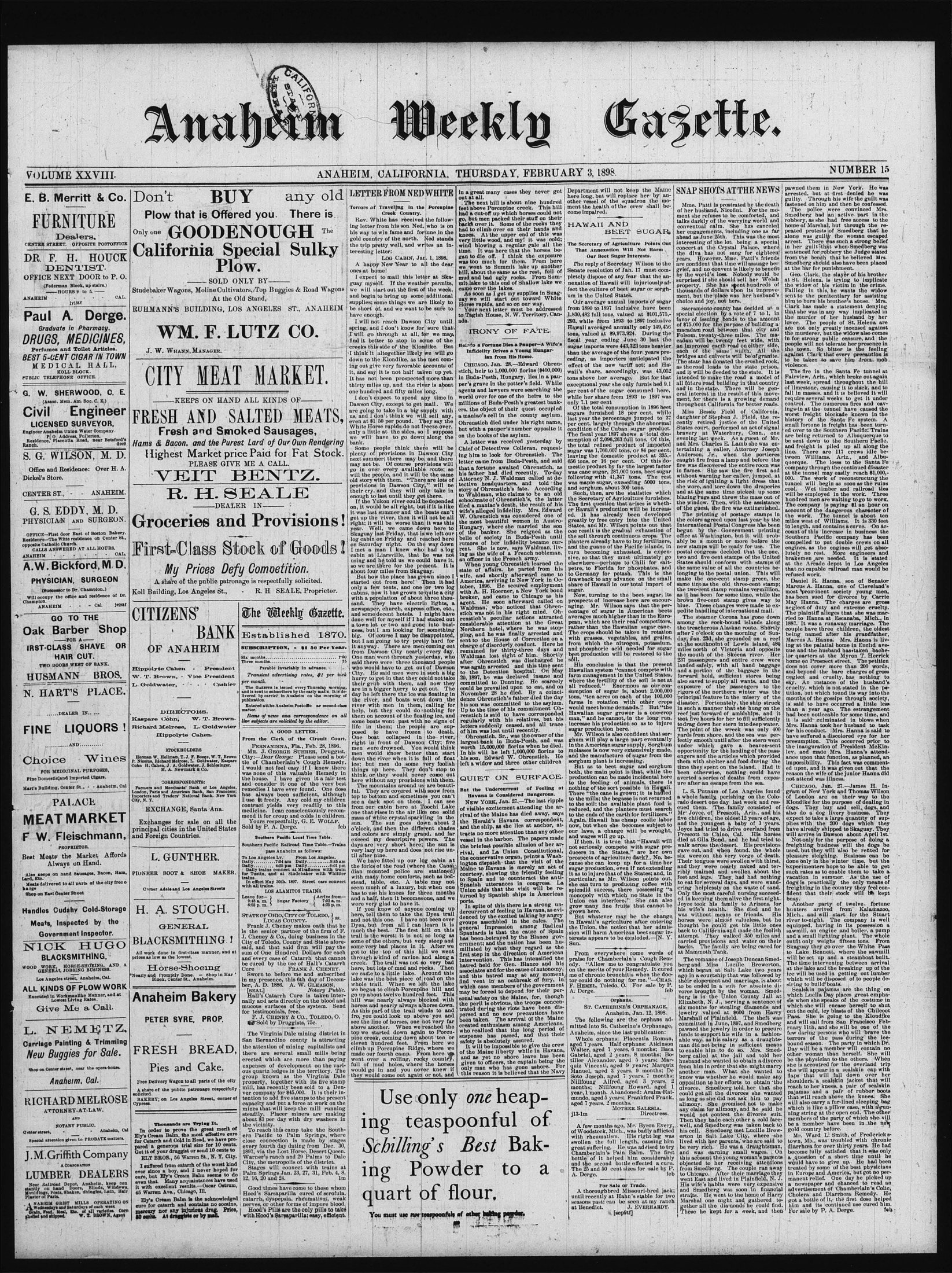
Searchable text
Anaheim
VOLUME XXVIII.
ANAHEIM
E. B. Merritt & Co.
FURNITURE Dealers.
CENTER STREET. OPPOSITE POSTOFFICE
DR. F. H. HOUCK DENTIST.
OFFICE NEXT DOOR to P. O.
(Federman Block, up stairs.)
HOURS 9 to 5
ANAHEIM CAL.
Paul A. Derge.
Graduate in Pharmacy.
DRUGS, MEDICINES,
Perfumes and Toilet Articles.
BEST 5-CENT CIGAR IN TOWN
MEDICAL HALL,
KOLL BLOCK.
PUBLIC TELEPHONE OFFICE.
G. W. SHERWOOD, C. E.
(Assoc. Mem. Am. Soc. C. E.)
Civil Engineer
LICENSED SURVEYOR,
Engineer Anaheim Union Water Company.
P.O. Address: Fullerton.
Residence: Placentia Road, near Botsford's Ranch.
S. G. WILSON, M. D.
Office and Residence: Over H. A.
Don't BUY any old Plow that is Offered you. There is Only one GOODENOUGH The California Special Sulky Plow.
SOLD ONLY BY
Studebaker Wagons, Moline Cultivators, Top Buggies & Road Wagons At the Old Stand,
RUHMANN'S BUILDING, LOS ANGELES ST., ANAHEIM
WM. F. LUTZ CO.
J. W. WHANN, MANAGER.
CITY MEAT MARKET.
KEeps on hand all kinds of
FRESH AND SALTED MEATS,
Fresh and Smoked Sausages,
Hams & Bacon, and the Purest Lard of Our Own Rendering
Highest Market price Paid for Fat Stock.
PLEASE GIVE ME A CALL.
G. W. SHERWOOD, C. E.
(Assoc. Mem. Am. Soc. C. E.)
Civil Engineer
LICENSED SURVEYOR,
Engineer Anaheim Union Water Company.
P.O. Address, Fullerton.
Residence, Placentia Road, near Botsford's Ranch.
S. G. WILSON, M. D.
Office and Residence: Over H. A. Dickel's Store.
CENTER ST., - - ANAHEIM.
G. S. EDDY, M. D.
PHYSICIAN AND SURGEON.
OFFICE—First door East of Boston Bakery.
Residence—The Witte residence on Center St., opposite Catholic Church.
CALLS ANSWERED AT ALL HOURS.
ANAHEIM - - - CAL.
A.W. Bickford, M.D.
PHYSICIAN, SURGEON
(Successor to Dr. Champion.)
Will occupy the office and residence of Dr. Champion.
ANAHEIM - - - Cal. je24tf
GO TO THE Oak Barber Shop
FOR A
IRST-CLASS SHAVE OR HAIR CUT.
TWO DOORS WEST OF BANK.
HUSMANN BROS.
N. HART'S PLACE.
...DEALER IN...
FINE LIQUORS!
AND...
Choice Wines
FOR MEDICINAL PURPOSES,
Fine Domestic and Imported Cigars.
Hart's Building, Center St., - - Anaheim, Cal.
PALACE
MEAT MARKET
F. W. Fleischmann,
PROPRIETOR
Beat Meats the Market Affords Always on Hand.
Also keeps on hand Sausages, Bacon, Ham, Lard, Etc.
Meats delivered to all parts of the city free of charge
Shop on East Center Street
CITY MEAT MARKET.
KEEPS ON HAND ALL KINDS OF FRESH AND SALTED MEATS,
Fresh and Smoked Sausages,
Hams & Bacon, and the Purest Lard of Our Own Rendering
Highest Market price Paid for Fat Stock.
PLEASE GIVE ME A CALL.
VEIT BENTZ.
R. H. SEALE
DEALER IN
Groceries and Provisions!
First-Class Stock of Goods!
My Prices Defy Competition.
A share of the public patronage is respectfully solicited.
Koll Building, Los Angeles St., - R. H. SEALE, Proprietor.
CITIZENS'
BANK
OF ANAHEIM
Hippolyte Cahen - President
W. T. Brown - Vice President
L. Goldwater, - Cashier
DIRECTORS:
Kaspare Cohn, W. T. Brown.
Richard Melrose, L. Goldwater
Hippolyte Cahen.
STOCKHOLDERS
Harman W. Hellman, T.J. F. Boege, W.T. Brown
P. Nicolaus, Richard Melrose, L. Goldwater, Kaspar Cohn H. Cahen, J.A. Goldwater, J. Schlesinger.
M.A. Newmark & Co.
CORRESPONDENTS:
Farmers and Merchants' Bank of Los Angeles, London, Paris and American Bank, San Francisco;
Importers and Traders' National Bank, New York City, N.Y.
EXCHANGE, Santa Ana.
Exchanges for sale on all the principal cities in the United States and Foreign Countries.
L. GUNTHER.
PIONEER BOOT & SHOE MAKER.
Corner Adele and Los Angeles Streets
The Weekly Gazette.
Established 1870.
SUBSCRIPTION, - $1 50 Per Year.
Six months.....1-60
Three months.....75
Pavable invariably in advance.
Transient advertising rates, $1 per inch per month.
The Gazetta is issued every Thursday morning, and is sent to subscribers by the early mails. It is delivered by carrier in Anaheim on the morning of publication.
Entered at the Anaheim Postoffice as second-class matter.
Items of news and correspondence on all live subjects are solicited by the editor.
A GOOD LETTER.
From the Clerk of the Circuit Court.
FERNANDINA, Fla., Feb. 28, 1896.
MR. J. GEORGE SUHRER, Druggist,
City—Dear George: Please send a bottle of Chamberlain's Cough Remedy.
I would not feel easy if I knew there was none of this valuable Remedy in the house. I have given it a fair test and consider it one of the very best remedies I have ever found. One dose has always been sufficient, although I use it freely. Any cold my children contract yields very readily to this medicine. I can conscientiously recommend it for croup and colds in children.
Yours respectfully, G.E. WOLLF.
Sold by P.A. Derge.
Southern Pacific Local Time Table.
Southern Pacific Railroad Time Table—Trains pass Anaheim as follows:
To Los Angeles Lv.. From Los Angeles,
Daily.....7:34 am Daily.....2:45 am
Daily.....4:25 pm Daily.....6:01 pm
Daily trains connect at Miraflores with train for Tustin, and at Studebaker with Whittier trains.
In effect May 30th, 1897. Street cars connect with all trains.
LOS ALAMITOS TRAINS.
Leave for—
PALACE
MEAT MARKET
F W. Fleischmann,
PROPRIETOR.
Best Meats the Market Affords
Always on Hand.
Also keeps on hand Sausages, Bacon, Ham,
Lard, Etc.
Meats delivered to all parts of the city free o
charge
Shop on East Center Street
Handles Cudahy Cold-Storage
Meats, Inspected by the
Government Inspector.
NICK HUGO
BLACKSMITHING,
WOOD WORK, HORSE-SHOEING, AND A
GENERAL JOBBING BUSINESS.
Los Angeles street, Anaheim, Cal.
ALL KINDS OF PLOWWORK
Executed in Workmanlike Manner, and at
Lowest Living Rates.
Give Me a Call.
L. NEMETZ.
Carriage Painting & Trimming
New Buggies for Sale.
Shop on Center street, near the opera-house.
Anaheim, Cal.
RICHARD MELROSE
ATTORNEY-AT-LAW.
AND
NOTARY PUBLIC.
Center street, Anaheim, Cal.
Special attention given to PROBATE matters.
J.M.Griffith Company
A CORPORATION
LUMBER DEALERS
Near Railroad Depot, Anaheim, keep constantly on hand Doors, Blinds, Windows,
Mouldings, Posts, Shakes, shingles, Lath, Hair
Plaster of Paris.
NAHEIM GRIST MILLS OPERATING ON
Wednesdays and Saturdays of each week
Grain, Feed, Meal, Etc. of all varieties. Corn
shellled and shipped.
EXCHANGE, Santa Ana.
Exchanges for sale on all the principal cities in the United States and Foreign Countries.
L. GUNTHER.
PIONKER BOOT & SHOE MAKER.
Corner Adele and Los Angeles Streets
H. A. STOUGH.
GENERAL
BLACKSMITHING!
All work done in first-class manner, and at prices as low as the lowest.
Horse-Shoeing
Neatly and Promptly Done. shop in Har Block, Center St., Anaheim.
Anaheim Bakery
PETER SYRE, PROP.
FRESH BREAD,
Pies and Cake.
Free Delivery Wagon to all parts of the city
A share of the public patronage respectfully solicited.
BAKERY; on Los Angeles Street, corner of Cypress.
Thousands are Trying It.
In order to prove the great merit of Ely's Cream Balm, the most effective cure for Catarrh and Cold in Head, we have prepared a generous trial size for 10 cents. Get it of your druggist or send 10 cents to ELY BROS., 56 Warren St., N.Y. City.
I suffered from catarrh of the worst kind ever since a boy, and I never hoped for cure, but Ely's Cream Balm seems to do even that. Many acquaintances have used it with excellent results.—Oscar Ostrum,
45 Warren Ave., Chicago, Ill.
Ely's Cream Balm is the acknowledged cure for catarrh and contains no cocaine, mercury nor any injurious drug. Price, 50 cents. At druggists or by mail.
Southern Pacific Local Time Table.
Southern Pacific Railroad Time Table.—Trains pass Anaheim as follows:
To Los Angeles Lv. From Los Angeles,
Daily...7:54 am Daily...9:45 am
Daily...4:25 pm Daily...6:01 pm
Daily trains connect at Miraflores with train for Tustin, and at Studebaker with Whittier trains.
In effect May 30th, 1897. Street cars connect with all trains.
LOS ALAMITOS TRAINS.
Leave for—
9:48 a.m. Sugar Factory {Arrive from—
6:03 p.m. 7:52 a.m. 4:25 p.m.
STATE OF OHIO,CITY OF TOLEDO,LUCAS COUNTY.
Frank J. Cheney makes oath that he is the senior partner of the firm of F. J. Cheney & Co., doing business in the City of Toledo, County and State aforesaid, and that said firm will pay the sum of One Hundred Dollars for each and every case of Catarrh that cannot be cured by the use of Hall's Catarrh Cure.
FRANK J. CHENEY.
Sworn to before me and subscribed in my presence, this 6th day of December, A.D. 1886. A.W. GLEASON,[SEAL]
Hall's Catarrh Cure is taken internally and acts directly on the blood and mucous surfaces of the system. Send for testimonials, free.
F.J.CHENEY&Co.,TOLEDO.O.Sold by Druggists,75c.
The Virginia Dale mining district in San Bernardino county is attracting the attention of mining capitalists and there are several small mills being erected which are more than paying expenses of development on the various quartz ledges in the territory. The group known as the Virginia Dale property, together with its five stamp mill, has recently been sold to a Denver company for $45,000. It is their intention to add five stamps to the present capacity and put a force at work on the mines that will keep the mill running steadily. Placer miners are making about $3 per day with dry washers in the vicinity.
To reach this camp take the Southern Pacific to Palm Springs, where close connection is made by stages every fourth day dating from Dec. 30, 1897, via the Lost Horse, Desert Queen. Warner's ranch and 29 Palms to Dale City, the metropolis of the district.
Stages will connect with trains at Palm Springs Jan. 23, 27, 31,Feb.4,8,
12,16,20 and 24.
Good times have come to those whom Hood's Sarsaparilla cured of scrofula,
catarrh, dyspepsia, rheumatism, weak nerves, or other forms of impure blood.
Hood's Pills are the only pills to take with Hood's Sarsaparilla; easy, efficient.
ANAHEIM, CALIFORNIA, THURSDAY, FEBRUARY 3, 1898.
LETTER FROM NED WHITE
Terrors of Traveling in the Porcupine Creek Country.
Rev. White has received the following letter from his son Ned, who is on his way to win fame and fortune in the gold country of the north. Ned stands the trip pretty well, and writes an interesting letter:
LOG CABIN, Jan. 1, 1898.
A happy New Year to all the dear ones at home!
I expect to mail this letter at Skaguay myself. If the weather permits, we will start out the first of the week, and begin to bring up some additional supplies; some things we are likely to be short of, and we want to be sure to have enough.
I will not reach Dawson City until spring, and I don't know for sure that I will go through at all, for we may find it better to stop in some of the creeks this side of the Klondike. But I think it altogether likely we will go down to the Klondike, as the men coming out give very favorable accounts of it, and say it is not half taken up yet. It has not been prospected more than thirty miles up, and the river is about one hundred and fifty miles long.
I don't expect to spend any time in Dawson City, except to get mail. We are going to take in a big supply with us, and I don't think we will sell any, even at $1.50 per pound. They say the White Horse rapids do not freeze over, only a little at the sides, so I suppose we will have to go down along the bank.
Some people think there will be plenty of provisions in Dawson City next summer; there may be, and there may not be. Of course provisions will go in over every available route; so will the people and it will be the same in a great many cases they never got out at all.
The next hill is about nine hundred feet above Porcupine creek. This hill had a cut-off up which horses could not go, but men packed their stuff on their backs over it. Some of the rocks they had to climb over on their hands and knees. At the upper end of this was very little wood, and my! it was cold; wind blowing a regular gale all the time. It was here that the horses began to die off. I think the exposure was too much for them. From here we went to Summit lake up another hill, about the same as the rest, full of mud and bad ugly rocks. From Summit lake to this end of Shallow lake we came over the lakes.
As soon as I get my supplies in Skaguay we will start out toward White Horse rapids, and so on our way.
Your next letter must be addressed to Tagish House, N. W. Territory, Canada.
IRONY OF FATE.
Heir to a Fortune Dies a Pauper—A Wife's Infidelity Drives a Young Hungarian from His Home.
CHICAGO, Jan. 28.—Edward Ohrenstich, heir to 1,000,000 florins ($400,000) in Buda-Pesth, Hungary, lies in a pauper's grave in the potter's field. While agents and lawyers were searching the world over for one of the heirs to the millions of Buda-Pesth's greatest bankers, the object of their quest occupied a maniac's cell in the county asylum. Ohrenstich died under his right name, but with a pauper's number opposite it on the books of the asylum.
A letter was received yesterday by Chief of Detectives Colleran, requesting him to look for Ohrenstich. The letter came from Buda-Pesth, and said that a fortune awaited Ohrenstich, as his father had died recently. To-day Department will not keep the Maine here long, but will replace her by another vessel of the squadron the moment the health of the crew shall become impaired.
HAWAII AND BEET SUGAR
The Secretary of Agriculture Points Out That Annexation Will Not Harm Our Beet Sugar Interests.
The reply of Secretary Wilson to the Senate resolution of Jan. 17 must completely dispose of any fear that the annexation of Hawaii will injuriously affect the culture of beet sugar or sorghum in the United States.
Our average annual imports of sugar from 1890 to 1897 inclusive have been 1,830,482 full tons, valued at $101,575,-293, while from 1893 to 1897 inclusive Hawaii averaged annually only 149,456 tons, valued at $9,973,924. During the fiscal year ending June 30 last the sugar imports were 443,323 tons heavier than the average of the four years preceding, as importers anticipated the effect of the new tariff act; and Hawaii's share, accordingly, was 43,052 tons above her average. But for that exceptional year she only furnished 9.1 per cent of the sugar consumed here, while her share from 1893 to 1897 was only 7.1 per cent.
Of the total consumption in 1896 beet sugars furnished 18 per cent, while last year the percentage jumped to 37 per cent, largely through the abnormal condition of the Cuban sugar product. The fiscal year 1897 shows a total consumption of 2,096,263 full tons. Of this, the total refined product of imported sugar was 1,760,607 tons, or 84 per cent, leaving the domestic product at 335,-656 tons, or 16 per cent. Of this domestic product by far the largest factor was cane sugar, 287,007 tons, beet sugar
It has not been prospected more than thirty miles up, and the river is about one hundred and fifty miles long.
I don’t expect to spend any time in Dawson City, except to get mail. We are going to take in a big supply with us, and I don’t think we will sell any, even at $150 per pound. They say the White Horse rapids do not freeze over, only a little at the sides, so I suppose we will have to go down along the bank.
Some people think there will be plenty of provisions in Dawson City next summer; there may be, and there may not be. Of course provisions will go in over every available route; so will the people, and it will be the same old story with them. “There are lots of provisions in Dawson City,” will be their cry, and they will only take in enough to last until they get there.
If the Yukon river could be depended on, it would be all right, but if it is like it was last summer and the boats can’t get up the river, then it will not be all right; it will be worse than it was this year. Well, we came down here to Skagway last Friday, that is we left our log cabin on Friday and reached here on Saturday night. On the way down I met a man I knew who had a log cabin at Liarville, that he was not using and he told us we could have it, so we are there for the present. It is about four miles from Skagway.
But how the place has grown since I started out from here! Then it had only a few tents, and one or two log cabins, now it has grown to quite a city with a population of about three thousand. They have electric lights, a newspaper, church, express office, etc., and some decent hotels. I might have done well for myself if I had staked out a town lot or two and gone into business, but I am looking for something big. Of course I may be disappointed, but I am going to try pretty hard for it anyway. There are men coming out from Dawson City nearly every day. One man went through yesterday, who said there were three thousand people who would have to get out of Dawson City. He said men were in such a big hurry to get in that they could not take their grub with them, and now they are in a bigger hurry to get out. The day he left there the ice was floating in the river, and boats went down the river with men in them, calling for help, but they could do nothing for them on account of the floating ice, and some boats went past with no signs of life in them; the people are supposed to have frozen to death.
One boat collapsed in the river, right in front of Dawson City; five men were drowned. You would think men would know better than start down the river when it is full of float ice; but men do some very foolish things up here. They don’t stop to think, or they would never come out here without any provisions with them.
The mountains around us are beautiful. They are covered with snow from top to bottom and sometimes you can’t see a dark spot on them. I can see from our cabin here at Toochi Lake one that rises in the air like one solid mass of white crystal sparkling in the sun. The sun goes down about 2 o’clock, and then the different shades and colors are simply grand, and far exceed my descriptive powers. The days are very short here; the sun is very lazy up here and does not rise until after nine.
We have fitted up our log cabin at the forks of the road (where the Canal dian mounted police are stationed) with many home comforts, such as bedstead, table, etc. A table may not seem much of a luxury, but when one has to use his knees for three months and a half, then it becomes one, and we in Buda-Pesth, Hungary, lies in a pauper’s grave in the potter’s field. While agents and lawyers were searching the world over for one of the heirs to the millions of Buda-Pesth’s greatest bankers, the object of their quest occupied a maniac’s cell in the county asylum. Ohrenstich died under his right name, with a pauper’s number opposite it on the books of the asylum.
A letter was received yesterday by Chief of Detectives Colleran, requesting him to look for Ohrenstich. The letter came from Buda-Pesth, and said that a fortune awaited Ohrenstich, as his father had died recently. To-day Attorney N. J. Waldman called at detective headquarters, and told the story of Ohrenstich’s fate. According to Waldman, who claims to be an old schoolmate of Ohrenstich’s, the latter died a maniac’s death, the result of his wife’s alleged infidelity. Mrs. Edward W. Ohrenstich was considered one of the most beautiful women in Austro-Hungary, where she married the son of the banker. She reigned as the belle of society in Buda-Pesth until rumors of her infidelity became current. She is now, says Waldman, living as the wife of a French nobleman, an officer in the French army.
When young Ohrenstich learned the state of affairs, he parted from his wife, and shortly afterward came to America, arriving in New York in October, 1896. He secured employment with A. H. Hoerner, a New York bond broker, and came to Chicago as his agent. He soon afterward called on Waldman, who noticed that Ohrenstich was not in his right mind. Ohrenstich’s peculiar actions attracted considerable attention at the Great Northern hotel, where he was stopping, and he was finally arrested and sent to the House of Correction on a charge of disorderly conduct. Here he remained for thirty-three days and Waldman lost sight of him. Shortly after Ohrenstich was discharged he was again arrested and this time sent to the Detention hospital. On May 20, 1897, he was declared insane and committed to Dunning. He scarcely could be prevailed upon to eat, and on November 28 he died. By a coincidence Ohrenstich’s father died the day his son was committed to the asylum. Up to the time of his commitment Ohrenstich is said to have corresponded regularly with his relatives, but his letters suddenly ceased, and all trace of him was lost until recently.
Ohrenstich, Sr., was the owner of the largest bank in Buda-Pesth, and was worth 15,000,000 florins when he died. In his will he left 1,000,000 florins to his son, Edward W. Ohrenstich. He left a widow and three other children
QUIET ON SURFACE.
But the Undercurrent of Feeling at Havana is Considered Dangerous.
New York, Jan. 27.-The last ripple of visible excitement attending the arrival of the Maine has died away, says the Herald’s Havana correspondent, and the ship, as she lies at anchor, attracts no more attention than any other vessel in the harbor. The papers made the briefest possible allusion of her arrival, and La Union Constitutional, the conservative organ, prints a Washington dispatch that the visit of the Maine to Havana is merely an act of courtesy, showing the friendly feeling to Spain and to counteract the anti-Spanish utterances in congress. La Union adds that the visit will be returned by Spanish ships in American in Buda-Pesth, Hungary, lies in a pauper’s grave in the potter’s field. While agents and lawyers were searching the world over for one of the heirs to the millions of Buda-Pesth’s greatest bankers, the object of their quest occupied a maniac’s cell in the county asylum. Ohrenstich died under his right name, with a pauper’s number opposite it on the books of the asylum.
A letter was received yesterday by Chief of Detectives Colleran, requesting him to look for Ohrenstich. The letter came from Buda-Pesth, and said that a fortune awaited Ohrenstich, as his father had died recently. To-day Attorney N. J. Waldman called at detective headquarters, and told the story of Ohrenstich’s fate. According to Waldman, who claims to be an old schoolmate of Ohrenstich’s, the latter died a maniac’s death, the result of his wife’s alleged infidelity. Mrs. Edward W. Ohrenstich was considered one of the most beautiful women in Austro-Hungary, where she married the son of the banker. She reigned as the belle of society in Buda-Pesth until rumors of her infidelity became current. She is now, says Waldman, living as the wife of a French nobleman, an officer in the French army.
When young Ohrenstich learned the state of affairs, he parted from his wife, and shortly afterward came to America, arriving in New York in October, 1896. He secured employment with A. H. Hoerner, a New York bond broker, and came to Chicago as his agent. He soon afterward called on Waldman, who noticed that Ohrenstich’s peculiar actions attracted considerable attention at the Great Northern hotel, where he was stopping, and he was finally arrested and sent to the House of Correction on a charge of disorderly conduct. Here he remained for thirty-three days and Waldman lost sight of him. Shortly after Ohrenstich was discharged he was again arrested and this time sent to the Detention hospital. On May 20, 1897, he was declared insane and committed to Dunning. He scarcely could be prevailed upon to eat, and on November 28 he died. By a coincidence Ohrenstich’s father died the day his son was committed to the asylum. Up to the time of his commitment Ohrenstich is said to have corresponded regularly with his relatives, but his letters suddenly ceased, and all trace of him was lost until recently.
Ohrenstich, Sr., was the owner of the largest bank in Buda-Pesth, and was worth 15,000,000 florins when he died. In his will he left 1,000,000 florins to his son,Edward W.Ohrenstich。He left a widow and three other children
Of the total consumption in 1896 beet sugars furnished 18 per cent,while last year the percentage jumped to 37 per cent,largely through the abnormal condition of the Cuban sugar product.
The fiscal year 1897 shows a total consumption of 2,096,263 full tons。Of this,the total refined product of imported sugar was 1,760,607 tons,or 84 per cent,leaving domestic product at 335,-656 tons,or 16 per cent。Of this domestic product by far the largest factor was cane sugar,287,007 tons,beet sugar following with 41,347 tons。The rest was maple sugar,exceeding 5000 tons,and sorghum,about 300 tons。
Such,then,are the statistics which The Secretary of Agriculture furnishes.The first question that arises is whether Hawaii's production will be increased。它 has already been developed greatly by free entry into United States,and Mr.Wilson points out that one result is the gradual exhaustion of the soil through continuous crops.The planters already have to buy fertilizers,and the guano of the Pacific islands,in turn becoming exhausted,is expensive,所以 they must ultimately go elsewhere—perhaps to Chili for saltpetre,to Florida for phosphates,and to Germany for potash。这 is the drawback to any advance on the small share of Hawaii in our total import of sugar.
Now,turning to the beet sugar,其 prospects of increase here are encouraging.Mr.Wilson says that the percentage of sugar in American beets averages much higher than in the European,which are their reaf competitors,rather than the Hawaiian sugar cane.The crops should be taken in rotation with grasses,vegetables,and grains,从 which the nitrogen,potassium,和 phosphoric acid needed for sugar beet production will be restored to the soil.
His conclusion is that the present Hawaiian system "cannot compete with farm management in the United States,where the fertility of the soil is not at all reduced." Enormous as our consumption of sugar is,about 2,000,000 tons,“ten acres on each of the 1000,000 farms in rotation with other crops would meet home demands.” But“the Hawaiian sugar grower is a one-crop man”,and he cannot,在 long run,增加 his production so as to injure sugar production here.
Mr.Wilson is also confident that sorghum will play a large part eventually in the American sugar supply.Sorghum molasses is now very extensively made,和the manufacture of sugar from the sorghum plant is increasing.
But as to beet sugar和 sorghum both,the main point is that,while the production can be made incidental here tothe feeding of animals,there is nothing ofthe sort possible in HawaiiThere "the cane is grown;it is handed tothe mills;the begasse is not returnedtothe soil;the available plant foodis reduced,andthe plantersmust searchtothe endsofthe earth for fertilizers."Again,Hawaii has cheap coolie labornow,但when she becomes subject toour laws,a change will be wrought,andwageswill go up.
If then,它 is true that "Hawaii willnot seriously compete with sugar producersin the States," are her ownprospects of agriculturedark?_.No.beause she can keep up for a time her sugarproduction,even if not extendingitastoinureoftheStates,and.inparticular.asMr.Wilson pointsout,shecanturntoproducingcoffeewithsplendidsuccess,therepossessing"amonopolywithwhichnoStateinthe
DOMES OF MEATS,
MUSAGES,
AND CORNISH TRAINING.
ARKLOS LAKE,
BAYTOWN,
NEW YORK,
JANEZ.
THE NATIONAL GARDEN,
DANAHILL,
DAYTON,
PARKSIDE,
COLUMBIA,
MISSISSippi,
MISSISSippi.
FORTWICK,
GREENELEA,
PROVINCE.
RAILROAD TIMETABLE.
ARRIVAL FROM LAKES.
DANAHILL.
DAYTON.
PARKSIDE.
COLUMBIA.
MISSISSippi.
FORTWICK.
GREENELEA.
PROVINCE.
RAILROAD TIMETABLE.
ARRIVAL FROM LAKES.
DANAHILL.
DAYTON.
PARKSIDE.
COLUMBIA.
MISSISSippi.
FORTWICK.
GREENELEA.
PROVINCE.
RAILROAD TIMETABLE.
ARRIVAL FROM LAKES.
DANAHILL.
DAYTON.
PARKSIDE.
COLUMBIA.
MISSISSippi.
FORTWICK.
GREENELEA.
PROVINCE.
RAILROAD TIMETABLE.
ARRIVAL FROM LAKES.
DANAHILL.
DAYTON.
PARKSIDE.
COLUMBIA.
MISSISSippi.
FORTWICK.
GREENELEA.
PROVINCE.
RAILROAD TIMETABLE.
ARRIVAL FROM LAKES.
DANAHILL。
DAYTON。
PARKSIDE。
COLUMBIA。
MISSISSippi。
FORTWICK。
GREENELEA。
PROVINCE。
RAILROAD TIMETABLE。
ARRIVAL FROM LAKES。
DANAHILL。
DAYTON。
PARKSIDE。
COLUMBIA。
MISSISSippi。
FORTWICK。
GREENELEA。
PROVINCE。
RAILROAD TIMETABLE。
ARRIVAL FROM LAKES。
DANAHILL。
DAYTON。
PARKSIDE。
COLUMBIA。
MISSISSippi。
FORTWICK。
GREENELEA。
PROVINCE。
RAILROAD TIMETABLE。
ARRIVAL FROM LAKES。
DANAHILL。
DAYTON、
PARKSIDE、
COLUMBIA、
MISSISSippi、
FORTWICK、
GREENELEA、
PROVINCE。
RAILROAD TIMETABLE。
ARRIVAL FROM LAKES。
DANAHILL、
DAYTON、
PARKSIDE、
COLUMBIA、
MISSISSippi、
FORTWICK、
GREENELEA、
PROVINCE。
RAILROAD TIMETABLE。
ARRIVAL FROM LAKES。
DANAHILL、
DAYTON、
PARKSIDE、
COLUMBIA、
MISSISSippi、
FORTWICK、
GREENELEA、
PROVINCE。
RAILROAD TIMETABLE。
ARRIVAL FROM LAKES。
DANAHILL、
DAYTON、
PARKSIDE、
COLUMBIA、
MISSISSippi、
FORTWICK、
GREENELEA、
PROVINCE。
RAILROAD TIMETABLE。
ARRIVAL FROM LAKES。
DANAHILL、
DAYTON、
PARKSIDE、
COLUMBIA、
MISSISSippi、
FORTWICK、
GREENELEA、
PROVINCE。
RAILROAD TIMETABLE。
ARRIVAL FROM LAKES。
DANAHILL、
DAYTON、
PARKSIDE、
COLUMBIA、
MISSISSippi、
FORTWICK、
GREENELEA、
PROVINCE。
RAILROAD TIMETABLE。
ARRIVAL FROM LAKES。
DANAHILL、
DAYTON、
PARKSIDE、
COLUMBIA、
MISSISSippi、
FORTWICK、
GREENELEA、
PROVINCE。
RAILROAD TIMETABLE。
ARRIVAL FROM LAKES。
DANAHILL、
DAYTON、
PARKSIDE、
COLUMBIA、
MISSISSippi、
FORTWICK、
GREENELEA、
PROVINCE。
RAILROAD TIMETABLE。
ARRIVAL FROM LAKES)。
DANAHILL,
DAYTON、
PARKSIDE、
COLUMBIA、
MISSISSippi、
FORTWICK、
GREENELEA、
PROVINCE。
RAILROAD TIMETABLE。
ARRIVAL FROM LAKES)。
DANAHILL,
DAYTON、
PARKSIDE、
COLUMBIA、
MISSISSippi、
FORTWICK、
GREENELEA、
PROVINCE。
RAILROAD TIMETABLE)。
ARRIVAL FROM LAKES)。
DANAHILL,
DAYTON、
PARKSIDE、COLUMBIA、MISSISSippi、FORTWICK、GREENELEA、PROVINCE、RAILROAD TIMETABLE)。
ARRIVAL FROM LAKES)。
DANAHILL,
DAYTON、PARKSIDE、COLUMBIA、MISSISSippi、FORTWICK、GREENELEA、PROVINCE、RAILROAD TIMETABLE)。
ARRIVAL FROM LAKES)。
DANAHILL、DAYTON、PARKSIDE、COLUMBIA、MISSISSippi、FORTWICK、GREENELEA、PROVINCE、RAILROAD TIMETABLE)。
ARRIVAL FROM LAKES)。
DANAHILL、DAYTON、PARKSIDE、COLUMBIA、MISSISSippi、FORTWICK、GREENELEA、PROVINCE、RAILROAD TIMETABLE)。
ARRIVAL FROM LAKES)。
DANAHILL、DAYTON、PARKSIDE、COLUMBIA、MISSISSippi、FORTWICK、GREENELEA、PROVINCE、RAILROAD TIMETABLE)。
ARRIVAL FROM LAKES)。
DANAHILL、DAYTON、PARKSIDE、COLUMBIA、MISSISSippi、FORTWICK、GREENELEA、PROVINCE、RAILROAD TIMETABLE)。
ARRIVAL FROM LAKES)。
DANAHILL、DAYTON、PARKSIDE、COLUMBIA、MISSISSippi、FORTWICK、GREENELEA、PROVINCE、RAILROAD TIMETABLE)。
ARRIVAL FROM LAKES)。
DANAHill、DAYton、ParkSIDE、COLUMBIA、Mississippi、FORTWick、GREENELEA、PROVINCE、RailROAD TIMETABLE)。
ARRIVAL FROM LAKES)。
DANAHill、DAYton、ParkSIDE、COLUMBIA、Mississippi、FORTWick、GREENELEA、PROVINCE、RailROAD TIMETABLE)。
ARRIVAL FROM LAKES)。
DANAHill、DAYton、ParkSIDE、COLUMBIA、Mississippi、FORTWick、GREENELEA、PROVINCE、RailROAD TIMETABLE)。
ARRIVAL FROM LAKES)。
DANAHill、DAYton、ParkSIDE、COLUMBIA、Mississippi、FORTWick、GREENELEA、PROVINCE、RailROAD TIMETABLE)。
ARRIVAL FROM LAKES)。
DANAHill、DAYton、ParkSIDE、COLUMBIA、Mississippi、FORTWick、GREENELEA、PROVINCE、RailROAD TIMETABLE)。
ARRIVAL FROM LAKES)。
DANAHill、DAYton、ParkSIDE、COLUMBIA、Mississippi、FORTWick、GREENELEA、PROVINCE、RailROAD TIMETABLE)。
ARRIVAL FROM LAKES)。
DANAHill、DAYton、ParkSIDE、COLUMBIA、Mississippi、FORTWick、GREENELEA、PROVINCE、RailROAD TIMETABLE)。
ARRIVAL FROM LAKES)。
DANAHill、DAYton、ParkSIDE、COLUMBIA、Mississippi、FORTWick、GREENELEA、PROVINCE、RailROAD TIMETABLE)。
ARRIVAL FROM LAKES)。
DANAHill、DAYton、ParkSIDE、COLUMBIA 、Mississippi 、FORTWick 、GREENELEA 、 PROVINCE 、 RAILROAD TIMETABLE ) 。
ARRIVAL FROM LAKES ) 。
ARRIVAL FROM LAKES ) 。
ARRIVAL FROM LAKES ) 。
ARRIVAL FROM LAKES ) 。
ARRIVAL FROM LAKES ) 。
ARRIVAL FROM LAKES ) 。
ARRIVAL FROM LAKES ) 。
ARRIVAL FROM LAKES ) 。
ARRIVAL FROM LAKES ) 。
ARRIVAL FROM LAKES ) 。
ARRIVAL FROM LAKES ) 。
ARRIVAL FROM LAKES ) 。
ARRIVAL FROM LAKES ) 。
ARRIVAL FROM LAKES ) 。
ARRIVAL From LA KEs ) 。
ARRIVAL From LA KEs ) 。
ARRIVAL From LA KEs ) 。
ARRIVAL FromLA KEs ) 。
ARRIVAL FromLA KEs ) 。
ARRIVAL FromLA KEs ) 。
ARRIVAL FromLA KEs ) 。
ARRIVAL FromLA KEs ) 。
ARRIVAL FromLA KEs ) 。
ARRIVAL FromLA KEs ) 。
ARRIVAL FromLA KEs ) 。
ARRIVAL FromLA KEs ) 。
ARRIVAL FromLA KEs ) 。
ARRIVAL FromLA KEs ) 。
AR RIGHT TO BEAT THE MONEYS IN THE CASE OF THE FIRST ORDER OF THE MONEYS IN THE CASE OF THE FIRST ORDER OF THE MONEYS IN THE CASE OF THE FIRST ORDER OF THE MONEYS IN THE CASE OF THE FIRST ORDER OF THE MONEYS IN THE CASE OF THE FIRST ORDER OF THE MONEYS IN THE CASE OF THE FIRST ORDER OF THE MONEYS IN THE CASE OF THE FIRST ORDER OF THE MONEYS IN THE CASE OF THE FIRST ORDER OF THE MONEYS IN THE CASE OF THE FIRST ORDER OF THE MONEYS IN THE CASE OF THE FIRST ORDER OF THE MONEYS IN THE CASE OF THE FIRST ORDER OF THE MONEYS IN THE CASE OF THE FIRST ORDER OF THE MONEYS IN THE CASE OF THE FIRST ORDER OF THE MONEYS IN THE CASE OF THE FIRST ORDER OF THE MONEYS IN THE CASE OF THE FIRST ORDER OF THE MONEYS IN THE CASE OF THE FIRST ORDER OF THE MONEYS IN THE CASE OF THE FIRST ORDER OF THE MONEYS IN THE CASE OF THE FIRST ORDER OFTHE MONEYS IN THE CASE OF THE FIRST ORDER OFTHE MONEYS IN THE CASE OF THE FIRST ORDER OFTHE MONEYS IN THE CASE OF THE FIRST ORDER OFTHE MONEYS IN THE CASE OF THE FIRST ORDER OFTHE MONEYS IN THE CASE OF THE FIRST ORDER OFTHE MONEYS IN THE CASE OF THE FIRST ORDER OFTHE MONEYS IN The CASE OFTHE FIRST ORDEROFTHE MONEYS IN The CASE OFTHE FIRST ORDEROFTHE MONEYS IN The CASE OFTHE FIRST ORDEROFTHE MONEYS IN The CASE OFTHE FIRST ORDEROFTHE MONEYS IN The CASE OFTHE FIRST ORDEROFTHE MONEYS IN The CASE OFTHE FIRST ORDEROFTHE MONEYS IN The CASE OFTHE FIRST ORDEROFTHE MONEYS IN The CASEOFTHE FIRST ORDEROFTHE MONEYS IN The CASEOFTHE FIRST ORDEROFTHE MONEYS IN The CASEOFTHE First ORDEROFTHE Moneys In The Case OfThe First Orders OfThe First Orders OfThe First Orders OfThe First Orders OfThe First Orders OfThe First Orders OfThe First Orders OfThe First Orders OfThe First Orders OfThe First Orders OfThe First Orders OfThe First Orders OfThe First Orders OfThe First Orders OfThe First Orders OfThe First Orders OfThe First Orders OfThe First Orders OfThe First Orders OfThe First Orders OfThe First Orders OfThe FirstOrdersOfTheFirstOrdersOfTheFirstOrdersOfTheFirstOrdersOfTheFirstOrdersOfTheFirstOrdersOfTheFirstOrdersOfTheFirstOrdersOfTheFirstOrdersOfTheFirstOrdersOfTheFirstOrdersOfTheFirstOrdersOfTheFirstOrdersOfTheFirstOrdersOfTheFirstOrdersOfTheFirstOrdersOfTheFirstOrdersOfThe
Use only one heaping teaspoonful of Schilling’s Best Baking Powder to a quart of flour.
You must use two teaspoonfuls of other baking powder.
Gazette.
1898. NUMBER 15
SNAP SHOTS AT THE NEWS
Mme. Patti is prostrated by the death of her husband, Nicolini. For the moment she refuses to be comforted, and talks darkly of the worrying world and conventual calm. She has canceled her engagements, including one as far ahead as June 25th. This was the most interesting of the lot, being a special concert at the Crystal Palace, where the diva has not sung for eighteen years. However, Mme. Patti’s friends are confident that time will assuage her grief, and no convent is likely to benefit by the world’s loss. Nobody would be surprised if she should sell her Welsh property. She has spent hundreds of thousands of dollars upon its improvement, but the place was her husband’s choice and joy, not hers.
Sacramento county has decided at a special election by a vote of 7 to 1, in favor of issuing bonds to the amount of $75,000 for the purpose of building a macadam road between that city and Folsom, twenty-three miles. The macadam will be twenty feet wide, with an improved earth road on either side, each of the same width. All the bridges and culverts will be of granite. The state has donated the crushed rock, as the road leads to the state prison, and it will be deeded to the state. It is intended to make the road a model of all future road building in that country and in the state. There will be general interest in the result of this movement, for there is a growing demand throughout California for better roads.
Miss Bessie Field of California, daughter of Stephen J. Field, the recently retired justice of the United States court, performed an act of signal bravery at Waterbury, Conn., one evening last week. As a guest of Mr. and Mrs. Charles E. Lamb she was entertaining a caller, Attorney Joseph Anderson Jr., when the portieres caught fire from a lamp and before the fire was discovered the entire room was in flames. She saw the fire first and pawned them in New York. He was arrested, but at first denied he was guilty. Through his wife the guilt was fastened on him and then he confessed.
The police were convinced Mrs. Smedberg had an active part in the robbery, as she had free access to the home of Marshal, but through the repeated protests of Smedberg that he alone was guilty the woman escaped arrest. There was such a strong belief in her guilt that when Smedberg was sentenced for robbery the Judge stated from the bench that he believed Mrs. Smedberg should also have been placed at the bar for punishment.
Geo. Clark, the slayer of his brother at St. Helena, is trying to implicate the widow of his victim in the crime. Falling in this, he wants the widow sent to the penitentiary for assisting him to burn his brother’s house. Mrs. Clark has made a statement denying that she was in any way implicated in the murder of her husband by her lover. The people of St. Helena are not only greatly incensed against the murderer, but the widow also comes in for strong public censure, and the people will not tolerate her presence in the town. So bitter is the feeling against Clark that every precaution is to be taken to save him from mob violence.
The fire in the Santa Fe tunnel at Fairview, Ariz., which broke out again last week, spread throughout the hill of limestone, causing it to slack, and to fall in masses, and it is believed it will require several weeks to get it under control. The numerous fires and cavings-in at the tunnel have caused the worst freight blockade known in the history of the Santa Fe system. A small fortune in freight has been turned over to the Southern Pacific Trains are being returned to Albuquerque to be sent down to the Southern Pacific, and freight is piled up all along the line. There are 117 crews idle between Williams, Ariz., and Albuquerque. The loss to the Santa Fe company through the continued disaster at the tunnel may easily reach $1,000,-
intended to make the road a model of all future road building in that country and in the state. There will be general interest in the result of this movement, for there is a growing demand throughout California for better roads.
Miss Bessie Field of California, daughter of Stephen J. Field, recently retired justice of the United States court, performed an act of signal bravery at Waterbury, Conn., one evening last week. As a guest of Mr. and Mrs. Charles E. Lamb she was entertaining a caller, Attorney Joseph Anderson, Jr., when the portieres caught fire from a lamp and before the fire was discovered the entire room was in flames. She saw the fire first and without warning her caller, jumped, at the risk of igniting a light dress that she wore, and torre down the draperies and at the same time picked up some blazing rugs and threw the mass out of the window. Then, with the assistance of the guest, the fire was extinguished.
The printing of postage stamps in the colors agreed upon last year by the International Postal Congress has been begun by the Government printing office at Washington, but it will probably be a month or more before the new stamps will be ready for use. The postal congress decided that the one two and five cent stamps of the United States should conform with stamps of the same value of all the countries belonging to the postal union. This will make the one-cent stamp green, the same tint as the old three-cent stamp; the two-cent stamp remains vermillion, as it has been for some time, while the brown five-cent stamp gives way to blue. These changes were made to expedite handling of international mail.
The steamer Corona has gone down among the rock-bound islands along the treacherous Alaskan route. Shortly after 7 o'clock on the morning of Sunday, Jan. 23d, she grounded on a reef at the southpoint of Lewis island, 480 miles north of Victoria and opposite the mouth of the Skeena river. Her 237 passengers and entire crew were landed safely, with all hand baggage and a portion of the baggage in the forward hold, sufficient stores being also saved to supply all wants, and the exposure of the passengers to the rigors of the northern winter was the principal feature in the misery of the disaster. Fortunately, the ship struck in such a manner that she hung on the reef just forward of amidships, and it took five hours for her to fill sufficiently to drag down her stern into deep water. The point of the wreck was only 400 yards from shore, and the sea was perfectly smooth until after the stern went under which gave a heaven-sent opportunity for the landing of the passengers and the articles which provided them with shelter and food during the time they spent on the island. Had it been otherwise, nothing could have averted a series of deaths from exposure after an escape from the sea.
L. S. Putnam of Los Angeles found a whole family perishing on the Colorado desert one day last week and rescued them. The family consisted of Mr. Joyce, of Prescott, Ariz., and his five children, the oldest 12 years of age, and the youngest a baby of 3 years. Joyce had tried to drive overland from Prescott to Chino, Cal. His horses died at Gila Bend, and he had tried to walk across the desert. His provisions gave out, and when found, the whole six were on the very verge of death. Their tongues were swollen with thirst, and they were nearly naked and terribly maimed and swollen about the feet and legs. They had had nothing to eat for several days, and were wandering helplessly on the waste of sand. Only the most careful nursing succeeded in keeping them alive first night.
Fairview, Ariz., which broke out again last week, spread throughout the hill of limestone, causing it to slack, and to fall in masses, and it is believed it will require several weeks to get it under control. The numerous fires and cavings-in at the tunnel have caused the worst freight blockade known in the history of the Santa Fe system. A small fortune in freight has been turned over to the Southern Pacific: Trains are being returned to Albuquerque to be sent down to the Southern Pacific, and freight is piled up all along the line. There are 117 crews idle between Williams, Ariz., and Albuquerque. The loss to the Santa Fe company through the continued disaster at the tunnel may easily reach $1,000,-000. The work of reconstructing the tunnel will begin as soon as the ruins cool. Wet timber and railroad ties will be employed in the work. Three hundred men are waiting to go to work. The company is paying $1 an hour on account of the dangerous character of the work. The tunnel is about ten miles west of Williams. It is 330 feet in length, and contains a curve. On account of this increase in business the Southern Pacific company has been compelled to put double crews on all engines, as the engines will get absolutely no rest. More engineers and brakemen are needed. It is stated at the Arcade depot in Los Angeles that no capable railroad man would be refused work.
Daniel R. Hanna, son of Senator Marcus A. Hanna, one of Cleveland's most prominent society young men, has been sued for divorce by Carrie May Hanna. The charges are gross neglect of duty and extreme cruelty. The plaintiff alleges that she was married to Hanna at Escanaba, Mich., in 1887. It was a runaway marriage. The couple have three children, the oldest being named after his grandfather, Marcus A. Hanna. Mrs. Hanna is living at the palatial home in Euclid avenue and the husband has taken bachelor quarters at the Myron T. Herrick home on Prospect street. The petition does not cover more than 200 words, and beyond the bare charges of gross neglect and cruelty, has nothing to say. An instance of the husband's cruelty, which is not stated in the petition, out which found its way into the mouths of the gossips through society, is said to have occurred a little less than a year ago. The estrangement had been noticeable for some time, and it is said culminated in blows when Mrs. Hanna took her husband to task for his conduct. Mrs. Hanna is said to have suffered a discolored eye for her presumption. This occurred prior to the inauguration of President McKinley, and made Mrs. Hanna's attendance upon that function, as planned, an impossibility. This fact was commented upon, and it was given out that the reason she wife of the junior Hanna did not attend was illness.
CHICAGO, Jan. 27.-James H. Ingram of New York and Thomas Wilson of London are on their way to the Klondike for the purpose of dealing in dogs. They buy and sell dogs, and also do a dog livestock business. They expect to take a large quantity of supplies with the 200 dogs which they have already shipped to Skagway. They will arrive in Dawson about April lst.
Not only for the purpose of doing a freighting business will the dogs be used, but they will also be rented for pleasure sleighing. Business can be done only in the winter time, but the experimenters hope to be able to get such rates as to enable them to take a vacation in summer. As use of dogs is practically only means of freighting in the country they feel confident that their stock will be kept busy.
It is true that "Hawaii will only compete with sugar-producing the States," are her own of agriculture dark? No, began keep up for a time her production, even if not extending that of the States; and, in as Mr. Wilson points out, keen to producing coffee with success, there possessing "a wine which no State in the interfire." She can also fine fruits that cannot be eaten.
However may be the change in agriculture after entering the notion that her admis-sarm American beet sugar in-ears to be exploded.—[N. Y.]
Everywhere come words of Chamberlain's Cough Remembrance me to congratulate you of your Remedy. It cured tonic bronchitis when the doco-no nothing for me."—CHAS. Toledo, O. For sale by P. feb
Orphans.
CATHERINE'S ORPHANAGE,
Anaheim, Jan. 12, 1898.
Nowing are the orphans adjoined St. Catherine's Orphanage, since the last publication: Orphans: Placentia Roman, Mrs. Half orphans: Atkinson aged 7 years, 6 months; Baca aged 2 years, 8 months; Boxander, aged 5 years; Marenti, aged 9 years; Marquiz aged 3 years, 9 months; Deiph, aged 7 years, 7 months; Alfred, aged 3 years, 2 Milloung Howard, aged 1 month. Abandoned: Araiza-Raired 5 years; Frankford Frank, ages 2 months.
MOTHER SALESIA.
Directress.
Months ago, Mr. Byron Every, stock, Mich., was badly afflictedumatism. His right leg was the full length, causing him suffering. He was advised to try Rain's Pain Balm. The first it helped him considerably second bottle effected a cure and 50 cent sizes for sale by P. feb
For Sale or Trade.
Sugbred Missouri-bred jack;ently at Hahn's stable for two last: can be seen at my ranch object.
J. EVERHARDY.
[sep9tf]