anaheim-gazette 1897-11-04
Scanned page
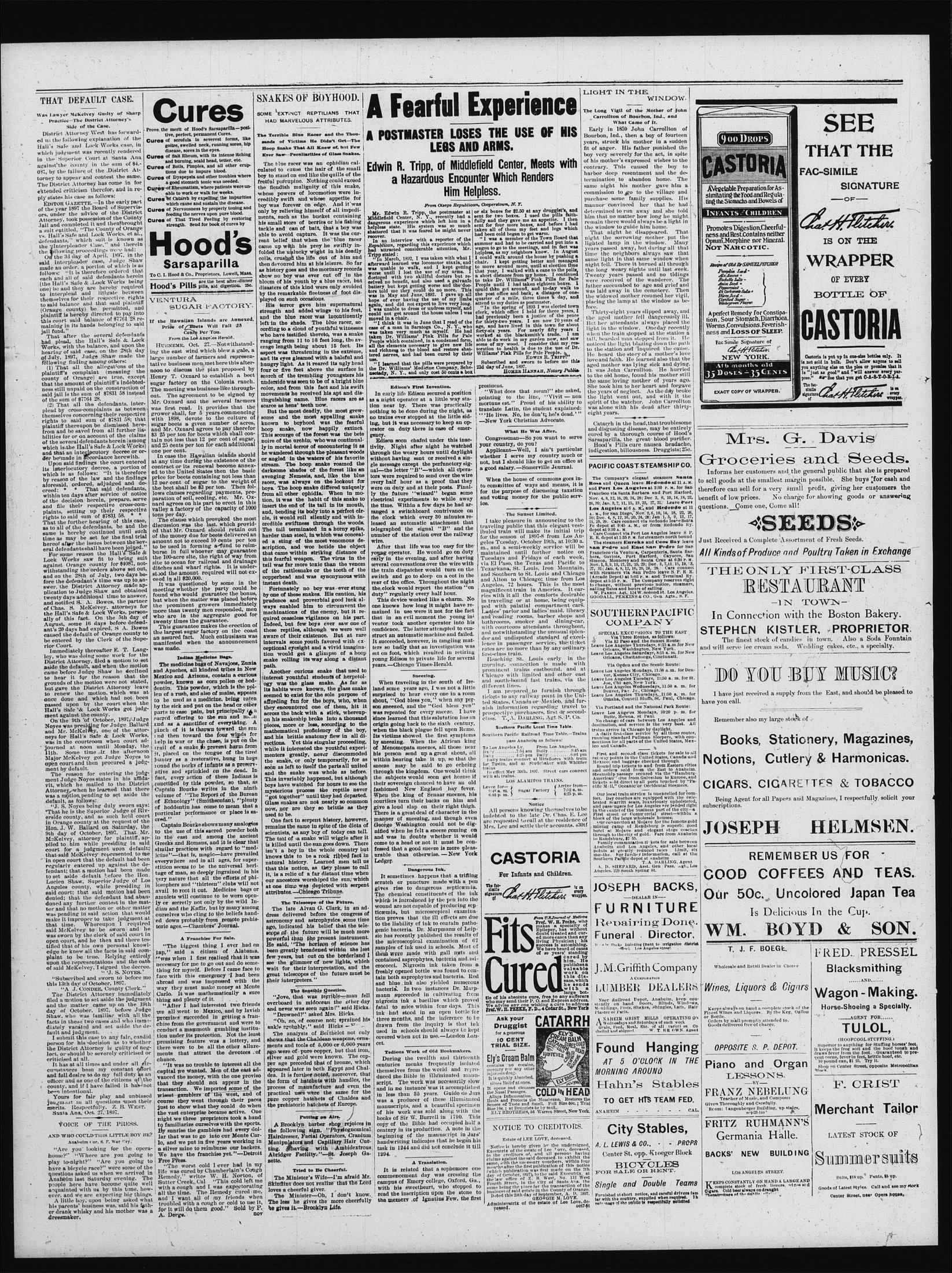
Searchable text
THAT DEFAULT CASE.
Was Lawyer McKelvey Guilty of Sharp Practice—The District Attorney's Side of the Case.
District Attorney West has forwarded us the following explanation of the Hall’s Safe and Lock Works case, in which judgment was recently rendered in the Superior Court at Santa Ana against the county in the sum of $4,037, by the failure of the District Attorney to appear and contest the same. The District Attorney has come in for extended criticism therefor, and in reply states his case as follows:
EDITOR GAZETTE—In the early part of the year 1897 the Board of Supervisors, under the advice of the District Attorney, took possession of the County Jail and completed it and then brought a suit entitled, “The County of Orange vs. Hall’s Safe and Lock Works, et al., defendants,” which suit is known as the "Interpleader Case," and therein the following proceedings were had:
On the 3d day of April, 1897, in the said Interpleader case, Judge Shaw made an order, a portion of which is as follows: “It is therefore ordered that each and all of said defendants herein (the Hall’s Safe & Lock Works being one) be and they are hereby required to interplead and litigate between themselves for their respective rights to said balance and that said plaintiff (Orange county) be permitted, and plaintiff is hereby directed to pay into this court said balance of $7764.28 remaining in its hands belonging to said jail fund.”
That after the several defendants had plead, the Hall’s Safe & Lock Works, with the balance, and upon the hearing of said case, on the 28th day of July, 1897, Judge Shaw made the following finding among others:
(1) That all the allegations of the plaintiff’s complaint (meaning the county of Orange) are true, except that the amount of plaintiff’s indebtedness still unpaid on the construction of said jail is the sum of $7831.58 instead of the sum of $7764.28.
(2) That all the defendants, interplead by cross-complaints as between themselves concerning their respective rights to said sum of $7831.58; that plaintiff thereupon be dismissed herefrom and be saved from all further liabilities for or on account of the claims of the several defendants herein (among which is the Hall’s Safe & Lock Works) and that an interlocutory decree or order be made in accordance herewith.
Upon said findings the court entered its interlocutory decree, a portion of which is as follows: “It is therefore
Cures
Prove the merit of Hood’s Sarsaparilla—positive, perfect, permanent Cures.
Cures of serofula in severest forms, like goitre, swelled neck, running sores, hip disease, sores in the eyes.
Cures of Salt Rheum, with its intense itching and burning, seald head, tetter, etc.
Cures of Boils, Pimples, and all other eruptions due to impure blood.
Cures of Dyspepsia and other troubles where a good stomach tonic was needed.
Cures of Rheumatism, where patients were unable to work or walk for weeks.
Cures of Catarrh by expelling the impurities which cause and sustain the disease.
Cures of Nervousness by properly toning and feeding the nerves upon pure blood.
Cures of That Tired Feeling by restoring strength. Send for book of cures by
Hood’s Sarsaparilla
To C. I. Hood & Co., Proprietors, Lowell, Mass.
Hood’s Pills are the best after-dinner pills, aid digestion. 250.
VENTURA
SUGAR FACTORY.
If the Hawaiian Islands are Annexed,
Price of Beets Will Fall 25
Centre Per Ton.
From the Los Angeles Herald.
HUENEME, Oct. 27.—Notwithstanding the east wind which blew a gale, a large number of farmers and representative business men met here this afternoon to discuss the plan proposed by Henry T. Oxnard to establish a beet sugar factory on the Colonia ranch. The meeting was business-like throughout. The agreement to be signed by Mr. Oxnard and the several farmers was first read. It provides that the grower shall, for 5 years commencing with 1898, devote to the culture of sugar beets a given number of acres, and Mr. Oxnard agrees to pay therefor $3.25 per ton for beets which shall contain not less than 12 per cent of sugar, and 25 cents per ton for each additional one per cent.
In case the Hawaiian islands should at any time during the existence of the contract or its renewal become annexed to the United States then the basic
SNAKES OF BOYHOOD
SOME EXTINCT REPTILIANS THAT HAD MARVELOUS ATTRIBUTES.
The Terrible Blue Racer and the Thousands of Victims He Didn't Get—The Hoop Snake That All Knew of, but Few Ever Saw—Peculiarities of Glass Snakes.
The blue racer was an ophidian calculated to cause the hair of the small boy to stand on end like the quills of the frettful porcupine. Nothing could exceed the flendish malignity of this snake whose powers of locomotion were credibly swift and whose appetite fled boy was forever on edge. And it would only by relieving himself of all impediments, such as the bucket containing his small store of berries or his fishing tackle and can of bait, that a boy would able to avoid capture. It was the current belief that when the blue racer came up with his prey he swiftly folded the unlucky wight in his dead coils, crushed the life out of him and then devoured him at his leisure. So far as history goes and the mortuary record show no boy was ever cut off in the bloom of his youth by a blue racer, his disasters of this kind were only avoided by the remarkable fleetness of foot dancers played on such occasions.
His terror gave him supernatural strength and added wings to his feet and the blue racer was incontinent left in the shade. The blue racer, cording to a cloud of youthful witness who have testified thereto, was a snake ranging from 11 to 16 feet long, the average length being about 15 feet. Aspect was threatening in the extremes and its eyes gleamed with a baleful nuggy light. As it reared its ugly hull four or five feet above the surface search of the trembling youngsters underside was seen to be of a bright blue color, and from this fact and his swings movements he received his apt and dangling name. Blue racers are scarce as hens' teeth now.
But the most deadly, the most great some and the most appalling snake known to boyhood was the feather hoop snake, now happily extinct. This scourge of the forest was the noire of the urchin; who was continue ly in mortal terror of encountering it he wandered through the pleasant woor or angled in the waters of his favorite stream. The hoop snake roamed darksome shades of the forest like...
Upon said findings the court entered its interlocutory decree, a portion of which is as follows: "It is therefore by reason of the law and the findings aforesaid, ordered, adjudged and decreed: That said defendants, within ten days after service of notice of the decision herein, prepare, serve and file their respective cross-complaints, setting up their respective rights to said sum of $7831 58. That the further hearing of this case, as to all of the defendants, be and the same is hereby continued until such time as may be set for the final trial hereof after the issues between the several defendants shall have been joined."
For some reason the Hall's Safe & Lock Works saw fit to bring suit against Orange county for $4087, notwithstanding the orders above set out, and on the 28th of July, two days before the defendant's time was up to answer. The District Attorney made application to Judge Shaw and obtained twenty days additional time to answer, and notified S. A. Bowes, the partner of Chas. S. McKelvey, attorneys for the Hall's Safe & Lock Works, personally of this fact. On the 5th day of August, some 16 days before defendant's 20 days had expired, S. A. Bowes caused the default of Orange county to be entered by the Clerk of the Superior Court.
Immediately thereafter E. T. Langley, who was doing some work for the District Attorney, filed a motion to set aside the default, and when the motion came before Judge Shaw he declined to hear it for the reason that the grounds of the motion were not stated, but gave the District Attorney leave to renew the motion, which was at once done and which had not been passed upon by the court when the Hall's Safe & Lock Works got judgment against the county.
On the 9th of October, 1897, Judge Noyes was presiding for Judge Ballard and Mr. McKelvey, one of the attorneys for Hall's Safe & Lock Works, was in the courtroom when court adjourned at noon until Monday, the 11th. Some time ir. the afternoon Major McKelvey got Judge Noyes to open court and then procured a judgment by default.
The reason for entering the judgment Judge Noyes states in his affidavit, which he mailed to the District Attorney when he learned that there was a motion pending to set aside the default, as follows:
"J. S. Noyes being duly sworn says: 'That he is the Superior Judge of Riverside county, and as such held court in Orange county at the request of the Hon. J. W. Ballard on Saturday, the 9th day of October, 1897. That Mr. McKelvey, attorney for plaintiff, applied to him while presiding in said court for a judgment upon default; that said McKelvey represented me in open court that the default had been regularly entered up against the defendant; that a motion had been made to set aside default before the Hon. Lucien Shaw, Superior Judge of Los Angeles county, while presiding in said court; that said motion had been denied; that the defendant had aban-
Henry T. Oxnard to establish a beet sugar factory on the Colonia ranch. The meeting was business-like throughout. The agreement to be signed by Mr. Oxnard and the several farmers was first read. It provides that grower shall, for 5 years commencing with 1898, devote to the culture of sugar beets a given number of acres, and Mr. Oxnard agrees to pay therefor $3 per ton for beets which shall contain not less than 12 per cent of sugar, and 25 cents per ton for each additional one per cent.
In case the Hawaiian islands should at any time during the existence of the contract or its renewal become annexed to the United States then the basic price for beets containing not less than 12 per cent of sugar to the weight of the beet shall be $3 per ton. Then follows clauses regarding payments, preparation of soil, seeding, etc. Mr. Oxnard agrees on his part to erect in this valley a factory of the capacity of 1000 tons per day.
The clause which provoked the most discussion was the last, which provided that Mr. Oxnard should retain out of money due for beete delivered an amount not to exceed 10 cents per ton to be used in forming a fund to reimburse in full whoever may guarantee the 100-acre site, the right way from site to ocean for railroad and drainage ditches and wharf rights. It is understood the amount required will not exceed in all $20,000.
It was questioned by some in the meeting whether the party could be found who would guarantee the bonus, but when the matter was placed before the prominent growers immediately more than twenty men responded, men who are in the aggregate good for twenty times the guarantee.
This guarantee makes the erection of the largest sugar factory on the coast an assured fact. Much enthusiasm was manifested when the announcement was made.
Indian Medicine Bags.
The medicine bags of Navajoos, Zunia and Apaches, all kindred tribes in New Mexico and Arizona, contain a curious powder, known as corn pollen or hoddinit. This powder, which is the pollen of a rush, and also of malze, appears to be used as a medicine, being eaten by the sick and put on the head or other parts to ease pain, but principally a sacred offering to the sun and moon and as a sanctifier of everything. A pinch of it is thrown toward the sun and then toward the four winds for help in war or the chase, is put on the trail of a snake to prevent harm from it, placed on the tongue of the tired hunter as a restorative, hung in bags round the necks of infants as a preservative and sprinkled on the dead. In fact, every action of these Indians is canceled by this powder, so that, as Captain Bourke writes in the ninth volume of "The Report of the Bureau of Ethnology" (Smithsonian), "plenty of hoddinit has come to mean that a particular performance or place is sacred."
Captain Bourke shows many analogies to use of this sacred powder both in the east and among ancient Greeks and Romans, and it is clear that similar practices with regard to "medicine"—that is, magic—have prevailed everywhere and in all ages, for superstition seems to be the universal heritage of man, so deeply ingrained in his very nature that allthe efforts of philosophers and "thirteen" clubs will not avail to root it out. Medicine bags or amulets will continue to be worn open-
But the most deadly, the most great some and the most appalling snakes known to boyhood was the feather snake, now happily extinct. This source of the forest was by no means in mortal terror of encountering it he wandered through the pleasant woods or angled in the waters of his favorite stream. The hoop snake roamed darksome shades of forest like avenging Nemesis, and, like the borer snake was always on the lookout boys. The hoop snake differed uniquely from all other ophidia. When in danger it was habit of this snake inserting end of its tail in its mouth and bending its body into a perfect clee it would roll silently and with credible swiftness through the woody harder than steel, in which was conceived a sting of the most venomous scripture, and woe bethe object that came within striking distance this fearful weapon. The virus in this tail was far more toxic than the virus of the rattlesnake or the tooth of copperhead and was synonymous with instant death.
Fortunately no boy was ever stray by one of these snakes. His caution, prudence and proverbial good luck ways enabled him to circumnavigate machinations ofthe enemy,但it quired ceaseless vigilance on his pants Indeed,但 few boys ever saw on these reptiles although we were aware of their existence.Bat intervals some youth favored with cephalic eyesight and a vivid imagination would get a glimpse of a snake rolling its way along a disney path.
Another curious snake that uses interest youthful students of herpology wasthe glass snake.As far its habits were known,the glass snake seemed to exist forthe sole purposeaffording fun forthe boyswho,were they encountered one of them,his across back witha stick,whereon his snakeship broke into a thousand pieces,more or less accordingto mathematical proficiencyofthe skinandhis brittle anatomy flew in all directions.Yetthis singular proceed while it interestedthe youthful exponents greatly never discommendthe snake,或only temporarily,f soon as lefttoitselfthepartsalluntilandthesnakewaswholeasbeethThis invariably happened,butalthough boys have watched for hours to see mysterious processthe reptile rose "got together" until they had depart Glass snakes are not nearly so common now,nor are they so brittle as used to be.
One fact in serpent history,how remainsthe samein spiteofthe diccient scientists,sayanyboyof todaycanThe taitofa snakewillwiggleafis killed untilthe sungoesdown.Thesitn'ta boyinthe whole country knowsthistobea rock ribbedfornaturalhistory.Learnedmenthisnotion.astheypleatetoitis,arelioofafar distanttimefrom our ancestorsworshippedthe sun;watone timewas depictedwithseeattributes.-Chicago Tribune.
"J. S. Noyes being duly sworn says: 'That he is the Superior Judge of Riverside county, and as such held court in Orange county at the request of the Hon. J. W. Ballard on Saturday, the 9th day of October, 1897. That Mr. McKelvey, attorney for plaintiff, applied to him while presiding in said court for a judgment upon default; that said McKelvey represented to me in open court that the default had been regularly entered up against the defendant; that a motion had been made to set aside default before the Hon. Lucien Shaw, Superior Judge of Los Angeles county, while presiding in said court; that said motion had been denied; that the defendant had abandoned any further contest in the matter and that no motion or other matter was pending in said action that would make it improper to take judgment at that time. Whereupon I required said McKelvey to be sworn and he was sworn by the clerk of said court in open court, and he then and there testified that of his own personal knowledge he knew all the facts in said complaint to be true. Relying entirely upon the representations and the oath of said McKelvey, I signed the decree.'"
"J. S. NOYES."
"Subscribed and sworn to before me this 13th day of October, 1897."
"A J. CONDEE, County Clerk."
The District Attorney immediately filed a motion to set aside the judgment and the matter came up on the 19th day of October, 1897, before Judge Shaw, who was familiar with all the facts in these two cases and who immediately vacated and set aside the default and judgment.
I submit this case to any fair, candid person for his decision as to whether the District Attorney is guilty of neglect, or should be severely criticised or criticised at all.
It has at all times and under all circumstances been my constant effort and full desire to do my full duty as an officer and as one of the citizens of the county, and if I have failed it has not been intentional.
Yours for fair play and unbiased judgment in all questions upon their merits. Respectfully, Z. B. WEST.
Santa Ana, Oct. 27, 1897.
VOICE OF THE PRESS.
AND WHO COULD THIS LITTLE BOY BE?
Anabeim Corr. S. F. War Cry.
"Are you looking for the opera-house?" "Where are you going to play to-night?" "Are you going to have a bicycle race?" were some of the questions asked us when we arrived in Anaheim last Saturday evening. The people here have become quite well acquainted with us by this time, however, and we are expecting big things.
A little boy, upon being asked what his parents' business was, said his father drank whisky and his mother was a dressmaker.
Captain Bourke shows many analogies to the use of this sacred powder both in the east and among the ancient Greeks and Romans, and it is clear that similar practices with regard to "medicine"—that is, magic—have prevailed everywhere and in all ages, for superstition seems to be the universal heritage of man, so deeply ingrained in his very nature that all the efforts of philosophers and "thirteen" clubs will not avail to root it out. Medicine bags or annulets will continue to be worn openly or secretly not only by the wild Indian and the Kaffir, but by many among ourselves who cling to the beliefs handed down probably from remote prehistoric ages.—Chambers' Journal.
A Franchise For Sale.
"The biggest thing I ever had on tap," said a citizen of Alabama. "was when I first realized that it was necessary for me to go out and do something for myself. Before I came face to face with this emergency I had been abroad and was impressed with the way they must make money at Monte Carlo. It was mathematically a sure thing and plenty of it.
"After I had interested two friends we all went to Mexico, and by lavish promises succeeded in getting a franchise from the government and were to conduct a mammoth gambling institution under its protection. Not the least promising feature was a lottery, and there were to be all the other allurements that attract the devotees of chance.
"It was no trouble to interest all the capital we wanted. Men of the east advanced the money, with the one proviso that they should not appear in the transaction. We imported some of the wisest gamblers of the west, and of course they went through their paces just to show what they could do when the vast enterprise became active. One night we three proprietors took a hand to familiarize ourselves with the sports. By sunrise the gamblers had every dollar that was to go into our Monte Carlo, and we put in five years working in a silver mine to reimburse our backers. We have the franchise yet."—Detroit Free Press.
"The worst cold I ever had in my life was cured by Chamberlain's Cough Remedy," writes W. H. Norton, of Sutter Creek, Cal. "This cold left me with a cough and I was expectorating all the time. The Remedy cured me, and I want all of my friends when troubled with a cough or cold to use it, for it will do them good." Sold by P. A. Derge.
Glass snakes are not nearly so common now, nor are they so brittle as used to be.
One fact in serpent history, how remains the same in spite of the dic scientists, as any boy of today can. The tail of a snake will wiggle afresh is killed until the sun goes down. It isn't a boy in the whole country knows this to be a rock ribbed for natural history. Learned men tend to this notion, as they please it, is a relic of a far distant time our ancestors worshiped the sun; we at one time was depicted with sea attributes.—Chicago Tribune.
The Telescope of the Future.
The late Alvan G. Clark, in a dress delivered before the congress astronomy and astrophysics some ago, indicated his belief that the scope of the future will be much powerful than the present instrument He said, "The horizon of science been greatly broadened within few years, but out on the border see the glimmer of new lights, wait for their interpretation, and great telescopes of the future may their interpreters."
The Sensible Question.
"Jove, that was terrible—man overboard in midocean other and never was seen again!" said H.
"Drowned?" asked Mrs. Hicks.
"Oh, no, of course not; sprain ankle probably." said Hicks.
The analysis of Beithelot not shows that the Chaldean weapons, ments and tools of 5,000 or 6,000 ago were of pure copper, but that silver and gold were known. The per age preceded that of bronze, appeared later in both Egypt and dea. It is further noted, moreover the form of hatchets with handle process of manufacture and even practical uses were the same for pure copper hatchets of Chaldean the prehistoric hatchets of Europe.
Putting on Airs.
A Brooklyn barber shop rejoins the following sign: "Physlogne Hairdresser, Facial Operators, Crew Manipulators and Capillary Hairtieing. shaving with Ambidextrus Abridger Facility."—St. Joseph zette.
Tried to Be Cheerful.
The Minister's Wife—I'm afraid Skinflint does not realize that she loves a cheerful giver.
The Minister—Oh, I don't The less he gives the more cheek he gives it.—Brooklyn Life.
A Fearful Experience
A POSTMASTER LOSES THE USE OF HIS LEGS AND ARMS.
Edwin R. Tripp, of Middlefield Center, Meets with a Hazardous Encounter Which Renders Him Helpless.
From Otsego Republican, Cooperstown, N.Y.
Mr. Edwin R. Tripp, the postmaster at Middlefield Center, N.Y., recently had a dangerous experience which left him in a helpless state. His system was so much shattered that it was feared he might never recover.
In an interview with a reporter of the Republican, regarding this experience which had attracted considerable attention, Mr. Tripp stated:
"In March, 1892, I was taken with what I afterward learned was locomotor ataxia, and was unable to walk, and I kept getting worse until I lost the use of my arms. I doctored with two skillful doctors but received no benefit, and also used a galvanic battery but kept getting worse and the doctors told me they could do no more. This was in May and June, 1892. I gave up all hope of ever having the use of my limbs again, and did not expect to live very long. I was unable to dress or undress myself, and could not get around the house unless I was moved in a chair."
"I think it was in June that I read of the case of a man in Saratoga Co., N.Y., who was taken very much as myself. He had taken Dr. Williams' Pink Pills for Pale People which contained, in a condensed form, all the elements necessary to give new life and richness to the blood and restore shattered nerves, and had been cured by their use."
"I learned that the pills were prepared by the Dr. Williams' Medicine Company, Schenectady, N.Y., and only cost 50 cents a box."
In the spring of 1893 I was elected town clerk, which office I held for three years. I had previously been a justice of the peace for thirty-two years. I am now 70 years of age, and have lived in this town for about forty-six years. For nearly fifty years I worked at the blacksmith's trade. I am able to work in my garden now, and saw some of my wood. I consider that my restoration to health is due to the use of Dr. Williams' Pink Pills for Pale People.
EDWIN R. TRIPP
Subscribed and sworn to before me this 23d day of June, 1897.
HOMER HANNAH, Notary Public
Edison's First Invention.
In early life Edison secured a position as a night operator at a little way station near by. There was practically nothing to be done during the night, as no trains ever stopped at the little siding, but it was necessary to keep an operator on duty there in case of emergency.
Edison soon chafed under this inactivity. Night after night he watched through the weary hours until daylight without having sent or received a single message except the perfunctory signal—the letter "B"—which all opera-president.
“What does that mean?” she asked, pointing to the line, “Vivit — non mortuus est.” Proud of his ability to translate Latin, the student explained: “He lives. No, he don't; he's dead.”—New York Christian Advocate.
What He Was After.
Congressman—So you want to serve your country, do you?
Applicant—Well, I ain't particular whether I serve my country much or not, but I should like to get an office at a good salary.—Somerville Journal.
LIGHT IN THE WINDOW
The Long Vigil of the Mother of Carrollton of Bourbon, Ind., and What Came of It.
Early in 1859 John Carrollton Bourbon, Ind., then a boy of four years, struck his mother in a suit of anger. His father punished boy very severely for the act, in spite of his mother's expressed wishes contrary. This caused the boy harbor deep resentment and the termination to abandon home. Some night his mother gave him commission to go to the village purchase some family supplies; manner convinced her that he determined to run away and she him that no matter how long he remained there would always be a lift the window to guide him home.
That night he disappeared. night the sorrowing mother put lighted lamp in the window. years passed away, but during all time the neighbors always saw same light in that same window night fell. There it burned all the long weary nights until last Twenty years passed and no tears were received of the wanderer; father succumbed to age and grief was laid away in the cemetery. The widowed mother resumed her placing the lamp at the window fore.
Thirty-eight years slipped away. But her attendants always placed light in the window. One day reaired when the train stopped at the station, bearded man stepped from it noticed the light blazing down thru to the station and Inquired thru He heard the story of a mother love and faith. He learned also that aged mother was lying sick and It was John Carrollton. He hated to old home, found his mother the same loving mother of years She took him to her heart and for the years of neglect. As the day light went out, and with spirit of the watcher John Carrollton was alone with his dead after eight years.
Catarph in the head, that trouble and disgusting disease, may be eased by a thorough course of Sarsaparilla, the great blood pills Hood's Pills cure nausea head indigestion, billiousness. Druggists
Edison's First Invention.
In early life Edison secured a position as a night operator at a little way station near by. There was practically nothing to be done during the night, as no trains ever stopped at the little siding, but it was necessary to keep an operator on duty there in case of emergency.
Edison soon chafed under this inactivity. Night after night he watched through the weary hours until daylight without having sent or received a single message except the perfunctory signal—the letter "B"—which all operators were required to send over the wire every half hour as a proof that they were on duty and at their posts. Finally the future "wizard" began some electrical experiments to while away the time. Within a few days he had arranged a switchboard contrivance on the clock which every 30 minutes released an automatic attachment that telegraphed the signal "B" and the number of the station over the railway wire.
After that life was too easy for the young operator. He would go on duty early in the evening, and after having several conversations over the wire with the train dispatcher would turn on the switch and go to sleep on a cot in the rear of the office. Throughout the night the clock would report the station "on duty" regularly every half hour.
This device worked like a charm. No one knows how long it might have remained in use were it not for the fact that in an evil moment the young inventor took another operator into his confidence. The latter attempted to construct an automatic machine and failed. It succeeded, however, in tangling matters so badly that an investigation was set on foot, which resulted in retiring young Edison to private life for several years. — Chicago Times-Herald.
Sneezing.
When traveling in the south of Ireland some years ago, I was not a little surprised to hear every one in a room shout, "God bless you," when any person sneezed, and the "God bless you" was repeated for every sneeze. I have since learned that this salutation has an origin going back to the sixth century, when the black plague fell upon Rome. Its victims showed the first symptoms by sneezing. When the African king of Menomopata sneezes, all those near his person send up a great shout, all within hearing take it up, so that the sneeze may be said to go echoing through the kingdom. One would think the subjects would soon get hoarse if their sovereign chanced to have an old fashioned New England hay fever. When the king of Senarau sneezes, his courtiers turn their backs on him and give a loud slap on their right thigh. There is a great deal of character in the manner of sneezing, and though even George Washington could not be diggified when he felt a sneeze coming on and was in doubts whether it would come to a head or not it must be confessed that a good sneeze is more pleasurable than otherwise. — New York Ledger.
Dangerous Ink.
It sometimes happens that a trifling scratch or puncture made with a pen gives rise to dangerous septicemia. The chemical constituents of the ink which is introduced by the pen into the president.
“What does that mean?” she asked, pointing to the line, “Vivit — non mortus est.” Proud of his ability to translate Latin, the student explained: “He lives. No, he don't; he's dead.” — New York Christian Advocate.
What He Was After.
Congressman—So you want to serve your country, do you?
Applicant—Well, I ain't particular whether I serve my country much or not, but I should like to get an office at a good salary. — Somerville Journal.
When the house of commons goes into committee of ways and means, it is for the purpose of discussing taxation and voting money for the public service.
The Sunset Limited.
I take pleasure in announcing to the traveling public that this elegant vestibule train will make its initial trip for the season of 1897-8 from Los Angeles Tuesday, October 19th, at 10:30 a.m., and a semi-weekly service will be maintained until further notice on Tuesdays and Fridays of each week, via El Paso, the Texas and Pacific to Texarkana, St. Louis, Iron Mountain, and Southern to St. Louis and Chicago and Alton to Chicago; time from Los Angeles, 72 hours. This is the most magnificent train in America. It carries with it all the comforts desirable in travel or at home, being equipped with palatal compartment cars. Library and reading rooms, barber shops and bathrooms, smoker and dining-car, with courteous attendants throughout, and notwithstanding the unusual splendor and undisputed standard of excellence in passenger service, the ticket rates are no more than by any ordinary first-class train.
Reaching St. Louis early in morning, connection is made with prominent trains eastbound, and at Chicago with limited and other east and south-bound fast trains, via different lines.
I am prepared to furnish through tickets to any railway point in the United States, Canada or Mexico, and furnish information regarding travel to prospective purchasers, first or second-class. T. A. DARLING, Agt S. P. Co.
Southern Pacific Local Time Table.
Southern Pacific Railroad Time Table—Trains pass Anaheim as follows:
To Los Angeles Ln.
From Los Angeles
Daily
7:34 am Daily
9:45 am Daily
Daily trains connect at Mirrosfores with train for Tustin, and at Studebaker with Whittier trains.
In effect May 30th, 1897. Street cars connect with all trains.
LOS ALAMITOS TRAINS.
Leave for—
9:48 a.m.
6:03 p.m.
Sugar Factory
Arrive from—
7:52 a.m.
4:25 p.m.
Notice
All persons knowing themselves to be indebted to the late Dr. Chase. E. Lee are requested to call at the residence of Mrs. Lee and settle their accounts. s30tf
First and second class tickets for railway points in the United States, China and baggage check for all running Standard Pullman Sleepers; nectices for all parts of the United States; ice and Canada.
Our local train service is unexcited fort. Day coaches are equipped with brated Scarritt seats, luxuriously used and passengers for Los Angeles are leased in the center of the business part of First street or CommerCIAL street block of large wholesale houses; our connection at Mojave for the first mining camp of Randburg is located near town through to city of gold. Fare from Randburg, $7.55.
Family commutation ti kets for san Anahelle and Los Angeles, and points at greatly reduced rates months. For further information, Southern Depot depot at LA DARLING.
A. D. SHEPARD, Asst. Gen Pass Angeles, 229 South Spring St.
JOSEPH BAGG
DEALER IN-
The fact in serpent history, however, insists the same in spite of the diota ofISTS, as any boy of today can tell. A snake will wiggle after it is held until the sun goes down. There is a boy in the whole country but this is to be a rock ribbed fact in real history. Learned men tell us this notion, as they please to call a relic of a far distant time when ancestors worshiped the sun, which the time was depicted with serpent motives. — Chicago Tribune.
The Telescope of the Future.
He late Alvan G. Clark, in an ad-delivered before the congress ofonomy and astrophysics some time indicated his belief that the tele- of the future will be much more useful than the present instrument. Said, "The horizon of science has greatly broadened within the last years, but out on the borderland I the glimmer of new lights, which for their interpretation, and the telescopes of the future must be interpreters."
The Sensible Question.
Love, that was terrible—man fell board in midocean the other day never was seen again!" said Hicks. Drowned?" asked Mrs. Hicks. Oh, no, of course not; sprained his knee probably." said Hicks.
The analysis of Beithelot not only was that the Chaldean weapons, ornals and tools of 5,000 or 6,000 years were of pure copper, but that iron and gold were known. The copage preceded that of bronze, which burned later in both Egypt and Chal- It is further noted, moreover, that form of hatchets with handles, thecess of manufacture and even the technical uses were the same for the copper hatchets of Chaldea and prehistoric hatchets of Europe.
Putting on Air.
Brooklyn barber shop rejoices in following sign, "Physiognomical dresser, Facial Operators, Cranium stipulators and Capillary Hair Cutting with Ambidextrous Adder Facility." — St Joseph GaTried to Be Cheerful.
The Minister's Wife—I'm afraid Mr. Smith does not realize that the Lord is a cheerful giver. The Minister—Oh, I don't know. Less he gives the more cheerfully gives it. — Brooklyn Life.
Dangerous Ink.
It sometimes happens that a trifling scratch or puncture made with a pen gives rise to dangerous septicemia. The chemical constituents of the ink which is introduced by the pen into the wound are not capable of producing septicemia, but microscopical examination proves that the ill effects are due to the liability of ink to contain pathogenic bacteria. Dr. Marpmann of Leip-sic has recently published the results of the microscopical examination of 67 samples of ink used in schools. Most of them were made with gall nuts and contained saprophytes, bacteria and micrococci. Nigrosin ink taken from a freshly opened bottle was found to contain both saprophytes and bacteria. Red and blue ink also yielded numerous bacteria. In two instances Dr. Marpmann succeeded in cultivating from nigrosin ink a bacillus which proved fatal to mice within four days. This ink had stood in an open bottle for three months, and the inference to be drawn from the inquiry is that ink used in schools should always be kept covered when not in use. — London Lancet.
T tedious Work of Old Bookmakers.
During the twelfth and thirteenth centuries monks frequently isolated themselves from the world and reproduced the Bible in illuminated manuscript. The work was necessarily slow and in no instance was it accomplished in less than 85 years. Guido de Jars was a producer of these illuminated manuscripts, and a beautiful specimen of his work was sold along with the books of Sir W. Burrell in 1790. This copy of the Bible had occupied half a century in its production. A note in the beginning of the manuscript in Jars' handwriting indicates that he began his task in 1244 and did not conclude it till 1294.
A Translation.
It is related that a sophomore one commencement day was crossing the campus of Emory college, Oxford, Ga., with his sweetheart, who stopped to read the inscription upon the stone to the memory of Ignatius Few, the first
Notice
All persons knowing themselves to be indebted to the late Dr. Chas. E. Lee are requested to call at the residence of Mes. Lee and settle their accounts. s30tf
CASTORIA
For Infants and Children.
The facsimile signature of Charlottie Hitchens is on every wrapper.
Fits Cured
Prof. W.H. Pecke, who makes a specialty of Epilepsy, has without doubt treated and curred more cases than any living Physician; his success is astonishing. We have heard of cases of so years' standing cured by him. He publishes valuable work on this disease, which he sends with a large bot-tle of his absolute cure, free to any sufferers who may send their P.O. and Express address. We advise any one wishing a cure to address Prof. W.H. PEEKE, F.D., 4 Cedar St., New York
Ask your Druggist
for a generous 10 CENT TRIAL SIZE.
Ely's Cream Balm contains no cocaine, mercury per any other injurious drag. It is quickly Absorbed. Gloves Relief at once.
It opens and cleans the Nasal Passages.
Allays Infammation.
Heals and Protects the Membrane. Restores the Senses of Taste and Smell. Full Size 50c.; Trial Size 10c.; at Druggists or by mail.
ELY BROTHEITS, 55 Warren Street, New York.
NOTICE TO CREDITORS.
Estate of LEE LOVE, deceased.
Notlee is hereby given by the undersigned, Executiverix of the estate of Lee Love, deceased,
to the creditors of, and all persons having claims against the said deceased to exhibit the same, with the necessary vouchers, within four months after the first publication of this notice (which publication was first made on the 7th day of October, 1897), to the said Executrix at the law office of Z. B. West, No. 113 West Fourth Street, in the City of Santa Ana, the same being the place for the transaction of the business of said estate in the County of Orange.
Dated this 29th day of September, A. D. 1897.
GEORGIE M. LOVE.
Administratrix of the estate of Lee Love, deceased.
City Stable
A. L. LEWIS & CO..
Center St. opp. Kroeger
BICYCLE FOR SALE OR RENT
Single and Double
Purchased at short notice, and careful lar with the country, supplied when resale age is respectfully
LONG VIGIL of the Mother of John Carrollton of Bourbon, Ind., and What Came of It.
Early in 1859 John Carrollton of Bourbon, Ind., then a boy of fourteen, struck his mother in a sudden anger. His father punished the very severely for the act, in spite of mother's expressed wishes to the family. This caused the boy to deep resentment and the de-ination to abandon home. The night his mother gave him a mission to go to the village and purchase some family supplies. His mother convinced her that he had terminated to run away and she told that no matter how long he might in there would always be a light in window to guide him home.
That night he disappeared. That at the sorrowing mother put the lamp in the window. Many passed away, but during all that the neighbors always saw that light in that same window when it fell. There it burned all through long weary nights until last week.enty years passed and no tidings were received of the wanderer. The succumbed to age and grief and laid away in the cemetery. Then widowed mother resumed her vigil, using the lamp at the window as being eight years slipped away, and aged mother fell dangerously ill. Her attendants always placed the lamp in the window. One day recently on the train stopped at the station a bearded man stepped from it. He ceed the light blazing down the path the station and Inquired the cause. He heard the story of a mother's love and faith. He learned also that the old mother was lying sick and dying. Was John Carrollton. He hurried the old home, found his mother still same loving mother of years ago. took him to her heart and forgave years of neglect. As the day broke light went out, and with it the suit of the watcher. John Carrollton alone with his dead after thirty-years.
SEE THAT THE FAC-SIMILE SIGNATURE OF
Cha H. Pitcher
IS ON THE WRAPPER OF EVERY BOTTLE OF CASTORIA
A Vegetable Preparation for Assimilating the Food and Regulating the Stomachs and Bowels of INFANTS OF CHILDREN
Promotes Digestion, Cheerfulness and Rest.Contains neither Opium,Morphine nor Mineral.
NOT NARCOTIC.
Recipe of Old Dr. SAMUEL PITCHER
Pumpkin Seed
Alc. Stemmer
Richelle Salts
Anise Seed
Peppermint
Di Carbone Soda
Worm Seed
Cloridized Sugar
Watergreen Player
Apperfect Remedy for Constipation, Sour Stomach, Diarrhoea, Worms, Convulsions, Feverishness and Loss of Sleep.
Fac Simile Signature of
Cha H. Pitcher
NEW YORK.
At 6 months old
35 DOSES - 35 CENTS
EXACT COPY OF WRAPPER.
Castoria is put up in one-size bottles only. It is not sold in bulk. Don't allow anyone to sell you anything else on the plea or promise that it is "just as good" and "will answer every purpose." See that you get O-A-B-T-O-B-I-A.
The fac-simile signature of
Cha H. Pitcher
Mrs. G. Davis Groceries and Seeds.
Informs her customers and the general public that she is prepared
Mrs. G. Davis
Groceries and Seeds.
Informs her customers and the general public that she is prepared to sell goods at the smallest margin possible. She buys for cash and therefore can sell for a very small profit, giving her customers the benefit of low prices. No charge for showing goods or answering questions. Come one, Come all!
SEEDS
Just Received a Complete Assortment of Fresh Seeds.
All Kinds of Produce and Poultry Taken in Exchange
THE ONLY FIRST-CLASS RESTAURANT
IN TOWN
In Connection with the Boston Bakery.
STEPHEN KISTLER, PROPRIETOR.
The finest stock of candies in town. Also a Soda Fountain and will serve ice cream soda. Wedding cakes, etc., a specialty.
DO YOU BUY MUSIC?
I have just received a supply from the East, and should be pleased to have you call.
Remember also my large stock of Books, Stationery, Magazines, Notions, Cutlery & Harmonicas.
CIGARS, CIGARETTES & TOBACCO
Being Agent for all Papers and Magazines, I respectfully solicit your subscriptions.
JOSEPH HELMSEN.
REMEMBER US FOR COOD COFFEES AND TEAS.
Our 50c. Uncolored Japan Tea
JOSEPH HELMSEN.
REMEMBER US FOR
COOD COFFEES AND TEAS.
Our 50c. Uncolored Japan Tea
Is Delicious In the Cup.
WM. BOYD & SON.
T. J. F. BOEGE.
Wholesale and Retail Dealer in Choice
Wines, Liquors & Cigars
Keeps always on hand a complete stock of the Finest Wines and Liquors. By the Keg, Oallon or Bottle.
Orders by mail promptly attended to. Goods delivered free of charge.
OPPOSITE S. P. DEPOT.
Piano and Organ
LESSONS.
BY
FRANZ NEBELUNG
Teacher of Music, and Composer
Given Thoroughly and Carefully.
Room: Iangenberger Building, up stairs,
sep23-1m
FRITZ RUHMANN'S
Germania Halle.
BACKS' NEW BUILDING
LOS ANGELES STREET.
KEEPS CONSTANTLY ON HAND A LARGE AND complete stock of fresh liquors, wines and Cigars. Cold beer always on draught.
Theatrresses of the public office.
FRED. PRESSEL
Blacksmithing
AND.....
Wagon - Making.
Horse-Shoeing a Specialty.
AGENT FOR.....
TULOL,
(HOOFCOOL STUFFING.)
Superior to anything for Stuffing horses' feet.
It keeps the frog soot and the boof tough and draws fever from the foot. Guaranteed to prevent corns, fever in feet, brittle hoof, etc.
10 pound can, $1 25. Try it.
Shop on Center Street, opposite Metropolitan Block.
F. CRIST
Merchant Tailor
LATEST STOCK OF
Summer suits
Suits, $18 up. Pants, $5 up.
Goods of Latest Styles. Call and see my stock
Center Street, near Opera house.