anaheim-gazette 1897-10-07
Scanned page
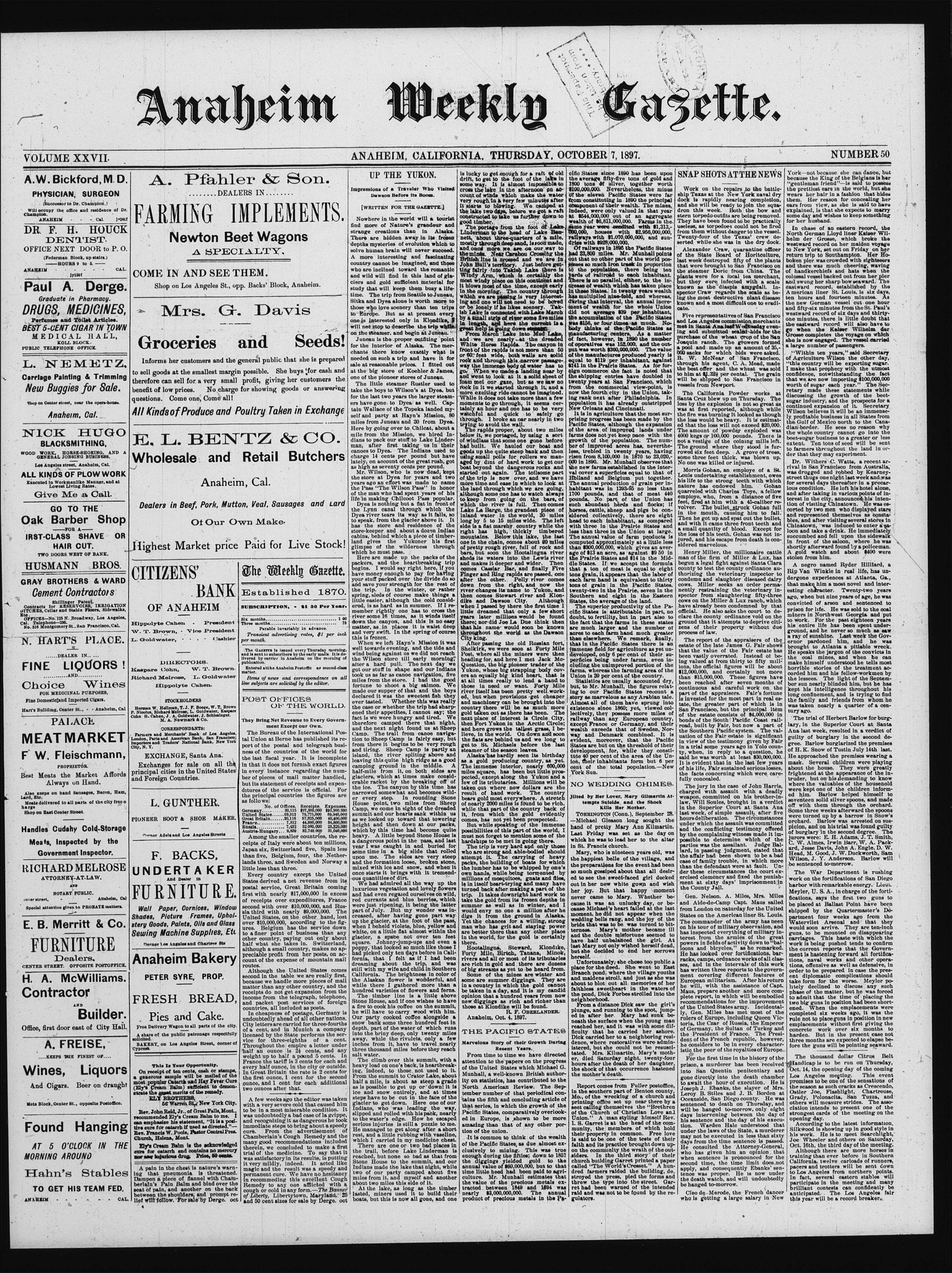
Searchable text
Anaheim
VOLUME XXVII.
A.W. Bickford, M.D.
PHYSICIAN, SURGEON
(Successor to Dr. Champion.)
Will occupy the office and residence of Dr. Champion.
ANAHEIM - Cal. j=24ff
DR. F. H. HOUCK
DENTIST.
OFFICE NEXT DOOR to P.O.
(Federman Block, up stairs.)
HOURS 9 to 6.
ANAHEIM - Cal. jy16tf
Paul A. Derge.
Graduate in Pharmacy.
DRUGS, MEDICINES,
Perfumes and Toilet Articles.
BEST 5-GENT CIGAR IN TOWN
MEDICAL HALL,
KOLL BLOCK.
PUBLIC TELEPHONE OFFICE.
L. NEMETZ.
Carriage Painting & Trimming
New Buggies for Sale.
Shop on Center street, near the opera-house.
Anaheim, Cal.
NICK HUGO
BLACKSMITHING,
WOOD WORK, HORSE-SHOEING, AND A GENERAL JOBBING BUSINESS.
Los Angeles street, Anaheim, Cal.
A. Pfahler & Son.
DEALERS IN...
FARMING IMPLEMENTS.
Newton Beet Wagons
A SPECIALTY.
COME IN AND SEE THEM.
Shop on Los Angeles St., opp. Backs' Block, Anaheim.
Mrs. G. Davis
Groceries and Seeds!
Informs her customers and the general public that she is prepared to sell goods at the smallest margin possible. She buys for cash and therefore can sell for a very small profit, giving her customers the benefit of low prices. No charge for showing goods or answering questions. Come one, Come all!
All Kinds of Produce and Poultry Taken in Exchange
E. L. BENTZ & CO.
Wholesale and Retail Butchers
Carriage Painting & Trimming
New Buggies for Sale.
Shop on Center street, near the opera-house.
Anaheim, Cal.
NICK HUGO
BLACKSMITHING,
WOOD WORK, HORSE-SHOEING, AND A
GENERAL JOBBING BUSINESS.
Los Angeles street, Anaheim, Cal.
ALL KINDS OF PLOW WORK
Executed in Workmanlike Manner, and at
Lowest Living Rates.
Give Me a Call.
GO TO THE
Oak Barber Shop
FOR A
IRST-CLASS SHAVE OR
HAIR CUT.
TWO DOORS WEST OF BANK.
HUSMANN BROS.
GRAY BROTHERS & WARD
Cement Contractors
Shillinger Patent.
Contracts for RESERVOIRS, IRRIGATION
DITCHES, Cellar and Stable Floors, Sidewalks,
Ete.
OFFICES—No. 125 N. Broadway, Los Angeles,
Cal. Telephone—236.
No. 516 Montgomery St., San Francisco, Cal.
N. HART'S PLACE.
DEALER IN...
FINE LIQUORS!
AND...
Choice Wines
FOR MEDICINAL PURPOSES,
Fine Domestic and Imported Cigars.
Hart's Building, Center St., - Anaheim, Cal
PALACE
MEAT MARKET
F W. Fleischmann,
PROPRIETOR.
Beat Meats the Market Affords
Always on Hand.
Also keeps on hand Sausages, Bacon, Ham,
Lard, Etc.
Meats delivered to all parts of the city free o
charge.
Shop on East Center Street.
Handles Cudahy Cold-Storage
Meats, Inspected by the
Government Inspector.
RICHARD MELROSE
ATTORNEY-AT-LAW.
AND
NOTARY PUBLIC.
CITIZENS'
BANK
OF ANAHEIM
Hippolyte Cahen - President
W. T. Brown - Vice President
L. Goldwater, Cashier
DIRECTORS:
Kaspare Cohn, W. T. Brown.
Richard Melrose, L. Goldwater
STOCKHOLDERS:
Herman W. Hellman, T.J. F. Boege, W.T. Brown
P. Nicolus, Richard Melrose, L. Goldwater, Kaspare
Cohn H. Cahen, J. A. Goldwater, J. Schlesinger.
M. A. Newmark & Co.
CORRESPONDENTS:
Farmers and Merchants' Bank of Los Angeles,
London, Paris and American Bank, San Francisco;
Importers and Traders' National Bank, New York
City, N.Y.
EXCHANGE, Santa Ana.
Exchanges for sale on all the principal cities in the United States and Foreign Countries.
L. GUNTHER.
PIONEER BOOT & SHOE MAKER.
Corner Adela and Los Angeles Streets
F. BACKS,
UNDERTAKER
And Dealer in
FURNITURE.
The Weekly Gazette.
Established 1870.
SUBSCRIPTION, - $1 50 Per Year.
Six months... 1 00
Three months... 75
Payable invariably in advance.
Transient advertising rates, $1 per inch per month.
The Gazette is issued every Thursday morning,
and is sent to subscribers by the early mails. It is delivered by carrier in Anaheim on the morning of publication.
Entered at the Anaheim Postoffice as second-class matter.
Items of news and correspondence on all live subjects are solicited by the editor.
POST OFFICES
OF THE WORLD.
They Bring Net Revenue to Every Government Except our Own.
The Bureau of the International Postal Union at Berne has published its report of the postal and telegraph business of the countries of the world for
the last fiscal year. It is incomplete
in that it does not furnish exact figures
in every instance regarding the number of pieces of mail matter handled,
but its statement of receipts and expenditures of the service is official. For
the principal countries the figures are
as follows:
No. of Offices. Receipts. Expenses.
Germany... 30,115 $97,360,000 $83,900,000
United States... 69,912 79,775,000 89,940,000
Great Britain... 20,116 57,825,000 40,400,000
France... 7,812 44,980,000 34,800,000
Russia... 7,432 32,060,000 23,820,000
Austria-Hungary... 9,859 32,740,000 31,040,000
Among the smaller countries, the receipts of Italy were about ten millions,
Japan six, Switzerland five, Spain less than five, Belgium four, the Netherlands three, and Sweden and Norway a little less than three.
Every country except the United States derived a net revenue from its postal service, Great Britain coming first with nearly $17,000,000 in excess
L. GUNTHER.
PIONEER BOOT & SHOE MAKER.
Corner Adela and Los Angeles Streets
F. BACKS,
UNDERTAKER
And Dealer in
FURNITURE.
Wall Paper, Cornices, Window Shades, Picture Frames, Upholstery Goods, Paints, Oils and Glass Sewing Machine Supplies, Etc.
Norner Los Angeles and Chartres Sts
Anaheim Bakery
PETER SYRE, PROP.
FRESH BREAD,
Pies and Cake.
Free Delivery Wagon to all parts of the city.
A share of the public patronage respectfully solicited.
BAKERY, on Los Angeles Street, corner of Cypress.
This Is Your Opportunity.
On receipt of ten cents, cash or stamps, a generous sample will be mailed of the most popular Catarrh and Hay Fever Cure (Ely's Cream Balm) sufficient to demonstrate the great merits of the remedy.
ELY BROTHERS,
56 Warren St., New York City.
Rev. John Reid, Jr., of Great Falls, Mont., recommended Ely's Cream Balm to me. I can emphasize his statement, "It is a positive cure for catarrh if used as directed."—Rev. Francis W. Poole, Pastor Central Pres. Church, Helena, Mont.
Ely's Cream Balm is the acknowledged cure for catarrh and contains no mercury nor any injurious drug. Price, 50 cents.
A pain in the chest is nature's warning that pneumonia is threatened. Dampen a piece of flannel with Chamberlain's Pain Balm and blind over the seat of pain, and another on the back between the shoulders; and prompt relief will follow. For sale by Derge. oct
Among the smaller countries, the receipts of Italy were about ten millions, Japan six, Switzerland five, Spain less than five, Belgium four, the Netherlands three, and Sweden and Norway a little less than three.
Every country except the United States derived a net revenue from its postal service, Great Britain coming first with nearly $17,000,000 in excess of receipts over expenditures, France second with over $10,000,000, and Russia third with nearly $9,000,000. The United States, on the other hand, lost over $10,000,000, according to the figures. Belgium has the service down to a finer point of business than any other country, paying out only about half what she takes in. Switzerland, although a small country, makes no appreciable profit from her posts, on account of the expense of mountain mail routes.
Although the United States comes second in the table we are really first, because we handle more pieces of mail matter than any other country, and the receipts do not get expansion from the income from the telegraph, telephone, and packet post services of foreign countries, all included as posts.
In cheapness of postage, Germany is undoubtedly ahead of all other nations. City letters are carried for three-fourths of a cent, and in Munich a company licensed by the State performs the service for three-eighths of a cent. Throughout the empire a letter under half an ounce is 2¼ cents, and any weight up to half a pound 5 cents. In France the tariff is 3 cents for each and every half ounce, in the city or outside. In Great Britain the rate is 2 cents for the first ounce, 1 cent for the second ounce, and 1 cent for each additional two ounces after that.
A few weeks ago the editor was taken with a very severe cold that caused him to be in a most miserable condition. It was undoubtedly a bad case of la gripe, and recognizing it as dangerous he took immediate steps to bring about a speedy cure. From the advertisement of Chamberlain's Cough Remedy and the many good recommendations included therein, we concluded to make a first trial of the medicine. To say that it was satisfactory in its results, is putting it very mildly, indeed. It acted like magic and the result was a speedy and permanent cure. We have no hesitancy in recommending this excellent Cough Remedy to any one afflicted with a cough or cold in any form. —The Banner of Liberty, Libertytown, Maryland. 25 and 50 cent sizes for sale by Derge. oct
ANAHEIM, CALIFORNIA, THURSDAY, OCTOBER 7, 1897.
UP THE YUKON.
Impressions of a Traveler Who Visited Dawson Before its Boom.
[WRITTEN FOR THE GAZETTE.]
Nowhere in the world will a tourist find more of Nature's grandeur and strange creations than in Alaska. There are hidden away in its frozen depths mysteries of evolution which to solve human brain will never succeed. A more interesting and fascinating country cannot be imagined, and those who are inclined toward the romantic and wild will find in this land of glaciers and gold sufficient material for study that will keep them busy a lifetime. The trip from Seattle to Juneau, Sitka and Dyea alone is worth more to those who love scenery than ten trips to Europe. But as at present every one is interested only in Klondike, I will not stop to describe the trip while on the steamer, and begin at Juneau.
Juneau is the proper outfitting point for the interior of Alaska. The merchants there know exactly what is needed on such a trip and have it for sale at reasonable prices. I fitted out at the big store of Koehler & James, one of the pioneer stores of Juneau.
The little steamer Rustler used to take the boys to Wilson's at Dyea, but for the last two years the larger steamers have gone to Dyea as well. Captain Wallace of the Topeka landed myself and party at Hayn's Mission, 80 miles from Juneau and 20 from Dyea. Here by going over to Chilcat, about a mile from the Mission, we hired Indians to pack our stuff to Lake Linderman, after first taking us in their canoes to Dyea. The Indians used to charge 14 cents per pound but have lately, on account of the great rush, got as high as seventy cents per pound.
Mr. Wilson, who is now dead, kept is lucky to get enough for a raft of old drift, to get to the foot of the lake in some way. It is almost impossible to cross the lake in the afternoon on account of winds which make the water very rough in a very few minutes after it starts to blowing. We camped at the lake two days, before we got a raft constructed to take us further down to good timber.
The portage from the foot of Lake Linderman to the head of Lake Bennett, about three-quarters of a mile, mostly through deep sand, is soon made, and once more we are on our way to the mines. Near Carabou Crossing the British line is crossed and we are in John Bull's territory. Just before getting fairly into Takish Lake there is Windy Arm, which is certainly the most windy place on this continent and it blows most of the time, except early in the morning. The country through which we are passing is very interesting and one will not need to be bored or be lonely if he likes scenery. Takish Lake is connected with Lake March by a small strip of river some five miles in length, and here the current is a great help in going down stream.
From March Lake into Mud Lake, and we are nearly at the dreaded White Horse Rapids. The canyon in front of the rapids is not more than 50 or 60 feet wide, both walls are solid rock and through this narrow passageway the immense body of water has to go. When we made a landing near by and went to look at it a solid sheet of foam met our gaze, but as we saw no rock in it we started through it, and a more exciting ride cannot be imagined. While it does not take more than a few moments to go through, it seems certainly an hour and one has to be very watchful and quick to safely go through. I broke an oar nearly in two trying to avoid the wall.
The rapids proper, about two miles below it, we portaged, by using a sort of windlass that some one gone before had built. We hauled our boat and goods up the quite steep bank and then using small polls for rollers we managed by dint of hard work to get our boat beyond the dangerous rocks and started out again. The tollsome part of Pacific States since 1890 has been upon the average fifty-five tons of gold and 1800 tons of silver, together worth $100,000,000. Nevertheless, the mines of the eleven Pacific States were far from constituting in 1890 the principal component of their wealth. The mines, indeed, were only valued in that year at $544,000,000 out of an aggregate wealth of $6,811,000,000. Farms in the same year were credited with $1,313,-000,000, houses with $2,956,000,000, railways with $1,070,000,000, and sundries with $928,000,000.
Of railways in 1895 the Pacific States had 23,800 miles. Mr. Munhall points out that no other part of the world possesses so much iron track in proportion to the population; there being ten yards of railroad to each inhabitant. There is no parallel, either, to the increase of wealth which has taken place in these States. In twenty years wealth has multiplied nine-fold, and whereas during that interval, the annual increment of wealth for the whole Union did not average $39 per inhabitant, the accumulation of the Pacific States was $158, or four times as much. Nobody thinks of the Pacific States as manufacturing centers. As a matter of fact, however, in 1890 the number of operatives was 152,000, and the output was worth $360,000,000. The value of the manufactures produced yearly is equal to $119 per inhabitant, against $141 in the Prairie States. As for foreign commerce the fact is noted that the shipping entries have doubled in twenty years at San Francisco, which from the commercial view-point, is now the fourth city in the Union; taking rank next after Philadelphia. In population it has already outstripped New Orleans and Cincinnati.
It is in agriculture that the most surprising progress has been made by the Pacific States, although the expansion of the area of improved lands under farms does not yet keep pace with the growth of the population. The number of improved acres has nevertheless trebled in twenty years, having risen from 8,100,000 in 1870 to 23,020,000 in 1890. Mr. Munhall observes that the new farms established in the interval cover a superficies equal to that of
The little steamer Rustler used to take the boys to Wilson's at Dyea, but for the last two years the larger steamers have gone to Dyea as well. Captain Wallace of the Topeka landed myself and party at Hayn's Mission, 80 miles from Juneau and 20 from Dyea. Here by going over to Chileat, about a mile from the Mission, we hired Indians to pack our stuff to Lake Linderman, after first taking us in their canoes to Dyea. The Indians used to charge 14 cents per pound but have lately, on account of the great rush, got as high as seventy cents per pound.
Mr. Wilson, who is now dead, kept the store at Dyea for years and two years ago an effort was made to name the Pass "The Wilson Pass" in honor of the man who had spent years of his life in making Chilcoot Pass popular.
Dyea is nothing but a flat in front of the Lynn canal through which the Dyea river tears its way as it falls, so to speak, from the glacier above it. It has the store and residence of the store-keeper and about a dozen Indian cabins, behind which a piece of timberland gives the Yukoner his first glimpse of the wilderness through which he must pass.
Here are made up the packs of the packers, and the heartbreaking trip begins. I would say right here, if you have money enough to pay for having your stuff packed over the divide do so and save your strength for the rest of the trip. In the winter, or rather spring, sleds of course make things a little easier, although the cold considered, is as hard as in summer. If I remember rightly one has to cross the river some 16 times, as it winds itself down the canyon, and this is no easy matter, as in places it is waist deep and very swift. In the spring of course this is frozen.
When we left Hayn's Mission it was well towards evening, and the tide and wind being against us we did not reach the Wilson store till early morning after a hard pull. The next day we got our stuff in shape and our Indians took us as far as canoe navigation, five miles from the store. I had the good fortune to shoot a big salmon. We made our supper of that and the boys declared it was the sweetest fish they ever tasted. Whether this was really the case or whether the trip had sharpened their appetites, I cannot say; the fact is we were hungry and tired. We therefore camped there that night, and the next night found us at Sheep Camp. The trail from canoe navigation to Sheep Camp is fairly easy, but from there it begins to be very rough and tiring. Sheep Camp is partly an island, the river splitting above and leaving this quite high ridge as a good camping ground in the middle.
A half-mile from it, on both sides are glaciers, which at times make considerable racket by the breaking off of the ice. The canyon by this time has narrowed somewhat and becomes wilder every step. In rounding Stone House point, two miles from Sheep Camp, we come in sight of the dreaded summit and our hearts sank within us as we looked up toward that towering height and then down at our packs, which by this time had become quite heavy. A little beyond Stone House is a dangerous point in the pass, and last year I was caught in and buried for some time in a big slide that rolled upon me. The sides are very steep and the formation loose, broken stone, mixed with ice and snow, and when it once starts it brings with it tremendous quantities of dirt.
We had admired all the way up the luxurious vegetation and lovely flowers and had even regained ourselves on wild red currents and blue berries which and went to look at it a solid sheet of foam met our gaze, but as we saw no rock in it we started through it, and a more exciting ride cannot be imagined. While it does not take more than a few moments to go through, it seems certainly an hour and one has to be very watchful and quick to safely go through. I broke an oar nearly in two trying to avoid the wall.
The rapids proper, about two miles below it, we portaged, by using a sort of windlass that some one gone before built. We hauled our boat and goods up the quite steep bank and then using small polls for rollers we managed by dint of hard work to get our boat beyond the dangerous rocks and started out again. The tollsome part of the trip is now over, and we have more time and ease in which to look at the land through which we are going, although some one has to watch always to keep from going on the bars, of which the river is full. Then comes Lake La Barge, the grandest piece of inland water in the world, 30 miles long by 5 to 15 miles wide. The left side is a flat marshy country while the right has high, thickly timbered mountains. Below this lake, the last one in the chain, comes about 20 miles of pretty rough river, full of rock and bars, but soon the Hootalingna river sheds its waters into the Lewis river and makes it deeper and wider. Then comes Cassiar Bar, and finally Five Finger and Ring rapids are passed, one after the other. Pelly river comes down from the right, and now the river changes its name to Yukon, and then comes Stewart river and Klondike and Dawson City. Although when I passed by there the first time I little dreamed that only a few short years later millions would be found there; nor did Joe La Due think then that his name would soon be known throughout the world as the Dawson City king.
After passing the old Russian fort, Shelkirk, we were soon at Forty Mile Post, where all the miners were then heading for, and here I met Jack Moquestion, the big pioneer trader of the Yukon, whose big strapping body covers an equally big kind heart, that is at all times really to lend a hand to those in need or want. Forty Mile river itself has been pretty well worked, but when provisions get cheaper and machinery can be brought into the country there will be as much more gold taken out as there has been. The next place of interest is Circle City, then Fort Yukon in the Arctic Circle; and here grows the tallest grass, I believe, in the world. On down and soon the flats are behind us and we long to get to St. Michals before the last steamer of the season leaves.
Alaska has hardly seen its birthday as a gold producing country, as yet. The immense interior, nearly 600,000 miles square, has been but little prospected, except along the Yukon and a few of its tributaries. Millions will be taken out where now dollars are the result of hand work. The country bears gold most everywhere. A stretch of nearly 2000 miles is found to be rich. While that part of the country back of it, from which the gold evidently comes, has not yet been prospected.
But while speaking of the immense possibilities of this part of the world, I must not forget to mention some of the hardships to be met in going there.
The trip is very hard and only those who are strong and able-bodied should attempt it. The carrying of heavy packs, the building of boats for which the lumber has to be whipped by one's own hands, while being tormented by millions of mosquitoes, gnats and flies, is in itself heart-trying and many have turned back after making a part of the trip. It takes downright hard work to take gold from its frozen depths in one of her customers she doubled in twenty years at San Francisco, which from the commercial view-point, is now the fourth city in the Union, taking rank next after Philadelphia. In population it has already outstripped New Orleans and Cincinnati.
It is in agriculture that the most surprising progress has been made by the Pacific States, although the expansion of the area of improved lands under farms does not yet keep pace with the growth of the population. The number of improved acres has nevertheless trebled in twenty years, having risen from 8,100,000 in 1870 to 23,020; 000 in 1890. Mr. Munhall observed that new farms established in the interval cover a superficies equal to that of Holland and Belgium put together.
The annual production of grain per inhabitant was in 1393-95 no less than 1700 pounds, and that of meat 440 pounds. No part of the Union has such abundant herds and flocks; if horses, cattle, sheep and pigs be considered collectively, there are eight head to each inhabitant, as compared with three in the Prairie States and less than three in the Union at large.
The annual value of farm products is computed approximately at a little less than $300,000,000, which gives an average of $13 an acre, as against $950 in the Prairie States and $14 in the Middle States. If we accept the formula that a ton of meat is equal to eight tons grain, it appears that the labor of each farm hand is equivalent to thirty tons of grain in the Pacific States twenty-two in the Southern and eight in the Eastern States, the average of the land.
The superior productivity of the Pacific States is attributable in part no doubt to fertility, but in part also to the fact that the farms are much larger and the number of acres to each farm hand much greater than elsewhere. We remark finally that in the Pacific States there is an immense field for agriculture yet developed, only 6 per cent of their superficies being under farms, even including the unimproved portion of the farms, whereas the farming area of the Union is 20 per cent of the country.
Statistics are usually accounted dry, but to Mr. Munhall,the figures relating to our Pacific States recount a story as marvelous as any Arabian tale. Almost all of them have sprung into existence since 1860; yet viewed collectively they possess more miles of railway than any European country except France or Germany,and their wealth exceeds that of Sweden,Norway and Denmark combined. It is evident,moreover thatthe Pacific States are but onthe thresholdof their development for,because they constitute 40 per cent ofthe areaoftheUnion,theirinhabitantsformbut6percentofthetotalpopulation—New York Sun.
NO WEDDING CHIMES
Jlited by Her Lover,Mary Gilmartin Attempts Suicide and The Shock Kills Her Mother.
TORRINGTON (Conn.), September 28—Michael Gleason long soughtthe hand of pretty Mary Ann Killmartin Last Friday was set asthe day orwhich he wasto leadhertothealtanSt.Francis church.
Mary ,who is nineteen years old,,wasthe happiestbelleofthe village,andthe preparationsfortheeventhadbeenso muchgossipedaboutthatalldesiredtoseethesweet-faced girldeckedoutinhernewwhitegownandwishherjoy.ButthathappymomentnevercametoMary.Whetherbeen
In a net revenue from its Great Britain coming nearly $17,000,000 in excess over expenditures, France over $10,000,000, and Russia nearly $9,000,000. The on the other hand, lost 500, according to the figure, paying out only about three cents of business than any other country, and the not get expansion from the telegraph, telephone, post services of foreign countries included as posts. In postage, Germany is ahead of all other nations. We carried for three-fourths in Munich a company State performs the service-eighths of a cent. The empire a letter under it is 24 cents, and any half a pound 5 cents. In Griff is 3 cents for each and once in the city or outside. The rate is 2 cents for one, 1 cent for the second percent for each additional latter that.
As ago the editor was taken were cold that caused him not miserable condition. It really a bad case of la gripe, being it as dangerous he took steps to bring about a speedy advertisement of his Cough Remedy and the recommendations included concluded to make a first medicine. To say that it very in its results, is putting it as dangerous he took steps to bring about a speedy advertisement of his Cough Remedy and the recommendations included concluded to make a first medicine. To say that it very in its results, is putting it as dangerous he took steps to bring about a speedy advertisement of his Cough Remedy and the recommendations included concluded to make a first medicine.
There are one or two bad places in the trail, before Lake Linderman is reached, but none so bad as that from Stone House to the summit, and our Indians made the lake that night, while two of our party camped about five miles from it, and myself and another about two miles this side of it.
At the lake, as long as the timber lasted, miners used it to build their boats, but this is now all gone, and one House point, two miles from Sheep Camp, we come in sight of the dreaded summit and our hearts sank within us as we looked up toward that towering height and then down at our packs, which by this time had become quite heavy. A little beyond Stone House is a dangerous point in the pass, and last year I was caught in and buried for some time in a big slide that rolled upon me. The sides are very steep and the formation loose, broken stone, mixed with ice and snow, and when it once starts it brings with it tremendous quantities of dirt.
We had admired all the way up the luxurious vegetation and lovely flowers and had even regained ourselves on wild, red currants and blue berries, which were just ripening, it being the latter part of July. But my wonder was increased, after having gone part way up the glacier, at the foot of the pass, when I behold violets, blue, yellow and white, on a little flat almost within the glacier, a space not over ten feet square. Johnny-jump-ups and even a poppy, that looked so much like those I had picked only ten days before in California, that I felt as if I had been dreaming about the trip, and was still with my wife and child in Southern California. The brightness in color of the Alaskan flower is wonderful, and while there I gathered more than a hundred varieties of flowers and ferns.
The timber line is a little above Stone House, and if one wishes to have a fire to cook his coffee on the summit, he will have to carry wood with him. Our party cooked coffee alongside a snow bank some three hundred feet in depth, part of the water of which runs into the briny deep, only twenty miles away, while the rivulets, only a few inches from it, have to travel nearly three thousand miles before they reach salt water.
The climb over this summit, with a heavy load on one's back, is heartbreaking, indeed, to those not used to it. From the summit to Crator Lake, about half a mile, is about as steep a grade as is possible to get up or down! It is ice and snow entirely, and at times steps have to be cut in the face of the glacier to get down. Here one of our Indians, who was leading the way, slipped and rolled with his pack, nearly to the water's edge. How he escaped serious injuries is still a puzzle to me. He managed to get along after a short rest, and a little rubbing with vaseline, which I carried in my medicine chest.
There are one or two bad places in the trail, before Lake Linderman is reached, but none so bad as that from Stone House to the summit, and our Indians made the lake that night, while two of our party camped about five miles from it, and myself and another about two miles this side of it.
At the lake, as long as the timber lasted, miners used it to build their boats, but this is now all gone, and one
The trip is very hard and only those who are strong and able-bodied should attempt it. The carrying of heavy packs, the building of boats for which the lumber has to be whipped by one's own hands, while being tormented by millions of mosquitoes, gnats and flies, is in itself heart-trying and many have turned back after making a part of the trip. It takes downright hard work to take the gold from its frozen depths in summer as well as in winter, and I would envy no one a million after he digs it from the ground in Alaska. Yet the chances for a willing, strong man who has grit and staying power are better there than any other place in the world, for the gold is certainly there.
Hootalingna, Steward, Klondike, Forty Mile, Birtech, Tanana, Minok rivers and all or most of its tributaries are rich in gold and there are dozens of big streams as yet to be heard from.
Some of the mines are winter and some are summer diggings. They are in a country in which the gold cannot be taken in a day, and it is my candid opinion that a hundred years from now new diggings as rich and richer than those at Klondike will be found.
R. F. OBERLANDER.
Anaheim, Oct. 4. 1897.
THE PACIFIC STATES
Marvelous Story of their Growth During Recent Years.
From time to time we have directed attention to the papers on the progress of the United States which Michael G. Munhall, a well-known British authority on statistics, has contributed to the North American Review. The September number of that periodical contains the fifth and concluding article of that series, in which the growth of the Pacific States, comparatively overlooked in Europe, is shown to be more amazing than that of any other portion of the union.
It is common to think of the wealth of the Pacific States as due almost exclusively to mining. This was true enough during the fifties; down to 1857 the diggings yielded gold to the annual value of $60,000,000; but to that time little heed had been paid to agriculture. Mr. Munhall estimates that the value of the precious metals extracted between 1849 and 1894 was nearly $3,000,000,000. The annual product of precious metals in the Pacific states long sought by hand of pretty Mary Ann Kilmartin. Last Friday was set as the day one which he was to lead her to the altar in St. Francis church.
Mary, who is nineteen years old, was the happiest belle of the village,and she prepared for the event had been so much gossiped about that all desired to see the sweet-faced girl decked out in her new white gown and wished her joy. But that happy moment came to Mary. Whether because it was an unlucky day or because Michael's heart failed at the last moment,他 did not appear when she wedding bells rang,and the joy of the bride that was to be was turned to bitterness.Mary's mother became ill and the double misfortune seemed to have half unbalanced the girl.A last Mary not only wished herself deadbut she decided to end her sorrowherself.
Unfortunately,she chose too publica place for the deed.She went to East Branch pond,the village youthand maidens stroll,and just as she was about to blot out all memories of her faithless sweetheart in the waters onthe pond,Dick Forbes strolled intothe neighborhood.
From a distance Dick saw the girl's plunge,and running to the spot,jumpingedin after her.Mary had sunkbehindthe surface whenthe young manreached her,and it was with some difficultythat he carried her ashoreDick carried her to a neighboring residencewhere restoratives were administered,但she could not be resuscited.Mrs.Kilmartin,Mary's mother,died Saturday night,twenty-four hours afterthe deathofher daughter,the shockofthat occurrence hastenedthemother's death.
Report comes from Fuller postofficein the southern part of Benton county,Mo.,of the wrecking of a churchand printing office set up near there bya sect calling themselves "Brethrenofthe ChurchofChristian LoveandUnion."A man styling himself Riv.I.S.Garretis atthe headofthe community,the membersofwhich holdtheir propertyincommon.Free loveis saidto beoneofthe testsof theirfaithanditspracticebroughtdownuponthecommunitythewrathoftheoutiders.Inthe third storyofthechurchbuildingGarretprintedapapercalled"TheWorld'sCresset."A hundred farmers raidedthe building,destroyedthepress,piedtheformsandthrewthetypeintothestreet.Garrethad been warnedoftheintendedraidandwasnottobefoundbytheregulators.
SNAP SHOTS AT THE NEWS
Work on the repairs to the battle-ship Texas at the New York naval dry dock is rapidly nearing completion, and she will be ready to join the squadron this week. Both the bow and stern torpedoes could not be fired from them without danger to the vessel. Twenty-four of the Texas' crew deserted while she was in the dry dock.
Alexander Craw, quarantine officer of the State Board of Horitculture, last week destroyed fifty of the plants that were brought to San Francisco on the steamer Doric from China. The plants were for a local tea merchant, but they were infected with a scale known as the diaspis amygdali. Inspector Craw regards the scale as being the most destructive plant disease known and a most difficult one to eradicate.
Five representatives of San Francisco and Los Angeles commission merchants met in Santa Ana last Wednesday evening and submitted sealed bids for the purchase of the wheat crop of the San Joquin ranch. The growers formed a pool and made up an amount of 35,000 sacks for which bids were asked. B. W. McNear of San Francisco, through his agent, C. A. Mead, made the best offer and the wheat was sold to him at $1,324 per cental. The grain will be shipped to San Francisco in vessels from Newport.
The California Powder works at Santa Cruz blew up on Thursday. The loss by the explosion is not so great as was at first reported, although while the fire was burning it looked as though the loss would be heavy. It is estimated that the loss will not exceed $20,000. The amount of powder exploded was 4000 kegs or 100,000 pounds. There is not a vestige of the coining mills left. The ground where they stood is furrowed six feet deep. A grove of trees, some three feet thick, was blown up. No one was killed or injured.
Morris Gohan, an employee of a St. Louis undertaking establishment, wrote:
"Within ten years," said Secretary of Agriculture Wilson the other day, "this country will be exporting sugar. I make that prophecy with the utmost confidence, notwithstanding the fact that we are now importing $100,000,000 worth of sugar each year." The Secretary made these statements while discussing the growth of the beet-sugar industry, and the prospects for a continued expansion of it. Secretary Wilson believes it will be an immensely profitable business in all States from the Gulf of Mexico north to the Canadian border. He sees no reason why the whole country cannot go into the beet-sugar business to a greater or less extent. Ten tons of seed will be sent to farmers throughout the land in order that they may experiment.
Dr. Withers C. Watts, a recent arrival in San Francisco from Australia, was drugged and robbed by Kearney-
ag entries have doubled in size at San Francisco, which is fourth city in the Union, taking place after Philadelphia. It has already outstripped banks and Cincinnati.
Agriculture that the most progress has been made by the states, although the expansion of improved lands under not yet keep pace with the population. The number of acres has never exceeded in twenty years, having 8,100,000 in 1870 to 23,020. Mr. Munhall observes that farms established in the inter-land Belgium put together. The production of grain per inch was in 1393-95 no less than 440 and that of meat 440. No part of the Union has had herds and flocks; if cattle, sheep and pigs be collectively, there are eight such inhabitant, as compared in the Prairie States and three in the Union at large. The value of farm products is approximately at a little less than 600,000, which gives an average score, as against $50 in the States and $14 in the Midwest.
If we accept the formula of meat is equal to eight it appears that the labor of hand is equivalent to thirty grain in the Pacific States. In the Prairie, seven in the midwest and eight in the Eastern average of the land.
Superior productivity of the Pains is attributable in part, no fertility, but in part also to that farms in these states larger and the number of such farm hands much greater there. We remark, finally, that Pacific States there is an shield for agriculture as yet unproven only 6 per cent of their subsiding under farms, even in the unimproved portion of the areas the farming area of the 100 per cent of the country.
Ores are usually accounted dry. Mr. Munhall, the figures relating Pacific States recount a marvelous as any Arabian tale of them have sprung into since 1860; yet, viewed collythe possess more miles of human any European country,rance or Germany,and their proceeds that of Sweden,Northernmark combined. It is moreover, that the Pacific but on the threshold of their rent, for, while they constituent of the area of the Uninhabitants form but 6 per cent of the total population.-New England (Conn.), September 28.
Gleason long sought the pretty Mary Ann Kilmartin day was set as the day on was to lead her to the altar church.
Who is nineteen years old, was best belle of the village,and occasions for the event had beenossipped about that all desirethe sweet-faced girl decked new white gown and wish But that happy moment came to Mary. Whether be
The California Powder works at Santa Cruz blew up on Thursday. The loss by the explosion is not so great as was at first reported, although while the fire was burning it looked as though the loss would be heavy. It is estimated that the loss will not exceed $20,000. The amount of powder exploded was 4000 kegs or 100,000 pounds. There is not a vestige of the coining mills left. The ground where they stood is furrowed six feet deep. A grove of trees, some three feet thick, was blown up. No one was killed or injured.
Morris Gohan, an employee of a St. Louis undertaking establishment, owes his life to the strong teeth with which nature has endowed him. Gohan quarreled with Charles Toye,a fellow employee,who,from a distance of five feet,fired at him with a 45-caliber revolver. The bullet struck Gohan full in the mouth,causeing him to fall. Then he got up and spat out the bullet,and with it came three front teeth and a small quantity of blood.Except for the loss of his teeth,Gohan was not injured,and his escape from death is considered marvelous.
Henry Miller,the millionaire cattle man of the firm of Miller & Lux,has begun a legal fight against Santa Clara county to test the county ordinance authorizing the veterinary inspector to condemn and slaughter diseased dairy cows.Miller seeks an order permanently restraining the veterinary inspector from slaughtering fifty-three cows on the Miller & Lux ranch,which have already been condemned by that official. He also asks the court to declare the county ordinance void on the ground that it attempts to deprive citizens of their property without due process of law.
The report of the appraisers of the estate of the late James G.Fair shows that the value of the Fair estate has been vastly overrated.Instead of being valued at from thirty to fifty millions,the official figures will be about $12,000,000,and certainly not more than $15,000,000.These figures have been reached after seven months of continuous and careful work on the part of the appraisers.Fair's fortune is invested for the most part in real estate,the greater part of which is in San Francisco,但the principal item of the estate consists of $4,000,000in bonds of the South Pacific Coast railroad,built by Fair,但 now a part of the Southern Pacific system.The valuation of the Fair estate is significant in view of the testimony given by Fair in a trial some years ago in Yolo county,when,在 reply to a question,他 said he was worth at least $30,000,000.It is evident that in the last few years of his life,Fair sustained serious losses,the facts concerning which were carefully concealed.
The jury in the case of John Harris,charged with assault with a deadly weapon,committed on his brother-in-law Will Soules,brought in a verdict in the Superior Court at Santa Ana last week,of simple assault,after five hours deliberation.The circumstances under which the assault was committed and the conflicting testimony offered by the complaining witness made it impossible to determine which of the parties was the assailant.Judge Ballard,int passing judgment,sated that the affair had been shown to be a bad case of family trouble,在which more than the defendant were at fault.Under these circumstances,the court exercised clemency and fixed the punishment at sixty days' imprisonment in the County Jail.
Gen.Nelson.A.Miles,Mrs.Miles
Dr. Withers C.Watts,a recent arrival in San Francisco from Australia,was dragged and robbed by Kearney-street thugs one night last week and was for several days thereafter in a precarious condition.He left his hotel alone,and after taking in various points of interest in the city announced his intention of visiting Chinatown.He was escorted by two men who displayed stars and represented themselves as constables,and after visiting several stores in Chinatown,was induced to enter a saloon and take a drink.He immediately succumbed and fell upon the sidewalk in front of the saloon,where he was shortly afterward found by a policeman.A gold watch and about $400 were stolen from him.
A negro named Ryder Hilliard,a Rip Van Winkle in real life,has undergone experiences at Atlanta,Ga.,that make him a most novel and interesting character.Twenty-two years ago,当but nine years of age,他was convicted of arson and sentenced to prison for life。他 was sold to the coal miners in Northwest Georgia and put to work.For the past eighteen years his entire life has been spent underground,and he never so much as saw a ray of sunshine.Last weekthe Governor pardoned him,and he was brought to Atlanta a pitilable wreck.He speaks the jargon of the convicts in the coal mines,and when he can make himself understood he tells most horrible stories of the treatment accorded him and his fellow-workmen by the lessees.The light of the September sun nearly blinded him,但he has kept his intelligence throughout his long confinement,and is trying to findthe family and friends from whom he was taken nearly a quarter of a century ago.
The trial of Herbert Barlow for burglary.in the Superior Court at Santa Ana last week,结果在 a verdict of guilty of burglary in the second degree.Barlow burglarized the premises of H.K.Snow of Tustin July 14th last.Here approached the premises wearing a mask.Several children were playing about the house They were greatly frightened at the appearance of the intruder,但 on his demanding to know where the valuables of the household were kept one of the children informed him.Barlow helped himself to seventeen solid silver spoons,and made off with them through orchard.Some three weeks afterward the spoons were turned up by a harrow in Snow's orchard.Barlow was arrested on suspicion,and on his trial was found guilty of burglary in the second degree.The jurors were:E.H.Adams,j.T.Smith,C.W.Almes,iRwin Barr,N.A.Packard,Jesse Davis,john A.Engle,D.W.Head,M.Good,j.W.Duckworth,Sam Wilson,j.Y.Anderson.Barlow will be sentenced to morrow.
The War Department is rushing work on the fortifications of San Diego harbor with remarkable energy.Lieut.Meyler,U.S.A.,in charge of the fortifications,saysthe first two guns to
Who is nineteen years old, was best belle of the village, and operations for the event had beenossiped about that all desirethe sweet-faced girl decked in new white gown and wishBut that happy momenttime to Mary. Whether beas an unlucky day, orbehael's heart failed at the lasthe did not appear when thepells rang, and the joy ofthewas to be was turned to bitiMary's mother became illdouble misfortune seemed toof unbalanced the girl. Atnot only wished herself dead,decided to end her sorrows
nately, she chose too publicahe deed. She went to EastBond, where the village youthsstroll, and just as she waslot out all memories of heris sweetheart in the waters ofDick Forbes strolled into thewood.
Adistance Dick saw the girl'sand running to the spot, jumperher. Mary had sunk besurface when the young manmer, and it was with some difthat he carried her ashore.He to a neighboringresidence restoratives were adminut,she could not be resusciers. Kilmartin, Mary's moth-Saturday night, twenty-fourfor the death of her daughter,of that occurrence hastenedher's death.
comes from Fuller postoffice,north part of Benton county,the wrecking of a church andoffice set up near there byaung themselves the "Brethrenchurch of Christian Love andA man styling himself Revreet is at the head of thecomthe members of which holdproperty in common. Free lovebe one of the tests of theirits practice brought downup-munity the wrath of theoutIn the third story of theirbuilding Garret printed a paperthe World's Cresset." A hunners raided the building,de.the press, pled the formsandtype into the street.Garreen warned of the intendedwas not to be found by the re-
Gen. Nelson. A. Miles, Mrs. Milesand Aide-de-Camp Capt. Maus sailedfrom London on Saturday for theUnitedStates on the American liner St. Louis.The commander of the army has beenon his tour of military observation,andhas inspected everything of militaryinterest from the armies of the greatpowers in fields of activity down to"balloons and bicycles," as he remarked.He has looked over fortifications,barracks,camps, ordnance works of allclasses,and in the intervals of thiswork has written three reports to thegovernment covering different featuresofEuropean militarism.After his returnhe will,with the assistance ofCapt.Maus, prepare another and morecompletereport, in which will be embodiedrecommendations for the improvementofthe United States army.Incidentally,Gen. Miles has met most oftherulers of Europe, including Queen Victoria,the Czar of Russia, the Emperorof Germany, the Sultan of Turkey andthe President of France.ThePresident of the French republic, however,he considers to be in every characteristicthe peer of the royalties of Europe.
For the first time in the history of theprison, a murderer has been receivedinto San Qnentin penitentiary andgone directly into the death chamberto await the hour of execution. He isJoseph J. Ebanks, the slayer of Mrs.Leroy B. Stiles and J. B. BordenatOceanside, San Diego county. He was sentenced to death on Thursday,andwill be hanged to-morrow,only eightdays intervening between the dayofhis sentence and the day of his execution.Warden Hale understoodthat under the laws of the State,a murderermay not be executed in less than sixtydays from the time sentence is passed.He consulted the Attorney-General,who has given him an opinion thatwhen sentence is pronounced forthe second time,the time limit does.notapply,and consequently Ebanks'sentence was proper. He is nowunder the death watch, and will undoubtedlybe hanged to-morrow.
Cleo de Merode, the French dancerwho is getting a large salary in Newlaw, Soules, brought in a verdictin the Superior Court at Santa Analast week, of simple assault, after fivehours deliberation. The circumstancesunder which the assault was committedand the conflicting testimony offeredby the complaining witness made it impossible to determine which ofthe parties was the assailant. Judge Ballard, in passing judgment, stated thatthe affair had been shown to be a badcase of family trouble, in which morethan the defendant were at fault.Under these circumstances the courtexercised clemency and fixedthe punishment at sixty days' imprisonmentin the County Jail.
The War Department is rushingwork on the fortifications of San Diegoharbor with remarkable energy. Lieut.Meyler, U. S. A., in charge of the fortifications,says the first two guns tobe placed at Ballast Point have beenshipped by the Quartermaster'sDepartment four weeks ago fromthe Watervliet Arsenal and that theywould soon arrive. They are ten-inchguns, to be mounted on disappearingcarriages. This haste with whichthe work is being pushed tends to confirmthe current reports that theGovernment is hastening forward all fortifications, naval works and otheroperations, offensive as well as defensive,in order to be prepared in case theresent diplomatic complications shouldtake form for the worse. Meylerpolitely declined to discuss any suchphase of the matter, but he was forcedto admit that the time of placingthe two big guns in position had beenshortened. When the emplacements were completed six weeks ago, it wasthe rule not to place guns in position innewemplacements without first givingthe concrete work over six months toharden. But in the present case notthree months are expected to elapsebeforethe guns will be pointing seaward.
The thousand dollar Citrus BeltHandicap is to be run on Thursday,Oct. 14, the opening day ofthe comingLos Angeles meeting. This eventpromises to be one of the sensationsofthe season as such cracks as Crescendo, Ostler Joe, Flashlight, Chartreuse,Grady, Polonacita, San Tuzza,and others will measure strides.The associationintends to present one ofthe strongest cards of the meeting onthe opening day.
According to the latest information,Silkwood is showing up in good stylein his work. He is to meet Searchlight,joe Wheeler and others on Saturday,Oct. 16th,the third day ofthe meeting.
Although there are more horsesin training than ever before in SouthernCalifornia,t twelve carloads of runners,pacers and trotters will be sent downto Los Angeles from northern points.In fact, several eastern stableswillparticipate in the meeting and manybrilliant contests can confidentlybe anticipated.The Los Angeles fairthis year will be a record breaker.