anaheim-gazette 1897-07-01
Scanned page
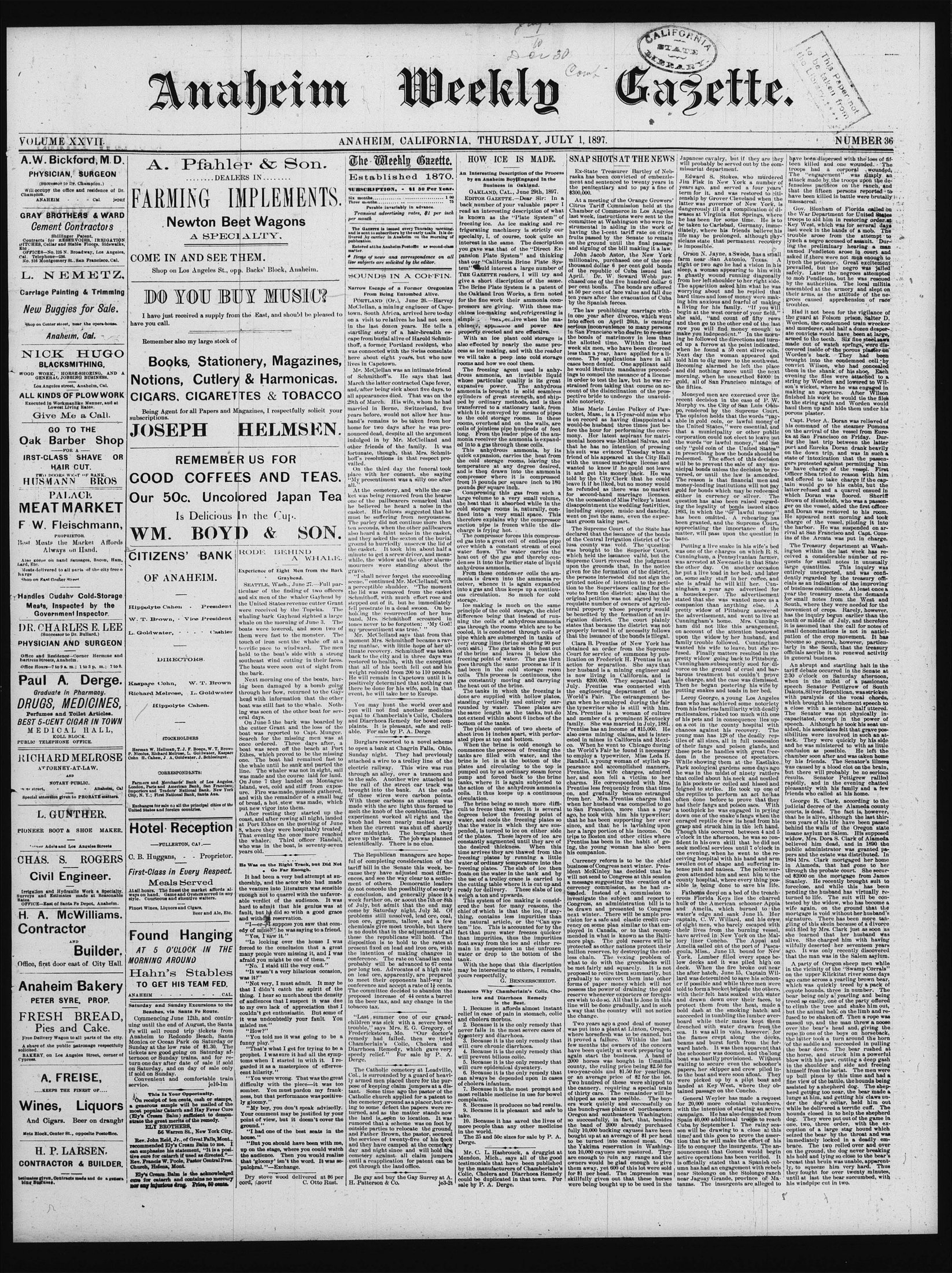
Searchable text
A. W. Bickford, M.D.
PHYSICIAN, SURGEON
(Successor to Dr. Champion.)
Will occupy the office and residence of Dr. Champion.
ANAHEIM - Cal. je24tf
GRAY BROTHERS & WARD
Cement Contractors
Shillinger Patent,
Contracts for KESERVOIRS, IRRIGATION
MITCHES, Cellar and Stable Floors, Sidewalks,
Ete.
OFFICES—No. 125 N. Broadway, Los Angeles,
Cal. Telephone—236.
No. 316 Montgomery St., San Francisco, Cal.
L. NEMETZ.
Carriage Painting & Trimming
New Buggies for Sale.
Shop on Center street, near the opera-house.
Anaheim, Cal.
NICK HUGO
BLACKSMITHING,
WOOD WORK, HORSE-SHOEING, AND A
GENERAL JOBBING BUSINESS.
Los Angeles street, Anaheim, Cal.
ALL KINDS OF PLOW WORK
Executed in Workmanlike Manner, and at
Lowest Living Rates.
Give Me a Call.
GO TO THE
Oak Barber Shop
FOR A
IRST-CLASS SHAVE OR
HAIR CUT.
A. Pfahler & Son.
DEALERS IN...
FARMING IMPLEMENTS.
Newton Beet Wagons
A SPECIALTY.
COME IN AND SEE THEM.
Shop on Los Angeles St., opp. Backs' Block, Anaheim.
DO YOU BUY MUSIC?
I have just received a supply from the East, and should be pleased to have you call.
Remember also my large stock of
Books, Stationery, Magazines,
Notions, Cutlery & Harmonicas.
CIGARS. CIGARETTES & TOBACCO
Being Agent for all Papers and Magazines, I respectfully solicit your subscriptions.
JOSEPH HELMSEN.
REMEMBER US FOR
GOOD COFFees AND TEAS
GO TO THE Oak Barber Shop
FOR A
IRST-CLASS SHAVE OR HAIR CUT.
TWO DOORS WEST OF BANK.
HUSMANN BROS
PALACE MEAT MARKET
F. W. Fleischmann,
PROPRIETOR.
Best Meats the Market Affords Always on Hand.
Also keeps on hand Sansages, Bacon, Ham, Lard, Elec.
Meats delivered to all parts of the city free o harge.
Shop on East Center Street
Handles Cudahv Cold-Storage Meats, Inspected by the Government Inspector.
DR. CHARLES E. LEE
(Successor to Dr. Bullard.)
PHYSICIAN AND SURGEON
Office and Residence—Corner Hermine and heartress Streets, Anaheim.
Office Hours—7 to 9 a.m.; 1 to 3 p.m.; 7 to 8.
Paul A. Derge.
Graduate in Pharmacy.
DRUGS, MEDICINES,
Perfumes and Toilet Articles.
BEST 5-CENT CIGAR IN TOWN MEDICAL HALL,
KOLL BLOCK.
PUBLIC TELEPHONE OFFICE.
RICHARD MELROSE ATTORNEY-AT-LAW.
AND NOTARY-PUBLIC.
Anaheim, Cal
Special attention given to PROBATE matters.
L. GUNTHER.
PIONEER BOOT & SHOE MAKER.
CHAS. S. ROGERS
Civil Engineer.
Irrigation and Hydraulic Work a Specialty. Surveys and Estimates made at Reasonable Los Angeles street, Anaheim, Cal.
ALL KINDS OF PLOWWORK
Executed in Workmanlike Manner, and at Lowest Living Rates.
Give Me a Call.
NOTIONS, Cutlery & Harmonicas.
CIGARS, CIGARETTES & TOBACCO
Being Agent for all Papers and Magazines, I respectfully solicit your subscriptions.
JOSEPH HELMSEN.
REMEMBER US FOR COOD COFFEES AND TEAS.
Our 50c. Uncolored Japan Tea Is Delicious In the Cup.
WM. BOYD & SON.
CITIZENS' BANK OF ANAHEIM.
Hippolyte Cahen President
W. T. Brown Vice President
L. Goldwater Cashier
DIRECTORS.
Kaspare Cohn, W. T. Brown
Richard Melrose, L. Goldwater
Hippolyte Cahen.
STOCKHOLDERS
Herman W. Hellman, T.J. F. Boege, W.T. Brown
P. Nicolus, Richard Melrose, L. Goldwater, Kaspare Cohn H. Cahen, J. A. Goldwater, J. Schlesinger.
CORRESPONDANTS:
Farmers and Merchants' Bank of Los Angeles, London, Paris and American Bank, San Francisco; Importers and Traders' National Bank, New York City, N.Y.; First National Bank, Santa Ana.
Exchanges for sale on all the principal cities of the United States and foreign countries.
Hotel Reception
—FULLERTON, CAI.
C. B. Huggans, Proprietor.
First-Class in Every Respect. Meals Served
At all hours. The finest the market affords always on hand. Game and Oysters served in any style. Courteous and attentive waiters.
RODE BEHIND A WHALE.
Experience of Eight Men from the Bark Grayhead.
SEATTLE, Wash., June 27.—Full particulars of the finding of two officers and six men of the whaler Gayhead by the United States revenue cutter Grant were received by the Topeka. The whaling bark Gayhead sighted a large whale on the morning of June 3. The boats were lowered, and soon two of them were fast to the monster. The touch of iron sent the whale off at a terrific pace to windward. The men held to the boat's side with a strong southeast wind cutting in their faces. The boats were soon out of sight from the bark.
Next morning one of the boats, having been damaged by a bomb going through her bow, returned to the Gayhead with information that the other boat was still fast to the whale. Nothing was seen of the other boat for several days.
On June 5 the bark was boarded by the cutter Grant and the loss of the boat was reported to Capt. Munger. Search for the missing men was at once ordered. Three days after, a boat was seen off the beach at Port Ethes, which proved to be the missing one. The boat had remained fast to the whale until he sank and parted the line. The whaler was not in sight, sail was made and the course laid for land. On June 7 they landed on Montague Island, wet, cold and stiff from exposure. Fire was made, mussels gathered, and with the remainder of a small bag of bread, a hot stew was made, which put new vigor into them.
After resting they started up the coast, and after rowing all night, landed at Port Ethes on the morning of June 8, where they were hospitably treated. That evening the once more reached the whaler. Third officer Randall, who was in the boat, is seventy-seven years old.
He Was on the Right Track, but Did Not Go Far Enough.
It had been a very bad attempt at authorship, and the actor who had made the venture into literature was sensible enough not to quarrel with the unfavorable order of the ordinance. It was
Hotel Reception
—FULLERTON, CA.—
C. B. Huggans, - Proprietor.
First-Class in Every Respect.
Meals Served
At all hours. The finest the market affords always on hand. Game and Oysters served in any style. Courteous and attentive waiters.
Finest Wines, Liquors and Cigars.
Beer and Ale, Etc.
Found Hanging
AT 5 O'CLOCK IN THE MORNING AROUND
Hahn's Stables TO GET HIS TEAM FED.
ANAHEIM
Saturday and Sunday Excursions to the Beaches, via Santa Fe Route.
Commencing June 12th, and continuing until the end of August, the Santa Fe will sell round trip tickets from Anaheim to Redondo Beach, Santa Monica or Ocean Park on Saturday or Sunday at the low rate of $1.30. The tickets are good going on Saturday afternoon or Sunday trains, and for return one day after date of sale if sold on Saturday, and on day of sale only if sold on Sunday.
Convenient and comfortable train service.
This Is Your Opportunity.
On receipt of ten cents, cash or stamps, a generous sample will be mailed of the most popular Catarrh and Hay Fever Cure (Ely's Cream Balm) sufficient to demonstrate the great merits of the remedy.
ELY BROTHERS,
56 Warren St., New York City.
Rev. John Reid, Jr., of Great Falls, Mont., recommended Ely's Cream Balm to me. I can emphasize his statement, "It is a positive cure for catarrh if used as directed."—Rev. Francis W. Poole, Pastor Central Press, Church, Helena, Mont.
Ely's Cream Balm is the acknowledged cure for catarrh and contains no mercury nor any injurious drug. Price, 50 cents.
He Was on the Right Track, but Did Not Go Far Enough.
It had been a very bad attempt at authorship, and the actor who had made the venture into literature was sensible enough not to quarrel with the unfavorable verdict of the audience. It was hard to admit that his genius was at fault, but he did so with a good grace and without reservation.
"I—er—I suppose you saw that comedy of mine!" he was saying to a friend.
"Yes, I saw it."
"In looking over the house I was forced to the conclusion that a great many people were missing it, and I was afraid you might be one of them."
"No. I staid till the very end."
"It wasn't a very hilarious occasion, was it?"
"Not very, I must admit. It may be that I didn't catch the spirit of the thing. I hear so much about the density of audiences that I suspect it was due to my own lack of appreciation that I couldn't get enthusiastic. But some of it was undoubtedly your fault. You misled me."
"How?"
"You told me it was going to be a funny play."
"That's what I get for trying to be a prophet. I was sure it had all the symptoms when I started in with it. I regarded it as a masterpiece of effervescent hilarity."
"You were wrong. That was the great difficulty with the piece—it was too somber. You must pardon my frankness, but that performance was positively gloomy."
"My boy, you don't speak advisedly. Your comment may be justified by your point of view, but it doesn't cover the ground."
"I had one of the best seats in the house."
"But you should have been with me, up on the stage, where you could watch the audience. Then you would realize that 'gloomy' isn't the word. It was popularchal."—Exchange.
Dry stove wood delivered at $6 per cord, novtf C. Otto Rust.
ANAHEIM, CALIFORNIA, THURSDAY, JULY 1, 1897.
SON.
MENTS.
gons
k, Anaheim.
MUSIC?
I should be pleased to
Magazines,
Hermonas.
TOBACCO
pectfully solicit your
MSEN.
OR
THE WEEKLY GAZETTE.
Established 1870.
SUBSCRIPTION, - $150 Per Year.
Six months... 1 00
Three months... 75
Pavable invariably in advance.
Transient advertising rates, $1 per inch per month.
The Gazette is issued every Thursday morning, and is sent to subscribers by the early zails. It is delivered by carrier in Anabeim on the morning of publication.
Entered at the Anabeim Postoffice as second-class matter.
Items of news and correspondence on all live subjects are solicited by the editor.
SOUNDS IN A COFFIN.
Narrow Escape of a Former Oregonian From Being Entombed Alive.
PORTLAND (Or.), June 26.—Harvey McClellan, a mining engineer of Capetown, South Africa, arrived here to-day on a visit to relatives he had not seen in the last dozen years. He tells a startling story of a hair-breadth escape from burial alive of Harold Schmitthoff, a former Portland resident, who was connected with the Swiss consulate here about eight years, but who now lives in Capetown.
Mr. McClellan was an intimate friend of Schmitthoff's. He says that last March the latter contracted Cape fever, and, after being sick about five days, to all appearances died. That was on the 29th of March. His wife, whom he had married in Berne, Switzerland, five years before, would not allow her husband's remains to be taken from her home for two days after he was pronounced dead, despite all the argument indulged in by Mr. McClelland and other friends of the family. It was fortunate, though, that Mrs. Schmitthoff's resolutions in that respect prevailed.
On the third day the funeral took place with her consent, she saving HOW ICE IS MADE.
An Interesting Description of the Process by an Anaheim Boyl Engaged In the Business in Oakland.
OAKLAND, CAL., June 29th, 1897.
EDITOR GAZETTE.—Dear Sir: In a back number of your valuable paper I read an interesting description of what is known as the "Plate System" of freezing ice. As ice making and refrigerating machinery is strictly our specialty, I, of course, took quite an interest in the same. The description you gave was that of the "Direct Expansion Plate System" and thinking that our "California Brine Plate System" could interest a large number of THE GAZETTE readers, I will try and give a short description of the same. The Brine Plate System is a patent of the Oakland Iron Works, a firm noted for the fine work their ammonia compressors are giving. With these machines ice-making and refrigerating is simple; expensive when the machine, appliance and power are properly erected and are effective.
With an ice plant cold storage is also effected by nearly the same process as ice making, and with the reader we will take a peep into cold storage rooms and how we cool them.
The freezing agent used is anhydrous ammonia, an invisible liquid whose particular quality is its great expansive power. The anhydrous ammonia is brought in solid seamless cylinders of great strength, and shipped by ordinary methods, and is then transferred to a stationary tank, from which it is conveyed by means of pipes to the cold storage rooms. In these rooms, overhead and on the walls, are coils of jointless pipe hundreds of feet long. From the leader pipe of the ammonia receiver the ammonia is expanded into a gas through these coils.
This anhydrous ammonia, by its quick expansion, carries the heat from the cold storage rooms, leaving the temperature at any degree desired, and is then drawn into the ammonia SNAP SHOTS AT THE NEWS.
Ex-State Treasurer Bartley of Nebraska has been convicted of embezzlement and sentenced to twenty years in the penitentiary and to pay a fine of $300,000.
At a meeting of the Orange Growers' Citrus Tariff Commission held at the Chamber of Commerce in Los Angeles last week, instructions were sent to the committee at Washington who were instrumental in alding in the work of having the 1-cent tariff rate on citrus fruits passed by the Senate to remain on the ground until the final passage and signing of the bill making it a law.
John Jacob Astor, the New York millionaire, purchased one of the one-thousand dollar 6 per cent gold bonds of the republic of Cuba issued last April. Dr. W. Seward Webb purchased one of the five hundred dollar 6 per cent bonds. The bonds are offered at 50 per cent of face value and fall due ten years after the evacuation of Cuba by the Spanish forces.
The law prohibiting marriage within one year after divorce, which went into effect on April 26th, is causing serious inconvenience to many persons in San Francisco who desire to re-enter the bonds of matrimony in less than the allotted time. Within the last week six men, who have been divorced less than a year, have applied for a license. The applications have in all cases been denied. One applicant said he would institute mandamus proceedings to compel the issuance of a license in order to test the law, but he was restrained from taking that course on account of the disinclination of the prospective bride to undergo the unavoidable notoriety.
Miss Marie Louise Pelkey of Pawtucket, Mass., is a 17-year-old miss who is on record as having disappointed a would-be husband three times just before the hour for performing the ceremony. Her latest aspirant for matrimonial honors was Michael Salvas, and that he has no intention of pressing his suit was evinced Tuesday when a friend of his appeared at the City Hall with the unused marriage license and wanted to know if he could not leave it and get his money back. He was
March the latter contracted Cape fever, and after being sick about five days, to all appearances died. That was on the 29th of March. His wife, whom he had married in Berne, Switzerland, five years before, would not allow her husband's remains to be taken from her home for two days after he was pronounced dead, despite all the argument indulged in by Mr. McClelland and other friends of the family. It was fortunate, though, that Mrs. Schmithoff's resolutions in that respect prevailed.
On the third day the funeral took place with her consent, she saying "My presentiment was a silly one after all."
At the cemetery, and while the casket was being removed from the hearse one of the pallbearers remarked that he believed he heard a noise in the casket. His fellows suggested that he must be suffering from neryousness. The parley did not continue more than ten seconds, when the other pallbearers also heard a faint noise in the casket, and they asked the sexton of the burial ground to hurriedly unsew the lid of the casket. It took him about half a minute to get a screw driver, and meanwhile, the widow and the other alarm-mourners were standing about the grave.
"I shall never forget the succeeding scene," continued Mr. McClelland, with a perceptible shudder. "The moment the lid was removed from the casket Schmithoff, with much effort rose and stepped out of it, but he immediately fell prostrate in a dead swoon. On beholding the resurrection of her husband, Mrs. Schmithoff screamed in tones never to be forgotten: 'My God! my presentment was true.'"
Mr. McClelland says that from that moment Mrs. Schmithoff became a raving maniac, with little hope of her ultimate recovery. Schmithoff was taken back to the city and in three days was restored to health, with the exception that all of his teeth fell out and his weight reduced from 200 to 110 pounds. He will remain in Capetown until it is positively determined that nothing can there be done for his wife, and, in that event, he will take her to Europe.
You may hunt the world over and you will not find another medicine equal to Chamberlain's Colic, Cholera and Diarrhea Remedy for bowel complaints. It is pleasant, safe and reliable. For sale by P. A. Derge.
Burglaries resorted to a novel scheme to open a bank at Chagrin Falls, Ohio, Sunday night. They had previously attached a wire to a trolley line of the electric railway. This wire was run through an alley, over a transom and to the safe. Another wire attached to the rail of the street car track was brought into the bank. At the ends of these wires were carbon points. With these carbons an attempt was made with the arc light thus formed to melt the knob of the combination. The experiment worked all right and the knob had been nearly melted away when the current was shut off shortly after midnight. The burglaries then gave up the task. The job was planned scientifically. There is no clue.
The Republican managers are hopeful of completing consideration of the tariff bill in the Senate this week, because they have adjusted most differences, and see the way clear to a settlement of others. Democratic leaders do not concede the possibility of so early a conclusion, and generally place it a week further on account of the 5th amendment.
The anhydrous ammonia, an invisible liquid whose particular quality is its great expansive power. The anhydrous ammonia is brought in solid seamless cylinders of great strength, and shipped by ordinary methods, and is then transferred to a stationary tank, from which it is conveyed by means of pipes to the cold storage rooms. In these rooms, overhead and on the walls, are coils of jointless pipe hundreds of feet long. From the leader pipe of the ammonia receiver the ammonia is expanded into a gas through these coils.
This anhydrous ammonia, by its quick expansion, carries the heat from the cold storage rooms, leaving the temperature at any degree desired, and is then drawn into the ammonia compressor where it is compressed from 15 pounds per square inch to 180 pounds per square inch.
Compressing this gas from such a large volume to a very small volume, the heat that it absorbed while in the cold storage rooms is naturally, confined into a very small space. This therefore explains why the compressor suction pipe is frozen while the discharge is frying hot.
The compressor forces this compressed gas into a great coil of endless pipe over which a constant stream of cool water flows. The water carries the heat out of the gas and thereby condenses it into the former state of liquid anhydrous ammonia.
From these condenser coils the ammonia is drawn into the ammonia receiver, whence it is again expanded into a gas and thus keeps up a continuous circulation. So much for cold storage.
Ice making is much on the same principle of the cold storage, the chief difference being that instead of running the coils of anhydrous ammonia gas through the rooms which are to be cooled, it is conducted through coils of pipe which are submerged in tanks of very strong lime (brine showing 90 percent salt.) The gas takes the heat out of the brine and leaves it below the freezing point of water. The gas then goes through the same process as if it had been in the cold storage room coils. This process is continuous, the gas constantly moving and carrying the heat out of the brine.
The tanks in which the freezing is done are supplied with hollow plates, standing vertically and entirely surrounded by water. These plates are the same length as the tanks, but do not extend within about 6 inches of the bottom of the tanks.
The plates consist of two sheets of sheet iron 14 inches apart, with perforated pipes at top and bottom.
When the brine is cold enough to commence the process of freezing the tanks are filled with water, and the brine is let in at the bottom of the plates and circulating to the top is pumped out by an ordinary steam force pump and forced back to the brine tanks, where it is again subjected to the action of the anhydrous ammonia coils. It thus keeps up a continuous circulation.
The brine being so much more difficult to freeze than water, it is several degrees below the freezing point of water, and cools the freezing plates so that the water in which they are suspended, is turned to ice on either side of the plates. These layers of ice are constantly augmented until they are of the desired thickness. When this time arrives they are thawed from the freezing plates by running a little water of ordinary temperature into the freezing plates. The slab of ice then floats on the water in the tank and by use of a trolley crane is carried to the cutting table where it is cut up and ready for delivery. These slabs of ice weigh a ton and upwards.
Miss Marie Louise Pelkey of Pawtucket, Mass., is a 17-year-old miss who is on record as having disappointed a would-be husband three times just before the hour for performing the ceremony. Her latest aspirant for matrimonial honors was Michael Salvas, and that he has no intention of pressing his suit was evinced Tuesday when a friend of his appeared at the City Hall with the unused marriage license and wanted to know if he could not leave it and get his money back. He was told by the City Clerk that he could leave it if he liked, but no money would be refunded as there was no market for second-hand marriage licenses. On the occasion of Miss Pelkey's latest disappointmentthe wedding festivitiesincluding supper,music,and dancingwent on justthe same,eventhe expectant groom taking part.
The Supreme Court ofthe State has declared thatthe issuanceofthe bondsofthe Central Irrigation districtofColusa countywas void.The questionwas broughttotheSuperiorCourtwhichheldtheissuancevalid,buttheSupreme Courtreversedthejudgmentuponthegroundsthat.inthenoticegivenfortheformationofthedistrict,thepersonsinteresteddidnotsigntheprint noticeofintentiontothepetitiontotheSupervisorscallingforthevotetoformthedistrict;alsothattheoriginalpetitionwasnot signedbytherequisitenumberofownersofagriculturalpropertywhosepropertywouldbebenefitedbytheformationofanirrigationdistrict.Thecourtplainstatesthatbecausethedistrictwasnotproperlyformeditofnecessityfollowsthattheissuanceofthebondsisfillegal.
Clara B.PrentissofNewYorkhasobtainedanorderfromtheSupremecourtforserviceofsummonsbypublicationonFrederickH.Prentissinanactionforseparation.She says thatherhusbandisaminingengineerandisnow livinginCalifornia,andisworth$200,000.TheyseparatedlastJuly.PrentisswasconnectedwiththeengineeringdepartmentoftheWorld'SFair.Theestragementbeginwhenheemployedduringthefairthetypewriterwhoisstillwithhim.Mrs.PrentissisawomanofcultureandmemberofaprominentKentuckyfamily.ShewasmarriedinJuly1881.Prentisshasanincomeof$15,000.Healsoownsminingclaims,andisinterestedinminesinCaliforniaandMexico.当hewenttoChicago duringtheWorld'SFairhefounditnecessarytoemployatypewriter,MissLedaB.Randall,ayoungwomanofstylishappearanceandaccomplishedmanners.Prentiss,hiswifecharges,admiredher,andsofallavictimtohercharms.HerecorrespondedwithMrs.Prentisslessfrequentlyfromthattimeon,andgraduallybecameestrangedfromher.Mrs.PrentisschargesthatwhenherhusbandwascompelledtogotoSanFrancisco,morethanayearago,hie tookwithhimhistypewriter;thathehasbeensupportinghereversince,andthathelavishingupheralargeportionofhisincome.OntripstoBostonandothercitieswherePrentisshasbeeninthehabitofgoing,theyoungwomanhasalsobeenhis companion.
Currency reformistobethechiefbusinessOf Congressnext winter.PresidentMcKinleyhasdecidedthathewillnotsendtoCongressatthissessionamessage suggestingthecreationofacurrencycommission.ashehadintended.Insteadofacmissiontoinvestigatethesubjectandreportto
With these carbons an attempt was made with the arc light thus formed to melt the knob of the combination. The experiment worked all right and the knob had been nearly melted away when the current was shut off shortly after midnight. The burglars then gave up the task. The job was planned scientifically. There is no clue.
The Republican managers are hopeful of completing consideration of the tariff bill in the Senate this week, because they have adjusted most differences, and see the way clear to a settlement of others. Democratic leaders do not concede the possibility of so early a conclusion, and generally place it a week further on, or about the 7th or 8th of July, but admit that the end may come by Saturday night, July 3d. Of problems still unsolved, lead ore, coal, iron ore, gypsum, tallow, and a few chemicals give most trouble, but there is no doubt that in the adjustment of all these republicans will hold. The disposition is to hold to the rates at present fixed on lead and iron ore, with the intention of making changes in conference. The rate on Canadian coal probably will be advanced 67 cents per long ton. Advocates of a high rate on lead ore, apparently, are prepared to meet their opponents half-way in conference and accept a rate of 14 cents. The committee decided to abandon the proposed increase of 44 cents a barrel in the beer tax, and any change in the tobacco tax.
"Last summer one of our grandchildren was sick with a severe bowel trouble," says Mrs. E. G. Gregory, of Frederickstown, Mo. "Our doctor's remedy had failed, then we tried Chamberlain's Colic, Cholera and Diarrhoea Remedy, which gave very speedy relief." For sale by P. A. Derge.
The Catholic cemetery at Leadville, Col., is surrounded by a guard of heavily armed men placed there for the purpose of keeping claim jumpers at a distant. Some time ago the pastor of the Catholic church applied for a patent to the cemetery ground as a placer, but owing to some defect the papers were returned, and as the matter stands now the land is open to location. It was rumored that a scheme was on foot by outside parties to relocate the ground, and Father Brown, the pastor, secured the services of twenty-five of his stock and they have camped at the cemetery day and night since and will hold the cemetery against all claim jumpers until a reapplication for patent can be got through the land office.
Be gay and buy the Gay Surrey at A. H. Patterson & Co.
The brine being so much more difficult to freeze than water, it is several degrees below the freezing point of water, and cools the freezing plates so that the water in which they are suspended, is turned to ice on either side of the plates. These layers of ice are constantly augmented until they are of the desired thickness. When this time arrives they are thawed from the freezing plates by running a little water of ordinary temperature into the freezing plates. The slab of ice then floats on the water in the tank and by use of a trolley crane is carried to the cutting table where it is cut up and ready for delivery. These slabs of ice weigh a ton and upwards.
This system of ice making is considered the best for many reasons, the chief of which is that the ice, if anything, contains less impurities than the natural article, or the "Can system" ice. This is accounted for by the fact that pure water freezes quicker than impurities, thus the impurities float away from the ice and either remain in suspension in the unfrozen water or drop to the bottom of the tank.
With the hope that this description may be interesting to others, I remain, yours respectfully,
G. BENNERSCHEIDT.
Reasons Why Chamberlain's Colic, Cholera and Diarrhoea Remedy is the Best.
1. Because it affords almost instant relief in case of pain in stomach, colic and cholera morbus.
2. Because it is the only remedy that never fails in the most severe cases of dysentery and diarrhoea.
3. Because it is the only remedy that will cure chronic diarrhoea.
4. Because it is the only remedy that will prevent bilious colic.
5. Because it is the only remedy that will cure epidemical dysentery.
6. Because it is the only remedy that can always be depended upon in cases of cholera infantum.
7. Because it is the most prompt and most reliable medicine in use for bowel complaints.
8. Because it produces no bad results.
9. Because it is pleasant and safe to take.
10. Because it has saved the lives of more people than any other medicine in the world.
The 25 and 50c sizes for sale by P. A. Derge.
Mr. C. L. Hasbrouck, a druggist at Mendon, Mich., says all of the good testimonials that have been published by the manufacturers of Chamberlain's Colic, Cholera and Diarrhoea Remedy could be duplicated in that town. For sale by P. A. Derge.
Currency reform is to be the chief business of Congress next winter. President McKinley has decided that he will not send to Congress at this session a message suggesting the creation of a currency commission, as he had intended. Instead of a commission to investigate the subject and report to Congress, an administration bill is to be drawn and presented to Congress next winter. There will be ample provision for a safe and elastic credit currency on some plan similar to that employed in Canada, or to that recommended in what is known as the Baltimore plan. The gold reserve will be protected as other nations protect their bullion reserves, by destroying the endless chain. The vexing problem of what to do with the greenbacks will be met fairly and squarely. It is not proposed to retire them summarily, but gradually to convert them into other forms of paper money which will not possess the power of draining the gold reserve whenever exporters or foreigners wish to do so. All that is done in this line will be done gradually, and in such a way that the country will not notice the change.
Two years ago a good deal of money was put into a plant at Linton, Oregon, where horseflesh was to be canned, but it proved a failure. Within the last few months the owners of the concern have been quietly at work preparing to again start the business. A band of 2000 horses was bought in Umatilla county, the ruling price being $2.50 for two-year-olds and $1.50 for yearlings, or an average price of $2 for the lot. Two hundred of these were shipped to the cannery, requiring a special train of thirty cars. The remainder will be shipped as soon as possible. The buyers work quietly and successfully on the bunch-grass plains of northeastern Oregon and southeastern Washington; so successfully, in fact, that, besides the band of 2000 already purchased fully 10,000 bucking cayuses have been bought up at an average of $1 per head to be turned into canned meat. On the Yakima reservation in Washington 10,000 cayuses are pastured. They are enough to ruin any range and the owners would be glad enough to give them away, yet 600 of this lot were sold for $1 per head. The impression was skillfully given out that these horses were being bought up to be used in the
HOTS AT THE NEWS
The Treasurer Bartley of Nebbeen convicted of embezzlesentenced to twenty years in
incertiary and to pay a fine of
eting of the Orange Growers'
Griff Commission held at the
of Commerce in Los Angeles
instructions were sent to the
at Washington who were inalding in the work of
the 1-cent tariff rate on citrus
by the Senate to remain
until the final passage
of the bill making it a law.
Jacob Astor, the New York
purchased one of the onedollar 6 per cent gold bonds
public of Cuba issued last
year. W. Seward Webb pursued of the five hundred dollar 6
bonds. The bonds are offered
ent of face value and fall due
after the evacuation of Cuba
nish forces.
prohibiting marriage wither after divorce, which went
on April 26th, is causing
convenience to many persons
enciso who desire to re-enter
of matrimony in less than
ed time. Within the last
ten, who have been divorced
year, have applied for a lice
applications have in all denied. One applicant said
institute mandamus proceedpel the issuance of a license
test the law, but he was rem taking that course on accide disinclination of the proxsible to undergo the unavoidalty.
Erie Louise Pelkey of Pawsas, is a 17-year-old miss who
has as having disappointed a
husband three times just beer for performing the aspirant for matriors was Michael Salvas, and
has no intention of pressing
was evinced Tuesday when a
was appeared at the City Hall
used marriage license and
know if he could not leave
his money back. He was
Japanese cavalry, but if they are they will probably be served out by the commissariat department.
Edward S. Stokes, who murdered Jim Fisk in New York a number of years ago, and served a four years' term for it, and was restored to citizenship by Grover Cleveland when the latter was governor of New York, is dangerously ill of a complication of diseases at Virginia Hot Springs, where he has been for some time. He is to be taken to Carlsbad, Germany, immediately, where his friends believe his life may be prolonged, although physicians state that permanent recovery is impossible.
Orson N. Jayne, a Swede, has a small farm near San Antonio, Texas. A night or two ago he had a vision in his sleep, a woman appearing to him with a ghastly wound running diagonally from her left shoulder to her right side. The apparition asked him what he was worrying about and he replied that hard times and loss of money were making him anxious and fearful of making a living for his family. "If you will begin at the west corner of your field," she said, "and count off fifty rows and then go to the other end of the last row you will find money enough to make you independent." In the morning he followed directions and turned up a furrow at the point indicated, when he found a 50 cent silver coin. Next day the woman appeared and told him to dig more to the southwest. Becoming alarmed he left the place and did nothing more until the next morning, when he unearthed $4000 in gold, all of San Francisco mintage of the fifties.
Money men are exercised over the recent decision in the case of P. W. Murphy vs. the City of San Luis Obispo, rendered by the Supreme Court. The opinion holds that the words "payable in gold coin, or lawful money of the United States," were essential, and that a municipality or other public corporation could not elect to leave out the words "or lawful money," and use only "gold coin of the United States" in prescribing how the bonds should be redeemed. The effect of this decision will be to prevent the sale of any municipal bonds unless the decision be reversed, or until the law is amended.
have been dispersed with the loss of fifteen killed and one wounded. The troops had a corporal wounded. The "engagement" was simply an attack made by the troops upon the defenseless pacificos on the ranch, and that the fifteen persons reported to have been killed in battle were brutally massacred.
Gov. Bloxham of Florida called on the War Department for United States troops to aid him in restoring order at Key West, which was for several days last week in the hands of a mob. The trouble arose from the attempt to lynch a negro accused of assault. During the preliminary hearing a man named Pendleton arose in court and asked if there were not men enough to lynch the prisoner. Great excitement prevailed, but the negro was jailed safely. Later the negroes attempted to mob Pendleton, but he was rescued by the authorities. The local militia assembled at the armory and slept on their arms, as the attitude of the negroes caused apprehension of race troubles.
Had it not been for the vigilance of the guard at Folsom prison, Salter D. Worden, the condemned train wrecker and murderer, and half a dozen desperate convicts would have been at large, armed to the teeth. Six fine steel saws made out of watch springs, were discovered inside of the porous plaster on Worden's back. They had been brought into the condemned cell by convict Wilson, who had concealed them in the shank of his shoe. Each evening the files were attached to a string by Worden and lowered to Wilson's wicket, where he was engaged in making an aperture. After Wilson finished his work he would tie the files to the string again and Worden would haul them up and hide them under his porous plaster.
Capt. Peter A. Doran was relieved of his command of the steamer Pomona on the arrival of the vessel from Eureka at San Francisco on Friday. During the last trip between the latter port and Eureka Doran drank heavily on the down trip, and was in such a state of intoxication that the passengers protested against permitting him to have charge of the vessel. First Officer Shea tried to reason with him
The issuance of a license test the law, but he was re-taking that course on account of the disinclination of the proside to undergo the unavoidable morning, when he unearthed $4000 in gold, all of San Francisco mintage of the fifties.
Money men are exercised over the recent decision in the case of P.W. Murphy vs. the City of San Luis Obispo, rendered by the Supreme Court. The opinion holds that the words "mayable in gold coin, or lawful money of the United States," were essential, and that a municipality or other public corporation could not elect to leave out the words "or lawful money," and use only "gold coin of the United States" in prescribing how the bonds should be redeemed. The effect of this decision will be to prevent the sale of any municipal bonds unless the decision be reversed, or until the law is amended. The reason is that financial men and money-lending institutions will not pay gold for bonds which may be redeemed either in currency or silver. The question has also been raised regarding the legality of bonds issued since 1893, in which the "or lawful money" has been omitted. A rehearing has been granted, and the Supreme Court, appreciating the importance of the matter, will pass upon the question in banc.
Putting a live snake in his wife's bed was one of the charges on which R.S. Cunningham, a Pennsylvanian farmer, was arrested at Newcastle in that State other day. On another occasion he put a live toad in her bed, and later on, some salty stuff in her coffee, and she is afraid he will kill her. Cunningham a year ago advertised for a housekeeper. The advertisement stated that she was wanted more as a companion than anything else. A pretty widow of Pittsburg answered the advertisement, and went to live at Cunningham's home. Mrs. Cunningham did not like this arrangement, on account of the attention bestowed upon the widow by her husband, and family trouble followed. Cunningham wanted his wife to leave, but she refused. Finally matters resulted in the pretty widow going back to Pittsburg. Cunningham subsequently sued for divorce on the ground of cruel and barbarous treatment but couldn't prove his charge, and the case was dismissed. Then he began pestering his wife by putting snakes and toads in her bed.
Leroy George, a young Los Angeles man who has achieved some notoriety from his fearless familiarity with deadly rattlesnakes, risked too much with one of his pets and in consequence lies up on a cot in the county hospital with chances against his recovery. The young man has 128 of the deadly reptiles of all sizes, all in full possession of their fangs and poison glands, and these pets he handles with great freedom in the presence of spectators. While showing them at the Eastlake Park zoological gardens some days ago he was in the midst of ninety rattlers that coiled about his neck and nestled in his pockets or coiled and hissed and feigned to strike. He took up one of the reptiles to perform an act he has often done before to prove that they had their fangs and poison sacs. With a toothpick he was engaged in prying down one of the snake's fangs when the enraged reptile drew its head from his grasp and struck him in the left hand. Though this occurred between 4 and 5 o'clock in the afternoon, he was so confident in his own skill that he did not seek medical services until 7 o'clock in the evening, when he went to the receiving hospital with his hand and arm swollen out of shape and suffering intense pain and nausea. The police surgeon attended him and sent him to the county hospital, where every thing possible is being done to save his life.
Fathoms deep on a bed of the treacherous Florida Keys lies the charred evening files were attached to a string by Worden and lowered to Wilson's wicket, where he was engaged in making an aperture. After Wilson finished his work he would tie the files to the string again and Worden would haul them up and hide them under his porous plaster.
Capt. Peter A. Doran was relieved of his command of the steamer Pomona on the arrival of the vessel from Eureka at San Francisco on Friday. During the last trip between the latter port and Eureka Doran drank heavily on the down trip, and was in such a state intoxication that the passengers protested against permitting him to have charge of the vessel. First Officer Shea tried to reason with him and offered to take charge if the captain would go to his cabin, but the latter refused and a quarrel ensued in which Doran was floored. Sheriff Brown of Humboldt, who was a passenger on the vessel, aided the first officer and Doran was removed to his room. He appeared next morning and took charge of the vessel, piloting it into the harbor. He was suspended on arrival at San Francisco and Capt. Cousins of the Arcata was put in charge.
The Treasury department at Washington within the last week has received a considerable number of requests for small notes in unusually large quantities. This inquiry was entirely unexpected, and was confidently regarded by the treasury officials as an indication of the improving business conditions. At least once a year the treasury meets the demands for small notes from the West and South, where they were needed for the movement of crops. Rarely, however, has the inquiry begun earlier than the tenth or middle of July, and therefore it is assumed that the call for notes of small denominations is not in anticipation of the crop movement. It has become so general, however, particularly in the South, that the treasury officials ascribe it to renewed activity in general business.
An abrupt and startling halt in the tariff debate occurred in the Senate at 2:30 o'clock on Saturday afternoon, when in the midst of a passionate speech Senator Pettigrew of South Dakota, Silver Republican, was stricken with paralysis of the vocal chords, which brought his vehement speech to a close with a sentence half uttered. The Senator was not physically incapacitated, except in the power of speech. Although he took his seat unaided, his associates felt that grave possibilities were involved in such an attack. They were quickly by his side and he was ministered to with as little confusion as possible. He left the chamber soon after and was taken home by his friends. The Senator's illness was caused by a blood clot on the brain, but there will probably be no serious results. Senator Pettigrew rallied rapidly, and in the evening chatted pleasantly with his family and a few friends who called at his home.
George R. Clark, according to the judicial decree of the Alameda county courts, is dead. The fact is, however, that he is alive, although the last thirteen years of his life have been passed behind the walls of the Oregon state insane asylum at Salem. His supposed widow, Mrs. Dora S. Clark of Alameda believed him dead, and in 1890 the public administrator was granted papers and the estate was distributed. In 1894 Mrs. Clark mortgaged her home in Alameda, that had gone to her through the probate court. She secured $2000 on the mortgage from James Stanley. He recently brought suit to foreclose, and while this has been pending the husband has virtually returned to life. The suit will be con-
Mrs. Prentiss charges that husband was compelled to go to Francisco, more than a year after being with him his typewriter; been supporting her ever since that he is lavishing upon the portion of his income. On Boston and other cities where he has been in the habit of goung woman has also been reformed is to be the chief Congress next winter. Présinley has decided that he had to Congress at this session suggesting the creation of a commission, as he had instead of a commission to the subject and report to an administration bill is to stand presented to Congress. There will be ample prosafe and elastic credit curreme plan similar to that emmanuela Canada, or to that recommend what is known as the Balti-The gold reserve will be used other nations protect theirerves, by destroying the endangered. The vexing problem of the with the greenbacks will only and squarely. It is not yet retired them summarily, but they convert them into other paper money which will not power of draining the gold whenever exporters or foreign-do so. All that is done gradually, and in such the country will not notice it ago a good deal of money into a plant at Linton, Oregon, selfish was to be canned, but failure. Within the last few years the owners of the concern quietly at work preparing to set the business. A band of horses was bought in Umatilla the ruling price being $2.50 for hides and $1.50 for yearlings, average price of $2 for the lot. Need of these were shipped to New York, requiring a special train cars. The remainder will be soon as possible. The buy-quietly and successfully on grass plains of northeastern and southeastern Washington; fully, in fact, that, besides of 2000 already purchased bucking cayuses have been taken at an average of $1 per head into canned meat. On a reservation in Washing-away uses are pastured. They do not ruin any range and the horse be glad enough to give yet 600 of this lot were sold ahead. The impression was driven out that these horses were bought up to be used in the often done before to prove that they had their fangs and poison sacs. With a toothpick he was engaged in prying down one of the snake's fangs when the enraged reptile drew its head from his grasp and struck him in the left hand. Though this occurred between 4 and 5 o'clock in the afternoon, he was so confident in his own skill that he did not seek medical services until 7 o'clock in the evening, when he went to the receiving hospital with his hand and arm swollen out of shape and suffering intense pain and nausea. The police surgeon attended him and sent him to the county hospital, where every thing possible is being done to save his life.
Fathoms deep on a bed of the treacherous Florida Keys lies the charred hulk of the American schooner Appia and Amelia, which burned to the water's edge and sank June 15. Her captain, C.W. Willard, and his crew of eight men, who barely escaped with their lives from the burning vessel, have arrived in New York on the Mallory liner Concho. The Appai and Amelia sailed out of the port of Pascagoula, Miss., June 13, bound for New York. Lumber filled every space below decks and it was piled high on deck. When the fire broke out near the after hatch, June 15, Captain Willard was determined to save his schooner if possible and while three men were told to form a bucket brigade the others, with their felt hats soaked with water and drawn down over their faces, to protect them from the heat, made a bold dash at the smoking hatch and succeeded in tumbling the lumber overboard while their mates kept them drenched with water drawn from the sea. It was all in vain, however, for the flames creep along the decks, beams and burst forth from the forward hatch. It was then apparent that the schooner was doomed, and the long boat was hastily provisioned. Without waiting to secure even the schooner's papers, her skipper and crew piled into the boat and were soon afloat. They were picked up by a pilot boat and landed at Key West, where they obtained passage on the Concho.
General Weyler has made a request for 20,000 more colonial volunteers, with the intention of starting an active campaign. He has also demanded from Spain 40,000 additional troops to reach Cuba by September 1. The rainy season will be drawing to a close at this time, and this goes to prove the assertion that he will make the effort of his life to conquer the insurgents. The announcement that Gomez would begin active operations has been verified. It is officially stated that a Spanish column has had an engagement with rebels near Stolongo on the Stolongo ranch near Jaguay Grande, province of Matanzas. The insurgents are alleged to George R. Clark, according to the judicial decree of the Alameda county courts, is dead. The fact is, however, that he is alive, although the last thirteen years of his life have been passed behind the walls of the Oregon state insane asylum at Salem. His supposed widow, Mrs. Dora S. Clark of Alameda believed him dead, and in 1890 the public administrator was granted papers and the estate was distributed. In 1894 Mrs. Clark mortgaged her home in Alameda, that had gone to her through the probate court. She secured $2000 on the mortgage from James Stanley. He recently brought suit to foreclose, and while this has been pending husband has virtually returned to life. The suit will be contested by the widow, who has become a wife again, on the ground that the mortgage is void without her husband's signature. There has been more tangling of this skein because of a divorce suit filed by Mrs. Clark just as soon as she learned that her husband was alive. She charged him with having wilfully deserted her seventeen years ago. It was only recently discovered that the man was in the Salem asylum.
A party of Oregon sheep men while in the vicinity of the "Swamp Corrals" on the upper Klickitat river some days ago came across a yearling brown bear, which was quickly treed by a pack of coyote hounds, three in number. The bear being only a yearling and being treed so easily, one of the party offered to climb the tree and shake him out, but the animal held on the limb and refused to be shaken off. Then a rope was passed up, and the man threw a noose over the bear's head and, giving the rope to one of the boys on horseback, the latter took a turn around the horn of the saddle and succeeded in pulling the bear down. The bear rushed at the horse, and struck him a powerful blow with his paw, cutting a deep gash in the shoulder and side and freeing himself from the lariat. The men were up bull pines by this time and had a fine view of the battle, the hounds being assisted by a shepherd dog. The shepherd getting too near, the bear made a lunge at him, and getting his claws under the dog's collar, held him out while he delivered a terrific cuff. The hounds closed in to help shepherd dog. They were put out of the game in one, two, three order, with the exception of a large stag hound which seized the bear by the throat and was immediately locked in a deadly embrace. The two rolled over and over on the ground, the dog never breaking his hold and lying so close to the bear's breast that bruin was unable, apparently, to squeeze him very hard. Thus they fought for over twenty minutes, until at last the bear succumbed, with his windpipe cut in two.