anaheim-gazette 1897-06-24
Scanned page
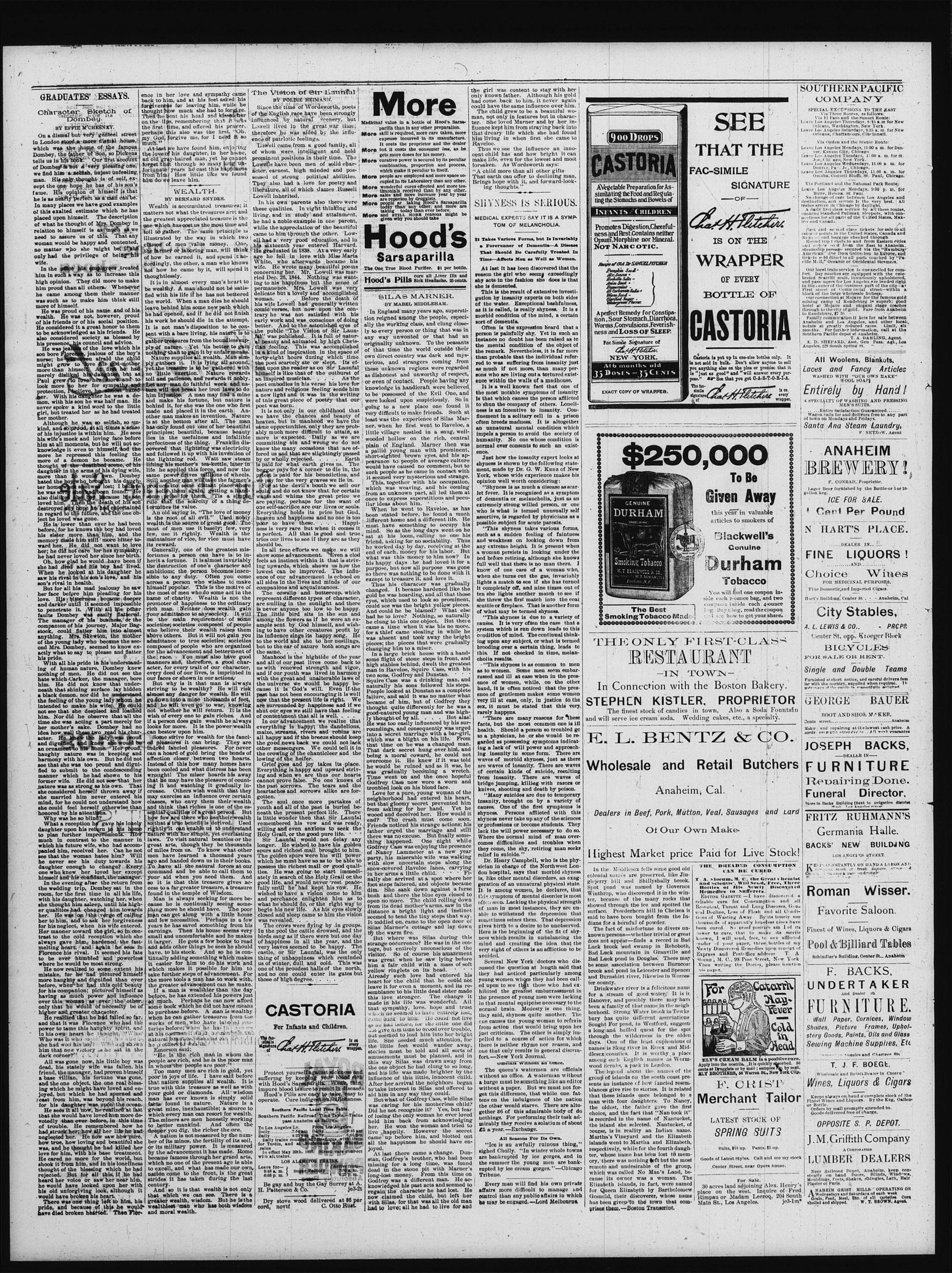
Searchable text
GRADUATES' ESSAYS.
Charaoter Sketch of Dombey.
BY EFFIE M'CHESNEY.
On a dismal but very genteel street in London stood a more dismal house, which was the home of the famous Dombey, the father of Son, so Dickens tells us in his book. Our first account of Dombey is not a very pleasing one; we find him a selfish, unjust ineffecient man. His only thought is of self, except the one hope he has of his son's fame. His opinion of himself is that he is as nearly perfect as a man can be. In many places we have good examples of this exalted estimate which he has placed upon himself. The description of what he thought of Mrs. Dombey in relation to himself is as much as we need to assure us of this. That any woman would be happy and contented, no matter who she might be, if she only had the privilege of being his wife.
In the office his employees treated him in such a way as to increase this high opinion. They did more to make him proud than all others. Whenever he came among them their manner was such as to make him think still more of himself.
He was proud of his name and of his wealth. He was not, however, proud of his friends or of his social position. He considered it a great honor to them to be acknowledged as his friends. He also considered society as blessed by his presence, his council and advice.
He was jealous of the love which his son bore Florence, jealous of the boy's nurse; he was even afraid the child might grow to love his god-mother more than himself. At first he had merely disliked his daughter, but as Paul grew to love her more and to look more to her for sympathy and protection, I believe, he almost hated her. With his daughter he was a demon, with his son he was half man. He never spoke a kind word to the little girl, but treated her as he had treated her mother.
Although he was so selfish, so unkind, and so proud, at all times a sense of his injustice is within him. He sees his wife's meek and loving face before him at all moments, but he will not acknowledge it even to himself, and the more he repressed this feeling the more of a demon he became. He thought of the deathbed scene, of his daughter in the arms of his dying wife,
ence in her love and sympathy came back to him, and at his feet asked his forgiveness for leaving him, while he thought how much she had to forgive. Then he bent his head and kissed her on the lips, remembering that it was the first time, and offered his prayer, perhaps this also was the first. "Oh, my God, forgive me, for I need it so much."
At last we have found him, enjoying the love of his daughter, in her home, an old gray-haired man, yet he cannot forget that through so many long unfortunate years he cast this happiness from him. How little like we found him do we leave him.
WEALTH.
BY BERNARD SNYDER.
Wealth is accumulated treasures; it matters not what the treasures are and the greatest appreciated treasure is the one which has cost us the most time and to gather. The same principle is illustrated by the way in which two classes of men value money. One, the farmer or laboring man, will think of how he earned it, and spend it accordingly, the other, a man who knows not how he came by it, will spend it thoughtlessly.
It is in almost every man's heart to be wealthy. A man should not be satisfied with his life if he has not bettered the world. When a man dies he should leave behind him some new path which he had opened, and if he did not finish his work he should die in the attempt. It is not man's disposition to be content with a bare living, his nature is to gather treasures from the boundless supply of nature. Yet 'tis better to gain nothing than to gain it by unfair means.
Nature supplies all wealth. Man simply gathers it. It is lying all around, yet the treasure is to be gathered with no little exertion. Nature rewards toll and patience, and rewards it nobly. Let any man do faithful work and nature will not break her iron laws to do him injustice. A man may find a mine and make his fortune, but nature is behind it, for she was the one who first made and placed it in the earth. Another man makes an invention. Nature is at the bottom after all. The man has only found out one of her beautiful principles; beautiful, because beauty lies in the usefulness and infallible perfectness of the thing. Franklin discovered that lightning was electricity and followed it up with his invention of the lightning rod. Watt saw steam lifting his mother's tea-kettle, later in life he applied this force, and now the power drives millions of wheels.
The Vision of Sir Launfair.
BY POLDIE HEIMANN.
Since the time of Wordsworth, poets of the English race have been strongly influenced by natural scenery, but Lowell lived in the great war time; therefore he was aided by the influence of patriotic feelings.
Lowell came from a good family, all of whom were intelligent and held prominent positions in their time. The Lowells have been men of solid character, earnest, high minded and possessed of strong political abilities. They also had a love for poetry and literature, all of which James Russell Lowell inherited.
In his own parents also there were these qualities. In right thinking and living, and in study and attainment he had a noble example in one parent while the appreciation of the beautiful came to him through the other. Lowell had a very good education, and in his sixteenth year entered Harvard. He graduated in 1838. At a very early age he fell in love with Miss Marie White, who afterwards became his wife. He wrote many beautiful poems concerning her. Mr. Lowell was married Dec. 26, 1844. Nothing was wanting to his happiness but the sense of permanence. Mrs. Lowell was very delicate but a lovely and accomplished woman. Before the death of his wife Lowell had generally written comic verses, but now upon the contrary he was not satisfied with his early work and was conscious of doing better. And to the astonished eyes of the public "The Vision of Sir Launfair" was published. It is full of natural beauty and animated by high Christian feeling. This was accomplished in a kind of inspiration in the space of forty-eight hours during which time the poet scarcely ate or slept. Its effect upon the reader as on Sir Launfair himself is like that of the outburst of an inspired musician.
As the poet embodies in his verse his love for nature and religious feeling sends him a new light and it was in the writing of this great piece of poetry that our poet was born.
It is not only in our childhood that we have the chances and beauty of heaven, but in manhood we have the same opportunities, only they are probably much more difficult to attain, more is expected. Daily as we are committing sin and wrong we do not know the many occasions that are owed us and that are slightly passed by or wholly rejected.
Earth is paid for what earth gives us. The beggar pays for a corner to die in, the peasant is paid for his benediction and
merely disliked his daughter but as Paul grew to love her more and to look more to her for sympathy and protection, he believe he almost hated her. With his daughter he was a demon, with his son he was half man. He never spoke a kind word to the little girl, but treated her as he had treated her mother.
Although he was so selfish, so unkind, and so proud, at all times a sense of his injustice is within him. He sees his wife's meek and loving face before him at all moments, but he will not acknowledge it even to himself, and the more he repressed this feeling the more of a demon he became. He thought of the deathbed scene of his daughter in the arms of his dying wife, more than he would own. Dombey hated the boy who brought his daughter home when she was lost; I believe he was sorry she had been found. He also disliked the boy because his son loved him. Then the death of his son destroyed any hope he had entertained in regard to the future, and the one object he loved was gone.
He is lower than ever he had been before, for he knows the boy had loved his sister more than him, and the memory made him still more bitter toward her. He did not want to love her; he did not care for her sympathy; he had never loved her since her birth.
Oh, how glad he would have been if she had died and his boy had lived. When he looked at his daughter he saw his rival in his son's love, and his son's rival in health.
But for all his mad jealousy he saw her face before him pleading for his love. His bitterness became deeper and darker until it seemed impossible to penetrate it. With all his other faults Dombey was easily flattered. The manager of his business, or the companion of his journey, Major Bagstock, could flatter him into almost anything. Mrs. Skewton, the mother of the young lady who became the second Mrs. Dombey, seemed to know exactly what to say to please and flatter his pride.
With all his pride in his understanding of human nature, Dombey knew nothing of men. He did not see the hate which Carker, the manager, bore him. He did not know that underneath that shining surface lay hidden a black demon, nor did he understand the feeling of the young lady whom he intended to make his wife. He could not see that she despised and loathed him. Nor did he observe that all the time she was acting a part merely for her mother's sake. Dombey had no idea how well these two read his character. He knew the lady was proud and dignified and knew she would be an ornament to his home. Her proud, haughty nature was in keeping and harmony with his own. But he did not see that she was too proud and dignified to submit to the condescending manner which he had shown to his former wife. He did not see that her nature was as strong as his own. That she considered herself thrown away if she married him never entered his mind, for he could not understand how she could feel herself otherwise than honored by his attentions.
Why was he so blind?
What a reception he gave his lonely daughter upon his return to his home to plan further improvements. How much in contrast to the manner in which his future wife, who had accompanied him, received her. Can he not see that the woman hates him? Will he never see his duty towards his daughter enough to change? Every one who knew her loved her except himself and his confidant, the manager.
In the evening after the return from the wedding trip, Dombey sat in the room, for the first time in all his life, with his daughter watching her when no little exertion Nature rewards toll and patience, and rewards it nobly. Let any man do faithful work and nature will not break her iron laws to do him injustice. A man may find a mine and make his fortune, but nature is behind it, for she was the one who first made and placed it in the earth. Another man makes an invention. Nature is at the bottom after all. The man has only found out one of her beautiful principles; beautiful, because beauty lies in the usefulness and infallible perfectness of the thing. Franklin discovered that lightning was electricity and followed it up with its invention of the lightning rod. Watt saw steam lifting his mother's tea-kettle, later in life he applied this force, and now the same power drives millions of wheels. Still another man will take the farmer's products to some distant place where he sells them again, getting a handsome price for them. Tis a simple rule that the scarcity of a thing determines its value.
An old saying is, "The love of money is the root of all evil." Used nobly wealth is the source of great good. The most of men use it basely; few, very few, use it rightly. Wealth is the maintainer of vice, for vice must have its reward.
Generally, one of the greatest misfortunes a person can have is to inherit a fortune. It is almost invariably the destruction of one's character and ambitions; the person becomes insensible to any duty. Often you come across a person who wishes to make himself popular. This is the motive of the most men who do some act in the name of charity. Wealth is not the promoter of happiness to the ordinary rich man. Neither does wealth gain your admittance to any society. It will be the main requirement of some societies; societies composed of people who believe their wealth raises them above others. But it will not gain you admittance to true societies; societies composed of people who are organized for the advancement and betterment of the race. You must also have good manners and therefore, a good character, for every trait of our character, every deed of our lives, is imprinted in our faces or shown in our actions.
But why is it that man is always striving to be wealthy? He will risk almost any danger for wealth. He will go down into a mine thousands of feet, and he will even go to war, knowing not whether he will return. It is the wish of every one to gain riches. And if a person does gain wealth he always looks for more. It is the power wealth can bestow upon him.
Some strive for wealth for the fancied pleasures it can bring. They are indeed fancied pleasures. For never can a hoard of gold bring the bonds of affection closer: between two hearts. Instead of this how many homes have been cooled and what distress has been wrought! The miser hoards his away that he may have the pleasure of counting it and watching it gradually increase. Others wish wealth that they may exercise an influence over certain classes, who envy them their wealth and think that riches is one of the essential qualities of a great person. But how few are there who use their wealth so that a true benefit is derived. Used rightly it can enable us to understand nature with her simple, yet everlasting laws. To visit natural beauties or the great arts, though they be thousands of miles from us. To know what other men have learned a thousand years ago and handed down us in their books. To have all the natural forces at our command and be able to call them to your aid when you need them. And so it is that this treasure gives access to a far greater treasure, a treasure found in the temple of Wisdom.
Man is always seeking for more beaten up and tilted with patience, and rewards it nobly. Let any man do faithful work and nature will not break her iron laws to do him injustice. A man may find a mine and make his fortune, but nature is behind it, for she was the one who first made and placed it in the earth. Another man makes an invention. Nature is at the bottom after all. The man has only found out one of her beautiful principles; beautiful, because beauty lies in the usefulness and infallible perfectness of the thing. Franklin discovered that lightning was electricity and followed it up with its invention of the lightning rod. Watt saw steam lifting his mother's tea-kettle, later in life he applied this force, and now the same power drives millions of wheels.
Still another man will take the farmer's products to some distant place where he sells them again, getting a handsome price for them. Tis a simple rule that the scarcity of a thing determines its value.
An old saying is, "The love of money is the root of all evil." Used nobly wealth is the source of great good. The most of men use it basely; few, very few, use it rightly. Wealth is the maintainer of vice, for vice must have its reward.
Generally, one of the greatest misfortunes a person can have is to inherit a fortune. It is almost invariably the destruction of one's character and ambitions; the person becomes insensible to any duty. Often you come across a person who wishes to make himself popular. This is the motive of the most men who do some act in the name of charity. Wealth is not the promoter of happiness to the ordinary rich man. Neither does wealth gain your admittance to any society. It will be the main requirement of some societies; societies composed of people who believe their wealth raises them above others. But it will not gain you admittance to true societies; societies composed of people who are organized for the advancement and betterment of the race. You must also have good manners and therefore, a good character, for every trait of our character, every deed of our lives, is imprinted in our faces or shown in our actions.
But why is it that man is always striving to be wealthy? He will risk almost any danger for wealth. He will go down into a mine thousands of feet, and he will even go to war, knowing not whether he will return. It is the wish of every one to gain riches. And if a person does gain wealth he always looks for more. It is the power wealth can bestow upon him.
Some strive for wealth for the fancied pleasures it can bring. They are indeed fancied pleasures. For never can a hoard of gold bring the bonds of affection closer: between two hearts. Instead of this how many homes have been cooled and what distress has been wrought! The miser hoards his away that he may have the pleasure of counting it and watching it gradually increase. Others wish wealth that they may exercise an influence over certain classes, who envy them their财富和财富的财产。They were happy with renewed strength and vigor; if our youth was lived in harm with the great and unalterable laws they were never able to be happy with among the flowers as if we were an emblem sent by God himself; and willing to have other creatures profit in its influence sings its happy song.
To the world and she to her nestling but to the ear of nature both songs are at the same.
Manhood is the highide of the year and all of our past lives come back as we God's will. Even if this past has not been encouraging it was now that present life is right.Were surrounded by happiness and if we shut our eyes we still have that feeling of contentment that all is well.
In our advancement we realize that everything is happy; the dandelion maize, streams, rivers and robins are all happy and if breeze should keep the good news back we could not lace other messengers We could tell it they crowing of the chanticleer and lowing of the helfer.
Grief goes and joy takes its place Everything is happy and upward stiring and when we are thus our heart cannot prove false No one knows that past sorrows The tears and heartaches and sorrows allike are for gotten.
The soul once more partakes in youth and all of the past is buried herethe present perfect life They are little wonder then that Sir Launfal remembered his vow and was ready willing and even anxious to seek their Holy Grail or the pure life.
Sir Launfal would not delay any longer He wished to have his golden spurs and richest mail brought to him The golden spurs were his will power which he must have so as to be able possesses richest mail or good qualities He was going to start immerte at search of the Holy Grail or try good life, and would never rest peacefully until he had kept his vow.I wished to have a vision come to him and perch enlighten him as
What a reception he gave his lonely daughter upon his return to his home to plan further improvements. How much in contrast to the manner in which his future wife, who had accompanied him, received her. Can he not see that the woman hates him? Will he never see his duty towards his daughter enough to change? Every one who knew her loved her except himself and his confidant, the manager.
In the evening after the return from the wedding trip, Dombey sat in the room, for the first time in all his life, with his daughter, watching her, when she thought him asleep, until his higher qualities had changed him towards her. He was on the verge of calling her to him, and to ask her forgiveness for his neglect, when his wife entered. Her manner toward the girl, so in contrast to the cold reception which she always gave him, hardened the fast-melting heart, and again he sees in Florence his rival. It seemed his fate to be ever humbled and powerless where he would be most strong.
He now realized to some extent his mistake, for he had pictured himself more haughty and dignified than ever before, when he had this cold beauty for his companion; pictured himself as having as much power and influence over this woman as over the other, only that he would of necessity be of higher and greater character.
He realized that he had failed so far, and that it was Florence who had the power to tame this haughty spirit, and in his own heart he thought: "Who? Who was it who could win his wife she had won his boy! Who had shown him that new victory as he sat in the dark corner?"
All was gone now, his little boy was dead, his stately wife was fallen, his friend, the manager, had proven himself a base villian, his fortune was gone, and the one object, the one real blessing which he might have loved and enjoyed, but which he had spurned and cast from him, was beyond his reach, for his daughter was upon the ocean.
He sees it all now, he realized at last that she would have loved him more devotedly than ever before, in this time of trouble. He remembered how he had struck her; how all her life he had neglected her. He now saw how pure, how true, how loving and beautiful she was, and he thought he had killed her love for him, with his base treatment. He cared no more for the world, but shook it from him, and in his loneliness thought of the blessing which he had rejected. But for all this, if he had heard her voice or saw her near him, he would have looked upon her with his old unforgiving look, although it would have broken his heart.
There was one thing left to him, his pride, and because of this he would have died broken hearted. Then Flor-
Man is always seeking for more because he is continually seeing something more he should have. The poor man can get along with a little house and few necessities. Perhaps in a few years he has saved something from his earnings. Then his house seems very small and uncomfortable and he makes it larger. He gets a few books to read and adds other things he sees he should have, to his stock. And so he is continually adding something which makes it easier for him to do his work and which makes it possible for him to take further steps of advancement. For the more tools a man has to work with, the greater advancement can be made.
If a man is wealthier than the day before, he has extended his powers just so much. Perhaps he can now afford some book which he did not have means to purchase before. A man is wealthy when he can gather treasures from the works of men who have labored centuries before; when he has thrown at his command such natural beauties; when he can help others to wealth.
Emerson said:
"He is the rich man in whom the people are rich, and he is the poor man in whom the people are poor."
Too many men are rich in gold, yet poor in joys of life. I have said before that nature supplies all wealth. It is true with this treasure as well as with your gold or diamonds. All wisdom man has ever known is simply solid facts found in nature. Nature is a great mine, inexhaustible; a source to which every man can resort for wealth. The miners are men honestly working to better mankind. And often the deeper you dig, the richer the ore.
A nation is not measured by the number of its mines, the fertility of its soil, or its military power. It is measured by the advancement it has made. Rome became famous through her grand arts, which no one of the present age is able to excell, and what has made our own nation come to the front, is the great strides it has taken during the last century.
And so it is that wealth is not only that which we can see. There is a greater wealth, wisdom. But he is the wealthiest man who has both wisdom and moral wealth.
The soul once more partakes youth and all of the past is buried by neath the present perfect life. It is little wonder then that Sir Launfall remembered his vow and was ready willing and even anxious to seek the Holy Grail, or the good pure life.
Sir Launfall would not delay any longer. He wished to have his gold spurs and richest mail brought to him. The golden spurs were his will power which he must have so as to be able possess the richest mail or good qualities. He was going to start immediately in search of the Holy Grail or to good life, and would never rest peacefully until he had kept his vow. He wished to have a vision come to him and perchance enlighten him as what he should do, or the right way begin his new life. As his eyes slowly closed and sleep came to him the visit was revealed.
The crows were flying by in groups In the pool the cattle drowsed, and their birds sang as if there were but one day of happiness in all the year, and that very leaves seemed to be happy. The castle, or Sir Launfal, was the only thing of unhappiness which reminded us of winter, dull and cold. This was one of the proudest halls of the north and no one could enter its gates those of high degree.
More
Medicinal value in a bottle of Hood's Sarsaparilla than in any other preparation.
More skill is required, more care taken, more expense incurred in its manufacture. It costs the proprietor and the dealer but it costs the consumer less, as he gets more doses for his money.
More curative power is secured by its peculiar combination, proportion and process, which make it peculiar to itself.
More people are employed and more space occupied in its Laboratory than any other.
More wonderful cures effected and more testimonials received than by any other sales and more increase year by year are reported by druggists.
More people are taking Hood's Sarsaparilla today than any other, and more are taking today than ever before.
and STILL MORE reasons might be given why you should take
Hood's Sarsaparilla
The One True Blood Purifier. $1 per bottle.
Hood's Pills cure all Liver Ills and Sick Headache. 25 cents.
SILAS MARNER.
BY MABEL MIDDLEHAM.
In England many years ago, superstition reigned among the people, especially the working class, and clung closely to every person or thing that was in any way unwonted or that had an originality unknown. To the peasants of that time the world outside their own direct country was dark and mysterious, and strangers coming from these unknown regions were regarded as dishonest and unworthy of respect, or even of contact. People having any knowledge in handicraft were believed to be possessed of the Evil One, and were looked upon suspiciously. So in going to a new place one found it very difficult to make friends. Such at least was the experience of Silas Marner, when he first went to Raveloe, a little village nestled in a snug, well-wooded hollow on the rich, central plain of England. Marner then was a pallid young man with prominent, short-sighted brown eyes, and his appearance to people of average culture would have caused no comment, but to such people as he came in contact with the girl was content to stay with her only known father. Although his gold had come back to him, it never again could have the same influence over him.
The child grew to be a beautiful woman, not only in features but in character. She loved Marner and by her influence kept him from straying back into that dreary life which she had found him living in when first she came to Raveloe.
Thus we see the influence an innocent child has and how bright it can make life, even for the lowest and most forsaken. As Wordsworth says:
"A child more than all other gifts
That earth can offer to declining man,
Brings hope with it, and forward-looking thoughts."
SHYNESS IS SERIOUS.
MEDICAL EXPERTS SAY IT IS A SYMPTOM OF MELANCHOLIA.
It Takes Various Forms, but Is Invariably a Forerunner of Dementia—A Disease That Should Be Carefully Treated In Time—Affects Men as Well as Women.
At last it has been discovered that the reason the girl who seems exceedingly shy acts in the fashion she does is that she is demented.
This is the result of extensive investigation by insanity experts on both sides of the water. Exceptional bashfulness, as it is called, is really shyness. It is a morbid condition of the mind, a certain sort of dementia.
Often is the expression heard that a person is painfully shy. Yet in such an instance no doubt has been raised as to the mental condition of the object of the remark. Nevertheless, it is far more than probable that the individual referred to was suffering from insanity just as much if not more, than many persons who are living out a tortured existence within the walls of a madhouse.
It is a well known fact that one of the most notable symptoms of insanity is that which causes the person afflicted to shun the company of others. Loneliness is an incentive to insanity. Confinement in a solitary cell in a prison often breeds madness. It is altogether an unnatural mental condition which impels a person to avoid the society of humanity. No one whose condition is normal ever consents to such an existence.
Just how the insanity expert looks at shyness is shown by the following statement, made by Dr. G. W. Kunz of New York, whose wide experience makes his
At only in our childhood that the chances and beauty of being in manhood we have the opportunities, only they are probably more difficult to attain, as expected. Daily as we are long sin and wrong we do not many occasions that are offended and that are slightly passed really rejected. Earth for what earth gives us. The days for a corner to die in, the paid for his benediction, and for the very graves we lie in. The devil's booth we sell our old do not know that for certain and whims the great price we might perhaps for the want of sacrifice are our lives or souls. Hold its price but God, and happiness and no one is too have these. Happiness rare but when it comes it. All that is good and true lives to see if they are as they truly efforts we make we will be advancement. Even a clod instinct within it that is strivyards, which shows us how the can be improved. The influence advancement is echoed on in the lives and minds of our sons and acquaintances. Bowlslip and buttercup, which at different types of character, sing in the sunlight and there anyone too low to be happy. He bird sits in the sun and the flowers as if he were an extent by God himself, and wishive other creatures profit by once sings its happy song. He world and she to her nestlings, the ear of nature both songs are good is the hightide of the year of our past lives come back to renewed strength and vigor, our youth was lived in harmony great and unalterable laws of verse we would be happy because God's will. Even if the not been encouraging it is well the present life is right. We bounded by happiness and if we eyes we still have that feeling treatment that all is well.
Advancement we realize that living is happy; the dandelions, dreams, rivers and robins are joy and if the breeze should keep news back we could not lack messengers. We could tell it in mind of the chanticleer and the helfer. Croes and joy takes its place is happy and upward striving when we are thus our hearts prove false. No one knows of sorrows. The tears and sorrows allike are for soul once more partakes of all of the past is buried before present perfect life. There wonder then that Sir Launfal needed his vow and was ready, and even anxious to seek the call, or the good pure life. Launfal would not delay any He wished to have his golden and richest mail brought to him. Ten spurs were his will power he must have so as to be able to the richest mail or good qualification was going to start immediate search of the Holy Grail or the Lord, and would never rest peacefull he had kept his vow. He have a vision come to him chance enlighten him as to as dishonest and unworthy of respect, or even of contact. People having any knowledge in handicraft were believed to be possessed of the Evil One, and were looked upon suspiciously. So in going to a new place one found it very difficult to make friends. Such at least was the experience of Silas Marner, when he first went to Raveloe, a little village nestled in a snug, wellwooded hollow on the rich, central plain of England. Marner then was a pallid young man with prominent, short-sighted brown eyes, and his appearance to people of average culture would have caused no comment, but to such people as he came in contact with it seemed very mysterious and strange.
This, together with his occupation, which was weaving, and his coming from an unknown part, all led them at once to express superstitious and peculiar ideas about him.
When he went to Raveloe, as has been stated before, he found a much different home and a different life. He must have something to occupy his mind. So as the long days went on he sat at his loom, calling no one his friend, asking for no sociability. Thus he worked day by day, receiving at the end of each money for his labor. But what was this money to him now? In his happy days he had loved it for a purpose, but now all purpose was gone so there was nothing to be done with it except to treasure it, and love it.
Thus his character was gradually changed. It became hardened like the gold he was hoarding, and all those eyes, which used to look so prominent, could see was the bright yellow pieces. And could he be blamed? What else had he to love? Nothing, so naturally he clung to this one object. But there came a time when it was his no more for a thief came stealing in while he was absent and took away the bright pieces; the pieces that were gradually changing him to a miser.
In a large brick house with a handsome flight of stone steps in front, and high stables behind, dwelt the greatest man in Raveloe, Squire Cass, with his two sons, Godfrey and Dunstan. Squire Cass was a drinking man, and naturally his sons followed his steps. People looked at Dunstan as a complete failure, and said it was no matter what became of him, but of Godfrey they thought quite differently for he was a good-natured young man and highly thought of by all.
But alas! He was too easily influenced by his surroundings, and consequently was urged into a secret marriage with a bar-girl, which was a blight on his life. From that time on he was a changed man. That dark secret hung over him, and being a moral coward, he could not overcome it. He knew if it was told he would be ruined and as it was, he was gradually becoming a wretch. Time went on and the once hopeful Godfrey Cass now wore a worn and troubled look on his blood face.
Love for a pure, young woman of the neighborhood had entered his heart, but that gloomy secret prevented him from asking for her hand. Yet he wooded and deceived her. How would it end? The crash must come soon. Friends noticed his strange actions; his father urged the marriage and still there was no excuse. But finally something happened. One night while Godfrey Cass was enjoying the presence of Nancy Lammeter at a new year party, his miserable wife was walking with slow uncertain steps along the snow-covered Raveloe lanes, carrying in her arms a little child.
Finally she arrived at a spot where her foot steps faltered, and objects became dim. She sank down against a furze bush and there the blue eyes closed to the child'sILDing down.
It is a well known fact that one of the most notable symptoms of insanity is that which causes the person afflicted to shun the company of others. Loneliness is an incentive to insanity. Confinement in a solitary cell in a prison often breeds madness. It is altogether an unnatural mental condition which impels a person to avoid the society of humanity. No one whose condition is normal ever consents to such an existence.
Just how the insanity expert looks at shyness is shown by the following statement, made by Dr. G. W. Kunz of New York, whose wide experience makes his opinion well worth considering:
"Shyness is as much a disease as scarlet fever. It is recognized as a symptom of dementia or melancholia, just as an extremely strong willed person, or one who is what is termed unusually self assertive, is regarded by physicians as a possible subject for acute paresis.
"This shyness takes various forms, such as a sudden feeling of faintness and weakness on looking down from any extreme height. It is present when a woman persists in looking under the bed before retiring, although she knows full well that there is no man there. I know of one case of a woman who, when she turns out the gas, invariably lights a match to see if she has turned it completely off, and nine times out of ten she lights another match to see if she threw the first match into the coal scuttle or fireplace. That is another form of what may be termed shyness.
"This shyness is due to a variety of causes. It is very often the case that a system which is run down leads to this condition of mind. The continual thinking upon any subject, or what is termed brooding over a certain thing, leads to this. If not checked in time, melancholia results.
"This shyness is as common to men as to women. Some men seem embarrassed and ill at ease when in the presence of women, while, on the other hand, it is often noticed that the presence of gentlemen makes some women very ill at ease, only, in justice to the sex, it must be stated that this very rarely happens.
"There are many reasons for these facts, but the most common one is ill health. Should a person so troubled go to a physician, he or she would be regarded as possessing symptoms indicating a lack of will power and approaching insanity in some form. There are waves of morbid shyness, just as there are waves of insanity. There are waves of bridge jumping, killing with razors or knives, shooting and death by poison.
"Many suicides are due to temporary insanity, brought on by a variety of causes. One of the first symptoms is shyness. Persons afflicted with this shyness never take up any of the sciences or professions or become students. They lack the will power necessary to do so. Where the normal mind of man overcomes difficulties and troubles when they come, the shy, retiring man seeks relief in suicide."
Dr. Henry Campbell, who is the physician in charge of the Northwest London hospital, says that morbid shyness is like other mental disorders, an exaggeration of an unnatural physical state. It is among women, he declares, that this symptom of mental disorder is most
Dealers in Beef, Pork,
Of Our
Highest Market place
In the Middlesex fell some good colonial names are preserved, like glejerry hill and Shillyshally. Spot pond was named by God Winthrop, who discovered it in the ter, because of the many rocks showed through the ice and spot surface. Powderhorn hill in Chester said to have been bought from dians for a hornful of powder.
The fact of misfortune to divide known persons—whether trivial or does not appear—finds a record of Luck brook and swamp in Reh Bad Luck mountain in Granville. Bad Luck pond in Douglas. They be some association between Brook and pond in Leicester and Saw and Burnshirt river, likewise in Water county.
Drinkwater river is a felicitous for a stream of good water. Hanover, and possibly there may been a family of that name in the borhood. Strong Water brook in bury has quite different associate sought For pond, in Westford, so a long and baffled quest for the through the wilderness in these days. One of the least euphor names is Skug river in Essex and dlesex counties. It is worthy among such English names as wood Scrubs, a park in London.
The legend about the names group of islands on the south coasts an instance of how fancied blances give rise to stories. It is that these islands once belonged man with four daughters. To the oldest, the father gave the choice, and the fact that "Nan t is recorded in the name of Nant the island she selected. Nantu course is in reality an Indian Martha's Vineyard and the Elk islands went to Martha and Ellis respectively, while for the fourth ter, whose name has been lost to ory, there was nothing left but the remote and undesirable of the which was called No Man's Land cause its owner was a woman Elizabeth islands, in fact, were for Queen Elizabeth by Barth Gosnold, their discoverer, whose has been given to the town thus prises them.—Boston Transcript
SEE THAT THE FAC-SIMILE SIGNATURE OF CHARLES H. HITCHER IS ON THE WRAPPER OF EVERY BOTTLE OF CASTORIA
Castoria is put up in one-size bottles only. It is not sold in bulk. Don't allow anyone to sell you anything else on the plea or promise that it is "just as good" and "will answer every purpose." See that you get C-A-S-T-O-R-I-A.
The facsimile signature of Charles H. Hitcher is on every wrapper.
SOUTHERN PACIFIC COMPANY
SPECIAL EXCUSIONS TO THE EAST
Via Three Routes, as follows:
Via El Paso and the Sunset Route:
Leave Los Angeles Thursdays, 8:15 a.m. for New Orleans, Washington, New York.
Leave Los Angeles Saturdays, 8:15 a.m. for New Orleans, Chattanooga, Cincinnati.
Via Ogden and the Scenic Route:
Leave Los Angeles Mondays, 11:00 a.m. for Denver, Kansas City, Chicago.
Leave Los Angeles Tuesdays, 11:00 a.m. for St. Joe, Chicago, New York.
Leave Los Angeles Wednesdays, 11:00 a.m. for Denver, Pa., Jc., Chicago.
Leave Los Angeles Thursdays, 11:00 a.m. for Omaha, Council Bluffs, St. Paul, Chicago.
Via Portland and the National Park Route:
Leave Los Angeles Mondays, 9:50 p.m. for Butte, Helena, St Paul.
No change of cars between Los Angeles and destination, and service is the very best. All trains arrive in Chicago by daylight.
A daily first-class service by all these routes, running Standard Pullman Sleepers, with connections for all parts of the United States, Mexico and Canada.
First and second class tickets for sale to all railway points in the United States, Canada and Mexico. Good language checked through. Foundation checks to and from Eastern cities and orders sold from the East to Anaheim. Steamship passage secured via the "Hamburg American" line from Galveston to Europe, and tickets sold direct to all ports touched by "Pacific Mail," Oceanic or Occidental Steamers.
Our local train service is unexcelled for comfort. Day coaches are equipped with the celebrated Scarritt seats, luxuriously upholstered, and passengers for Los Angeles are lended right in the center of the business part of the city—at First street or commercial street—within a block of the large wholesale houses.
Our connection at Mojave for the famous gold mining camp of Randsburg is superb; good hotel at Mojave and elegant stage coaches through to the city of gold. Fare from Anaheim to Randsburg, $7.55.
Family commutation tickets for sale between Anaheim and Los Angeles, and other local points at greatly reduced rates. Limit six months. For further information, call at the Southern Pacific depot at Anaheim.
T. A. DARLING, Agent.
A. D. SHEPARD, Asst. Gen Pass. Agt., Los Angeles, 229 South Sping St.
All Woolens, Blankets,
Laces and Fancy Articles
WASHED WITH "OUR OWN MAKE"
WOOL SOAP!
Entirely by Hand!
A SPECIALTY OF WASHING AND PRESSING MEN'S SUITS.
Entire satisfaction Guaranteed.....
Wagon calls for and delivers free to any part of town on Mondays and Fridays.
Santa Ana Steam Laundry,
F. NETZOW, Agent
ANAHEIM BREWERY!
$250,000 To Be Given Away
this year in valuable articles to smokers of Blackwell's Genuine Durham Tobacco
You will find one coupon inside each 2-ounce bag, and two coupons inside each 4-ounce bag. Buying, read the coupon and see how to get your share.
THE ONLY FIRST-CLASS RESTAURANT IN TOWNIn Connection with the Boston Bakery.
STEPHEN KISTLER, PROPRIETOR
The finest stock of candies in town. Also a Soda Fountain will serve ice cream soda. Wedding cakes, etc., a specialty.
E. L. BENTZ & CO.
Wholesale and Retail Butchers
Anaheim, Cal.
Dealers in Beef, Pork, Mutton, Veal, Sausages and Lard
Of Our Own Make.
highest Market price Paid for Live Stock!
THE DREADED CONSUMPTION CAN BE CURED.
T. A. Slocum, M. C., the Great Chemist and Scientist; Will Send, Free, Three Bottles of His Newly Discovered Remedies to Sufferers.
EDITOR GAZETTE — I have discovered a WASHED WITH "OUR OWN MAKE" WOOL SOAP!
Entirely by Hand!
A SPECIALTY OF WASHING AND PRESSING MEN'S SUITS.
Entire Satisfaction Guaranteed...
Wagon calls for and delivers free to any part of town on Mondays and Fridays.
Santa Ana Steam Laundry,
F. NETZOW. Agent
ANAHEIM BREWERY!
F. CONRAD, Proprietor.
Lager Beer furnished by the Bottle or 5 or 10-gallon keg.
ICE FOR SALE.
1 Cent Per Pound
N HART'S PLACE.
DEALER IN....
FINE LIQUORS !
AND
Choice Wines
FOR MEDICINAL PURPOSES,
Flue Domestic and Imported Cigars.
Hart's Building, Center St... Anaheim, Cal
City Stables,
A. L. LEWIS & CO... PRCP8
Center St, opp. Kroeger Block
BICYCLES
FOR SALE OR RENT.
Single and Double Teams
Furnished at short notice, and careful drivers familiar with the country, supplied when required.
GEORGE BAUER
BOOT AND SHOE MAKER.
Cente street... Anaheim
Making and repairing at the lowest cash price. A order will appear later. All week guarantee
JOSEPH BACKS,
DEALER IN---
FURNITURE Repairing Done.
Funeral Director.
Store in Backs Building (next to irrigation district)
FRITZ RUHMANN'S Germania Halle.
BACKS' NEW BUILDING
LOS ANGELES STREET.
KEES CONSTANTLY ON HAND A LARGE AND COMPACT STOCK OF fresh liquors, alcoholic beverages and wines.
Roman Wisser.
Dealers in Beef, Pork, Mutton, Veal, Sausages and Lard
Of Our Own Make.
Highest Market price Paid for Live Stock!
In the Middlesex fells some good old
onial names are preserved, like Jinberry hill and Shillyshally brook.
It pond was named by Governor
Wathrop, who discovered it in the winbecause of the many rocks that
were through the ice and spotted the
face. Powderhorn hill in Chelsea is
to have been bought from the Inus for a hornful of powder.
The fact of misfortune to divers unknown persons—whether trivial or great
is not appear—finds a record in Bad
kirk brook and swamp in Rehoboth,
and Luck mountain in Granville and
Luck pond in Douglas. There may
some association between Burncoat
kirk and pond in Leicester and Spencer
Burnshirt river, likewise in Worcescounty.
Drinkwater river is a felicitous name
of a stream of good water. It is in
noover, and possibly there may havam a family of that name in the neighhood. Strong Water brook in Tewksley has quite different associations
right For pond, in Westford, suggests
long and baffled quest for the spot
rough the wilderness in the oldenness. One of the least euphonious of
names is Skug river in Essex and Midsex counties. It is worthy a place
long such English names as Wormood Scrubs, a park in London.
The legend about the names of the
group of islands on the south coast prevents an instance of how famiied resemences give rise to stories. It is related
that these islands once belonged to a
man with four daughters. To Nancy,
the oldest, the father gave the first
choice, and the fact that "Nan took it"
recorded in the name of Nantucket,
is island she selected. Nantucket, of
course, is in reality an Indian name.
Martha's Vineyard and the Elizabeth
lands went to Martha and Elizabeth,
pectively, while for the fourth daughher whose name has been lost to memthere was nothing left but the most
note and undesirable of the group,
which was called No Man's Land, bese its owner was a woman. The
Zebabeth islands, in fact, were named
Queen Elizabeth by Bartholomew
old, their discoverer, whose name
has been given to the town that composes them.—Boston Transcript.
THE DREADED CONSUMPTION CAN BE CURED.
T. A. Stoemm, M. C., the Great Chemist
and Scientist; Will Sead, Free, Three
Bottles of His Newly Discovered
Remedies to Sufferers.
EDITOR GAZETTE — I have discovered a
reliable cure for Consumption and all
Bronchial, Throat and Lung Diseases, General Decline, Loss of Flesh and all Conditions of Wasting Away. By its timely use
thousands of apparently hopeless cases have
been cured. So proof positive am I of its
power to cure that to make its morite
known, I will send, free, to any afflicted
reader of your paper, three bottles of my
Newly Discovered Remedies upon receipt of
Express and Postoffice address. T. A.
Stoemm, M. C., 98 Pine Street, New York.
When writing the Doctor, please mention his paper.
ELY'S CREAM BALM is a positive cure.
Apply into the nostrils. It is quickly absorbed. 50 cents at Druggists or by mail; samples Inc. by mail.
ELY BROTHERS, 56 Warren St., New York City.
F. CRIST Merchant Tailor
LATEST STOCK OF SPRING SUITS
Suits, $18 up. Pants, $5 up.
Goods of Latest Styles. Call and see my stock
Center Street, near Opera house.
For Sale.
30 acres land adjoining Alex. Henry's
place on the west. Inquire of Fred.
Rimpau or Madam Lecroq, 204 South Main St., Los Angeles.
je3-1m*
FRITZ RUHMANN'S Germania Halle.
BACKS' NEW BUILDING
LOS ANGELES STREET.
Roman Wisser.
Favorite Saloon.
Finest of Wines, Liquors & Cigars
Pool & Billiard Tables
Schindler's Building, Center St., Anaheim.
F. BACKS,
UNDERTAKER
And Dealer in
FURNITURE.
Wall Paper, Cornices, Window
Shades, Picture Frames, Upholstery Goods, Paints, Oils and Glass
Sewing Machine Supplies, Etc.
T. J. F. BOEGE.
Wholesale and Retail Dealer in Choice
Wines, Liquors & Cigars
Keeps always on hand a complete stock of the Finest Wines and Liquors. By the Keg, Oallonor Bottle.
Orders by mail promptly attended to.
Goods delivered free of charge.
OPPOSITE S. P. DEPOT.
J.M.Griffith Company
A CORPORATION
LUMBER DEALERS
Neer Railroad Depot, Anaheim, keep constantly on hand Doors, Blinds, Windows,
Mouldings, Posts, Shakes, Shingles, Latin, Hair Plaster of Paris.
ANAHEIM GRIST MILLS OPERATING ON
Wednesdays and Saturdays of each week
Grain, Feed, Meal, Etc. of all varieties. Corn shelled and shipped.
W. T. BROWN, Agent.