anaheim-gazette 1897-05-13
Scanned page
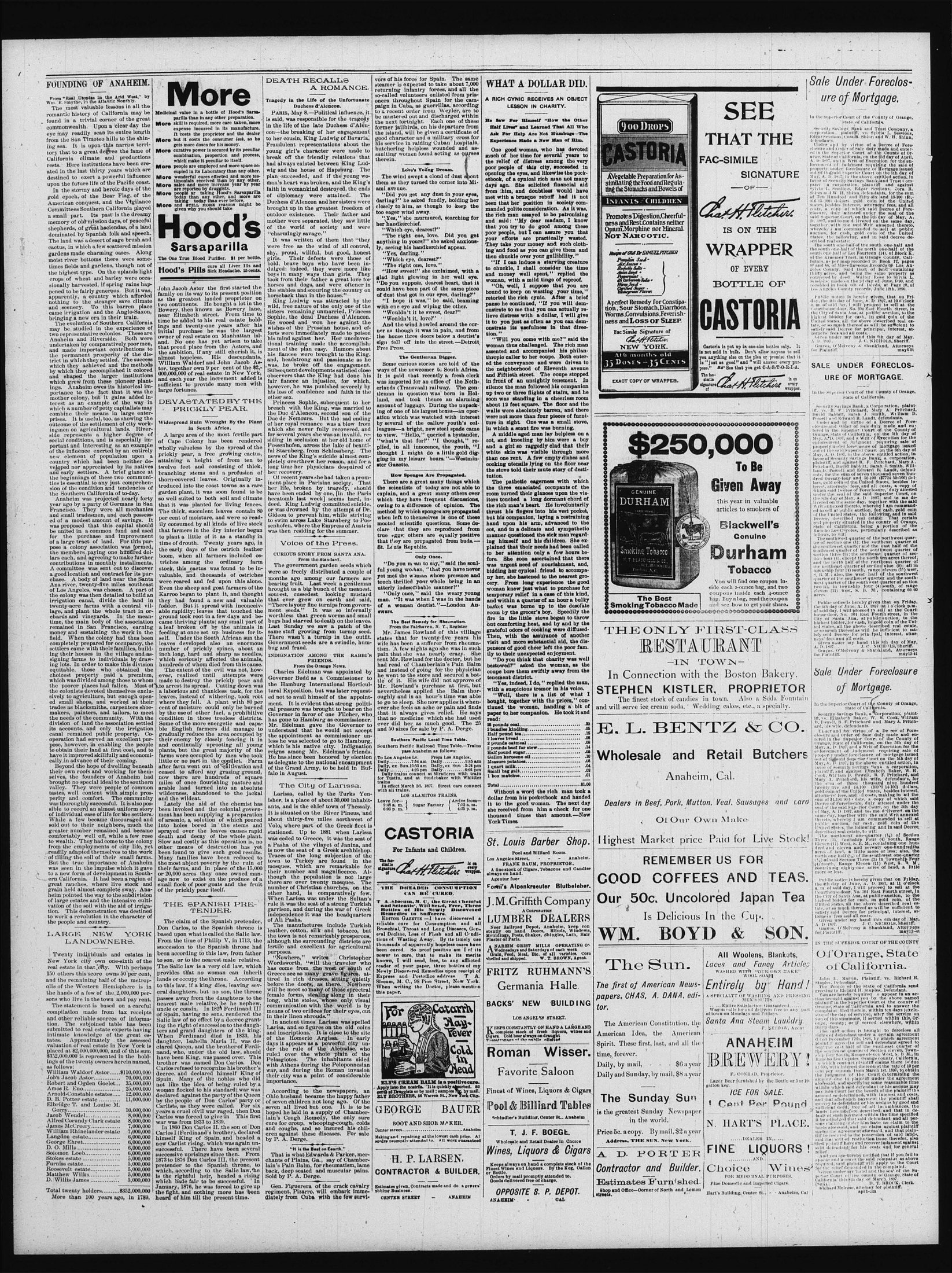
Searchable text
FOUNDING OF ANAHEIM.
From "Real Utopias in the Arid West," by Wm. E. Smythe, in the Atlantic Monthly.
The most valuable lessons in all the romantic history of California may be found in a trivial corner of the great commonwealth. Upon a clear day the eye may readily scan its entire length from the San Timoteo hills to the shining sea. It is upon this narrow territory that to a great degree the fame of California climate and productions rests. Here institutions have been created in the last thirty years which are destined to exert a powerful influence upon the future life of the Pacific coast.
In the stormy and heroic days of the gold epoch, of the Bear Flag, of the American conquest, and the Vigilance Committees Southern California played a small part. Its past is the dreamy memory of old mission days, of peaceful shepherds, of great haciendas, of a land dominated by Spanish folk and speech. The land was a desert of sage brush and cactus, in which a few scattered mission gardens made charming oases. Along moist river bottoms there were sometimes fields and gardens, though not of the highest type. On the uplands light crops of wheat and barley were occasionally harvested, if spring rains happened to be fairly generous. But it was, apparently, a country which afforded nothing to the stranger save climate and scenery. To this barren place came irrigation and the Anglo-Saxon, bringing a new era in their train.
The evolution of Southern California may be studied in the experience of two representative colonies. These are Anaheim and Riverside. Both were undertaken by comparatively poor men, and made important contributions to the permanent prosperity of the district in which they settled. The success which they achieved and the methods by which they accomplished it colored and shaped the larger institutions which grew from these pioneer plantings. Anaheim owes its historical importance to the fact that it was the mother colony, but it gains added interest as an example of the way in which a number of petty capitalists may combine their means in large enterprises. It is useful, too, as showing the outcome of the settlement of city workingmen on agricultural lands. Riverside represents a higher degree of social conditions, and is especially important and interesting as an example of the influence exerted by an entirely new element of population upon a country which had been neither developed nor appreciated by its natives and early settlers. A brief glance at More
Medicinal value in a bottle of Hood's Sarsaparilla than in any other preparation.
More skill is required, more care taken, more expense incurred in its manufacture. It costs the proprietor and the dealer but it costs the consumer less, as he gets more doses for his money.
More curative power is secured by its peculiar combination, proportion and process, which make it peculiar to itself.
More people are employed and more space occupied in its Laboratory than any other.
More wonderful cures effected and more testimonials received than by any other.
More sales and more increase year by year are reported to druggists.
More people are taking Hood's Sarsaparilla today than any other, and more are taking today than ever before.
More still reasons might be given why you should take Hood's Sarsaparilla
The One True Blood Purifier. $1 per bottle.
Hood's Pills cure all Liver Ills and Sick Headache. 25 cents.
John Jacob Astor the first started the family on its way to its present position as the greatest landed proprietor on two continents. He bought a lot in the Bowery, then known as Bowery lane, near Elizabeth street. From time to time he added to his real estate holdings and twenty-one years after his initial purchase he was the largest owner of real estate on Manhattan island. No one has yet arisen to take that proud place from the Astors, and the ambition, if any still cherish it, is almost hopeless. His descendants, William Waldorf and John Jacob Astor, together own 9 per cent of the $2,-000,000,000 of real estate in New York, and each year the increment added is sufficient to provide many men with large fortunes.
DEVASTATED BY THE PRICKLY PEAR.
Widespread Ruin Wrought By the Plant in South Africa.
A large area of the most fertile part of Cape Colony has been rendered wholly valueless by the spread of the prickly pear, a free growing cactus, attaining a height of from ten to twelve feet and consisting of thick, branching stems and a profusion of DEATH RECALLS A ROMAN
Tragedy in the Life of the Unfortunate Duchess d'Alencon.
PARIS, May 8.—Political influence is said, was responsible for the traumatism in the life of the late Duchess d'Alencon—the breaking of her engagement to her cousin, King Ludwig of Bavaria. Fraudulent representations about young girl's character were mainly break off the friendly relations had always existed between King Ludwig and the house of Hapsburg. Plan succeeded, and if the young man's heart was broken, and the Kaiser-in-womankind destroyed, then of diplomacy were attained. Duchess d'Alencon and her sisters brought up in the greatest freedom outdoors existence. Their father mother were separated, they saw no world of society and "charmingly savage."
It was written of them that were free as the wind of all coatsy, proud, willful, but good, girls. Their defects were those bold, brave boys who have been dulged; indeed, they were more boys in many ways than girls. They took from their father a great love horses and dogs, and were often the stables and scouring the countryside horseback than in the house."
King Ludwig was attracted by wild, free nature of the only one sisters remaining unmarried. Prin Sophie, the dead Duchess d'Alencon. He wooed and won her against wishes of the Prussian house, and forts were immediately made to pay his mind against her. Her unconscious training made the accommodation of the plan easy. Rumors his fiancée were brought to their head, headstrong and passionate; was he broke off the engagement? Subsequent developments satisfied observers that the King had done fair fiancée an injustice, for however, he was punished severely his loss of confidence and faith in other sex.
Princess Sophie, subsequent to breach with the King, was married to Duc d'Alencon, second son of Duc de Nemours. But the sad end of her royal romance was a blow which she never fully recovered for several years she was an invaluable siding in seclusion at her old home. Possenhofen, across the lake of his full Starnberg, from Schlossberg. News of the King's suicide almostpletely overthrew her reason, and long time her physicians despaired her recovery.
and shaped the larger institutions which grew from these pioneer plantings. Anaheim owes its historical importance to the fact that it was the mother colony, but it gains added interest as an example of the way in which a number of petty capitalists may combine their means in large enterprises. It is useful, too, as showing the outcome of the settlement of city workingmen on agricultural lands. River-side represents a higher degree of social conditions, and is especially important and interesting as an example of the influence exerted by an entirely new element of population upon a country which had been neither developed nor appreciated by its natives and early settlers. A brief glance at the beginnings of these two communities is essential to any just comprehension of the condition and tendencies of the Southern California of today.
Anaheim was projected nearly forty year ago by a party of Germans in San Francisco. They were all mechanics and small tradesmen, and each possessed of a modest amount of savings. It was proposed that this capital should be united in a common fund and used for the purchase and improvement of a large tract of land. For this purpose a colony association was formed, the members paying one hundred dollars each, and agreeing to make further contributions in monthly installments. A committee was sent out to discover a good location and contract for its purchase. A body of land near the Santa Ana river, twenty-five miles southeast of Los Angeles, was chosen. A part of the colony was then detailed to build an irrigation canal, divide the land in twenty-acre farms with a central village, and plant the whole tract in orchards and vineyards. In the meantime, the main body of the association remained in San Francisco, earning money and sustaining the work in the field. When the colony had thus been completely prepared for occupancy, the settlers came with their families, building their houses in the village and assigning farms to individuals by drawing lots. In order to make this division equitable, those who obtained the choiceest property paid a premium, which was divided among those to whom the poorer places had fallen. Most of the colonists devoted themselves exclusively to agriculture, but enough opened small shops, and worked at their trades as blacksmiths, carpenters, shoe-makers, painters, and tailors, to meet the needs of the community. With the division of land the association settled its accounts, and only the irrigation canal remained public property. Cooperation had served an excellent purpose, however, in enabling the people to obtain their land at first cost, and to have it improved skillfully and economically in advance of their coming.
Beyond the hope of dwelling beneath their own roofs and working for themselves, the founders of Anaheim had brought no special ideal to the southern valley. They were people of common tastes, well content with simple prosperity and comfort. The community was thoroughly successful. It is also possible to record an almost uniform story of individual ease of life for the settlers. While a few became discouraged and sold out to their neighbors, much the greater number remained and became comfortably well off, while a few rose to wealth. They had come to the colony from the employments of city life, yet readily adapted themselves to the work of filling the soil of their small farms. But the true importance of Anaheim was seen in the impulse which it gave to a new form of development in Southern California. It had been a region of great ranches, where live stock and grain held almost complete sway. Anaheim pointed the way to the subdivision and shaped the larger institutions which grew from these pioneer plantings. Anaheim owes its historical importance to the fact that it was the mother colony, but it gains added interest as an example of the way in which a number of petty capitalists may combine their means in large enterprises. It is useful, too, as showing the outcome of the settlement of city workingmen on agricultural lands. River-side represents a higher degree of social conditions, and is especially important and interesting as an example of the influence exerted by an entirely new element of population upon a country which had been neither developed nor appreciated by its natives and early settlers. A brief glance at the beginnings of these two communities is essential to any just comprehension of the condition and tendencies of the Southern California of to-day.
Anaheim was projected nearly forty year ago by a party of Germans in San Francisco. They were all mechanics and small tradesmen, and each possessed of a modest amount of savings. It was proposed that this capital should be united in a common fund and used for the purchase and improvement of a large tract of land. For this purpose a colony association was formed, the members paying one hundred dollars each, and agreeing to make further contributions in monthly installments. A committee was sent out to discover a good location and contract for its purchase. A body of land near the Santa Ana river, twenty-five miles southeast of Los Angeles, was chosen. A part of the colony was then detailed to build an irrigation canal, divide the land in twenty-acre farms with a central village, and plant the whole tract in orchards and vineyards. In the meantime, the main body of the association remained in San Francisco, earning money and sustaining the work in the field. When the colony had thus been completely prepared for occupancy, the settlers came with their families, building their houses in the village and assigning farms to individuals by drawing lots. In order to make this division equitable, those who obtained the choiceest property paid a premium, which was divided among those to whom the poorer places had fallen. Most of the colonists devoted themselves exclusively to agriculture, but enough opened small shops, and worked at their trades as blacksmiths, carpenters, shoe-makers, painters, and tailors, to meet the needs of the community. With the division of land the association settled its accounts, and only the irrigation canal remained public property.
Cooperation had served an excellent purpose, however, in enabling the people to obtain their land at first cost, and to have it improved skillfully and economically in advance of their coming.
Beyond the hope of dwelling beneath their own roofs and working for themselves, the founders of Anaheim had brought no special ideal to the southern valley. They were people of common tastes, well content with simple prosperity and comfort. The community was thoroughly successful. It is also possible to record an almost uniform story of individual ease of life for the settlers. While a few became discouraged and sold out to their neighbors, much the greater number remained and became comfortably well off, while a few rose to wealth. They had come to the colony from the employments of city life, yet readily adapted themselves to the work of filling the soil of their small farms. But the true importance of Anaheim was seen in the impulse which it gave to a new form of development in Southern California. It had been a region of great ranches, where live stock and grain held almost complete sway. Anaheim pointed the way to the subdivision and shaped the larger institutions which grew from these pioneer plantings. Anaheim owes its historical importance to the fact that it was the mother colony, but it gains added interest as an example of the influence exerted by an entirely new element of population upon a country which had been neither developed nor appreciated by its natives and early settlers. A brief glance at the beginnings of these two communities is essential to any just comprehension of the condition and tendencies of the Southern California of to-day.
Anaheim was projected nearly forty year ago by a party of Germans in San Francisco. They were all mechanics and small tradesmen, and each possessed of a modest amount of savings. It was proposed that this capital should be united in a common fund and used for the purchase and improvement of a large tract of land. For this purpose a colony association was formed, the members paying one hundred dollars each, and agreeing to make further contributions in monthly installments. A committee was sent out to discover a good location and contract for its purchase. A body of land near the Santa Ana river, twenty-five miles southeast of Los Angeles, was chosen. A part of the colony was then detailed to build an irrigation canal, divide the land in twenty-acre farms with a central village, and plant the whole tract in orchards and vineyards. In the meantime, the main body of the association remained in San Francisco, earning money and sustaining the work in the field. When the colony had thus been completely prepared for occupancy, the settlers came with their families, building their houses in the village and assigning farms to individuals by drawing lots. In order to make this division equitable, those who obtained the choiceest property paid a premium, which was divided among those to whom the poorer places had fallen. Most of the colonists devoted themselves exclusively to agriculture, but enough opened small shops, and worked at their trades as blacksmiths, carpenters, shoe-makers, painters, and tailors, to meet the needs of the community. With the division of landthe association settled its accounts,and onlythe irrigation canal remained public property.
Cooperation had served an excellent purpose,however,在 enablingthepeopletoobtainthelandatfirstcost,andtohaveitimprovedskillfullyandeconomicallyinadvanceoftheircoming.
Beyondthehopeofdwellingbeneaththeirownrooftosworkingforthemselves,thefoundersofanaheimhadbroughtnospecialidealtothesouthernvalley.Theywerepeopleofcommetasteswellcontentwithsimpleproperlyandcomfort.Thecommunitywasthoroughlysuccessful.Itsalsopossibletocordinetanamiformstoryofindividualeaseoflifeforthesettlers.Whilea fewbecamediscouragedandsoldouttothireighbors,muchthegreaternumberremainedandbecamedcomfortablywelloff,whilea fewrosetowealth.Theyhadcometocothecolonyfromtheemploymentsofcitylife,yetreadilyadaptedthemestotheworkoftillingthesoilofthesmallfarms.ButthetrueimportanceanaheimwasseenintheimpulsewhichitgavetoanewformdevelopmentinSouthernCaliforniaIthadbeenaregionofgreatrancheswherelivestockandgrainheldalmostcompletelysway.Anaheimpointedthewaytothesubdivisionandshapedthelargerinstitutionsthichgrewfromthesepioneerplantings.Anaheimowesitshistoricalimportancetothefactthatitwasthemothercolonybutitisneverfully recoveredforseveralyearsshewasaninvaluablesidinginseclusionather oldhousePossenhofen,crosshlossberg.newsofTheKing'ssuicidealmostpletelyoverthrewherreason,andlongtimeherphysiciansdespairherrecovery.
Of recent years she had takenainentplaceinParisian society.herlife,brokenbytragedy,shehavebeendiedbyone[inthehecatomblastweek]seemsharddeed.KingLudwig committedsureorwasdrownedbytheattemptGideontopreventhim;whistostemswacymainstreamexaminedfromsumhofenwheretheEmpressofAustriawasthenresidingforthesummer.
VoiceofthePress
CURIOUSSTORYFROMSANTAANFROMtheStandard.
The government garden seedswere so freely distributeda coummonthsago amongour农erm bearing fruit.Last weekageni broughtusabigbunchofthem sourest,cussedlestlookingmethat evergrewonearthand"Thereisyourfineturnipsfromgmentseeds."Itwassoinfearlessworthlessthatgreenwormsandbugshadstarvedto deathontheLastSundaywe sawapatchsame stuff growingfromturnipTherewasn'taturnintheGovernmentseedsarea swindlebugandfraud.
INDIGNATIONAMONGTHERAFRIENDS.FromtheOrangeNews.
CharlesEdelmanwasappointedGovernorBuddasasCommissionTheHamburgInternationalHousingExposition,Butwas laterreducednotavailhimselfoftheappointment。它是 evidentthatcalpressurewas broughtto bearGovernorin favorofoneFilcherhas gonetoHamburgascommissionMr.EdelmangaveTheGovernmentunderstandthathewouldnottheappointmentascommissionlesshewwasselectedtogoToHamburgwhichishisnativecity.Intidignationsmanysincebeen honoredbyeleasdelegatetothenationalencounterofTheGrandArmy,tobeheldintalofthe夏。
TheCityofLarissa,Larissa,calledbytheTurksisher,是a placeofabout30000inants,andisthe chief townOfTheItis situated ontheRiverPineabout thirty-five miles northwestVolo,thepartoftheGreekstation.Upto1881whenLisawededtoGreece,它是theaPashaofthevilayetofJaniningisnowtheseatofaGreekarchitectureofthelongsubjectionintowntoTurkeyarefoundinmosqueswhichareremarkablethenumberandmagnificencethoughthepopulationisnotthereareovertwentymosques.numberofChristian churches,otherhand,是 comparativelyWhenLarissawasunderTheSupr
LARGE NEW YORK LANDOWNERS.
Twenty individuals and estates in New York city own one-sixth of the real estate in that city. With perhaps 150 others this score owns 50 per cent, and the remaining half of the metropolis of the Western Hemisphere is in the hands of a few of the 2,000,000 persons who live in the town and pay rent.
The statement is based on a careful compilation made from tax receipts and other reliable sources of information. The subjoined table has been submitted to real estate experts having intimate knowledge of the great estates. Approximately the assessed valuation of real estate in New York is placed at $2,000,000,000, and of this sum $352,000,000 is represented in the holdings of the twenty owners herein named, as follows:
William Waldorf Astor.....$110,000,000
John Jacob Astor.....70,000,000
Robert and Ogden Goelet...35,000,000
Amos R. Eno.....25,000,000
Arnold-Constable estates.....12,000,000
D. B. Potter estate.....11,000,000
Elbridge T. and Louise M. Gerry.....10,000,000
Jacob Wendel.....8,000,000
Alfred Corundy Clark estate.....8,000,000
James McCreery.....7,000,000
William Rhineland estate.....7,000,000
Langdon estate.....6,000,000
George Ehret.....6,000,000
D. O. Mills.....6,000,000
Solomon Loeb.....6,000,000
Stokes estate.....5,000,000
Furniss estate.....5,000,000
Roosevelt estate.....5,000,000
Matthew Wilks.....5,000,000
D. Willis James.....5,000,000
Total twenty holders.....$352,000,000
More than 199 years ago, in 1789,
Lately the aid of the chemist has been invoked and the colonial government has been supplying a preparation of arsenic, a solution of which poured into holes bored in the stems and sprayed over the leaves causes rapid death and decay of the whole plant. Slow and costly as this operation is, no other means of destruction has yet been found to give such good results. Many families have been reduced to the most abject poverty by the ruin of their farms, and in place of the 15,544 or 25,444 acres they once owned manage now to exist on the produce of a small flock of poor goats and the fruit of the prickly pear itself.
THE SPANISH PRETENDER.
The claim of the Spanish pretender, Don Carlos, to the Spanish throne is based upon what is called the Salic law. From the time of Philip V., in 1713, the succession to the Spanish throne had been according to this law, from father to son, or to the nearest male relative. The Salic law is a very old law, which provides that no woman can inherit lands or occupy the throne. According to this law, if a king dies, leaving several daughters, but no son, the throne passes away from the daughters to the nearest male relative, be he nephew, uncle or cousin. In 1829 Ferdinand III of Spain, having no sons, rendered the Salic law of no effect by a decree granting the right of succession to the daughters and grand daughters of the king. When Ferdinand died in 1833, his daughter Isabella Maria II was declared Queen, and the brother of Ferdinand, who under the old law should have been King, was passed over. This brother was named Don Carlos. Don Carlos refused to recognize his brother's decree, and declared himself King of Spain. Many of the nobles who did not like the idea of being ruled by a woman flocked to his standard; war was declared against the party of the Queen by the people of Don Carlos' party or Carlists, as they were called. For six years a cruel civil war raged, then Don Carlos was forced to give in. This first war was from 1833 to 1839.
In 1869 Don Carlos II, the son of Don Carlos I (Ferdinand's brother), declared himself King of Spain, and headed a new Carlist rising, which was again unsuccessful. There have been several successive uprisings since then. From 1873 to 1876 Don Carlos III, the present pretender to the Spanish throne, to which, according to the Salic law, he is the rightful heir, headed a rising which bade fair to be successful. In January 1876, he was forced to give up the fight, and nothing more has been heard of him till the present time.
The manufactures include two leather, cotton, silk and tobacco; the town is not remarkably prosperous although the surrounding district fertile and excellent for agricultural purposes.
"Nowhere," writes Christine Wordsworth, "will the traveler have come from the west or south Greece see so many grave figures tired in rich dresses, sitting quiet before the doors; as there. Now will he meet so many of those spright female forms, stealing along in long white stoles, whose only communication with the world means of two orifices for their eyes in their linen shrouds."
In ancient times Larisa was spared Larisa and so figures on the old and inscriptions. It is close to that of Homeric Argissa. In days it appears as a powerful citizen dering the rule of the Alenadae ruled over the whole plain or Pelasgiotes. The inhabitants with Athens during the Peloponnesian war, and during the Roman invasion their city was a point of considerable importance.
According to the newspapers Ohio husband became the happy fighter of seven children not long ago. One seven all lived but one. It is hoped he laid in a supply of Charlain's Cough Remedy; the only cure for croup, whooping-cough; and coughs, and so insured his enemies against these diseases. For by P. A. Derge.
"It is the Best on Earth."
That is what Edwards & Parker chants of Plains, Ga., say of Charlain's Pain Balm; for rheumatism; back; deep seated and muscular pain Sold by P. A. Derge.
Gen. Figuerera of the crack case regiment, Pizarro, will embark in dially from Cuba with the few
WHAT A DOLLAR DID.
A RICH CYNIC RECEIVES AN OBJECT LESSON IN CHARITY.
He Saw For Himself "How the Other Half Lives" and Learned That All Who Ask For Help Are Not Humbugs—The Experience Made a New Man of Him.
One good woman, who has devoted much of her time for several years to the relief of distress among the very poor people of this city, succeeded in opening the eyes, and likewise the pocketbook, of a cynical rich man not many days ago. She solicited financial aid from him, and doubtless would have met with a brusque rebuff had it not been that her position in society commanded polite consideration. As it was, the rich man essayed to be patronizing and said: "My dear madam, I know that you try to do good among these poor people, but I can assure you that your efforts are practically wasted. They take your money and such clothing and food as you can give them and then chuckle over your gullibility."
"If I can induce a starving creature to chuckle, I shall consider the time and money well spent," replied the woman, with a mild tinge of reproof.
"Oh, well, I suppose that you are bound to keep on wasting your time," retorted the rich cynic. After a brief pause he continued, "If you will demonstrate to me that you can actually relieve distress with a dollar, I will give it to you just as often as you can demonstrate its usefulness in that direction."
"Will you come with me?" said the woman thus challenged. The rich man assented and accompanied his philanthropic caller to her coupe. Both entered the conveyance and were driven to the neighborhood of Eleventh avenue and Fiftieth street. The coupe stopped in front of an unsightly tenement. In silence the man followed his companion up two or three flights of stairs, and he soon was standing in a cheerless room about 12 feet square. The floor and the walls were absolutely barren, and there were not more than four pieces of furniture in sight. One was a small stove, in which a scant fire was burning.
A middle aged man lay helpless on a cot, and kneeling by him were a boy and a girl so raggedly clad that their white skin was visible through more than one rent. A few empty dishes and cooking utensils lying on the floor near the stove told their mute story of desti-
It is said that recently a fresh clerk was imported for an office of the Netherlands (Transvaal) railway. The gentleman in question was born in Holland, and took thence an alarming amount of luggage. During the unpacking of one of his largest boxes—an operation which was watched with interest by several of the callow youth's colleagues—a bright, new steel spade came to view. "Hello," queried a bystander, "what's that for?" "I thought," replied, in all innocence, the youth, "I thought I might do a little gold digging in my leisure hours."—Westminster Gazette.
How Sponges Are Propagated
There are a great many things which the scientists of today are not able to explain, and a great many others over which they have frequent discussions, owing to a difference of opinion. The method by which sponges are propagated when left to themselves is one of these mooted scientific questions. Some declare that they are reproduced from true eggs; others are equally positive that they are propagated from buds.—St. Louis Republic.
Only Once.
"Do you mean to say," said the soulful young woman, "that you have never met the woman whose presence and touch thrilled your whole being in an utterly indescribable manner?"
"Only once," said the weary young man. "It was when I was in the hands of a woman dentist."—London Answers.
The Best Remedy for Rheumatism.
From the Fairhaven, N. Y., Register
Mr. James Rowland of this village states that for twenty-five years his wife has been a sufferer from rheumatism. A few nights ago she was in such pain that she was nearly crazy. She sent Mr. Rowland for the doctor, but he had read of Chamberlain's Pain Balm and instead of going for the physician he went to the store and secured a bottle of it. His wife did not approve of Mr. Rowland's purchase at first, but nevertheless applied the Balm thoroughly and in an hour's time was able to go to sleep. She now applies it whenever she feels an ache or pain and finds that it always gives relief. He says that no medicine which she had used ever did her as much good. The 25 and 50 sizes for sale by P. A. Derge.
Southern Pacific Local Time Table.
Southern Pacific Railroad Time Table—Trains pass Anaheim as follows:
To Los Angeles Lv. From Los Angeles.
Daily...ex Sun:10:33 am Daily ex Sun:3:24 pm
Daily...4:25 pm Daily....6:01 pm
Daily trains connect at Mirrafores with train for Tustin, and at Studebaker with Whittier trains.
In effect March 2d, 1897. Street cars connect with all trains.
LOS ALAMITOS TRAINS.
Leave for—
9:48 a.m.
Sugar Factory
Arrive from—
7:52 a.m.
4:25 p.m.
CASTORIA
For Infants and Children.
The first-time signature of Chatham Hutchinson.
THE DREADED CONSUMPTION CAN BE CURED.
It is said that recently a fresh clerk was imported for an office of the Netherlands (Transvaal) railway. The gentleman in question was born in Holland, and took thence an alarming amount of luggage. During the unpacking of one of his largest boxes—an operation which was watched with interest by several of the callow youth's colleagues—a bright, new steel spade came to view. "Hello," queried a bystander, "what's that for?" "I thought," replied, in all innocence, the youth, "I thought I might do a little gold digging in my leisure hours."—Westminster Gazette.
How Sponges Are Propagated
There are a great many things which the scientists of today are not able to explain, and a great many others over which they have frequent discussions, owing to a difference of opinion. The method by which sponges are propagated when left to themselves is one of these mooted scientific questions. Some declare that they are reproduced from true eggs; others are equally positive that they are propagated from buds.—St. Louis Republic.
Only Once.
"Do you mean to say," said the soulful young woman, "that you have never met the woman whose presence and touch thrilled your whole being in an utterly indescribable manner?"
"Only once," said the weary young man. "It was when I was in the hands of a woman dentist."—London Answers.
The Best Remedy for Rheumatism.
From the Fairhaven, N. Y., Register
Mr. James Rowland of this village states that for twenty-five years his wife has been a sufferer from rheumatism. A few nights ago she was in such pain that she was nearly crazy. She sent Mr. Rowland for the doctor, but he had read of Chamberlain's Pain Balm and instead of going for the physician he went to the store and secured a bottle of it. His wife did not approve of Mr. Rowland's purchase at first, but nevertheless applied the Balm thoroughly and in an hour's time was able to go to sleep. She now applies it whenever she feels an ache or pain and finds that it always gives relief. He says that no medicine which she had used ever did her as much good. The 25 and 50 sizes for sale by P. A. Derge.
Southern Pacific Local Time Table.
Southern Pacific Railroad Time Table—Trains pass Anaheim as follows:
To Los Angeles Lv. From Los Angeles.
Daily...ex Sun:10:33 am Daily ex Sun:3:24 pm
Daily...4:25 pm Daily....6:01 pm
Daily trains connect at Mirrafores with train for Tustin, and at Studebaker with Whittier trains.
In effect March 2d, 1897. Street cars connect with all trains.
LOS ALAMITOS TRAINS.
Leave for—
9:48 a.m.
Sugar Factory
Arrive from—
7:52 a.m.
4:25 p.m.
CASTORIA
For Infants and Children.
The first-time signature of Chatham Hutchinson.
THE DREADED CONSUMPTION CAN BE CURED.
It is said that recently a fresh clerk was imported for an office of the Netherlands (Transvaal) railway. The gentleman in question was born in Holland, and took thence an alarming amount of luggage. During the unpacking of one of his largest boxes—an operation which was watched with interest by several of the callow youth's colleagues—a bright, new steel spade came to view. "Hello," queried a bystander, "what's that for?" "I thought," replied, in all innocence, the youth, "I thought I might do a little gold digging in my leisure hours."—Westminster Gazette.
How Sponges Are Propagated
There are a great many things which the scientists of today are not able to explain, and a great many others over which they have frequent discussions, owing to a difference of opinion. The method by which sponges are propagated when left to themselves is one of these mooted scientific questions. Some declare that they are reproduced from true eggs; others are equally positive that they are propagated from buds.—St. Louis Republic.
Only Once.
"Do you mean to say," said the soulful young woman, "that you have never met the woman whose presence and touch thrilled your whole being in an utterly indescribable manner?"
"Only once," said the weary young man. "It was when I was in the hands of a woman dentist."—London Answers.
The Best Remedy for Rheumatism.
From the Fairhaven, N. Y., Register
Mr. James Rowland of this village states that for twenty-five years his wife has been a sufferer from rheumatism. A few nights ago she was in such pain that she was nearly crazy. She sent Mr. Rowland for the doctor, but he had read of Chamberlain's Pain Balm and instead of going for the physician he went to the store and secured a bottle of it. His wife did not approve of Mr. Rowland's purchase at first, but nevertheless applied the Balm thoroughly and in an hour's time was able to go to sleep. She now applies it whenever she feels an ache or pain and finds that it always gives relief. He says that no medicine which she had used ever did her as much good. The 25 and 50 sizes for sale by P. A. Derge.
Southern Pacific Local Time Table.
Southern Pacific Railroad Time Table—Trains pass Anaheim as follows:
To Los Angeles Lv. From Los Angeles.
Daily...ex Sun:10:33 am Daily ex Sun:3:24 pm
Daily...4:25 pm Daily....6:01 pm
Daily trains connect at Mirrafores with train for Tustin, and at Studebaker with Whittier trains.
In effect March 2d, 1897. Street cars connect with all trains.
LOS ALAMITOS TRAINS.
Leave for—
9:48 a.m.
Sugar Factory
Arrive from—
7:52 a.m.
4:25 p.m.
CASTORIA
For Infants and Children.
The first-time signature of Chatham Hutchinson.
THE DREADED CONSUMPTION CAN BE CURED.
It is said that recently a fresh clerk was imported for an office of the Netherlands (Transvaal) railway. The gentleman in question was born in Holland, and took thence an alarming amount of luggage. During the unpacking of one of his largest boxes—an operation which was watched with interest by several of the callow youth's heart. He involuntarily thrust his fingers into his vest pocket, but his companion, laying a restraining hand upon his arm, advanced to the cot, and in a delicate and sympathetic manner questioned the sick man regarding himself and his children. She explained that their needs had been called to her attention only a few hours before. She soon ascertained that there was urgent need of nourishment, and biddling her cynical friend to accompany her, she hastened to the nearest grocery. From long experience the good woman knew just what to purchase for temporary relief in a case of this kind, and within a quarter of an hour a bulky basket was borne up to the desolate room by the grocer's boy. Speedily the fire in the little stove began to throw out comforting heat, and by and by the grateful odors of cooking were diffused.Theu, with the assurance of another visit and more substantial aid, the dispensers of good cheer left the poor family to their unexpected enjoyment.
"Do you think that charity was well bestowed?" asked the woman, as the coupe bore them swiftly away from the tenement district.
"Yes, indeed I do," replied the man, with a suspicious tremor in his voice.
"Well, there is a list of what I bought, together with the prices," continued the woman, handling a bit of paper to her companion. He took it and read:
28 pounds coal...
22 bundles kindling...
Half pound tea...
2 leaves bread...
2 pounds oatmeal...
2 pounds beef for stew...
Half pound sugar...
Gallon kerosene oil...
Measure potatoes...
1 quart milk...
Small bag salt...
1 box matches...
Total.....$1.00
Without a word the rich man took a dollar from his pocketbook and handed it to the good woman. The next day she received from him a check for one thousand times that amount.-New York Times.
St. Louis Barber Shop.
Pool and Billiard Room.
Los Angeles Street,
FRANK BAUM, PROPRIETOR.
A fine stock of Cligars,Tobaccos and Candles always on hand.
Agentur fuer
Fortni's Alpenkrauter Blutbeleber.
LM Griffith Company
CASTORIA
For Infants and Children.
THE DREADED CONSUMPTION CAN BE CURED.
T. A. Slocum, M. C., the Great Chemist and Scientist, Will Need, Free, Three Bottles of His Newly Discovered Remedies to Sufferers.
EDITOR GAZETTE — I have discovered a reliable cure for Consumption and all Bronchial, Throat and Lung Diseases, General Decline, Loss of Flesh and all Conditions of Wasting Away. By its timely use thousands of apparently hopeless cases have been cured. So proof positive am I of its power to cure, that to make its merite known, I will send, free, to any afflicted reader of your paper, three bottles of my Newly Discovered Remedies upon receipt of Express and Postoffice address T. A. Slocum, M. C., 98 Pine Street, New York. When writing the Doctor, please mention this paper.
FOR CATARRH MAY-FEVER COLD IN NEAD
ELY'S CREAM BALM is a positive cure. Apply into the nostrils. It is quickly absorbed. 50 cents at Druggists or by mail; samples not by mail. ELY BROTHERS, 56 Warren St., New York City.
GEORGE BAUER
BOOT AND SHOE MAKER.
Center street... Anaheim
Making and repairing at the lowest cash price. All orders promptly attended to. All work guaranteed.
H. P. LARSEN,
CONTRACTOR & BUILDER.
Estimates given, Contracts made and do a general obbing Business.
CENTER STREET - ANAHEIM
St. Louis Barber Shop.
Pool and Billiard Room.
Los Angeles Street... Anaheim.
FRANK BAUM, PROPRIETOR.
A fine stock of Cigars, Tobacco and Candles always on hand.
Agentur fuer Formi's Alpenkraeuter Blutbeleber.
J.M.Griffith Company
A CORPORATION
LUMBER DEALERS
Neer Railroad Depot, Anaheim, keep constantly on hand Doors, Blinds, Windows, Mouldings, Posts, Shakes, Shingles, Lath, Hair Plaster of Paris.
ANAHEIM GRIST MILLS OPERATING ON Wednesdays and Saturdays of each week
Grain, Feed, Meal, Etc. of all varieties. Corn shelded and shipped.
FRITZ RUHMANN'S Germania Halle.
BACKS' NEW BUILDING
LOS ANGELES STREET.
KEEPS CONSTANTLY ON HAND A LARGE AND complete stock of fresh liquors, wines and Cigara. Cold beer always on draught.
Transactions of the mobile oleated
Roman Wisser.
Favorite Saloon
Finest of Wines, Liquors & Cigars
Pool & Billiard Tables
Bondler's Building, Center St... Anaheim
T. J. F. BOEGE.
Wholesale and Retail Dealer in Choice
Wines, Liquors & Cigars
Keeps always on hand a complete stock of the Finest Wines and Liquors. By the Keg, Oallon or Bottle.
Orders by mail promptly attended to.
Goods delivered free of charge.
OPPOSITE 8. P. DEPOT.
ANAHEIM - CAL
The first of American papers, CHAS. A. DA tor.
The American Constitution American Idea, the Spirit. These first, last, au time, forever.
Daily, by mail,
Daily and Sunday, by mail
The Sunday is the greatest Sunday N in the world.
Price 5c. a copy. By mail Address, THE SUN. New
A D. PORT Contractor and Estimates Furniture Shop and Office—Corner of North streets.
SEE THAT THE FAC-SIMILE SIGNATURE OF CHARLES H. FLITCHER IS ON THE WRAPPER OF EVERY BOTTLE OF CASTORIA
Castoria is put up in one-size bottles only. It is not sold in bulk. Don't allow anyone to sell you anything else on the plea or promise that it is "just as good" and "will answer every purpose." See that you get C-A-S-T-O-R-I-A.
SALE UNDER FORECLOSURE OF MORTGAGE.
In the Superior Court of the County of Orange, State of California.
Security Savings Bank and Trust Company, a corporation, plaintiff vs. Syllia L. Sessions, Edgar Sessions, Cora R. Shinn and W. H. Shinn, defendants.
Under and by virtue of a Decree of Foreclosure and Order of Sale duly made and entered in the Superior Court of the County of Orange, State of California, on the 2d day of April, A.D. 1897, and a Writ of Execution for the enforcement of judgment requiring the sale of property under foreclosure of Mortgage issued out of the said superior Court on the 5th day of May, A.D. 1897, in the above entitled action, in favor of Security Savings Bank and Trust Company, a corporation, plaintiff and against Syllia L. Sessions, Edgar Sessions, Cora R. Shinn and W. H. Shinn, defendants, for the sum of Ten Hundred and Fifty-six and 13-100 ($1,066) in all dollars gold coin of the United States. Besides interest, attorneys' fees, and all costs, a copy of which said Decree of Foreclosure, duly attested under the seal of the said Superior Court, on the 5th day of May, A.D. 1897, and to me delivered on the same day, together with the said Writ annexed thereto, am commanded to sell at public auction for cash, gold coin of the United States, the following, and in said decree described real estate:
The south one-half of the south one-half and the south one-half of the north one-half of the south one-half of Lot Fourteen (14), of Block K, of the Kraemer Tract, in Orange County, California, as per map recorded in Book 12, pages 87 and 88, of Miscellaneous Records of Los Angeles County, said tract of land containing thirty acres, and being the same property as conveyed by deed: Walter Rose to Syllia L. Sessions; made on the 2d day of June, 1-99, and recorded in Book 688 of Deeds, at Page 28, of Los Angeles County records, July 12th, 1890.
Public notice is hereby given, that on Friday, the 4th day of June, A.D. 1897, at 10 o'clock a.m., of said bay, I will proceed to sell at the Courthouse door No. 304 East Fourth Street, in the City of Santa Ana, at public auction, to the highest bidder for cash, in gold coin of the United States, all the above described real estate or so much thereof will be sufficient to satisfy said Decree for principal, lutterest, attorneys' fees and all costs.
Given under my hand this 4th day of May, A.D. 1897,
J.C.NICHOLS,Sheriff.
Graves, O.Melveny & Shankland, Attorneys for Plaintiff.
SALE UNDER FORECLOSURE OF MORTGAGE.
In the Superior Court of the County of Orange, State of California.
Security Savings Bank, a Corporation, plaintiff vs. B.F. Pritchard, Mary A. Pritchard, David Rabbitt, Sarah J. Smith, William D. Powell and Edward B. Landt, defendants.
Under and by virtue of a Decree of Foreclosure and Order of Sale duly made and entered in the Superior Court of the County of Orange, State of California, on the 5th day of May, A.D. 1897, and a Writ of Execution for the enforcement of judgment requiring sale of property under foreclosure of Mortgage issued out of the said superior Court on the 5th day of May, A.D. 1897 in the above entitled action, in favor of Security Savings Bank and Trust Company a corporation, plaintiff and against B.F. Pritchard,Mary A.Pritchard,David Rabbitt,Sarah J.SmithWilliam D.PowellandEdwardB.Landtdefendantsforthesumofseven thousandsevenhundredandfivehundredandfiftydollarsgoldcoinoftheUnitedStates.JustifiedInterestattorneys'fees,andallcosts,acopyofwhichsaidDecreeofForeclosure,dulyattestedunderthesealofthesaidSuperiorCourt,the5thdayofMay,A.D.1897,andtomedeliveredonthesameday,togetherwiththesaidWritannexedthereto,veterinarycommandedtosellatpublicauction,forsale,goldcoinoftheUnitedStates,thefollowing,andinsaiddecreedescribedrealestate:
The south one-half of the south one-half and the south one-half of the north one-half of the south one-half of Lot Fourteen (14),of Block K.oftheKraemerTract.inOrangeCounty,CaliforniaaspermaprecordedinBook12,pages87and88.ofMiscellaneousRecordsofLosAngelesCounty,saidtractoflandcontainingthirtyacres,andbeingthesamepropertyasconveyedbydeed:WalterRosetoSylliaL.Sessionsmadeonthe2ddayofJune,i-99,andrecordedinBook688ofDeeds.atPage28.ofLosAngelesCountryrecords,july12th,1890.
PublicnoticeisherebygiventhatonFriday,the4thdayofJune,A.D.1897at10o'clockam.ofsaidbayIwillproceedtosellatetheCourthousedoorNo.304EastFourthStreetintheCityofSantaAnaatpublicauctiontothehighestbidderforcashingoldcoinoftheUnitedStatesalltheabovedescribedrealestateorsomuchthereofwillbesufficienttosatisfydailedecreeforprincipallutterestattorneys'feesandallcosts.
Givenundermyhandthis4thdayofMay.A.D.1897,
J.C.NICHOLS,Sheriff.
Graves.O.Melveny&ShanklandAttorneysforPlaintiff.
$250,000
To Be
Given Away
this year in valuable articles to smokers of Blackwell’s Genuine Durham Tobacco
You will find one coupon inside each 2-ounce bag, and two coupons inside each 4-ounce bag. Buy a bag, read the coupon and see how to get your share.
THE ONLY FIRST-CLASS RESTAURANT
IN TOWN—
In Connection with the Boston Bakery.
STEPHEN KISTLER, PROPRIETOR
The finest stock of candies in town. Also a Soda Fountain and will serve ice cream soda. Wedding cakes, etc., a specialty.
E. L. BENTZ & CO.
Wholesale and Retail Butchers
Anaheim, Cal.
Dealers in Beef, Pork, Mutton, Veal, Sausages and Lard
Of Our Own Make
Highest Market price Paid for Live Stock!
REMEMBER US FOR GOOD COFFEES AND TEAS.
URE OF MORTGAGE.
In the Superior Court of the County of Orange, state of California.
Security Savings Bank, a Corporation, plaintiff, B. F. Prithhard, Mary A. Prithhard, David Habbut, Sarah J. Smith, William D. Powell and Edward B. Landt, defendants.
Under and by virtue of a Decree of Foreclosure and Order of Sale duly made and entered in the Superior Court of the County of Orange, state of California, on the 5th day of May, A.D. 1877, and a Writ of Execution for the property under foreclosure of mortgage issued out of the said Superior Court on the 5th day of May, A.D. 1877, in the above entitled action, in favor of Security Savings Bank, a corporation, plaintiff, and against B. F. Prithhard, Mary A. Prithhard, David Habbut, Sarah J. Smith, William D. Powell and Edward B. Landt, defendants, for the sum of seven thousand seven hundred twenty-four and 50-100 ($7724 50-100) dollars, gold coin of the United States, besides interest, attorneys’ fees, and all costs, a copy of which said Decree of Foreclosure, duly attested under the seal of the said Superior Court, on the 5th day of May, A.D. 1877, and one deferred for the same day, together with the said Writ annexed thereto, whereby I am commanded to sell at public auction, for cash, gold coin of the United States, the following, and in said Decree, described real estate: That certain real property situated in the county of Orange, State of California, being a portion of the Rancho Leopold Coyotes, particularly described as follows to wit:
The southwest quarter of the northwest quarter of section one (1): the southeast quarter of the southwest quarter and the east half of the southwest quarter of the southwest quarter of section three (3): the southeast quarter of section four (1), except the northwest quarter of section four (1), half of the northeast quarter of the northeast quarter of section nine (9); all in township four (1) south, range eleven (11) west, S. B. M.; also, the west half of the southwest quarter of the southwest quarter and the southwest quarter of the southwest quarter of section two (2), in township four (4) south, of range eleven (11) West, S. B. M., containing 60 60 acres.
Public notice is hereby given that on Friday, the 3rd day of June, A. D. 1877 at 1 o’clock p.m. of said day, I will proceed to sell at the Courthouse door No. 301 East Fourth street, in the City of Santa Ana, at public auction; the highest bidder for each u-gold coin of the United States, all the above described real estate, or so much thereof as will be sufficient to satisfy said Decree for principal interest, attorneys’ fees and all costs.
Given under my hand this 8th day of May, A. D. 1877 at 1 o’clock p.m. of said day, I will proceed to sell at the Courthouse door No. 301 East Fourth street, in the City of Santa Ana, at public auction; the highest bidder for each u-gold coin of the United States, all the above described real estate, or so much thereof as will be sufficient to satisfy said Decree for principal interest, attorneys’ fees and all costs.
Given under my hand this 8th day of May, A. D. 1877 at 1 o’clock p.m. of said day, I will proceed to sell at the Courthouse door No. 301 East Fourth street, in the City of Santa Ana, at public auction; the highest bidder for each u-gold coin of the United States, all the above described real estate, or so much thereof as will be sufficient to satisfy said Decree for principal interest, attorneys’ fees and all costs.
Given under my hand this 8th day of May, A. D. 1877 at 1 o’clock p.m. of said day, I will proceed to sell at the Courthouse door No. 301 East Fourth street, in the City of Santa Ana, at public auction; the highest bidder for each u-gold coin of the United States, all the above described real estate, or so much thereof as will be sufficient to satisfy said Decree for principal interest attorneys’ fees and all costs.
Given under my hand this 8th day of May, A. D. 1877 at 1 o’clock p.m. of said day, I will proceed to sell at the Courthouse door No. 301 East Fourth street, in the City of Santa Ana, at public auction; the highest bidder for each u-gold coin of the United States, all the above described real estate, or so much thereof as will be sufficient to satisfy said Decree for principal interest attorneys’ fees and all costs.
Given under my hand this 8th day of May, A. D. 1877 at 1 o’clock p.m. of said day, I will proceed to sell at the Courthouse door No. 301 East Fourth street, in the City of Santa Ana, at public auction; the highest bidder for each u-gold coin of the United States
Dealers in Beef, Pork, Mutton, Veal, Sausages and Lard
Of Our Own Make
Highest Market price Paid for Live Stock!
REMEMBER US FOR
GOOD COFFEES AND TEAS.
Our 50c. Uncolored Japan Tea
Is Delicious In the Cup.
WM. BOYD & SON.
The Sun.
The first of American Newspapers, CHAS, A. DANA, editor.
The American Constitution, the American Idea, the American Spirit. These first, last, and all the time, forever.
Daily, by mail, $6 a year
Daily and Sunday, by mail, $8 a year
The Sunday Sun is the greatest Sunday Newspaper in the world.
Price 5c. a copy. By mail, $2 a year
Address: THE SUN. NEW YORK.
A D. PORTER
Contractor and Builder.
Estimates Furnished.
All Woolens, Blankets,
Laces and Fancy Articles
WASHED WITH "OUR OWN MAKE"
WOOL SOAP
Entirely by Hand!
A SPECIALTY OF WASHING AND PRESSING MEN'S SUITS.
Entire satisfaction guaranteed.
Wagon calls for and delivers free to any part of town on Mondays and Fridays.
Santa Ana Steam Laundry.
F. NETZOW, Agent
ANAHEIM BREWERY!
F. CONRAD, Proprietor.
Lager Beer furnished by the Bottle or 5 or 10-gallon keg.
ICE FOR SALE.
1 Cent Per Pound
N. HART'S PLACE.
DEALER IN...
FINE LIQUORS!
AND....
Choice Wines
FOR MEDICINAL PURPOSES,
Fine Domestile and Imported Cigars.
Hart's Building, Center St., - Anaheim, Cal
IN THE SUPERIOR COURT OF THE COUNTY
Of Orange, State of California.
John L. Martin, Plaintiff, vs. Richard H. Staples, Defendant.
The People of the state of California send greeting to Richard H. Staples, Defendant.
You are hereby required to appear in an action brought against you by the above named plaintiff in the superior Court of the county of Orange, State of California and to answer the complaint filed therein, within ten days (exclusive of the day of service), after the service on out of this summons, if served within this Orange county; or if served elsewhere, within thirty days.
The said action is brought to foreclose all rights of defendant under a certain agreement dated December 17th, 1896, by which agreement plaintiff agreed to sell and defendant agreed to buy the east half of the northeast quarter of the southwest quarter of Section eleven, Township four South, Range eleven West, S. B. M., in Rancho Los Coyotes Orange county, California, in which contract plaintiff claims there is due $1500 with interest thereon at the rate of 10 per cent per annum from March 1st, 1897, to obtain the judgment of the Court determining the amount due to plaintiff under the agreement aforesaid, and specifying some reasonable time within which said defendant or his assigns may pay into Court for the benefit of the plaintiff the amount so determined, with interest and costs and that after such payment the plaintiff shall convey to defendant or his design good and sufficient deed, free of all incumbrances, the lands hereinafter described; and that in default of such payment within the time specified it be adjudged that said defendant and all persons claiming under him have no claim to the lands aforesaid, and no claim against plaintiff under the agreement aforesaid, and that plaintiff be restored to the possession of said lands, and that writ of restitution issue therefor, also that plaintiff have and recover judgment against defendant for his costs and for general relief.
And you are hereby notified that if you fail to appear and answer the said comp陪 as above required, said plaintiff will apply to the Court for the relief demanded in the complaint.
Given under my hand and the sea' of the Superior Court of the county of Orange, State of California this sixth day of March, 1897.
[SEAL]
D. T. BROCK. Clerk.
Richard Melrose, attorney for plaintiff.