anaheim-gazette 1897-04-15
Scanned page
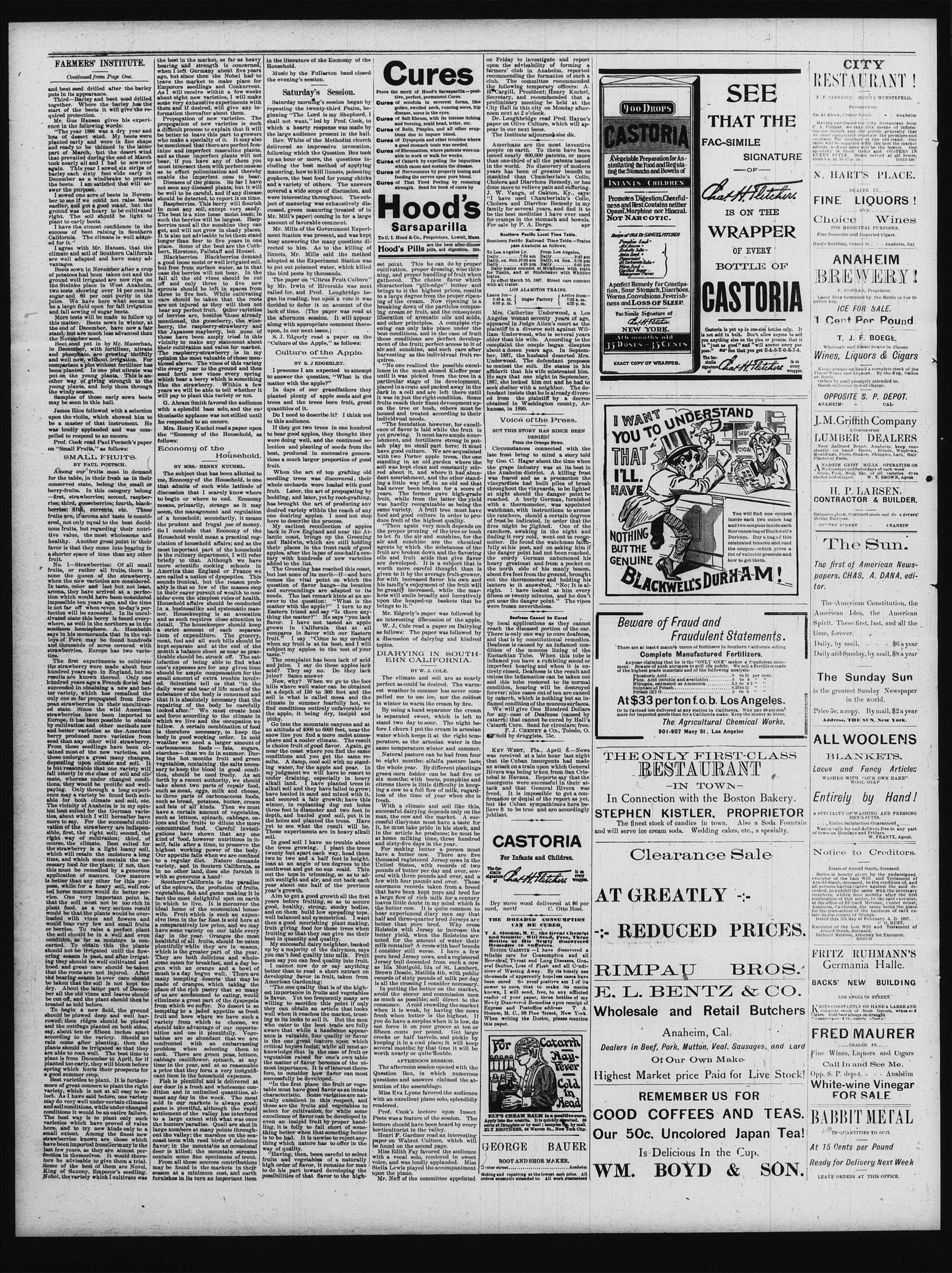
Searchable text
FARMERS' INSTITUTE.
Continued from Page One.
and beet seed drilled after the barley puts in its appearance.
Third—Barley and beet seed drilled together. Where the barley has the start of the beets it will give the required protection.
Mr. Gus Hansen gives his experience in the following words:
"The year 1896 was a dry year and lots of desert wind. My beets were planted early and were in fine shape and ready to be thinned in the latter part of March, but the desert wind that prevailed during the end of March took nearly all and I had to sow over again. This year I sowed six strips of barley each sixty feet wide early in December as a windbrake to protect the beets. I am satisfied that will answer the purpose.
I sowed one acre of beets in November to see if we could not raise beets earlier, and got a good stand, but the ground was too heavy to be cultivated right. The soil should be light to plant to early beets.
I have the utmost confidence in the success of beet raising in Southern California. The climate is well adapted for it."
I agree with Mr. Hansen, that the climate and soil of Southern California are well adapted and have many advantages.
Beets sown in November after a crop of potatoes had been taken out and the ground well irrigated are now ripe on the Steinke place in West Anaheim, two tests showing over 14 per cent in sugar and 80 per cent purity in the juice. We have here what seems to be a large field open for fall irrigation and fall sowing of sugar beets.
More tests will be made to follow up this matter. Beets sown in winter, at the end of December, have now a fair stand, but are much less advanced than the November seed.
Beet seed put in by Mr. Mauerhan, in December, with fertilizer, nitrate and phosphate, are growing thriftily and well now, without irrigation. For comparison a plot without fertilizer has been planted. In one plot nitrate was put on the young plants. This is another way of giving strength to the young plants, and help them through the windy season.
Samples of these early sown beets may be seen in this hall.
James Rice followed with a selection upon the violin, which showed him to be a master of that instrument. He was loudly applauded and was compelled to respond to an encore.
Prof. Cook read Paul Poetsch's paper on "Small Fruits," as follows:
SMALL FRUITS.
BY PAUL POETSCH.
Among our fruits most in demand
the best in the market, as far as heavy bearing and strength is concerned, when I left Germany about five years ago, but since then the Nobel had to leave the market to make place for Emporors seedlings and Conkurrent. As I will receive within a few weeks about eight new varieties, I will make some very exhaustive experiments with them and if desired, will give any information thereafter about them.
Propogation of new varieties. The propagation of new varieties is such a difficult process to explain that it will be better to leave this part to growers who make a specialty of it. It may also be mentioned that there are perfect feminine and imperfect masculine plants, and as these imperfect plants will not bear, if you have any of them you must intersect them with perfect ones so as to effect pollenization and thereby enable the imperfect ones to bear.
Diseases of the plants. So far I have not seen any diseased plants, but it will be well to be careful, and if any disease should be detected, to report it on time.
Raspberries. This berry will flourish in most any soil, except very sandy. The best is a nice loose moist loam; in such the berries will be largest. Raspberries need all the sunshine they can get, and will not grow in shady places. It is also not advisable to let them stand longer than four to five years in one place. Some of the best are the Cuthbert, Horstone, Fallstaff and Housel.
Blackberries. Blackberries demand a good loose moist or well irrigated soil, but free from surface water, as in that case the berries will not bear. In the fall all the old vines should be cut off and only three to five new sprouts should be left in spaces from three to five feet. While cultivating care should take that the roots are not injured as they will then not bear any perfect fruit. Other varieties of berries are, besides those already mentioned, the gooseberry, the wineberry, the raspberry-strawberry and the Japanese mayberry, but none of these have been amply tried in this vicinity to make any statement about their cultivation and value for market.
The raspberry-strawberry is in my opinion the most valuable of those mentioned above. The vines of this variety die every year to the ground and then send forth new vines every spring which bear a berry which is something like the strawberry. Within a few years we will be able to tell whether it will pay to plant this variety or not.
G. Abram Smith favored the audience with a splendid bass solo, and the enthusiastic applause was not stilled until he responded to an encore.
Mrs. Henry Kuchel read a paper upon the "Economy of the Household," as follows:
Economy of the Household.
BY MRS.-HENRY KUCHEL.
The subject that has been allotted to
in the literature of the Economy Household.
Music by the Fullarton band on the evening's session.
Saturday morning's session began repeating the twenty-third Psalm ginning "The Lord is my Shepherd shall not want," led by Prof. Cochrane which a hearty response was made to large audience present in the Rev. White of the Methodist church delivered an impressive invocation following which the Question Book up an hour or more, the question eluding the best method of applying manuring, how to kill linnets, poison gophers, the best food for young cows and a variety of others. The answer covered a wide scope of discussion were interesting throughout. The object of manuring was exhaustively cussed, green manuring (treated by Mr. Mill's paper) coming in for an amount of favorable comment.
Mr. Mills of the Government Station was present, and was busy answering the many questions rected to him. As to the killer linnets, Mr. Mills said he adopted at the Experiment Station to put out poisoned water, which is lack of time. (The paper was read aloud with appropriate comments upon, in our next issue.) S. J. Edgerly read a paper on "Culture of the Apple," as follows:
Culture of the Apples
BY S.J.Edgerley.
I presume I am expected to attend to answer the question, "What matter with the apple?" In days of our grandfathers planted plenty of apple seeds and trees and the trees bore fruit, quantities of it. Do I need to describe it? I think to this audience.
If they got two trees in one hut to bear good apples, they thought were doing well, and the continued section and planting of seeds from best, produced in successive generations a much larger proportion of fruit.
When the art of top grafting
put on the young plants. This is another way of giving strength to the young plants, and help them through the windy season.
Samples of these early sown beets may be seen in this hall.
James Rice followed with a selection upon the violin, which showed him to be a master of that instrument. He was loudly applauded and was compelled to respond to an encore.
Prof. Cook read Paul Poetsch's paper on "Small Fruits," as follows:
SMALL FRUITS.
BY PAUL POETSCH.
Among our fruits most in demand for the table, in their fresh as in their conserved state, belong the small or berry-fruits. In this category belong—first, strawberries; second, raspberries; third, gooseberries; fourth, blackberries; fifth, currents, etc. These fruits are, if aroma and taste is considered, not only equal to the best deciduous fruits, but regarding their nutritive value, the most wholesome and healthy. Another great point in their favor is that they come into bearing in a shorter space of time than any other fruit.
No. 1—Strawberries: Of all small fruits, or rather all fruits, there is none the queen of the strawberry, when the new varieties are considered. In taste, color and last but not least, aroma, they have arrived at a perfection which would have been considered impossible ten years ago, and the time is not far off when even to-day's perfection will be exceeded. In its uncultivated state this berry is found everywhere, as well in the northern as in the southern hemisphere. A. Humboldt says in his memoranda that in the valleys of Peru may be found hundreds and thousands of acres covered with strawberries, Europe has two varieties.
The first experiments to cultivate the strawberry were made about four hundred years ago in England, but no results are known thereof. Only one hundred years ago a French florist had succeeded in obtaining a new and better variety, which has remained the only one so far propagated from European strawberries in their uncultivated state. Since the wild American strawberries have been imported to Europe, it has been possible to obtain by cultivation and other methods new and better varieties as the American berry produced more varieties from seed than any other wild strawberry. From these seedlings have been obtained most of the new varieties, and these undergo a great many changes, depending upon climate and soil. It is but reasonable that one variety will fall utterly in one class of soil and climate, whereas under changed conditions, they would be prolific and well-paying. Only through a long experience may a variety be found both suitable for both climate and soil, etc. The vicinity of Anaheim is in my opinion best suited for the German varieties, about which I will hereafter have more to say. For the successful cultivation of the strawberry are indispensable, first, the right soil; second, the right way of cultivation; third, of course, the climate. Best suited for the strawberry is a light loamy soil, which will retain the moisture a long time, and which must contain the necessary food for the plant; if not, then this must be remedied by a generous application of manure. Cow manure is better than any other for this purpose, while for a heavy soil, well rotated horse manure would do better service. One very important point is,
SECOND FRUITS.
BY MRS.-HENRY KUCHEL.
The subject that has been allotted to me, Economy of the Household, is one that admits of such wide latitude of discussion that I scarely know where to begin or where to end. Economy means, primarily, strange as it may seem, the management and regulation of a household; secondarily, it means the prudent and frugal use of money. So I conclude that Economy of the Household would mean a practical regulation of household affairs; and as the most important part of the household is the culinary department, I will refer briefly to that. Although we have more scientific cooking schools in America than England or France we are called a nation of dyspeptics. This sounds ironical, but the reason probably is that so few of the masses stop in their eager pursuit of wealth to consider even the simplest rules of health. Housekeeping is an avocation and as such requires close attention to detail. The housekeeper should keep a strict account of each separate item of expenditure. The grocery meat, fuel and all such bills should be kept separate and at the end of the month a balance sheet as near as practicable should be struck off. The satisfaction of being able to find what one's expenses are for any given time should be ample compensation for the small amount of extra trouble involved. Scientists tell us that "in the daily wear and tear of life much of the substance of the body is consumed and that it is absolutely necessary that the repairing of the body be carefully looked after." We must create heat and force according to the climate in which we live and the occupation we follow. A certain combination of food is therefore necessary, to keep the body in good working order. In cold weather we need a larger amount of carbonaceous foods — fats, sugars, starches — than we do in summer. During the hot months fruit and green vegetables, containing the salts necessary to keep the blood in good condition, should be used freely. As set forth by a recent authority, we should take about two parts of repair food, such as meat, eggs, milk and cheese, to three parts of carbonaceous foods, such as bread, potatoes, butter, cream and fats of all kinds. Then we must have a certain amount of vegetables, such as lettuce, spinach, cabbage, onions and the fruits to dilute the more concentrated food. Careful investigations have shown that any one kind of food, however nutritious in itself, fails after a time, to preserve the highest working power of the body. Our appetite falls when we are confined to a regular diet. Nature demands variety, as in no other land, does she furnish it with so generous a hand.
Southern California is the paradise of the elure, the profusion of fruits, vegetables, fish and game making it in fact the most delightful spot on earth
When the art of top grafting seedling trees was discovered whole orchards were loaded with fruit. Later, the art of propagation budding and later, yet by root-graft has brought the art of producing desired variety within the reach one desiring apples. I need now here to describe the process.
My earliest recollection of back in New England and near the lantic coast, brings up the Great and Baldwin, which are still held their places in the front rank of apples, after the lapse of one-half turn with hundreds of new vines added to the list.
The Greening has reached this but lost none of its merit—if—and comes to vital point on which question of flavor hangs—its low and surroundings are adapted to needs. The last remark hints at swerter to the question: "What matter with the apple?" I turn Eastern friend and say "Is there thing the matter?" He says "your flavor. I have not tasted an apple grown in California that can compare in flavor with our Eruit."
I say "Come to my own when my fruit is at its best, and subject my apples to the test of taste."
The complaint has been lack of juice. I say do these apples acid? They say no. Do they juice?
Now why? When we go to those hills where well water can be obtained at a depth of 150 to 300 feet and soil is what is called mesa and climate in summer fearfully hard find conditions entirely unfavorable for apple it being dry, insipid pithy.
Go into the mountain canyons an attitude of 4000 to 6000 feet near snow line you find a more moist cinder shape and a cooler climate. The is choice fruit of good flavor. Again near the coast where you find these conditions and you get the same salts. A damp cool soil with no water for the apple and peas my judgment we will have to reside under draining, especially in alkali land. I have planted tralkali soil and they have failed to have hauled in sand and mixed wet and secured a fair growth; have winter, in replanting dug out three feet in diameter and two feet deep, and hauled good soil; putthe holes and planted the trees yet to see what the result will be.
In good soil I have no trouble in the trees growing. I plant them twenty feet apart each way, head two to two and a half feet in he lean at an angle of ten degrees southwest and get no sun scald. Out the tops in trimming, so as to mit sunlight and air, and cut back year about one half of the previous year's growth.
Aim to get a good growth all th
able for both climate and soil, etc.
The vicinity of Anaheim is in my opinion best suited for the German varieties, about which I will hereafter have more to say. For the successful cultivation of the strawberry are indispensable, first, the right soil; second, the right way of cultivation; third, of course, the climate. Best suited for the strawberry is a light loamy soil, which will retain the moisture a long time, and which must contain the necessary food for the plant; if not, then this must be remedied by a generous application of manure. Cow manure is better than any other for this purpose, while for a heavy soil, well rotated horse manure would do better service. One very important point is that the soil must not be too rich in plant food, as a very serious result would be that the plants would be overloaded with vines and flowers and would bear very few and small fruits or berries. To raise a perfect plant the soil should be in a well and even condition, as far as moisture is concerned. To obtain this the plants should not be irrigated until the flowering season is past, and after irrigating they should be well cultivated and hoed. And great care should be taken that the roots are not injured. After the bearing season is over care should be taken that the soil is not kept too dry. About the latter part of December all the old vines and leaves should be cut off, and the plant should then be treated as told before.
To begin a new field, the ground should be plowed deep and well harrowed; then ridges should be plowed and the cuttings planted on both sides, say, about ten or fifteen inches apart according to the variety. Should no rain come after planting, then the plants should be irrigated so that they are able to root well. The best time to plant is from December to April, for if planted too early, they will bloom before spring which hurts their prospects for a good summer crop.
Best varieties to plant. It is furthermore of great concern to plant the right variety, which is not at all easy to select. As I have said before, one variety may do very well under certain climates and soil conditions, while under changed conditions it would be an entire failure. The best way is to plant only such varieties which have proved of value here, and to try new kinds only to a small extent. Among the finest new strawberries known are those which have been imported from Germany in the last few years, as they are almost perfection in themselves. It would therefore be advisable to give them a trial. Some of the best of them are Novel, King of Saxony, Emperor's seedling. Nobel, the variety which I cultivate was such as bread, potatoes, butter, cream and fats of all kinds. Then we must have a certain amount of vegetables, such as lettuce, spinach, cabbage, onions and the fruits to dilute the more concentrated food. Careful investigations have shown that any one kind of food, however nutritious in itself, fails after a time, to preserve the highest working power of the body. Our appetite fails when we are confined to a regular diet. Nature demands variety, and in Southern California, as in no other land, does she furnish it with so generous a hand.
Southern California is the paradise of the epicure, the profusion of fruits, vegetables, fish and game making it in fact the most delightful spot on earth in which to live. It is moreover the ideal home of the economical housewife. Fruit which is such an expensive item in the far East is sold here at a comparatively low price, and we may have some variety on our table every day in the year. Oranges the most healthful of all fruits, should be eaten plentifully while they are in season, which is the greater part of the year. They are both delicious and wholesome eaten for breakfast, and a day begun with an orange and a bowl of mush is a day begun well. There are many tempting deserts that may be made of oranges, which taking the place of the rich pastry that so many of us are accustomed to eating, would eliminate a great part of the dyspepsia from which we suffer. No desert is so tempting to a jaded appetite as fresh fruit and here where we have such a variety from which to choose, we should take advantage of our opportunities and use it plentifully. Vegetables are so abundant that we are confronted with an embarrassing problem when selecting them to cook. There are green peas, lettuce, cabbage cauliflower, spinach, at any time in the year, and at so reasonable a price that they form a very insignificant item in the household expenses.
Fish is plentiful and is delivered at our door in a fresh and wholesome condition and in unlimited quantities, almost any day in the week. The meat sold in our markets is always good; game is plentiful, although the rapid settlement of the valley has interfered to a large extent with what was once the hunters' paradise. Quail are shot in large numbers at many points throughout the valley; the marshes on the seacoast teem with reed birds of delicious flavor; in the mountains an occasional deer is killed; the mountain streams contain some fine specimens of trout.
From all these sources contributions may be found in the markets in their season at a minimum cost, and earth furnishes in its turn an important item
and secured a fair growth; have winter, in replanting dug out three feet in diameter and two feet depth, and hauled good soil, put holes and planted the trees yet to see what the result will be.
These experiments are in heavy soil.
In good soil I have no trouble in the trees growing. I plant twenty feet apart each way, head two to two and a half feet in helium at an angle of ten degrees to southwest and get no sun scald. Out the tops in trimming, so as to minimize sunlight and air, and cut back year about one half of the previous year's growth.
Aim to get a good growth all these years before fruiting, so as to keep it good, healthy, strong, stocky beetle and on them build low spreading well balanced and symmetrical. If then a good nourishing plant makes fruit giving food for these trees fruiting so that they can give me best in quantity and quality.
My successful dairy neighbor, based up by a majority of the dairymen you can't feed quality into milk. Men say you can feed quality into milk. I cannot now do or say anything better than to read a short extra-developing flavor in fruit, taken American Gardening:
"The one quality that is of the best importance in fruits and vegetables is flavor. Yet too frequently many willing to sacrifice this point if they can obtain an article that he well when it reaches the market, trying to its looks to sell it. But who cater to the best trade are aware that while a handsome appearance is valuable, fine quality or fluffiness is the one great feature upon which critical buyers insist; while all must knowledge that in the case of fruits vegetables raised for one's own taste the matter of flavor becomes of the most importance. It is of interest thus foreto consider how flavor can be successfully developed."
"In the first place the fruit or vegetable must have good flavor as an imitative characteristic. Some varieties are naturally excellent in this respect; these are the fruits and vegetables select for cultivation, for while excellence of flavor can be developed even an insipid fruit by proper handling it is folly to fall short of something better when that something being is to be had. It is unwise to reject thing which nature has to offer in way of quality."
"Having then, been careful to sow fruits and vegetables of a high order of flavor, it remains for me to do his part toward developing possibilities of that flavor to the h
Saturday's Session.
Saturday morning's session began by hearing the twenty-third Psalm, being "The Lord is my Shepherd, I do not want," led by Prof. Cook, to which a hearty response was made by large audience present in the hall. White of the Methodist church covered an impressive invocation, drawing which the Question Box took an hour or more, the questions including the best method of applying vinegar, how to kill linnets, poisoning others, the best food for young chicks a variety of others. The answers were a wide scope of discussion, and interesting throughout. The sub-committee manuring was exhaustively discharged, green manuring (treated of in Mill's paper) coming in for a large amount of favorable comment.
Mr. Mills of the Government Experienced Station was present, and was kept answering the many questions directed to him. As to the killing of insects, Mr. Mills said the method used at the Experiment Station was out poisoned water, which killed bird pests by thousands.
The paper on "Citrus Fruit Culture" Mr. Irwin of Riverside was next read for, and Prof. Loughridge begins reading, but upon a vote it was decided to defer it on account of the lack of time. (The paper was read at afternoon session. It will appear with appropriate comment thereafter, in our next issue.) J. Edgerly read a paper on the culture of the Apple," as follows:
Culture of the Apple.
BY S. J EDGERLEY.
Resume I am expected to attempt answer the question, "What is the flavor with the apple?"
Days of our grandfathers they added plenty of apple seeds and got ripe and the trees bore fruit, great quantities of it.
I need to describe it? I think not this audience.
They got two trees in one hundred year good apples; they thought they doing well, and the continued season and planting of seeds from the tree produced in successive generations—a much larger proportion of good trees when the art of top grafting old
Cures
Prove the merit of Hood's Sarsaparilla—positive, perfect, permanent Cures.
Cures of scrofula in severest forms, like goitre, swelled neck, running sores, hip disease, sores in the eyes.
Cures of Salt Rheum, with its intense itching and burning, scald head, tetter, etc.
Cures of Bolls, Pimples, and all other eruptions due to impure blood.
Cures of Dyspepsia and other troubles where a good stomach tonic was needed.
Cures of Rheumatism, where patients were unable to work or walk for weeks.
Cures of Catarrh by expelling the impurities which cause and sustain the disease.
Cures of Nervousness by properly toning and feeding the nerves upon pure blood.
Cures of That Tired Feeling by restoring strength. Send for book of cures by Hood's Sarsaparilla
To C. I. Hood & Co., Proprietors, Lowell, Mass.
Hood's Pills are the best after-dinner pillis, aid digestion. 250 cent point. This he can do by proper cultivation, proper dressing, wise thinning, and proper handling of fruit when gathered. The choice flavor which characterizes "gilt-edge" butter and brings to it the highest prices, results to a large degree from the proper ripening of the cream. Now ripening is a breaking down of the particles composing cream or fruit, and the consequent liberation of aromatic oils and acids, and other principles. A complete ripening can only take place under the best conditions, and in the case of fruit these conditions are perfect development of the fruit; perfect access to it of air and sunshine, and such care after harvesting as the individual fruit requires.
"No one realized the possible excellence in the much abused Kieffer pear until it was picked from the tree in a particular stage of its development, placed in a crate and packed away in the dark in a cell and are left there until it was in just the right condition. Some fruits reach their finest devopment upon the tree or bush, others must be housed and treated according to their individvual needs."
"The foundation however, for excellence of flavor is laid while the fruit is yet growing. It must have ample nourishment, and fertilizers strong in potash play no small part here; it must have good culture. We are acquainted with two Porter apple trees, the one standing in an old garden where the soil was kept clean and constantly stirred about it, and where it had abun-
on Friday to investigate and report upon the advisability of forming a farmers' club in Anaheim, reported recommending the formation of such a club. The committee recommended the following temporary officers: A. H. Cargill, President; Henry Kuchel, Secretary, and recommended that a preliminary meeting be held at the City Hall in this city on Monday afternoon next at 2 o'clock.
Dr. Loughbridge read Prof. Hayne's paper on Olive Culture, which will appear in our next issue.
The Institute adjourned sine die.
Americans are the most inventive people on earth. To them have been issued nearly 600,000 patents, or more than one-third of all the patents issued in the world. No discovery of modern years has been of greater benefit to mankind than Chamberlain's Colic, Cholera and Diarrhoe Remedy, or has done more to relieve pain and suffering. J. W. Vaughn, of Oakton, Ky., says: "I have used Chamberlain's Colic, Cholera and Diarrhoe Remedy in my family for several years, and find it to be the best medicine I have ever used for cramps in the stomach and bowels. For sale by P. A. Derge."
Southern Pacific Railroad Time Table.
Southern Pacific Railroad Time Table—Trains pass Anaheim as follows:
To Los Angeles Lv. From Los Angeles,
Daily...7:54 am Daily...9:45 am
Daily.ex Sun 10:53 am Daily.ex Sun 3:24 pm
Daily...4:25 pm Daily...6:01 pm
Daily trains connect at Mirrafores with train for Tustin, and at Studebaker with Whittier trains.
In effect March 2d, 1897. Street cars connect with all trains.
LOS ALAMITOS TRAINS.
Leave for—
Sugar Factory
Arrive from—
7:52 a.m.
6:03 p.m.
Mrs. Catherine Underwood, a Los Angeles woman seventy years of age, appeared in Judge Allen's court as the plaintiff in a divorce suit against William Underwood, who is several years older than his wife. According to the complaint the couple began disputes about a dozen years ago. In September, 1887, the husband deserted Mrs. Underwood. The defendant proposes to contest the suit. He states in his affidavit that his wife mistreated him. He says that one night in September, 1887, she locked him out and he had to seek shelter with a neighbor. The defendant insists that he is already divorced from the plaintiff by a decree obtained in Washington county, Arkansas, in 1890.
Voice of the Press.
BUT THIS STORY HAS SINCE BEEN DENIED!
From the Orange News.
Circumstances connected with the late frost bring to mind a story told by Geo.C. Hagar about the time when the grape industry was at its best in the Anaheim district. A killing frost
Answer the question, "What is the water with the apple?"
Days of our grandfathers they planted plenty of apple seeds and got them and the trees bore fruit, great quantities of it.
I need to describe it? I think not its audience.
They got two trees in one hundred year good apples, they thought they doing well, and the continued season and planting of seeds from the produced in successive generations a much larger proportion of good.
Later, the art of propagating by planting, and later, yet by root-grafting, brought the art of producing any variety within the reach of any desiring apples. I need not stop to describe the process.
Earliest recollection of apples in New England and near the Atkinson coast, brings up the Greening Baldwin, which are still holding places in the front rank of good apples, after the lapse of one-half a century with hundreds of new varieties and to the list.
Greening has reached this coast, most none of its merit—if—and here is the vital point on which the intention of flavor hangs—its location surroundings are adapted to its needs. The last remark hints at an answer to the question: "What is the water with the apple?" I turn to my friend and say "Is there anything matter?" He says "you lack it. I have not tasted an apple in California that at all spares in flavor with our Eastern fruit. I say 'Come to my orchard' my fruit is at its best, and I will meet my apples to the test of your complaint has been lack of acid juice. I say do these apples lack They say no. Do they lack Same answer now, why? When we go to the foot where well water can be obtained depth of 150 to 300 feet and this what is called mesa and the state in summer fearfully hot, we conditions entirely unfavorable to apple, it being dry, insipid and into the mountain canyons and at attitude of 4000 to 6000 feet, near the line you find a more moist atmosphere and a cooler climate. The resultoice fruit of good flavor. Again, go to the coast where you find the same conditions and you get the same reaction. A damp, cool soil with no standwater, for the apple and pear. In judgment we will have to resort to dripping, especially in heavy land. I have planted trees in soil and they have failed to grow; hauled in sand and mixed with it, secured a fair growth; have this ear, in replanting dug out holes feet in diameter and two feet in inch, and hauled good soil, put it in holes and planted the trees. Have see what the result will be. The experiments are in heavy alkali good soil I have no trouble about trees growing. I plant the trees my feet apart each way, head them two and a half feet in height, at an angle of ten degrees to the west and get no sun scald. Thin tops in trimming, so as to adjunlight and air, and cut back each about one half of the previous growth.
until it was picked from the tree in a particular stage of its development, placed in a crate and packed away in the dark in a cell and are left until it was in just the right condition. Some fruits reach their finest development upon the tree or bush, others must be housed and treated according to their individual needs.
"The foundation however, for excellence of flavor is laid while the fruit is yet growing. It must have ample nourishment, and fertilizers strong in potash play no small part here; it must have good culture. We are acquainted with two Porter apple trees, the one standing in an old garden where the soil was kept clean and constantly stirred about it, and where it had abundant nourishment, and the other standing a little way off, in an old sod that had never been broken for a score of years. The former gave high-grade fruit, while from the latter the yield was hardly recognizable as being the same variety. A fruit tree must have food and good culture in order to produce fruit of the highest quality.
"Then again very much depends on the proper pruning of the tree or bush to let fn the air and sunshine, for the air and sunshine are the chemical agents by which the substances of the fruit are broken down and the flavoring oils and fruit acids that give flavor are developed. It is a subject that is worth more careful thought than is given to it by the average fruit-grower, for with increased flavor his own and his family's enjoyment of the fruit will be greatly increased, while the markets will smile broadly and lucratively upon the heaped-up baskets that he brings to it."
Mr. Edgerly's paper was followed by an interesting discussion of the apple.
W. J. Cole read a paper on Dairying as follows: The paper was followed by a discussion of dairying and kindred topics.
DIARYING IN SOUTHERN CALIFORNIA.
BY W. J. COLE.
The climate and soil are as nearly perfect as could be desired. The warmest weather in summer has never compelled me to use ice, nor the coldest in winter to warm the cream by fire.
By using a hand separator the cream is separated sweet, which is left to stand two day to sour. The night before I churn I put the cream in artesian water which keeps it at the right temperature, as the artesian water is the same temperature winter and summer.
Natural pasture can be had from four to eight months; alfalfa pasture lasts the whole year. By different plantings green corn fodder can be had five or six months; with beets, pumpkins and citrons there is little difficulty in keeping a cow to a full flow of milk, regardless of the time of year when she is fresh.
With a climate and soil like this, successful dairying depends only on the man, the cow and the market. A successful diaryman must have a taste for it, he must take pride in his stock, and in the article he produces; he must be at home milking time, three hundred and sixty-five days in the year.
For making butter a person must have a butter cow. There are five thousand registered Jersey cows in the United States, with records of two pounds of butter per day and over, several with three pounds and over, and a few with four pounds and over. These enormous records taken from a breed that have been kept pure and bred for a large flow of rich milk for a century
He says that one night in September, 1887, she locked him out and he had seek shelter with a neighbor. The defendant insists that he is already divorced from the plaintiff by a decree obtained in Washington county, Arkansas, in 1890.
Voice of the Press.
BUT THIS STORY HAS SINCE BEEN DENIED!
From the Orange News.
Circumstances connected with the late frost bring to mind a story told by Geo. C. Hagar about the time when the grape industry was at its best in Anahaim district. A killing frost was feared and as a precaution the vineyardists had built piles of brush throughout the vinyears, to be lighted at night should the danger point be reached. A burly German, furnished with a thermometer, was appointed watchman, with instructions to arouse the ranchers, should a certain degrees of frost be indicated, in order that the fires might be lighted. One of the ranchers, awaking in the night and finding it very cold, went out to reconnoiter. He found the watchman faithfully at his post, and on asking him if the danger point had not been reached, the sturdy German unbuttoned his heavy greatcoat and from a pocket on the north side of his manly bosom, about five feet from the ground, brought out the thermometer and holding his lantern to it answered, "No; It is alright. I have looked at him every fifteen or twenty minutes, and he don't get near the danger point." The vines were frozen nevertheless.
Deafness Cannot be Cured
by local applications as they cannot reach the diseased portion of the ear. There is only one way to cure deafness, and that is by constitutional remedies. Deafness is caused by an inflamed condition of the mucous lining of the Eustachian Tube. When this tube is inflamed you have a rumbling sound or imperfect hearing and when it is entirely closed, Deafness is the result and unless the inflammation can be taken out and this tube restored to its normal condition, hearing will be destroyed forever; nine cases out of ten are caused by catarrh, which is nothing but an inflamed condition of the mucous surfaces.
We will give One Hundred Dollars for any case of Deafness (caused by catarrh) that cannot be cured by Hall's Catarrh Cure. Send for circulars; free.
F. J. CHENEY & Co., Toledo, O.
Sold by druggists, 75c.
KEY WEST, Fla., April 8.-News was received at a late hour last night that the Cuban insurgents had made an attack on a train upon which General Rivera was being taken from San Cristobal to Havana. Reports say that the insurgents were successful in their attack and that General Rivera was freed. It is impossible to get a confirmation or denial of the report as yet, but the Cuban sympathizers here believe it to be true and are accordingly jubilant.
CASTORIA
For Infants and Children.
The thin signature of CASTORIA is an every wrappers.
In connection with the Cuban sympathizers here believe it to be true and are accordingly jubilant.
CASTORIA
For Infants and Children.
The timeless signature of Carthus Hutchison is every wrapper.
Dry stove wood delivered at $6 per cord, novtf C. Otto Rust.
THE DREADED CONSUMPTION CAN BE CURED.
T. A. Slocum, M. C., the Great Chemist and Scientist, Will Need, Free, Three Bottles of His Newly Discovered Remedies to Sufferers.
EDITOR GAZETTE — I have discovered a reliable cure for Consumption and all Bronchial, Throat and Lung Diseases, General Decline, Loss of Flesh and All Conditions of Wasting Away. By its timely use thousands of apparently hopeless cases have been cured. So proof positive am I of its power to cure, that to make its merits known, I will send, free, to any afflicted reader of your paper, three bottles of my Newly Discovered Remedies upon receipt of Express and Postoffice address T. A. Slocum, M. C., 98 Pine Street, New York. When writing the Doctor, please mention this paper.
AFTERNOON SESSION.
The afternoon session opened with the Question Box, in which numerous questions and answers claimed the attention of the assemblage.
Miss Eva Lyons favored the audience with an excellent piano solo, splendidly rendered.
Prof. Cook’s lecture upon Insect Pests was a feature of the session. The lecture should have been heard by every horticulturist in the valley.
Henri F. Gardner read an interesting paper on Walnut Culture, which will be found on the second page.
Miss Edith Fay favored the audience with a vocal solo, rendered in sweet voice, and was loudly applauded. Miss Stella Lewis played the accompaniment upon the piano.
Mr. Neff of the committee appointed
900 DROPS
CASTORIA
A vegetable preparation for assimilating the Food and regulating the Stomachs and Bowels of
INFANTS CHILDREN
Promotes Digestion, Cheerfulness and Rest. Contains neither Opium, Morphine nor Mineral.
NOT NARCOTIC.
Recipe of Old Dr. SAMUEL PITCHER
Pumpkin Seed,
Alkene,
Richelle Salts,
Anise Seed,
Peppermint,
All Carbamate Salts,
Honey Seed,
Citrated Sugar,
Woolly Goose Fever.
Aperfect Remedy for Constipation, Sour Stomach, Diarrhoea, Worms, Convulsions, Feverishness and Loss of Sleep.
Fac Simile Signature of
Cha H. Flitchner
NEW YORK.
At 6 months old
35 Doses - 35 Cents
EXACT COPY OF WRAPPER.
SEE THAT THE FAC-SIMILE SIGNATURE OF Cha H. Flitchner IS ON THE WRAPPER OF EVERY BOTTLE OF CASTORIA
Castoria is put up in one-size bottles only. It is not sold in bulk. Don't allow anyone to sell you anything else on the plea or promise that it is "just as good" and "will answer every purpose." Bee that you get 0-A-S-T-O-R-I-A.
The fac-simile signature of Cha H. Flitchner is on every wrapper.
CITY RESTAURANT!
F. F. SADELIUS. HENRY WUESTEFELD,
PROPRIETORS
Backs Block, Center Street. Anaheim
Having purchased the City Restaurant from C. A. Calmar, we take this means of informing our friends and the public generally that we shall completely renovate the premises and continue the business at the old stand. Our table will be supplied with the best the market affords and our rates will be the lowest. Our specialty is Short Order and OYSTERS IN EVERY STYLE. Meals served at all hours, from 5 a.m. to 12 p.m. feb11-1m
N. HART'S PLACE.
DEALER IN...
FINE LIQUORS!
AND...
Choice Wines
FOR MEDICINAL PURPOSES,
Fine Domestie and Imported Cigars.
Hart's Building, Center St., Anaheim, Cal
ANAHEIM BREWERY!
F. CONRAD, Proprietor.
Lager Beer furnished by the Bottle or 5 or 10-gallon keg.
ICE FOR SALE.
1 Cent Per Pound.
T. J. F. BOEGE.
Wholesale and Retail Dealer in Choice
Wines, Liquors & Cigars
Keeps always on hand a complete stock of the Finest Wines and Liquors. By the Keg, Oallon or Bottle.
Orders by mail promptly attended to.
Goods delivered free of charge.
OPPOSITE S. P. DEPOT.
ANAHEIM - CAL.
J.M. Griffith Company
A CORPORATION
LUMBER DEALERS
Neer Railroad Depot, Anaheim, keep constantly on hand Doors, Blinds, Windows, Mountings, Posts, Shakes, Shingles, Lath, Hair Plaster of Parks.
ANAHEIM GRIST MILLS OPERATING ON Wednesdays and Saturdays of each week
Grain, Feed, Meal, Etc. of all varieties. Corn
I WANT YOU TO UNDERSTAND THAT I'LL HAVE NOTHING BUT THE GENUINE BLACKWELL'S DURHAM!
You will find one coupon inside each two ounce bag and two coupons inside each four ounce bag of Blackwell's Durham. Buy a bag of this celebrated tobacco and read the coupon—which gives a list of valuable presents and how to get them.
Beware of Fraud and Fraudulent Statements.
There are at least 6 manufacturers of fertilizers in Southern California selling Complete Manufactured Fertilizers.
Anyone claiming that he is the "ONLY ONE" makes a fraudulent statement. Beware of such attempts to gull the public. We sell a Fertilizer made of the highest grade materials and of the following analysis:
Phosphoric Acid .....8 to 11 per cent.
Phos. Acid (soluble and available).....6 to 8 " "
Nitrogen, estimated as Ammonia.....3.5 to 4.5 " "
Sulphate of Potash.....9.25 to 11 " "
Potash (K2 O).....5 to 6 "
At $33 per ton f.o.b. Los Angeles.
Or in Carload lots delivered at any station in California. Why pay 40 per cent more for imported goods than for a California make. Keep the money at home.
The Agricultural Chemical Works,
901-907 Macy St., Los Angeles
THE ONLY FIRST-CLASS RESTAURANT
IN TOWNIn Connection with the Boston Bakery.
STEPHEN KISTLER, PROPRIETOR
The finest stock of candies in town. Also a Soda Fountain and will serve ice cream soda. Wedding cakes, etc., a specialty.
Clearance Sale
AT GREATLY:
OPPOSITE S. P. DEPOT.
ANAHEIM - CAL-
J.M. Griffith Company
A CORPORATION
LUMBER DEALERS
Neer Railroad Depot, Anaheim, keep constantly on hand Doors, Blinds, Windows, Mountings, Posts, Shakes, Shingles, Lath, Hair Plaster of Paris.
ANAHEIM GRIST MILLS OPERATING ON Wednesdays and Saturdays of each week
Grain, Feed, Meal, Etc. of all varieties. Corn shelled and shipped.
H. P. LARSEN,
CONTRACTOR & BUILDER.
Estimates given, Contracts made and do a gerers' sibling Business.
The Sun.
The first of American Newspapers, CHAS, A. DANA, editor.
The American Constitution, the American Idea, the American Spirit. These first, last, and all the time, forever.
Daily, by mail, $6 a year
Daily and Sunday, by mail,$8 a year
The Sunday Sun
is the greatest Sunday Newspaper in the world.
Price 5c. a copy. By mail,$2 a year
Address, THE SUN, New York.
ALL WOOLENS
BLANKETS.
Laces and Fancy Articles
WASHED WITH "OUR OWN MAKE"
WOOL SOAP
Entirely by Hand!
A SPECIALTY OF WASHING AND PRESSING MEN'S SUITS.
Entire Satisfaction Guaranteed.
Wagon calls for and delivers free to any part of town on Mondays and Fridays.
W. FRANTZ, Agent.
Notice to Creditors.
Estate of Arnold Staub, deceased.
Notice is hereby given by the undersigned executor of the Last Will and Testament of Arnold Staub, deceased, to the creditors of, and all persons having claims against the said deceased, to exhibit the same with the necessary vouchers within four months after the dritt publication of this notice, to the said executor.
STEPHEN KISTLER, PROPRIETOR
The finest stock of candies in town. Also a Soda Fountain and will serve ice cream soda. Wedding cakes, etc., a specialty.
Clearance Sale
AT GREATLY --
REDUCED PRICES.
RIMPAU BROS.
E. L. BENTZ & CO.
Wholesale and Retail Butchers
Anaheim, Cal.
Dealers in Beef, Pork, Mutton, Veal, Sausages, and Lard
Of Our Own Make
Highest Market price Paid for Live Stock!
REMEMBER US FOR GOOD COFFEES AND TEAS.
Our 50c. Uncolored Japan Tea!
Is Delicious In the Cup.
WM. BOYD & SON.
Notice to Creditors.
Estate of Arnold Staub, deceased.
Notice is hereby given by the undersigned executor of the Last Will and Testament of Arnold Staub, deceased, to the creditors of, and all persons having claims against the said deceased, to exhibit the same with the necessary vouchers, within four months after the first publication of this notice, to the said executor, at the office of Richard Melrose, Center street, Anaheim, California, the same being the place for the transaction of the business of said estate in the county of Orange.
Dated this 5th day of February A. D. 1897.
Executor of the Last Will and Testament of Arnold Staub, deceased.
Richard Melrose, Attorney for Executor.
feb11-5f
FRITZ RUHMANN'S Germania Halle.
BACKS' NEW BUILDING
LOS ANGELES STREET.
KEEPS CONSTANTLY ON HAND A LARGE AND CONNECTIVE STOCK OF FRESH LIQUORS, WINES AND CIGARS. Cold beer always on draught.
FRED MAURER
DEALER IN...
Fine Wines, Liquors and Cigars
Call In and See Me.
Opp. S. P. depot... Anaheim
White-wine Vinegar FOR SALE.
BABBIT METAL
IN QUANTITIES TO SUIT.
At 15 Cents per Pound
Ready for Delivery Next Week
LEAVE ORDERS AT THIS OFFICE.