anaheim-gazette 1897-04-15
Scanned page
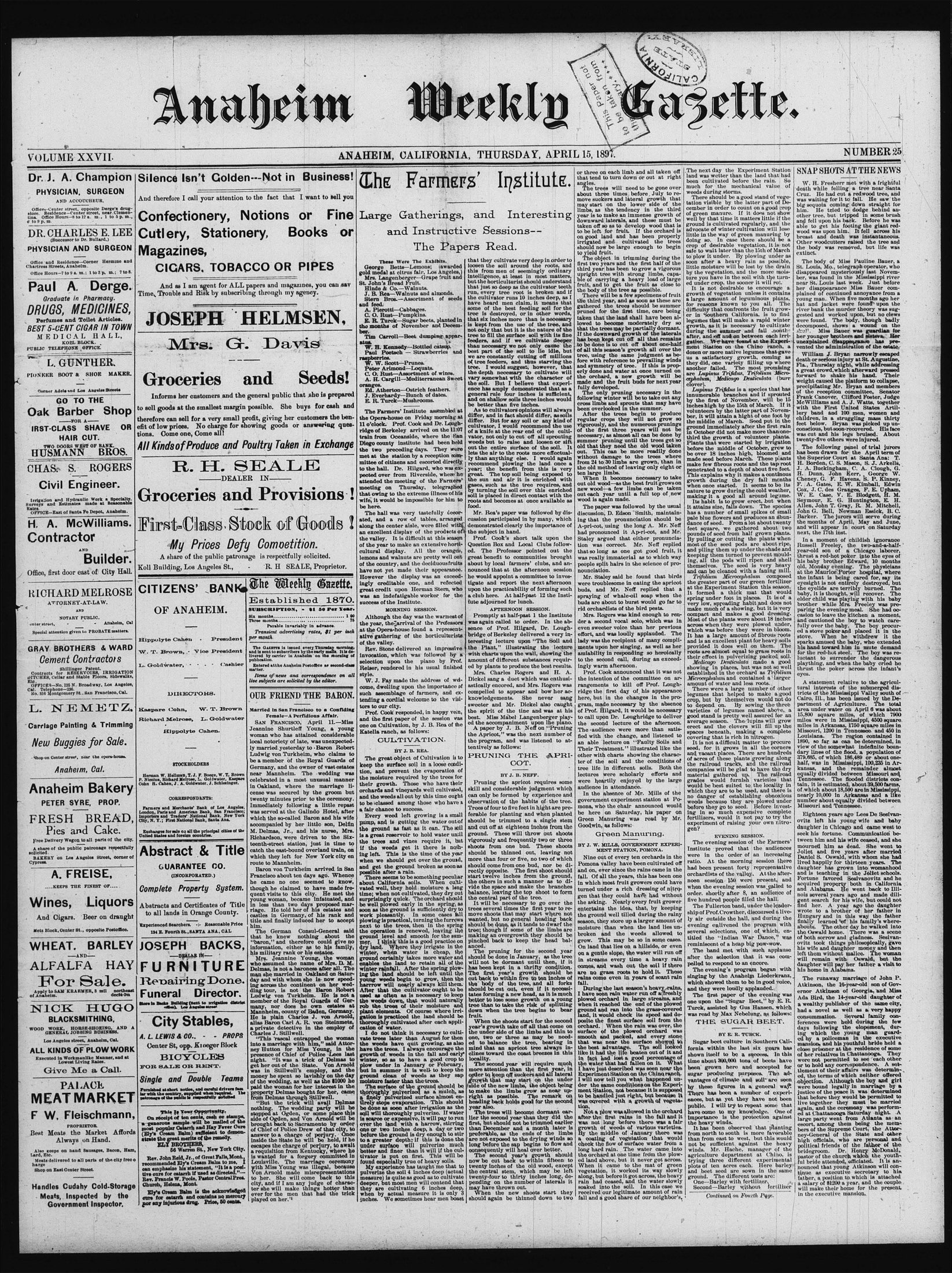
Searchable text
Anaheim
VOLUME XXVII.
Dr. J. A. Champion
PHYSICIAN, SURGEON
AND ACCOUCHEUR.
Office—Center street, opposite Derge's drugstore. Residence—Center street, near Clemen-tina. Office Hours—8 to 12 a.m., 1 to 5 p.m., 6 to 9 p.m.
DR. CHARLES E. LEE
(Successor to Dr. Bullard.)
PHYSICIAN AND SURGEON
Office and Residence—Corner Hermine and Chartress Streets, Anaheim.
Office Hours—7 to 9 a.m.; 1 to 3 p.m.; 7 to 8.
Paul A. Derge.
Graduate in Pharmacy.
DRUGS, MEDICINES,
Perfumes and Toilet Articles.
BEST 5-CENT CIGAR IN TOWN
MEDICAL HALL,
KOELL BLOCK.
PUBLIC TELEPHONE OFFICE.
L. GUNTHER.
PIONEER BOOT & SHOE MAKER.
Corner Adela and Los Angeles Streets
GO TO THE Oak Barber Shop
FOR A
IRST-CLASS SHAVE OR HAIR CUT.
TWO DOORS WEST OF BANK.
HUSMANN BROS.
CHAS. S. ROGERS
Silence Isn't Golden---Not in Business!
And therefore I call your attention to the fact that I want to sell you
Confectionery, Notions or Fine Cutlery, Stationery, Books or Magazines,
CIGARS. TOBACCO OR PIPES
And as I am agent for ALL papers and magazines, you can save Time, Trouble and Risk by subscribing through my agency.
JOSEPH HELMSEN,
Mrs. G. Davis
Groceries and Seeds!
Informs her customers and the general public that she is prepared to sell goods at the smallest margin possible. She buys for cash and therefore can sell for a very small profit, giving her customers the benefit of low prices. No charge for showing goods or answering questions. Come one, Come all!
All Kinds of Produce and Poultry Taken in Exchange
R. H. SEALE
GO TO THE Oak Barber Shop FOR A IIRST-CLASS SHAVE OR HAIR CUT. TWO DOORS WEST OF BANK. HUSMANN BROS. CHAS. S. ROGERS Civil Engineer. Irrigation and Hydraulic Work a Specially Surveys and Estimates made at Reasonable Rates. OFFICE—East of Santa Fe Depot, Anaheim. H. A. McWilliams. Contractor AND Builder. Office, first door east of City Hall. RICHARD MELROSE ATTORNEY-AT-LAW. AND NOTARY PUBLIC. center street, Anaheim, Cal Special attention given to PROBATE matters.
GRAY BROTHERS & WARD Cement Contractors Shillinger Patent. Contracts for RESERVOIRS, IRRIGATION DITCHES, Cellar and Stable Floors, Sidewalks, ETC. OFFICES—No. 125 N. Broadway, Los Angeles, Cal. Telephone—236. No. 316 Montgomery St., San Francisco, Cal.
L. NEMETZ, Carriage Painting & Trimming New Buggies for Sale. Shop on Center street, near the opera-house. Anaheim, Cal.
Anaheim Bakery PETER SYRE, PROP. FRESH BREAD, Pies and Cake. Free Delivery Wagon to all parts of the city. A share of the public patronage respectfully solicited. BAKERY on Los Angeles Street, corner of Cypress.
A. FREISE, ...KEEPS THE FINEST OF...
PETER SYRE, PROP.
FRESH BREAD,
Pies and Cake.
Free Delivery Wagon to all parts of the city.
A share of the public patronage respectfully solicited.
BAKERY on Los Angeles Street, corner of Cypress.
A. FREISE,
...KEEPS THE FINEST OF...
Wines, Liquors
And Cigars. Beer on draught
Metz Block, Center St., opposite Postoffice.
WHEAT. BARLEY
AND
ALFALFA HAY
For Sale.
Apply to SAM KRAEMER, 3 mil northeast of Anaheim.
NICK HUGO
BLACKSMITHING,
WOOD WORK, HORSE-SHOEING, AND A GENERAL JOBBING BUSINESS.
Los Angeles street, Anaheim, Cal.
ALL KINDS OF PLOWWORK
Executed in Workmanlike Manner, and at Lowest Living Rates.
Give Me a Call.
PALACE
MEATMARKET
F W. Fleischmann,
PROPRIETOR.
Best Meats the Market Affords Always on Hand.
Also keeps on hand Sausages, Bacon, Ham, Lard, Etc.
Meats delivered to all parts of the city free o harge
Shop on East Center Street.
Handles Cudahy Cold-Storage Meats, Inspected by the Government Inspector.
Abstract & Title
GUARANTEE CO.
(INCORPORATED.)
Complete Property System.
Abstracts and Certificates of Title to all lands in Orange County.
Experienced Searchers. :: Reasonable Price
124 E. Fourth St., SANTA ANA, CAL
JOSEPH BACKS,
DEALER IN
FURNITURE
Renairing Done.
Funeral Director.
Store in Backs Building (next to irrigation district office). Los Angeles street
City Stables,
A. L. LEWIS & CO.. - PROP8
Center St, opp. Kroeger Block
BICYCLES
FOR SALE OR RENT.
Single and Double Teams
Furnished at short notice, and careful drivers familiar with the country, supplied when required. The patronage of the public is respectfully solicited.
This Is Your Opportunity.
On receipt of ten cents, cash or stamps, a generous sample will be mailed of the most popular Catarrh and Hay Fever Cure (Ely's Cream Balm) sufficient to demonstrate the great merits of the remedy.
ELY BROTHERS,
56 Warren St., New York City.
Rev. John Reid, Jr., of Great Falls, Mont., recommended Ely's Cream Balm to me. I can emphasize his statement, "It is a positive cure for catarrh if used as directed."—Rev. Francis W. Poole, Pastor Central Presa. Church, Helena, Mont.
Ely's Cream Balm is the acknowledged cure for catarrh and contains no mercury nor any injurious drug. Price, 50 cents.
Immediately following a little repast was served at the Galindo Hotel, after which the so-called Baron and his wife accompanied by her little son, Delfin M. Delmas, Jr., and his nurse, Mrs. Richardson, were driven to the Sixteenth-street station, just in time to catch the east-bound overland train, on which they left for New York city en route to Mannheim.
Baron von Turkheim arrived in San Francisco about ten days ago. Whence he came no one seemed to know, though he claimed to have made frequent visits to this city. He met the young woman, became infatuated, and in less than two days proposed marriage. He told her of his estates and castles in Germany, of his rank and title and finally induced her to accept him.
The German Consul-General said that he knew nothing about the "baron," and therefore could give no information, either as to his family, his military rank or his estates.
Mrs. Jeannine Young, the woman who assumed the name of Mrs. D. M. Delmas, is not a baroness after all. The man she married in Oakland on Saturday and with whom she is now speeding across the continent on her wedding tour, is not the Baron Robert Ludwig von Turkheim. He is not a member of the Royal Guards of Germany, nor does he own estates at Mannheim, county of Baden, Germany. He is plain Charles J. von Arnold, alias Baron Carl A. R. von Steinmetz, a private detective in the employ of Charles J. Stillwell.
"This rascal entrapped the woman into a marriage with him," said Attorney Hutton for Miss Young, in the presence of Chief of Police Lees last night. "It was a trick of Delmas to get her out of the State. Von Arnold was in Stillwell's employ, and the money he spent so lavishly on the day of the wedding, as well as the $1000 he paid the woman for her interest in the property Delmas bought for her, came from Delmas through Stillwell.
"But the trick will avail Delmas nothing. The wedding party will be stopped at Ogden, or some place this side of Ogden, and Von Arnold will be brought back to Sacramento by order of Chief of Police Drew of that city, to answer to a charge of perjury. Once inside the State he will be held, if he escapes the charge of perjury, to await a requisition from Kentucky, where he is wanted for a forgery committed in Louisville. The marriage ceremony with Miss Young was illegal, because Von Arnold made misrepresentations to her. She will come back to this city, and if I am any judge of character she will make things hotter than ever for the men that had the trick played on her."
Weekly Gazette
ANAHEIM, CALIFORNIA, THURSDAY, APRIL 15, 1897.
In Business!
that I want to sell you
books or Fine
Books or
DR PIPES
magazines, you can save
my agency.
LMSEN,
avis
Seeds!
public that she is prepared
She buys for cash and
her customers the benpods or answering quesTaken in Exchange
ALE
The Farmers' Institute.
Large Gatherings, and Interesting
and Instructive Sessions--
The Papers Read.
These Were The Exhibits.
George Betts—Lemons; (awarded
gold medal at citrus fair, Los Angeles.)
Mrs. Langenberger—Grape fruit and
St. John's Bread Fruit.
Hinde & Co.—Walnuts.
J. B. Rea—Walnuts and almonds.
Stern Bros.—Assortment of seeds
and feed.
A. Pierotti—Cabbages.
C. O. Rust—Pumpkins.
E. R. Turck—Sugar beets, planted in
the months of November and December.
Tim Carroll—Beet dumping apparatus.
W. H. Kennedy—Bottled catsup.
Paul Poetsch — Strawberries and
raspberries.
W. W. Scott—Prunes.
Peter Arimond—Loquats.
C. O. Rust—Assortment of wines.
A. H. Cargill—Mediterranean Sweet
oranges.
Ed. Atherton—Ostrich feathers.
J. Everhardy—Bunch of dates.
E. R. Turck—Mushrooms.
The Farmers' Institute assembled at the Opera-house on Friday morning at 11 o'clock. Prof. Cook and Dr. Loughridge of Berkeley arrived on the 11:07 train from Oceanside, where the San Diego county institute had been held the two preceding days. They were met at the station by a reception committee of citizens and escorted directly to the hall. Dr. Hilgard, who was expected over from Riverside, where they cultivate very deep in order to loosen the soil around the roots, and this from men of seemingly ordinary intelligence, at least in most matters, but the horticulturist should understand that just so deep as the cultivator teeth run, every tree root is broken and if the cultivator runs 10 inches deep, as I have heard men claim, it means that some of the best feeding soil for the tree is destroyed, or in other words, that six inches more than is necessary is kept from the use of the tree, and not only that but it is the nature of the tree to fill the surface soil with its fine feeders, and if we cultivate deeper than necessary we not only cause the best part of the soil to lie idle, but we are constantly cutting off millions of tree feeders, and thus starving the tree. I would suggest, however, that the depth necessary to cultivate will vary somewhat with the character of the soil. But I believe that experience has amply demonstrated that as a general rule four inches is sufficient, and on shallow soils three inches would be better than five inches.
As to cultivators opinions will always differ, and in fact should differ, as soils differ. But for any soil or any kind of cultivator, I would recommend the use of a knife at the rear end of the cultivator, not only to cut off all sprouting weeds but to raise and loosen or sift out the entire surface of the soil. It lets the air to the roots more effectually than anything else. I would again recommend plowing the land once a year; the benefit from this is very great.
The trees will need to be gone o
about three times before July to move suckers and lateral growth tha
may start on the lower side of th
limbs, as the tendency in the th
year is to make an immense growth downward laterals, and these must
taken off so as to develop wood tha
to be left for fruit. If the orchard on good land and has been proper irrigated and cultivated the tree should now be large enough to begin to yield fruit.
The object in trimming during the first two years and the first half of the third year has been to grow a vigorous upright tree with strong limbs, capable of carrying a heavy load of land fruit, and to get the fruit as close to the body of the tree as possible.
There will be a few specimens of frothe third year, and as soon as these are gathered the trees should be summed pruned for the first time, care betained that the land shall have been lowed to become moderately dry so that the trees may be partially dormant.
If the downward growth of the later has been kept cut off all that remain to be done is to cut off about one-half of all this season's growth all over a tree, using the same judgment as fore with reference to prevailing wind and symmetry of tree. If this is properly done and water at once turned off the orchard, a new growth will be made and the fruit buds for next year fully developed.
The only pruning necessary in following winter will be to take out cross limbs and sprouts that may have been overlooked in the summer.
After the trees begin to produce regular crops they will not grow vigorously, and the numerous pruning of the first three years will not be necessary, as almost all can be done summer pruning until the trees get old that they need the old wood taken out. This can be more readily done without damage to the trees which from 24 to 30 limbs are grown, than the old method of leaving only eight ten large limbs.
The Farmers’ Institute assembled at the Opera-house on Friday morning at 11 o’clock. Prof. Cook and Dr. Loughridge of Berkeley arrived on the 11:07 train from Oceanside, where the San Diego county institute had been held the two preceding days. They were met at the station by a reception committee of citizens and escorted directly to the hall. Dr. Hilgard, who was expected over from Riverside, where he attended the meeting of the Farmers’ meeting on Thursday, telegraphed that owing to the extreme illness of his wife, it would be impossible for him to be here.
The hall was very tastefully decorated, and a row of tables, arranged along the center aisle, were filled with an excellent display of the products of the valley. It is difficult at this season of the year to make an extensive horticultural display. All the oranges, lemons and walnuts are pretty well out of the country, and the deciduous fruits have not yet made their appearance. However the display was an exceedingly creditable one, and reflected great credit upon Herman Stern, who was an indefatigable worker for the success of the Institute.
MORNING SESSION.
Although the day was the warmest of the year, the arrival of the Professors at the Opera-house found a representative gathering of the horticulturists of the valley.
Rev. Stone delivered an impressive invocation, which was followed by a selection upon the piano by Prof. Reiser, rendered in his usual finished style.
W. J. Fay made the address of welcome, dwelling upon the importance of such assemblage of farmers, and extending a cordial welcome to the visitors to our city.
Prof. Cook responded, in happy vein, and the first paper of the session was one on Cultivation, by J. B. Rea of the Katella ranch, as follows:
CULTIVATION.
BY J. B. REA.
The great object of Cultivation is to keep the surface soil in a loose condition, and prevent the evaporation of the moisture required by the trees for their growth. Those who have their orchards and vineyards well cultivated, and the weeds all out by this time ought to be classed among those who have a fair chance to success.
Every weed left growing is a small pump, and is getting the water out of the ground as fast as it can. The soil is a great reservoir to hold water until the trees and vines require it, but if the weeds get it there is nothing left. This is the time of the year when we should get over the ground, and get the ground broken as soon as possible after a rain.
There seems to be something peculiar about California soils. When cultivated well, they hold moisture a long time; when not cultivated, they dry out surprisingly quickly. The orchard should vary somewhat with the character of the soil. But I believe that experience has amply demonstrated that as a general rule four inches is sufficient, and on shallow soils three inches would be better than five inches.
As to cultivators opinions will always differ, and in fact should differ, as soils differ. But for any soil or any kind of cultivator, I would recommend the use of a knife at the rear end of the cultivator, not only to cut off all sprouting weeds but to raise and loosen or sift out the entire surface of the soil. It lets the air to the roots more effectually than anything else. I would again recommend plowing the land once a year; the benefit from this is very great. The top soil being exposed to the sun and air it is enriched with gases, such as the tree requires, and by turning the soil over this enriched soil is placed in direct contact with the roots and becomes at once available as food.
Mr. Rea’s paper was followed by discussion participated in by many, which demonstrated clearly the importance of the subject in hand.
Prof. Cook’s short talk upon the Question Box and Local Clubs followed. The Professor pointed out the great benefit to communities brought about by local farmers’ clubs, and announced that at the afternoon session he would appoint a committee to investigate and report the next afternoon upon the practicability of forming such a club here. At half-past 12 the Institute adjourned for lunch.
AFTERNOON SESSION.
Promptly at half-past 1 the Institute was again called to order. In the absence of Prof. Hilgard, Dr. Loughbridge of Berkeley delivered a very interesting lecture upon “The Soil and the Plant,” illustrating the lecture with charts upon the wall, showing the amount of different substances required by plants to produce best results.
Mrs. Charles Rogers and H. A. Dickel sang a duet which was enthusiastically encored, and Mrs. Rogers was compelled to appear and bow her acknowledgements. She never sang sweeter and Mr. Dickel also caught the spirit of the tine and was at his best. Miss Mabel Langenberger played the accompaniment upon the piano.
A paper by J. B. Neff on “Pruning the Apricot,” was the next number of the program, and was listened to attentively as follows:
PRUNING THE APRI-COT.
BY J. B. NEFF.
Pruning the apricot requires some skill and considerable judgment which can only be formed by experience and observation of the habits of the tree. Trees of four to five feet in height are preferable for planting and when planted should be trimmed to a single stem and cut off at eighteen inches from the ground. These will throw out shoots vigorously and frequently two or three shoots from one bud. These shoots should be thinned out, leaving not more than four or five, no two of which should come from one bud, nor be directly opposite. The first shoot should start twelve inches from the ground, the others in such a manner as to divide the space and make the branches balance, leaving the top shoot to form central part of the tree.
The orchard, a new growth will be made and the fruit buds for next year fully developed.
The only pruning necessary in following winter will be to take out cross limbs and sprouts that may have been overlooked in the summer.
After the trees begin to produce regular crops they will not grow vigorously, and the numerous prunings of the first three years will not need necessary, as almost all can be done summer pruning until the trees get old that they need the old wood taken out. This can be more readily done without damage to the trees which from 24 to 30 limbs are grown, than the old method of leaving only eight ten large limbs.
When it becomes necessary to take out old wood—as the best fruit grows new wood—a few limbs can be taken out each year until a full top of new wood is again made.
The paper was followed by the user discussion, D. Edson Smith, maintaining that the pronunciation should be A-pri-cot, using the long A. Mr. Nahad pronounced it Ap-ri-cot, and D Staley argued that either pronunciation was correct. Mr. Neff replied that so long as one got good fruit was really immaterial as to which people split hairs in science or pounciation.
Mr. Staley said he found that birds were troublesome in eating the apricots buds, and Mr. Neff replied that spraying of whale-oil soap when buds are about to burst would go far wild or orchardists of the bird pests.
Mrs. Rogers was kind enough to render a second vocal solo, which was even sweeter voice than her previous effort, and was loudly applauded.
Lady was the recipient of many comments upon her singing, as well as amiability in responding so heroically to the second call, during an exceptionally warm afternoon.
Prof. Cook announced that it was intention of the committee on rangements to kill off Prof. Loughridge the first day of his appearance here, but in the changes in his program, made necessary bythe absence of Prof. Hilgard, it would be necessary to call upon Dr. Loughridge to delineate the second lecture of the afternoon.
The audience were more than satisfied with change, and listened an able lecture on “Faulty Soils Their Treatment.” illustrated like other with charts showing charmter of the soil and the condition tree life in different soils.Both lectures were scholarly efforts were heartily enjoyed by the laurel audience in attendance.
In the absence of Mr. Mills of government experiment station at Monnao, who she chair announced would be here on Saturday, his paper Green Manuring was read by Goodwin, as follows:
Green Manuring.
BY J.W.MILLS,GOVERNMENT EXPERIMENT STATION,POMONA.
Nine out of every ten orchards in Pomona valley have been cultivated and on, ever since the rains came in fall.Of all the years,this has been in which most fruit growers could have turned under a rich dressing of nitrogen that they could have had with
You are an OCR engine for a region cropped from a scanned historical newspaper page. Transcribe all legible text exactly as printed, top-to-bottom.
Every weed left growing is a small pump, and is getting the water out of the ground as fast as it can. The soil is a great reservoir to hold water until the trees and vines require it, but if the weeds get it there is nothing left. This is the time of the year when we should get over the ground, and get the ground broken as soon as possible after a rain.
There seems to be something peculiar about California soils. When cultivated well, they hold moisture a long time; when not cultivated, they dry out surprisingly quick. The orchard should be well plowed early in the spring, as soon as the ground is sufficiently dry to work pleasantly. In some cases fall plowing is practical, turning the furrows next to the trees, then in the spring the operation is renewed, leaving the ground level and smooth for the summer. I think this is a good practice on dry land. Where they irrigate in the winter, when water is cheap, the ground certainly takes more water and enables the land to retain all of the winter rainfall. After the spring plowing the land should be left until the young weeds begin to grow, then the harrow will nearly always kill them. After that the cultivator ought to be used as often as is necessary to keep the weeds down, that would naturally rob the trees of their moisture and plant elements. Of course where irrigation is practiced the land should be thoroughly cultivated after each application of water.
I do not think it necessary to cultivate trees later than August for then the weeds have quit growing, as also have the trees. I always encourage the growth of weeds in the fall and early winter, so as to have a good crop to plow under in January or February, but in summer it is well to keep the ground clean of weeds as they sap moisture faster than the trees.
The surface of the ground should be thoroughly pulverized as a mulch, as a finely pulverized surface almost entirely stops evaporation. This should be done as soon after irrigation as the soil will thoroughly pulverize. If water is scarce or expensive, it will pay to run over the land with a harrow, stirring one or two inches deep, a day or two before the ground is dry enough to stir to a greater depth; if this is done the under surface will pulverize much better and finer than it will if the cultivator is put on first. This will be found especially true of heavy soils.
My experience has taught me that to pulverize the soil 4 inches deep (actual measure) is quite as good as to cultivate deeper, but most men will contend that they are cultivating 6 inches deep, when by actual measure it is only 3 inches. We sometimes hear men boast observation of the habits of the tree. Trees of four to five feet in height are preferable for planting and when planted should be trimmed to a single stem and cut off at eighteen inches from the ground. These will throw out shoots vigorously and frequently two or three shoots from one bud. These shoots should be thinned out, leaving not more than four or five, no two of which should come from one bud, nor be directly opposite. The first shoot should start twelve inches from the ground, the others in such a manner as to divide the space and make the branches balance, leaving the top shoot to form the central part of the tree.
It will be necessary to go over the trees several times the first year to remove shoots that may start where not wanted, but no general heading back should be done, as it tends to dwarf the tree; though if some of the limbs are making an overgrowth they should be pinched back to keep the head balanced.
The pruning for the second year should be done in January, as the tree will not be dormant until then, if it has been kept in a thrifty condition. The first year's growth should be cut back to within five to ten inches of the body of the tree, and all forks should be cut out, even if it necessitates forming a new head, as it is much better to lose some growth on a young tree than to take the risk of splitting down when the tree begins to bear fruit.
When the shoots start for the second year's growth take off all that come on the under side of the limbs and thin to one, two or three as may be needed to balance the tree, bearing in mind that an apricot tree always climbs toward the coast breezes in this locality.
The second year will require much more attention than the first year, in order to keep off suckers and all lateral growth that may start on the under side of the new limbs, the object being to make the limbs grow as near upright as possible. The remark on heading back holds good for the second year also.
The trees will become dormant earlier than the second year than they did first, but should not be trimmed earlier than December and a month later is preferable, as the ends of the limbs are not exposed to the drying winds so long before the sap begins to flow and consequently will heal over better.
The second year's growth should now be cut back to within fifteen to twenty inches of the old wood, except the central stem, which may be left twenty-four to thirty inches long, depending on the number of laterals it may have thrown out.
When the new shoots start they should again be thinned down to two observation of the habits of the tree. Trees of four to five feet in high are preferable for planting and when planted should be trimmed to a single stem and cut off at eighteen inches from the ground. These will throw out shoots vigorously and frequently two or three shoots from one bud. These shoots should be thinned out, leaving not more than four or five, no two of which should come from one bud, nor be directly opposite. The first shoot should start twelve inches from the ground, the others in such a manner as to divide the space and make the branches balance, leaving the top shoot to form the central part of the tree.
It will be necessary to go over the trees several times the first year to remove shoots that may start where not wanted, but no general heading back should be done, as it tends to dwarf the tree; though if some of the limbs are making an overgrowth they should be pinched back to keep the head balanced.
The pruning for the second year should be done in January, as the tree will not be dormant until then, if it has been kept in a thrifty condition. The first year's growth should be cut back to within five to ten inches of the body of the tree, and all forks should be cut out, even if it necessitates forming a new head, as it is much better to lose some growth on a young tree than to take the risk of splitting down when the tree begins to bear fruit.
When the shoots start for the second year's growth take off all that come on the under side of the limbs and thin to one, two or three as may be needed to balance the tree, bearing in mind that an apricot tree always climbs toward the coast breezes in this locality.
The second year will require much more attention than the first year, in order to keep off suckers and all lateral growth that may start on the under side of the new limbs, the object being to make the limbs grow as near upright as possible. The remark on heading back holds good for the second year also.
The trees will become dormant earlier than they did first, but should not be trimmed earlier than December and a month later is preferable, as the ends of the limbs are not exposed to the drying winds so long before the sap begins to flow and consequently will heal over better.
The second year's growth should now be cut back to within fifteen to twenty inches of the old wood, except the central stem, which may be left twenty-four to thirty inches long, depending on the number of laterals it may have thrown out.
When the new shoots start they should again be thinned down to two observation of the habits of the tree. Trees of four to five feet in high are preferable for planting and when planted should be trimmed to a single stem and cut off at eighteen inches from the ground. These will throw out shoots vigorously and frequently two or three shoots from one bud. These shoots should be thinned out, leaving not more than four or five, no two of which should come from one bud, nor be directly opposite. The first shoot should start twelve inches from the ground, the others in such a manner as to divide the space and make the branches balance, leavingthe top shootto formthe central partofthetree.
It willbe necessarytogooverthetreesseveraltimesthefirstyeartoremoveshootsthatmaystartwherenotwantedbutnogeneralheadingbackshouldbemadedoneasittendstodwarfthetree;thoughifsomeofthelimbsaremakinganovergrowththeyshouldbepinchedbacktokeeptheheadbalanced.
ThepruningforthesecondyearshouldbedoneinJanuaryasthetreewillnotbe dormantuntilthenifhasbeenkeptinathriffycondition.Thefirstyear'sgrowthshouldbetcutbackwithintofivetoteninchesofthebodyofthetree,andallforksshouldbescutout,evenifnecessitestforminganewhead.asitismuchbettertolosesomegrowthonayoungtreethantocaketheriskofsplittingdownwhenthetreebeginstobearfruit.
Whentheshootstartsforthesecondyeargrowthtakeoffallthatcomeontheundersideofthelimbsandthintoone,twoorthreeasmaybeneeddedtobalancethetree,bearingindmindthatanapricottreealwaysinclinestowardthecoastbreezesinthislocality.
Thesecondyearwillrequiremuchmoreattentionthanthefirstyearinordertokeepoff suckersandalllateralgrowththatmaystartontheundersideofthelimbsandthintoone,tendsofthelimbsarenotexposedtothedryingwindswoolongbeforethesapbeginstoflowandconsequentlywillhealoverbetter.
Thesecondyear'sgrowthshouldnowbecutbackwithintofiveto十inchesoftheoldwoodexceptthecentralstemwhichmaybelefttwenty-fourto thirtyincheslongdependingonthenumberoflateralsitmayhavethrownout.
Whenthenewshootstartsforthesecondyeargrowthtakeoffallthatcomeontheundersideofthelimbsandthintoone,twostorymightgetacrosswhenitcameowhenthemaironcertainconditionsontheExperimentStation,theExpressmentStation,nothingissupposedjustrightbutbecausewascoveredwithagrowthofvegetation.Notaplowwasallowedintheorchardafterthefirstrainsinthefallandwasnotlongbeforethere wasa Growthofweedsofvarious varietiesBythemiddleofJanuarythere wasa coatingofvegetationthatwouldchecktheflowofsurfacewaterfromlonghardrain.Thewater cameintheorchardatone timefromtheplowedlandabove,但它 never got acridWhenitcameothematogreg vegetation,它workeditswayslong along,但beforeitgotacross,theheatrainhad ceased,andthewaterslotsoakedinto,the soil.Inthiscasereceivedourlegitimateamountofnosefallandagoodshareofourneighborhood
Gazette.
NUMBER 25
The next day the Experiment Station land was wetter than the land that had been cultivated before the rain. So much for the mechanical value of weeds during storms.
There should be a good stand of vegetation visible by the latter part of December in order to count on a good crop of green manure. If it does not show well by that time it matters little if the ground is cultivated regularly, and the advocate of winter cultivation will lose little in the way of green manuring by doing so. In case there should be a crop of desirable vegetation, it is not safe to wait later than the 15th of March to plow it under. By plowing under as soon after a heavy rain as possible, little moisture will be lost by the drain by the vegetation, and the more moisture you have in the soil with the turned under crop, the sooner it will rot.
It is not desirable to encourage a growth of vegetation unless it contains a large amount of leguminous plants, for reasons known to you all. The difficulty that confronts the fruit grower in Southern California, is to find legumes that will make a rapid winter growth, as it is necessary to cultivate during the summer and fall months after, and off and on between each irrigation. We have found at the Experiment Station on the Chino ranch, a dozen or more native legumes that gave us a satisfactory growth, coming as they did, one variety filling up where another failed. The most promising are Lupinus Trifidus, Trifolium Microcephalum, Medicago Denticulata (burr clover).
Lupinus Trifidus is a species that has innumerable branches and if sprouted by the first of November, will be 15 inches high by the 15th of March. If volunteers by the latter part of November, it will attain a height of one foot by the middle of March. Seed put in the ground immediately after the first rain in October did not make more than one-third the growth of volunteer plants. Plants that were started by irrigation before the middle of October, grew to be over 18 inches high, bloomed and made seed before March. These plants make few fibrous roots and the tap root penetrated to a depth of about five feet. This explains why it makes a continuous
SNAP SHOTS AT THE NEWS
W. H. Fresherr met with a frightful death while fellring a tree near Santa Cruz. He had cut a redwood tree, and was waiting for it to fall. He saw the big sequoia coming down straight for him. He tried to dodge behind another tree, but tripped in some brush and fell upon his back. Before he was able to get his footing the giant redwood was upon him. It fell across his breast and death was instantaneous. Other woodcutters raised the tree and the body was removed, but life was extinct.
The body of Miss Pauline Bauer, a St. Louis, Mo., telegraph operator, who disappeared mysteriously last November, was found in the Mississippi river near St. Louis last week. Just before her disappearance Miss Bauer complained of continued annoyance from a young man. When five months ago her hat and jacket were found upon the river bank the murder theory was suggested and worked upon, but no clews were found. The body, though badly decomposed, shows a wound on the skull. Miss Bauer was guardian for her younger brothers and sisters. Her unexplained disappearance has prevented the administration of the estate.
William J. Bryan narrowly escaped death or serious injury at St. Augustine, Fla., Thursday night, while addressing a great crowd, which afterward pressed forward to shake his hand. Their weight caused the platform to collapse, precipitating Mr. Bryan and members of the reception committee. Senator Frank Canover, Clifford Foster, Judge McWilliams and A. J. Watts, together with the First United States Artillery band and 100 men, women and children, in a struggling mass thirty feet below. Bryan was picked up unconscious, but soon recovered. His face was cut and his legs bruised. About twenty-five others were injured.
The following panel of trial jurors has been drawn for the April term of the Superior Court at Santa Ana: T. H. Borden, C. S. Mason, S. J. Arkells, J. A. Buckingham, C. A. Clough, G. H. Dunn, John Kerr, George W.
only pruning necessary in the winter will be to take out any limbs and sprouts that may have overlooked in the summer.
The trees begin to produce crops they will not grow so easily, and the numerous prunings first three years will not be berry, as almost all can be done by pruning until the trees get so that they need the old wood taken this can be more readily done at damage to the trees where 30 limbs are grown, than in method of leaving only eight or nine limbs.
In it becomes necessary to take wood—as the best fruit grows on wood—a few limbs can be taken each year until a full top of new wood again made.
Paper was followed by the usual motion, D. Edson Smith, maintain that the pronunciation should be not, using the long A. Mr. Neff announced it Ap-ri-cot, and Mr. Neff replied that a ring of whale-oil soap when the nose about to burst would go far to hardists of the bird pests.
Rogers was kind enough to renew vocal solo, which was in greeter voice than her previous one and was loudly applauded. The roar is the recipient of many compliments her singing, as well as her quiet in responding so heroically second call, during an exceeding warm afternoon.
Cook announced that it was not mention of the committee on arguments to kill off Prof. Loughhey the first day of his appearance but in the changes in the proclamation necessary by the absence of Hilgard, it would be necessary upon Dr. Loughridge to deliver second lecture of the afternoon. Audience were more than satisfied with the change, and listened to the lecture on "Faulty Soils and Treatment." illustrated like the sixth charts showing the character of soil and the conditions of life in different soils. Both theses were scholarly efforts and heartily enjoyed by the large audience.
The absence of Mr. Mills of the moment experiment station at Powell who the chair announced would live on Saturday, his paper on Manuring was read by Mr. Mills, as follows:
Green Manuring.
W. MILLS, GOVERNMENT EXPERIMENT STATION, POMONA.
Out of every ten orchards in the valley have been cultivated off ever since the rains came in in all the years, this has been one inch most fruit growers could have under a rich dressing of nitrogen that they could have had without
Lupinus Trifidus is a species that has innumerable branches and if sprouted by the first of November, will be 15 inches high by the 15th of March. If it volunteers by the latter part of November, it will attain a hight of one foot by the middle of March. Seed put in the ground immediately after the first rain in October did not make more than one-third the growth of volunteer plants. Plants that were started by irrigation before the middle of October, grew to be over 18 inches high, bloomed and made seed before March. These plants make few fibrous roots and the tap root penetrated to a depth of about five feet. This explains why it makes a continuous growth during the dry fall months when once started. It seems to be its nature to grow during the cold weather, making it a good all around legume.
Its habit is to grow erect, but when it attains size, falls down. The species has a number of small spikes of small pale blue flowers and produces an abundance of seed. From a lot about twenty feet square, we gathered about two pounds of seed from half grown plants. By pulling or cutting the plants when most of the seed pods are about ripe, and piling them up under the shade and keeping them turned to prevent moulding, all the pods will ripen and shell themselves. The seed is very heavy and can be cleaned with a fanning mill.
Trifolium Microcephalum composed the greater part of our green fertilizer at the Experiment Station this season. It formed a thick mat that would spring under foot in places. It is of a very low, spreading habit and does not make much of a showing, but it is very compact and makes a good dressing. Most of the plants were about 18 inches across when they were plowed under, which was before they were in bloom. It has a large amount of fibrous roots and is an excellent plant for heavy soils provided it does well on them. The roots are almost equal to grass roots in their effect in pulverizing packed soil.
Medicago Denticulata made a good showing in places, but was not so well established in the orchard as Trifolium Microcephalum and contained a larger amount of water and less roots.
There were a large number of other legumes that helped to make a good crop, but by themselves would not do depend on. By sowing the three varieties of legumes named above, a good stand is pretty well assured for an average season. The lupins will grow erect and the clovers will fill up the spaces beneath, making a complete covering that is rich in nitrogen.
It is not a difficult matter to procure seed, for it grows in all the corners and vacant places. There are hundreds of acres of these plants growing along the railroad tracks, and the railroad companies will be glad to have the dry material gathered up. The railroad grades would furnish varieties that would be best suited to the locality in which they are to be used, and there is no danger of establishing obnoxious weeds because they are plowed under before they go to seed. Before investing in so much expensive complete fertilizers, would it not pay to try the experiment of raising your own nitrogen?
EVENING SESSION.
The evening session of the Farmers' Institute proved that the audiences were in the order of an increasing ratio. At the morning session there had been present forty representative orchardists of the valley. At the afternoon session 150 were present, and when the evening session was called to order, shortly after 8, an audience of five hundred people filled the hall.
Lupinus Trifidus is a species that has innumerable branches and if sprouted by the first of November, will be 15 inches high by the 15th of March. If it volunteers by the latter part of November, it will attain a hight of one foot by the middle of March. Seed put in the ground immediately after the first rain in October did not make more than one-third the growth of volunteer plants. Plants that were started by irrigation before the middle of October, grew to be over 18 inches high, bloomed and made seed before March. These plants make few fibrous roots and the tap root penetrated to a depth of about five feet. This explains why it makes a continuous growth during the dry fall months when once started. It seems to be its nature to grow during the cold weather, making it a good all around legume.
It is a large amount of fibrous roots and is an excellent plant for heavy soils provided it does well on them. The roots are almost equal to grass roots in their effect in pulverizing packed soil.
Medicago Denticulata made a good showing in places, but was not so well established in the orchard as Trifolium Microcephalum and contained a larger amount of water and less roots.
There were a large number of other legumes that helped to make a good crop, but by themselves would not do depend on. By sowing the three varieties of legumes named above, a good stand is pretty well assured for an average season. The lupins will grow erect and the clovers will fill up the spaces beneath, making a complete covering that is rich in nitrogen.
It is not a difficult matter to procure seed, for it grows in all the corners and vacant places. There are hundreds of acres of these plants growing along the railroad tracks, and the railroad companies will be glad to have the dry material gathered up. The railroad grades would furnish varieties that would be best suited to the locality in which they are to be used, and there is no danger of establishing obnoxious weeds because they are plowed under before they go to seed. Before investing in so much expensive complete fertilizers, would it not pay to try the experiment of raising your own nitrogen?
Eighteen years ago Lees De Sesivanovitz left his young wife and baby daughter in Chicago and came west to seek his fortune. Communication between him and his wife ceased, and she mourned him as dead. She went to Joliet and five years after married Daniel S. Oswald, with whom she had lived happily for thirteen years. The daughter has grown into womanhood and is teaching in the Joliet schools. Fortune favored Sesivanovitz and he acquired property both in California and Alabama. He went back to Illinois several years ago and made diligent search for his wife but could not
Green Manuring.
Out of every ten orchards in the valley have been cultivated off all the years, this has been one with most fruit growers could have under a rich dressing of nitrogen that they could have had without using. Nearly every fruit grower knows the idea, that, by keeping ground well tilled during the rainy season they store up a larger amount of rice than when the land lies unraveled and the weeds allowed to grow. This may be so in some cases, and that lies on a hillside, or even gentle slope, the water will run off streams every time a heavy rain falls and wash out the soil if there is grass roots to hold it. These come even in years of scant rain during the last season's heavy rains, seen rain water run off a freshly orchard in large streams, and reached the end of the plowed field and ran into the grass-covered field would check its speed and determine the finest surface soil from the soil. When the rain was over, the soil looked hard the life beaten out of it and had lost a good percentage of water that had fallen on it. What just described was seen near theEMENT Station on the Chinquash farm tell you what happened unevenly conditions on the Experimentation, not because it is supposed handled just right, but because it covered with a growth of vegetation.
A plow was allowed in the orchard the first rains in the fall and it got long before there was a fair of weeds of various varieties. In the middle of January there was planting of vegetation that would flow of surface water from a hard rain. The water came into the orchard at one time from the plow above, but it never got across. It came to the mat of green cement, it worked its way slowly about before it got across, the heavy mud ceased, and the water slowly into the soil. In this case we used our legitimate amount of rain and a good share of our neighbor's weeds because they are plowed under before they go to seed. Before investing in so much expensive complete fertilizers, would it not pay to try the experiment of raising your own nitrogen?
EVENING SESSION.
The evening session of the Farmers' Institute proved that the audiences were in the order of an increasing ratio. At the morning session there had been present forty representative orchardists of the valley. At the afternoon session 150 were present, and when the evening session was called to order shortly after 8, an audience of five hundred people filled the hall.
The Fullerton band, under the leadership of Prof. Crowther, discussed a live air outside the hall, and during the evening eglivened the program with several selections, one of which, entitled "Indian War Dance," was reminiscent of a heap big pow-wow.
The band met with such applause after the selection that it was compelled to respond to an encore.
The evening's program began with singing by the Anaheim Liederkranz, which showed them to be in good voice, and they were loudly applauded.
The first paper of the evening was one upon the "Sugar Beet," by E.R. Turck, assisted by Gus Hansen, which was read by Max Nebelung, as follows:
THE SUGAR BEET.
BY E.R. TURCK.
Sugar beet culture in Southern California within the last six years has shown itself to be a success. In this time about 300,000 tons of beets have been grown here and accepted for sugar producing purposes. The advantages of climate and soil are seen by these figures in a general way. There has been a number of experiences, but as yet they have not been public. I will try to repeat some that have come to my knowledge. One of importance is the protection against the heavy winds.
It has been observed that planting from north to south is more favorable than from east to west, but this would not be sufficient against the heavy winds. Mr. Hache, manager of the agriculture department at Chino, is trying three different experimental plots of ten acres each. Here barley and beet seed are sown in the same ground. The different tests are:
One—Barley with fertilizer.
Second—Barley without fertilizer
Continued on Fourth Page.
Eighteen years ago Lees De Sesivanovitz left his young wife and baby daughter in Chicago and came west to seek his fortune. Communication between him and his wife ceased, and she mourned him as dead. She went to Joliet and five years after married Daniel S. Oswald, with whom she had lived happily for thirteen years. The daughter has grown into womanhood and is teaching in the Joliet schools. Fortune favored Sesivanovitz and he acquired property both in California and Alabama. He went back to Illinois several years ago and made diligent search for his wife, but could not find her. A year ago the daughter wrote to a brother of her father in Hungary and in this way the father finally learned of his family's whereabouts. The other day he walked into the Oswald home. There was a scene of both sorrow and gladness. Sesivanovitz took things philosophically, gave his wife and daughter money and then left them without malice. The woman will remain with Oswald, but the daughter will pay her father a visit to his home in Alabama.
The runaway marriage of John P. Atkinson, the 16-year-old son of Governor Atkinson of Georgia, and Miss Ada Bird, the 14-year-old daughter of a wealthy publisher of the same city, had a novel as well as a very happy consummation. Several family conferences were held during the few days following the elopement, during which the young man guarded by a policeman in the executive mansion, and his youthful bride held a close prisoner at the residence of some of her relatives in Chattanooga. They were not permitted to see each other or to hold any correspondence. A settlement of their affairs was determined, the terms of which neither offered objection. Although the boy and girl were bound legally in marriage by a justice of the peace it was determined that before they would be permitted to live together they must be married again, and the ceremony was performed at Chattanooga Saturday night. A large party went from Atlanta as an escort, among them being the members of the Supreme Court, the Attorney-General of the State and other high officials, who are personal and political friends of the father of the bridegroom. Dr. Henry McDonald, pastor of the church which the youthful bride attended, officiated. It is announced that young Atkinson will continue as executive secretary to his father, a position to which is attached a salary of $1200 a year, and the couple will make their home for the present in the executive mansion.