anaheim-gazette 1897-04-08
Scanned page
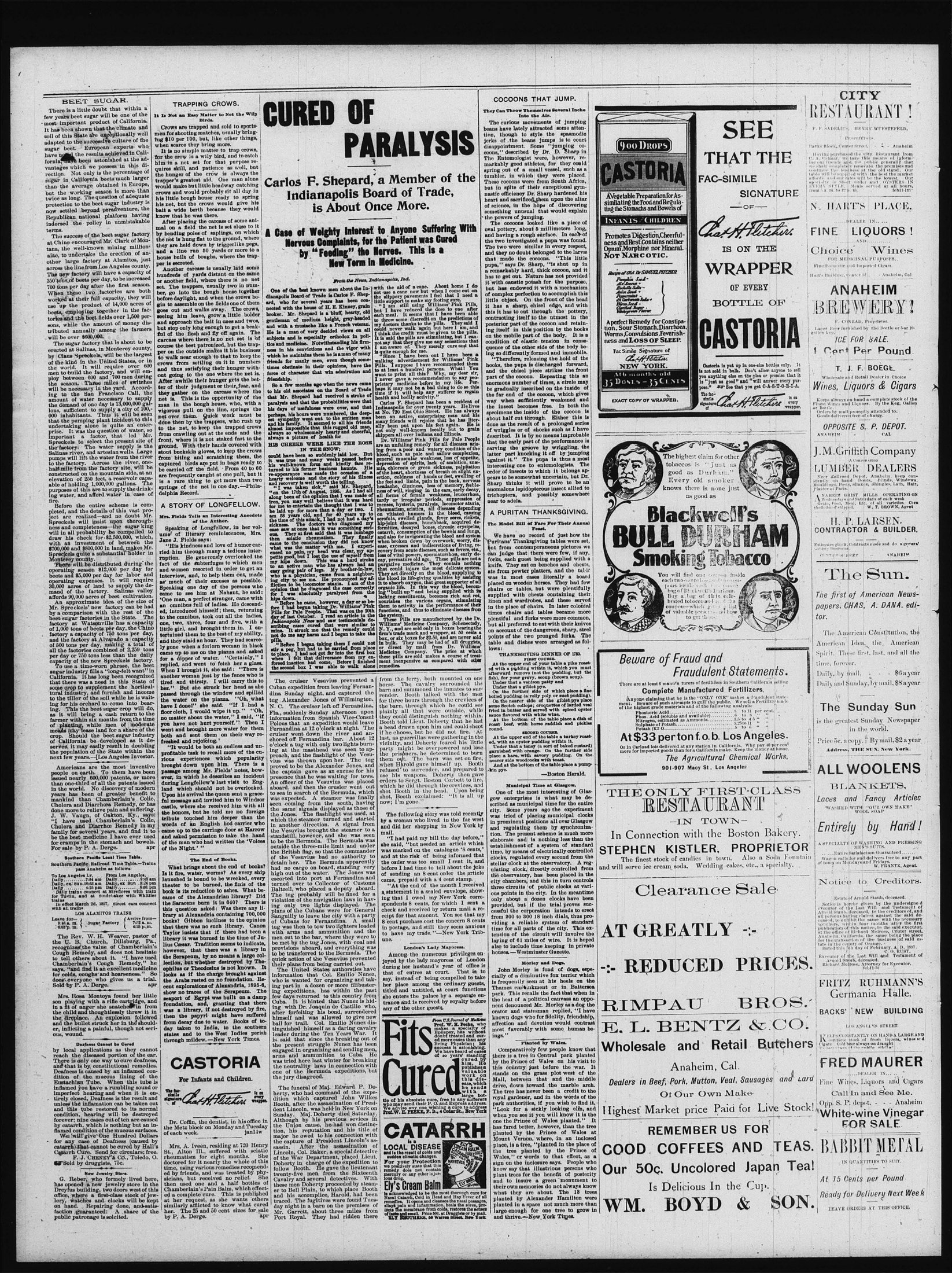
Searchable text
BEET SUGAR.
There is a little doubt that within a few years beet sugar will be one of the most important product of California. It has been shown that the climate and soil of this State are exceptionally well adapted to the successive culture of the sugar beet. European experts who have noted the results achieved in California, have been astonished at the advantages which we possess in this direction. Not only is the percentage of sugar in California beets much larger than the average obtained in Europe, but the working season is more than twice as long. The question of adequate protection to the beet sugar industry is now settled beyond peradventure, the Republican national platform having indorsed the policy in unmistakable terms.
The success of the beet sugar factory at China encouraged Mr. Clark of Montana, the well-known mining millionaire, to undertake the erection of another large factory at Alamitos, just across the line from Los Angeles county. The new factory will have a capacity of 350 tons of beets per day, to be increased 700 tons per day after the first season. When these two factories are both worked at their full capacity, they will use up the product of 14,000 acres of beets, employing together in the factories and the beet fields over 1,500 persons, while the amount of money distributed annually among the farmers will be over $600,000.
The sugar factory that is about to be erected at Salinas, in Monterey county, by Claus Spreckels, will be the largest of the kind in the United States, or in the world. It will require over 600 men to build the factory, and will employ between 600 and 700 men during the season. Three miles of switches will be necessary in the yard. According to the San Francisco Call, the amount of water necessary to supply the demand of one day is 13,000,000 gallons, sufficient to supply a city of 100,000 inhabitants. Thus it will be seen that the pumping plant incident to this undertaking alone is quite an enterprise. It was the question of water, so important a factor, that led Mr. Spreckels to select the present site of the factory: The water supply is the Salinas river, and artesian wells. Large pumps will lift the water from the river to the factory. Across the river, one-half mile from the factory site, will be constructed on the mountain side, at an
TRAPPING CROWS.
It Is Not an Easy Matter to Net the Wily Birds.
Crows are trapped and sold to sportsmen for shooting matches, usually bringing $10 per 100, but, like other things, when scarce they bring more.
It is no simple matter to trap crows, for the crow is a wily bird, and to catch him in a net set for that purpose requires skill, and patience as well, but the hunger of the crow is always the trapper's greatest aid. One man alone would make but little headway catching crows and would probably sit all day in his little bough house ready to spring his net, but the crows would give his bait a wide berth because they would know that he was there.
After placing the carcass of some animal on a field the net is set close to it by bending poles of saplings, on which the net is hung flat to the ground, where they are held down by triggerlike pegs, and a line run 50 yards or more to a house built of boughs, where the trapper is secreted.
Another carcass is usually laid some hundreds of yards distant on the same or another field, where there is no net set. The trappers, usually two in number, go into the bough house together before daylight, and when the crows begin to assemble on the fields one of them goes out and walks away. The crows, seeing him leave, grow a little bolder and approach the bait in ones and twos, but stop only long enough to get a beakful of the flesh and fly off again. The carcass where there is no net set is of course the best patronized, but the trapper on the outside makes it his business to walk near enough to that to keep the crows from settling on it in numbers and thus satisfying their hunger without going to the one where the net is. After awhile their hunger gets the better of their judgment or their fear, and they gather on the carcass where the net is. This is the opportunity of the man in the bough house, who, with a vigorous pull on the line, springs the net over them. Quick work must be done then by the trappers, who rush up to the net, to keep the trapped crows from crawling out at the ends and the front, where it is not staked fast to the ground. With their hands covered with stout buckskin gloves, to keep the crows from biting and scratching them, the captured birds are put in bags ready to be carried off the field. From 40 to 60 are frequently caught on one pull, but it
Before the entire scheme is completed, and the details of this vast project are realized—and no doubt Mr. Spreckels will insist upon thoroughness and completeness—the sugar king will in all probability be compelled to draw his check for $2,500,000, which, with an investment of between the $700,000 and $5,000 per day for labor and operating expenses. It will require 30,000 acres of land to supply the demand of the factory. Salinas valley affords 90,000 acres of beet cultivation.
An approximate idea of the size of Mr. Spreckels' new factory can be had by a comparison with the rest of the beet sugar factories in the State. The factory at Watsonville has a capacity of 1,000 tons of beets per day, the Chino factory a capacity of 750 tons per day, and the factory at Alvarado a capacity of 500 tons per day, making a total of all the factories combined of 2,250 tons per day or 750 tons less than the daily capacity of the new Spreckels factory.
To use a time-worn phrase, the beet sugar industry fills a "long-felt want" in California. It has long been recognized that there was a need in this State of some crop to supplement the horticultural industry, and furnish and income to the tiller of the soil while he is waiting for his orchard to come into bearing. This the beet sugar crop will do, as it will bring a cash return to the farmer within six months from the time of planting, while men of moderate means may lease land for a share of the crop. Should the beet sugar industry of California be developed as it deserves, it may easily result in doubling the population of the State within the next few years.—[Los Angeles Investor.
Americans are the most inventive people on earth. To them have been issued nearly 600,000 patents, or more than one-third of all the patents issued in the world. No discovery of modern years has been of greater benefit to mankind than Chamberlain's Colic, Cholera and Diarrhoea Remedy, or has done more to relieve pain and suffering. J. W. Vaugn, of Oakton, Ky., says: "I have used Chamberlain's Colic, Cholera and Diarrhoea Remedy in my family for several years, and find it to be the best medicine I have ever used for cramps in the stomach and bowels. For sale by P. A. Derge."
Southern Pacific Local Time Table.
Southern Pacific Railroad Time Table.—Trains pass Anaheim as follows:
To Los Angeles Lv.
Daily
7:44 am Daily
9:45 am
Daily ex Sun 10:53 am Daily ex Sun 3:24 pm
Daily
4:25 pm Daily
6:01 pm
Daily trains connect at Mirrores with train for Tucilin, and at Studebaker with Whittier
A STORY OF LONGFELLOW.
Mrs. Fields Tells an Interesting Anecdote of the Author.
Speaking of Longfellow, in her volume of literary reminiscences, Mrs. Jane J. Fields says:
"His kindness and love of humor carried him through many tedious interruption. He generously overlooked the fact of the subterfuges to which men and women resorted in order to get an interview, and, to help them out, made as much of their excuses as possible. Speaking one day of the persons who came to see him at Nahant, he said: 'One man, a perfect stranger, came with an omnibus full of ladies. He descended, introduced himself; then, returning to the omnibus, took out all the ladies, one, two, three, four and five, with a little girl, and brought them in. I entertained them to the best of my ability, and they staid an hour. They had scarcely gone when a forlorn woman in black came up to me on the plaza and asked for a dipper of water.' Certainly,' I replied, and went to fetch her a glass. When I brought it, she said: 'There is another woman just by the fence who is tired and thirsty. I will carry this to her.' But she struck her head as she passed through the window and spilled the water on the piazza. "Oh, what have I done!" she said. "If I had a floor cloth, I would wipe it up." "Oh, no matter about the water," I said, "if you have not hurt yourself." Then I went and brought more water for them both and sent them on their way re-freshed and rejoicing."
"It would be both an endless and unprofitable task to recall more of the curious experiences which popularity brought down upon him. There is a passage among Mr. Fields' notes, however, in which he describes an incident during Longfellow's last visit to England which should not be overlooked. Upon his arrival the queen sent a graceful message and invited him to Windsor castle, where she received him with all the honors, but he told me no foreign tribute touched him deeper than the words of an English hod carrier who came up to the carriage door at Harrow and asked permission to take the hand of the man who had written the 'Voices of the Night.'"
The End of Books.
What brings about the end of books? Is it fire, water, worms? As every ship launched is bound to be wrecked, every theater to be burned, the finis of the book is its reduction to ashes. What became of the Alexandrian library? Did After awhile their hunger gets the better of their judgment or their fear, and they gather on the carcass where the net is. This is the opportunity of the man in the bough house, who, with a vigorous pull on the line, springs the net over them. Quick work must be done then by the trappers, who rush up to the net, to keep the trapped crows from crawling out at the ends and the front, where it is not staked fast to the ground. With their hands covered with stout buckskin gloves, to keep the crows from biting and scratching them, the captured birds are put in bags ready to be carried off the field. From 40 to 60 are frequently caught at one pull, but it is a rare thing to get more than two springs of the net in one day.—Philadelphia Record.
HIS CHEEKS WERE LIKE THE IN THE SNOW;
could have been so suddenly laid low it was true and many weeks passed his well-known form and kindly turned to his former business haunted re-appearance was made the occasion hearty welcome and the story of his and recovery is well worth the telling.
"I was taken sick," said Mr. S.
on the 17th of August, 1895. As I along been of the opinion that I was a iron, you may well believe that it was for me to entertain the thought that it be laid up for more than a day or for 58 years old, and for 40 years the time of this attack, I had not had sickness. The doctors who diagnose case saw at once that it was somewhat ouseless sclerotic rheumatism. They came to the conclusion they did not what was the matter with me. I enced no pain, my head was clear, petite good, but I lost use of my hips down. This was a harde to an active man who has always easy going pair of legs. My brother is a physician, came from a nearby city to see me. He pronounced fliction to be locomotor stasis. I am opinion that he diagnosed the case for I was absolutely paralyzed frightens down.
Before he came, however, a day fore I had begun taking Dr. William Pills for Pale People. That was on day of last October. I read an article Indianapolis News and saw testimonial cases cured that were mine. It struck me that the remedy not do me any harm and I began to pills.
Before I began taking them I could stir a peg, but had not far into the room when I felt that deliverance had come. Before I second box I was able to walk.
The cruiser Vesuvius prevailed Cuban expedition from leaving Rina Sunday night, and captured tug Alexander Jones of Willmire N.C. The cruiser left off Fernald Fla., suddenly Sunday afternoon information from Spanish Vice-Palous that an expedition would Fernandina at 12 o'clock at night cruiser went down the river chored off Fernandina bar. All o'clock a tug with only two lightings at the masthead was seen proach, and the flashlight of the vius was thrown upon her. The proved to be the Alexander Jones captain gave as an excuse for presence that he was waiting for An officer of the Vesuvius was aboard, and then cruiser weighed sea in search of Bermuda was expected. A steamer was seen coming from the south, the same signals displayed as to The Jones. The flashlight was which the steamer turned and ran in another direction. A signa vthe Vesuvius brought the steam standstill, however, she woke to be the Bermuda. The Bermuda outside three-mile limit and The British flag, so that the comma of the Vesuvius had no author detain her. The Bermuda appaid no cargo on board, standing high out of the water. The Jon escorted into port at Colt Or Baltzell, who placed a deputy The tug probably will be fine violation of the navigation laws
Southern Pacific Local Time Table.
Southern Pacific Railroad Time Table.—Trains pass Anaheim as follows:
To Los Angeles Lv. From Los Angeles.
Daily 7:34 am Daily 9:45 am
Daily ex Sun 10:33 am Daily 3:24 pm
Daily 4:25 pm Daily 6:01 pm
Daily trains connect at Miraflores with train for Tustin, and at Studebaker with Whittier trains.
Los Alamitos Trains
Leave for—
9:48 a.m. Sugar Factory
6:03 p.m.
The Rev. W. H. Weaver, pastor of the U. B. Church, Dillsburg, Pa., recognizes the value of Chamberlain's Cough Remedy, and does not hesitate to tell others about it. "I have used Chamberlain's Cough Remedy," he says, "and find it an excellent medicine for colds, coughs and hoarseness." So does everyone who gives us a trial. Sold by P. A. Derge.
Mrs. Rosa Montoya found her little son playing with a rifle cartridge, and in a fit of anger she snatched in from the child and thoughtlessly threw it in the fireplace. An explosion followed and the bullet struck her in the shoulder, inflicting a painful, though not serious, wound.
Deafness Cannot be Cured
by local applications as they cannot reach the diseased portion of the ear. There is only one way to cure deafness, and that is by constitutional remedies. Deafness is caused by an inflamed condition of the mucous lining of the Eustachian Tube. When this tube is inflamed you have a rumbling sound or imperfect hearing and when it is entirely closed, Deafness is the result and unless the inflammation can be taken out and this tube restored to its normal condition, hearing will be destroyed forever; nine cases out of ten are caused by catarrh, which is nothing but an inflamed condition of the mucous surfaces.
We will give One Hundred Dollars for any case of Deafness (caused by catarrh) that cannot be cured by Hall's Catarrh Cure. Send for circulars; free.
F. J. CHENEY & CO., Toledo, O.
Sold by druggists, 75c.
New Jewelry Store.
G. Reber, who formally lived here, has opened a new jewelry store in the Dreyfus building, two doors west of this office, where a first-class stock of jewellery, watches and clocks will be kept on hand. Repairing done, and satisfaction guaranteed: A share of the public patronage is solicited.
The End of Books.
What brings about the end of books? Is it fire, water, worms? As every ship launched is bound to be wrecked, every theater to be burned, the finis of the book is its reduction to ashes. What became of the Alexandrian library? Did the Saracens burn it in 640? There is this question asked: Was there any library at Alexandria containing 700,000 books? Gibbon inclines to the opinion that there was no such library. Canon Taylor insists that if there had been a library it was burned in the time of Julius Caesar. Tradition seems to indicate, however, that there was a library in the Serappeum, by no means a large collection, but whether destroyed by Theophilus or Theodosius is not known. It looks as if the charge brought against the Arabs rested on no foundation. Recent explorations of Alexandria, 1895-6, show no traces of the Serappeum. The seaport of Egypt was built on a damp foundation, and, granting that there was a library, if not destroyed by fire, then the papyri might have suffered from decay due to water. Books of today taken to India, to the southern states and to the West Indies perish through mildew.—New York Times.
CASTORIA
For Infants and Children.
Dr. Coffin, the dentist, in his office in the Metz block on Monday and Tuesday of each week.
Mrs. A. Iveen, residing at 720 Henry St., Alton Ill., suffered with sciatic rheumatism for eight months. She doctored for it nearly the whole of this time, using various remedies recomended by friends, and was treated by physicians, but received no relief. She then used one and a half bottles of Chamberlain's Pain Balm, which effected a complete cure. This is published at her request, as she wants others similarly afflicted to know what cured her. The 25 and 50 cent sizes for sale by P. A. Derge.
The funeral of Maj. Edward herty, who had command of the dition which captured John Booth, after the assassination of Drent Lincoln, was held in New Sunday. Maj. Doherty died Saturday. By his previous service the Union cause, he had won his reputation and his major he owed to his connection with the capture of President Lincoln sassin. After the assassination Lincoln, Col. Baker, a specialist of the War Department, placed Doherty in charge of the expected follow Booth. He gave the life twenty-five men from the State Cavalry and several detectives these men Doherty proceeded before to Bell Plain, to which place and his accomplice, Harold, traced. The fugitives were four day night in a barn on the premises Mr. Garrett, about three miles Port Royal. They had riddled
CURED OF PARALYSIS
Carlos F. Shepard, a Member of the Indianapolis Board of Trade, is About Once More.
Case of Welgty Interest to Anyone Suffering With Nervous Complaints, for the Patient was Cured by “Feeding” the Nerves. This is a New Term in Medicine.
From the News, Indianapolis, Ind.
of the best known men about the Indianapolis Board of Trade is Carlos F. Shepard who for several years has been consulted with the house of H. E. Kinney, grain mason of medium height, gray-headed with a mustache like a French veteran. He is a man of very decided views on all acts and is especially orthodox in poli- and medicine. Notwithstanding his firmness in his convictions and the vigor with which he maintains them he is a man of many skills for manly men, even though some obstinate in their opinions, have the character that win admiration and respect.
A few months ago when the news came to old associates on the Board of Trade Mr. Shepard had received a stroke of paralysis and that the probabilities were that days of usefulness were over, and that maps, his hours were numbered, the deep-eympathy went out to the smitten man's family. It seemed to all his friends that this rugged old man, says so wholesomely hearty and cheerful, is a picture of health for CHEEKS WERE LIKE THE ROSE IN THE SNOW;
I have been so suddenly laid low. But as true and many weeks passed before well-known form and kindly face re-edited to his former business haunts. His appearance was made the occasion of a visit with the aid of a cane. About home I do not use a cane now but when I come out on the slippery pavements I feel that I need a little support to make my footing sure.
“I am still using Williams’ Pink Pills, but I have reduced the dose to one after each meal. It seems that I have been able to throw some discredit on the predictions of my doctors thanks to the pills. They said I could never walk again but here I am, and I think the credit must be given to the pills. It is said the pills are stimulating, but I cannot say that they give me any sensations that I am aware of. They merely cure and that is quite enough for me.
“Since I have been out I have been a walking advertisement for Williams’ Pink Pills. I suppose I have recommended them to at least a hundred persons. What! You want to print all this? Why, my dear sir, I never gave a recommendation to any proprietary medicine before in my life. Perhaps it may not be a bad thing to do so this time if it will help any sufferer to regain health and bodily activity.”
Carlos F. Shepard has been a resident of Indianapolis for over twenty years. Helives at No. 720 East Ohio Street. He has always been an active, enterprising man and his many friends will rejoice that he has literally been put upon his feet again. He is not only well-known locally but to grain shippers all over Indiana and Illinois.
Dr. Williams’ Pink Pills for Pale People are an unfailing remedy for all diseases arising from a poor and watery condition of the blood, such as pale and sallow complexion, general muscular weakness, loss of appetite, depression of spirits, lack of ambition, anemia, chlorosis or green sickness, palpitation of the heart, shortness of breath on slight ex-
COCOONS THAT JUMP.
They Can Throw Themselves Several Inche Into the Air.
The curious movements of jumping beans have lately attracted some attention, though to style the spasmodic jerks of the beans jumps is to court disappointment. Some “jumping cocons,” described by Dr. D. Sharp in The Entomologist were, however, remarkably good athletes, for they could spring out of a small vessel, such as a tumbler, in which they were placed. These coccons were from South Africa, but in spite of their exceptional gymnastic efficiency Dr. Sharp hardened his heart and sacrificed them upon the altar of science, in the hope of discovering something unusual that would explain the powers of jumping.
The coccons looked like a piece of oval pottery, about 5 millimeters long, and having a rough surface. In each of the two investigated a pupa was found. The two were similar in every respect, and they no doubt belonged to the larvae that made the coccons. “This little pupa,” says Dr. Sharp, “is shut up in a remarkably hard, thick cocoon, and it has to get out. Nature has not provided it with caustic potash for the purpose, but has endowed it with a mechanism of complex perfection to accomplish this little object. On the front of the head it has a sharp, chisel edge, and with this it has to cut through the pottery, contracting itself to the utmost in the posterior part of the cocoon and retaining itself in this position by the hooks on the mobile part of the body. It is a condition of elastic tension in consequence of the other side of the body being so differently formed and immobile.
“Therefore, releasing the hold of the hooks, the pupa is discharged forward, and the chisel piece strikes the front part of the cocoon. Repeating this an enormous number of times, a circle may be gradually inscribed on the inside of the far end of the cocoon, which gives way when sufficiently weakened and the insect becomes free. In both the specimens the inside of the cocoon is about half cut through. Either this is done as the result of a prolonged series of wriggles or of shocks such as I have described. It is by no means improbable that the early part of the performance is carving the groove by wriggling, the latter part knocking it off by jumping against it.” The pupa is thus a most interesting one to entomologists. The order of insects to which it belongs ap-
the cruiser Vesuvius prevented a man expedition from leaving Fernandina Sunday night, and captured the Alexander Jones of Willmington, C. The cruiser left off Fernandina, suddenly Sunday afternoon upon formation from Spanish Vice-Consul that an expedition would leave Fernandina at 12 o'clock at night. The cruiser went down the river and arrived off Fernandina bar. About 12 locks a tug with only two lights burnt at the masthead was seen to approach, and the flashlight of the Vesuvius was thrown upon her. The tug moved to be the Alexander Jones, and captain gave as an excuse for his presence that he was waiting for tows. Officer of the Vesuvius was placed guard, and then the crusier went out near in search of the Bermuda, which expected. A steamer was finally coming from the south, having same signals displayed as those of Jones. The flashlight was used, at which the steamer turned and started another direction. A signal from Vesuvius brought the steamer to a dockstill, however, and she was seen by the Bermuda. The Bermuda was inside the three-mile limit and under British flag, so that the commander of Vesuvius had no authority to gain her. The Bermuda apparently had no cargo on board, standing very high out of the water. The Jones was sorted into port at Fernandina and moved over to Collector of Customsitzell, who placed a deputy aboard. The tug probably will be fined for a violation of navigation laws in Hawaii.
from the ferry, both mounted on one horse. The cavalry surrounded the barn and summoned the inmates to surrender. Booth talked with the men for three hours through the crevices of the barn, through which he could see plainly all that were outside, while they could distinguish nothing within. Booth told Doherty. Doherty that he had a bead drawn upon him and could shoot if he choose, but he did not fire. At last, as guerrillas were gathering in the vicinity, and Doherty feared his little party might be overpowered and lose the prisoners, he determined to burn them out. The barn was set on fire, when Harold gave himself up. Booth refused to surrender, and prepared to use his weapons. Doherty then gave orders to Sergt. Boston Corbett to fire, which he did through the crevices, and shot Booth in the head. Upon being shot, Booth exclaimed: "It is all up now; I'm gone."
The following story was told recently by a woman who lived in the far west and did her shopping in New York by mail.
"I had paid my bill the day before," she said, "but needed an article which was marked on the catalogue '8 cents,' and at the risk of being informed that the order was too small I sent it, and before I had time to tell about the joke of sending an 8 cent order the article came, prepaid with a 4 cent stamp.
"At the end of the month I received a statement in a sealed envelope, showing that I owed my New York corrections."
Carlos F. Shepard has been a resident of Indianapolis for over twenty years. Helives at No. 720 East Ohio Street. He has always been an active, enterprising man and his many friends will rejoice that he has literally been put upon his feet again. He is not only well-known locally but to grain shippers all over Indiana and Illinois.
Dr. Williams' Pink Pills for Pale People are an unfailing remedy for all diseases arising from a poor and watery condition of the blood, such as pale and sallow complexion, general muscular weakness, loss of appetite, depression of spirits, lack of ambition, anemia, chlorosis or green sickness, palpitation of the heart, shortness of breath on slight extention, coldness of hands or feet, swelling of the feet and limbs, pain in the back, nervous headache, dizziness, loss of memory, feebleness of will, ringing in the ears, early decay, all forms of female weakness, leucorrhoea, tardy or irregular periods, suppression of menses, hysteria, paralysis, locomotor ataxia, rheumatism, sciatica, all diseases depending on vitiated humors in the blood, causing scrofula, swelled glands, fever sorres, rickets, hip-joint diseases, hunchback, acquired deformities, decayed bones, chronic erysipelas, catarrh, consumption of the bowels and lungs, and also for invigorating the blood and system when broken down by overwork, worry, disease, excesses and indiscretions of living recovery from acute diseases, such as fevers, etc., loss of vital powers, spermatorrhhea, early decay, premature old age. These pills are not a purgative medicine. They contain nothing that could injure the most delicate system. They act directly on the blood, supplying to the blood its life-giving qualities by assisting it to absorb oxygen, that great supporter of all organic life. In this way the blood, becoming "built up" and being supplied with lacking constituents, becomes rich and red, nourishes the various organs, stimulating them to activity in the performance of their functions, and thus to eliminate diseases from the system.
These Pills are manufactured by the Dr. Williams Medicine Company. Schenectady, N.Y., and are sold only in boxes bearing the firm's trade mark and wrapper, at 50 cents a box, or six boxes for $2.50, and are never sold in bulk. They may be had of all drugs or direct by mail from Dr. Williams Medicine Company. The price at which these pills are sold makes a course of treatment inexpensive as compared with other remedies.
A PURITAN THANKGIVING.
The Model Bill of Fare For Their Annual Feast.
We have no record of just how the Puritans' Thanksgiving tables were set, but from contemporaneous pictures we can judge that there were few, if any, forks each guest being supplied with a knife. They sat on benches and chests; ate from pewter platters, and the tail was in most cases literally a board placed on wooden horses. They had few chairs or tables; but were plentifully supplied with chests containing their linen and wardrobes; and these served in the place of chairs. In later colonial times chairs and tables became more plentiful and forks were more common, but all preferred to eat with their knives on account of the dangerous, sharp steel points of the two pronged forks. The table and dishes were arranged as follows:
THANKSGIVING DINNER OF 1720.
FIRST COURSE.
At the upper end of your table a pike roasted with a pudding within it, which you must afterward remove (not the pudding), but the fish; for your gravy, scoop (brown soup).
Under that a venison patty and Under that a giblet pye.
On the further side of which place a fine boiled pudding (a roly poly or suet pudding). On the nearer side of the giblet pye place some Scotch collope; orougettes of larded real fried in butter and served with spiced oyster sauce flavored with white wine.
At the bottom of the table place a dish of roast beef, with horse raddish and pickles round.
SECOND COURSE.
At the upper end of the table a turkey roasted with an oyster pudding within it.
Under that a tanys (a sort of baked custard) garnished with orange. On the further side place a hare, with savory pudding. On the nearer side wood cooks with toast.
And at the bottom of the table place a pumpkin pye.
—Boston Herald.
Municipal Time at Glasgow.
One of the most interesting of Glasgow enterprises is what may be described as municipal time for the entire city. Some years ago the experiment was tried of placing municipal clocks in prominent positions all over Glasgow and regulating them by synchronization. The present scheme is much more elaborate and is nothing less than the establishment of a system of standard time, by means of electrically controlled clocks, regulated every second from the stellar clock at the observatory. A regulating clock directly controlled from the observatory has been placed in city chambers, and this in turn controls three circuits of public clocks at various points in the city. In the meantime only about a dozen clocks have
The following story was told recently by a woman who lived in the far west and did her shopping in New York by mail.
"I had paid my bill the day before," she said, "but needed an article which was marked on the catalogue '8 cents,' and at the risk of being informed that the order was too small I sent it, and before I had time to tell about the joke of sending an 8 cent order the article came, prepaid with a 4 cent stamp.
"At the end of the month I received a statement in a sealed envelope, showing that I owed my New York correspondents 8 cents, for which I sent a check and received by return mail a receipt for that amount. You see that my 8 cent purchase cost the concern 8 cents in postage, and still they seem anxious to have my trade."—New York Tribune.
London's Lady Mayoress.
Among the numerous privileges enjoyed by the lady mayoress of London during her husband's year of office is that of entree at court. That is to say, instead of being compelled to take her place among the ordinary guests, titled and untitled, at court functions she enters the palace by a separate entrance and is received by royalty before any of the other guests.
Fits Cured
From U.S.Journal of Medicine Prof. W. H. Peeke, who makes a specialty of Epilepsy, has without doubt treated and curved more cases than any living Physician; his success is astonishing. We have heard of cases of 20 years' standing cured by him. He publishes valuable work on this disease, which he sends with a large bottle of his absolute cure, free to any sufferers who may send their P.O. and Express address. We advise any one wishing a cure to address Prof. W. H. FEEKE, P. D., 4 Cedar St., New York.
CATARRH
is a LOCAL DISEASE and is the result of colds and sudden climatic changes. For your Protection we positively state that this remedy does not contain mercury or any other injurious drug.
Ely's Cream Balm is acknowledged to be the most thorough cure for Nasal Catarrh, Cold in Head and Hay Fever of all remedies. It opens and cleanses the nasal passages, sillies pain and inflammation, heals the sores, protects the membrane from colds, restores the senses of taste and smell. Price 50c. at Drugists or by mail.
Gow enterprises is what may be described as municipal time for the entire city. Some years ago the experiment was tried of placing municipal clocks in prominent positions all over Glasgow and regulating them by synchronization. The present scheme is much more elaborate and is nothing less than the establishment of a system of standard time, by means of electrically controlled clocks, regulated every second from the stellar clock at the observatory. A regulating clock, directly controlled from the observatory, has been placed in the city chambers, and this in turn controls three circuits of public clocks at various points in the city. In the meantime only about a dozen clocks have been provided, but if the trial proves successful the corporation intends to erect from 200 to 300 18 inch dials, thus providing a reliable system of standard time for all parts of the city. This extension of the circuit will involve the laying of 61 miles of wire. It is hoped also to include time keeping in private houses.—Westminster Gazette.
Morley and Dogs.
John Morley is fond of dogs, especially of a diminutive fox terrier which is frequently seen at his heels on the Thames embankment or in Battersea park. This recalls the fact that when in the heat of a political canvass an opponent denounced Mr. Morley as a dog the orator and statesman replied, "I have known dogs who for fidelity, friendship, affection and devotion would contrast most favorably with some human beings."
Planted by Wales.
Comparatively few people know that there is a tree in Central park planted by the Prince of Wales on his visit to this country just before the war. It stands on the grass plot west of the Mall, between that and the middle drive, down toward the marble arch. The tree has never been a credit to the royal gardener, and in the words of the park authorities, if you wish to find it, "Look for a sickly looking elm, and when you see it you will know it is the one Prince of Wales planted." It has fared better, however, than the tree planted by the Prince of Wales at Mount Vernon, where, in an inclosed place, is a tree, "planted in the place of the tree planted by the Prince of Wales," or words to that effect, as a sign on the inclosure says. People who know say that illustrious persons who plant trees for the benefit of posterity and to insure a green monument to their own memories do not always know what they are about. The 18 trees planted by Alexander Hamilton were planted in a space not much more than large enough for one tree to grow in and thrive.—New York Times.
900 DROPS
CASTORIA
A Vegetable Preparation for Assimilating the Food and Regulating the Stomachs and Bowels of
INFANTS CHILDREN
Promotes Digestion, Cheerfulness and Rest. Contains neither Opium, Morphine nor Mineral.
NOT NARCOTIC.
Recipe of Old Dr. SAMUEL PITCHER
Pumpkin Seed - All Aroma - Rochille Salts - Anise Steak - Peppermint - 10 Carbamate Salts - Worm Seed - Citrus Seed - Waterproof Plastic
A perfect Remedy for Constipation, Sour Stomach, Diarrhoea, Worms, Convulsions, Feverishness and Loss of Sleep.
Fac Simile Signature of
Chas H. Fitchers
NEW YORK.
At 6 months old
35 Doses - 35 Cents
EXACT COPY OF WRAPPER.
SEE THAT THE FAC-SIMILE SIGNATURE OF
Chas H. Fitchers
IS ON THE WRAPPER
OF EVERY BOTTLE OF CASTORIA
Castoria is put up in one-size bottles only. It is not sold in bulk. Don't allow anyone to sell you anything else on the plea or promise that it is "just as good" and "will answer every purpose." See that you get C-A-S-T-O-R-I-A.
The facsimile signature of
Chas H. Fitchers is on every wrapper.
CITY RESTAURANT!
F. F. SADELIUS, HENRY WUESTEFELD,
PROPRIETORS.
Barks Block, Center Street, Anaheim
Having purchased the City Restaurant from G. A. Calmar, we take this means of informing our friends and the public generally that we shall completely renovate the premises and continue the business at the old stand. Our table will be supplied with the best the market affords, and our rates will be the lowest. Our specialty is Short Order and OYSTERS IN EVERY STYLE. Meals served at all hours, from 5 a.m. to 12 p.m.
N. HART'S PLACE.
DEALER IN...
FINE LIQUORS!
AND...
Choice Wines
FOR MEDICINAL PURPOSES.
Fine Domestic and Imported Cigars.
Hart's Building, Center St., Anaheim, Cal
ANAHEIM BREWERY!
F. CONRAD, Proprietor.
Lager Beer furnished by the Bottle or 5 or 10-gallon keg.
ICE FOR SALE.
1 Cent Per Pound.
T. J. F. BOEGE.
Wholesale and Retail Dealer in Choice
Wines, Liquors & Cigars
Keeps always on hand a complete stock of the Finest Wines and Liquors. By the Keg, Oailon or Bottle.
Orders by mail promptly attended to.
Goods deliverent free of charge.
OPPOSITE S. P. DEPOT.
ANAHEIM - CAL
J.M.Griffith Company
A CORPORATION
LUMBER DEALERS
The highest claim for other tobaccos is "Just as good as Durham."
Every old smoker knows there is none just as good as Blackwell's Bull Durham Smoking Tobacco.
Beware of Fraud and Fraudulent Statements.
There are at least 6 manufa-turers of fertilizers in Southern California selling Complete Manufactured Fertilizers.
Anyone claiming that he is the "ONLY ONE" makes a fraudulent statement. Beware of such attempts to gull the public. We sell a Fertilizer made of the highest grade materials and of the following analysis:
Phosphoric Acid...8 to 11 per cent.
Phos. Acid (soluble and available)...6 to 8 ""
Nitrogen, estimated as Ammonia...3.5 to 4.5 ""
Sulphate of Potash...2.25 to 11"
Potash (K2O)...5 to 6"
At $33 per ton f.o.b. Los Angeles.
Or in Carload lots delivered at any station in California. Why pay 40 per cent more for imported goods than for a California make. Keep the money at home.
The Agricultural Chemical Works,
901-907 Macy St., Los Angeles
THE ONLY FIRST-CLASS RESTAURANT
—IN TOWN—
In Connection with the Boston Bakery.
STEPHEN KISTLER, PROPRIETOR
The finest stock of candies in town. Also a Soda Fountain and will serve ice cream soda. Wedding cakes, etc., a specialty.
Clearance Sale
Wholesale and Retail Dealer in Choice
Wines, Liquors & Cigars
Keeps always on hand a complete stock of the Finest Wines and Liquors. By the Keg, Oallon or Bottle.
Orders by mail promptly attended to.
Goods delivered free of charge.
OPPOSITE S. P. DEPOT.
ANAHEIM
J.M.Griffith Company
A CORPORATION
LUMBER DEALERS
Neer Railroad Depot, Anaheim, keep constantly on hand Doors, Hildens, Windows, Buildings, Posts, Shimkes, Shingles, Lath, Hair, Flaster of Paris.
ANAHEIM GRIST MILLS OPERATING ON Wednesdays and Saturdays of each week
Grain, Feed, Meal, Etc. of all varieties Corn shellled and shipped.
H. P. LARSEN,
CONTRACTOR & BUILDER.
Estimates given. Contracts made and do a general soliciting business.
The Sun.
The first of American Newspapers, CHAS, A. DANA, editor.
The American Constitution, the American Idea, the American Spirit. These first, last, and all the time, forever.
Daily, by mail...$6 a year
Daily and Sunday, by mail.$8 a year
The Sunday Sun
is the greatest Sunday Newspaper in the world.
Price 5e.a copy. Bymail,$2 a year
Address: THE SUN, New York.
ALL WOOLENS
BLANKETS.
Laces and Fancy Articles
WASHED WITH "OUR OWN MAKE"
WOOL SOAP
Entirely by Hand!
A SPECIALTY OF WASHING AND PRESSING MEN'S SUITS.
Entire Satisfaction Guaranteed.....
Wagon calls for and delivers free to any part of town on Mondays and Fridays.
W. FRANTZ, Agent.
Notice to Creditors.
Estate of Arnold Staub, deceased.
RESTAURANT
-IN TOWNIn Connection with the Boston Bakery.
STEPHEN KISTLER, PROPRIETOR
The finest stock of candies in town. Also a Soda Fountain and will serve ice cream soda. Wedding cakes, etc., a specialty.
Clearance Sale
AT GREATLY -
REDUCED PRICES.
RIMPAU BROS.
E. L. BENTZ & CO.
Wholesale and Retail Butchers
Anaheim, Cal.
Dealers in Beef, Pork, Mutton, Veal, Sausages and Lard
Of Our Own Make
Highest Market price Paid for Live Stock!
REMEMBER US FOR
COOD COFFEES AND TEAS.
Our 50¢. Uncolored Japan Tea!
Is Delicious In the Cup.
WM. BOYD & SON.
Laces and Fancy Articles
WASHED WITH "OUR OWN MAKE"
WOOL SOAP
Entirely by Hand!
A SPECIALTY OF WASHING AND PRESSING MEN'S SUITS.
...Entire Satisfaction Guaranteed.....
Wagon calls for and delivers free to any part of town on Mondays and Fridays.
W. FRANTZ, Agent.
Notice to Creditors.
Estate of Arnold Staub, deceased.
Notice is hereby given by the undersigned executor of the Last Will and Testament of Arnold Staub, deceased, to the creditors of, and all persons having claims against the said deceased, to exhibit the same with the necessary witnesses, within four months after the first publication of this notice, to the said executor, at the office of Richard Melrose, Center street, Anaheim, California, the same being the place for the transaction of the business of said estate in the county of Orange.
Dated this 18th day of February, A.D. 1897.
C.O. RUST.
Executor of the Last Will and Testament of Arnold Staub, deceased.
Richard Melrose, Attorney for Executor.
feb11-3t
FRITZ RUHMANN'S Germania Halle.
BACKS' NEW BUILDING
LOS ANGELES STREET.
KEEPES CONSTANTLY ON HAND A LARGE AND complete stock of fresh liquors, wines and Cigars. Cold beer always on draught.
FRED MAURER
DEALER IN...
Fine Wines, Liquors and Cigars
Call In and See Me.
Opp. S. P. depot. - - Anaheim
White-wine Vinegar FOR SALE.
BABBIT METAL
IN QUANTITIES TO SUIT.
At 15 Cents per Pound
Ready for Delivery Next Week
LEAVE ORDERS AT THIS OFFICE.