anaheim-gazette 1897-04-01
Scanned page
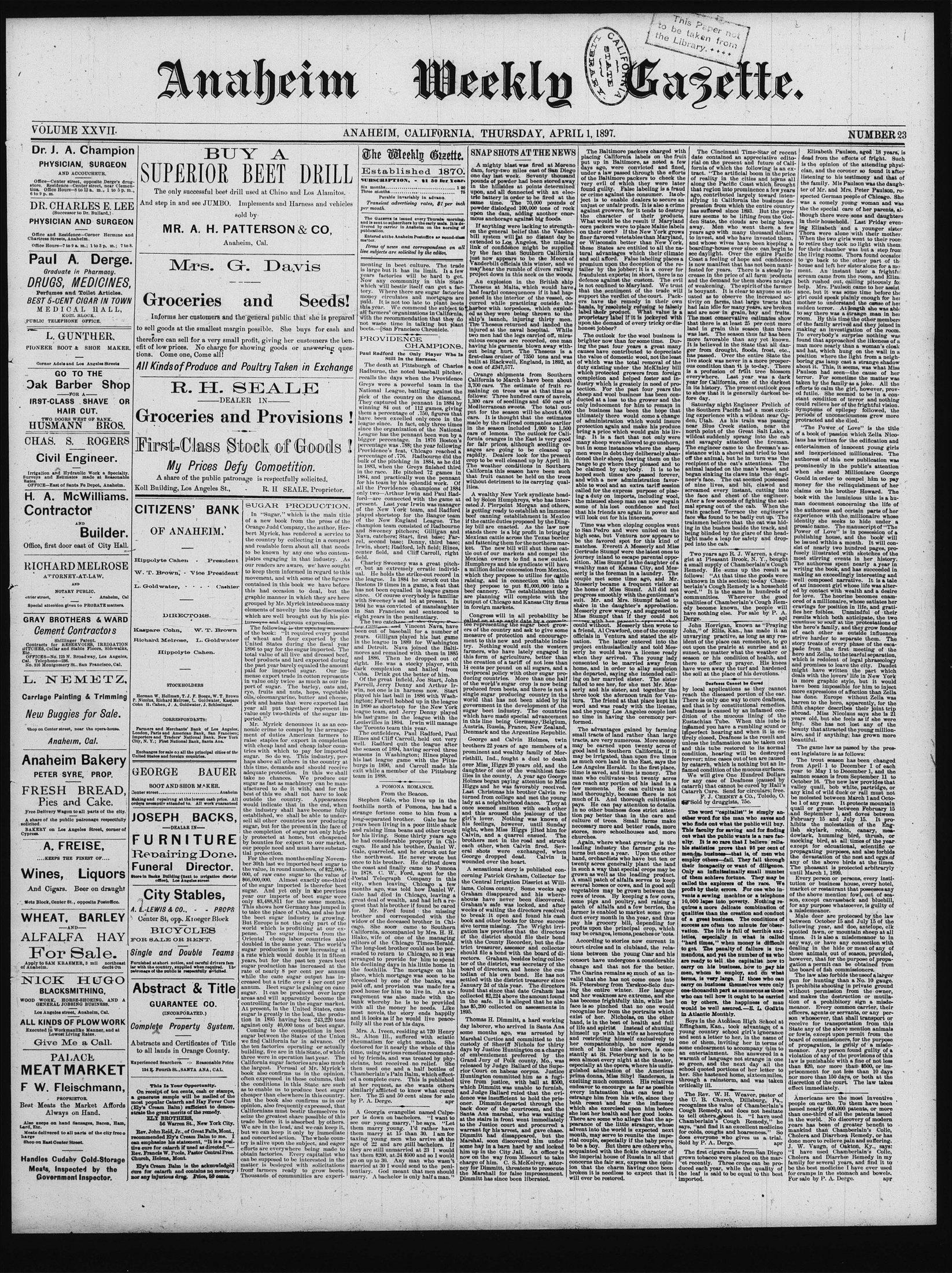
Searchable text
Anaheim
VOLUME XXVII.
Dr. J. A. Champion
PHYSICIAN, SURGEON
AND ACCOUCHEUR.
Office—Center street, opposite Derge's drugstore. Residence—Center street, near Clemen-tina. Office Hours—8 to 12 a.m., 1 to 5 p.m., 6 to 9 p.m.
DR. CHARLES E. LEE
(Successor to Dr. Bullard.)
PHYSICIAN AND SURGEON
Office and Residence—Corner Hermine and Chartress Streets, Anaheim.
Office Hours—7 to 9 a.m.; 1 to 3 p.m.; 7 to 8.
Paul A. Derge.
Graduate in Pharmacy.
DRUGS, MEDICINES,
Perfumes and Toilet Articles.
BEST 5-CENT CIGAR IN TOWN
MEDICAL HALL,
KOEL BLOCK.
PUBLIC TELEPHONE OFFICE.
L. GUNTHER.
PIONEER BOOT & SHOE MAKER.
Corner Adela and Los Angeles Streets
GO TO THE Oak Barber Shop
FOR A
IRST-CLASS SHAVE OR HAIR CUT.
TWO DOORS WEST OF BANK.
HUSMANN BROS.
CHAS. S. ROGERS
Civil Engineer.
BUY A
SUPERIOR BEET DRILL
The only successful beet drill used at Chino and Los Alamitos.
And step in and see JUMBO. Implements and Harness and vehicles sold by
MR. A. H. PATTERSON & CO,
Anaheim, Cal.
Mrs. G. Davis
Groceries and Seeds!
Informs her customers and the general public that she is prepared to sell goods at the smallest margin possible. She buys for cash and therefore can sell for a very small profit, giving her customers the benefit of low prices. No charge for showing goods or answering questions. Come one, Come all!
All Kinds of Produce and Poultry Taken in Exchange
R. H. SEALE
DEALER IN
Groceries and Provisions !
First-Class Stock of Goods !
My Prices Defy Competition.
GO TO THE Oak Barber Shop FOR A IRST-CLASS SHAVE OR HAIR CUT. TWO DOORS WEST OF BANK HUSMANN BROS. CHAS. S. ROGERS Civil Engineer. Irrigation and Hydraulic Work a Specialty. Surveys and Estimates made at Reasonable Rates. OFFICE—East of Santa Fe Depot, Anaheim.
H. A. McWilliams. Contractor AND Builder. Office, first door east of City Hall.
RICHARD MELROSE ATTORNEY-AT-LAW. AND NOTARY PUBLIC. center street, Anaheim, Cal Special attention given to PROBATE matters.
GRAY BROTHERS & WARD Cement Contractors Shillinger Patent. Contracts for RESERVOIRS, IRRIGATION DITCHES, Cellar and Stable Floors, Sidewalks, Etc. OFFICES—No. 125 N. Broadway, Los Angeles, Cal. Telephone—236. No. 316 Montgomery St., San Francisco, Cal.
L. NEMETZ. Carrlage Painting & Trimming New Buggies for Sale. Shop on Center street, near the opera-house Anaheim, Cal.
Anaheim Bakery PETER SYRE, PROP. FRESH BREAD, Pies and Cake. Free Delivery Wagon to all parts of the city. A share of the public patronage respectfully solicited. BAKERY on Los Angeles Street, corner of Cypress.
A. FREISE, ...KEEPS THE FINEST OF... Wines, Liquors And Cigars. Beer on draught
R. H. SEALE DEALER IN Groceries and Provisions! First-Class Stock of Goods! My Prices Defy Competition. A share of the public patronage is respectfully solicited. Koll Building, Los Angeles St., R. H. SEALE, Proprietor.
CITIZENS' BANK OF ANAHEIM.
Hippolyte Cahen President W. T. Brown Vice President L. Goldwater Cashier DIRECTORS.
Kaspare Cohn, W. T. Brown Richard Melrose, L. Goldwater Hippolyte Cahen.
STOCKHOLDERS
Herman W. Hellman, T.J. F. Boege, W.T. Brown P. Nicolus, Richard Melrose, L. Goldwater, Kaspare Cohn H. Cahen, J. A. Goldwater, J. Schlesinger.
CORRESPONDANTS:
Farmers and Merchants' Bank of Los Angeles, London, Paris and American Bank, San Francisco; Importers and Traders' National Bank, New York City, N.Y.; First National Bank, Santa Ana.
Exchanges for sale on all the principal cities of the United States and foreign countries.
GEORGE BAUER BOOT AND SHOE MAKER.
Center street...Anaheim Making and repairing at the lowest cash price. All orders promptly attended to. All work guaranteed
JOSEPH BACKS, DEALER IN FURNITURE RepairingDone.Funeral Director.
Store in Backa Building (Next to irrigation district office), Los Angeles street
City Stables,
SUGAR PRODUCTION.
In "Sugar," which is the main title of a new book from the press of the Orange Judd Company, the author, Herbert Myrick, has rendered a service to the country by collecting in a compact and readable form about all that needs to be known by any one who contemplates engaging in that industry. As our readers are aware, we have sought to keep them informed in regard to this movement, and with some of the figures contained in this book we have before this had occasion to deal, but the graphic manner in which they are here grouped by Mr. Myrick introduces many elements of novelty into the discussion which are well brought out by his picturesque and vigorous expression.
The following is the opening sentence of the book: "It required every pound of wheat and flour exported by the United States during the fiscal year 1896 to pay for the sugar imported. The total value of all live and dressed beef, beef products and lard exported during the past year barely equaled the amount paid for imported sugar. Our immense export trade in cotton represents in value only twice as much as our import of sugar. The barley, oats and rye, fruits and nuts, hops, vegetable oils, oleomargarine, butter and cheese, pork and hams that were exported last year all put together represent in value only two-thirds of the sugar imported."
Mr. Myrick denounces it as an economic crime to compel by the arrangement of duties American farmers to raise staples for export in completion with cheap land and cheap labor countries with which to pay for imported sugar. So do we. This industry, perhaps above all others in the country at this time, demands and should receive adequate protection. In this we shall take no chances. We produce our sugar as fast as machinery can be manufactured to do it with; and for the best of this we shall not have to look outside the country. Appearances would indicate that in the end, when the industry shall have become fully established, we shall be able to under-sell all other countries now producing sugar, but for the present in the face of the completion of sugar not only highly protected at home, but cheapened by bounties for export to our market, our people need and must have substantial protection.
For the eleven months ending November 30th last we imported beet sugar to the value, in round numbers, of $22,000,-000, of raw cane sugar to the value of $66,000,000. Almost exactly one-third of the sugar imported is therefor beet sugar. And yet only in the previous year our imports of beet sugar were
Pies and Cake.
Free Delivery Wagon to all parts of the city.
A share of the public patronage respectfully solicited.
BAKERY on Los Angeles Street, corner of Cypress.
A. FREISE,
...KEEPS THE FINEST OF...
Wines, Liquors
And Cigars. Beer on draught
Metz Block, Center St., opposite Postoffice.
WHEAT, BARLEY
AND
ALFALFA HAY
For Sale.
Apply to SAM KRAEMER, 3 mil northeast of Anaheim.
NICK HUGO BLACKSMITHING,
WOOD WORK, HORSE-SHOEING, AND A GENERAL JOBBING BUSINESS.
Los Angeles street, Anaheim, Cal.
ALL KINDS OF PLOW WORK
Executed in Workmanlike Manner, and at Lowest Living Rates.
Give Me a Call.
PALACE MEAT MARKET
F W. Fleischmann,
PROPRIETOR.
Best Meats the Market Affords Always on Hand.
Also keeps on hand Sausages, Bacon, Ham, Lard, Etc.
Meats delivered to all parts of the city free o harge
Shop on East Center Street.
Handles Cudahy Cold-Storage Meats, Inspected by the Government Inspector.
JOSEPH BACKS,
DEALER IN
FURNITURE
Repairing Done.
Funeral Director.
Store in Backs Building (next to irrigation district office), Los Angeles street
City Stables,
A. L. LEWIS & CO.. - PROPS
Center St, opp. Kroeger Block
BICYCLES
FOR SALE OR RENT.
Single and Double Teams
Furnished at short notice, and careful drivers familiar with the country, supplied when required. The patronage of the public is respectfully solicited.
Abstract & Title
GUARANTEE CO.
(INCORPORATED.)
Complete Property System.
Abstracts and Certificates of Title to all lands in Orange County.
Experienced Searchers. :: Reasonable Price
124 E. Fourth St., SANTA ANA, CAL.
This Is Your Opportunity.
On receipt of ten cents, cash or stamps, a generous sample will be mailed of the most popular Catarrh and Hay Fever Cure (Ely's Cream Balm) sufficient to demonstrate the great merits of the remedy.
ELY BROTHERS,
56 Warren St., New York City.
Rev. John Reid, Jr., of Great Falls, Mont., recommended Ely's Cream Balm to me. I can emphasize his statement, "It is a positive cure for catarrh if used as directed."—Rev. Francis W. Poole, Pastor Central Pres. Church, Helena, Mont.
Ely's Cream Balm is the acknowledged cure for catarrh and contains no mercury nor any injurious drug. Price, 50 cents.
Outside the country. Appearances would indicate that in the end, when the industry shall have become fully established, we shall be able to undersell all other countries now producing sugar, but for the present in the face of the completion of sugar not only highly protected at home, but cheapened by bounties for export to our market, our people need and must have substantial protection.
For the eleven months ending November 30th last we imported beet sugar to the value, in round numbers, of $22,000,-000, of raw cane sugar to the value of $66,000,000. Almost exactly one-third of the sugar imported is therefor beet sugar. And yet only in the previous year our imports of beet sugar were only $3,488,811 for the same months. This shows how Germany has jumped in to take the place of Cuba, and also how the beet sugar industry is growing. But Europe is not the only part of the world which is profiting at our expense. The sugar imports from the Oriental cheap labor countries also doubled in the same year. The world's sugar production is now increasing at a rate which would double it in fifteen years, but for the past ten years beet sugar production has increased at the rate of nearly 8 per cent per annum while the cane sugar output has increased but a trifle over 4 per cent per annum. Beet sugar is gaining on cane sugar. It can be produced over large areas and will apparently become the controlling factor in the sugar market. At present, in the United States, cane sugar is greatly in the lead, the production in 1895 having been 243,220 tons against only 40,000 tons of beet sugar.
Coming to the competition in beet sugar between the States of the Union we find California far in advance. Of the ten factories operating or actually building, five are in this State, of which three were in operation last year. The California sugar factories are also much the largest. Perusal of Mr. Myrick's book also confirms us in the opinion, often expressed in these columns, that the conditions in this State are such as to enable us to produce beet sugar cheaper than elsewhere in this country. But the book also confirms us in our opinion, also frequently expressed, that Californians must bestir themselves to seize the greatest share possible of this trade before it is absorbed by others. We are in the lead, and we can keep it, but we can keep it only by immediate and concerted action. The whole country is alive upon the subject, and eager efforts are everywhere being made to obtain factories. Every capitalist who can be supposed to be interested in the matter is besieged with solicitations from farmers ready to grow beets. Thousands of communities are experi-
ANAHEIM, CALIFORNIA, THURSDAY, APRIL 1, 1897.
The Weekly Gazette.
Established 1870.
SUBSCRIPTION, - $1.50 per Year.
Six months... 1.00
Three months... 75
Payable invariably in advance.
Transient advertising rates, $1 per inch per month.
The Gazette is issued every Thursday morning, and is sent to subscribers by the early mails. It is delivered by carrier in Anaheim on the morning of publication.
Entered at the Anaheim Postoffice as second-class matter.
Items of news and correspondence on all live subjects are solicited by the editor.
menting in beet culture. The trade is large but it has its limit. In a few years factories will be hard to get. Now any community in this State which will bestir itself can get a factory. Where there are sugar factories money circulates and mortgages are paid. It is not too late to plant beets this year. We commend the subject to all farmers' organizations in California, with the recommendation that they do not waste time in talking but plant beets.—[San Francisco Chronicle.
PROVIDENCE CHAMPIONS.
Paul Radford the Only Player Who Is Still In the Harness.
The death at Pittsburgh of Charles Radburne, the noted baseball pitcher, recalls the days when the Providence Greys were a powerful team in the National League, battling against the pick of the country on the diamond. They captured the pennant in 1884 by winning 84 out of 112 games, giving them a percentage of .750, figures that have been excelled only once in the league since. In fact, only three times since the organization of the National League has the pennant been won by a bigger percentage. In 1876 Boston's percentage was .788; the year following Providence's feat, Chicago reached a percentage of .776. Radbourne did the bulk of the pitching in 1884, as he did in 1883, when the Greys finished third in the race. He pitched 72 games in
SNAP SHOTS AT THE NEWS
A mighty blast was fired at Moreno dam, forty-two miles east of San Diego one day last week. Seventy thousand pounds of powder had been stored away in the hillsides at points determined upon, and all connected with an electric battery in order to be fired at the same time. The 70,000 pounds of powder dislodged 100,000 tons of rock upon the dam, adding another enormous anchorage against big floods.
If anything were lacking to strengthen the general belief that the Vanderbilt system will fat no distant day be extended to Los Angeles, the missing link of confidence might be supplied by the fact that Southern California just now appears to be the Mecca of Vanderbilt officials this winter, and we may hear the rumble of divers railway project down in this neck os the woods.
An explosion in the British ship Theseus at Malta, which would have had fearful consequences if it had happened in the interior of the vessel, occurred while practicing outside the harbor with torpedoes, which exploded as they were being thrown to the ship's launch, injuring thirty men. The Theseus returned and landed the injured at the naval hospital. While two men had the legs carried off, miraculous escapes are recorded, one man having his garments blown away without being hurt. The Theseus is a first-class cruiser of 7350 tons and was built at Blackwell, England, in 1892, at a cost of £347,577.
Orange ships from Southern California to March 5 have been about 3,700 cars. The estimate of fruit remaining on trees was at that time as follows: Three hundred cars of navels, 1,300 cars of seedlings and 450 cars of Mediterranean sweets. The total output for the season will be about 6,000 cars. It is thought that the estimates made by the railroad companies earlier in the season included 1,000 to 1,500 cars of lemons. The outlook for California oranges in the East is very good for fair prices, although seedling oranges are going to be cleaned up rapidly. Dealers look for the present crop to be well cleaned up by April 10. The weather conditions in Southern California this season have been such
The Baltimore packers charged with placing California labels on their put up in Baltimore, as noted a days ago, were convicted and fined under a law passed through the eighth of the Baltimore packers to check very evil of which they were found guilty. False labeling is a form or crime against the consumer. Its object is to enable dealers to secure unjust or unfair profit. It is also a case against growers, for it tends to desecrate the character of their product. What would be the result if Mary's corn packers were to place Maine lard on their corn? If the New York grain finer flavored vetables than Maryland or Wisconsin better than New York these States are entitled to all their tural advantages which their climate and soil afford. False labeling places premium upon the deception of their taller by the jobber; it is a cover fraudulent exports; in short, there is defiance against the custom. The object is not confined to Maryland. We treat that the sentiment of the trade is support the verdict of the court. Packers have the remedy in their hands, by resolutely refusing to falsify their product. What value is proprietary label if it is jockeyed upon the demand of every tricky or honest jobber?
The outlook for the wool business brighter now than for some time. During the past four years a great many causes have contributed to depreciation of the value of domestic wool, not the leftof which was the total removal of it duty existing under the McKinley Bldg which protected growers from foreclosure and helped foster and dustry which is greatly in need of protection. For the past four years sheep and wool business has been conducted at a loss to the grower and thus only inducement for him to remapthe business has been the hope ultimately there would come a change of administration which would insure protection again and make his products price which would gain his liking. It is a fact that not only were many sheep allowed to go unshorn but in some instances where sheep men were in debt they deliberately abused their sheep, leaving them on the range to go where they pleased and be claimed by anybody. It is too honored such times are passed forever.
PRODUCTION.
which is the main title book from the press of the Company, the author, Herd has rendered a service to collecting in a compact form about all that needs by any one who contending in that industry. As are aware, we have sought informed in regard to this and with some of the figures in this book we have before occasion to deal, but the manner in which they are here Mr. Myrick introduces many novelty into the discussion will brought out by his pivigorous expression.
is the opening sentence. It required every pound and flour exported by the dies during the fiscal year for the sugar imported. The all live and dressed beef, and lard exported during barely equaled the amount imported sugar. Our im- trade in cotton represents twice as much as our im- The barley, oats and, and nuts, hops, vegetable garine, butter and cheese, as that were exported last together represent in no-thirds of the sugar im- denounces it as an eco- coompel by the arran- geses American farmers to export in completion and cheap labor counsell to pay for imported we. This industry, per- al others in the country at hands and should receive rejection. In this we shallences. We produce our machinery can be man- do it with; and for the he shall not have to look country. Appearances that in the end, when shall have become fully able to under- countries now producing the present in the face of ton of sugar not only high at home, but cheapened our export to our market, and must have substan- ten months ending November we imported beet sugar to round numbers, of $22,000. One sugar to the value of Almost exactly one-third imported is therefor beet yet only in the previous sorts of beet sugar were recalls the days when the Providence Greys were a powerful team in the National League, battling against the pick of the country on the diamond. They captured the pennant in 1884 by winning 84 out of 112 games, giving them a percentage of .750, figures that have been excelled only once in the league since. In fact, only three times since the organization of the National League has the pennant been won by a bigger percentage. In 1876 Boston's percentage was .788; the year following Providence's feat, Chicago reached a percentage of .776. Radbourne did the bulk of the pitching in 1884, as he did in 1883, when the Greys finished third in the race. He pitched 72 games in 1884, and practically won the pennant for his team by his splendid work. Of all the Providence champions of 1884 only two—Arthur Irwin and Paul Radford—are connected with the game at present. Last year Irwin was manager of the New York team, and Radford played shortstop for the Bangor team of the New England League. The champion team consisted of Radbourne and Sweeney pitchers; Gilligan and Nava, catchers; Start, first base; Farrel, second base; Denny, third base; Irwin, short; Radbourne, left field; Hines, center field, and Cliff Carroll, right field.
Charley Sweeney was a great pitcher, but an extremely erratic individual. He holds the strike-out record in the league. In 1884 he struck out the Bostons 19 times in a game, a feat that has not been equalled in league games since. Of course everybody is familiar with Sweeney's sad lot at present. In 1894 he was convicted of manslaughter in San Francisco and sentenced to eight years in the penitentiary.
The two catchers, Joe Start, John Farrell, Jerry Denny and Arthur Irwin, not one is in harness now. Start played his last ball in 1886 with Washington; Farrell bobbed up in the league in 1890 as shortstop for the New York league team, and Jerry Denny played his last game in the league with the Louisvilles in 1894. Irwin will manage the Toronto team this year.
The outfielders, Paul Radford, Paul Hines and Cliff Carroll, held out very well. Radford quit the league after the season of 1894, having served three seasons in Washington; Hines played his last league game with the Pittsburg in 1890, and Carroll made his exit while a member of the Pittsburg team in 1888.
A POMONA ROMANCE.
From the Beacon.
Stephen Gale, who lives up in the foothills north of Pomona, has had a strange fortune come to him from a long-separated brother. Gale has for years been living in a poor little shack and raising lima beans and other truck for his living. Some thirty years ago he had considerable property in Chicago. He and his brother, Daniel W. Gale, quarreled, and he struck out for the northwest. He never wrote but once to his brother. He drifted down the coast and finally came to Pomona in 1878. C. W. Ford, agent for the Postal Telegraph Company in this city, when leaving Chicago a few months ago, was told how Daniel W. Gale had died in Chicago, leaving a great deal of wealth and bad health.
Orange shipments from Southern California to March 5 have been about 3,700 cars. The estimate of fruit remaining on trees was at that time as follows: Three hundred cars of navels, 1,300 cars of seedlings and 450 cars of Mediterranean sweets. The total output for the season will be about 6,000 cars. It is thought that the estimates made by the railroad companies earlier in the season included 1,000 to 1,500 cars of lemons. The outlook for California oranges in the East is very good for fair prices, although seedling oranges are going to be cleaned up rapidly. Dealers look for the present crop to be well cleaned up by April 10. The weather conditions in Southern California this season have been such that fruit cannot be held on the trees without detriment to its carrying qualities.
A wealthy New York syndicate headed by Solon Humphreys, who has interested J. Pierpoint Morgan and others, is getting ready to establish an immense beef canning establishment in Mexico if the cattle duties proposed by the Dingley bill are enacted. As the law now stands there is a big profit in bringing Mexican cattle across the Texas border and fattening them for the northern market. The new bill will shut these cattle out of our markets and compel the Mexican owners to find a new outlet. Humphreys and his syndicate will have a million dollar concession from Mexico, which they propose to utilize cattle raising, and in connection with this they propose to put $1,000,000 into a beef cannery. The establishment they are planning will complete with the output of Chicago and Kansas City firms in foreign markets.
Congress will in all probability be called on at an early date by a committee representing the sugar beet growers of the country and ask to give some measure of protection and encouragement to this new and profitable industry. Nothing would suit the western farmers who have lately engaged in this form of agriculture, better than the creation of a tariff of not less than 14 cents per pound on all sugars, and a reciprocal policy with other sugar producing countries. More than one half of the world's sugar crop is now being produced from beets, and there is not a single sugar producing country in the world that has not been aided by its government in the development of the sugar beet industry. The countries which have made special advancement in this line being Germany, Belgium, Austria, Russia France, New Zealand Denmark and the Argentine Republic.
George and Calvin Holmes, twin brothers 22 years of age members of a prominent and wealthy family of Morristillah, Ind., fought a duel to death over Miss Higgs 20 years old, and the daughter of one of the wealthiest families in the county. A year ago George Holmes began paying attention to Miss Higgs and he was favorably received. Last Christmas his brother Calvin returned from college and met the young lady at a neighborhood dance. They at once seemed smitten with each other and this aroused their jealousy of the girl's lover. Nothing was known of his feelings, however, until Sunday night, when Miss Higgs jilted him for Calvin, and a quarrel ensued. The brothers met in the road and struck each other, when Calvin fired. Several shots were exchanged, when George dropped dead. Calvin is wounded over the heart.
A sensational story is published concerning Patrick Graham, Collector for the Central Irrigation Dissrict at Williams, Colusa county. Some weeks ago Graham disappeared and his whereabouts have never been discovered which protected growers from loss due to dustry which is greatly in need of protection. For the past four years she sheep and wool business has been ousted at a loss to the grower and thus only inducement for him to remain ultimately there would come a chance of administration which would insure protection again and make his product bring a price which would gain his ing. It is a fact that not only was many sheep were allowed to go unshorn but in some instances where she sheep men were in debt they deliberately abused donned their sheep, leaving them on the range to go where they pleased and be claimed by anybody. It is too hoped such times are passed foreverable to wool and an extra tariff session called for the express purpose of placing a duty on imports, including works that misused sheep man can now regain some of his lost confidence and fear that his friends are again in power as will look out for his interests.
Time was when eloping couples went to San Pedro and were united on their high seas, but Ventura now appears bethe favored spot for this kind matches. Everett A Messerly and Mrs Gertrude Stumpf were the latest ones journeyinland to escape parental opposition. Miss Stumpf is the daughter of wealthy man of Kansas City,and Me Merseyly is the foreman in a laundry.The couple met some time ago,and Mrs Merseyly became a frequent visitor tothe home.of Miss Stumpf.All did not progress smoothly withthe gentleman suit.Mr.and Mrs.Stumpf failed shareinthe daughter's approbationMesserly grew weary,and suggestedMiss Stumpf that if they could notwith her parental appealcould without.Messlerly then wrotea friend,Al Crawford,一ofthecountialfinals officialsinVenturaandstatedthe situation.The latter entered intothe project enthusiastically and toldMerseylyhewouldhavealicensereadwhentheyarrived.Theyoung lad consentedtobemarriedawayfromhome,andinordertoallaysuspiciousshe departed,saying she intended callingonher married sister.The sisterfailedto see her,forshemetMr.Merseylyandhis sister,andtogetherthree tooktheafternoontrainforVeruata.ThefriendatthatplacekepthwordandwasreadywiththelicensesandtheyoungLosAngelescouplelosnotimeinhavingtheceremonyperformed.
The advantages gained by farmingsmall tracts of land rather than larg tracts are very numerous.More money may be earned upon twenty acresofgood landinSouthernCaliforniaifformaybeirrigated,thanuponfivetimesasmuch cornlandintheEast,saystheLos Angeles Herald.Inthefirstplacetimeis saved,andtimeismoney.Themanwho cultivatesbuthlandthoroughly,becausethereisnomuchofit.Andthoroughcultivationpays.HecanpayattentiontodetailsInnootherbusinessdoesstrictattentionpaybetterthaninthecareandcultureoftrees.Smallfarmsmakenecessarymoreandbetter roads,morestores,moreschoolhousesandmorechurches.
Again,where wheat growing is thereadingindustrythe farmergetsreturnsbutonceayear.Uponotheotherhand,orchardistswhohavebutteno twentyacresgenerallyplantthelandinsuchawaythatspecialcropsmaybegrownaswelltheleadingproductAsmallpatchofalfalfa servestokeepseveral horsesorcows,andingoodsovegetablesmaybegrownbetweenthrowsoftrees.BYkeepinga fewcows
Appearances that in the end, when she shall have become fully aware shall be able to understand countries now producing the present in the face of men of sugar not only high-altitude home, but cheapened export to our market, and must have substantiated.
Ten months ending November imported beet sugar to bound numbers, of $22,000; one sugar to the value of Almost exactly one-third imported is therefor beet yet only in the previous months of beet sugar were 1 for the same month. New Germany has jumped in place of Cuba, and also how the industry is growing, not the only part of the industry is profiting at our ex-sugar imports from the sap labor countries also same year. The world's economy is now increasing at would double it in fifteen years the past ten years beet ton has increased at the 8 per cent per annum the sugar output has intricate over 4 per cent per sugar is gaining on cane be produced over large areas apparently become the factor in the sugar market. In the United States, cane may in the lead, the production having been 243,220 tons, 50,000 tons of beet sugar. The competition in beet in the States of the Union尼亚 far in advance. Of these operating or actually care in this State, of which operation last year. The war factories are also much Perusal of Mr. Myrick's firms us in the opinion, and in these columns, that is in this State are such as to produce beet sugar elsewhere in this country. Also confirms us in our frequently expressed, that must bestir themselves to best share possible of this it is absorbed by others. Lead, and we can keep it, but it only by immediate action. The whole counsellor the subject, and eager everywhere being made to know. Every capitalist who did to be interested in the siege with solicitations ready to grow beets. Communities are experi-
Stephen Gale, who lives up in the foothills north of Pomona, has had a strange fortune come to him from a long-separated brother. Gale has for years been living in a poor little shack and raising lima beans and other truck for his living. Some thirty years ago he had considerable property in Chicago. He and his brother, Daniel W. Gale, quarreled, and he struck out for the northwest. He never wrote but once to his brother. He drifted down the coast and finally came to Pomona in 1878. C. W. Ford, agent for the Postal Telegraph Company in this city, when leaving Chicago a few months ago, was told how Daniel W. Gale had died in Chicago, leaving a great deal of wealth, and had left a request that his brother if found be cared for. Mr. Ford found the missing brother and corresponded with the widow of the deceased brother in Chicago. She soon came to Southern California, accompanied by Mrs. H. H. Blake, wife of one of the managing editors of the Chicago Times-Herald. The long-lost brother could not be persuaded to return to Chicago, so it was arranged to provide for him to spend his declining days in his little home in the foothills. The mortgage on his place, which mortgage was soon to be foreclosed by one of the banks, was paid off, and provision was made for a good house for him to live in. An arrangement was also made with the bank whereby he is to be provided with all the money he needs. Like most novels, the story ends happily and it looks as if he would live peacefully all the rest of his days.
Mrs. A. Iveen, residing at 720 Henry St., Alton Ill., suffered with sciatic rheumatism for eight months. She doctored for it nearly the whole of this time, using various remedies recommended by friends, and was treated by physicians, but received no relief. She then used one and a half bottles of Chamberlain's Pain Balm, which effected a complete cure. This is published at her request, as she wants others similarly afflicted to know what cured her. The 25 and 50 cent sizes for sale by P. A. Derge.
A Georgia evangelist named Culpeper is down on bachelors. "I want to see our young marry," he says. "Let them marry young. I'd rather have them marry at 15 than 30. I am for taxing young men who arrive at the age of 22 and are still bachelors. If they are still unmarried at 23 I would tax them $200, at 24 $500 and so I would go on up to 30. Any man who wasn't married at 30 I would send to the penitentiary. God meant that men should marry. A bachelor is only half a man."
A sensational story is published concerning Patrick Graham, Collector for the Central Irrigation Dissrict at Williams, Colusa county. Some weeks ago Graham disappeared and his whereabouts have never been discovered. Graham's safe was locked, and after weeks of waiting the directors resolved to break it open and found his cash book and other books for three successive terms missing. The Wright irrigation law provides that the directors of the district should file their bond with the County Recorder, but the district treasurer, assessor and collector should file a bond with the board of directors. Graham, besides being collector of the district, was secretary of the board of directors, and hence the custodian of his own bond. He has not settled with the district treasurer since January 2d of this year. The directors found that since that date Graham has collected $2,224 above the amount found in the safe. It is alleged that he also has $5,200 collected on assessments in 1895.
Thomas H. Dimmitt, a hard working day laborer, who arrived in Santa Ana some months ago, was arrested by Marshal Curtice and committed to the custody of Sheriff Nichols for thirty days by Justice Huntington on a charge of embezzlement preferred by the Grand Jury of Polk county, Mo., was released by Judge Ballard of the Superior Court on habeas corpus. Justice Huntington committed him as a fugitive from justice, with ball at $500, which Dimmitt was unable to furnish, and Judge Ballard ruled that the evidence was insufficient to hold the prisoner. Dimmitt departed through the back door of the courtroom, and the Santa Ana marshal, who was waiting at the stairs in front went immediately to the Justice court and procured a warrant for his arrest, and gave chase. Dimmitt had dissappeared, but the Marshal, soon discovered him under some hay in a barn hard by and locked him up in the City Jail. An officer is now on the way from Missouri to take charge of him. C. S.McKelvey, attorney for Dimmitt, threatens to prosecute the Marshall for false imprisonment. Dimmitt has since been liberated.
A sensational story is published concerning Patrick Graham, Collector for the Central Irrigation Dissrict at Williams, Colusa county. Some weeks ago Graham disappeared and his whereabouts have never been discovered. Graham's safe was locked, and after weeks of waiting the directors resolved to break it open and found his cash book and other books for three successive terms missing. The Wright irrigation law provides that the directors of the district should file their bond with the County Recorder, but the district treasurer, assessor and collector should file a bond with the board of directors. Graham besides being collector of the district, was secretary of the board of directors, and hence the custodian of his own bond. He has not settled with the district treasurer since January 2d of this year. The directors found that since that date Graham has collected $2,224 above the amount found in the safe. It is alleged that he also has $5,200 collected on assessments in 1895.
According to stories now current in court circles and in clubland, the relations between the young Czar and his consort have undergone a considerable change and that not for the better. The Czarina remains so much of an invalid that she has not come once into St. Petersburg from Tarskoe-Selo during the entire winter. Her language and her weakness are extreme, and she has become frightfully thin while her face is so pinched that no one would recognize her from the portraits which exist of her. Nicholas, on the other hand, is in the best health and full of life and spirits.
Instead of shutting himself up with his wife as heretofore and restricting himself exclusively to her companionship, he now spends much of his time elsewhere, is constantly at St. Peterburg and is to be seen almost every night at the theater, especially at the opera; where his undisguised admiration of the American prima donna, Miss Sibyl Sanderson, is exciting much comment. His relatives endeavor to encourage as far as possible every infatuation that can tend to estrange him from his wife, since they both resent and fear the influence which she exercised upon him before she lost her health and her good looks.
There are some who allege that the appearance of the little stranger, whose advent into the world is expected next month, may serve to reunite the imperial couple, especially if the baby prove to be a boy. But there are others who acquainted with the fickle character of the imperial house of Russia in all that concerns the fair sex, express the opinion that the charm having once been broken it is needless to expect that it will ever be restored.
The Baltimore packers charged with bringing California labels on the fruit crop in Baltimore, as noted a few ago, were convicted and fined, a law passed through the efforts of Baltimore packers to check the evil of which they were later guilty. False labeling is a fraud against the consumer. Its objection to enable dealers to secure an or unfair profit. It is also a crime that growers, for it tends to destroy character of their products, would be the result if Maryland packers were to place Maine labels on corn? If the New York grows favored vetables than Maryland, Wisconsin better than New York, States are entitled to all the advantages which their climate will afford. False labeling places a ham upon the deception of the rebel by the jobber; it is a cover for client exports; in short, there is no vein against the custom. The evil confined to Maryland. We trust the sentiment of the trade will not the verdict of the court. Package the remedy in their own by resolutely refusing to falsely their product. What value is a stray label if it is jockeyed with the demand of every tricky or disobserver?
Outlook for the wool business is now now for sometime. Durant past four years a great many have contributed to depreciate due of domestic wool, not the least which was the total removal of the existing under the McKinley bill protected growers from foreignation and helped foster and in which is greatly in need of prosecution for him to remain in business has been the hope that surely there would come a change administration which would insure on again and make his produce price which would gain his livelihood is a fact that not only were sheep were allowed to go unshorn, some instances where the sheep are in debt they deliberately aban-neir sheep, leaving them on the go where they pleased and to need by anybody. It is to be much times passed forever.
The Cincinnati Time-Star of recent date contained an appreciative editorial on the present and future of California of which the following is an extract. "The artificial boom in the price of reality in the cities and towns all along the Pacific Coast which brought that region into prominence a few years ago, contributed largely toward intensifying in California the business depression from which the entire country has suffered since 1893. But the pressure seems to be lifting from the Golden State, the clouds are being blown away. Men who went there a few years ago with many thousand dollars to invest, and who have invested them, and whose wives have been keeping a boarding-house ever since can begin to see daylight. Over the entire Pacific Coast a feeling of hope and confidence is now manifest that has not been manifested for years. There is a steady increase in the price of all farm products and the demand for them shows no sign of weakening. The spirit of the farmer is bouyant. It is clear to anyone so situated as to observe the increased activity on farms, that large tracts that had lain idle for many years, are broken and are now in grain, hay and fruits. The most conservative estimates show that there is at least 25 per cent more land in grain this season than there was last. The season thus far has been more favorable than any yet known. It is believed in the State that all danger from drought, floods, frost, etc., has passed. Over the entire State the live stock was never in a more prosperous condition than it is to-day. There is a profusion of fruit tree blossom everywhere. Last year was a dark year for California, one of the darkest in its history. The present outlook goes to show that it is generally darkest before day.
Saturday night Engineer Frelich of the Southern Pacific had a most exciting experience with a wildcat near Ogden, Utah. As his train was passing near Blue Creek station, near the north point of the Great Salt Lake, a wildcat suddenly sprang into the cab and savagely attacked the fireman. The engineer came to the fireman's assistance with a shovel and tried to beat off the animal, but he in turn was the recipient of the cat's attentions. The animal landed on the man's breast and began sinking its claws into the engli-
Elizabeth Paulson, aged 18 years, is dead from the effects of fright. Such is the opinion of the attending physician, and the coroner so found it after listening to his testimony and that of the family. Mis Paulson was the daughter of Mr. and Mrs. Peter Paulson, respected German people of Chicago. She was a comely young woman and was the special care of her parents, although there were sons and daughters in their household. Last Friday evening Elizabeth and a younger sister Thora were alone with their mother. When the two girls went to their room to retire they took no light with them for their chamber was but a step from the living rooms. Thora found occasion to go back to the other part of the house and left her sister alone for a moment. An instant later a frightful scream came from the room, and Eliza beth rushed out, calling piteously for help. Mrs. Paulson came to her assistance, but it was some time before she girl could speak plainly enough for her mother to understand the cause of her sudden terror. At length she was able to say there was a strange man in her room. By this time the other members of the family arrived and they joined in making an investigation of the room. To everybody's surprise nothing was found that approached the likeness of a man more nearly than a woman's cloak and hat, which hung on the wall in a position where the light from a neighboring gas lamp cast a strange shadow about it. This, it seems, was what Miss Paulson had seen—the cause of her terror. For sometime the matter was taken by the family as a joke. All the efforts to calm the girl, however, proved futile. She seemed to be in a constant condition of terror and nothing could relieve her of the frightful vision. Symptoms of epilepsy followed, the periods of unconsciousness grew more protracted and she died.
"The Power of Love" is the title of a book of passion which Zella Nicolaus has written for the edification and entertainmen of innocent young girls and inexperienced millionaires. The authoress of this new publication was prominently in the public's attention when she sued Millionaire George
was when eloping couples went Pedro and were united on the hills, but Ventura now appears to favored spot for this kind of Everett A Messerly and Miss Stumpf were the latest ones to inland to escape parental oppression Miss Stumpf is the daughter of a man of Kansas City, and Messie foreman in a laundry. The met some time ago, and Mr. became a frequent visitor at the Miss Stumf. All did not smoothly with the gentleman's Mr. and Mrs. Stumpf failed to meet the daughter's approbation. Grew weary, and suggested to Stumpf that if they could not with her parents' approval they without. Messery then wrote to Al Crawford, one of the county men Ventura and stated the situation. The latter entered into the enthusiastically and told Messie would have a license ready they arrived. The young lady had to be married away from her in order to allay suspicion, saying she intended caller married sister. The sister see her, for she met Mr. Messie his sister, and together the kink the afternoon train for Venice friend at that place kept his was ready with the license, young Los Angeles couple lost in having the ceremony pervadingages gained by farming acts of land rather than large the very numerous. More money earned upon twenty acres of land in Southern California, if it irrigated, than upon five times corn land in the East, says theales Herald. In the first place, loved, and time is money. The cultivates but twenty acres any portion of his land in a cents. He can cultivate his roughly, because there is not at. And thorough cultivation he can pay attention to details. Her business does strict attentiveness than in the care and of trees. Small farms make more and better roads, more more schoolhouses and more where wheat growing is the industry the farmer gets rejoice a year. Upon the other hardists who have but ten or acres generally plant the land away that special crops may be well as the leading product. Match of alfalfa serves to keep horses or cows, and in good soil may be grown between the cows. By keeping a few cows,
The word "capitalist" is simply another word for the man who saves and finds out what the public will buy. This faculty for saving and for finding out what the public wants is a rare faculty. It is so rare that I believe reliable statistics prove that 95 per cent of men in business—that is, of men who employ others—fail. They fall through their incapacity or want of diligence. Only an infinitesimally small number of them achieve fortune. They may be called the explorers of the race. We profit by their errors. For one who invents a sewing machine or a telephone everywhere. Last year was a dark year for California, one of the darkest in its history. The present outlook goes to show that it is generally darkest before day.
Saturday night Engineer Frelich of the Southern Pacific had a most exciting experience with a wildcat near Ogden, Utah. As his train was passing near Blue Creek station, near the north point of the Great Salt Lake, a wildcat suddenly sprang into the cab and savagely attacked the fireman. The engineer came to the fireman's assistance with a shovel and tried to beat off the animal, but he in turn was the recipient of the cat's attentions. The animal landed on the man's breast and began sinking its claws into the engineer's face. The cat seemed possessed of nine lives, and bit, clawed and screamed every instant, cutting into the face and chest of the engineer. After a few seconds of fighting the animal sprang out of the cab. When the train reached Terrace the engineer's face was found to be badly cut up. The trainmen believe that the cat was hiding in the bushes beside the track, and being blinded by the glare of the headlight made a leap for safety and dropped into the cab.
Two years ago R.J.Warren, a druggist at Pleasant Brook, N.Y., bought a small supply of Chamberlain's Cough Remedy. He sums up the result as follows: "At that time the goods were unknown in this section; to-day Chamberlain's Cough Remedy is a household word." It is the same in hundreds of communities. Wherever the good qualities of Chamberlain's Cough Remedy become known, the people will have nothing else. For sale by P.A.Derge.
John Horrigan, known as "Praying John," of Ellis, Kan., has made it an unvarying practicable, as long as any resident of the place can remember, to go out upon the prairie at sunrise and at sunset, no matter what the weather or season or his condition of health, and there to offer up prayer. His knees have worn away the turf and hardened the soil at the place of his devotions.
Desfness Cannot be Cured by local applications as they cannot reach the diseased portion of the ear. There is only one way to cure deafness, and that is by constitutional remedies. Deafness is caused by an inflamed condition of the mucous lining of the Eustachian Tube. When this tube is inflamed you have a rumbling sound or imperfect hearing and when it is entirely closed, Deafness is the result and unless the inflammation can be taken out and this tube restored to its normal condition, hearing will be destroyed forever; nine cases out of ten are caused by catarrh, which is nothing but an inflamed condition of the mucous surfaces.
We will give One Hundred Dollars for any case of Deafness (caused by catarrh) that cannot be cured by Hall's Catarrh Cure. Send for circulars; free.
F.J.CHENEY & Co., Toledo, O.Sold by druggists, 75c.
The word "capitalist" is simply another word for the man who saves and finds out what the public will buy. This faculty for saving and for finding out what the public wants is a rare faculty. It is so rare that I believe reliable statistics prove that 95 per cent of men in business—that is, of men who employ others—fail. They fall through their incapacity or want of diligence. Only an infinitesimally small number of them achieve fortune. They may be called the explorers of the race. We profit by their errors. For one who invents a sewing machine or a telephone
For sometime the matter was taken by the family as a joke. All the efforts to calm the girl, however, proved futile. She seemed to be in a constant condition of terror and nothing could relieve her of the frightful vision. Symptoms of epilepsy followed, the periods of unconsciousness grew more protracted and she died.
"The Power of Love" is the title of a book of passion which Zella Nicolaus has written for the edification and entertainment of innocent young girls and inexperienced millionaires. The authoress of this new publication was prominently in the public's attention when she sued Millionaire George Gould in order to compel him to pay money for the relinquishment of her claims on his brother Howard. The book with the luminious title is a human document concerning the life of the authoress and certain parts of her experience with the millionaire whose identity she seeks to hide under a prosaic name. The manuscript of "The Power of Love" is in possession of a publishing house, and the book will be issued within a month. It will consist of nearly two hundred pages, profusely illustrated with sketches of the most stirring events in her history. The authoress spent nearly a year in writing the book, and has succeeded in making an exceedingly interesting and well composed narrative. It is a tale of an innocent girl whose life was altered by contact with wealth and a desire for love. The authoress becomes enamored of a millionaire, whose satiates her cravings for position in life, and gratifies her foibles. Unmindful of their results which both anticipate, the two continue to soff at the protestations of the hero's family, and they grow fonder of each other as outside influences strive harder to separate them. The story treats of every phase of the escapade from the first meeting of the hero and Zella, to the tearful separation, which is redolent of legal phraseology and promises to leave the city. Daudet might have written the part which deals with the lovers' life in New York in more graphic style, but it would have been impossible for him to inject more expressions of affection than Zella has done. Europe without Zella was barren tothe hero, apparently,forthe fifth chapter describes their joint trip abroad.Miss Nicollaus says she is 21 years old, but she feels as if she were fifty.She has not lost any ofthe beauty that attractedthe young millionaire,and if anything,has grown more beautiful.
The game law as passed bythe present legislature is as follows:
The trout season has been changed from April-1 to December 1of each year to May 1to December 1,andthe salmon season is from September 11to October 16.The new law provides that valley quail,bob white,partridge,或any kind of wild duck or rail must not be molested between March 1and October 1of any year.It protects mountain quail or grouse between February 15and July 15.It prohibitsthe molesterationoftheEnglishskylark Robin,canary,meadowlark,hummingbird thrush,或mock bird.at alltimesoftheyearexceptforeducational,scientificorpropagatingpurposes,andalsoforbidsthe devastationofthenestandeggsofanyoftheabovebirdsatthetimes.ThepheasantisprotectedarbitrarlyuntilMarch1,1899.
Every person or persons,every institution or business house,every hotel,market or restaurant that possesses anyofthe above mention fowl,outof season except canvasesand bluehill
The word "capitalist" is simply another word for the man who saves and who finds out what the public will buy. This faculty for saving and for finding out what the public wants is a rare faculty. It is so rare that I believe reliable statistics prove that 95 per cent of men in business—that is, of men who employ others—fail. They fall through their incapacity or want of diligence. Only an infinitesimally small number of them achieve fortune. They may be called the explorers of the race. We profit by their errors. For one who invents a sewing machine or a telephone 10,000 lapse into poverty. Nothing requires a more delicate combination of qualities than the creation and conduct of a great business. The conditions of success are often too minute for observation. The life is full of terrible anxieties, especially in what is called "hard times," when money is difficult to get. The penalty of failure is tremendous, and yet the number of us who are ready to tell the capitalist how to carry on his business, how to pay his men, whom to employ, and on what terms, is very large. If those who can carry on business themselves were only one-thousand part as numerous as those who can tell how it ought to be carried on by others, the happiness of man would be well assured.—E. L. Godkin in Atlantic Monthly.
Boys in the Atchison High School at Effingham, Kan., took advantage of a young country school girl's ignorance and sent a letter to her, in the name of one of them, inviting her in terms of some endearment to accompany him to an entertainment. She answered in a warmth of language not strange in one so green, and the next day all the school quoted portions of her letter to her. She hastened home, sixteen miles, through a rainstorm, and was taken critically ill.
The Rev. W. H. Weaver, pastor of the U. B. Church, Dillsburg, Pa., recognizes the value of Chamberlain's Cough Remedy, and does not hesitate to tell others about it. "I have used Chamberlain's Cough Remedy," he says, "and find it an excellent medicine for colds, coughs and hoarseness." So does everyone who gives us a trial. Sold by P. A. Derge.
The first cigars made from San Diego grown tobacco were placed on the market recently. Three crops can be produced each year, while the quality of the leaf is said to be equal to the best imported.
Americans are the most inventive people on earth. To them have been issued nearly 600,000 patents, or more than one-third of all the patents issued in the world. No discovery of modern years has been of greater benefit to mankind than Chamberlain's Colic, Cholera and Diarrhoea Remedy, or has done more to relieve pain and suffering. J. W. Vaugn, of Oakton, Ky., says: "I have used Chamberlain's Colic, Cholera and Diarrhoea Remedy in my family for several years, and find it to be the best medicine I have ever used for cramps in the stomach and bowels. For sale by P. A. Derge."
The word "capitalist" is simply another word for the man who saves and who finds out what the public will buy. This faculty for saving and for finding out what the public wants is a rare faculty. It is so rare that I believe reliable statistics prove that 95 per cent of men in business—that is, of men who employ others—fail. They fall through their incapacity or want of diligence. Only an infinitesimally small number of them achieve fortune. They may be called the explorers of the race. We profit by their errors. For one who invents a sewing machine or a telephone 10,000 lapse into poverty. Nothing requires a more delicate combination of qualities than the creation and conduct of a great business. The conditions of success are often too minute for observation. The life is full of terrible anxieties, especially in what is called "hard times," when money is difficult to get. The penalty of failure is tremendous, and yet the number of us who are ready to tell the capitalist how to carry on his business, how to pay his men, whom to employ, and on what terms, is very large. If those who can carry on business themselves were only one-thousand part as numerous as those who can tell how it ought to be carried on by others, the happiness of man would be well assured.—E. L. Godkin in Atlantic Monthly.
Boys in the Atchison High School at Effingham, Kan., took advantage of a young country school girl's ignorance and sent a letter to her, in the name of one of them, inviting her in terms of some endearment to accompany him to an entertainment. She answered in a warmth of language not strange in one so green, and the next day all the school quoted portions of her letter to her. She hastened home, sixteen miles, through a rainstorm, and was taken critically ill.
The Rev. W. H. Weaver, pastor of the U. B. Church, Dillsburg, Pa., recognizes the value of Chamberlain's Cough Remedy, and does not hesitate to tell others about it. "I have used Chamberlain's Cough Remedy," he says, "and find it an excellent medicine for colds, coughs and hoarseness." So does everyone who gives us a trial. Sold by P. A. Derge.
The first cigars made from San Diego grown tobacco were placed on the market recently. Three crops can be produced each year, while the quality of the leaf is said to be equal to the best imported.
Americans are the most inventive people on earth. To them have been issued nearly 600,000 patents, or more than one-third of all the patents issued in the world. No discovery of modern years has been of greater benefit to mankind than Chamberlain's Colic, Cholera and Diarrhoea Remedy, or has done more to relieve pain and suffering. J. W. Vaugn, of Oakton, Ky., says: "I have used Chamberlain's Colic, Cholera and Diarrhoea Remedy in my family for several years, and find it to be the best medicine I have ever used for cramps in the stomach and bowels. For sale by P. A. Derge."