anaheim-gazette 1897-03-18
Scanned page
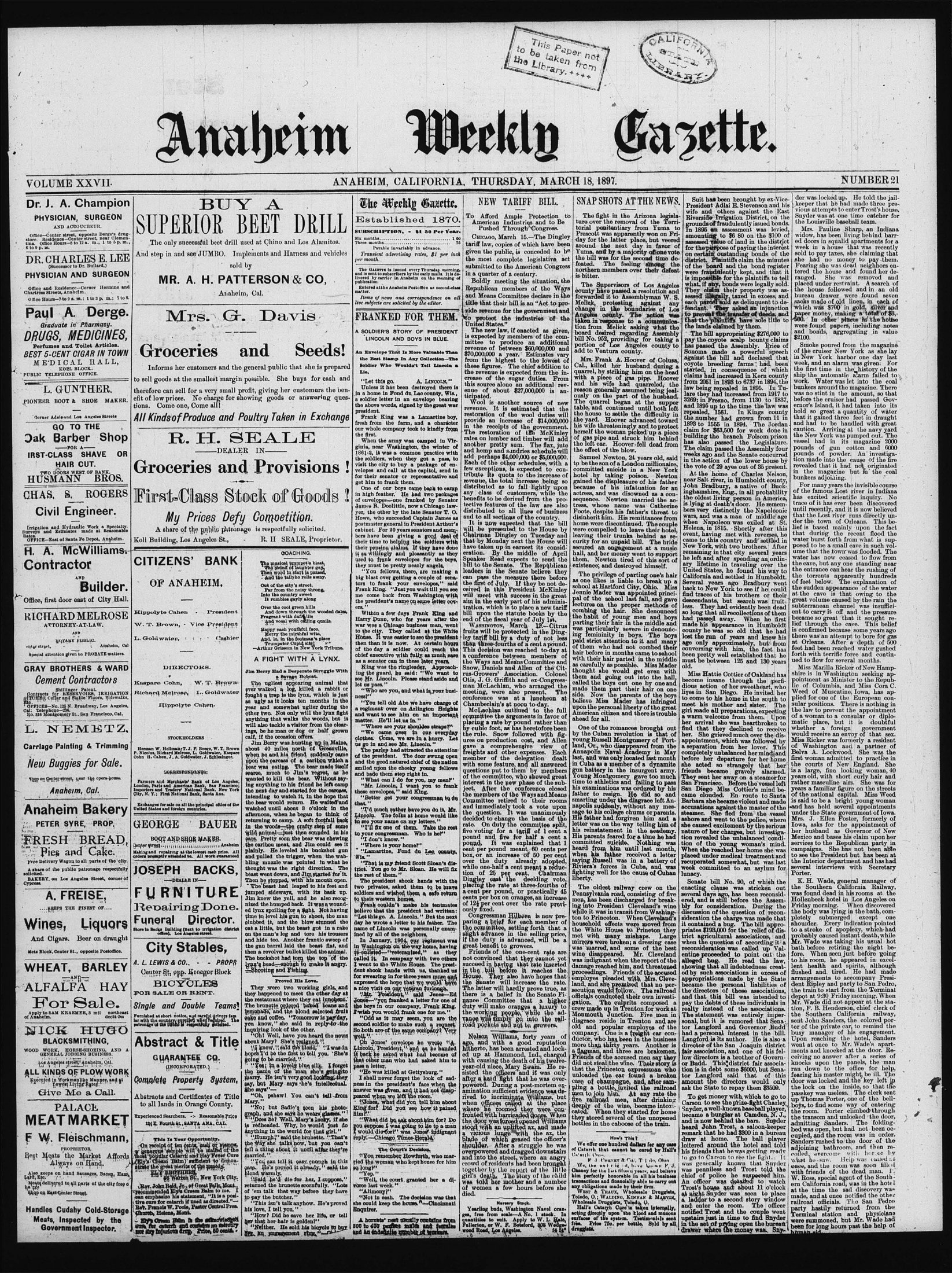
Searchable text
Anaheim
VOLUME XXVII.
Dr. J. A. Champion
PHYSICIAN, SURGEON
AND ACCOUCHEUR.
Office—Center street, opposite Derge's drugstore. Residence—Center street, near Clemen-tina. Office Hours—8 to 12 a.m., 1 to 5 p.m., 6 to 9 p.m.
DR. CHARLES E. LEE
(Successor to Dr. Bullard.)
PHYSICIAN AND SURGEON
Office and Residence—Corner Hermine and Chartress Streets, Anaheim.
Office Hours—7 to 9 a.m.; 1 to 3 p.m.; 7 to 8.
Paul A. Derge.
Graduate in Pharmacy.
DRUGS, MEDICINES,
Perfumes and Toilet Articles.
BEST 5-CENT CIGAR IN TOWN
MEDICAL HALL,
KOEL BLOCK.
PUBLIC TELEPHONE OFFICE.
L. GUNTHER.
PIONEER BOOT & SHOE MAKER.
Corner Adela and Los Angeles Streets
GO TO THE Oak Barber Shop
FOR A IRST-CLASS SHAVE OR HAIR CUT.
TWO DOORS WEST OF BANK.
BUY A
SUPERIOR BEET DRILL
The only successful beet drill used at Chino and Los Alamitos.
And step in and see JUMBO. Implements and Harness and vehicles sold by
MR. A. H. PATTERSON & CO,
Anaheim, Cal.
Mrs. G. Davis
Groceries and Seeds!
Informs her customers and the general public that she is prepared to sell goods at the smallest margin possible. She buys for cash and therefore can sell for a very small profit, giving her customers the benefit of low prices. No charge for showing goods or answering questions. Come one, Come all!
All Kinds of Produce and Poultry Taken in Exchange
R. H. SEALE
DEALER IN
Groceries and Provisions!
L. GUNTHER.
PIONEER BOOT & SHOE MAKER.
Corner Adela and Los Angeles Streets
GO TO THE Oak Barber Shop FOR A IRST-CLASS SHAVE OR HAIR CUT.
TWO DOORS WEST OF BANK.
HUSMANN BROS.
CHAS. S. ROGERS Civil Engineer.
Irrigation and Hydraulic Work a Specialty. Surveys and Estimates made at Reasonable Rates.
OFFICE—East of Santa Fe Depot, Angheim.
H. A. McWilliams. Contractor AND Builder.
Office, first door east of City Hall.
RICHARD MELROSE ATTORNEY-AT-LAW.
AND NOTARY PUBLIC.
Center street, Anaheim, Cal.
Special attention given to PROBATE matters.
GRAY BROTHERS & WARD Cement Contractors
Shillinger Patent.
Contracts for RESERVOIRS, IRRIGATION MITICES, Cellar and Stable Floors, Sidewalks,
No. OFFICES—No. 125 N. Broadway, Los Angeles, Cal.
Telephone—226.
No. 316 Montgomery St., San Francisco, Cal.
L. NEMETZ.
Carriage Painting & Trimming New Buggies for Sale.
Shop on Center street, near the opera-house.
Anaheim, Cal.
Anaheim Bakery PETER SYRE, PROP.
FRESH BREAD, Pies and Cake.
Free Delivery Wagon to all parts of the city.
A share of the public patronage respectfully solicited.
BAKERY, on Los Angeles Street, corner of Cypress.
A. FREISE.
CITIZENS' BANK OF ANAHEIM.
Hippolyte Cahen - President
W. T. Brown, Vice President
L. Goldwater, Cashier
DIRECTORS:
Kaspare Cohn, W. T. Brown
Richard Melrose, L. Goldwater
Hippolyte Cahen.
STOCKHOLDERS
Herman W. Hellman, T.J. F. Boege, W.T. Brown
P. Nicolus, Richard Melrose, L. Goldwater, Kaspare Cohn H. Cahen, J. A. Goldwater, J. Schlesinger.
CORRESPONDANTS:
Farmers and Merchants' Bank of Los Angeles; London, Paris and American Bank; San Francisco; Importers and Traders' National Bank. New York City, N.Y.; First National Bank, Santa Ana.
Exchanges for sale on all the principal cities of the United States and foreign countries.
GEORGE BAUER
BOOT AND SHOP MAKER.
Center street... Anaheim
Making and repairing at the lowest cash price. All orders promptly attended to. All work guaranteed
JOSEPH BACKS,
DEALER IN
FURNITURE
COACHING.
The musical trumpet's blast,
The sound of laughter gay,
Then word to start is passed,
And the tallyho rolls away.
Out of the city's street,
Far from the noisy throng,
Into the country sweet
It rumbles gayly along
Over the cool green hills
And down through the wooded dales,
Fragrant with daffodils
And vocal with calling quails.
Happy each youthful face,
Merry the mithful wits,
And lo, in the footman's place
Trumpeter Cupid sits
Arthur Grissom in New York Tribune.
A FIGHT WITH A LYNX.
Jim Berry Had a Desperate Struggle With a Savage Bobcat.
The ugliest appearing animal that ever walked a log, killed a rabbit or fought a trap is the lynx, which is just as ugly as it looks ten months in the year and somewhat uglier during the other two. Not only will the lynx fight anything that walks the woods, but it will also tackle a visitor from the clearings, be he man or dog or half grown calf, if the occasion offers.
Jim Berry was hunting up in Maine, about 40 miles north of Greenville, when he and his friend suddenly came upon the carcass of a caribou which a bear was eating. The bear made itself scarce, much to Jim's regret, as he wanted to kill the bear. Without saying anything to his friend he left camp the next day and started for the carcase, intending to watch it, in the hope that the bear would return. He waited and watched until about 8 o'clock in the afternoon, when he began to think of returning to camp. A soft footfall back in the woods—the crafty step of some wild animal—just then sounded in his ears. Pretty soon the bear was chewing the caribou meat, and Jim could see it plainly. He leveled his buckshot gun and pulled the trigger, when the wabbling muzzle was pointed in what he thought was the right direction. The beast went down, and Jim started for it. Then he stopped, with his mouth open.
The beast had leaped to his feet and jumped sideways, with its back up. Jim knew the vell, and he also recog-
Anaheim Bakery
PETER SYRE, PROP.
FRESH BREAD,
Pies and Cake.
Free Delivery Wagon to all parts of the city.
A share of the public patronage respectfully solicited.
BAKERY, on Los Angeles Street, corner of Cypress.
A. FREISE,
...KEEPS THE FINEST OF...
Wines, Liquors
And Cigars. Beer on draught
Metz Block, Center St., opposite Postoffice.
WHEAT, BARLEY
AND
ALFALFA HAY
For Sale.
Apply to SAM KRAEMER, 3 mil northeast of Anaheim.
NICK HUGO
BLACKSMITHING,
WOOD WORK, HORSE-SHOEING, AND A GENERAL JOBBING BUSINESS.
Los Angeles street, Anaheim, Cal.
ALL KINDS OF PLOW WORK
Executed in Workmanlike Manner, and at Lowest Living Rates.
Give Me a Call.
PALACE
MEAT MARKET
F.W. Fleischmann,
PROPRIETOR.
Rest Meats the Market Affords Always on Hand.
Also keeps on hand Sausages, Bacon, Ham, Lard, Eic.
Meats delivered to all parts of the city free o hare shop on East Center Street.
Handles Cudahy Cold-Storage Meats, Inspected by the Government Inspector.
GEORGE BAUER
BOOT AND SHOP MAKER.
Center street.....Anaheim
Making and repairing at the lowest cash price. All orders promptly attended to. All work-runs guaranteed
JOSEPH BACKS,
DEALLE IN
FURNITURE
Repairing Done.
Funeral Director.
Store in Backs Building (next to irrigation district office), Los Angeles street.
City Stables,
A. L. LEWIS & CO.. - PROPS
Center St. opp. Kroeger Block
BICYCLES
FOR SALE OR RENT.
Single and Double Teams!
Furnished at short notice, and careful drivers familiar with the country, supplied when required. The patronage of the public is respectfully collected.
Abstract & Title
GUARANTEE CO.
(INCORPORATED.)
Complete Property System.
Abstracts and Certificates of Title to all lands in Orange County.
Experienced Searchers. ...Reasonable Price
194 E. Fourth St., SANTA ANA, CAL.
This Is Your Opportunity.
On receipt of ten cents, cash or stamps, a generous sample will be mailed of the most popular Catarrh and Hay Fever Cure (Ely's Cream Balm) sufficient to demonstrate the great merits of the remedy.
ELY BROTHERS
60 Watson St., New York City.
Rev. John Reid, Jr., of Great Falls, Mont., recommended Ely's Cream Balm to me. I can emphasize his statement, "It is a positive cure for catarrh if used as directed." Rev. Francis W. Poole, Pastor Central Pres. Church, Helena, Mont.
Elly's Cream Balm is the acknowledged cure for catarrh and contains no metotry nor any injurious drug. Price: 50 cents.
The bear would return. He waited and watched until about 8 o'clock in the afternoon, when he began to think of returning to camp. A soft footfall back in the woods—the crafty step of some wild animal—just then sounded in his ears. Pretty soon the bear was chewing the caribou meat, and Jim could see it plainly. He leveled his buckshot gun and pulled the trigger, when the wabbling muzzle was pointed in what he thought was the right direction. The beast went down, and Jim started for it. Then he stopped, with his mouth open.
The beast had leaped to his feet and jumped sideways, with its back up. Jim knew the yell, and he also recognized the humped back. It was a wound-ed lynx spoiling for a fight. Not having time to level his gun to shoot, the man clubbed it, and the blow stunned the cat a little, but the beast got in a rake on the man's leg and tore his trousers and hide too. Another frantic sweep of the gun barrel laid the beast flat, and then a revolver bullet killed the animal. The buckshot had torn the top of the lynx's head—enough to make it angry.
Shooting and Fishing.
Proved His Love.
They were two working girls, and they happened to meet the other day at the restaurant where they eat lunchoon. The brunette ordered baked beans and lemonade, and the blond selected fruit cake and coffee. "Tomorrow is pay day, you know," she said in reply to the inquiry look of the other.
"Oh! Well, have you heard the news about Mary? She's resigned."
"I know," said the blond. "I was in hopes I'd be the first to tell you. She's going to be married."
"Year in a lovely blue silk. I forget the name of the man she's going to marry. He isn't very good looking; they say, but Mary says he's intellectual. She says"
"Oh, pshaw! You can't tell from Mary."
"No; but Sadie's soon his photograph, and she says he wears glasses."
"Does he? Well, Mary's looky, if she is redheaded. Why, he would just do anything in the world for that girl."
"Humph!" said the brunette. "That's the way she talks now, but you can't tell a thing about it until affax they're married."
"You can tell it easy enough in this case. He's proved it already," said the blond warmly.
"Said he'd die for her, I suppose," returned the brunette scornfully. "Lots of 'em talk that way before they have to pay the butcher."
"This isn't talk anyhow. He's proved his love, I tell you."
"How? Did he save her life, or tell her that her hair is golden?"
"Neither. He sold his bicycle to buy her an engagement ring."
This Paper not to be taken from the Library.
ANAHEIM, CALIFORNIA, THURSDAY, MARCH 18, 1897.
DRILL and Los Alamitos.
Harness and vehicles
N & CO,
avis
Seeds!
lic that she is prepared
she buys for cash and
her customers the benals or answering quesaken in Exchange
LE
ovisions!
The Weekly Gazette.
Established 1870.
SUBSCRIPTION, - $150 Per Year.
Six months... 1,00
Three months... 75
Payable invariably in advance.
Transient advertising rates, $1 per inch per month.
The Gazette is issued every Thursday morning,
and is sent to subscribers by the early mails. It is delivered by carrier in Anaheim on the morning of publication.
Entered at the Anaheim Postoffice as second-class matter.
Items of news and correspondence on all live subjects are solicited by the editor.
FRANKED FOR THEM.
A SOLDIER'S STORY OF PRESIDENT LINCOLN AND BOYS IN BLUE.
An Envelope That Is More Valuable Than the Best Stamp In Any Collection—The Soldier Who Wouldn't Tell Lincoln a Lie.
"Let this go. A. LINCOLN."
Unless it has been destroyed there is in a home in Fond du Lao county, Wis., a soldier letter in an envelope bearing the above words, signed by the great war president.
Frank King was a Lamartine boy, fresh from the farm, and a character our whole company took to kindly from the first.
When the army was camped in Virginia, near Washington, the winter of 1861-2, it was a common practice with the soldiers, when they got a pass, to visit the city to buy a package of envelopes and call at the capitol, send in
NEW TARIFF BILL.
To Afford Ample Protection to American Industries and to Be Pushed Through Congress.
Chicago, March 15.—The Dingley tariff law, copies of which have been given the public, is conceded to be the most complete legislative act submitted to the American Congress in a quarter of a century.
Boldly meeting the situation, the Republican members of the Ways and Means Committee declare in the title that their bill is an "Act to provide revenue for the government and to protect the industries of the United States."
The new law, if enacted as given, is expected by members of the committee to produce an additional revenue of between $60,000,000 and $70,000,000 a year. Estimates vary from the highest to the lowest of these figures. The chief addition to the revenue is expected from the increase of the sugar duties. From this source alone an additional revenue of about $27,000,000 is anticipated.
Wool is another source of new revenue. It is estimated that the restoration of the wool duties will provide an increase of $14,000,000 in the receipts of the government.
The restoration of the McKinley rates on lumber and timber will add perhaps $4,000,000 or $5,000,000. Each of the other schedules, with a few exceptions, is expected to contribute its quota to the increase of SNAP SHOTS AT THE NEW
The fight in the Arizona legislature over the removal of the Territorial penitentiary from Yuma Prescott was apparently won on Friday for the latter place, but veered around the next day in favor of Yuma, and by a majority of one vote the bill was for the second time defeated. The feeling among northern members over their defense is bitter.
The Supervisors of Los Angeles county have passed a resolution and forwarded it to Assemblyman W. Melick, protesting against any change in the boundaries of Los Angeles county. The action was taken in response to a communication from Melick asking what the board desired regarding Assemblage bill No. 952, providing for taking portion of Los Angeles county and adding to Ventura county.
Mrs. Frank A. Hoover of Colum Cal., killed her husband during quarrel, by striking him on the heels with a piece of gas pipe. Hoover and his wife had quarreled, the reason generally assumed being merely on the part of the husband. The quarrel began at the supply table, and continued until both left the house to settle the difficulty of the yard. Hoover advanced toward his wife threateningly and to protect herself the woman picked up a piece of gas pipe and struck him behind the left ear. Hoover fell dead from the effect of the blow.
Samuel Newton, 24 years old, said to be the son of a London millionaire committed suicide in a New York hotel by taking poison.
"Let this go. A. LINCOLN."
Unless it has been destroyed there is in a home in Fond du Lac county, Wis., a soldier letter in an envelope bearing the above words, signed by the great war president.
Frank King was a Lamartine boy, fresh from the farm, and a character our whole company took to kindly from the first.
When the army was camped in Virginia, near Washington, the winter of 1861-2, it was a common practice with the soldiers, when they got a pass, to visit the city to buy a package of envelopes and call at the capitol, send in for their senator or representative and get him to frank them.
One of our boys came back to camp in high feather. He had two packages of envelopes—one franked by Senator James R. Doolittle, now a Chicago lawyer, the other by the late Senator T. O. Howe, who succeeded Captain James as postmaster general in President Arthur's cabinet. For 20 years senators and members have been giving a good deal of their time to helping the soldiers with their pension claims. If they have done it willingly and pleasantly as they used to frank envelopes for the boys, they must be pretty nearly angels.
"You fellows, there, are making a big blast over getting a couple of senators to frank your envelopes," said Frank King. "Just you wait till you see me come back from Washington with the president's name on some letter covers."
Within a few days Frank King and Harry Dunn, who for years after the war was a Chicago business man, went to the city. They called at the White House. It was easier to see the president than it is now. At certain hours of the day a scold could reach the chief executive with fully as much ease as a senator can in these later years.
King was the ringleader. Approaching the guard, he said: "We want to see Mr. Lincoln. Please stand aside and let us pass."
"Who are you, and what is your business?"
"You tell old Abe we have charge of a regiment over on Arlington Heights and want to see him on an important matter. He'll let us in."
"Where are your shoulder straps?"
"We came over in our everyday clothes. Come, we are in a hurry. Let us go in and see Mr. Lincoln."
The parley had attracted the attention of the president. The door swung open and the good natured chief of the nation smiled upon the cheeky young fellows and bade them step right in.
"What can I do for you, my men?"
"Mr. Lincoln, I want you to frank these envelopes," said King.
"Better get your congressman to do that."
"I'd much rather have you do it, Mr. Lincoln. The folks at home would like to see your name on my letters."
"I'll fix one of them. Take the rest to your congressman. Who is he?"
"I don't know."
"Where is your home?"
"Lamartine, Fond du Lac county, Wis."
That is my friend Scott Sloan's district. You go to Mr. Sloan. He will fix the rest of them."
The president shook hands with the two privates, asked them to be brave soldiers and wished them a safe return to their western homes.
Washington, March 12.-Citrus fruits will be protected in the Dingley tariff bill by a duty of not less than three-fourths of a cent a pound. This decision was reached to-day at a conference between members of the Ways and Means Committee and Snow, Daniels and Allen of the Citrus-Growers' Association. Colonel Otis, J. G. Griffith and ex-Congressman McLachlan, who arranged the meeting, were also present. The conference was at a luncheon at Chamberlain's at noon-to-day.
McLachlan outlined to the full committee the arguments in favor of placing a rate by pound rather than by cubic foot, as has heretofore been the rule. Snow followed with figures on production cost, and Allen gave a comprehensive view of freights and other expenses. Each member of the delegation dealt with some feature, and all answered questions put to them by members of the committee, who showed great interest in the new phase of the subject. After the conference closed the members of the Ways and Means Committee retired to their rooms and immediately took a vote upon the question. It was unanimously decided to change the basis of the rate. On duty the committee split, five voting for a tariff of 1 cent a pound and five for half a cent a pound. It was explained that 1 cent per pound meant 60 cents per box, or an increase of 50 per cent over the duty already adopted, while one-half a cent meant a reduction of 25 per cent. Chairman Dingley cast the deciding vote, placing the rate at three-fourths of a cent per pound, or practically 45 cents per box on oranges, an increase of the sugar duties. From this source alone an additional revenue of about $27,000,000 is anticipated.
Wool is another source of new revenue. It is estimated that the restoration of the wool duties will provide an increase of $14,000,000 in the receipts of the government. The restoration of the McKinley rates on lumber and timber will add another pretty sum. The flax, jute and hemp and sundries schedule will add perhaps $4,000,000 or $5,000,000. Each of the other schedules, with a few exceptions, is expected to contribute its quota to the increase of revenue, the total increase being so distributed as to fall lightly upon any class of customers, while the benefits to be derived from the protective features of the law are also distributed to all lines of business and to all sections of the country.
It is now expected that the bill will be presented to the House by Chairman Dingley on Tuesday and that by Monday next the House will have taken up in earnest its consideration. By the middle of April Speaker Read expects to send the bill to the Senate. The Republican leaders in the Senate believe they can pass the measure there before the first of July. If they be not deceived in this President McKinley will meet with success in the great aim in the early part of his administration, which is to place a new tariff bill upon the statute books by the end of the fiscal year of July 1st.
Washington, March 12.-Citrus fruits will be protected in the Dingley tariff bill by a duty of not less than three-fourths of a cent a pound. This decision was reached to-day at a conference between members of the Ways and Means Committee and Snow, Daniels and Allen of the Citrus-Growers' Association. Colonel Otis, J. G. Griffith and ex-Congressman McLachlan, who arranged the meeting, were also present. The conference was at a luncheon at Chamberlain's at noon-to-day.
McLachlan outlined to the full committee the arguments in favor of placing a rate by pound rather than by cubic foot, as has heretofore been the rule. Snow followed with figures on production cost, and Allen gave a comprehensive view of freights and other expenses. Each member of the delegation dealt with some feature, and all answered questions put to them by members of the committee, who showed great interest in the new phase of the subject. After the conference closed the members of the Ways and Means Committee retired to their rooms and immediately took a vote upon the question. It was unanimously decided to change the basis of the rate. On duty the committee split, five voting for a tariff of 1 cent a pound and five for half a cent a pound. It was explained that 1 cent per pound meant 60 cents per box, or an increase of 50 per cent over the duty already adopted, while one-half a cent meant a reduction of 25 per cent. Chairman Dingley cast the deciding vote, placing the rate at three-fourths of a cent per pound, or practically 45 cents per box on oranges, an increase of the sugar duties.
From this source alone an additional revenue of about $27,000,000 is anticipated.
Wool is another source of new revenue. It is estimated that the restoration of the wool duties will provide an increase of $14,000,000 in the receipts of the government. The restoration of the McKinley rates on lumber and timber will add another pretty sum. The flax, jute and hemp and sundries schedule will add perhaps $4,000,000 or $5,000,000. Each of the other schedules, with a few exceptions, is expected to contribute its quota to the increase of revenue, the total increase being so distributed as to fall lightly upon any class of customers, while the benefits to be derived from the protective features of the law are also distributed to all lines of business and to all sections of the country.
It is now expected that the bill will be presented to the House by Chairman Dingley on Tuesday and that by Monday next the House will have taken up in earnest its consideration. By the middle of April Speaker Read expects to send the bill to the Senate. The Republican leaders in the Senate believe they can pass the measure there before the first of July. If they be not deceived in this President McKinley will meet with success in the great aim in the early part of his administration, which is to place a new tariff bill upon the statute books by the end of the fiscal year of July 1st.
Washington, March 12.-Citrus fruits will be protected in the Dingley tariff bill by a duty of not less than three-fourths of a cent a pound. This decision was reached to-day at a conference between members of the Ways and Means Committee and Snow, Daniels and Allen of the Citrus-Growers' Association. Colonel Otis, J. G. Griffith and ex-Congressman McLachlan, who arranged the meeting, were also present. The conference was at a luncheon at Chamberlain's at noon-to-day.
McLachlan outlined to the full committeethe arguments in favorof placinga ratebypoundratherthanbycubicfoot.ashasheretoforebeentherule.Snowfollowedwithfiguresonproductioncost,andAllengaveacomprehensiveviewoffreightsandotherexpenses.Eachmemberofthedelegationdealtwithsomefeature,andallansweredquestionsputtothembymembersofthecommittee,theshowgottowethismettoathingsandfailingtopishexaminationswasorderedbyhifathertoresign.Hew did soandsmartingunderthedisgraceleftAnnapolis suddenlywithoutanymessagetohiscollegechumsorparentshisfatherhadforgivenhimandhisreinstatementintheacademyHisparentsfearedfora.timehehadcommittedsuicide.NothingwereheardfromhimuntillastmonthwhenhisfatherreceivedalettersayingRussellwasinCubaorRiviera'sforcesinCuba,andwafightingwellforthecauseOfCubaliberty.
The oldest railway crew onthePennsylvaniaroad,consistingoffivemenhasbeendischargedforkresearch
Proved His Love.
Two working girls and
to meet the other day at
where they eat lunchon.
ordered baked beans and
the blond selected fruit
mee. "Tomorrow is pay day,
she said in reply to the
sk of the other.
Have you heard the news
She's resigned."
Said the blond. "I was in
the first to tell you. She's
married."
Lovely blue silk. I forget
the man she's going to
not very good looking, they
says he's intellectual.
Sadie'a soon photoeshe says he wears glasses.
Well, Mary's lucky, if she
Why, he would just do
the world for that girl."
That's talks now, but you can't
about it until after they're
roll it easy enough in this
proved it already," said the
Die for her, I suppose,
brunette scornfully. "Lots
that way before they have
talk anyhow. He's proved
you."
He save her life, or tell
hair is golden?"
He sold his bicycle to buy
argument ring."
Before get your congressman to we
that."
"I'd much rather have you do it, Mr.
Lincoln. The folks at home would like
to see your name on my letters."
"I'll fix one of them. Take the rest
to your congressman. Who is he?"
"I don't know."
"Where is your home?"
"Lamartine, Fond du Leo county,
Wis."
"That is my friend Scott Sloan's district. You go to Mr. Sloan. He will fix
the rest of them."
The president shook hands with the
two privates, asked them to be brave
soldiers and wished them a safe return
to their western homes.
Frank couldn't make his tentmates
believe that the president had written:
"Let this go. A. Lincoln." But the next
day he wrote a letter to his father. The
name of Lincoln was personally examined by all of the neighbors.
In January, 1864, our regiment was in Washington on the way home, having re-enlisted—"veteranized," as they called it. In company with two others I went to the White House. The president shook hands with us, thanked us for swearing in for three years more and expressed the hope that we would have a nice visit on our veteran furlough.
Mr. President," said Jones—Ed Jones—"you franked a letter for one of the boys in our company, Frank King. Twish you would frank one for me."
"Odd as it may seem, you are the second soldier to make such a request. So both are of the same company? Very well."
Oh Jones' envelope he wrote "A. Lincoln, President," and as he handed it back he asked what had become of that other man who had asked him to pass a letter.
He was killed at Gettysburg.
I shall never forget the look of sadness in the president's face when the answer was given, and it had not disappeared when we left the room.
Jones, what did you tell him about King for? Did you see how it pained him?
What did he ask about him for? Do you suppose I was going to lie to a man I would die for?" was Jones indignant reply.—Chicago Times-Herald.
The Court's Decision.
You remember Howforth, who maried the woman who kept house for him so long?
Yep.
Well, the court granted her a divorce last week.
Alimony?
Not in cash. The decision was that she could keep the house."—Cincinnati Enquirer.
A hornets' nest usually contains from 300 to 400 perfect males and females and an endurable number of workers.
Committee retired to their rooms and immediately took a vote upon the question. It was unanimously decided to change the basis of the rate. On duty the committee split, five voting for a tariff of 1 cent a pound and five for half a cent a pound. It was explained that 1 cent per pound meant 60 cents per box, or an increase of 50 per cent over the duty already adopted, while one-half a cent meant a reduction of 25 per cent. Chairman Dingley cast the deciding vote, placing the rate at three-fourths of a cent per pound, or practically 45 cents per box or oranges, an increase of 12% per cent over the rate previously fixed.
Congressman Hilborn is now preparing a brief for each member of the committee, setting forth that a slight advance in the selling price, if the duty is advanced, will be a great benefit to growers.
Friends of the one-cent rate are not convinced that they cannot yet succeed in having that rate inserted in the bill before it reaches the House. They also have hopes that the Senate will increase the rate. The latter will hardly prove true, as there is a belief in the Senate Finance Committee that a higher duty will make oranges a luxury to the working people, while the advance will simply go into the railroad pockets and not to growers.
Nelson Williams, forty years of age, and with a good reputation hitherto, has been arrested and locked up at Hammond, Ind., charged with causing the death of his twelve-year-old niece, Mary Swain. He resisted the officers and it was only after a hard fight that he was overpowered. During a post-mortem examination sufficient evidence was derived to incriminate Williams, but when officers called at the place where he roomed they were confronted with barricaded doors. When the door was forced opened Williams stood with an uplifted ax, and made a vicious lunge with the ax, the blade of which grazed the officer's shoulder. After a struggle he was overpowered and dragged downstairs and into the street, where an angry crowd of residents had been brought together by the report of the little girl's death. The story of the child was told her mother and a number of women a few hours before she died.
Nursery Stock.
Yearling buds, Washington Navel oranges, free from scale—A No. 1 stock. In quantities to suit. Apply to W. L. Hale, Fullerton, or W. F. Botaford, 808 Wedgewood Road, Los Angeles.
Smarting under the disgrace left Annapolis suddenly, without any message to his college chums or parents. His father had forgiven him and a letter was on the way telling him of his reinstatement in the academy. His parents feared for a time he had committed suicide. Nothing was heard from him until last month when his father received a letter saying Russell was in a battery of Riviera's forces in Cuba, and was fighting well for the cause of Cuban liberty.
The oldest railway crew on the Pennsylvania road, consisting of five men, has been discharged for breaking into President Cleveland's win while it was in transit from Washington to Princeton. When Cleveland household effects were moved from the White House to Princeton they met with many mishaps. Large mirrors were broken; a dressing case was marred, and some of the best wine disappeared. Mr. Cleveland was indignant when the report of the damage reached him, and threatened proceedings. Friends of the accused employees pleaded with Mrs. Clever land, and she promised that no persecution would follow. The railroad officials conducted their own investigation. The culprits composed crew made up in Trenton for work at Monmouth Junction. Five men in disgrace reside in Trenton and an old and popular employes of the company. One is a freight car conductor, who has been in the business more than thirty years. Another is a flagman, and three are brakemen. Friends of the accused men say they did not steal the wine. Their story that the Princeton expressman who unloaded the car found a broke case of champagne, and after sampling a bottle invited the railroadmen to join him. At any rate that five railroad men, after drinking deeply of the wine, became intoxicated. When they started for home they stored several of the unopene bottles in the caboose of the train.
How's This?
We offer one hundred dollars for any car of Catarrh that cannot be cured by Hall Catarrh Care.
F.J.Cheenry & Co., Tldo, Ohio.
We, the untrigged, have known F., Cheney for the last fifteen years, and believe him perfectly honorable in all his business transactions and financially able to carry out any obligations made by their firm.
West & Traux, Wholesale Druggists Toledo, O.; Walding, Kinnan & Marvin Wholesale Druggists Toledo, O.
Hall's Catarrh Care is taken internally acting directly upon the blood and mucous surfaces of the system. Testimonials seen free. Price 75c. per bottle. Sold by a druggist.
SHOTS AT THE NEWS.
fight in the Arizona legislature the removal of the Terri-penitentiary from Yuma to it was apparently won on Fri- the latter place, but veered the next day in favor of and by a majority of one vote was for the second time de- The feeling among the members over their defeat.
Supervisors of Los Angeles have passed a resolution and led it to Assemblyman W. S. protesting against any in the boundaries of Los county. The action was a response to a communica- Melick asking what the desired regarding Assembly 1952, providing for taking a of Los Angeles county to Ventura county.
Frank A. Hoover of Colusa, called her husband during a by striking him on the head piece of gas pipe. Hoover wife had quarreled, the generally assumed being jeal- in the part of the husband. barrel began at the supper and continued until both left ease to settle the difficulty in. Hoover advanced toward threateningly and to protect the woman picked up a piece pipe and struck him behind ear. Hoover fell dead from out of the blow.
El Newton, 24 years old, said he son of a London millionaire, died suicide in a New York Suit has been brought by ex-Vice-President Adlai E. Stevenson and his wife and others against the East Riverside Irrigation District, on the grounds of fraudulently issued bonds. In 1895 an assessment was levied, amounting to $6 80 on the $100 of assessed value of land in the district for the purpose of paying the interest on certain outstanding bonds of the district. Plaintiffs claim the minutes of the board and the bond register were fraudulently kept, and that it is impossible for the plaintiffs to tell what, if any, bonds were legally sold. They claim their property was assessed illegally, taxed in excess, and each parcel sold as delinquent to defendant. They asked an injunction to prevent the transfer of deeds, and that the plaintiffs have sole title to the lands claimed by them.
The bill appropriating $276,000 to pay the coyote scalp bounty claims has passed the Assembly. Price of Sonoma made a powerful speech against the bill and declared that coyote breeding farms; had been started, in consequence of which claims had increased in Kern county from 2051 in 1893 to 6737 in 1894, the law being repealed in 1895. In Tulare they had increased from 1917 to 3269; in Fresno, from 1130 to 1837, and 1895 up to the time the law was repealed, 1561. In Kings county the number had grown from 11 in 1893 to 1555 in 1894. The Jordan claim for $63,500 for work done in building the branch Folsom prison has also passed the Legislature. The claim passed the Assembly four weeks ago and the Senate concurred in the action of the lower house by the vote of 29 ayes out of 35 present.
At the home of Charles Nelson der was locked up. He told the jail- keeper that he had made three previous attempts to enter Trost's house. Snyder was at one time catcher for the Louisville baseball team.
Mrs. Pauline Sharp, an Indiana widow, has been living behind barred doors in squalid apartments for a week in a house that was recently sold to pay taxes, she claiming that she had no money to pay them. Fearing she was dead neighbors entered the house and found her deranged. She was removed and placed under restraint. A search of the house followed and in an old bureau drawer were found seven sacks made of old linen, in each of which was $700 in gold, silver and paper money, making a total of $3,600. In other places in the house were found papers, including notes and bonds, aggregating in value $2100.
Smoke poured from the magazine of the cruiser New York as she lay in New York harbor one day last week, and an alarm was given: For the first time in the history of the ship the automatic alarm failed to work. Water was let into the coal bunkers around the magazine. There was no stint in the amount, so that before the cruiser had passed Governor's Island, it had taken into its hold so great a quantity of water that it gained three feet in draught and had to be handled with great caution. Arriving at the navy yard the New York was pumped out. The vessel had in its magazine 2000 pounds of gun cotton and 6000 pounds of powder. An investigation made into the cause of the fire revealed that it had not originated in the magazine but in the coal
The piece of gas pipe. Hoover was wife had quarreled, the generally assumed being jealous the part of the husband. Barrel began at the supper and continued until both left to settle the difficulty in Hoover advanced toward threateningly and to protect the woman picked up a piece pipe and struck him behind ear. Hoover fell dead from out of the blow.
Sel Newton, 24 years old, said he son of a London millionaire, died suicide in a New York city taking poison. Newton the displeasure of his father of his infatuation for an island was disowned as a condescension. Newton married the act whose name was Catherine despite his father's threat to him. His remittances from there discontinued. The couple impelled to leave their hotel, their trunks behind as sewer an unpaid bill. The bride had an engagement at a music hall her money went to support Newton tired of this sort of work, and destroyed himself.
Privilege of parting one's hair makes is liable to break up a Hartford City, Ohio. Miss Mader was appointed principal school last fall, and gave on the proper methods of cut the hair. She denounced that of young men and boys their hair in the middle andicularly severe in denomination in boys. The boys not attention to it and many who had not combed their hair in months came to school their hair parted in the middle really as possible. Miss Mader she would get even with and going out into the hall, the boys out one by one and them part their hair on one now the parents of the boys Miss Mader has infringed personal liberty of the great citizen and there is trouble for all.
The romances brought out Cuban revolution is that of Russell Montgomery of Port-au-Prince, who disappeared from the Miss Naval Academy in May was only located last month was a member of a dynamite battery in the insurgent army. Montgomery gave too much athletics and failing to passinations was ordered by his no resign. He did so and under the disgrace left Anuddely, without any mesis college chums or parents. Her had forgiven him and a was on the way telling him of statement in the academy. Prints feared for a time he had died suicide. Nothing was from him until last month, a father received a letter Russell was in a battery of forces in Cuba, and was well for the cause of Cuban oldest railway crew on the main road, consisting of five trains discharged for break claims had increased in Kern county from 2051 in 1893 to 6737 in 1894, the law being repealed in 1895. In Tulare they had increased from 1917 to 3269; in Fresno, from 1130 to 1837, and 1895 up to the time the law was repealed, 1561. In Kings county the number had grown from 11 in 1893 to 1555 in 1894. The Jordan claim for $63,500 for work done in building the branch Folsom prison has also passed the Legislature. The claim passed the Assembly four weeks ago and the Senate concurred in the action of the lower house by the vote of 29 ayes out of 35 present.
At the home of Charles Nelson, near Salt river, in Humboldt county, John Bradbury, a native of Buckinghamshire, Eng., in all probability the oldest living person in America, is lying at death's door. He remembers very distinctly the Napoleonic wars, and was a man of middle age when Napoleon was exiled at St Helena, in 1815. Shortly after this event, having met with reverses, he came to this country and settled in New York, with two brothers. After remaining in that city several years he left and after spending an ordinary lifetime in traveling over the United States, he found his way to California and settled in Humboldt. Several years ago Bradbury went back to New York to see if he could find traces of his brothers or their descendants, but search was fruitless. They had evidently been dead so long that all recollections of them had passed away. When he first made his appearance in Humboldt county he was so old that he had lost the run of years and knew his age only approximately, but from conversing with him, the fact has been pretty well established that he must be between 125 and 130 years old.
Miss Hattie Cottier of Oakland has become insane through the perfidious action of her sweetheart, who lives in San Diego. He invited her to come to his home in the south to meet his mother and sister. The girl made all preparations, expecting a warm welcome from them. Upon her arrival she was heartbroken to find that they declined to receive her. She grieved much over the disappointment, which was followed by a separation from her lover. This completely unbalanced her mind and before her departure for her home she acted so strangely that her friends became gravely alarmed. They sent her away on a steamer for San Francisco. Before the vessel left San Diego Miss Cottier's mind became clouded. En route to Santa Barbara she became violent and made accusations against the master of the steamer. She fled from the vessel ashore and went to the police, where she caused excitement by the serious nature of her charges, but investigation revealed the unbalanced condition of the young woman's mind. When she reached her home she was placed under medical treatment and recuperated somewhat, but was last week committed to an asylum for lunacy.
Senate bill No. 90, of which the enacting clause was stricken out several days ago, has been reconsidered and is still before the Artist.
ship the automatic alarm failed to work. Water was let into the coal bunkers around the magazine. There was no stint in the amount, so that before the cruiser had passed Governor's Island, it had taken into its hold so great a quantity of water that it gained three feet in draught and had to be handled with great caution. Arriving at the navy yard the New York was pumped out. The vessel had in its magazine 2000 pounds of gun cotton and 6000 pounds of powder. An investigation made into the cause of the fire revealed that it had not originated in the magazine but in the coal bunkers adjoining.
For many years the invisible course of the famous Lost river in Indiana has excited scientific inquiry. No trace of it has ever been discovered until recently, and it is now believed that the Lost river runs directly under the town of Orleans. This belief is based mainly upon the fact that during the recent flood the water burst forth from what is supposed to be a small cave in such volume that the town was flooded. The water has now ceased to flow from the cave, but any one standing near the entrance can hear rushing of the torrents apparently hundreds of feet below. The explanation of the sudden appearance of the water at the cave is that owing to the great volume caused by the rain the subterranean channel was insufficient to carry it off and the pressure became so great that it sought relief through the cave. This belief is confirmed because some years ago there was an attempt to bore for gas at Orleans. After a depth of 500 feet had been reached water gushed forth with terrific force and continued to flow for several months.
Miss Marilla Ricker of New Hampshire is in Washington seeking appointment as Minister to the Republic of Columbia, and Miss Cora C. Weed of Muscatine, Iowa, has applied for one of the European consular positions. There nothing in the law to prevent the appointment of a woman to a consular or diplomatic place, but it is doubtful whether a foreign government would receive an envoy of that sex. Miss Ricker was formerly a resident of Washington and a partner of Belva A. Lockwood. She was the first woman admitted to practice in the courts of New England. She is a large, fine looking woman, 40 years old, with short curly hair and rather masculine airs. She was for years a familiar figure on the streets of national capital. Miss Weed is said to be a bright young woman and has held several appointments under the State government of Iowa. Mrs. J. Ellen Foster, formerly of Iowa, asks for the appointment of her husband as Governor of New Mexico and bases his claim upon her services to the Republican party in campaigns. She has not been able to see the President but has been at the Interior department and has had several interviews with Secretary Porter.
K. H. Wade, general manager of the Southern California Railway, was found dead in his rooms at the Hollenbeck hotel in Los Angeles on
under the disgrace left Andundedly, without any messils college chums or parents,
her had forgiven him and a
was on the way telling him of
statement in the academy.
ents feared for a time he had
suicide. Nothing was
from him until last month,
a father received a letter
russell was in a battery of
forces in Cuba, and was
well for the cause of Cuban
oldest railway crew on the
Mania road, consisting of five
been discharged for breakPresident Cleveland's wine
was in transit from Washingrinconet. When Cleveland's
effects were moved from
the House to Prinston they
had many mishaps. Large
were broken; a dressing case
fired, and some of the best
appeared. Mr. Cleveland
signant when the report of the
breached him, and threatened
ings. Friends of the accused
was pleaded with Mrs. Cleveshe promised that no perwould follow. The railroad
conducted their own investition. The culprits composed a
side up in Trenton for work at
with Junction. Five men in
reside in Trenton and are
popular employees of the.
One is a freight car conwho has been in the business
thirty years. Another is
man, and three are brakemen,
of the accused men say they
deal the wine. Their story is
Princeton expressman who
lived the car found a broken
champagne, and, after sambottle, invited the railroad
join him. At any rate the
road men, after drinking of the wine, became intoxicated. When they started for home
and several of the unopened
in the caboose of the train.
Senate bill No. 90, of which the enacting clause was stricken out several days ago, has been reconsidered, and is still before the Assembly for consideration. During the discussion of the question of reconsideration the charge was made that it contained a bug. The bill appropriates $193,000 for the relief of district agricultural associations, and when the question of according it a reconsideration was called up Valentine proceeded to point out the alleged bug. He read the law, showing that all indebtedness created by such associations in excess of appropriations made by the State became the personal liabilities of the directors of those associations, and that this bill was intended to pay the debts of these individuals in reality instead of the associations. The statement was entirely imperial, but it is rumored that Senator Langford and Governor Budd had a personal interest in the bill. Langford is its author. He is also a director of the San Joaquin district fair association, and one of his fellow directors is a brother of Governor Budd. This district fair association is in debt some $6000, but Senator Langford said that of this amount the directors would only ask the State to repay them $3500.
To get money with which to go to Carson to see the prize-fight Charley Snyder, a well-known baseball player, became a burglar at Camden, N. J., and is now behind the bars. Snyder heard John Trost, a saloon-keeper remark that he had $300 in a bureau draw at home. The ball player loitered around the hotel and told his friends that he was getting ready to go to Carson to see the fight. It was generally known that Snyder was penniless and Trost told the chief of police he suspected him. An officer was detailed to watch Trost's house and about 11 o'clock at night Snyder was seen to place a ladder to a second story window and enter the room. The officer notified Trost and the couple went upetairs just in time to find Snyder in the set of prying open the bureau drawer where the money was. Sny-