anaheim-gazette 1897-01-28
Scanned page
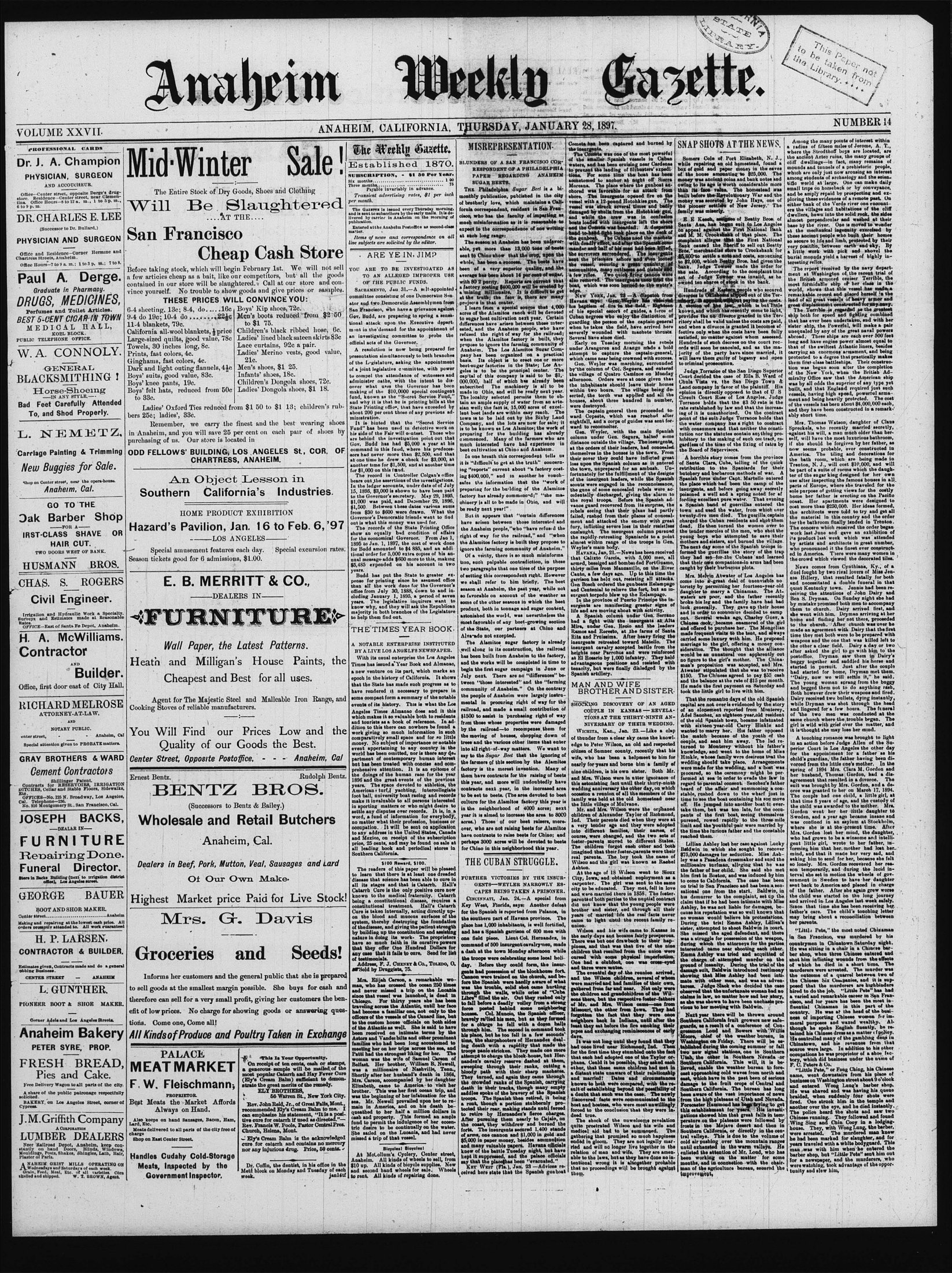
Searchable text
Anaheim
VOLUME XXVII.
PROFESSIONAL CARDS
Dr. J. A. Champion
PHYSICIAN, SURGEON
AND ACCOUCHEUR.
Office—Center street, opposite Derge's drugstore. Residence—Center street, near Clementina. Office Hours—8 to 12 a.m., 1 to 5 p.m., 6 to 9 p.m.
DR. CHARLES E. LEE
(Successor to Dr. Bullard.)
PHYSICIAN AND SURGEON
Office and Residence—Corner Hermine and Chartress Streets, Anaheim.
Office Hours—7 to 9 a.m.; 1 to 3 p.m.; 7 to 8.
Paul A. Derge.
Graduate in Pharmacy.
DRUGS, MEDICINES,
Perfumes and Toilet Articles.
BEST 5-CENT CIGAR IN TOWN
MEDICAL HALL,
KOEL BLOCK.
PUBLIC TELEPHONE OFFICE.
W. A. CONNOLY.
GENERAL BLACKSMITHING!
Horse-Shoeing
IN ANY STYLE.
Bad Feet Carefully Attended To, and Shod Properly.
L. NEMETZ.
Carriage Painting & Trimming
New Buggies for Sale.
Mid-Winter Sale!
The Entire Stock of Dry Goods, Shoes and Clothing
Will Be Slaughtered ...AT THE.....
San Francisco
Cheap Cash Store
Before taking stock, which will begin February 1st. We will not sell a few articles cheap as a bait, like our competitors, but all the goods contained in our store will be slaughtered. Call at our store and convince yourself. No trouble to show goods and give prices or samples.
THESE PRICES WILL CONVINCE YOU:
6-4 sheeting, 13c; 8-4, do...16c
9-4 do 19c; 10-4 do...221c
11-4 blankets, 79c.
California all-wool blankets, $\frac{1}{2}$ price
Large-sized quilts, good value, 78c
Towels, 30 inches long, 8c.
Prints, fast colors, 4c.
Gingham, fast colors, 4c.
Dark and light outing flanuels, $41c
Boys' suits, good value, 83c.
Boys' knee pants, 19c.
Boys' felt hats, reduced from 50c to 33c.
Boys' Kip shoes, 72c.
Men's boots reduced from $2 50 to $1 75.
Children's black ribbed hose, 6c.
Ladies' lined black sateen skirts 83c
Lace curtains, 92c a pair.
Ladies' Merino vests, good value, 21c.
Men's shoes, $1 25.
Infants' shoes, 18c.
Children's Dongola shoes, 72c.
Ladies' Dongola shoes, $1 18.
Ladies' Oxford Ties reduced from $1 50 to $1 13; children's rubbers 25c; ladies', 33c.
Remember, we carry the finest and the best wearing shoes in Anaheim, and you will save 25 per cent on each pair of shoes by purchasing of us. Our store is located in ODD FELLOWS' BUILDING, LOS ANGELES St., COR. OF CHARTRESS, ANAHEIM.
BLACKSMITHING!
Horse-Shoeing
IN ANY STYLE.
Bad Feet Carefully Attended
To, and Shod Properly.
L. NEMETZ.
Carriage Painting & Trimming
New Buggies for Sale.
Shop on Center street, near the opera-house.
Anaheim, Cal.
GO TO THE
Oak Barber Shop
FOR A
IRST-CLASS SHAVE OR
HAIR CUT.
TWO DOORS WEST OF BANK.
HUSMANN BROS.
CHAS. S. ROGERS
Civil Engineer.
Irrigation and Hydraulic Work a Specialty.
Surveys and Estimates made at Reasonable Rates.
OFFICE—East of Santa Fe Depot, Anaheim.
H. A. McWilliams.
Contractor
AND
Builder.
Office, first door east of City Hall.
RICHARD MELROSE
ATTORNEY-AT-LAW.
AND
NOTARY PUBLIC.
enter street, Anaheim, Cal.
Special attention given to PROBATE matters.
GRAY BROTHERS & WARD
Cement Contractors
Shillinger Patent.
Contracts for RESERVOIRS, IRRIGATION DITCHES, Cellar and Stable Floors, Sidewalks, etc.
OFFICES—No. 125 N. Broadway, Los Angeles, Cal., Telephone—236.
No. 316 Montgomery St., San Francisco, Cal.
JOSEPH BACKS,
DEALER IN
FURNITURE
Repairing Done.
Funeral Director.
Store in Backs Building (next to irrigation district office), Los Angeles street.
GEORGE BAUER
Boys' suits, good value, 83c.
Boys' knee pants, 19c.
Boys' felt hats, reduced from 50c to 33c.
Ladies' Oxford Ties reduced from $1 50 to $1 13; children's rubbers 25c; ladies', 33c.
Remember, we carry the finest and the best wearing shoes in Anaheim, and you will save 25 per cent on each pair of shoes by purchasing of us. Our store is located in ODD FELLOWS' BUILDING, LOS ANGELES St., COR. OF CHARTRESS, ANAHEIM.
An Object Lesson in Southern California's Industries.
HOME PRODUCT EXHIBITION
Hazard's Pavilion, Jan. 16 to Feb. 6,'97
——LOS ANGELES——
Special amusement features each day. Special excursion rates. Season tickets good for 6 admissions, $1.00.
E. B. MERRITT & CO.,
DEALERS IN
FURNITURE
Wall Paper, the Latest Patterns.
Heatn and Milligan's House Paints, the Cheapest and Best for all uses.
Agent for The Majestic Steel and Malleable Iron Range, and Cooking Stoves of reliable manufacturers.
You Will Find our Prices Low and the Quality of our Goods the Best.
Center Street, Opposite Postoffice, - - - Anaheim, Cal
Ernest Bentz.
Rudolph Bentz.
BENTZ BROS.
(Successors to Bentz & Bailey.)
Wholesale and Retail Butchers
Anaheim, Cal.
Dealers in Beef, Pork, Mutton, Veal, Sausages and Lard
Of Our Own Make.
Highest Market price Paid for Live Stock!
JOSEPH BACKS,
DEALER IN
FURNITURE
Repairing Done.
Funeral Director.
Store in Backs Building (next to irrigation district office), Los Angeles street.
GEORGE BAUER
BOOT AND SHOE MAKER.
Center street... Anaheim
Making and repairing at the lowest cash price. All orders promptly attended to. All work guaranteed
H. P. LARSEN,
CONTRACTOR & BUILDER.
Estimates given, Contracts made and do a general obbing Business.
CENTER STREET — ANAHEIM
L. GUNTHER.
PIONEER BOOT & SHOE MAKER.
Corner Adela and Los Angeles Streets.
Anaheim Bakery
PETER SYRE, PROP.
FRESH BREAD,
Pies and Cake.
Free Delivery Wagon to all parts of the city.
A share of the public patronage respectfully solicited.
BAKERY on Los Angeles Street, corner of Cypress.
J.M.Griffith Company
A CORPORATION
LUMBER DEALERS
Neer Railroad Depot, Anaheim, keep constantly on hand Doors, Blinds, Windows, Mouldings, Posts, Shakes, Shingles, Lath, Hair, Plaster of Parts.
ANAHEIM GRIST MILLS OPERATING ON Wednesdays and Saturdays of each week.
Grain, Feed, Meal, Etc. of all varieties. Corn shelled and shipped.
(Successors to Bentz & Bailey.)
Wholesale and Retail Butchers
Anaheim, Cal.
Dealers in Beef, Pork, Mutton, Veal, Sausages and Lard
Of Our Own Make.
Highest Market price Paid for Live Stock!
Mrs. G. Davis
Groceries and Seeds!
Informs her customers and the general public that she is prepared to sell goods at the smallest margin possible. She buys for cash and therefore can sell for a very small profit, giving her customers the benefit of low prices. No charge for showing goods or answering questions. Come one, Come all!
All Kinds of Produce and Poultry Taken in Exchange
PALACE
MEAT MARKET
F. W. Fleischmann;
PROPRIETOR.
Best Meats the Market Affords Always on Hand.
Also keeps on hand Sausages, Bacon, Ham, Lard, Etc.
Meats delivered to all parts of the city free of charge.
Shop on East Center Street.
Handles Cudahy Cold-Storage Meats, Inspected by the Government Inspector.
This Is Your Opportunity.
On receipt of ten cents, cash or stamps, a generous sample will be mailed of the most popular Catarrh and Hay Fever Cure (Ely's Cream Balm) sufficient to demonstrate the great merits of the remedy.
ELY BROTHERS,
56 Warren St., New York City.
Rev. John Reid, Jr., of Great Falls, Mont., recommended Ely's Cream Balm to me. I can emphasize his statement, "It is a positive cure for catarrh if used as directed."—Rev. Francis W. Poole, Pastor Central Pres. Church, Helena, Mont.
Ely's Cream Balm is the acknowledged cure for catarrh and contains no mercury nor any injurious drug. Price, 50 cents.
Dr. Coffin, the dentist, in his office in the Metz block on Monday and Tuesday of each week.
Sale!
and Clothing
htered
sh Store
t. We will not sell
but all the goods
at our store and con价 prices or samples.
FACE YOU:
oes, 72c.
reduced from $2 50
black sateen skirts 83c
92c a pair.
vests, good value,
$1 25.
18c.
angola shoes, 72c.
bola shoes, $1 18.
1 13; children's rubbest wearing shoes
chip pair of shoes by
ES St., COR. OF
The Weekly Gazette.
Established 1870.
SUBSCRIPTION, - $1 50 Per Year.
Six months... 1 00
Three months... 75
Payable invariably in advance.
Transient advertising rates, $1 per inch per month.
The Gazette is issued every Thursday morning,
and is sent to subscribers by the early mails. It is delivered by carrier in Anaheim on the morning of publication.
Entered at the Anaheim Postoffice as second-class matter.
Items of news and correspondence on all live subjects are solicited by the editor.
ARE YE IN, JIMP
YOU ARE TO BE INVESTIGATED AS
TO AN ALLEGED IMPROPER USE
OF THE PUBLIC FUNDS.
SACRAMENTO, Jan 31.—A salt-appointed committee consisting of one Democratic Senator and two Democratic Assemblymen from San Francisco, who have a grievance against Gov. Budd, are preparing to spring a sensational attack upon the Executive department in the demand for the appointment of an investigating committee to probe the official acts of the Governor.
A resolution is now being prepared for presentation simultaneously to both branches of the Legislature, asking the appointment of a joint legislative committee, with power to compel the attendance of witnesses and administer oaths, with the intent to discover what uses the Governor has been making of the $10,000 special contingent fund, known as the "Secret Service Fund," and why it is that he is printing bills at the State Printing office, that have exceeded by about 200 percent those of any previous administration.
It is binted that the "Secret Service Fund" has been used in detective work on his side of the Fair will contest. Those who are behind the investigation point out that Gov. Budd has had $5,000 a year at his command in this fund, where his predecessors had never more than $2,500, and that at one time he drew a check for $3,000, at another time for $1,500, and at another time for $1,000 on this fund.
MISREPRESENTATION.
BLUNDERS OF A SAN FRANCISCO CORRESPONDENT OF A PHILADELPHIA PAPER REGARDING ANAHEIM SUGAR BEETS.
The Philadelphia Sugar Beet is a bi-monthly publication, published in the city of brotherly love, which maintains a California correspondent, resident in San Francisco, who has the faculty of imparting as much misinformation as it is reasonable to expect in the correspondence of one writing at such long range:
The season at Anaheim has been unfavorable, yet more than 13,000 tons of beets sent to China show that the crop, upon the whole, has been a success. The beets have been of a very superior quality, and the average has been about 14 per cent of sugar, with 80 2 purity. Reports are current that a factory costing $400,000 will be erected by a mining millionaire. It is difficult to get at the truth; the fact is, there are many projects in that center.
I learn from a special source that 4,000 acres of the Alamitos ranch will be devoted to sugar beet cultivation next year. Certain differences have arisen between those interested, and the Anaheim people, who have refused the right of way for the railroad; when the Alamitos factory is built, they propose to ignore the farming community of Anaheim. The Los Alamitos Sugar Company has been organized on a practical basis. Its object is to erect one or more best-sugar factories in the State; Los Angeles is to be the principal center. The capital of this company is said to be $1,000,000, half of which has already been subscribed. The machinery is all to be made in Ohio, and will be ready next year. The locality selected permits them to obtain an ample supply of water from an artesian well; the fact is, 15,000 acres of excellent beet lands are within easy reach. The town is to be laid out by the Bixby Land Company, and the lots are now for sale; it is to be known as Los Alamitos; the work of preparing for the building has already commenced. Many of the farmers who are much interested have had experience in beet cultivation at Chino and Anaheim.
In one breath this correspondent tells us it is "Difficult to get at the truth" concerning "reports" current about "a factory costing $400,000." Cometa has been captured and burned by the insurgents.
The Cometa was one of the most powerful of the smaller Spanish vessels in Cuban waters, and has been cruising near Cardenas to prevent the landing of filibusters' expeditions. For some time the boat has been accustomed to anchor at night off Sierra Moreana. The place where the gunboat anchored was favorable for an attack from shore. The insurgents opened fire on the vessel with a 12-pound Hotchkiss gun. The vessel was struck several times and badly damaged by shells from the Hotchkiss gun, and while the crew was in confusion boats loaded with insurgents left the shore and the Cometa was boarded. A desperate hand-to-hand fight took place on the deck of the gunboat. The Cabana used the machete with deadly effect, and after the Spanish commander and half of his men had been killed, the survivors surrendered. The insurgents sent the prisoners ashore and even locked the vessel, securing a great quantity of ammunition, many outlasters and pistols and a few rifles. Two quick-firing cannon were also removed. The insurgents then fired the boat, which was soon hurried to the water's edge.
New York, Jan. 23—A dispatch from Havana says: Gen Weyler has received his baptism of fire in the field. Eighteen of his special escort of guides, a force of Cuban negroes who enjoy the distinction of guarding the person of the captain-general when he takes the field, have arrived here severely wounded with machete thrusts. Several have since died.
Early on Tuesday morning the rebels under Aranguen and Arango made a bold attempt to capture the captain-general, which came near being crowned with success.
Gen Weyler was marched surrounded by the column of Col. Seguera, and entered the village of Quatro Caminos on Monday afternoon. Orders were at once given that the inhabitants should leave their homes within two hours. The village being deserted, the torch was applied and all the houses, about three hundred in number, were destroyed.
The captain general then proceeded toward Copaste, which was reached after nightfall, and a corps of guides was sent forward to reconnoiter.
Gen Weyler, with the main Spanish column under Gen. Segura, halted some distance outside the village. The insurgents at the orders of their leaders, had concealed themselves in the houses in the town. From their cover they could have inflicted great loss upon the Spanish column as it entered the town, unprepared for an ambush. Unfortunately for the fulfillment of the design
to compel the attendance of witnesses and administer oath, with the intent to discover what uses the Governor has been making of the $10,000 special contingent fund, known as the "Secret Service Fund," and why it is that he is printing bills at the State Printing office, that have exceeded by about 200 per cent those of any previous administration.
It is binted that the "Secret Service Fund" has been used in detective work on his side of the Fair will contest. Those who are behind the investigation point out that Gov. Budd has had $5,000 a year at his command in this fund, where his predecessors had never more than $2,500, and that at one time he drew a check for $3,000, at another time for $1,500, and at another time for $1,000 on this fund.
The record in Controller Colgan's office bears out the assertions of the investigations. In the ledger accounts, under date of July 15, 1895, $3,000 is shown to have been paid to the Governor's secretary. May 29, 1895, $1,000 was paid, and December 29, 1896, $1,500. Between these dates various sums from $30 to $600 were drawn. What the Governor's Democratic friends want to find out is what this money was used for.
The records of the State Printing Office show an equally bad condition of affairs for the economical Governor. From Jan 1, 1895 to Jan 1, 1897, the cost of work done for Budd amounted to $4,885, and an additional order for 5,000 extra copies of his annual message adds $600 more to this, making $5,485 expended on his account in two years.
Budd has put the State to greater expense for printing since he assumed office than all the work done for the Governor's office from July 30, 1888, down to and including January 1, 1895, a period of seven years. The legislative inquirers want to know why, and they will ask the Republican majority in both branches of the Legislature to help them find out.
THE TIMES YEAR BOOK
A NOTABLE ENTERPRISE INSTITUTED BY A LIVE LOS ANGELEFS NEWSPAPER.
With its usual enterprise the Los Angeles Times has issued a Year Book and Almanac, a new venture on its part, which marks an epoch in the history of California. It shows that the State has made such progress as to have rendered it necessary to prepare in some compact form a summary of the notable events of its history. This is what the Los Angeles Times Almanac does and it this which makes it so valuable both residents and tourists as a book of reference. In addition to this there can nowhere be found a work giving so much information in such comparatively small space and for so little money. No subject of importance or notable event appertaining to any country in the world has been omitted, nor is there any department of contemporary human interest but has been treated with concise and comprehensive attention. It is an epitome of the doings of the human race for the year 1896 and the great events of the previous years. The space devoted to athletics, the American turf, yachting, intercolegiate foot ball, university boat racing and records make invaluable to all persons interested in sporting matters or who might desire to settle any disputes over records. It is, in a word, a fund of information for everybody, no matter what their profession, business or occupation. It will be sent on application to any address in the United States, Canada and Mexico, on receipt of the subscription price, 25 cents, and may be found on sale at all leading book and periodical stores in Southern California.
$100 Reward, $100.
The readers of this paper will be pleased to learn that there is at least one dreaded disease that science has been able to cure in all its stages and that is Catarrh. Hall's Catarrh Cure is the only positive cure now known to the medical fraternity. Catarrh
THE CUBAN STRUGGLE.
FURTHER VICTORIES BY THE INSURGENTS—WEYLER NARROWLY ESCAPES BEING TAKEN A PRISONER.
CINCINNATI. Jan. 24. A special from capital of this company is said to be $1,000,000, half of which has already been subscribed. The machinery is all to be made in Ohio, and will be ready next year. The locality selected permits them to obtain an ample supply of water from an artesian well; the fact is, 15,000 acres of excellent best lands are within easy reach. The town is to be laid out by the Bixby Land Company, and the lots are now for sale; it is to be known as Los Alamitos; the work of preparing for the building has already commenced. Many of the farmers who are much interested have had experience in beet cultivation at Chino and Anaheim.
In one breath this correspondent tells us it is "difficult to get at the truth" concerning "reports" current about "a factory costing $400,000," and in another he vouches the information that the "work of preparing for the building of the Alamitos factory has already commenced;" "the machinery is all to be made in Ohio, and will be ready next year."
But it appears that "certain differences have arisen between those interested and the Alamitos people," who "have refused the right of way for the railroad," and "when the Alamitos factory is built they propose to ignore the farming community of Anaheim."
Of a verity, there is so much misinformation, such palpable contradiction, in those two paragraphs that one tires of the purpose of setting this correspondent right. However we shall refer to him briefly. The beet season at Anaheim, the past year, while not so favorable on account of the weather as some of the other seasons in which the beet product, both in tonnage and sugar content, astonished the world, was nevertheless the most favorable of any beet-growing section of the State, our partners at Chino and Alva-ado not excepted.
The Alamitos sugar factory is already well along in its construction, the railroad has been built from Anaheim to the factory, and the works will be completed in time to begin the first sugar campaign in June or July next. There are no "differences" between "those interested" and the "farming community of Anaheim." On the contrary people of Anaheim were largely instrumental in procuring right of way for the railroad, and made a small contribution of $1500 to assist in purchasing right of way from those whose properties were damaged by the railroad—to recompense them for moving of houses, chopping down of trees and the various other items that enter into all right-of-way matters. We want to say to the Sugar Beet that the ignoring of the farmers of this section by the Alamitos factory is the most invention. Many of them have contracts for the raising of beets this year, and more will undoubtedly have contracts next year, in the increased area to be set to beets. (The area devoted to beet culture for the Alamitos factory this year is in the neighborhood of 4000 acres; next year it is aimed to increase the area to 8000 acres.) Those of our beet raisers, moreover, who are not raising beets for Alamitos have contracts to raise beets for Chino; and perhaps 3000 acres will be devoted to beets for Chino in this neighborhood this year.
MAN AND WIFE BROTHER AND SISTER
SHOCKING DISCOVERY OF AN AGENT COUPLE IN KANSAS—REVELATIONS AT THE THIRTY-NINTH ANNIVERSARY OF THE WEDDING WICHITA, Kan., Jan. 23. Like a class of thunder from a clear sky came the knowledge edge to Peter Wilson, an old and respected citizen of Sumner county, recently that his wife, who has been a helpmeet to him for nearly for years and borne him a family nine children, is his own sister. Both Mr. and Mrs. Wilson were in utter ignorance of this astonishing fact until their thirty-ninth wedding anniversary the other day, on which occasion a reunion of all the members of the family was held at the old homestead near the little village of Malvale.
Mr. and Mrs. Wilson were the orphan children of Alexander Taylor of Richmond Ind. Their parents died when they were a very tender age and they were adopted into different families, their names, course were changed, and the two sets of foster-parents moved to different States. The children forgot each other and both imagined that their foster-parents were their real parents. The boy took the name of Wilson and the girl was known as Rahee Ashton.
At the age of 18 Wilson went to Sioux City, Iowa, and obtained employment as a carpenter. The girl was sent to the same city to be educated. They met fell in love and were married there in 1858. The foster parents of both parties in the nuptial contract
Butchers
Live Stock!
Seeds!
that she is prepared
the buys for cash and
other customers the bensaries or answering questions of the remedy.
Others,
Warren St., New York City.
Id., Jr., of Great Falls, Mont.
Ely's Cream Balm to me.
I this statement, "It is a positarrh if used as directed."
Poole, Pastor Central Pres.
Mont.
Balm is the acknowledged
fish and contains no mercury
drug. Price, 50 cents.
The dentist, in his office in the
Monday and Tuesday of each
jan14th
make it invaluable to all persons interested
in sporting matters or who might desire to
settle any disputes over records. It is, in a
word, a fund of information for everybody,
no matter what their profession, business or
occupation. It will be sent on application
to any address in the United States, Canada
and Mexico, on receipt of the subscription
price, 25 cents, and may be found on sale at
all leading book and periodical stores in
Southern California.
$100 Reward, $100.
The readers of this paper will be pleased
to learn that there is at least one dreaded
disease that science has been able to cure in
all its stages and that is Catarrh. Hall's
Catarrh Cure is the only positive cure now
known to the medical fraternity. Catarrh
being a constitutional disease, requires a
constitutional treatment. Hall's Catarrh
Cure is taken internally, acting directly upon the blood and mucous surfaces of the
system, thereby destroying the foundation
of the disease, and giving the patient strength
by building up the constitution and assisting
nature in doing its work. The proprietors
have so much faith in its curative powers
that they offer One Hundred Dollars for
any case that it fails to cure. Send for list
of testimonial.
Address, F. J. CHENEY & Co., TOLKDO, O.
Sold by Druggists, 75.
Mrs. Elijah Carson, a remarkable womman, who has crossed the ocean 250 times
and never missed a trip on the Lucanis
since that vessel was launched, is dead in
Chicago. For thirty years she has been
traveling across the Atlantic, until her face
had become a familiar one, not only to the
officers of the vessels of the Canard line, but
to the custom house officials on both sides
of the Atlantic as well. She is said to have
been received on intimate terms by the
Astors and Vanderbilt and other prominent
families who had been long accustomed to
meeting her on her trips across the sea, and
Patti had the strongest liking for her. The
woman was the wife of Samuel Carson of
Belfast. Her brother, William B. Newell,
was a millionaire of Nashville, Tenn.
Shortly after her husband's death in 1864,
Mrs. Carson accompanied by her daughter
Elizabeth, came to America to visit her
brother. This was her first ocean trip, and
was the beginning of her infatuation for the sea. Mr. Newell prevailed upon her to remain in America, and on his death bequeathed to her half a million dollars in cash and property. This formed an ample fund to permit the indulgence of her eccentric desire to be continually on the water. She sailed on the Lucania, and had never missed a trip of that vessel.
Bicycles! Bicycles!
At McCollum's Cyclery, Center street,
Anaheim. All kinds of wheels to sell, from $10 up. All kinds of bicycle supplies. New and second hand wheels for sale. Wheels to rent. All kinds of repairing done.
THE CUBAN STRUGGLE.
FURTHER VICTORIES BY THE INSURGENTS—WEYLER NARROWLY ESCAPES BEING TAKEN A PRISONER.
CINCINNATI, Jan. 24.—A special from Key West, Florida, says: Another defeat for the Spanish is reported from Pelano, in the southern part of Havana province. The place has 1,000 inhabitants, is well fortified, and has a Spanish garrison of 600 men with one field piece. Lieut Col. Hernandez, in command of 500 insurgent cavalrymen, made a dash at the town Monday afternoon while the troops were celebrating some local holiday. Before they could form, the insurgents had possession of the blockhouse fort. Cannon were trained on the church, and before the Spanish were hardly aware of what was the trouble, solid shot came hurting through the walls, while cries of "Cuba Libre" filled the air. Out they rushed only to fall before a deadly volley from a strong force posted behind some neighboring houses. Col Muncio, the Spanish officer, bravely rallied his men, but as they formed for a charge he fell with a dogen balle through him. The second in command took his place, but he too fell in a few seconds' time, the sharpshooters of Hernandes dealing death with a rapidity that made the troops panic stricken. They made one more attempt to charge the block-house, but Hernandez's cavalry reserve dashed at them, sweeping through their ranks, cutting a bloody path with their sharp machine. They turned, and again they came through the crowded ranks of the Spanish, carrying death in their tracks, though many empty saddles spoke of the bravery of the Spanish troops. The Spanish then retired, it being a rout, though a portion stubbornly protected their rear, making stands until forced to retire by Hernandez's fierce charges. After pursuing them nearly to Cajaio, on the coast, they withdrew and burned the forts. The insurgents secured 1,400 stands of arms, one cannon and $1,000 in gold and $5,000 in paper money, besides ammunition and many valuable papers. Havana officials knew of the battle Tuesday night, but have kept it suppressed, and the palace officials say that the place has been "evacuated."
KEY WEST (Fla.), Jan. 23 — Advices received here state that the Spanish gunboat culture for the Alamitos factory this year is in the neighborhood of 4000 acres; next year it is aimed to increase the area to 8000 acres.) Those of our beet raisers, moreover, who are not raising beets for Alamitos have contracts to raise beets for Chino; and perhaps 3000 acres will be devoted to beets for Chino in this neighborhood this year.
THE CUBAN STRUGGLE.
FURTHER VICTORIES BY THE INSURGENTS—WEYLER NARROWLY ESCAPES BEING TAKEN A PRISONER.
CINCINNATI, Jan. 24.—A special from Key West, Florida, says: Another defeat for the Spanish is reported from Pelano, in the southern part of Havana province. The place has 1,000 inhabitants, is well fortified, and has a Spanish garrison of 600 men with one field piece. Lieut Col. Hernandez, in command of 500 insurgent cavalrymen, made a dash at the town Monday afternoon while the troops were celebrating some local holiday. Before they could form, the insurgents had possession of the blockhouse fort. Cannon were trained on the church, but Hernandez's cavalry reserve dashed at them, sweeping through their ranks, cutting a bloody path with their sharp machine. They turned, and again they came through the crowded ranks of the Spanish, carrying death in their tracks, though many empty saddles spoke of the bravery of the Spanish troops. The Spanish then retired, it being a rout, though a portion stubbornly protected their rear, making stands until forced to retire by Hernandez's fierce charges. After pursuing them nearly to Cajaio, on the coast, they withdrew and burned the forts. The insurgents secured 1,400 stands of arms, one cannon and $1,000 in gold and $5,000 in paper money, besides ammunition and many valuable papers. Havana officials knew of the battle Tuesday night, but have kept it suppressed, and the palace officials say that the place has been "evacuated."
1897.
SNAP SHOTS AT THE NEWS.
Somers Cole of Port Elizabeth, N. J., while repairing an old homestead, found a box of gold and paper money in the oaves of the house amounting to $25,000. The money was ancient coins and bank notes and owing to its age is worth considerable more than its face value. The homestead was built before the Revolutionary War and the money was secreted by John Hays, one of the pioneer settlers of New Jersey. The family was miserly.
E. E. Keech, assigns of Beatty Bros. of Santa Ana, has begun suit in Los Angeles on appeal against the First National Bank and M. M. Crookshank of that place. The complaint alleges that the First National Bank caused the Sheriff to sell out Beatty Bros.' merchantize store to Crookshank for $5,600 to settle a note and costs, amounting to $2,600, which Beatty Bros. had given the bank. Judge Towner made the order for the sale. According to the complaint this act of Judge Towner was invalid, as he owned ten shares of stock in the bank.
Hundreds of Eastern people who secured divorces in Oklahoma shipped out of the Territory to appear without paying the costs. A section of the law, which is but little known, and which has recently come to light, provides the no divorce granted in the Territory shall be valid unless the costs are paid, and when a divorce is granted it becomes effective only when the coats have been fully satisfied, no matter against whom assessed. Hundreds of such decrees on the court records will soon be canceled, and as the majority of the party have since married, it will leave them guilty of bigamy and open to criminal prosecution.
Judge Torrance of the San Diego Superior Court decided the case of Ella B. Ward of Chula Vista vs. the San Diego Town & Land company in favor of the plaintiff. His opinion is directly opposed to that of U.S. Circuit Court Rose of Los Angeles. Judge Torrance holds that the $3 50 rate is the rate established by law and that the increasing of it is unauthorized. On the contract point of the suit Judge Torrance holds that the water company has a right to contract with consumers and that neither the constitution nor the statutes contain anything prohibitory to the making of such contract, regardless of the time of the fixing of rates by the Board of Supervisors.
A horrible story comes from the province of Santa Clara, Cuba, telling of the quick retribution to the Spaniards for their butchery and barbarous methods of war. Among the many points of interest within a radius of fifteen miles of Jerome, A. T., where the Strodthoff boys are located, are the ancient Aztec ruins, the many groups of cliff dwellings—in fact, many remains of mounds and tunnels of a prehistoric people, which are only just now arousing an interest among students of archaeology and the scientific world at large. One can make daily small trips on horseback or by conveyance, and be amply repaid by prospecting and exploring these evidences of a remote past. On either bank of the Verde river one encounters the villages and habitations of the cliff dwellers, hown into the solid rock, the sides almost perpendicular and washed at their base by the river. One is moved to wonder at the mechanical ingenuity exercised by these ancient people who built their homes so secure to life and limb, protected by their very position, between earth and sky. By a little work with pick and shovel the burial mound yield a harvest of highly interesting relics.
The report received by the navy department at Washington of the recent trial of the British armored cruiser Terrible, the most formidable ship of her class in the world, shows that this vessel has made a remarkable record and placed herself in the lead of all great vessels of heavy armor and great displacement constructed for any navy.
The Terrible is regarded as the greatest ship both for speed and fighting combined that has ever been undertaken, and with her sister ship, the Powerful, will make a pair unequaled by any of the great naval powers abroad. These ships are each over 500 feet long and have engine power almost equal to that of the swiftest Atlantic liners, besides carrying an enormous armament, and being protected to a degree that practically makes them first-class battleships. Their construction was begun soon after the completion of the New York, when the British Admiralty Office saw that the American ship was by all odds the superior of any type yet built, and that England required just such vessels, having high speed, powerful armament and being heavily protected. The cost of the vessels has been about $4,000,000 each, and they have been constructed in a remarkably short time.
Mrs. Thomas Watson, daughter of Claus Spreckels, who recently married secretly against his will, a man much older than herself, will have the most luxurious bathroom if she should be forgiven by her father, as now seems probable, ever constructed in America. The tiling and decorations for the bath room, which are being made in Trenton, N. J., will cost $10,000, and will be part of a suite of rooms which the daughter of the sugar king designed for her own
MAND WIFE
OTHER AND SISTER
DISCOVERY OF AN AGED
BLEU IN KANSAS — REVELAS AT THE THIRTY-NINTH ANNEMARY OF THEIR WEDDING.
Kan., Jan. 23. — Like a clap
from a clear sky came the knowlter Wilson, an old and respected
summer county, recently that his
has been a helpmeet to him for
years and borne him a family of
men, is his own sister. Both Mr.
Wilson were in utter ignorance of
bath fact until their thirty-ninth
anniversary the other day, on which
reunion of all the members of the
hold at the old homestead near
Mulvane.
Mrs. Wilson were the orphaned
Alexander Taylor of Rochmond,
or parents died when they were at
older age and they were adopted
sent families, their names, of
are changed, and the two sets of
children moved to different States.
They forgot each other and both
that their foster-parents were their
sisters. The boy took the name of
the girl was known as Rachel
Age of 18 Wilson went to Sioux
and obtained employment as a
The girl was sent to the same
educated. They met, fell in love
married there in 1858. The fosterparties to the mutual contract
Court decided the case of Ella B. Ward of Chula Vista vs. the San Diego Town & Land company in favor of the plaintiff. His opinion is directly opposed to that of U.S Circuit Court Ross of Los Angeles. Judge Torrance holds that the $3 50 rate is the rate established by law and that the increasing of it is unauthorized. On the contract point of the suit Judge Torrance holds that the water company has a right to contract with consumers and that neither the constitution nor the statutes contain anything prohibitory to the making of such contract, regardless of the time of the fixing of rates by the Board of Supervisors.
A horrible story comes from the province of Santa Clara, Cuba, telling of the quick retribution to the Spaniards for their butchery and barbarous methods of war. A Spanish force under Capt. Martello entered the place which had been the camp of the insurgents, and before going away secretly poisoned a well and a spring noted for afd foxed excellent pure water. That evening a Spanish band of guerrillas entered the town and used the water, from which over twenty-five men died. The guerilla captain charged the Cuban residents and shot them dead. He then turned the women over to the tender mercies of the men, who shot the young boys who attempted to save their mothers and sisters, and burned the village. The next day some of the Spanish troops informed the guerillas the story of the trap they had set for the Cubans and learned that their own companions-in arms had been caught by their barbarous plots.
Mrs. Melvin Atwater of Los Angeles has come into a great deal of unenviable no-tortory by permitting her fourteen-year-old daughter to marry a Chinaman. The Atwaters are poor, and the father recently broke his leg and the family have had bad luck generally. They gave up their house and in order to economize decided to camp out. Several weeks ago, Charley Goev, a Chinese cook, became enamored of the girl and offered to purchase her. The Mongolian made frequent visits to the tent, and always carried some luxury with him. He proposed marriage to the girl offering a money consideration. The thought that the alliance would be an unnatural one apparently out no figure to the girl's mother. The Chinaman's proposition was accepted, and Mrs. Atwater stipulated that she was to receive $150. The Chinese agreed to pay $55 cash and the balance at the rate of $15 per month. He made the first payment on Saturday and took the little girl to live with him.
That romantico days of the old Spanish capital are not over is evidenced by the story of an elopement reported from Monterey, Adel Sanchez, an eighteen year-old resident of the old Spanish town, became infatuated with sixteen year-old Carry Hinkle and wanted to marry her. His father opposed the match because of the youth of the couple, and sent him away. The lad returned to Monterey without his father's knowledge, and went to the home of Miss Hinkle, whose family were desirous that the wedding should take place. Arrangements were made for the wedding, and a boat was procured, so the ceremony might be performed at sea in order to evade the law in regard to parental consent. Sanchez's father heard of the affair and summoning a constable, rushed down to the wharf just in time to see the boat containing his son move off. He jumped into another boat to take them, but was too late, for the occupants of the first boat, seeing themselves pursued, rowed rapidly to the three-mile limit and the youthful pair were married by the time they furious father and the constable reached them.
Lillian Asbley lost her case against Lucky Baldwin in which she sought to recover $75,000 damages for seduction. Miss Ashley was a Pasadena dressmaker and said the millionaire turfman, alleging that he was the father of her child. She said she met him first in Boston, and was induced by him to come to California. The case has been on trial in San Francisco and has been a sensational one from the start. Baldwin, in his demurrier to the complaint, set up the court decided the case of Ella B. Ward of Chula Vista vs. the San Diego Town & Land company in favor of the plaintiff. His opinion is directly opposed to that of U.S Circuit Court Ross of Los Angeles. Judge Torrance holds that the $3 50 rate is the rate established by law and that the increasing of it is unauthorized. On the contract point of the suit Judge Torrence holds that the water company has a right to contract with consumers and that neither the constitution nor the statutes contain anything prohibitory to the making of such tract, regardless of the time of the fixing of rates by the Board of Supervisors.
A horrible story comes from the province of Santa Clara, Cuba, telling of the quick retribution to the Spaniards for their butchery and barbarous methods of war. A Spanish force under Capt. Martello entered the place which had been the camp of the insurgents, and before going away secretly poisoned a well and a spring noted for afd foxed excellent pure water. That evening a Spanish band of guerrillas entered the town and used the water, from which over twenty-five men died. The guerilla captain charged the Cuban residents and shot them dead. He then turned the women over to the tender mercies of the men, who shot the young boys who attempted to save their mothers and sisters, and burned the village. The next day some of the Spanish troops informed the guerillas the story of the trap they had set for the Cubans and learned that their own companions-in arms had been caught by their barbarous plots.
Mrs. Melvin Atwater of Los Angeles has come into a great deal of unenviable no-tortory by permitting her fourteen-year-old daughter to marry a Chinaman. The Atwaters are poor, and the father recently broke his leg and the family have had bad luck generally. They gave up their house and in order to economize decided to camp out. Several weeks ago, Charley Goev, a Chinese cook, became enamored of the girl and offered to purchase her. The Mongolian made frequent visits to the tent, and always carried some luxury with him. He proposed marriage to the girl offering a money consideration. The thought that the alliance would be an unnatural one apparently out no figure to the girl's mother. The Chinaman's proposition was accepted, and Mrs. Atwater stipulated that she was to receive $150. The Chinese agreed to pay $55 cash and the balance at the rate of $15 per month. He made first payment on Saturday and took little girl to live with him.
That romantico days of the old Spanish capital are not over is evidenced by the story of an elopement reported from Monterey, Adel Sanchez, an eighteen year-old resident of the old Spanish town, became infatuated with sixteen year-old Carry Hinkle and wanted to marry her. His father opposed the match because of the youth of the couple, and sent him away. The lad returned to Monterey without his father's knowledge, and went to home of Miss Hinkle, whose family were desirous that the wedding should take place. Arrangements were made for the wedding, and a boat was procured, so the ceremony might be performed at sea in order to evade the law in regard to parental consent. Sanchez's father heard of the affair and summoning a constable, rushed down to the wharf just in time to see the boat containing his son move off. He jumped into another boat to take them, but was too late, for the occupants of the first boat, seeing themselves pursued, rowed rapidly to the three-mile limit and the youthful pair were married by time they furious father and the constable reached them.
Lillian Asbley lost her case against Lucky Baldwin in which she sought to recover $75,000 damages for seduction. Miss Ashley was a Pasadena dressmaker and said the millionaire turfman, alleging that he was the father of her child. She said she met him first in Boston, and was induced by him to come to California. The case has been on trial in San Francisco and has been a sensational one from the start. Baldwin, in his demurrier to the complaint, set up
Mrs. Wilson were the orphaned Alexander Taylor of Richmond, her parents died when they were at under age and they were adopted by families their names, of are changed, and the two sets of parents moved to different States. They forgot each other and both that their foster-parents were their parents. The boy took the name of the girl was known as Rachel
Age of 18 Wilson went to Sioux and obtained employment as a teacher. The girl was sent to the same educated. They met, fell in love married there in 1858. The foster-both parties to the nuptial contract know that the young people were and sister, and through all their married life the real facts never right until the recent family re-
and his wife came to Kansas in days and became fairly prosperous, but one drawback to their hap-that was that five of the nine that resulted from the union were with some physical imperfection. A clubfoot, one was cross-eyed were mutes.
Fateful day of the reunion arrived, Wilson children, several of whom had and had families of their own, coin far and near. Not only were men and grandchildren of the Wil-but the respective foster-fathers Mrs. Wilson came—one from the other from Iowa. They had the fact that they were once back in Indiana, until after the last before the fire smoking their exchanging reminiscences of early
not long until they found that they lived near Richmond, Ind. Then at time they stumbled onto the fact had adopted one of the Taylor or-ld it be possible, they asked each these same children had met in late unaware of their relationship and!
Dates and circumstances both were compared, with the re-republishing beyond the possibility of such was the case. The newly facts were communicated to the posters, who were most unwillingly the conclusion that they were in-
lock of the unwelcome revelation cratered Wilson and his wife and had to be summoned. The that promised so much happinessoom. They are not legally marri- will no longer live together in the man and wife. They are amen-laws, but as they have done no in-wrong it is altogether probable proceedings will be brought against
time to see the boat containing his son move off. He jumped into another boat to overtake them, but was too late, for the oocpants of the first boat, seeing themselves pursued, rowed rapidly to the three-mile limit and the youthful pair were married by the time the furious father and the constable reached them.
Lillian Ashley lost her case against Lucky Baldwin in which she sought to recover $75,000 damages for seduction. Miss Ashley was a Pasadena dressmaker and audited the millionaire turfman, alleging that he was the father of her child. She said she met him first in Boston, and was induced by him to come to California. The case has been on trial in San Francisco and has been a sensational one from the start. Baldwin, in his demurrer to the complaint, set up the claim that if he had been intimate with Miss Ashley, he was not liable for damages, because his reputation was so well known that no woman would believe his protestations. During the trial Emma Ashley, Lillian's sister, attempted to shoot Baldwin in court. She missed the aged defendant, and there was a struggle for possession of the weapon, during which the attorneys for the parties interested came near shooting each other. Emma Ashley was tried and acquitted of the charge of attempted murder on the ground of insanity. During the trial of the damage suit, Baldwin introduced testimony showing that Miss Ashley had been intimate with other men, and was an adventurer. Judge Slack who decided the case observed that the unfortunate woman had no claims in law, no matter how sad her story, as she was shown to have been unchaste previous to her meeting with Baldwin.
Next year there will be thrown around Southern California fruit growers new safeguards, as a result of a conference of Congressmen Loud and Bowers with Willis Moore, chief of the weather bureau, in Washington on Friday. There will be established during the coming summer or fall two new signal stations, one in Southern Utah, the other in Southern Nevada or Southern California. This will, it is believed, enable the weather bureau to forecast approaching cold waves from north and east, which have in the past been of serious damage to the fruit crops of Central and Southern California. The bureau has long been aware of the vast importance of news from the high plateaus of Utah and Nevada. Forecaster Hammond has been trying to get this establishment for years. His investigations showed him that great falls in temperature on the plateaus were followed by frosts in the Mojave desert and then in Southern California, directly in the central valleys. This is due to the volume of cold air pushing over the mountain ranges until exhausted in the warm valleys. He enlisted the attention of Mr. Loud, who has been working on the matter for some months, and in connection with the chairman of the agriculture bureau, secured the improvement,
that time 8 years of age, and the custody of the child was awarded to the mother. Mrs. Gordon went her her little daughter to Sweden, and a year ago became insane and was confined in an asylum at Stockholm, where she is at the present time. After Mrs. Gordon lost her mind, the daughter, who had grown to be a winsome and intelligent little girl, wrote to her father, informing him that her mother had lost her mind, and that it made her very sad, and asking him to send for her, because she felt so lonely. Mrs. Gordon recovered her reason temporarily, and during the lucid interval she set in motion the wheels of government in Sweden to have her daughter sent back to America and placed in charge of the father. After she again grew worse the child was started on the long journey and arrived in Los Angeles last week safely. Since that time she has been receiving her father's care. The child's touching letter may bring about a reconciliation between her parents.
"Little Pete," the most noted Chinaman in San Francisco, was murdered by his countrymen in Chinatown Saturday night. He was sitting in a chair in a Chinese barber shop, when three Chinese entered and shot him inflicting wounds from the effects of which he died in a short time. The murders were arrested. The murder was the outcome of a quarrel between two of the Chinese Six Companies, and it is supposed that the murders are highbinders hired to do the job. "Little Pete" has had a varied and remarkable career in San Francisco, and for years has been the most influential Chinaman in this part of the country. He was at the head of the business of importing Chinese women for immoral purposes and waxed wealthy. Although he spoke English fluently, he retained his Chinese dress as a matter of policy. He controlled many of the gambling dens in Chinatown, and his revenues from that source were large. In addition to his other occupations he was proprietor of a shoe factory, which did business under the name of F.C.Peters & Co.
"Little Pete," or Fong Ching, his Chinese name, went downstairs from his place of business on Washington street about 9 o'clock and entered Wong Lung's barber shop. He was shaved and was having his queue braided, when suddenly four shots were fired. One struck him in the temple and another over the eye, and he died instantly. The police heard the shots and saw two Chinese running. They followed and found Wing Sing and Chin Cooy in a lodging-house. They, with Wong Lung, the barber, were arrested. The murdered man knew he had been marked for slaughter, and for years traveled with a white bodyguard. This man was with him when he entered the barber shop, but "Little Pete" sent him out for a newspaper, and the murderers, who were watching, took advantage of the opportunity and slew him.