anaheim-gazette 1896-11-12
Scanned page
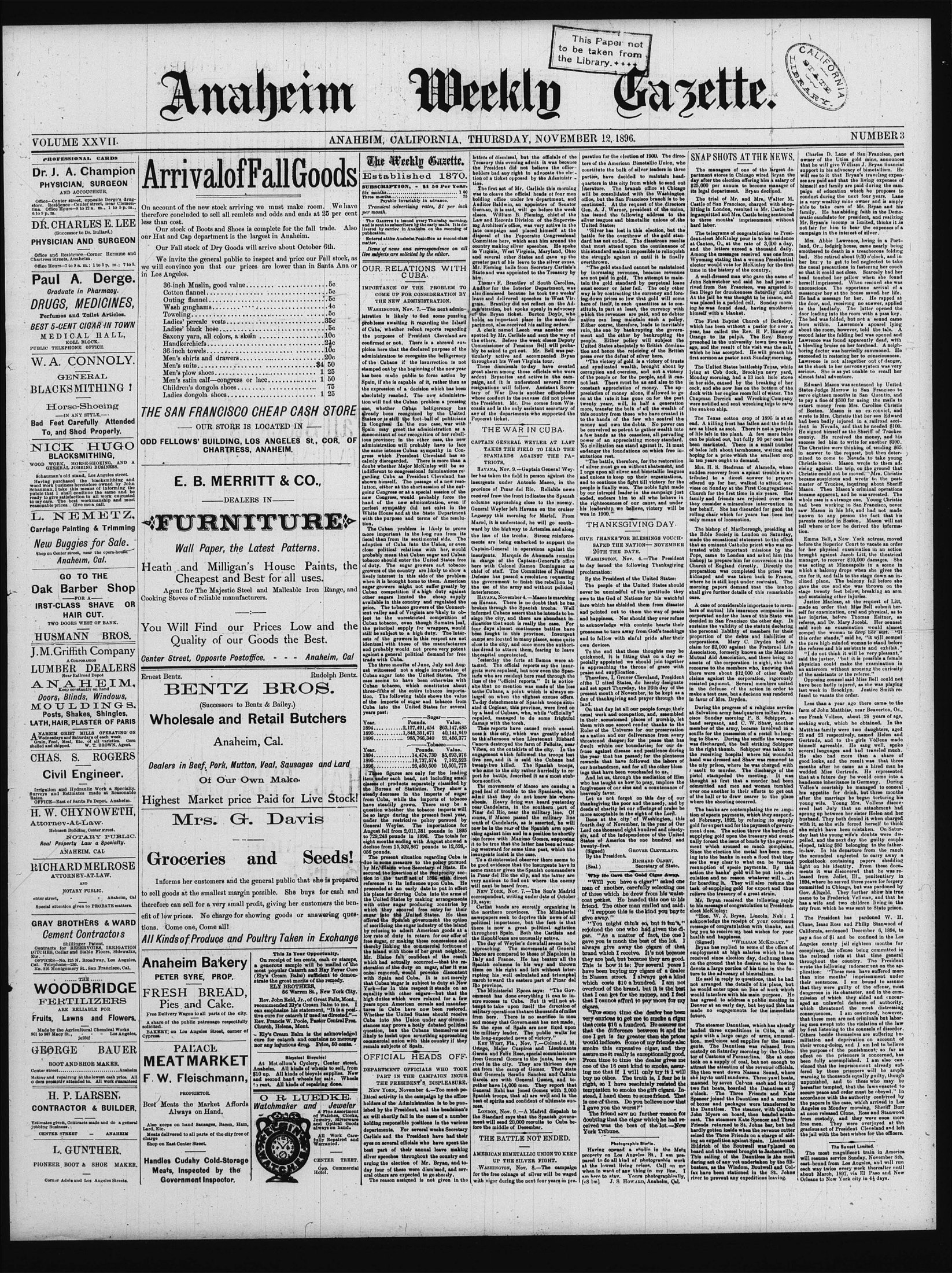
Searchable text
Anaheim
VOLUME XXVII.
PROFESSIONAL CARDS
Dr. J. A. Champion
PHYSICIAN, SURGEON
AND ACCOUCHEUR.
Office—Center street, opposite Derge's drugstore. Residence—Center street, near Clemen-tina. Office Hours—8 to 12 a.m., 1 to 5 p.m., 6 to 9 p.m.
DR. CHARLES E. LEE
(Successor to Dr. Bullard.)
PHYSICIAN AND SURGEON
Office and Residence—Corner Hermine and Chartress Streets, Anaheim.
Office Hours—7 to 9 a.m.; 1 to 3 p.m.; 7 to 8.
Paul A. Derge.
Graduate in Pharmacy.
DRUGS, MEDICINES,
Perfumes and Toilet Articles.
BEST 5-CENT CIGAR IN TOWN
MEDICAL HALL,
KOLL BLOCK.
PUBLIC TELEPHONE OFFICE.
W. A. CONNOLY.
GENERAL BLACKSMITHING!
Horse-Shoeing
—IN ANY STYLE.—
Bad Feet Carefully Attended To, and Shod Properly.
NICK HUGO
BLACKSMITHING,
WOOD WORK, HORSE-SHOEING, AND A GENERAL JOBBING BUSINESS.
Arrival of Fall Goods
On account of the new stock arriving we must make room. We have therefore concluded to sell all remlets and odds and ends at 25 per cent less than cost.
Our stock of Boots and Shoes is complete for the fall trade. Also our Hat and Cap department is the largest in Anaheim.
Our Fall stock of Dry Goods will arrive about October 6th.
We invite the general public to inspect and price our Fall stock, as we will convince you that our prices are lower than in Santa Ana or in Los Angeles.
36-inch Muslin, good value...5c
Cotton flannel...5c
Outing flannel...5c
Wash ginghams...4c
Toweling...5c
Ladies' percale vests...35c
Ladies' black hose...5c
Saxony yarn, all colors, a skein...10c
Handkerchiefs...21c
36-inch towels...10c
Men's shirts and drawers...20c
Men's suits...$4 50
Men's plow shoes...1 25
Men's satin calf—congress or lace...1 50
Children's dongola shoes...75
Ladies dongola shoes...1 25
THE SAN FRANCISCO CHEAP CASH STORE
OUR STORE IS LOCATED IN
ODD FELLOWS' BUILDING, LOS ANGELES St., COR. OF CHARTRESS, ANAHEIM.
GENERAL BLACKSMITHING!
Horse-Shoeing
IN ANY STYLE.
Bad Feet Carefully Attended To, and Shod Properly.
NICK HUGO BLACKSMITHING,
WOOD WORK, HORSE-SHOEING, AND A GENERAL JOBBING BUSINESS.
Schauman's old stand, Los Angeles street.
Having purchased the blacksmithing and wood work business heretofore owned by John Schauman, I take this means of informing the public that I shall continue the same and be ready to give satisfaction in all work entrusted to my care. The best workmanship and most reasonable prices. Give me a call.
L. NEMETZ,
Carriage Painting & Trimming
New Buggies for Sale.
Shop on Center street, near the opera-house Anaheim, Cal.
GO TO THE
Dak Barber Shop
FOR A
IRST-CLASS SHAVE OR HAIR CUT.
TWO DOORS WEST OF BANK.
HUSMANN BROS.
J.M.Griffith Company
A CORPORATION
LUMBER DEALERS
Near Railroad Depot
ANAHEIM.
Keep constantly on hand
Doors, Blinds, Windows,
MOULDINGS.
Posts, Shakes, Shingles,
LATH, HAIR, PLASTER OF PARIS
ANAHEIM GRIST MILLS OPERATING ON Wednesdays and Saturdays of each week.
Grain, Feed, Meal, Etc. of all varieties. Corn shelled and shipped.
W.T.BROWN, Agent.
CHAS. S. ROGERS
Civil Engineer.
Irrigation and Hydraulic Work a Specialty.
Surveys and Estimates made at Reasonable Rates.
OFFICE—East of Santa Fe Depot, Anaheim.
H.W. CHYNOWETH,
Attorney-At-Law.
Helmsen Building, Center street.
NOTARY PUBLIC.
Real Property Law a Specialty.
ANAHEIM, CA.
RICHARD MELROSE
ATTORNEY-AT-LAW.
AND
NOTARY PUBLIC.
enter street,
anaheim, cal
THE SAN FRANCISCO CHEAP CASH STORE
OUR STORE IS LOCATED IN
ODD FELLOWS' BUILDING, LOS ANGELES St., COR. OF CHARTRESS, ANAHEIM.
E. B. MERRITT & CO.,
DEALERS IN
FURNITURE
Wall Paper, the Latest Patterns.
Heath and Milligan's House Paints, the Cheapest and Best for all uses.
Agent for The Majestic Steel and Malleable Iron Range, and Cooking Stoves of reliable manufacturers.
You Will Find our Prices Low and the Quality of our Goods the Best.
Center Street, Opposite Postoffice, Anaheim, CA
Ernest Bentz.
Rudolph Bentz
BENTZ BROS.
(Successors to Bentz & Bailey.)
Wholesale and Retail Butchers
Anaheim, Cal.
Dealers in Beef, Pork, Mutton, Veal, Sausages and Lard
Of Our Own Make.
Highest Market price Paid for Live Stock
Mrs. G. Davis
Groceries and Seeds!
Informs her customers and the general public that she is prepared to sell goods at the smallest margin possible. She buys for cash and
H. W. CHYNOWETH,
Attorney-At-Law.
Helmsen Building, Center street.
NOTARY PUBLIC.
Real Property Law a Specialty.
ANAHEIM, CAL.
RICHARD MELROSE
ATTORNEY-AT-LAW.
AND
NOTARY PUBLIC.
enter street, Anaheim, Cal
Special attention given to PROBATE matters.
GRAY BROTHERS & WARD
Cement Contractors
Shillinger Patent.
Contracts for RESERVOIRS, IRRIGATION
DITCHES, Cellar and Stable Floors, Sidewalks,
Etc.
OFFICES—No. 125 N. Broadway, Los Angeles,
Cal. Telephone—236.
No. 316 Montgomery St., San Francisco, Cal.
THE .....
WOODBRIDGE
FERTILIZERS
ARE RELIABLE FOR
Fruits, Lawns and Flowers.
Made by the Agricultural Chemical Works
901 to 907 Macy St., Los Angeles,
je25tf
GEORGE BAUER
BOOT AND SHOE MAKER.
Center street.....Anaheim
Making and repairing at the lowest cash price. All
orders promptly attended to. All work guaranteed
H. P. LARSEN,
CONTRACTOR & BUILDER.
Estimates given, Contracts made and do a general
jobbing Business.
CENTER STREET — ANAHEIM
L. GUNTHER.
PIONEER BOOT & SHOE MAKER.
Corner Adela and Los Angeles Streets.
Highest Market price Paid for Live Stock
Mrs. G. Davis
Groceries and Seeds!
Informs her customers and the general public that she is prepared
to sell goods at the smallest margin possible. She buys for cash and
therefore can sell for a very small profit, giving her customers the benefit of low prices. No charge for showing goods or answering questions. Come one, Come all!
All Kinds of Produce and Poultry Taken in Exchange
Anaheim Bakery
PETER SYRE, PROP.
FRESH BREAD,
Pies and Cake.
Free Delivery Wagon to all parts of the city.
A share of the public patronage respectfully
solicited.
BAKERY; on Los Angeles Street, corner of Cypress.
PALACE
MEAT MARKET
F. W. Fleischmann,
PROPRIETOR.
Best Meats the Market Affords
Always on Hand.
Also keeps on hand Sausages, Bacon, Ham,
Lard, Etc.
Meats delivered to all parts of the city free of
charge
Shop on East Center Street.
Handles Cudahy Cold-Storage
Meats, Inspected by the Government Inspector.
This Is Your Opportunity.
On receipt of ten cents, cash or stampa
a generous sample will be mailed of the
most popular Catarrh and Hay Fever Curse
(Ely's Cream Balm) sufficient to demonstrate the great merits of the remedy.
ELY BROTHERS,
56 Warren St., New York City
Rev. John Reid, Jr., of Great Falls, Mont.
recommended Ely's Cream Balm to me. He
can emphasize his statement, "It is a positive cure for catarrh if used as directed."—Rev. Francis W. Poole, Pastor Central Preschurch, Helena, Mont.
Ely's Cream Balm is the acknowledged
cure for catarrh and contains no mercury,
nor any injurious drug. Price, 50 cents.
Bicycles! Bicycles!
At Met ollum's Cyclery, Center street
Anaheim. All kinds of wheels to sell, from
$10 up. All kinds of bicycle supplies. New
and second hand wheels for sale. Wheelto rent. All kinds of repairing done.
O R LUEDKE.
Watchmaker and Jeweler
A Fine Assortment
of Watches, Clock,
Jewelry, Silverware
and Optical Goods
always on hand.
All Work Carried
fully Repaired and
Warranted.
CENTER TREET
Opp. Commercial
ANAHEIM, CALIFORNIA, THURSDAY, NOVEMBER 12, 1896.
All Goods
Just make room. We have
iss and ends at 25 per cent
for the fall trade. Also
Anaheim.
About October 6th.
and price our Fall stock, as
lower than in Santa Ana or
5c
5c
5c
4c
5c
35c
5c
10c
21c
10c
20c
$4 50
1 25
1 50
75
1 25
P CASH STORE
ED IN —
GELES St., COR. OF
EIM.
The Weekly Gazette.
Established 1870.
SUBSCRIPTION, - $1 50 Per Year.
Six months... 1 00
Three months... 75
Payable invariably in advance.
Transient advertising rates, $1 per inch per month.
The Gazette is issued every Thursday morning,
and is sent to subscribers by the early mails. It is delivered by carrier in Anaheim on the morning of publication.
Entered at the Anaheim Postoffice as second-class matter.
Items of news and correspondence on all live subjects are solicited by the editor.
OUR RELATIONS WITH CUBA.
IMPORTANCE OF THE PROBLEM TO COME UP FOR CONSIDERATION BY THE NEW ADMINISTRATION.
WASHINGTON, Nov. 7.—The next administration is likely to find some puzzling problems awaiting it regarding the Island of Cuba, whether recent reports regarding the purposes of President Cleveland are confirmed or not. There is a shrewd suspicion here that the declared purpose of the administration to recognize the belligerency of the Cubans if the insurrection is not stamped out by the beginning of the new year has been made public to force action by Spain, if she is capable of it, rather than as the expression of a decision which has been absolutely reached. The new administration will find the Cuban problem a pressing one, whether Cuban belligerency has already been recognized by the United States or is still the foot-ball of politicians in Congress. In the one case, war with Spain may greet the administration as a concomitant of our recognition of her rebellious province; in the other case, the new administration will probably have to face the same intense Cuban sympathy in Congress which President Cleveland has so calmly disregarded. There is more than a doubt whether Major McKinley will be so indifferent to congressional fulminations reparation for the election of 1900. Theitors of the American Bimetallic Union, countitute the bulk of silver leaders in parties, have decided to maintain quarters in this city from which to send literature. The branch office at Chennai will be consolidated with the Washington office, but the San Francisco branch is continued. At the request of the director Gen. A. J. Warner, president of the union has issued the following address to silver leagues and bimetallic unions of United States:
"The gold standard cannot be maintained by increasing revenues, because revenue are not paid in gold. The attempt to maintain the gold standard by perpetual must sooner or later fail. The only way is by contracting the currency and down prices so low that gold will here of itself, in such quantities as to attitude, in part at least, the currency which the revenues are paid, and no nation can long maintain such a power. Either course, therefore, leads to inevitable ruin, the one by bankrupting the government and the other by bankrupting people. Either policy will subject United States absolutely to British domination and hence the rejoicing of the British press over the defeat of silver here."
"The victory of gold is a victory of the and syndicated wealth, brought about corruption and coercion, and not a victim of the people or for the people, and it not last. There must be an end also to constant appreciation of money. The preciation of money alone, if allowed to at the rate it has gone on for the twenty yearr, will, in half a genera more, transfer the bulk of all the wealth this country from those who have created to the hands of few who control money and own the debts. No power be convolved so potent to gather wealth as a few hands as the coessless, all pervasive power of an appreciating money stand. No civilization can stand against it. It endanger the foundations on which free situations rest."
"The battle, therefore, for the restoration of silver must go on without abatement." I urge upon all silver and bimetallic leaves.
has been made public to force action by Spain, if she is capable of it, rather than as the expression of a decision which has been absolutely reached. The new administration will find the Cuban problem a pressing one, whether Cuban belligerency has already been recognized by the United States or is still the foot-ball of politicians in Congress. In the one case, war with Spain may greet the administration as a concomitant of our recognition of her rebellious province; in the other case, the new administration will probably have to face the same intense Cuban sympathy in Congress which President Cleveland has so calmly disregarded. There is more than a doubt whether Major McKinley will be so indifferent to congressional fulminations regarding Cuba as President Cleveland has shown himself. The passage of a new resolution, either at the short session of the outgoing Congress or at a special session of the new Congress, would probably force the hand of the new administration, even if perfect sympathy did not exist in the White House and at the State Department with the purpose and terms of the resolution.
The Cuban problem is likely to prove more important in the long run from its fiscal than from its sentimental side. The adoption of Cuba into the Union, or even close political relations with her, would probably mean that Cuban sugar and Cuban tobacco should enter the United States free of duty. The sugar growers and tobacco growers of the country are likely to show a lively interest in this side of the problem when it is brought home to them. American sugar growers might not suffer greatly by Cuban competition if a high duty against other sugars limited the cheap supply available in this country and regulated the price. The tobacco growers of the Connecticut valley and of Virginia are likely to object to the unrestricted competition of Cuban tobacco, even though Sumatra leaf, the principal supply for wrappers, would still be subject to a high duty. The interests of the growers in this respect are not identical with those of the manufacturers and probably would not prove very potent against a general political demand for free trade with Cuba.
The three months of June, July and August witnessed not a single importation of Cuban sugar into the United States. The case seems to have been otherwise with Cuban tobacco, which constitutes about three-fifths of the entire tobacco importation. The following table shows the value of the imports of sugar and tobacco from Cuba into the United States for several years past:
| Year | Pounds | Value |
| :--- | :--- | :--- |
| 1894 | 2,127,491,454 | $63,147,485 |
| 1895 | 1,848,351,471 | 40,141,919 |
| 1896 | 985,766,340 | 21,456,377 |
| Year | Pounds | Value |
| :--- | :--- | :--- |
| 1894 | 14,474,730 | $5,693,976 |
| 1895 | 19,737,574 | 7,162,523 |
| 1896 | 26,460,500 | 10,501,775 |
These figures are only for the leading item under each head, not including small classes of products separately classified by the Bureau of Statistics. They show a steady decrease in the imports of sugar from Cuba, while the imports of tobacco have steadily grown. There may be a question whether the tobacco imports will be so large during the present fiscal year, under the restrictive policy pursued by General Weyler. The importations for August fell from 2,011,381 pounds in 1895 to 729,248 pounds in 1896. The totals for eight months ending with August showed a decline from 15,302,867 pounds to 12,526,-056 pounds.
The present situation regarding Cuba is due in some measure to the policy purposed by Mr. Blaine when Secretary of State. He secured the insertion of the reciprocity section in the tariff set of 1894 with direct reference to its influence upon Cuba. He proceeded at an early date to put in effect his plans for driving Cuba into the arms of the United States by making arrangements with Spain.
Bryanites and active in the campaign, and it is understood several more resignations will follow. Assistant Secretary of War Doe is another officeholder whose conduct in the canvass did not please the President. Mr. Doe comes from Wisconsin and is the only assistant secretary of any of the departments who supported the Popocaticket.
THE WAR IN CUBA.
CAPTAIN GENERAL WEYLER AT LAST
TAKES THE FIELD TO LEAD THE SPANIARDS AGAINST THE PATRIOTS.
HAVANA, Nov. 9.—Gaptain General Weyler has taken the field in person against the insurgents under Antonio Maceo, in the province of Pinar del Rio. Reliable news received from the front indicates the Spanish columns approaching close to the enemy. General Weyler left Havana on the cruiser Legasepy this morning for Mariel. From Mariel, it is understood, he will go southward by the highway to Artemisa and along the line of the trocha. Strong reinforcements are being embarked to support the Captain-General in operations against the insurgents. Marquis de Abumiza remains in charge of the Captain-General's office here with Colonel Ramon Dominguez as chief of staff. The Committee of National Defense has passed a resolution requesting the government to finish the rebellion by use of the army and without political interference.
HAVANA, November 4.—Maceo is marching on Havana. There is no doubt that he has broken through the Spanish troopa. Well informed Cubans assert that he intends to be siege the city, and there are abundant indications that such is really the case. For four days almost continuous battles have been fought in this province. Insurgent camps are located in many places, some quite close to the city, and once more the authorities dread to attack them, fearing to leave the capital unprotected.
Yesterday the forts at Bamoa were attacked. The official reports say the insurgents were repulsed, but now even the Spaniards who are resident here read through the lines of the "official reports." It is noticeable that no mention was made of the loss to the Cubans, a point which is always enraged on when the slighest excuse offers. To-day detachments of Spanish troops situated it Cognarac, this province, were fired on by a land of Cubans, who while "officially" repulsed, managed to do some frightful damage with the torche.
These reports have caused much uneasiness in this city, which was greatly added to this afternoon when Lieutenant Richard Canora destroyed the farm of Fellote near Viben on the outskirts of the city. In the engagement which followed the troops lost five men, and it is said that the Cubans had twenty-two killed. The Spanish troops, who aim at the city rather hurriedly to report he battle, described it as a most stubborn conflict.
The movements of Maceo are causing a good leal of trouble to the Spaniards, who admit that they do not know his whereabouts. Heavy firing was heard yesterday near Candelaria, in the southern part of Pinar del Rio, near the military line. Of course, if Maceo passed the military line south of Candelaria, as is asserted, he will now be in the rear of the Spanish arm operating against him and in a position to shortly join forces with Maximo Gomez, supposing it to be true that the latter has been advancing westward for some time past, which the insurgents insist is the case.
To a disinterested observer there seems to be good evidence that the insurgents have in some manner given the Spanish commanders in Pinar del Rio the slip, and the latter are very anxious to find out where the enemy will next be heard from.
NEW YORK, Nov. 7.—The Sun's Madrid correspondent, written under date of October
THANKSGIVING DAY
GIVE THANKS FOR BLESSINGS YOU SAFED THE NATION—NOVEMBER 26TH THE DATE.
WASHINGTON, Nov. 4.—The President today issued the following Thanksgiving proclamation:
By the President of the United States
The people of the United States shall never be unmindful of the gratitude owe to God of Nations for his water care which has shielded them from disease and pointed out to them how they work and happiness. Nor should they ever return to acknowledge with contrite hearts proneness to turn away from God's teachings and to follow with sinful pride after own devices.
To end that these thoughts may quicken it is fitting that on a day specially appointed we should join together in approaching the throne of grace praise and supplication.
Therefore I, Grover Cleveland, President of U.Nited States, do hereby designate and set apart Thursday, the 26th day of our month of November, to be kept day of thanksgiving and prayer throughout land.
On that day let all our people forego usual work and occupation, and assume their customomed places of worship them with one accord render thanks to Ruler of the Universe for our preservation as a nation and our deliverance from a threatened danger; for the peace that dwelt within our boundaries; for our fence against disease and pestilence die this year that has passed; for the plenum rewards that have followed the labour our husbandmen, and for all other bings that have been vouchsafed to us.
And let us through mediation of who has taught us how to pray, implore forgiveness our sins and a countenance heavenly favor.
Let us not forget on this day of thanksgiving for poor and needy; as deeds of charity let our offerings or praises more acceptable in sight of Lord one thousand eight hundred and six; and of independence of the U.S. States of America one hundred twenty-first.
(Gigned) GROVER CLEVELAND
By the President.
RICHARD OLNEY
Secretary of State
Why We Give The Good Citizen
"Will you have a cigar?" makes man of another carefully selecting three which he drew from his wrist basket.
public that she is prepared for live stock!
Seeds!
Davis
Seeds!
public that she is prepared
She buys for cash and
ing her customers the bengoods or answering questions
Taken in Exchange
This Is Your Opportunity.
apt of ten cents, cash or stamps,
as sample will be mailed of the
Near Catarrh and Hay Fever Cure
(am Balm) sufficient to demongreat merits of the remedy.
M BROTHERS,
56 Warren St., New York City.
An Reid, Jr., of Great Falls, Mont.
Added Ely's Cream Balm to me.
I size his statement, "It is a positor catarrh if used as directed."—
Alisa W. Poole, Past Central Pres.
Selena, Mont.
Team Balm is the acknowledged
catarrh and contains no mercury
furious drug. Price, 50 cents.
Bicycles! Bicycles!
Colum's Cyclery, Center street.
All kinds of wheels to sell, from
all kinds of bicycle supplies. New
hand wheels for sale. Wheels
all kinds of repairing done.
R. LUEDKE.
maker and Jeweler
A Fine Assortment of Watches, Clocks,
Jewelry, Silverware and Optical Goods
always on hand.
CENTER TREET.
Opp. Commercial Hotel.
OFFICIAL HEADS OFF.
DEPARTMENT OFFICIALS WHO TOOK
PART IN THE CAMPAIGN INCUR
THE PRESIDENT'S DISPLEASURE.
New York, November 4.—Too much political activity in the campaign by the officeholders of the Administration is to be punished by the President, and the headsman's ax will shortly fall in the cases of a number holding responsible positions in the various departments. For several weeks Secretary Carlisle and the President have had their eyes on several officials who have spent the best part of their annual leave making silver speeches throughout the country and urging the election of Mr. Bryan, and today four of these were dismissed, and several others are expected to go shortly.
The reason assigned is not given in the abouts. Heavy firing was heard yesterday near Candelaria, in the southern part of Pinar del Rio, near the military line. Of course, if Macco passed the military line south of Candelaria, as is asserted, he will now be in the rear of the Spanish arm oper-ating against him and in a position to shortly join forces with Maximo Gomez, supposing it to be true that the latter has been advancing westward for some time past, which the insurgents insist is the case.
To a disinterested observer there seems to be good evidence that the insurgents have in some manner given the Spanish commanders in Pinar del Rio the slip, and the latter are very anxious to find out where the enemy will next be heard from.
NEW YORK, Nov. 7.—The Sun's Madrid correspondent, writing under date of October 19, says:
Carlist hands are secretly organizing in the northern provinces. The Ministerial newspapers seek to deprive this news of all political importance, but the fact is that there is now a great political agitation throughout Spain. Both the Carlists and the Republics are unusually active.
The day of Weyler's downfall seems to be approaching. The movements of General Macco are compared to those of Napoleon in Italy and France. He has beaten all the Spanish columns in his way and thrown them on his right and left without interrupting his well calculated and triumphal march toward the eastern part of Pinar del Ro province.
The Ministerial Epoca says: "The Government has done everything it can to insure success in Cuba. But it will not attempt to take upon itself the direction of military operations that thousands of miles from here. There is no sacrifice in men and money that Government has not made. So the eyes of Spain are now fixed upon the military leader. The public waits for the long-expected news of victory."
KEY WEST, Fl., Nov. 7.—Colonel J. M. Ortego, Major Cuspiros and Lieutenants Garcia and Felix Rose, special commissioners from General Gomes to the junta, have arrived in the city. They are thirteen days out from the camp of Gomes. They state that Generals Sorafin Sanchez and Calixto Garcia are with General Gomes, and together have 14,000 men. They report that General Rabi has joined Gomes with 3,000 Spanish troops, that all are well and in the best of spirits and confident of ultimate success.
LONDON, Nov. 9.—A Madrid dispatch to the Standard says that the Spanish government will send 20,000 recruits to Cuba before the middle of December.
THE BATTLE NOT ENDED.
AMERICAN BIMETALLIC UNION TO KEEP UP THE SILVER FIGHT.
WASHINGTON, Nov. 8.—The campaign for the free coinage of silver will be waged with vigor during the next four years in pre-
Let us not forget on this day our thanksgiving the poor and the needy, and deeds of charity let our offering of praises more acceptable in the sight of the Lord.
Done at the city of Washington, fourth day of November, in the year of Lord one thousand eight hundred and ninety six, and of the independence of the U.S. States of America the one hundred twenty-first.
(Signed)
GROVER CLEVELAND
By the President.
RICHARD OLNEY
Secretary of State
Why He Gave the Good Cigar Away?
"Will you have a cigar?" asked man of another, carefully selecting of three which he drew from his coat pocket. He handed this one to friend. The other man smiled and said: "I suppose this is the kind you give away."
"You might think so, but it funrejoined the one who had given them a cigar." As a matter of fact, he gave you is much the best of the old brand which I receive. It's not bad they are bad, but because they are good This is how it is: For several years have been buying my cigars of a dainty Nassau street. I always get a which costs $10 a hundred. I am overford of the brand, but it is the that I can get for the money, and I that I cannot afford to pay more for cigars.
"For some time the dealer has very anxious to get me to smoke a that costs $10 a hundred. He assure me it really is exceptionally From time to time the dealer gives one of the 16 cent kind to smoke, and ing me that if I will only try it I buy no other. The truth is, I fear right, so I have resolutely resisted temptation to smoke the gift cigars stead. I hand them to some friend. Is one of them. Do you believe now I gave you the worst?"
The friend saw no further reason doubting that the cigar which he has received was the best of the lot.-York Tribune.
Photographic Studio.
Having opened a studio in this property on Los Angeles St., I am pared to do all kind of photographic at the lowest living prices. Call on when in want of any thing in my lines am here to stay. Youra photographi[c [c8 1m] J. S. HOWARD Anabelm,
SNAP SHOTS AT THE NEWS.
The managers of one of the largest department stores in Chicago wired Bryan the day after the election offering him a salary of $25,000 per annum to become manager of its legal department. Bryan declined.
The trial of Mr. and Mrs. Walter M. Castle of San Francisco, charged with shoplifting in London, resulted in Mr. Castle being acquitted and Mrs. Castle being sentenced to three months' imprisonment without hard labor.
The telegrams of congratulation to President McKinley pour in to his residence at Canton, O., at the rate of 3,000 a day, and the letters exceed a thousand daily. Among the messages received was one from Wyoming stating that a woman Presidential elect would vote for McKinley for the first time in the history of the country.
A well-dressed man who gave the name of John Schwetober and said he had just arrived from San Francisco, was arrested in San Diego for drunkenness Saturday night. At the jail he was thought to be insane, and was placed in a padded cell. Sunday morning he was found dead, having smothered himself with a blanket.
The First Baptist Church of Berkeley, which has been without a pastor for over a year, has called the Rev. H. F. Binney of Orange to its pulpit. The Rev. Binney preached in the university town two weeks ago, and the result of his visit was the call, which he has accepted. He will preach his first sermon as pastor next Sunday morning.
The United States battleship Texas, while at Cob dock, Brooklyn navy yard, Monday morning, had a 13 inch hole stove in her side, caused by the breaking of her cock, and she now lies on the bottom of the dock with her engine room full of water. The Chapman Derrick and Wrecking Company were notified and sent wrecking tugs to raise the sunken ship.
The Texas cotton crop of 1896 is at an end. A killing frost has fallen and the fields are as black as soot. There is not a particle of life left in the plant. A few more bales can be picked out, but fully 90 per cent has been marketed. There is a small number of bales left about farmhouses, waiting and hoping for a price which the smallest crop in ten years ought to demand.
Mrs. H. S. Stedman of Alameda, whose sudden recovery from a spinal trouble is announced by the Utica gold mine, announces that he will give William J. Bryan financial support in his advocacy of bimetallism. He will see to it that Bryan's traveling expenses are paid and that the living expenses of himself and family are paid during the campaign of education which he proposes to conduct during the next four years. Lane is a very wealthy mine owner and is amply able to take care of Mr. Bryan and his family. He has abiding faith in the Democratic candidate for president, and realizing Mr. Bryan's income is limited, thinks it is not fair for him to bear the expenses of a campaign in the interest of silver.
Mrs. Abbie Lawrence, living in a Portland, Or., lodging house, came nearly being smothered to death in a treacherous folding bed. She retired about 9:30 o'clock, and in her hurry to get to bed neglected to take the usual precautions in fastening her couch so that it could not close. Scarcely had her head touched her pillow when she found herself imprisoned. When rescued she was unconscious. The opportunity arrival of a messenger boy at the house saved her life. He had a message for her. He rapped at the door, and receiving no answer, applied to the landlord. The latter opened the door leading into the room with a pass key. The bed was folded, but not a sound came from within. Lawrence's apparel lying about the room, however, told the tale. A second later the folding bed was opened and Lawrence was found apparently dead, with a bleeding bruise on her forehead. A neighboring doctor was hurriedly summoned. He succeeded in restoring her to consciousness. Lawrence is not altogether out of danger, as the shock to her nervous system was very serious. She is as yet unable to recall her almost fatal adventure.
Edward Mason was sentenced by United States Judge Morrow in San Francisco to serve eighteen months in San Quentin, and to pay a fine of $500 for using the mails to extort money from Mrs. Caroline Christie of Boston. Mason is an ex-convict, and wrote to Mrs. Christie that her son Edward had been badly injured in a railroad accident in Nevada, and that he needed $100. He signed himself as the Sheriff of Trackee county. He received the money, and his success led him to write for another $100. The Christians were thinking of sending $65 in answer to the request, but then determined to come to Nevada to take young Christie home. Mason wrote to them advising against the trip, on the ground that Christie could not be moved. Mrs. Christie
THANKSGIVING DAY.
THANKS FOR BLESSINGS VOUCHERED THE NATION—NOVEMBER 26TH THE DATE.
WASHINGTON, Nov. 4.—The President issued the following Thanksgiving notice:
The President of the United States: people of the United States should be unmindful of the gratitude they the God of Nations for his watchful which has shielded them from disaster sent out to them the way of peace happiness. Nor should they ever refuse knowledge with contrite hearts their need to turn away from God's teachings follow with sinful pride after their devices.
The end that these thoughts may be used, it is fitting that on a day esy appointed we should join together broaching the throne of grace with and supplication.
Before, I, Grover Cleveland, President U. nited States, do hereby designate apart Thursday, the 26th day of the month of November, to be kept as a thanksgiving and prayer through the day let all our people forego their work and occupation, and assembled in accustomed places of worship, let with one accord render thanks to the of the Universe for our preservation and our deliverance from every danger; for the peace that has within our boundaries; for our designtain disease and pestilence during war that has passed; for the plenteous that have followed the labors of embdenmen, and for all the other blesses that have been vouchafea to us.
Let us through the mediation of Him as taught us how to pray, implore the necessity of our sins and a countenance ofoly favor.
We not forget on this day of our giving the poor and the needy, and by charity let our offerings of praise be acceptable in the sight of the Lord.
At the city of Washington, this day of November, in the year of Our thousand eight hundred and ninety-fourth of America the one hundred and first.
GROVER CLEVELAND.
The President.
RICHARD OLNRY,
Secretary of State.
He Gave the Good Cigns Away,
will you have a cigar?" asked one of another, carefully selecting one which he drew from his waist rest.
battle, therefore, for the restoration or must go on without abatement, and upon all silver and bimetallic leagues continue the fight till victory for the finally won. The noble fight madeintrepid leader in the campaign just endears him to all who believe in righteousness of our cause, and under leadership, we believe, victory will be 1900."
Monday morning, had a 13 inch hole stove in her side, caused by the breaking of her cock, and she now lies on the bottom of the dock with her engine room full of water. The Chapman Derrick and Wrecking Company were notified and sent wrecking tugs to raise the suken ship.
The Texas cotton crop of 1895 is at an end. A killing frost has fallen and the fields are as black as soot. There is not a particle of life left in the plant. A few more bales can be picked out, but fully 90 per cent has been marketed. There is a small number of bales left about farmhouses, waiting and hoping for a price which the smallest crop in ten years ought to demand.
Mrs. H. S. Stedman of Alameda, whose sudden recovery from a spinal trouble is attributed to a direct answer to prayers offered up for her, walked to attend services on Sunday at the First Congregational Church for the first time in six years. Her family and friends are rejoiced over what they consider a miraculous intervention in her behalf. She has discarded for good the rolling chair which for years has been her only means of locomotion.
The bishop of Marlborough, presiding at the Bible Society in London on Saturday, made the sensational statement to the effect that an eminent Catholic priest who was entrusted with important missions by the Pope, came to London and asked him (the bishop) to prepare him for conversion to the Church of England directly. Directly the preparation was completed the priest was kidnapped and was taken back to France, where he is still kept under restraint. The morning papers demand that the bishop shall give further details of this remarkable case.
A case of considerable importance to members of mutual life insurance companies incorporated under the laws of this State was decided in San Francisco the other day. It sustains the validity of the statute declaring the personal liability of members for their proportion of the debts and liabilities of corporations. Mary C. Dryden held a claim for $2,000 against the Fraternal Life Association, formerly known as the Masonic Mutual Aid Association, and there being no assets of the corporation in sight, she had recourse to the members who, knowing that there were about $12,000 of other death claims against the corporation, vigorously resisted payment. Several members united in the defense of the action in order to make a test case, but a decision was rendered in favor of Mrs. Dryden.
During the progress of a religious service at Salvation army headquarters in San Francisco Sunday morning P. S. Schipper, a band sergeant, and C. W. Shaw, another member of the army, became involved in a scuffle for the possession of a pistol belonging to Shaw. During the scuffle the weapon was discharged, the ball striking Schipper in right thumb. Schipper was taken to the receiving hospital where his wounded hand was dressed and Shaw was removed to the city prison, where he was charged with result to murder. The discharge of the pistol stamped the meeting. It was thought at first that a murder had been committed and men and women tumbled over one another in their efforts to get out of the hall or to draw nearer to the place where the shooting occurred.
The banks are contemplating the re-application of specie payments, which they suspended February, 1892, by refusing to supply gold for export and for the payment of government dues. The action threw the burden of supplying gold upon the treasury and eventually forced the issue of bonds by the government which aroused so much complaint. Since the election the metal has been coming into the bank in such a flood that they see the way clear to what can be termed resumption of specie payments. By this action the banks gold will be put into circulation and no reason whatever will take for boarding it. They will also resume the task of applying gold for export and thus relieve the treasury of a great strain.
Edward Mason was sentenced by United States Judge Morrow in San Francisco to serve eighteen months in San Quentin, and to pay a fine of $500 for using the mails to extort money from Mrs. Caroline Christie of Boston. Mason is an ex-convict, and wrote to Mrs. Christie that her son Edward had been badly injured in a railroad accident in Nevada, and that he needed $100. He signed himself as the Sheriff of Truckee county. He received the money, and his success led him to write for another $100. The Christians were thinking of sending $65 in answer to the request, but then determined to come to Nevada to take young Christie home. Mason wrote to them advising against the trip, on the ground that Christie could not be moved. Mrs. Christie became suspicious and wrote to the postmaster of Truckee, inquiring about Sheriff Mason. Then Mason's criminal operations became apparent, and he was arrested. The whole case is a strange one. Young Christie had been working in San Francisco, never saw Mason in his life, and had not made known to any person that his parents resided in Boston. Mason will not tell where or how he derived the information.
Emma Bell, a New York actress, moved before the Superior Court to vacate an order for her physical examination in an action brought against Jacob Litt, the theatre manager, to recover $10,000 damages. She was acting at Minneapolis in a scene in which a balcony drops when she gives the cue for it, and falls to the stage down an inclined plane. The balcony fell before she gave the cue and she was thrown on the stage twenty feet below, breaking an arm and sustaining other injuries.
Justice Maclean, at the request of Litt, made an order that Miss Bell submit herself for examination, oral and physical, as to her injuries, before Thomas Eoitner, as referee, and Dr. Mary Jocobi. Her counsel said such an examination would almost compel the woman to drop her suit." If this order stands," said he "it will compel the pure high-minded woman to stand before the referee and his assistants and exhibit."
"I do not think it will be very pleasant," said the justice," but it is possible a female physician could make the examination in an anteroom without arousing the curiosity of the assistants or the referee."
Opposing counsel said Miss Bell could not have been badly injured, as she was playing last week in Brooklyn. Justice Smith refused to vacate the order.
Less than a year ago there came to the farm of John Matthias, near Beaverton, Or., one Frank Volleus, about 28 years of age, seeking work, which he obtained. In The Matthias family were two daughters, aged 21 and 23 respectively, named Helon and Gertrude, and to the girls Volllen made himself agreeable. He sang well, spoke several languages and had travel much. He also had more than a share of good looks, and the result was that three months after he came as a hired man he wedded Miss Gertrude. He represented that at a future day he would come into a handsome inheritance in Germany. During Volllen's courtship he managed to conceal his appetite for drink, but three months after the marriage he began torturing his young wife. Young Mrs. Volllen discovered last July that an attachment had sprung up between her sister Helen and her husband. They both denied it when charged with it, so she wifed herself to think she might have been mistaken. On Saturday last year wifes doubts were dispelled, and next day she guilty couple eloped, taking $80 belonging to father-in-law. In his departure from the ranch she sounded neglected to carry away a pocketbook containing papera shedding light on his identity. From these documents it was discovered that he was released from Joliet, Ill., penitentiary in 1894, where he served three years for forgery committed in Chicago, but was pardoned by Gov. Altgeld. They further show his true name to be Frederick Vellman, and that he
He gave the Good Cigar Away,
will you have a cigar?" asked one of another, carefully selecting one which he drew from his waistcoat.
The other man smiled and said: "Suppose this is the kind you buy to way."
You might think so, but it isn't," added the one who had given the clue. "As a matter of fact, the one I you is much the best of the lot. I give away the cigars of that which I receive. It's not because there bad, but because they are good. How it is: For several years I been buying my cigars of a dealer Jessau street. I always get a kind costs $10 a hundred. I am not bound of the brand, but it is the best that can get for the money, and I feel cannot afford to pay more for my time the dealer has been anxious to get me to smoke a cigar costs $10 a hundred. He assures me the difference between it and the get is far greater than the prices indicated. Some of my friends also see this expensive cigar, and they me it really is exceptionally good. Time to time the dealer gives me of the 16 cent kind to smoke, assurance that if I will only try it I will no other. The truth is, I fear he is so I have resolutely resisted the intention to smoke the gift cigars. In fact, I hand them to some friend. That of them. Do you believe now that you the worst?"
The friend saw no further reason for being that the cigar which he had reused was the best of the lot.—New Tribune.
Photographie Studio.
Opened a studio in the Meta city on Los Angeles St., I am ready to do all kind of photographic work at lowest living prices. Call on me in want of any thing in my line. I dare to stav. You're photographically, J. S. Howard, Anabelm, Cal.
The banks are contemplating the admission of specie payments, which they suspended February, 1892, by refusing to supply gold for export and for the payment of government dues. The action threw the burden of supplying gold upon the treasury and eventually forced the issue of bonds by the government which aroused so much complaint. Since the election the metal has been coming into the banks in such a flood that they see the way clear to what can be termed resumption of specie payments. By this action the banks' gold will be put into circulation and no reason whatever will exist for boarding it. They will also resume the task of supplying gold for export and thus relieve the treasury of a great strain.
Mr. Bryan received the following reply to his message of congratulation to President-elect McKinley:
"Hon. W. J. Bryan, Lincoln Neb.: I acknowledge the receipt of your courteous message of congratulation with thanks, and beg you to receive my best wishes for your health and happiness.
(Signed) "WILLIAM MCKINLEY."
Bryan has replied to some of the offers of employment at high salaries which he has received since election day, declining them on the ground that he desires to be free to devote a large portion of his time in the future to the advocacy of bimetallism.
He said in reply to questions, that he had not arranged the details of his plans, but he would enter upon no line of work which would interfere with his main purpose. He has agreed to address a public meeting in Denver at an early day, but beyond this has made no engagements for the immediate future.
The steamer Dauntless, which has already landed three expeditions in Cuba, is off again with a large cargo of arms, ammunition, medicines and supplies for the insurgents. The Dauntless was released from custody on Saturday morning by the Collector of Customs of Fernandina. She at once took on a supply of coal, but not enough to attract the attention of the revenue officials. She then went down Nassau Sound, where she lay-to until sundown. Three yawl boats, manned by seven Cubans each and towing two flat boats, boarded the Dauntless at 7 o'clock. The Three Friends and Kate Spencer joined the Dauntless and a number of boxes and packages were transferred to the Dauntless. The steamer, with Captain John Myers on board, then headed southeast. The steamers Kate Spencer and Three Friends returned to St. Johns bar, but had hardly gotten inside when the revenue cutter seized the Three Friends on a charge of aiding an expedition against Spain. Lieutenant Hildrich of the Boutwell was placed on board and the vessel brought to Jacksonville. This sailing of the Dauntless is the most daring act of any yet undertaken by the filibusters, as the Windom, Boutwell and Colfax have been stationed in the St. Johns river to prevent any expeditions leaving.
The marriage he began torring this young wife. Young Mrs. Vollens discovered last July that an attachment had sprung up between her sister Helen and her husband. They both denied it when charged with it, so the wife forced herself to think she might have been mistaken. On Saturday last the young wife's doubts were dispelled, and next day the guilty couple eloped, taking $80 belonging to the father-in-law. In his departure from the ranch the scoundrel neglected to carry away a pocketbook containing papers shedding light on his identity. From these documents it was discovered that he was released from Joliet, Ill., penitentiary in 1894, where he served three years for forgery committed in Chicago, but was pardoned by Gov. Altgeld. They further show his true name to be Frederick Vellman, and that he has a wife and two children living in the city from which he was sent to State prison.
The President has pardoned W. H. Clune, Isaac Ross and Philip Stanwood of California, sentenced December 6, 1894, to pay a fine of $1 and be confined in the Los Angeles county jail eighteen months for conspiracy, the offense being committed in the railroad riots at that time general throughout the country. The President wrote the following indorsement on the application: "These men have suffered more than nine months' imprisonment under their sentences. I am bound to assume that they were guilty of the offense, most dangerous in its character, and in the commission of which they aided and encouraged an unlawful defiance of authority, which threatened the most distressing consequences. I am convinced, however, that these men are not criminals but laboring men swept into the violation of law by first listening to the counsels of disorder. Others beside themselves are suffering humiliation and deprivation on account of their wrong-doing, and I am led to believe the purpose of the punishment; so far as effect on the prisoners is concerned, has been fully accomplished. I am also convinced that the imprisonment already suffered by these prisoners will be ample warning to thousands equally guilty, though unpunished, and to those who may be hereafter tempted, that the laws enacted to secure peace and order must be obeyed." In accordance with the authority conferred by the papers in the case, which arrived in Los Angeles on Monday morning, Sheriff Burr at noon released Clune, Ross and Stanwood from custody, and they were once more free men. They were overjoyed at the gracious act of President Cleveland and left the jail with the best wishes for the officers.
The Sunset Limited.
The most magnificent train in America will resume service Sunday, November 8th, east-bound from Los Angeles, and will run each way twice every week thereafter until about March, 1897, via El Paso and New Orleans to New York city in 4½ days.*