anaheim-gazette 1896-10-08
Scanned page
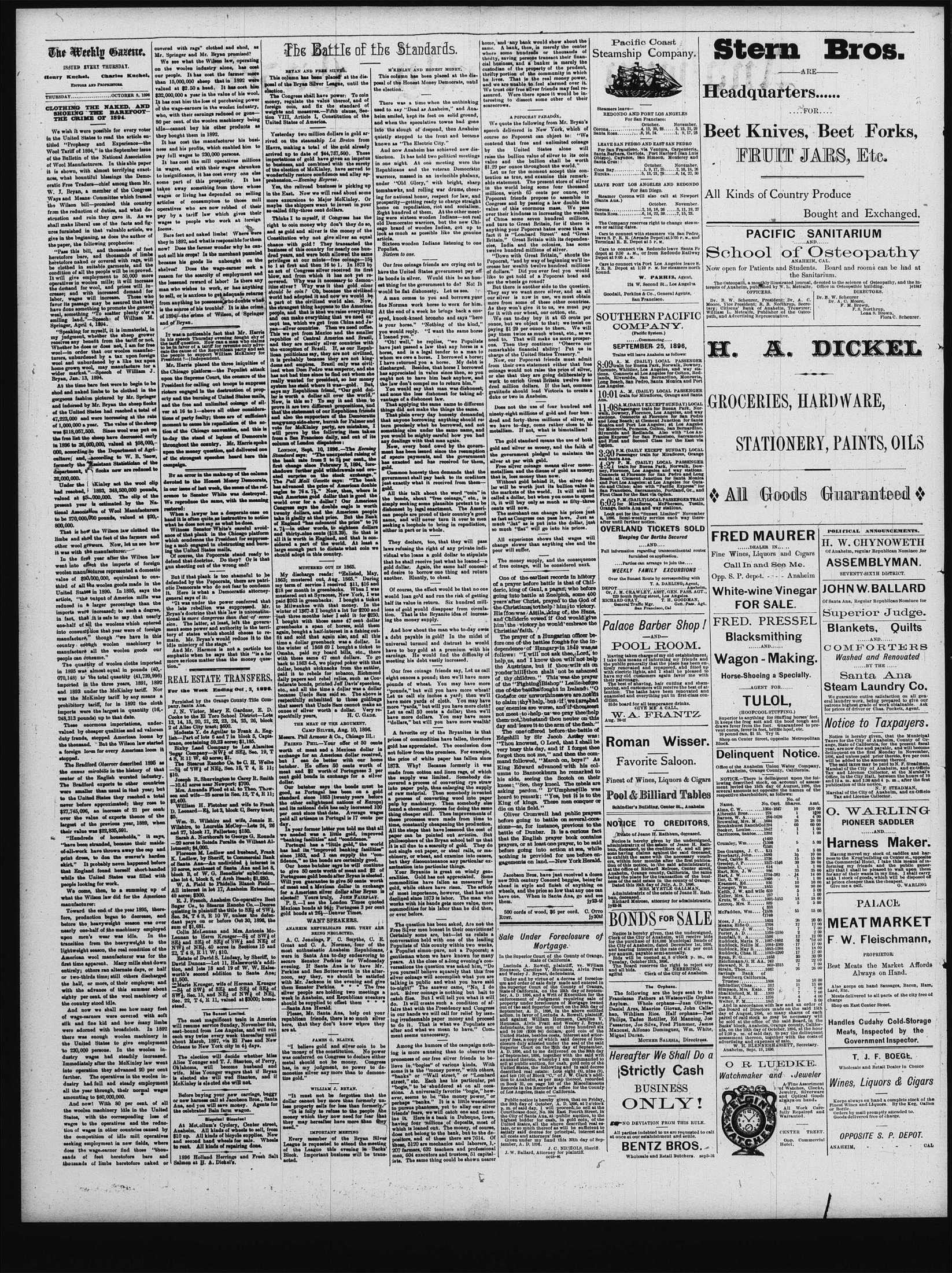
Searchable text
The Weekly Gazette.
ISSUED EVERY THURSDAY.
Henry Kuckel, Charles Kuckel,
EDITORS AND PROPRIETORS.
THURSDAY...OCTOBER 8, 1896
CLOTHING THE NAKED, AND SHOEING THE BAREFOOT—THE CRIME OF 1894.
We wish it were possible for every voter in the United States to read the article entitled "Prophecy and Experience—the Wool Tariff of 1894," in the September issue of the Bulletin of the National Association of Wool Manufacturers. In this able paper it is shown, with almost terrifying exactness, what bountiful blessings the Democratic Free Traders—chief among them Mr. W. J. Bryan, a member of the Congress Ways and Means Committee which framed the Wilson bill—promised this country from the reduction of duties, and what destruction and ruin they gave it. As we shall make liberal use of the facts and figures furnished in that valuable article, we give in the beginning, as does the author of the paper, the following prophecies:
"Pass this bill, and thousands of feet heretofore bare, and thousands of limbs heretofore naked or covered with rage, will be clothed in suitable garments, and the condition of all the people will be improved. It will give employment to 50,000 more operatives in woolen mill; it will increase the demand for wool, and prices will increase; and with increased demand for labor, wages will increase. Those who favor its passage may be assured that they have done something to promote the general weal, something "To scatter plenty o'er a smiling land."—Speech of William M. Springer, April 4, 1894.
"Speaking for myself, it is immaterial, in my judgment, whether the sheep grower receives any benefit from the tariff or not. Whether he does or does not, I am for free wool—in order that our woolen manufacturers, unburdened by a tax upon foreign wool and unburdened by a like tax upon home grown wool, may manufacture for a wider market."—Speech of William J. Bryan, Jan. 13, 1894.
At the time bare feet were to begin to be shod and naked limbs to be clothed in the gorgeous fashion pictured by Mr. Springer and indorsed by Mr. Bryan the sheep flocks of the United States had reached a total of 47,223,000 and were increasing at the rate of 1,000,000 a year. The value of the sheep was $118,057,500. Since wool was put on the free list the sheep have decreased early in 1896 to 36,000,000, valued at $58,000,000 according to the Department of Agriculture; and, according to W. B. Snow, formerly the Assistant Statistician of the department, these flocks now are reduced to covered with rags" clothed and shed, as Mr. Springer and Mr. Bryan promised?
We see what the Wilson law, operating on the woolen industry alone, has cost our people. It has cost the farmer more than 15,000,000 sheep that in 1892 were valued at $2.50 a head. It has cost him $32,000,000 a year in the value of his wool. It has cost him the loss of purchasing power of the wage earners in the woolen industry, who, with their earnings reduced or gone—80 per cent. of the woolen machinery being idle—cannot buy his other products as they bought them in 1892.
It has cost the manufacturer his business and his profits, which enabled him to pay full wages to 230,000 persons.
It has cost the mill operatives millions in wages, and with their wages shrunk to insignificance, it has cost every one else some part of this prosperity. It has taken away something from those whose wages or living has depended on selling articles of consumption to those mill operatives who are now robbed of their pay by a tariff law which gives their wages to people who work at foreign foams.
Bare feet and naked limbs Where were they in 1892, and what is responsible for them now? Does the farmer wonder why he cannot sell his crops? Is the merchant puzzled because his goods lie unbought on the shelves? Does the wage-carner seek a reason for the scarcity of employment and the lessened reward of labor? Is there any man who wishes to work, or has anything to sell, or is anxious to get adequate returns from anything he possesses; who doubts what is the source of his trouble? It is the crime of 1894—the crime of Wilson, of Springer and of Bryan.
It was a noticeable fact that Mr. Harris in his speech Thursday evening fought shy of the tariff question. How can a man who claims the cause of the Republican party and asks the people to support William McKinley for President?—Independent.
Mr. Harris placed three inquiries of the Chicago platform—the Populist attack upon the Supreme Court, the consure of the President for calling out troops to suppress rioters engaged in the destruction of property and the burning of United States mails, and the free and unlimited coinage of silver at 16 to 1—above all other considerations of party fealty; these are of sufficient moment to cause his repudiation of the action of the Chicago convention, and this is-day the stand of legions of Democrats throughout the country. Mr. Harris spoke upon the money question, and delivered one of the strongest speeches heard here this campaign.
The Battle
BRYAN AND FREE SILVER.
This column has been placed at the posal of the Bryan Silver League, until election.
The Congress shall have power: The money, regulate the value thereof, a foreign coin, and fix the standard weights and measures. Fifth clause VIII, Article I, Constitution of United States of America.
Yesterday two million dollars in goods arrived up to date of $44,757,500. Importations of gold have given an influx to business, combined with the addition of the election of McKinley, have sorely restore confidence and all prehension. Evening Express.
Yes, the railroad business is picked in the East. Now we will read about more excursions to Major McKinley; maybe she shippers want to invest in so-called fifty-three cont dollars.
Thinks I to myself, if Congress hight right to coin money why don't they buy as gold and silver is the money Constitution why not give silver an chance with gold? They transaction business of this country for nearly one dred years, and were both allowed their privileges at our mints—free coins to 1 at first and then 16 to 1. In an act of Congress silver received is blow, and from which it has not covered. Why was it necessary to titize silver? Why was it that gold should be coin? Oh, because the world had adopted it and now we would part of the civilized world also. The strangest thing happens to the American politicians say, they are not only it is probably because they are not doms and empires. Brazil only wished when Dom Pedro was emperor; has not had time since to find out what really wanted for president; so he system has stood where it was—gold says my Republican friend. "Our galar is worth a dollar all over the Now, is this so? To say it and prove it are two different propositions that the statement of our Republicans and also the supporters of the Demagogue side-show, hurrah for Palm vote for McKinley party; are misled will prove by the following items from a San Francisco daily; and one column of London dispatches:
London, Sept. 10, 1896—The Standard says: "The unexpected rise in bank rate from 2 to 2½ per cent change since February 2, 1896 shadow further gold withdrawals."
At the time bare feet were to begin to be shod and naked limbs to be clothed in the gorgeous fashion pictured by Mr. Springer and indorsed by Mr. Bryan the sheep flocks of the United States had reached a total of 47,223,000 and were increasing at the rate of 1,000,000 a year. The value of the sheep was $118,057,500. Since wool was put on the free list the sheep have decreased early in 1896 to 36,000,000 valued at $58,000,000 according to the Department of Agriculture; and, according to W. B. Snow, formerly the Assistant Statistician of the department, the flocks now are reduced to 32,000,000.
Under the McKinley act the wool clip had reached, 1893, 348,500,000 pounds, valued at $5,000,000. The clip of the present year is estimated by the National Association of Wool Manufacturers to be 270,000,000 pounds, valued at $20,-800,000.
That is how the Wilson law clothed the limbs and shod the feet of the farmers and other wool growers. Now, let us see how it was with the manufacturer.
In the first year after the Wilton law went into effect the imports of foreign woolen manufactures represented a domestic value of $90,000,000 equivalent to one-third of all the woolen goods made in the United States in 1890. In 1895, says the article, "the output of America mills was reduced in a larger percentage than the imports were increased; to such a degree, in fact, that it is safe to say that nearly one-half of all the woolens which entered into consumption that year were of foreign manufacture," though "we have in this country enough woolen machinery to manufacture all the woolen goods our people can consume."
The quantity of woolen cloths imported in 1895 was almost equal in pounds (40,-070,148) to the total quantity (41,739,996) imported in the three years, 1891, 1892 and 1893 under the McKinley tariff. Nor was the McKinley tariff by any means a prohibitory tariff, for in 1892 the cloth imports were the largest in quantity (16,-248,313 pounds) up to that date.
These enormous importations, undervalued by cheaper qualities and ad valorem duty frauds, stopped American looms by the thousand. But the Wilson law started a foreign loom for every American loom it stopped.
The Bradford Observer described 1895 as the annus mirabilis in the history of that center of the English worsted industry. The Bradford exports to other countries were smaller than usual in that year; but to the United States they reached a total never before approximated; they rose to $27,745,096, an increase of 21 per cent over the value of exports thence of the largest of the previous year, 1889, when their value was $22,835,591.
"Hundreds of households," it says, "have been stranded, because their maids-of-all-work have thrown away the cap and print dress, to don the weaver's harden skirt." It probably never happened before that England found herself short-handed while the United States was filled with people looking for work.
We come then, to a summing up of what the Wilson law did for the American Bryan, Jan. 13, 1894.
At the time bare feet were to begin to be shod and naked limbs to be clothed in the gorgeous fashion pictured by Mr. Springer and indorsed by Mr. Bryan the sheep flocks of the United States had reached a total of 47,223,000 and were increasing at the rate of 1,000,000 a year. The value of the sheep was $118,057,500. Since wool was put on the free list the sheep have decreased early in 1896 to 36,000,000 valued at $58,000,000 according to the Department of Agriculture; and, according to W. B. Snow, formerly the Assistant Statistician of the department, the flocks now are reduced to 32,000,000.
Under the McKinley act the wool clip had reached, 1893, 348,500,000 pounds, valued at $5,,000,000. The clip of the present year is estimated by the National Association of Wool Manufacturers to be 270,000,000 pounds, valued at $20,-800,000.
That is how the Wilson law clothed the limbs and shod the feet of the farmers and other wool growers. Now, let us see how it was with the manufacturer.
In the first year after the Wilton law went into effect the imports of foreign woolen manufactures represented a domestic value of $90,000,000 equivalent to one-third of all the woolen goods made in the United States in 1890. In 1895 says the article, "the output of America mills was reduced in a larger percentage than the imports were increased; to such a degree, in fact, that it is safe to say that nearly one-half of all the woolens which entered into consumption that year were of foreign manufacture," though "we have in this country enough woolen machinery to manufacture all the woolen goods our people can consume."
The quantity of woolen cloths imported in 1895 was almost equal in pounds (4O,-O7O,I48) to the total quantity (41,739,996) imported in the three years, 1891, 1892 and 1893 under the McKinley tariff. Nor was the McKinley tariff by any means a prohibitory tariff, for in 1892 the cloth imports were the largest in quantity (16,-248,313 pounds) up to that date.
These enormous importations, undervalued by cheaper qualities and ad valorem duty frauds, stopped American looms by the thousand. But the Wilson law started a foreign loom for every American loom it stopped.
The Bradford Observer described 1895 as the annus mirabilis in the history of that center of the English worsted industry. The Bradford exports to other countries were smaller than usual in that year; but to the United States they reached a total never before approximated; they rose to $27,745,O96, an increase of 21 per cent over the value of exports thence of the largest of the previous year, 1889 when their value was $22,835,591.
"Hundreds of households," it says,
"have been stranded,because their maids-of-all-work have thrown away the cap and print dress,towon tho weaver's harden skirt." It probably never happened before that England found herself short-handed while the United States was filled with people looking for work.
We come then,to a summing up of what the Wilson law did for the American Bryan,Jan. 13,1894.
At the time bare feet were to begin to be shod and naked limbs to be clothed in the gorgeous fashion pictured by Mr. Springer and indorsed by Mr. Bryan the sheep flocks of the United States had reached a total of 47,223,Ooo and were increasing at the rate of 1,OOOO,Ooo according to W. B. Snow,formerly the Assistant Statistician of the department,the flocks now are reduced to 32,OOOO,Ooo.
Under the McKinley act the wool clip had reached,1893,348,5Ooo,and values at last week,the sense of reference to Senator White was destroyed. We reproduce the same,with meaning restored:
When a lawyer has a desperate case on hand it is often quite as instructive to notice what he does not say as what he does.Witness Senator White's avoidance of that plank in the Chicago platform which condemns The President for suppressing a mob engaged in obstructing and burning The United States mails.
Of course,the Popocator stand ready to defend that doctrine.Do they? Or is that gun shooting out of the wrong end?
But if that plank is too shameful to be defended by The Popocator,the there are patriotic Democrats who do not fear to condemn it.Here is what a Democratic attorney general says of it:
"It was under the power conferred that late rebellion was suppressed.Mr.Bryan's doctrine that this law is unconstitutional is more dangerous than that-of secession.The latter,at least,leftthe government some power and authority inthe territoryof stateswhich should chooseto remain.Mr.Bryan's would reduce itto idle mimicryofthe stage."
And Mr. Harmon is not a particle too emphatic when he says that this "is far more serious matter thanthe money question."
REAL ESTATE TRANSFERS.
For the Week Ending Oct.3,1896.
Furnished bythe Orange County Title Company,Santa Ana.
J.N.Victor,Mary E.Gardner,e.E.D.Cooke tothe El Toro School District—Lots 13,14,15,2O,21,22,24,25,26,block 2 Of Aliso City tract;$6OO.
Modesta Y.de Aguilar to Frank A.English—Part of lots 6 and 7 in block 5,Capitrano,countering 59.2 acres;$1,185.
Bixby Land Company to Los Alamitos Sugar Company—NWlof SEl.,Sec. 19,T4B,R 11W ,4O acres;$1.
The Stearns Rancho Co.to C.H.Weihe—SfWlof NEl.,Sec. 15,T4,B,R 11;$1O.
Joseph R.Shurvington to Carey R.Smith—1O.4l acres near Newport;$7OO.
Mrs.Amanda Flood et al.to Theo.Thowson and wife-25 acres in Sec. 12,T4,R 11;$2,AOO.
William H.Fletcher and wife to Frank D.Learnard-El.,lot 3.block G,Berry tract;$5.
Wm.B.Wilshire and wife,jennie E.Wilshire,tou Lucretia McCoy-Lots 24,26and 27.block 17,Fullerton;$15O.
Sarah A.Northbraff to George G.Rounds—2O acres in Soleda Perala de Wilhant Alotment;$4.OO.
Florence M.Ludlow and husband,Frank K.Ludlow,byseriff,tocommercial Bank of Santa Ana-An undividedinterestin 1Oacres,southeastof Santa Ana and lot 8-block B.of W.G.Benediois subdivisionalso lot 4.block B.of Arch Beach;$1,2SO.
W.A.Field to Phidelia Blanch Field—All interest in lot 17,Anaheim Extension,4O acres;$3OO.
Florence M.Ludlow and husband,Frank K.Ludlow,byseriff,tocommercial Bank of Santa Ana-An undividedinterestin 1Oacres,southeastof Santa Ana and lot 8-block B.of W.G.Benediois subdivisionalso lot 4.block B.of Arch Beach;$1,2SO.
W.A.Field to Phidelia Blanch Field—All interest in lot 17,Anaheim Extension,4O acres;$3OO.
My discharge reads: "Eolist
1863;mustered out,Aug.1865.
my term of service I received $18per month in greenbacks.Wm mustered out at Syracuse.New York paid $263 in greenbacks.I bought
to Milwaukee with that money winter of 1867-8I bought a lot for just three months later I sold itI bought with those same 47greenbanks a span of horses,a again,bought half-in-interest in a fit and sold that again also,and time a dollar greenback was a fit
the winter of 1868-69 I bought itOmaha,paid my board bills.with these same 47cent dollarsback to 1863-4-5we played pokerdollar,bought nicknacks from paidit to rebels for tobacco,daily papars and robel relics,supp federate bonds,painted Jeff Davis etc.,and allthe time a dollar wore because Uncle Sam said so.Trespectfully submitted to thosethat assert that Uncle Sam cannot ounceof silver worth a dollar.specifically yours,H.
THE MEAT OF THE ARGUMENT
Camp Silver,Aug.1O.Mesera.Phil Armour & Co.,Chicago
FRIEND PHIL--Your offer orworth of meat and a Mexicanexchange for anAmerican dolldbut I can do betterwithbutcher.Ho offers5Ocontentsmeatand$2worthOfPortuguese gold bonds after BryanWill you guarantee to give5Ocollegeof meatandA Mexican dollaraforaAmerican silver dollarafterYours truly.JohnH
to the United States they remain never before approximated; they rose to $27,745,096, an increase of 21 per cent; over the value of exports thence of the largest of the previous year, 1889, when their value was $22,835,591.
"Hundreds of households," it says, "have been stranded, because their maids-of-all-work have thrown away the cap and print dress, to don the weaver's harden skirt." It probably never happened before that England found herself short-handed while the United States was filled with people looking for work.
We come, then, to a summing up of what the Wilson law did for the American manufacturer:
Toward the end of the year 1895, therefore, production began to decrease, and before the heavyweight season was over nearly one-half of the machinery employed upon men's wear was idle. In the transition from the heavyweight to the lightweight season, the real condition of the American wool manufacturer was for the first time apparent. Many mills shut down entirely; others ran alternate days, or half or two-thirds time; still others discharged the half, or more, of their employees; and with the advance of this summer about eighty per cent. of the wool machinery of the country stood idle.
And now we shall see how many feet of wage-carners were covered with soft silk and fine kid and how many limbs were adorned with broadcloth. In 1892 there was enough woolen machinery in the United States to give employment to 230,000 persons. In the woolen industry wages had steadily increased. Immediately after the McKinley law went into operation they advanced 20 per cent further. The operatives in the woolen industry had full and steady employment all the year through, their normal wages amounting to $80,000,000.
And now! With 80 per cent. of all the woolen machinery idle in the United States, with the corresponding loss of wages to the operatives and the reduction of wages in other countries caused by the competition of idle mill operatives seeking employment in new fields, where does the wage-carner find those "thousands of feet heretofore bare and thousands of limbs heretofore naked or
William H. Fletcher and wife to Frank D. Leonard—E½, lot 3, block C, Berry tract; $5.
Wm. B. Wilshire and wife, Jennie E. Wilshire, to Lucretia McCoy—Lots 24, 26 and 27, block 17, Fullerton; $150.
Sarah A. Northcraft to George G. Rounds—20 acres in Soteda Peralta de Wilhant Alotment; $4,000.
Florence M. Ludlow and husband, Frank K. Ludlow, by Sheriff, to Commercial Bank of Santa Ana—An undivided interest in 10 acres, southeast of Santa Ana and lot 8, block B, of W. G. Benedict's subdivision, also lot 4, block 8, of Arch Beach; $1,250.
W. A. Field to Phidelia Blanch Field—All interest in lot 17, Anaheim Extension, 40 acres; $300.
E. J. French, Anaheim Co-operative Best Sugar Co., to Stearns Rancho Co.—Decree quieting in plaintiff the title to SE½ of SW½, Sec. 34, T 4 S, R 10 W, unless the defendant pays on or before Oct 30, 1896, the sum of $1,681.
Colin McLennan and Mrs. Antonis Mo-Lennan to Herm Krueger—S½ of SW½ of SE½ and SE½ of SW½ and NE½ of NW½ of NE½ of NE½ of NE½ of NE½ of NE½ of NE½ of NE½ of NE½ of NE½ of NE½ of NE½ of NE½ of NE½ of NE½ of NE½ of NE½ of NE½ of NE½ of NE½ of NE½ of NE½ of NE½ of NE½ of NE½ of NE½ of NE½ of NE½ of NE½ of NE½ of NE½ of NE½ of NE½
Estate of David S. Lindsay, by Sheriff, to David Duncan—Lot 11, Halesworth's addition, and lots 18 and 19 of W. W. Halesworth's second addition to Santa Ana; $1,500.
Maria Krueger, wife of Herman Krueger—S½ of SW½ of SE½ and SE½ of SW½ and NE½ of NW½ of NE½ of NE½ of NE½ of NE½ of NE½ of NE½ of NE½ of NE½ of NE½ of NE½ of NE½ of NE½ of NE半夜的
The Sunset Limited.
The most magnificent train in America will resume service Sunday, November 8th, east-bound from Los Angeles, and will run each way twice every week thereafter until about March, 1897, via El Paso and New Orleans to New York city in 4⅔ days.
The election will decide whether Miss Alice Younger and T. J. Stanton, of Perry Oklahoma, will become husband and wife. Miss Younger wagers that if Bryan is elected she will wed Stanton, and if McKinley is elected she will not.
Before buying your new carriage, baggy or new harness call at Jacobson Bros., Santa Ana, and you will save money. Agents for the celebrated Bain farm wagon.
Bicycles! Bicycles!
At McCollum's Cyclory, Center street, Anaheim. All kinds of wheels to sell, from $10 up. All kinds of bicycle supplies. New and second hand wheels for sale. Wheels to rent. All kinds of repairing done.
1896 Holland Herrings and Fresh Salt Salmon at H. A. Dickel's.
William H. Fletcher and wife to Frank D. Leonard—E½, lot 3, block C, Berry tract; $5.
Wm. B. Wilshire and wife, Jennie E. Wilshire, to Lucretia McCoy—Lots 24, 26 and 27, block 17, Fullerton; $150.
Sarah A. Northcraft to George G. Rounds—20 acres in Soteda Peralta de Wilhant Alotment; $4,000.
Florence M. Ludlow and husband, Frank K. Ludlow, by Sheriff, to Commercial Bank of Santa Ana—An undivided interest in 10 acres, southeast of Santa Ana and lot 8, block B, of W. G. Benedict's subdivision, also lot 4, block 8, of Arch Beach; $1,250.
W. A. Field to Phidelia Blanch Field—All interest in lot 17, Anaheim Extension, 40 acres; $300.
E. J. French, Anaheim Co-operative Best Sugar Co., to Stearns Rancho Co.—Decree quieting in plaintiff the title to SE½ of SW½ and SE½ and SE½ of SW鲜血和SE鲜血和SE鲜血和SE鲜血和SE鲜血和SE鲜血和SE鲜血和SE鲜血和SE鲜血和SE鲜血和SE鲜血和SE鲜血和SE鲜血和SE鲜血和SE鲜血和SE鲜血和SE鲜血和SE鲜血和SE鲜血和SE鲜血和SE鲜血和SE鲜血和SE鲜血和SE鲜血和SE鲜血和SE鲜血和SE鲜血和SE鲜血和SE鲜血和SE鲜血和SE鲜血和SE鲜血和SE鲜血和SE鲜血和SE血
The Battle of the Standards.
BRYAN AND FREE SILVER.
This column has been placed at the disposal of the Bryan Silver League, until the election.
Congress shall have power: To coin, regulate the value thereof, and of its coin, and fix the standard of its measures.—Fifth clause, Seventh clause, Article I, Constitution of the United States of America.
Today two million dollars in gold arrived on the steamship La Breton from East. Now we will read about some excursions to Major McKinley. Or the shippers want to invest in your fifty-three cent dollars.
MINKS I to myself, if Congress has the right to coin money why don't they do so, and gold and silver is the money of the constitution why not give silver an equal price with gold? They transacted the excess of this country for nearly one hundred years, and were both allowed the same wages at our mints—free coinage—15 cents first and then 16 to 1. In 1873 by most of Congress silver received its first use, and from which it has not yet relied. Why was it necessary to demonize silver? Why was it that gold alone could be coin? Oh, because the civilized had adopted it and now we would be part of the civilized world also. Now, strangest thing happens to the American people, and that is that we raise everything can make everything that we need exquisite tea, which we get from China and Japan countries. Then we need coffee.
We get from Mexico and the smaller islands of Central America and Brazil, they are mostly silver countries with exception of Brazil. It is, our Republican politicians say, they are not civilized, but probably because they are not kingdoms and empires. Brazil only was civilized when Dom Pedro was emperor, and she did not had time since to find out whom she really wanted for president, so her money them has staid where it was—gold. But, as my Republican friend, "Our gold dollar is worth a dollar all over the world," we are this so? To say it and then to believe it are two different propositions, and of the statement of our Republican friends also the supporters of the Democratic gwampside show, hurrah for Palmer and McKinley party, are mistaken. I prove by the following item taken from a San Francisco daily, and out of itsumn of London dispatches:
LONDON, Sept. 10, 1894.—The Evening Standard says: "The unexpected raising of the bank rate from 2 to 2½ per cent., the change since February 2, 1894, furrows further gold withdrawals and creations of the stock exchange."
M'KINLEY AND HONEST MONEY.
This column has been placed at the disposal of the Honest Money Democrat, until the election.
There was a time when the unthinkable used to say "Dead as Anaheim," and Anaheim smiled, kept its feet on solid ground, and when the speculative towns had gone into the slough of despond, then Anaheim quietly stepped to the front and became known as "The Electric City."
And now Anaheim has achieved new distinction. It has held two political meetings in one night. At one meeting were the Republicans and the veteran Democratic warriors, massed in an invincible phalanx, under "Old Glory," with bright, sharp tomahawks, and rolling war drums, cheering for national honor, respect for law, and prosperity—getting ready to charge straight home on repudiation, riot and socialism. Eight hundred of them. At the other meeting were sixteen wooden Indians—not real old Democratic warriors, but the new Chicago brand of wooden Indian, got up to look as much as possible like the genuine article.
Sixteen wooden Indians listening to one Populist.
Sixteen to one.
Our free coinage friends are crying out to have the United States government pay off its bonds in silver. Would this be an honest thing for the government to do? No! It would be flat dishonesty. Let us see.
A man flies and borrows your fine Norman work horse to work for him. At the end of a week he brings back a one-eyed, knock-kneed broncho and says "here is your horse." "Nothing of the kind," you would reply. "I want the same horse I loaned you."
"Oh! well," he replies, "we Populists have just passed a law that any horse is a horse, and is a legal tender to a man to whom we owe a horse. I borrowed a horse; I have returned you a horse. My debt is discharged. Besides that horse I borrowed has appreciated in value since then, so you ought not to have him back anyhow, and the law don't compel me to return him."
You would say that man was dishonest, and none the less dishonest for taking advantage of a dishonest law.
That applying the same name to different things did not make the things the same.
That plain every day honesty demanded that anyone borrow anything should return precisely what he borrowed, and not something else under the same name, and you would be mighty careful how you had any dealings with that man again.
Now, every bond owed by the government has been issued since the resumption of specie payments, and the government has exacted and received for them, gold.
Common honesty then demands that the home, and any bank would show about the same. A bank, then, is merely the center where some hundreds or thousands of thrifty, saving persons transact their financial business, and a banker is merely the custodian of the property of the prudent, thrifty portion of the community in which he lives. That is the real money power, and we are unable to feel alarmed over it. We trust our free silver friends may feel reassured. Were there space it would be interesting to dissect some other of their scarecrows.
A POPOCRAT PARADÓX.
We quote the following from Mr. Bryan's speech delivered in New York, which of course no Popocrat can object to: "We contend that free and unlimited coinage by the United States alone will raise the bullion value of silver to its coin value and the bullion shall be worth $1.29 per ounce throughout the world."
Let us for the moment accept this contention as true, and examine this remarkable statement. The present store of silver in the world being some four thousand millions, worth 65 cents per ounce, our Popocrat friends propose to assemble in Congress and by passing a law double the value of this enormous mass. We pass over their kindness in increasing the wealth of China some seven hundred millions, and turn to Great Britain, for if there is anything your Popocrat hates worse than a fact it is "Lombard Street" and "Great Britain." Great Britain with its dependencies, India and the colonies, has some twelve hundred millions of silver.
"Down with Great Britain," shouts the Popocrat, "and by way of beginning we'll increase her wealth twelve hundred millions of dollars." Did you ever feel you would like to get hold of a Popocrat head and see the wheels go round?
But there is another side to the question. They say we want more silver, and as all our silver is now in use, we must obtain more from some of these other countries. As they won't give it to us, we must pay for it with our wheat, our cotton, etc.
We can to-day buy it at 65 cents per ounce, but we object to that; we insist on paying $1 29 per ounce to them. We will pay them twice as much wheat, etc., as we need to. That will make us more prosperous. Then they continue: "Observe our remarkable financial ability!" Put us in charge of the United States Treasury."
Now, our Popocrat friends must admit from their own statement either that free coinage would not raise the price of silver, or else that they are going deliberately to work to enrich Great Britain twelve hundred million dollars. If the last common gratitude should lead Victoria to create a duke or two in Anabeim.
Does not the use of four hundred and ninety-eight millions of gold and four hundred and forty-three millions of silver, as we have to-day, come rather close to biometalism. If not, what is bimetalism?
The gold standard means the use of both gold and silver as money, and the faith of the government pledged to maintain the silver at par with gold.
Free silver coinage means silver monetarism and the disuse of gold as money;
Pacific Coast Steamship Company
Steamers leave—REDONDO AND PORT LOS ANGELES For San Francisco:
Corona...4 12 20 28 Santa Rosa...8 16 24
LEAVE SAN PEDRO AND EAST SAN Santa Barbara; Gavliota; Port Harbor; Obispo; Cayucos; San Simone; Montana Santa Cruz:
October.
Coos Bay...1 9 17 25 Eureka...5 13 21 29
LEAVE PORT LOS ANGELES AND FOR San Diego.
Steamer Corona will also call (Santa Ana.) October.
Corona...2 10 18 26 Santa Rosa...6 14 22 30
The Company reserves right to chargers or sailing dates.
Cars to connect with steamers via leave S.P.R.K.(Arcade Depot) at 5 Terminal R.R.Depot at 5 P.M.
Cars to connect via Redondo deport at 9:50 A.M., or from Redondo Depot at 9:05 A.M.
Cars to connect via Port Los Angeles P.R.R.R.Depot at 1:10 P.M.for stu bound.
W.P. PARRIZI
124 W.Second St., LA.
Goodall, Perkins & Co., Genera,
San Francisco.
SOUTHERN PACIFIC COMPANY
(Pacific System.)
Commencing.
SEPTEMBER 25, 18:09 A.M.(DAILY) LOGICAL Train for Buena Park,Norwalk Florence,Whittier,Los Angeles stations. Connects at Los Angeles for lands,Riverside,San Bernardino Long Beach,San Pedro,Santa Monica Los Angeles.
10:01 A.M.(DAILY) LOGICAL train for Mirraflores,Orange Ana.
11:08 A.M.(DAILY EXCEPT SUN) Passenger train for Buena Park,Downey Florence,Los Angeles stations. Connects at Los Angeles for lands,Riverside,San Bernardino Long Beach,San Pedro,Santa Monica Los Angeles.
3:20 P.M.(DAILY EXCEPT SUN) Passenger train for Mirraflores,Orange Ana.
4:27 P.M.(DAILY) LOGICAL train for Buena Park,Norwalk Florence,Los Angeles stations. Connects at Florence for San Francisco.
Ogden.
P.M.(DAILY EXCEPT SUN) Passenger train for Mirraflores,Orange Ana.
4:27 P.M.(DAILY) LOGICAL train for Buena Park,Norwalk Florence,Los Angeles stations. Connects at Florence for San Francisco.
Ogden.
P.M.(DAILY EXCEPT SUN) Passenger train for Mirraflores,Orange Ana.
4:27 P.M.(DAILY) LOGICAL train for Buena Park,Norwalk Florence,Los Angeles stations. Connects at Florence for San Francisco.
Ogden.
P.M.(DAILY EXCEPT SUN) Passenger train for Mirraflores,Orange Ana.
4:27 P.M.(DAILY) LOGICAL train for Buena Park,Norwalk Florence,Los Angeles stations. Connects at Florence for San Francisco.
Ogden.
P.M.(DAILY EXCEPT SUN) Passenger train for Mirraflores,Orange Ana.
4:27 P.M.(DAILY) LOGICAL train for Buena Park,Norwalk Florence,Los Angeles stations. Connects at Florence for San Francisco.
Ogden.
P.M.(DAILY EXCEPT SUN) Passenger train for Mirraflores,Orange Ana.
4:27 P.M.(DAILY) LOGICAL train for Buena Park,Norwalk Florence,Los Angeles stations. Connects at Florence for San Francisco.
Ogden.
P.M.(DAILY EXCEPT SUN) Passenger train for Mirraflores,Orange Ana.
4:27 P.M.(DAILY) LOGICAL train for Buena Park,Norwalk Florence,Los Angeles stations. Connects at Florence for San Francisco.
Ogden.
P.M.(DAILY EXCEPT SUN) Passenger train for Mirraflores,Orange Ana.
4:27 P.M.(DAILY) LOGICAL train for Buena Park,Norwalk Florence,Los Angeles stations. Connects at Florence for San Francisco.
Ogden.
P.M.(DAILY EXCEPT SUN) Passenger train for Mirraflores,Orange Ana.
4:27 P.M.(DAILY) LOGICAL train for Buena Park,Norwalk Florence,Los Angeles stations. Connects at Florence for San Francisco.
Ogden.
P.M.(DAILY EXCEPT SUN) Passenger train for Mirraflores,Orange Ana.
4:27 P.M.(DAILY) LOGICAL train for Buena Park,Norwalk Florence,Los Angeles stations. Connects at Florence for San Francisco.
Ogden.
P.M.(DAILY EXCEPT SUN) Passenger train for Mirraflores,Orange Ana.
4:27 P.M.(DAILY) LOGICAL train for Buena Park,Norwalk Florence,Los Angeles stations. Connects at Florence for San Francisco.
Ogden.
P.M.(DAILY EXCEPT SUN) Passenger train for Mirraflores,Orange Ana.
4:27 P.M.(DAILY) LOGICAL train for Buena Park,Norwalk Florence,Los Angeles stations. Connects at Florence for San Francisco.
Ogden.
P.M.(DAILY EXCEPT SUN) Passenger train for Mirraflores,Orange Ana.
4:27 P.M.(DAILY) LOGICAL train for Buena Park,Norwalk Florence,Los Angeles stations. Connects at Florence for San Francisco.
Ogden.
P.M.(DAILY EXCEPT SUN) Passenger train for Mirraflores,Orange Ana.
4:27 P.M.(DAILY) LOGICAL train for Buena Park,Norwalk Florence,Los Angeles stations. Connects at Florence for San Francisco.
Ogden.
P.M.(DAILY EXCEPT SUN) Passenger train for Mirraflores,Orange Ana.
4:27 P.M.(DAILY) LOGICAL train for Buena Park,Norwalk Florence,Los Angeles stations. Connects at Florence for San Francisco.
Ogden.
P.M.(DAILY EXCEPT SUN) Passenger train for Mirraflores,Orange Ana.
4:27 P.M.(DAILY) LOGICAL train for Buena Park,Norwalk Florence,Los Angeles stations. Connects at Florence for San Francisco.
Ogden.
P.M.(DAILY EXCEPT SUN) Passenger train for Mirraflores,Orange Ana.
4:27 P.M.(DAILY) LOGICAL train for Buena Park,Norwalk Florence,Los Angeles stations. Connects at Florence for San Francisco.
Ogden.
P.M.(DAILY EXCEPT SUN) Passenger train for Mirraflores,Orange Ana.
4:27 P.M.(DAILY) LOGICAL train for Buena Park,Norwalk Florence,Los Angeles stations. Connects at Florence for San Francisco.
Ogden.
P.M.(DAILY EXCEPT SUN) Passenger train for Mirraflores,Orange Ana.
4:27 P.M.(DAILY) LOGICAL train for Buena Park,Norwalk Florence,Los Angeles stations. Connects at Florence for San Francisco..
Ogden.
P.M.(DAILY EXCEPT SUN) Passenger train for Mirraflores,Orange Ana.
4:27 P.M.(DAILY) LOGICAL train for Buena Park,Norwalk Florence,Los Angeles stations. Connects at Florence for San Francisco..
Ogden.
P.M.(DAILY EXCEPT SUN) Passenger train for Mirraflores,Orange Ana.
4:27 P.M.(DAILY) LOGICAL train for Buena Park,Norwalk Florence,Los Angeles stations. Connects at Florencefor San Francisco..
Ogden.
P.M.(DAILY EXCEPT SUN) Passenger train for Mirraflores,Orange Ana.
4:27 P.M.(DAILY) LOGICAL train for Buena Park,Norwalk Florences,Orange Ana..
4:27 P.M.(DAILY) LOGICAL train for Buena Park,Norwalk Florences,Orange Ana..
4:27 P.M.(DAILY) LOGICAL train for Buena Park,Norwalk Florences,Orange Ana..
4:27 P.M.(DAILY) LOGICAL train for Buena Park,Norwalk Florences,Orange Ana..
4:27 P.M.(DAILY) LOGICAL train for Buena Park,Norwalk Florences,Orange Ana..
4:27 P.M.(DAILY) LOGICAL train for Buena Park,Norwalk Florences,Orange Ana..
4:27 P.M.(DAILY) LOGICAL train for Buena Park,Norwalk Florences,Orange Ana..
4:27 P.M.(DAILY) LOGICAL train for Buena Park,Norwalk Florences,Orange Ana..
4:27 P.M.(DAILY) LOGICAL train for Buena Park,Norwalk Florences,Orange Ana..
4:27 P.M.(DAILY) LOGICAL train for Buena Park,Norwalk Florences,Orange Ana..
4:27 P.M.(DAILY) LOGICAL train for Buena Park,Norwalk Florences,Orange Ana..
4:27 P.M.(DAILY) LOGICAL train for Buena Park,Norwalk Florences,Orange Ana..
4:27 P.M.(DAILY) LOGICAL train for Buena Park,Norwalk Florences,Orange Ana..
4:27 P.M.(DAILY) LOGICAL train for Buena Park,Norwalk Florences,Orange Ana..
4:27 P.M.(DAILY) LOGICAL train for Buena Park,Norwalk Florences,Orange Ana..
4:27 P.M.(DAILY) LOGICAL train for Buena Park,Norwalk Florences,Orange Ana..
4:27 P.M.(DAILY) LOGICAL train for Buena Park,Norwalk Florences,Orange Ana..
4:27 P.M.(DAILY) LOGICAL train for Buena Park,Norwalk Florences,Orange Ana..
4:27 P.M.(DAILY) LOGICAL train for Buena Park,Norwalk Florences,Orange Ana..
4:27 P.M.(DAILY) LOGICAL train for Buena Park,Norwalk Florences,Orange Ana..
4:27 P.M.(DAILLY) LOGICAL train for Buena Park,Norwalk Florida;
Florence;Los Angeles;Connects at Los Angeles;for Long Beach;San Bernardino Long Beach;San Pedro;San Diego;
Long Beach;San Bernardino Long Beach;San Pedro;San Diego;
Long Beach;San Bernardino Long Beach;San Pedro;San Diego;
Long Beach;San Bernardino Long Beach;San Pedro;San Diego;
Long Beach;San Bernardino Long Beach;San Pedro;San Diego;
Long Beach;San Bernardino Long Beach;San Pedro;San Diego;
Long Beach;San Bernardino Long Beach;San Pedro;San Diego;
Long Beach;San Bernardino Long Beach;San Pedro;San Diego;
Long Beach;San Bernardino Long Beach;San Pedro;San Diego;
Long Beach;San Bernardino Long Beach;San Pedro;San Diego;
Long Beach;San Bernardino Long Beach;San Pedro;San Diego;
Long Beach;San Bernardino Long Beach;San Pedro;San Diego;
Long Beach;San Bernardino Long Beach;San Pedro;San Diego;
Long Beach;San Bernardino Long Beach;San Pedro;San Diego;
Long Beach;San Bernardino Long Beach;San Pedro;San Diego;
Long Beach;San Bernardino Long Beach;San Pedro;San Diego;
Long Beach;San Bernardino Long Beach;San Pedro;San Diego;
Long Beach;San Bernardino Long Beach;San Pedro;san Diego;
Long Beach;san Diego;san Diego;san Diego;san Diego;san Diego;san Diego;san Diego;san Diego;san Diego;san Diego;san Diego;san Diego;san Diego;san Diego;san Diego;san Diego;san Diego;san Diego;san Diego;san Diego;san Diego;san Diego;san Diego;san Diego;san Diego;san Diego;san Diego;san Diego;san Diego;san Diego;san Diego;san Diego;san Diego;san Diego;san Diego;san Diego;san Diego;san Diego;san Diego;san Diego;san Diego;san Diego;san Diego;sanDiego;san Diego;san Diego;san Diego;san Diego;san Diego;san Diego;san Diego;san Diego;san Diego;san Diego;san Diego;san Diego;san Diego;san Diego;san Diego;san Diego;san Diego;san Diego;san Diego;san Diego;san Diego;san Diego;san Diego;san Diego;s san Diego;s san Diego;s san Diego;s san Diego;s san Diego;s san Diego;s san Diego;s san Diego;s san Diego;s san Diego;s san Diego;s san Diego;s san Diego;s san Diego;s san Diego;s san Diego;s san Diego:san Diego:san Diego:san Diego:san Diego:san Diego:san Diego:san Dieго:sан Дiego:sан Дiego:sан Дiego:sан Дiego:sан Дiego:sан Дiego:sан Дiego:sан Дiego:sан Дiego:sан Дiego:sан Дiego:sан Дiego:sан Дiego:sан Дiego:sан Дiego:sан Дiego:sан Дiego:sан Дiego:sан Дiego:sан Дiego:sан Дiego:sан Дiego:sан Дiego:sан Дiego:sан Дiego:sан Дiego:sан Дiego:sан Дiego:sан Дiego:sан Дiego:sан Дiego:sан Дiego:sан Дiego:sан Дiego:sан Дiego:sан Дiego:sан Дiego:sанДiego:sан Дiego:sан Дiego:sан Дiego:sан Дiego:sан Дiego:sан DWORD:DWORD:DWORD:DWORD:DWORD:DWORD:DWORD:DWORD:DWORD:DWORD:DWORD:DWORD:DWORD:DWORD:DWORD:DWORD:DWORD:DWORD:DWORD:DWORD:DWORD:DWORD:DWORD:DWORD:DWORD:DWORD:DWORD:DWORD:DWORD:DWORD:DWORD:DWORD:DWORD:DWORD:DWORD:DWORD:DWORD:DWORD:DWORD:DWORD:DWORD:DWORD:DWORD:DWORD:DWORD:DWORD:DWORD:DWORD:DWORD:DWORD:DWORD:DWORD:DWORD:DWORD:DWORD:DWORD:DWORD:DWORD:DWORD:DWORD:DWORD:DWORD:DWORD:DWORD:DWORD:DWORD:DWORD:DWORD:DWORD:DWORD:DWORD:DWORD:DWORD:DWORD:DWORD:DWORD:DWORD:DWORD:DWORD:DWORD:DWORD:DWORD:DWORD:DWORDERDWORDERDWORDERDWORDERDWORDERDWORDERDWORDERDWORDERDWORDERDWORDERDWORDERDWORDERDWORDERDWORDERDWORDERDWORDERDWORDERDWORDERDWORDERDWORDERDWORDERDWORDERDWORDERDWORDERDWORDERDWORDERDWORDERDWORDERDWORDERDWORDERDWORDERDWORDERDWORDERDWORDERDWORDERDWORDERDWORDERDWORDERDWORDERDWORDERDWORDERDWORDERDWORKORKORKORKORKORKORKORKORKORKORKORKORKORKORKORKORKORKORKORKORKORKORKORKORKORKORKORKORKORKORKORKORKORKORKORKORKORKORKORKORKORKORKORKORKORKorkorkorkorkorkorkorkorkorkorkorkorkorkorkorkorkorkorkorkorkorkorkorkorkorkorkorkorkorkorkorkorkorkorkorkorkorkorkorkorkorkorkorkorkorkorkorkorkorkorkorkorkorkorkorkorkorkorkorkorkorkorkorkorkorkorkorkorkorkorkorkorkorkorkORKORKORKORKORKORKORKORKORKORKORKORKORKORKORKORKORKORKORKORKORKORKORKORKORKORKORKORKORKORKORKORKORKORKORKORKORKORKORKORKARKWORKWORKWORKWORKWORKWORKWORKWORKWORKWORKWORKWORKWORKWORKWORKWORKWORKWORKWORKWORKWORKWORKWORKWORKWORKWORKWorkworkWorkworkWorkworkWorkworkWorkworkWorkworkWorkworkWorkworkWorkworkWorkworkWorkworkWorkworkWorkworkWorkworkWorkworkWorkworkWorkworkWorkworkWorkworkWorkworkWorkworkWorkworkWorkworkWorkworkWorkworkWorkworkWorkworkWorkworkWorkworkWorkworkWorkworkWorkworkWorkworkWorkworkWorkworkWorkworkWorkworkWorkworkWorkworkWorkworkWorkworkWorkworkWorkworkWorkworkWorkworkWorkworkWorkworkWorkworkWorkworkWorkworksWorksWorksWorksWorksWorksWorksWorksWorksWorksWorksWorksWorksWorksWorksWorksWorksWorksWorksWorksWorksWorksWorksWorksWorksWorksWorksWorksWorksWorksWorksWorksWorksWorksWorksWorksWorksWorks Works Works Works Works Works Works Works Works Works Works Works Works Works Works Works Works Works Works Works Works Works Works Works Works Works Works Works Works Works Works Works Works Works Works Works Works Works Works Works Works Works Works Works Works Works Works Works Works Works Works Works Works Works Works Works Works Works Works Works Works Works Works Works Works Works Works Works Works Works Works Works Works Works Works Works Workworks Workworks Workworks Workworks Workworks Workworks Workworks Workworks Workworks Workworks Workworks Workworks Workworks Workworks Workworks Workworks Workworks Workworks Workworks Workworks Workworks Workworks Workworks Workworks Workworks Workworks Workworks Workworks Workworks Workworks Workworks Workworks Workworks Workworks Workworks Workworks Workworks Workworks Workworks Workworks Workworks Workworks Workworks Workworks Workworks Workworks Workworks Workworks Workworks Workworks Workworks
works works works works works works works works works works works works works works works works works works works works works works works works works works works works works works works works works works works works works works works works works works works works works works works works works works works works works works works works works works works works works works works works works works works works works works works works works works works works works works works works worked workworks workworks workworks workworks workworks workworks workworks workworks workworks workworks workworks workworks workworks workworks workworks workworks workworks workworks workworks workworks workworks workworks workworks workworks workworks workworks workworks workworks workworks workworks workworks workworks workworks workworks workworks workworks workworks workworks workworks workworks工作工作的工作工作的工作工作的工作工作的工作工作的工作工作的工作工作的工作工作的工作工作的工作工作的工作工作的工作工作的工作工作的工作工作的工作工作的工作工作的工作工作的工作工作的工作工作的工作工作的工作工作的工作工作的工作工作的工作工作的
MUSTERED OUT IN 1865.
My discharge reads: "Enlisted, May, 1863; mustered out, Aug. 1865." During my term of service I received $11, $16 and $18 per month in greenbacks. When I was mustered out at Syracuse, New York, I was bought $263 in greenbacks. I bought a ticket to Milwaukee with that money. In the winter of 1867 I bought a lot for $200 and last three months later I sold it for $250. bought with those same 47 cent dollar greenbacks a span of horses, sold them again, bought a half interest in a fishing outfit and sold that again also, and all this time a dollar greenback was a dollar. In the winter of 1868 I bought a ticket to Mahale, paid my board bills, etc., there with these same 47 cent dollars. To go back to 1863 4-5, we played poker with that dollar, bought nicknacks from the butler, said it to rebels for tobacco, Richmond daily papers and robel relics, such as Conder bonds, printed Jeff Davis speebles, etc., and all the time a dollar was a dollar because Uncle Sam cannot make an ounce of silver worth a dollar. Very respectfully yours,
H. C. Gade.
THE MEAT OF THE ARGUMENT
CAMP SILVER, Aug. 10, 1896.
Messrs. Phil Armour & Co., Chicago Ill.:
FRIEND PHIL—Your offer of 50 cents worth of meat and a Mexican dollar in exchange for an American dollar received, but I can do better with our home butcher. He offers 50 cents worth of meat and $2 worth of Portuguese 3 per cent gold bonds in exchange for a silver dollar.
Our butcher says the bonds must be good, as Portugal has been on a gold standard since 1853 (twenty years before the enlightened nations of Europe) and its national debt has only increased 100 per cent since that date. Average wages paid all artisans in Portugal is 17 cents per day.
In your former letter you told me that all we needed was a little gold, improved "banking facilities" and "confidence."
Portugal has a "little gold," the world has had its "improved banking facilities" since 1853, and I can supply the "confidence," so the bonds are certainly good.
Our home butcher says he will continue to give 50 cents worth of meat and $2 of Portuguese gold bonds after Bryan is elected.
Will you guarantee to give 50 cents worth of meat and a Mexican dollar in exchange for a American silver dollar after Bryan is elected? Yours truly, JOHN FAIRLEY.
Your Bryanite is great on windy generalities. Gold has not appreciated. Some commodities have fallen as measured by gold, while others have risen. The article of most importance, however, that has not declined since 1873 is labor. The man who say that man was dishonest, and none the less dishonest for taking advantage of a dishonest law.
That applying the same name to different things did not make the things the same.
That plain every day honestly demanded that anyone borrow anything should return precisely what he borrowed, and not something else under the same name, and you would be mighty careful how you had any dealings with that man again.
Now, every bond owed by the government has been issued since the resumption of specie payments, and the government has exacted and has received for them, gold.
Common honesty then demands that the government shall pay back to its creditors just exactly what it received from them—gold.
All this talk about the word "coin" in the bonds, about "free coinage," etc., is simply seeking some plausible pretext to be disheastern by legal enactment. The American people are proud of their country's good name, and will never turn it over to men seeking a loophole to bring in repudiation, either in part or in whole.
They declare, too, that they will pass laws refusing the right of any private individual who loans a gold dollar to stipulate that he shall receive just what he loaned—a gold dollar. Again, the same half concealed desire to borrow one thing and return another. Bluntly, to cheat.
Of course, the effect would be that no one would loan gold and run the risk of getting half its value in return. Six hundred millions of gold would disappear from circulation. That is the Bryanite idea of increasing the money supply.
And how about the man who to-day owes a debt payable in gold! In the midst of universal turmoil and distrust he would have to buy gold at a premium with his earnings. He would find the difficulty of meeting his debt vastly increased.
Our free coinage friends say, Let us call eight ounces a pound; then we'll have more pounds of wheat. You may have more "pounds," but will you have more wheat! Let us call six inches a yard; then we'll have more yards of cloth. You may have more "yards," but will you have more cloth! Let us call 50 dollars a dollar; then we'll have more dollars. You may have more "dollars," but will you have more wealth?
A favorite cry of the Bryanites is that prices of commodities have fallen, therefore gold has appreciated. The conclusion does not follow from the premises. For example, the price of white paper has fallen since 1873. Why? Because formerly it was made from cotton and linen rags, of which the supply was limited. Somebody discovered a process of converting rye straw into paper pulp, thus enlarging the supply of raw material. Then somebody invented a process of converting wood into paper pulp by machinery. Then somebody else found a chemical process for doing the same thing obsolete still. Then improvements of these processes were made from time to time, constantly cheapening the production. All the steps that have lossened the cost of paper can be pointed out seriatim. But philosophers of the Bryan school tell us that it is all due to a scarcity of gold. They do not single out paper, or steel rails, or machinery, or wheat, and examine into causes, but they discountance any particular examination into particular things.
Your Bryanite is great on windy generalities. Gold has not appreciated. Some commodities have fallen as measured by gold, while others have risen. The article of most importance, however, that has not declined since 1873 is labor. The man who say that man was dishonest, and none the less dishonest for taking advantage of a dishonest law.
That applying the same name to different things did not make the things the same.
That plain every day honestly demanded that anyone borrow anything should return precisely what he borrowed, and not something else under the same name, and you would be mighty careful how you had any dealings with that man again.
Now, every bond owed by the government has been issued since the resumption of specie payments, and the government has exacted and has received for them, gold.
Common honesty then demands that the government shall pay back to its creditors just exactly what it received from them—gold.
All this talk about the word "coin" in the bonds, about "free coinage," etc., is simply seeking some plausible pretext to be disheastern by legal enactment. The American people are proud of their country's good name, and will never turn it over to men seeking a loophole to bring in repudiation, either in part or in whole.
They declare, too, that they will pass laws refusing the right of any private individual who loans a gold dollar to stipulate that he shall receive just what he loaned—a gold dollar. Again, the same half concealed desire to borrow one thing and return another. Bluntly, to cheat.
Of course, the effect would be that no one would loan gold and run the risk of getting half its value in return. Six hundred millions of gold would disappear from circulation. That is the Bryanite idea of increasing the money supply.
And how about the man who to-day owes a debt payable in gold! In the midst of universal turmoil and distrust he would have to buy gold at a premium with his earnings. He would find the difficulty of meeting his debt vastly increased.
Our free coinage friends say, Let us call eight ounces a pound; then we'll have more pounds of wheat. You may have more "pounds," but will you have more wheat! Let us call six inches a yard; then we'll have more yards of cloth. You may have more "yards," but will you have more cloth! Let us call 50 dollars a dollar; then we'll have more dollars. You may have more "dollars," but will you have more wealth!
A favorite cry of the Bryanites is that prices of commodities have fallen therefore gold has appreciated. The conclusion does not follow from the premises. For example, the price of white paper has fallen since 1873. Why? Because formerly it was made from cotton and linen rags, of which the supply was limited. Somebody discovered a process of converting rye straw into paper pulp thus enlarging the supply of raw material. Then somebody invented a process of converting wood into paper pulp by machinery. Then somebody else found a chemical process for doing the same thing obsolete still. Then improvements of these processes were made from time to time, constantly cheapening the production. All the steps that have lossened the cost of paper can be pointed out seriatim. But philosophers of the Bryan school tell us that it is all due to a scarcity of gold. They do not single out paper, or steel rails, or machinery, or wheat, and examine into causes, but they discountance any particular examination into particular things.
Your Bryanite is great on windy generalities. Gold has not appreciated. Some commodities have fallen as measured by gold, while others have risen. The article of most importance, however, that has not declined since 1873 is labor. The man who say that man was dishonest, and none the less dishonest for taking advantage of a dishonest law.
That applying the same name to different things did not make the things the same.
That plain every day honestly demanded that anyone borrow anything should return precisely what he borrowed, and not something else under the same name, and you would be mighty careful how you had any dealings with that man again.
Now, every bond owed by the government has been issued since the resumption of specie payments, and the government has exacted and has received for them, gold.
Common honesty then demands that the government shall pay back to its creditors just exactly what it received from them—gold.
All this talk about the word "coin" in the bonds, about "free coinage," etc., is simply seeking some plausible pretext to be disheastern by legal enactment. The American people are proud of their country's good name, and will never turn it over to men seeking a loophole to bring in repudiation, either in part or in whole.
They declare, too, that they will pass laws refusing the right of any private individual who loans a gold dollar to stipulate that he shall receive just what he loaned—a gold dollar. Again, the same half concealed desire to borrow one thing and return another. Bluntly, to cheat.
Of course, the effect would be that no one would loan gold and run the risk of getting half its value in return. Six hundred millions of gold would disappear from circulation. That is the Bryanite idea of increasing the money supply.
And how about the man who to-day owes a debt payable in gold! In the midst of universal turmoil and distrust he would have loaned just what he loaned—a gold dollar. Again, the same half concealed desire to borrow one thing and return another. Bluntly, to cheat.
One of earliest records in history of a prayer before battle is that of Childerio, king of Gaul, a pagant; who before going into battle at Zuelpioh, some 400 years after Christ; prayed to the God of the Christianiangt to help him to victory.His foe was Attila, king of Huns,and Childer vowed if God would give him the victory he would embracethe Christian faith.
The prayer of a Hungarian officer before one of the battles fought for the independence of Hungary in 1849 was as follows: "I will not ask these Lord,tos help us,and I know thou will not help us Austrians,b但 if thou wilt sit on yonder hill thou shalt not be ashamed thy children." This was the prayer of the Fighting Bishop" Leslie-before one of the battles fought in Ireland: "O God for our unworthiness we are not to claim thy help,b但 if we are bad our enemies are worse,and if thou needst their help not,b但 stand thou neuter on this day and leave it to arm of the flesh."
One offered before the battle of Edgehill by Sir Jacob Astley was: "Thou knowest O Lord,that I shall be very busy this day,and if I forget-the forget thou not me,"and then the command followed,"March on boys!" As King Edward advanced with his columns to Bannockburn he remarked to his aids,seeing the Scotch on their knees: "See,they kneel.The robals are asking pardon." D'Umphrayille was heard to remark: "Yes,但它是到The King of kings。这些men conquer or die on this field."
Oliver Cromwell had public prayers before going to battle on several occasions—as for instance,previous to the battle of Dunburk。它 is a curious fact that the English prayer book contains prayers,或 at least one prayer,to be said before going into action at sea,而 nothing is provided for use before engagements on land—New York Herald.
Jacobson Bros,have just received a dozen new 20th century Concord buggies,being far ahead in style and finish of anything on wheels,and the price so low that any one can have one。When in Santa Ana,go and see
WANT SPEAKERS.
ANAHEIM REPUBLICANS FEEL THEY ARE BEING NEGLECTED.
A. C. Jencings, F. C. Smythe, C. E. Groat and C. A. Norman, four of the most enthusiastic Anaheim Republicans, were in Santa Ana to-day endeavoring to secure Senator Perkins for Wednesday evening. If Santa Ana is to hold Mr. Perkins and Ben Butterworth in the afternoon, say they, we should be satisfied with Mr. Jackson in the evening and give them Senator Perkins. The free silver people are holding two meetings a week in Anabeim, and Republican speakers should be supplied to offset them—Santa Ana Herald.
Please, Mr. Santa Ana, help out your republican friends, there is so much silver here, that they don't know where they are at.
JAMES G. BLAINE.
"I believe gold and silver coin to be the money of the constitution. No power was conferred on Congress to declare either metal should not be money. Congress has, in my judgment, no power to demonetize silver any more than to demonize gold."
WILLIAM J. BryAN.
"It must not be forgotten that the dollar cannot buy more than formerly unless property sells for less than formerly."
"It is folly to refuse to the people the money which they now need for fear that they may hereafter have more than they need."
IMPORTANT MEETING
Every member of the Bryan Silver League is requested to attend the meeting of the League this evening in Back's Block. Important business will be transacted.
The question has been asked, Are not the Free Silver men honest in their convictions? Certainly some are, but—let us relate a conversation held with one of the leading Populist simon-pure, not a Popocorat; a gentleman whom we have known for many years. At the close of a long evening's conversations the question was asked him, "Do you yourself believe squarely that this free silver coinage will accomplish what you are talking in public and what you have said to-night?" The answer came, "No, I do not. Silver coinage is nothing but bait to catch flies. But I will tell you what it will do. It will create such a condition of affairs that with the Presidency and Congress in our hands we will call for relief by issuing irredeemable paper money and proceed to do it. That is what we Populists are after and what we mean to have." Comment seems unnecessary.
Among the humors of the campaign nothing is more amusing than to observe the proneness of our free silver friends to believe in "bogies" of various kinds. With some it is the "money power," with others, "banks" or "Wall street," or "Lombard street," etc. Each has his particular, pet "bogie," to be shuddered at on all occasions. A universally favorite "bogie," however, seems to be, "the money power," or perhaps "banks." It is a little wearisome to pursue phantoms, yet to allay our silver friends' fears, we will catch one and examine it. Here is a bank in Dubuque, Iowa, having four millions of deposits, most of which is loaned out. The money, of course, does not belong to the bank, but to the depositors, and of these there are 7614. Of these, 5120 are mechanics and laborers, 1-207 farmers, 632 teachers and professional men, 604 executors and trustees, 51 capitalists. The same thing could be shown nearer
Sale Under Foreclosure of Mortgage.
In the Superior Court of the County of Orange, State of California.
Lucinda A. Rowell, plaintiff, vs. William Hounson, Caroline V. Hounson, Wilhelm Hounson, Caroline V. Hounson, Alvin Patt and Wenley J. Bryant, defendants.
Under and by virtue of a decree of foreclosure and order of sale duly made and entered in the Superior Court of the County of Orange, State of California, on the 25th day of September, A.D. 1896, in the above entitled action, in favor of Lucinda A. Rowell plaintiff, and against Wilhelm Hounson, Caroline V. Hounson, Alvin Patt and Wenley J. Bryant, defendants, for the sum of three hundred six and 94-100 ($306 94) dollars, gold coin of the United States, besides costs, interest and attorneys' fees, a copy of which said decree of foreclosure duly attested under the seal of the said Superior Court on the 25th day of September, A.D. 1896, at 2 o'clock p.m. of said day, I will proceed to sell at the Courthouse door, No. 304 East Fourth Street, in the City of Santa Ana at public auction, to the highest bidder for cash, gold coin of the United States, all the above described real estate, or so much thereof as will be sufficient to satisfy said decree for principal, interest and all costs and attorneys' fees.
Given under my hand this 30th day of September, A.D. 1896.
J. C. NICHOLS.Sheriff.
Schindler's Building,
Center
NOTICE TO CRIME
Notice is hereby given that Clerk of the City of Anaheim, for the purchase of $18,000 M.C., the City of Anaheim, dated I and bearing interest at the rate per annum, payable semi-monthly. Bids will be opened at 8:30 Tuesday, October 18th, 1896.
The Board reserves the right to adjourn until further notice.
MRS. MYRTLE
Bunnison,
deceased.
Richard Melrose,
attorney for plaintiff.
BONDS FOR
Hereafter We S
Strictly
BUSINESS ONLY
NO DEVIATION FROM
All parties indebted to us at once at our establishment
BENTZ B
Wholesale and Retail
Pacific Coast Steamship Company.
Steamers leave—REDONDO AND PORT LOS ANGELES
For San Francisco:
October. November.
Corona...4, 12, 20, 28...5, 13, 21, 29
Santa Rosa...8, 16, 24...1, 9, 17, 25
LEAVE SAN PEDRO AND EAST SAN PEDRO
For San Francisco, via Ventura, Carpenteria,
Santa Barbara, Gaviota, Port Harford (San Luis Obispo), Cayucos, San Simeon, Monterey and Santa Cruz:
October. November.
Coos Bay...1, 9, 17, 25...2, 10, 18, 26
Sureka...5, 13, 21, 29...6, 14, 22, 30
LEAVE PORT LOS ANGELES AND REDONDO
For San Diego.
Steamer Corona will also call at Newport Santa Ana.)
October. November.
Corona...2, 10, 18, 26...3, 11, 19, 27
Santa Rosa...6, 14, 22, 30...7, 15, 23.
The Company reserves right to change stems or sailing dates.
Cars to connect with steamers via San Pedro, cave S. P. R. R. (Arcade Depot) at 5:05 P.M., and terminal R. R. Depot at 5 P.M.
Cars to connect via Redondo leave Santa Fe Depot at 9:00 A.M., or from Redondo Railway Depot at 9:05 A.M.
Cars to connect via Port Los Angeles leave S. P. R. R. Depot at 1:10 P.M. for steamers north bound.
W. PARRIS, Agent,
124 W. Second St., Los Angeles.
Goodall, Perkins & Co., General Agents,
San Francisco.
SOUTHERN PACIFIC COMPANY.
(Pacific System.)
Commencing...
SEPTEMBER 25, 1896,
Trains will leave Anaheim as follows:
8:09 A. M. (DAILY) LOCAL PASSENGER train for Buena Park, Norwalk, Downey, Florence, Whittier, Los Angeles, and way stations. Connects at Los Angeles for Colton, Redlands, Riverside, San Bernardino, Monrovia, Long Beach, San Pedro, Santa Monica and Port Los Angeles.
10:01 A. M. (DAILY) LOCAL PASSENGER train for Miraflores, Orange and Santa Ana.
11:08 A.M.(DAILY EXCEPT SUNDAY) LOCAL Passenger train for Buena Park, Norwalk, Downey, Florence, Los Angeles, and way stations. Connects at Florence for San Pedro and Long Beach; at Clement Junction for Santa Monica and Port Los Angeles; at Los Angeles for Monrovia, Pomona, Colton, San Bernardino, Riverside and Redlands. Also with "Los Angeles Express" for San Francisco, Sacramento and First and Second Class for the East via Ogden.
3:20 P.M. (DAILY EXCEPT SUNDAY) LOCAL Passenger train for Miraflores, Orange and Santa Ana.
4:27 P.M. (DAILY) LOCAL Passenger train for Buena Park, Norwalk, Downey, Florence, Los Angeles and way stations. Connects at Florence for San Pedro and Long Beach.
Stern Bros.
ARE
Headquarters....
FOR...
Beet Knives, Beet Forks,
FRUIT JARS, Etc.
All Kinds of Country Produce
Bought and Exchanged.
PACIFIC SANITARIUM
AND.
School of Osteopathy
ANAHEIM, CAL.
Now open for Patients and Students. Board and rooms can be had at the Sanitarium.
The Osteopathic, a monthly illustrated journal devoted to the science of Osteopathy, and the interests of Anaheim, published by W.L. Metcalfe. Office in Osteopathic building.
OFFICERS.
Dr. B. W. Scheurer, President; Dr. A. C. Moore, Vice President; R.B. Northrup, Secretary; Citizens' Bank of Anaheim; Treasurer; William L. Metcalfe Publisher of the Osteopathic and Advertising Representative.
H. A. DICKEL
GROCERIES, HARDWARE,
STATIONERY, PAINTS, OILS
GROCERIES, HARDWARE,
STATIONERY, PAINTS, OILS
All Goods Guaranteed
FRED MAURER
DEALER IN...
Fine Wines, Liquors and Cigars
Call In and See Me.
Opp. S. P. depot... Anaheim
White-wine Vinegar FOR SALE.
FRED. PRESSEL
Blacksmithing
AND...
Wagon - Making.
Horse-Shoeing a Specialty.
AGENT FOR...
TULOL,
(HOOFCOOL STUFFING.)
Superior to anything for Stuffing horses' feet.
It keeps the frog soft and the hoof tough and draws fever from the foot. Guarantee to prevent corns, fever in feet, brittle hoof, etc.
10 pound can, $1 25. Try it.
Shop on Center Street, opposite Metropolitan Block.
Delinquent Notice.
Office of the Anaheim Union Water Company,
Anaheim, Orange County, California.
NOTICE—There is delinquent upon the following described stock, on account of assessment levied the 15th day of August, 1896, the several amounts set opposite the names of the respective shareholders, as follows:
No. of Name.
No. Cert. Shares.
Amt.
Alms, C. W....1364-1647
10 $10.00
Albrecht Bros....224
1 1600
Barnes, W. A....1644-1620
4 4.00
Browning, Mr. M....1644-1620
28 28.00
Brookhunt Ranch Coll294
60 00.00
Becker, Louise....1842
1 1.00
Carrizos, Santos....1202
1 1.00
MRS. MYRTLE GALLMAN,
Administratrix of the estate of Jeane H. Rathbun, deceased.
Notice is hereby given by the undersigned, administratrix of the estate of Jeane H. Rathbun, being acting claims against the said deceased, to exhibit the same with the necessary vouchers, within four months after the first publication of this notice, to the said administratrix at the office of Richard Melrose, center street, Anaheim, Orange county, California, the same being the place for transaction of the business of the said estate in the county of Orange.
Dated this 20th day of July, A.D. 1896.
O. WARLING
PIONEER SADDLER
AND...
Harness Maker.
Having moved my stock of saddles and harness to the Krue building on Center st., opposite the Commercial Hotel, I take this means of informing my friends and the public generally that I shall be pleased to wait upon them for any of their wants in my line. I shall carry an AJ stock of goods, which will be disposed of at prices cheaper than the cheapest.
O. WARLING
NOTICE TO CREDITORS.
Estate of Jeane H. Rathbun, deceased.
Notice is hereby given by the undersigned, administratrix of the estate of Jeane H. Rathbun, deceased, to the creditors of, and all persons having claims against the said deceased, to exhibit the same with the necessary vouchers, within four months after the first publication of this notice, to/the said administrative street, at the office of Richard Mellos, Center Street, Anaheim, Orange county, California, the same being the place for the transaction of the business of the said estate in the county of Orange.
Dated this 20th day of July, A.D. 1896.
MRS. MYRTLE GALLMAN,
Administrator of the estate of Jeane H. Rathbun, deceased.
Richard Melrose, attorney for administrator jy23-5k
BONDS FOR SALE
Notice is hereby given that the undersigned, Clerk of the City of Anaheim, will receive bids for the purchase of $18,000 Municipal Bonds of the City of Anaheim, dated December 1st, 1896, and bearing interest at the rate of six per cent per annum, payable semi-annually.
Bids will be opened at 8 o'clock p.m., on Tuesday, October 13th, 1896.
The Board reserves the right to reject any and all bids.
M. NEBEBUNG,
ag27td
Clerk of the City of Anaheim.
The Orphans.
The following are the boys sent to the Francisco Fathers at Watsonville Orphan Asylum. Whole orphans—Juan Olivers, Daniel Arza, Maurice Giovan, John Callahan, William Rios. Half orphans—Paul Philips, Tadeo Botiller, Ed Manning, Joe Passarine, Joe Silva, Fred Plummer, James Maccusi, Alfonso Dominguez, Wm. White, Miguel Duran.
MOTHER SALESIA, Directress.
Hereafter We Shall Do a Strictly Cash BUSINESS ONLY!
NO DEVIATION FROM THIS RULE.
All parties indebted to us are requested to call at once at our establishment and settle.
BENTZ BROS.
Wholesale and Retail Butchers. sep3-3t
O.R. LUEDKE.
Watchmaker and Jeweler
A Fine Assortment of Watches, Clocks, Jewelry, Silverware and Optical Goods always on hand.
All Work Carefully Repaired and Warranted.
CENTER TREET.
Opp. Commercial Hotel.
O. WARLING
PIONEER SADDLER
AND...
Harness Maker.
Having moved my stock of saddles and harness to the Krug building on Center st., opposite the Commercial Hotel, I take this means of informing my friends and the public generally that I shall be pleased to wait upon them for any of their wants in my line. I shall carry anJA stock of goods, which will be disposed of at prices cheaper than the cheapest.
Give me a call.
O.WARLING
PALACE
MEAT MARKET
F.W. Fleischmann,
PROPRIETOR.
Best Meats the Market Affords Always on Hand.
Also keeps on hand Sausages, Bacon, Ham, Lard, Etc.
Meats delivered to all parts of the city free of charge.
Shop on East Center Street.
Handles Cudahy Cold-Storage Meats Inspected by the Government Inspector.
T. J.F. BOEGE.
Wholesale and Retail Dealer in Choice
Wines, Liquors & Cigars
Keeps always on hand a complete stock of the Finest Wines and Liquors. By the Keg, Oallon or Bottle.
Orders by mail promptly attended to. Goods delivered free of charge.
OPPOSITE S.P. DEPOT.
ANAHEIM.