anaheim-gazette 1896-09-03
Scanned page
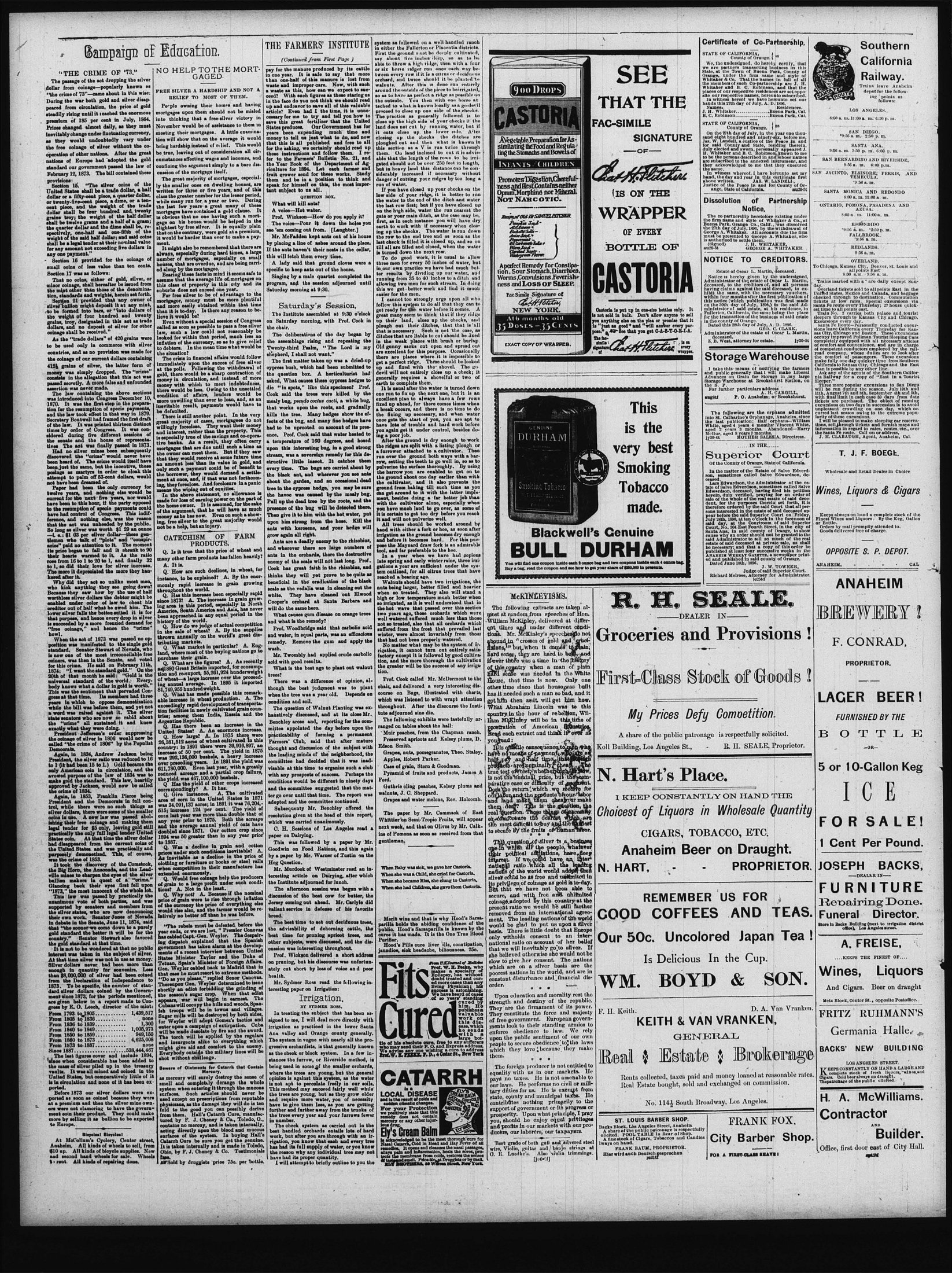
Searchable text
**Campaign of Education.**
"The Crime of '73."
The passage of the act dropping the silver dollar from coinage—popularly known as "the crime of 73"—came about in this wise: During the war both gold and silver disappeared from circulation, the price of gold steadily rising until it reached the enormous premium of 185 per cent in July, 1864. Prices changed almost daily, as they must inevitably change under fluctuating currency, as they would undoubtedly vary under the free coinage of silver without the cooperation of other nations. After the great nations of Europe had adopted the gold standard our government passed the law of February 12, 1873. The bill contained these provisions:
Section 15. "The silver coins of the United States shall be a trade dollar, a half dollar or a fifty-cent piece, a quarter dollar, or twenty-five-cent piece, a dime, or a ten-cent piece, and the weight of the trade dollar shall be four hundred and twenty grains troy; the weight of the half dollar shall be twelve grams and a half of a gram; the quarter dollar and the dime shall be, respectively, one-half and one-fifth of the weight of the said half dollar; and said coins shall be a legal tender at their nominal value for any amount not exceeding five dollars in any one payment."
Section 16 provided for the coinage of small coins of less value than ten cents.
Section 17 was as follows:
That no coins, either of gold, silver, or minor coinage, shall hereafter be issued from the mint other than those of the denomination, standards and weights, herein set forth.
Section 21 provided that any owner of silver bullion might deposit it at any mint, to be formed into bars, or "into dollars of the weight of four hundred and twenty grains, troy, designated in this act as trade dollars, and no deposit of silver for other coinage shall be received."
As the "trade dollars" of 420 grains were to be used only in commerce with silver countries, and as no provision was made for the coinage of our current dollars containing 412 grains of silver, the latter form of money was simply dropped. The "crime" consists in the allegation that this act was passed secretly. A more false and unfounded assertion was never made.
The law containing the above sections was introduced into Congress December 10, 1870. It was the first step in the preparation for the resumption of specie payments, and the law took effect in that way in 1879. Secretary Boutwell had framed the first draft of the law. It was printed thirteen distinct times by order of Congress. It was considered during five different sessions of the senate and the house of representatives. The act was finally passed in 1873.
Had no silver mines been subsequently discovered the "crime" would never have been heard of. The crime would itself have been just the same, but the incentive, these poisons as martyrs in order to cloak this NO HELP TO THE MORTGAGED.
FREE SILVER A HARDSHIP AND NOT A RELIEF TO MOST OF THEM.
People owning their homes and having mortgages upon them should not be misled into thinking that a free-silver victory in November would be of assistance to them in meeting their mortgages. A little examination will show that on the average it would bring hardship instead of relief. This would be true, leaving out of consideration all circumstances affecting wages and incomes, and confining the argument simply to a bare discussion of the mortgage itself.
The great majority of mortgages, especially the smaller ones on dwelling houses, are written for three or five years, and of this class the greater number for the lesser period, while many run for a year or two. During the last few years a great many of these mortgages have contained a gold clause. It is obvious that no one having such a mortgage on his house would be helped in the slightest by free silver. It is equally plain that on the contrary, were gold at a premium, it would be harder than ever to make a payment.
It might also be remembered that there are always, especially during hard times, a large number of mortgages, especially on small houses, that are overdue, and are being carried along by the mortgagors.
Bearing these facts in mind it seems safe to assume that the average life of mortgages on this class of property in this city and its suburbs does not exceed one year.
For free silver to be of advantage to the mortgagor, money must be more plentiful and more easily obtained within that time than it is to-day. Is there any reason to believe it would be?
Even without a special session of Congress called as soon as possible to pass a free silver law, such a law could not reasonably be looked for within that period, much less an inflation of the currency, so as to give relief to debtors. In the mean time what would be the situation?
The crisis in financial affairs would follow immediately upon the success of free silver at the polls. Following the withdrawal of gold, there would be a sharp contraction of money in circulation, and instead of more money with which to meet indebtedness, there would be less. Owing to the unsettled condition of affairs, lenders would be more unwilling than ever to loan, and, as an inevitable result, payments would have to be defaulted.
There is still another point. In the very great majority of cases, mortgages do not willingly foreclose. They want their money and interest, rather than the property. This is especially true of the savings and co-operative banks. As a result, they often carry mortgages that are due until such a time as the owner can meet them. But if they saw that they would receive at some future time an amount less than its value in gold, and only such a payment could be of benefit to the borrower, they would demand a settlement pay for the manure produced by its use in one year. It is safe to say that it is far less waste and improper care. Now, with a waste as this, how can we expect to succeed? With such figures as these stand in the face do you not think we should up and endavor to save all of this article? Even had I the time, it is necessary for me to try and tell you how save this great fertilizer that the U.S. states produces. Our Government has years been expending much time money to tell us just what to do, and that this is all published and free for the asking, we certainly should re-use these instructions and follow them. Fer to the Farmers' Bulletin No. 229 The Year Book of the Department of Agriculture for 1894. Let each farm fruit grower send for these works them and be in a position to think speak for himself on this, the most tant subject to us all.
QUESTION BOX.
What will kill ants?
A voice—Hot water.
Prof. Wickson—How do you apply?
The voice—Pour it down the hole see 'em coming out from. [Laughter].
Mr. McFadden kept ants out of his by placing a line of sahes around them.
If the ants haven't their nests in this will fetch them every time.
A lady said that ground cloves specific to keep ants out of the house.
Singing by a male quartet complete program, and the session adjourned Saturday morning at 9:30.
Saturday's Session
The Institute assembled at 9:30 on Saturday morning, with Prof. Coxchair.
The deliberations of the day began the assemblage rising and repeating Twenty-third Psalm, "The Lord shepherd, I shall not want."
The first matter taken up was a dry cypress bush, which had been submitted to question box. A horticulturist asked What causes these cypress heeds "in spots," like this specimen? Cook said the trees were killed by mealy bug, pseudo coctus cacti, a white that works upon the roots, and grabs kills the tree. Many hedges show feets of the bug, and many fine hedges had to be unpotted on account of its ence. Prof. Cook said that water heat is temperature of 160 degrees, and upon this interesting bug, in a good stream, was a sovereign remedy for this structive little insect. It catches every time. The bugs are carried ab
The law containing the above sections was introduced into Congress December 10, 1870. It was the first step in the preparation for the resumption of specie payments, and the law took effect in that way in 1879. Secretary Boutwell had framed the first draft of the law. It was printed thirteen distinct times by order of Congress. It was considered daring five different sessions of the senate and the house of representatives. The act was finally passed in 1873.
Had no silver mines been subsequently discovered the "crime" would never have been heard of. The crime would itself have been just the same, but the incentive, these pceies as martyrs in order to cloak this attempt to palm off 53-cent dollars, would not have been dreamed of.
Paper had been the only currency for twelve years, and nothing else would be current for the next five years, nor would have been to this hour, if the party opposed to the resumption of specie payments could have had control of Congress. This indifference, and nothing else, was the reason that the act was unheeded by the public.
So long as silver was worth $1.29 an ounce—L.e.: $1.03 per silver dollar—these gentlemen who talk of "plots" and "conspiracies" paid no attention to it. The moment its price began to fall and it shrank to 90 hearts warmed to it. As the ratio rose from 16 to 1 to 20 to 1, and finally 32 to 1, so did their love for silver increase. The more it depreciated the more they hankered after it.
Why did they act so unlike most men, who kick anything they see going down? Because they saw how by the use of half worthless silver dollars the debtor might be enabled under color of law to cheat his creditor out of half what he owed him. The lower silver falls the better suited it is for that purpose, and hence every drop in silver is succeeded by a more frenzied demand for "free coinage," and hence the "crime" howl.
When the act of 1873 was passed no opposition was manifested to the single gold standard. Senator Stewart of Nevada, who is now one of the most irreconcilable free coiners, was then in the Senate, and voted for this crime. He said on February 11th, 1874: "I want the standard gold." On the 20th of that month he said: "Gold is the universal standard of the world." Everybody knows what a dollar in gold is worth. This was the sentiment that porvaded Congress at that time. Its members had three years in which to oppose demonization while the bill was before them, and yet not a word was raised against it. The silver state senators who are now so rabid about the "crime" all sustained it and knew exactly what they were doing.
President Jefferson's order suppressing the coinage of silver in 1806 would now be called "the crime of 1806" by the Populist Democrat.
Again, in 1834, Andrew Jackson being President, the silver ratio was reduced to 16 to 1 (it had been 15 to 1.) Gold became the only American coin in circulation, and the avowed purpose of the law of 1834 was to make gold the standard. This law, heartily approved by Jackson, would now be called the crime of 1834.
Again, in 1853, Franklin Pierce being President and the Democrats in full control, while there were no such things as silver dollars, there were some of the smaller coins in use. A new law was passed abolishing their free coinage and making them legal tender for $5 only, leaving gold still practically the only full legal tender United States coin. At that time the silver dollar disappeared from the current coins of the United States and was practically and purposely demonized. This, of course, was the crime of 1853.
It took the discovery of the Comstock, the Big Horn, the Anaconda, and the Leadville mines to sharpen the eyes of the silver bullion makers in quest of a "crime". Glancing back their eyes first fell upon "1873," the most innocent of the whole lot.
This law was passed by practically the money in circulation, and instead of more money with which to meet indebtedness, there would be less. Owing to the unsettled condition of affairs, lenders would be more unwilling than ever to loan, and, as an inevitable result, payments would have to be defaulted.
There is still another point. In the very great majority of cases, mortgages do not willingly foreclose. They want their money and interest, rather than the property. This is especially true of the savings and co-operative banks. As a result, they often carry mortgages that are due until such a time as the owner can meet them. But if they saw that they would receive at some future time an amount less than its value in gold, and only such a payment could be of benefit to the borrower, they would demand a settlement at once, and, if that was not forthcoming, they foreclose. And forclosure in a panic means wiping out of equities.
In the above statement, no allowance is made for loss of earning power on the part of the home owner. It is assumed, for the sake of argument, that he will have as much money as he has now. Even on such a showing, free silver to the greatest majority would not be a help, but an injury.
CATECHISM OF FARM PRODUCTS.
Q. Is it true that the price of wheat and many other farm products has fallen heavily?
A. It is.
Q. How are such declines, in wheat, for instance, to be explained?
A. By the enormously rapid increase in grain growing throughout the world.
Q. Has this increase been especially rapid since 1873?
A. The increase in grain growing area in this period, especially in North America, South America and Asia, has never been approached in any equal period in the history of the world.
Q. How do we judge of actual competition in the sale of wheat?
A. By the supplies thrown annually on the world's great distributing markets.
Q. What market in particular?
A. England, where most of the buying nations go to purchase their grain.
Q. What are the figures?
A. As recently as 1880 Great Britain imported, for consumption and re-export, 55,261,924 hunderweight of wheat—a large increase over the proceeding annual average. In 1895 it imported 81,749,955 hundredweight.
Q. What has made possible this remarkable increase in wheat production.
A. The exceedingly rapid development of transportation facilities in newly cultivated grain countries; among them India, Russia and the Argentine Republic.
Q. Has there been an increase in the United States?
A. An enormous increase.
Q. How large?
A. In 1875 there were 26,381,512 acres of wheat cultivated in this country; in 1891 there were 39,916,897 an increase of 50 per cent.
The yield in 1875 was 292,136,000 bushels, a heavy increase over preceding years. In 1891 the yield was 611,780,000. Even last year, with a greatly reduced acreage and a partial crop failure, the yield was 467,100,000 bushels.
Q. Has the yield of other crops increased correspondingly?
A. It has.
Q. Give instances.
A. The cultivated area of corn in the United States in 1871 was 34,091,137 acres; in 1891 it was 76,204,515; increase 124 per cent. The yield of corn last year was more than double that of any year prior to 1875. Both the acreage and the average annual yield of oats have doubled since 1871. Our cotton crop since 1894 was 50 greater than in any year prior to 1887.
Q. Was a decline in grain and cotton prices under conditions invitable?
A. As inevitable as a decline in the price of clothing or furniture or books or steel rails when competition in their manufacture has extended enormously.
Q. Would free coinage help the producers of grain to a large profit under such conditions?
A. Not in the least.
Q. Why not?
A. Because if the nominal price of grain were to rise through inflation
There would be a sharp contraction of money in circulation, and instead of more money with which to indebtedness there would be less. Owing to the unsettled condition of affairs, lenders would be more unwilling than ever to loan, and as an inevitable result, payments would have to be defaulted.
There is still another point. In very great majority of cases, mortgages do not willingly foreclose. They want their money and interest, rather than the property. This is especially true of the savings and co-operative banks. As a result, they often carry mortgages that are due until such a time as the owner can meet them. But if they saw that they would receive at some future time an amount less than its value in gold, and only such a payment could be of benefit to the borrower, they would demand a settlement at once, and if that was not forthcoming, they foreclose. And forclosure in a panic means wiping out of equities.
In the above statement, no allowance is made for loss of earning power on the part of the home owner. It is assumed for sake of argument that he will have as much money as he has now. Even on such a showing, free silver to the greatest majority would not be a help but an injury.
Prof. Woodbridge said that carbon and water, in equal parts, was an efficient remedy. Remove the gum and apwash.
Mr Twombly had applied crude oil with good results.
What is best age to plant out trees?
There was a difference of opinion though the best judgment was taken when the tree was a year old. Deprived condition and soil.
The question of Walnut Planting hauntively discussed,and at its old Benchley arose,and reporting for this mittee appointed the day before uprooting capability of forming a perennial Farmers' Club,said that after thought and discussion of the subject,the leading minds of the neighborhood had decided that it was visible at this time to organize with any prospects of success.Perhaps conditions would be different in nine and the committee suggested that terger go over until that time.The report adopted andthe committee continued.Subsequently Mr.Benchley offered resolution given atthe headofthiswhichwas carriedunanimously.C.H.Sessions.ofLosAngelespaper on Dairying.
This was followed by a paper on Goodwin on Food Rations,and this by a paper by Mr.Warner of Tustin Hog Question.
Mr.Murdockof Westminster read interesting article on Dairying,afterthe Institute adjourned for lunch.
The afternoon session was begun discussion ofthe best cow for but
President and the Democrats in full control, while there were no such things as silver dollars, there were some of the smaller coins in use. A new law was passed abolishing their free coinage and making them legal tender for $5 only, leaving gold still practically the only full legal tender United States coin. At that time the silver dollar had disappeared from the current coins of the United States and was practically and purposely demonetized. This, of course, was the crime of 1853.
It took the discovery of the Comstock, the Big Horn, the Anaconda, and the Leadville mines to sharpen the eyes of the silver balloon makers in quest of a "orime." Glancing back their eyes first fell upon "1873," the most innocent of the whole lot.
This law was passed by practically the unanimous vote of both parties, and was supported by senators and members from the silver states, who are now denouncing their own work. Senator Jones of Nevada in debate in the Senate, June 11, 1874, said that "the sooner we come down to a purely gold standard the better it will be for the country." Senator Stewart also favored the gold standard at that time.
It is not to be wondered at that no public interest was taken in the subject of silver. At that time silver was not in use as money. Silver dollars never had been more than enough in quantity for souvenirs. Less than $8,000,000 of silver had been coined from the Declaration of Independence to 1873. To be specific, the number of standard silver dollars coined by the Government since 1873, for the periods mentioned, are given below in a report made to Congress by E. O. Leech, director of the mint:
From 1793 to 1805... 1,439,517
From 1805 to 1836... none
From 1836 to 1839... 1,300
From 1840 to 1849... 1,005,973
From 1850 to 1859... 949,150
From 1860 to 1873... 4,625,008
From 1873 to 1887... none
Since 1887... 538,444,467
The last figures cover and include 1894, since when considerable has been added to the mass of silver piled up in the treasury vaults. It was all mined and coined in the United States, but comparatively little of it is in circulation and none of it has been exported.
Before 1873 our silver dollars were exported as soon as coined because they were at a premium and then the silver mine owners were not clamoring to have the government coin their product. They could make more by selling it as bullion to be exported to Europe.
Bicycles! Bicycles!
At McCollum's Cyclery, Center street, Anaheim. All kinds of wheels to sell, from $10 up. All kinds of bicycle supplies. New and second hand wheels for sale. Wheels to rent. All kinds of repairing done.
Beware of Ointments for Catarrh that Contain Mercury,
as mercury will surely destroy the sense of smell and completely derange the whole system when entering it through the mucous surfaces. Such articles should never be used except on prescriptions from reputable physicians, as the damage they will do is ten fold to the good you can possibly derive from them. Hall's Catarrh Cure, manufactured by F. J. Cheney & Co., Toledo, O., contains no mercury, and is taken internally, acting directly upon the blood and mucous surfaces of the system. In buying Hall's Catarrh Cure be sure you get the genuine. It is taken internally and is made in Toledo, Ohio, by F. J. Cheney & Co. Testimonials face.
Sold by druggists price 75c. per bottle.
Q. Was a decline in grain and cotton prices under such conditions inevitable? A. As inevitable as a decline in the price of clothing or furniture or books or steel rails when competition in their manufacture has extended enormously.
Q. Would free coinage help the producers of grain to a large profit under such conditions? A. Not in the least.
Q. Why not? A. Because if the nominal price of grain were to rise through inflation of the currency the price of everything else would rise also, and the farmer would be relatively no better off than he was before.
"The rebels must be defeated before the year ends, or we are lost," Premier Conovas has cabled Capt. Gen. Weyler. The despairing dispatch explained that the Spanish government has taken alarm at the developments of a recent interview between United States Minister Taylor and the Duke of Tetuan, Spain's Minister of Foreign Affairs. Gen. Weyler cabled back to Madrid that in that case he must resort to extreme methods.
"Do as you please," replied Senor Canovas. Thereupon Gen. Weyler determined to issue shortly an edict for bidding the grinding of the season's sugar crop. When that edict appears, war will begin in earnest. The Cubans will occupy the hills and woods, Spanish troops will be in towns and villages. Sugar mills will be destroyed by both sides, for Weyler will adopt Gomez's tactics and enter upon a campaign of extirpation. Cuba will be made desolate by fire and the sword. The torch will be applied by the regulars and insurgents alike to everything which might give aid and comfort to the enemy. Everybody outside the military lines will be shot without challenge.
Irrigation.
BY SYDMER ROSS.
In treating the subject that has been signed to me, I will deal more directly with irrigation as practiced in the lower Ana valley and Orange county gee. The system in vogue with nearly all gressive orchardists, is that generally as the check or block system. In all instances the furrow, or Riverside meadow is used in some of the smaller ones where the trees are young, but the opinion is against this system, as this method may succeed fairly well the trees are young, but as they grow and require more water, you of no chance to give them loss, as you are further and further away from the trunk the trees every year and your furrow in number.
The check system as carried out best handled orchards entails lots of work, but after you are through with irrigation, you know that each and every has had its full supply of water, or you have reason why any individual tree has had its proper quantity.
I will attempt to briefly outline to
THE FARMERS' INSTITUTE
(Continued from First Page)
For the manure produced by its cattle year. It is safe to say that more than one-half of this manure is lost from and improper care. Now, with such figure as this, how can we expect to succeed?
With such figures as these staring us face do you not think we should read and endeavor to save all of this valuable crop? Even had I the time, it is unnecessary for me to try and tell you how to this great fertilizer that the United States produces. Our Government has for been spending much time and money to tell us just what to do, and now this is all published and free to all who ask, we certainly should read up on instructions and follow them. I re-read the Farmers' Bulletin No. 21, and the Year Book of the Department of Agriculture for 1894. Let each farmer and grower send for these works. Study and be in a position to think and for himself on this, the most important subject to us all.
QUESTION BOX.
What will kill ants?
Voices—Hot water.
Of Wickson—How do you apply it?
The voice—Pour it down the holes you come out from. [Laughter.]
McFadden kept ants out of his house facing a line of ashes around the place, where ants haven't their nests in the cellar, will fetch them every time.
Lady said that ground cloves were a recipe to keep ants out of the house.
Bing by a male quartet completed the jam, and the session adjourned until Sunday morning at 9:30.
Saturday's Session.
The Institute assembled at 9:30 o'clock Saturday morning, with Prof. Cook in chair.
The deliberations of the day began by assemblage rising and repeating the thirty-third Psalm, "The Lord is my sheder, I shall not want."
The first matter taken up was a dried-up bush, which had been submitted to question box. A horticulturist had asked what causes these cypress hedges to "in spots," like this specimen? Prof. said the trees were killed by the bug, pseudo coctus cacti, a white bug, works upon the roots, and gradually the tree. Many hedges show the effect of the bug, and many fine hedges have to be uprooted on account of its presence.
Prof. Cook said that water heated to temperature of 160 degrees, and hosed this interesting bug, in a good strong form, was a sovereign remedy for this detrive little insect. It catches them time. The bugs are carried about by black ant and wherever you see ants system as followed on a well handled ranch in either the Fullerton or Placentia districts.
First the ground must be deeply cultivated, say about five inches deep, so as to be able to throw a high ridge, then with a four or six horse ridger run once each way between every row if it is a citrus or deciduous orchard, and twice should it be planted to walnuts. After this is done run entirely around the outside of the piece to be irrigated, so as to have as perfect a ridge as possible on the outside. You then with one horse at tached to what is known locally as a go-devil proceed to close up one side of the checks.
The practice as generally followed is to close up the high side of your checks if the land does not cut by running water, but if it cuts close up the lower side. After closing up the checks the ditches are ploughed out and then what is known in this section as a V is run twice through them. On land inclined to cut it is advisable that the length of the rows to be irrigated should not be over 250 feet in length, but in heavy land this distance can be considerably increased if necessary without danger of cutting your ridges by too long a run of water.
If you have closed up your checks on the low side of your ridge, it is better to run the water to the end of the ditch and water the last row first; but if you have closed up on the high side, water the run nearest the gate or your main ditch, as the case may be, first, as in each instance you will have dry earth to work with if necessary when closing up the checks. The water is run down the row to the end tree and as soon as the last check is filled it is closed up, and so on till all are filled and closed, when the water is turned down the next row.
To do good work, it is usual to allow three men for every 50 inches of water, but in our own practice we have had much better results by dividing up our water, and running from 35 to 40 inches to a ditch and allowing two men for such stream. In doing this we get better work and find it much easier for the men.
I cannot too strongly urge upon all who follow this system to do all that they can to get ready for the water before it comes. A great many seem to think that if they ridge up their land, close up the checks, and plough out their ditches, that that is 'all that is necessary.' Such is not the case, as ditches that are liable to cut should be axed in the weak places with brush or burlap. Old gunny sacks cut open and spread out are excellent for this purpose. Occasionally there are places where it is impossible to get a perfect ridge. These should be looked up and fixed with the shovel. The go devil will not entirely close up a check; it generally requires a shovelful or two of earth to complete them.
It is usual after the water is turned down one run to fix up the next one, but it is an excellent plan to always have a few rows fixed up ahead, for there comes times when a break occurs, and there is no time to do the fixing up necessary, and when water once gets the start of you, you are apt to have lots of trouble and hard work before you again get it under control, besides doing a poor job.
After the ground is dry enough to work the ridges are split with a listing plough or a furrower attached to a cultivator. Then run over the ground both ways with a barrow, setting the teeth to go well in, so as to pulverize the surface thoroughly. By using the harrow you are enabled to get on to...
This is the very best Smoking Tobacco made.
Blackwell’s Cenuine BULL DURHAM
You will find one coupon inside each 2 ounce bag and two coupons inside each 4 ounce bag. Buy a bag, read the coupon and see how to get your share of $50,000 in presents.
McKINLEYISMS.
The following extracts are taken almost at random from speeches of Hon. William McKinley, delivered at different times and under different conditions. Mr. McKinley's speeches do not abound in "crosses of gold and crucifixions," but when it comes to main hard sense, they are hard to bear, and if ever there was a time in the history of this country when a man of plain hard sense was needed in the White House, that time is now. Only one other time since that house was built has it needed such a man so bad, and it got him then as it will get him now. What Abraham Lincoln was to this country in the hour of rebellion, William McKinley will be in this time of prostration of American interests. Read each extract and think it over as you read:
It is or little consequence to men who have no means of payment, who live on half pay and half time, that their products are nominally cheap. The true test of cost, whether high or low, is not the nominal price, but the comparative ease or difficulty of payment. Does the return which we receive for our labor and the products of our labor and land make them cheap or make them dear? This is the question, the real question. Those things of necessity or comfort are the dearest which are the most difficult to buy and the easiest to secure by the fruits of human labor.
This question of silver is a business one in which all the people whatever their political affiliations have deep interest. If we could have an international ratio which all the leading nations of the world would adopt then silver could be as free and unlimited in its privilege of coinage as gold is to-day. But that we have not been able to secure, and with free and unlimited
The paper by Mr. Cammaok of East Whittier on Semi-Tropic Fruits, will appear next week, and that on Olives by Mr. Calkins of Pomona as soon as received from that gentleman.
When Baby was sick, we gave her Castoria.
When she was a Child, she cried for Castoria.
When she became Miss, she clung to Castoria.
When she had Children, she gave them Castoria.
Merit wins and that is why Hood's Sarsaparilla holds the abiding confidence of the public. Hood's Sarsaparilla is known by the cures it has made. It is the One True Blood Purifier.
Hood's Pills cure liver ills, constipation, jaundice, sick headache, biliousness. 25c.
Fits Cured
From U.K. Journal of Medicine Prof. W. H. Peeke, who makes a specialty of Epilepsy, has without doubt treated and curved more cases than any living Physician; his success is astonishing. We have heard of cases of so years' standing cured by him. He publishes valuable work on this disease, which he sends with a large botel of his absolute cure, free to any sufferers who may send their P.O. and Express address. We advise any one wishing a cure to address Prof. W. E. PEKE, F. D., 4 Cedar St., New York.
CATARRH
is a LOCAL DISEASE and is the result of colds and sudden climatic changes. For your Protection we positively state that this remedy does not contain mercury or any other injurious drug.
Ely's Cream Balm is acknowledged to be the most thorough cure for Nasal Catarrh, Cold in Head and Hay Fever of all remedies. It opens and cleanses the nasal passages, always pain and inflammation, heals the sore, protects the membrane from colds, restores the senses of taste and smell. Price 50 at Druggists or by mail.
Best grade of both guts and silvered steel wire, Violin, guitar and banjo strings at O. R. Laudke's. Also violin trimmings.
This question of silver is a business one in which all the people, whatever their political affiliations, have deep interest. If we could have an international ratio which all the leading nations of the world would adopt then silver could be as free and unlimited in its privilege of coinage as gold is to-day. But that we have not been able to secure, and with free and unlimited coinage adopted by this country at the present ratio we would be still farther removed from an international agreement. The leading nations of the world would be glad to put us upon a silver basis. There is little doubt that Europe only withholds consent to an international ratio on account of her bellof that we will inevitably go to silver. If she believed otherwise she would not be slow to give her consent. The nations which are on a silver basis are the poorest nations in the world, and are in constant disturbance and financial disorder.
Upon education and morality rest the strength and destiny of the republic. They are the firmament of its power. They constitute the force and majesty of free government. European governments look to their standing armies to enforce obedience to law. We rely upon the public sentiment of our own people to secure obedience to the laws which they love because they make them.
The foreign producer is not entitled to equality with us in our markets. He pays no taxes. He is not amenable to our laws. He performs no civil or military duties for us. He is exempt from state, county and municipal taxes. He contributes nothing primarily to the support of government or its progress or prosperity. Upon what principle, I pray you, should he enjoy equal privileges and profits in our markets with our producers, our laborers, our taxpayers.
Backs Block, Los Angeles Street,
A share of the public patronage olleited. POOL TABLE In Rea
A fine stock of Cigars, Tobacco lways on hand.
FRANK BAUM, PROPRIN
Hier wird auch Deutsch gesprochen
SEE THAT THE WRAPPER OF EVERY BOTTLE OF CASTORIA is on the very best Smoking
Certificate of Co-Partnership.
STATE OF CALIFORNIA,
County of Orange.
We, the undersigned, do hereby certify that we are partners transacting business in this State, at the Town of Buena Park, County of Orange, under the firm name and style of Whitaker & Co. That the names in full of all the members of such Co-partnership are J. H. Whitaker and B. C. Robinson, and that the places of our respective residences are set opposite our respective names, herein to subscribed.
In witness hereof we have hereunto set our hands this 27th day of July, A. D. 1896.
Names.
J. H. Whitaker...
Buena Park, Cal.
B. C. Robinson...
Buena Park, Cal.
STATE OF CALIFORNIA,
County of Orange.
On the 27th day of July, in the year one thousand eight hundred and ninety-six, before me, Jas. W. Landell, a Justice of the Peace in and for said County and State, residing therein, duly elected and sworn, personally appeared J. H. Whitaker and B. C. Robinson, known to me to be the persons described in and whose names are subscribed to the annexed instrument, and they acknowledged to me that they executed the same.
In witness whereof, I have hereunto set my hand, the day and year in this certificate first above written.
JAS. W. LANDELI,
Justice of the Peace in and for County of Orange, State of California.
Dissolution of Partnership Notice.
The co-partnership heretofore existing under the firm name and style of Whitaker & Co., at Buena Park, Orange Co., Calif., was dissolved the 27th day of July, 1896, by the withdrawal of George A. Whitaker. All accounts due the firm must be presented to George A. Whitaker, who is authorized to settle them.
(Signed)
J. H. WHITAKER,
au20-5t
GEORGE A. WHITAKER.
NOTICE TO CREDITORS.
Estate of Oscar L. Martin, deceased.
Notice is hereby given by the undersigned, Administrator of the estate of Oscar L. Martin, deceased, to the creditors of, and all persons having claims against the said deceased, to exhibit the same, with the necessary vouchers, within four months after the first publication of this notice (which publication was first made on the 30th day of July, 1896) to the said Administrator of said estate, at his residence, in Fullerton, California, the same being the place for the transaction of the business of said estate in the county of Orange.
Dated this 28th day of July, A. D. 1896.
GEO. C. CLARK,
Administrator of the estate of Oscar L. Martin, deceased.
Z. B. West, attorney for estate.
jy30-5t
Storage Warehouse
I take this means of notifying the farmers and public generally that I will make Liberal Advances on Grain for Storage in my large Storage Warehouse at Brookshurst Station, on the S. P.
For further particulars address
A. H. CARGILL,
aug8tf
P. O. Anaheim; or Brookshurst.
The following are the orphans admitted into St. Catharine's Orphanage, Anaheim, since the last publication: Half orphan—William White, aged 4 years; 4 month; Vincent White, aged 2 years; 3 months. Abandoned—Harry Mellus, aged 8 years; 7 months.
MOTHER SALESIA, Directress.
IN THE...
Superior Court
Of the County of Orange, State of California.
In the matter of the Estate of Salve Edwardson, de
Southern California Railway.
Trains leave Anaheim depot for the following points as follows:
LOS ANGELES.
8:00 a.m. 11:00 a.m. 6:20 p.m.
SAN DIEGO.
*9:56 a.m. 2:50 p.m.
SANTA ANA.
9:56 a.m. 2:50 p.m. 6:00 p.m.
SAN BERNARDINO AND RIVERSIDE,
9:56 a.m. 6:00 p.m.
SAN JACINTO, ELSINORE, PERRIS, AND TEMECULA,
*9:56 a.m.
SANTA MONICA AND REDONDO
8:00 a.m. 11:00 a.m.
ONTARIO, POMONA, PASADENA AND AZUSA.
8:00 a.m. 11:00 a.m.
ESGONDIDO
*9:56 a.m.* *2:50 p.m.* FALLBROOK.
*9:56 a.m.*
REDLANDS.
9:56 a.m.*
OVERLAND.
To Chicago, Kansas City, Denver, St. Louis and all points East.
8:00 a.m. 9:56 a.m.
Trains marked with a are daily except Sunday.
Overland tickets sold to all points East in the United States, Mexico and Canada, and baggage checked through to destination. Commutation tickets at low rates. Special excursions via Santa Fe route every Thursday; 27 hours quickest time to all points east.
Train No. 2 carries both palace and tourist sleepers through to Kansas City and Chicago. Excursions every day.
Santa Fe Route—Personally conducted excursions leave California every Thursday for Kansas City, Chicago and Boston. These excursions occupy improved Pullman Tourist Sleeping Cars completely equipped with all necessary articles of comfort and convenience, and are in charge of competent conductors employed by the railroad company, whose duties are to look after the comfort of passengers. These excursions make fully one day quicker time from Southern California to Kansas City, Chicago and the East than is possible by any other line.
Ask any of the agents of the Southern California Railway for a copy of "East in a Tourist Sleeper."
Three more popular excursions to San Diego will be run during the season. July 10th and 11th, August 7th and 8th, September 4th and 5th, with final limit in each case 20 days from date tickets are purchased. The object of running excursions on two days in succession is to avoid unpleasant crowding on one day, which occurred last season owing to the extreme popularity of these excursions.
I will be pleased to make sleeping car reservations, sell through tickets and furnish maps and information in regard to rates, routes, etc., over the Santa Fe route. Call on or address.
J. H. CLABAUGH, Agent, Anaheim, Cal.
T. J. F. BOEGE.
Wholesale and Retail Dealer in Choice
This is the very best Smoking Tobacco made.
Genuine URHAM
and two coupons inside each 4 ounce bag.
For further particulars address
A. H. CARGILL,
aug8tf
P. O. Anaheim; or Brookshurst.
The following are the orphans admitted into St. Catharine's Orphanage, Anaheim, since the last publication: Half orphans—William White, aged 4 years 4 months; Vincent White, aged 2 years 3 months. Abandoned—Harry Mellur, aged 8 years 7 months.
MOTHER SALESMIA, Directress.
IN THE.....
Superior Court
Of the County of Orange, State of California.
In the matter of the Estate of Salve Edverdson, sometimes called Salve Edwardson, deceased.
Lars Edwardson, the Administrator of the estate of Salve Edverdson, sometimes called Salve Edwardson, deceased, having filed his petition herein, duly verified, praying for an order of sale of the whole of the real estate of said decedent, for the purposes therein set forth. It is therefore ordered by the said Court that all persons interested in the estate of said deceased appear before the said Superior Court on Friday, July 24th, 1896, at ten o'clock in the forenoon of said day, at the Courtroom of said Superior Court, No. 304 East Fourth Street, in the city of Santa Ana, in said county of Orange, to show cause why an order should not be granted to the said Administrator to sell so much of the real estate of said deceased at private sale, as shall be necessary; and that a copy of this order be published at least four successive weeks in the Anaheim Weekly Gazette, a newspaper printed and published in said county of Orange.
Dated June 15th, 1896.
J. W. TOWNER,
Judge of said Superior Court.
Richard Melrose, Attorney for Administrator.
R. H. SEALE.
DEALER IN
Groceries and Provisions!
First-Class Stock of Goods!
My Prices Defy Competition.
A share of the public patronage is respectfully solicited.
Koll Building, Los Angeles St., R. H. SEALE, Proprietor.
N. Hart’s Place.
I KEEP CONSTANTLY ON HAND THE Choicest of Liquors in Wholesale Quantity
CIGARS, TOBACCO, ETC.
Anaheim Beer on Draught.
N. HART, - PROPRIETOR.
REMEMBER US FOR
T. J. F. BOEGE.
Wholesale and Retail Dealer in Choice
Wines, Liquors & Cigars
Keeps always on hand a complete stock of the Finest Wines and Liquors. By the Keg, Oallon or Bottle.
Orders by mail promptly attended to.
Goods delivered free of charge.
OPPOSITE S. P. DEPOT.
ANAHEIM.
ANAHEIM BREWERY!
F. CONRAD,
PROPRIETOR.
LAGER BEER!
FURNISHED BY THE BOTTLE
OR—
5 or 10-Gallon Keg ICE
FOR SALE!
1 Cent Per Pound.
JOSEPH BACKS,
DEALER IN
FURNITURE
Choicest of Liquors in Wholesale Quantity
CIGARS, TOBACCO, ETC.
Anaheim Beer on Draught.
N. HART, PROPRIETOR.
REMEMBER US FOR
GOOD COFFEES AND TEAS.
Our 50c. Uncolored Japan Tea!
Is Delicious In the Cup.
WM. BOYD & SON.
F. H. Keith.
D. A. Van Vranken.
KEITH & VAN VRANKEN,
GENERAL
Real Estate Brokerage
Rents collected, taxes paid and money loaned at reasonable rates.
Real Estate bought, sold and exchanged on commission.
No. 114½ South Broadway, Los Angeles.
ST. LOUIS BARBER SHOP.
Backs Block, Los Angeles Street, Anaheim.
A share of the public patronage is respectfully olicited. POOL TABLE In Rear of Shop.
A fine stock of Cigars, Tobacco and Candies lways on hand.
FRANK BAUM, PROPRIETOR.
Hier wird auch Deutsch gesprochen
FRANK FOX,
City Barber Shop.
FOR A FIRST-GLASS SHAVE!
FOR SALE!
1 Cent Per Pound.
JOSEPH BACKS,
DEALER IN
FURNITURE
Repairing Done.
Funeral Director.
Store in Backs Building (next to irrigation district office), Los Angeles street.
A. FREISE,
...KEEPS THE FINEST OF...
Wines, Liquors
And Cigars. Beer on draught
Metz Block, Center St., opposite Postoffice.
FRITZ RUHMANN'S
Germania Halle.
BACKS' NEW BUILDING
LOS ANGELES STREET.
KEeps constantly on hand a large and complete stock of fresh liquors, wines and cigars. Cold beer always on draught.
The patronage of the public offered.
H. A. McWilliams.
Contractor
AND
Builder.
Office, first door east of City Hall.