anaheim-gazette 1896-07-02
Scanned page
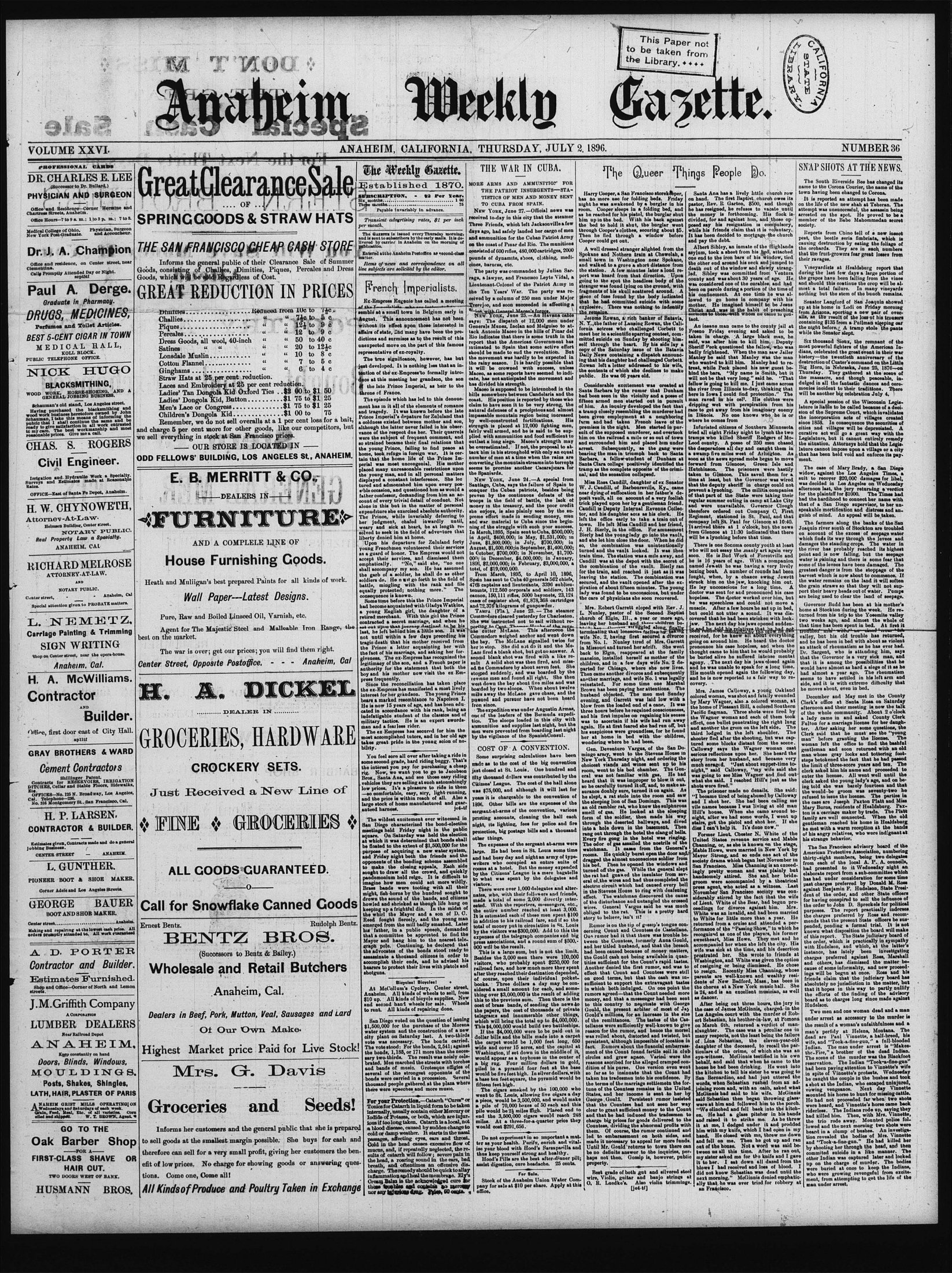
Searchable text
VOLUME XXVI.
PROFESSIONAL CARDS
DR. CHARLES E. LEE
(Successor to Dr. Bullard.)
PHYSICIAN AND SURGEON
Office and Residence—Corner Hermine and Chartress Streets, Anaheim.
Office Hours—7 to 9 a.m.; 1 to 3 p.m.; 7 to 8.
Medical College of Ohio.
Physician, Surgeon and Accoucheur.
Dr. J. A. Champion
Office and residence, on Center street, near Clementina.
Calls Promptly Attended Day or Night.
sept5tf
Paul A. Derge.
Graduate in Pharmacy.
DRUGS, MEDICINES,
Perfumes and Toilet Articles.
BEST 5-CENT CIGAR IN TOWN
MEDICAL HALL,
KOLL BLOCK.
PUBLIC TELEPHONE OFFICE.
NICK HUGO
BLACKSMITHING,
WOOD WORK, HORSE-SHOOKING, AND A GENERAL JOBBING BUSINESS.
Schauman's old stand, Los Angeles street.
Having purchased the blacksmithing and wood work business heretofore owned by John Schauman, I take this means of informing the public that I shall continue the same and be ready to give satisfaction in all work entrusted to my care. The best workmanship and most reasonable prices. Give me a call.
CHAS. S. ROGERS
Civil Engineer.
Great Clearance Sale
OF ...
SPRING GOODS & STRAW HATS
THE SAN FRANCISCO CHEAP CASH STORE
Informs the general public of their Clearance Sale of Summer Goods, consisting of Challies, Dimities, Piques, Percales and Dress Goods, which will be sold Regardless of Cost.
GREAT REDUCTION IN PRICES
Dimities... Reduced from 10¢ to 7½¢.
Challies... “ 7½¢ to 5¢
Piques... “ 12½¢ to 9¢
Percales... “ 12¢ to 9¢
Dress Goods, all wool, 40-inch “ 50¢ to 40¢
Satines “ “ 20¢ to 12½¢
Lonsdale Muslin... “ 10¢ to 8¢
Cotton Flannel... “ 7¢ to 5¢
Ginghams... “ 6¢ to 4¢
Straw Hats at 25 per cent reduction.
Laces and Embroidery at 25 per cent reduction.
Ladies' Tan Dongola Kid Oxford Ties ... $2 00 to $1 50
Ladies' Dongola Kid, Button ... $1 75 to $1 25
Men's Lace or Congress ... $1 75 to $1 25
Children's Dongola Kid ... $1 00 to 75
Remember, we do not sell overalls at a 1 per cent loss for a bait, and charge 5 per cent more for other goods, like our competitors, but we sell everything in stock at San Francisco prices.
OUR STORE IS LOCATED IN
ODD FELLOWS' BUILDING, LOS ANGELES St., ANAHEIM.
BLACKSMITHING,
WOOD WORK, HORSE-SHOOKING, AND A GENERAL JOBBING BUSINESS.
Schauman's old stand, Los Angeles street.
Having purchased the blacksmithing and wood work business heretofore owned by John Schauman, I take this means of informing the public that I shall continue the same and be ready to give satisfaction in all work entrusted to my care. The best workmanship and most reasonable prices. Give me a call.
CHAS. S. ROGERS
Civil Engineer.
Irrigation and Hydraulic Work a Specialty.
Surveys and Estimates made at Reasonable Rates.
OFFICE—East of Santa Fe Depot, Anaheim.
H. W. CHYNOWETH,
Attorney-At-Law.
Helmsen Building, Center Street.
NOTARY PUBLIC.
Real Property Law a Specialty.
ANAHEIM, CAL.
RICHARD MELROSE
ATTORNEY-AT-LAW.
AND
NOTARY PUBLIC.
Center street, Anaheim, Cal.
Special attention given to PROBATE matters.
L. NEMETZ,
Carriage Painting & Trimming
SIGN WRITING
Shop on Center street, near the opera-house.
Anaheim, Cal.
H. A. McWilliams.
Contractor
AND
Builder.
Office, first door east of City Hall.
apilif
GRAY BROTHERS & WARD
Cement Contractors
Shillinger Patent.
Contracts for RESERVOIRS, IRRIGATION DITCHES, Cellar and Stable Floors, Sidewalks, Etc.
OFFICES—No. 125 N. Broadway, Los Angeles, Cal., Telephone—236.
No. 316 Montgomery St., San Francisco, Cal.
H. P. LARSEN,
CONTRACTOR & BUILDER.
Estimates given, Contracts made and do a general jobbing Business.
CENTER STREET — ANAHEIM.
L. GUNTHER.
PIONEER BOOT & SHOE MAKER.
Corner Adele and Los Angeles Streets.
Straw Hats at 25 per cent reduction.
Laces and Embroidery at 25 per cent reduction.
Ladies' Tan Dongola Kid Oxford Ties ...$2 00 to $1 50
Ladies' Dongola Kid, Button ...$1 75 to $1 25
Men's Lace or Congress ...$1 75 to $1 25
Children's Dongola Kid ...$1 00 to 75
Remember, we do not sell overalls at a 1 per cent loss for a bait, and charge 5 per cent more for other goods, like our competitors, but we sell everything in stock at San Francisco prices.
OUR STORE IS LOCATED IN ODD FELLOWS' BUILDING, LOS ANGELES St., ANAHEIM.
E. B. MERRITT & CO,
DEALERS IN
FURNITURE
AND A COMPLELE LINE OF
House Furnishing Goods.
Heath and Muliigan's best prepared Paints for all kinds of work.
Wall Paper---Latest Designs.
Pure, Raw and Boiled Linseed Oil, Varnish, etc.
Agent for The Majestic Steel and Malleable Iron Range, the best on the market.
The war is over; get our prices; you will find them right.
Center Street, Opposite Postoffice. - - - Anaheim, Cal
H. A. DICKEL
DEALER IN
GROCERIES, HARDWARE
CROCKERY SETS.
Just Received a New Line of
FINE GROCERIES
ALL GOODS GUARANTEED.
H. P. LARSEN,
CONTRACTOR & BUILDER.
Estimates given, Contracts made and do a general jobbing Business.
CENTER STREET — ANAHEIM.
L. GUNTHER.
PIONEER BOOT & SHOE MAKER.
Corner Adele and Los Angeles Streets.
GEORGE BAUER
BOOT AND SHOE MAKER.
Center street... Anaheim.
Making and repairing at the lowest cash price. All orders promptly attended to. All work guaranteed
A D. PORTER
Contractor and Builder.
Estimates Furnished.
Shop and Office—Corner of North and Lemon streets.
J.M.Griffith Company
A CORPORATION
LUMBER DEALERS
Near Railroad Depot
ANAHEIM,
Keep constantly on hand
Doors, Blinds, Windows,
MOULDINGS.
Posts, Shakes, Shingles,
LATH, HAIR, PLASTER OF PARIS
ANAHEIM GRIST MILLS OPERATING ON Wednesdays and Saturdays of each week.
Grain, Feed, Meal, Etc. of all varieties. Corn elled and shipped.
W. T. BROWN, Agent.
GO TO THE
Oak Barber Shop
FOR A
FIRST-CLASS SHAVE OR HAIR CUT.
TWO DOORS WEST OF BANK.
HUSMANN BROS.
FINE GROCERIES
ALL GOODS GUARANTEED.
Call for Snowflake Canned Goods
Ernest Bentz.
Rudolph Bentz
BENTZ BROS.
(Successors to Bentz & Bailey.)
Wholesale and Retail Butchers
Anaheim, Cal.
Dealers in Beef, Pork, Mutton, Veal, Sausages and Lard
Of Our Own Make.
Highest Market price Paid for Live Stock
Mrs. G. Davis
Groceries and Seeds!
Informs her customers and the general public that she is prepared to sell goods at the smallest margin possible. She buys for cash and therefore can sell for a very small profit, giving her customers the best fit of low prices. No charge for showing goods or answering questions. Come one, Come all!
All Kinds of Produce and Poultry Taken in Exchange
Weekly Gazette
ANAHEIM, CALIFORNIA, THURSDAY, JULY 2, 1896.
The Weekly Gazette.
Established 1870.
SUBSCRIPTION, - $2 Per Year.
Six months. 1 00
Three months. 75
Payable invariably in advance.
Transient advertising rates, $1 per inch per month.
The Gazette is issued every Thursday morning, and is sent to subscribers by the early mails. It is delivered by carrier in Anaheim on the morning of publication.
Entered at the Anaheim Postoffice as second-class matter.
Items of news and correspondence on all live subjects are solicited by the editor.
French Imperialists.
Ex-Empress Eugenie has called a meeting of the Imperialists who are interested in affairs of state, and many have been the predictions and surmises as to the result of this unexpected move on the part of this famous representative of ex-royalty.
The true significance, however, has but just developed. It is nothing less that an intention of the ex-Empress to formally introduce at this meeting her grandson, the son of the late Prince Imperial, as heir to the throne of France.
The episode which has led to this denouement has in it all of the elements of romance and tragedy. It was known before the late Prince Imperial's departure for Zululand that a coldness existed between mother and son, although the latter never failed in his observance of the respect due her. Their quarrels were the subject of frequent comment, and so strained became their final relations that the young Prince, failing to find peace at home, took refuge in foreign war. It is certain that the home life of the Prince Imperial was most uncongenial. His mother placed many unreasonable restrictions upon the young man and in all personal matters.
THE WAR IN CUBA.
MORE ARMS AND AMMUNITION FOR THE PATRIOT INSURGENTS—STATISTICS OF MEN AND MONEY SENT TO CUBA FROM SPAIN.
New York, June 27. Official news was received to-day in this city that the steamer Three Friends, which left Jacksonville a few days ago, had safely landed her cargo of men and ammunition for the Cuban Patriot Army on the coast of Pinar del Rio. The munitions consisted of 600 rifles, 480,000 cartridges, 2000 pounds of dynamite, shoes, clothing, medicines, barrances, etc.
The party was commanded by Julian Sarraga, a lawyer, and Francisco Leyte Vidal, a Lieutenant-Colonel of the Patriot Army in the Ten Years' War. The party was received by a column of 250 men under Major Trerejoo, and soon succeeded in affecting a union with General Macao's forces.
New York, June 25. An Havana cable says: The dispatch of 12,000 men under Generals Munoz, Inclan and Melguiso to attack Antonio Maceo in the hills of Pinar del Rio indicates that there is some truth in the report that the American Government has intimated to Spain that some active effort should be made to end the revolution. But the movement was hardly to be expected in the rainy season. It is hardly possible that it will be crowned with success, unless Macao, as some reports have seemed to indicate, has not anticipated the movement and has divided his strength.
Macao is supposed to be intrenched in the hills somewhere between Candelaria and the coast. His position is reported by those who claim to have seen it to be very strong, the natural defenses of a precipitous and almost impassable mountain region being increased by well-constructed fortifications. His strength is placed at 12,000 fighting men, fairly well armed, and he is said to be supplied with ammunition and food sufficient to outlast a long siege. Macao's strength may be overestimated. If not, the proposal to attack him in his stronghold with only an equal number of men at time when the rains are converting the mountain streams into torrents seems to promise another Cacarajicara for the Spaniards.
The Queer
Harry Cooper, a San Francisco storekeeper has no more use for folding beds. Friday he was awakened by a burglar in room. Cooper sleeps in a folding bed, as he reached for his pistol, the burglar him up in the bed. With his back agile the bed to hold it shut, the burglar wished through Cooper's clothes, securing about them he fled through a window behind Cooper could get out.
A well dressed stranger alighted from Spokane and Northern train at Chewell small town in Washington near Spokane and walked to a grove a short distance from the station. A few minutes later a loud port was heard from that direction. Upping to the spot the headless body of stranger was found lying on the ground, fragments of his skull scattered around pieces of fuse found by the body indicating that he had committed suicide with an explosive. There was nothing to index the remains.
Jerome Rowan, a rich banker of Bata N.Y., the father of Lansing Rowan, the California actress who challenged Corbett meet her in a scientific sparring contest, missed suicide on Sunday by shooting herself through the heart. By his side he copy of the Saturday issue of the Bata Daily News containing a dispatch announcing that his daughter had challenged Corbett Rowan left a letter addressed to his wife the contents of which she deplines to public. He was 66 years old.
Considerable excitement was created Santa Barbara by the rumor that Duncan had been seen in the vicinity and a posse fifteen armed men started out in pursuit of him. An inquiry developed the fact that a tramp closely resembling the murderer been given employment at a neighborhood farm and taken French leave premises in the night. Men started in suit of the supposed murderer, and over him on the railroad a mile or so out of town and surrounded him and placed him under arrest. Subsequently, as the gang bearing the man in triumph back to Santa Barbara, Santa Clara college positively identified trump as the complete opposite of the criminal and the sensation collapsed.
The episode which has led to this denouement has in it all of the elements of romance and tragedy. It was known before the late Prince Imperial's departure for Zululand that a coldness existed between mother and son, although the latter never failed in his observance of the respect due her. Their quarrels were the subject of frequent comment, and so strained became their final relations that the young Prince, failing to find peace at home, took refuge in foreign war. It is certain that the home life of the Prince Imperial was most uncongenial. His mother placed many unreasonable restrictions upon the young man, and in all personal matters displayed a constant interference. She lecured and admonished him upon every possible occasion, and questioned him as would a father confessor, demanding from him an account of every trivial detail of conduct. Not alone in this but in the matter of personal expenditure she exercised absolute authority. The Prince, while invariably deferring to her judgment, chafed inwardly until, weary and sick at heart, he at length resolved to seek in the field of adventure that liberty denied him at home.
Upon his departure for Zululand forty young Freemouth volunteered their services as a guard of honor. The Empress would not accept their services, and dismissed them emphatically. "No," said she, "go one shall accompany my son. He has assumed the garb of a soldier, he shall do as other soldiers do. He n't go forth to the field of battle, mingling with the rank and file equally protected; nothing more." The consequence is known.
Some time before this the Prince Imperial had become acquainted with Gladys Watkins, a young Eglish girl, the daughter of a retired merchant. With this girl the Prince contracted a secret marriage, and when he set out upon that journey destined to be his last, he left behind him a little son. It was not until within a few days preceding his tragic death that his mother received from the Prince a letter acquiring her with the fact of his marriage, and asking her forgiveness. The ex-Empress recognized the legitimacy of the son, and a French paper is authority for the statement that both the boy and his mother now visit the Ex-Press frequently.
Since the reconciliation has taken place the ex-Empress has manifested a most lively interest for her grandson. The young Prince bears a marked resemblance to Napoleon I. He is now 15 years of age, and has been educated in accordance with his rank, being an indeftigable student of the classics and of military tactics. He is an expert swordman and a fearless rider.
The ex-Empress has secured for him the most accomplished tutors, and in her old age takes great pride in the young son of nobility.
You feel sorrow all over after taking a ride in some second grade, hard riding buggy. That's the interest you pay for purchasing a cheap rig. Now, we want you to go to Jacobson Bros., Santa Ana, and see those easy riding vehicles they are selling at such astonishingly low prices. It's a pleasure to ride in them—so comfortable, easy, airy, light running, and the price is within reach of all. Also a large stock of home manufactured and guaranteed harnesses.
The wildest excitement ever witnessed in San Diego characterized the bond-election meetings held Friday night in the public square. On Saturday was held the election at which it was determined that bonds shall be floated to the extent of $1,500,000 for the purpose of acquiring a new water system, and Friday night both the friends and the opponents of the bonding scheme assembled to make the closing appeals. Each side sought to draw all the crowd, and quickly pandemonium held reign. It is difficult to imagine how men could act more wildly. Brass bands were tooting with all their might, fish-horns by the hundred sought to drown the sound of the bands, and citizens
The episode which has led to this denouement has in it all of the elements of romance and tragedy. It was known before the late Prince Imperial's departure for Zululand that a coldness existed between mother and son, although the latter never failed in his observance of the respect due her. Their quarrels were the subject of frequent comment, and so strained became their final relations that the young Prince, failing to find peace at home, took refuge in foreign war. It is certain that the home life of the Prince Imperial was most uncongenial. His mother placed many unreasonable restrictions upon the young man, and in all personal matters displayed a constant interference. She lecured and admonished him upon every possible occasion, and questioned him as would a father confessor, demanding from him an account of every trivial detail of conduct. Not alone in this but in the matter of personal expenditure she exercised absolute authority. The Prince, while invariably deferring to her judgment, chafed inwardly until, weary and sick at heart, he at length resolved to seek in the field of adventure that liberty denied him at home.
Upon his departure for Zululand forty young Freemouth volunteered their services as a guard of honor. The Empress would not accept their services, and dismissed them emphatically. "No," said she, "go one shall accompany my son. He has assumed the garb of a soldier, he shall do as other soldiers do. He n't go forth to the field of battle, mingling with the rank and file equally protected; nothing more." The consequence is known.
Some time before this the Prince Imperial had become acquainted with Gladys Watkins, a young Eglish girl, the daughter of a retired merchant. With this girl the Prince contracted a secret marriage, and when he set out upon that journey destined to be his last, he left behind him a little son. It was not until within a few days preceding his tragic death that his mother received from the Prince a letter acquiring her with the fact of his marriage, and asking her forgiveness. The ex-Empress recognized the legitimacy of the son, and a French paper is authority for the statement that both the boy and his mother now visit the Ex-Press frequently.
Since the reconciliation has taken place the ex-Empress has manifested a most lively interest for her grandson. The young Prince bears a marked resemblance to Napoleon I. He is now 15 years of age, and has been educated in accordance with his rank, being an indeftigable student of the classics and of military tactics. He is an expert swordman and a fearless rider.
The ex-Empress has secured for him the most accomplished tutors, and in her old age takes great pride in the young son of nobility.
You feel sorrow all over after taking a ride in some second grade, hard riding buggy. That's the interest you pay for purchasing a cheap rig. Now, we want you to go to Jacobson Bros., Santa Ana, and see those easy riding vehicles they are selling at such astonishingly low prices. It's a pleasure to ride in them—so comfortable, easy, airy, light running, and the price is within reach of all. Also a large stock of home manufactured and guaranteed harnesses.
The wildest excitement ever witnessed in San Diego characterized the bond-election meetings held Friday night in the public square. On Saturday was held the election at which it was determined that bonds shall be floated to the extent of $1,500,000 for the purpose of acquiring a new water system, and Friday night both the friends and the opponents of the bonding scheme assembled to make the closing appeals. Each side sought to draw all the crowd, and quickly pandemonium held reign. It is difficult to imagine how men could act more wildly. Brass bands were toooting with all their might, fish-horns by the hundred sought to drown the sound of the bands, and citizens
The episode which has led to this denouement has in it all of the elements of romance and tragedy. It was known before the late Prince Imperial's departure for Zululand that a coldness existed between mother and son, although the latter never failed in its observance of the respect due her. Their quarrels were the subject of frequent comment, and so strained became their final relations that the young Prince, failing to find peace at home, took refuge in foreign war. It is certain that the home life of the Prince Imperial was most uncongenial. His mother placed many unreasonable restrictions upon the young man, and in all personal matters displayed a constant interference. She lecured and admonished him upon every possible occasion, and questioned him as would a father confessor, demanding from him an account of every trivial detail of conduct. Not alone in this but in the matter of personal expenditure she exercised absolute authority. The Prince, while invariably deferring to her judgment, chafed inwardly until, weary and sick at heart, he at length resolved to seek in the field of adventure that liberty denied him at home.
Upon his departure for Zululand forty young Freemouth volunteered their services as a guard of honor. The Empress would not accept their services, and dismissed them emphatically. "No," said she, "go one shall accompany my son. He has assumed the garb of a soldier, he shall do as other soldiers do. He n't go forth to the field of battle, mingling with the rank and file equally protected; nothing more." The consequence is known.
Some time before this the Prince Imperial had become acquainted with Gladys Watkins, a young Eglish girl, the daughter of a retired merchant. With this girl the Prince contracted a secret marriage, and when he set out upon that journey destined to be his last, he left behind him a little son. It was not until within a few days preceding his tragic death that his mother received from the Prince a letter acquiring her with the fact of his marriage, and asking her forgiveness. The ex-Empress recognized the legitimacy of the son, and a French paper is authority for the statement that both the boy and his mother now visit the Ex-Press frequently.
Since the reconciliation has taken place the ex-Empress has manifested a most lively interest for her grandson I. He is now 15 years of age, and has been educated in accordance with his rank, being an indeftigable student of the classics and of military tactics. He is an expert swordman and a fearless rider.
The ex-empress has secured for him the most accomplished tutors, and in her old age takes great pride in the young son of nobility.
You feel sorrow all over after taking a ride in some second grade, hard riding buggy. That's the interest you pay for purchasing a cheap rig. Now, we want you to go to Jacobson Bros., Santa Ana, and see those easy riding vehicles they are selling at such astonishingly low prices. It's a pleasure to ride in them—so comfortable, easy, airy, light running, and the price is within reach of all. Also a large stock of home manufactured and guaranteed harnesses.
The wildest excitement ever witnessed in San Diego characterized the bond-election meetings held Friday night in the public square. On Saturday was held the election at which it was determined that bonds shall be floated to the extent of $1,500,000 for the purpose of acquiring a new water system, and Friday night both the friends andthe opponents ofthe bonding scheme assembled to makethe closing appeals.Each side sought to draw allthe crowd,and quickly pandemonium held reign.it is difficult to imagine how men could act more wildly.Brass bands were toooting with all their might,fish-horns bythe hundred soughtto drownthe soundofthe bands,andcitizens
COST OF A CONVENTION.
Some surprising calculations have been made as tothe costofthebig conventionjustclosedatSt.Louis.Onewhundredandfifty thousanddollarswascontributedbytheCitizen' League.Thecostofthehallalonewas$75,000,andalthoughitwilllastforyeaschangedtobe firedwithsecondsothecommandsberequiredbutboardedfrombeenheardfromsince.theexpeditionwouldunderAugustArmasonexpressesoftheconvention,variousprintingaccountscleaningthehalleachnightitslighting,feesforpoliceandfireprotection,bigpostbillsandathousandother things.
The expensesofthesergeantatarmswerelarge.HehadbeeninSt.Louissometimeandbadbusydayandnightanarmyoftypewriterswhooccupiedentruese suiteofroomsathail.ButthemoneyexpendedbytheCitizen'LeagueisamerebagatelleratstalkoutintheroomandesleepinglionSanDomingo.Theanoldramblerratwhow knewthesmal smellofgas.Hewookedattheslormofthe Soldierthenmadehisthroughthedesertedhalways,andintoaholedowninthebasement.rangoutthroughthehoteltheclangEveryfiregonginthehotelwasreceduringtheodorofgasassailedthenoiristwatchman.I camefromtheGer rooms.Hequicklyburstopendoctrade almostunconscious士兵bed。Thenopenmedicalturnedoffthegas.W.J.Caudill.ofBarbourville.Ky.o near dyingofsuffocationinherfather'spositvault.allonaccountofveryfortrickplayedupherbya gentlemanfranciscoudispartiedupherbya gentlemanfranciscoudispartiedupherbya gentlemanfranciscoudispartiedupherbya gentlemanfranciscoudispartiedupherbya gentlemanfranciscoudispartiedupherbya gentlemanfranciscoudispartiedupherbya gentlemanfranciscoudispartiedupherbya gentlemanfranciscoudispartiedupherbya gentlemanfranciscoudispartiedupherbya gentlemanfranciscoudispartiedupherbya gentlemanfranciscoudispartiedupherbya gentlemanfranciscoudispartiedupherbya gentlemanfranciscoudispartiedupherbya gentlemanfranciscoudispartiedupherbya gentlemanfranciscoudispartiedupherbya gentlemanfranciscoudispartiedupherbya gentlemanfranciscoudispartiedupherbya gentlemanfranciscoudispartiedupherbya gentlemanfranciscoudispartiedupherbya gentlemanfranciscoudispartiedupherbya gentlemanfranciscoudispartiedupherbya gentlemanfranciscoudispartiedupherbya gentlemanfranciscoudispartiedupherbya gentlemanfranciscoudispartiedupherbya gentlemanfranciscoudispartiedupherbya gentlemanfranciscoudispartiedupherbya gentlemanfranciscoudispartiedupherbya gentlemanfranciscoudispartiedupherbya gentlemanfranciscoudispartiedupherbya gentlemanfranciscoudispartiedupherbya gentlemanfranciscoudispartiedupherbya gentlemanfranciscoudispartiedupherbya gentlemanfranciscoudispartiedupherbya gentlemanfranciscoUDISPARTEDUPHERBYA GENTLEMANFRANCISALWAYSDEVOTEDINTHESTEVENHOUSETORINGWITHCAYLORDERINGTHESECONDITIONSOFTHESTEVENHOUSETORINGWITHCAYLORDERINGTHESECONDITIONSOFTHESTEVENHOUSETORINGWITHCAYLORDERINGTHESECONDITIONSOFTHESTEVENHOUSETORINGWITHCAYLORDERINGTHESECONDITIONSOFTHESTEVENHOUSETORINGWITHCAYLORDERINGTHESECONDITIONSOFTHESTEVENHOUSETORINGWITHCAYLORDERINGTHESECONDITIONSOFTHESTEVENHOUSETORINGWITHCAYLORDERINGTHESECONDITIONSOFTHESTEVENHOUSETORINGWITHCAYLORDERINGTHESECONDITIONSOFTHESTEVENHOUSETORINGWITHCAYLORDERINGTHESECONDITIONSOFTHESTEVENHOUSETORINGWITHCAYLORDERINGTHESECONDITIONSOFTHESTEVENHOUSETORINGWITHCAYLORDERINGTHESECONDITIONSOFTHESTEVENHOUSETORINGWITHCAYLORDERINGTHESECONDITIONSOFTHESTEVENHOUSETORINGWITHCAYLORDERINGTHESECONDITIONSOFTHESTEVENHOUSETORINGWITHCAYLORDERINGTHESECONDITIONSOFTHESTEVENHOUSETORINGWITHCAYLORDERINGTHESECONDITIONSOFTHESTEVENHOUSETORINGWITHCAYLORDERINGTHESECONDITIONSOFTHESTEVENHOUSETORINGWITHCAYLORDERINGTHESECONDITIONSOF THESTEVENHOUSETORINGWITHCAYLORDERINGTHESECONDITIONSOFTHESTEVENHOUSETORINGWITHCAYLORDERINGTHESECONDITIONSOFTHESTEVENHOUSETORINGW WITHCAYLORDERINGTHESECONDITIONSOFTHESTEVENHOUSETORINGW WITHCAYLORDERINGTHESECONDITIONSOFTHESTEVENHOUSETORINGW WITHCAYLORDERINGTHESECONDITIONSOFTHESTEVENHOUSETORINGW WITHCAYLORDERINGTHESECONDITIONSOFTHESTEVENHOUSE TO RELIEVE THESECONDITIONS OF THE STEVEN HOUSE TO RELIEVE THESECONDITIONS OF THE STEVEN HOUSE TO RELIEVE THESECONDITIONS OF THE STEVEN HOUSE TO RELIEVE THESECONDITIONS OF THE STEVEN HOUSE TO RELIEVE THESECONDITIONS OF THE STEVEN HOUSE TO RELIEVE THESECONDITIONS OF THE STEVEN HOUSE TO RELIEVE THESECONDITIONS OF THE STEVEN HOUSE TO RELIEVE THESECONDITIONS OF THE STEVEN HOUSE TO RELIEVE THESECONDITIONS OF THE STEVEN HOUSE TO RELIEVE THESECONDITIONS OF THE STEVEN HOUSE TO RELIEVE THESECONDITIONS OF THE STEVEN HOUSE TO RELIEVE THESECONDITIONS OF THE STEVEN HOUSE TO RELIEVE THESECONDITIONS OF THE STEVEN HOUSE TO RELIEVE THESECONDITIONS OF THE STEVEN HOUSE TO RELIEVE THESECONDITIONS OF THE STEVEN HOUSE TO RELIEVE THESECONDITIONS OF THE STEVEN HOUSE TO RELIEVE THESECONDITIONS OF THE STEVEN HOUSE TO RELIEVE THESECONDITIONS OF THE STEVEN HOUSE TO RELIEVE THESECONDITIONS OF THE STEVEN HOUSE TO RELIEVE THESECONDITIONS OF THE STEVEN HOUSE TO RELIEVE THESECONDITIONS OF THE STEVEN HOUSE TO RELIEVE THESECONDITIONS OF THE STEVEN HOUSE TO RELIEVE THESECONDITIONS OF THE STEVEN HOUSE TO RELIEVE THESECONDITIONS OF THE STEVEN HOUSE TO RELIEVE THESECONDITIONS OF THE STEVEN HOUSE TO RELIEVE THESECONDITIONS OF THE STEVEN HOUSE TO RELIEVE THESECONDITIONS OF THE STEVEN HOUSE TO RELIEVE THESECONDITIONS OF THE STEVEN HOUSE TO RELIEVE THESECONDITIONS OF THE STEVEN HOUSE TO RELIEVE THESECONDITIONS OF THE STEVEN HOUSE TO RELIEVE THESECONDITions OF THE STEVEN HOUSE TO RELIEVE THESECONDITions OF THE STEVEN HOUSE TO RELIEVE THESECONSTATIONS OF THE STEVEN HOUSE TO RELIEVE THESECONSTATIONS OF THE STEVEN HOUSE TO RELIEVE THESECONSTATIONS OF THE STEVEN HOUSE TO RELIEVE THESECONSTATIONS OF THE STEVEN HOUSE TO RELIEVE THESECONSTATIONS OF THE STEVEN HOUSE TO RELIEVE THESECONSTATIONS OF THE STEVEN HOUSE TO RELIEVE THESECONSTATIONS OF THE STEVEN HOUSE TO RELIEVE THESECONSTATIONS OF The STEVEN HOUSE TO RELIEVE THESECONSTATIONS OF The STEVEN HOUSE TO RELIEVE TheseCONSTATIONS Of The St EVEN HOUSE To Relieve TheseCONSTATIONS Of The St EVEN HO House To Relieve TheseCONSTATIONS Of The St EVen House To Relieve TheseCONSTATIONS Of The St EVen House To Relieve TheseCONSTATIONS Of The St EVen House To Relieve TheseCONSTATIONS Of The St EVen House To Relieve TheseCONSTATIONS Of The St EVen House To Relieve TheseCONSTATIONS Of The St EVen House To Relieve TheseCONSTATIONS Of The St EVen House To Relieve TheseCONSTATIONS Of The St EVen House To Relieve TheseCONSTATIONS Of The St EVen House To Relieve TheseCONSTATIONS OfThe St EVen House To Relieve TheseCONSTATIONS Of The St EVen House To Relieve TheseCONSTATIONS Of The St EVen House To Relieve TheseCONSTATIONS Of The St EVen House To Relieve TheseCONSTATIONS Of The St EVen House To Relieve TheseCONSTATIONS Of The St EVen House To Relieve TheseCONSTATIONS Of The St EVen House To Relieve TheseCONSTATIONS OfThe St EVen House To Relieve TheseCONSTATIONS Of The St EVen House To Relieve TheseCONSTATIONS Of The St EVen House To Relieve TheseCONSTATIONS Of The St EVen House To Relieve TheseCONSTATIONS Of The St EVen House To Relieve TheseCONSTATIONS Of The St EVen House To Relieve TheseCONSTATIONS OfThe St EVen House To Relieve TheseCONSTATIONS OfThe St EVen House To Relieve TheseCONSTATIONS OfThe St EVen House To Relieve TheseCONSTATIONS OfThe St EVen House To Relieve TheseCONSTATIONS OfThe St EVen House To Relieve TheseCONSTATIONS OfThe St EVen House To Relieve TheseCONSTATIONS OfThe St EVen House To Relieve TheseCONSTATIONSOfThe St EVen HouseToRelieveTheseCONSTATIONSOfThe St EVenHouseToRelieveTheseCONSTATIONSOfThe St EVenHouseToRelieveTheseCONSTATIONSOfThe St EVenHouseToRelieveTheseCONSTATIONSOfThe St EVenHouseToRelieveTheseCONSTATIONSOfThe St EVenHouseToRelieveTheseCONSTATIONSOfThe St EVenHouseToRelieveTheseCONSTATIONSOfThe St EVenHouseToRelieveTheseCONSTATIONSOFThe St EVenHouseToRelieveTheseCONSTICATIONSOFThe St EVenHouseToRelieveTheseCONSTICATIONSOFThe St EVenHouseToRelieveTheseCONSTICATIONSOFThe St EVenHouseToRelieveTheseCONSTICATIONSOFThe St EVenHouseToRelieveTheseCONSTICATIONSOFThe St EVenHouseToRelieveTheseCONSTICATIONSOFThe St EVenHouseToRelievesOFSThe St EVenHouseToRelievesOFSThe St EVenHouseToRelievesOFSThe St EVenHouseToRelievesOFSThe St EVenHouseToRelievesOFSThe St EVenHouseToRelievesOFSThe St EVenHouseToRelievesOFSThe St EVenHouseToRelievesOFSThe St EVenHouseToRelievesOFSThe St EVenHouseToRelievesOFSTheSt EVEnHouseToRelievesOFSTheSt EvEnHouseToRelievesOFSTheSt EvEnHouseToRelievesOFSTheSt EvEnHouseToRelievesOFSTheSt EvEnHouseToRelievesOFSTheSt EvEnHouseToRelievesOFSTheSt EvEnHouseToRelievesOFSTheSt EvEnHouseToRelievesOFSTheSt EvEnHouseToRelievesOFSTheSt EvEnHouseToRelievessOFSTheSt EvEnHouseToRelievessOFSTheSt EvEnHouseToRelievessOFSTheSt EvEnHouseToRelievessOFSTheSt EvEnHouseToRelievessOFSTheSt EvEnHouseToRelievessOFSTheSt EvEnHouseToRelievessOFSTheSt EvEnHouseToRelievessOFSTheSt EvEnHouseToRelievessOFSTheSt EvEnHouseToRelievessOFSThreateningSituationsInAustriaAndBritainDuringAgesOfTerrorismAndCivilUnrestInAustriaAndBritainDuringAgesOfTerrorismAndCivilUnrestInAustriaAndBritainDuringAgesOfTerrorismAndCivilUnrestInAustriaAndBritainDuringAgesOfTerrorismAndCivilUnrestInAustriaAndBritainDuringAgesOfTerrorismAndCivilUnrestInAustriaAndBritainDuringAgesOfTerrorismAndCivilUnrestInAustriaAndBritainDuringAgesOfTerrorismAndCivilUnrestInAustriaAndBritainDuringAgesOfTerrorismAndCivilUnrestInAustriaAndBritainDuringAgesOfTerrorismAndCivilUnrestInAustriaAndBritainDuringAgesOfTerrorismAndCivilUnrestInAustriaAndBritainDuringAgesOfTerrorismAndCivilUnrestInAustriaAndBritainDuringAgesOfTerrorismAndCivilUnrestInAustriaAndBritainDuringAgesOfTerrorismAndCivilUnrestInAustriaAndBritainDuringAgesOfTerrorismAndCivilUnrestInAustriaAndBritainDuringAgesOfTerrorism AndCivilUnrestInAustriaAndBritainDuringAgesOfTerrorismAndCivilUnrestInAustriaAndBritainDuringAgesOfTerrorismAndCivilUnrestInAustriaAndBritainDuringAgesOfTerrorismAndCivilUnrestInAustriaAndBritainDuringAgesOfTerrorismAndCivilUnrestInAustriaANDBritainDuringAgesOfTerrorismANDBritainDuringAgesOfTerrorismANDBritainDuringAgesOfTerrorismANDBritainDuringAgesOfTerrorismANDBritainDuringAagesOfTerrorismANDBritainDuringAagesOfTerrorismANDBritainDuringAagesOfTerrorismANDBritainDuringAagesOfTerrorismANDBritainDuringAagesOfTerrorismANDBritainDuringAagesOfTerrorismANDBritainDuringAagesOfTerrorismAND
The wildest excitement ever witnessed in San Diego characterized the bond-election meetings held Friday night in the public square. On Saturday was held the election at which it was determined that bonds shall be floated to the extent of $1,500,000 for the purpose of acquiring a new water system, and Friday night both the friends and opponents of the bonding scheme assembled to make the closing appeals. Each side sought to draw all the crowd, and quickly pandemonium held reign. It is difficult to imagine how men could act more wildly. Brass bands were tooting with all their might, fish-born by the hundred sought to drown the sound of the bands, and citizens howled and shrieked as though life hung on keeping up a frightful din. In the midst of the whirl the Mayor and a son of D.C. Reed fought fiercely, and the young man emerged from the mill badly smashed. Later his father, in a public speech, demanded that a committee be appointed to find the Mayor and hang him to the nearest telegraph pole. Continuing, he declared that the advocates of the bonds stood ready to assassinate a thousand citizens in order to accomplish their ends, and he advised his hearers to protect their lives with pistols and shotguns.
Bicycles! Bicycles!
At McCollum's Cyclery, Center street, Anaheim. All kinds of wheels to sell, from $10 up. All kinds of bicycle supplies. New and second hand wheels for sale. Wheels to rent. All kinds of repairing done.
San Diego voted on the question of issuing $1,500,000 for the purchase of the Morena water system and the construction of a new city plant on Saturday last. A two-thirds vote was necessary. The bonds carried. The vote stood: For the bonds, 2,541 against the bonds, 1,185, or 171 more than the necessary two-thirds. The result was noisily celebrated. Men marched the streets with torches and bands of music. Grotesque effigies of several of the strongest opponents of the bonds were carried in a procession. Several thousand people gathered at the plaza where there were speeches and more music.
For your Protection.—Catarrh "Cure" or Tonics for Catarrh in liquid form to be taken internally, usually contain either Mercury or Iodide of Potassa, or both, which are injurious if too long taken. Catarrh is a local, not a blood disease, caused by sudden change to cold or damp weather. It starts in the nasal passages, affecting eyes, ears and throat. Cold in the head causes excessive flow of mucus, and, if repeatedly neglected, the results of catarrh will follow; severe pain in the head, a roaring sound in the ears, bad breath, and oftentimes an offensive discharge. The remedy should be quick to alleviate inflammation and heal the membrane. Ely's Cream Balm is the acknowledged cure for these troubles and contains no mercury nor any infectious drug. Price: 60 cents.
For Sale.
Stock of the Anaheim Union Water Company for sale at $10 per share. Apply at this office.
Other bills are the expenses of the sergeant-at-arms of the convention, various printing accounts, cleaning the hall each night, its lighting, fees for police and fire protection, big postage bills and a thousand other things.
The expenses of the sergeant-at-arms were large. He had been in St. Louis some time and had busy day and night an army of typewriters who occupied an entire suite of rooms at a hotel. But the money expended by the Citizens' League is a mere bagatelle to what was spent by the delegates and visitors.
There were over 1,000 delegates and alternates, who, with their followers and friends, made a total of some 2,000 directly interested. With the reporters, messengers, etc., the entire number reached at least 3,000. It is estimated each of these men spent $100 in addition to his railroad fare, and if so the total of money put in circulation in St. Louis by the visitors was $300,000. Add to this the expenses of the telegraph companies and big press associations, and a round sum of $500,-000 will be the result.
This is a large sum, but is not the limit. Besides the 3,000 men there were 100,000 visitors, who probably spent $250,000 for railroad fare, and how much more they spent after they reached their destination depended on course, upon individual pocketbooks. Three dollars a day may be considered a small amount for each, and something over $3,000,000 is the result of adding this to the previous sum. Then there is the cost of brass bands, of sending the news to the papers, the cost of thousands of private telegrams and innumerable other things, which will bring the total up to $4,000,000.
This $4,000,000 would build two battleships. If the $4,000,000 were to be paid out in dollar bills and the bills made into a carpet the carpet would be 1,100 feet long, 650 wide and cover 15 acres, and the capitol at Washington, if set down in the middle of it, would appear as a toyhouse in the center of a big rug. Four million dollars in gold, piled in a pyramid four feet at the base would be five feet high. In silver dollars with a base ten feet square, the pyramid would be fifteen feet high.
The cigars smoked by the 100,000 who went to St. Louis, allowing five cigars a day a piece, would be 3,500,000, and would make a pile of 70,000 boxes of 50 each and this pile would be 2½ miles high. Placed end to end the 3,500,000 cigars would reach 248 miles. At a three-for-a-quarter price they would cost $291,656.
Do not experiment in so important a matter as your health. Purify, enrich and vitalize your blood with Hood's Sarasapilla and thus keep yourself strong and healthy.
Hood's Pills are the best after-dinner pill; assist digestion; cure headache. 25 cents.
Rumor is on the tip of gossip's tongue concerning Count and Countess de Castell One rumor had it that there was trouble between the Countess, formerly Anna and her titled husband, and that she had been caused because of money mutilation for the Count's rapidAnother denied the first rumor,and that effect Count and Countess were on good terms,但thatthe cash was sufficient to supportthe extravagantin which both indulged.On one point rumors agreed—thatthe Count needed money,and thata messenger had been to this country to negotiatewith Gould,the present arbiter of most Gould's millions,for an increase in tionofthe remittances.The taste ofthe tellanes were sufficiently well-knownreason forthe rumor,hencetherewas rolled about,distortedandtwistedpersistent although impossibleoflocalfact.RumorsaboutthefinancialemmentoftheCountfoundfertile soilcirclesandgrowapace.Varied reasonsascribedfortheallegedcrampditionofhispureOneversionsofarastoinsuimatethattheCosttakenhistradesmenintohisconfidesthetermsofthemarriagesettlementnatureofthecountessremainsintheStates,andherincomeissenttoGeorgeGould.PersistentrumorthattheCountesshadnotseenbearleadtograntsufficientmoneytotheandthathehadinducedthetradechargebigpricesforgoodsdeliveredCountess.dividingabnormalproblem.Ofcourse,therumor continuedledtoembarassmentonbothsidemadeitnecessarytoappealformoreUntilMr.Gould'returnsto townthatthebe no definiteanswertotheinquirihapnotthen.Gossipis,howeverproperty.
Best grade of both gut and silverwire,Violin,guitarandbanjostrO.R.Luedke's.Also violintrim[je4-tf]
The Queer Things People Do.
All dressed stranger alighted from the bed and Northern train at Chewelah, a town in Washington near Spokane, looked to a grove a short distance fromion. A few minutes later a loud re- heard from that direction. Upon the spot the headless body of the man was found lying on the ground, with arms of his skull scattered around. A fuse found by the body indicated he had committed suicide with some force. There was nothing to identify remains.
The Rowan, a rich banker of Batavia, the father of Lausing Rowan, the Cali-actress who challenged Corbett to run in a scientific sparring contest, commu-sicide on Sunday by shooting him through the heart. By his side lay a Saturday issue of the Batavia news containing a dispatch announc-ing his daughter had challenged Corbett. Left a letter addressed to his wife, contents of which she declines to make He was 66 years old.
Durable excitement was created at Barbara by the rumor that Dunham seen in the vicinity and a posse of armed men started out in pursuit. An inquiry developed the fact that closely resembling the murderer had even employment at a neighboring and had taken French leave of the men in the night. Men started in pur-che supposed murderer, and took the railroad a mile or so out of town rounded him and placed him under Subsequently, as the gang were the man in triumph back to Santa Claire, a fellow-student of Dunham atlara college positively identified the man as the complete opposite of the crimi-nal situation collapsed.
Santa Ana has a lively little church row on hand. The first Baptist church owes its pastor, Rev. R Garton, $500, and though he has resigned, he refuses to vacate until the money is forthcoming. His flock is divided, for and against him, and those opposed say his resignation is compulsory, while his friends claim that it is voluntary. It has been decided to mortgage the church and pay the debt.
Albert Sibley, an inmate of the Highlands asylum, took a sheet from his bed, attached one end to the iron bars of his window, tied the other end around his neck and jumped to death out of the window and slowly strangled. Sibley was committed from Ventura county and was about 30 years of age. He was considered one of the curables, and had been on parole during a portion of the time of his confinement. At one time he was allowed to go home in company with his mother. He imagined himself to be Jesus Christ and was in the habit of preaching cermons to those with whom he came in contact.
An insane man came to the county jail at Fresno Friday evening and asked to be taken in charge. A large black man, he said, was after him to kill him. Deputy Sheriff Peck questioned the fellow, who was badly frightened. When the man saw Jailer Manley he said that Manley was the man who wanted to kill him. Manley had to retreat, while Peck placed his new guest behind the bara. "My name is Smith, but it will not be that very long," said he. "That fellow is going to kill me. I just came across the river from Illinois to day, thinking that here in Iowa I could find protection." The man raved in his cell. His clothes were dripping wet with perspiration from his race to get away from his imaginary enemy in Illinois. No one knows who he is or where he comes from.
Infuriated citizens of Southern Minnesota tried all night Friday night to lynch the two tramps who killed Sheriff Rodgers of Mo-Leod county. A posse of 250 men chased the desperadoes all day and caught them in a swamp five miles west of Arlington. As soon as the news spread mobs began to move forward from Glencoe, Green Isle and Hutchinson. The prisoners were hastily taken to Glencoe. The saved them for a
SNAP SHOTS AT THE NEWS.
The South Riverside Bee has changed its name to the Corona Courier, the name of the town having been changed to Corona.
It is reported an attempt has been made on the life of the new shah at Teheran. The attempt was unsuccessful, the assassin being arrested on the spot. He proved to be a member of the Babe Mahommedan secret society.
Reports from Chino tell of a new insect pest, the beetle seria fimbriata, which is causing destruction by eating the foliage of the orchards. They are in such numbers that the fruit-growers fear great losses from their ravages.
Vineyardists at Healdsburg report that during the last few days a large portion of the grapes have been falling from the vines and should this continue the crop will be almost a total failure. In many vineyards nothing but the stem of the bunch remains.
Senator Langford of San Joaquin showed up at his home in Lodi on Friday morning from Arizona, sporting a new pair of overalls, as the result of the loss of his trousers containing $135 from a Pullman sleeping car the night before. A tramp stole the pants while the Senator slept.
Six thousand Sioux, the remnant of the most powerful fighters of the American Indians, celebrated the great event in their war history—the twentieth anniversary of the destruction of Custer's command on the Little Big Horn, in Nebraska, June 25, 1876—on Thursday. They gathered at the scene of the massacre, and though peaceable, indulged in all the fantastic dances and ceremonies incident to their traditions. There will be another big celebration July 4.
A special session of the Wisconsin Legislature is liable to be called because of a decision of the Supreme Court, which invalidates the incorporation acts of villages created since 1858. In consequence the securities of cities and villages will be depreciated. A curative act will go a great way with the Legislature, but it cannot entirely remedy the situation. Attorneys hold that the Legislature cannot impose upon a village or a city that has been held void and enforce its payment.
The case of Mary Brady, a San Diego widow, against the Los Angeles Times, a
He was 66 years old.
Adherent excitement was created at Barbara by the rumor that Dunham seen in the vicinity and a pose of armed men started out in pursuit.
An inquiry developed the fact that closely resembling the murderer had been employment at a neighboring and had taken Frenoh leave of the town in the night. Men started in pursuit of the supposed murderer, and overtook the man in triumph back to Santa Clara, a fellow-student of Dunham at Santa Clara college positively identified the case as the complete opposite of the criminal and the sensation collapsed.
Rosa Caudill, daughter of ex Senator Caudill, of Barbourville, Ky., came into suffocation in her father's default, all on account of a very foolish layup upon her by a gentleman friend. His Deputy Internal Revenue Collector his daughter acts as his clerk. He office early to take a train out of the left Miss Caudill and her friend Bierly, in the office. For amusement he young lady go into the vault, let him close the door. When he did the combination was unintentionally and the vault looked. It was then. The station was a mile away, and was at the depot with the secret of combination of the vault. Bierly ran train, and reached it just as it was at the station. The combination was broken, and the vault opened after the expiration of fifteen minutes. The young woman found to be unconscious, but under the care of physicians she soon recovered.
Robert Garrett eloped with Rev. J. Holley, pastor of the Second Baptist Church of Elgin, Ill., a year or more ago, her husband and three children beating that lonely feeling in family life. No. 2, having first secured a divorce No. 1. Nunley tired of Mrs. Garrettouri and turned her adrift. She went to Elgin, reappeared at the family room, installed herself as mother of the man, and in a few days wife No. 2 defender Chicago, where she now lives. A name another divorce and subsequently married, and wife No. 1 was legally married. For some time one Marshal has been paying her attentions. Theodore objected. The men met Sunday and Garrett was laid low with a room from the loaded end of a cane. It was hours before he regained consciousness, so first impulse on regaining his senses was ascertain if his wife had run away. He at first feared she had run off, but suspicions were groundless, for he found home in bed with the children, bringing where he had been.
Deventuro Vargus, of the San Donary, went to the Stevens House in York Thursday night, and ordering the visitiands and wines sent up to his bed to his bed chamber. The Genius not familiar with gas. He had that it was improper to blow it out, carefully turned it off, and to make as much doubly sure, turned it on again. As a result, a rat stole into the room and saw sleeping lion of San Domingo. This was rambler rat, who knew the sulphurous gas. He looked at the sleeping soldier, then made his way through the deserted hallways, and dived hole down in the basement. Then bent through the hotel the clang of bells fire gong in the hotel was ringing, odor of gas assailed the nostrils of the man. It came from the General's office. He quickly burst open the door and almost unconscious soldier from bed. Then he opened the windows and rolled off the gas. While the general slept he gnawed the insulator from seventh-fifth-wheel wires and had thus completed two circuit which had caused every ball steven House to ring with deafening watchman discovered the cause
Furious citizens of Southern Minnesota tried all night Friday night to lynch the two traps who killed Sheriff Rodgers of Moody county. A posse of 250 men chased the desperadoes all day and caught them in a swamp five miles west of Arlington. As soon as the news spread mobs began to move forward from Glencoe, Green Isle and Hutchinson. The prisoners were hastily taken to Glencoe. This saved them for a time at least, but the Governor was wired that the deputy sheriff in charge could not prevent a lynching. The militia companies of that part of the State were taking their regular summer outing in camp at Lake City and were unavailable. Governor Clough therefore ordered out Company C, First Regiment, stationed in St. Paul, and that company left St. Paul for Glencoe at 10:40. It arrived there at 1 o'clock, but the news from Glencoe at 11:30 indicated that there will be a lynching before that time.
There is one Sonoma county youth at least who will not essay the manly art again very soon. He is Bud Work of Forestville and he is 16 years of age. With a companion named Jewett he was having a very lively boxing bout. A number of rounds had been fought, when, by a chance swing Jewett struck him on the jaw, knocking him out. He lay unconscious for a long time. A doctor was sent for and pronounced his case hopeless. The doctor worked over him, but he was speechless and could not move a muscle. After a few hours he sat up in bed, but could not utter a sound. It was discovered that he had been stricken with lock-jaw. The next day his jaws opened suddenly and told his relatives that he had not received, for he knew all about everything going on around him. He heard the doctor pronounce his case hopeless, and when the thought came to him that he would probably be buried alive he suffered intense mental agony. The next day his jaws closed again and he was unable to speak for a long time. His mouth opened again following day, and he is now reported in a fair way to recovery.
Mrs. James Calloway, a young Oakland colored woman, was shot and fatally wounded by Mary Wagner, also a colored woman, at the home of Pleasant Hill, a colored Southern Pacific flagman. Three shots were fired by the Wagner woman and each of them took effect, one bullet penetrating the right lung and another groin on the left side. The third lodged in the left shoulder. The shooter fled after the shooting, but was captured some blocks distant from the scene. Calloway says the Wagner woman cast serious reflections upon her. She heard the story from her husband, and became very much enraged. "Just about suppet-time tonight," said Calloway, "my wife said she was going to see Miss Wagner and find out what she said. I reached Hill's just as the shots were fired."
The prisoner made no denials. She said: "I am tired of being abused by Callway and I shot her. She had been calling me wife names because I was living at old Man Hill's house. When she came around tonight, after we had some words, I went up stairs, got the pistol and shot her. If she dies I can't help it. It's done now."
Former Lieut. Chester N. White of the United States revenue service and Mable Channing, or, as she is known on the stage, Mable Howe, were married in New York by Mayor Strong, and so ends one act of the society drama which began last November in San Francisco. Miss Channing is an exceedingly pretty woman and was plainly but handsomely attired. She and her bride-groom were accompanied by athetical press agent, who acted as a witness. Last November San Francisco society was considerably stirred by the fact that they wife will not be that very long." said he.
The fellow is going to kill me. I just came across the river from Illinois to-day, thinking that here in Iowa I could find protection." The man raved in his cell. His clothes were dripping wet with perspiration from his race to get away from his imaginary enemy in Illinois. No one knows who he is or where he comes from.
A special session of the Wisconsin Legislature is liable to be called because of a decision of the Supreme Court, which invalidates the incorporation acts of villages created since 1858. In consequence the securities of cities and villages will be depreciated. A curative act will go a great way with the Legislature, but it cannot entirely remedy the situation. Attorneys hold that the Legislature cannot impose upon a village or a city that has been held void and enforce its payment.
The case of Mary Brady, a San Diego widow, against the Los Angeles Times, a suit to recover $20,000 damages for libel, was decided in Los Angeles on Wednesday last, the jury returning a verdict for the plaintiff for $1000. The Times had had the hardship to connect her name with that of a San Diego supervisor, to her unspeakable mortification and distress anguish of mind. An appeal will be taken.
The farmers along the banks of San Joaquin river south of Stockton are troubled on account of the excess of seepage water which finds its way through the levees and damages the standing crops. The water in the river has probably reached its highest point and is now falling, but the seepage water is gaining and there is some fear that some of the levees have been damaged. The greatest danger is from the stoppage of the harvest which is now about to commence. If the water remains on the land it will soften the grain straws so that they will not support their heavy heads out of water. Pomps are being used to clear the land of seepage.
Governor Budd has been at his mother's home at Stockton during the week. He returned from his trip to the Yosemite valley two weeks ago, and almost whole of that time has been spent in bed. At first it trembled with wind; then it cried loudly; then it valued itself; then it had passed the limit of three-score years and ten. The clerk asked him his name and proceeded to enter the license. All went well until the clerk asked the young lady's age, and on being told she was barely fourteen and that would-be groom was seventy-two he refused to issue the license. The parties in case are Joseph Paxton Platt and Miss Mary Burns, residents of Healdsburg. Paxton is a carriage maker by trade. The Platt family are well connected. When the old gentleman reached his home in Healdsburg he met with a warm reception at the hands of his angry relatives, who were indignant at his strange behavior.
The San Francisco advisory board of the American Protective Association, numbering thirty-sight members, being two delegates from each of the local A.P.A.councils, had presented to it Wednesday night an elaborate report from a sub-committee which has had under consideration for some time past charges preferred by Donald M.Ross against Benjamin F.Hudelson.State President of the order,and other State officers having conspired to sell,the influence of
The peeping lion of San Domingo. This was a rambler rat, who knew the sulphurous gas. He looked at the sleeping soldier, then made his way through the deserted hallways, and dived into a hole down in the basement. Then he went through the hotel the clang of bells. A fire gong in the hotel was ringing, and of gas assailed the nostrils of the man. It came from the General's office. He quickly burst open the door and found the almost unconscious soldier from behind. Then he opened the windows and fired off the gas. While the general slept, he had gnawed the insulator from seaview, the wires and had thus completed the circuit which had caused every bell to stevens House to ring with deafening sound. The watchman discovered the cause of disturbance and untangled the crossed General Vargus said he was much afraid to believe, isn't it?
The rumor is on the tip of gossip's tongue concerning Count and Countess de Castellane. The rumor had it that there was trouble between the Countess, formerly Anna Gould, and her titled husband, and that the breach been caused because of money matters, would cash not being available in quan-sufficient for the Count's rapid tastes. Another denied the first rumor, and was to report that Count and Countess were still good terms, but that the cash was insufficient to support the extravagant tastes both indulged. On one point the rumors agreed—that the Count needed more money, and that a messenger had been sent this country to negotiate with George Gould, the present arbiter of most of Jay's millions, for an increase in the size of remittances. The tastes of the Countess were sufficiently well-known to give him for the rumor, and hence the morsel rolled about, distorted and twisted, but instant, although impossible of location in Rumors about the financial embarrassment of the Count found fertile soil in club houses and grow apace. Varied were the rumors ascribed for the alleged cramped condition of his purse. One version even went far as to insinuate that the Count had his tradesmen into his confidence. By terms of the marriage settlement the form of the Countess remains in the United States, and her income is sent to her by George Gould. Persistent rumor insisted that the Count had not seen her way to grant sufficient money to the County that he had induced the tradesmen to charge big prices for goods delivered to the Countess, dividing the abnormal profits with him. Of course, the rumor continued and no one necessary to appeal for more funds. Mr. Gould returns to town there can definite answer to the inquiries, per se not then. Gossip is, however, public property.
The best grade of both gut and silvered steel in Violin, guitar and banjo strings at R. Luedke's. Also violin trimmings.
[je4-tf]