anaheim-gazette 1896-03-26
Scanned page
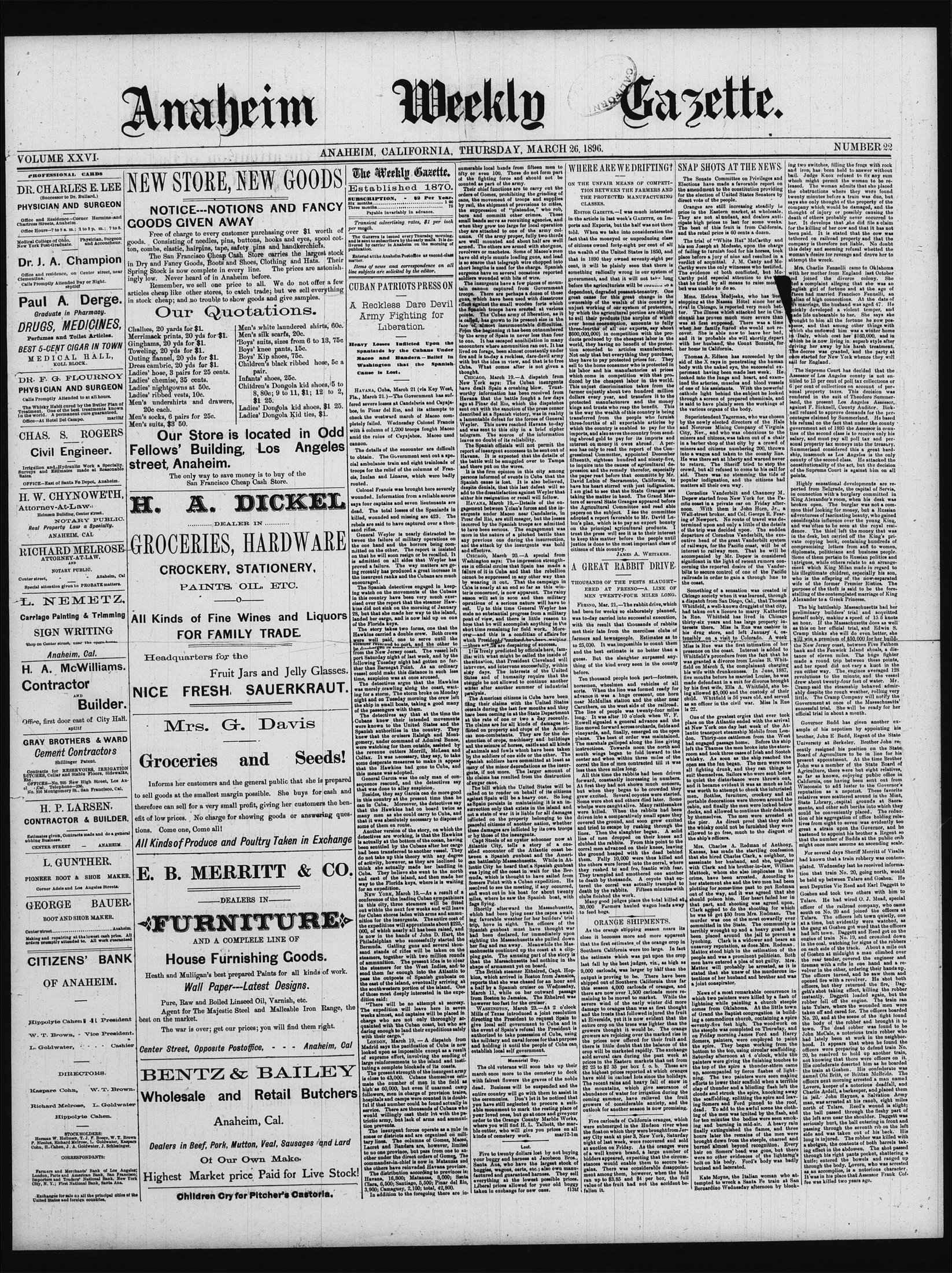
Searchable text
Anaheim
VOLUME XXVI.
PROFESSIONAL CARDS
DR. CHARLES E. LEE
(Successor to Dr. Bullard.)
PHYSICIAN AND SURGEON
Office and Residence—Corner Hermine and Chartress Streets, Anaheim.
Office Hours—7 to 9 a.m.; 1 to 3 p.m.; 7 to 8.
Medical College of Ohio.
New York Post-Graduate.
Physician, Surgeon and Accoucheur.
Dr. J. A. Champion
Office and residence, on Center street, near Clementina.
Calls Promptly Attended Day or Night.
sept5tf
Paul A. Derge.
Graduate in Pharmacy.
DRUGS, MEDICINES,
Perfumes and Toilet Articles.
BEST 5-CENT CIGAR IN TOWN
MEDICAL HALL,
KOLL BLOCK.
DR. F. G. FLOURNOY
PHYSICIAN AND SURGEON
Calls Promptly Attended to at all hours.
The Whisky Habit cured by the Butler Plan of Treatment. One of the best treatments known in the world. A permanent cure guaranteed.
Office—At Hotel Del Campo.
CHAS. S. ROGERS
Civil Engineer.
NEW STORE, NEW GOODS
NOTICE---NOTIONS AND FANCY GOODS GIVEN AWAY
Free of charge to every customer purchasing over $1 worth of goods. Consisting of needles, pins, buttons, hooks and eyes, spool cotton, combs, elastic, hairpins, tape, safety pins and handkerchiefs.
The San Francisco Cheap Cash Store carries the largest stock in Dry and Fancy Goods, Boots and Shoes, Clothing and Hats. Their Spring Stock is now complete in every line. The prices are astonishingly low. Never heard of in Anaheim before.
Remember, we sell one price to all. We do not offer a few articles cheap like other stores, to catch trade; but we sell everything in stock cheap; and no trouble to show goods and give samples.
Our Quotations.
Challies, 20 yards for $1.
Merrimack prints, 20 yds for $1.
Ginghams, 20 yds for $1.
Toweling, 20 yds for $1.
Outing flannel, 20 yds for $1.
Dress cambric, 20 yds for $1.
Ladies' hose, 3 pairs for 25 cents.
Ladies' chemise, 35 cents.
Ladies' nightgowns at 50c.
Ladies' ribbed vests, 10c.
Men's undershirts and drawers, 20c each.
Men's socks, 6 pairs for 25c.
Men's suits, $3 50.
Men's white laundered shirts, 60c.
Men's silk scarfs, 20c.
Boys' suits, sizes from 6 to 13, 75c
Boys' knee pants, 15c.
Boys' Kip shoes, 75c.
Children's black ribbed hose, 5c a pair.
Infants' shoes, 25c.
Children's Dongola kid shoes, 5 to 8, 80c; 9 to 11,$1; 12 to 2,$1 25.
Ladies' Dongola kid shoes,$1 25.
Ladies' Dongola Kid ties,$1.
Our Store is located in Odd Fellows' Building, Los Angeles street, Anaheim.
DR. F. G. FLOURNOY
PHYSICIAN AND SURGEON
Calls Promptly Attended to at all hours.
The Whisky Habit cured by the Butler Plan of Treatment. One of the best treatments known in the world. A permanent cure guaranteed.
Office—At Hotel Del Campo.
CHAS. S. ROGERS
Civil Engineer.
Irrigation and Hydraulic Work a Specialty.
Surveys and Estimates made at Reasonable Rates.
OFFICE—East of Santa Fe Depot, Anaheim.
H. W. CHYNOWETH,
Attorney-At-Law:
Helmsen Building, Center street.
NOTARY PUBLIC.
Real Property Law a Specialty.
ANAHEIM, CAL
RICHARD MELROSE
ATTORNEY-AT-LAW.
AND
NOTARY PUBLIC.
Center street, Anaheim, Cal
Special attention given to PROBATE matters.
L. NEMETZ,
Carriage Painting & Trimming
SIGN WRITING
Shop on Center street, near the opera house.
Anaheim, Cal.
H. A. McWilliams.
Contractor
AND
Builder.
Office, first door east of City Hall.
splitf
GRAY BROTHERS & WARD
Cement Contractors
Shillinger Patent.
Contracts for RESERVOIRS, IRRIGATION DITCHES, Cellar and Stable Floors, Sidewalks, etc.
OFFICES—No. 205 New High Street, Los Angeles, Cal., Telephone—236.
No. 316 Montgomery St., San Francisco, Cal.
H. P. LARSEN,
CONTRACTOR & BUILDER.
Estimates given, Contracts made and do a general obbing Business.
CENTER STREET — ANAHEIM.
L. GUNTHER.
PIONEER BOOT & SHOE MAKER.
Corner Adele and Los Angeles Streets.
Our Store is located in Odd Fellows’ Building, Los Angeles street, Anaheim.
The only way to save money is to buy of the San Francisco Cheap Cash Store.
H. A. DICKEL
DEALER IN .....
GROCERIES, HARDWARE
CROCKERY, STATIONERY,
PAINTS, OIL, ETC.
All Kinds of Fine Wines and Liquors FOR FAMILY TRADE.
Headquarters for the
Fruit Jars and Jelly Glasses.
NICE FRESH SAUERKRAUT.
Mrs. G. Davis
Groceries and Seeds!
Informs her customers and the general public that she is prepared to sell goods at the smallest margin possible. She buys for cash and therefore can sell for a very small profit, giving her customers the benefit of low prices. No charge for showing goods or answering questions. Come one, Come all!
All Kinds of Produce and Poultry Taken in Exchange
E. B. MERRITT & CO.
H. P. LARSEN,
CONTRACTOR & BUILDER.
Estimates given, Contracts made and do a general obbing Business.
CENTER STREET - ANAHEIM.
L. GUNTHER.
PIONEER BOOT & SHOE MAKER.
Corner Adele and Los Angeles Streets.
GEORGE BAUER,
BOOT AND SHOE MAKER.
Center street... Anaheim.
Making and repairing at the lowest cash price. All orders promptly attended to. All work guaranteed
CITIZENS’ BANK
OF ANAHEIM.
Hippolyte Cahen | President
W. T. Brown, Vice President.
L. Goldwater, Cashier
DIRECTORS.
Kaspare Cohn, W. T. Brown.
Richard Melrose, L. Goldwater
Hippolyte Cahen.
STOCKHOLDERS:
Herman W. Hellman, T. J. F. Boege, W. T. Brown
P. Nicolus, Richard Melrose, L. Goldwater, Kaspare Cohn, H. Cahen, J. A. Goldwater, J. Schlesinger.
CORRESPONDANTS:
Farmers and Merchants' Bank of Los Angeles;
London, Paris and American Bank, San Francisco;
Importers and Traders' National Bank, New York City, N.Y.; First National Bank, Santa Ana.
Exchanges for sale on all the principal cities of the United States and foreign countries,
therefore can sell for a very small profit, giving her customers the benefit of low prices. No charge for showing goods or answering questions. Come one, Come all!
All Kinds of Produce and Poultry Taken in Exchange
E. B. MERRITT & CO.
DEALERS IN
FURNITURE
AND A COMPLELE LINE OF
House Furnishing Goods.
Heath and Muliigan's best prepared Paints for all kinds of work.
Wall Paper---Latest Designs.
Pure, Raw and Boiled Linseed Oil, Varnish, etc.
Agent for The Majestic Steel and Malleable Iron Range, the best on the market.
The war is over; get our prices; you will find them right.
Center Street, Opposite Postoffice, ... Anaheim, Cal
BENTZ & BAILEY
Wholesale and Retail Butchers
Anaheim, Cal.
Dealers in Beef, Pork, Mutton, Veal, Sausages and Lard
Of Our Own Make.
Highest Market price Paid for Live Stock
Children Cry for Pitcher's Castoria.
Weekly Gazette
ANAHEIM, CALIFORNIA, THURSDAY, MARCH 26, 1896.
GOODS
AND FANCY
We do not offer a few we sell everything give samples.
ONs.
Launched shirts, 60c.
Arfs, 20c.
Zees from 6 to 13, 75c
Gants, 15c.
Zees, 75c.
Ribbed hose, 5c a
25c.
Angola kid shoes, 5 to 11,$1; 12 to 2,
Ola kid shoes,$1.1
Ola Kid ties,$1.
ed in Odd Angeles
The Weekly Gazette.
Established 1870.
SUBSCRIPTION, - $2 Per Year.
Six months. 1 00
Three months. 75
Payable invariably in advance.
Transient advertising rates, $1 per inch per month.
The Gazette is issued every Thursday morning, and is sent to subscribers by the early mails. It is delivered by carrier in Anaheim on the morning of publication.
Entered at the Anaheim Postoffice as second-class matter.
Items of news and correspondence on all live subjects are solicited by the editor.
CUBAN PATRIOTS PRESS ON
A Reckless Dare Devil Army Fighting for Liberation.
Heavy Losses Inflicted Upon the Spaniards by the Cubans Under Maceo and Bandera—Belief In Washington that the Spanish Cause is Lost.
HAVANA, Cuba, March 21 (via Key West, Fla., March 21.)—The Government has suffered severe losses at Candelaria and Cayajabos, in Pinar del Rio, and its attempts to check the westward march of Maceo completely failed. Wednesday Colonel Francis with a column of 1,200 troops fought Maceo amid the ruins of Cayajabos. Maceo used cannon.
The details of the encounter are difficult to obtain. The Government sent out a special ambulance train and eight trainloads of troops for the relief of the columns of Fran-
numerable local bands from fifteen men to fifty or even 100. These do not form part of the fighting force and should not be counted as part of the army.
Their chief functions are to carry out the orders of Gomez, prohibiting the grinding of cane, the movement of troops and supplies by rail, the shipment of provisions to cities, the suppression of "plateados," who rob, burn and committ other crimes. These small bands serve as recruiting agencies, and when they grow too large for local operation they are attached to one of the army columns. Of the army proper, fully two-thirds are well mounted and about half are well armed. The others are armed with shotguns, revolvers or machetes. Some of Maceo's men have old style muzzle loading guns, and lead is so scarce that telegraph wire chopped into short lengths is used for the charge. Spanish surgeons have on several occasions reported soldiers wounded with bits of wire.
The insurgents have a few pieces of mountain cannon captured from Government troops. There are perhaps a dozen of these guns, which have been used with disastrous effect against the small wooden forts which the Spanish troops have erected at various points. The Cuban army of liberation, as it is called, has grown to its present size in the face of almost insurmountable difficulties. From the beginning it has been outnumbered by the army of Spain in never less than four to one. It has escaped annihilation in many encounters where ammunition ran out. It has lived on forage, been almost constantly under fire and is to-day a rockless, dare-devil army with but the idea in view, and that is to free Cuba. What comes after is not given a thought.
CHICAGO, March 19.—A dispatch from New York says: The Cuban insurgents have dealt Spain a crushing blow. Trustworthy information has been received from Havana that the battle fought a few days ago at Pinar del Rio, which the dispatches sent out with the sanction of the press censor described as a Spanish victory, was in reality a lamentable defeat for the forces of General Weyler. This news reached Havana to-day and was sent to this city in a brief cipher telegram. The source of the information leaves no doubt of its reliability.
The Spanish officials will not permit the report of insurgent successes to be sent out of Havana. It is expected that the details of the battle will be smuggled over to Tampa and there put on the wires.
It is the firm opinion in this city among WHERE ARE WE DRIFTING?
ON THE UNFAIR MEANS OF COMPETITION BETWEEN THE FARMERS AND THE PROTECTED MANUFACTURING CLASSES.
EDITOR GAZETTE.—I was much interested in the article in last week's Gazette, on Imports and Exports, but the half was not there told. When we take into consideration the fact that the moneyed or unproducing class of citizens owned forty-eight per cent of all the wealth of the United States in 1850, and that in 1890 they owned seventy-eight per cent, it will be plainly seen that there is something radically wrong in our system of government, and that it will not take long before the agriculturists will be reduced to a dependent, degraded peasant-tenantry. One great cause for this great change in the ownership of the wealth of this country is unjust working of our system of protection, by which the agricultural portion are obliged to sell their products (the surplus of which over home consumption, amounts to fully three-fourths of all our exports, say about $600,000,000) in competition with the products produced by the cheapest labor in the world, they having no benefit of the protection accorded to articles manufactured. Not only that but everything they purchase, they have to pay protected prices for. They sell to the home consumer who is protected in his labor and his manufactories at prices which come in competition with that produced by the cheapest labor in the world. This unjust discrimination takes from the farmer unjustly about two hundred million dollars every year, and transfers it to the protected manufacturers and the money kings and trusts who reap the benefit. This is the way the wealth of this country is being transferred from the people who furnish three-fourths of all exportable articles by which the country is enabled to pay for the imports, and also saves the country from sending abroad gold to pay for its imports and interest on money it owes abroad. A per son has only to read the report of the Congressional Committee, appointed December fifteenth, eighteen hundred ninety-five to inquire into the causes of agricultural deposition and the remedy thereof, especially before that committee by Mr.
HAVANA, Cuba, March 21 (via Key West, Fla., March 21).—The Government has suffered severe losses at Candelaria and Cayajabos, in Pinar del Rio, and its attempts to check the westward march of Maceo completely failed. Wednesday Colonel Francis with a column of 1,200 troops fought Maceo amid the ruins of Cayajabos. Maceo used cannon.
The details of the encounter are difficult to obtain. The Government sent out a special ambulance trainloads of troops for the relief of the columns of Francis, Inclan and Linares, which were badly routed.
Colonel Francis was brought here severely wounded. Information from a reliable source says four captains and seven lieutenants are dead. The total losses of the Spaniards in killed, wounded and missing are 423. The rebels are said to have captured over a thousand rifles.
General Weyler is nearly distracted between the failure of military operations on the one hand and the horrors being committed on the other. The report is insisted on that he will soon resign or be recalled. It is admitted on all sides that Weyler has proved a failure. The way matters are going recently has produced a great increase in the insurgent ranks and the Cubans are much encouraged.
The Spanish detectives engaged in keeping watch on the movements of the Cubans in this country have been very much exercised over the report that the steamer Hawkins did not sink on the morning of January 28, but that she made her way to the island, landed her cargo, and is now laid up on one of the Florida keys.
The story takes two forms, one that the Hawkins carried a double crew. Both crews were well paid, one to serve until the steamer returned to port, and the other to from the New Jersey coast. The vessel left port Saturday night of last week, and by the following Tuesday night had gotten no further than Barnegat Point. As an ordinary vessel could make this distance in such less time, suspicion was at once aroused.
The detectives argue that the Hawkins was merely crawling along the coast, waiting for a storm. The storm broke on Monday night and on Tuesday morning the crew left the ship in small boats, taking a good many of the passengers with them.
The detectives say that at the time the Cubans knew their intended movements were known to the United States and the Spanish authorities in the country. They knew that the cruisers Raleigh and Montgomery, under command of Admiral Bunce, were watching for them outside, assisted by the revenue cutters Morrill, McLean and Colfax. It was necessary, they say, to take some desperate measures to make it appear that the Hawkins had gone to Cuba, and this means was adopted.
General Garcia was the only man of consequence rescued, and the detectives say that was done to allay suspicion.
Besides, they say García can do more good in this country at the present time than he can in Cuba. Moreover, the detectives say that the Hawkins had on board twice as many men as she could carry to Cuba, and that it was absolutely necessary to dispose of some of them on route.
Another version of the story, on which the detectives are working, is that the Hawkins is actually at the bottom of the ocean, having been sentled by the Cubans after her cargo had been transferred to another vessel. They do not take up this theory with any degree of activity, however, as they are inclined to think she actually made her landing in Cuba. They believe she went to the north and east of the island, and then made her way to the Florida keys, where is waiting for an expedition.
NEW YORK, March 19.—As a result of a conference of the leading Cuban sympathizers with a column of 1,200 troops fought Maceo amid the ruins of Cayajabos. Maceo used cannon.
The details of the encounter are difficult to obtain. The Government sent out a special ambulance trainloads of troops for the relief of the columns of Francis, Inclan and Linares, which were badly routed.
Colonel Francis was brought here severely wounded. Information from a reliable source says four captains and seven lieutenants are dead. The total losses of the Spaniards in killed, wounded and missing are 423. The rebels are said to have captured over a thousand rifles.
General Weyler is nearly distracted between the failure of military operations on the one hand and the horrors being committed on the other. The report is insisted on that he will soon resign or be recalled. It is admitted on all sides that Weyler has proved a failure. The way matters are going recently has produced a great increase in the insurgent ranks and the Cubans are much encouraged.
The Spanish detectives engaged in keeping watch on the movements of the Cubans in this country have been very much exercised over the report that the steamer Hawkins did not sink on the morning of January 28, but that she made her way to the island, landed her cargo, and is now laid up on one of the Florida keys.
The story takes two forms, one that the Hawkins carried a double crew. Both crews were well paid, one to serve until the steamer returned to port, and the other to from the New Jersey coast. The vessel left port Saturday night of last week, and by the following Tuesday night had gotten no further than Barnegat Point. As an ordinary vessel could make this distance in such less time, suspicion was at once aroused.
The detectives argue that the Hawkins was merely crawling along the coast, waiting for a storm. The storm broke on Monday night and on Tuesday morning the crew left the ship in small boats, taking a good many of the passengers with them.
The detectives say that at the time the Cubans know their intended movements were known to the United States and the Spanish authorities in the country. They knew that the cruisers Raleigh and Montgomery, under command of Admiral Bunce, were watching for them outside, assisted by the revenue cutters Morrill, McLean and Colfax. It was necessary, they say, to take some desperate measures to make it appear that the Hawkins had gone to Cuba, and this means was adopted.
General Garcia was only man of consequence rescued, and the detectives say that was done to allay suspicion.
Besides, they say García can do more good in this country at the present time than he can in Cuba. Moreover, the detectives say that the Hawkins had on board twice as many men as she could carry to Cuba, and that it was absolutely necessary to dispose of some of them on route.
Another version of the story, on which the detectives are working, is that the Hawkins is actually at the bottom of the ocean, having been sentled by the Cubans after her cargo had been transferred to another vessel. They do not take up this theory with any degree of activity, however, as they are inclined to think she actually made her landing in Cuba. They believe she went to the north and east of the island, and then made her way to the Florida keys, where is waiting for an expedition.
NEW YORK, March 19.—As a result of a conference of the leading Cuban sympathizers with a column of 1,200 troops fought Maceo amid the ruins of Cayajabos. Maceo used cannon.
The details of the encounter are difficult to obtain. The Government sent out a special ambulance trainloads of troops for the relief of the columns of Francis, Inclan and Linares, which were badly routed.
Colonel Francis was brought here severely wounded. Information from a reliable source says four captains and seven lieutenants are dead. The total losses of the Spaniards in killed, wounded and missing are 423. The rebels are said to have captured over a thousand rifles.
General Weyler is nearly distracted between the failure of military operations on the one hand and the horrors being committed on the other. The report is insisted on that he will soon resign or be recalled. It is admitted on all sides that Weyler has proved a failure. The way matters are going recently has produced a great increase in the insurgent ranks and the Cubans are much encouraged.
The Spanish detectives engaged in keeping watch on the movements of the Cubans in this country have been very much exercised over the report that the steamer Hawkins did not sink on the morning of January 28, but that she made her way to the island, landed her cargo, and is now laid up on one ofthe Florida keys.
The story takes two forms, one that the Hawkins carried a double crew. Both crews were well paid, one to serve until the steamer returned to port, and the other to from the New Jersey coast. The vessel left port Saturday night of last week, and by the following Tuesday night had gotten no further than Barnegat Point. As an ordinary vessel could make this distance in such less time, suspicion was at once aroused.
The detectives argue that the Hawkins was merely crawling along the coast, waiting for a storm. The storm broke on Monday night and on Tuesday morning the crew left the ship in small boats, taking a good many ofthe passengers with them.
The detectives say that at timethe Cubans know their intended movements were known tothe United StatesandtheSpanish authoritiesinthecountry.ThetheyknowthatthecruisersRaleighandMontgomeryundercommandofAdmiralBuncewerewatchingforthemoutsideassistiedbytherevenuecuttersMorrill,McLeanandColfax.Itsnecessary,theysay,tothesedesperatemeasurestomakeitappearthattheHawkinshadgonetocuba,andthismeasuredwasadopted.
General Garciawasonlymanofconsequencerescued,andthedetectivessaythatwasdonetoallaysuspicion.
Besides,theysayGarcíacandomoregoodinthiscountryatthepresenttimehanhecaninCuba.Moreover,thedetectivessaythattheHawkinshadonboardtwiceasmanymenasshecouldcarrytocuba,andthatitwasabsolutelynecessarytouseofsomeofthemonroute.
Anotherversionofthestory.onwhichthedetectivesareworking.isthattheHawkinsisactuallyatbottomoftheoccean,havingbeensentledbytheCubansafterhercargohadbeentransferredtoanothervessel.Theydontakeupthistheorywithanydegreeofactivity,however,theysareinclinedtothinksheactuallymadeherlandinginCuba.Theybelieveshewenttothenorthandeastofthe岛,andthenmadeherwaytotheFloridakeys.whereiswaitingforanexpedition.
NEWYORK,March21.(viaKeyWest,Fla.,March21.)—TheGovernmenthassufficedseverelossatCandelariaandCayajabos,binPinardelRio,anditsattemptsathesteamerowkindissolvedoverthereportthatthesteamerHawkinsdidnotsinkonthemorningofJanuary28,但那她madeherwaytothe岛,Landedhercargo,andisnowlaidupononeoftheFloridakeys.
The story takes two forms,一件thattheHawkinscarriedadoublecrew.Bothcrewswerewellpaid,一件thattheHawkinscarriedadoublecrew.Bothcrewswerewellpaid,一件thattheHawkinscarriedadoublecrew.Bothcrewswerewellpaid,一件thattheHawkinscarriedadoublecrew.Bothcrewswerewellpaid,一件thattheHawkinscarriedadoublecrew.Bothcrewswerewellpaid,一件thattheHawkinscarriedadoublecrew.Bothcrewswerewellpaid,一件thattheHawkinscarriedadoublecrew.Bothcrewswerewellpaid,一件thattheHawkinscarriedadoublecrew.Bothcrewswerewellpaid,一件thattheHawkinscarriedadoublecrew.Bothcrewswerewellpaid,一件thattheHawkinscarriedadoublecrew.Bothcrewswerewellpaid,一件thattheHawkinscarriedadoublecrew.Bothcrewswerewellpaid,一件thattheHawkinscarriedadoublecrew.Bothcrewswerewellpaid,一件thattheHawkinscarriedadoublecrew.Bothcrewswerewellpaid,一件thattheHawkinscarriedadoublecrew.Bothcrewswerewellpaid,一件thattheHawniscarriedadoublecrew.Bothcrewswerewellpaid,一件thattheHawniscarriedadoublecrew.Bothcrewswerewellpaid,一件thattheHawniscarriedadoublecrew.Bothcrewswerewellpaid,一件thattheHawniscarriedadoublecrew.Bothcrewswerewellpaid,一件thattheHawniscarriedadoublecrew.Bothcrewswerewellpaid,一件thattheHawniscarriedadoublecrew.Bothcrewswerewellpaid,一件thattheHawniscarriedadoublecrew.Bothcrewswerewellpaid,一件thattheHawniscarriedadoublecrew.Bothcrewswerewellpaid,一件thattheHawniscarriedadoublecrew.Bothcrewswerewellpaid,一件thattheHawniscarriedadoublecrew.Bothcrewswerewellpaid,一件thattheHawniscarriedadoublecrew.Bothcrewswerewellpaid,一件thattheHawniscarriedadoublecrew.Bothcrewswerewellpaid,一件thattheHawniscarriedadoublecrew.Bothcrewswerewellpaid,一件thattheHawniscarriedaDoublecrew.Bothcrewswerewellpaid,一件thattheHawniscarriedaDoublecrew.Bothcrewswerewellpaid,一件thattheHawniscarriedaDoublecrew.Bothcrewswerewellpaid,一件thattheHawniscarriedaDoublecrew.Bothcrewswerewell付费,二是also believed, despite denials, that this last defeat will soil away from it,now there is no reason for it,therefore, it is also believed, despite denials, that this last defeat will soil away from it,now there is no reason for it,therefore, it is also believed, despite denials, that this last defeat will soil away from it,now there is no reason for it,therefore, it is also believed, despite denials, that this last defeat will soil away from it,now there is no reason for it,therefore, it is also believed, despite denials, that this last defeat will soil away from it,now there is no reason for it,therefore, it is also believed, despite denials, that this last defeat will soil away from it,now there is no reason for it,therefore, it is also believed, despite denials, that this last defeat will soil away from it,now there is no reason for it,therefore, it is also believed, despite denials, that this last defeat will soil away from it,now there is no reason for it,therefore, it is also believed, despite denials, that this last defeat will soil away from it,now there is no reason for it,therefore, it is also believed, despite denials, that this last defeat will soil away from it,now there is no reason for it,therefore, it is also believed, despite denials, that this last defeat will soil away from it,now there is no reason for it,therefore, it is also believed, despite denials, that this last defeat will soil away from it,now there is no reason for it,therefore, it is also believed, despite denials, that this last defeat will soil away from it,now there is no reason for it,therefore, it is also believed, despite denials, that this last defeat will soil away from it,now there is no reason for it,therefore, it is also believed, despite denials, that this last defeat will soil away from it,now there is no reason for它,
therefore,
it
is
also
believed,
despite
denials,
that
this
last
defeat
will
soil
away
from
it,
now
there
is
no
reason
for
it,
therefore,
it
is
also
believed,
despite
denials,
that
this
last
defeat
will
soil
away
from
it,
now
there
is
no
reason
for
it,
therefore,
it
is
also believed,
despite
denials,
that
this
last
defeat
will
soil
away
from
it,
now there
is
no
reason
for
it,
therefore,
it
is
also believed,
despite
denials,
that
this
last defeat
will
soil away from
it,
now there
is
no reason for
it,
therefore,
it
is also believed,
despite denials,
that this last defeat will soil away from it,
now there is no reason for它,
therefore,
it
is also believed,
despite denials,
that this last defeat will soil away from它,
now there is no reason for它,
therefore,
it is also believed,
despite denials,
that this last defeat will soil away from它,
now there is no reason for它,
therefore,
it is also believed,
despite denials,
that this last defeat will soil away from它,
now there is no reason for它,
therefore,
it is also believed,
despite denials,
that this last defeat will soil away from它,
now there is no reason for它,
therefore,
it is also believed,
despite denials,
that this last defeat will soil away from它,
now there is no reason for它,
therefore,
it is also believed,
despite denials,
that this last defeat will soil away from它,
now there is no reason for它,
therefore,
it is also believed,
despite denials,
that this last defeat will soil away from它,
now there is no reason for它,
therefore,
it is also believed,
despite denials,
that this last defeat will soil away from它,
now there is no reason for它,
therefore,
it is also believed,
despite denials,
that this last defeat will soil away from它。
whereiswaitingforanexpedition.
NEWYORK,March21.(viaKeyWest,Fla.,March21.)—TheGovernmenthassufficedseverelossatCandelariaandCayajabos,binPinardelRio,andnitairaforthesteamerowkindissolvedoverthereportthatthesteamerowkindissolvedoverthereportthatthesteamerowkindissolvedoverthereportthatthesteamerowkindissolvedoverthereportthatthesteamerowkindissolvedoverthereportthatthesteamerowkindissolvedoverthereportthatthesteamerowkindissolvedoverthereportthatthesteamerowkindissolvedoverthereportthatthesteamerowkindissolvedoverthreesteadesignationofthesteamerowkindissolvedoverthreesteadesignationofthesteamerowkindissolvedoverthreesteadesignationofthesteamerowkindissolvedoverthreesteadesignationofthesteamerowkindissolvedoverthreesteadesignationofthesteamerowkindissolvedoverthreesteadesignationofthesteamerowkindissolvedoverthreesteadesignationofthesteamerowkindissolvedoverthreesteadesignationofthesteamerowkindissolvedoverthreesteadesignationofthesteamerowkindissolvedoverthreesteadesignationofthesteamerowkindissolvedoverthreesteadesignationofthesteamerowkindissolvedoverthreesteadesignationofthesteamerowkindissolvedoverthreesteadesignationofthesteamerowkindissolvedoverthreesteadesignationofthesteamerowkindissolvedoverthreesteadesignationofthesteamerowkindissolvedoverthreesteadesignationofthesteamerowkindissolvedoverthreesteadesignationofthesteamerowkindissolvedoverthreesteadesignationofthesteamerowkindissolvedoverthreesteadesignationofthesteamerowkindissolvedoverthreesteadesignationofthesteamerowkindissolvedoverthreesteadesignationofthesteamerowkindissolvedoverthreesteadesignationofthesteamerowkindissolvedoverthreesteadesignationofthesteamerowkindissolvedoverthreesteadesignationofthesteamerowkindissolvedoverthreesteadesignationofthesteamerowkindissolvedoverthreesteadesignationofthesteamerowkindissolvedoverthreesteadesignationofthesteamerowkindissolvedoverthreesteadesignationofthesteamerowkindissolvedoverthreesteadesignationofthesteamerowkindissolvedoverthreesteadesignationofthesteamerowkindissolvedoverthreesteadesignationofthesteamerowkindissolvedoverthreesteadesignationofthesteamerowkindissolvedoverthreesteadesignationofthesteamerowkindissolvedoverthreesteadesignationofthesteammerowkindissolvedoverthreesteadesignationofthesteammerowkindissolvedoverthreesteadesignationofthesteammerowkindissolvedoverthreesteadesignationofthesteammerowkindissolvedoverthreesteadesignationofthesteammerowkindissolvedoverthreesteadesignation ofthedestinationoftherememberstatesandvillagesandvillagesandvillagesandvillagesandvillagesandvillagesandvillagesandvillagesandvillagesandvillagesandvillagesandvillagesandvillagesandvillagesandvillagesandvillagesandvillagesandvillagesandvillagesandvillagesandvillagesandvillagesandvillagesandvillagesandvillagestandingsandvillagesstandingsandvillagesstandingsandvillagesstandingsandvillagesstandingsandvillagesstandingsandvillagesstandingsandvillagesstandingsandvillagesstandingsandvillagesstandingsandvillagesstandingsandvillagesstandingsandvillagesstandingsandvillagesstandingsandvillagesstandingsandvillagesstandingsandvillagestandingsandvillagestandingsandvillagestandingsandvillagestandings和villagestandings和villagestandings和villagestandings和villagestandings和villagestandings和villagestandings和villagestandings和villagestandings和villagestandings和villagestandings和village standings和village standings和village standings和village standings和village standings和village standings和village standings和village standings和village standings和village standings和village standings和village standings和village standings和VILLAGESTANDSANDVILLAGESTANDSANDVILLAGESTANDSANDVILLAGESTANDSANDVILLAGESTANDSANDVILLAGESTANDSANDVILLAGESTANDSANDVILLAGESTANDSANDVILLAGESTANDSANDVILLAGESTANDSANDVILLAGESTANDSANDVILLAGESTANDSANDVILLAGESTANDSANDVILLAGESTANDSANDVILLESTANDSANDVILLESTANDSANDVILLESTANDSANDVILLESTANDSANDVILLESTANDSANDVILLESTANDSANDVILLESTANDSANDVILLESTANDSANDVILLESTANDSANDVILLESTANDSANDVILLESTANDSANDVILLESTANDSANDVILLESTANDSANDVILLESTANDSANDVILLEST AND VILLAGE STANDS AND VILLAGE STANDS AND VILLAGE STANDS AND VILLAGE STANDS AND VILLAGE STANDS AND VILLAGE STANDS AND VILLAGE STANDS AND VILLAGE STANDS AND VILLAGE STANDLESTANDLESTANDLESTANDLESTANDLESTANDLESTANDLESTANDLESTANDLESTANDLESTANDLESTANDLESTANDLESTANDLESTANDLESTANDLESTANDLESTANDLESTANDLESTANDLESTANDLESTANDLESTANDLESTANDLESTANDLESTANDLESTANDLESTANDLESTANDLESTANDLESTANDLESTANDLESTANDLESTANDLESTANDLEStABLESTALESTABLESTALESTABLEStALEStALEStALEStALEStALEStALEStALEStALEStALEStALEStALEStALEStALEStALEStALEStALEStALEStALEStALEStALEStALEStALEStALEStALEStALEStALEStALEStALEStALEStALEStALEStALEStALEStALEStALEStALEStALEStALEStALEStALEStALEStALE StALLEStALEStALLEStALLEStALLEStALLEStALLEStALLEStALLEStALLEStALLEStALLEStALLEStALLEStALLEStALLEStALLEStALLEStALLEStALLEStALLEStALLEStALLEStALLEStALLEStALLEStALLEStALLE StALLE StALLE StALLE StALLE StALLE StALLE StALLE StALLE StALLE StALLE StALLE StALLE StALLE StALLE StALLE StALLE StALLE StALLE StALLE StALLE StALLE StALLE StALLE StAlley StAlley StAlley StAlley StAlley StAlley StAlley StAlley StAlley StAlley StAlley StAlley StAlley StAlley StAlley StAlley StAlley StAlley StAlley StAlley StAlley StAlley StAlley StAlley StAlley StAlley StAlley StAlley StAlley StAlley StAlley StAlley StAlley STAIL STAIL STAIL STAIL STAIL STAIL STAIL STAIL STAIL STAIL STAIL STAIL STAIL STAIL STAIL STAIL STAIL STAIL STAIL STAIL STAIL STAIL STAIL STAIL STAIL STAIL STAIL STAIL STAIL STAIL
in this country at the present time that he can in Cuba. Moreover, the detectives say that the Hawkins had on board twice as many men as she could carry to Cuba, and that it was absolutely necessary to dispose of some of them en route.
Another version of the story, on which the detectives are working, is that the Hawkins is actually at the bottom of the ocean, having been suttled by the Cubans after her cargo had been transferred to another vessel. They do not take up this theory with any degree of activity, however, as they are inclined to think she actually made her landling in Cuba. They believe she went to the north and east of the island, and then made her way to the Florida keys, where is waiting for an expedition.
NEW YORK, March 19.—As a result of a conference of the leading Cuban sympathizers in this city, three steamers will be fitted out within the next few weeks and will leave for Cuban shores laden with arms and ammunition for the insurgents. The entire coast of the expeditions will approximate about $225,000, of which nearly all has been raised, and is now in the hands of John D. Hart, the Philadelphia who successfully started the Bermuda. Gatling guns and several thousand stands of rifles will be taken on the steamers, together with two million rounds of ammunition. The present idea is to clear the steamers for the West Indies, and to send them far enough into the Atlantic to pass the outposts of Spanish gunboats on the east of the island, eventually arriving at the southwestern portion of the island. One of those most deeply interested in the expedition said:
"There will be no attempt at secrecy. The expedition will leave here in seven weeks almost, and captains will be placed in charge who are not only thoroughly acquainted with the Cuban coast, but who are daring enough to land their expeditions safely with their cargo."
LONDON, March 19.—A dispatch from Madrid says the pacification of Cuba is now looked upon as impossible except as a result of supreme effort, involving the sending of large reinforcements to the island and instituting a complete blockade of its coasts.
The present strength of the insurgent army is close to 43,000. Cubans themselves estimate the number of men in the field as high as 60,000, but even if unarmed camp followers, men in charge of provision trains, hospitals and camps were counted it is doubtful if that number could be found actually in service. There are thousands of Cubans who would willingly cast their lot with the patriotic army, but lack of arms and ammunition prevents.
The insurgent forces operate as a rule in zones or districts and are organized on military lines. The columns of Gomez, Maco, Lacret and Bandera are, however, limited to no one province, but pass from one to another under the direct orders of Gomez. The commander-in-chief is now in Matauzas and the others have reinvaded Havana province.
The distribution according to provinces is: Havana, 16,800; Matanzas, 8,000; Santa Clara, 6,500; Santiago, 5,500; Pinar del Rio, 3,900; Camaguey, 2,100; total, 42,800.
In addition to the foregoing there are in-
ORANGE SHIPMENTS.
As the orange shipping season near close it becomes more and more apparent that the first estimates of the orange or Southern California were too large. In the estimate which was put upon the last fall by the best judges, viz., as his 9,000 carloads, was larger by half than output is proving to be. There have shipped out of Southern California thus this season 4,000 carloads of oranges there are now over 1,500 carloads more being moved to market. While severe wind of the early winter did damage to oranges than was at first thought and the frosts that followed injured them at Riverside, yet it is now evident that entire crop on the trees was lighter than growers thought it would be. The org growers are rejoicing over the marked price now offered for their fruit there is little doubt that the balance crop will be marketed rapidly. The exe-sold several cars during the past wei- prices in the Eastern markets that net $2 25 to $2 35 per box f. o.b. The highest prices reported at which owe have sold in carload lots since the hol- The recent rains and heavy fall of an mountains, which give assurance abundance of water for irrigation during coming summer, have relieved the growers of considerable anxiety, and outlook for another season is now pro-
Five carloads of California oranges were submerged in the Hudson river the float on which they were brought from sey City sank at pier 3, New York. Night of last week, were recovered and auction on Friday. As the oranges of a well known brand, a large num-bidders appeared, expecting that the o-stances would enable them to secu-gains. There was considerable disa-ment among them, however, when theran up to $3.85 and $4 per box,the value of the fruit had not the accid-fallen it.
WE ARE WE DRIFTING?
IN FAIR MEANS OF COMPETITION THE FARMERS AND PROTECTED MANUFACTURING MES.
GAZETTE.—I was much interested in last week's Gazette, on Imports, but the half was not there we take into consideration the moneyed or unproducing class owned forty-eight per cent of all of the United States in 1850, and 70 they owned seventy-eight per cent be plainly seen that there is radically wrong in our system of and that it will not take long agriculturists will be reduced to a degraded peasant-tenantry. One of this great change in the wealth of this country is rising of our system of protection, the agricultural portion are obliged products (the surplus of which consumption, amounts to fully of all our exports, say about 20) in competition with the produced by the cheapest labor in the having no benefit of the protected to articles manufactured, at but everything they purchase, pay protected prices for. They some consumer who is protected and his manufactories at prices in competition with that produce the cheapest labor in the having no benefit of the protected to articles manufactured, at but everything they purchase, pay protected prices for. They some consumer who is protected and his manufactories at prices in competition with that produce the cheapest labor in the having no benefit of the protected to articles manufactured, at but everything they purchase, pay protected prices for.
Mme. Helena Modjeska, who has been stopping at the Nassau Hotel since her arrival in Chicago, is reported very much better. The illness which attacked her in Cincinnati has proven much more severe than was at first supposed. There was a time when her family feared she would not recover. She is able now to leave her bed, and it is probable she will shortly depart with her husband, the Count Bozents, for her home in California.
Thomas A. Edison has succeeded by the aid of the X rays in penetrating the human body with the naked eye, the successful experiment having been made last week. He looked into the lungs and heart, and examined the arteries, muscles and blood vessels of one of his assistants. With the powerful cathode light behind the subject he looked through a screen of prepared chemicals, and is said to have plainly seen the workings of the various organs of the body.
Superintendent Tagerman, who was chosen by the newly elected directors of the Hale and Norcross Mining Company of Virginia City, Nev., and who was obnoxious to the miners and citizens, was taken out of a chair in a barber shop of that city by a crowd of miners and citizens numbering 200, thrown into a wagon and taken to the county line. He was there set at liberty and warned never to return. The Sheriff trined to stop the crowd, but all refused to come to his call for ing two switches, filling the frogs with rock and iron, has been held to answer without bail. Judge Knox refused to fix any sum which might permit the woman to be released. The woman admits that she placed the obstructions where they were found twenty minutes before a train was due, but says she only thought of the property of the company which would be damaged, and the thought of injury or possibly causing the death of others probably never occurred to her. It develops that she did file a claim for the killing of her cow and that it has not been paid. It is stated that the cow was tethered on railroad property and that the company is therefore not liable. No doubt this delay and seeming refusal whetted the woman's desire for revenge and drove her to attempt the wreck.
Mrs. Charlie Fennelli came to Oklahoma with her mother from England last October and joined the divorce colony. She led a complaint alleging that she was an English girl of fortune and at the age of fifteen had married Francisco Fennelli, an Italian of high connections. At the date of his marriage, the husband was aged 47. He quickly developed a violent temper, and made life unbearable to her. She says she brought to him all the fortune he now possesses, and that among other things with which she endowed him was a winter-home in Italy, which cost her $160,000, and in which he is now living in superb style after driving her away by his harsh treatment. The decree was granted, and the party at once started for New York whence they will sail for England.
The Supreme Court has decided that the Assessor of Los Angeles county is not entitled to 15 per cent of poll tax collections or 6 per cent of collections on account of personal property taxes. This decision was rendered in the suit of Theodore Summerland, the present Los Angeles Assessor, against F. Bicknell, County Auditor. Bicknell refused to approve demands for the percentages claimed by Summerland. He based his refusal on the fact that under the county government act of 1895 the Assessor in counties of the second class is to receive only his salary, and must pay all poll tax and personal property tax moneys into the treasury. Summerland considered this a great hardship, insomuch as Los Angeles is the only county of the second class. He attacked the constitutionality of the act, but the decision of the Supreme Court is against him on all points.
in competition with that cheapest labor in the world, and discrimination takes from the vastly about two hundred million every year, and transfers it to the manufacturers and the money trusts who reap the benefit. This is the wealth of this country being from the people who furnish us of all exportable articles by country is enabled to pay for the also saves the country from send-gold to pay for its imports and money it owes abroad. A per-ty to read the report of the Con-committee, appointed December eighteen hundred and ninety-five, into the causes of agricultural deed the remedy therefor, especially head before that committee by Mr. man of Sacramento, California, to start stirred with just indignation. No see that the State Granges are matter in hand. The Grand Mas-terial State Granges appeared before cultural Committee and read able the subject. I see the committee report favorable to Mr. David Luftham which is to pay an export bounty municipal agricultural products. I press will see it is to their interest as matter before the people until none to the most important class of this country.
JAMES A. WHITAKER.
EAT RABBIT DRIVE
BODS OF THE PESTS SLAUGHT-ED AT FRESNO—A LINE OF TWENTY-FOUR MILES LONG.
Mar. 21. — The rabbit drive, which four weeks so elaborately planned, was carried into successful execution, result that thousands of rabbits fate from the merciless clubs of townpeople. Estimates as to it was impossible to count them best estimate is no better than a fact that the slaughter surpassed any kind every seen in the county.
Husband and people took part—footmen, when the line was formed ready for it was a huge crescent, one horn Mullan station and the other near on the west side of the railroad. Of people was twenty-four miles was after 10 o'clock when W. F. Galea general a general advance and the had forward across orchards, fields and, finally, emerged on the open The best of order was maintained. Shall galloped along the line giving tons. Towards noon the north and dud when within three miles of the line of men contracted till it was three miles long.
This time the rabbits had been driven constantly increasing in numbers. They had not shown much concern, they began to be crowded they litited. Several coyotes were started, some were caught alive. Many rattlesnakes killed. When the rabbits had been into a comparatively small space they got ground, and soon grew excited to escape by rushing through the When the slaughter began. A solid men dropped on their knees and the rabbits. From this point to the men advanced on their knees, leaving round heaped with the dead behind Fully 10,000 were thus killed and were forced into the corral, whereashed to and fro, frantic with fear,ampled and smothered one another by thousands. A coyote that chewed the corral was actually trampled to the rabbits. Fifteen minutes with finished the work.
Superintendent Tagerman, who was chosen by the newly elected directors of the Hale and Norcross Mining Company of Virginia City, Nev., and who was obnoxious to the miners and citizens, was taken out of a chair in a barber shop of that city by a crowd of miners and citizens numbering 200, thrown into a wagon and taken to the county line. He was there set at liberty and warned never to return. The Sheriff tried to stop the crowd, but all refused to come to his call for aid. There was not stemming the tide of popular indignation, and the citizens had matters all their own way.
Cornelius Vanderbilt and Chaucey M. Depew started from New York for the Pacific coast in a private car on Friday afternoon. With them is John Horn, Jr., a Wall-street broker, and Col. George R. Fearing of Newport. No route of travel was determined upon and only a little of the details of the trip was decided upon. The sudden departure of Cornelius Vanderbilt, the executive head of the great Vanderbilt system of railways, for the Pacific coast, will be of interest to railway men. That he will be accompanied by Mr. Depew is considered significant in the light of recent rumors concerning the reported desire of the Vanderbilts to secure control of one of the Pacific railroads in order to gain a through line to the coast.
Something of a sensation was created in Chicago society when it was learned, through a dispatch from San Diego, Cal., that Thomas Whitfield, a well-known druggist of that city, had taken out a license to marry Katherine la Rue. Whitfield has lived in Chicago thirty-six years and has large property interests there. Miss la Rue was cashier in his drug store, and left January 4, tenably on a visit to Colorado. A week Miss la Rue was the first intimation of her presence on the coast. Interest is added to Whitfield's procedure from the fact that he was granted a divorce from Louise B. Whitfield on March 5, the complain charging his wife with drunkenness. In June, 1887, five months before he married Louise, he made defendant in a suit for divorce brought by his first wife, Ella A. Whitfield, she being allowed $5,000 and the custody of their child. Whitfield is 56 years old, and served as an officer in the civil war. Miss la Rue is 22.
One of the greatest orgies that ever took place on the Atlantic end with the arrival at New York one day last week of the Atlantic transport steamship Mobile from London. Thirty-one cattlemen from the West had engaged passage home. Before the ship left the Thames men broke into the store-room and took three cases of Irish and Scotch whisky. As soon as the ship reached the open sea fun began. The men were soon all fighting drunk, and they ran things to suit themselves. Sailors who were sent below to quiet the disturbance were thrown out, and it became evident it was as much as life was worth to attempt to check the infuriated men. Bottles, furniture, crockery and all portable decorations were thrown around the cabin, and finally the men were locked below decks, and allowed to continue their debauch by themselves. The men were arrested at the pier. As direct proof that they stole the whisky could not be furnished they were allowed to go free, much to the disgust of the ship's officers.
Mrs. Charles A. Rodman of Anthony, Kansas, has made the startling confession that she hired Charles Clark, a neighbor, to assassinate her husband, and she, together with Clark and his brother-in-law William Mattock, whom she also implicates in the crime, have been arrested. According to her statement she and two men had been plotting for some time past to put Rodman out of the way, and it was agreed that she should poison him. Her heart failed her in Assessor of Los Angeles county is not entitled to 15 per cent of poll tax collections or 6 per cent of collections on account of personal property taxes. This decision was rendered in the suit of Theodore Summerland, the present Los Angeles Assessor, against F. Bicknell, County Auditor. Bicknell refused to approve demands for the percentages claimed by Summerland. He based his refusal on the fact that under the county government act of 1895 The Assessor in counties of the second class is to receive only his salary, and must pay all poll tax and personal property tax moneys into the treasury. Summerland considered this a great hardship, insmuch as Los Angeles is only county of the second class. He attacked the constitutionality of the act, but the decision of the Supreme Court is against him on all points.
Highly sensational developments are reported from Belgrade, the capital of Servia, in connection with a burglary committed in King Alexander's room, when his desk was broken open. The burglar was not a common thief looking for money, but a Russian adventures of fascinating beauty, who gained considerable influence over the young King,and was often to be seen at the royal residence.The thief left the money that was in the desk, but carried off the King's private copying book, containing hundreds of compromising letters from and to women,d diplomats,politicians and business people.Some of them pertain to Russian politics and intrigues while others relate to an arrangement which King Milan made in regard to his illegitimate children,specially his son,the is offspring of the now-separated wife of the former Premier Ristics.The purpose of the theft is said to be for forestalling ofthe contemplated marriage of King Alexander to a Greek Princess.
The big battleship Massachusetts had her preliminary builders' trial and acquitted herself nobly,making a speed of 15.6 knots an hour. If The Massachusetts does as well as this on her official trial,and Edwin S.Cramp thinks she will do even better,she will win a premium of $50,000 for her build-the New Jersey coast,between Five Fathom bank and The Fenwick Island shoals,a distance of eleven miles.The huge fighter made a round trip between these points,and her speed did not vary a knot in run either way.The engines averaged 128 revolutions tothe minute,andthe vessel drew about twenty-four feet of water.Mr.Cramp saidthe steamship behaved admirably despitethe rough weather,rolling very little.The Cramp Company will notifythe Government at onceofthe Massachusetts'successful trial.She will be ready for her official trial in about a month.
Governor Budd has given another example of his nepotism by appointing his brother John E Budd,Regent ofthe State University at Berkeley.Brother John recently resigned his position onthe State Board of Agricultureto be in line for his present appointment.Atthe time Brother John was a memberofthe State BoardofAgriculture,there werebut eight relatives,sо far as known,ejoying public officein California,一ne having been sent outfrom Wisconsinto add lustertothe Governor's reputationas a nepotist.These favorite relatives were scattered aroundinthe Mint.State Library,capital groundsat Sacramento,and other soft berthsintowhich theycouldbe conveniently placed.The reductionofhis aggregationofficeholdingrelativesfrom eightto sevenwere evidenttoo greata strainupontheGovernor,andhe hastenedtoappointhisbrotherARegentsothatthenumberofBuddsatthepubliccribmightoncemoreassumeanascendingscale.
For several days Sheriff Merritt of Vissalia had known that a train robbery was contemplated.Wednesday last he received information that train No.20,growing north wouldbe held upbetweenTulareandGoahen.He sentDeputiesVicReedandEarlDaggetttoGoshenandtooktwootherswithhimtoTulare.HadwiredO.J.Meadspecial
ORANGE SHIPMENTS.
The orange shipping season nears its first estimates of the orange crop in Northern California were too large. In fact, estimate which was put upon the crop fell by the best judges, viz., as high as carloads, was larger by half than the proving to be. There have been out of Southern California thus far the season 4,000 carloads of oranges, and there now over 1,500 carloads more reeling to be moved to market. While the wind of the early winter did more to oranges than was at first thought frosts that followed injured the fruit persides, yet it is now evident that the crop on the trees was lighter than the others thought it would be. The orange cars are rejoicing over the marked rise in prices now offered for their fruit and is little doubt that the balance of the will be marketed rapidly. The exchange several cars during the past week at in the Eastern markets that net from $235 per box f.o.b. These are highest prices reported at which oranges sold in carload lots since the holidays, recent rains and heavy fall of snow in mountains, which give assurance of chance of water for irrigation during the summer, have relieved the fruit farmers considerable anxiety, and the stock for another season is now promising.
The carloads of California oranges, which submerged in the Hudson river when boat on which they were brought from Jersey sank at pier 3, New York, Saturday of last week, were recovered and sold on Friday. As the oranges well known brand, a large number of sales appeared, expecting that thecircumstances would enable them to secure barter. There was considerable disappointment among them, however, when the bids up to $3.85 and $4 per box, the full fruit had not the accident be it.
Mrs. Charles A. Rodman of Anthony, Kansas, has made the startling confession that she hired Charles Clark, a neighbor, to assassinate her husband, and she, together with Clark and his brother-in-law, William Mattock, whom she also implicates in the crime, have been arrested. According to her statement she and the two men had been plotting for some time past to put Rodman out of the way, and it was agreed that she should poison him. Her heart failed her in that part, and shooting was agreed upon. Clark agreed to do the shooting for which he was to get $50 from Mrs. Rodman. The murder was one of the most cowardly ever committed in the State. The community is terribly wrought up and a heavy guard has been placed around the jail to prevent a lynching. Clark is a widower and bears an unsavory reputation, as does Mrs. Rodman. Mattox stood high in the estimation of the people and was a prominent politician. Both men have entered a plea of not guilty. Mrs. Mattox will probably be arrested, as it is stated that she knew of the murderous intentions of her husband and brother and was a joint conspirator.
News of a most remarkable occurrence in which two painters were killed by a flash of lightning while painting a church steeple comes from Oklahoma. At the little town of Grand the Baptist congregation is building a commodious church, containing a spire seventy-five feet high. The woodwork on the steepe was completed on Thursday, and on Friday morning James Ford and Harry Somers, painters, were employed to paint the spire. They began working from the bottom to the top, using circular scaffolding. Saturday afternoon at 4 o'clock, while the painters were giving the finishing touches to the top of the spire a thunder-storm came up, accompanied by fierce flashes of lightning. The two painters were seen making efforts to lower their scaffold when a terrible clap of thunder and a blinding flash left the clouds and struck the spire, knocking away the scaffolding, splitting the spire and leaving Somers and Ford pinned to the roof, dead. To add to the awful scene the clothing of the men was ignited by the flash, and for ten minutes the bodies were seen smoking and burning in mid-air. A heavy rain finally extinguished the flames, and three hours later the remains of the men were brought down from the steepe, charred and burned almost beyond recognition. Every hair on Somers' head was gone, but there were no other evidences of the lightning's bolt on his body. Ford's body was badly bruised and lacerated.
Kate Moyne, the Italian woman who attempted to wreck a Santa Fe train at San Bernardino Wednesday afternoon by block-
State Library, capital grounds at Saaramento, and other soft berths into which they could be conveniently placed. The reduction of his aggregation of office holding relatives from eight to seven was evidently too great a strain upon the Governor, and he hastened to appoint his brother a Regent so that the number of Budds at the public crib might once more assume an ascending scale.
For several days Sheriff Merritt of Visalia had known that a train robbery was contemplated. Wednesday last he received information that train No. 20, going north, would be held up between Tulare and Goshen. He sent Deputies Vic Reed and Earl Daggett to Goshen and took two others with him to Tulare. He had wired O.J. Mead, special officer of the railroad company, who came south on No. 20 and joined the officers at Tulare. The officers left town quietly, one at a time, but evidently were watched, as the gang at Goshen got word that the officers had left town. Daggett and Reed got on the engine of train No. 19, and crushed down in the coal, watching for signs of the robbers on each side of the track. About a mile out of Goshen at midnight a man climbed over the rear tender, covered the engineer and fireman with a rifle in one hand and a revolver in the other, ordering their hands up. The officers turned, and he saw them and opened fire with a revolver. He shot both officers, but they returned the fire. Daggett's shot taking effect, killing the robber instantly. Daggett loaded again, but the robber fell off the engine. The train ran into Tulare, where the wounded men were taken off and cared for. The officers boarded No. 20, and at the scene of the fight found body of the robber and brought it to town. The dead robber was found to be John McCale, a notorious train robber who had lately been at work in the neighborhood. It appears that when he found the officers were preparing to defend train No. 20, he resolved to hold up another train, not knowing that there were officers on it. His confederate deserted him as he boarded the train at Goshen. His confederate was named Obi Britt, or Bitttan McBride. The officers next morning arrested a man named Lovern, keeper of a notorious deadfall, and Charlie Ardell, a barkeeper, and placed them in jail. John Haynes, a Salvation Army man, was arrested at his ranch, eight miles north of Tulare. Reed's wound is slight; the ball passed through the fleshy part of the left arm near the shoulder. Daggett was seriously hurt, the ball entering in front and passing through the seventh rib on the left side and was taken out of his back. His lung is injured. The robber was killed with a shotgun, the contents of both barrels taking effect in the abdomen. The shot passed through his right pants pocket, shattering a knife; entered the bowels and ranged up through the body. Lovern, who was arrested as an accomplice, is a notorious character.
It was in his place that Assessor Frank Coffee was killed two years ago.