anaheim-gazette 1896-03-12
Scanned page
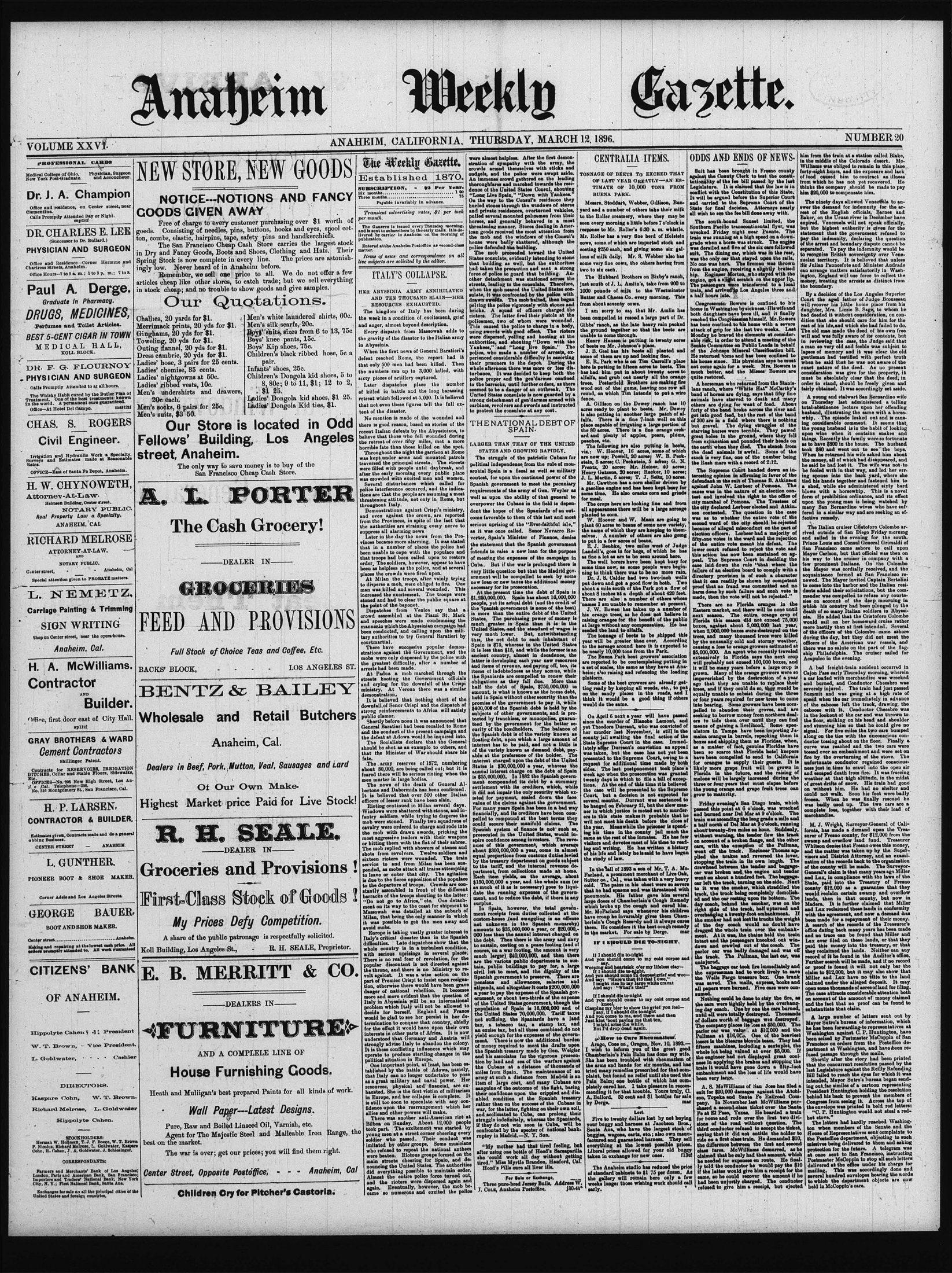
Searchable text
Anaheim
VOLUME XXVI.
PROFESSIONAL CARDS
Medical College of Ohio.
New York Post-Graduate.
Physician, Surgeon and Accoucheur.
Dr. J. A. Champion
Office and residence, on Center street, near Clementina.
Calls Promptly Attended Day or Night.
sept5tf
DR. CHARLES E. LEE
(Successor to Dr. Bullard.)
PHYSICIAN AND SURGEON
Office and Residence—Corner Hermine and Chartress Streets, Anaheim.
Office Hours—7 to 9 a.m.; 1 to 3 p.m.; 7 to 8.
Paul A. Derge.
Graduate in Pharmacy.
DRUGS, MEDICINES,
Perfumes and Toilet Articles.
BEST 5-CENT CIGAR IN TOWN
MEDICAL HALL,
KOLL BLOCK.
DR. F. G. FLOURNOY
PHYSICIAN AND SURGEON
Calls Promptly Attended to at all hours.
The Whisky Habit cured by the Butler Plan of Treatment. One of the best treatments known in the world. A permanent cure guaranteed.
Office—At Hotel Del Campo.
mar12tf
CHAS. S. ROGERS
Civil Engineer.
Irrigation and Hydraulic Work a Specialty. Surveys and Estimates made at Reasonable Rates.
OFFICE—East of Santa Fe Depot, Anaheim.
NEW STORE, NEW GOODS
NOTICE---NOTIONS AND FANCY GOODS GIVEN AWAY
Free of charge to every customer purchasing over $1 worth of goods. Consisting of needles, pins, buttons, hooks and eyes, spool cotton, combs, elastic, hairpins, tape, safety pins and handkerchiefs.
The San Francisco Cheap Cash Store carries the largest stock in Dry and Fancy Goods, Boots and Shoes, Clothing and Hats. Their Spring Stock is now complete in every line. The prices are astonishingly low. Never heard of in Anaheim before.
Remember, we sell one price to all. We do not offer a few articles cheap like other stores, to catch trade; but we sell everything in stock cheap; and no trouble to show goods and give samples.
Our Quotations.
Challies, 20 yards for $1.
Merrimack prints, 20 yds for $1.
Ginghams, 20 yds for $1.
Toweling, 20 yds for $1.
Outing flannel, 20 yds for $1.
Dress cambric, 20 yds for $1.
Ladies' hose, 3 pairs for 25 cents.
Ladies' chemise, 35 cents.
Ladies' nightgowns at 50c.
Ladies' ribbed vests, 10c.
Men's undershirts and drawers, 20c each.
Men's socks, 6 pairs for 25c.
Men's suits, $3 50.
Men's white laundered shirts, 60c.
Men's silk scarfs, 20c.
Boys' suits, sizes from 6 to 13, 75c
Boys' knee pants, 15c.
Boys' Kip shoes, 75c.
Children's black ribbed hose, 5c a pair.
Infants' shoes, 25c.
Children's Dongola kid shoes, 5 to 8, 80c; 9 to 11,$1; 12 to 2,$1 25.
Ladies' Dongola kid shoes,$1 25.
Ladies' Dongola Kid ties,$1.
Our Store is located in Odd Fellows' Building, Los Angeles street, Anaheim.
The only way to save money is to buy of the San Francisco Cheap Cash Store.
PHYSICIAN AND SURGEON
Calls Promptly Attended to at all hours.
The Whisky Habit cured by the Butler Plan of Treatment. One of the best treatments known in the world. A permanent cure guaranteed.
Office—At Hotel Del Campo.
CHAS. S. ROGERS
Civil Engineer.
Irrigation and Hydraulic Work a Specialty. Surveys and Estimates made at Reasonable Rates.
OFFICE—East of Santa Fe Depot, Anaheim.
H. W. CHYNOWETH,
Attorney-At-Law.
Helmsen Building, Center street.
NOTARY PUBLIC.
Real Property Law a Specialty.
ANAHEIM, CAL.
RICHARD MELROSE
ATTORNEY-AT-LAW.
AND
NOTARY PUBLIC.
Center street, Anaheim, Cal.
Special attention given to PROBATE matters.
L. NEMETZ,
Carriage Painting & Trimming
SIGN WRITING
Shop on Center street, near the opera-house.
Anaheim, Cal.
H. A. McWilliams.
Contractor
and
Builder.
Office, first door east of City Hall.
ap11tf
GRAY BROTHERS & WARD
Cement Contractors
Shillinger Patent.
Contracts for RESERVOIRS, IRRIGATION DITCHES, Cellar and Stable Floors, Sidewalks, etc.
OFFICES—No. 205 New High Street, Los Angeles Cal., Telephone—236.
No. 316 Montgomery St., San Francisco, Cal.
H. P. LARSEN,
CONTRACTOR & BUILDER.
Estimates given, Contracts made and do a general obbing Business.
CENTER STREET — ANAHEIM.
L. GUNTHER.
PIONEER BOOT & SHOE MAKER.
Ladies' nightgowns at 50c.
Ladies' ribbed vests, 10c.
Men's undershirts and drawers, 20c each.
Men's socks, 6 pairs for 25c.
Men's suits, $3 50.
Children's Dongola kid shoes, 5 to 8, 80c; 9 to 11, $1; 12 to 2, $1 25.
Ladies' Dongola kid shoes, $1 25.
Ladies' Dongola Kid ties, $1.
Our Store is located in Odd Fellows' Building, Los Angeles street, Anaheim.
The only way to save money is to buy of the San Francisco Cheap Cash Store.
A. L. PORTER
The Cash Grocery!
DEALER IN
GROCERIES
FEED AND PROVISIONS
Full Stock of Choice Teas and Coffee, Etc.
BACKS' BLOCK, LOS ANGELES ST.
BENTZ & BAILEY
Wholesale and Retail Butchers
Anaheim, Cal.
Dealers in Beef, Pork, Mutton, Veal, Sausages and Lard
Of Our Own Make.
Highest Market price Paid for Live Stock!
R. H. SEALE.
DEALER IN
Groceries and Provisions!
H. P. LARSEN,
CONTRACTOR & BUILDER.
Estimates given, Contracts made and do a general obbing Business.
CENTER STREET - ANAHEIM.
L. GUNTHER.
PIONEER BOOT & SHOE MAKER.
Corner Adele and Los Angeles Streets.
GEORGE BAUER,
BOOT AND SHOE MAKER.
Center street... Anaheim.
Making and repairing at the lowest cash price. All orders promptly attended to. All work guaranteed
CITIZENS' BANK
OF ANAHEIM.
Hippolyte Cahen J.; President
W. T. Brown, Vice President.
L. Goldwater, Cashier
DIRECTORS.
Kaspare Cohn, W. T. Brown.
Richard Melrose, L. Goldwater
Hippolyte Cahen.
STOCKHOLDERS:
Herman W. Hellman, T. J. F. Booge, W. T. Brown
P. Nicolus, Richard Melrose, L. Goldwater, Kaspare Cohn, H. Cahen, J. A. Goldwater, J. Schlesinger.
CORRESPONDANTS:
Farmers and Merchants' Bank of Los Angeles;
London, Paris and American Bank, San Francisco;
Importers and Traders' National Bank, New York City, N.Y.; First National Bank, Santa Ana.
Exchanges for sale on all the principal cities of the United States and foreign countries.
Highest Market price Paid for Live Stock!
R. H. SEALE.
DEALER IN
Groceries and Provisions
First-Class Stock of Goods
My Prices Defy Competition.
A share of the public patronage is respectfully solicited.
Koll Building, Los Angeles St., R. H. SEALE, Proprietor.
E. B. MERRITT & CO.
DEALERS IN
FURNITURE
AND A COMPLELE LINE OF
House Furnishing Goods.
Heath and Mulliigan's best prepared Paints for all kinds of work.
Wall Paper---Latest Designs.
Pure, Raw and Boiled Linseed Oil, Varnish, etc.
Agent for The Majestic Steel and Malleable Iron Range, the best on the market.
The war is over; get our prices; you will find them right.
Center Street, Opposite Postoffice, Anaheim, CA
Children Cry for Pitcher's Castoria.
ANAHEIM, CALIFORNIA, THURSDAY, MARCH 12, 1896.
NEW GOODS AND FANCY
Housing over $1 worth of books and eyes, spool cot- and handkerchiefs.
Carries the largest stock clothing and Hats. Their prices are astonishing. We do not offer a few but we sell everything and give samples.
ITALY'S COLLAPSE.
HER ABYSSINIA ARMY ANNIHILATED AND TEN THOUSAND SLAIN—HER RESOURCES EXHAUSTED.
The kingdom of Italy has been during the week in a condition of excitement, grief and anger, almost beyond description.
Every dispatch from Massowah adds to the gravity of the disaster to the Italian army in Abyssinia.
When the first news of General Baratieri's defeat reached Rome, the report had it that only 500 men had been killed. Then the numbers ran up to 3,000 killed, with sixty pieces of artillery captured.
Later dispatches place the number of killed in battle and the long harassing retreat which followed at 5,000. It is believed that not even these figures tell the full extent of the disaster.
No mention is made of the wounded and there is good reason, based on stories of the recent Italian defeats by the Abyssinians, to believe that those who fell wounded during the retreat of over fifty miles, met a more horrible fate than those killed on the spot.
Throughout the night the garrison at Rome was kept under arms and mounted patrols traversed the principal streets. The streets were filled with people until daybreak, and after the early morning every public place were almost helpless. After the first demonstration of sympathy with the army, the crowds armed themselves with sticks and oudgels, and the police were swept aside. An immense crowd gathered on the leading thoroughfares and marched towards the residence of the United States Consul, shouting "Long Live Spain," "Down with Yankees."
On the way to the Consul's residence they hurled stones through the windows of stores and private residences, overturned vehicles, pulled several mounted policemen from their horses, and generally behaved in a most threatening manner. Stores dealing in American goods received the most attention from the mob and the windows of the Consul's house were badly shattered, although the police defended the building.
The mob proceeded toward the United States consulate, evidently intending to stone that building as well, but the authorities had taken the precaution and sent a strong force of police to guard that building. Another detachment was stationed across the streets, leading to the consulate. Therefore, when the mob neared the United States consulate, it was confronted by the police with drawn swords. The mob halted, then began pelting the police vigorously with stones and bricks. A squad of officers charged the rioters. The latter fired their pistols at the policemen, two of whom were wounded.
This caused the police to charge in a body, using swords with good effect. The rioters were dispersed, yelling and shooting at the authorities, and shouting "Down with the Yankees," and "Long Live Spain." The police, who made a number of arrests, experienced considerable difficulty in escorting their prisoners to the depot. During the whole afternoon there was more or less disturbance. It was decided to keep both the police proper and the gen'darmes confined to the barracks, until further orders, as there seemed to be a danger of an outbreak. The United States consulate is now guarded by a strong detachment of gen'darmes armed with carbines, revolvers and swords and instructed to protect the consulate at any cost.
THENATIONAL DEBT OF SPAIN.
LARGER THAN THAT OF THE UNITED STATES AND GROWING RAPIDLY.
The struggle of the patriotic Cubans for political independence from the rule of monarchial Spain is a fiscal as well as military
CENTRALIA ITEMS.
TONNAGE OF BEETS TO EXCEED THE OF LAST YEAR GREATLY—AN TIMATE OF 10,000 TONS FOR BUENA PARK.
Measures, Stoddart, Webber, Gillison, yard and a number of others take their turn to the Roller creamery, where they may seen every morning a little before 7 o'clock response to Mr. Roller's 6:30 a.m. whil Mr. Roller has a very fine herd of Holcows, some of which are imported stock coating $250 each, and giving six lions of milk daily. Mr. S. Webber also some very fine cows, the others having two to six each.
The Hubbard Brothers on Bixby's run just south of J. L. Amlin's, take from 9 1000 pounds of milk to the Westminster Batter and Cheese Co., every morning from about seventy cows.
I am sorry to say that Mr. Amlin been compelled to reside a large part of Gibbs' ranoh, as the late heavy rain put the ground together so that the boots unable to come through.
Henry Hansen is putting in twenty of beets on Mr. Johnson's place.
J. B. Giel has his beets all planted some of them are up and looking fine.
E. R. Park who is on Tim Carroll's here is putting in fifteen acres to beets. has had him put in about twenty acres alfalfa, and grub out nearly all the oak trees. Pestertield Brothers are making wood out of the gums, leaving one row round, on which Tim intends to put a fence.
A. Gillison on the Dewey ranch hides acres ready to plant to beets. Mr. D is also putting in another large patch of alfalfa. There is a fine 7-inch well on place capable of irrigating a large portion of 80 acres. There is a fine orange ard and plenty of apples, pears, peaches, etc.
The following are also putting in viz.: W. Hoover, 16 acres, some of them are now up; Powell, 20 acres; W. B. Stein, 5 acres; C. Peckstein, 5 acres; O. Frentz, 20 acres; Mr. Heiner, 40 Henry Gatzona, 20 acres; Rucker, 10
Later dispatches place the number of killed in battle and the long harassing retreat which followed at 5,000. It is believed that not even these figures tell the full extent of the disaster.
No mention is made of the wounded and there is good reason, based on stories of the recent Italian defeats by the Abyssinians, to believe that those who fell wounded during the retreat of over fifty miles, met a more horrible fate than those on the spot.
Throughout the night the garrison at Rome was kept under arms and mounted patrols traversed the principal streets. The streets were filled with people until daybreak, and after the early morning every public place was crowded with excited men and women.
Several disturbances which called for police interference occurred, and the indications are that the people are assuming a most threatening attitude, not only in Rome, but throughout Italy.
Demonstrations against Crispi's ministry, and even against the crown, are reported from the Provinces, in spite of the fact that the authorities are straining every nerve to suppress all alarming news.
Later in the day the news from the Provinces became more alarming. It was stated that in a number of places the police had been unable to cope with the populace and that troops had been called upon to restore order. The soldiers, however, appear to have been as helpless as the police, and at several places the crowds were fired upon.
At Milan the troops, after vainly trying to disperse a mob, were obliged to fire. One man was killed and several wounded. This increased the excitement. The troops were stoned and had to clear the public square at the point of the bayonet.
Dispatches from Venice say that a crowd assembled at the Piazzai St. Mark and speeches were made condemning the mannequin which the Abyssinian campaign had been conducted, and calling upon the military authorities to try General Baratieri by courtmartial.
There have successive popular demonstrations against the Government, and the mobs were only dispersed by the police with the greatest difficulty, after a number of arrests had been made.
At Padua a mob marched through the streets hooting the Government officials and crying for the downfall of the Crispi ministry. At Verona there was a similar demonstration.
It is believed that nothing short of the downfall of Senor Crispi and the dispatch of strong reinforcements to Africa will satisfy public clamor.
Shortly before noon it was announced that General Baratieri had been recalled to Rome and the conduct of the present campaign and the defeat at Adowa would be inquired into.
The Socialists declare that the General should be shot as an example to others, and that the Minister of War should share his fate.
The army reserves of 1872, numbering about 80,000, are being called out; but it is feared there will be serious rioting when the men muster in large bodies.
The news of the death of General Albertone and Dabormida has been confirmed. It is believed that over 500 other Italian officers of lesser rank have been slain.
Rioting continued in Milan several days. Windows were shattered with stones, and infantry soldiers while trying to disperse the mob were stoned. Finally two squadrons of cavalry were ordered to charge and rode into the mob with drawn swords, pricking the most aggressive leaders with their weapons or hitting them with the flat of their sabres. The mob replied with showers of stones and shots from revolvers. Twelve soldiers and sixteen rioters were wounded. The train service to and from Milan has been suspended, as mob attack all trains attempting to leave or enter that city. The agitation is due to the fierce opposition of the populace to the departure of troops. Crowds are constantly assembled in front of the different barracks of the troops shouting to the latter:
LATER DISPATCHES PLACE THE NUMBER OF KILLED IN BATTLE AND THE LONG HARASSING RETREAT WHICH FOLLOWED AT 5,000. IT IS BELOVED THAT NOT EVEN THESE FIGURES TELL THE FULL EXTENT OF THE DISASTER.
No mention is made of the wounded and there is good reason, based on stories of the recent Italian defeats by the Abyssinians, to believe that those who fell wounded during the retreat of over fifty miles, met a more horrible fate than those on the spot.
Throughout the night the garrison at Rome was kept under arms and mounted patrols traversed the principal streets. The streets were filled with people until daybreak, and after the early morning every public place was crowded with excited men and women.
Several disturbances which called for police interference occurred, and the indications are that the people are assuming a most threatening attitude, not only in Rome, but throughout Italy.
Demonstrations against Crispi's ministry, and even against the crown, are reported from the Provinces, in spite of the fact that the authorities are straining every nerve to suppress all alarming news.
LATER IN THE DAY THE NEWS FROM THE PROVINCES BECAME MORE ALARMING. It was stated that in a number of places the police had been unable to cope with the populace and that troops had been called upon to restore order. The soldiers, however, appear to have been as helpless as the police, and at several places the crowds were fired upon.
At Milan the troops, after vainly trying to disperse a mob, were obliged to fire. One man was killed and several wounded. This increased the excitement. The troops were stoned and had to clear the public square at the point of the bayonet.
Dispatches from Venice say that a crowd assembled at the Piazzai St. Mark and speeches were made condemning the mannequin which the Abyssinian campaign had been conducted, and calling upon the military authorities to try General Baratieri by courtmartial.
There have successive popular demonstrations against the Government, and the mobs were only dispersed by the police with the greatest difficulty, after a number of arrests had been made.
At Padua a mob marched through the streets hooting the Government officials and crying for the downfall of the Crispi ministry. At Verona there was a similar demonstration.
It is believed that nothing short of the downfall of Senor Crispi and the dispatch of strong reinforcements to Africa will satisfy public clamor.
Shortly before noon it was announced that General Baratieri had been recalled to Rome and the conduct of the present campaign and the defeat at Adowa would be inquired into.
The Socialists declare that the General should be shot as an example to others, and that the Minister of War should share his fate.
The army reserves of 1872, numbering about 80,000, are being called out; but it is feared there will be serious rioting when the men muster in large bodies.
The news of the death of General Albertone and Dabormida has been confirmed. It is believed that over 500 other Italian officers of lesser rank have been slain.
Rioting continued in Milan several days. Windows were shattered with stones, and infantry soldiers while trying to disperse the mob were stoned. Finally two squadrons of cavalry were ordered to charge and rode into the mob with drawn swords, pricking the most aggressive leaders with their weapons or hitting them with the flat of their sabres. The mob replied with showers of stones and shots from revolvers. Twelve soldiers and sixteen rioters were wounded. The train service to and from Milan has been suspended, as mob attack all trains attempting to leave or enter that city. The agitation is due to the fierce opposition of the populace to the departure of troops. Crowds are constantly assembled in front of the different barracks of the troops shouting to the latter:
LATER DISPATCHES PLACE THE NUMBER OF KILLED IN BATTLE AND THE LONG HARASSING RETREAT WHICH FOLLOWED AT 5,000. IT IS BELOVED THAT NOT EVEN THESE FIGURES TELL THE FULL EXTENT OF THE DISASTER.
No mention is made of the wounded and there is good reason, based on stories of the recent Italian defeats by the Abyssinians, to believe that those who fell wounded during the retreat of over fifty miles, met a more horrible fate than those on the spot.
Throughout the night the garrison at Rome was kept under arms and mounted patrols traversed the principal streets. The streets were filled with people until daybreak, and after the early morning every public place was crowded with excited men and women.
Several disturbances which called for police interference occurred, and the indications are that the people are assuming a most threatening attitude, not only in Rome, but throughout Italy.
Demonstrations against Crispi's ministry, and even against the crown, are reported from the Provinces, in spite of the fact that the authorities are straining every nerve to suppress all alarming news.
LATER IN THE DAY THE NEWS FROM THE PROVINCES BECOME MORE ALARMING. It was stated that in a number of places the police had been unable to cope with the populace and that troops had been called upon to restore order. The soldiers, however, appear to have been as helpless as the police, and at several places the crowds were fired upon.
At Milanthe troops, after vainly trying to disperse a mob, were obliged to fire. One man was killed and several wounded. This increasedthe excitement. The troops were stoned and had to clearthe public square atthe pointofthe bayonet.
Dispatches from Venice say that a crowd assembled atthe Piazzai St.Markand speechesweremadecondemningthemannenwhichtheAbyssiniancampaignhadbeenconducted,andcallinguponthemilitaryauthoritiestotryGeneralBaratieribycourtmartial.
There have successive popular demonstrations againsttheGovernment,andthemobwereonlydispersedbythepolicewiththegreatestdifficulty,afteranumberofarrestehdabadmade.
AtPaduaa mobmarchedthroughthestreetshootingtheGovernmentofficialsandcryingforsheddownfalloftheCrispiministry.AtVeronatherewasasimilardemonstration.
Itisbelievedthatnothingshortofthedownfallofthesenior委員会isnonequalforpublicclamor.
ShortlybeforenoonitwasannouncedthatGeneralBaratierihadbeenrecalledtoRomeandtheconductofthepresentcampaignandthedefeatatAdowawouldbeinquiredinto.
TheSocialistsdeclarethattheGeneralshouldbeshotasanexampletoothers,andthattheMinisterofWarshouldsharehisfate.
Thearmyreservesof1872,Numberingabout80,000arebeingcalledoutbutitisfearedtherewillbeseriousriotingwhenthemenmusterinlargebodies.
ThenewsofthedeathofGeneralAlbertoneandDabormidahasbeenconfirmed.itisbelievedthatover500otherItalianofficersoflesserrankhavebeenslain.
RiottingcontinuedinMilanseveraldays.Windowswereshatteredwithstones,andinfantry Soldierswhiletryingtosdispersemobwerestoned.Finallytwosquadronsofcavalrywereorderedtocarryandroedeintothembwithdrawsedswords,prickingthemostaggressiveleaderswiththeirweaponsorhittingthemwiththeflatofthesabres.Themob repliedwithshowersofstonesandshotsfromrevolvers.Twelve Soldiersandsixteenrioterswerewounded.TheatrainservicetoandfromMilanhasbesuspended.asmobattackalltrainsattemptingtoleaveorenterthatcity.Theagitationisdue.tothefierceoppositionofthepopulaceto.thedepartureoftroops.shoutingtothe latter:
Rioting continued in Milan several days. Windows were shattered with stones, and infantry soldiers while trying to disperse the mob were stoned. Finally two squadrons of cavalry were ordered to charge and rode into the mob with drawn swords, pricking the most aggressive leaders with their weapons or hitting them with the flat of their sabres. The mob replied with showers of stones and shots from revolvers. Twelve soldiers and sixteen rioters were wounded. The train service to and from Milan has been suspended, as mobs attack all trains attempting to leave or enter that city. The agitation is due to the fierce opposition of the populace to the departure of troops. Crowds are constantly assembled in front of the different barracks of the troops shouting to the latter: "Do not go to Africa," etc. One detachment on its way to the coast for shipment to Massowah was detailed at the suburb of Milan, that being the only manner in which it was possible to get the men away and avoid mobs.
Europe is taking vastly greater interest in Italy's critical disaster than in the Spanish difficulties. Late dispatches show that the whole country is in a turbulent condition, with serious uprisings in several places. There is no real fear of revolution; for the popular discontent is not directed against the throne, and there is no Ministry to revolt against. It was a wise action on the part of Premier Crispi to insist upon resignation, otherwise there would have been grave danger of national rebellion. It becomes more and more evident that the question of Italy in Abysinia will be an international problem which Italy will not be allowed to decide for herself. England and France would be glad to see her peristis in her determination to conquer that country, chiefly for the effect it would have upon their own interests in other parts of Africa. It is now understood that Germany and Austria will strongly advise Italy to abandon the colony. It is these conflicting influences which may operate to produce starling changes in the political situation in Europe.
One important point, at least, has been established by the battle of Adowa, namely, that Italy can no longer undertake to pose as a great military and naval power. Her resources, physical and financial, are exhausted. She is the first victim of militarism in Europe, and her collapse is complete. It is still too soon to speculate with any confidence upon the rearrangement which her allies and other powers will make.
There was another anti-American riot at Bilboa on Sunday. About 12,000 people took part. The excitement was started by young men at a street corner cheering every soldier who passed. Their conduct was imitated by other groups. Some musicians who refused to repeat the national anthem were beaten. Riotous groups formed on the main streets cheering for Spain, and denouncing the United States. The authorities did everything possible to maintain order. Almost the entire police force turned out, and the rioters were dispersed again and again. Eventually, however, the mob became so numerous and excited the police value of the claims against the government.
For many years Spain has been in a bad way financially, and its creditors have been compelled to compound at the best terms they could secure their manifold claims. The Spanish system of finance is not such as prosecuted in the United States, would inspire confidence among investors. The revenues of this government, which average about $300,000,000 a year, come in almost equal proportions from customs duties levied by the treasury department on goods subject to the tariff, and the internal revenue department, from collections made at home. Each item yields, on the average, about $150,000,000 a year, and the whole sum (or as much of it as is necessary) goes to liquidate the running expenses of the government, and to reduce the debt, if there is any surplus.
In Spain, however, the total government receipts from duties collected at the custom-house (and smuggling is an offense not unknown in the Spanish monarchy) amounts to $35,000,000 a year, or $20,000,-000 less than the annual interest charged on the debt. Then there is the army and navy to sustain, coating on a peace footing (and of course, on a war footing, the amount is very much larger) $40,000,000, and then there are the various public departments to sustain, public buildings to pay for, a large civil list to meet, and the dignity of the Spanish government to preserve. There are pensions and allowances, salaries and stipends, and altogether it costs $200,000 a year to pay the expense of the Spanish government, or about two-thirds of the expense of the United States government, though the population of Spain is 16,000,000 and of the United States 70,000,000. Tariff taxes not sufficiency, the Spaniards have a land tax, a tobacco tax, a stamp tax, and an excise tax, but all these combined do not yield enough for the expenses of the government. There is now the additional burden of money required to most the drafts upon the Spanish treasury made by Gen. Weigler and his associates for the vigorous prosecution by land and sea of the warfare against the Cubans at a distance of thousands of miles from Spain. The maintenance of an army at such a distance from Madrid is an item of large cost, and many Cubans are sanguine of the outcome of the fight, basing their confidence upon the crippled and disabled condition of the Spanish treasury rather than on the success of the Cubans in war, for the latter, fighting on their own soil, and acclimated to Cuba, can prolong their struggle indefinitely, whereas the Spaniards, if they do not win soon in Cuba, will be confronted by the specter of national bankruptcy in Madrid.—N.Y.Sun.
"My mother had that tired feeling, but after using one bottle of Hood's Saraspilla she could work all day without getting tired." Miss Myrtle Brandon, Hanford, Cal. Hood's Pills cure all liver ill.
For Sale or Exchange.
Three pure-bred Jersey Balls, Address W.J.Cole, Anaheim Postoffice.
Durrant was sentenced to hang on February 21, but she slowed in which justice is met out to make sure he will not meet his death before the court year. Meanwhile the prisoner is being his time in the county jail must same as the rest of the inmates. He has visitors and devotes most of his time taking and writing. He has written a letter of his life and lately he is said to have studied law.
In the fall of 1893 a son of Mr. T.A.Farland, a prominent merchant of Livestock co., Cal., was taken with a very cold. The pains in his chest were so that he had spasms and was threatened pneumonia. His father gave him a large doses of Chamberlain's Cough Rite which broke up the cough and cured Mr. McFarland says whenever his cousin have group he invariably gives them berlinain's Cough Remedy and it always them. He considers it the best cough in the market. For sale by Derge.
IF I SHOULD DIE TO-NIGHT
If I should die to-night And you should come to my cold cornea say,
Weeping and heartache o'er my lifeless cry
If I should die to-night And you should come in deepest grief and And say: "Here's that $10 that I owe," I might rise in my large white cravat And say: "What's that!"
If I should die to-night And you should come to my cold cornea kneel,
Clapping my bler to show the grief you say,
I say, if I should die to-night And you come to me, and there and then Just hint 'bout paying me that ten I might arise while But I'd drop dead again.
How to Cure Rheumatism
Arago, Coos co., Oregon, Nov. 10,
I wish to inform you of the greatest Chamberlain's Pain Balm has done me She has been troubled with rheumatic arms and hands for six months,
tried many remedies prescribed for this plaint but found no relief until she used Pain Balm; one bottle of which has pleated cured her. I take pleasure in mending it for that trouble. You're tainted A. Bullord; 50 cent and $1 bottles by Derge.
Lost.
Five to twenty dollars lost by not your buggy and harness at Jacobson Santa Ana, who have at largest buggies, wagons, carts, etc.; also owned factured and guaranteed harness. Everything at the lowest possible Liberal prices allowed for your old taken in exchange for new ones.
The Anaheim studio has reduced value of standard cabinets to $1 75 per dozen gallery will remain here only weeks longer those wishing work she early.
CENTRALIA ITEMS.
AGE OF BEETS TO EXCEED THAT LAST YEAR GREATLY—AN ESTIMATE OF 10,000 TONS FROM QUEENA PARK.
Mrs. Stoddart, Webber, Gillison, Bund and a number of others take their milk Roller creamery, where they may be every morning a little before 7 o'clock in time to Mr. Roller's 6:30 a.m. whistle. Roller has a very fine herd of Holstein some of which are imported stock and $250 each, and giving some six galmilk daily. Mr. S. Webber also has very fine cows, the others having from six each.
Hubbard Brothers on Bixby's ranch, north of J. L. Amlin's, take from 900 to pounds of milk to the Westminster and Cheese Co., every morning. This about seventy cows.
sorry to say that Mr. Amlin has compelled to rescue a large part of Dr. Branch, as the late heavy rain packed together so that the beets are to come through.
Vy Hanson is putting in twenty acres on Mr. Johnson's place.
Giel has his beets all planted and of them are up and looking fine.
Park who is on Tim Carroll's place putting in fifteen acres to beets. Tim him put in about twenty acres to and grub out nearly all the orange Pesterfield Brothers are making fire out of the gums, leaving one row all on which Tim intends to put a wire millison on the Dewey ranch has 10 ready to plant to beets. Mr. Dewey putting in another large patch of alfalfa. There is a fine 7-inch well on this capable of irrigating a large portion of acres. There is a fine orange orchard plenty of apples, pears, plums, etc.
following are also putting in beets, W. Hoover, 16 acres, some of which were up; Powell, 20 acres; W. B. Peck-5 acres; C. Peckstein, 5 acres; G. N. 20 acres; Mr. Heiner, 40 acres; Gatzona, 20 acres; Rucker, 10 acres;
ODDS AND ENDS OF NEWS.
Suit has been brought in Freano county against the County Clerk to test the constitutionality of the fee bill passed by the last Legislature. It is claimed that the law is in conflict with the Constitution of this State. It will be argued before the Superior Court and carried to the Supreme Court of the State for final decision. Attorneys nearly all wish to see the fee bill done away with.
The south-bound Sunset limited, the Southern Pacific transcontinental flyer, was wreaked Friday night near Puente. The train was running at a high speed on a downgrade when a horse was struck. The engine was derailed and five of the six cars followed suit. The dining car, which was in the rear, was the only car that stayed upon the rails. No one was hurt. The fireman was thrown from the engine, receiving a slightly bruised hip. Engineer Morton, who stayed with the engine, got a slight scratch on the upper lip. The passengers were transferred to a local train, and arrived in Los Angeles three and a half hours late.
Congressman Bowers is confined to his home in Washington by sickness. His wife and both daughters have been ill, and it finally reached the Congressman himself. Mr.Bowers has been confined to his home with a severe attack of grip for the last two weeks. Last Monday he braved the elements at considerable risk, in order to attend a meeting of the Senate Committee on Public Lands in behalf of the Johnson Mineral Classification bill. He returned home and has been confined to his house since. His physician says he must not come again for a week. Mrs.Bowers is much better, and the Misses Bowers are quite restored.
A horseman who returned from the Stanislaus ranch, where "White Hat" McCarthy's band of horses are dying, says that fifty fine animals have starved for want of food. About forty of the band broke across the river and got into good feed, but the rest of the band of 300 are in a field where there is nothing but gravel. The dying struggles of the starving horses were terrible. They pawed great holes in the ground, where they fell from exhaustion and pounded their heads on the earth when they died. The stench from the dead animals is awful. Some of the stock is very fine, one of the number being the Rush mare with a record of 2:12.
The Supreme Court handed down an injunction in affirming its favor of him from the train at a station called Blake, in the middle of the Colorado desert. McWilliams was obliged to remain in this place forty-eight hours, and the exposure and lack of food caused him to contract an illness from which he has not yet recovered. He thinks the company should be made to pay him $20,000 to compensate him.
The ninety days allowed Venezuela to answer the demand for indemnity for the arrest of the English officials, Barnes and Baker, on the Uruan river in December have expired. Venezuela will not speak officially, but the highest authority is given for the statement that the government refused to pay the indemnity, declaring the question of the arrest and boundary dispute cannot be separated. To pay the indemnity would be to recognize British sovereignty over Venezuela territory. It is believed that unless Sir Julian Paunceofote and Minister Andrade can arrange matters satisfactorily in Washington, England will use force to collect the money, treating the arrests as distinct from the boundary.
By a decision of the Los Angeles Superior Court the aged father of Judge Brouseau will recover his little home place from his daughter, Mrs. Lizzie B. Sage, to whom he had deeded it without consideration, on condition that she should care for him for the rest of his life, and which she had failed to do. The old man made the deed of his own free will and was fully aware of its contents, but in reviewing the case, the Judge said that a man so very old and feeble was subject to lapses of memory and it was clear the old gentleman had testified with perfect truth when he said that he was not aware of the exact nature of the deed. As no present consideration was give for the property, it must be absolutely clear that the deed; in order to stand, should be freely given and fairly obtained. It was accordingly set aside.
A young and stalwart San Bernardino wife on Thursday last administered a tolling total abstinence lecture upon her offending husband, illustrating the same with a horseride. The episode leaked out and is causing considerable comment. It seems that the young husband is in the habit of looking upon wine when it contains snakes and things. Recently the family were so fortunate as to have $800 in the house. The husband took $80 and went out to see the boys. When he returned his wife asked him about the money, all of which had disappeared, and he said he had lost it. The wife was not to be fooled with in that way, and led her erroneous item.
---
A horseman who returned from the Stanislaus ranch, where "White Hat" McCarthy's band of horses are dying, says that fifty fine animals have starved to death and many others are dying for want of food. About forty of the band broke across the river and got into good feed, but the rest of the band of 300 are in a field where there is nothing but gravel. The dying struggles of the starring horses were terrible. They pawed great holes in the ground, where they fell from exhaustion and pounded their heads on the earth when they died. The stenoh from the dead animals is awful. Some of the stock is very fine, one of the number being the Rush mare with a record of 2:12.
The Supreme Court handed down an interesting opinion in affirming in favor of the defendant in the suit of Thomas B. Atkinson against John W. Lorbeer of Pomona. The cause was in the nature of an election contest and involved the right to the office of city marshal of Pomona. The Trustees of the city declared Lorbeer elected and Atkinson contested. The question in the case was as to whether the entire vote of the second ward of the city should be rejected because of alleged misconduct on the part of election officers. Lorbeer had a majority of fifty-one votes in the ward and the rejection of the entire vote meant his defeat. The lower court refused to reject the vote and this action has now been sustained on appeal. The Supreme Court in deciding the case laid down the rule "that where the failure of an election board to comply with a directory provision is of such a character that it can readily be shown by competent proof that no fraud was committed and no harm done by such failure and such vote is made, then the vote will not be rejected."
There are no Florida oranges in the Eastern market, and there will be none until next season. The entire orange crop of Florida this season did not exceed 75,000 boxes, against about 5,000,000 last year, when 2,000,000 boxes were destroyed on the trees, and many thousand trees were killed by the unusually cold and stormy weather, causing a loss to orange growers estimated at $5,000,000. An agent who recently traveled extensively in Florida says the next crop will probably not exceed 100,000 boxes, and it will be many years before a large crop is grown. Many of the orange growers were so impoverished by the destruction of a year ago that they are unable to replace their trees, and if they could do so, they would be equally unable to subsist during the three or four years required for new trees to come into bearing. Some growers have been compelled to abandon their groves, and are seeking to borrow money from northern dealers to tide them over until they can find means of gaining a livelihood. Some speculators in Tampa have been importing Jamaica oranges in barrels, repacking them in boxes and shipping them as Floridas, when, as a matter of fact, genuine Floridas have been so scarce that Florida hotel keepers have been compelled to send to California for oranges to supply their guests. It is likely more grape fruit will be grown in Florida in the future, and the raising of melons will be largely increased during the three or four years that must elapse before the young orange and grape fruit trees can grow to maturity.
Friday evening's San Diego train, which passed this point at 6 o'clock, was wrecked and burned near Del Mar at 9 o'clock. The train was ascending the long grade a mile and a half north of Del Mar at 9 o'clock, running about twenty-five miles an hour. Suddenly, without warning, the tender flew the track on account of a broken flange, and the other cars, with the exception of the Pullman, went off the track. Engineer Thomas applied the brakes and reversed the lever, stopping the train in its own length. The drawhead between the tender and baggage car was broken and the engine and tender went on about a hundred feet. The baggage car left the track, turning on the side. Next to it was the smoker, which straddled the track, the truck being completely demolished and the roosting upon its bottom.
A horseman who returned from the Stanislaus ranch, where "White Hat" McCarthy's band of horses are dying, says that fifty fine animals have starved to death and many others are dying for want of food. Above forty of the band broke across the river and got into good feed, but the rest of the band of 300 are in a field where there is nothing but gravel. The dying struggles of the starring horses were terrible. They pawed great holes in the ground, where they fell from exhaustion and pounded their heads on the earth when they died. The stenoh from the dead animals is awful. Some of the stock is very fine, one of the number being the Rush mare with a record of 2:12.
The Supreme Court handed down an interesting opinion in affirming in favor of the defendant in the suit of Thomas B. Atkinson against John W. Lorbeer of Pomona. The cause was in the nature of an election contest and involved the right to the office of city marshal of Pomona. The Trustees of the city declared Lorbeer elected and Atkinson contested. The question in the case was as to whether the entire vote of the second ward of the city should be rejected because of alleged misconduct on the part of election officers. Lorbeer had a majority of fifty-one votes in the ward and the rejection of the entire vote meant his defeat. The lower court refused to reject the vote and this action has now been sustained on appeal. The Supreme Court in deciding the case laid down the rule "that where the failure of an election board to comply with a directory provision is of such a character that it can readily be shown by competent proof that no fraud was committed and no harm done by such failure and such vote is made, then the vote will not be rejected."
There are no Florida oranges in the Eastern market, and there will be none until next season. The entire orange crop of Florida this season did not exceed 75,000 boxes, against about 5,000,000 last year, when 2,000,000 boxes were destroyed on the trees, and many thousand trees were killed by the unusually cold and stormy weather, causing a loss to orange growers estimated at $5,000,000. An agent who recently traveled extensively in Florida says the next crop will probably not exceed 100,000 boxes, and it will be many years before a large crop is grown. Many of the orange growers were so impoverished by the destruction of a year ago that they are unable to replace their trees, and if they could do so, they would be equally unable to subsist during the three or four years required for new trees to come into bearing. Some growers have been compelled to abandon their groves, and are seeking to borrow money from northern dealers to tide them over until they can find means of gaining a livelihood. Some speculators in Tampa have been importing Jamaica oranges in barrels, repacking them in boxes and shipping them as Floridas, when, as a matter of fact, genuine Floridas have been so scarce that Florida hotel keepers have been compelled to send to California for oranges to supply their guests. It is likely more grape fruit will be grown in Florida in the future, and the raising of melons will be largely increased during the three or four years that must elapse before the young orange and grape fruit trees can grow to maturity.
A freight-train accident occurred in Cajon Pass early Thursday morning, wherein a car loaded with merchandise was wrecked and burned, and Conductor Cheesebro was severely injured. The train had just passed Summit and was going at a high rate of speed when the car immediately in advance of the caboose left the track, drawing the caboose with it. Conductor Cheesebro was in the lookout of the car and was thrown to the floor, striking on his head and shoulder and stunning him so that he could give no signal. For five miles two cars bumped along on the ties with the unconscious conductor tossing about on the floor. Finally a curve was reached and the two cars were tossed over an embankment and were set on fire by the overturning of the stove. The unfortunate conductor regained consciousness just in time to crawl into the open air and escaped death from fire. It was freezing weather at that high altitude, in the midst of great drifts of snow. His train had gone on without him. He had no shelter and could not walk. Soon his feet were badly frozen. When he was finally rescued he was badly used up. The two cars are a complete loss, together with their load of merchandise.
M.J.Wright, Surveyor-General of California, has made a demand upon the Treasurer of Fresno county, for $12,000 from the swamp and overflow land fund. Treasurer Whitson denies that Fresno owes this money, and she matters taken up by the Supervisors and District Attorney, and an examination of the records back to the organization of the county will be made. The Surveyor-General's claim is that many years ago Miller county $12,000 as a guarantee that they would reclaim certain swamp and overflow lands; then in that county, but now in
Friday evening's San Diego train, which passed this point at 6 o'clock, was wrecked and burned near Del Mar at 9 o'clock. The train was ascending the long grade a mile and a half north of Del Mar at 9 o'clock, running about twenty-five miles an hour. Suddenly, without warning, the tender flew the track on account of a broken flange, and the other cars, with the exception of the Pullman, went off the track. Engineer Thomas applied the brakes and reversed the lever, stopping the train in its own length. The drawhead between the tender and baggage-car was broken and the engine and tender went on about a hundred feet. The baggage-car left the track, turning on the side. Next to it was the smoker, which straddled the track, the truck being completely demolished and the car resting upon its bottom. The day coach, behind the smoker, was on the right side of the track, half upturned and overhanging a twenty-foot embankment. If the smoker had not lost its trucks the weight of the day coach would no doubt have dragged the whole train over the embankment. At it was, the chains held the train intact and the passengers knocked out windows and crawled out of the coach. The parlor car was badly damaged and was off the track. The Pullman, the last car, was uninjured.
The baggage-car took fire immediately and the expressman had to work lively to save the Wells Fargo treasure box. One trunk was saved. The malls, express books and all papers were burned. Five cars were consumed.
Nothing could be done to stay the fire, as the cars were tightly held by the overhanging day coach. One by one the cars burned until all were totally destroyed. Thousands of dollars worth of baggage was destroyed. The company places its loss at $50,000. The parlor car was value at $10,000 and the Pullman at $16,000. One of the heaviest losses is the Stearns bicycle team. They had fifteen machines, including a sextuple, the whole lot being valued at over $5,000. If the engineer had not displayed great coolness in applying the brakes and stopping the train it would have gone down a fifty-foot embankment and the loss of life would have been very large.
A. S. McWilliams of San Jose has filed a suit for $20,000 damages against the Atchison, Topeka and Santa Fe Railroad Company. In November last McWilliams purchased a second-class ticket over the Santa Fe at El Paso, Texas. He boarded a train for home and rode over the first two divisions of the road without question. The third conductor refused to accept the ticket, saying that it did not entitle the holder to ride on a first class train. He demanded $10, the difference between the first and second class fares. McWilliams demurred, as he claimed that he only had that amount, which he needed for expenses on route. He finally told the conductor he would pay the $10 if the latter would give him a receipt for the same, so he could recover the amount if he had been unjustly charged. The conductor refused to give him a receipt, but ejected frozen. When he was finally rescued he was badly used up. The two cars are a complete loss, together with their load of merchandise.
M. J. Wright, Surveyor-General of California, has made a demand upon the Treasurer of Fresno county, for $12,000 from the swamp and overflow land fund. Treasurer Whitson denies that Fresno owes this money, and the matter was taken up by the Supervisors and District Attorney, and an examination of the records back to the organization of the county will be made. The Surveyor-General's claim is that many years ago Miller and Lux, in compliance with the laws of the State, paid into the Treasury of Fresno county $12,000 as a guarantee that they would reclaim certain swamp and overflow lands, then in that county, but now in Madera. It is further claimed that Miller and Lux reclaimed these lands in conformity with the agreement, and now a demand has been made for a repayment of their money. A search of the records of the Treasurer's office dating back many years has been made and no trace can be found that Miller and Lux ever filed on these lands, or that they paid this money into the treasury, or that they reclaimed the lands. Neither can any record of it be found in the Auditor's office. Further search will be made, and if no record or proof is found it will not only bar the claim to $12,000, but it may also show that Miller and Lux have no title to the land claimed under the alleged deposit. It may open some thousands of acres of land for filling. The case attracts considerable attention both on account of the amount of money claimed and the fact that no proof can be found to substantiate that claim.
A large number of letters sent out by Mayor Sutro's bureau of information, which he has been forwarding to representatives at Washington against C.P.Huntington, have been seized by Postmaster MoCoppin of San Francisco on orders from the Postoffice department at Washington, and have been refused passage through the mails.
Shortly after the story had been printed that the concurrent resolution passed by the last Legislature against the Reilly Refunding Bill failed to reach the eyes for which it was intended, Mayor Sutro's bureau began sending out fao similies of a cartoon representing President Huntington holding the resolution behind his back to prevent the members of Congress from seeing it. Across the top of the envelope was printed in bold red letters: "C.P.Huntington would not steal a red-hot stove."
The letters had hardly reached Washington when members of the Senate and the House of Representatives sent complaints to the Postoffice department, objecting to such missives being delivered to them and asking protection for the future. A telegram was at once sent to San Francisco, instructing Postmaster MoCoppin to stop all such letters delivered at the office under his charge for mailing. This was accordingly done and several hundred envelopes bearing the words to which the department objects are now held in MoCoppin's care.