anaheim-gazette 1896-03-05
Scanned page
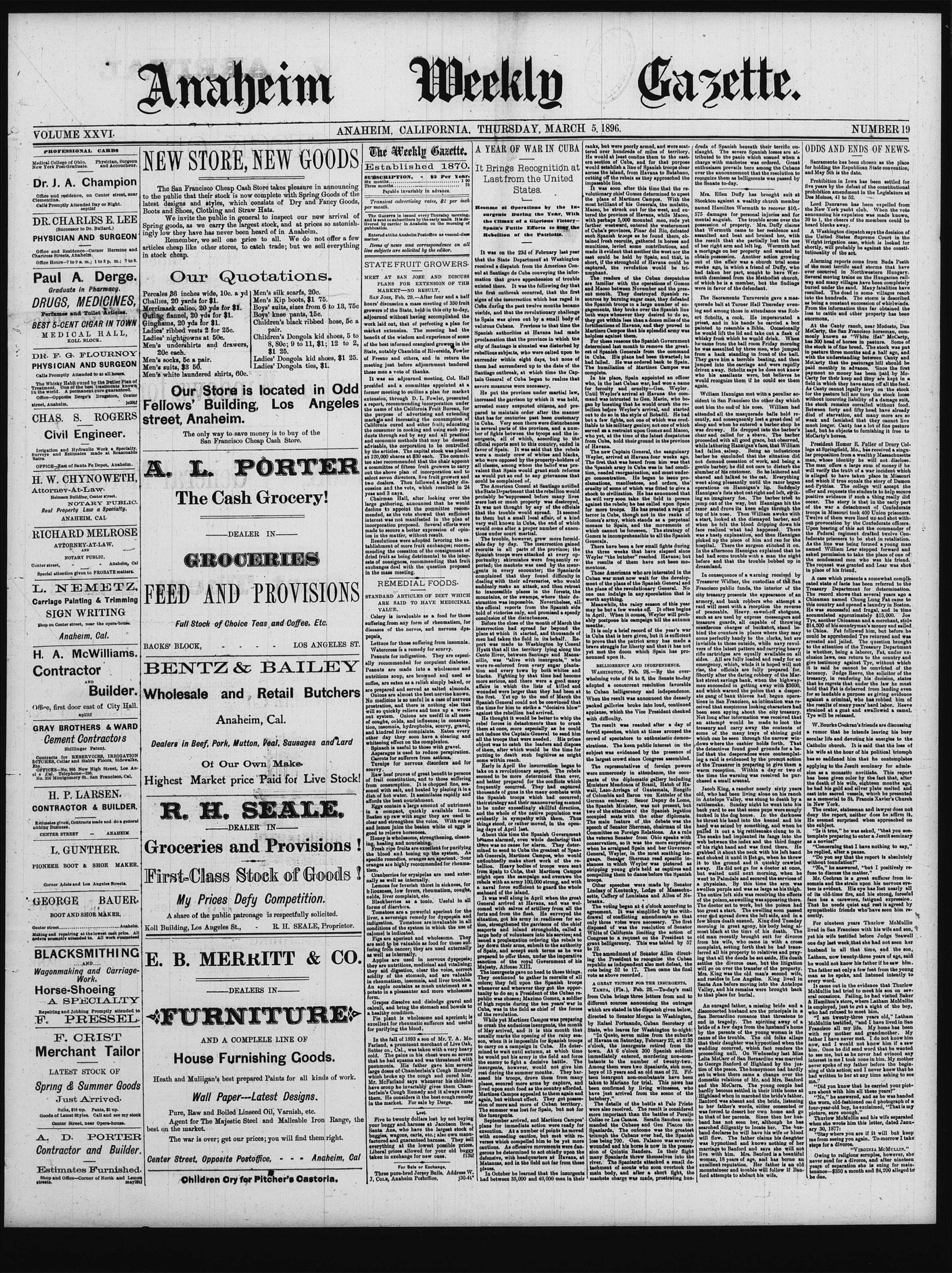
Searchable text
Anaheim
VOLUME XXVI.
PROFESSIONAL CARDS
Medical College of Ohio.
New York Post-Graduate.
Physician, Surgeon and Accoucheur.
Dr. J. A. Champion
Office and residence, on Center street, near Clementina.
Calls Promptly Attended Day or Night.
sept51f
DR. CHARLES E. LEE
(Successor to Dr. Bullard.)
PHYSICIAN AND SURGEON
Office and Residence—Corner Hermine and Chartress Streets, Anaheim.
Office Hours—7 to 9 a.m.; 1 to 3 p.m.; 7 to 8.
Paul A. Derge.
Graduate in Pharmacy.
DRUGS, MEDICINES,
Perfumes and Toilet Articles.
BEST 5-CENT CIGAR IN TOWN
MEDICAL HALL,
KOLL BLOCK.
DR. F. G. FLOURNOY
PHYSICIAN AND SURGEON
Calls Promptly Attended to at all hours.
The Whisky Habit cured by the Butler Plan of Treatment. One of the best treatments known in the world. A permanent cure guaranteed.
Office—Opposite Derge's Drugstore, Center street, Anaheim.
CHAS. S. ROGERS
Civil Engineer.
Irrigation and Hydraulic Work a Specialty.
Surveys and Estimates made at Reasonable Rates.
OFFICE—East of Santa Fe Depot, Anaheim.
NEW STORE, NEW GOODS
The San Francisco Cheap Cash Store takes pleasure in announcing to the public that their stock is now complete with Spring Goods of the latest designs and styles, which consists of Dry and Fancy Goods: Boots and Shoes, Clothing and Straw Hats.
We invite the public in general to inspect our new arrival of Spring goods, as we carry the largest stock, and at prices so astonishingly low they have has never been heard of in Anaheim.
Remember, we sell one price to all. We do not offer a few articles cheap like other stores, to catch trade; but we sell everything in stock cheap.
Our Quotations.
Percales 36 inches wide, 10c. a yd Challies, 20 yards for $1.
Merrimack calico, 20 yds for $1.
Outing flannel, 20 yds for $1.
Ginghams, 20 yds for $1.
Ladies' ribbed vests 2 for 25c.
Ladies' nightgowns at 50c.
Men's undershirts and drawers, 20c each.
Men's socks, 5c a pair.
Men's suits, $3 50.
Men's white laundered shirts, 60c.
Men's silk scarfs, 20c.
Men's Kip boots, $1 75.
Boys' suits, sizes from 6 to 13, 75 Boys' knee pants, 15c.
Children's black ribbed hose, 5c pair.
Children's Dongola kid shoes, 5 t 8, 80c; 9 to 11,$1; 12 to 2$1 25.
Ladies' Dongola kid shoes, $1 25
Ladies' Dongola ties, $1.
Our Store is located in Odo Fellows' Building, Los Angeles street, Anaheim.
The only way to save money is to buy of the San Francisco Cheap Cash Store.
CHAS. S. ROGERS
Civil Engineer.
Irrigation and Hydraulic Work a Specialty.
Surveys and Estimates made at Reasonable Rates.
OFFICE—East of Santa Fe Depot, Anaheim.
H. W. CHYNOWETH,
Attorney-At-Law.
Helmsen Building, Center street.
NOTARY PUBLIC.
Real Property Law a Specialty,
ANAHEIM, CAL.
RICHARD MELROSE
ATTORNEY-AT-LAW.
AND
NOTARY PUBLIC.
Center street, Anaheim, Cal.
Special attention given to PROBATE matters.
L. NEMETZ.
Carriage Painting & Trimming
SIGN WRITING
Shop on Center street, near the opera-house.
Anaheim, Cal.
H. A. McWilliams.
Contractor
AND
Builder.
Office, first door east of City Hall.
split
GRAY BROTHERS & WARD
Cement Contractors
Shillinger Patent.
Contracts for RESERVOIRS, IRRIGATION
DITCHES, Cellar and Stable Floors, Sidewalks,
Eco.
OFFICES—No. 205 New High Street, Los Angeles
e. Cal., Telephone—236.
No. 316 Montgomery St., San Francisco, Cal.
H. P. LARSEN.
CONTRACTOR & BUILDER.
Estimates given, Contracts made and do a general obbing Business.
CENTER STREET — ANAHEIM.
L. GUNTHER.
PIONEER BOOT & SHOE MAKER.
Corner Adele and Los Angeles Streets.
Our Store is located in Odo
Fellows' Building, Los Angeles
street, Anaheim.
The only way to save money is to buy of the
San Francisco Cheap Cash Store.
A. L. PORTER
The Cash Grocery!
DEALER IN
GROCERIES
FEED AND PROVISIONS
Full Stock of Choice Teas and Coffee, Etc.
BACKS' BLOCK,
LOS ANGELES ST
BENTZ & BAILEY
Wholesale and Retail Butchers
Anaheim, Cal.
Dealers in Beef, Pork, Mutton, Veal, Sausages and Lard
Of Our Own Make.
Highest Market price Paid for Live Stock
R. H. SEALE.
DEALER IN
Groceries and Provisions
First-Class Stock of Goods
My Prices Defy Competition
CONTRACTOR & BUILDER.
Estimates given, Contracts made and do a general obbling Business.
CENTER STREET - ANAHEIM.
L. GUNTHER.
PIONEER BOOT & SHOE MAKER.
Corner Adele and Los Angeles Streets.
GEORGE BAUER.
BOOT AND SHOE MAKER.
Center street... Anaheim.
Making and repairing at the lowest cash price. All orders promptly attended to. All work guaranteed
BLACKSMITHING
AND...
Wagonmaking and Carriage-Work,
Horse-Shoeing
A SPECIALTY
Repairing and Jobbing Promptly attended to
F. PRESSEL
F. CRIST
Merchant Tailor
LATEST STOCK OF
Spring & Summer Goods
Just Arrived.
Suits, $18 up. Pants, $5 up.
Goods of Latest Styles. Call and see my stock
Center Street, near Opera-house.
A. D. PORTER
Contractor and Builder.
Estimates Furnished.
Shop and Office—Corner of North and Lemon streets.
R. H. SEALE.
DEALER IN
Groceries and Provisions
First-Class Stock of Goods
My Prices Defy Competition.
A share of the public patronage is respectfully solicited.
Koll Building, Los Angeles St., R. H. SEALE, Proprietor.
E. B. MERRITT & CO.
DEALERS IN
FURNITURE
AND A COMPLELE LINE OF
House Furnishing Goods.
Heath and Mulligan's best prepared Paints for all kinds of work.
Wall Paper---Latest Designs.
Pure, Raw and Boiled Linseed Oil, Varnish, etc.
Agent for The Majestic Steel and Malleable Iron Range, the best on the market.
The war is over; get our prices; you will find them right.
Center Street, Opposite Postoffice, ... Anaheim, Co
Children Cry for Pitcher's Castoria.
ANAHEIM, CALIFORNIA, THURSDAY, MARCH 5, 1896.
NEW GOODS
Times pleasure in announcing
me with Spring Goods of the
of Dry and Fancy Goods,
expect our new arrival of
and at prices so astonishin Anaheim.
We do not offer a few
ple; but we sell everything
tions.
ilk scarfs, 20c.
hip boots, $1 75.
its, sizes from 6 to 13, 75c
tree pants, 15c.
's black ribbed hose, 5c a
's Dongola kid shoes, 5 to
0c; 9 to 11, $1; 12 to 2,
25.
Dongola kid shoes, $1 25.
Dongola ties, $1.
ated in Odd Los Angeles
to buy of the Store.
RTER
The Weekly Gazette.
Established 1870.
SUBSCRIPTION, - $2 Per Year.
Six months... 1,00
Three months... 75
Payable invariably in advance.
Transient advertising rates, $1 per inch per month.
The GAZETTE is issued every Thursday morning,
and is sent to subscribers by the early maila. It is delivered by carrier in Anaheim on the morning of publication.
Entered at the Anaheim Postoffice as second-class matter.
Items of news and correspondence on all live subjects are solicited by the editor.
STATE FRUIT GROWERS
MEET AT SAN JOSE AND DISCUSS PLANS FOR EXTENSION OF THE MARKET—NO RESULT.
SAN JOSE, Feb. 29. After four and a half hours' discussion a mass meeting of 350 fruit growers of the State, held in this city to-day,
adjourned without having accomplished the work laid out, that of perfecting a plan for market extension. The meeting had the benefit of the wisdom and experience of some of the best informed orangized growers in the State, notably Chamblin of Riverside, Fowler of Freeno and others, and in return the meeting just before adjournment tendered these men a vote of thanks.
It was an adjourned meeting, Col. Hall presided and a committee appointed at a former meeting to outline a plan for market extension, through D. L. Fowler, presented a report, recommending incorporation under the name of the California Fruit Bureau, for the purpose of advertising and extending markets and increasing the consumption of California cured and other fruit; educating the consumer in cooking and using such products through and by any and all practical and economic methods that may be deemed advisable, the corporation to be controlled by the articles. The capital stock was placed at 120,000 shares at $30 each. The committee also recommended that the chair appoint a committee of fifteen fruit growers to carry out the above plan of incorporation and to
A YEAR OF WAR IN CUBA
It Brings Recognition at Last from the United States.
Resume of Operations by the Insurgents During the Year, With the Climax of a Glorious Victory—Spain's Futile Efforts to Stay the Rebellion of the Patriots.
It was on the 23d of February last year that the State Department at Washington received a dispatch from the American Consul at Santiago de Cuba conveying the information that grave apprehension of trouble existed there. It was the following day that the first outbreak occurred, that the first signs of the insurrection which has raged in Cuba during the past twelve months became visible, and that the revolutionary challenge to Spain was given out by a small body of valorous Cubans. Previous to that time the Spanish authorities at Havana had made proclamation that the province in which the city of Santiago is situated was disturbed by rebellious subjects, who were called upon to surrender within eight days, but none of them had surrendered up to the date of the Santiago outbreak, at which time the Captain General of Cuba began to realize that severe measures were necessary.
He put the province under martial law, increased the garrison by which it was held, arrested many suspected citizens, and prepared to maintain order after the manner that has for centuries past been customary in Cuba. Very soon there were disturbances in several parts of the province, and a number of fights between the troops and the insurgents, all of which, according to the official reports sent to this country, ended in favor of Spain. It was said that the rebels were a motely crew of whites and blacks, who were opposed by the property-holders of all classes, among whom the belief was prevalent that Spain would grant such reforms ranks, but were poorly armed, and were tered over hundreds of miles of tehern section of Cuba, and for that plu would establish a line of Spanish troops across the island, from Havana to Bastion cutting off the rebels as they approach impassable line.
It was soon after this time that a revolutionary chief Gomez determined that the plans of Martinez Campos. We most brilliant of his Generals, the most Macco, he struck out for the west, and tered the province of Havana, while with perhaps 5,000 mounted men, roared farther westward, entered the weather of Cuba's provinces, Pinar del Rio, such Spanish troops as he found there trained fresh recruits, gathered in horrific munitions, levied some contributions made is evident that neither the west nor east could be held by Spain, and short, if the stronghold of Havana captured, the revolution would be unimpacted.
The readers of the Cuban deserts are familiar with the operations of and Macoo between November and thenent month. They destroyed Spanish sources by burning sugar cane, they dug the Spanish troops in a large number of gagements, they broke over the Spanish both ways whenever they desired to they got within less than a dozen miles fortifications of Havana, and they pro-Martinez Campos that his splendid armies helpless against them.
For these reasons the Spanish Government determined last month to remove their cast of Spanish Generals from the coast in Cuba. His plans had been thwarted failed. He was ordered back to The humiliation of Martinez Camp complete.
In his place, Spain appointed an who, in the last Cuban war, had won for fervor and cruelty—Gen. W. Until Weyler's arrival at Havana the mand was intrusted to Gen. Mario, who gan by boosting that he would crush bellion before Weyler's arrival, and out to do so in the style of Bobadill. But a few fights, not one of which wasitable to his military genius; not one o serviced as a restraint upon Gomez and who yet, at the time of the latest desir from Cuba, hold their ground in the pane of Havana.
The new Captain General, the sang Weyler, arrived at Havana four weeks. The first that was heard from him wished the Spanish army in Cuba was in bad condition needed reorganization, and must
It was an adjourned meeting, Col. Hall presided and a committee appointed at a former meeting to outline a plan for market extension, through D. L. Fowler, presented a report, recommending incorporation under the name of the California Fruit Bureau, for the purpose of advertising and extending markts and increasing the consumption of California cured and other fruit; educating the consumer in cooking and using such products through and by any and all practical and economic methods that may be deemed advisable, the corporation to be controlled by the articles. The capital stock was placed at 120,000 shares at $30 each. The committee also recommended that the chair appoint a committee of fifteen fruit growers to carry out the above plan of incorporation and to select seven directors, five fruit growers and two dealers. Then followed a lengthy discussion and the vote, which resulted in 24 yeas and 3 nays.
Chairman Hall, after looking over the large gathering, announced that he would decline to appoint the committee recommended, as the vote showed that sufficient interest was not manifested in the plan of incorporation proposed. Several efforts were made to secure a better expression of opinion in the matter, without result.
Resolutions were adopted favoring the establishment of more fruit exchanges; recommending the cessation of the consignment of dried fruit as being detrimental to the interests of consignors; recommending that fruit exchanges deal with the question proposed in the mass meeting.
REMEDIAL FOODS.
STANDARD ARTICLES OF DIET WHICH ARE SAID TO HAVE MEDICINAL VALUE.
Celery is invaluable as a food for those suffering from any form of rheumatism, for diseases of the nerves, and nervous dyspeaia.
Lettuce for those suffering from insomnia.
Watercress is a remedy for sourvie.
Peanuts for indigestion. They are especially recommended for corpulent diabetes.
Peanuts are made into a wholesome and nutritious soup, are browned and used as coffee, are eaten as a relish simply baked, or are prepared and served as salted almonds.
Onions are almost the best nerve known. No medicine is so useful in a case of nervous prostration, and there is nothing else that will so quickly relieve and tone up a worn-out system. Onions are useful in all cases of coughs, colds, and influenza; in consumption, insomnia, hydrophobia, scurvy, gravel, and kindred liver complaints. Eaten every other day they soon have a clearing and whitening effect on the complexion.
Spinach is useful to those with gravel.
Asparagus is used to reduce perspiration.
Carrots for sufferers from asthma.
Turnips for nervous disorders and for sourvie.
Raw beef proves of great benefit to persons of frail constitution, and to those suffering from consumption. It is chopped fine, seasoned with salt, and heated by plaging it in a dish of hot water. It assimilates rapidly and affords the best nourishment.
Eggs contain a large amount of nutriment in a compact, quickly available form. Beaten up raw with sugar they are used to clear and strengthen the voice. With sugar and lemon juice the beaten white of eggs is good to relieve horeness.
Honey is wholesome, strengthening, cleansing, healing and nourishing.
Fresh ripe fruits are excellent for purifying the blood and toning up the system. As specific remedies, oranges are apterent. Sour oranges are highly recommended for rheumatism.
Cranberries for erysingelas are used externally as well as internally.
Lemons for feverish thirst in sickness, for bliousness, low fevere, rheumatism, coughs, colds, liver complaint, etc.
He put the province under martial law, increased the garrison by which it was held, arrested many suspected citigens, and prepared to maintain order after the manner that has for centuries past been customary in Cuba. Very soon there were disturbances in several parts of the province, and a number of fights between the troops and the insurgents, all of which, according to the official reports sent to this country, ended in favor of Spain. It was said that the rebels were a motely crew of whites and blacks, who were opposed by the property-holders of all classes, among whom the belief was prevalent that Spain would grant such reforms as would put an end to any grievances that could be complained of.
The American Consul at Santiago notified the State Department that the rebellion would probably be suppressed before many lives were lost or much property was destroyed. It was not thought by any of the officials that the trouble would spread. It seemed to them but a small local affair, of a kind very well known in Cuba, the end of which would come after a proper number of executions under court martial.
The trouble, however, grew more formidable day by day. The insurrection gained recruits in all parts of the province; the Spanish troops were attacked at every opportunity; skirmishes were frequently reported; the machete was used by the insurgents in every encounter; the Spaniards complained that they found difficulty in dealing with their adversaries, who would suddenly make an attack, and then retreat to inaccessible places in the forests, the mountains, or the swamps, where their destruction was impossible. Nevertheless, all the official reports from the Spanish side told of victories only, and promised a speedy conclusion of the disturbances.
Before the close of the month of March the insurrection had spread far beyond the place at which it started, and thousands of men had taken the field in its behalf. Report was made to Washington by Consul Hyatt that all the territory lying along the Canto River, between Santiago and Manzanillo, was "alive with insurgents," who were re-enforced from every sugar plantation and every town by both whites and blacks. Fighting by that time had become more serious, and there were a good many affairs in which the lists of killed and wounded were larger than they had been at the first. Yet up to the end of March the Spanish General could not be convinced that the time for him to strike a "decisive blow" against the rebellion had arrived.
He thought it would be better to whip the rebels forces in detachments than to crush them at once, more especially as he could not induce the Captain-General to send him all the troops that were needed. His prime object was to catch the leaders and dispose of them, after which would be the time for putting to death such fugitives as might come within reach.
Early in April the insurrection began to take on a revolutionary aspect. The rebels seemed to be more determined than ever, and better prepared for the conflicts which frequently occured. They had captured thousands of guns in the many combats with the Spanish troops which had occurred; their strategy and their maneuvering seemed to be under exceedingly skillful direction, and the whole of the native population was evidently in sympathy with them. Thus things stood, or rather moved, in the opening days of April last.
About this time the Spanish Government became alarmed even while declaring that there was no cause for alarm. They determined to send to Cuba the greatest of Spanish Generals, Martinez Campos, who would undoubtedly make short work of the rebellion. Heavy bodies of troops were sent from Spain to Cuba, that Martinez Campos might open the campaign and overawe the rebels with an army 100,000 strong, and with a naval force sufficient to guard the whole seaboard of the island.
It was well along in April when the great General of Cuba began to realize that severe measures were necessary.
He put the province under martial law, increased the garrison by which it was held, arrested many suspected citigens, and prepared to maintain order after the manner that has for centuries past been customary in Cuba. Very soon there were disturbances in several parts of the province, and a number of fights between the troops and the insurgents, all of which, according to the official reports sent to this country, ended in favor of Spain. It was said that the rebels were a motely crew of whites and blacks, who were opposed by the property-holders of all classes, among whom the belief was prevalent that Spain would grant such reforms as would put an end to any grievances that could be complained of.
The American Consul at Santiago notified the State Department that the rebellion would probably be suppressed before many lives were lost or much property was destroyed. It was not thought by any of the officials that the trouble would spread. It seemed to them but a small local affair, of a kind very well known in Cuba, the end of which would come after a proper number of executions under court martial.
The trouble, however, grew more formidable day by day. The insurrection gained recruits in all parts of the province; the Spanish troops were attacked at every opportunity; skirmishes were frequently reported; the machete was used by the insurgents in every encounter; the Spaniards complained that they found difficulty in dealing with their adversaries, who would suddenly make an attack, and then retreat to inaccessible places in the forests, the mountains, or the swamps, where their destruction was impossible. Nevertheless, all the official reports from the Spanish side told of victories only, and promised a speedy conclusion of the disturbances.
Before the close of the month of March the insurrection had spread far beyond the place at which it started, and thousands of men had taken the field in its behalf. Report was made to Washington by Consul Hyatt that all the territory lying along the Canto River, between Santiago and Manzanillo, was "alive with insurgents," who were re-enforced from every sugar plantation and every town by both whites and blacks. Fighting by that time had become more serious, and there were a good many affairs in whichthe lists of killed and wounded were larger than they had been at the first. Yet up to the end of March the Spanish General could not be convinced that the time for him to strike a "decisive blow" against the rebellion had arrived.
He thought it would be better to whip the rebels forces in detachments than to crush them at once, more especially as he could not induce the Captain-General to send him allthe troops that were needed. His prime object was to catchthe leadersand disposeof themafterwhichwouldbethedifficultiesthandswiththeotherpartiesofthebattlefieldofthecountry.
In his place, Spain appointed an officer who,在thelastCubanwar,hadwonforferocity—Gen.W.UntilWeyler's arrival at HavanamandwasintrustedtoGen.Marinwhandengainbyboastingthathewouldorshutdowngoconcentration,Henbeitoissaimelations,andorder crueltyofsomeofwhichwassittedtochallenge,magnificethesourceofsomeofwhichwassittedtochallenge,magnificethesourceofsomeofwhichwassittedtochallenge,magnificethesourceofsomeofwhichwassittedtochallenge,magnificethesourceofsomeofwhichwassittedtochallenge,magnificethesourceofsomeofwhichwassittedtochallenge,magnificethesourceofsomeofwhichwassittedtochallenge,magnificethesourceofsomeofwhichwassittedtochallenge,magnificethesourceofsomeofwhichwassittedtochallenge,magnificethesourceofsomeofwhichwassittedtochallenge,magnificethesourceofsomeofwhichwassittedtochallenge,magnificethesourceofsomeofwhichwassittedtochallenge,magnificethesourceofsomeofwhichwassittedtochallenge,magnificethesourceofsomeofwhichwassittedtochallenge,magnificethesourceofsomeofwhichwassittedtochallenge,magnificethesourceofsomeofwhichwassittedtochallenge,magnificethesourceofsomeofwhichwassittedtochallenge,magnificethesourceofsomeofwhichwassittedtochallenge,magnificethesourceofsomeofwhichwassittedtochallenge,magnificethesourceofsomeofwhichwassittedtochallenge,magnificethesourceofsomeofwhichwassittedtochallenge,magnificethesourceofsomeofwhichwassittedtochallenge,magnificethesourceofsomeofwhichwassittedtochallenge,magnificethesourceofsomeofwhichwassignedtochallenge,magnificethesourceofsomeofwhichwassignedtochallenge,magnificethesourceofsomeofwhichwassignedtochallenge,magnificethesourceofsomeofwhichwassignedtochallenge,magnificethesourceofsomeofwhichwassignedtochallenge,magnificethesourceofsomeofwhichwassignedtochallenge,magnificethesourceofsomeofwhichwassignedtochallenge,magnificethesourceofsomeofwhichwassignedtochallenge,magnificethesourceofsomeofwhichwassignedtochallenge,magnificethesourceofsomeofwhichwassignedtochallenge,magnificethesourceofsome.ofwhichwassignedtochallenge,magnificethesourceOfSomeOfGoods!
Eggs contain a large amount of nutriment in a compact, quickly available form. Beaten up raw with sugar they are used to clear and strengthen the voice. With sugar and lemon juice the beaten white oil eggs is good to relieve horrences.
Honey is wholesome, strengthening, cleansing, healing and nourishing.
Fresh ripe fruits are excellent for purifying the blood and toning up the system. As specific remedies, oranges are apient. Sour oranges are highly recommended for rheumatism.
Cranberries for erysipelas are used externally as well as internally.
Lemons for feverish thirst in sickness, for bliousness, low fevers, rheumatism, coughs, colds, liver complaint, etc.
Blackberries as a tonic. Useful in all forms of diarrhoea.
Tomatoes are a powerful apient for the liver, a sovereign remedy for dyspepsia and indigestion. Tomatoes are invaluable in all conditions of the system in which the use of calomel is indicated.
Figs are apient and wholesome. They are said to be valuable as food for those suffering from cancer; they are used externally as well as internally.
Apples are used in nervous dyspepsia; they are nutritious, medicinal and vitalizing; they aid digestion, clear the voice, correct acidity of the stomach, and are valuable in rheumatism, insomnia, and liver troubles.
An apple contains as much nutriment as a potato in a pleasanter and more wholesome form.
Grapes dissolve and dislodge gravel and calculi, and bring the stomach and bowels to a healthy condition.
Pie plant is wholesome and apient; it is excellent for rheumatic sufferers and useful for purifying the blood.
In the fall of 1893 a son of Mr. T. A. McFarland, a prominent merchant of Live Oak, Sutter co., Cal., was taken with a very heavy cold. The pains in his chest were so severe that he had spasms and was threatened with pneumonia. His father gave him several large doses of Chamberlain's Cough Remedy which broke up the cough and cured him. Mr. McFarland says whenever his children have group he invariably gives them Chamberlain's Congo Remedy and it always cures them. He considers it the best cough remedy in the market. For sale by Derge.
For Sale or Exchange.
Three pure-bred Jersey Bulls, Address W.J.Cole, Anaheim Postoffice.
September arrived, and Martinez Campos' plans for immediate action were ready for execution. At a number of points he moved with exceeding caution, but met with reverses which compelled him to be yet more cautious. As offensive movements were dangerous he determined to act chiefly upon the defensive, with headquarters at Havana, at Matanzas, and in the field not far from these places.
In October he learned that the insurgents had between 35,000 and 40,000 men in their their strategy and their maneuvering seemed to be under exceedingly skillful direction, and the whole of the native population was evidently in sympathy with them. Thus things stood, or rather moved, in the opening days of April last.
About this time the Spanish Government became alarmed, even while declaring that there was no cause for alarm. They determined to send to Cuba the greatest of Spanish Generals, Martinez Campos, who would undoubtedly make short work of the rebellion. Heavy bodies of troops were sent from Spain to Cuba, that Martinez Campos might open the campaign and overweave the rebels with an army 100,000 strong, and with a naval force sufficient to guard the whole seaboard of the island.
It was well along in April when the great General arrived at Havana, and was welcomed with salves of artillery from all the forts and from the fleet. He surveyed the situation, got his army in readiness for action, strengthened the garrisons of the chief seaports and inland strongholds, called a large body of volunteers into his service; and issued a proclamation ordering the rebels to lay down their arms, submit to the authority of Spain, and accept such terms as he was prepared to offer them, under the imperative sanction of the royal Government of his Majesty, Alfonso XIII.
The insurgents gave no heed to these things. They continued to gather in recruits of all colors; they fell upon the Spanish troops whenever and wherever they got the opportunity to do so; a President of the Cuban republic was chosen; Maximo Gomez, a soldier of high reputation during the ten years' war in Cuba, was in the field as chief of the forces of the revolution.
While yet Martinez Campos was preparing to crush the audacious insurgents, the month of May arrived, and it is this month that usually marks the opening of the rainy season, when it is impossible for Spanish troops to carry on a campaign in Cuba. He determined to wait until autumn, at which time he would put his army in the field and force the enemy to fight a decisive battle. The insurgents, however, would not give him rest during the summer months. They harassed his troops, drove them from many places, secured more arms by capture, and lived upon such food as the country afforded. Martinez Campos appealed to them again and again, but without effect. They got possession of more and more of Cuban territory. The summer was lost for Spain, but not for the insurgents.
In Quato, seven miles from the old Havana on Saturday, February 22 o'clock, the insurgents retired from town. At 6 o'clock 300 Spanish immediately entered, murdering two batants to the number of twenties Among them were two Spaniards, six boys of 15 years and an old man of seventeen insurgent non-combatants had taken to Mariano for trial. This has been confirmed by living witnesses have just arrived from the scene butchery."
The details of the battle at Palma were also received. The result is considerable than the battles of Coliso or Los Cacacos. Serafin Sanchez manded the Cubans and Gen Plai Spaniards. The outcome was that triumph the Cubans ever had, their loss being 700. Gen. Palanco was wounded and his horse is now in position of Quintin Bandera. In these Spaniards threw themselves across German embassy. Senior Deputy de la Spanish Minister, Ohio speeches conservatism, so it was the more acute when he arraigned Spain and her General, Weyler, in the most scathing guage. Senator Sherman read speeches in which Weyler was pictured stripping young girls held as captives compelling them to dance before the troops.
Other speeches were made by Lindsay of Kentucky, Lodge of Maysett, Caffery of Louisiana and Allen braska.
The voting began at 4 o'clock according agreement. It was simplified by the drawal of conflicting amendments only three votes were necessary. The disposed of was the resolution of White of California limiting the act Congress to a request on the President grant belligerency. This was tabled to 12.
The amendment of Senator Allen ing the President to recognize the republic as independent also met definite vote being 52 to 17. Then came vote as above recorded.
A GREAT VICTORY FOR THE INSURANCE TAMPA,(Fla.), Feb. 28.-To-day from Cuba brings three letters from different sources announcing that which are stated in the dispatch given directed to Senator Morgan in Washington by Rafael Portuando, Cuban Secretary, who leaves for Washington "In Quato, seven miles from the old Havana on Saturday, February 22 o'clock,the insurgents retired from town.At 6 o'clock 300 Spanish immediately entered,murdering two batants to the number of twenties Among them were two Spaniards,six boys of 15 years and an old man of seventeen insurgent non-combatants had taken to Mariano for trial.This has been confirmed by living witnesses have just arrived from the scene butchery."
Gazette.
1896. NUMBER 19
but were poorly armed, and were scatover hundreds of miles of territory.
would at least confine them to the eastsection of Cuba, and for that purpose
and establish a line of Spanish troops clear
as the island, from Havana to Batabano,
going off the rebels as they approached the
resistance line.
was soon after this time that the resionary chief Gomez determined to upset
plans of Martinez Campos. With the
brilliant of his Generals, the mulatto,
he struck out for the west, and entroduced the province of Havana, while Maceo,
perhaps 5,000 mounted men, rode yet
her westward, entered the westernmost
Maceo's provinces, Pinar del Rio, defeated
Spanish troops as he found there, objected fresh recruits, gathered in horses and
tents, levied some contributions, and
it evident that neither the west nor the
could be held by Spain, and that, in
if the stronghold of Havana could be
raided, the revolution would be triumnant.
The readers of the Cuban despatches
familiar with the operations of Gomez
Macco between November and the presmonth. They destroyed Spanish reactions by burning sugar cane, they defeated
Spanish troops in a large number of enments, they broke over the Spanish line
always whenever they desired to do so,
got within less than a dozen miles of the
locations of Havana, and they proved to
Martinez Campos that his splendid army was
less against them.
For these reasons the Spanish Government
remained last month to remove the greatest Spanish Generals from the command
Maceo. His plans had been thwarted; he
failed. He was ordered back to Spain.
Humiliation of Martinez Campos was
released.
His place, Spain appointed an officer
in the last Cuban war, had won a name
heroicity and cruelty—Gen. Weyler.
Weyler's arrival at Havana the commission was intrusted to Gen. Marín, who beyous boosting that he would crush the reon before Weyler's arrival, and started
to do so in the style of Bobadil. He had
few fights, not one of which was creded to his military genius; not one of which
was a restraint upon Gomez and Macco,
yet, at the time of the latest despatches
Cuba, hold their ground in the province
of Havana.
Now Captain General, the sanguinary
cler, arrived at Havana four weeks ago.
first that was heard from him was that
Spanish army in Cuba was in bad condined reorganization, and must under-
dreda of Spanish beneath their terrific onslaught. The severe Spanish losses are attributed to the panic which ensued when a charge with macbetes was ordered. Great enthusiasm prevails here among the Cubans over the announcement that the resolution to recognize them as belligerents was passed by the Senate to-day.
Mrs. Ellen Duffy has brought suit at Stockton against a wealthy church member named Hamilton Wermuth to recover $10,-575 damages for personal injuries and for mental anguish. The trouble arose over the possession of property. Mrs. Duffy claims that Wermuth came to her residence and assaulted and beat and braised her, with the result that she partially lost the use of her right arm and left leg. Wermuth had a mortgage on her property and wanted to obtain possession. Another action growing out of the affair was a church trial some weeks ago, in which a friend of Duffy, who had taken her part, sought to have Wermuth dismissed from the Methodist church, of which he is a member, but the findings were in favor of the defendant.
The Sacramento Turnverein gave a masquerade ball at Turner Hall Thursday evening and among those in attendance was Robert Scholtz, a cook. He impersonated a priest, and in his hands he carried a box painted to resemble a Bible. Occasionally he would lift the lid and take out a flask of whisky from which he would drink. When he came from the ball room Friday morning he was assaulted by three men, who jumped from a hack standing in front of the ball. They gave him a terrible beating, and then jumped into the carriage and were rapidly driven away. Scholtz says he does not know who his assailants were, but believes he would recognize them if he could see them again.
William Hannigan met with a peculiar accident in San Francisco the other day which cost him the end of his nose. William had attended all the masquerade balls held recently, and consequently lost a great deal of sleep and when he entered a barber shop he was drowsy. He dropped into the barber's chair and called for a shave. The barber proceeded with all good grace, but observed, while lathering Hannigan's face, that William had fallen asleep. Being an industrious barber he concluded that the situation did not demand cessation of work, and being a gentle barber, he did not care to disturb the slumber of his customer. So he lathered and
ODDS AND ENDS OF NEWS
Sacramento has been chosen as the place for holding the Republican State convention,
and May 5th is the date.
Prohibition in Iowa has been settled for five years by the defeat of the constitutional prohibition amendment in the Legislature at Des Moines, 41 to 52.
Lord Dunraven has been expelled from the New York yacht club. When the vote announcing his expulsion was made known, 39 to 1, the cheers of the members could be heard blocks away.
A Washington dispatch says the decision of the United States Supreme Court in the Wright irrigation case, which is looked for shortly, will probably be against the constitutionality of the act.
Alarming reports come from Buda Peath of the most terrific sand storms that have ever occurred in Northwestern Hungary. Several moving trains on the Hungarian railway and many villages have been completely buried under the sand. Many fatalities have resulted. The dead in some villages reach into the hundreds. The storm is described as being a constant succession of whirlwinds. From the information thus far obtained the loss to cattle and other property has been enormous.
At the Canty ranch, near Modesto, Dan McCarty, the San Francisco horseman, commonly known as "White Hat" McCarty, has 300 head of horses in pasture. Some of the stock is of fine breed. The stock was put in pasture three months and a half ago, and with the understanding between Canty and McCarty that the pasturage bill should be paid monthly in advance. Since the first payment no money has been paid by McCarty for their keep and they are kept in a field in which they have eaten off all the feed. As Canty cannot legally levy on the stock for the pasture bill nor turn the stock loose without incurring liability of a damage suit, the stock remains corralled without food. Between forty and fifty head have already died of starvation, and many more are so weak and famished that they cannot live much longer. Canty has a lot of fine pasture land, but he objects to furnishing it free to McCarty's horses.
President Homer E. Fuller of Drury College at Springfield, Mo., has received a singular proposition from a wealthy Massachusetts man, whose identity he will not disclose. The man offers a large sum of money if he will verify the truth of a war incident which
The new Captain General, the sanguinary elder, arrived at Havana four weeks ago. First that was heard from him was that Spanish army in Cuba was in bad condition reorganized, and must under-concentration. He began to issue proclamations, manifestoes, and orders, the majority of which was fitted to give a key to civilization. He has announced that all very soon take the field in person against the rebels; he has called upon Spain more troops. He has created a reign of war in Cuba, though not in the ranks of the enemy's army, which stands as a perpetual force to Spain, and the movements of the cannot be foreseen. The strategy of mezziz is incompressible to all the Spanish wars.
There have been a few small fights during three weeks that have elapsed since "the butcher" reached Havana; but results of them have not been monstrous.
American who are interested in the war must now wait for the development of the plans of the Spanish General and navalists of the revolutionary General. No can indulge in any speculation that is anything.
While the rainy season of this year be but a few weeks off. It often begins April. When it comes, Weyler will postpone his campaign till the autumn season.
Only a brief record of the year's war in Cuba that is here given, but it is sufficient prove that the patriot army has made a struggle for liberty and that it has not met the doom which Spain has proceeded upon it.
The result was reached after a day of speeches, which at times aroused the mood of spectators to enthusiastic demonstrations. The keen public interest on the event was evidenced by the presence of a large crowd since Congress assembled. Representatives of foreign powers numerously in attendance, theocopies of the diplomatic gallery including Mendonca of Brazil, Hatch of Ha-Lazo-Arriaga of Guatemala, Rengifo Colombia and Baron von Ketteler of the man embassy. Senior Depuy de Lome, Spanish Minister, was not present, but of the attaches of the Spanish legation replied seats with the other diplomats.
Main feature of the debate was the choice of Senator Sherman, chairman of the committee on Foreign Relations. As a rule veteran Senator from Ohio speaks with servatism, so it was the more surprising he arraigned Spain and her Governor-general, Weyler, in the most soothing lance. Senator Sherman read specific incursions in which Weyler was pictured as young girls held as captives and spelling them to dance before the Spanish lips.
Other speeches were made by Senator Slavay of Kentucky, Lodge of Massachusetts, Caffery of Louisiana and Allen of New York.
William Hannigan met with a peculiar accident in San Francisco the other day which cost him the end of his nose. William had attended all the masquerade balls held recently, and consequently lost a great deal of sleep and when he entered a barber shop he was drowsy. He dropped into the barber's chair and called for a shave. The barber proceeded with all good grace, but observed, while lathering Hannigan's face, that William had fallen asleep. Being an industrious barber he concluded that the situation did not demand cessation of work, and being a gentle barber, he did not care to disturb the slumber of his customer. So he lathered and shaved and talked to the cat. Everything went along pleasantly until the razor began operations on Hannigan's lip. Suddenly Hannigan's fists shot out right and left, striking an imaginary foe. The barber tried to jump out of the way, but Hannigan hit the razor and drove its keen edge through the top of his nose. Then William awoke with a start, looked at the dismayed barber, and when he felt the blood dripping down his face realized what had happened. There was a hasty explanation, and then Hannigan picked up the piece of him and ran for the hospital. There the surgeon stitched it on. In the afternoon Hannigan explained that he had had some trouble with a man the night before and that the trouble bobbed up in dreamland.
In consequence of a warning received by Treasurer Widber, the custodian of the San Francisco public funds, the interior of the city treasury presents the appearance of an armory, and bank robbers attempt a raid will meet with a reception the reverse of peaceable. Heavy, sawed-off shotguns, such as are used by express messengers and treasure guards, all capable of throwing murderous charges of buckshot, stand behind the counters in places where they may come perfectly handy to the clerks, but are invisible to those outside, while navy revolvers of the latest pattern and carrying heavy rifle cartridges are equally available on all sides. All are fully loaded and ready for an emergency, which, while it is hoped will not rise, the officials are fully prepared for. Shortly after the daring robbery of the Market street savings bank, when the highwaymen succeeded in getting away with $3600 and which warned the police that a desperate gang of bank thieves had begun operations in San Francisco, an intimation was received that suspicious looking characters had been seen spying about the city treasury. Not long after information was received that an attempt would be made to loot the treasury and carry away the contents of some of the many trays of shining gold which can be seen through the narrow windows where the cashier holds forth. That the detectives found good grounds for a belief that the desperadoes were contemplating a raid is evidenced by the prompt action of the Treasurer in preparing to give them a warm reception. Within a day or two of time the warning was received by purchased a small arsenal.
Jacob King, a rancher nearly sixty years old, who had been living alone on his ranch in Antelope Valley, was stung to death by a rattlesnake. Sunday night he went into his back yard to see that some pups were snugly tucked in the dog house. In the darkness he thrust his hand into the kennel and his hand was seized by something, and when he pulled it out a big rattlesnake clung to it. The snake had implanted its fangs into the web between the index and the third finger of his right hand and was fixed there. He grabbed it about the neck with his left hand and choked it until it lot go, when he threw it to the ground and it quickly crawled away. He did not go for a doctor at once, but waited until next morning, when he went to Palmdale and secured the services of a physician. By this time the arm was awollen purple and was as large as his thigh. The entire left side was receiving the effects of poisoning as swelling was appearing there.
President Homer E. Fuller of Drury College at Springfield, Mo., has received a singular proposition from a wealthy Massachusetts man, whose identity he will not disclose. The man offers a large sum of money if he will verify the truth of a war incident which is alleged to have taken place in Missouri and which if true equals the story of Damon and Pythias. The college will accept the offer and requests the students to help secure positive evidence if such a thing really did occur. The story is that in the early part of the war a detachment of Confederate troops in Missouri took 400 Union prisoners. Twelve of them were lined up and shot without provocation by the Confederate officers. Upon hearing of this act the commander of the Federal regiment drafted twelve Confederate prisoners to be shot in retaliation. As the line was being formed a young man named William Lear stepped forward and asked permission to take the place of one of the condemned men who was his friend. The request was granted and Lear was shot in place of his friend.
A case which presents a somewhat complicated state of facts has been referred to the Treasury Department for determination. The record shows that several years ago a Chinaman named Chung Lung Fat came to this country and opened a laundry in Boston. He was successful and frugal, and in time accumulated approximately $15,000. Joe Tye, another Chinaman and a merchant, stole $14,500 of his countryman's money and sailed to China. Fat followed him, but before he could be apprehended Tye returned and was arrested and jailed. The question brought to attention of the Treasury Department is whether, being a laborer, Fat, under exclusion laws, can return to the country and give testimony against Tye, without which it is said he cannot be convicted of the larceny. Judge Reeve, the solicitor of the treasury, in rendering his decision, states that he regrets that under the law he must hold that Fat is debarred from landing even for so laudable purpose as giving evidence against a criminal who has robbed him of the results of many years' hard labor. Reeve strained at a gnat and swallowed a camel. Tye will be released.
W.Bourke Cockran's friends are discussing a rumor that he intends leaving his busy secular life and devoting his energies to the Catholic church. It is said that he loses his wife at the hour of his political triumph so sapped him that he contemplates applying to the Jesuit seminary for admission as a monastic novitiate. This report has been given color by the fact that, after the death of his wife, eighteen months ago, he had his gold and silver plate melted and cast into sacred vessels, which he presented as a memorial to St. Francis Xavier's Church in New York.
The orator, statesman and lawyer does not deny that report, neither does he affirm it. He seemed surprised when approached on the subject.
"Is it true," he was asked, "that you contemplate preparing to enter a Jesuit seminary as a novice?"
"Concerning that I have nothing to say," he replied after a pause.
"Do you say that the report is absolutely without foundation!"
"No," he answered, "but I positively refuse to discuss the matter."
Mr. Cochran is a great sufferer from insomnia and the strain upon his nervous system is evident. His eye has lost nearly all of its old-time fire, and his strong forceful face has been fatigued expression."
GREAT VICTORY FOR THE INSURGENTS.
(AMA, (Fla.), Feb. 28.—To-day's mail in Cuba brings three letters from and to parent sources announcing the outrages which are stated in the dispatch given below, quoted to Senator Morgan in Washington, Rafael Portuando, Cuban Secretary of State, who leaves for Washington to-night: In Quato, seven miles from the suburbs Havana on Saturday, February 22, at 2:30 p.m., the insurgents retired from the city. At 6 o'clock 300 Spanish soldiers immediately entered, murdering non-combatants to the number of twenty-two. Among them were two Spaniards, sick men, of 15 years and an old man of 72. Fifteen insurgent non-combatants have been sent to Mariano for trial. This news has been confirmed by living witnesses, who are just arrived from the scene of the cherry."
The details of the battle at Palo Prieto are also received. The result is considered more important than the battles of Peraljo or Los Cacaos. Serafin Sanchez comanded the Cubans and Gen Planco the Spaniards. The outcome was the greatest sumph the Cubans ever had, the Spanish being 700. Gen. Palanco was severelyounded and his horse is now in the possession of Quintin Bandera. In their flight my Spaniards threw themselves into the war. The Spaniards attacked a small detachment of scouts who soon overtook the in body, and after a short fight, the mobite charge was made, prostrating hun-