anaheim-gazette 1896-02-06
Scanned page
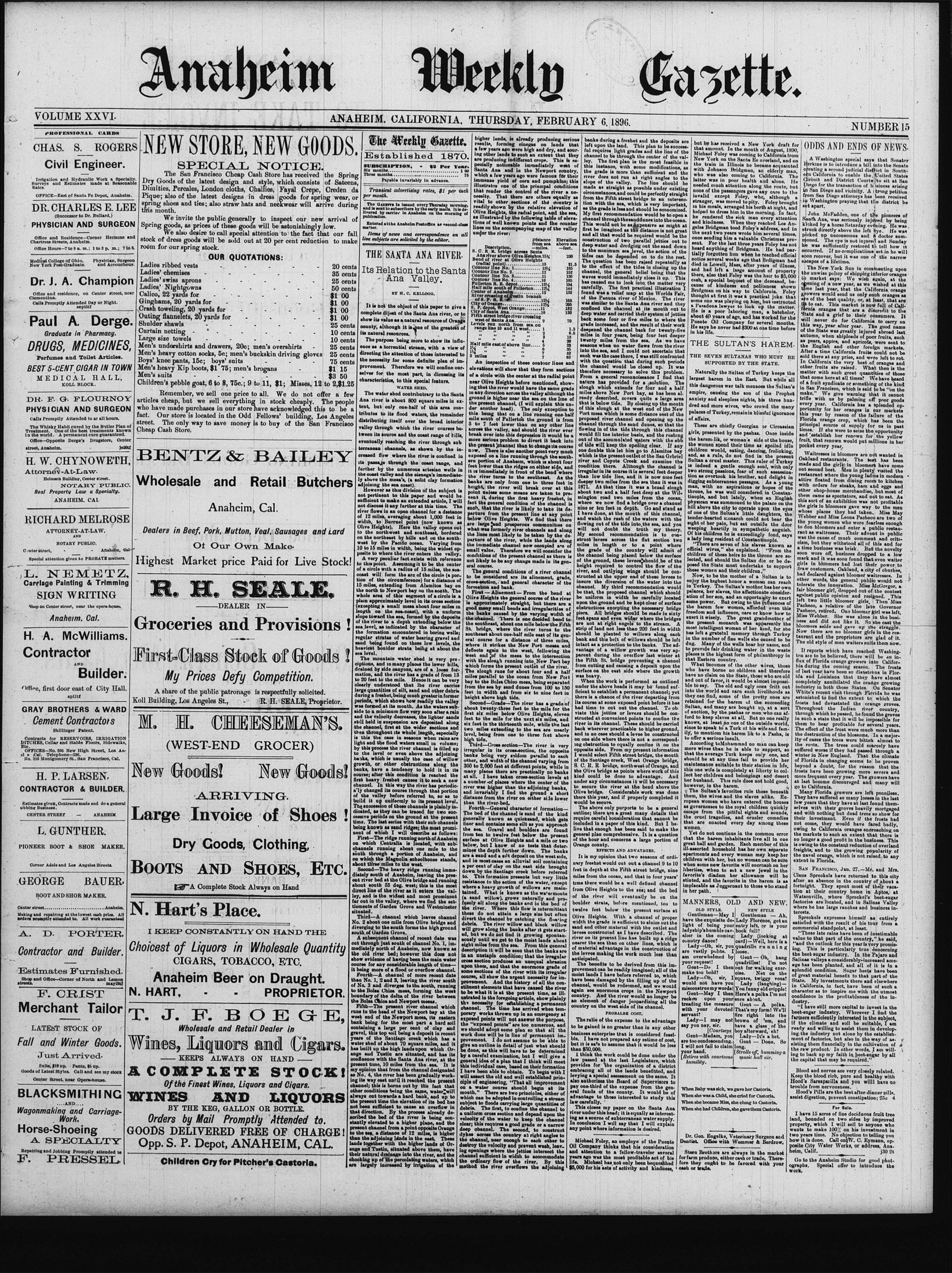
Searchable text
Anaheim
VOLUME XXVI.
PROFESSIONAL CARDS
CHAS. S. ROGERS
Civil Engineer.
Irrigation and Hydraulic Work a Specialty. Surveys and Estimates made at Reasonable Rates.
OFFICE—East of Santa Fe Depot, Anaheim.
DR. CHARLES E. LEE
(Successor to Dr. Bullard.)
PHYSICIAN AND SURGEON
Office and Residence—Corner Hermine and Chartress Streets, Anaheim.
Office Hours—7 to 9 a.m.; 1 to 3 p.m.; 7 to 8.
Medical College of Ohio. Physician, Surgeon and Accoucheur.
Dr. J. A. Champion
Office and residence, on Center street, near Clementina.
Calls Promptly Attended Day or Night.
sept5tf
Paul A. Derge.
Graduate in Pharmacy.
DRUGS, MEDICINES,
Perfumes and Toilet Articles.
BEST 5-CENT CIGAR IN TOWN
MEDICAL HALL,
KOLL BLOCK.
DR. F. G. FLOURNOY
PHYSICIAN AND SURGEON
Calls Promptly Attended to at all hours.
The Whisky Habit cured by the Butler Plan of Treatment. One of the best treatments known in the world. A permanent cure guaranteed.
Office—Opposite Derge's Drugstore, Center street, Anaheim.
H. W. CHYNOWETH,
Attorney-At-Law.
NEW STORE, NEW GOODS
SPECIAL NOTICE.
The San Francisco Cheap Cash Store has received the Spring Dry Goods of the latest design and style, which consists of Sateens Dimities, Percales, London cloths, Challies, Fayal Crepe, Creden d'Pique; also of the latest designs in dress goods for spring wear, our spring shoes and ties; also straw hats and neckwear will arrive during this month.
We invite the public generally to inspect our new arrival of Spring goods, as prices of these goods will be astonishingly low.
We also desire to call special attention to the fact that our fall stock of dress goods will be sold out at 20 per cent reduction to make room for our spring stock.
OUR QUOTATIONS:
Ladies ribbed vests - $20 cents
Ladies' chemises - $35 cents
Ladies' swiss aprons - $25 cents
Ladies' Nightgowns - $50 cents
Calico, 22 yards for - $1 00
Ginghams, 20 yards for - $1 00
Crash toweling, 20 yards for - $1 00
Outing flannelets, 20 yards for - $1 00
Shulder shawls - $25 cents
Curtain netting - $10 cents
Large size towels - $10 cents
Men's undershirts and drawers, 20c; men's overshirts - $25 cents
Men's heavy cotton socks, 5c; men's buckskin driving gloves - $25 cents
Boys' knee pants, 15c; boys' suits - $75 cents
Men's heavy Kip boots, $1 75; men's brogans - $1 15
Men's suits - $3 50
Children's pebble goat, 6 to 8, 75c.; 9 to 11, $1; Misses, 12 to 2,$1.25
Remember, we sell one price to all. We do not offer a few articles cheap, but we sell everything in stock cheaply. The people who have made purchases in our store have acknowledged this to be a fact. Our store is located in the Odd Fellows' building, Los Angeles street. The only way to save money is to buy of the San Francisco Cheap Cash Store.
BENTZ & BAILEY
MEDICAL HALL,
KOLL BLOCK.
DR. F. G. FLOURNOY
PHYSICIAN AND SURGEON
Calls Promptly Attended to at all hours.
The Whisky Habit cured by the Butler Plan of Treatment. One of the best treatments known in the world. A permanent cure guaranteed.
Office—Opposite Derge's Drugstore, Center street, Anaheim.
H. W. CHYNOWETH,
Attorney-At-Law.
Helmsen Building, Center street.
NOTARY PUBLIC.
Real Property Law a Specialty.
ANAHEIM, CAL.
RICHARD MELROSE
ATTORNEY-AT-LAW.
AND
NOTARY PUBLIC.
Center street, Anaheim, Cal.
Special attention given to PROBATE matters.
L. NEMETZ,
Carriage Painting & Trimming
SIGN WRITING
Shop on Center street, near the opera-house.
Anaheim, Cal.
H. A. McWilliams.
Contractor
AND
Builder.
Office, first door east of City Hall.
ap11tf
GRAY BROTHERS & WARD
Cement Contractors
Shillinger Patent.
Contracts for RESERVOIRS, IRRIGATION DITCHES, Cellar and Stable Floors, Sidewalks, Etc.
OFFICES—No. 205 New High Street, Los Angeles St., R. H. SEALE, Proprietor.
No. 316 Montgomery St., San Francisco, Cal.
H. P. LARSEN,
CONTRACTOR & BUILDER.
Estimates given, Contracts made and do a general obbing Business.
CENTER STREET - ANAHEIM
L. GUNTHER.
PIONEER BOOT & SHOE MAKER.
Corner Adele and Los Angeles Streets.
GEORGE BAUER,
BOOT AND SHOE MAKER.
Men's suits
$3 50
Children's pebble goat, 6 to 8, 75c.; 9 to 11, $1; Misses, 12 to 2,$1.25
Remember, we sell one price to all. We do not offer a few articles cheap, but we sell everything in stock cheaply. The people who have made purchases in our store have acknowledged this to be a fact. Our store is located in the Odd Fellows' building, Los Angeles street. The only way to save money is to buy of the San Francisco Cheap Cash Store.
BENTZ & BAILEY
Wholesale and Retail Butchers
Anaheim, Cal.
Dealers in Beef, Pork, Mutton, Veal, Sausages and Lard
Of Our Own Make.
Highest Market price Paid for Live Stock!
R. H. SEALE.
DEALER IN
Groceries and Provisions!
First-Class Stock of Goods!
My Prices Defy Competition.
A share of the public patronage is respectfully solicited.
Koll Building, Los Angeles St., R. H. SEALE, Proprietor.
M. H. CHEESEMAN'S.
(WEST-END GROCER)
New Goods! New Goods!
ARRIVING.
Large Invoice of Shoes!
Dry Goods, Clothing,
BOOTS AND SHOES, ETC.
A Complete Stock Always on Hand
L. GUNTHER.
PIONEER BOOT & SHOE MAKER.
Corner Adele and Los Angeles Streets.
GEORGE BAUER
BOOT AND SHOE MAKER.
Center street...Anaheim.
Making and repairing at the lowest cash price. All orders promptly attended to. All work guaranteed
A. D. PORTER,
Contractor and Builder.
Estimates Furnished.
Shop and Office—Corner of North and Lemon streets.
F. CRIST
Merchant Tailor
LATEST STOCK OF
Fall and Winter Goods.
Just Arrived.
Suits, $18 up. Pants, $5 up.
Goods of Latest Styles. Call and see my stock
Center Street, near Opera-house.
BLACKSMITHING
...AND...
Wagonmaking and Carriage-Work.
Horse-Shoeing
A SPECIALTY
Repairing and Jobbing Promptly attended to
F. PRESSEL.
Large Invoice of Shoes!
Dry Goods, Clothing,
Boots and Shoes, Etc.
A Complete Stock Always on Hand
N. Hart's Place.
I KEEP CONSTANTLY ON HAND THE
Choicest of Liquors in Wholesale Quantity
CIGARS, TOBACCO, ETC.
Anaheim Beer on Draught.
N. HART, PROPRIETOR.
T. J. F. BOEGE,
Wholesale and Retail Dealer in
Wines, Liquors and Cigars.
KEEPS ALWAYS ON HAND
A COMPLETE STOCK!
Of the Finest Wines, Liquors and Cigars.
WINES AND LIQUORS
BY THE KEG, GALLON OR BOTTLE.
Orders by Mail Promptly Attended to.
GOODS DELIVERED FREE OF CHARGE!
Opp. S. P. Depot, ANAHEIM, CAL.
Children Cry for Pitcher's Castoria.
W GOODS.
NOTICE.
He has received the Spring which consists of Sateens, Fayal Crepe, Creden da goods for spring wear, or skwear will arrive during expect our new arrival of astonishingly low. to the fact that our fall cent reduction to make
20 cents
35 cents
25 cents
50 cents
$1 00
$1 00
$1 00
25 cents
10 cents
10 cents
25 cents
25 cents
75 cents
$1 15
$3 50
1; Misses, 12 to 2,$1.25
We do not offer a few back cheaply. The people knowledged this to be a building, Los Angeles of the San Francisco
THE SANTA ANA RIVER.
Its Relation to the Santa Ana Valley.
BY H. C. KELLOGG.
It is not the object of this paper to give a complete digest of the Santa Ana river, or to show its value as a natural resource of Orange county, although it is one of the greatest of its natural resources.
The purpose being more to show its influence as a torrential stream, with a view of directing the attention of those interested to the necessity for some definite plan of improvement. Therefore we will confine ourselves for the most part, in discussing its characteristics, to this special feature.
WATER SHED.
The water shed contributory to the Santa Ana river is about 800 square miles in extent, but only one-half of this area contributes to its flood waters, the remainder distributing itself over the broad interior valley through which the river courses between its source and the coast range of hills, eventually reaching the river through subterranean channels, as shown by the increased flow where the river is confined in its passage through the coast range, and further by the numerous artesian wells in the coast valley and the ciencia's immediate higher lands, is already producing serious results, forming cinegas on lands that a few years ago were high and dry, and souring other lands to such an extent that they are producing indifferent crops. This is especially noticeable immediately west of Santa Ana and in the Newport country, which a few years ago were famous for their immense yield of corn and pumpkins; this illustrates one of the principal conditions that render the control of the river a necessity. That there are others equally as vital to other sections of the country is readily shown by the relative elevation of Olive Heights, the radial point, and the sea, as illustrated by the following table of elevations of well known points and the counter lines on the accompanying map of the valley under the river:
Distance from sea —miles. Elevation above sea —feet.
Description.
S. C. R. R. bridge across Santa Ana river above Olive Heights. 15%
Bend of river at Olive Heights (radial point). 15
Contour line No. 1. 13½
Contour line No. 2. 12
Contour line No. 3. 11
Contour line No. 4. 10
Fullerton R. R. depot. 12½
Half mile south of Fullerton. 12½
Center of Anabelm. 12
River crossing Tustin branch of S. W. R. R. 12½
City of Orange. 12½
S. P. depot, West Orange. 11
City of Santa Ana. 10
Fifth street bridge river crossing west of Santa Ana. 9
Levels run north from sea on range line 10 and 11 west. 1
" " " " " " " " " " " " " " " " " " " " " " " " " " " " " " " " " " " " " " " " " "
" " " " " " " " " " " " " " " " " " " " " " " " " " " " " " "
" " " " " " " " " " " " " " " "
Half mile east of above line. 5
Half mile east of above line. 6
Miles east of above line. 7
63
An inspection of these contour lines and elevations will show that they form sections of a circle with the center at the radial point near Olive Heights before mentioned, showing that the river would have the same grade in any direction across the valley although the ground is higher near the sea on the line of the present channel, (I will explain this under another head). The only exception to this being that on a line running one-half mile south of Fullerton the ground is from 5 to 7 feet lower than on any other line across the valley, and should the river ever break over into this depression it would be a more serious problem to divert it back into the present channel than to change its course now. There is also another point very much exposed on a line running through the southern portion of Anabelm, which is about four feet lower than the ridges on either side, and it is immediately in front of the bend where banks during a frechet and the deposit left upon the land. This plan to be successful requires light grades and the lines channel to be through the center of the levy. The first plan is the most feasible instance, with some modifications: the grade is more than sufficient and river does not run at right angles to the immense yield of corn and pumpkins; this illustrates one of the principal conditions that render the control of the river a necessity. That there are others equally as vital to other sections of the country is readily shown by the relative elevation of Olive Heights, the radial point, and the sea, as illustrated by the following table of elevations of well known points and the counter lines on the accompanying map of the valley under the river:
Distance from sea —miles. Elevation above sea —feet.
Description.
S. C. R. R. bridge across Santa Ana river above Olive Heights. 15%
Bend of river at Olive Heights (radial point). 15
Contour line No. 1. 13½
Contour line No. 2. 12
Contour line No. 3. 11
Contour line No. 4. 10
Fullerton R. R. depot. 12½
Half mile south of Fullerton. 12½
Center of Anabelm. 12
River crossing Tustin branch of S. W. R. R. 12½
City of Orange. 12½
S. P. depot, West Orange. 11
City of Santa Ana. 10
Fifth street bridge river crossing west of Santa Ana. 9
Levels run north from sea on range line 10 and 11 west. 1
" " "
" "
" "
" "
" "
" "
" "
" "
" "
" "
" "
" "
" "
" "
" "
" "
" "
" "
" "
" "
" "
" "
" "
" "
" "
" "
" "
" "
" "
" "
" "
" "
" "
" "
" "
" "
" "
" "
" "
" "
" "
" "
" "
" "
" "
" "
" "
" "
" "
An inspection of these contour lines and elevations will show that they form sections of a circle with the center at the radial point near Olive Heights before mentioned, showing that the river would have the same grade in any direction across the valley although the ground is higher near the sea on the line of the present channel, (I will explain this under another head). The only exception to this being that on a line running one-half mile south of Fullerton the ground is from 5 to 7 feet lower than on any other line across the valley, and should the river ever break over into this depression it would be a more serious problem to divert it back into the present channel than to change its course now. There is also another point very much exposed on a line running through the southern portion of Anabelm, which is about four feet lower than on any other side, and it is immediately in front of the bend where banks during a frechet and the deposit left upon the land. This plan to be successful requires light grades and the lines channel to be through the center of the levy. The first plan is the most feasible instance, with some modifications: the grade is more than sufficient and river does not run at right angles to the immense yield of corn and pumpkins; this illustrates one of the principal conditions that render the control of the river a necessity. That there are others equally as vital to other sections of the country is readily shown by the relative elevation of Olive Heights, the radial point, and the sea, which is very important as the grade is less and should be cooled My first recommendation would be to channel through these dunes into the lake This would not be as expensive as mine first be imagined as the distance is not all that would be required would be construction of two parallel jetties on deep water and dredging out the sand tothe minimum sea level, the action o tides can be depended on to do this The question has been raised repeated tothe effect ofthe tides in closing upchannel,the general belief being that waves would immediately close it up.has caused me to look into the matter carefully.The first practical illustration found was a relief map at the Worldsof Panuca river of Mexico.The was similar tothe Santa Ana river andconfinedthe channelatitsmoutho deepwater and carried their system济back some four or five miles to wheregrade increased,andthe resultof theirdeepenedthe channel back fortwentymiles in four years,being four feet downtwenty miles fromthesea.Aswe seasons when no water flows fromtheintothesea,andIcouldnotascertainsuchwasthecasethere.Iwas stillconfirmwiththequestionthatduringsuchperchannelwouldbeclosedup.IttheforeecessarytosolvethisproblemFromageneralreconnoissanceIfindnaturehas providedfora solution.soughwhichextendsfourandamilesaboveNewPort bay,ahasbereadydescribed,coversquitea largerthatisbelowtide.ByclosingupthemofthissloughatthewestendofthePortmesawhichissomedistance eastofproposedriverchannelandopeningupchannelthroughthesanddunes,sothawflowinginofthetidethroughthischannelwouldfilltheinteriorbasin,andtherausoutoftheaccumulatedwaterswiththeoftidewillkeeptheopedingclearIfone doubtsthislethimgo toAlamitoswhichisthepresent outletoftheSanGriff RiverandCoyote Creekandexamineconditionthere.Althoughthechanneirregularinitscourseitisseveralfeetde
The water shed contributory to the Santa Ana River is about 800 square miles in extent, but only one-half of this area contributes to its flood waters, the remainder distributing itself over the broad interior valley through which the river courses between its source and the coast range of kills, eventually reaching the river through subterranean channels, as shown by the increased flow where the river is confined in its passage through the coast range, and further by the numerous artesian wells in the coast valley and the cienega's immediately above the mesa's, (a solid clay formation adjoining the sea coast).
However as this division of the subject is not pertinent to this paper and would be sufficient to make an extended article, I will not discuss it any further at this time. The river flows in an open channel for a distance of 12 miles, averaging about 1,000 feet in width, to Burrael point (now known as Olive Heights). Here the valley opens out to the northwest and southeast, bordered on the northeast by hills and on the southwest by the Pacific ocean. Varying from 10 to 15 miles in width, being the widest opposite to where the river enters the valley.
A very popular fact exists with reference to this point. Assuming it to be the center of a circle with a radius of 15 miles, the seacoast will form the arc of the circle (a portion of the circumference) for a distance of 15 miles, extending from Alamitos bay on the north to Newport bay on the south. The whole area of this segment of a circle is a plain approximately level in its cross section (excepting a small mesa about four miles in length on the sea-coast), with a uniform slope toward the sea, formed by the deposits of the river to a depth extending below the sea level, as indicated by the character of the formation encountered in boring wells; regular stratas of water bearing gravel and sand being found on these low levels, the heaviest boulder strata being at about the sea level.
The mountain water shed is very precipiptions, and in many places the lower hills, drained by side canyons, are of a loose formation, and the river has a grade of from 13 to 20 feet to the mile. Hence it can be very clearly understood that the river carries large quantities of silt, sand and other debris during a freshet, being much greater in former periods, which shows how readily the valley was formed at its mouth. As the waters subside to a minimum flow as soon after a rain and the velocity decreases, the lighter sands still hold in suspension are deposited along the channel, first at the wider sections and then throughout its whole length, especially is this case in seasons when rains are light and the flood waters small in volume; by this process the river channel is filled up to the level or even above the adjoining banks, which is usually the case of willow growth, or other obstructions along the banks, have a tendency to hold it in its course; after this condition is reached the first heavy freshet causes it to seek a new channel. In this way the river has periodically changed its course through that portion of the valley before referred to, so as to build it up uniformly to its present level. The succession of these channels is plainly indicated, as they can be traced for two successive periods on the ground at the present time. The last series with their sub-channels being known as sand ridges; the most prominent of which I will describe as follows:
First—The ridge running north of Anahiem on which Centralia is located, with sub-channels running about one mile to the south through a portion of Anahiem, and on which the Magnolia schoolhouse stands, about three miles to the west.
Second—The heavy ridge running immediately south of Anahiem, leaving the present river bed at the Olive bridge and running about south 55 deg. west; this is the most direct line of the river as it enters the valley, and is the widest and most prominent of all parts in this area.
WATER SHELD.
The water shed contributory to the Santa Ana River is about 800 square miles in extent, but only one-half of this area contributes to its flood waters, the remainder distributing itself over the broad interior valley through which the river courses between its source and the coast range of kills, eventually reaching the river through subterranean channels, as shown by the increased flow where the river is confined in its passage through the coast range, and further by the numerous artesian wells in the coast valley and the cienega's immediately above the mesa's, (a solid clay formation adjoining the sea coast).
However as this division of the subject is not pertinent to this paper and would be sufficient to make an extended article, I will not discuss it any further at this time. The river flows in an open channel for a distance of 12 miles, averaging about 1,000 feet in width, to Burrael point (now known as Olive Heights). Here the valley opens out to the northwest and southeast, bordered on the northeast by hills and on the southwest by the Pacific ocean. Varying from 10 to 15 miles in width, being the widest opposite to where the river enters the valley.
A very peculiar fact exists with reference to this point. Assuming it to be the center of a circle with a radius of 15 miles, the seacoast will form the arc of the circle (a portion of the circumference) for a distance of 15 miles, extending from Alamitos bay on the north to Newport bay on the south. The whole area of this segment of a circle is a plain approximately level in its cross section (excepting a small mesa about four miles in length on the sea-coast), with a uniform slope toward the sea, formed by the deposits of the river to a depth extending below the sea level, as indicated by the character of the formation encountered in boring wells; regular stratas of water bearing gravel and sand being found on these low levels, the heaviest boulder strata being at about the sea level.
The mountain water shed is very precipiptions, and in many places the lower hills, drained by side canyons, are of a loose formation, and the river has a grade of from 13 to 20 feet to the mile. Hence it can be very clearly understood that the river carries large quantities of silt, sand and other debris during a freshet, being much greaterin former periods, which shows how readily the valley was formed at its mouth. As the waters subside to a minimum flow as soon after a rain and the velocity decreases, the lighter sands still hold in suspension are deposited along the channel, first at the wider sections and then throughout its whole length, especially is this case in seasons when rains are light and the flood waters small in volume; by this process the river channel is filled up to the level or even above the adjoining banks, which is usuallythe case of willow growth, or other obstructions alongthe banks, have a tendency to hold it in its course; after this condition is reachedthe first heavy freshet causes it to seek a new channel. In this waythe river has periodically changed its course through that portionofthe valley before referred to, so as to build it up uniformly to its present level.
The succession of these channels is plainly indicated, as they can be traced for two successive periods onthe ground atthe present time. The last series with their sub-channelsbeing known as sand ridges;the most prominentofwhichIwilldescribeasfollows:
First—The ridge running north of Anahiemon which Centraliais locatedwith sub-channelsrunningaboutonemiletothesouththroughapartofAnahiem,andonwhichtheMagnoliaschoolhousestands,bearingsthreemilestothewest.
Second—The heavy ridge runningimmediatelysouthofAnahiemleavingthepresentriverbedattheOlivebridgeandrunningaboutsouth55deg.west;thisisthemostdirectlineoftheriverasitentersthevalley,andisthewidestandmostprominentofallpartsinthisarea.
WATER SHELD.
The water shed contributory totheSanta Ana Riverisabout800squaremilesinextentbutonlyonehalfofthisareacontributestoitsfloodwaters,theremaindistributingitselfoverthebroadinteriorvalleythroughwhichtherivercoursesbetweenitssourceandthecoastrangekillseventuallyreachingtheriverthroughsubterraneanchannels.asshownbytheincreasedflowwheretheriverconfinesitspassagethroughthecoastrange,killseventuallyreachingtheriverthroughsubterraneanchannels.asshownbytheincreasedflowwheretheriverconfinesitspassagethroughthecoastrange,killseventuallyreachingtheriverthroughsubterraneanchannels.asshownbytheincreasedflowwheretheriverconfinesitspassagethroughthecoastrange,killseventuallyreachingtheriverthroughsubterraneanchannels.asshownbytheincreasedflowwheretheriverconfinesitspassagethroughthecoastrange,killseventuallyreachingtheriverthroughsubterraneanchannels.asshownbytheincreasedflowwheretheriverconfinesitspassagethroughthecoastrange,killseventuallyreachingtheriverthroughsubterraneanchannels.asshownbytheincreasedflowwheretheriverconfinesitspassagethroughthecoastrange,killseventuallyreachingtheriverthroughsubterraneanchannels.asshownbytheincreasedflowwheretheriverconfinesitspassagethroughthecoastrange,killseventuallyreachingtheriverthroughsubterraneanchannels.asshownbytheincreasedflowwheretheriverconfinesitspassagethroughthecoastrange,killseventuallyreachingtheriverthroughsubterraneanchannels.asshownbytheincreasedflowwheretheriverconfinesitspassagethroughthecoastrange,killseventuallyreachingtheriverthroughsubterraneanchannels.asshownbytheincreasedflowwheretheriverconfinesitspassagethroughthecoastrange,killseventuallyreachingtheriverthroughsubterraneanchannels.asshownbytheincreasedflowwheretheriverconfinesitspassagethroughthecoastrange,kilseventuallyreachingtheriverthroughsubterraneanchannels.asshownbytheincreasedflowwheretheriverconfinesitspassagethroughthecoastrange,kilseventuallyreachingtheriverthroughsubterraneanchannels.asshownbytheincreasedflowwheretheriverconfinesitspassagethroughthecoastrange,kilseventuallyreachingtheriverthroughsubterraneanchannels.asshownbytheincreasedflowwheretheriverconfinesitspassagethroughthecoastrange,kilseventuallyreachingtheriverthroughsubterraneanchannels.asshownbytheincreasedflowwheretheriverconfinesitspassagethroughthecoastrange,kilseventuallyreachingtheriverthroughsubterraneanchannels.asshownbytheincreasedflowwheretheriverconfinesitspassage throughthecoastrange,kilseventuallyreachingtheriver throughsubterraneanchannels.asshownbytheincreasedflowwheretheriverconfinesitspassage throughsubterraneanchannels.asshownbytheincreasedflowwheretheriverconfinesitspassage throughsubterraneanchannels.asshownbytheincreasedflowwheretheriverconfinesitspassage throughsubterraneanchannels.asshownbytheincreasedflowwheretheriverconfinesitspassage throughsubterraneanchannels.asshownbytheincreasedflowwheretheriverconfinesitspassage throughsubterraneanchannels.asshownbytheincreasedflowwheretheriverconfinesitspassage throughsubterraneanchannels.asshownbytheincreasedflowwheretheriverconfinesitspassage throughsubterraneanchannels.asshownbytheincreasedflowwheretheriverconfinesitspassage throughsubterraneanchannels.asshownbytheincreasedflowwheretheriverconfinesitspassage throughsubterraneanchannels.asshownbytheincreasedflowwheretheriverconfinesitspassage throughsubterraneanchannels.asshownbytheincreasedflowwheretheriverconfinesitspassage throughsubterraneanchannels.asshownbytheincreasedflowwheretheriverconfinesitspassage throughsubterraneanchannels.asshownbytheincreasedflowwheretheriverconfinesitspassage throughsubterraneanchannels.asshownbytheincreasedflowwheretheriverconfinesitspassage throughsubterraneanchannels.asshownbytheincreasedflowwheretheriverconfinesitspassage throughsubterraneanchannels.asshownbytheincreasedflowwheretheriverconfinesitspassage throughsubterraneanchannels.asshownbytheincreasedflowwheretheriverconfinesitspassage throughsubterraneanchannels.asshownbytheincreasedflowwheretheriverconfinesitspassage throughsubterraneanchannels.asshownbytheincreasedflowwheretheriverconfinesitspassage throughsubterraneanchannels.asshownbytheincreasedflowwheretheriverconfinesitspassage throughsubterraneanchannels.asshownbytheincreasedflowwheretheriverconfinesitspassage throughsubterraneanchannels.asshownbytheincreasedflowwheretheriverconfinesitspassage throughsubterraneanchannels.asshownby-theincreasedflowwhereTHERVERCONFIDENCEISREQUIREDFORTHESEPASSAGESFROMTHESEPASSAGESFROMTHESEPASSAGESFROMTHESEPASSAGESFROMTHESEPASSAGESFROMTHESEPASSAGESFROMTHESEPASSAGESFROMTHESEPASSAGESFROMTHESEPASSAGESFROMTHESEPASSAGESFROMTHESEPASSAGESFROMTHESEPASSAGESFROMTHESEPASSAGESFROMTHESEPASSAGESFROMTHESEPASSAGESFROMTHESEPASSAGESFROMTHESEPASSAGESFROMTHESEPASSAGESFROMTHESEPASSAGESFROMTHESEPASSAGESFROMTHESEPASSAGESFROMTHESEPASSAGESFROMTHESEPASSAGESFROMTHESEPASSAGES FROMTHESEPASSAGESFROMTHESEPASSAGESFROMTHESEPASSAGESFROMTHESEPASSAGESFROMTHESEPASSAGESFROMTHESEPASSAGESFROMTHESEPASSAGESFROMTHESEPASSAGESFROMTHESEPASSAGESFROM THESEPASSAGESFROM THESEPASSAGES FROM THESEPASSAGES FROM THESEPASSAGES FROM THESEPASSAGES FROM THESEPASSAGES FROM THESEPassages FROM THESEPassages FROM THESePassages From TheSePassages From TheSePassages From TheSePassages From TheSePassages From TheSePassages From TheSePassages From TheSePassages From TheSePassages From TheSePassages From TheSePassages From TheSePassages From TheSePassages From TheSePassages From TheSePassagesFrom TheSePassagesFrom TheSePassagesFrom TheSePassagesFrom TheSePassagesFrom TheSePassagesFrom TheSePassagesFrom TheSePassagesFrom TheSePassagesFrom TheSePassagesFrom TheSePassagesFrom TheSePassagesFrom TheSePassagesFrom TheSePassagesFrom TheSePassagesFrom TheSePassagesFrom TheSePassagesFromTheSePassagesFromTheSePassagesFromTheSePassagesFromTheSePassagesFromTheSePassagesFromTheSePassagesFromTheSePassagesFromTheSePassagesFromTheSePassagesFromTheSePassagesFromTheSePassagesFromTheSePassagesFromTheSePassagesFromTheSePassagesFromTheSePassagesFromTheSePassagesFromTheSePassagesFromTheSePassagesFromTheSePassagesFromTheSePassagesFromTheSePassagesFromTheSePassagesFromTheSePassagesFromTheSePassagesFromTheSePassagesFromTheSePassagesFromTheSePassagesFromTheSePassagesFromTheSePassages.FromTheSePassagesFromTheSePassagesFromTheSePassagesFromTheSePassagesFromTheSe PassesFromThe Se Passes From The Se Passes From The Se Passes From The Se Passes From The Se Passes From The Se Passes From The Se Passes From The Se Passes From The Se Passes From The Se Passes From The Se Passes From The Se Passes From The Se Passes From The Se Passes From The Se Passes.FromThe Se Passes.FromThe Se Passes.FromThe Se Passes.FromThe Se Passes.FromThe Se Passes.FromThe Se Passes.FromThe Se Passes.FromThe Se Passes.FromThe Se Passes.FromThe Se Passes.FromThe Se Passes.FromThe Se Passes.FromThe Se Passes.FromThe Se Passes.FromThe Se Passes.FromThe Se Passes.FromThe Se Passes.FromThe Se Passes.FromThe Se Passes.From.The Se Passes.From.The Se Passes.From.The Se Passes.From.The Se Passes.From.The Se Passes.From.The Se Passes.From.The Se Passes.From.The Se Passes.From.The Se Passes.From.The Se Passes.From.The Se Passes.From.The Se Passes.From.The Se Passes.From.The Se Passes.From.The Se Passes.From.The Se Passes.From.The Se Passes.From.The Se Passes.From.The Se Passes.From.The Se Passes.From.The SE Passes.From.The SE Passes.From.The SE Passes.From.The SE Passes.From.The SE Passes.From.The SE Passes.From.The SE Passes.From.The SE Passes.From.The SE Passes.从>The SE Passes.从>The SE Passes.从>The SE Passes.从>The SE Passes.从>The SE Passes.从>The SE Passes.从>The SE Passes.从>The SE Passes.从>The SE Passes.从>The SE PassES.从>The SE Passe.从>The SE Passe.从>The SE Passe.从>The SE Passe.从>The SE Passe.从>The SE Passe.从>The SE Passe.从>The SE Passe.从>The SE Passe.从>The SE Passe.从>The SE Passe.从>The SE Passe.从>The SE Passe.从>The SE Passe.从>The SE Passe.从>The SE Passe.从>The SE Passe.从>The SE Passe.从>The SE Passe.从>The SE Passe.从>The SE Passe.从。THE SE Passe.从>The SE Passe.从>The SE Passe.从>The SE Passe.从>The SE Passe.从>The SE Passe.从>The SE Passe.从>The SE Passe.从>The SE Passe.从>The SE Passe.从>The SE Passe.从>The SE Passe.从>The SE Passe.from>The SE Passe.from>The SE Passe.from>The SE Passe.from>The SE Passe.from>The SE Passe.from>The SE Passe.from>The SE Passe.from>The SE Passe.from>The SE passe.from>The SE passe.from>The SE passe.from>The SE passe.from>The SE passe.from>The SE passe.from>The SE passe.from>The SE passe.from>The SE passe.from>The SE passe.from>The SE passe.from>The SE passe.from>The SE passe.from>The SE passe.from>The SE passe.from>The SE passe.from.TheSE passefrom.TheSE passefrom.TheSE passefrom.TheSE passefrom.TheSE passefrom.TheSE passefrom.TheSE passefrom.TheSE passefrom.TheSE passefrom.TheSE passefrom.TheSE passefrom.TheSE passefrom.TheSE passefrom.TheSE passefrom.TheSE passefrom.TheSE passefrom.TheSE passefrom.TheSE passefrom.TheSE passefrom.TheSE passefrom。THESE passefrom。THESE passefrom。THESE passefrom。THESE passefrom。THESE passefrom。THESE passeefrom。THESE passeefrom。THESE passeefrom。THESE passeefrom。THESE passeefrom。THESE passeefrom。THESE passeefrom。THESE passeefrom。THESE passeefrom。THESE passeefrom。THESE passeefrom。THESE passeefrom。THESEpasseefrom。THESEpasseefrom。THESEpasseefrom。THESESpasseefrom。THESESpasseefrom。THESESpasseefrom。THESESpasseefrom。THESESpasseefrom。THESESpasseefrom。THESESpasseefrom。THESESpasseefrom。THREEpasseefrom。THREEpasseefrom。THREEpasseefrom。THREEpasseefrom。THREEpasseefrom。THREEpasseefrom。THREEpasseefrom。THREEpasseefrom。THREEpasseefrom。THREEpasseefrom。THREEpasseefrom。THREEpasseefrom。THREEpasseefrom。THREEpasseefrom。THREEpassee从。THREEpassee从。THREEpassee从。THREEpassee从。THREEpassee从。THREEpassee从。THREEpassee从。THREEpassee从。THREEpassee从。THREEpassee从。THREEpassee从。THREEpassee从。THREEpassee从。THREEpassee从。THREEpassee从。
WHAT IS OUR PURPOSE TO BE A GENERAL FINDER OF THIS NEWPORT BAY ON THE SOUTH WEST EAST WEST EAST WEST EAST WEST EAST WEST EAST WEST EAST WEST EAST WEST EAST WEST EAST WEST EAST WEST EAST WEST EAST WEST EAST WEST EAST WEST EAST WEST EAST WEST EAST WEST EAST WEST EAST WEST EAST WEST EAST WEST EAST WEST EAST WEST EAST WEST EAST WEST EAST WEST EAST WEST EAST WEST EAST WEST EAST WEST EAST WEST EAST WEST EAST WEST EAST WEST EAST WEST EAST WEST EAST WEST EAST WEST EAST WEST EAST WEST EAST WEST EAST WEST EAST WEST EAST WEST EAST
WHAT IS OUR PURPOSE TO BE A GENERAL FINDER OF THIS NEWPORT BAY ON THE SOUTH WEST EAST WEST EAST WEST EAST WEST EAST WEST EAST WEST EAST WEST EAST WEST EAST WEST EAST WEST EAST WEST EAST WEST EAST WEST EAST WEST EAST WEST EAST WEST EAST WEST EAST WEST EAST WEST
WHAT IS OUR PURPOSE TO BE A GENERAL FINDER OF THIS NEWPORT BAY ON THE SOUTH WEST EAST WEST EAST WEST EAST WEST EAST WEST EAST WISTE ASTWISTE ASTWISTE ASTWISTE ASTWISTE ASTWISTE ASTWISTE ASTWISTE ASTWISTE ASTWISTE ASTWISTE ASTWISTE ASTWISTE ASTWISTE ASTWISTE ASTWISTE ASTWISTE ASTWISTE ASTWISTE ASTWISTE ASTWISTE ASTWISTE ASTWISTE ASTWISTE ASTWISTE ASTWISTE ASTWISTE ASTWISTE ASTWISTE ASTWISTE ASTWISTE ASTWISTE ASTWISTE ASTWISTE ASTWISTE
WHAT IS OUR PURPOSE TO BE A GENERAL FINDER OF THIS NEWPORT BAY ON THE SOUTH WSTE ASTWSTE ASTWSTE ASTWSTE ASTWSTE ASTWSTE ASTWSTE ASTWSTE ASTWSTE ASTWSTE ASTWSTE ASTWSTE ASTWSTE ASTWSTE ASTWSTE ASTWSTE ASTWSTE ASTWSTE ASTWSTE ASTWSTE ASTWSTE ASTWSTE ASTWSTE ASTWSTE ASTWSTE ASTWSTIE
WHAT IS OUR PURPOSE TO BE A GENERAL FINDER OF THIS NEWPORT BAY ON THE SOUTH WSTE ASTWSTE ASTWSTE ASTWSTE ASTWSTE ASTWSTE ASTWSTE ASTWSTE ASTWSTE ASTWSTE ASTWSTE ASTWSTE ASTWSTE ASTWSTE ASTWSTE AstWSTe AstWSte AstWSte AstWSte AstWSte AstWSte AstWSte AstWSte AstWSte AstWSte AstWSte AstWSte AstWSte AstWSte AstWSte AstWSte AstWSte AstWSte AstWSte AstWSte AstWSte AstWSte AstWSte AstWSte AstwSte AstwSte AstwSte AstwSte AstwSte AstwSte AstwSte AstwSte AstwSte AstwSte AstwSte AstwSte AstwStе AstwStе AstwStе AstwStе AstwStе AstwStе AstwStе AstwStе AstwStе AstwStе AstwStе AstwStе AstwStе
WHAT IS OUR PURPOSE TO BE A GENERAL FINDER OF THIS NEWPORT BAY ON THE SOUTH WSTЕ ASTWSTЕ ASTWSTЕ ASTWSTЕ ASTWSTЕ ASTWSTЕ ASTWSTЕ ASTWSTЕ ASTWSTЕ ASTWSTЕ ASTWSTЕ ASTWSTЕ astwStе astwStе astwStе astwStе astwStе astwStе astwStе astwStе astwStе astwStе astwStе astwStе astwStе astwStе astwStе astwStе astwStе astwStе astw Stе astw Stе astw Stе astw Stе astw Stе astw Stе astw Stе astw Stе astw Stе astw Stе astw Stе astw Stе astw Stе astw Stе astw Stе astw Stе astw Stе astw Stе astw Stе astw Stе astw Stе astw Stе astw Stе astw Stее astw Stее astw Stее astw Stее astw Stее astw Stее astw Stее astw Stее astw Stее astw Stее astw Stее astw Stее astw Stее astw Stее astw Stее astw Stее astw Stее astw Stее astweast wstее astweast wstее astweast wst罢astweast wst罢astweast wst罢astweast wst罢astweast wst罢astweast wst罢astweast wst罢astweast wst罢astweast wst罢astweast wst罢astweast wst罢astweast wst罢astweast wst罢astweast wst罢astweast wst罢
WHAT IS OUR PURPOSE TO BE A GENERAL FINDER OF THIS NEWPORT BAY ON THE SOUTH WSTЕ ASTWSTЕ ASTWSTЕ ASTWSTЕ ASTWSTЕ ASTWSTЕ ASTWTЕ ESTWTÉ ESTWTÉ ESTWTÉ ESTWTÉ ESTWTÉ ESTWTÉ ESTWTÉ ESTWTÉ ESTWTÉ ESTWTÉ ESTWTÉ ESTWTÉ ESTWTÉ ESTWTÉ ESTWTÉ ESTWTÉ ESTWTÉ ESTWTÉ ESTWTÉ ESTWTÉ ESTWTÉ ESTWTÉ ESTWTÉ ESTWTÉ ESTWTÉ ESTWTÉ ESTWTÉ EST
build it up uniformly to its present level. The succession of these channels is plainly indicated, as they can be traced for two successive periods on the ground at the present time. The last series with their sub-channels being known as sand ridges; the most prominent of which I will describe as follows:
First—The ridge running north of Anaheim on which Centralia is located, with sub-channels running about one mile to the south through a portion of Anaheim, and on which the Magnolia soboolhouse stands, about three miles to the west.
Second—The heavy ridge running immediately south of Anaheim, leaving the present river bed at the Olive bridge and running about south 55 deg. west; this is the most direct line of the river as it enters the valley, and is the widest and most prominent far out in the valley, where we find the settlements of Garden Grove and Westminster situated.
Third—A channel which leaves channel No. 2 about one mile from Olive bridge and diverging to the south forms the high ground south of Garden Grove.
A subsequent channel of recent date was out through just south of channel No. 1, immediately north of Anaheim, now known as the old river bed; however this does not show evidence of having been the main water course for any considerable length of time—it being more of a flood or overflow channel.
Fourth—A channel of more recent date than No. 1, 2 and 3, leaving the river south of No. 3 and diverges to the south, running to the Bolsa Chica mesa, forming the west boundary of the delta of the river between the Bolsa Chica and Newport mesas.
Fifth—The present river channel which runs to the head of the Newport bay at the west end of the Newport mesa, its eastern bank being for the most part a hard soil containing a large per cent of clay and gravel, this top soil being a deposit in recent years of the Santiago creek which has a waterhed of about 70 square miles, and it has built up the high land upon which Orange and Tustin are situated, and has its influence with the Santa Ana river, at the present time, 10 miles from the sea. It is my opinion that from the channel designated as No. 4, the river has been gradually working its way east until it reached the present channel; this is borne out by the fact that other conditions being the same, water will always cut towards a hard bank, and up to the present time the elevation of its bed has not been sufficient to cause an overflow in that direction. By the process already described the bed of the river is being constantly elevated to a higher plane, and the present channel from a point opposite Orange to the sea, a distance of 12 miles, is higher than the adjoining lands in the east. These lands together with the higher lands of Orange and Tustin, situated above them, have their natural drainage into the river, and the chocking up of the percolating waters, which are largely increased by irrigation of the
Fourth—General character of formation—the bed of the channel is sand of the kind generally known as quicksand, which gets finer and contains some silt as you approach the sea. Gravel and boulders are found from ten to twelve feet below the present surface at Olive Heights and a mile or two below, but I know of no tests that determine the depth further down. The banks are a sand and a salt deposit on the west side, and in most cases an alluvial soil containing a per cent of clay on the east side brought down by the Santiago creek before referred to. This formation presents but very little resistance to the action of the water, except where a heavy growth of willows are maintained. What is known as the watermout (a sand willow), grows naturally and profusely along the banks and in the bed of the river. Where this flow is intermittent these do not attain a large size but often divert the channel by catching the floating debris. The river willow and black willow will grow along the banks after it gets started, but we do not find it growing spontaneously until we get to the moist lands about eight miles from the sea. From this general description it will be seen that the banks are in an unstable condition; that the irregular cross section produces an unequal abrasion upon them, and that the enormous grade of some sections of the river with its irregular course, all show the urgent necessity for improvement. And the history of all the constituent elements that have caused the river to be what it is at the present time, as illustrated in the foregoing article, show plainly this necessity for establishing a permanent channel. The time has arrived when temporary works thrown up in an emergency at exposed points will not answer the purpose, "exposed points" are too numerous, and we should adopt some plan so that all the work done will be in line of permanent improvement. I do not assume to be able to give an outline in detail of just what should be done, as this will have to be determined by a careful examination, but I will give a general idea of a plan that I think will meet this individual case, based on their formation I have been able to obtain. To begin with I will assert the old and well established principle of engineering, "That all improvement on a water course should begin at its mouth." There are two principles, either of which can be adopted in controlling a stream subject to floods carrying large quantities of debris. The first, to confine the channel to a uniform cross section and depend upon the velocity of the water to keep the channel clear; this requires a good grade or a narrow deep channel. The second, to construct dykes across the country at right angles to the channel, near enough to each other to destroy the velocity and prevent wash, leaving openings where the jetties intersect the channel sufficient in width to accommodate the ordinary flow of the river. By this method the river overflows the adjoining distance from the river on either side lower than the river-bed.
Fourth—General character of formation—the bed of the channel is sand of the kind generally known as quicksand, which gets finer and contains some silt as you approach the sea. Gravel and boulders are found from ten to twelve feet below the present surface at Olive Heights and a mile or two below, but I know of no tests that determines the depth further down. The banks are a sand and a salt deposit on the west side, and in most cases an alluvial soil containing a per cent of clay on the east side brought down by the Santiago creek before referred to. This formation presents but very little resistance to the action of the water, except where a heavy growth of willows are maintained. What is known as the watermout (a sand willow), grows naturally and profusely along the banks and in the bed of the river will eventually be on them. The boulder strata, before mentioned, teetle twelve feet below the present surface at Olive Heights. With a channel of proper width the grade is sufficient to aluice out this sand and other material withthe outlet and levues constructed as I have described. The river on its present line has built up a bridge nearerthe sea than on other lines,whichof material advantage inthe constructionofthe levues makingthe work much less than anticipated.
The benefits to be derived from this invention can be readily imagined:allofthe moist lands I have before referredto,whichhave been damagedbythe fillingupofthechannel,thewouldbe redeemed,andwewouldagainseeenormouscropsintheNewportcountry.Andtheriverwouldno longerbeanelementofdangerjeopardizingallthecountryonthewestsideofitschannel.
PROBALBE COST.
The ratio ofthe expensetotheadvantagetobe gainedisno greaterthaninanyotherbusinessenterprisethatisconsideredfeasible.Ihavenotpreparedanyestimateofcostbutitissafetoassumethatitwouldbelessthan$50,000.
IthinktheworkcouldbedoneunderthislawpassedatthelastLegislaturewhichprovidesfortheorganizationofadistrictembracingallofthelandsbeneftitted,andlevyingaspecialassessmentonthesame.BlalsoauthorizestheBoardOfSupervisorstophayone-thirdoftheexpensefromthegeneralfundsofthecountyItwouldbeo advantageto those interestedtostudythislawcarefully.
ThisclosesmypaperontheSantaAnnariverunderthishead;itisequallyasinterestingasasourceofsubterraneanwatersupplyingInconclusionIwillsaythatIwillexplainsanypointwhereinformationisdesired.
Michael Foley,anemployeeofthePuenteOilCompanythinksthathisconsiderationandattentiontoafellow-travelerseveralyearsagowasthemostprofitableactofhislife.Michaelhasnotonlybequested$5,000forhisactsofactivityandkindness,
6, 1896. NUMBER 15
was during a freshet and the deposits are upon the land. This plan to be successes requires light grades and the line of the canal to be through the center of the valle. The first plan is the most feasible in instance, with some modifications, as grade is more than sufficient and the does not run at right angles to the of the valley. The line should be as straight as possible under existing instances, and could be perfectly straight the Fifth street bridge to an intersec- with the sea, which is very important, grade is less and should be economized. Best recommendation would be to open a canal through these dunes into the ocean. Would not be as expensive as might at be imagined as the distance is not great that would be required would be the motion of two parallel jetties out to water and dredging out the sand down minimum sea level, the action of the can be depended on to do the rest. Question has been raised repeatedly as effect of the tides in closing up the seal, the general belief being that the would immediately close it up. This caused me to look into the matter very fully. The first practical illustration I was a relief map at the Worlds Fair, Panuca river of Mexico. The river similar to the Santa Ana river and they had the channel at its mouth out to water and carried their system of jetties some four or five miles to where the increased, and the result of their work led the channel back for twenty-five on four years, being four feet deeper in miles from the sea. As we have when no water flows from the river sea, and I could not ascertain that as the case there, I was still confronted the question that during such periods channel would be closed up. It was necessary to solve this problem. A general reconnoissance I find that has provided for a solution. The which extends for four and a half above New Port bay, as has been al-described, covers quite a large area below tide. By closing up the mouth although at the west end of the New sea which is some distance east of the river channel and opening up the through the sand dunes, so that the in of the tide through this channel will the interior basin, and the rushing the accumulated waters with the ebb will keep the opening clear. If any debts this let him go to Alamitos bay at the present outlet of the San Grbriel and Coyote Creek and examine the san there. Although the channel is in its course it is several feet deeper but he has received a New York draft for that amount. In the month of August, 1890, Michael Foley was coming to California from New York on the Santa Ee overland, and on the train in Illinois he became acquainted with Johnson Bridgman, an elderly man, who was also coming to California. The latter was in poor health and alone. He needed much attention along the route, but none of the passengers gave any care to the invalid except Foley, who, although a stranger, was moved to pity. Foley brought in his meals, arranged his berth at night, and helped to dress him in the morning. In fact, he rendered the sick man every attention and kindness. When they reached Los Angeles Bridgman told Foley's address, and in the next two years wrote him several times, once sending him a valuable Christmas present. For the last three years Foley has not heard anything of Bridgman. He had partially forgotten him when he reached official notice several weeks ago that Bridgman had died in Lowell, Mass., after years of illness, and had left a large amount of property there, also that Foley was the heir to $5,000 cash, a special bequest of the deceased, because of kindness and politeness shown Bridgman on his way to California. Foley thought at first it was a practical joke that some one was playing on him, but instructed a Pasadena lawyer to look up the matter. He is a poor laboring man, a batchelor, about 40 years of age, and worked for the Puente Oil Company for several months. He says he never had $300 at one time before in his life.
THE SULTAN'S HAREM.
THE SEVEN SULTANAS WHO MUST BE SUPPORTED BY THE STATE.
Naturally the Sultan of Turkey keeps the largest harem in the East. But while all this dangerous war talk menaces the Sultan's empire, causing the son of the Prophet anxiety and sleepless nights, his three hundred and more wives, who crowd the many palaces of Turkey, remain in blissful ignorance of affairs.
These are chiefly Georgian or Circassian girls, presented by the paschas. Once inside the harem-lik, or woman's side of the house, the women spend their time as spoiled idle children would, eating, dancing, frolicking, and, as a rule, do not find in the present Sultan a cruel master. This ruler of Turkey is indeed a gentle enough soul, with only two strong passions, fear of such assassinations.
ODDS AND ENDS OF NEWS.
A Washington special says that Senator Rerkins is to introduce a bill into the Senate creating a second judicial district in Southern California to enable the United States Circuit and District Courts to sit at San Diego for the transaction of business arising in San Diego and vicinity. A strong petition from San Diego attorneys has been received in Washington praying that the district be set apart.
John McFadden, one of the pioneers of Santh Ana, was seriously injured by being kicked by a horse Saturday evening. He was struck directly above the left eye. He was picked up unconscious and a doctor summoned. The eye is not injured and Sunday he was sufficiently restored to tell how it occurred. If no complications set in he will soon recover, but it was one of the narrow escapes of a lifetime.
The New York Sun in commenting upon the unwise policy of shipping inferior oranges to market says: We wish again, at the opening of a new year, as we wished at this time last year, that the California orange growers would send us only such oranges as are of best quality, or, at least, that are fit to eat. This market is now full of California oranges that are a discredit to the State and a grief to their consumers. It will never do for California to carry on this way, year after year. The good name of the State was greatly injured abroad last autumn, when shiploads of poor fruits, such as pears, apples, and apricots, were sent to the English and other foreign markets. After a time California fruits could not be sold there at any price, and were left to rot. In California the very best of oranges and other fruits are raised. What then is the matter with such great quantities of those that come here at all times? We have heard of a fruit syndicate or something of the kind in San Francisco, which is said to be "on the make." We give warning that it cannot trifle with us by palming off poor goods every year. California has a splended opportunity for her oranges in our markets this year by reason of the failure of the Florida orange crop, which has been the principal source of supply for us in past times. If she were to seize the opportunity and establish her renown for the yellow fruit, that renown would put millions in her pocket every year.
Waitresses in bloomers are not wanted in Oakland restaurants. The test has been made and the girl in bloomers have come out second best. Men in plenty visited the restaurant where they were
general reconnoissance I find that has provided for a solution. The which extends for four and a half above New Port bay, as has been described, covers quite a large area below tide. By closing up the mouth at the west end of the New sea which is some distance east of the river channel and opening up the through the sand dunes, so that the in of the tide through this channel will the interior basin, and the rushing the accumulated waters with the ebb will keep the opening clear. If any abbs this let him go to Alamitos bay at the present outlet of the San Grbriel and Coyote Creek and examine the there. Although the channel is in its course it is several feet deeper new tide line, and it is now nine feet two miles from the sea than it was in that time it was a broad slough two and a half feet deep at the Wilford road two miles from the ocean, we now find a bridge over a channel often feet in depth. Go and stand as one, at the mouth of this channel, the rush of the waters with the out of the tide into the sea, and you doubt the truth my theory, and recommendation is to conceive across the flat section two length or to a point where side of the country will admit of canal being placed below the surface ground, these levees should be of the required to control the flow of the outlying wings should be conduct upper end of these levees to the diversion of the water into the My third recommendation would the proposed channel which should form in width be carefully located ground and be kept clear of surface ones excepting the necessary bridge all bridges should be made in sixty and even wider where the bridges at right angles to the stream. A and not less than 200 feet in width he planted to willows along each this belt of willows should be left a protection to the banks. The ad of a willow growth was very surprising the overflow last winter at St. bridge preventing a channel and causing a deposit upon the east side where the growth may.
the work is performed as outlined above heads it may be found suffastablish a permanent channel; yet chance of the river departing from at some exposed point before it has to cut out the channel. To objs jetties or levees should be conducted convenient points to confine the as channel. These should be carried never practicable to higher ground, case should a levee be constructed where there is not a correspondence to equally confine it on the side. From my present information select Fifth street bridge, the mouth mitigation creek, West Orange bridge, bridge, northwest of Orange, and bridge as points where work of this belt done to advantage. And circumstances it will be necessary river at the bend above the edge. Considerable work was done year, and if properly completed it secure.
have only purports to be a general here are a great many details that useful consideration that cannot be in a paper of this kind. But I be enough has been said to make the man comprehensive. It is a question and concerns a large portion of county.
EFFECTS AND ADVATAGES.
opinion that two seasons of ordiest would cut out a channel 9 to 10 with at the Fifth street bridge, nine with the ocean, and that in four years' would be a well defined channel Heights to the sea; and the bed water will eventually be on the largest barem in the East. But while all this dangerous war talk menaces the Sultan's empire, causing son of the Prophet anxiety and sleepless nights, his three hundred and more wives, who crowd the many palaces of Turkey, remain blissful ignorance of affairs.
These are chiefly Georgian or Circassian girls, presented by the pashas. Once inside harem-lik, or woman's side of the house, women spend their time as spoiled idle children would, eating, dancing, frolicking, and as a rule, do not find in present Sultan a cruel master. This ruler of Turkey is indeed a gentle enough soul, with only two strong passions, fear of such assassination as overtook his brother, and delight in digging subterranean passages. As a young man, with no aspirations or hopes of the throne, he was well considered in Constantinople, and but lately, when an English physician was summoned to the palace on the hill above the city to operate upon the eyes of one of the Sultan's little daughters, the tender-hearted monarch could not bear the sight of her pain, but sat outside the door weeping heartily in sympathetic anguish. Of his children he is exceedingly fond, says a lady long resident of Constantinople.
"There are seven of his slaves known as official wives," she explained. "From the children of these heirs to the throne are selected, and should the Sultan die or be deposed the State must undertake to support these women and their children."
Now, to be the mother of a Sultan is to enjoy the highest honor a woman can reach in Turkey. The Sultan's mother has her own palaces, her slaves, the affectionate consideration of her son, and an opportunity to exert some power. But owing to the influences of the harem few women afforded even this freedom and influence, care or know how to exert it wisely. The great grandmother of the present monarch was apparently the most intelligent woman of her kind, for she has left a grateful memory through Turkey in number fine wells she caused to be dug. Many of the wells bear her name, and to provide fair drinking water in the waste places is highest form of philanthropy in that Eastern country.
What becomes of other wives, those who have borne no children and therefore have no claim on the State, those who are old and out of favor, it would be almost impossible to say. The old and ugly ones drift out into the world and earn such livelihoods as they can find, some of the pretty ones are retained for the harem of the succeeding Sultan, and many are bought up, at a sort of auction, by the pashas or men who can afford to keep slaves at all. But no one really knows, at least no one of the outside world, since to speak to a Turk of his wife and family, to mention his bare lik to a Pasha, is offer a serious insult.
According to Mohammed no man can keep more wives than he is able to support, so that average Turk keeps only one, and should he at any time fail to provide her maintenance suitable to their station in life, this one wife is completely at liberty to collect her children and belongings and desert her husband. This rule does not hold good, however in the harem.
The Sultan's favorite rule those beneath them, the wives and their slaves alike. European women who have entered the houses as governesses to the royal children quickly escape from the pitiful sights and sounds, the cruel tragedies, and crueler comedies that are enacted every day among these women.
Yet do not continue in the common error that the harem inhabitants live all in one great hall and garden. Each member of this ill-assorted household has her own separate apartments and every woman may keep her children with her, but no woman can be sure when some new favorite will encroach on her liberties, when to set a new jewel in the favorite's diadem her allowance will be stinted, and the favorite in the harem is as implacable as Juggernaut to those who stand in her path.
Waitresses in bloomers are not wanted in Oakland restaurants. The test has been made and the girl in bloomers have come out second best. Men in plenty visited the restaurant where young ladies in modern attire floated from dining room to kitchen with orders for steaks and eggs and other chop-house merchandise, but most of them came as spectators, not to eat. As this sort of an exhibition was not profitable girls in bloomers gave way to the men whose places they had taken. Miss May Webber and Miss Leona Pacheco are two of the young women who were fearless enough to don bloomers and enter a public restaurant as waitresses. Their advent in public was cause of much comment and criticism, but they withstood all of this and for a time business was brisk. But the novelty soon wore off, business dropped to a low mark and it was soon found that even waiter girls in bloomers had lost their power to draw customers. Oakland, a city of churches, had declared against bloomer waitresses. In other words, general public would not tolerate the innovation. Miss McGregor, a fair bloomer girl, dropped out of the contest against public opinion and resigned. This left two little bloomer girls. Then Miss Pacheco, a relative of late Governor Pacheco, retired. One bloomer girl was left. Miss Webber. She was alone in the business and did not like it. So she cast the bloomers aside and gave up the struggle. Now there are no bloomer girls in the restaurant and the proprietors are glad of it. The old style of men waiters suits them now.
It reports which have reached Washington are to be believed, there will be an influx of Florida orange growers into California during the coming season. The frosts of last year have been so disastrous in Florida and Louisiana that they have almost completely annihilated the orange growing industry in both states. On Senator White's recent visit through Florida he was astonished to find the extent to which the frosts had devastated the orange groves. Throughout Indian river country, through which he passed, he found groves in such a state that it will be impossible for them to bear profitable for several years. The effect of the frost were much more than the destruction of the blossoms. In a majority of cases trees were bitten almost to roots. The trees could scarcely have suffered worse if they had passed through a winter in New England. That the climate of Florida in changing seems to be proven beyond a doubt, for the reason that the frosts have been growing more severe and more frequent every year. The growers have at last become discouraged and many will go to California.
Many Florida growers are left penniless. They have suffered so many losses in last few years that they have at last found themselves with their groves heavily mortgaged and with nothing but dead trees so show for their investment. Even if the frosts had not come, they would have fared badly, owing to California oranges enroaching on the markets to such an extent that there is no longer a good profit in this business. This is owing to the constant reduction overland freights, and to the growing popularity of the navel orange, which is not raised to any extent in Florida.
SAN FRANCISCO Jan. 27.-Mr. and Mrs. Claus Spreckels have returned to this city after an absence in the country about a fortnight. They spent most of their vacation at their country home in Apitos, at Watsonville, where Spreckels' best-sugar
EFFECTS AND ADVATAGES.
Opinion that two seasons of ordinet would cut out a channel 9 to 10
moth at the Fifth street bridge, nine
of the ocean, and that in four years'
would be a well defined channel
Heights to the sea; and the bed
ever will eventually be on the
strata, before mentioned, ten to
just below the present surface at
rights. With a channel of proper
grade is sufficient to sluice out the
other material with the outlet and
instructed as I have described. The
present line has built up a ridge
sea than on other lines, which is
advantage in the construction of
making the work much less than
feels to be derived from this impact can be readily imagined; all of the
I have before referred to, which
damaged by the filling up of the
could be redeemed, and we would
enormous crops in the Newport
And the river would no longer be
out of danger jeopardizing all the
west side of its channel.
PROBALBE COST.
Of the expense to the advantage
and no greater than in any other
enterprise that is considered foalable not prepared any estimate of cost,
we to assume that it would be less
the work could be done under the
at the last Legislature, which
for the organization of a district
all of the lands benefitted, and
special assessment on the same. It
izes the Board of Supervisors to
guard of the expense from the gendation of the county. It would be oto those interested to study this
my paper on the Santa Ana
this head; it is equally as interesttree of subterranean water supply.
on I will say that I will explain
here information is desired.
Foley, an employee of the Puente
you thinks that his consideration
on to a fellow-traveler several
as the most profitable act of his
sel has not only been bequesthed
is acts of activity and kindness,
OLD STYLE.
Gentleman—May I have the exquisite delight of being your ladyship's humble cavalier in the coming country dance?
Lady—Oh, sir, you are vastly polite. I am overwhelmed by your request!
Gent—Do I then make too bold?
Lady—Oh, sir, I would not have you misconstrue my words!
Gent—May I then reckon upon your treading the measure with your devoted servant?
Lady—I may not say you nay, sir.
[Courtseys]
Gent—Madam, you are too condescending. I will not fail to claim your hand.
[Retires with courteous humility.
NEW STYLE
Gentleman — Ah,
Lady Florence, got an entry left, or is your book full?
Lady (looking at card)—Well, here is a quadrille running loose.
Gent — Oh, hang quadrilles! I'm not out for walking exercise.
Net on the square, twiggy voun?
Lady (laughing)—You funny old cripple!
Here's a polka I'm not sure about.
Gent — A polka. That's my form! We'll fire right into the brown of 'em, and have a glass of the boy afterward, eh?
Lady—It's a bet.
Gent — Done. So long.
[Strolls off, humming a music hall air.
When Baby was sick, we gave her Castoria.
When she was a Child, she cried for Castoria.
When she became Miss, she clung to Castoria.
When she had Children, she gave them Castoria.
Dr. Geo. Engelke, Veterinary Surgeon and Dentist. Office with Wommer & Berdrow.
Stewn Brothers are always in the market for farm produce, either cash or trade. Therefore they ought to be favored with your cash or trade.
Blood and nerves are very closely related. Keep the blood rich, pure and healthy with Hood's Sarsaparilla and you will have no trouble from nervousness.
Hood's Pills are the best after-dinner pills, assist digestion, prevent constipation; 250
For Sale.
I have 15 acres of fine deciduous fruit tree land, bounded on two sides by improved property, which I will sell to anyone who wants to make 100% on his investment in two years time. No objection to telling you how it is done. Call on W. C. Eymann, opposite City Water Works, or address Anaheim, Calif.
Go to the Anaheim Studio for good photographs. Special offer to introduce the work.