anaheim-gazette 1895-10-31
Scanned page
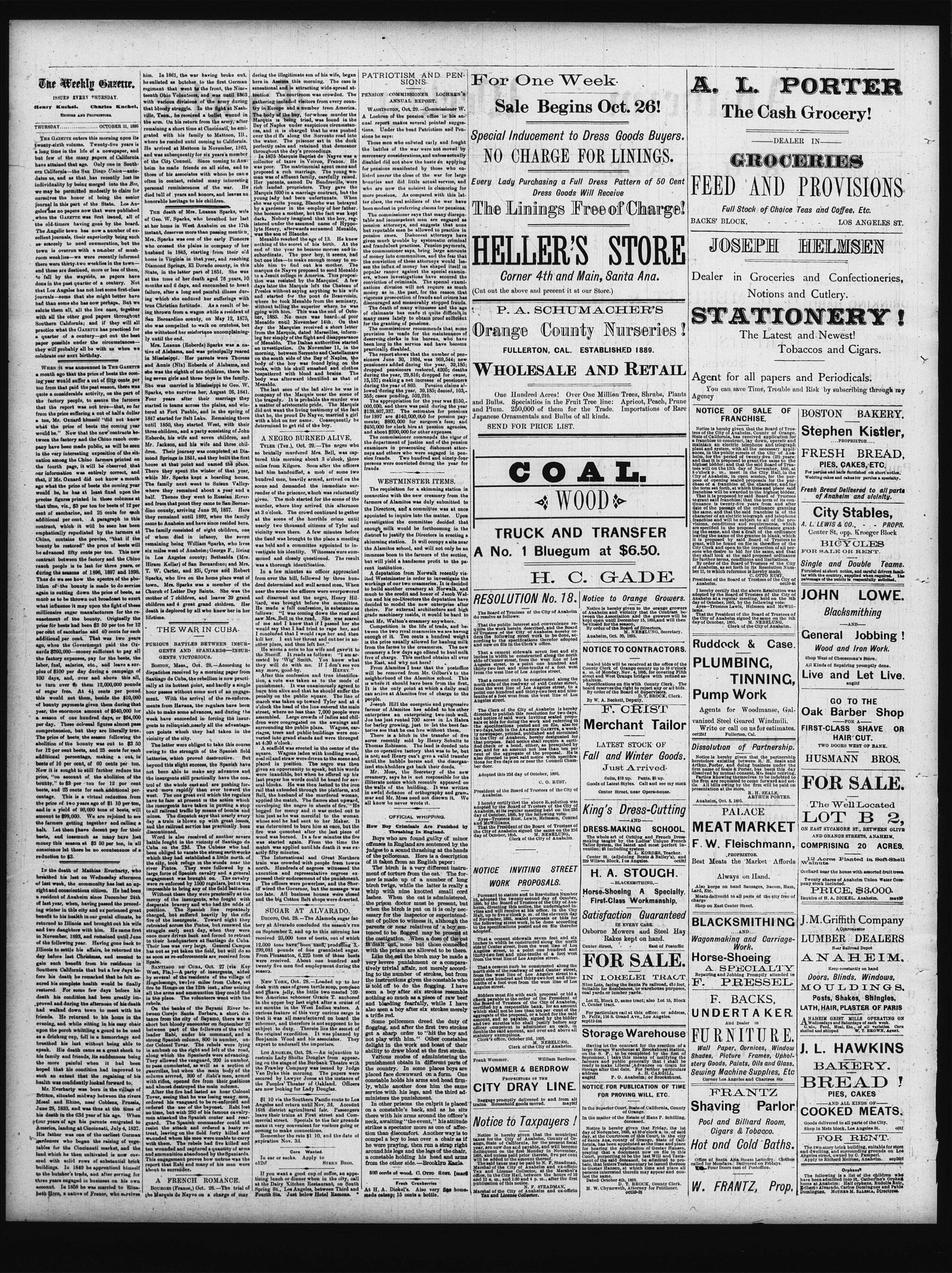
Searchable text
The Weekly Gazette.
ISSUED EVERY THURSDAY.
Henry Kuchel. Charles Kuchel.
EDITORS AND PROPRIETORS.
THURSDAY... OCTOBER 21, 1895
THE GAZETTE enters this morning upon its twenty-sixth volume. Twenty-five years is a long time in the life of a newspaper, and but few of the many papers of California have attained that age. Only one in Southern California—the San Diego Union—ante-dates us, and as that has recently lost its individuality by being merged into the Bee, we may be permitted modestly to claim for ourselves the honor of being the senior journal in this part of the State. Los Angeles has no papers now that were published when the Gazette was first issued, all of the old-timers having gone by the board. The Angelic town has now a number of excellent journals, their superiority being such as scarcely to need enumeration, but the town is overrun with a number of muhroom weeklies—we were recently informed there were thirty-two weeklies in the town—and these are destined, more or less of them, to fall by the wayside, as papera have done in the past quarter of a century. Not that Los Angeles has not lost some first-class journals—some that she might better have had than some she has now perhaps. But we salute them all, all the live ones, together with all the other good papers throughout Southern California; and if they will all practice what the Gazette has practiced for a quarter of a century—get out the best paper possible under the circumstances—they will probably all be with us when we celebrate our next birthday.
When it was announced in THE GAZETTE a month ago that the price of beets the coming year would suffer a cut of fifty cents per ton from that paid the past season, there was quite a considerable activity, on the part of the factory people, to assure the farmers that the report was not true—that, so far from the price suffering a cut of half a dollar a ton, Mr. Oxnard himself "did not know what the price of beets the coming year would be." Now that the new contracts between the factory and the Chino ranch company have been made public, as will be seen in the very interesting exposition of the situation among the Chino farmers printed on the fourth page, it will be observed that our information was entirely correct, and him. In 1861, the war having broke out, he enlisted as butcher to the first German regiment that went to the front, the Nineteenth Ohio Volunteers, and was until 1863 with various divisions of the army during that bloody struggle. In the fight at Nashville, Tenn., he received a bullet wound in the arm. On his return from the army, after remaining a short time at Cincinnati, he emigrated with his family to Mattoon, Ill., where he resided until coming to California. He arrived at Mattoon in November, 1863, and was subsequently for six years a member of the City Council. Since coming to Anaheim he made friends on all sides, and to those of his associates with whom he can often in contact, related many interesting personal reminiscences of the war. He died full of years and honors, and leaves an honorable heritage to his children.
The death of Mrs. Luanna Sparks, wife of Geo. W. Sparks, who breathed her last at her home in West Anaheim on the 17th instant, deserves more than passing mention. Mrs. Sparks was one of the early Pioneers who crossed the plains in company of her husband in 1845, starting from their old home in Virginia in that year, and reaching Diamond Springs, El Dorado county, in this State, in the latter part of 1851. She was at the time of her death aged 76 years, 10 months and 6 days, and succumbed to heart failure, after a long and painful illness during which she endured her sufferings with true Christian fortitude. As a result of being thrown from a wagon while a resident of San Bernardino county, on May 12, 1875, she was compelled to walk on crutches, but she withstood her misfortune uncomplainingly until the end.
Mrs. Luanna (Roberda) Sparks was a native of Alabama, and was principally reared in Mississippi. Her parents were Thomas and Annie (Niz) Roberda of Alabama, and she was the eighth of ten children, there being seven girls and three boys in the family. She was married in Mississippi to Geo. W. Sparks, who survives her, August 26, 1841. Four years after their marriage they started in teams across the plains, and wintered at Fort Pueblo, and in the spring of 1847 started for Salt Lake. Remaining there until 1850, they started West, with their three children, and a party consisting of John Roberda, his wife and seven children, and Mr. Jackson, and his wife and three children. Their journey was completed at Diamond Springs in 1851, and they built the first house at that point and named the place. There they spent the winter of that year,
dering the illegitimate son of his wife, began here in Assize this morning. The case is sensational and is attracting wide-spread attention. The courtroom was crowded. The gathering included visitors from every country in Europe and a number from America.
The body of the boy, for whose murder the Marquis is being tried, was found in the Bay of Naples under suspicious circumstance, and it is charged that he was pusheed over the cliffs along the Sorrento road into the water. The prisoner sat in the dock perfectly calm and retained that demeanor throughout the day's proceedings.
In 1875 Marquis Baptist de Nayve was a collector of taxes in Voiron, France. He was poor. The matrimonial agent came and proposed a rich marriage. The young woman was of affluent family, carefully raised; her name named De Boudreville, were rich landed proprietors. They gave that Marquis f600 in a marriage contract, but the young lady had been unfortunate. When she was quite young, Blanche was betrayed by a gardener in the employ of her father. She became a mother, but the fact was kept dark. Nobody imagined that the boy registered under the assumed name of Hippolyte Henry, afterwards surnamed Menaldo; was the son of Blanche.
Menaldo resolved the age of 13. He knew nothing of the secret of his birth. At the end of the year he became morose and insubordinate. The poor boy, it seems bad but one idea—to make enough money to enable him to find out his mother. The marquis de Nayve proposed to send Menaldo to a Jesuit college in America. This proposition was resisted by the Marquisse. A few days later the Marquis left the Chateau du Presles without saying anything to his wife and started for the pont de Beauvois where he took Menaldo from the seminary without telling the superior where he was going with him. This was the end of October, 1885. No more was heard of poor Menaldo until November 14th. On this day the Marquisse received a short letter from the Marquisse dated Marseilles, informing her simply of the flight and disappearance of Menaldo. The Italian authorities started an investigation. On November 11, in this morning between Sorrento and Castellamaro on the south side of the Bay of Naples, the body of the boy was found lying on the rocks with his skull smashed and clothes bespattered with blood and brains. The body was afterward identified as that of Menaldo.
The last seen of the lad alive he was in company of the Marquis near the scene of the tragedy. It is probable the murder was a matter of aristocratic pride. The Marquis did not want the living testimony of the fact that he, the proud De Nayve, married a girl with a blot on her name. Consequently he determined to get rid of the boy.
A NEGRO BURNED ALIVE.
TYLER (Tex.), Oct. 29.-The negro who so brutally murdered Mrs. Bell, was captured this morning about 3 o'clock, three miles from Kilgore. Soon after the officer had him handcuffed, a mob of some two
In the death of Mathias Everbarty, who breathed his last on Wednesday afternoon of last week, the community has lost an upright and conscientious citizen. He had been a resident of Anaheim since December 24th.
The new contracts between the factory and the Chino ranch company have been made public, as will be seen in the very interesting exposition of the situation among the Chino farmers printed on the fourth page, it will be observed that our information was entirely correct, and that, if Mr. Oxnard did not know a month ago what the price of beets the coming year would be, he has at least fixed upon the precise figures printed in these columns at that time, viz., $3 per ton for beets of 12 per cent of saccharine, and 25 cents for each additional per cent. A paragraph in this contract, which it will be seen has been emphatically repudiated by the tarmara at Chino, contains the proviso, "that if the bounty be restored" the price of beets will be advanced fifty cents per ton. This new contract between the factory and the Chino ranch people is to last for three years, or during the seasons of 1896, 1897 and 1898. Thus do we see how the spectre of the abolition of the bounty is made to do service again in cutting down the price of beets, as much as to be thrown out broadcast to exert what influence it may upon the fight of these millionaire sugar manufacturers for the re-enactment of the bounty. Originally the price for beets had been $3 50 per ton for 12 per cent of saccharine and 40 cents for each additional per cent. That was two years ago, when the Government paid the Oxnards $260,000—money sufficient to pay all the factory expenses, pay for the beets, the labor, fuel, salaries, etc., and leave a surplus of $100 per day during a campaign of 100 days, and over and above this all, to turn over to them 12,000,000 pounds of sugar free. At 4½ cents per pound this would not them, beside the $10,000 bounty payments given them during that year, the enormous amount of $540,000 for a season of one hundred days, or $54,000 per day. These colossal figures almost pass comprehension, but they are literally true. The price of beets the season following the abolition of the bounty was cut to $3 50 for 12 per cent beets, and 25 cents for each additional percentage, making a cut, in beets of 16 per cent, of 60 cents per ton. Now it is sought to still further reduce the price, "on account of the abolition of the bounty," to $3 per ton for 12 per cent beets, and 25 cents for each additional percentage. This is a virtual reduction from the price of two years ago of $1 10 per ton, and in a yield of 90,000 tons of beets, will amount to $99,000. We are rejoiced to see the farmers getting together and calling a halt. Let them have decent pay for their beets, and inasmuch as many have lost money this season at $3 50 per ton, in all conscience let there be no countenance of a reduction to $3.
In the death of Mathias Everbarty, who breathed his last on Wednesday afternoon of last week, the community has lost an upright and conscientious citizen. He had been a resident of Anaheim since December 24th.
The war in Cuba
FURIOUS BATTLES BETWEEN INSURGENTS AND SPANIARDS—INSURGENTS VICTORIOUS.
Boston, Mass., Oct. 28. According to dispatches received by a morning paper from Santiago de Cuba, the rebellion is now practically at its hottest point, and hardly a single hour passes without some sort of an engagement. With the arrival of the re-enforcements from Havana, the regulars have been able to make some advances, and during the week have succeeded in forcing the insurgents to relinquish nearly all the advantageous points which they had taken in the vicinity of the city.
The latter were obliged to take this course owing to the strength of the Spanish field batteries, which proved destructive. But beyond this slight success, the Spanish have not been able to make any advances and the insurgents still practically have the control of the whole east and are pushing forward more rapidly than ever toward the west. The one great evil which the regulars have to face at present is the action which the insurgents have taken in putting a stop to all railroad traffic by means of bombs and mines. The dispatch says that nearly every day a train is blown up with great losses, and the railroad service has practically been discontinued.
Word is also received of another severe battle fought in the vicinity of Santiago de Cuba on the 23d. The Cubans who had been obliged to vacate the strong earthworks which they had established a little north of the city, took refuge in the woods near the river Pinto. They were followed by a large force of Spanish cavalry and a general engagement was brought on. The cavalry were re-enforced by 1500 regulars, but it was impossible to bring any of the field batteries.
Without these they were practically at the mercy of the insurgents who fought with seven girls and three boys in the family. She was married in Mississippi to Geo. W. Sparks, who survives her, August 26, 1841. Four years after their marriage they started in teams across the plains, and wintered at Fort Pueblo, and in the spring of 1847 started for Salt Lake. Remaining there until 1850, they started West, with their three children, and a party consisting of John Roberds, his wife and seven children, and Mr. Jackson, and his wife and three children.
Their journey was completed at Diamond Springs in 1851, and they built the first house at that point and named the place. There they spent the winter of that year, while Mr. Sparks kept a boarding house.
The family next went to Suisun Valley where they remained about a year and a half. Thence they went to Russian River and from that point they came to San Bernardo county, arriving June 26, 1857. Here they remained until 1892, when the family came to Anaheim and have since resided here.
The family consisted of eight children, one of whom died in infancy, the seven remaining being William Sparks, who lives six miles west of Anaheim; George F., living in Los Angeles county; Bethsaida (Mrs. Hiram Kellar) of San Bernardino; and Mrs. T. W. Carter, and Eli Cyrus and Robert Sparks, who live on home place west of town. Mrs. Sparks was a member of the Church of Latter Day Saints. She was the mother of 7 children, and leaves 39 grand children and 4 great grand children. Her death is deplored by all who knew her in her lifetime.
THE WAR IN CUBA
FURIOUS BATTLES BETWEEN INSURGENTS AND SPANIARDS—INSURGENTS VICTORIOUS.
Boston, Mass., Oct. 28. According to dispatches received by a morning paper from Santiago de Cuba, the rebellion is now practically at its hottest point, and hardly a single hour passes without some sort of an engagement. With the arrival of the re-enforcements from Havana, the regulars have been able to make some advances, and during the week have succeeded in forcing the insurgents to relinquish nearly all the advantageous points which they had taken in the vicinity of the city.
The latter were obliged to take this course owing to the strength of the Spanish field batteries, which proved destructive. But beyond this slight success, the Spanish have not been able to make any advances and the insurgents still practically have the control of the whole east and are pushing forward more rapidly than ever toward the west. The one great evil which the regulars have to face at present is the action which the insurgents have taken in putting a stop to all railroad traffic by means of bombs and mines. The dispatch says that nearly every day a train is blown up with great losses, and the railroad service has practically been discontinued.
Word is also received of another severe battle fought in the vicinity of Santiago de Cuba on the 23d. The Cubans who had been obliged to vacate the strong earthworks which they had established a little north of the city, took refuge in the woods near the river Pinto. They were followed by a large force of Spanish cavalry and a general engagement was brought on. The cavalry were re-enforced by 1500 regulars, but it was impossible to bring any of the field batteries.
Without these they were practically at the mercy of the insurgents who fought with seven girls and three boys in the family.
She was married in Mississippi to Geo. W. Sparks, who survives her, August 26, 1841. Four years after their marriage they started in teams across the plains, and wintered at Fort Pueblo, and in that point and named the place. There they spent the winter of that year, while Mr. Sparks kept a boarding house.
The family next went to Suisun Valley where they remained about a year and a half. Thence they went to Russian River and from that point they came to San Bernardo county, arriving June 26, 1857. Here they remained until 1892, when the family came to Anaheim and have since resided here.
The family consisted of eight children, one of whom died in infancy, the seven remaining being William Sparks, who lives six miles west of Anaheim; George F., living in Los Angeles county; Bethsaida (Mrs. Hiram Kellar) of San Bernardino; and Mrs. T. W. Carter, and Eli Cyrus and Robert Sparks, who live on home place west of town.
Mrs. Sparks was a member of the Church of Latter Day Saints. She was the mother of 7 children, and leaves 39 grand children and 4 great grand children. Her death is deplored by all who knew her in her lifetime.
He wrote a note to his wife and gave it to her Sheriff. It reads as follows: "I am arrested by 'Wig' Smith. You know what you will do with me. If I don't see you any more good-by."
HENRY."
After this confession and true identification,a vote was taken as tothe modeof punishment.it Was unanimously agreedburn him aliveand that he should sufferthe penalty onthe public square.The line march was taken up toward Tyler andat o'clockthe head ofthe line enteredthe main streetwhere no less than7,000peoplewereassembled.Large crowdsofladiesandchildrenwerecongregatedontheawningsan surroundingthepublicplaza.Wagons,cars,andriages,treesandpublicbuildingswereconverted intograndstandsandwerestrongenedat4:30o'clock.
A scaffold was erected inthe centerofthe square.Wagons ladenwithkindlingwoodcoal oiland strawwere driventothesceneapartinposition.The negrowasthegivenanopportunitytow speak,buthiswordwereinsaudiblebutwhenheoffereduphislastprayerhiswordscouldbeheardforseveralblocks.Hewasthenlashedtotherailrthatextendedthroughtheplatform,andBell,thehusbandofthemurderedwomanappliedthematch.Theflamesshotupwearingthenegroin sheetsoffire.Beggedforsermycitanditwasmetodutethroughwhomhis soulhehad senttoherMaker.wasdeterminedtoburnhimatoncebuttherfirewasquenchedafterthelastpieceofthewoodwasburned.Ina few minutesthefirewasstarted again.Fromthetimethatmatchwasapplieduntilbildeathitwasactivelyfiftyminutes.
The International and Great Northerntrain was crowded with people fromtownnorth.Hundredsofnegresswitnessedexecutionandrepresentativengreenspentpressedtheendorsementofthepunishment.
The officers werepowerless,andtheShifffiredtheGovernor,但themessagetoo late.AllbusinesshouseswerecloseandthebigCottonBeltworeseparateandthebigCottonBeltworeseparateandthebigCottonBeltworeseparateandthebigCottonBeltworeseparateandthebigCottonBeltworeseparateandthebigCottonBeltworeseparateandthebigCottonBeltworeseparateandthebigCottonBeltworeseparateandthebigCottonBeltworeseparateandthebigCottonBeltworeseparateandthebigCottonBeltworeseparateandthebigCottonBeltworeseparateandthebigCottonBeltworeseparateandthebigCottonBeltworeseparateandthebigCottonBeltworeseparateandthebigCottonBeltworeseparateandthebigCottonBeltworeseparateandthebigCottonBeltworeseparateandthebigCottonBeltworeseparateandthebigCottonBeltworeseparateandthebigCottonBeltworeseparateandthebigCottonBeltworeseparateandthebigCottonBeltworeseparateandthebigCottonBeltworeseparateandthebigCottonBeltworeseparateandthebigCottonBeltworeseparateandthebigCottonBeltworeseparateandthebigCottonBeltworeseparateandthebigCottonBeltworeseparateandthebigCottonBeltworeseparateandthebigCottonBeltworeseparateandthebigCottonBeltworeseparateandthebigCottonBeltworeseparateandthebigCottonBeltworeseparateandthebigCottonBeltworeseparateandthebigCottonBeltworeseparateandthe bigCottonBeltworeseparateandthe bigCottonBeltworeseparateandthe bigCottonBeltworeseparateandthe bigCottonBeltworeseparate和the bigCottonBeltworeseparate和the bigCottonBeltworeseparate和the bigCottonBeltworeseparate和the bigCottonBeltworeseparate和the bigCottonBeltworeseparate和the bigCottonBeltworeseparate和the bigCottonBeltworeseparate和the bigCottonBeltworeseparate和the bigCottonBeltworeseparate和the bigCottonBeltworeseparate和the bigCottonBeltworeseparate和the bigCottonBeltworeseparate和the bigCottonBeltworeseparate和the bigCottonBeltworeseparate和th
In the death of Mathias Everharty, who breathed his last on Wednesday afternoon of last week, the community has lost an upright and conscientious citizen. He had been a resident of Anaheim since December 24th of last year, when, having passed the preceding winter in this city and experienced great benefit to his health in our genial climate, he returned to Illinois and brought out his wife and two daughters with him. He came first in November, 1893, and remained until June of the following year. Having gone back to Illinois to settle his affairs, he returned the day before last Christmas, and seemed to gain such benefit from his residence in Southern California that but a few days before his death he remarked that he felt assured his complete health would be finally restored. For some few days before his death his condition had been greatly improved and during the afternoon of his death had walked down town to meet with his friends. He returned to his home in the evening, and while sitting in his easy chair upon the porch whitttling a gourd to be used as a drinking cup, fell in a hemorrhage and breathed his last without being able to speak. His death came as a great shock to his family and friends, its suddenness being the more painful when it had been hoped that his condition had improved to such an extent that the regaining of his health was confidently looked forward to.
Mr. Everharty was born in the village of Britton, situated midway between the rivers Mosel and Rhine, near Coblenz, Prussia, June 28, 1833, and was thus at the time of his death in the 63d year of his age. When four years of age his parents emigrated to America, landing at Cincinnati, July 4, 1837. His father was one of the earliest German gardeners who began the raising of vegetables for the Cincinnati market, and the land which he then cultivated is now covered with solid rows of substantial brick buildings. In 1849 he apprenticed himself to the butcher's trade, and after serving for three years engaged in business on his own account. In 1858 he was married to Elizabeth Horn, a native of France, who survives have to face at present is the action which the insurgents have taken in putting a stop to all railroad traffic by means of bombs and mines. The dispatch says that nearly every day a train is blown up with great losses, and the railroad service has practically been discontinued.
Word is also received of another severe battle fought in the vicinity of Santiago de Cuba on the 23d. The Cubans who had been obliged to vacate the strong earthworks which they had established a little north of the city, took refuge in the woods near the river Pintos. They were followed by a large force of Spanish cavalry and a general engagement was brought on. The cavalry were re-enforced by 1500 regulars, but it was impossible to bring any of the field batteries.
Without these they were practically at the mercy of the insurgents, who fought with desperate bravery and who had the odds of position. The Spanish line repeatedly charged, but suffered heavily by the rifle fire of the insurgents. Toward night they retreated across the Pintos, but renewed the struggle early next day, when they were once more driven back and forced to retreat to their headquarters at Santiago de Cuba. Their loss was very large. General Campos has not as yet taken the field, but will do so as soon as re-enforcements are received from Spain.
SANTIAGO DE CUBA, Oct. 27 (via Key West, Fla.)—A party of insurgents, aided by several of the residents of the village of Hogolosongo, twelve miles from Cobre, set fire to Hongo on the 12th inst., after seizing all the arms and ammunition they could find in the place. The volunteers went with the rebels.
On the banks of the Bayami River between Corejo Santa Barbara, a short distance from the city of Bayamo, there was a short but bloody encounter on September 22 between part of the followers of the rebel leader Rabi, under his command, and a strong Spanish column, 800 in number, under Colonel Tovar. The rebels were lying in ambush on the right and left of the road, along which the Spaniards were advancing. They allowed the vanguard, 200 in number, to pass unmolested, as well as a section of guerrillas, but when the main body of the column arrived, 300 of Rabi's men, armed with rifles, opened fire from their positions and almost destroyed the main column.
After the fire had lasted an hour Colonel Tovar, seeing that he was losing many men, ordered his vanguard to be re-enforced and ordered the use of the bayonet. Rabi lost no time, but with 250 of his famous cavalrymen attacked the Spanish center and rearguard. The Spanish commander could not resist the attack and ordered a hasty retreat, leaving on the field forty killed and wounded whom his men were unable to carry with them. The rebels had five killed and ten wounded and captured a quantity of arms and ammunition abandoned by the Spaniards. This engagement proves how untrue was the report that Rabi and many of his men were about to surrender.
A FRENCH ROMANCE.
Bourges (France), Oct. 28.—The trial of the Marquis de Nayve on a charge of mur
If you want a good cup of coffee, an appertizing lunch or dinner when in the city, call at Dairy Kitchen Restaurant, on South Spring St., Los Angeles, between Third and Fourth Sts. Just below Hotel Ramona.
For One Week
Sale Begins Oct. 26!
Special Inducement to Dress Goods Buyer
NO CHARGE FOR LININGS.
Every Lady Purchasing a Full Dress Pattern of 50 Cm.
Dress Goods Will Receive
The Linings Free of Charge
HELLER'S STORY
Corner 4th and Main, Santa Ana.
(Cut out the above and present it at our Store.)
P. A. SCHUMACHER'S
Orange County Nurseries
FULLERTON, CAL. ESTABLISHED 1889.
WHOLESALE AND RETAIL
One Hundred Acres! Over One Million Trees, Shrubs, Plants and Bulbs. Specialties in the Fruit Tree line: Apricot, Peach, Pear and Plum. 250,000 of them for the Trade. Importations of Japanese Ornamentals and Bulbs of all kinds.
SEND FOR PRICE LIST.
GRO BURNED ALIVE.
Tex.), Oct. 29.—The negro who may murdered Mrs. Bell, was capmored morning about 3 o'clock, three Kilgore. Soon after the officers bandcuffed, a mob of some two men, heavily armed, arrived on the demanded the immediate surtection the prisoner, which was reluctantly the mob started for the scene of the where they arrived this afternoon. The crowd continued to gather one of the horrible crime until two thousand citizens of Tyler and there there. A few minutes before was brought to the place a meeting and a committee appointed to insistis identity. Witnesses were sumd closely questioned. The resultough identification.
Twenty minutes au officer approached the hill, followed by three hunmined and well armed men. WhenScene the officers were overpowered and the negro, Henry Hill, brought before the committee.a full confession, in substance as I was coming down the road and Bell in the road. She was scared and I knew that if I passed her she had tried to rape her, and that I would rape her and then eat her throat and cut her in an- and then left her."
A note to his wife and gave it to it. It reads as follows: "I am arwig Smith. You know what do with me. If I don't see you good-by."HENRY."
This confession and true identification was taken as to the mode of it. It was unanimously agreed to alive and that he should suffer the public square. The line of the taken up toward Tyler and at 4 head of the line entered the main here no less than 7,000 people were large crowds of ladies and chilconegregated on the awnings and laying the public plaza. Wagons, carses and public buildings were congrand stands and were thronged clock.
Old was erected in the center of the Wagons laden with kindling wood, straw were driven to the scene and position. The negro was then opportunity to speak, but his words did not, but when he offered up his husbands could be heard for severs he was merciful to the woman he had sent to her Maker. It remained to burn him at once, but the quenched after the last piece of burned. In a few minutes the fire again. From the time the applied until his death it was ex-minutes.
International and Great Northern crowded with people from towns hundreds of negroes witnessed the and representative negroes experienced endorsement of the punishment. Cars were powerless, and the Sherhe Governor, but the message was All business houses were closed
OFFICIAL WHIPPING.
How Boy Criminals are Punished by Thrashing In England.
Boys who are found guilty of minor offenses in England are sentenced by the judges to a sound thrashing at the hands of the policeman. Here is a description of it taken from an English paper:
The birch is a very different instrument of torture from the cat. The former is made up of a number of long birch twigs, while the latter is really a whip with nine knotted small cord when the cat is administered.
WESTMINSTER ITEMS.
The requisition for a skimming station in connection with the new creamery from the farmers of Alamitos was duly submitted to the Directors, and a committee was at once appointed to inquire into the matter. Upon investigation the committee decided that enough milk would be forthcoming in the district to justify the Directors in erecting a skimming station. It will occupy a site near the Alamitos school, and will not only be an immense boon to the farmers of the section, but will yield a handsome profit to the parent institution.
A deputation from Norwalk recently visited Westminster in order to investigate the workings of our two creameries. It is decided to build another creamery at Norwalk, and much to the credit and honor of Jacob Walton and his co-Directors the deputation have decided to model the new enterprise after theirs. For external architecture and high grade machinery inside, it would be hard to beat Mr. Walton's creamery anywhere.
Competition is the life of trade, and between the two rival creameries we are having enough of it. Ten cents a hundred weight is the price usually allowed for hauling milk from the farms to the creameries. The new creamery a few days ago offered to baul milk free of charge. This method obtains all over the East, and why not here?
From Alamitos I hear that the postoffice will be removed from Mr. Gilbert's to the neighborhood of Alamitos school. This is where it should have been from the first. It is the only point at which a daily mail can arrive at Alamitos free of charge to the people.
Joseph Hill the energetic and progressive farmer of Alamitos has added to his other enterprises an enterprising two-inch well. Joe has just rented 700 acres in La Habra for barley growing, just to let the beet factories see that he can live without them.
There is a hitch in the transfer of five acres recently sold by Henry Schulz to Thomas Robinson. The land is deemed into the co operative factory that was be, but is not; and Henry can't give a valid transfer until the bubble bursts and the disorganized stockholders get back their deeds.
Mr. Moss, the Secretary of the new creamery, says he is not responsible for the illiterate notice which recently appeared on the walls of the building. It was written in awful defiance of orthography and grammar and Mr. Moss need not disown it. We all know he never wrote it.
RESOLUTION No. 18.
The Board of Trustees of the City of Anaheim do resolve as follows:
That the public interest and convenience require work herein described, and the Road of Trustees of the city of Anaheim hereby orders that following street work to be done, according to the specifications thereof adopted and now on file in the Clerk's office.
That a cement curb be constructed along the north side of the roadway of said Center street, from the west line of Los Angeles street.
That a cement curb be constructed along the north side of the roadway of said Center street, from the west line of Los Angeles street.
The Clerk of the City of Anaheim is hereby directed to publish this resolution for two days, and notice of said work inviting sealed proposals or bids for doing the work and referring to the specifications posted and on file, also for two days, both in the Anaheim Garage, weekly newspaper, published, circulated and circulated is the City of Anaheim, hereby designated for this purpose. Said notice shall require a certified check or a bond, either as prescribed by law, and for an amount not less than ten per cent of the aggregate of the proposal. He is also directed to post said notice with specifications for five days on or near the Council Chamber door.
Adopted this 22d day of October, 1895.
C. O. RUST,
President of the Board of Trustees of the City of Anaheim.
I hereby certify that above Resolution was adopted by the Board of Trustees of the City of Anaheim, at its regular meeting held on the 22d day of October, 1895, bythe following vote:
Ayes—Trustees Rust, Lewis Helmsen, Courad McWilliams.
That the President of the Board of Trustees of the City of Anaheim signed the same on the 22d day of October, 1895.
Clerk of the City of Anaheim.
NOTICE INVITING STREET WORK PROPOSALS.
Pursuant to statute and to Resolution Number is adopted twenty-second day of October,
One Hundred Acres! Over One Million Trees, Shrubs, Plants and Bulbs. Specialties in the Fruit Tree line: Apricot, Peach, Plum and Plum. 250,000 of them for the Trade. Importations of Japanese Ornamentals and Bulbs of all kinds.
SEND FOR PRICE LIST.
COAL
WOOD
TRUCK AND TRANSFER
A No. 1 Bluegum at $6.50.
H.C.GADE
F.CRIST
Merchant Tail
LATEST STOCK OF
Fall and Winter Good
Just Arrived.
Suits,$18 up.Pants,$5 up.
Goods of Latest Styles.Call and see my
Center Street,near Opera-house.
King's Dress-Cutti
AND
DRESS-MAKING SCHOOL
The whole art of Cutting and French making taught by The Ladies' Unique Tail System,the latest most perfect version;$6 including system.
Center St.(adjoining Benz & Bailey's 229 Wilson Block.Ios Angeles.
H.A. STOUGH
Horse-Shoeling A Special
First Workmanhip
OFFICIAL WHIPPING.
How Boy Criminals Are Punished by Thrashing In England.
Boys who are found guilty of minor offenses in England are sentenced by the judges to a sound thrashing at the hands of the policeman. Here is a description of it taken from an English paper:
The birch is a very different instrument of torture from the cat. The former is made up of a number of long birch twigs, while the latter is really a whip with nine knotted small cord lashes. When the cat is administered, the prison doctor must be present, but when the birch is put on it is only necessary for the inspector or superintendent of police to witness it, although the parents or near relatives of a boy sentenced to be flogged may be present at the castigation. When a dose of the cat is dealt out, none but those connected with the prison are allowed to be there.
Like the cat the birch may be made a very severe punishment or a comparatively trivial affair, not merely according to the number of strokes, but from the instructions given the constable who is told off to do the flogging. I have seen a boy after six strokes resemble nothing so much as a piece of raw beef and bleeding fearfully, while I have also seen a boy after six strokes merely a trifle red.
Some policemen dread the duty of flogging, and after the first two strokes get a sharp order to "hit the boy and not play with him." Other constables delight in the work and boast of their ability to draw blood at the first stroke.
Various modes of administering the punishment obtain in different parts of the country. In some places boys are placed face downward on a form. One constable holds his arms and head firmly, while another does him the same service with his legs, and the third administers the punishment.
In other prisons the culprit is placed on a constable's back, and as he sits there with his arms around the officer's neck, awaiting "the event," his attitude strikes a spectator more as one of affection than discomfort. Another way is to compel a boy to lean over a chair as if he were praying, then run a strap right around his legs and the legs of the chair, a constable holding his head and arms from the other side.—Brooklyn Eagle.
500 cords of wood. C. Orro Rosr. [mar8]
Fresh Cranberries
At H. A. Dickel's. Also very fine homemade catsup; 15 cents a bottle.
NOTICE INVITING STREET WORK PROPOSALS.
Pursuant to statute and to Resolution Number 15, adopted the twenty-second day of October, 1895, by the Board of Trustees of the City of Anaheim, directing this notice, the undersigned invites and will receive at his office, in the City Hall, up to five clock p.m. of the eleventh day of November, 1895, sealed proposals or bids for the following street work, to be done according to the specifications posted and on file therefore adopted.
That a cement sidewalk seven feet and six inches in width be constructed along the north side of Center street, from the west line of Los Angeles street, to a point one hundred and thirty-two feet and nineteenth of a foot west from the west line of Los Angeles street.
That a cement curb be constructed along the north side of the roadway of said Center street, from the west line of Los Angeles street to a point one hundred and thirty-two feet and nineteenth of a foot west from the west line of Los Angeles street.
Bidders must file with each proposal or bid a check payable to the President of the Board of Trustees of the City of Anaheim, certified by a responsible bank, for an amount which shall not be less than ten per cent of the aggregate of the proposal, or a bond for the said amount, and two sureties who shall justify before any officer competent to administer an oath, in double the said amount, and over and above all statutory exemptions.
Clerk's office, October 23d, 1895.
M. NEBELUNG.
Clerk of the City of Anaheim.
Frank Wommer.
William Berdrow.
WOMMER & BERDROW
PROPRIETORS OF THE
CITY DRAY LINE.
Baggage promptly delivered to and from all trains. Household goods moved.
Notice to Taxpayers!
Notice is hereby given that the municipal taxes for the City of Anaheim, County of Orange, State of California, for the present fiscal year, are now due and payable, and will become delinquent on the first Monday in November, 1895, and unless paid prior thereto, five per cent will be added to the amount thereof.
The said taxes may be paid to N. F. Steadman, Marshal of the City of Anaheim and ex-officio Tax and License Collector, at the Marshall's office, in the City Hall, between the hours of 10 and 12 a.m., and 1:30 p.m., after the first publication of this notice.
N. F. STEADMAN,
Marshal of the City of Anaheim and ex-officio Tax and License Collector.
King’s Dress-Cutting AND
DRESS-MAKING SCHOOL
The whole art of Cutting and French making taught by the Ladies' Unique Kailor System, the latest and most perfect invention; $8 including system
R. L. KORDES, Teacher
Center St. (adjoining Bents & Bailey's 229 Wilson Block, Los Angeles).
H. A. STOUGH
BLACKSMITHING.
Horse-Shoeing A Special First-Class Workmanship
Satisfaction Guarantee
IN EVERY CASE
Osborne Mowers and Steel Rakes kept on hand.
Center Street.
East Of Post
FOR SALE
IN LORELEI TRACTION
Nine Lots, facing the Santa Fe railroad, 45 Suitable for Residences, or warehouse purposed coal yards or lumber yards.
Lot 32, Block D, same tract; also Lot 15,C,Center tract.
For particulars call at this office; or ad D. Felix, 116 S. Grand Ave., Los Angeles.sept12-1m
Storage Warehouse
Having let the contract for the erection large Storage Warehouse at Brookshunt Station on the S.P., to be completed by the first September, I take this means of notifying farmers and public generally that I shall ready to make Liberal Advances on Gran Storage ware after that date. For further partia address A. H. CARGILL augustf P. O. Anaheim; or Brookshunt
NOTICE FOR PUBLICATION OF THIS FOR PROVING WILL, ETC.
In the Superior Court.State of California,City Of Orange.
In the matter of the Estate of Hans P.Schnecked.
Notice is hereby given that Friday,the day of November,1895.at 10 o'clock am.m.c.day.at the Courtroom at Court,the latest formula has been appointed as time and for hearing the application of Gustav Hanspraying that a document now on file in Court,purporting to be the last Will and mentofalment that interested therein may appear and testthe same.
Dated October 4th,1895.
D.T.BROCK,县Chicago
H.W.chynoweth,Attorney for Petition oct10-3t
A. L. PORTER
The Cash Grocery!
DEALER IN
GROCERIES
FEED AND PROVISIONS
Full Stock of Choice Teas and Coffee, Etc.
BACKS' BLOCK,
LOS ANGELES ST.
JOSEPH HELMSEN
Dealer in Groceries and Confectioneries,
Notions and Cutlery.
STATIONERY!
The Latest and Newest!
Tobaccos and Cigars.
Agent for all papers and Periodicals.
You can save Time, Trouble and Risk by subscribing through my Agency
NOTICE OF SALE OF FRANCHISE.
Notice is hereby given that the Board of Trustees of the City of Anaheim, County of Orange, State of California, has received application for a franchise to construct, lay down, operate and maintain an electric telephone and telegraph plant and system, with all the necessary appliances, in the public streets of the City of Anaheim, for the period of twenty-five (25) years; and that it is proposed to grant the same to the highest bidder; and that the said Board of Trustees will on the 12th day of November, 1895, at 8 o'clock p.m., meet in the City Hall, in the Boston Bakery.
Stephen Kistler,
PROPRIETOR...
FRESH BREAD,
PIES, CAKES, ETC.
For parties and bails furnished on short notice.
NOTICE OF SALE OF FRANCHISE.
Notice is hereby given that the Board of Trustees of the City of Anaheim, County of Orange, State of California, has received application for a franchise to construct, lay down, operate and maintain an electric telephone and telegraph plant and system, with all the necessary appliances, in the public streets of the City of Anaheim, for the period of twenty-five (25) years; and that it is proposed to grant the name of the highest bidder; and that the said Board of Trustees will on the 12th day of November, 1895, at 8 o'clock p.m., meet in the City Hall, in the City of Anaheim, in open session, for the purpose of opening sealed proposals for the purchase of a franchise of the character of an electric telegraph and telephone franchise and will be subject to all the provisions, conditions and requirements, which are specified in the proposed ordinance granting the same, and that a draft of the ordinance leaving the name of the grantee in blank, which it is proposed by said Board of Trustees to grant, will be found on file in the office of the City Clerk and open to the inspection of all persons who desire to bid for the same, and that they shall look at the said proposed ordinance for further terms, conditions and limitations.
By order of the Board of Trustees of the City of Anaheim, as set forth in its Resolution Number 17, to which reference is hereby made, M. NEBELUNG, C. OTTO RUST,
President of the Board of Trustees of the City of Anaheim.
I hereby certify that the above Resolution was adopted by the Board of Trustees of the City of Anaheim at a regular meeting, held on the 8th day of October, 1895, by the following vote:
Ayes—Trustees Lawis, Helmsen and McWilliams.
That the President of the Board of Trustees of the City of Anaheim signed the same on the 9th day of October, 1895.
Ruddock & Case.
PLUMBING,
TINNING,
Pump Work
Agents for Woodmanse, Galvanized Steel Geared Windmill.
Write or call on us for estimates.
Fullerton, Cal.
Dissolution of Partnership.
Notice is hereby given that the partnership heretofore exists between R. H. Seale and Arthur Porter, and doing business under the firm name of Seale & Porter, has been this day dissolved by mutual consent, Mr. Seale retiring.
Parties knowing themselves to be indebted to the firm are requested to come forward and settle. All bills owing by the firm will be paid on presentation at the store.
R. H. SEALE,
ARTHUR PORTER
Anaheim, Oct. 8, 1895.
PALACE
MEAT MARKET
F. W. Fleischmann,
PROPRIETOR
Best Meats the Market Affords
Always on Hand.
Also keeps on hand Sausages, Bacon, Ham, Lard, Etc.
Meats deliverd to all parts of the city free of Agent for all papers and Periodicals.
You can save Time, Trouble and Risk by subscribing through my Agency
BOSTON BAKERY.
Stephen Kistler,
...PROPRIETOR...
FRESH BREAD,
PIES, CAKES, ETC.
For parties and balls furnished on short notice.
Wedding cakes and cakes for parties a specialty.
Fresh Bread Delivered to all parts of Anaheim and violinity.
City Stables,
A. L. LEWIS & CO., ... PROPS.
Center St, opp. Kroeger Block
BICYCLES
FOR SALE OR RENT.
Single and Double Teams.
Furnished at short notice, and careful drivers familiar with the country, supplied when required. The patronage of the public is respectfully solicited.
JOHN LOWE.
Blacksmithing
AND
General Jobbing!
Wood and Iron Work.
Shop West of Cheeseman's Store.
All Kinds of Repairing promptly done.
Live and Let Live.
aug11t
GO TO THE Oak Barber Shop
FOR A
FIRST-CLASS SHAVE OR HAIR CUT.
TWO DOORS WEST OF BANK.
HUSMANN BROS.
FOR SALE.
The Well Located LOT B 2,
ON EAST SYCAMORE ST., BETWEEN OLIVE AND ORANGE STREETS, ANAHEIM,
COMPRISING 20 ACRES.
12 Acres Planted in Soft-Shell Walnuts.
Oichard near the house with assorted fruit trees.
Twenty shares of Anaheim Union Water Company stock included.
PRICE, $3.000.
Inquire of H. A. DICKEL, Anaheim.
PALACE
MEAT MARKET
F. W. Fleischmann,
PROPRIETOR
Best Meats the Market Affords
Always on Hand.
Also keeps on hand Sausages, Bacon, Ham, Lard, Etc.
Meats deliverd to all parts of the city free of charge
Shop on East Center Street.
BLACKSMITHING
...AND...
Wagonmaking and Carriage-Work.
Horse-Shoeing
A SPECIALTY
Repairing and Jobbing Promptly attended to
F. PRESSEL.
F. BACKS,
UNDERTAKER.
And Dealer in
FURNITURE.
Wall Paper, Cornices, Window Shades, Picture Frames, Upholstery Goods, Paints, Oils and Glass.
Sewing Machine Supplies, Etc.
Corner Los Angeles and Chartres Sts
FRANTZ
Shaving Parlor
Pool and Billiard Room,
Cigars & Tobacco.
Hot and Cold Baths.
Office of Santa Ana Steam Laundry. Clothes called for Mondays. Delivered on Fridays.
Four Doors east of Postoffice.
W. FRANTZ, Prop.
The Well Located
LOT B 2,
ON EAST SYCAMORE ST., BETWEEN OLIVE AND ORANGE STREETS, ANAHEIM,
COMPRISING 20 ACRES.
12 Acres Planted in Soft-Shell Walnuts.
Ochard near the house with assorted fruit trees.
Twenty shares of Anaheim Union Water Company stock included.
PRICE, $3,000.
Inquire of H. A. DICKEL, Anaheim.
J.M. Griffith Company
A CORPORATION
LUMBER DEALERS
Near Railroad Depot
ANAHEIM.
Keep constantly on hand
Doors, Blinds, Windows,
MOULDINGS.
Posts, Shakes, Shingles,
LATH, HAIR, PLASTER OF PARIS
ANAHEIM GRIST MILLS OPERATING ON Wednesdays and Saturdays of each week.
Gale, Feed, Meal, Etc., of all varieties. Corn shelled and shipped.
W. T. BROWN, Agent.
J. L. HAWKINS
BAKERY.
BREAD!
PIES, CAKES
AND ALL KINDS OF COOKED MEATS.
Goods delivered to all parts of the City.
Shop in Metz block, Los Angeles St.
FOR RENT.
The two-story brick building, suitable for store and dwelling, and surrounding grounds on Los Angeles street, owned by C. Pampel.
Apply to Richard Melrose, Anaheim.
Orphans¹
The following is a list of the children who have been admitted into St. Catherine's Orphan home at Anaheim: Half orpbans, Rudolfle Rule, Eriberto Alvarado, Carlos Domingues and Pablo Domingues, Mother M. SALESIA, Directress.