anaheim-gazette 1895-09-12
Scanned page
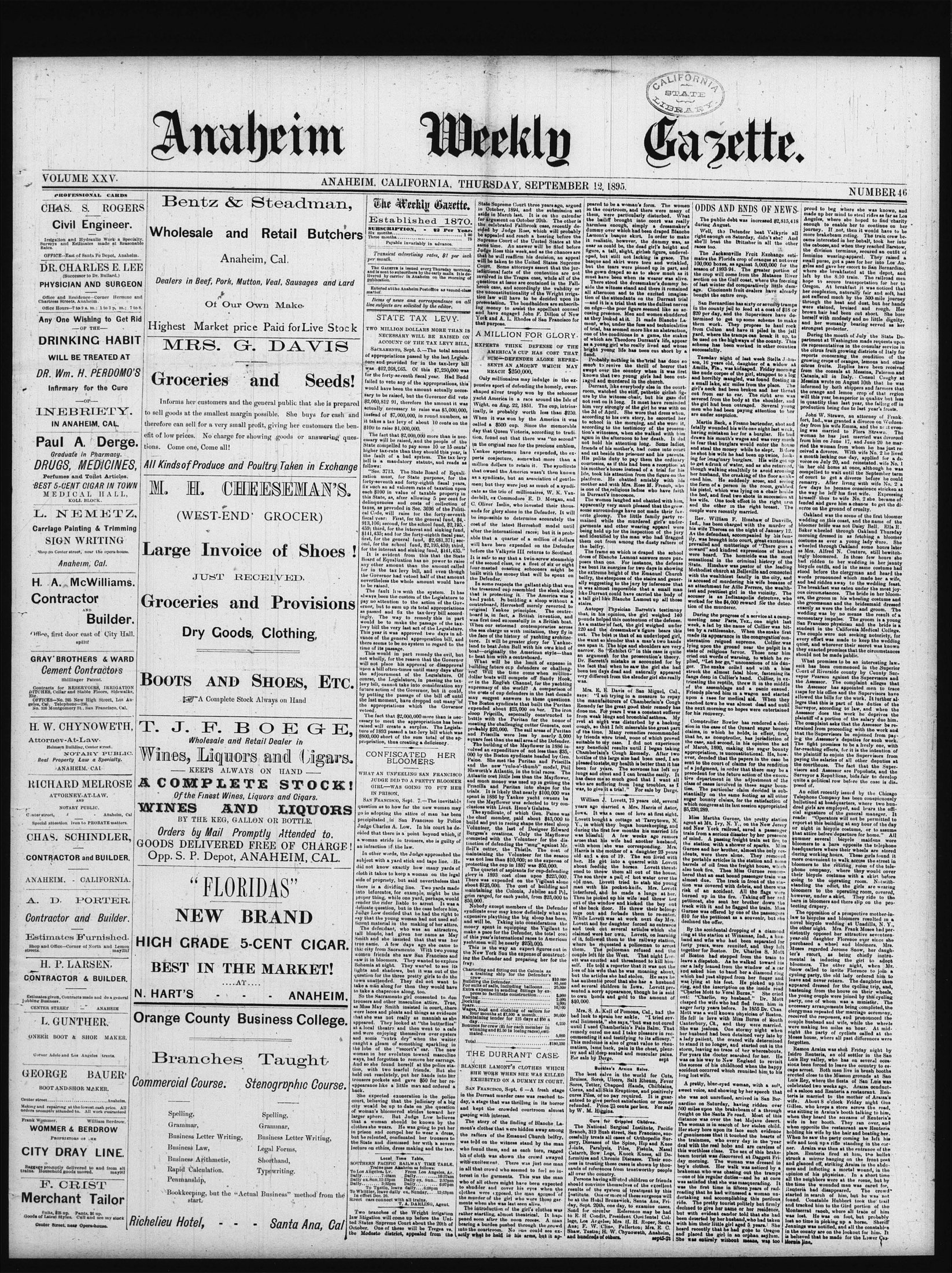
Searchable text
Anaheim
VOLUME XXV.
PROFESSIONAL CARDS
CHAS. S. ROGERS
Civil Engineer.
Irrigation and Hydraulic Work a Specialty.
Surveys and Estimates made at Reasonable Rates.
OFFICE—East of Santa Fe Depot, Anaheim.
DR. CHARLES E. LEE
(Successor to Dr. Bullard.)
PHYSICIAN AND SURGEON
Office and Residence—Corner Hermine and Chartress Streets, Anaheim.
Office Hours—7 to 9 a.m.; 1 to 3 p.m.; 7 to 8.
Any One Wishing to Get Rid
OF THE
DRINKING HABIT
WILL BE TREATED AT
DR. Wm. H. PERDOMO'S
Infirmary for the Cure
OF
INEBRIETY.
IN ANAHEIM, CAL.
Paul A. Derge.
Graduate in Pharmacy.
DRUGS, MEDICINES,
Bentz & Steadman,
Wholesale and Retail Butcher
Anaheim, Cal.
Dealers in Beef, Pork, Mutton, Veal, Sausages and Lard
Of Our Own Make.
Highest Market price Paid for Live Stock
MRS. G. DAVIS
Groceries and Seeds!
Informs her customers and the general public that she is prepared to sell goods at the smallest margin possible. She buys for cash and therefore can sell for a very small profit, giving her customers the benefit of low prices. No charge for showing goods or answering questions. Come one, Come all!
All Kinds of Produce and Poultry Taken in Exchange
INFIRMARY FOR THE CURE
INEBRIETY.
IN ANAHEIM, CAL.
Paul A. Derge.
Graduate in Pharmacy.
DRUGS, MEDICINES,
Perfumes and Toilet Articles.
BEST 5-CENT CIGAR IN TOWN
MEDICAL HALL,
KOLL BLOCK.
L. NEMETZ.
Carriage Painting & Trimming
SIGN WRITING
Shop on Center street, near the opera-house.
Anaheim, Cal.
H. A. McWilliams.
Contractor
AND
Builder.
Office, first door east of City Hall.
split
GRAY'BROTHERS & WARD
Cement Contractors
Shillinger Patent.
Contracts for RESERVOIRS, IRRIGATION
DITCHES, Cellar and Stable Floors, Sidewalks,
Kele
OFFICES—No. 205 New High Street, Los Angeles,
Cal., Telephone—236.
No. 316 Montgomery St., San Francisco, Cal.
H. W. CHYNOWETH,
Attorney-At-Law.
Helmsen Building, Center street.
NOTARY PUBLIC.
Real Property Law a Specialty.
ANAHEIM, CAL.
RICHARD MELROSE
ATTORNEY-AT-LAW.
AND
NOTARY PUBLIC.
Center street,
Anaheim, Cal.
Special attention given to PROBATE matters.
CHAS. SCHINDLER,
CONTRACTOR and BUILDER.
ANAHEIM, - CALIFORNIA.
Groceries and Seeds!
Informs her customers and the general public that she is prepared to sell goods at the smallest margin possible. She buys for cash and therefore can sell for a very small profit, giving her customers the benefit of low prices. No charge for showing goods or answering questions. Come one, Come all!
All Kinds of Produce and Poultry Taken in Exchange
M. H. CHEESEMAN'S.
(WEST-END GROCER)
Large Invoice of Shoes!
JUST RECEIVED.
Groceries and Provisions
Dry Goods, Clothing,
BOOTS AND SHOES, ETC.
A Complete Stock Always on Hand
T. J. F. BOEGE,
Wholesale and Retail Dealer in
Wines, Liquors and Cigars.
KEEPS ALWAYS ON HAND
A COMPLETE STOCK!
Of the Finest Wines, Liquors and Cigars.
WINES AND LIQUORS
BY THE KEG, GALLON OR BOTTLE.
Orders by Mail Promptly Attended to.
GOODS DELIVERED FREE OF CHARGE!
Opp. S. P. Depot, ANAHEIM, CAL.
"FLORIDAS"
WINES AND LIQUORS
BY THE KEG, GALLON OR BOTTLE.
Orders by Mail Promptly Attended to.
GOODS DELIVERED FREE OF CHARGE!
Opp. S. P. Depot, ANAHEIM, CAL.
"FLORIDAS"
NEW BRAND
HIGH GRADE 5-CENT CIGAR.
BEST IN THE MARKET!
AT...
N. HART'S - - - ANAHEIM.
Orange County Business College.
Branches Taught
Commercial Course. Stenographic Course.
Spelling,
Spelling,
Grammar,
Grammar,
Business Letter Writing,
Business Letter Writing,
Business Law,
Legal Forms,
Business Arithmetic,
Shorthand,
Rapid Calculation.
Typewriting.
Penmanship,
Bookkeeping, but the "Actual Business" method from the start.
Richelieu Hotel, - - Santa Ana, Cal
ANAHEIM, CALIFORNIA, THURSDAY, SEPTEMBER 12, 1895.
headman,
tail Butchers
al.
M, Sausages and Lard
Make
d for Live Stock
DAVIS
Seeds!
public that she is prepared
She buys for cash and
ing her customers the benoods or answering quesTaken in Exchange
The Weekly Gazette.
Established 1870.
SUBSCRIPTION, - $2 Per Year.
Six months... 1 90
Three months... 75
Payable invariably in advance.
Transient advertising rates, $1 per inch per month.
The Gazette is issued every Thursday morning, and is sent to subscribers by the early maila. It is delivered by carrier in Anaheim on the morning of publication.
Entered at the Anaheim Postoffice as second-class matter.
Items of news and correspondence on all live subjects are solicited by the editor.
STATE TAX LEVY.
TWO MILLION DOLLARS MORE THAN IS NECESSARY WILL BE RAISED ON ACCOUNT OF THE TAX LEVY BILL.
SACRAMENTO, Sept. 5.—The total amount of appropriations passed by the last Legislature and provided for in the tax-levy bill was $12,268,265. Of this $7,250,000 was for the forty-seventh fiscal year. Had Budd failed to veto any of the appropriations, this would have been the amount actually necessary to be raised, but the Governor did veto $2,060,812 91, therefore the amount it was actually necessary to raise was $5,000,000, instead of $7,000,000, in round numbers, as it takes a tax levy of about 10 cents on the $100 to raise $1,000,000.
The fact that $2,000,000 more than is necessary will be raised, and the people of the State compelled to pay some 10 or 15 cents' higher tax-rate than they should this year, is the fault of a bad system. The tax-levy bill is a mandatory statute, and reads as follows:
"See. 3713. The State Board of Equali-
State Supreme Court three years ago, argued in October, 1894, and the submission set aside in March last. It is on the calendar for argument on October 20th. The other is the celebrated Fallbrook case, recently decided by Judge Ross, which will probably be appealed and reach a hearing before the Supreme Court of the United States at the same time. An answer will be filed before Judge Ross this week, and as the chances are that he will reaffirm his decision, an appeal will be taken to the United States Supreme Court. Some attorneys assert that the jurisdictional facts of the contention are not involved in the Tregoa case, while all of the questions at issue are contained in the Fallbrook case, and accordingly the validity or the unconstitutionality of the Wright irrigation law will have to be decided upon its presentation. The bondholders are subscribing money to assist the appellant counsel and have engaged John F. Dillon of New York and A. L. Rhodes of San Francisco for that purpose.
A MILLION FOR GLORY.
EXPERTS THINK DEFENSE OF THE AMERICA'S CUP HAS COST THAT SUM—DEFENDER ALONE REPRESENTS AN AMOUNT WHICH MAY REACH $250,000.
Only millionaires may indulge in the expensive sport of defending the homely, ewer-shaped silver trophy won by the schooner yacht America in a race around the Isle of Wight, on Aug. 22, 1851. The cup, intrinsically, is probably worth less than $250. When it was won by the America it was called a $500 cup. Since the memorable day that Queen Victoria, according to tradition, found out that there was "no second" in the original race for the precious emblem, Yankee sportsmen have expended, the experts conjecture, somewhat more than a million dollars to retain it. The syndicate that owned the America wasn't then known appeared to be a woman's form. The courtroom, and there were many them, were particularly disturbed. The bailiff brought into court was harmless enough, simply a dresser dummy over which had been draped by Lamont's basque skirt. In order to it realistic, however, the dummy wore near as could be, the dead girl's height figure, a tall, slight, girlish figure, unopposed, but still not lacking in grace; basque and skirt were torn and wrinkled but the tears were pinned up in place; the gown draped so as to show much must have been when its wearer was there stood the dressmaker's dummy side the witness stand and there it remitted all afternoon and to the excited intention of the attendants on the Durrant—and it is a trial that sets the dullest edge—the poor figure seemed like a cusinous presence. Men and women shouted as they looked at it. It made Blanchmont, who under the fuss and technical of trial, has seemed more like an abstraction one of the conditions in a game; the one of which are Theodore Durrant's life; as a young girl who really lived and bright young life has been cut short fiend.
Probably nothing in the trial has done much to revive the thrill of horror swept over the country when it was known that two young girls had been raped and murdered in the church.
Durrant, like everybody else in the room, watched the stiff, pathetic girlure by the witness chair, but his gas not rest on it long. It must have remained very strong of the girl he was with the 3d of April. She wore that dress waving according to his own story; he escorted him to school in the morning, and she waved according to the testimony of the prosecution witnesses, when she walked again in the afternoon to her death. It not hold his attention long. Some friends of his mother's had come into his apartment and sat beside the prisoner and his parlor. His polite duty to pay them the ordinance courtesies, as if this had been a receptacle his mother's house instead of a trial for life, took his attention from the figure...
for the forty-seventh fiscal year. Had Budd failed to veto any of the appropriations, this would have been the amount actually necessary to be raised, but the Governor did veto $2,060,812 91, therefore the amount it was actually necessary to raise was $5,000,000, instead of $7,000,000, in round numbers, as it takes a tax levy of about 10 cents on the $100 to raise $1,000,000.
The fact that $2,000,000 more than is necessary will be raised, and the people of the State compelled to pay some 10 or 15 cents' higher tax-rate than they should this year, is the fault of a bad system. The tax-levy bill is a mandatory statute, and reads as follows:
Sec. 3713. The State Board of Equalization must, for State purposes, for the forty-seventh and forty-eighth fiscal years, fix such an ad valorem rate of taxation upon each $100 in value of taxable property in this State, as after allowing 5 per cent for delinquencies and costs of collection of taxes, as provided in Sec. 3696 of the Political Code, will raise for the forty-seventh fiscal year: First, for the general fund, $4,913,106; second, for the school fund, $2,195,459; third, for the interest and sinking fund, $141,435; and for the forty-eighth fiscal year, first, for the general fund, $2,681,371; second, for the school fund, $2,195,459; third, for the interest and sinking fund, $141,435."
It is evident from this that the State Board of Equalization has no power to raise any other amount than the amount called for in the tax levy bill, and even though the Governor had vetoed half of that amount nevertheless the whole amount would have to be raised.
The fault lies with the system. It has always been the custom of the Legislature to pay no attention to the action of the Governor, but to sum up its total appropriations as passed and fix the tax-levy bill accordingly. The way to remedy this in part would be to make the passage of the tax-levy bill the very last act of the Legislature. This year it was approved two days in advance of the general appropriation bill, and there seems to be no system in regard to the time of its passage.
This would in part remedy the evil, but not wholly, for the reason that the Governor will not place his approval or disapproval upon a bill often-times until many days after the adjournment of the Legislature. Of course, the Legislature, in passing the tax-levy bill, cannot take into consideration any future action of the Governor, but it could, by putting the passage of the bill off until the last moment, have dropped out many of the appropriations which the Governor vetoed.
The fact that $2,000,000 more than is necessary to meet the appropriations has been raised will create a surplus. The Legislature of 1893 passed a tax-levy bill which was $800,000 short of the sum total of the appropriation, thus creating a deficiency.
CONFISCATED HER BLOOMERS.
WHAT AN UNFEELING SAN FRANCISCO JUDGE DID TO A PRETTY BLOOMER GIRL—WAS GOING TO PUT HER IN PRISON.
SAN FRANCISCO. Sept. 7. — The inevitable question as to how far the new woman may go in adopting the attire of man has been precipitated in San Francisco by Police Judge Charles A. Low. In his court he decided that there is a point beyond which, if a woman stride in trousers, she is guilty of an infraction of the law.
In other words, the Judge approached the subject with a yard stick and tape line. He did not know exactly how many yards of cloth it takes to keep a woman on the legal side of propriety, but said nevertheless that there is a dividing line. Two yards made into bifurcates, for example, might be the proper thing, while one yard perhaps would only millionaires may indulge in the expensive sport of defending the homely, ewershaped silver trophy won by the schooner yacht America in a race around the Isle of Wight, on Aug. 22, 1851. The cup, intrinsically, is probably worth less than $250. When it was won by the America it was called a $500 cup. Since the memorable day that Queen Victoria, according to tradition, found out that there was "no second" in the original race for the precious emblem. Yankee sportmen have expended, the experts conjecture, somewhat more than a million dollars to retain it. The syndicate that owned the America wasn't then known as a syndicate, but an association of gentlemen; but they were just as much of a syndicate as the trio of millionaires, W. K. Vanderbilt, ex Commodore E. D. Morgan, and C. Oliver Iselin, who invested their thousands for glory alone in the Defender. It will be impossible to determine accurately the cost of the latest Herreshoff model until after the international races; but it is probable that a quarter of a million of dollars will have been expended on the Defender before the Valkyrie III returns to Scotland.
It is safe to say that a twin-screw steamship of the second class, or a fleet of six or eight four-masted coasting schooners might be built with the money that will be spent on the Defender.
In some respects the gallant ship that won the treasured cup resembled the sleek sloop that is protecting it. The America was a keel yacht. In building a slow without a centreboard, Herreshoff merely reverted to original Yankee principles. The centeboard is, in fact, a British invention, and was first used successfully in a British boat. When our esteemed contemporaries across the sea charge us with imitation, they fly in face of the history of yachting architecture. It will be greater glory for Yankee-land to beat John Bull with his own kind of boat—originally the American style—than to beat him with a contreboard.
What will be the limit of expense in building future cap defenders or challengers? Will the time come when million-dollar boats will compete with Sandy Hook, or in English Channel, for the yachting supremacy of the world? A comparison of the costs of cap defenders in the last decade may suggest answers to these questions. The Boston syndicate that built the Paritan expanded about $25,000 on her. The iron iron Priscilla, especially constructed to battle with the Puritan for the honor of meeting the challenging cutter Genesta, cost probably $20,000. The sail areas of Puritan and Priscilla were less by nearly 5,000 square feet than the sail area of the Defender.
The building of Mayflower in 1886 involved an expenditure of not less than $35.000 by the Boston syndicate headed by Gen Paine. She met the Puritan and Priscilla and the new "rule-o-thumb" model, Phil Haworth's Atlantic in the trial races. The Atlantic cost little less than the Mayflower, and much money was used up in getting the Priscilla and Pariran into shape for the trials. It is likely that nearly $100,000 was spent in 1886 by Yankee yacht owners be forethe Mayflower was selected to try conclusions with Lieut. Henn's Galatea.
The syndicate of which Gen Paine was the chief member paid about $45,000 to build and put in racing shape the steel sloop Volunteer, the last of Designer Edward Burgess's creations. Only The Mayflower competed with the Volunteer for the distinction of defending the "mug" against Mr. Bell's cutter, The Thistle. The cost of maintaining the Volunteer for the season was not less than $10,000; so the expense of protecting the cup in 1887 was $55,000.
The quartet of aspirants for cup-defending glory in 1893 cost close upon $225,000. There was expended on the Vigilant alone about $125,000. The cost of building and maintaining the Colonia, Jubilee and Pilgrim ranged, for each yacht, from $25,000 to only millionaires may indulge in the expensive sport of defending the homely,ewershaped silver trophy won by by schooner yacht America in a race around the Isle of Wight, on Aug. 22, 1851. The cup,intrinsically,is probably worth less than $250. When it was won bythe America it was called a $500 cup. Sincethe memorable day that Queen Victoria,accordingto tradition,found out that there was "no second" inthe original race forthe precious emblem.Yankee sportmen have expended,the experts conjecture,somewhat more than a million dollars to retain it.The syndicate that ownedthe America wasn’tthenknownasa syndicate,但anassociationofgentlemen;buttheywerejustasmuchofa syndicateasthetrioofmillionaires.W.K.Vanderbilt,exCommodoreE.D.Morgan,andC.OliverIselin,whoinvestedthethreesupportsforgloryaloneintheDefender。ItwillbeimpossibletodetermineaccuratelythecostofthelatestHerreshoffmodeluntilaftertheinternationalraces;但itisprobablethataquarterofamilliondollarswillhavebeenexpendedontheDefenderbeforetheValkyrieIIIreturnstoScotland.
It is safe to say thata twin-screwsteamshipoftheforthestclass,或a fleetofsixoreightfour-mastedcoastingschoonersmightbebuiltwiththemoneythatwillbespentontheDefender.
Insomerespectsthegallantshipthatwonthetreasuredcupresembledthesleeksloopthatisprotectingit.TheAmericawasakelyacht.Inbuildingaslowwithoutacentreboard,HerreshoffmerelyrevertedtooriginalYankeeprinciples.Thecenteboardis,在fact,aBritishinvention,andwasfirstusedsuccessfullyinabritishboatWhenouareestimatedcontemporariesacrosstheseachargeuswithimitation,theflyinfaceofthehistoryofyachtingarchitecture。它willbetgreatergloryforYankee-landtobeatJohnBullwithhisownkindofboat—originallytheAmericanstyle—thantobeathimwithattheconflictbeforetheValkyrieIIIreturnstoScotland.
Itissafe.to saythata twin-screwsteamshipoftheforthestclass,或a fleetofsixoreightfour-mastedcoastingschoonersmightbebuiltwiththemoneythatwillbespentontheDefender.
Insomerespectsthegallantshipthatwonthetreasuredcupresembledthesleeksloopthatisprotectingit.TheAmericawasakelyacht.InbuildingaSlowwithoutacentreboard,HerreshoffmerelyrevisedtotryconclusionswithlieutHenn'sGalatea.
ThesyndicatedofwhichGenPainewasthechiefmemberpaidabout$45,000tobuildandputinracingshapethesteaksloopVolunteer,thelastofDesignerEdwardBurgess的creationsOnlyTheMayflowercompetedwiththeVolunteerforthedistinctiondefendingthe"mug"againstMr.Bell'scutter,theThistle.ThecostofmaintainingtheVolunteerfortheseasonwasnotlessthan$10,000;sotheexpenseofprotectingthecupin1887was$55,000.
Thequartetofaspirantsforcup-defendinggloryin1893costcloseupon$225,000TherewasexpendedontheVigilantaloneabout$125,000.ThecostofbuildingandmaintainingtheColonia,jubileeandPilgrimranged,forkeachyacht,从$25,000toanyotherthingthanthisisdividingline.theloweryard.willbecomeaparticularobjectwithayardstickandtapeline.Hewidknowhowmanyyardsofclothitakestokeepawomanontheresidentialsideofpropriety,becauseneverthelessthatthereisadividingline.thewomanstrideintrousers,sheisguiltyofaninfractionofthelaw.
Inotherwords,theJudgeapproachedthesubjectwithayardstickandtapeline.Hewidknowhowmanyyardsofclothitakestokeepawomanontheresidentialsideofpropriety,becauseneverthelessthatthereisadividingline.thelowerwomanstrideintrousers,sheisguiltyofaninfractionofthelaw.
WHAT AN UNFEELING SANFRANCISCO JUDGE DID TO A PRETTY BLOOMER GIRL—WAS GOING TO PUT HER IN PRISON.
SAN FRANCISCO.Sept.7.-TheinevitablequestionastohowfarthenewwomanmaygoinadoptingtheattireofmanhasbeenprecipitatedinSanFranciscobyPoliceJudgeCharlesA.Low.Inhis Courthedecidedthatthereisapointbeyondwhich,iwaswomanstrideintrousers,sheisguiltyofaninfractionofthelaw.
INotherwords,theJudgeapproachedthesubjectwithayardstickandtapeline.Hewidknowhowmanyyardsofclothitakestokeepawomanontheresidentialsideofpropriety,becauseneverthelessthatthereisadividingline.thelowerwomanstrideintrousers,sheisguiltyofaninfractionofthelaw.
WHAT AN UNFEELING SANFRANCISCO JUDGE DID TO A PRETTY BLOOMER GIRL—WAS GOING TO PUT HER IN PRISON.
SAN FRANCISCO.Sept.7.-TheinevitablequestionastohowfarthenewwomanmaygoinadoptingtheattireofmanhasbeenprecipitatedinSanFranciscobyPoliceJudgeCharlesA.Low.Inhis Courthedecidedthatthereisapointbeyondwhich,iwaswomanstrideintrousers,sheisguiltyofaninfractionofthelaw.
WHAT AN UNFEELING SANFRANCISCO JUDGE DID TO A PRETTY BLOOMER GIRL—WAS GOING TO PUT HER IN PRISON.
SAN FRANCISCO.Sept.7.-TheinevitablequestionastohowfarthenewwomanmaygoinadoptingtheattireofmanhasbeenprecipitatedinSanFranciscobyPoliceJudgeCharlesA.Low.Inhis Courthedecidedthatthereisapointbeyondwhich,iwaswomanstrideintrousers,sheisguiltyofaninfractionofthelaw.
WHAT AN UNFEELING SANFRANCISCO JUDGE DID TO A PRETTY BLOOMER GIRL—WAS GOING TO PUT HER IN PRISON.
SAN FRANCISCO.Sept.7.-TheinevitablequestionastohowfarthenewwomanmaygoinadoptingtheattireofmanhasbeenprecipitatedinSanFranciscobyPoliceJudgeCharlesA.Low.Inhis Courthedecidedthatthereisapointbeyondwhich,iwaswomanstrideintrousers,sheisguiltyofaninfractionofthelaw.
WHAT AN UNFEELING SANFRANCISCO JUDGE DID TO A PRETTY BLOOMER GIRL—WAS GOING TO PUT HER IN PRISON.
SAN FRANCISCO.Sept.7.-TheinevitablequestionastohowfarthenewwomanmaygoinadoptingtheattireofmanhasbeenprecipitatedinSanFranciscobyPoliceJudgeCharlesA.Low.Inhis Courthedecidedthatthereisapointbeyondwhich,iwaswomanstrideintrousers,sheisguiltyofaninfractionofthelaw.
WHAT AN UNFEELING SANFRANCISCO JUDGE DID TO A PRETTY BLOOMER GIRL—WAS GOING TO PUT HER IN PRISON.
SAN FRANCISCO.Sept.7.-TheinevitablequestionastohowfarthenewwomanmaygoinadoptingtheattireofmanhasbeenprecipitatedinSanFranciscobyPoliceJudgeCharlesA.Low.Inhis Courthedecidedthatthereisapointbeyondwhich,iwaswomanstrideintrousers,sheisguiltyofaninfractionofthelaw.
WHAT AN UNFEELING SANFRANCISCO JUDGE DID TO A PRETTY BLOOMER GIRL—WAS GOING TO PUT HER IN PRISON.
SAN FRANCISCO.Sept.7.-TheinevitablequestionastohowfarthenewwomanmaygoinadoptingtheattireofmanhasbeenprecipitatedinSanFranciscobyPoliceJudgeCharlesA.Low.Inhis Courthedecidedthatthereisapointbeyondwhich,iwaswomanstrideintrousers,sheisguiltyofaninfractionofthelaw.
WHAT AN UNFEELING SANFRANCISCO JUDGE DID TO A PRETTY BLOOMER GIRL—WAS GOING TO PUT HER IN PRISON.
SAN FRANCISCO.Sept.7.-TheinevitablequestionastohowfarthenewwomanmaygoinadoptingtheattireofmanhasbeenprecipitatedinSanFranciscobyPoliceJudgeCharlesA.Low.Inhis Courthedecidedthatthereisapointbeyondwhich,iwaswomanstrideintrousers,sheisguiltyofaninfractionofthelaw.
WHAT AN UNFEELING SANFRANCISCO JUDGE DID TO A PRETTY BLOOMER GIRL—WAS GOING TO PUT HER IN PRISON.
SAN FRANCISCO.Sept.7.-TheinevitablequestionastohowfarthenewwomanmaygoinadoptingtheattireofmanhasbeenprecipitatedinSanFranciscobyPoliceJudgeCharlesA.Low.Inhis Courthedecidedthatthereisapointbeyondwhich,iwaswomanstrideintrousers,sheisguiltyofaninfractionofthelaw.
WHAT AN UNFEELING SANFRANCISCO JUDGE DID TO A PRETTY BLOOMER GIRL—WAS GOING TO PUT HER IN PRISON.
SAN FRANCISCO.Sept.7.-TheinevitablequestionasstohowfarthenewwomanmaygoinadoptingtheattireofmanhasbeenprecipitatedinSanFranciscobyPoliceJudgeCharlesA.Low.Inhis Courthedecidedthatthereisapointbeyondwhich,iwaswomanstrideintrousers,sheisguiltyofaninfractionofthelaw.
WHAT AN UNFEELING SANFRANCISCO JUDGE DID TO A PRETTY BLOOMER GIRL—WAS GOING TO PUT HER IN PRISON.
SAN FRANCISCO.Sept.7.-TheinevitablequestionasstohowfarthenewwomanmaygoinadoptingtheattireofmanhasbeenprecipitatedinSanFranciscobyPoliceJudgeCharlesA.Low.Inhis Courthedecidedthatthereisapointbeyondwhich,iwaswomanstrideintrousers,sheisguiltyofaninfractionofthelaw.
WHAT AN UNFEELING SANFRANCISCO JUDGE DID TO A PRETTY BLOOMER GIRL—WAS GOING TO PUT HER IN PRISON.
SAN FRANCISCO.Sept.7.-TheinevitablequestionasstohowfarthenewwomanmaygoinadoptingtheattireofmanhasbeenprecipitatedinSanFranciscobyPoliceJudgeCharlesA.Low.Inhis Courthedecidedthatthereisapointbeyondwhich,iwaswomanstrideintrousers,sheisguiltyofaninfractionofthelaw.
WHAT AN UNFEELING SANFRANCISCO JUDGE DID TO A PRETTY BLOOMER GIRL—WAS GOING TO PUT HER IN PRISON.
SAN FRANCISCO.Sept.7.-TheinevitablequestionasstohowfarthenewwomanmaygoinadoptingtheattireofmanhasbeenprecipitatedinSanFranciscobyPoliceJudgeCharlesA.Low.Inhis Courthedecidedthatthereisapointbeyondwhich,iwaswomanstrideintrousers,sheisguiltyofaninfractionofthelaw.
WHAT AN UNFEELING SANFRANCISCO JUDGE DID TO A PRETTY BLOOMER GIRL—WAS GOING TO PUT HER IN PRISON.
SAN FRANCISCO.Sept.7.-TheinevitablequestionasstohowfarthenewwomanmaygoinadoptingtheattireofmanhasbeenprecipitatedinSanFranciscobyPoliceJudgeCharlesA.Low.Inhis Courthedecidedthatthereisapointbeyondwhich,iwaswomanstrideintrousers,sheisguiltyofaninfractionofthelaw.
WHAT AN UNFEELING SANFRANCISCO JUDGE DID TO A PRETTY BLOOMER GIRL—WAS GOING TO PUT HER IN PRISON.
SAN FRANCISCO.Sept.7.-TheinevitablequestionasstohowfarthenewwomanmaygoinadoptingtheattireofmanhasbeenprecipitatedinSanFranciscobyPoliceJudgeCharlesA.Low.Inhis Courthedecidedthatthereisapointbeyondwhich,iwaswomanstrideintrousers,sheisguiltyofaninfractionofthelaw.
WHAT AN UNFEELING SANFRANCISCO JUDGE DID TO A PRETTY BLOOMER GIRL—WAS GOING TO PUT HER IN PRISON.
SAN FRANCISCO.Sept.7.-TheinevitablequestionasstohowfarthenewwomanmaygoinadoptingtheattireofmanhasbeenprecipitatedinSanFranciscobyPoliceJudgeCharlesA.Low.Inhis Courthedecidedthatthereisapointbeyondwhich,iwaswomanstrideintrousers,sheisguiltyofaninfractionoftothelaw.
WHAT AN UNFEELING SANFRANCISCO JUDGE DID TO A PRETTY BLOOMER GIRL—WAS GOING TO PUT HER IN PRISON.
SAN FRANCESEMANCHAINSTANDMEN.COLLECTION.AUSTRIA.PROVINCE.COMPUTEDBYTHEAVAILABLE.EQUIPMENT.WITHTHEMESSAGES.NOTLESSHORE.SUPPLYFORTHREE.GENERAL.FUNDATION.WITHTHEMESSAGES.NOTLESSHORE.SUPPLYFORTHREE.GENERAL.FUNDATION.WITHTHEMESSAGES.NOTLESSHORE.SUPPLYFORTHREE.GENERAL.FUNDATION.WITHTHEMESSAGES.NOTLESSHORE.SUPPLYFORTHREE.GENERAL.FUNDATION.WITHTHEMESSAGES.NOTLESSHORE.SUPPLYFORTHREE.GENERAL.FUNDATION.WITHTHEMESSAGES.NOTLESSHORE.SUPPLYFORTHREE.GENERAL.FUNDATION.WITHTHEMESSAGES.NOTLESSHORE.SUPPLYFORTHREE.GENERAL.FUNDATION.WITHTHEMESSAGES.NOTLESSHORE.SUPPLYFORTHREE.GENERAL.FUNDATION.WITHTHEMESSAGES.NOTLESSHORE.SUPPLYFORTHREE.GENERAL.FUNDATION.WITHTHEMESSAGES.NOTLESSHORE.SUPPLYFORTHREE.GENERAL.FUNDATION.WITHTHEMESSAGES.NOTLESSHORE.SUPPLYFORTHREE.GENERAL.FUNDATION.WITHTHEMESSAGES.NOTLESSHORE.SUPPLYFORTHREE.GENERAL.FUNDATION.WITHTHEMESSAGES.NOTLESSHORE.SUPPLYFORTHREE.GENERAL.FUNDATION.WITHTHEMESSAGES.NOTLESSHORE.SUPPLYFORTHREE.GENERAL.FUNDATION.WITHTHEMESSAGES.NOTLESSHORE.SUPPLYFORTHREE.GENERAL.FUNDATION.WITHTHEMESSAGES.NOTLESSHORE.SUPPLYFORTHREE.GENERAL.FUNDATION.WITHTHEMESSAGES.NOTLESSHORE.SUPPLYFORTHREE.GENERAL.FUNDATION.WITHTHEMESSAGES.NOTLESSHORE.SUPPLYFORTHREE.GENERAL.FUNDATION.WITHTHEMESSAGES.NOTLESSHORE.SUPPLYFORTHREE.GENERAL.FUNDATION.WITHTHEMESSAGES.NOTLESSHORE.SUPPLYFORTHREE.GENERAL.FUNDATION.WITHTHEMESSAGES.NOTLESSHORE.SUPPLYFORTHREE.GENERAL.FUNDATION.WITHTHEMESSAGES.NOTLESSHORE.SUPPLYFORTHREE.GENERAL.FUNDATION.WITHTHEMESSAGES.NOTLESSHORE.SUPPLYFORTHREE.GENERAL.FUNDATION.WITHTHEMESSAGES.NOTLESSHORE.SUPPLYFORTHREE.GENERAL.FUNDATION.WITHTHEMESSAGES.NOTLESSHORE.SUPPLYFORTHREE.GENERAL.FUNDATION.WITHTHEMESSAGES.NOTLESSHORE.SUPPLYFORTHREE.GENERAL.FUNDATION.WITH THEMESSAGES.NOTLESSHORE.SUPPLYFORTHREE.GENERAL.FUNDATION.WITH THEMESSAGES.NOTLESSHORE.SUPPLYFORTHREE.GENERAL.FUNDATION.WITH THEMESSAGES.NOTLESSHORE.SUPPLYFORTHREE.GENERAL.FUNDATION.WITH THEMESSAGES.NOTLESSHORE.SUPPLYFORTHREE
SAN FRANCISCO, Sept. 7.—The inevitable question as to how far the new woman may go in adopting the attire of man has been precipitated in San Francisco by Police Judge Charles A. Low. In his court he decided that there is a point beyond which, if a woman stride in trousers, she is guilty of an infraction of the law.
In other words, the Judge approached the subject with a yard stick and tape line. He did not know exactly how many yards of cloth it takes to keep a woman on the legal side of propriety, but said nevertheless that there is a dividing line. Two yards made into bifurcates, for example, might be the proper thing, while one yard, perhaps, would render the rider liable to arrest. It was a delicate question, but in the case before him, Judge Low decided that he had the right to say that the young woman had not used sufficient material in the making of her attire.
The defendant, who was an attractive, tall blonde, had given her name as May Smith and she insisted that that was her true name. A few days ago she came to this city from Sacramento. With two young women friends she saw San Francisco and saw it in bloomers. They wanted to explore Bohemia at night. They wanted to see its lights and shadows, but it was out of the question for the three pretty girls to do the town unattended. They did not want to take a man along for then they would have to take a chaperone along, too.
So the Sacramento girl consented to don trousers and other masculine attire. True, as Miss May Smith insisted in court, there were laces and pleats and things as evidence that she was not really as mannish as she appeared. They looked at "the butterflies" at a local theatre and then went to a cafe and were enjoying themselves over oysters and some "extra dry" when the waiter caught a gleam of something sparkling in the lobe of the "escort's" ear. The new woman in her evolution toward masculine ways, had forgotten to remove her earrings. And so she found herself at the police station, with two tearful friends. But she held out resolutely, put her hands into her trousers pockets and gave $50 for her re-appearance like a little man and ordered a hack.
She expected exoneration in the police court, believing that the judiciary of a big city would be up to date on the question of woman's bloomered strides toward her larger sphere. But Judge Low believes that a woman should be known by the clothes she wears. He was going to put her in prison and compel her to wear a dress, but he relented, confiscated her trousers to the State and dismissed her with a severe lecture on ethics, dress making and the law.
LOCAL TIME TABLE.
SOUTHERN PACIFIC RAILWAY TIME TABLE.
Trains pass Anaheim as follows:
To Los Angeles, Lv. From Los Angeles, Ar.
Daily... 7:48am Dally... 10:37am
Daily ex.Sun.12:13pm Daily ex.Sun... 2:57pm
Daily... 3:35pm Daily... 6:07pm
To Tustin, leave daily... 6:08pm
To Whittier, leave daily ex., Sunday... 12:18pm
In effect Dec. 20.
Street cars connect with all trains.
T.A.DARLING, Agent.
Two branches of the Wright irrigation law litigation will come up before the United States Supreme Court about the 20th of October. One of these will be Tregea vs. the Modesto district, appealed from the
THE DURRANT CASE.
BLANCHE LAMONT'S CLOTHES WHICH SHE WORE WHEN SHE WAS KILLED EXHIBITED ON A DUMMY IN COURT.
SAN FRANCISCO, Sept. 6 — A fresh stage in the Durrant murder case was reached today, a stage that was thrilling in its horror and kept the crowded courtroom almost gasping with interest.
The story of the finding of Blanche Lamont's clothes that were hidden away among the rafters of the Emanuel Church belfry, was told on the witness stand by the man who found them, and as each torn, ragged bit of cloth was shown the crowd awayed with excitement. There was just one man in all that crowd who seemed to feel no interest in the garments. This was the man who of all others might have expected to shudder and cover his eyes when the clothes were exposed, the man accused of the murder of the girl who wore those garments when she was last seen alive.
The introduction of the girl's clothes was rather startling, almost theatrical. It happened soon after the noon recess. A man bearing a burden pushed through the crowd into the courtroom. No one could see exactly what he held in his arms, but it ap-
William J. Lovett, 75 years old, several years ago married a Mrs. Harris of Astoria Iowa. It was a case of love at first sight. Lovett bought a cottage at Tarrytown, N.Y., in which they began housekeeping, and during the first few months his married life was blissful. A few weeks ago rumored that his wife had another husband with whom she was corresponding. Mr. Harris is the mother of a daughter 25 years old and a son of 19. The son lived with her. He got into a quarrel with Lovett about feeding the horses. Lovett threatened to throw them all out of the house. The son threw a pail of hot water over the old man. Lovett tried to stab the young man with his pocket-knife. Mr. Lovett interfered, and he made a lunge at her Then he picked up his wife and threw back out of the window and kicked the boy out of the back door. He threw their belongings out and forbade them to re-enter While Lovett was at work next day Mr. Lovett and her daughter forced an entrance and took out several articles which she claimed were her own. Lovett, on learning of it, followed them to the railway station where he requested a policeman to arrest them. The policeman refused and threw them left for the West. That night Lovett was excited and threatened to kill himself. He told a reporter that it was not the loss of his wife that he was moaning about but the articles she had stolen. He says he has authenticate proof that she has a husband and several children in Iowa. Lovett presented a sorry appearance, though he is said to own bonds and gold to the amount of $50,000.
Mrs. S.A.Kell of Pomona, Cal., had bad luck to sprain her ankle. "I tried several liniments," she says, "but was not cursed until I used Chamberlain's Pain Balm." That remedy cured me and I take pleasure in recommending it and testifying to its efficacy. This medicine is also of great value to rheumatism, lame back, pain in the chest, pleuraisy and all deep seated and muscular pains.
For sale by Derge.
Bucklen's Arnica Salve.
The best salve in the world for Cuts,
Bruises, Sores, Salt Rheum, Fever
Sores, Totter, Chapped Hands, Chilblains,
Corns, and All Skin Eruptions, and positively cures Piles, or no pay required. It is guaranteed to give perfect satisfaction or money refunded. Price 25 cents per box. For sale by W.M.Higgins.
Cure for Grippled Children.
The National Surgical Institute, Pacific Branch, 319 Bush street, San Francisco, successfully treats all cases of Orthopedic Surgery, Diseases of the Spine, Hip and Knee Joints, Paralysis, Piles, Fistula, Nasal Catarrh, Bow Legs, Knock Knees, All Deformities and Chronic Diseases. Their success in treating these cases is shown by thousands of references from trustworthy people all over the country.
Persons having illited children or friends should convince themselves of the excellent results of the system of treatment by this Institute. One or more of these surgeons will be at the Hotel Brunswick, Santa Ana, Friday, Sept. 20th, one day, to examine cases.
Send for circular Reference may be had to E.H Condit, President Occidental College, Los Angeles; Mrs H.H.Roper; Santa Ana; F.W.Cline; Fullerton; Mrs.E.C.Shaw; Tustin; H.W.Cynoweth; Anaheim,and hundreds of others.
sept5-2t
2, 1895.
ODDS AND ENDS OF NEWS.
The public debt was increased $2,815,418 during August.
Well, the Detender beat Valkyrie all right enough on Saturday, didn't she! And she'll beat the Britsher in all the other races too.
The Jacksonville Fruit Exchange estimates the Florida crop of oranges at not over 100,000 boxes, as against 5,000,000 for the season of 1893-94. The greater portion of the crop will come from the Matanee River section on the Gulf coast, where the freezing of last winter did comparatively little damage. Cincinnati fruit dealers have already bought the entire crop.
San Bernardino has sixty or seventy tramps in the county jail to feed at a cost of $18 or $20 per day, and the Supervisors have determined to get up some scheme to make them work. They propose to haul rock from Colton and have it piled in the jail yard, where the tramps can break it up, to be used on the highways of the county. This scheme has been worked in other counties successfully.
Tuesday night of last week Stella Johnson, 16 years old, daughter of a widow at Amilla, Fla., was kidnapped. Friday morning the nude corpse of the girl, strapped to a log and horribly mangled, was found floating in a small lake, six miles from the place. The girl's neck had been broken and her throat cut from ear to ear. The right arm was severed from the body at the shoulder, and the girl had been outraged. Several young men who had been paying attention to her are under suspicion.
Martin Back, a Freano bartender, shot and fatally wounded his wife one night last week, having mistaken her for a burglar. He had drawn his month's wages and was very much in fear that burglars would enter the house and steal the money while he slept. Before he shot his wife he had been up twice, looking for imaginary burglars. His wife got up to get a drink of water, and as she returned, though walking stealthily to avoid arousing her husband, the creak of her heart proud to beg where she was known, and made up her mind to steal rides as far as Los Angeles, where she hoped to find charity enough to enable her to continue on her journey. If not, then it would have to be more brakebeam riding. The train crew became interested in her behalf, took her into the caboose, and when they reached Baretow, the division terminus, secured an outfit of feminine wearing-apparel. They raised a small purse, got a pass for her into Los Angeles and gave her escort to San Bernardino, where she breakfasted at the depot, and left by the 8:10 train. The railroad men hope to secure transportation for her to Oregon. At breakfast it was noticed that her complexion naturally fair and soft, had not suffered much by the 500-mile journey through the heat and dust, but her hands were stained, bruised and rough. Her brown hair had been cut short. She bore herself with modesty and no little dignity, and her womanly bearing served as her strongest protector.
During the month of July the State Department at Washington made requests upon its representatives in the consular service in the citrus fruit growing districts of Italy for reports concerning the condition of the growing crops of oranges, lemons and other citrus fruits. Replies have been received from the consuls at Messina, Palermo and Catania, all in Italy. Consul Caughy at Messina wrote on August 10th that he was informed by both shippers and farmers that the orange and lemon crop of that region will this year be superior in quality but less in quantity than last year, the falling off in production being due to last year's frosts.
John W. Strawn, au attorney of Frankfort, Ind., was granted a divorce on Wednesday from his wife Emma, and the next evening was married to Flora Strawn. The woman he has just married was divorced from him on June 17, and June 20 he married the woman from whom he has just received a divorce. With wife No. 2 he lived a month lacking one day, applied for a divorce on July 20, and reinstated. wife No. 1 in her old home at once, although he was compelled to wait until the September term
that two young girls had been out and murdered in the church.
want, like everybody else in the court, stifted the stiff, pathetic girlish figure of the witness-chair, but his gaze did not sit on it long. It must have reminded her strongly of the girl he was with on April. She wore that dress when going to his own story, he escorted her cool in the morning, and she wore it to the testimony of the prosecution witnesses, when she walked with him on the afternoon to her death. It did hold his attention long. Some ladies, of his mother's, had come into court at beside the prisoner and his parents. White duty to pay them the ordinary duties is, if this had been a reception at father's house instead of a trial for his look attention from the figure on the man. He chatted amiably with his wife and with Mrs. Rose M. French, who of the religious ladies who have faith grant's innocence.
woman laughed and chatted with him, totally very much pleased that the grow-aroundings have not made their favourable. The little family party rewhile the murdered girl's understates and other wearing apparel were held up for the inspection of the jury identified by the man who had dragged out from among the dusty rafters of frry.
frame on which is draped the school Blanche Lamont answers more puritan one. For instance, the defense its energies for two days in showing some height of the Emanuel Church the steepness of the stairs and gener-ating to the jury by inference that almost impossible that a small man grant could have carried the body of girl like Blanche Lamout up all those
psy Physician Barrett's testimony his opinion, the girl weighed 140 helped this contention of the defense. letter of fact, the girl weighed under the dreammaker's figure bears this bust is that of an undeveloped girl, but so slender that a man's two hands it. The hips and shoulders are very So "Exhibit G" in this case is quite meant for the prosecution's theory. pretit mistake is accounted for by that when he saw the girl she had days dead and naturally appeared percent from the slender girl she really
E. B. Davis of San Miguel, Cal., I am trying in a measure to repay fundurers of Chamberlain's Cough far the great good their remedy has. For years I was a constant sufferer alk lungs and bronchial asthma. My night was disturbed by a hacking that I felt miserable the great part once. Many remedies recommended it were tried, none of which proved to my case. I did not experience official results until I began taking Blanche Cough Remedy. After two months the large size had been used, I am astonate, my health is better than it has years. The soreness has left my chest and I can breathe easily. It time so much good that I want all suffering from lung troubles, as I live it a trial." For sale by Derge.
J. Lovett, 75 years old, several married a Mrs. Harris of Astor, was a case of love at first sight. Naught a cottage at Tarrytown, N. which they began housekeeping, and the first few months his married life full. A few weeks ago rumors of his wife had another husband, whom she was corresponding. Mrs. mother of a daughter 25 years a son of 19. The son lived with got into a quarrel with Lovett riding the horses. Lovett threaten them all out of the house. Threw a pail of hot water over the Lovett tried to stab the young his pocket-knife. Mrs. Lovett and he made a lunge at her colled up his wife and threw her Martin Back, a Freo n bartender, shot and fatally wounded his wife one night last week, having mistaken her for a burglar. He had drawn his month's wages and was very much in fear that burglar would enter the house and steal the money while he slept. Before he shot his wife he had been twice, looking for imaginary burglars. His wife got up to get a drink of water, and as she returned, though walking stealthily to avoid arousing her husband, the creaking of the floor awakened him. He suddenly arose, and seeing the form of a person in the room, grabbed his pistol, which was lying on a chair beside the bed, and fired two shots in succession at his wife. One took effect in the right arm and the other in the right breast. The couple were recently married.
Rev. William F. Hinshaw of Danville, Ind., has been charged with the murder of his wife Theresa on the night of January 12. As the defendant, accompanied by his family, was brought into court, great excitement prevailed and matters goes "There goes a coward" and kindred expressions of hatred were heard. The homicide was the most sensational in the criminal history of the State. Hinshaw was pastor of the leading Methodist church at Belleville and connected with the wealthiest family in the city, and is accused of murdering his wife because of an attachment for Allie Ferrere, the wealthiest and prettiest girl in the vicinity. The accuser is an Indianapolis detective, who worked for the $4,000 reward for the detection of the murderer.
During the progress of a service at a camp-meeting near Paris, Tex., one night last week, a lad by the name Collier was bitten by a rattlesnake. When the snake first made its appearance in the congregation consternation reigned supreme. Collier was lying upon the ground near the pulpit in a state of religious fervor. Those near him cried out words of warning, to which he replied, "Let her go," unconscious of his danger. The snake coiled and with a hisis struck the almost fatal blow, fastening its fangs deep in Collier's hand. Collier, in extricating the reptile, threw it in the middle of the assemblage and a panic ensued. Friends placed him in a wagon and started upon a race for medical aid. When they reached town he was almost dead and until the next morning no hopes were entertained for his recovery.
Comptroller Bowler has rendered a decision in the case of Oxnard sugar bounty claims, in which he holds, in effect, first that he, as comptroller, has jurisdiction of the case, and second, in his opinion the act of March, 1890, making the sugar bounty appropriation, is unconstitutional. He, however, decided that papers in the case be sent to the court of claims for the rendition of a judgment, in order that there may be a precedent for the future action of the executive department in the adjustment of the class of cases involved in these sugar bounties. The particular claim decided is substantially on same footing as all other sugar bounty claims, for the satisfaction of which congress at its last session appropriated $5,230,289.
Miss Martha Gurnee, the pretty station agent at Mt.Ivy, N.Y., on New Jersey and New York railroad, saved a passenger train from a serious disaster by her presence of mind. A passing freight train set fire to the station with a shower of sparks. Miss Gurnee and her brother, almost only residents, were there alone. They removed the portable articles in the station and some barrels of oil from the freight house, which also took fire. Then Miss Gurnee remembered that an east bound passenger train was almost due. The track front of the station was covered with debris, and there was risk of an accident. All the flags were burned up in the fire. Taking off her red
John W. Strawn, an attorney of Frankfort, Ind., was granted a divorce on Wednesday from his wife Emma, and then even was married to Flora Strawn. The woman he has just married was divorced from him on June 17, and June 20 he married the woman from whom he has just received a divorce. With wife No. 2 he lived a month lacking one day, applied for a divorce on July 20, and reinstated; wife No. 1 in her old home at once although he was compelled to wait until the September term of court to get a divorce before he could remarry. After living with wife No. 2 a few days he became conscience stricken at the way he left his first wife. Expressing himself thus to wife No. 2 she became offended and gave him a chance to get the divorce on the ground of cruelty.
Oakland was the scene of the first bloomer wedding on this coast, and the name of the bloomer bride was not Daisy Bell. Ella R. Baker wheeled through Oakland Thursday morning dressed in as fetching a bloomer costume as ever a young lady wore. She wheeled through Oakland some hours later as Mrs. Alfred N. Couture, still bowhittingly bloomed. In those few hours she had ridden to her wedding in her jaunty bicycle outfit, and in the same costume had stood before the clergyman and heard the words pronounced which made her a wife, and had ridden away to the wedding feast.The breakfast was eaten under the most joyous circumstances.The bride in her bloomers,the groom in his wheeling costume andthe grammansandthe bridesmaid dressed exactly as were the bride and groom.The wedding was by no means result of a momentary impulse.The groom is a young San Francisco physician and the bride is a student in the California Medical College.The couple were not seeking notoriety;for every effort was made to keep the wedding quiet,and wherever their secret was known they exacted promises that the circumstances should not be made public.
What promises to be an interesting lawsuit has been commenced in The Superior Court of Riverside county by County Surveyor Pearson against the Supervisors andthe Assessor.The complaint alleges thatthe Assessor has appointed men to trace traps for his office andthe Supervisors have allowed bills forthe workIt further alleges that this is part ofthe dutiesofthe Surveyor,andtolaw,andwhentheAssessor doestheworkhedeprivesthe plaintiffofa portionofthe salaryduehim.Thecomplaint asksthattheAssessorberestrainedfromproceedingwiththeworkandthattheSupervisorsbeenjoinedfrompayingtheAssessorsdeputiesforsuchwork.Thefightpromisestobeaveryonewithfar-reachingeffects;foritistheintentionoftheplaintifftoenjoytheSupervisorsfrompayingthesalariesofallotherdeputiesatthecourthouse.ThefactthattheSupervisorsandAssessorsarePopulists,andtheSurveyoraRepublican,bidsfairtodevelopquiteapoliticalrowbeforethecaseisdisposedof.
An edict recently issued by the Chicago Telephone Company has been conspicuously bulleted at headquarters where two hundred girls are employed,and bearstheofficialsignatureofthegeneralmanager.itreads:"Operatorswillnotbepermittedtoreportatthisbuildingatanytimeofthedayordnightinbicyclecostume,andtoassumethatattirebeforedepartureforhome."Allsummerseveralbicyclemaidensworebloomerstoa bareoppositethetelephoneheadquarterswherehirwheelsare storedduringworkinghours.Thesesgirlsfounditmoreconvenienttowalkacrossthestreathinbloomerstotheretiringroomofthetelephonecompany WHEREtheywouldcovertheirbicyclecostumeswithaskirtbeforegoingtotheoperatingroom.Notwithstandingtheedict,thegirlsarewearbloomerstotheoperatingroomcovered,howeverundera skirt.Rhyte ride tothe
Miss Martha Gurnee, the pretty station agent at Mt. Ivy, N.Y., on the New Jersey and New York railroad, saved a passenger train from a serious disaster by her presence of mind. A passing freight train set fire to the station with a shower of sparks. Miss Gurnee and her brother, almost the only residents, were there alone. They removed the portable articles in the station and some barrels of oil from the freight house, which also took fire. Then Miss Gurnee remembered that an east bound passenger train was almost due. The track in front of the station was covered with debris, and there was risk of an accident. All the flags were burned up in the fire. Taking off her red petticoat, she sent her brother down the track with it and he flagged the train. Miss Gurnee was offered by one of the passengers $10 for the petticoat as a souvenir, but she declined the offer.
By the accidental dropping of a diamond ring at the station at Winsanse, Ind., a husband and wife who had been separated for forty years, were reunited, and they left together for Boston. Dr. Charles S. Mott of Boston had stepped from the train to leave a dispatch. As he walked toward his car a lady leaned from the window of a car and asked him to hand her a diamond ring which had just slipped from her finger and was lying at his feet. He picked up the ring, and the inscription on the inside read "Charles Mott to Veral Burns." She cried out: "Charlie, my husband." Dr. Mott clasped the wife who had fled from him in anger forty years before. In 1855 Dr. Chas. Mott was a well known physician of Boston. He fell in love with Miss Burns of South Canterbury, Ct., and they were married. She was jealous. One stormy night when her husband had been detained very late by a lady patient, the crazed wife determined to stand it no longer, and started out in the storm, leaving no trace of her wheresbouts. For years the doctor searched for her. He was on his way to New England to revisit the scenes of his childhood when the happy accident occurred which reunited him to his long lost wife.
A pretty, blue-eyed woman, with a soft sweet voice, and showing by her speech that she was not unrefined, arrived in San Bernardino on Saturday, having ridden over 500 miles upon the brakebeam of a through freight on the Santa Fe road. Most of this distance was over the hot Mojave desert. The woman is in search of her stolen child. Her story bore upon its face such evidence of genuineness that it touched the hearts of the trainmen, who every day in the year deal with the real hobo and are careless of this worthless class. The sex of this brakebeam tourist was discovered at Daggett Friday morning. The woman was dressed in boy's clothes. Her walk was noticed by a brakeman who was chasing out the tramps—one of his regular duties—and he at once was satisfied that she was maquerading. It was the first time in fifteen years of railroading that he had witnessed a woman undertaking and accomplishing this perilous ride. The pretty tourist politely but firmly declined to give her name or her residence, but with evident candor told that she had been deserted by her husband, who had taken with him their little girl aged 5 years! She heard recently that he had gone to Oregon and placed the girl in an orphan saylum. She was entirely without means, was too bulleted at headquarters, where two hundred girls are employed, and bears the official signature of the general manager. It reads: "Operators will not be permitted to report at this building at any hour of the day or night in bicycle costume, or to assume that attire before departure for home."
All summer several bicycle maidens wore bloomers to a bare opposite telephone headquarters where their wheels are stored during working hours. These girls found it more convenient to walk across the street in bloomers to the retiring room of the telephone company, where they would cover their bicycle costume with a skirt before going to the operating room. Notwithstanding the edict, the girls are wearing bloomers to the operating room, covered, however, under a skirt. They ride to the barn in bloomers and there slip on the protecting drapery.
The opposition of a prospective mother-in-law to bicycles and bloomers resulted in a novel bicycle wedding at Unadilla, N.Y., the other night. Mrs. Frank Moses had persistently opposed her attractive seventeen-year-old daughter Florence ever since she purchased a wheel and bloomers. Mrs. Moses regarded Jerome Snow, her daughter's escort, as being chiefly instrumental in inducing the girl to adopt bloomers. The other night, when Mr. Snow called to invite Florence to join a cycling party, the old lady ordered him to leave and never return. The daughter then appeared dressed for the cycling trip, and hastening from the house on their wheels, the young couple were joined by the cycling party, one of whom was a minister. The necessary arrangements being completed, the clergyman repeated the marriage ceremony, received the responses, and pronounced the couple husband and wife, while the wheels were making ten miles an hour. At midnight the party of cyclists called at the Moses house, where all past differences were forgotten.
Ramon Araiza was shot Friday night by Isidro Renterais, an old settler in the San Luis Rey valley, who has on several occasions been forced to leave the country to escape arrest. Both men live in brush booths erected close to the Mission grounds at San Luis Rey, where the fiesta of San Luis was celebrated two weeks ago. Araiza conducted a saloon and Renterais a restaurant. Renterais is married to the mother of Araiza's wife. About 8 o'clock Friday night Gus Gillen, who keeps a store across the road, was sitting in Araiza's booth talking to him when they heard screams of Renterais's wife in her booth. They ran over, and when opposite the restaurant saw Renterais holding his wife by the hair and beating her. When he saw the party coming he left his wife and took up a rifle standing in the corner. Araiza was then at the entrance of the place. Renterais fired at him, the bullet struck a mirror hanging on the front post and glanced off, striking Araiza in the abdomen and inflicting a mortal wound, in the opinion of his physician. In a short time all the neighbors were at the recene, but by the time the wounded man was cared for, Renterais had disappeared.
The crowd started in search of him, but he was not found. Constable Hubbert took the trail and tracked him to the Gird portion of the Montserrat ranch, where all trace of him was lost. He was on foot, but probably lost no time in picking up a horse. Sheriff Jennings was notified, and all the constables in the county are on the lookout for him. It is believed that he made for the Lower Carmichael line.