anaheim-gazette 1895-09-05
Scanned page
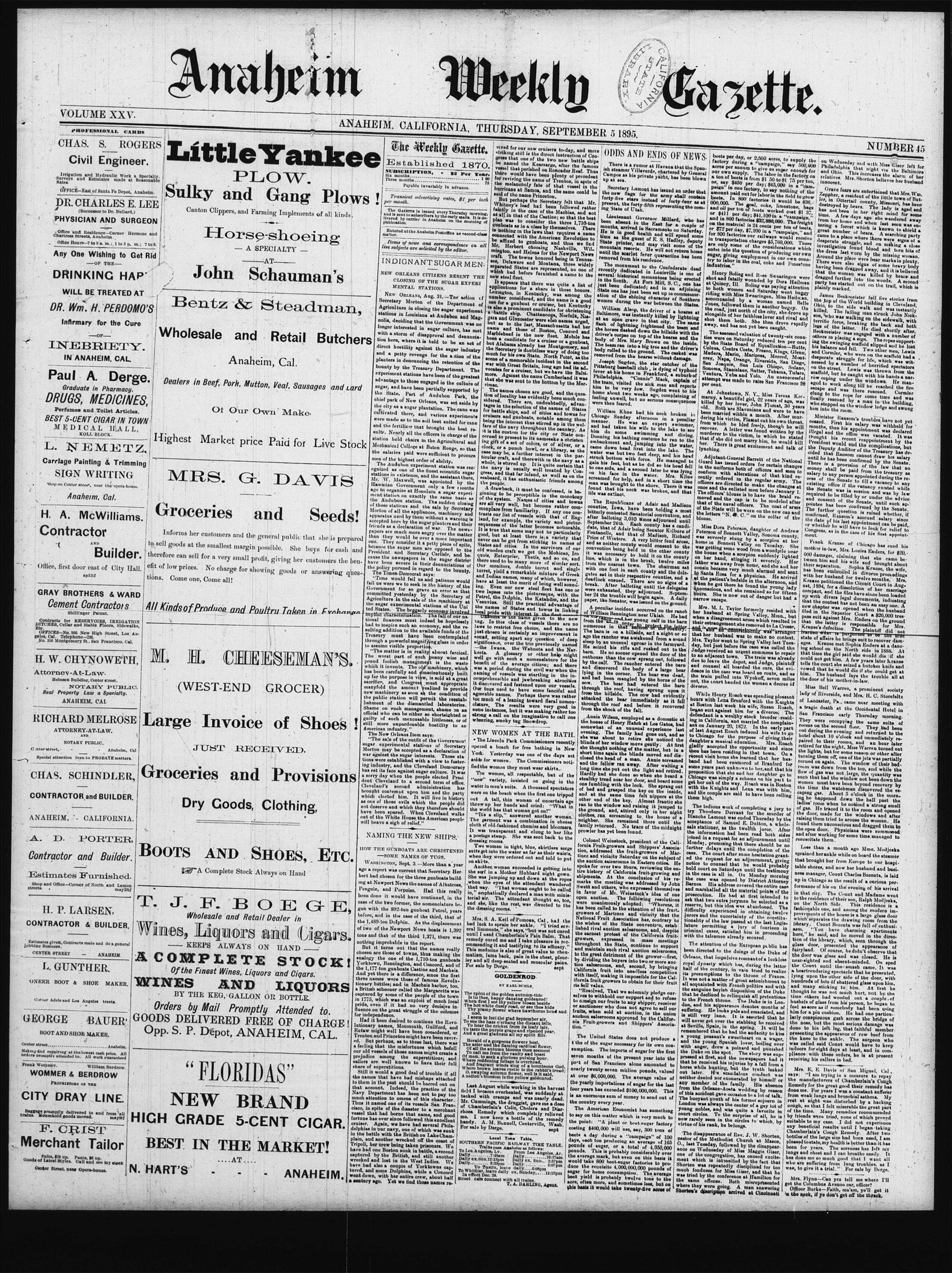
Searchable text
Anaheim
VOLUME XXV.
PROFESSIONAL CARDS
CHAS. S. ROGERS
Civil Engineer.
Irrigation and Hydraulic Work a Specialty.
Surveys and Estimates made at Reasonable Rates.
OFFICE—East of Santa Fe Depot, Anaheim.
DR. CHARLES E. LEE
(Successor to Dr. Bullard.)
PHYSICIAN AND SURGEON
Office and Residence—Corner Hermine and Chartress Streets, Anaheim.
Office Hours—7 to 9 a.m.; 1 to 3 p.m.; 7 to 8.
Any One Wishing to Get Rid
OF THE DRINKING HAP'
WILL BE TREATED AT
DR. Wm. H. PERDOMO'S
Infirmary for the Cure
OF INEBRIETY.
IN ANAHEIM, CAL.
Paul A. Derge.
Graduate in Pharmacy.
DRUGS, MEDICINES,
Perfumes and Toilet Articles.
BEST 5-CENT CIGAR IN TOWN
MEDICAL HALL,
KOLL BLOCK.
L. NEMETZ,
Carriage Painting & Trimming
Little Yankee
PLOW.
Sulky and Gang Plow
Canton Clippers, and Farming Implements of all kinds.
Horse-shoeing
— A SPECIALTY —
AT——
John Schauman's
Bentz & Steadman
Wholesale and Retail Butchery
Anaheim, Cal.
Dealers in Beef, Pork, Mutton, Veal, Sausages and Lamb
Of Our Own Make
Highest Market price Paid for Live Sto
Paul A. Derge.
Graduate in Pharmacy.
DRUGS, MEDICINES,
Perfumes and Toilet Articles.
BEST 5-CENT CIGAR IN TOWN
MEDICAL HALL,
KOLL BLOCK.
L. NEMETZ.
Carriage Painting & Trimming
SIGN WRITING
Shop on Center street, near the opera-house.
Anaheim, Cal.
H. A. McWilliams.
Contractor
AND
Builder.
Office, first door east of City Hall.
ap11tf
GRAY BROTHERS & WARD
Cement Contractors
Shillinger Patent.
Contracts for RESERVOIRS, IRRIGATION
DITCHES, Cellar and Stable Floors, Sidewalks,
Etc.
OFFICES—No. 205 New High Street, Los Angeles, Cal.
Telephone—236.
No. 316 Montgomery St., San Francisco, Cal.
H. W. CHYNOWETH,
Attorney-At-Law.
Helmsen Building, Center street.
NOTARY PUBLIC.
Real Property Law a Specialty.
ANAHEIM, Cal.
RICHARD MELROSE
ATTORNEY-AT-LAW.
AND
NOTARY PUBLIC.
Center street, Anaheim, Cal
Special attention given to PROBATE matters.
CHAS. SCHINDLER,
CONTRACTOR and BUILDER.
ANAHEIM, CALIFORNIA.
A. D. PORTER,
Contractor and Builder.
Estimates Furnished.
Shop and Office—Corner of North and Lemon streets.
Dealers in Beef, Pork, Mutton, Veal, Sausages and Lard
Of Our Own Make.
Highest Market price Paid for Live Stores
MRS. G. DAVIS
Groceries and Seeds
Informs her customers and the general public that she is prepared to sell goods at the smallest margin possible. She buys for cash and therefore can sell for a very small profit, giving her customers the best efit of low prices. No charge for showing goods or answering questions. Come one, Come all!
All Kinds of Produce and Poultru Taken in Exchange
M. H. CHEESEMAN'S.
(WEST-END GROCER)
Large Invoice of Shoes
JUST RECEIVED.
Groceries and Provisions
Dry Goods, Clothing,
BOOTS AND SHOES, ETC.
A Complete Stock Always on Hand
ANAHEIM, CALIFORNIA.
A. D. PORTER,
Contractor and Builder.
Estimates Furnished.
Shop and Office—Corner of North and Lemon streets.
H. P. LARSEN,
CONTRACTOR & BUILDER.
Estimates given, Contracts made and do a general jobbing Business.
CENTER STREET - ANAHEIM.
L. GUNTHER.
ONEER BOOT & SHOE MAKER.
Carrier Adele and Los Angeles treets.
GEORGE BAUER'
BOOT AND SHOE MAKER.
Center street... Anaheim.
Making and repairing at the lowest cash price. All orders promptly attended to. All work guaranteed
Frank Wommer. William Berdrow.
WOMMER & BERDROW
PROPRIETORS OF THE
CITY DRAY LINE.
Baggage promptly delivered to and from all trains. Household goods moved. may 9th
F. CRIST
Merchant Tailor
Suits, $25 up. Pants, $6 up.
Goods of Latest Styles. Call and see my stock
Center Street, near Opera-house.
Dry Goods, Clothing,
BOOTS AND SHOES, ETC.
A Complete Stock Always on Hand
T. J. F. BOEGE,
Wholesale and Retail Dealer in
Wines, Liquors and Cigars.
KEEPS ALWAYS ON HAND
A COMPLETE STOCK!
Of the Finest Wines, Liquors and Cigars.
WINES AND LIQUORS
BY THE KEG, GALLON OR BOTTLE.
Orders by Mail Promptly Attended to.
GOODS DELIVERED FREE OF CHARGE!
Opp. S. P. Depot, ANAHEIM, CAL.
"FLORIDAS"
NEW BRAND
HIGH GRADE 5-CENT CIGAR.
BEST IN THE MARKET!
AT...
N. HART'S - - - ANAHEIM.
ANAHEIM. CALIFORNIA, THURSDAY, SEPTEMBER 5 1895.
Wankee
D.W.
ang Plows!
Implements of all kinds.
hoeing
ALTY —
auman's
headman,
detail Butchers
Cal.
real, Sausages and Lard
Make
aid for Live Stock
The Weekly Gazette.
Established 1870.
SUBSCRIPTION, - 92 Per Year.
Six months.....1 00
Three months.....75
Payable invariably in advance.
Transient advertising rates, $1 per inch per month.
The Gazette is issued every Thursday morning, and is sent to subscribers by the early mails. It is delivered by carrier in Anaheim on the morning of publication.
Entered at the Anaheim Postoffice as second-class matter.
Items of news and correspondence on all live subjects are solicited by the editor.
INDIGNANT SUGAR MEN:
NEW ORLEANS, Aug. 31.—The action of Secretary Morton of the Department of Agriculture in closing the sugar experiment stations in Louisiana at Audubon and Magnolia, deciding that the Government was no longer interested in sugar culture, has met with a storm of disapproval and denunciation here, where it is held to be an act of direct hostility against the sugar industry and a petty revenge for the action of the planters in denouncing the retention of the bounty by the Treasury Department. The experiment stations have been of the greatest advantage to those engaged in the culture of sugar, and have been partially supported by the State. Part of Audubon Park, the chief park of New Orleans, was set aside by the city as a sugar plantation. The cane was cultivated there, and various experiments were made as to the soil best suited for cane and the fertilizer that brought the best results. Nearly all the officers in charge of the station held chairs in the Agricultural and Mechanical College at Baton Rouge, so that the salaries paid were sufficient to procure men of the highest order of ability.
The Audubon experiment station was recognized as one of the finest scientific sugar stations in existence.
vived for our new cruisers to-day, and more striking still is the direct instruction of Congress that one of the two new battle ships be named the Kearsarge, after the famous vessel that perished on Roncador Reef. Thus there would have been plenty of precedent for reviving the name of Trenton, in spite of the melancholy fate of that vessel in the hurricane at Samoa, and the same could be said of the name Princeton.
But perhaps the Secretary felt that Mr. Whitney lead had been followed rather faintly in the case of the Machias, and not at all in that of the Castine; so that the best plan was to consider the three 1,710-ton gunboats as in a class by themselves. There is nothing in the laws that requires a name connected with the American Revolution to be affixed to gunboats, and thus we find Mr. Herbert choosing Nashville, Wilmington, and Helena for the Newport News craft. The towns honored being in Tennessee, Delaware and Montana, three widely separated States are represented, no one of which had before furnished a name to the new steel fleet.
It appears that there was quite a list of applications for a share in these honors. Lexington, in Kentucky, was among the number considered, and the name is a good one for a gunboat or cruiser, but Kentucky is also a prominent candidate for christening a battle ship. Chattanooga, Norfolk, Niagara and Gloucester were also names urged, but as to the last, Massachusetts had her name and those of Boston, Concord and Marblehead in the new fleet. Mobile has been a candidate for a cruiser or a gunboat, but Alabama already has Montgomery, and the Secretary is doubtless wary of doing too much for his own State. North Point, as the scene of a memorable incident in the second war with Great Britain, long ago had its advocates for a cruiser, but we have the Baltimore. Against the name Cumberland it was that she was sent to the bottom by the Merrimac.
The names chosen are good, and the question of locality has evidently been much considered. There are, undoubtedly, advantages in the selection of the names of States for battle ships, and of cities and towns for cruisers and gunboats, notable among them being the interest thus stirred up in the welfare of the navy throughout the country. As it is custom for the city or State concerned to present to its namesake a christening gift of a set of colors, or of silver, or a clock, or a punch bowl, or a library, as the case may be, a further interest in the particular craft, and therewith in the navy as a whole, is stirred up. It is quite certain that the navy is usually well treated by Congress, and that far inland as well.
ODDS AND ENDS
There is a rumor at Havanaish steamer Villaverde, chartered Campos as his private yacht, built up at sea.
Secretary Lamont has issued the new flags for the army forty-five stars instead of four present, the forty-fifth representing State of Utah.
Lieutenant Governor Millan been absent in the East for five months, arrived in Sacramento. He is in good health and will time as the guest of E. S. Hale State printer, and may visit mountain resorts. He will not until the scarlet fever quarantined from his residence.
The monument to the Confederate recently dedicated in Louisville several historical memesoes bein in the South. At Fort Mill, S.C., just been dedicated; and in state one has just been set up in relation of the shining character of women during the war between them.
William Alsop, the driver of Baltimore, was instantly killed by an open grave in that city. Flash of lightning frightened them; the horses dashed down the hillside; driver's corpse on top of the heart; body of Mrs. Mary Brown on top; The team ran into a big tree and then body rolled to the ground. The crew removed from their hearse without fear.
Joseph Sugden, the star catcher Pittsburgh baseball club, is dying fever at home in Frankford, an Philadelphia. "Connie" Mack, he team, visited the sick man after him to be very low. Sugden went home about two weeks ago, complying feeling unwell, but no serious concern were then feared.
William Klune had his neck broken Chicago Sunday afternoon in a manner. He was an expert sailor and had taken some swimming and donning his bathing costume he ran embankment and jumping into the lake came down head first into the water was but two feet deep, and struck bottom with force. He may gain his feet, but as he did so his face on one side, and a second later he went back on his face in water.
DAVIS
Seeds!
Taken in Exhange
public that she is prepared
She buys for cash and
bringing her customers the bengoods or answering questions.
THE GUNBOATS ARE CHRISTENED
—SOME NAMES OF TUGS.
WASHINGTON, Sept. 3. —More than a year ago a report was current that Secretary Herbert had chosen for the three gunboats building at Newport News the names of Albatross, Penguin, and Porpoise. Had this really been done it would have continued, in the experiment stations have been of the greatest advantage to those engaged in the culture of sugar, and have been partially supported by the State. Part of Audubon Park, the chief park of New Orleans, was set aside by the city as a sugar plantation. The cane was cultivated there, and various experiments were made as to the soil best suited for cane and the fertilizer that brought the best results. Nearly all the officers in charge of the station held chairs in the Agricultural and Mechanical College at Baton Rouge, so that the salaries paid were sufficient to procure men of the highest order of ability.
The Audubon experiment station was recognized as one of the finest scientific sugar stations in existence, and the assistant there, Mr. W. Maxwell, was appointed by the Hawaiian Government only a few months ago to organize at Honolulu a sugar experiment station on exactly the same basis as the Audubon station. The sudden closing of these stations and the sale by Secretary Morton of all the appliances, machinery and apparatus used by them without a warning is accepted here by the sugar planters and their friends as a declaration of war. The newspapers are much more angry over the matter than they would be over a more important one. They consider it a petty piece of spite, because the sugar men are opposed to the President and Secretary Carlisle, and because the newspapers in the sugar district have been severe in their denunciations of the policy pursued in regard to the bounty.
The Times-Democrat says:
"Time would fail us and patience would fail us we need to seek in the history of the Government for so grave an error as that committed yesterday by the Secretary of Agriculture in the sale of the machinery at the sugar experimental stations of the United States. The beggarly economy involved myriad characterization. The fall of our national finances must indeed be hopelessly bad to inspire such an economy, and the resulting addition to the available funds of the Treasury must have been contemplated through a powerful magnifying glass in order to assume visible proportion.
"The matter is in reality almost farcical. The worst part of such penny wise and pound foolish management is the waste which it invents. The old machinery, which has been carefully and conscientiously built up for the purpose in view, is sold at a great sacrifice, and Congress must appropriate manyfold the amount realized to provide new machinery as soon as the condition of the public station will permit the reestablishment of the dismantled laboratories. Shame on such management, shame on an official who can be either so shortsighted or guilty of such nexcessable littleness, or of still more unpardonable hostility to an American industry."
The New Orleans Item says:
"The sale of the outfit of the Government sugar experimental stations of Secretary Morton may be accepted as a declaration of war against the sugar interests. These stations were established with a view to fostering industry, and the Cleveland Democracy has set its face against sugar culture. It was a day when the people elected President Cleveland to a second term of office. Cleveland's second administration has brought contempt upon him and the party which elected him. It will live in history as one of those evils which the people did not deserve and which therefore should have been spared. When Cleveland walks out of the White House the American people will heave a sigh of relief."
NAMING THE NEW SHIPS.
HOW THE GUNBOATS ARE CHRISTENED —SOME NAMES OF TUGS.
WASHINGTON, Sept. 3. —More than a year ago a report was current that Secretary Herbert had chosen for the three gunboats building at Newport News the names of Albatross, Penguin, and Porpoise. Had this really been done it would have continued, in the experiment stations have been of the greatest advantage to those engaged in the culture of sugar, and have been partially supported by the State. Part of Audubon Park, the chief park of New Orleans, was set aside by the city as a sugar plantation. The cane was cultivated there, and various experiments were made as to the soil best suited for cane and the fertilizer that brought the best results. Nearly all the officers in charge of the station held chairs in the Agricultural and Mechanical College at Baton Rouge, so that the salaries paid were sufficient to procure men of the highest order of ability.
The Audubon experiment station was recognized as one of the finest scientific sugar stations in existence, and the assistant there, Mr. W. Maxwell, was appointed by the Hawaiian Government only a few months ago to organize at Honolulu a sugar experiment station on exactly the same base as the Audubon station. The sudden closing of these stations and the sale by Secretary Morton of all the appliances, machinery and apparatus used by them without a warning is accepted here by the sugar planters and their friends as a declaration of war. The newspapers are much more angry over the matter than they would be over a more important one. They consider it a petty piece of spite, because the sugar men are opposed to the President and Secretary Carlisle, and because the newspapers in the sugar district have been severe in their denunciations of the policy pursued in regard to the bounty.
The Times-Democrat says:
"Time would fail us and patience would fail us we need to seek in the history of the Government for so grave an error as that committed yesterday by the Secretary of Agriculture in the sale of the machinery at the sugar experimental stations of the United States. The beggarly economy involved myriad characterization. The fall of our national finances must indeed be hopelessly bad to inspire such an economy, and the resulting addition to the available funds of the Treasury must have been contemplated through a powerful magnifying glass in order to assume visible proportion.
"The matter is in reality almost farcical. The worst part of such penny wise and pound foolish management is the waste which it invents. The old machinery, which has been carefully and conscientiously built up for the purpose in view, is sold at a great sacrifice, and Congress must appropriate manyfold the amount realized to provide new machinery as soon as the condition of the public station will permit the reestablishment of the dismantled laboratories. Shame on such management, shame on an official who can be either so shortsighted or guilty of such nexcessable littleness, or of still more unpardonable hostility to an American industry."
The New Orleans Item says:
"The sale of the outfit of the Government sugar experimental stations of Secretary Morton may be accepted as a declaration of war against the sugar interests. These stations were established with a view to fostering industry, and the Cleveland Democracy has set its face against sugar culture. It was a day when the people elected President Cleveland to a second term of office. Cleveland's second administration has brought contempt upon him and the party which elected him. It will live in history as one of those evils which the people did not deserve and which they therefore should have been spared. When Cleveland walks out of the White House the American people will heave a sigh of relief."
NEW WOMEN AT THE BATH.
"The Lincoln Park Commissioners recently opened a beach for free bathing in New York. Yesterday was one of the days set aside for women. The Commissioners notified—the women they must wear skirts.
The women, all respectable, but of the "new" variety, insisted on going in the water in men's suits. A thousand spectators were on the beach when the first one tripped out A tall, thin woman of uncertain age threw up her hands and cried: "What in the world has that woman got on!"
"It is a slip," answered another woman. The garment was a combination in cheese cloth of old-fashioned chemise and bloomers. It was transparent and elonged to her like a postage stamp. She was sent back to the dressing rooms.
Two women in tight, blue skirtless serge suits got into the water an far as their waists, when they were ordered out and told to put on skirts.
Another woman succeeded in getting into the surf in a Mother Hubbard night gown. She was jumping up and down at the ropes when she eyes of the attendant wandered that way: "That woman ought to be called in," emphatically declared a man with ministerial air. The attendant thought no longer.
Again Wilson, employed as a domestick house of Henry Hatch at Los Gatos somewhat of an unusual experience evening. The family had gone out, and she was about to retire she noticed blinds of her window move gently. At she thought nothing of the matter, but she short time againthe blinds moved and closedthe headofa man.Annie screamedandthe fellow ran away.After waitinglong time she put outthe light and retreatedHardly had she done so when she heardstealth tread near her door,and hearda one fumbling withthe lock.She sprangof bed and graspedthe key onthe insideandatthe same time felt nippersatother endofthe key.Almost franticallyrantothewindow和raisingitjumpedthe ground,andattiredonlyinherne clothes,ran screamingtothehouseinfamily returned.No traceofthe midnightprowlerhas yet found.
Colonel Weinstock,presidentoftheCleveland Fruit-growersandShippers'Association addressedthefruit-growersofMainezincityandvicinitySaturdayonthesubjectauctionsaileroomsinEasterncities.spokeforovertwobourshowingthefirehistoryofCaliforniafruit-growingshipments.Atthe conclusionofhismarksthemeetingwas addressedbyJoseSwettandothers,howexpressedtheselfin favorofMr.Weinstock'sideaofopen auction.Thefollowing resolution
NAMING THE NEW SHIPS.
HOW THE GUNBOATS ARE CHRISTENED
SOME NAMES OF TUGS.
WASHINGTON, Sept. 3.—More than a year ago a report was current that Secretary Herbert had chosen for the three gunboats building at Newport News the names of Albatross, Penguin, and Porpoise. Had this really been done it would have continued, in the case of the two former, the nomenclature begun with the 892-tun gunboat Petrel, years before, and in the case of the third, that of the 1,489-ton Dolphin. As the displacement of two of the Newport News boats is 1,392 tons and that of the third, 1,371, there was nothing improbable in the report.
But it turns out that the names really chosen are those of towns, thus making the analogy the one of the 1,710-ton gunboats Yorktown, Bennington, and Concord, and of the 1,177-ton gunboats Castine and Machais. And yet there is a difference, since the first three names were those of famous Revolutionary battles; and in Machais harbor, too, a British schooner called the Margaretta was captured by some of the people of the town in 1775, which was an exploit of much local pride, even if it had no very decisive influence on the great struggle of the colonies for independence.
Had it been desired to continue the Revolutionary names, Monmouth, Guilford, and Futaw might well have been considered, or Trenton and Princeton might have been revived. But perhaps, as to these last, there was a feeling that the misfortunes which befell our old vessels of those names might create a prejudice among the superstitions; and sailors are well known to have their full share of superstitious.
Still it would a good deal of trouble if all the names that have had mishaps attached to them in the past should be barred out on that account. Indeed, the practice of the Navy Department has been not to pay too much attention to omens of this character. Thus it named one of its vessels San Francisco, in spite of the disaster to a merchant vessel that had borne that name, and good fortune has ever since followed this excellent cruiser. Again, we have had several Philadelphias in our navy, one of which was sunk in the battle with the British on Lake Champlain, and another wrecked off the coast of Tripoli, her crew being taken prisoners. We have had one Boston sunk in battle, a second captured by the British, and still another wrecked and lost in the West Indies. We have had also a couple of Yorktowns captured, and some Dolphins, while a Concord went down, with her entire crew, about half a century ago. Yet we find those names out.
A tall, thin woman of uncertain age threw up her hands and cried: "What in the world has that woman got on?"
"It's a slip," answered another woman. The garment was a combination in cheese cloth of old-fashioned chemise and bloomers. It was transparent and clung to her like a postage stamp. She was sent back to the dressing rooms.
Two women in tight, blue, skirtless serge suits got into the water as far as their waists, when they were ordered out and told to put on skirts.
Another woman succeeded in getting into the surf in a Mother Hubbard night gown. She was jumping up and down at the ropes when the eyes of the attendant wandered that way. "That woman ought to be called in," emphatically declared a man with ministerial air. The attendant thought so, too, and she, like the rest, was directed to the dressing rooms.
Mrs. S. A. Kell of Pomona, Cal., had the bad luck to sprain her ankle. "I tried several liniments," she says, "but was not cured until I used Chamberlain's Pain Balm. That remedy cured me and I take pleasure in recommending it and testifying to its efficacy."
This medicine is also of great value to rheumatism, lame back, pain in the chest, pleurisy and all deep-seated and muscular pains. For sale by Dorge.
GOLDENROD.
BY KARL BUHLLE.
The spirit of the golden autumn-tide is in these happy dancing goldenrod! When first I see thy yellow bloom beside The hot-white dusty road, or see these hide Thy plumy flower where hawthorns bend and nod,
I seem to feel the glad September air. To see the haze o'rhang the distant bills. To hear the cricket from its leafy lair. To taste the purple grape and ripened pear. And a great gladness all my spirit fills.
Herald of a gorgeous flowery host. The aster and the flaming cardinal flower, Of all the autumn blooms thou seemest To call me from the vanity and boast Of men to seek a glorious pulsing hour. Where roddening foliage is overhead, And fragrant winds sing of a bounteous God. Where brown leaves rustle to the rabbit's tread; O, swapling leaves flower, well is it said, A nation's blossom is the yellow goldenrod.
Last August while working in the harvest field I became overheated, was suddenly attacked with cramps and was nearly dead. Mr. Cummings, the druggist, gave me a dose of Chamberlain's Colic, Cholera and Diarrhoea Remedy which completely relieved me. I now keep a bottle of the remedy handy. A. M. Bunnell, Centerville, Wash. For sale by Derge.
Local Time Table.
SOUTHERN PACIFIC RAILWAY TIME TABLE.
Trains pass Anaheim as follows:
To Los Angeles, Lv. From Los Angeles, Ar.
Dally... 7:48am Dally... 10:27am
Dally ex Sun. 12:13pm Dally ex Sun. 2:57pm
Dally... 3:33pm Daily...
To Tustin, leave daily...6:08pm
To Whittier, leave daily ex,Sunday...12:13pm
In effect Dec. 20.
Street cars connect with all trains.
Colonel Weinstock, president of the California Fruit-growers and Shippers' Association addressed the fruit-growers of Malta and vicinity Saturday on the subject of the auction salesrooms in Eastern cities; spoke for over two hours, reviewing the fire history of California fruit-growing shipments. At the conclusion of his marks he meeting was addressed by John Swett and others, who expressed themselves in favor of Mr. Weinstock's idea of open auction. The following resolution were unanimously adopted: "Whereas has been called to the attention of the fruit growers of Martinez and vicinity that to National Fruit Association has contrary to the wishes of the State convention, estates rished rival auction salesrooms, and despite the carnal protest of the California fruit growers, expressed in mass meetings throughout the State, continue to support and maintain such rival auction salesrooms; to the great detriment of the grower—first by dividing the buyers into two or more auction salesrooms; and second, by bringing California fruit into neoclass competition with itself, making it impossible for the California fruit growers to obtain for their fruits its fall value.
"Resolved That we solemnly pledge ourselves to withhold our support and to refuse to consign our fruits to any shipper, receive or auctioneer who does not agree to sell our fruits, when sold at auction, in the union auction salesrooms approved by the California Fruit-growers and Shippers' Association."
The United States does not produce fruit at the sugar necessary for its own consumption. The imports of sugar for the first seven months of the present year into the port of San Francisco alone amounted to nearly twenty-seven million pounds; valued at over $6,000,000. The average value of the yearly importations of sugar for the last four years has exceeded $100,000,000. This is an enormous sum of money to send out of the country every year.
The American Economist has something to say on this matter which is very much to be pointed out: "A plant or beet-sugar factory costing $400,000 will use, say, 300 tons of beets a day during a 'campaign' of 100 days each ton producing an average of 165 pounds of sugar, or a total of 4,950,000 pounds. This is probably considerably overthe average mark but even on this basis it would take 800 beet-sugar factories to produce the requisite 4,000,000 pounds of sugar for home consumption. The average beet yield is probably twelve tons to the acre; often more, and sometimes less; but on this basis it would take twenty-five acres of..."
ODDS AND ENDS OF NEWS.
There is a rumor at Havana that the Spanish steamer Villaverde, chartered by General Campos as his private yacht, has been blown up at sea.
Secretary Lamont has issued an order that the new flags for the army shall contain forty-five stars instead of forty-four as at present, the forty-fifth representing the coming State of Utah.
Lieutenant Governor Millard, who has been absent in the East for a couple of months, arrived in Sacramento on Saturday. He is in good health and will spend some time as the guest of E. S. Hadley, deputy State printer, and may visit some of the mountain resorts. He will not return home until the scarlet fever quarantine has been removed from his residence.
The monument to the Confederate dead recently dedicated in Louisville is one of several historical memorials being erected in the South. At Fort Mill, S. C., one has just been dedicated; and in an adjoining State one has just been set up in commemoration of the shining character of Southern women during the war between the States.
William Alsop, the driver of a hearse at Baltimore, was instantly killed by lightning at an open grave in that city. The same flash of lightning frightened the team and the horses dashed down the hillside with the driver's corpse on top of the hearse and the body of Mrs. Mary Brown on the inside. The team ran into a big tree and the driver's body rolled to the ground. The casket was removed from the hearse without damage.
Joseph Sugden, the star catcher of theittaburg baseball club, is dying of typhoid at his home in Frankford, a suburb of Philadelphia. "Connie" Mack, captain of the team, visited the sick man and reports him to be very low. Sugden went to his home about two weeks ago, complaining ofeling unwell, but no serious consequences were then feared.
William Klune had his neck broken in Chicago Sunday afternoon in a peculiar manner. He was an expert swimmer, had taken his wife to the lake to see him do some swimming and diving. Running his bathing costume he ran to the bankment and jumping into the water, one down head first into the lake. The latter was but two feet deep, and his head hook bottom with force. He managed to hit his feet, but as he did so his head fell one side, and a second later he was lying his face in the water.
beets per day, or 2,500 acres, to supply the factory during a "campaign," say 500,000 acres per annum to give us sugar enough for our own supply. The labor in the factory on a ton of beets is from $1 50 to $1 75 per ton, or say $450 per day; $45,000 in a "campaign" in one factory, to say nothing of the amount paid out for labor in the field to grow beets. In 800 factories it would be $36,000,000. The coal, coke, limestone, bags and oil per ton of beets worked cost $1 37, or $411 per day; $41,100 in a "campaign," and in 800 factories $32,880,000. The freight on the material is 24 cents per ton of beets, or $72 per day, $7,200 in a "campaign," and for 800 factories our railways would receive in transportation charges $5,760,000. These are only some of the considerations which entet into the question of producing our own sugar, giving employment in our own country to labor in the coal, coke and limestone industries."
Henry Boling and Rose Swearingen were shot and fatally wounded by Dora Heilman at Quincy, Ill. Boling was paying attention to both women and Saturday went buggy riding with Miss Swearingen. Miss Heilman accompanied by a woman named Belle Jones, followed them in another buggy. On the road, just north of the city, she drove up alongside of her faithless lover and rival and shot them both. She then drove rapidly away, and has not yet been caught.
The assessed valuation of twenty-six counties were on Saturday reduced ten per cent by the State Board of Equallzation—Butte, Colusa, Contra Costa, Fresno, Kings, Glenn, Madera, Marin, Mariaposa, Merced, Monterey, Napa, Orange, Riverside, San Diego, San Joaquin, San Luis Obispo, Solano, Sonoma, Stanislaus, Sutter, Tehama, Tulare, Ventura, Yuba and Yolo. An unsuccessful attempt was made to raise San Francisco 20 per cent.
At Johnstown, N. Y., Miss Teresa Kermany, a beautiful girl, 22 years of age, was killed by her lover, John Flamat, 30 years old. Both are Slavonians and were to have been married within a month. After murdering his victim, Flamat cut his own throat, from which he bled freely though he will recover. A letter was found written by the murderer to the victim, in which he stated that if she did not marry him, he would kill her. There is great excitement and talk of lynching.
Adjutant-General Barrett of the National Guard has issued orders for certain changes in the uniforms both of officers and men to conform with alterations of that kind.
On Wednesday and with Miss Ciser left for Philadelphia that night via the Baltimore and Ohio. This increases the alarm of her relatives. Mrs. Shorten believes her husband innocent.
Grave fears are entertained that Mrs. Wm. Zephher, a resident of the little town of Butler, in Ottertail county, Missouri, has been destroyed by bears. The lady is aged and has not been in her right mind for some time. A few days ago she wandered away from her home and when last seen was entering a forest which is known to shield a great number of bears. A searching party came to a place where there were signs of a desperate struggle, and on making a close investigation found blood and torn bits of the dress last worn by the missing woman. Around the place were bear marks in plenty. There were also signs of some heavy body having been dragged away, and it is believed that the woman was killed by bears and dragged further into the woods. A second party has started out on the trail, which is plainly marked.
James Beckmeister fell five stories from the top of the World building in Cleveland, Ohio; to the side walk and was instantly killed. The falling man struck John Nickerson; who was walking on the sidewalk with terrific force, breaking back and both legs of the latter. He died shortly after. Beckmeister was engaged with a number of others in placing a sign. The repers supporting the swinging scaffold slipped and he lost his balance and fell. Two other men Lewis and Cormler, who were on the scaffold had a desperate struggle for life which was witnessed by a number of horrified spectators on the street. Lewis was thrown from the scaffold, but he caught with his hands a narrow coping under the windows. He managed to work along till he reached the fire escape and was there rescued. Cormler clung to the rope for some time and was finally rescued by a man in the building, who stopped on the window ledge and swung him into the room.
Minister Ransom's troubles have not yet ceased. First his salary was withheld for months; then his appointment was declared illegal and the office was vacated. It was thought his recent reappointment by the President would end the complications, but the Deputy Auditor of the Treasury has decided that Ransom cannot draw his salary until he has been confirmed by the Senate. There is a provision of the law that no money shall be paid from the treasury as salary to any person...
William Kline had his neck broken in Chicago Sunday afternoon in a peculiar manner. He was an expert swimmer, and had taken his wife to the lake to see him do some swimming and diving, running his bathing costume he ran to the bankment and jumping into the water, one down head first into the lake. The latter was but two feet deep, and his head stuck bottom with force. He managed to hit his feet, but as he did so his head fell on one side, and a second later he was lying his face in the water. Mrs. Kline seemed for help, and in a short time the man was brought to the shore. There it was and that his neck was broken, and that was extinct.
The Republicans of Adair and Madison counties, Iowa, have been holding a most early contested Senatorial convention, and her balloting 3,010 times adjourned until December 24th. Each county has a candidate, that of Adair being Senator Kilburn of Danube, and that of Madison, Richard of Winters. A very bitter feud arose, as neither county would consent to the election being held in the other county was necessary to hold it on the county which is in the brush, twelve miles away the nearest town. The chairman sat one foot in each county and the delegate sat in their respective counties, and a clock ensued. There are no signs of a dispute. After balloting until the delegates exhausted, they adjourned. September 17 the trouble will begin again. A daily report by the Senator, was issued on the ground.
A peculiar incident occurred on the ranch Bennington near Ukiah. He had ran and her young calf in the barn in order to protect the latterrous in that section of the county. Barn is on a hillside, and a night or so the rancher was awakened from a sound by an unusual uproar in the farmyard. His rifle and rushed out to the barn. He no sooner opened the door of the case than the cow sprang out, followed calf. The rancher entered the barn discovered the body of a large bear in the corner. The bear was dead, and been mangled by the horns of the bear. The bear had entered the barn with the roof, having sprung upon it at the hillside. The cow had evidently led the bear immediately as it fell on the roof and before it recovered the shock of the fall.
Mrs. Wilson, employed as a domestic at house of Henry Hatch at Los Gatos, had that of an unusual experience last year. The family had gone out, and as about to retire she noticed the same time felt nippers at the end of the key. Almost frantic she window and raising it jumped to stand, and attired only in her night ran screaming to the house of a friend. She remained there until returned. No trace of the midnight has yet been found.
Sel Weinstock, president of the Califruit-growers and Shippers' Association addressed the fruit-growers of Marvin vicinity Saturday on the subject of onion saleries in Eastern cities. He over two hours, reviewing the enquiry of California fruit-growing and salting. At the conclusion of his rehearsal meeting was addressed by John and others, who expressed themselves of Mr. Weinstock's idea of one action.
At Johnstown, N.Y., Miss Teresa Keemary, a beautiful girl, 22 years of age, was killed by her lover, John Flamat, 30 years old. Both are Slavonians and were to have been married within a month. After murdering his victim, Flamat cut his own throat, from which he bled freely, though he will recover. A letter was found written by the murderer to the victim, in which he stated that if she did not marry him, he would kill her. There is great excitement and talk of lynching.
Adjutant-General Barrett of the National Guard has issued orders for certain changes in the uniforms both of officers and men to conform with alterations of that kind recently ordered in the regular army. The officers are directed to make the changes at once and enlisted men before January 1. The officers' blouse is to have the braid removed and the cap is to be modeled after that of naval officers. The coat of arms of the State will be worn on the new cap and the letters "N. C. C." on the collar of the blouse.
Miss Dora Peterson, daughter of Andrew Peterson of Bennett Valley, Sonoma county, was severely stung by a scorpion at her home in Bennett Valley on Tuesday. She was getting some wood from a woodpile near the house when a scorpion suddenly lighted on her hand, stinging it severely. Her father was away from home, and she and her cousin became very much alarmed and sent to Santa Rosa for a physician. He arrived at the patient's bedside in the afternoon, and when he got there he found the young lady unconscious, and she remained so for fifteen hours. She is now out of danger but had a narrow escape.
Mr. M. L. Taylor formerly resided with her husband at Spring Valley, Minn., but when a disagreement arose which resulted in their estrangement she removed to La Crosse, Indiana and then entertaining was arranged that her husband was to make no contest. Mrs. Taylor went to Spring Valley last Tuesday, but just before the case was called the Judge received an urgent summons to repair to an adjacent town. The train was already due to leave the depot, and Judge, plaintiff and counsel all boarded the cars, the evidence in the case was heard on route, and as the train pulled into Wyckoff, seven miles out, the court handed out woman a decree of divorce.
While Henry Roach was spending pleasant hours with Lena Brandon with the Knights at Boston last week his wife, Susan Roach, began suit against him for a divorce. The defendant is a wealthy stock breeder residing in California, and married the complainant on January 20, 1872. In the early part of last August Roach induced his wife to go to Chicago for the purpose of giving their daughter a musical education. Mrs. Roach gladly accepted the opportunity and since then has been residing in that town. On a recent visit home she learned that her husband had been enamed of Branford for some years past unknown to her, and that his proposition that she and her daughter go to Chicago was simply a scheme on his part to get her out of the way. Roach was in Boston with the Knights and Lena was with him, and the couple are said to have been relling them high.
The tedious work of completing a jury to try Theodore Durrant for the murder of Blanche Lamont was ended Thursday by the acceptance of Samuel E. Dutton, a wholesale stationer, as the twelfth juror. After the information had been read both sides joined in a request for an adjournment until Monday, promising that there should be no further delays until the completion of the case. The court after some hesitation granted the request for an adjournment, giving notice to counsel that he would probably hold court on Saturdays until the testimony in case is all in. On Monday morning the case was opened by District Attorney Barnes. His address covered the entire case and marshalled all the material points of the prosecution. He had at first intended to ask that court made his hands a narrow coping under the windows. He managed to work along till he reached the fire escape and was there rescued. Cormler clung to rope for some time and was finally rescued by a man in the building, who stopped on the window ledge and swum him into the room.
Minister Ransom's troubles have not yet ceased. First his salary was withdied for months, then his appointment was declared illegal and the office was vacated. It was thought his recent reappointment by the President would end the complications, but the Deputy Auditor of The Treasury has decided that Ransom cannot draw his salary until he has been confirmed by the Senate.
There is a provision of the law that no money shall be paid from the treasury as salary to any person appointed during the recess of the Senate to fill a vacancy to any existing office if the vacancy existed while the Senate was in session and was by law required to be filled by or under the advice and consent of the Senate, until such appointee has been confirmed by the Senate.
The further question is raised whether, if confirmed, Ransom's accrued salary since date of his last appointment can be paid or whether he will have to look for relief to Congress, as in case of his first appointment.
Frank Krause of Chicago has sued his mother-in-law, Mrs. Louis Enders, for $20,000 damage; claiming that she came between him and his wife and brought about their separation.
Sophia Krause, the wife, has been embroiled in divorce proceedings with her husband for twelve months. Mrs. Krause petitioned Circuit Court in August, 1894, for a dissolution of her marriage compact, and she files have since been loaded up with divers legal documents, indicating that the contest has not been an easy one. A new chapter was opened when the husband filed in the Superior Court at $20,000 trespass suit against Mrs. Enders on the ground that latter is responsible for Mrs. Krause's defection. The plaintiff did not learn what is purported to be true state of affairs he brings suit to recover damages. Krause met Sophia Enders at a dancing school on the North side in 1888. At that time she girl said she would die if she could not get him. A few years later Krause tells the court she butted knife and vowed that he would die if she could get at him. The husband lays the trouble all at the door of his mother-in-law.
Miss Bell Warren, a prominent society lady of Riverside, and Mrs. H.C. Storefeltz of Lancaster, Pa., came near meeting with a tragic death at the Occidental Hotel in San Francisco early Thursday morning. They were occupying same suite of rooms on second floor. They had been out duringthe evening and returnedtothe hotel about 10 o'clockand immediately repairedto their rooms,and an hour later retiredforthe night.Miss Warren turned outthe lights,but for some reason or other after turning them off,一方ofthe jetswas partiallyturnedonagain.Thewindowofbethereadfromthetop,andwhiletheflowofgaswasnotlarge,thequantitywassuchthathadthewindownotbeendownthewomenmusthavebeenbeyondrecoverybythetimewatchmandiscoveredtheescapinggas.About5o'clockinthemorninghehappeneddowntheballpasttheladiesroomwhenhenoticedastrongsmellofgas.Hec tracedittotheroomandopenedthedoor,madeforthewindowsandafterraisingthetriedtoarousethewomen.Hewoundtheunconsciousanddraggedthetomeoftheopendoor.Physiciansweresummedandafterworkingforsometimemanagedtoresuscitate them.
Less than a month ago Mme.Modjeska sprained her ankle while on boardthe steamer that brought her from Europe to our hospital shores,andnowher husbandandbusinesmanager.CountCharles Bozents.islaidupinChicagoasresultofacuriousperformanceofhisontheeveningofhisarrivalinthatcity.TheCountAndMadamewenttothes residenceoftheirsonRalphMedi
The Weinstock, president of the Califruit-growers and Shippers' Association,
dressed the fruit-growers of Marlark vicinity Saturday on the subject of
the sale rooms in Eastern cities. He
over two hours, reviewing the entry of California fruit-growing and
grazing. At the conclusion of his rehearing meeting was addressed by John
and others, who expressed themselves
of Mr. Weinstock's idea of one
action.
The following resolutions
amnimously adopted: "Whereas, it
called to the attention of the fruitof Martinez and vicinity that the
Fruit Association has, contrary to
the State convention, establishes auction salesrooms, and, despite
that protest of the California fruitexpressed in mass meetings
at the State, continue to support
to obtain such rival auction salesrooms,
that detriment of the grower—first,
being the buyers into two or more aucous rooms, and, second, by bringing
fruit into neoless competition,
making it impossible for the Califit growers to obtain for their fruit
use."
That we solemnly pledge our
withhold our support and to refuse
our fruits to any shipper, receiver
deer who does not agree to sell our
on sale at auction, in the union
salesrooms approved by the Califorgrowers and Shippers' Association.
United States does not produce a
sugar necessary for its own construction. The imports of sugar for the first
month of the present year into the
San Francisco alone amounted to
nearly seven million pounds, valued
$100,000,000. This sum of money to send out of
every year.
American Economist has something
this matter which is very much to
"A plant or beet-sugar factory
will use, say, 300 tons of
syrup during a "campaign" of 100
ton producing an average of 165
sugar, or a total of 4,950,000
sugar is probably considerably overmark, but even on this basis it
800 beet-sugar factories to proquire 4,000,000,000 pounds of
some consumption. The average
is probably twelve tons to the store,
and sometimes less, but on
would take twenty-five acres of
The tedious work of completing a jury to try Theodore Durrant for the murder of Blanche Lamont was ended Thursday by the acceptance of Samuel E. Dutton, a wholesale stationer, as the twelfth juror. After the information had been read both sides joined in a request for an adjournment until Monday, promising that there should be no further delays until the completion of the case. The court after some hesitation granted the request for an adjournment, giving notice to counsel that he would probably hold court on Saturdays until the testimony in the case is all in. On Monday morning the case was opened by District Attorney Barnes. His address covered the entire case and marshalled all the material points of the prosecution. He had at first intended to ask that two extra jurymen be selected as a reserve, but this idea was abandoned. The difficulty experienced in obtaining twelve jurors and the uncertainty of the constitutionality of the law passed at the last Legislature permitting a jury of fourteen in criminal cases, satisfied him in proceeding with the tailsmen already secured.
The attention of the European public has been directed to the doings of the Duke of Orleans, that impulsive remnant of a luckless royal dynasty which has, during the latter half of the century, in vain tried to realize its presumptions to the throne of France. It was not a matter of great astonishment to all acquainted with French politics and with the sanguine boyish disposition of the Duke that he declined to relinquish all pretentious to the French throne. The Duke is in London, and his appearance denotes months of suffering. He looks pale and emaciated, and is still very lame. It is asserted that he will never get over the stabbing he received at Seville, Spain, in the spring. It will be remembered that he had the audacity to kiss a young peasant's sweetheart on a wager, and the young Spanish lover, boiling over with anger, drew a poinard and punished the Duke on the spot. The story was suppressed at first, and the newspapers had it that he received his injuries by a fall from a horse while hunting, but the truth leaked out later. His scandalous conduct was neither denied nor exonerated by himself or any member of the family. His absence from the Orleans-Aosta wedding by reason of this accident gave occasion to a lot of talk. The buoyant youth of his former sojourn in London was always the center of a gay lot of young nobles, and was quite a favorite in court circles. To the surprise of all, he is now rarely seen in the circles to which, by virtue of his rank, he belongs.
The disappearance of Rev. J. W. Shorten, pastor of the Methodist Church at Mason, O., last Tuesday, followed by the disappearance on Wednesday of Miss Maggie Giser, one of the congregation, has caused excitement which is intensified by the fact that Shorten was repeatedly disciplined for too much fondness for Miss Giser, and that he was tried by the conference at Hamilton for the same offense. Both misrepresented where they were going. A man answering Shorten's description arrived at Cincinnati
Mrs. E. E. Davis of San Miguel, Cal., says: "I am trying in a measure to repay the manufacturers of Chamberlain's Cough Remedy for the great good their remedy has done me. For years I was a constant sufferer from weak lungs and bronchial asthma. My rest at night was disturbed by a hacking cough, so that I felt miserable the great part of the time. Many remedies recommended by friends were tried, none of which proved suitable to my case. I did not experience any beneficial results until I began taking Chamberlain's Cough Remedy. After two bottles of large size had been used, I am pleased to state my health is better than it has been for years. The soreness has left my lungs and chest and I can breathe easily. It has done me so much good that I want all who are suffering from lung troubles, as I was, to give it a trial." For sale by Derge.
Mrs. Flynn—Can yez tell me where I'll get the Columbus Avenoo car, officer?
Officer Burke—Faith, ma'am, ye'll get it in the neck, if ye don't get off the track.