anaheim-gazette 1895-06-20
Scanned page
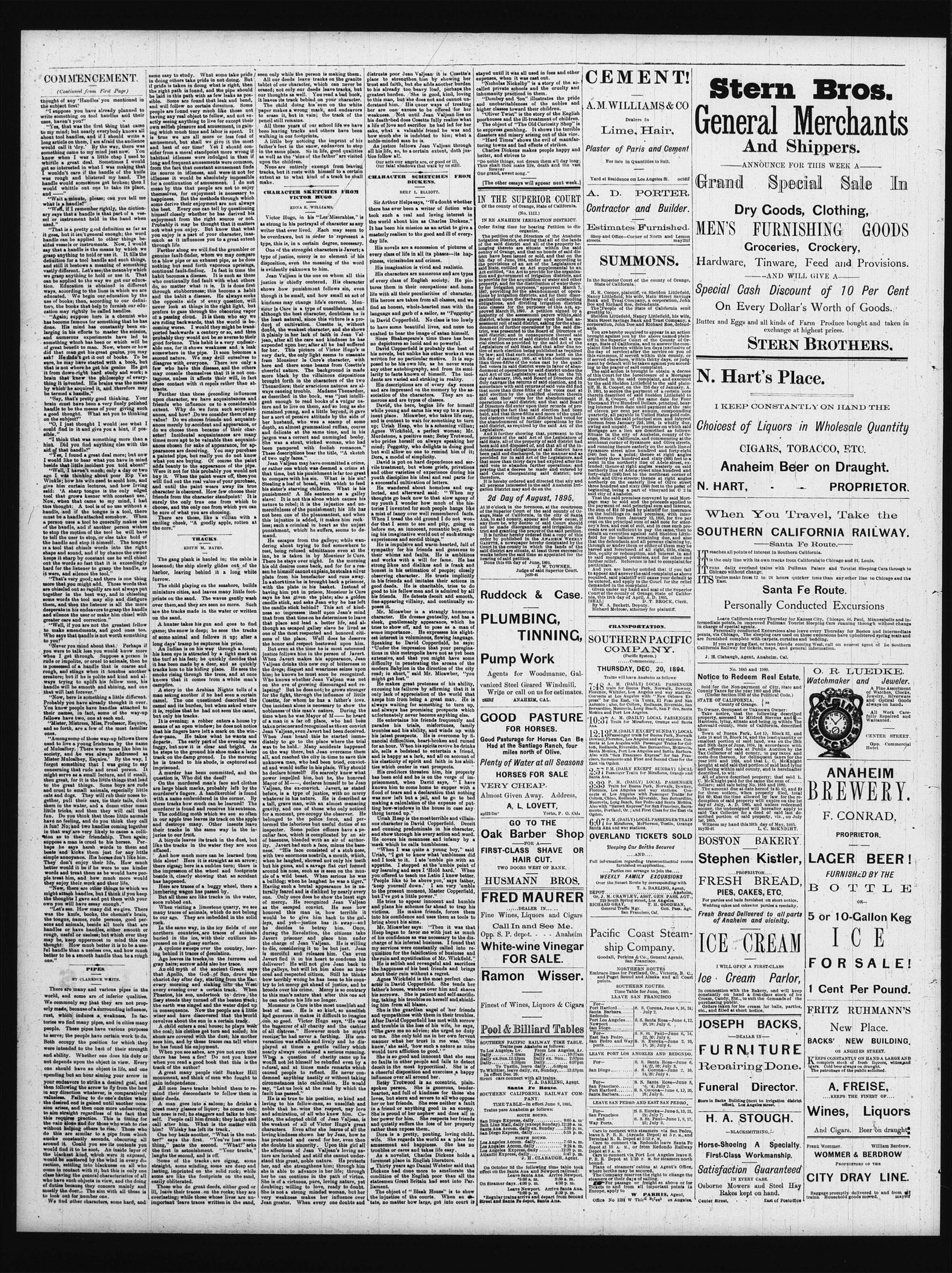
Searchable text
COMMENCEMENT.
(Continued from First Page)
thought of any 'Handles' you mentioned in the subject first?
"I suppose you have already planned to write something on tool handles and their uses, haven't you?"
"Yes, that was the first thing that came to my mind; but nearly everybody knows all about tool handles, and if I should write a long article on them, I am afraid the audience would call it 'dry.' By the way, there was something came to my mind just now. You know when I was a little chap I used to whittle a great deal. Sometimes I would get so interested in what I was making that I wouldn't care if the handle of the knife was rough and blistered my hand. The handle would sometimes get broken; then I would whittle out one to take its place, and —"
"Wait a minute, please; can you tell me what is a handle?"
"Well, if I remember rightly, the dictionary says that a handle is that part of a vessel or instrument held in the hand when used."
"That is a pretty good definition as far as it goes, but it isn't general enough; the word handle can be applied to other things besides vessels or instruments. Now, I would say that a handle is the means by which we grasp anything to hold or use it. That can be applied to the way we get our education. Education is obtained in different ways, according to the lines in which we are educated. We begin our education by the use of books; then, according to our definition, the books that help to furnish our education may rightly be called handles."
"Again; suppose here is a chemist who has become famous for something that he has done. His mind has constantly been enlarging in his efforts to master the science, and numerous experiments have led to something which has been or which will be of great benefit to man. Now, where or how did that man get his great genius, you may ask? He didn't get it out of books. To be sure, he may have started with a book, but that is not where he got his genius. He got it from down-right hard study and work; a brain that knew the philosophy of everything it invented. His brains was the means by which he acquired it, and therefore may be termed a handle."
"Say, that's pretty good thinking. Your brain must have been a very finely polished handle to be the means of your giving such a good thought. What set you to thinking on the subject?"
"O, I just thought I would see what I could find in it and give you a hint, if possible."
"I think that was something more than a hint. Did you find anything else with the aid of that handle?"
"Yes, I found a great deal more; but now I would like to hear what you have in mind beside that little incident you told about?"
"Well, I haven’t much; only a day or two some easy to study. What some take pride in doing others take pride in not doing. But if pride is taken in doing what is right, then the right path is found, and the pipe should be laid in this path with as few leaks as possible. Some are found that leak and bend, and will follow no certain direction. Some people are found very much like those not having any real object to follow, and not exactly seeing anything to live for except their own selfish pleasure and amusement, in gaining which much time and labor is spent. It is true we are all more or less fond of amusement, but shall we give it the most and best of our time? Yet I should consider from a moral standpoint more wrong if habitual idleness were indulged in than if long and frequent amusements were common, from the fact that constant amusement finds its source in idleness, and were it not for idleness it would be absolutely impossible for a continuation of amusement. I do not mean by this that people are not to enjoy themselves, for enjoyment is necessary to happiness. But the methods through which some derive their enjoyment are not always the best. Every one can tell by questioning himself closely whether he has derived his enjoyment from the right source or not. Probably it may be thought that it matters not what you enjoy. But know that what you enjoy is a part of your character, insults as it influences you to a great extent through life.
Farther along we will find the grumbler or genuine fault-finder, whom we may compare to a blow pipe or an exhaust pipe, as he does nothing but send forth vaporous uprisings, continual fault-finding. In fact in time the habit becomes a disease. It is such as these who continually find fault with what others do, no matter what it is. It is done first through stubbornness; this become a habit and the habit a disease. He always seeks the opposite side of every question, will never look at things in the right light, but prefers to gaze through the obscuring vapor of a passing cloud. It is them who say we are riding backwards, that the world is becoming worse. I would they might be transported backwards a century or so, and then probably they would not be so averse to their good fortune. This habit is a very undesirable one, for it shows weakness and a leak somewhere in the pipe. It soon becomes a second nature. We may drill ourselves to disagree with everyone. There are only a few who have this disease, and the others may console themselves that it is not contagious, unless it affects their will, in fact close contact with it repels rather than attracts.
Further than these preceding influences upon character, we have acquaintances and friends who influence us to a considerable extent. Why do we form such acquaintances, and how? Do we consider them of any value? Do we choose friends and acquaintances merely by accident and appearance, or do we choose them because of their character? Incidental acquaintances are many times more apt to be valuable than acquaintances chosen for sake of appearance, for appearances are deceiving. You may purchase a painted pipe, but really you do not know what you are buying. Of course the paint adds beauty to the appearance of the pipe. Were it not for this probably you would not seen only while the person is making them.
All our deeds leave tracks on the grand tablet of our character, which can never erase; not only our deeds leave tracks, but our thoughts as well. You read a bad book it leaves its track behind on your character.
The child doing his sum on the white paper makes a wrong mark, and endeavors to erase it, but in vain; the track of O pencil still remains.
All these years of our school life we have been leaving tracks and others have been walking in our footprints.
A little boy noticing the imprint of father’s feet in the snow, endeavors to sit in the same place. So in life, good quality as well as the "sins of the father" are visible upon the children.
None are entirely exempt from leave tracks, but it rests with himself to a certain extent as to what kind of a track he make.
CHARACTER SKETCHES FROM VICTOR HUGO.
EDNA E. WILLIAMS.
Victor Hugo, in his "Les Miserables," as strong in his portrayal of character as writer that ever lived. Each may seem be overdrawn, but in order to represent type, this is, in a certain degree, necessary.
One of the strongest characters is Javier type of justice, mercy is no element of disposition, even the meaning of the word is evidently unknown to him.
Jean Valjean is the one on whom all justice is chiefly centered. His charisma shows how punishment follows sin, though it be small, and how small an act kindness may change life's current.
Misieur le Cure is a type of unselfishness, although the best character, doubtless he least natural, since this virtue is a product of cultivation. Cosette is, with doubt, the weakest character, and she shakes it plainly in her lack of faith in Jean le Cure after all the care and kindness he expended upon her; after all he had suffered for her.
This picture of Victor Hugo very dark, the only light seems to emote from Monsieur le Cure's character, here and there some beams from Cosette cheerful nature. The background is more black by the villainous disposition brought forth in the characters of Thenardiers; their avaricious natures are ways causing trouble. Madame Thenardier as described in the book was "just intent gent enough to read books of vulgarity and to live on them, and so long as remained young, and a little beyond it her a sort of pensive attitude by the aid her husband, who was a scamp of a depth, an almost grammatical ruffian, coarse and delicate at the same time, and in jargon was a correct and unmingled book She was a stout, wicked woman who been pampered with foolish romance These descriptions bear the title, "A skirt of two ugly faces."
Jean Valjean may have committed a crime or rather one which was deemed a crime that time, but his punishment is far too
"Say, that’s pretty good thinking. Your brain must have been a very finely polished handle to be the means of your giving such a good thought. What set you thinking on the subject?"
"Q, I just thought I would see what I could find in it and give you a hint, if possible."
"I think that something more than a hint. Did you find anything else with the aid of that handle?"
"Yes, I found a great deal more; but now I would like to hear what you have in mind beside that little incident you told about?"
"Well, I haven’t much; only a day or two ago I was thinking about poor Rip Van Winkle; how his wife used to soil him, and give him curtain lectures, and how Irving said: ‘A sharp tongue is the only edged tool that grows keener with constant use.’ Now, when that came to my mind, I had this thought: A tool is of no use without a handle, and if the tongue is a tool, there must be a handle attached somehow. When a person uses a tool he generally makes use of the handle, and if another person wishes to stop the motion of the tool he will have to tell the user to stop, or else take hold of the handle and stop it himself. The tongue is a tool that chisels words into the right shape and sound, and if by chance the owner keeps it sharp by constant use he will chisel the words so fast that it is exceedingly hard for the listener to grasp the handle, as it were, and silence the tool."
"That’s very good; and there is one thing more that you might add. Those words that are chiselled out so rapidly are not always put together in the best way, and in chiseling some words the tool may slip and disfigure them, and then the listener is all the more desperate in his endeavors to grasp the handle and silence the user or make him chisel with greater care and correction."
"Well, if you are not the greatest fellow to make amendments, and good ones too. Who says that handle is not worth something to you?"
"Never you mind about that. Perhaps if you were to talk less you would know more when I get through. Suppose a person is rude or impolite, or cruel to animals, then he is possessed of a handle that is coarse and rough, and stings when it touches another creature; but if he is polite and kind and always trying to uplift his fellow men, his handle will be smooth and shining, and one that will last forever."
"Now, here is something a little different. Probably you have already thought it over. You know people have handles attached to their names, in fact, some of the way-up fellows have two, one at each end."
"Mister, Mistress, Miss, Professor Esquire, and so forth, are a few of the most familiar ones."
"Among some of those way-up fellows there used to live a young Irishman by the name of Mulcalhey. There were ‘none like him in society,’ and he was always addressed as Mister Mulcalhey, Esquire. By the way, I forgot something that I was going to say concerning that rude and cruel person. It might serve as a small lecture, and if small, then great, for it is the little things that lead to the great things. Some boys are rude and cruel to small animals, especially little cats and dogs. They will rub their noses together, pull their ears, tie their tails, duck them in the water, and a dozen other mean little tricks, and then they will call that fun. Do you think that those little animals have no feeling, and do you think they call it fun? No; two handles coming together in that way are very likely to cause a collision as to their friendship. Then again; suppose a man is cruel to his horses. Perhaps he says harsh words to them and beats and kicks them just for any little simple annoyance. His horaces don’t like him. They don’t enjoy their life. How much better would it be if he were to use kinder words and treat them as he would have people treat him, and how much more would they enjoy their work and their life."
"New, there are other things to which we might attach handles, but I think if you keep the thoughts I gave and not them with your brain that knew the philosophy of everything it invented. His brains was the means by which he acquired it, and therefore may be termed a handle."
"Say, that’s pretty good thinking. Your brain must have been a very finely polished handle to be the means of your giving such a good thought. What set you thinking on the subject?"
"Q, I just thought I would see what I could find in it and give you a hint, if possible."
"I think that something more than a hint. Did you find anything else with the aid of that handle?"
"Yes, I found a great deal more; but now I would like to hear what you have in mind beside that little incident you told about?"
"Well, I haven’t much; only a day or two ago I was thinking about poor Rip Van Winkle; how his wife used to soil him, and give him curtain lectures, and how Irving said: ‘A sharp tongue is the only edged tool that grows keener with constant use.’ Now, when that came to my mind, I had this thought: A tool is of no use without a handle, and if the tongue is a tool, there must be a handle attached somehow. When a person uses a tool he generally makes use of the handle, and if another person wishes to stop the motion of the tool he will have to tell the user to stop, or else take hold of the handle and stop it himself. The tongue is a tool that chisels words into the right shape and sound, and if by chance the owner keeps it sharp by constant use he will chisel the words so fast that it is exceedingly hard for the listener to grasp the handle, as it were, and silence the tool."
"That's very good; and there is one thing more that you might add. Those words that are chiselled out so rapidly are not always put together in the best way, and in chiseling some words the tool may slip and disfigure them, and then the listener is all the more desperate in his endeavors to grasp the handle and silence the user or make him chisel with greater care and correction."
"Well, if you are not the greatest fellow to make amendments, and good ones too. Who says that handle is not worth something to you?"
"Never you mind about that. Perhaps if you were to talk less you would know more when I get through. Suppose a person is rude or impolite, or cruel to animals, then he is possessed of a handle that is coarse and rough, and stings when it touches another creature; but if he is polite and kind and always trying to uplift his fellow men, his handle will be smooth and shining, and one that will last forever."
"Now here is something a little different. Probably you have already thought it over. You know people have handles attached to their names, in fact, some of the way-up fellows have two, one at each end."
"Mister, Mistress, Miss, Professor Esquire, and so forth, are a few of the most familiar ones."
"Among some of those way-up fellows there used to live a young Irishman by the name of Mulcalhey. There were ‘none like him in society,’ and he was always addressed as Mister Mulcalhey, Esquire. By the way, I forgot something that I was going to say concerning that rude and cruel person. It might serve as a small lecture, and if small, then great, for it is the little things that lead to the great things. Some boys are rude and cruel to small animals, especially little cats和dogs. They will rub their noses together, pull their ears,tie their tails,duck them in the water,and a dozen other mean little tricks,and then they will call that fun. Do you think that those little animals have no feeling,and do you think they call it fun? No; two handles coming together in that way are very likely to cause a collision as to their friendship. Then again; suppose a man is cruel to his horses. Perhaps he says harsh words to them和beats和kicks them just for any little simple annoyance. His horaces don’t like him. They don’t enjoy their life. How much better would it be if he were to use kinder words和treat them as he would have people treat him,and how much more would they enjoy their work和their life."
"New,there are other things to which we might attach handles,但I think if you keep the thoughts I gave和not them with your brain that knew the philosophy of everything it invented.His brains was the means by which he influence us to a considerable extent. Why do we form such acquaintances,and how?Do we consider them of any value?Do we choose friends和acquaintances merely by accident和appearance,或do we choose them because of their character?Incidental acquaintances are many times more apt to be valuable than acquaintances chosen for sake of appearance,for appearances are deceiving。You may purchase a painted pipe,但 really you do not know what you are buying.Of course the paint adds beauty to the appearance of the pipe.Were it not for this probably you would not buy it。When the paint wears off,then you will find out the real value of your purchase,and until the paint wears away its true character is obscured.How few choose their friends from the character standpoint!It is surely the only true one from which to choose,and the only one from which you can be sure of what you are choosing。
A hunter takes his gun and goes to find game;the snow is deep;he sees the tracks of some animal and follows it up;after a long days’ tramp he captures his prize.
An Indian on his way through forest;his keen eye is attracted by a light mark on the turf at his feet;he quickly decides that it has been made by a deer,and as quickly tracks him to his hiding place。他 sees the smoke rising through the trees,and at once knows that it comes from a white man’s campfire。
A story in the Arabian Nights tells of a man asking another if he had seen a certain camel.The one questioned described the camel and its burden,但 when asked where it is,replies that he had not seen the camel,但 only his tracks。
It is evening;a robber enters a house by means of an open window;he does not notice that his fingers have left a mark on the window-pane。他 takes what he wants and departs.The early part of the evening was foggy,但 now it is clear and bright.As he steps to the ground his shoe make a large track on the damp ground.In the morning he is traced to his abode,是 captured and imprisoned。
A murder has been committed,和the question is,Who did she deed?
On the murdered man’s face and clothes are large black marks,probably left by the murderer’s fingers.A handkerchief is found with a name embroidered in the corner.By these tracks how much can be learned?The murderer is found and receives his sentence。
The coddling moth which we see often in our apple tree leaves its track on the apple and destroys many.Other insects leave their tracks in the same way in the injuries to our fruit。
A bicycle leaves its track in the dust,但 like the tracks in the water are soon effaced。
And how much more can be learned from this alone? Here it is straight as an arrow;there zigzag;here is a sudden turn;there is the impression of the wheel and footprints beside it,clearly showing that an accident has happened。
Here are traces of a buggy wheel,there a lumbering wagon has passed by。
But all these are like tracks in the water,
maybe complicated by air or autumn.Javelin has consisted of a stub with two enormous nostrils,a mouth,when he laughed,showed not only his big but his gums,and a savage flat curl for around his nose,such as is seen on the zile of a wild beast。When serious heat has caused him pain,he laughed with such a brutal appearance he is tursely feared by nearly one.
Only once does he show least
gether, pull their ears, duck them in the water, and then they will call that fun. Do you think that those little animals have no feeling, and do you think they call it fun? No; and two handles coming together in that way are very likely to cause a collision as to their friendship. Then again; suppose a man is cruel to his horses. Perhaps he says harsh words to them and beats and kicks them just for any little simple annoyance. His horses don't like him. They don't enjoy their life. How much better would it be if he were to use kinder words and treat them as he would have people treat him, and how much more would they enjoy their work and their life.
"Now, there are other things to which we might attach handles, but I think if you keep the thoughts I gave and put them with your own you will have essay enough."
"Let's see. How many did we give. There was the knife, books, the chemist's brain, the tongue, names, rude persons, good persons and animals, beside all tools that are handles or have handles, either smooth or rough, useful or useless; but which ever they may be, keep uppermost in mind this one thought: How much better it is to be a useful handle than a useless one, and how much better to be a smooth handle than be a rough one."
PIPES.
BY CLARENCE WRITE.
There are many and various pipes in the world, and some are of inferior qualities. We commonly say that they are not properly made, because of a surrounding influence, rust, which induces a weakness. In factories we find many pipes, and in cities many people. These pipes have various purposes to serve; the people have certain work to do. Both occupy the position for which they were intended to the best of their strength and ability. Whether one does his duty or not depends upon the object in view. Every one should have an object in life, and one spending but an hour aiming your arrow in your endeavors to strike a desired goal, and then following the arrow to fly from the bow in any direction whatever, is comparatively valueless. Failing to do one's duties when the desired end is gained until another occasion arises, and then once more endeavoring to aim straight regardless of the fact that this requires practice. This is fitting for the vain alone and for those who wish to rise without helping others to rise. Those who do this are similar to a pipe from which smoke constantly ascends, obscuring all around it. Could you see its contents you would find it to be soot. An inside layer of the blackest kind, which were it exposed, would be scattered by the wind in every direction, settling into blackness on all who come in contact with it; but this is only one class having the general characteristics of all who have such objects in view, and the doing of duties because they concern mainly and mostly the doer. The aim with all these is to look out for number one.
We find other characters, some hard, and with a name embroidered in the corner. By these tracks how much can be learned? The murderer is found and receives his sentence.
The coddling moth which we see so often in our apple tree leaves its track on the apple and destroys many. Other insects leave their tracks in the same way in the injuries to our fruit.
A bicycle leaves its track in the dust, but like the tracks in the water they are soon effaced.
And how much more can be learned from this alone? Here it is straight as an arrow; there zigzag; here is a sudden turn; there is the impression of the wheel and footprints beside it, clearly showing that an accident has happened.
Here are traces of a buggy wheel, there a lumbering wagon has passed by.
But all these are like tracks in the water, soon rubbed out.
When visiting a limestone quarry, we see many traces of animals, which do not belong to our age. They are imbedded in the solid rock.
In the same way, in the ice fields of our northern countries, are traces of animals buried in the ice, with their outlines impressed on its glossy surface.
A cyclone sweeps over the country, leaving behind it traces of desolation.
Age leaves its tracks in the turrows and gray hairs; sorrow adds also her trace.
An old myth of the ancient Greek says that Apollo, the God of Sun, drove the chariot day after day, starting from the East every morning and sinking into the West every evening over a certain track. When Phaeton, his son, undertook to drive the fiery steeds they turned off the beaten track; the earth was singed and the water dried up in consequence. Now the people are a little wiser and have discovered that the world revolves about the sun in a certain track.
A child enters a coal house; he plays with the coal; his clothes get torn and soiled; his shoes are covered with the dust; his mother sees him, and by these traces can tell where he has found his enjoyment.
When you see ashes, are you not sure that there has been a fire? Do not you know when you read a good book that this is the track of the author?
A great many people visit Bunker Hill monument, and think of men who fought to gain independence.
All men leave tracks behind them to remind their descendants to follow them in their deeds.
A man goes into a saloon; he drinks a great many glasses of liquor; he comes out; his nose is red; he staggers and talks to himself. People call him drunk; they laugh and call after him. What is the matter with him? Whisky has left its track.
One boy hails another. "What is the matter?" says the first. "You've lost something," pants the second. "What?" asks the first in astonishment. "Your tracks," laughes the second, and is off.
Some of the tracks are zigzag, some straight, some winding, some are deep and lasting, imprinted on the solid rock; while some are like the footprints on the sand, easily obliterated.
Those who do great deeds, either good or ill, leave their traces on the rocks; they are everlasting; while those whose lives are unimportant leave traces written in the sand,
whatever in his nature. He is described as a tall grave man with an almost mean gravity, and one of those who only now for a moment preoccupy the observer.
belonged to the police force, and formed the laborious but useful duties of an insurer face, which is complicated by an oasis of baseness, blended with an air of authority. Jawert had such a face, minus the eyes. "His face consisted of a stub but with two enormous nostrils, a mouth, when he laughed, showed not only his teeth but his gums, and a savage flat curl for around his nose, such as is seen on the zile of a wild beast. When serious he bulldog; when he laughed he was a tiger. Having such a brutal appearance he is turtally feared and is disliked by nearly one.
Only once does he show the least of mercy. He recognized Jean Valjean as the escaped convict. He sees him honored this man is, how terrible would be to give him back to these leys, and yet—justice has it away—he decides to betray him.
During the Revelation, the citizens of Javier prisoner and place him under the charge of Jean Valjean. He is wise to die, considering it to be but just.
is merciful and releases him. Can Javier find it in his heart to condemn deliverer? He will not give Jean back to the galleys, but will let him alone and ordered and respected citizen. Still he thou how terribly wrong he has been to his try to let mercy get ahead of justice, and broods over his crime. Mercy is so countenance this man's nature that after this one he can endure his life no longer.
Monsieur I Cure is the most unselfish best of men. He is so kind, so unseemless and generous it makes difficult to imagine one so good. Victor Hugo says, "He has treasurer of all charity and the case of all distress." However much he receive he had never farthing. His versation was awful and lively and he played at times a gentle raillery well nearly always contained a serious meaning. When a question of charity came up would not let himself be rebuffed even refusal, and at times made remarks caused people to reflect. He never demned anything hastily or without taking circumstances into calculation. He wry say, "Let us look at the road by which fault has passed."
He is so true to his position, so kind loving to his fellow-men, so unselfish noble that he wins the respect, nay admiration of all who knew him.
sette, the adopted child of Jean Valjean,the weakest of all of Victor Hugo's girls.
Even after she learns of all loving kindness shown her by Jean,how has protected and cared for her even she doubts his sincerity. Upon this girlthe affections of Jean Valjean's loving ture are lavished still she cannot understand this great,noble nature.Here protect her,and she strengthens him;through she is able to advance in her life;thru her he can continue in the path of virgin She is of a virtuous,pure,Loving nature,doubtting;willing to love,ready to do She is not a strong minded woman,but very weakness makes her influence Jean greater. When every one doubts
While the person is making them, their deeds leave tracks on the granite of our character, which can never be not only our deeds leave tracks, but rights as well. You read a bad book, its track behind on your character, build doing his sum on the white makes a wrong mark, and endeavors it, but in vain; the track of the will remains.
These years of our school life we have being tracks and others have been in our footprints.
The boy noticing the imprint of his street in the snow, endeavors to step some place. So in life, good qualities are the "sins of the father" are visited children.
Are entirely exempt from leaving it rests with himself to a certain is to what kind of a track he shall
CHARACTER SKETCHES FROM VICTOR HUGO.
EDNA E. WILLIAMS.
Hugo, in his "Les Miserables," is in his portrayal of character as any that ever lived. Each may seem to be drawn, but in order to represent this is, in a certain degree, necessary. Of the strongest characters is Javert; a justice, mercy is no element of his reason, even the meaning of the word truly unknown to him.
Valjean is the one on whom all this chiefly centered. His character show punishment follows sin, even it be small, and how small an act of may change life's current. Mon-Cure is a type of unselfishness, and the best character, doubtless he is natural, since this vitre is a proof of cultivation. Cosette is, without the weakest character, and she shows in her lack of faith in Jean Valjean all the care and kindness he has had upon her; after all he had suffered This picture of Victor Hugo's is dark, the only light seems to emulate Monieur le Cure's character, with there some bane from Cosette's nature. The background is made black by the villainous dispositions forth in the characters of the two sisters; their avaricious natures are allying trouble. Madame Thenardier, described in the book, was "just intelli- enough to read books of a vulgar na- tion; their avaricious natures are allying trouble. Madame Thenardier, described in the book, was "just intelli- enough to read books of a vulgar na- tion; their avaricious natures are allying trouble. Madame Thenardier, described in the book, was "just intelli- enough to read books of a vulgar na- tion; their avaricious natures are allying trouble. Madame Thenardier, described in the book, was "just intelli- enough to read books of a vulgar na- tion; their avaricious natures are allying trouble. Madame Thenardier, described in the book, was "just intelli- enough to read books of a vulgar na- tion; their avaricious natures are allying trouble. Madame Thenardier, described in the book, was "just intelli- enough to read books of a vulgar na- tion; their avaricious natures are allying trouble. Madame Thenardier, described in the book, was "just intelli- enough to read books of a vulgar na- tion; their avaricious natures are allying trouble. Madame Thenardier, described in the book, was "just intelli- enough to read books of a vulgar na- tion; their avaricious natures are allying trouble. Madame Thenardier, described in the book, was "just intelli- enough to read books of a vulgar na- tion; their avaricious natures are allying trouble. Madame Thenardier, described in the book, was "just intelli- enough to read books of a vulgar na- tion; their avaricious natures are allying trouble. Madame Thenardier, described in the book, was "just intelli- enough to read books of a vulgar na- tion; their avaricious natures are allying trouble. Madame Thenardier, described in the book, was "just intelli- enough to read books of a vulgar na- tion; their avaricious natures are allying trouble. Madame Thenardier, described in the book, was "just intelli- enough to read books of a vulgar na- tion; their avaricious natures are allying trouble. Madame Thenardier, described in the book, was "just intelli- enough to read books of a vulgar na- tion; their avaricious natures are allying trouble. Madame Thenardier, described in the book, was "just intelli- enough to read books of a vulgar na- tion; their avaricious natures are allying trouble. Madame Thenardier, described in the book, was "just intelli- enough to read books of a vulgar na- tion; their avaricious natures are allying trouble. Madame Thenardier, described in the book, was "just intelli- enough to read books of a vulgar na- tion; their avaricious natures are allying trouble. Madame Thenardier, described in the book, was "just intelli- enough to read books of a vulgar na- tion; their avaricious natures are allying trouble. Madame Thenardier, described in the book, was "just intelli- enough to read books of a vulgar na- tion; their avaricious natures are allying trouble. Madame Thenardier, described in the book, was "just intelli- enough to read books of a vulgar na- tion; their avaricious natures are allying trouble. Madame Thenardier, described in the book, was "just intelli- enough to read books of a vulgar na- tion; their avaricious natures are allying trouble. Madame Thenardier, described in the book, was "just intelli- enough to read books of a vulgar na- tion; their avaricious natures are allying trouble. Madame Thenardier, described in the book, was "just intelli- enough to read books of a vulgar na- tion; their avaricious natures are allying trouble. Madame Thenardier, described in the book, was "just intelli- enough to read books of a vulgar na- tion; their avaricious natures are allying trouble. Madame Thenardier, described in the book, was "just intelli- enough to read books of a vulgar na- tion; their avarious natures are allying trouble. Madame Thenardier, described in the book, was "just intelli- enough to read books of a vulgar na- tion; their avarious natures are allying trouble. Madame Thenardier, described in the book, was "just intelli- enough to read books of a vulgar na- tion; their avarious natures are allying trouble. Madame Thenardier, described in the book, was "just intelli- enough to read books of a vulgar na- tion; their avarious natures are allying trouble. Madame Thenardier, described in the book, was "just intelli- enough to read books of a vulgar na- tion; their avarious natures are allying trouble. Madame Thenardier, described in the book, was "just intelli- enough to read books of a vulgar na- tion; their avarious natures are allying trouble. Madame Thenardier, described in the book, was "just intelli- enough to read books of a vulgar na- tion; their avarious natures are allying trouble. Madame Thenardier, described in the book, was "just intelli- enough to read books of a vulgar na- tion; their avarious natures are allying trouble. Madame Thenardier, described in the book, was "just intelli- enough to read books of a vulgar na- tion; their avarious natures are allying trouble. Madame Thenardier, described in the book, was "just intelli- enough to read books of a vulgar na- tion; their avarious natures are allying trouble. Madame Thenardier, described in the book, was "just inteli- enough to read books of a vulgar na- tion; their avarious natures are alying trouble. Madame Thenardier, described in the book, was "just inteli- enough to read books of a vulgar na- tion; their avarious natures are alying trouble. Madame Thenardier, described in the book, was "just inteli- enough to read books of a vulgar na- tion; their avarious natures are alying trouble. Madame Thenardier, described in the book, was "just inteli- enough to read books of a vulgar na- tion; their avarious natures are alying trouble. Madame Thenardier, described in the book, was "just inteli- enough to read books of a vulgar na- tion; they avarious natures are alying trouble. Madame Thenardier, described in the book, was "just inteli- enough to read books of a vulgar na- tion; they avarious natures are alying trouble. Madame Thenardier, described in the book, was "just inteli- enough to read books of a vulgar na- tion; they avarious natures are alying trouble. Madame Thenardier, described in the book, was "just inteli- enough to read books of a vulgar na- tion; they avarious natures are alying trouble. Madame Thenardier,described in the book,was “just inteli- enough to read books of a vulgar na-tion;they avarious natures are aliying troubled;they avarious natures are aliying troubled;they avarious natures are aliying troubled;they avarious natures are aliying troubled;they avarious natures are aliying troubled;they avarious natures are aliying troubled;they avarious natures are aliying troubled;they avarious natures are aliying troubled;they avarious natures are aliying troubled;they avarious nature s is so difficult that it cannot be handled properly.”
This picture of Victor Hugo’s is dark: the only light seems to emulate Monieur le Cure’s character with there some bane from Cosette’s nature. The background is made black by the villainous dispositions forth in the characters of the two sisters; their avaricious natures are alarming trouble. Madame Thenardier,described in the book,was “just intelli-lough enough to读书籍ofvulgar name and live on them,and long as she had young,and little beyond,它 gave portentive attitude bythe side of husband,who wasa scampofsome almost grammatical ruffian,course situate atthe same time,andin hiswasa correct and unmingled booby,asa stout,wicked woman,who had camparedwith foolish romances.” descriptions bearthe title,“A sketch ugly faces.”
Vuljean may have committeda crime,for onewhich seemeda crime at once,但his punishmentis far too great
SUMMONS
Inthe Superior Courtofthe countyofStateofCalifornia.
H.R.Cooper,plaintiffvs.SheldonLiancyLittlefield,his wife,Main StreetBankandTrustCompany,a corporationDoddandRichardRoe,dewnthePeopleoftheStateOfCaliforniagreetingtoSheldonLittlefield,NancyLittlefield,his wife,Main StreetBankandTrustCompany,a corporationDoddandRichardRoe,dewnthePeopleoftheStateOfCaliforniagreetingtoSheldonLittlefield,NancyLittlefield,his wife,Main StreetBankandTrustCompany,a corporationDoddandRichardRoe,dewnthePeopleoftheStateOfCaliforniagreetingtoSheldonLittlefield,NancyLittlefield,his wife,Main StreetBankandTrustCompany,a corporationDoddandRichardRoe,dewnthePeopleoftheStateOfCaliforniagreetingtoSheldonLittlefield,NancyLittlefield,his wife,Main StreetBankandTrustCompany,a corporationDoddandRichardRoe,dewnthePeopleoftheStateOfCaliforniagreetingtoSheldonLittlefield,NancyLittlefield,his wife,Main StreetBankandTrustCompany,a corporationDoddandRichardRoe,dewnthePeopleoftheStateOfCaliforniagreetingtoSheldonLittlefield,NancyLittlefield,his wife,Main StreetBankandTrustCompany,a corporationDoddandRichardRoe,dewnthePeopleoftheStateOfCaliforniagreetingtoSheldonLittlefield,NancyLittlefield,his wife,Main StreetBankandTrustCompany,a corporationDoddandRichardRoe,dewnthePeopleoftheStateOfCaliforniagreetingtoSheldonLittlefield,NancyLittlefield,his wife,Main StreetBankandTrustCompany,a corporationDoddandRichardRoe,dewnthePeopleoftheStateOfCaliforniagreetingtoSheldonLittlefield,NancyLittlefield,his wife,Main StreetBankandTrustCompany,a corporationDoddandRichardRoe,dewnthePeopleoftheStateOfCaliforniagreetingtoSheldonLittlefield,NancyLittlefield,his wife,Main StreetBankandTrustCompany,a corporationDoddandRichardRoe,dewnthePeopleoftheStateOfCaliforniagreetingtoSheldonLittlefield,NancyLittlefield,his wife,Main StreetBankandTrustCompany,a corporationDoddandRichardRoe,dewnthePeopleoftheStateOfCaliforniagreetingtoSheldonLittlefield,NancyLittlefield,his wife,Main StreetBankandTrustCompany,a corporationDoddandRichardRoe,dewnthePeopleoftheStateOfCaliforniagreetingtoSheldonLittlefield,NancyLittlefield,his wife,Main StreetBankandTrustCompany,a corporationDoddandRichardRoe,dewnthePeopleoftheStateOfCaliforniagreetingtoSheldonLittlefield,NancyLittlefield,his wife,Main StreetBankandTrustCompany,a corporationDoddandRichardRoe,dewnthePeopleoftheStateOfCaliforniagreetingtoSheldonLittlefield,NancyLittlefield,his wife,Main StreetBankandTrustCompany,a corporationDoddandRichardRoe,dewnthePeopleoftheStateOfCaliforniagreetingtoSheldonLittlefield,NancyLittlefield,his wife,Main StreetBankandTrustCompany,a corporationDoddandRichardRoe,dewnthePeopleoftheStateOfCaliforniagreetingtoSheldonLittlefield,NancyLittlefield,his wife,Main StreetBank和TrustCompany,a corporationDoddandRichardRoe,dewnthePeopleoftheStateOfCaliforniagreetingtoSheldonLittlefield,NancyLittlefield,his wife,Main StreetBank和TrustCompany,a corporationDoddandRichardRoe,dewnthePeopleoftheStateOfCaliforniagreetingtoSheldonLittlefield,NancyLittlefield,his wife,Main Street Bank和TrustCompany,a corporationDoddandRichardRoe,dewnthePeopleoftheStateOfCaliforniagreetingtoSheldonLittlefield,NancyLittle field,his wife,Main Street Bank和TrustCompany,a corporationDoddandRichardRoe,dewnthePeopleoftheStateOfCaliforniagreetingtoSheldonLittlefield,NancyLittle field,his wife,Main Street Bank和TrustCompany,a corporationDoddandRichardRoe,dewnthePeopleoftheStateOfCaliforniagreetingtoSheldonLittlefield,NancyLittle field,his wife,Main Street Bank和TrustCompany,a corporationDoddandRichardRoe,dewnthePeopleoftheStateOfCaliforniagreetingtoSheldonLittlefield,Nancy Litle field,his wife,Main Street Bank和TrustCompany,a corporationDoddandRichardRoe,dewnthePeopleoftheStateOfCaliforniagreetingtoSheldonLitle field,his wife,Main Street Bank和TrustCompany,a corporationDoddandRichardRoe,dewnthePeopleoftheStateOfCaliforniagreetingtoSheldonLitle field,his wife,Main Street Bank和TrustCompany,a corporationDoddandRichardRoe,dewnthePeopleoftheStateOfCaliforniagreetingtoSheldonLitle field,his wife,Main Street Bank和TrustCompany,a corporationDoddandRichARD Roe,downthePeopleoftheStateOfCaliforniagreetingtoSheldonLitle field,his wife,Main Street Bank和TrustCompany,a corporationDoddandRichARD Roe,downthe PeopleoftheStateOfCaliforniagreetingtoSheldonLitle field,his wife,Main Street Bank和TrustCompany,a corporationDoddandRichARD Roe,downthe Peopleofthe StateOfCaliforniagreetingtoSheldonLitle field,his wife,Main Street Bank和TrustCompany,a corporationDoddandRichARD Roe,downthe Peopleofthe StateOfCaliforniagreetingtoSheldonLitle field,his wife,Main Street Bank和TrustCompany,a corporationDoddandRichARD Roe,downthe Peopleofthe StateOfCaliforniagreetingto SheldonLitle field,his wife,Main Street Bank和TrustCompany,a corporationDoddandRichARD Roe,downthe Peopleofthe StateOfCaliforniagreetingto SheldonLitle field,his wife,Main Street Bank和TrustCompany,a corporationDoddandRichARD Roe,downthe Peopleofthe StateOfCaliforniagreetingto SheldonLitle field,his wife,Main Street Bank和TrustCompany,a corporationDoddandRichARD Roe,downthe Peopleofthe StateOfCaliforniagreetingto SheldonLitle field,his wife,Main Street Bank和TrustCompany,a corporationDoddandRichARD Roe,downthe Peopleofthe StateOfCaliforniagreetingto SheldonLitle field,his wife,Main Street Bank和TrustCompany,a corporationDoddandRichARD Roe,downthe Peopleofthe StateOfCaliforniagreetingto SheldonLtitle field,his wife,Main Street Bank和TrustCompany,a corporationDoddandRichARD Roe,downthe Peopleofthe StateOfCaliforniagreetingto SheLDON,Litle field,his wife,Main Street Bank和TrustCompany,a corporationDDDAND,RHOE,DOWNTHE,PLEASURE,GREATING IN THE LAST DAY OF JANUARY,BEST OF THE PRESENCE OF A MODELL FOR THE PREOSECTION OF A MODELL FOR THE PREOSECTION OF A MODELL FOR THE PREOSECTION OF A MODELL FOR THE PREOSECTION OF A MODELL FOR THE PREOSECTION OF A MODELL FOR THE PREOSECTION OF A MODELL FOR THE PREOSECTION OF A MODELL FOR THE PREOSECTION OF A MODELL FOR THE PREOSECTION OF A MODELL FOR THE PREOSECTION OF A MODELL FOR THE PREOSECTION OF A MODELL FOR THE PREOSECTION OF A MODELL FOR THE PREOSECTION OF A MODELL FOR THE PREOSECTION OF A MODELL FOR THE PREOSECTION OF A MODELL FOR THE PREOSECTION OF A MODELL FOR THE PREOSECTION OF A MODELL FOR THE PREOSECTION OF A MODELL FOR THE PREOSECTION OF A MODELL FOR THE PREOSECTION OF A MODELL FOR THE PREOSECTION OF A MODELL FOR THE PREOSECTION OF A MODELL FOR THE PREOSECTION OF A MODELL FOR THE PREOSECTION OF A MODELLFOR THE PREOSECTION OF A MODELLFOR THE PREOSECTIONOFA MODELLFORTHEPREOSECTIONOFAMODELLFORTHEPREOSECTIONOFAMODELLFORTHEPREOSECTIONOFAMODELLFORTHEPREOSECTIONOFAMODELLFORTHEPREOSECTIONOFAMODELLFORTHEPREOSECTIONOFAMODELLFORTHEPREOSECTIONOFAMODELLFORTHEPREOSECTIONOFAMODELLFORTHEPREOSECTIONOFAMODELLFORTHEPREOSECTIONOFAMODELLFORTHEPREOSECTIONOFAMODELLFORTHEPREOSECTIONOFAMODELLFORTHEPREOSECTIONOFAMODELLFORTHEPREOSECTIONOFAMODELLFORTHEPREOSECTIONOFAMODELLFORTHEPREOSECTIONOFAMODELLFORTHEPREOSECTIONOFAMODELLFORTHEPREOSECTIONOFAMODELLFORTHENEWORDEREDINTHEREAUTHORIZATIONDECREASEMENTINTHEREAUTHORIZATIONDECREASEMENTINTHEREAUTHORIZATIONDECREASEMENTINTHEREAUTHORIZATIONDECREASEMENTINTHEREAUTHORIZATIONDECREASEMENTINTHEREAUTHORIZATIONDECREASEMENTINTHEREAUTHORIZATIONDECREASEMENTINTHEREAUTHORIZATIONDECREASEMENTINTHEREAUTHORIZATIONDECREASEMENTINTHEREAUTHORIZATIONDECREASEMENTINTHEREAUTHORIZATIONDECREASEMENTINTHEREAUTHORIZATIONDECREASEMENTINTHEREAUTHORIZATIONDECREASEMENTINTHEREAUTHORIZATIONDECREASEMENTINTHEREAUTHORIZATIONDECREASEMENTINTHEREAUTHORIZATIONDECREASEMENTINTHEREAUTHORIZATIONDECREASEMENTINTHEREAUTHORIZATIONDECREASEMENTINTHEREAUTHORIZATIONDECREASEMENTINTHEREAUTHORIZATIONDECREASEMENTINTHEREAUTHORIZATIONDECREASEMENTINTHEREAUTHORIZATIONDECREASEMENTINTHEREAUTHORIZATIONDECREASEMENTINTHEREAUTHORIZATIONDECREASEMENTINTHEREAUTHORIZATIONDECREASEMENTINTHEREAUTHORIZATIONDECREASEMENTINTHEREAUTHORIZATIONDECREASEMENTINTHEREAUTHORIZATIONDECREASEMENTINTHEREAUTHORIZATIONDECREASEMENTINTHEREAUTHORIZATIONDECREASEMENTINTHEREAUTHORIZATIONDECREASEMENTINTHEREAUTHORIZATIONDECREASEMENTINTHEREAUTHORIZATIONDECREaseMESSAGEFROMTHEPERSONWHOMHEARTEDBYTHEPERSONWHOMHEARTEDBYTHEPERSONWHOMHEARTEDBYTHEPERSONWHOMHEARTEDBYTHEPERSONWHOMHEARTEDBYTHEPERSONWHOMHEARTEDBYTHEPERSONWHOMHEARTEDBYTHEPERSONWHOMHEARTEDBYTHEPERSONWHOMHEARTEDBYTHEPERSONWHOMHEARTEDBYTHEPERSONWHOMHEARTEDBYTHEPERSONWHOMHEARTEDBYTHEPERSONWHOMHEARTEDBYTHEPERSONWHOMHEARTEDBYTHEPERSONWHOMHEARTEDBYTHEPERSONWHOMHEARTEDBYTHEPERSONWHOMHEARTEDBYTHEPERSONWHOMHEARTEDBYTHEPERSONWHOMHEARTEDBYTHEPERSONWHOMHEARTEDBYTHEPERSONWHOMHEARTEDBYTHEPERSONWHOMHEARTEDBYTHEPERSONWHOMHEARTEDBYTHEPERSONWHOMHEARTEDBYTHEPERSONWHOMHEARTEDBYTHEPERSONWHOMHEARTEDBYTHEPERSONWHOMHEARTEDBYTHEPERSONWHOMHEARTEDBYTHEPERSONWHOMHEARTEDBYTHEPERSONWHOMHEARTEDBYTHEPERSONWHOMHEARTEDBYTHEPERSONWHOMHEARTEDBYTHEPERSONWHOMHEARTEDBYTHEPERSONWHOMHEARTEDBYTHEPERSONWHOMHEARTEDBYTHEPERSONWHOMHEARTEDBYTHEPERSONWHOMHEARTEDBYTHEPERSONWHOMHEARTEDBYTHEPERSONWHOMHEARTEDBYTHEPERSONWHOMHEARTEDBYTHEPERSONWHOMHEARTEDBYTHEPERSONWHOMHEARTEDBYTHEPERSONWHOMHEARTEDBYTHEPERSONWHOMHEARTEDBYTHE PERSON WHOMHEARTED BY THE PERSON WHOM HEARTED BY THE PERSON WHOM HEARTED BY THE PERSON WHOM HEARTED BY THE PERSON WHORM HEARTED BY THE PERSON WHORM HEARTED BY THE PERSON WHORM HEARTED BY THE PERSON WHORM HEARTED BY THE PERSON WHORM HEARTED BY THE PERSON WHORM HEARTED BY THE PERSON WHORM HEARTED BY THE PERSON WHORM HEARTED BY THE PERSON WHorm HEARTED BY THE PERSON WHorm HEarted BY THE PERSON WHorm Hearted BY THE PERSOHORM HEarted BY THE PERSOHORM Hearted BY THE PERSOHORM Hearted BY THE PERSOHORM Hearted BY THE PERSOHORM Hearted BY THE PERSOHORM Hearted BY THE PERSOHORM Hearted BY THE PERSOHORM Hearted BY THE PERSOHORM Hearted BY THE PERSOHORM Hearted BY THE PERSOHORM Hearted BY THE PERSOHORM Hearted By The PERSOHORM HeartedBy The PERSOHORM Hearted By The PERSOHORM Hearted By The PERSOHORM Hearted By The PERSOHORM Hearted By The PERSOHORM Hearted By The PERSOHORM Hearted By The PERSOHORM Hearted By The PERSOHORM Hearted By The PERSOHORM Hearted By The PERSOHORM Hearted By The PERSOHORM HeartedBy The PERSOHORM HeartedBy The PERSOHORM HeartedBy The PERSOHORM HeartedBy The PERSOHORM HeartedBy The PERSOHORM HeartedBy The PERSOHORM HeartedBy The PERSOHORM HeartedBy The PERSOHORM HeartedBy The PERSOHORM HeartedBy The PERSOHORM HeartedBy The PERSOHORMHeartedBy The PERSOHormHeartedBy The PERSOHormHeartedBy The PERSOHormHeartedBy The PERSOHormHeartedBy The PERSOHormHeartedBy The PERSOHormHeartedBy The PERSOHormHeartedBy The PERSOHormHeartedBy The PERSOHormHeartedBy The PERSOHormHeartedBy The PERSOHormHeartedByThe PERSOHormHeartedByThe PERSOHormHeartedByThe PERSOHormHeartedByThe PERSOHormHeartedByThe PERSOHormHeartedByThe PERSOHormHeartedByThe PERSOHormHeartedByThe PERSOHormHeartedByThe PERSOHormHeartedByThe PERSOHormHeartedByThe PERSOHormHeartedByThe PERSOHMHeartedByThe_PERSOHMHeartedByThe_PERSOHMHe heartedbyThe_PERSOHMheartedbyThe_PER
Black by the villainous dispositions forth in the characters of the two widows; their avaricious natures are al-uminous; read in the book, was "just intelli- cious to read books of a vulgar na- ture and live on them, and so long as she is young, and a little beyond, it gave a penalty attitude by the side of us, who was a scam of some almost grammatical ruffian, course diacate at the same time, and in his was a correct and unmingled booby, as a stout, wicked woman, who had dampened with foolish romances. Descriptions bear the title, "A sketch ugly faces."
Valleja may have committed a crime, or one which was deemed a crime at the time, but his punishment is far too great to spare with his sin. What is his sin? A leaf of bread, with which to feed our starving children. What is his menace? A life sentence as a galley. It is not this alone which causes him to rebel; it is the injustice and un- tolerance of the punishment; his life has been one of the pleasantest, and when he is added, it makes him rock- ochacha criminal in heart as the unjunct, which he suffers, seems to de- ceperes from the galleys; while wan- about trying to find someone to bring refused admittance even at the time it is taken in Monsieur le Cure. He stays over night. In the morning deserves come back, and for for a real- imself cannot explain, best calca silver from his benefactor and runs away. Time he is brought back a prisoner, the plate in his basket. Instead of him put in prison, Monsieur le Cure has given the plate; also a golden stick, and asks Jean why he has left little stick behind. This act of kind- impresses itself upon Jean's mind that time on he determines to leave place and lead a better life, and al- an escaped galley slave he lived as the most respected and honored citi- cle. Well does he deserve or respect bestowed upon him. Even at the time he is most esteemed follows him in the person of Javier. Jeavent makes his appearance. Jeavent drinks this new cup of bitterness to disguise and weariness seizes upon knows whether Jean Valleja was not even of growing discouraged and re- flect. But he does not; he grows stronger through the influence of little for whom he has a father's love. Ident alone is necessary to show the mess of this man's nature. During the time he was Mayor of M—he heard him in a far off place, who had been prisoner and recognized as the ex convict valleja, even Javier had been deceived. Jean heard this he started imme- to go to the place where the trial be held. Many accidents happened away there, but Jean overcame them I reached the city in time to save this man, who had been tried, convict would suffer in his place. Why should he himself? He scarcely knew what impelled him, but he, the honored M—declares himself to be Jean, the ex-convict. Javier, as stated is a type of justice, with no mireder in his nature. He is described as grave man, with an almost menacing and one of those who only noticed moment, pre-cupy the observer. He led to the police force, and per- laborious but useful duties of an officer. Some police officers have a pa- cease, which is complicated by an airness, blended with an air of author- avert had such a face, minus the base-"His face consisted of a stub nose, two enormous nostrils, a mouth, which, laughed, showed not only his teeth gum, and a savage flat curl formed his nose, such as is seen on the muz wild beast. When serious he was bog; such a brutal appearance he is na- fished and is disliked by nearly every only once does he show the least sign
His descriptions are of every day scenes and are impressed on the memory by the association of the characters. They are numerous and are types of classes.
David, the hero, begins life for himself while young and earns his way up to a prominent place. Micawber, who takes life easy, and is content to wait for something to turn up. Uriah Heap, who is a scheming villian; Agnes Wickfield, a perfect woman; Mr. Murdatone, a positive man; Betsy Trotwodt, who prides herself on always speaking her mind; Peggotty, who delights in doing good but will allow no one to remind him of it; Dora, a model of simplicity.
David is put on hard dependence and servile treatment, but whose griefs, privations and other varieties of experience during his youth discipline his ideal and real parts for a successful cultivation of letters.
He wandered about homeless and neglected, and afterward said: "When my thoughts go back now to that slow agony of my youth I wonder how much of the histories I invented for such people hang like a mist of fancy over well remembered facts. When I tread the old ground I do not wonder that I seem to see and pity, going on before me, an innocent, romantic boy, making his imaginative world out of such strange experiences and sordid things."
He is impulsive and warm-hearted, full of sympathy for his friends and generous to their whims and faults. He is ambitious and works with a will for fame. He has strong likes and dislikes and is frank and honest in his estimation of people; closely observing character. He trusts implicitly in his friends and imitates their actions in good deeds. He is charitable, tries to do good to his fellowmen and is admired by all his friends. He detests deceit and smooth, fine-appearing villainy, and continually exposes it.
Mr. Micawber is a strangely humorous character. He dresses genteelly, and has a sleek, gentlemanly appearance, which he tries to show off, and to pose as a man of some importance. He expresses his slightest interest in voluminous flowing language. Speaking to David Copperfield, he says: "Under the impression that your peregrinations in this metropolis have not as yet been extensive, and that you might have some difficulty in penetrating the arcana of the modern Babylon in the direction of the city road; in short," said Mr. Micawber, "you might get lost."
He makes great pretenses of his ability, excusing his failures by affirming that it is only lack of appreciation of the world that keeps him from being a great man. He is always waiting for something to turn up, and always has promising prospects which unfortunately never become anything else.
He entertains his friends frequently and parades his trials, misfortunes, family troubles and his ability, and winds up with his latest prospects. He is overcome by financial difficulties, heart-broken and ruined for an hour. When his spirits revive he drinks a sale, beds aDEBETE to entertain a friend, and is happy as a lark, and all on account of his elasticity of spirit and faith in his abilities which center in vast prospects.
His creditors threaten him, his property has been sold and he is on the verge of imprisonment, when David says: "I have known him to come home to supper with a flood of tears and a declaration that nothing was now left but a jail, and to go to bed making a calculation of the expense of putting bow-windows in the house in case any thing turned up."
Uriah Heep is the most terrible and villainous character in David Copperfield. Deceit and cunning predominate in his character, and show through his every action and word. He covers his meanness and infamy by a mask which he calls humbleness.
"When I was quite a young boy," said Uriah, "I got to know what umbleden did and I took to it. I ate 'umble pie with an appetite. I stopped at the 'umble point of my learning and says I 'Hold hard.' When you offered to teach me Latin I knew better." People like to be above you," says father," keep yourself down." I am very 'umble to the present moment,' Master Copperfield, but I've got a little power."
Suddock & Case.
PLUMBING,
TINNING,
Pump Work
Agents for Woodmanse,Galvanized Steel Geared Windmill.
Write or call on us for estimates.
ANAHEIM,CAL.
GOOD PASTURE
FOR HORSES.
Good Pasturage for Horses Can Be Had at the Santiago Ranch,four miles north of Olive.
Plenty of Water at all Seasons
HORSES FOR SALE
VERY CHEAP.
Almost Given Away.Address,
A.L.LOVETT,
apl22-2m*
GO TO THE
Oak Barber Shop
FOR A
FIRST-CLASS SHAVE OR HAIR CUT.
TWO DOORS WEST OF BANK.
HUSMANN BROS.
FRED MAURER
TRANSPORTATION.
SOUTHERN PACIFIC COMPANY
(Pacific System.)
Commencing.
THURSDAY,DEC.20,18
Trains will leave Anaheim as follow:
A.M.(DAILY) LOCAL Park train for Buena Park,Norwalk,Borreville,Los Angeles,and Way station.Conference on January 18,1995,cw cent on the principal sum of paid note for East via Yuma,El Paso press;"for the East,yuma,El Paso
also with "San Francisco Express" for Rio San Francisco,mortgage on Portland Or.;and First Class for the Ogden.
6:07.P.M.(DAILY)LOCAL PASSENGER for Miraflores,Olanta Santa Ana和way stations.
OVERLAND TICKETS
Sleeping Car Berths Secured.
And...Full information regarding transcontinental furnished on application.
WEEKLY FAMILY EXCURSION Over the Sunset Route by corresponding T.A.DARLING.
DEPOT.
Or.J.M.CRAWLEY,ASST.GEN.PA
He recognized Jean Valjean escaped convict. He sees how this man is, how terrible it be to give him back to the gal and yet—justice has it away—and decides to betray him. Once, the Revolution, the citizens take prisoner and place him under charge of Jean Valjean. He is willing considering it to be but just. Jean is careful and releases him. Can even find it in his heart to condemn his error? He will not give Jean back tokeys, but will let him alone an honest respected citizen. Still he thinks irreply wrong he has been to his countrymen's nature that after this one act endure his life no longer.
Meroy is so contrary human nature that after this one act endure his life no longer.
Betsy Trottwood is an eccentric, plain-spoken person. She is generous, tender-hearted, and full of kindness for those she loves, but stern and severe to all who oppose her or her friends. She sees neither a fault in a friend or anything good in an enemy. She is proud of her nephew and does all in her power for him. She respects her friends and quietly suffers the loss of her property rather than expose them.
Dora is a pretty, pouting, loving child-wife. She regards the world as a place for amusement and happiness. She has no troubles or cares and takes life easy.
As a novelist, Charles Dickens holds a foremost place in English literature.
Thirty years ago Daniel Webster said that Dickens had done more to ameliorate the condition of the English poor than all the statesmen Great Britain had sent into Parliament.
The object of "Bleak House" is to show the injustice of the courts. When an atate, no matter how large, got into court it
GO TO THE Oak Barber Shop FOR A FIRST-CLASS SHAVE OR HAIR CUT. TWO DOORS WEST OF BANK. HUSMANN BROS. FRED MAURER DEALER IN... Fine Wines, Liquors and Cigars Call In and See Me. Opp. S. P. depot... Anaheim White-wine Vinegar FOR SALE. Ramon Wisser. Finest of Wines, Liquors and Cigars Pool & Billiard Tables SOUTHERN PACIFIC RAILWAY TIME TABLE. Trains pass Anaheim as follows: To Los Angeles, Lv. From Los Angeles, Ar. Dally...7:48am Dally...10:37am Dally ex.Sun.12:13pm Daily ex.Sun...2:57pm Dally...3:33pm Daily...6:07pm To Tustin, leave daily...6:08pm To Whittier, leave daily, ex, Sunday...12:13pm In effect Dec. 20. Street cars connect with all trains. T.A.DARLING, Agent. SOUTHERN CALIFORNIA RAILWAY COMPANY. TIME TABLE—In effect June 9, 1895. Trains pass Anaheim as follows: SOUTH BOUND. San Diego Express, daily...9:05 a.m. Belt Line Mail, daily (except Sunday) 12:10 a.m. Santa Ana Accom, daily ex.Sunday...2:55 p.m. San Diego Express, daily...5:18 p.m. NORTH BOUND. Los Angeles Accom, daily...7:55 a.m. Los Angeles Accom, daily...9:24 a.m. Los Angeles Express, daily...12:29 p.m. Atlantic Express, daily...5:47 p.m. J.H.CLABAUGH, Agent.
On October 3d the following time table took effect on the Santa Ana and Newport railroad: Leave Santa Ana. Arrive Newport.*9:00 a.m. 9:30 a.m.On Steamer days:4:00 p.m. 4:30 p.m.Leave Newport. Arrive Santa Ana.*8:00 p.m. 8:30 p.m.*Regular trains arrive and depart from Second Street and Santa Fe depot, Santa Ana.*
Pacific Coast Steam Company Goodall, Perkins & Co., General Agents San Francisco, Cal.
OVERLAND TICKETS Sleeping Car Berths Secured AND...
Full information regarding transcontinental furnished on application.
Parties can arrange to join the WEEKLY FAMILY EXCURSION Over the Sunset Route by corresponding T.A.DARLING.
Or, J.M.CRAWLEY, ASST.GEN.PAUL 229 South Spring street, Los Angeles RICHARD GRAY.T.H.GOODDGeneral Traffic Mgr.San Francisco, Cal.
Pacific Coast Steam Company Goodall, Perkins & Co., General Agents San Francisco, Cal.
Embrace lines for Portland, Or., Victor and Puget Sound and Alaska and points.
SOUTHERN POINTES.Time Table for June, 1895.LEAVE SAN FRANCISCO
For-Port HarfordSanta BarbaraRedondoPort Los AngelesNewportSan DiegoFor-East San PedroSan Pedro and Wayports.S.Eureka-Junil8; 26July 4.
LEAVE PORT LOS ANGELES AND RIVERSIDEFor-San FranciscoSanta Barbara28; 26July 4.
LEAVE SAN PEDRO AND EAST SAN PEDROFor-San FranciscoSanta Barbara28; 26July 4.
Cars to connect with steamers via Leave S.P.R.R.(Arcade Depot) at Terminal R.R.Depot at 5:15 p.M.Cars to connect via Redondo leave depot at 10 A.M., or from Redondo Depot at 9 A.M.Cars to connect via Port Los AngelesP.R.R.Depot at 1:10 P.M.for steamboatsPlans of steamers' cabins at Agent where berths may be secured.The Company reserves the right to chase steamers or their days of sailing.For passage or freight as about tickets to and from important portsEurope, apply toW.PARRIS,A Office No 123$W Third Street os
Stern Bros.
General Merchants
And Shippers.
ANNOUNCE FOR THIS WEEK A
Grand Special Sale In
Dry Goods, Clothing,
MEN'S FURNISHING GOODS
Groceries, Crockery,
Hardware, Tinware, Feed and Provisions.
AND WILL GIVE A
Special Cash Discount of 10 Per Cent
On Every Dollar's Worth of Goods.
Butter and Eggs and all kinds of Farm Produce bought and taken in exchange at highest prices.
STERN BROTHERS.
N. Hart’s Place.
I KEEP CONSTANTLY ON HAND THE
Choicest of Liquors in Wholesale Quantity
CIGARS, TOBACCO, ETC.
Anaheim Beer on Draught.
N. Hart's Place.
I KEEP CONSTANTLY ON HAND THE
Choicest of Liquors in Wholesale Quantity
CIGARS, TOBACCO, ETC.
Anaheim Beer on Draught.
N. HART,
PROPRIETOR.
When You Travel, Take the
SOUTHERN CALIFORNIA RAILWAY.
Santa Fe Route.
Personally Conducted Excursions
Leave California every Thursday for Kansas City, Chicago, St. Paul, Minneapolis and intermediate points in unproved Pullman Tourist Sleeping Cars running through without change in charge of special agents.
Personally conducted Excursions also leave every Thursday for Boston and intermediate points via Chicago. The sleeping cars used on these excursions have upholstered spring seats and are furnished complete with carpets, curtains and bedding.
If you are going East, or have friends coming West, call on nearest agent of the Southern California Railway for tickets, maps, and general information.
J. H. Clabaugh, Agent, Anaheim, Cal.
No. 1685 and 1980.
Notice to Redeem Real Estate.
Sold for the Non-payment of City, State and County Taxes for the year 1893 and 1894.
(Under Section 3785 of the Political Code.)
STATE OF CALIFORNIA.
County of Orange
To Owner, Occupant or Unknown Owner:
Take notice, that the following described property, assessed to Mildred Stevens and Harrison, lying, situate and being within the aforesaid county, State of California, described thus:
Ownership of Buena Park, Lot 19, Block 32, and Lots 18 and 19, Block 14, and the least quantity or smallest portion of said land, was on the 25th and 26th days of June, 1894, in accordance with law, offered for sale at Public Auction by the Tax Collector of said county, to pay taxes and costs due thereon, for delinquent taxes for the year 1894 and than J. C. McKnight bought at said sale that portion of said land lying and being within said county, and is hereafter described, to wit:
All of above described property; that said L. C. McKnight paid for the same sum of... dollars; said sale being No. 1685 and 1890.
for these notice, when properly filed, total $14.60; that the time allowed by law for the redemption of said property will expire on the 1st day of July, A.D. 1895, and unless redeemed sooner, the undersigned will hereafter apply to said Tax Collector for a deed of said last deserved portion of said property, viz., on July 1st, 1895.
Witness my hand this 30th day of May, 1895.
my30-4t.
BOSTON BAKERY.
Stephen Kistler,
FRESH BREAD,
PIES, CAKES, ETC.
PROPRIETOR.
LAGER BEER!
FURNISHED BY THE BOTTLE
VERLAND TICKETS SOLD
Sleeping Car Berths Secured
AND...
Information regarding transcontinental routes furnished on application.
Parties can arrange to join the...
WEEKLY FAMILY EXCURSIONS
Over the Sunset Route by corresponding with
T. A. DARLING, Agent,
Pot...
Anaheim,
J. M. CRAWLEY, ASST. GEN. PASS. AGT., 229 South Spring street, Los Angeles.
HARD GRAY,
T. H. GOODMAN,
General Traffic Mgr.
Gen. Pass. Agt.
San Francisco, Cal.
Pacific Coast Steamship Company.
Goodall, Perkins & Co., General Agents,
San Francisco.
NORTHERN ROUTES
Brace lines for Portland, Or., Victoria, B. C., and Puget Sound and Alaska and all Coast points.
SOUTHERN ROUTES.
Time Table for June, 1895.
LEAVE SAN FRANCISCO
Harford...
S. S. Corona, June 8, 16, 24;
Ta Barbara...
S. S. Santa Rosa—June 4, 12,
Los Angeles...
S. S. Santa Rosa—June 20, 28; July 6.
Port...
S. S. St. Paul—June 6, 14,
San Pedro...
S. S. Eureka—June 2, 10,
Pedro and Way
Ports...
AVE PORT LOS ANGELES AND REDONDO.
Diego...
S. S. Santa Rosa—June 6,
14, 22, 30; July 8.
Frisco...
S. S. Corona—June 2, 10,
San Harford...
S. S. Corona—June 4, 12, 20,
Barbara.
AVE SAN PEDRO AND EAST SAN PEDRO.
Frisco...
S. S. Eureka—June 5, 13, 21,
and
Port...
S. S. St. Paul—June 1, 9, 17,
Ports.
To connect with steamers via San Pedro,
Se P. R. R. (Arcade Depot) at 5 p.m., and
terminal R. R. Depot at 5:15 p.m.
To connect via Redondo leave Santa Fe
at 10 A.M., or from Redondo Railway
at 9 A.M.
To connect via Port Los Angeles leave S.
T. R. Depot at 1:10 p.m., for steamers north
and south of steamers' cabins at Agent's Office,
are berths may be secured.
The Company reserves the right to change the
owners or their days of sailing.
For passage or freight as above or for
transits to and from all important points in
cope, apply to
W PARRIS, Agent,
office No 1234 W Third Street Los Angeles.
BOSTON BAKERY.
Stephen Kistler,
PROPRIETOR....
FRESH BREAD,
PIES, CAKES, ETC.
For parties and bails furnished on short notice.
Wedding cakes and cakes for parties a specialty.
Fresh Bread Delivered to all parts of Anaheim and vicinity.
ICE CREAM
I WILL OPEN A FIRST-CLASS
Ice Cream Parlor,
In connection with the Bakery, and will keep constantly on hand a first-class stock of ice Cream, Candy, Etc., to suit the demands of the purchasing public.
Orders taken for ice cream for balls, parties,
etc., and filled at short notice.
JOSEPH BACKS,
DEALER IN....
FURNITURE
Repairing Done.
Funeral Director.
Store in Backs Building (next to irrigation district office), Los Angeles street.
H. A. STOUGH.
BLACKSMITHING.
Horse-Shoeing A Specialty.
First-Class Workmanship.
Satisfaction Guaranteed
IN EVERY CASE.
Osborne Mowers and Steel Hay
Rakes kept on hand.
Center Street,
F.RITZ RUHMANN'S
New Place.
BACKS' NEW BUILDING.
OS ANGELES STREET.
KEEPS CONSTANTLY ON HAND A LARGE AND complete stock of fresh liquors, wines and cigars. Cold beer always on draught.
The patronage of the public solicited.
A. FREISE,
...KEEPS THE FINEST OF....
Wines, Liquors
And Cigars. Beer on draught.
Frank Wommer.
William Berdrow.
WOMMER & BERDROW
PROPRIETORS OF THE
CITY DRAY LINE.
Baggage promptly delivered to and from all trains. Household goods moved.