anaheim-gazette 1895-06-06
Scanned page
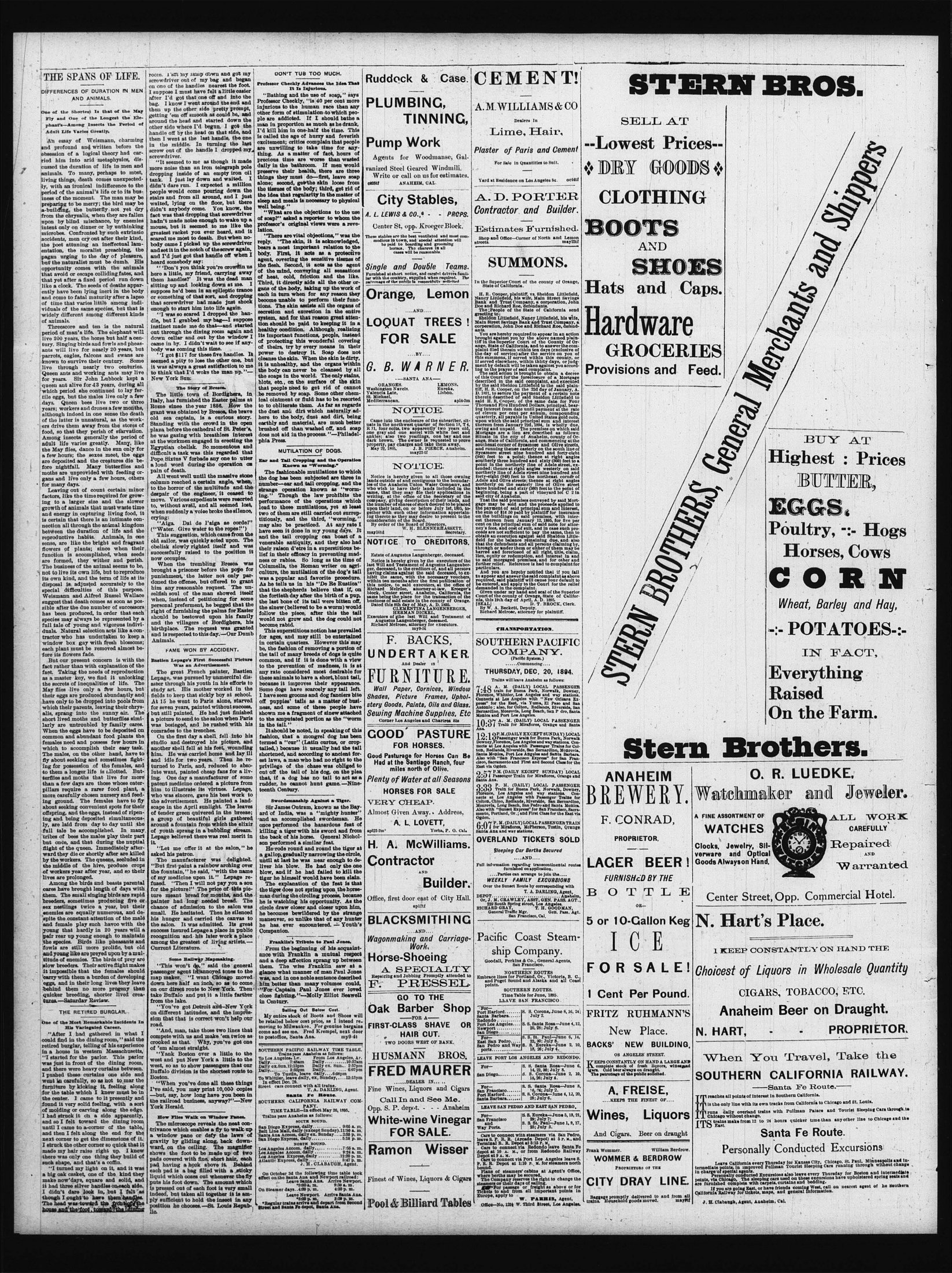
Searchable text
THE SPANS OF LIFE.
DIFFERENCES OF DURATION IN MEN AND ANIMALS.
One of the Shortest Is that of the May Fly and One of the Longest the Elephant's—Among Insects the Period of Adult Life Varies Greatly.
An essay of Weismann, charming and profound and written before the obsession of a logical theory had carried him into arid metaphysics, discussed the duration of life in men and animals. To many, perhaps to most living things, death comes unexpectedly, with an ironical indifference to the period of the animal's life or to its business of the moment. The man may be preparing to be merry; the bird may be a-building, the butterfly not yet dry from the chrysalis, when they are fallen upon by blind mischance, by enemies intent only on dinner or by unthinking microbes. Confronted by such extrinsic accidents, men cry out after their kind, the poet attuning an ineffectual lamentation, the moralist preaching, the pagan urging to the day of pleasure, but the naturalist must be dumb. His opportunity comes with the animals that avoid or escape colliding fates, and that yet after a fixed period run down like a clock. The seeds of deaths apparently have been lying in the body and come to fatal maturity after a lapse of time that varies little among individuals of the same species, but that is widely different among different kinds of animals.
Threescore and ten is the natural period of man's life. The elephant will live 200 years, the horse but half a century. Singing birds and fowls and pheasants will live for nearly 20 years, but parrots, eagles, falcons and swans are known to survive their century. Some live through nearly two centuries. Queen ants and working ants may live for years. Sir John Lubbock kept a queen ant alive for 43 years, during all which period she continued to lay fertile eggs, but the males live only a few days. Queen bees live two or three years; workers and drones a few months, although indeed in one sense the death of the latter is unnatural, as the workers drive them away from the stores of food, so that they perish of starvation. Among insects generally the period of adult life varies greatly. Many, like the May flies, dance in the sun only for a few hours; the sexes meet, the eggs are deposited and the creatures die before nightfall. Many butterflies and moths are unprovided with feeding or room. I set my lamp down and got my screwdriver out of my bag and began on one of the handles nearest the foot. I suppose I must have felt a little easier after I'd got that one off and into the bag. I know I went around the end and then up the other side pretty prompt, getting 'em off smooth as could be, and around the head and started down the other side where I'd begun. I got the handle off by the head on that side, and then I went at the last handle, the one in the middle. In turning the last screw out of the handle I dropped my screwdriver.
"It seemed to me as though it made more noise than an iron telegraph pole dropping inside of an empty iron oil tank. I just lay down and waited. I didn't dare run. I expected a million people would come pouring down the stairs and from all around, and I just waited, lying on the floor, but there didn't anybody come. You know, the fact was that dropping that screwdriver hadn't made noise enough to wake up a mouse, but it seemed to me like the greatest racket you ever heard, and it scared me most to death. But when nobody came I picked up the screwdriver and set it in the notch of the screw again, and I'd just got that handle off when I heard somebody say:
"Don't you think you're crowdin us here a little, my friend, carrying away them handles?" It was the dead man sitting up and looking down at me. I suppose he'd been in an epileptic trance or something of that sort, and dropping that screwdriver had made just shock enough to start him into life again.
"I was so scared I dropped the handle, but I grabbed my bag—I suppose instinct made me do that—and started out through the dining room again and down cellar and out by the window I came in by. I didn't wait to see if anybody was coming this time.
"I got $117 for these five handles. It seemed a pity to lose the other one, but it was always a great satisfaction to me to think that I'd woke the man up."—New York Sun:
The Story of Bresen.
The little town of Bordighera, in Italy, has furnished the Easter palms at Rome since the year 1856. How the grant was obtained by Bresen, the brave old sea captain, is a curious story. Standing with the crowd in the open plaza before the cathedral of St. Peter's, he was gazing with breathless interest at the workmen engaged in erecting the Egyptian obelisk. So momentous and difficult a task was this regarded that Pope Sixtus V forbade any one to utter a loud word during the operation on pain of death.
DON'T TUB TOO MUCH.
Professor Checkly Advances the Idea That It Is Injurious.
"Bathing and the use of soap," says Professor Checkly, "is 40 per cent more injurious to the human race than any other form of stimulation to which people are addicted. If I should bathe a man in proportion as much as he drains I'd kill him in one-half the time. This is called the age of hurry and feverish excitement; critics complain that people are unwilling to take time for any thing. As a matter of fact, hours of precious time are worse than waste daily in the bathroom. If men would preserve their health, there are three things they must do—first, leave so alone; second, get the skin loose from the tissues of the body; third, get rid of the idea that regularity in the matter is sleep and meals is necessary to physical well being."
"What are the objections to the use of soap?" asked a reporter to whom professor's original views were a revelation.
"There are vital objections," was this reply. "The skin, it is acknowledged bears a most important relation to the body. First, it acts as a protective agent, covering the sensitive tissues of the flesh. Second, it acts as the agent of the mind, conveying all sensations of heat, cold, friction and the likeness; directly aids all other organs of the body, taking up work each in turn when for any reason they become unable to perform their functions. The skin assists all the organs in secretion and excretion in the entire system, and for that reason great attention should be paid to keeping it healthy condition. Although realizing its important functions, people instate of protecting this wonderful covering of theirs, try by every means in their power to destroy it. Soap does not cleanse the skin. When the skin is dirty it is unhealthy, and the organs within the body can never be cleansed by soap in the world. The only stain blots, etc., on the surface of the skin that people need to get rid of cannot be removed by soap. Some other chemical ointment or fluid has to be resorted to to obliterate them. As far as regardsthe dust and dirt which naturally arise here to the body, dust and dirt, being earthly and material, are much better brushed off than washed off, and so does not aid in the process."—Philadelphia Press.
MUTILATION OF DOGS.
Ear and Tail Cropping and the Operation Known as "Worming."
The fashionable mutilations to which
Queen ants and working bees live for years. Sir John Lublock kept a queen ant alive for 43 years, during all which period she continued to lay fertile eggs, but the males live only a few days. Queen bees live two or three years; workers and drones a few months, although indeed in one sense the death of the latter is unnatural, as the workers drive them away from the stores of food, so that they perish of starvation. Among insects generally the period of adult life varies greatly. Many, like the May flies, dance in the sun only for a few hours; the sexes meet, the eggs are deposited and the creatures die before nightfall. Many butterflies and moths are unprovided with feeding organs and live only a few hours, others for many days.
Leaving out of count certain minor factors, like the time required for growing to a larger size and the slower growth of animals that must waste time and energy in capturing living food, it is certain that there is an intimate connection all through the animal kingdom between the duration of life and the reproductive habits. Animals, in one sense, are like the bright and fragrant flowers of plants; since when their function is accomplished, when seeds are formed, they wither and perish. The business of the animal seems to be not to live its own life, but to reproduce its own kind, and the term of life at its disposal is adjusted accurately to the special difficulties of this purpose. Weismann and Alfred Russel Wallace suggest that death comes as soon as possible after the due number of successors has been produced, in order that each species may always be represented by a full tale of young and vigorous individuals. Natural selection acts like a contractor who has undertaken to keep a window box gay with fresh blossoms; each plant must be removed almost before its flowers fade.
But our present concern is with the fact rather than with explanation of the fact. Taking the needs of reproduction as a master key, we find it unlocking the secrets of inequalities of life. The May flies live only a few hours, but their eggs are produced abundantly and have only to be dropped into pools from which their parents, leaving their chrysalis, sprang into the sunny air. The short lived moths and butterflies similarly are untroubled by family cares. When the eggs have to be deposited on common and abundant food plants the females need and possess few hours in which to accomplish their easy task. The males, on the other hand, have to fly about seeking and sometimes fighting for possession of the females, and to them a longer life is allotted. Butterflies and moths that live for more than a few days are those whose caterpillars require a rarer food plant, a more carefully chosen nursery and feeding ground. The females have to fly about seeking convenient spots for their offspring, and the eggs, instead of ripening and being deposited simultaneously, are laid from day to day until the full tale be accomplished. In many tribes of bees the males play their part but once, and that during the nuptial flight of the queen. Immediately afterward they die or shortly after are killed by the workers. The queens, secluded in the middle of the hive, produce crops of workers year after year, and so their lives are prolonged.
Among the birds and beasts parental cares have brought length of days with them. The small singing birds are rapid
The Story of Bresca.
The little town of Bordighera, in Italy, has furnished the Easter palms at Rome since the year 1856. How the grant was obtained by Bresca, the brave old sea captain, is a curious story. Standing with the crowd in the open plaza before the cathedral of St. Peter's, he was gazing with breathless interest at the workmen engaged in erecting the Egyptian obelisk. So momentous and difficult a task was this regarded that Pope Sixtus V forbade any one to utter a loud word during the operation on pain of death.
All went well until the massive stone column reached a certain angle, when to the horror of the multitude and the despair of the engineer, it ceased to move. Various expedients were resorted to, without avail, and all seemed lost, when suddenly a voice broke the silence, crying:
"Aiga. Dai de l'aiga cordel!"
("Water. Give water to the ropes!")
This suggestion, which came from the old sailor, was quickly acted upon. The obelisk slowly righted itself and was successfully raised to the position it now occupies.
When the trembling Bresca was brought a prisoner before the pope for punishment, the latter not only paraded the offense, but offered to grant him any reasonable request. The unselfish soul of the man showed itself when, instead of petitioning for some personal preferment, he begged that the right of furnishing the palms for Easter should be bestowed upon his family and the villagers of Bordighera, his birthplace. The request was granted and is respected to this day.—Our Dumb Animals.
FAME WON BY ACCIDENT.
Bastien Lepage’s First Successful Picture Was an Advertisement.
The great French painter, Bastien Lepage, was pursued by unmerciful disaster through his youth in his efforts to study art. His mother worked in the fields to keep that sickly boy at school. At 15 he went to Paris alone, starved for seven years, painted without success, but still painted. He had just finished a picture to send to the salon when Paris was besieged, and he rushed with his comrades to the trenches.
On the first day a shell fell into his studio and destroyed his picture, and another shell fell at his feet, wounding him. He was carried home and lay ill and idle for two years. Then he returned to Paris, and, reduced to absolute want, painted cheap fans for a living. One day a manufacturer of some patent medicine ordered a picture from him to illustrate its virtues. Lepage who was sincere, gave his best work to the advertisement. He painted a landscape in the April sunlight. The leaves of tender green quivered in the breeze; a group of beautiful girls gathered around a fountain from which the elixir of youth sprang in a bubbling stream. Lepage believed there was real merit in it.
"Let me offer it at the salon," he asked his patron.
The manufacturer was delighted. "But first paint a rainbow arching over the fountain," he said, "with the name of my medicine upon it." Lepage refused. "Then I will not pay you a souf for the picture!" The price of this picture meant bread for months, and the soaps in the world. The only stalk blots, etc., on the surface of the skin that people need to get rid of cannot be removed by soap. Some other chemical ointment or fluid has to be resorted to obliterate them. As far as regards the dust and dirt which naturally arise here to the body, dust and dirt, herein earthly and material, are much better brushed off than washed off, and so does not aid in the process."—Philadelphia Phila Press.
MUTILATION OF DOGS.
Ear and Tail Cropping and the Operation Known as “Worming.”
The fashionable mutilations to which the dog has been subjected are three numbers—ear and tail cropping, and their strange operation known as “worming.” Though the law prohibits their performance of the operations which lead to these mutilations, yet at least two of them are still carried out surreally and third,“worming” may also be practiced. At any rate have seen it done in my young days. And the tail cropping can boast of venerable antiquity, and they also have their raison d’etre in a superstitious belief in their efficacy in preventing maleness or rabies. So long as the time Columnella, the Roman writer on agnaculture, the mutilation of the dog’s tails was a popular and favorite procedure As he tells us in his “De Re Rusticum” that shepherdds believe that if they fortieth day after the birth of a pup last bone of its tail were bitten on by the sinew (believed to be a worm) would follow the piece, after this they would not grow and the dog could not become rabid.
This superstitions notion has prevailing for ages, and may still be entertained in certain quarters. However this may be, the fashion of removing a portion of the tail of many breeds of dogs is quite common, and if it is done with a view to the prevention of madness, it is any rate considered most desirable because it improves their appearance Some dogs have scarcely any tail leav I have seen grooms and dog fanciers be off puppies’ tails as a matter of business, and some of these people have shown me a fragment of sinew attachment to the amputated portion as the “worried in the tail.”
It should be noted, in speaking of these fashion that a mongrel dog has been termed a “curr” (Latin curtus, or cropped), because it usually had the shortened, and according to ancient test laws, a man who had no right to privilege of the chase was obliged out off the tail of his dog, on the that if a dog has no tail to act as rudder, he cannot hunt game.—Nineteenth Century.
Swordmanship Against A Tiger.
Sir James Outram, known as the Bard of India, was a “mighty hunter” and an accomplished swordsman. Once performed the hazardous feat killing a tiger with his sword and froze back of his horse. General Nicholas son performed a similar feat.
He rode round and round the tiger at gallop, gradually narrowing the circlo until at last he was near enough to cut liver his blow. He had only one blow, and if he had failed to kill tiger he himself would have been slain.
The explanation of the feat is that the tiger does not spring upon the human during the circlo process, because
The females have to fly about seeking convenient spots for their offspring, and the eggs, instead of ripening and being deposited simultaneously, are laid from day to day until the full tale be accomplished. In many tribes of bees the males play their part but once, and that during the nuptial flight of the queen. Immediately afterward they die or shortly after are killed by the workers. The queens, secluded in the middle of the hive, produce crops of workers year after year, and so their lives are prolonged.
Among the birds and beasts parental cares have brought length of days with them. The small singing birds are rapid breeders, sometimes producing five or sex nestlings twice a year, but their enemies are equally numerous, and despite the constant attention of the male and female play such havoo with the young that hardly in 20 years will a pair rear up young enough to maintain the species. Birds like pheasants and fowls are still more prolific, but old and young like are preyed upon by a multitude of enemies. The birds of prey are slow breeders. Their active flight makes it impossible that the females should carry with them a burden of developing eggs, and in their long lives they leave behind them no more progeny than quicker breeding, shorter lived creatures.—Saturday Review.
THE RETIRED BURGLAR.
One of the Most Remarkable Incidents In His Variegated Career.
"After I had gathered in what I could find in the dining room," said the retired burglar, telling of his experience in a house in western Massachusetts, "I started for the parlor. This parlor was just in front of the dining room, and there were heavy curtains between. I pushed these curtains one side and went in carefully, so as not to mar the furniture by kicking it, feeling along for the table which I knew must be in the center. I came to it presently and found it very solid feeling, with a sort of molding or carving along the edge. I had struck it on a side apparently, and so I felt toward the dining room until I came to a corner of the table, and then I felt along the end for the next corner to get the dimensions of it. I struck the other corner so quick that it made my hair raise right up. I knew there was only one thing they build of such shape, and that's a coffin.
"I turned my light on it, and it was a big oak casket, one of the kind they make now'days, square and solid, and it had three silver handles on each side. I didn't dare look in, but I felt as though I ought to have them handles. The head was toward the front of the house and the foot, toward the dining ground."
He painted a landscape in the April sunlight. The leaves of tender green quivered in the breeze; a group of beautiful girls gathered around a fountain from which the elixir of youth sprang in a bubbling stream. Lepage believed there was real merit in it.
"Let me offer it at the salon," he asked his patron.
The manufacturer was delighted. "But first paint a rainbow arching over the fountain," he said, "with the name of my medicine upon it." Lepage refused. "Then I will not pay you a sou for the picture!" The price of this picture meant bread for months, and the painter had long needed bread. The chance of admission to the salon was small. He hesitated. Then he silenced his hunger and carried the canvas to the salon. It was admitted. Its great success insured Lepage a place in public recognition and his later work a place among the greatest of living artists.—Current Literature.
Some Railway Mapmaking.
"This won't do," said the general passenger agent in annoyed tones to the map maker. "I want Chicago moved down here half an inch, so as to come on our direct route to New York. Then take Buffalo and put it a little farther from the lake.
"You've got Detroit and New York on different latitudes, and the impression that that is correct won't help our road.
"And, man, take those two lines that compete with us and make 'em twice as crooked as that. Why, you've got one of 'em almost straight.
"Yank Boston over a little to the west and put New York a little to the west, so as to show passengers that our Buffalo division is the shortest route to Boston.
"When you've done all these things I've said, you may print 10,000 copies—but say, how long have you been in the railroad business, anyway?"—New York Herald.
How Flies Walk on Window Panes.
The microscope reveals the neat contrivance which enables a fly to walk up a window pane or defy the laws of gravity by gliding along back downward, on the ceiling. The magnifier shows the foot to be made up of two pads covered with fine, short hair, each pad having a hook above it. Behind each pad is a bag filled with a sticky liquid which oozes out whenever the fly puts his foot down. The amount which is pressed out of each foot is very small indeed, but taken all together it is amply sufficient to hold the insect in any position he chooses.—St. Louis Republic.
On October 3d the following time table to effect on the Santa Ana and Newport railroad: Leave Santa Ana. Arrive Newpap.*9:00 a.m. 9:30 a.m. On Steamer days...4:00 p.m. 4:30 p.m. Leave Newport Arrive Santa Ana.*3:00 p.m. 3:30 p.m.*Regular trains arrive and depart from Secon Street and Santa Fe depot, Santa Ana.*
Ruddock & Case.
PLUMBING,
TINNING,
Pump Work
Agents for Woodmanse, Galvanized Steel Geared Windmill.
Write or call on us for estimates.
ANAHEIM, CAL.
City Stables,
A. L. LEWIS & CO., - PROPS.
Center St, opp. Kroeger Block.
These stables are the best ventilated and most commodious in town, and special attention will be paid to boarding and grooming horses. The charries in all cases will be reasonable.
Single and Double Teams.
Furnished at short notice, and careful drivers familiar with the country, supplied when required. The mainage of the public is respectfully solicited.
Orange, Lemon
...AND...
LOQUAT TREES!
FOR SALE
BY...
G. B. WARNER.
SANTA ANA—
ORANGES.
Washington Navels.
Valencia Late,
St Michael,
Mediterranean.
apl4-3m
NOTICE.
Came into the enclosure of the subscriber, situate in the northwest quarter of Section 18, T4, RJ1, four colts, two apparently two years old, one gray and one sorrel with white feet and ankles; also two yearlings, one bay and one dark brown. The owner is requested to prove property, pay charges and take them away.
May 22, 1895.
J. B. PIERCE, Anaheim.
may23-if
CEMENT!
A.M.WILLIAMS & CO
Dealers In
Lime, Hair,
Plaster of Paris and Cement
For Sale in Quantities to Suit.
Yard at Residence on Los Angeles St.
oct11f
A.D.PORTER
Contractor and Builder.
Estimates Furnished.
Shop and Office—Corner of North and Lemon streets.
SUMMONS.
In the Superior Court of the county of Orange, State of California.
H. R. Cooper, plaintiff, vs. Sheldon Littlefield, Nancy Littlefield, his wife, Main Street Savings Bank and Trust Company, a corporation, John Doe and Richard Roe, defendants.
The People of the State of California send greeting to:
Sheldon Littlefield, Nancy Littlefield, his wife, Main Street Savings Bank and Trust Company, a corporation, John Doe and Richard Roe, defendants.
You are hereby required to appear in an action brought against you by the above named plaintiff in the Superior Court of the County of Orange, State of California, and to answer the complaint filed therein within ten days (exclusive of the day of service) after the service on you of this summons, if served within this county, or if served elsewhere, within thirty days, or judgment by default will be taken against you according to the prayer of said complaint.
The said action is brought to obtain a decree of this Court for the foreclosure of a Mortgage described in the said complaint, and executed by the said Sheldon Littlefield to the said plaintiff, H. R. Cooper, on the 22d day of January, A. D. 1891, to secure the payment of a certain note therein described of said Sheldon Littlefield to said H. R. Cooper, of the same date for Four Thousand Five Hundred Dollars, principal, bearing interest from date until payment at the rate of eleven per cent per annum, compounding quarterly, all payable in United States gold coin which the said principal sum and interest therefrom from January 22d, 1894, is wholly due owing and unpaid. The premises on which said Mortgage are a lien are described as follows: Situate in the city of Anaheim, county of Orange, State of California, and commencing at the southeast corner of Sycamore and Olive streets, and running thence easterly on the south line of Sycamore street nine hundred and forty-eight (948) feet to a point; thence at right angles southerly three hundred and sixty (860) feet to a point in the northerly line of Adele street, extended; thence at right angles westerly on said northerly line of Adele street nine hundred and
MUTILATION OF DOGS.
Tail Cropping and the Operation Known as "Worming."
Fashionable mutilations to which has been subjected are three in ear and tail cropping, and the operation known as "worming." Though the law prohibits theance of the operations which these mutilations, yet at least them are still carried out surreptitiously, and the third, "worming," so be practiced. At any rate I am done in my young days. It tail cropping can boast of a lea antiquity, and they also had d'etre in a superstitions be their efficacy in preventing madrabies. So long as the time of趴, the Roman writer on agriculture the mutilation of the dog's tail popular and favorite procedure calls us in his "De Re Rustica" shepherds believe that if, on ninth day after the birth of a pup, ow (believed to be a worm) would the piece, after this the tail not grow and the dog could not rabid.
Superstitious notion has prevailed, and may still be entertained in quarters. However this may fashion of removing a portion of many breeds of dogs is quite, and if it is done with a view prevention of madness, it is at the considered most desirable for animals to have a short, blunt tail, it improves their appearance. Dogs have scarcely any tail left. Even grooms and dog fanciers bite pies' tails as a matter of business some of these people have one fragment of sinew attached computed portion as the "worm tail."
Could be noted, in speaking of this that a mongrel dog has been a "our" (Latin curtus, or oropause) it usually had the tail ed, and according to ancient for-mentions the hazardous feat of a tiger with his sword and from back of his horse. General Nichol-formed a similar feat.
Code round and round the tiger at gradually narrowing the circle, last he was near enough to de-sis blow. He had only the one and if he had failed to kill the himself would have been slain. Explanation of the feat is that does not spring upon the horesering the circling process, because
NOTICE.
Came into the enclosure of the subscriber, situate in the northwest quarter of Section 13, T4. It is not only two years old one gray and one sorrel with white feet and ankles; also two yearlings, one bay and one dark brown. The owner is requested to prove property, pay charges and take them away. May 22, 1895. J.B. PIERCE, Anaheim. may23if
NOTICE.
Notice is hereby given to all those owning lands outside of and contiguous to the boundaries of the Anaheim Union Water Company, and within ten months after the first publication of this notice, to said executors, at the office of the Secretary of the company, giving description of their lands, and the number of shares of stock desired to be placed upon their land, on or before July 1st, 1895, together with such other information appertaining to the consideration of the Board.
By order of the Board of Directors, W.H. BLENNERHASSETT, may1td
Secretary.
NOTICE TO CREDITORS.
Estate of Augustus Langenberger, deceased.
Notice is hereby given by the executors of the last Will and Testament of Augustus Langenberger, deceased, to the creditors of, and all persons having claims against the said deceased, to exhume the same with the necessary couchers within ten months after the first publication of this notice, to said executors, at the office of Richard Melrose, attorney-at-law, Kroeger's block, Center street, Anaheim, California, the same being the place for the transaction of the business of said estate in the county of Orange.
Dated this May 17, 1895. GLEMENTINIAM LANGENBERGER, HERMAN DICKKL.
Executors of the last Will and Testament of Augustus Langenberger, deceased. Richard Melrose, attorney for executors.
my9-ft
F. BACKS,
UNDERTAKER.
And Dealer in
FURNITURE.
Wall Paper, Cornices, Window Shades, Picture Frames, Upholstery Goods, Paints, Oils and Glass.
Sewing Machine Supplies, Etc
GOOD PASTURE FOR HORSES.
Good Pasturage for Horses Can Be Had at the Santiago Ranch, four miles north of Olive.
Plenty of Water at all Seasons HORSES FOR SALE
VERY CHEAP.
Almost Given Away.. Address,
A. L. LOVETT,
Yorba, P. O. Cal.
H. A. McWilliams.
Contractor AND Builder.
Office first door east of City Hall.
SOUTHERN PACIFIC COMPANY.
(Pacific System.)
Commencing...
THURSDAY, DEC. 20, 1894.
Trains will leave Anaheim as follows:
A. M. (DAILY) LOCAL PASSENGER train for Buena Park, Norwalk, Downey, Florence, Whittier, Los Angeles and way stations. Connects at Los Angeles with "New Orleans Express" for the East, via Yuma, El Paso and San Antonio; also for Colton, Redlands, Riverside, San Bernardino, Monrovia, Long Beach, San P dro, Santa Monica and Port Los Angeles.
10:37 A.M. (DAILY) LOCAL PASSENGER train for Mirrafores, Orange and Santa Ana.
12:13 P.M. (DAILY EXCEPT SUNDAY) LOCAL Passenger train for Buena Park, Newalk Downy, Florence, Los Angeles and way stations. Connects at Los Angeles with Passenger Trains for Colton, Redlands, Riverside, San Bernardino, Monrovia, Long Beach, San Pedro and Santa Barbara. Also with "San Francisco Express" for San Francisco, Sacramento and First and Second Class for the East via Ogden.
2:57 P.M. (DAILY EXCEPT SUNDAY) LOCAL Passenger Train for Mirrafores, Orange and Santa Ana.
3:33 P.M. (DAILY) LOCAL Passenger train for Buena Park, Newalk Downy, Florence, Los Angeles and way stations. Connects at Los Angeles with Passenger Trains for Colton, Chino Redlands, Riverside, San Bernardino Monrovia Long Beach San Pedro and Santa Barbara. Also with "Sunset Express" for San Francisco Sacramento Portland Or., and First Class for the East via Ogden.
6:07 P.M. (DAILY) LOCAL PASSENGER train for Mirrafores,TustinOrange Santa Ana and way stations.
OVERLAND TICKETS SOLD
Sleeping Car Bertha Secured
...AND...
Full information regarding transcontinental routes furnished on application.
Parties can arrange to join the...
WEEKLY FAMILY EXCURSIONS Over the Sunset Route by corresponding with T.A.DARLING,Agent,
DEPOT.
ORGANIZATION ANAHEIM
BREWER
F.CONRAD
PROPRIETOR.
STE
ANAHEIM
BREWER
F.CONRAD
PROPRIETOR.
VERY CHEAP.
Almost Given Away.. Address,
A. L. LOVETT,
Yorba, P. O. Cal.
H. A. McWilliams.
Contractor
AND
Builder.
Office, first door east of City Hall.
ap11ff
BLACKSMITHING
...AND...
Wagonmaking and Carriage-Work.
Horse-Shoeing
A SPECIALTY
Repairing and Jobbing Promptly attended to
F. PRESSEL.
GO TO THE
Oak Barber Shop
FOR A
FIRST-CLASS SHAVE OR HAIR CUT.
TWO DOORS WEST OF BANK.
HUSMANN BROS.
FRED MAURER
DEALER IN...
Fine Wines, Liquors and Cigars
Call In and See Me.
Opp. S. P. depot. - - Anaheim
White-wine Vinegar FOR SALE.
Ramon Wisser
Finest of Wines, Liquors & Cigars
Pool & Billiard Tables
OVERLAND TICKETS SOLD
Sleeping Car Berths Secured
...AND....
Full information regarding transcontinental routes furnished on application.
Parties can arrange to join the...
WEEKLY FAMILY EXCURSIONS
Over the Sunset Route by corresponding with
T. A. DARLING, Agent.
Anabeim,
Or, J. M. CRAWLEY, ASST. GEN. PASS. AGT., 229 South Spring street, Los Angeles.
RICHARD GRAY,
T. H. GOODMAN,
General Traffic Mgr.
Gen. Pass. Agt.
San Francisco, Cal.
Pacific Coast Steamship Company.
Goodall, Perkins & Co., General Agents,
San Francisco.
NORTHERN ROUTES
Embrace lines for Portland, Or., Victoria, B. O., and Puget Sound and Alaska and all Coast points.
SOUTHERN POINTS.
Time Table for June, 1895.
LEAVE SAN FRANCISCO.
ForPort Harford...
S. S. Corona, June 8, 16, 24; July 2.
Santa Barbara...
Redondo...
Port Los Angeles...
S. S. Santa Rosa—June 4, 12, 20; July 6.
Newport...
San Diego...
S. S. St. Paul—June 6, 14, 22, 30; July 8.
East San Pedro...
San Pedro and Way ports...
S. S. Eureka—June 2, 10, 18, 26; July 4.
LEAVE PORT LOS ANGELES AND REDONDO.
ForSan Diego...
S. S. Santa Rosa—June 6, 14, 22, 30; July 8.
S. S. Corona—June 2, 10, 18, 26; July 4.
ForSan Francisco...
S. S. Santa Rosa—June 8, 14, 22, 30; July 8.
S. S. Corona—June 4, 12, 20; July 6.
LEAVE SAN PEDRO AND EAST SAN PEDRO.
ForSan Francisco and Way Ports...
S. S. Eureka—June 5, 13, 21, 29; July 7;
S. S. St. Paul—June 1, 9, 17; July 8.
Cars to connect with steamers via San Pedro, leave S. P. R.R. (Arcade Depot) at 5 P.M., and Terminal R. R. Depot at 5:15 P.M.
Cars to connect via Redondo leave Santa Fe depot at 10 A.M., or from Redondo Railway Depot at 9 A.M.
Cars to connect via Port Los Angeles leave S. P. R.R. Depot at 1:10 P.M., for steamers north bound.
Plans of steamers' cabins at Agent's Office, where berths may be secured.
The Company reserves the right to change the steamers or their days of sailing.
For passage or freight as above or forTickets to and from all important points in Europe, apply to
W. PARRIS, Agent,
Office—No, 123rd W. Third Street, Los Angeles.
DREWER
F.CONRAD
PROPRIETOR.
LAGER BEE
FURNISHED BY THE BOTTLOR
5 or 10-Gallon KICE FOR SALE
1 Cent Per Pound
FRITZ RUHMAN
New Place.
BACKS' NEW BUILDINGS
OS ANGELES STREET.
KEEPS CONSTANTLY ON HAND A LARGE complete stock of fresh liquors, wlgars. Cold beer always on draught.
The patronage of the public solicited.
A. FREISE,
...KEEPS THE FINEST OF...
Wines, Liquor
And Cigars. Beer on draught.
Frank Wommer.
William B.
WOMMER & BERDROLL PROPRIETORS OF THE CITY DRAY LINES
Baggage promptly delivered to and f trains. Household goods moved.
STERN BROS.
SELL AT
Lowest Prices--
DRY GOODS
CLOTHING
BOOTS
AND
SHOES
Lats and Caps.
Hardware
GROCERIES
provisions and Feed.
General Merchants and Shippers
BUY AT
Highest : Prices
STERN BROTHERS, General M.
BUY AT
Highest : Prices
BUTTER,
EGGS.
Poultry, -:- Hogs
Horses, Cows
CORN
Wheat, Barley and Hay,
-:- POTATOES-:--
IN FACT,
Everything
Raised
On the Farm.
Stern Brothers.
ANAHEIM
REWERY.
F. CONRAD,
PROPRIETOR.
AGER BEER!
FURNISHED BY THE
OTTLE
O. R. LUEDKE,
Watchmaker and Jeweler.
A FINE ASSORTMENT OF
WATCHES
Clocks, Jewelry, Silverware and Optical
Goods Always on Hand.
ALL WORK
CAREFULLY
Repaired
AND
Warranted
Center Street, Opp. Commercial Hotel.
F. CONRAD,
PROPRIETOR.
AGER BEER!
FURNISHED BY THE
OTTLE
OR—
or 10-Gallon Keg
ICE
OR SALE!
Cent Per Pound.
RITZ RUHMANN'S
New Place.
CKS' NEW BUILDING.
OS ANGELES STREET.
KEPS CONSTANTLY ON HAND A LARGE AND
complete stock of fresh liquors, wines and
Cold beer always on draught.
the patronage of the public solicited.
A. FREISE,
...KEEP THE FINEST OF...
Wines, Liquors
And Cigars. Beer on draught
K Wommer. William Berdrow.
WOMMER & BERDROW
PROPRIETORS OF THE
CITY DRAY LINE.
A FINE ASSORTMENT OF
WATCHES
Clocks, Jewelry, Silverware and Optical Goods Always on Hand.
ALL WORK
CAREFULLY
Repaired
AND
Warranted
Center Street, Opp. Commercial Hotel.
N. Hart's Place.
I KEEP CONSTANTLY ON HAND THE
Choicest of Liquors in Wholesale Quantity
CIGARS, TOBACCO, ETC.
Anaheim Beer on Draught.
N. HART, - PROPRIETOR.
When You Travel, Take the
SOUTHERN CALIFORNIA RAILWAY.
—Santa Fe Route.—
It reaches all points of interest in Southern California.
It is the only line with its own tracks from California to Chicago and St. Louis.
It runs daily overland trains with Pullman Palace and Tourist Sleeping Car through to Chicago without change.
ITS trains make from 12 to 24 hours quicker time than any other line to Chicago and the East.
Santa Fe Route.
Personally Conducted Excursions
Leave California every Thursday for Kansas City, Chicago, St. Paul, Minneapolis and intermediate points, in improved Pullman Tourist Sleeping Cars running through without change in charge of special agents.
Personally conducted Excursions also leave every Thursday for Boston and intermediate points, via Chicago. The sleeping cars used on these excursions have upholstered spring seats and are furnished complete with carpets, curtains and bedding.
If you are going East, or have friends coming West, call on nearest agent of he Southern California Railway for tickets, maps, and general information.
J. H. Clabaugh, Agent, Anaheim, Cal.