anaheim-gazette 1895-04-25
Scanned page
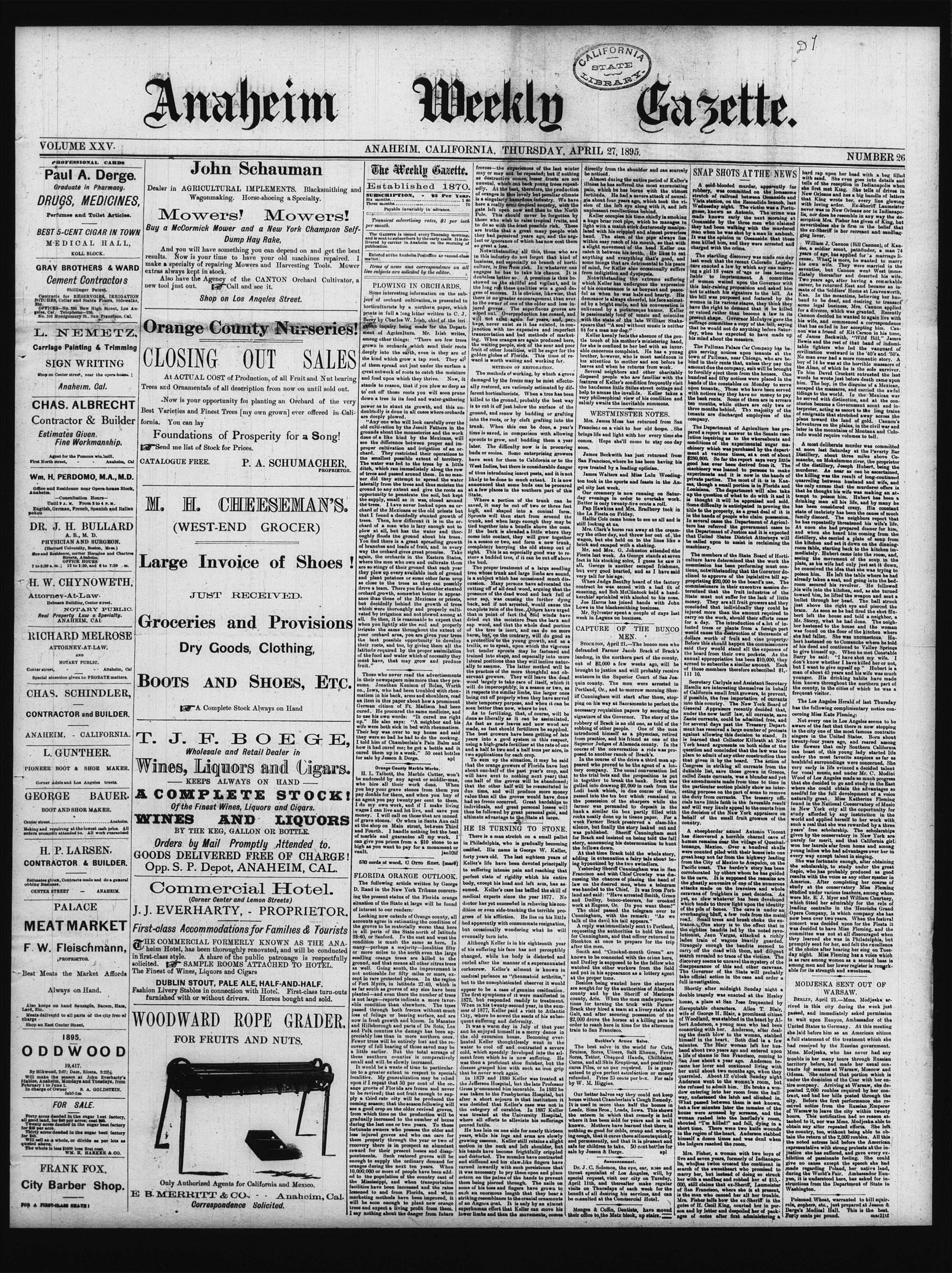
Searchable text
Anaheim
VOLUME XXV.
PROFESSIONAL CARDS
Paul A. Derge.
Graduate in Pharmacy.
DRUGS, MEDICINES,
Perfumes and Toilet Articles.
BEST 5-CENT CIGAR IN TOWN
MEDICAL HALL,
KOLL BLOCK.
GRAY BROTHERS & WARD
Cement Contractors
Shillinger Patent.
Contracts for RESERVOIRS, IRRIGATION
DITCHES, Cellar and Stable Floors, Sidewalks,
Elevator.
OFFICES—No. 205 New High Street, Los Angeles, Cal.
Telephone—236.
No. 316 Montgomery St., San Francisco, Cal.
L. NEMETZ,
Carriage Painting & Trimming
SIGN WRITING
Shop on Center street, near the opera-house!
Anaheim, Cal.
CHAS. ALBRECHT
Contractor & Builder
Estimates Given.
Fine Workmanship.
Agent for the Pomona win. mill.
First North street,
Anaheim, Cal
John Schauman
Dealer in AGRICULTURAL IMPLEMENTS. Blacksmithing and Wagonmaking. Horse-shoeing a Specialty.
Mowers! Mowers!
Buy a McCormick Mower and a New York Champion Self-Dump Hay Rake,
And you will have something you can depend on and get the best results. Now is your time to have your old machines repaired.
make a specialty of repairing Mowers and Harvesting Tools. Mowe extras always kept in stock.
Also have the Agency of the CANTON Orchard Cultivator, new tool just out. Call and see it.
Shop on Los Angeles Street.
Orange County Nurseries!
CLOSING OUT SALES
At ACTUAL COST of Production, of all Fruit and Nut bearing Trees and Ornamentals of all description from now on until sold out.
Now is your opportunity for planting an Orchard of the very Best Varieties and Finest Trees [my own grown] ever offered in California. You can lay
Foundations of Prosperity for a Song!
Send me list of Stock for Prices.
CATALOGUE FREE.
P. A. SCHUMACHER,
PROPRIETOR.
CHAS. ALBRECHT
Contractor & Builder
Estimates Given.
Fine Workmanship.
Agent for the Pomona win mill.
First North street.
Anaheim, Cal
Wm. H. PERDOMO, M.A., M.D.
Office and Residence near Opera-house Block,
Anaheim.
Consultation Hours—
Until 9 A.M. From 3 to 4 P.M.
English, German, French, Spanish and Italian
poken
DR. J. H. BULLARD
A. B., M. D.
PHYSICIAN AND SURGEON.
(Harvard University, Boston, Mass.)
Office and Residence, corner Hermine and Chartres
Streets, Anaheim.
OFFICE HOUSES
7 to 8:30 a.m.; 12 to 1:30, and 6 to 7:30 m.
H. W. CHYNOWETH,
Attorney-At-Law.
Helmsen Building, Center street.
NOTARY PUBLIC.
Real Property Law a Specialty.
ANAHEIM, CAL.
RICHARD MELROSE
ATTORNEY-AT-LAW.
AND
NOTARY PUBLIC.
Center street,
Anaheim, Cal
Special attention given to PROBATE matters.
CHAS. SCHINDLER,
CONTRACTOR and BUILDER.
ANAHEIM, - CALIFORNIA.
L. GUNTHER.
PIONEER BOOT & SHOE MAKER.
Corner Adele and Los Angeles trests.
GEORGE BAUER,
BOOT AND SHOR MAKER.
Center street...
Anaheim.
Making and repairing at the lowest cash price. All orders promptly attended to. All work guaranteed
H. P. LARSEN,
CONTRACTOR & BUILDER.
Estimates given, Contracts made and do a general obbing Business.
At ACTUAL COST of Production, of all Fruit and Nut bearing Trees and Ornamentals of all description from now on until sold out.
Now is your opportunity for planting an Orchard of the very Best Varieties and Finest Trees [my own grown] ever offered in California. You can lay Foundations of Prosperity for a Song!
Send me list of Stock for Prices.
CATALOGUE FREE.
P. A. SCHUMACHER,
PROPRIETOR.
M. H. CHEESEMAN'S.
(WEST-END GROCER)
Large Invoice of Shoes!
JUST RECEIVED.
Groceries and Provisions
Dry Goods, Clothing,
Boots and Shoes, Etc.
A Complete Stock Always on Hand
T. J. F. BOEGE,
Wholesale and Retail Dealer in
Wines, Liquors and Cigars.
KEEPS ALWAYS ON HAND
A COMPLETE STOCK!
Of the Finest Wines, Liquors and Cigars.
WINES AND LIQUORS
BY THE KEG, GALLON OR BOTTLE.
Orders by Mail Promptly Attended to.
GOODS DELIVERED FREE OF CHARGE!
Opp. S. P. Depot, ANAHEIM, CAL.
Commercial Hotel.
BOOT AND SHOR MAKER.
Center street... Anaheim.
Making and repairing at the lowest cash price. All orders promptly attended to. All work guaranteed
H. P. LARSEN,
CONTRACTOR & BUILDER.
Estimates given, Contracts made and do a general obbing Business.
CENTER STREET - ANAHEIM.
PALACE
MEAT MARKET
F. W. Fleischmann,
PROPRIETOR.
Best Meats the Market Affords
Always on Hand.
Also keeps on hand Sausages, Bacon, Ham, Lard, Eto.
Meats deliverid to all parts of the city free of charge.
Shop on East Center Street.
1895.
ODDWOOD
19,417.
By Silkwood, 2:07; Dam, Riceta, 2:22½.
Will make the season at John Everharty's Stables, Anaheim, Mondays and Tuesdays, from February 1 to June 1.
In charge of Owner S. A. GOLDSTEIN.
feb7-1m
FOR SALE.
Forty acres deeded in the sugar beet factory, all good land, for $40 per acres; cost $60.
Twenty acres deeded in the sugar beet factory for $80 per acres.
Thirty acres deeded in the sugar beet factory for $40.
Will sell as a whole, or divide as per lots as quoted above.
The whole is less $1600 less first cost.
WM. R. HARKER & CO.
FRANK FOX.
City Barber Shop.
FOR A FIRST-CLASS SHAKE!
Of the Finest Wines, Liquors and Cigars.
WINES AND LIQUORS
BY THE KEG, GALLON OR BOTTLE.
Orders by Mail Promptly Attended to.
GOODS DELIVERED FREE OF CHARGE!
Opp. S. P. Depot, ANAHEIM, CAL.
Commercial Hotel.
(Corner Center and Lemon Streets)
J. J. EVERHARTY, - PROPRIETOR.
First-class Accommodations for Families & Tourists
THE COMMERCIAL FORMERLY KNOWN AS THE ANA-heim Hotel, has been thoroughly renovated, and will be conducted in first-class style. A share of the public patronage is respectfully solicited. SAMPLE ROOMS ATTACHED TO HOTEL.
The Finest of Wines, Liquors and Cigars
DUBLIN STOUT, PALE ALE, HALF-AND-HALF.
Fashion Livery Stables in connection with Hotel. First-class turn-outs furnished with or without drivers. Horses bought and sold.
WOODWARD ROPE GRADER.
FOR FRUITS AND NUTS.
Only Authorized Agents for California and Mexico.
E B. MERRITT & CO.. Anaheim, Cal.
Correspondence Solicited.
Weekly Gazette
ANAHEIM, CALIFORNIA, THURSDAY, APRIL 27, 1895.
The Weekly Gazette.
Established 1870.
SUBSCRIPTION, - $2 Per Year.
Six months. 1 00
Three months. 75
Payable invariably in advance.
Transient advertising rates, $1 per inch per month.
The Gazette is issued every Thursday morning, and is sent to subscribers by the early mail. It is delivered by carrier in Anaheim on the morning of publication.
Entered at the Anaheim Postoffice as second-class matter.
Items of news and correspondence on all live subjects are solicited by the editor.
PLOWING IN ORCHARDS.
Some interesting information on the subject of orchard cultivation, is presented to horticulturists by a northern paper, which prints in full a long letter written to C. J. Berry by Charles W. Irish, chief of the irrigation inquiry being made for the Department of Agriculture. Mr. Irish writes, among other things: "There are few trees grown in orchards which send their roots deeply into the earth, even if they are of the kind which grow a tap root. They all of them spread out just under the surface a great network of roots to catch the moisture and food upon which they thrive. Now, it stands to reason, that if you plow so deep as to cut off those roots you will soon prune down a tree in its food and water-gathering power as to stunt its growth, and this undoubtedly is done in all cases where orchards are deeply plowed."
"Any one who will look carefully over the old cultivation by the Jesuit Fathers in the grounds about the monasteries and the work done of a like kind by the Mexicans, will see the difference between proper and improper cultivation and irrigation of an orchard. They restricted their operations to the smallest possible extent of territory. The water was fed to the trees by a little ditch, which ran immediately along the row of trees and passed around them. In no man's freezes—the experiences of the last winter may or may not be repeated; but if nothing as destructive comes, lesser frosts are not unusual, which cut back young trees repeatedly. At the best, therefore, the production of oranges in this lovely but peculiar climate is a singularly hazardous industry. We have here a really semi-tropical country, with the gate left open now and then to the North Pole. This should never be forgotten by those who wish to raise tropical fruits, and to do so with the least possible risk. These are truths that a great many people wish they had perceived years ago, and the neglect or ignorance of which has now cost them so great a loss.
Notwithstanding all this, those who are in this industry do not forget that kind of business, and especially no branch of horticulture, is free from risk. In whatever one engages he has to take his chance. It is doubtless better so. A premium is thus bestowed on the skillful and vigilant, and in the long run these qualities win a good degree of success. It is obvious, likewise, that there is no greater encouragement than ever to the owner of one of the older and less injured groves. The superfluous groves are wiped out. Overproduction has ceased, and will not exist again for years, and, perhaps, never exist as it has existed, in conjunction with too expensive and imperfect transportation and bad methods of marketing. When oranges are again produced here, the waiting people, sick of the sour and poor fruit of other localities, will be eager for the golden globes of Florida. This time of reward is worth waiting and working for.
METHODS OF RESTORATION.
The methods of working, by which a grove damaged by the freeze may be most effectually restored, are variously estimated by different horticulturists. When a tree has been killed to the ground, probably the best way is to cut it off just below the surface of the ground, and renew by budding or grafting into the roots, or by cleft grafting into the trunk. When this can be done, a year's time is saved, in comparison with allowing sprouts to grow, and budding them a year later. The difficulty now is in procuring buds or seeds. Some enterprising growers have sent for them to California or to the West Indies, but there is considerable danger of thus introducing insect pests, and it is not directly from the shoulder and can so be noticed.
Almost during the entire period of Keller illness he has suffered the most excruciating pain, which he has borne with the tortitude. He had a severe attack of nigia about four years ago, which took him sion of the left eye along with it, and unpleasant recollections behind.
Keller occupies his time chiefly in small huge briar root pipe, which he manages light with a match stick dexterously mated with his crippled and almost power band. The stem of the pipe always within easy reach of his mouth, so that a slight movement of his head Keller catch it between his teeth. He likes anything and everything that's good, some things that are detrimental to his mind for Keller also occasionally suffer from indigestion and dyspepsia.
Notwithstanding the extreme sufficiency which Keller has undergone the expressness of his countenance is as bonyant and painful as when he was hale and hearty. Demesner is always cheerful, his face audied by a bright smile, and his conversational enlivened by a picturesque humor. Keller is passionately fond of music and coins with the state of the late William Shore speare that "A soul without music is not fit for a man nor dog."
Keller keenly feels the absence of the touch of his mother's ministering hand for she is confined to her bed with an inability cancerous complaint. He has a yellow brother, however, who is most assiduous his attention to mother and son before leaves and when he returns from work.
Several neighbors and other charities disposed people who are familiar with features of Keller's condition frequently the handsome little Stiles-street cottage help to amuse the invalids. Keller takes very philosophical view of his condition calmly awaits the inevitable summons.
WESTMINSTER NOTES.
Mrs. James Moss has returned from Francisco on a visit to her old home. brings life and light with her every time comes. Hope she'll come to stay one soon.
James Beckwith has just returned from San Francisco, where he has been having eyes treated by a leading optician.
James Walters and Miss Lulu Wood
NEW Fruit and Nut bearing and food upon which they thrive. Now, it stands to reason, that if you plow so deep as to cut off those roots you will soon prune down a tree in its food and water-gathering power as to stunt its growth, and this undoubtedly is done in all cases where orchards are deeply plowed.
"Any one who will look carefully over the old cultivation by the Jesuit Fathers in the grounds about the monasteries and the work done of a like kind by the Mexicans, will see the difference between proper and improper cultivation and irrigation of an orchard. They restricted their operations to the smallest possible extent of territory. The water was led to the trees by a little ditch, which ran immediately along the row of trees and passed around them. In no manner did they attempt to spread the water laterally from the trees and thus moisten the ground to any extent and give the roots an opportunity to penetrate the soil, but kept the supply, small as it was, closed around the trees. I have never looked upon an orchard of the Mexicans or the old priests but that I found a decidedly stunted growth of trees. Then, how different it is in the orchard of a man who is lazy enough not to plow at all, but has the water and thoroughly floods the ground about his trees. You find there is a great spreading growth of branches and loads of fruit, and in every way the orchard gives great promise. Take again, the orchards in the Eastern States, where the men who own and cultivate them are so stingy of their ground that each year they plow up every available inch of ground and plant potatoes or some other farm crop as close to the trees as they can possibly drive a team. There you find another stunted orchard growth, somewhat better in appearance than those of the Mexicans or priests, but decidedly behind the growth of trees which were thoroughly and properly cultivated by irrigation and not plowed among at all. So then, it is reasonable to expect that when you lightly stir the soil and properly irrigate the same throughout the extent of your orchard area, you are given your trees the best possible opportunity to develop their roots, and too, by giving them all the latitude required by the proper assimilation of the food and water which of necessity they must have, that may grow and produce fruit."
Those who never read the advertisements in their newspapers miss more than they presume. Jonathan Kenison of Bolan, Worth co., Iowa, who had been troubled with rheumatism in his back, arms and shoulders, read an item in this paper about how a prominent German citizen of Ft. Madison had been cured. He procured the same medicine, and to use his own words: "It cured me right up." He also says: "A neighbor and his wife were both sick in bed with rheumatism. Their boy was over to my house and said they were so bad he had to do the cooking. I told him of Chamberlain's Pain Balm and how it had cured me; he got a bottle and it cured them up in a week." 50 cent bottles for sale by Jesson & Derge.
Orange County Marble Works.
H. L. Talbott, the Marble Cutter, won't be undersided by any agent or middle-man, who hire all their work done. When you buy your grave stones from them you pay double for them, and when you buy of an agent you pay twenty per cent to them. Do my own work, and if I make living wages I can live and let live, and save you money. I will call on those that are unneeded of grave stones. Or when in Santa Ana call at the shop on Main street, between Third and Fourth. I handle nothing but the best of narcissus and guarantee all my work. I can give you prices from a $10 stone to as high as you want to pay for a monument or vauln.
500 cords of wood. C. Otto Rurr. [mar8]
FLORIDA ORANGE OUTLOOK.
The following article written by George D. Rand in the New York Tribune concerning the present status of the Florida orange
The methods of working, by which a grove damaged by the freeze may be most effectually restored, are variously estimated by different horticulturists. When a tree has been killed to the ground, probably the best way is to cut it off just below the surface of the ground, and renew by budding or grafting into the roots, or by cleft grafting into the trunk. When this can be done, a year's time is saved, in comparison with allowing sprouts to grow, and budding them a year later. The difficulty now is in procuring buds or scoins. Some enterprising growers have sent for them to California or to the West Indies, but there is considerable danger of thus introducing insect pests, and it is not likely to be done to much extent. It is now announced that some buds can be procured at a few places in the southern part of this State.
Where a portion of the trunk can be saved, it may be cut off two or three feet high, and shaped into a conical form. Sprouta will then start from around the trunk, and when large enough they may be tied together into a bundle above the cone. If the bark is abraded a little where they come into contact, they will grow together in a season or two, and form a new trunk completely burrying the old stump out of sight. This is an especially good way to restore a budded tree, if it can be cut off above the bud.
The proper treatment of a large seedling tree whose trunk and large limbs are sound, is a subject which has occasioned much discussion. Many persons have advocated cutting off of all dead wood, arguing that the presence of the dead wood and bark full of sour sap, was causing the further dying back, and if not arrested, would cause the complete rain of the tree. Others have urged that in point of fact the cool winds have dried out the moisture from the bark and sap wood, and that the whole dead portion of the tree is inert, and can do no more harm, but on the contrary, will do good as a protection to the young growth, and as a trellis, so to speak, upon which the vigorous but tender sprouts may be fastened and trained into shape, and especially into more lateral positions than they will incline naturally to assume. The latter method will be the practice of more thoughtful and observant growers. They will leave the dead wood largely to take care of itself, which it will do imperceptibly in a season or two, as it respects similar limbs, the larger ones being cut off properly when they have served their temporary purpose, and when it can be seen better than now, where to cut.
As to fertilizing, that of course, will be done as liberally as it can be assimilated. As fast as new leaves and new wood are made, so fast should fertilizers be supplied. The best growers have been getting late years into a good system in this respect, using a high-grade fertilizer at the rate of one and a half to two and a half times per acre, in two applications for each crop.
To sum up the situation, it may be said that the orange growers of Florida have lost about one-half of the past year's crop, and will have next to nothing next year; that one half of the groves will be abandoned; that the other half will be resuscitated in due time, and will produce more money value than all the groves would have done had no freeze occurred. Great hardships to individuals, and great personal losses will thus be followed by great personal gain, and ultimate advantage to the State at large.
HE IS TURNING TO STONE.
There is a man stretch on a small pallet in Philadelphia, who is gradually becoming ossified. His name is George W. Keller, forty years old. The last eighteen years of Keller's life have been devoted principally to suffering intense pain and reaching that perfect state of rigidity which his entire body except his head and left arm has assumed. Keller's case has baffled the skill of medical experts since year 1877. No methods of working, by which a grove damaged by the freeze may be most effectively restored, are variously estimated by different horticulturists. When a tree has been killed to the ground, probably the best way is to cut it off just below the surface of the ground, and renovby budding or grafting into the roots, or by cleft grafting into the trunk. When this can be done, a year's time is saved, in comparison with allowing sprouts to grow, and budding them a year later. The difficulty now is in procuring buds or scoins. Some enterprising growers have sent for them to California or to the West Indies, but there is considerable danger of thus introducing insect pests, and it is not likely to be done to much extent. It is now announced that some buds can be procured at a few places in the southern part of this State.
Where a portion of the trunk can be saved, it may be cut off two or three feet high, and shaped into a bundle above the cone. If the bark is abraded a little where they come into contact, they will grow together in a season or two, form a new trunk completely burrowing the old stump out of sight. This is an especially good way to restore a budded tree, if it can be cut off above the bud.
The proper treatment of a large seedling tree whose trunk and large limbs are sound, is a subject which has occasioned much discussion. Many persons have advocated cutting off of all dead wood, arguing that the presence of the dead wood and bark full of sour sap, was causing the further dying back, and if not arrested, would cause the complete rain of the tree. Others have urged that in point of fact the cool winds have dried out the moisture from the bark and sap wood, and that the whole dead portion of the tree is inert, and can do no more harm, but on the contrary, will do good as a protection to the young growth, and as a trellis, so to speak, upon which the vigorous but tender sprouts may be fastened and trained into shape, and especially into more lateral positions than they will incline naturally to assume. The latter method will be the practice of more thoughtful and observant growers. They will leave the dead wood largely to take care of itself which it will do imperceptibly in a season or two, as it respects similar limbs,the larger ones being cut off properly when they have served their temporary purpose,and when it can be seen better than nowwhere to cut.
As to fertilizing,that of course,will be done as liberally as it can be assimilated.
As fast as new leaves和new wood are made,so fast should fertilizers be supplied.The best growers have been getting late years into a good system in this respect,using a high-grade fertilizer atthe rateof oneand halfto twoanda半timesperacreationtotheStateatlarge.
He is turning to stone.
There is a man stretch on a small pallet in Philadelphia,who is gradually becoming ossified.His name is George W.Keller,forty years old.The last eighteen years ofKeller'slifehavebeendevoted principallyto sufferingintensepainandreachingthatperfectstateofrigiditywhichhisentirebodyexcepthisheadandleftarmhasassumed.Kellercashaffailedtheskillofmedicalexpertssinceyear1877.Nomethodsfoworking,bymishengledfullyrestoredarevariouslyestimateddifferenthorticulturists.Wherethetreehasbeenkilledtothegroundprobledbybuddingorgraftingintothetrunkwhenthiscanbecutoffjustbelowthesurfaceofthegroundandrenovbybuddingorgraftingintothetrunkwhenthiscanbecutoffjustbelowthesurfaceofthegroundandrenovbybuddingorgraftingintothetrunkwhenthiscanbecutoffjustbelowthesurfaceofthegroundandrenovbybuddingorgraftingintothetrunkwhenthiscanbecutoffjustbelowthesurfaceofthegroundandrenovbybuddingorgraftingintothetrunkwhenthiscanbecutoffjustbelowthesurfaceofthegroundandrenovbybuddingorgraftingintothetrunkwhenthiscanbecutoffjustbelowthesurfaceofthegroundandrenovbybuddingorgraftingintothetrunkwhenthiscanbecutoffjustbelowthesurfaceofthegroundandrenovbybuddingorgraftingintothetrunkwhenthiscanbecutoffjustbelowthesurfaceofthegroundandrenovbybuddingorgraftingintothetrunkwhenthiscanbecutoffjustbelowthesurfaceofthegroundandrenovbybuddingorgraftingintothetrunkwhenthiscanbecutoffjustbelowthesurfaceofthegroundandrenovbybuddingorgraftingintothetrunkwhenthiscanbecutoffjustbelowthesurfaceofthegroundandrenovbybuddingorgraftingintothetrunkwhenthiscanbecutoffjustbelowthesurfaceofthegroundandrenovbybuddingorgraftingintothetrunkwhenthiscanbecutoffjustbelowthesurfaceofthegroundandrenovbybuddingorgraftingintothetrunkwhenthiscanbecutoffjustbelowthesurfaceofthegroundandrenovbybuddingorgraftingintothetrunkwhenthiscanbecutoffjustbelowthesurfaceofthegroundandrenovbybuddingorgraftingintothetrunkwhenthiscanbecutoffjustbelowthesurfaceofthegroundandrenovbybuddingorgraftingintothetrunkwhenthiscanbecutoffjustbelowthesurfaceofthegroundandrenovbybuddingorgraftingintothetrunkwhenthiscanbecutoffjustbelowthesurfaceofthegroundandrenovbybuddingorgraftingintothetrunkwhenthiscanbecutoffjustbelowthesurfaceofthegroundandrenovbybuddingorgraftingintothetrunkwhenthiscanbecutoffjustbelowthesurfaceofthegroundandrenovbybuddingorgraftingintothetrunkwhenthiscanbecutoffjustbelowthesurfaceofthegroundandrenovbybuddingorgraftingintothetrunkwhenthiscanbecutoffjustbelowthesurfaceofthegroundandrenovbybuddingorgraftingintothetrunkwhenthiscanbecutoffjustbelowthesurfaceofthegroundandrenovbybuddingorgraftingintothetrunkwhenthiscanbecutoffjustbelowthesurfaceofthegroundandrenovbybuddingorgraftingintothetrunkwhenthiscanbecutoffjustbelowthesurfaceofthegroundandrenovbybuddingorgraftingintothetrunkwhenthiscanbecutoffjustbelowthesurfaceofthegroundandrenovbybuddingorgraftingintothetrunkwhenthiscanbecutoffjustbelowthesurfaceofthegroundandrenovbybuddingorgraftingintothetrunkwhenthiscanbecutoffjustbelowthesurfaceofthegroundandrenovbybuddingorgraftingintothetrunkwhenthiscanbecutoffjustbelowthesurfaceofthegroundandrenovbybuddingorgraftingintothetrunkwhenthiscanbecutoffjustbelowthesurfaceofthegroundandrenovbybuddingorgraftingintothetrunkwhenthiscanbecutoffjustbelowthesurfaceofthegroundandrenovbybuddingorgraftingintothetrunkwhenthiscanbecutoffjustbelowthesurfaceofthegroundandrenovbybuddingorgraftingintothetrunkwhenthiscanbecutoffjustbelowthesurfaceofthegroundandrenovbybuddingorgraftingintothetrunkwhenthiscanbecutoffjustbelowthesurfaceofthegroundandrenovbybuddingorgraftingintothetrunkwhenthiscanbecutoffjustbelowthesurfaceofthegroundandrenovbybuddingorgraftingintothetrunkwhenthiscanbecutoffjustbelowthesurfaceofthegroundandrenovbybuddingorgraftingintothetrunkwhenthiscanbecutoffjustbelowthesurfaceofthegroundandrenovbybuddingorgraftingintothetrunkwhenthiscanbecutoffjustbelowthesurfaceofthegroundandrenovbybuddingorgraftingintothetrunkwhenthiscanbecutoffjustbelowthesurfaceofthegroundandrenovbybuddingorgraftingintothetrunkwhenthiscanbecutoffjustbelowthesurfaceofthegroundandrenovbybuddingorgraftingintothetrunkwhenthiscanbecutoffjustbelowthesurfaceofthegroundandrenovbybuddingorgraftingintothetrunkwhenthiscanbecutoffjustbelowthesurfaceofthegroundandrenovbybuddingorgrafting(intothetrunkwhenthiscanbecutoffjustbelowthesurfaceofthegroundandrenovbybuddingorgrafting(intothetrunkwhenthiscanbecutoffjustbelowthesurfaceoftheground和renovbybuddingorgrafting(intothetrunkwhenthiscanbecutoffjustbelowthesurface ofthedriveoutthermoclimitationofthermoclimitationofthermoclimitationofthermoclimitationofthermoclimitationofthermoclimitationofthermoclimitationofthermoclimitationofthermoclimitationofthermoclimitationofthermoclimitationofthermoclimitationofthermoclimitationofthermoclimitationofthermoclimitationofthermoclimitationofthermoclimitationofthermoclimitationofthermoclimitationofthermoclimitationofthermoclimitationofthermoclimitationofthermoclimitationofthermoclimitationofthermoclimitationofthermoclimitationofthermoclimitationofthermoclimitationofthermoclimitationofthermoclimitationofthermoclimitationofthermoclimitationofthermoclimitationofthermoclimitationofthermoclimitationofthermoclimitationofthermoclimitationofthermoclimitationofthermoclimitationofthermoclimitationofthermoclimitationofthermoclimitationofthermoclimitationofthermoclimitationofthermoclimitationofthermoclimitationofthermoclimitationofthermoclimitationofthermoclimitationofthermoclimitationofthermoclimitationofthermoclimitationofthermoclimitationofthermoclimiationofthermocliminationofthermocliminationofthermocliminationofthermocliminationofthermocliminationofthermocliminationofthermocliminationofhermocliminationofhermocliminationofhermocliminationofhermocliminationofhermocliminationofhermOC liminationOfherMOC liminationOfherMOC liminationOfherMOC liminationOfherMOC liminationOfherMOC liminationOfherMOC liminationOfherMOC liminationOfherMOC liminationOfherMOC liminationOfherMOC liminationOfherMOC liminationOfherMOC liminationOfherMOC liminationOfherMOC liminationOfherMOC liminationOfherMOC liminationOfherMOC liminationOfherMOC liminationOfherMOC liminationOfherMOC liminationOfherMOC liminationOfherMOC liminationOfherMOC liminationOfherMOC liminationOfherMOC liminationOfherMOC liminationOfherMOC liminationOfherMOC liminationOfherMOC liminationOfherMOC liminationOfherMOC liminationOfherMOC liminationOfherMOC liminationOfherMOC liminationOfherMOC liminationOfherMOC liminationOfherMOC liminationOfherMOC liminationOfherMOC liminationOfherMOC liminationOfherMOC liminationOfherMOC liminationOfherMOC liminationOfherMOC liminationOfherMOC liminationOf herMOC limination Of herMOC liminction Of herMOC liminction Of herMOC liminction Of herMOC liminction Of herMOC liminction Of herMOC liminction Of herMOC liminction Of herMOC liminction Of herMOC liminction Of herMOC liminction Of herMOC limistration Of herMOC limistration Of herMOC limistration Of herMOC limistration Of herMOC limistration Of herMOC limistration Of herMOC limistration Of herMOC limistration Of herMOC limistration Of herMOC limistration Of herMOC limistration Of herMOC limistration Of herMOC limistration Of herMOC limitiation Of herMOC limitiation Of herMOC limitiation Of herMOC limitiation Of herMOC limitiation Of herMOC limitiation Of herMOC limitiation Of herMOC limitiation Of herM OC limitiation Of her M OC limitiation Of her M OC limitiation Of her M OC limitiation Of her M OC limitiation Of her M OC limitiation Of her M OC limitiation Of her M OC limitiation Of her M OC limitiation Of her M OC limitiation Of her M OC limitiation Of her M OC limitiation Of her M OC limitiation Of her M OC limitiation Of her M OC limitiation Of her M OC limitiation OF her M OC limitiation OF her M OC limitiation OF her M OC limitiation OF her M OC limitiation OF her M OC limitiation OF her M OC limitiation OF her M OC limitiation OF her M OC limitiation OF her M OC limitiation OF her M OC limitiation OF her M OC limitiation OF her M OC limitiation OF her M OC limitiation OF her M OC limitiation OF her M OC limitiation OF her M OC limitiation OF her M OC limitiation OF her M OC limitiation OF her M OC limitiation OF her M OC limitiation OF her M OC limitiation OF her M OC limitiation OF her M OC limitiation OF her M OC limitiation OF她 M OC limitiation OF她 M OC limitiation OF她 M OC limitiation OF她 M OC limitiation OF她 M OC limitiation OF她 M OC limitiation OF她 M DC limitiation OF她 DC limitiation OF她 DC limitiation OF她 DC limitiation OF她 DC limitiation OF她 DC limitiation_OF她 DC limitiation_OF她 DC limitiation_OF她 DC limitiation_OF她 DC limitiation_OF她 DC limitiation_OF她 DC limitiation_OF她 DC limitiation_OF她 DC limitiation_OF她 DC limitiation_OF她 DC limitiation_OF她 DC limitiation_OF她 DC limitigation_OF她 DC limitation_OF她 DC limitation_OF她 DC limitation_OF她 DC limitation_OF她 DC limitation_OF她 DC limitation_OF她 DC limitation_OF她 DC limitation_OF她 DC limitation_OF她 DC limitation_OF她 DC limitation_OF她 DC limitation_OF她 DC limitation_OF她 DC limitation_OF她 DC limitation_OF她 DC limitation_OF她 DC limitation_OF她 DC limitation_OF她 DC limitation_OF她 DC limitation_OF她 DC limitation_OF她 DC limitation_OF她 DC limitation_OF她 DC limitation_OF她 DC limitation_OF她的DC limitation_OF她的DC limitation_of她的DC limitation_of她的DC limitation_of她的DC limitation_of她的DC limitation_of她的DC limitation_of她的DC limitation_of她的DC limitation_of她的DC limitation_of她的DC limitation_of她的DC limitation_of她的DC limitation_of她的DC limitation_of她的DC limitation_of她的DC limitation_of她的DC limitation_of她的DC limitation_of她的DC limitation_of她的DC limitation_of她的DC limitation_of她的DC limitation_of她的DC limitation_of她的DC limitation_of她的DC limitations_of他们的DC limitations_of他们的DC limitations_of他们的DC limitations_of他们的DC limitations_of他们的DC limitations_of他们的DC limitations_of他们的DC limitations_of他们的DC limitations_of他们的DC limitations_of他们的DC limitations_of他们的DC limitations_of他们的DC limitations_of他们的DC limitations_of他们的DC limitations_of他们的DC limitations_of他们的DC limitations_of他们的DC limitations_of他们的DC limitations_of他们的DC limitations_of他们的DC limitations_of他们的DC limitations_of他们的DC limitations_of他们的DC limitations_of他们的DC limitations_of他们的DC limitations_于他们的DC limitations_于他们的DC limitations_于他们的DC limitations_于他们的DC limitations_于他们的DC limitations_于他们的DC limitations_于他们的DC limitations_于他们的DC limitations_于他们的DC limitations_于他们的DC limitations_于他们的DC limitations_于他们的DC limitations_于他们的DC limitations_于他们的DC limitations_于他们的DC limitations_于他们的DC limitations_于他们的DC limitations_于他们的DC limitations_于他们的DC limitations_于他们DC limitations_于他们Dc limitations_于他们Dc limitations_于他们Dc limitations_于他们Dc limitations_于他们Dc limitations_于他们Dc limitations_于他们Dc limitations_于他们Dc limitations_于他们Dc limitations_于他们Dc limitations_于他们Dc limitations_于他们Dc limitations_于他们Dc limitations_于他们Dc limitations_于他们Dc limitations_于他们Dc limitations_于他们Dclimitations_于他们Dclimitations_于他们Dclimitations_于他们Dclimitations_于他们Dclimitations_于他们Dclimitations_于他们Dclimitations_于他们Dclimitations_于他们Dclimitations_于他们Dclimitations_于他们Dclimitations_于他们Dclimitations_于他们Dclimitations_于他们Dclimitations_于他们Dclimitations_于他们Dclimitations_于他们Dclimitations_于他们Dclimitations_于他们Dclimitations_于他们Dclimitations_于他们Dclimitations_于他们Dclimitations_
在于他们Dclimitations_在于他们Dclimitations_在于他们Dclimitations_在于他们Dclimitations_在于他们Dclimitations_在于他们Dclimitations_在于他们Dclimitations_在于他们Dclimitations_在于他们Dclimitations_在于他们Dclimitations_在于他们Dclimitations_在于他们Dclimitations_在于他们Dclimitations_在于他们Dclimitations_在于他们Dclimitations_
在于他们Dclimitations_在于他们Dclimitations_在于他们Dclimitations_在于他们Dclimitations_在于他们Dclimitations_在于他们Dclimitations_在于他们Dclimitations_在于他们Dclimitations_在于他们Dclimitations_在于他们Dclimitations_在于他们Dclimitions_在于他们Dclimitions_在于他们Dclimitions_在于他们Dclimitions_在于他们Dclimitions_在于他 Dclimitions_在于他 Dclimitions_至于他 Dclimitions之于他 Dclimitions之于他 Dclimitions之于他 Dc_limitions之于他 Dc_limitIONS之于他 Dc_limitIONS之于他 Dc_limitIONS之于他 Dc_limitIONS之于他 Dc_limitIONS之于他 Dc_limitIONS之于他 Dc_limitIONS之于他 Dc_limitIONS之于他 Dc_limitIONS之于他 Dc_limitIONS之于他 Dс_limitIONS之于他 Dс_limitIONS之于他 Dс_limitIONS之于他 Dс_limitIONS之于他 Dс_limitIONS之于他 Dс_limitIONS之于他 Dс_limitIONS之于他 Dс_limitIONS之于他 Dс_limitIONS之于他 Dс_limitIONS之于他 D
FLORIDA ORANGE OUTLOOK.
The following article written by George D. Rand in the New York Tribune concerning the present status of the Florida orange situation of the State at large will be found of interest to our readers:
Looking now outside of Orange county, all accounts agree in estimating the condition of the groves to be materially worse than here in all parts of the State north of latitude 28:40, or Sanford. To the east and west the condition is much the same as here. In many—perhaps a majority—localities fifty or more miles to the north even the large seedling orange trees are killed to the ground, and that means all other citrus trees as well. Going south, the improvement is not noticeable for fifty miles or more, except in rare protected places. In the region of Fort Myers, in latitude 27:40, which is as far south as groves of any size have been planted—and even there the number of trees is not large—reports indicate a more favorable condition than elsewhere. The trees passed through both freezes without much loss of foliage or bearing surface, and are now in fresh growth and bloom. In Manatee and Hillsborough and parts of De Soto, Lee and Polk counties the damage has been appreciably less than in more northern ones. Fewer trees will be entirely lost and the recovery of full bearing of those saved may be a little earlier. But the total acreage of these southern counties is comparatively small and will be slowly increased.
It would be a waste of time to particularize to a greater extent in respect to special localities. My generalization may be relied upon if I repeat that 50 per cent of the orange groves of Florida are frozen and never to be revived; that not fruit enough to supply a third rate city will be produced the coming season; that the season following will see a good crop on the older revived groves, from which time on the production will be gradually increased to the number of boxes during the last one or two years. To those fortunate owners who possess the older and less injured groves and who can care for them properly through the year or two of recovery there is in prospect an abundant reward for their present losses and disappointments. Such restored groves will be enough to supply the ordinary demand for oranges during the next ten years. When 10,000,000 or more of people have been added to the population of the country east of the Mississippi, and when transportation facilities have been increased and the rates lessened to and from Florida, and when marketing methods have been improved, it will be soon enough to plant new orange trees and expect a living profit from them. I say nothing about the danger from future had no freeze occurred. Great hardships to individuals, and great personal losses will thus be followed by great personal gain, and ultimate advantage to the State at large.
HE IS TURNING TO STONE.
There is a man stretch on a small pallet in Philadelphia, who is gradually becoming ossified. His name is George W. Keller, forty years old. The last eighteen years of Keller's life have been devoted principally to suffering intense pain and reaching that perfect state of rigidity which his entire body, except his head and left arm, has assumed. Keller's case has baffled the skill of medical experts since the year 1877. No doctor has yet succeeded in relieving his condition or even side-tracking the terrible progress of his affliction. He lies on his little bed apparently with consummate resignation, but occasionally wondering what he will eventually turn into.
Although Keller is in his eighteenth year of his suffering his face has not perceptibly changed, while his body is distorted and curled after the manner of a superannuated corkscrew. Keller's ailment is known in medical parlance as "cheumatoid arthritis," but to the unsophisticated observer it would appear to be a case of genuine ossification. The first symptoms of it were manifested in 1872, but responded readily to treatment. When in his twenty-second year, in the summer of 1877, Keller paid a visit to Atlantic City, where he sowed the seeds of his subsequent suffering and deformity.
It was a warm day in July of that year and he enjoyed himself in a merry dance in the old excursion house. Becoming overheated Keller thoughtlessly went in the water to cool off and contracted a severe cold, which speedily developed into the aliment from which he is now suffering. He was then a proficient shoe finisher, but the disease grasped him with such an iron grip that he never work again.
In 1879 and 1880 Keller was treated at the Jefferson Hospital, but the late Professor Gross pronounced him incurable. In 1882 he was taken to the Presbyterian Hospital, but after a short sojourn in that institution it was decided that Keller's case was not in the category of curables. In 1887 Keller was treated at the University Hospital, where all efforts to alleviate his sufferings proved futile.
He has lain on one side for nearly thirteen years, while his legs and arms are slowly growing osseous. Keller still retains a slight motion in the neck and left shoulder, but his hands have become frightfully crippled and distorted. The muscles have contracted and stiffened and his claw-like fingers have turned inwardly with such persistence that it was necessary to pry them open and place cotton on the palms of the hands to prevent them being pierced through. The nails on some of his toes and fingers have grown to such an enormous length that they bear a striking resemblance to the cranial ornaments of an Angora goat. It is only by an almost superhuman effort that Keller can move his lower limbs and then the movements, comes
Our better halves say they could not keep house without Chamberlain's Cough Remedy. It is used in more than half the homes in Leede. Sims Bros., Leeds, Iowa. This shows the esteem in which that remedy is held where it has been sold for years and is well known. Mothers have learned that there is nothing so good for colds, clump and whooping cough, that it cures these ailments quickly and permanently, and that it is pleasant and safe for children to take. 50 cent bottles for sale by Jesson & Derge.
Announcement.
Dr. J. C. Solomon, the eye, ear, nose and throat specialist of Los Angeles, will, by special request, visit our city on Thursday, April 11th, and thereafter make regular visits on Thursdays of each week for the benefit of all desiring his services, and can be consulted at the Commercial Hotel.
Menges & Coffin, Dentists, have moved their office to the Metz block, up stairs.
CALIFORNIA STATE LIBRARY.
APL 27, 1895.
NUMBER 26
SNAP SHOTS AT THE NEWS
A cold-blooded murder, apparently for robbery, was committed on the lonesome stretch of railroad between Oceanside and Vista station, on the Escondido branch, last Wednesday night. The victim was a Portuguese, known as Antonio. The crime was made known early the next morning at Oceanside by the three men who claimed they had been walking with the murdered man when he was shot by a man in ambush. It was the opinion in Oceanside that these men killed him, and they were arrested and charged with the crime.
The startling discovery was made one day last week that the recent Colorado Legislature enacted a law by which any one marrying a girl 18 years of age or less becomes liable to imprisonment. A committee of women waited upon the Governor with this hair-raising proposition and asked him not to attach his signature to the bill. As the bill was purposed and fostered by the women in its various stages, they think they have the right to demand that it be killed or vetoed rather than become a law in its present shape. Governor McIntyre gave the suffrage committee a copy of the bill, saying that he would not do anything before Saturday, when he expected to have made up his mind about the measure.
The Pullman Palace Car Company has begun serving notices upon tenants at the town of Pullman, near Chicago, who are behind in their rents that, unless they pay the amount due the company, suit will be brought to forcibly eject them from the houses. One hundred and fifty notices were placed in the hands of the constables on Monday to serve upon tenants. Those who have been served with notices say they have no money to pay the back rents. Some of them are in arrears ten months, while others are only two or three months behind. The majority of the tenants are discharged employees of the company.
The Department of Agriculture has prepared a report in answer to the Senate resolution inquiring as to the whereabouts and conditions of the experimental sugar machinery which was purchased by the department at various times, at a cost of about $280,000. So far the report says very little good has ever been derived from it. The machinery was loaned to persons to make experiments and it is now in the hands of hard rap upon her head with a bag filled with sand. She even goes into details and tells of the reception in Indianapolis when she first met King. She tells of drives in New Orleans and has a big bundle of letters that King wrote her, every line glowing with loving ardor. Ex-Sheriff Laumeister never was in New Orleans nor in Indianapolis, nor does he resemble in any way the description Mrs. Fisher has given of King, but nevertheless she is firm in the belief that the ex-Sheriff is her recreant and sandbagging lover.
William J. Cannon (Bill Cannon), of Kansas, a soldier scout, pathfinder, a man 74 years of age, has applied for a marriage license. What is more, he wanted to marry his own wife. They were married in the seventies, but Cannon went West immediately thereafter and deserted his wife. Two years ago, after having a remarkable career, he returned East and became an inmate of the Soldiers' Home at Leavenworth, Kan. In the meantime, believing her husband to be dead, and desiring to transact some legal business, Mrs. Cannon applied for a divorce, which was granted. Recently Cannon decided he wanted to again live with his wife, and commenced a correspondence that has ended in her accepting him. Cannon was a friend of Kit Carson in his time, of James Beckwith, "Wild Bill," James Bowie and the rest of that band of indomitable fighters who led the vanguard of civilization westward in the '40's and '50's. No man ever had a more romantic story. A boy of 14 he was at the horrible massacre of the Almo, of which he is the sole survivor. To him David Crockett entrusted the last words he wrote just before death came upon him. The boy, in the disguise of a Mexican, escaped the massacre, and carried the awful tidings to the world. In the Mexican war he served with distinction, and at the conclusion became a Government scout and interpreter, acting as escort to the long trainees of emigrants that stretched away across the plans toward the land of gold. Cannon's adventures on the plains, in the civil war and later in the mountains of Montana and Colorado would require volumes to tell.
A most deliberate murder was committed at noon last Saturday at the Poverty Bar Distillery, about three miles above Comanche, on Mokelumme river, the proprietor of the distillery, Joseph Hubert, being the murderer. As near as can be ascertained,
BESTMINSTER NOTES.
James Moss has returned from San Diego on a visit to her old home. She lives and light with her every time she hopes she'll come to stay one day.
Beckwith has just returned from Nancisco, where he has been having his meeting by a leading optician.
Walters and Miss Lulu Wooding-in the sports and feasts in the Anast week.
Dreamery is now running on Saturday nights in order to overtake work. Only twenty-five cents a roll.
Awkins and Mrs. Bradbury took in Wednesday.
Cole came home to see us all and is sitting at us.
Mark's horse ran away at the cream-mother day, and threw her out of the house held on to the lines like a dog escaped with a shaking.
And Mrs. G. Johnston attended the last week.
An George stands at seven is stocking soles, I guess he saw it urge is another escaped Irishman, good hearted, and as I have said for his age.
Judge Bentley heard of the factory she was seized with a bad fit of Bob McClintock held a hand-sprinkled alcohol to his nose. Arra has joined hands with John the blacksmithing business.
Ivester spent a couple of days last Laguna on business.
URE OF THE BUNCO MEN.
April 21.-The bunco men who Farmer Jacob Brack of Brack's in the northern part of the county, $2,000 a few weeks ago, will be justice and will probably receive in the Superior Court of San Joaquín. The men were arrested in Or., and to-morrow morning Sheringham will start after them, stop-away way at Sacramento to perfect the requisition papers by securing the Governor. The story of the Brack is an old one, as told of the other people. One of the men and himself as a physician, retired notice, and his friend as one of the Judges of Alameda county. In the conversation a ride was pro-nother ranch of Brack's course of the drive a third man apso proved to be the agent of a lottery. The usual conversation led bets and the proposition to putter to break the bank. Brack was no drawing $2,000 in cash from the bank which, in due course of time, to the tin box which remained in session of the sharpers while the pen was pernued to deposit in the similar tin box partly filled with ink done up in tissue paper. For aenser Brack preserved a clam-like finally the story leaked out and ashened. Sheriff Cunningham sent and insisted on being told the fullouncing his determination to hunt down.
Time Brack told the whole story, extenuation a fairy tale about being by the two swindlers.
Sheriff Cunningham was in San Diego with Chief Crowley was disguise chances of placing the hand of the desired men, when a telegram to the Chief. It was from Port-Augustine: "Have arrested Smith, Green
A sheepherder named Antonio Vincent has discovered a horrible channel cave of human remains near the village of Quechu-enango, Mexico. Over a hundred skulls were counted piled with their bones into one great heap not far from the highway leading from the City of Mexico to Acapulco, on the Pacific coast. The herder's story has been corroborated by others whom he has guided to the cave. It is supposed the remains are the ghastly souvenirs of one of the numerous attacks made on the travelers and whole caravana of freighters in past decades. As yet, no clew whatever has been developed.
The Department of Agriculture has prepared a report in answer to the Senate resolution inquiring as to the whereabouts and conditions of the experimental sugar machinery which was purchased by the department at various times, at a cost of about $280,000. So far the report says very little good has ever been derived from it. The machinery was loaned to persons to make experiments and it is now in the hands of private parties. The most of it is in Kansas, though a small portion is in Florida and Louisiana. The department will also take up the question of what to do with it and it is thought it will be appraised and sold. Some difficulty is anticipated in proving the title to the property, as a great deal of it is in the hands of people who claim possession. In several cases the Department of Agriculture has referred the government cases to the Department of Justice and it is expected that United States District Attorneys will be called upon to assist in reclaiming the machinery.
The members of the State Board of Horticulture have determined that the work the commission has been performing must continue, notwithstanding that the Governor declined to approve of the legislative bill appropriating $20,000 to the board's use. The commissioners in their executive session determined that the fruit industries of the State must not suffer for the lack of little money. They are all fruit growers and they concluded that individually they could be injured more than the amount required to carry on the work, should their efforts cease for a day. The introduction of a lot of infected trees or plants from a foreign port would cause the destruction of thousands of dollars worth of fruit and vine property. Before this should happen the commissioners said they would stand all the expenses of the board from their own pocketata. As the annual appropriation has been $10,000; they agreed to subscribe a similar amount. Each of those members therefore subscribed $1,111 10.
Secretary Carlyle and Assistant Secretary Hamlin are interesting themselves in behalf of California small fruit growers, to prevent, if possible, free importation of currants into this country. The New York Board of General Appraisers recently decided that, under the new tariff law, all currants, save Zante currants, could be admitted free, and for several days past the Treasury Department has received a large number of protections against allowing this decision to stand. It is learned that Collector Kilbrath at New York heard arguments on both sides of the question and concluded that the law was too plain to admit of any other construction than that given it by the board. The action of Congress in striking all currants from the dutiable list, save those grown in Greece, called Zante currants, was a blunder and yet the amendments made from time to time in particular section plainly show an interesting purpose on the part of some to remove the duty from currants. The treasury officials have little faith in the favorable result and will very likely appeal to the courts from the decision of the New York appraisers on behalf of the small fruit growers of the country.
A shepherder named Antonio Vincent has discovered a horrible channel cave of human remains near the village of Quechu-enango, Mexico. Over a hundred skulls were counted piled with their bones into one great heap not far from the highway leading from the City of Mexico to Acapulco, on the Pacific coast. The herder's story has been corroborated by others whom he has guided to the cave. It is supposed the remains are the ghastly souvenirs of one of numerous attacks made on the travelers and whole caravana of freighters in past decades. As yet, no clew whatever has been developed.
The Department of Agriculture has prepared a report in answer to the Senate resolution inquiring as to the whereabouts and conditions of the experimental sugar machinery which was purchased by the department at various times, at a cost of about $280,000. So far the report says very little good has ever been derived from it. The machinery was loaned to persons to make experiments and it is now in the hands of private parties. The most of it is in Kansas, though a small portion is in Florida and Louisiana. The department will also take up the question of what to do with it and it is thought it will be appraised and sold. Some difficulty is anticipated in proving the title to the property, as a great deal of it is in the hands of people who claim possession. In several cases the Department of Agriculture has referred the government cases to the Department of Justice and it is expected that United States District Attorneys will be called upon to assist in reclaiming the machinery.
The members of the State Board of Horticulture have determined that the work the commission has been performing must continue, notwithstanding that the Governor declined to approve of the legislative bill appropriating $20,000 to the board's use. The commissioners in their executive session determined that the fruit industries of the State must not suffer for the lack of little money. They are all fruit growers and they concluded that individually they could be injured more than the amount required to carry on the work, should their efforts cease for a day. The introduction of a lot of infected trees or plants from a foreign port would cause the destruction of thousands of dollars worth of fruit and vine property. Before this should happen the commissioners said they would stand allthe expenses ofthe board from their own pocketata. Asthe annual appropriation has been $10,000; they agreed to subscribe a similar amount. Each of those members therefore subscribed $1,111 10.
Secretary Carlyle and Assistant Secretary Hamlin are interesting themselves in behalfof California small fruit growers, to prevent, if possible, free importation of currants into this country. The New York Board of General Appraisers recently decided that, underthe new tariff law, all currants, save Zante currants, could be admitted free,and for several days past pastThe Treasury Department has received a large number of protections against allowing this decision to stand. It is learned that Collector Kilbrath at New York heard arguments on both sides ofthe question and concluded thatthe law was too plain to admitofany otherconstructionthanthatgivenitbytheboard.TheactionofCongressinstrikingallcurrantsfromthedutiablelist,savethosegrowninGreece,calledZantecurrants.wasablunderandyettheamendmentsmadefromtimetowtimeinparticularsectionplainshowaninterestingpurposeonthepartofsometoremovethedutyfromcurrants.ThetreasuryofficialshavelittlefaithinfavorableresultandwillverylikelyappealtothecourtsfromthedecisionoftheNewYorkappraisersonbehalfofthesmallfruitgrowersofthecountry.
A shepherder named Antonio Vincent has discovered a horrible channel cave of human remains nearthevillageofQuechu-enango,Mexico.OverahundredskullswerecountedpiledwiththeirbonesintoonegreatheapnotfarfromthehighwayleadingfromtheCityofMexicotocapulco,thePacificcoast.Theherder'sstoryhasbeencorroboratedbyotherswhomhehasguidedtothecave.itissupposedtheremainsaretheghastlysouvenirsofoneofmenerousattacksmadeontherailerversandwholecaravanaoffreightersinpastdecades.Asvetnoclewwhateverhasbeendeveloped.
The Department of Agriculture has prepared a report in answer totheSenateresolutioninquiringastoethewhereaboutsandconditionsoftheexperimentalsugarmachinerywhichwaspurchasedbythedepartmentatvarioustimesatnowthemilesaboveComanche.onMokelummeriver,theproprietorofthedistillery.JosephHubert,bestingthemurderer.Asnearascanbeascertained,thekillingwastheresultoflong-continuedquarrellingbetweenhusbandandwife,andtheonlyexcusethatthemurdereroffestsathopthethoughttopoisonhim.Huberthasbeena drinkingmanallhislife,andbymanyhehasbeenconsideredcrazy.Hisconstantstateidebrietyhasbeenthecauseofmuchfamilydiscord.Theneighborsreportthathehasrepeatedthreatenedhiswife'slife.Atnoonshehadprepareddinnerforhim,andwhensheheardhimcomingfromthedistillery,shecarriedaplateofsofpromethiscountedhimtable.startbacktothekitchenimmediately.Hubertcameintotheroom,andseeingthemovementofthesoupintheplate,ahiswifehadonlyjustsetitdown,heconsciencedthatshewastryingtopoisonhim.Hebleftthetablewherehehadalreadytakena seat,andgoingintothebedroomsecuredhis revolver.Hefollowedhiswifeintothekitchen,helf liftedtheweaponandsentabulletthroughherhead.Theballstruckjustabovetherighteyeand Piercedthebrain.As soonashehad firedtheshotHubertleftthehouseandtolda neighbor,aMr.Storeywhathehaddone.Theneighbor hastenedtothehouseandthewomanwasfoundonthe floorofthekitchenwhereshehadfallen.Shewasunconscious.Hubert hastenedtoComanchewherehe toldohidselfandcontinuedtoValleySpringstogivebimselfup。WhenhemetConstableBarryhe said:"Ihave shotmy wife.Idon'tknow whetherIhave killedherornotbut,bI wanttogivemyselfup。"Hubertismanofabout45yearsandhireswouldmuch younger.Hisdrinkinghabitshavemadehimknown throughoutthenorthernpartofthecounty,inthecitiesofwhichhewasafrequent visitor.
TheLos AngelesHeraldoflastThursdayhasthefollowingcomplimentarynoticeconcerningMissKateFleming:
NoteveryoneinLosAngelesseemstobewareoffactthatthereisnowstoppingincityoneofthemostfamouscontraito singersintheUnitedStates.Bornabouttwenty-fouryearsago,andreared amongtheflowersthatonlySouthernCaliforniacanboast.ofthisyoung ladystartedlifeunderthemostfavoriteausiesasfarashealthfulsurroundingswereconcerned.Sheveryearlyinlifeevincidedadecidedtalentforvocalmusic,andunderMr.C.ModiniWoodofLosAngelesmadeso muchprogressthatshedecidedtogoandstudyinEastWestwhereshecouldobtaintheadvantagessoneedfulforthefulldevelopmentofavoicenaturallygreat.MissKatherineFlemingfoundinTheNationalConservatoryOfMusicinNewYorkcityalltheopportunityforstudyingaffordedherson她workwithsuchazealthatshewas rewardedbythreeyears'freescholarship.Thescholarshipsgivenbythe conservatoryinNewYorkare purelyfor merit,andthatCalifornia girlwonherlaurelsafearfromhomeandamongyoungladieswhohadadvantagesoverherineverywayexcepttalentinsinging.
Shewasfortunateenough,fafterobtainingthescholarship,tostudyunderthegreatSapio,hophasprobablyproducedagoodresultswiththevoiceasanyothermasterinAmerica.Aftercompletinghercourseofstudyatthe conservatoryMissFlemingstudiedundertheworldandappliedherson她workwithsuchazealthatshewas rewardedbythreeyears'freescholarship.Thescholarshipsgivenbythe conservatoryinNewYorkare purelyfor merit,andthatCalifornia girlwonherlaurelsafearfromhome和amongyoungladieswho hadadvantagesoverherineverywayexcepttalentinsinging.
Shewasfortunateenough,fafterobtainingthescholarship,tostudyunderthegreatSapio,hophasprobablyproducedagoodresultswiththevoiceasanyothermasterinAmerica.Aftercompletinghercourseofstudyatthe conservatoryMissFlemingstudiedundertheworldandappliedherson她workwithsuchazealthatshewas rewardedbythreeyears'freescholarship.Thescholarshipsgivenbythe conservatoryinNewYorkare purelyfor merit,andthatCalifornia girlwonherlaurelsafearfromhome和amongyoungladieswho hadadvantagesoverherineverywayexcepttalentinsinging."
session of the sharpers while the was persuaded to deposit in the familiar tin box filled with only done up in tissue paper. For a former Brack preserved a clam-like but finally the story leaked out and washed. Sheriff Cunningham sent and insisted on being told the full pronouncing his determination to hunt down.
time Brack told the whole story, extenuation a fairy tale about beaten by the two swindlers. Sheriff Cunningham was in San Bernardino with Chief Crowley was displeased with chances of placing the hand of the desired men, when a telegram led to the Chief. It was from Port-McMahon: "Have arrested Smith, Green Bay, bunco-steerers, for crooked angene, Or. Do you want them?" The telegram passed the telegram over to him, with the remark: "As we devil his tail appears."
was immediately sent to Portland, the authorities to hold the men in San Bernardino, and that officer returned to meet once to prepare for the trip there.
"Crooked-mouth Green" are connected with the crime here, is supposed to be the fellow who is other workers from the field this appearance as a lottery agent over time.
being wanted here the sharpers for by the authorities of Alameda led by the Sheriff of Maricopa Azz. When the men made preparations the trick with Farmer hired a team at a livery stable at after occurring possession of the horse at a killing pace in both here in time for the afternoon Francisco.
Bucklen's Arna Salve.
salve in the world for Cuts, fires, Ulcers, Salt Rheum, Fever, Chapped Hands, Chillblains, Skin Eruptions, and positively no pay required. It is guarantee perfect satisfaction or money Price 25 cents per box. For sale Higgins.
or halves say they could not keep at Chamberlain's Cough Remedy. More than half the homes in Bros., Leeds, Iowa. This shows in which that remedy is held been sold for years and is well others have learned that there is good for colds, croup and whoopat it cures these allments quickly and that it is pleasant and friendly to take. 50 cent bottles for Jon & Derge.
Announcement.
Solomon, the eye, ear, nose and palate of Los Angeles, will, by best visit our city on Tuesday, and thereafter make regular thursdaydays of each week for the desiring his services, and can at the Commercial Hotel.
Coffin, Dentists, have moved to the Metz block, up stairs.
A sheepherder named Antonio Vincent has discovered a horrible channel cave of human remains near the village of Quechultenango, Mexico. Over a hundred skulls were counted piled with their bones into one great heap not far from the highway leading from the City of Mexico to Acapulco, on the Pacific coast. The herder's story has been corroborated by others whom he has guided to the cave. It is supposed the remains are the ghastly souvenirs of one of the numerous attacks made on the travelers and whole caravans of freighters in past decades. As yet, no clew whatever has been developed which tends to throw light upon the identity of the pile of bones. The cave is under an overhanging bluff, a few rods from the main road. Small trees and brush choke the entrance. One story is to the effect that in the eighties bandits led by the noted revolutionist, Jaun Vargas, attacked a richly laden train of wagons heavily guarded. Strangely enough the bandits seemed to carry off the dead with them, and diligent search revealed no trace of the victims. The discovery seems to unravel the mystery of the disappearance of this and other caravans. The Governor of the State will probably take official action in the case and order a full investigation.
Shortly after midnight Sunday night a double tragedy was enacted at the Hesley house, a place at San Jose frequented by disreputable characters. Alice T. Blair, wife of George H. Blair, a prominent citizen of Woodland, was stabbed in the heart by Albert Anderson, a young man who had been consorting with her. Anderson, after dealing the death blow to the woman, stabbed himself in the heart. Both died in a few minutes. The Blair woman left her husband about two years ago and entered upon a life of shame in San Francisco, coming to San Jose about a year ago. Anderson became her lover and continued living with her until about two months age, when they quarreled. About 12 o'clock Sunday night Anderson went to the woman's room, but she refused to admit him. He broke a window entering into her room from the hallway, unfastedened the latch and climbed in. What passed between them is not known, but a few minutes later the inmates of the house were aroused by screams, and the woman rubed into the landlady's room, shouted "I'm killed!" and fell, dying in a short time. There were two knife wounds in the region of the heart. Anderson stabbed himself a dozen times and was dead when the lodgers reached the room.
Mra. Fisher, a woman with two boys of five and seven years, formerly of Indianapolis, who has twice crossed the continent in search of the sweetheart who promised to marry her, but instead of doing so struck her with a sandbag and robbed her of $15,-000, still claims that ex-Sheriff Laumeister of San Francisco, where she is at present, is the man who canned her all her trouble. Mra. Fisher tells how the ex-Sheriff in the guise of H. Cecil King, courted her in person and by letter and despoiled her of packages of notes after first administering a naturally great Miss Katherine Fleming found in the National Conservatory of Music in New York city all the opportunity for study afforded by any institution in the world and applied herself to her work with such a zeal that she was rewarded by a three years' free scholarship. The scholarships given by the conservatory in New York are purely for merit, and that California girl won her laurels afar from home and among young ladies who had advantages over her in every way except talent in singing.
She was fortunate enough, after obtaining the scholarship, to study under the great Sapio, who has probably produced as good results with the voice as any other master in America. After completing her course of study at the conservatory Miss Fleming studied under various teachers, among whom wore Mr. E. J. Myer and William Courtney, which fitted her admirably for the role of leading contralto in the Henrichs Grand Opera Company, in which company she has now been over two years. When the festival concert was decided upon for the Fiesta it was decided to have Miss Fleming, and the committee was not at all discouraged when they learned she was in Philadelphia, but promptly sent for her, and felt the excellence of choice after hearing her sing on Tuesday night. Miss Fleming has a voice which is as rare among women as a second bass is among men and her lower register is remarkable for its strength and sweetness.
MODJESKA SENT OUT OF WARSAW.
BERLIN, April 21.-Mme. Modjeska arrived in this city during the week just passed, and immediately asked permission to wait upon Runyon, Ambassador of the United States to Germany. At this meeting she laid before him as an American citizen a full statement of the treatment which she had received by the Russian government.
Mme. Modjeska, who has never had any trouble in her many tours through Russian territory before, had made her usual contracts for seasons at Warsaw, Moscow and Odessa. She entered that portion which is under the dominion of the Czar with her entire company. Arriving at Warsaw, she deposited 2,000 roubles required by her contract, and had her bills posted through the city. Before the first performance she received notice from the Russian Emperor of Warsaw to leave the city within twenty hours. This notification had no reason attached to it, nor was Mme. Modjeska able to obtain any after repeated efforts. She left the country, too, without being able to obtain the return of the 2,000 roubles. All this noted actress laid before the American representative with strong protests at the injustice she has suffered, and gave every exhibition of passionate feeling. She could give no cause except the speech she had made regarding Poland, her native land, during the World's Fair. Ambassador Runyon, it is understood here, has asked for instructions from the Department of State in Washington.
Poisoned Wheat, warranted to kill squirrels, gophers, etc., just prepared at Jeason & Derges Medical Hall. This is the best forty cents per pound.
ma21tf