anaheim-gazette 1895-04-04
Scanned page
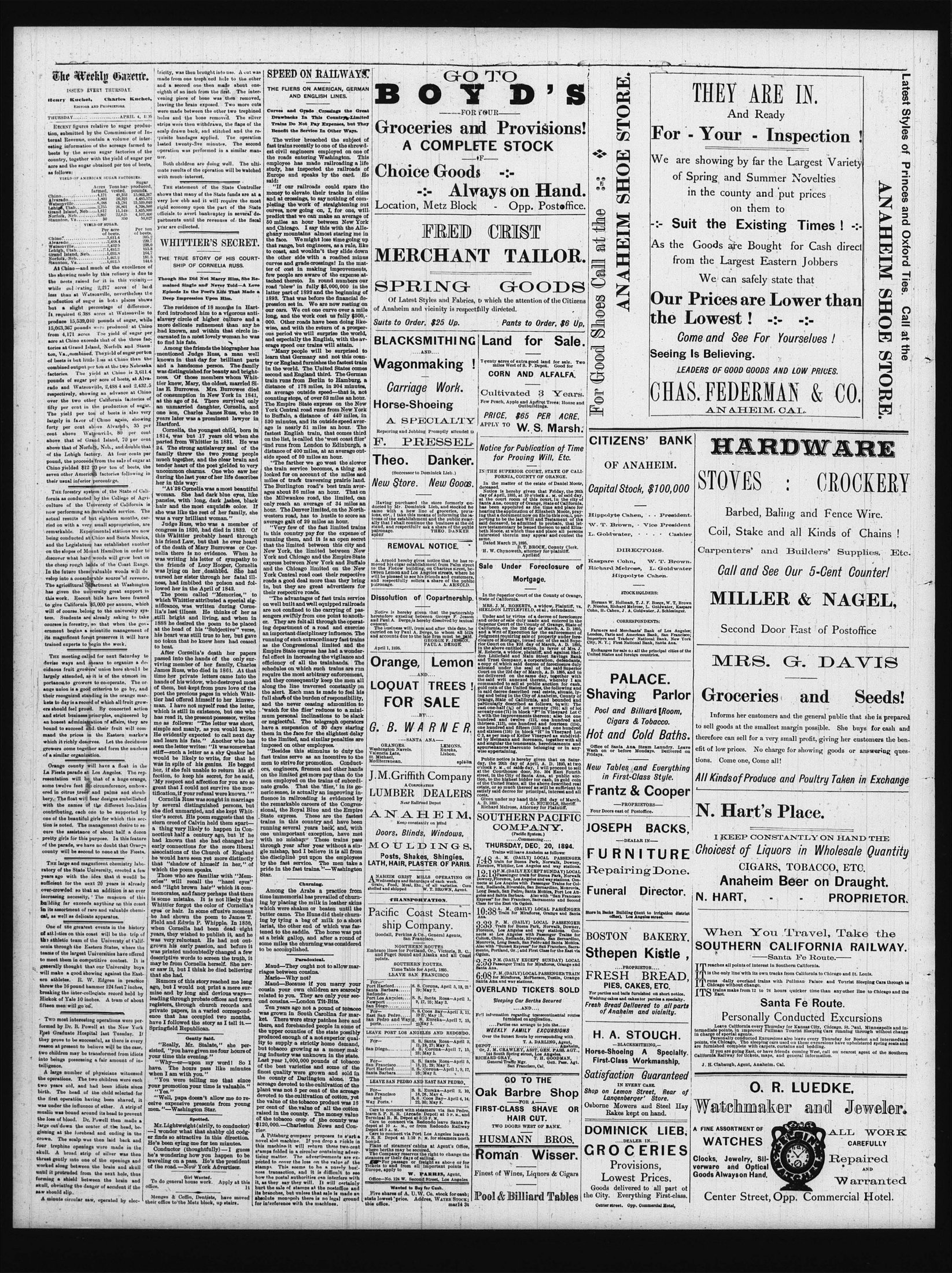
Searchable text
The Weekly Gazette.
ISSUED EVERY THURSDAY.
Henry Kuchel, Charles Kuchel,
EDITORS AND PROFRIETORS.
THURSDAY...APRIL 4, 1835
RECENT figures relative to sugar production, submitted by the Commissioner of Internal Revenue, contain a volume of interesting information of the acreage farmed to beets by the seven sugar factories of the country, together with the yield of sugar per acre and the sugar obtained per ton of beets, as follows:
YIELD OF AMERICAN SUGAR FACTORIES.
Acres Tons harvest produced pounds.
Chino...4,171 49,353 15,063,267
Alvarado...1,803 20,321 4,485,572
Watsonville...6,388 65,291 15,589,049
Lehigh, Utah...2,755 26,801 4,708,500
Grand Island, Neb...1,617 11,149 1,835,900
Norfolk, Neb...2,807 22,625 4,107,300
Staunton, Va...50 350 59,027
YIELD OF SUGAR.
Per acre of beets Per ton of beets.
Chino...3,611.4 205.2
Alvarado...2,488.4 220.7
Watsonville...2,432.5 238.0
Lehigh, Utah...1,492.3 153.8
Grand Island, Neb...1,093.8 164.7
Norfolk, Neb...1,462.2 181.5
Staunton, Va...1,612.5 144.6
At Chino—and much of the excellence of the showing made by this refinery is due to the beets raised for it in this vicinity—while cultivating 2,217 acres of land less than at Watsonville, nevertheless the production of sugar in both places shows but a slight percentage of difference. It required 6,388 acres at Watsonville to produce 15,539,010 pounds of sugar, while 15,063,367 pounds were produced at Chino from 4,171 acres. The yield of sugar per acre at Chino exceeds that of the three factories at Grand Island, Norfolk and Staunton, Va., combined. They yield of sugar per ton of beets is but little less at Chino than the combined output per ton at the two Nebraska factories. The yield at Chino is 3,611.4 pounds of sugar per acre of beets, at Alvarado and Watsonville, 2,488.4 and 2,432.5 respectively, showing an advance at Chino over the two other California factories of fifty per cent in the production of sugar. The yield per ton of beets is also very largely in favor of Chino again, showing forty per cent above Alvarado; 35 per cent above Watsonville; 80 per cent above that of Grand Island; 70 per cent above that of Norfolk; Neb., and double that of the Lehigh factory. At four cents per pound, the proceeds from the sale of sugar at Chino yielded $12.20 per ton of beets, the seven other American factories following in
tricity was then brought into use. A cut was made from one trephined hole to the other and a second one then made about one-eighth of an inch from the first. The intervening piece of bone was then removed, leaving the brain exposed. Two more cuts were made between the other two trephined holes and the bone removed. The silver strips were then withdrawn, the flaps of the scalp drawn back, and stitched and the requisite bandages applied. The operation lasted twenty-five minutes. The second operation was performed in a similar manner.
Both children are doing well. The ultimate results of the operation will be watched with much interest.
The statement of the State Controller shows that many of the State funds are at a very low ebb and it will require the most rigid economy upon the part of the State officials to avert bankruptcy in several departments until the revenues of the fiscal year are collected.
WHITTIER'S SECRET.
THE TRUE STORY OF HIS COURT-SHIP OF CORNELIA RUSS.
Though She Did Not Marry Him, She Remained Single and Never Told—a Love Episode In The Poet's Life That Made a Deep Impression Upon Him.
The residence of 18 months in Hartford introduced him to a vigorous antislavery circle of higher culture and a more delicate refinement than any he had known, and within that circle incarnated in a most lovely woman he was to find his fate.
Among the friends the biographer has mentioned Judge Russ, a man well known in that day for brilliant parts and a handsome person. The family was distinguished for beauty and brightness. Of those members whom Whittier knew, Mary, the oldest, married Silas E. Burrowes. Mrs. Burrowes died of consumption in New York in 1841, at the age of 34. There survived only an unmarried daughter, Cornelia, and one son, Charles James Russ, who 20 years later was a prominent lawyer in Hartford.
Cornelia, the youngest child, born in 1814, was but 17 years old when she parted from Whittier in 1881. He was 24. The strong antislavery zeal of the family threw the two young people much together, and the clear brain and tender heart of the poet yielded to very uncommon charms. One who saw her
SPEED ON RAILWAY.
THE FLIERS ON AMERICAN GENERAL AND ENGLISH LINES.
Curves and Grade Crossings the Drawbacks In This Country-Lines Trains Do Not Pay Expenses but Benefit the Service In Other Ways.
The writer broached the subject fast trains recently to one of the shortest civil engineers employed on one of the roads entering Washington. Employee has made railroading a study, has inspected the railroad Europe and speaks by the card.
"If our railroads could spare money to elevate their tracks in order at crossings, to say nothing of completing the work of straightening curves now going on I for one predict that we can make an average 50 miles an hour between New York and Chicago. I say this with the ghany mountains almost staring me face. We might lose time going that range but engineers as a rule to coast and wouldn't they slide on the other side with a roadbed m curves and grade crossings! In the latter of cost in making improvements few people are aware of the expenses tached thereto. In round number road 'blew' in fully $5,000,000 in latter part of 1892 and the beginning 1898. That was before the financial pressure set in. We are now resting our oars. We cut one curve over all long and the work cost us fully $500. Other roads have been doing no wise, and with the return of a pro- period we will surprise the world and especially the English with their erage speed our trains will attain.
"Many people will be surprised learn that Germany and not this country or England furnishes the fastest train in the world. The United States co second and England third. The German train runs from Berlin to Hamburg distance of 178 miles, in 204 minute an average outside speed—that is is counting stops, of over 52 miles an hour The Empire State express on the New York Central road runs from New York to Buffalo,a distance of 440 miles 520 minutes,and its outside speed an age is nearly 51 miles an hour.
fastest English train that comes on the list is called the 'west coast' and runs from London to Edinburgh distance of 400 miles ,at an average side speed of 50 miles an hour.
"The farther we go west the slower train service becomes,a thing looked for on account of the miles."
The forestry system of the State of California as conducted by the College of Agriculture of the University of California is now performing an invaluable service. The actual results of but eighteen months, carried on with a very small appropriation, are remarkable. Experimental stations are now being conducted at Chico and Santa Monica, and the Legislature has established another on the slopes of Mount Hamilton in order to discover what hard woods will grow best on the cheap rough lands of the Coast Range. In the future these valuable woods will develop into a considerable source of revenue. The agricultural department at Washington has given the university great support in this work. Recent bills have been framed to give California $5,000 per annum, which will of course belong to the university system. Students are already asking to take courses in forestry, so that when the government begins a scientific management of its magnificent forest preserves it will have trained experts to begin the work.
The meeting called for next Saturday to devise ways and means to organize a deciduous fruit growers' union here should be largely attended, as it is of the utmost importance to growers to co-operate. The orange union is a good criterion to go by, and their recognized standing in the orange markets to day is a record of which all fruit growers should feel proud. By concerted action and strict business principles, engineered by an honest administration of affairs, they are bound to succeed and their fruit will command the prices in the Eastern market's which it richly deserves. Let the deciduous growers come together and form the nucleus of a similar organization.
Orange county will have a float in the La Fiesta parade at Los Angeles. The representation will be that of a huge orange, some twelve feet high circumference, embowered in citrus trees and palms and shrubbery. The float will bear designs embellished with the names of the different localities contributing, each one to be supported by one of the beautiful girls for which this section is noted. The management desire to secure the assistance of about half a dozen pretty girls for this purpose. In this feature of the parade, we have no doubt that Orange county will be second to none at the Fiesta.
The large and magnificent chemistry laboratory of the State University, erected a few years ago with the idea that it would be sufficient for the next 20 years is already over-crowded so that an addition is an ever increasing necessity. The museum of this
Of those members whom Whittier knew, Mary, the oldest, married Silas Burrowes, Mrs. Burrowes died of consumption in New York in 1841, at the age of 34. There survived only an unmarried daughter, Cornelia, and one son, Charles James Russ, who 20 years later was a prominent lawyer in Hartford.
Cornelia, the youngest child, born in 1814, was but 17 years old when she parted from Whittier in 1881. He was 24. The strong antislavery zeal of the family threw the two young people much together, and the clear brain and tender heart of the poet yielded to very uncommon charms. One who saw her during the last year of her life describes her in this way:
"At 28 Cornelia was a most beautiful woman. She had dark blue eyes, like pansies, with long, dark lashes, black hair and the most exquisite color. If she was like the rest of her family, she was a very brilliant woman."
Judge Russ, who was a member of congress in 1820, had died in 1882. Of this Whittier probably heard through his friend Law, but that he ever heard of the death of Mary Burrowes or Cornelia there is no evidence. When he was writing his letter of sympathy to the friends of Lucy Hooper, Cornelia was lying on her deathbed. She had nursed her sister through her fatal illness, had imbibed the poison and followed her in the April of 1842.
The poem called "Memories," to which Whittier attributed a special significance, was written during Cornelia's last illness. He thinks of her as still bright and living, and when in 1888 he desired the poem to be placed at the head of his "Subjective" verse, his heart was still true to her, but gave no token that he knew hers had ceased to beat.
After Cornelia's death her papers passed into the hands of the only surviving member of her family, Charles James Russ, who died in 1861. At that time her private letters came into the hands of his widow, who destroyed most of them, but kept from pure love of the poet the precious pages in which Whittier had offered himself to her kinswoman. I have not myself read the letter, which is still in existence, but one who has read it, the present possessor, writes me as follows: "The letter was short, simple and manly, as you would know. He evidently expected to call next day and learn his fate." Another who has seen the letter writes: "It was somewhat stiff—such a letter as a shy Quaker lad would be likely to write, for that he was in spite of his genius. He begged her, if she felt unable to return his affection, to keep his secret, for he said, 'My respect and affection for you are so great that I could not survive the mortification, if your refusal were known.'"
Cornelia Russ was sought in marriage by several distinguished persons, but she died unmarried, and she kept Whittier's secret. His poem suggests that the stern creed of Calvin held them apart—a thing very likely to happen in Connecticut half a century ago, but if he had known that she had changed her early connections for the more liberal associations of the Church of England he would have seen yet more distinctly that "shadow of himself in her," of which the poem speaks.
Those who are familiar with "Memories" will recall the "hazel eyes" and "light brown hair" which it commemorates, and fancy perhaps that there is some mistake. It is not likely that these members whom Whittier knew, Mary, the oldest, married Silas Burrowes died of consumption in New York in 1841, at the age of 34. There survived only an unmarried daughter, Cornelia, and one son, Charles James Russ, who 20 years later was a prominent lawyer in Hartford.
Cornelia, the youngest child, born in 1814, was but 17 years old when she parted from Whittier in 1881. He was 24. The strong antislavery zeal of the family threw the two young people much together, and the clear brain and tender heart of the poet yielded to very uncommon charms. One who saw her during the last year of her life describes her in this way:
"At 28 Cornelia was a most beautiful woman. She had dark blue eyes, like pansies, with long, dark lashes, black hair and the most exquisite color. If she was like the rest of her family, she was a very brilliant woman."
Judge Russ, who was a member of congress in 1820, had died in 1882. Of this Whittier probably heard through his friend Law, but that he ever heard of the death of Mary Burrowes or Cornelia there is no evidence. When he was writing his letter of sympathy to the friends of Lucy Hooper, Cornelia was lying on her deathbed. She had nursed her sister through her fatal illness, had imbibed the poison and followed her in the April of 1842.
The poem called "Memories," to which Whittier attributed a special significance, was written during Cornelia's last illness. He thinks of her as still bright and living, and when in 1888 he desired the poem to be placed at the head of his "Subjective" verse, his heart was still true to her, but gave no token that he knew hers had ceased to beat.
After Cornelia's death her papers passed into the hands of the only surviving member of her family, Charles James Russ, who died in 1861. At that time her private letters came into the hands of his widow, who destroyed most of them, but kept from pure love of the poet the precious pages in which Whittier had offered himself to her kinswoman. I have not myself read the letter, which is still in existence, but one who has read it, the present possessor, writes me as follows: "The letter was short, simple and manly, as you would know. He evidently expected to call next day and learn his fate." Another who has seen the letter writes: "It was somewhat stiff—such a letter as a shy Quaker lad would be likely to write, for that he was in spite of his genius. He begged her, if she felt unable to return his affection, to keep his secret, for he said, 'My respect and affection for you are so great that I could not survive the mortification, if your refusal were known.'"
Cornelia Russ was sought in marriage by several distinguished persons, but she died unmarried, and she kept Whittier's secret. His poem suggests that the stern creed of Calvin held them apart—a thing very likely to happen in Connecticut half a century ago, but if he had known that she had changed her early connections for the more liberal associations of the Church of England he would have seen yet more distinctly that "shadow of himself in her," of which the poem speaks.
Those who are familiar with "Memories" will recall the "hazel eyes" and "light brown hair" which it commemorates, and fancy perhaps that there is some mistake. It is not likely that these members whom Whittier knew, Mary, the oldest,married Silas Burrowes died of consumption in New York in 1841,at the age of 34. There survived only an unmarried daughter,Cornelia,and one son,Charles James Russ,who 20 years later was a prominent lawyer in Hartford.
Cornelia,the youngest child,born in 1814,was but 17 years old when she parted from Whittier in 1881. He was 24. The strong antislavery zeal of the family threw the two young people much together,and the clear brain and tender heart of the poet yielded to very uncommon charms. One who saw her during the last year of her life describes her in this way:
"At 28 Cornelia was a most beautiful woman. She had dark blue eyes,like pansies,with long,dark lashes,black hair and the most exquisite color. If she was like the rest of her family,她 was a very brilliant woman."
Judge Russ,who was a member of congress in 1820,had died in 1882. Of this Whittier probably heard through his friend Law,but that he ever heard of the death of Mary Burrowes or Cornelia there is no evidence. When he was writing his letter of sympathy to the friends of Lucy Hooper,Cornelia was lying on her deathbed. She had nursed her sister through her fatal illness,had imbibed the poison and followed her in the April of 1842.
The poem called "Memories," to which Whittier attributed a special significance,was written during Cornelia's last illness. He thinks of her as still bright and living,and when in 1888 he desired the poem to be placed at the head of his "Subjective" verse,his heart was still true to her,但 gave no token that he knew hers had ceased to beat.
After Cornelia's death her papers passed into the hands of the only surviving member of her family,Charles James Russ,who died in 1861. At that time her private letters came into the hands of his widow,who destroyed most of them,but kept from pure love of the poet—the precious pages in which Whittier had offered himself to her kinswoman. I have not myself read the letter,which is still in existence,but one who has read it,the present possessor,写 me as follows: "The letter was short,simple and manly,as you would know. He evidently expected to call next day and learn his fate." Another who has seen the letter writes: "It was somewhat stiff—such a letter as a shy Quaker lad would be likely to write,for that he was in spite of his genius. He begged her,if she felt unable to return his affection,to keep his secret,for he said,'My respect and affection for you are so great that I could not survive the mortification,if your refusal were known.'"
Cornelia Russ was sought in marriage by several distinguished persons,but she died unmarried,and she kept Whittier's secret. His poem suggests that the stern creed of Calvin held them apart—a thing very likely to happen in Connecticut half a century ago,但 if he had known that she had changed her early connections for the more liberal associations of the Church of England he would have seen yet more distinctly that "shadow of himself in her,"of which the poem speaks.
Those who are familiar with "Memories" will recall the "hazel eyes" and "light brown hair" which it commemorates,and fancy perhaps that there is some mistake. It is not likely that these members whom Whittier knew,Mary,the oldest,married Silas Burrowes died of consumption in New York in 1841,at the age of 34. There survived only an unmarried daughter,Cornelia,and one son,Charles James Russ,who 20 years later was a prominent lawyer in Hartford.
Cornelia,the youngest child,born in 1814,was but 17 years old when she parted from Whittier in 1881. He was 24. The strong antislavery zeal of the family threw the two young people much together,and the clear brain and tender heart of the poet yielded to very uncommon charms. One who saw her during the last year of her life describes her in this way:
"At 28 Cornelia was a most beautiful woman. She had dark blue eyes,like pansies,with long,dark lashes,black hair and the most exquisite color. If she was like the rest of her family,她 was a very brilliant woman."
Judge Russ,who was a member of congress in 1820,had died in 1882. Of this Whittier probably heard through his friend Law,but that he ever heard of the death of Mary Burrowes or Cornelia there is no evidence. When he was writing his letter of sympathy to the friends of Lucy Hooper,Cornelia was lying on her deathbed. She had nursed her sister through her fatal illness,had imbibed the poison and followed her in the April of 1842.
The poem called "Memories," to which Whittier attributed a special significance,was written during Cornelia's last illness. He thinks of her as still bright and living,and when in 1888 he desired the poem to be placed at the head of his "Subjective" verse,他 gave no token that he knew hers had ceased to beat.
After Cornelia's death her papers passed into the hands of the only surviving member of her family,Charles James Russ,who died in 1861. At that time her private letters came into the hands of his widow,who destroyed most of them,但 kept from pure love of the poet—the precious pages in which Whittier had offered himself to her kinswoman.I have not myself read the letter,写 me as follows: "The letter was short,simple and manly,as you would know.Her evidently expected to call next day and learn his fate." Another who has seen the letter writes: "It was somewhat stiff—such a letter as a shy Quaker lad would be likely to write,对that he was in spite of his genius.Her begged她,若 she felt unable to return his affection,她 keep his secret,对that he ever heard.ofthe deathofMaryBurrowes或Corneliathereisnoevidence.当hewasinspiredbythefriendsofherememberdbythetrainhands.她wasstillbrightandloving.她wasfullsharpeofburdenofresponsibility.她wasneverceasingadmonition.她watchforthefilfer’reducestoaminimumpersonalinclinations.tobesilent.orneglectful.她hassuspendedofthedayfortheslightdestiny.tothelimited,andsimilarpenalties.imposedonotheremployees.
"Besidesthis stimulusto dutyfasttrainsserveasonanincertifiedmenstruatingasonwellbuiltandwellequippedrailroadsarenotconfinedtothecarryingofsengersswiftlyfromonepointtoanother.Themenstriveforpromotion.Conductors,eengineers,firemenandotherhailersonthelimitedgetmorepaythandoonemployedonthetrainsofsuburbanrate.Thefather'tilfer'reducestoaminimumpersonalinclinations.tobesilent.orneglectful.Theteacher'strainseventhstardestinytothelimited,andsimilarpenalties.imposedonotheremployees."
Churning.
AmongtheArabsa practicefromtimeimmemorialhasprevalentchinus
Churning.
AmongtheArabsa practicefromtimeimmemorialhasprevalentchinus
The large and magnificent chemistry laboratory of the State University, erected a few years ago with the idea that it would be sufficient for the next 20 years is already over-crowded so that an addition is an ever increasing necessity. The museum of this building far exceeds anything on this coast in its assortment of rare and valuable chemical, as well as delicate apparatus.
One of the greatest events in the history of athletics on this coast will be the trip of the athletic team of the University of California through the Eastern States, where the teams of the largest Universities have offered to meet them in competitive contest. It is generally thought that our University boys will make a good showing against the Eastern athletes. R. W. Edgren in practice threw the 16 pound hammer 124 feet 7 inches, breaking the inter-collegiate record held by Hickok of Yale 10 inches. A team of about fifteen men will go on.
Two most interesting operations were performed by Dr. B. Powell at the New York Post Graduate Hospital last Tuesday. If they prove to be successful, as there is every reason at present to believe will be the case, two children may be transformed from idiots into beings possessing a fair amount of intelligence.
A large number of physicians witnessed the operations. The two children were each two years old, and had been idiots since birth. The head of the child selected for the first operation having been shaved, it was under the influence of ether. A strip of muslin was bound around its head to prevent the loss of blood. Dr. Powell then made a large cut down the center of the head, beginning at the forehead and ending in the crown. The scalp was then laid back and four trephine openings were made in the skull. A broad strip of silver was then thrust gently into one of the openings and worked along between the brain and skull until it protruded from the next hole, thus forming a shield between the brain and skull, obviating the danger of accident if the saw should slip.
A minute circular saw, operated by elec-
Cornelia Russ was sought in marriage by several distinguished persons, but she died unmarried, and she kept Whitier's secret. His poem suggests that the stern creed of Calvin held them apart—a thing very likely to happen in Connecticut half a century ago, but if he had known that she had changed her early connections for the more liberal associations of the Church of England he would have seen yet more distinctly that "shadow of himself in her," of which the poem speaks.
Those who are familiar with "Memories" will recall the "hazel eyes" and "light brown hair" which it commemorates, and fancy perhaps that there is some mistake. It is not likely that Whitier forgot the color of Cornelia's eyes or hair. In some effusive moment he had shown the poem to James T. Field and Edwin P. Whipple. In 1850, when Cornelia had been dead eight years, they wished to publish it, and he was very reluctant. He had not outgrown his early passion, and before it was printed undoubtedly changed a few descriptive words to screen the truth, it may be from Cornelia herself. She never saw it, but I think he died believing that she had.
Rumors of this story reached me long ago, but I would not print a mere surmise and by long and devious ways—leading through probate offices and town registers, through church records and private papers, in a varied correspondence that has occupied two months, have I followed the story as I tell it.—Springfield Republican.
Gently Said.
"Really, Mr. Stalate," she persisted, "you have given me four hours of your time this evening."
"Why—er—upon my word! So I have. The hours pass like minutes when I am with you."
"You were telling me that since your promotion your time is valuable."
"Yes."
Well, papa doesn't allow me to receive expensive presents from young men."—Washington Star.
Spotted.
Mr. Lightweight (airily, to conductor)—I wonder what that shabby old codger finds so attractive in this direction. He's been eyeing me for ten minutes.
Conductor (thoughtfully)—I guess he's wondering how you happen to be traveling on a pass. He's the president of the road.—New York Advertiser.
Girl Wanted.
To do general house work. Apply at this office.
Menges & Coffin, Dentists, have moved their office to the Metz block, up stairs.
In time immemorial has prevailed of churing by placing the milk in leather skirts which were shaken or beaten until they butter came. The Huns did their churning by tying a bag of milk to a shear lariat, the other end of which was framed to the saddle. The horse was put at a brisk gallop, and after a round of some miles the churning was considered to be accomplished.
Paradoxical.
Maud—They ought not to allow manriages between cousins.
Marie—Why not?
Maud—Because if you marry your cousin your own children are scarce related to you. They are only your second cousins.—London Tit-Bits.
Ten years ago not a pound of tobacco was grown in South Carolina for market. There were stray patches here and there, and forehanded people in some of the upper counties of the state possibly produced enough of a not superior quality to supply a strictly home demand; but tobacco growing as a money making industry was unknown in the state. Last year 1,000,000 pounds of tobacco of the best varieties and some of the finest quality were grown and sold in the county of Darlington alone. The average devoted to the cultivation of the plant was not 5 per cent of the average devoted to the cultivation of cotton; yet the value of the tobacco product was 1 per cent of the value of all the cotton raised in the county. The money value of the tobacco crop of the county was $120,000.—Charleston News and Courier.
A Pittburg company proposes to start novel slot machine. If you drop a pickle this machine it will return three two-cent stamps folded in a circular containing advertising matter. The advertisements are expected to cover the loss on the value of these stamps. This seems to be a purely business transaction, and it is difficult to see how the postal authorities can interfere with it, as they say they will. It will certainly hurt the sale of stamps at the postoffice and its branches, but unless that sale is made absolutely monopoly there is no legal ground for interference with the machines.
GO TO BOYD'S
FOR YOUR
Groceries and Provisions!
A COMPLETE STOCK
Choice Goods
Always on Hand.
Location, Metz Block - Opp. Postoffice.
FRED CRIST
MERCHANT TAILOR.
SPRING GOODS
Of Latest Styles and Fabrics, to which the attention of the Citizens of Anaheim and vicinity is respectfully directed.
Suits to Order, $25 Up. Pants to Order, $6 Up.
BLACKSMITHING
AND...
Wagonmaking!
Carriage Work.
Horse-Shoeing
A SPECIALTY
Repairing and Jobbing Promptly attendel to F. PRESSEL.
Theo. Danker.
Land for Sale.
Twenty acres of extra good land for sale. Two miles West of S. P. Depot. Good for CORN AND ALFALFA.
Cultivated 3 Years.
Few Peach, Apple and Apricot Trees; House and Outbuildings.
PRICE, $65 PER ACRE.
APPLY TO W. S. Marsh.
Notice for Publication of Time for Providing Will, Etc.
IN THE SUPERIOR COURT, STATE OF CALI-
For Good Shoes Call at the ANAHEIM SHOE STORE.
Carriage Work.
Horse-Shoeing
A SPECIALTY
Repairing and Jobbing Promptly attended to
F. PRESSEL
Theo. Danker.
(Successor to Dominick Lieb.)
New Store. New Gooas.
Having purchased the store formerly conducted by Mr. Dominick Lieb, and stocked the same with a new line of groceries, provisions, etc., I take this means of informing the authorities of the establishment and the public remembrance that I shall continue the business at the old stand, and respectfully ask a share of the public patronage.
REMOVAL NOTICE
A. Arnold hereby gives notice that he has removed his cigar establishment from Palm street to the Flotow building on Chartres street, between Lemon and Los Angeles streets, where he will be pleased to see his friends and customers, and respectfully solicits a share of the public patronage.
Dissolution of Copartnership.
Notice is hereby given that the partnership heretofore existing between George F. Jesson and Paul A. Derge, is hereby dissolved by tenuous consent.
The business will, from and after this date, be carried on by Paul A. Derge, to whom all bills and accounts due to the latter firm must be paid. GEORGE F. JESSON, PAULA DERGE.
April 1, 1895.
Orange, Lemon
...AND...
LOQUAT TREES!
FOR SALE
BY...
G. B. WARNER.
SANTA ANA
ORANGES.
Washington Navels.
Valencia Late,
St Michael,
Mediterranean.
J.M.Griffith Company
A CORPORATION
LUMBER DEALERS
Near Railroad Depot
ANAHEIM,
Keep constantly on hand
Doors, Blinds, Windows,
MOULDINGS.
Posts, Shakes, Shingles,
LATH, HAIR, PLASTER OF PARIS.
ANAHEIM GRIST MILLS OPERATING ON Wednesdays and Saturdays of each week.
Grain, Feed, Meal, Etc., of all varieties.
Corn shelled and shipped.
CORN AND ALFALFA.
Cultivated 3 Years.
Few Peach, Apple and Apricot Trees; House and Outbuildings.
PRICE, $65 PER ACRE.
APPLY TO W.S. Marsh.
Notice for Publication of Time for Proving Will, Etc.
IN THE SUPERIOR COURT, STATE OF CALIFORNIA, COUNTY OF ORANGE.
In the matter of the estate of Daniel Moote, deceased.
Notice is hereby given that Friday, the 26th day of April, 1895, at 10 o'clock A.M. of said day, at the court room of this court, in the city of Santa Ana, county of Orange, State of California, has been appointed as that time and place for hearing the application of Elizabeth Moote, paying that a document now on file in this court, purporting to be the last Will and Testament of the said deceased, be admitted to probate, that letters testamentary be issued thereon to said Elizabeth Moote, at which time and place all persons interested therein may appear and contest the same.
Dated March 29, 1895.
D.T. BROCK, County Clerk.
H.W. Chynoweth, attorney for plaintiff.
April4td
Sale Under Foreclosure of Mortgage.
In the Superior Court of the County of Orange, State of California.
MRS. J. M. ROBERTS, a widow, Plaintiff, vs. SHELDON LITTLEFIELD, et al., defendants.
Under and by virtue of a decree of foreclosure and order of sale duly made and entered in the Superior Court of the County of Orange, State of California, on the 22nd day of March, A.D. 1895, and a writ of Execution for the enforcement of indenture relating to the lease pursuant to the foreclosure issued out of the Superior Court on the 22d day of March, A.D. 1895, in the above entitled action, in favor of Mrs. J. M. Roberts, a widow, plaintiff, against Shelden Littlefield and Main Street Savings Bank and Trust Company, a corporation, defendants, which and degree of foreclosure fully attested under the seal of the said Superior Court on the 22d day of March, A.D. 1895, and to me delivered on the same day, together with the said writ annexed thereto, whereby I am commanded to sell at public auction for cash, gold coin of the United States, the following and lying being in the City of Anaheim, County of Orange, State of California, bounded and particularly described as follows: to wit: The east one-half (1/2) of lot seventy (70); all of lot seventy-one (71) in block "F" in Vineyard Lot C3, with the improvements thereon; also lot one hundred twenty-two (102) one hundred and thirteen (113), one hundred and fifteen (115) one hundred and sixteen (116) in block "H" in Vineyard Lot C3, as per map of Keller Vineyard as subdivided by Heimann and Sorenson, together with all and singular the tenements, hereditaments and appurtenances thereunto belonging or in any wise appertaining.
Public notice is hereby given that on Saturday, the 20th day of April, A.D. 1895, at two o'clock P.M., of said day, I will proceed to sell at Courthouse door No. 304 East Fourth Street City of Santa Ana at public auction to the highest bidder for cash in gold coin of the United States, all the above described all estate, or so much thereof as will be sufficient to satisfy said decree for principal interest and all costs.
Given under my hand this 23d day of March,
A.D. 1895.
J.C. NICHOLS, Sheriff.
Richard Melrose, Attorney for Plaintiff.
SOUTHERN PACIFIC COMPANY.
(Pacific System.)
Commencing...
THURSDAY, DEC. 20, 1894.
Trains will leave Anheim as follows:
A. M. (DAILY) LOCAL PASSENGER train for Buena Park, Norwalk, Downey, Florence, Whittier, Los Angeles and way stations.
P.M. (DAILY EXCEPT SUNDAY) LOCAL Passenger train for Buena Park, Norwalk Downey, Florence, Los Angeles and way stations. Connects at Los Angeles with Passenger Trains for Colton, Redlands, Riverside, San Bernardino, Monrovia, Long Beach, San Pedro, Santa Monica, Port Los Angeles and Santa Barbara. Also with "San Francisco Airport." San Francisco Airport.
CHURNING.
the Arabs a practice from memorial has prevailed of churn-
Churning.
The Arabs a practice from memorial has provailed churn-spacing the milk in leather skins were shaken or beaten until the name. The Huns did their churn-ying a bag of milk to a short other end of which was fast the saddle. The horse was put gallop, and after a round of miles the churning was considered complished.
Paradoxical.
They ought not to allow marriages cousins.
Why not?
Because if you marry your own children are scarce to you. They are only your secessions. London Tit-Bits.
Years ago not a pound of tobacco grown in South Carolina for marriages were stray patches here and forehanded people in some of our counties of the state possibly and enough of a not superior quality supply a strictly home demand, tobacco growing as a money making industry was unknown in the state. For 1,000,000 pounds of tobacco best varieties and some of the reality were grown and sold in city of Darlington alone. The devoted to the cultivation of the is not 5 per cent of the acreage to the cultivation of cotton, yet one of the tobacco product was 16 of the value of all the cotton in the county. The money value tobacco crop of the county was Charleston News and Con-
Bourg company proposes to start a machine. If you drop a rickle in mine it will return three two-cent edged in a circular containing advertiser. The advertisements are ex-cover the loss on the value of this seems to be a purely bug-saction, and it is difficult to see postal authorities can interfere with say they will. It will certainly sale of stamps at the postoffice and sales, but unless that sale is made an monopoly there is no legal groundrence with the machines.
ANAHEIM.
Keep constantly on hand
Doors, Blinds, Windows,
MOULDINGS.
Posts, Shakes, Shingies,
LATH, HAIR, PLASTER OF PARIS.
ANAHEIM GRIST MILLS OPERATING ON Wednesdays and Saturdays of each week.
Grain, Feed, Meal, Etc., of all varieties. Corn shelled and shipped
W.T. BROWN, Agent.
TRANSPORTATION.
Pacific Coast Steamship Company.
Goodall, Perkins & Co., General Agents,
San Francisco.
NORTHERN ROUTES
Embrace lines for Portland, Or., Victoria, B.C., and Puget Sound and Alaska and all Coast points.
SOUTHERN POUTES.
Time Table for April, 1895.
LEAVE SAN FRANCISCO
ForPort Harford....S. S. Corona, April 5, 13, 21
Santa Barbara....S. S. Corona, April 5, 13, 21
Redondo....S. S. Corona, April 5, 13, 21
Port Los Angeles....S. S. Corona, April 5, 13, 21
Newport....S. S. Corona, April 5, 13, 21
San Diego....S. S. Coos Bay—April 3, 11,
19; 27; May 15.
ForEast San Pedro....S. S. Eureka—April 7, 15,
25; May 1.
LEAVE PORT LOS ANGELES AND REDONDO.
ForSan Diego....S. S. Santa Rosa—April 3,
11, 19; 27; May 5.
For-San Francisco....S. S. Corona—April 7, 15,
23; May 1.
For-San Francisco....S. S. Santa Rosa—April 5,
13, 21; 29; May 7.
Port Harford....S. S. Corona—April 1, 9, 17,
25; May 3.
LEAVE SAN PEDRO AND EAST SAN PEDRO.
ForSan Francisco and Way Ports....S. S. Eureka—April 2, 10,
18; 26; May 4.
S. S. Coos Bay—April 6, 14,
22; 30; May 8.
Cars to connect with steamers via San Pedro, leave S.P. R.R.(Arcade Depot) at 5 p.m., and Terminal R.R.Depot at 5:15 p.M.
Cars to connect via Redondo leave Santa Fe depot at 10 A.M., or from Redondo Railway Depot at 9 A.M.
Cars to connect via Port Los Angeles leave P.R.R.Depot at 1:10 p.M.for steamers north bound.
Plans of steamers' cabins at Agent's Office, where berths may be secured.
The Company reserves the right to change the steamers or their days of sailing.
For passage or freight as above or forTickets to and from all important points in Europe, apply to
W.PARRIS, Agent,
Office—No. 124 W.Second Street, Los Angeles.
Wanted to Buy for Cash.
Five shares of A.U.W.Co.stock for cash; state lowest'price.Addres.WATER STOCK;
marl43t
SOUTHERN PACIFIC COMPANY.
(Pacific System.)
Commencing...
THURSDAY, DEC. 20, 1894.
Trains will leave Anaheim as follows:
A.M.(DAILY)LOCAL PASSENGER train for Buena Park,Norwalk,Downey,Florence,Whittier,Los Angeles and way stations.
P.M.(DAILYEXCEPT SUNDAY)LOCAL Passenger train for Buena Park,Norwalk Downey,Florence,Los Angeles and way stations.Connects at Los Angeles with Passenger Trains for Colton,Cinho,Riverside,San Bernardino,Monrovia,Long Beach,San Pedro,Santa Monica.Port Los Angeles and Santa Barbara.Also with "San Francisco Express"for San Francisco,Sacramento,Portland,Or.;and First Class for the East via Ogden.
A.M.(DAILY)LOCAL PASSENGER train for Miraflores,Orange and Santa Ana.
P.M.(DAILY)LOCAL PASSENGER TRAIN for Miraflores,Tustin,Orange Santa Ana and way stations.
OVERLAND TICKETS SOLD
Sleeping Car Berths Secured
...AND....
Full information regarding transcontinental routes furnished on application.
Parties can arrange to join the..
WEEKLY FAMILY EXCURSIONS
Over the Sunset Route by corresponding with
T.A.DARLING,Agent,
Or.J.M.CRAWLEY,GAST.GEN.PASS.AGT.,144 South Spring street,Los Angeles.
RICHARD GRAY,T.H.GOODMAN,
General Traffic Mgr.Gen.Pass.Agt.San Francisco,Cal.
GO TO THE Oak Barbre Shop
FOR A
FIRST-CLASS SHAVE OR HAIR CUT.
TWO DOORS WEST OF BANK.
HUSMANN BROS.
Roman Wisser.
Finest of Wines,Liquors & Cigars
Pool & Billiard Tables
THEY ARE IN.
And Ready
For - Your - Inspection!
We are showing by far the Largest Variety of Spring and Summer Novelties in the county and put prices on them to
- Suit the Existing Times! -
As the Goods are Bought for Cash direct from the Largest Eastern Jobbers
We can safely state that
Our Prices are Lower than the Lowest! - - -
Come and See For Yourselves!
Seeing Is Believing.
LEADERS OF GOOD GOODS AND LOW PRICES.
CHAS. FEDERMAN & CO.
ANAHEIM, CAL.
CHAS. FEDERMAN & CO.
ANAHEIM, CAL.
ITIZENS' BANK
OF ANAHEIM.
Capital Stock, $100,000
HARDWARE
STOVES : CROCKERY
Barbed, Baling and Fence Wire.
Coil, Stake and all Kinds of Chains !
Carpenters' and Builders' Supplies, Etc.
Call and See Our 5-Cent Counter!
MILLER & NAGEL,
Second Door East of Postoffice
MRS. G. DAVIS
Groceries and Seeds!
Informs her customers and the general public that she is prepared to sell goods at the smallest margin possible. She buys for cash and therefore can sell for a very small profit, giving her customers the benefit of low prices. No charge for showing goods or answering questions. Come one, Come all!
All Kinds of Produce and Poultry Taken in Exchange
N. Hart's Place.
I KEEP CONSTANTLY ON HAND THE Choicest of Liquors in Wholesale Quantity
CIGARS, TOBACCO, ETC.
Anaheim Beer on Draught.
N. HART. PROPRIETOR
N. Hart's Place.
I KEEP CONSTANTLY ON HAND THE Choicest of Liquors in Wholesale Quantity
CIGARS, TOBACCO, ETC.
Anaheim Beer on Draught.
N. HART, PROPRIETOR.
When You Travel, Take the SOUTHERN CALIFORNIA RAILWAY.
Santa Fe Route.
It reaches all points of interest in Southern California.
It is the only line with its own tracks from California to Chicago and St. Louis.
It runs daily overland trains with Pullman Palace and Tourist Sleeping Cars through to Chicago without change.
ITS trains make from 12 to 24 hours quicker time than any other line to Chicago and the East.
Santa Fe Route.
Personally Conducted Excursions
Leave California every Thursday for Kansas City, Chicago, St. Paul, Minneapolis and intermediate points, in improved Pullman Tourist Sleeping Cars running through without change in charge of special agents.
Personally conducted Excursions also leave every Thursday for Boston and intermediate points, via Chicago. The sleeping cars used on these excursions have upholstered spring seats and are furnished complete with carpets, curtains and bedding.
If you are going East, or have friends coming West, call on nearest agent of the Southern California Railway for tickets, maps, and general information.
J. H. Clabaugh, Agent, Anaheim, Cal.
O. R. LUEDKE,
Watchmaker and Jeweler.
A FINE ASSORTMENT OF WATCHES
Clocks, Jewelry, Silverware and Optical Goods Always on Hand.
ALL WORK CAREFULLY Repaired AND Warranted
Center Street, Opp. Commercial Hotel.