anaheim-gazette 1894-12-06
Scanned page
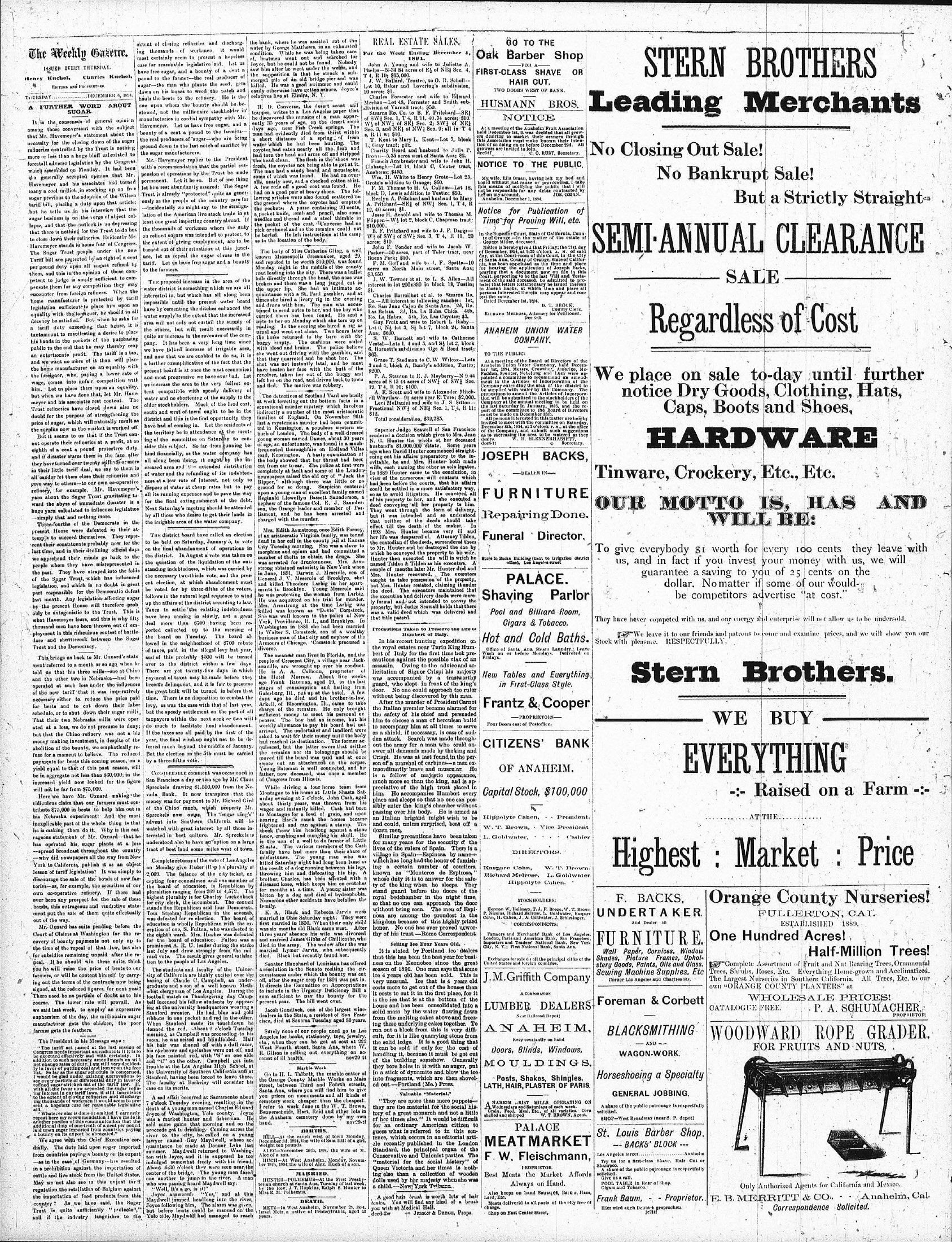
Searchable text
The Weekly Gazette.
ISSUER EVERY THURSDAY.
Henry Kuchol, Charles Kuchol,
Editors and Proprietors.
THURSDAY...DECEMBER 6, 1891.
A FURTHER WORD ABOUT SUGAR
It is the consensus of general opinion among those conversant with the subject that Mr. Havemeyer’s statement about the necessity for the closing down of the sugar refineries controlled by the Trust is nothing more or less than a huge bluff calculated to forestall adverse legislation by the Congress which assembled on Monday. It had been the generally accepted opinion that Mr. Havemeyer and his associates had turned many a cool million in stocking up on free sugar previous to the adoption of the Wilson tariff bill, placing a duty upon that article; but he tells us in his interview that the sugar business is on the verge of abject collapse, and that the outlook is so depressing that there is nothing for the Trust to do but to close down their refineries. Evidently Mr. Havemeyer stands in some fear of Congress. The Sugar Trust people under the new Tariff bill are protected by an eight of a cent per pound duty upon all sugars refined by them, and this in the opinion of those competent to judge is amply sufficient to compensate them for any competition they may encounter from foreign refiners. When the home manufacturer is protected by tariff legislation sufficient to place him upon an equality with the foreigner, he should in all decency be satisfied. But when he asks for a tariff duty exceeding that figure, it is tantamount to manifesting a desire to place his hands in the pockets of the purchasing public to the end that he may thereby reap an extortionate profit. The tariff is a tax, and we want no more of it than will place the home manufacturer on an equality with the foreigner, who, paying a lower rate of wage, comes into unfair competition with him. Let us place them upon an equality, but when we have done that, let Mr. Havemeyer and his associates rest content. The Trust refineries have closed down also no doubt for the purpose of strengthening the price of sugar, which will naturally result as the surplus now in the market is worked off.
But it seems to us that if the Trust cannot operate their refineries at a profit, at an eighth of a cent a pound protective duty, and if disaster stares them in face after them turnover over twenty millions or more extent of closing refineries and discharging thousands of workmen, it would most certainly seem to present a hopeless case for reasonable legislative aid. Let us have free sugar, and a bounty of a cent a pound to the farmer—the real producer of sugar—the man who plants the seed, gets down on his knees to weed the patch and hauls the beets to the refinery. He is the one upon whom the bounty should be stowed, not the millionaire stockholder in manufactories in cordial sympathy with Mr. Havemeyer. Let us have free sugar, and a bounty of a cent a pound to the farmers—the real producers of sugar—who are being ground down to the last notch of sacrifice by the sugar manufacturers.
Mr. Havemeyer replies to the President with a recommendation that the partial suspension of operations by the Trust be made permanent. Let it be so. But of one thing let him rest abundantly assured: The Sugar Trust is already "protected" quite as generously as the people of the country care for—incidentally we might say to the strangulation of the American live stock trade in at least one great importing country abroad. If the thousands of workmen whom the duty on refined sugars was intended to protect, to the extent of giving employment, are to be turned out of their situations at this juncture, let us repeal the sugar clause in the tariff. Let us have free sugar and a bounty to the farmers.
The proposed increase in the area of the water district is something which we are all interested in, but which has all along been impossible until the present water board by having cemented the ditches enhanced the water supply to the extent that the increased area will not only not curtail the supply of the others, but will result necessarily in quite an increase in the revenues of the company. It has been a very long time since we have talked increase of irrigable area, and now that we are enabled to do so, it is a further exemplification of the fact that the present board is at once the most economical and most progressive we have ever had. Lot us increase the area to the very fullest extent compatible with speedy delivery of water and no shortening of the supply to the older stockholders. Much of the land east, south and west of town ought to be in the district and this is the first opportunity they have had of coming in. Let the residents of the territory be in attendance at the meeting of the committee on Saturday to consider this subject. So far from running behind financially, as the water company has all along been doing, it ought by the in-bank, where he was assisted out of the water by George Matthews, in an exhaustion condition. While he was being taken care of, boatmen went out and searched for Joyce, but he could not be found. Nobody saw him after he went under the water, and the supposition is that he struck a submerged pile of an old bridge pier and was killed. He was a good swimmer and could easily otherwise have gotten ashore. Joyce relatives live at Elmira, N.Y.
H. D. Converse, the desert scout and trapper, writes to a Los Angeles paper this week discovered the remains of a man apparently 35 years of age, on the desert some days ago, near Fish Creek springs. The man had evidently died from thirst within a short distance of a spring of fresh water which he had been hunting. The coyotes had eaten nearly all the flesh and had torn the head and arms off and stripped the head clean. The flesh in the shoes was fresh, the coyotes not being able to get at it. The man had a sandy beard and moustache some of which was found. He had on oveys all, nearly new, and a checked cotton shirt. A few rods off a good coat was found. He had on a good pair of heavy shoes. The lowing articles were also found scattered on the ground where the coyotes had emptied their pockets: A purse containing 90 cents—a pocket knife, somb and pencil, also some needles and thread and a steel thumbhole—the pocket of the coat. Converse had a pick or shovel and so remains could not be buried. He left instructions at the carriage as to the location of the body.
The body of Miss Catherine Gling, a woman known Minnesota dressmaker, aged 74 and reputed to be worth $10,000, was found Monday night in middle of the courtyard leading into the city. There was a bulb hole directly through the head, the nose wilt broken and there was a long jagged cut out upper lip. She had an intimate quaintance with a St. Paul gambler, and times she hired a livery rig in the event and drove with him. The man was accustomed to send notes to her, and the boy was carried them has been found. He sent note to her on Monday which she toro up reading. In the evening she hired a rigid usual and went out alone. Two hours later she returned to the barn with buggy empty. The cushions were soon with blood and brains. The police belled she went out driving with the gambler, that they quarreled and he shot her. The shot was not instantly fatal, and he must have beaten her face with the butt of her revolver, taken her out of the buggy left her on the road, and driven back to town and fled.
The detectives of Scotland Yard are busy at work forreting outthe bottom facts in sensational murder mystery which involves indirectly a number ofthe most aristocratic families of England.On November 25 last a mysterious murder had been committed in Keensington,a populous western burh of London.The bodyofa well-dwelling young woman named Dawes,babout 30 years old,and an fortunate,dwas foundin a much frequented thoroughfare on Holland Viaduct.Keensington.A hasty examination tookthe body showed that her throat had been
the home manufacturer on an equality with the foreigner, who, paying a lower rate of wage, comes into unfair competition with him. Let us place them upon an equality, but when we have done that, let Mr. Havemeyer and his associates restitute the price of sugar, which will naturally result as the surplus now in the market is worked off.
But it seems to us that if the Trust cannot operate their refineries at a profit, at an eighth of a cent a pound protective duty, and if disaster stares them in the face after they have turned over twenty millions or more in their little tariff deal, we say to them in all candor let them close their refineries and give way to others—to our own co-operative refinery, for example. Mr. Havemeyer’s yarn about the Sugar Trust gravitating toward the abyss of immediate disaster is a huge yarn calculated to influence legislation—simply that and nothing more.
Three-fourths of the Democrats in the present House were defeated in their attempt to succeed themselves. They represent their constituents probably now for the last time, and in their declining official days we apprehend their minds go back to the people whom they have misrepresented in the past. They have strained into the folds of the Sugar Trust, which has influenced legislation, and which is no doubt in great part responsible for the Democratic defeat last month. Any legislation affecting sugar by the present House will therefore probably be antagonistic to the Trust. This is what Havemeyer fears, and this is why fifty thousand men have been thrown out of employment in this ridiculous contest of battle-dore and shutticock between the Sugar Trust and the Democracy.
This brings us back to Mr. Oxuard’s statement referred to a month or so ago when he told us that his three mills—one at Chino and the other two in Nebraska—had been operated at such loss under the influences of the new tariff that it was imperatively necessary either to reduce the price paid for beets and to cut down their labor schedule, or to abut down their sugar mills. That their two Nebraska mills were operated at a loss, we do not presume to deny; but that the Chino refinery was not a big money making investment, in despite of the abolition of the bounty, we emphatically refuse for a moment to believe. The reduced payments for beets this coming season, on a yield equal to that of this past season, will be in aggregate not less than $60,000; in the increased yield now looked for the figure will not be far from $75,000.
Here we have Mr. Oxuard making the ridiculous claim that our farmers must contribute $75,000 in beets to help him out in his Nebraska experiment! And the most inexplicable part of the whole thing is that he is making them do it. Why is this outrageous statement of Mr. Oxuard—that he has operated his sugar plants at a loss—spread broadcast throughout the country—why did newspapers all the way from New York to California publish it as an object lesson of tariff legislation? It was simply to present board is at once the most economical and most progressive we have ever had. Lot us increase the area to the very fullest extent compatible with speedy delivery of water and no shortening of the supply to the older stockholders. Much of the land east, south and west of town ought to be in the district and this is the first opportunity they have had of coming in. Let the residents of the territory be in attendance at the meeting of the committee on Saturday to consider this subject. So far from running behind financially, as the water company has all along been doing, it ought by the increased area and the extended distribution of water and the refunding of its indebtedness at a low rate of interest, not only to dispose of water at cheap rates but to pay all its running expenses and to pave the way for the final extinguishment of the debt. Next Saturday’s meeting should be attended by all those who desire to get their lands in the irrigable area of the water company.
The district board have called an election to be held on Saturday, January 5, to vote on the final abandonment of operations in the district. In August a vote was taken on the question of the liquidation of the outstanding indebtedness, which was carried by the necessary two-thirds vote, and the present election, at which abandonment must be voted for by three-fifths of the voters, follows in the natural legal sequence to wind up the affairs of the district according to law. Taxes to settle ‘the existing indebtedness have been coming in slowly, not a great deal more than $700 having been reported collected up to the meeting of the board on Tuesday. The board allowed in the neighborhood of $700 rebate of taxes, paid in the illegal levy last year, and of this probably $500 will be turned over to the district within a few days. There are yet twenty-five days in which payment of taxes may be made before they become delinquent, and it is fair to presume the great bulk will be turned in before that time. There is no disposition to combat the levy, as was the case with that of last year, but the speedy settlement on the part of all taxpayers within the next week or two will do much to facilitate final abandonment. If the taxes are all paid by the first of the year, the final wind-up ought not to be deferred much beyond the middle of January. But the election on the 5th must be carried by a three-fifths vote.
Considerable comment was occasioned in San Francisco a day or two ago by Mr. Claus Spreckels drawing $1,500,000 from the Nevada Bank. It now transpires that the money was for payment to Mr. Richard Girl of the Chino ranch, which property Mr. Spreckels now owns. The “sugar king’s” advent into Southern California will be watched with great interest by all those interested in beet culture. Mr. Spreckels is understood also to have an option on a large tract of beet land some miles west of town.
Complete returns of the vote of Los Angeles on Monday give Rader (R-p) a plurality of 2,009. The balance of the city ticket, ex present board is at once the most economical and most progressive we have ever had. Lot us increase the area to the very fullest extent compatible with speedy delivery of water and no shortening of the supply to the older stockholders. Much of the land east, south and west of town ought to be in the district and this is the first opportunity they have had of coming in. Let the residents of the territory be in attendance at the meeting of the committee on Saturday to consider this subject. So far from running behind financially, as the water company has all along been doing, it ought by the increased area and the extended distribution of water and the refunding of its indebtedness at a low rate of interest, not only to dispose of water at cheap rates but to pay all its running expenses and to pave the way for the final extinguishment of the debt. Next Saturday’s meeting should be attended by all those who desire to get their lands in the irrigable area of the water company.
The detectives of Scotland Yard are busy at work forreting out the bottom facts in sensational murder mystery which involves indirectly a number of the most aristocratic families of England. On November 24 last a mysterious murder had been committed in Kensington, a populous western burb of London. The body of a well-dressed young woman named Dawes, about 30 years old, an unfortunate, was found in a nearby frequented thoroughfare on Holland Village Road, Kensington. A busty examination of the body showed that her throat had been cut from ear to ear. The police at first wently completely at fault and some of The Lonely newspapers raised the old cry of “Jack Ripper,” although there was little or ground for so doing. Suspicion centered upon a young man of excellent family name Reginald Llewellyn Bassett Saunderson nephew of the famous Col. E. J. Saunson son, the Orange leader and member of lion lament, and he has been arrested charged with the murder.
Mrs. Edith Armstrong, once Edith Forrest of an aristocratic Virginia family, was torn dead in her cell in the county jail at Kail City Tuesday morning. She was a slave morphine and opium and had committed number of thefts to obtain drugs was arrested for drunkeness. Mrs. A strong obtained notoriety in New York wint in June, 1891; Darwin J. Messerole, son General J. Y. Messerole or Brooklyn; and killed Theodore Larbig in her apartment in Brooklyn. Young Messerole she was protecting the woman from Lark He was acquitted on his trial for murmur Mrs. Armstrong at time Lark Billed was known as “Dovie” Comtete She was well known to the police of New York, Providence, R.L., and Brooklyn.Washington in 1881 she had been married to Walter S. Comstock, son of a weak business man of that city and nephew of Armours of Chicago.Comstock procured divorce.
The meanest man lives in Florida,and people of Crescent City,a village near J.sonville are wrought up over his condiHe is A.A.Calhoun.propretorhe Hotel Morrow.About five weeks ago Frank Bateman,aged 19,in thie stagesof consumption and hastling Galesburg IL.put up at hotel.A days ago he died and his brother-Arkell.of Bloomington IL,came to o chargeofthe remains.He only brought sufficient money to meet his personal pens.The boy had an incomebut weekly allowance to pay his board had arrived.The undertaker and landlord asked to wait for their money until it had reached its destination.The former quiessed,butthe latter sware that net remained nor its belongings should moved tillthe board was paid and at swore out an attachment onthe Young Bateman is well connected,and father,now deceased.was once a memberof Congress from Illinois.
While driving a four horse team Montague to his home at Little Shasta闹 day evening at 7 o’clock John Cash,babout thirty yearswas thrown from wagon and instantly killed.Cash had to Montague for a load of grain,and nearing Hart’s ranchthe horsesbe freightenedand ran againsta stump.shock throw him headlong againsta fence,cruishingand manglinghis skull.isthe sonofa wellto do farmerL Shasta.The various membersofthe family have had more than their misfortunes.The young man who killed Saturday night had long been laughedthe result of a dog running between his throwing him and dislocating his hip
Here we have Mr. Oxnard making the ridiculous claim that our farmers must contribute $75,000 in beets to help him out in his Nebraska experiment! And the most inexplicable part of the whole thing is that he is making them do it. Why is this outrageous statement of Mr. Oxnard—that he has operated his sugar plants at a loss—spread broadcast throughout the country—why did newspapers all the way from New York to California publish it as an object lesson of tariff legislation? It was simply to discourage the sale of the bonds of new factories—as, for example, the securities of our own co-operative refinery. If there had ever been any prospect for the sale of these bonds, this outrageous and vindictive statement put the sale of them quite effectually out of the way.
Mr. Oxnard has suits pending before the Court of Claims at Washington for the recovery of bounty payments not only up to the time of the repeal of that law, but also for subsidies remaining unpaid after the repeal. If he should win these suits, think you he will raise the price of beets to our farmers, or will he content himself by carrying out the terms of the contracts now being signed, at the reduced figures, for next year? There need be no particle of doubt as to his course. The lower rate will prevail. As we said last week, to employ an expressive euphemism of the day, the millionaire sugar manufacturer gets the chicken, the poor farmer gets the feathers.
The President in his Message says:
"The tariff act passed at the last session of Congress important amendments if it is to be executed effectively and with certainty. In addition to such necessary amendments as will not change rates of duty, I am still very decidedly in favor of putting coal and from upon the free land the sugar schedule in order to avoid I would be glad under existing aggravations to see every particle of differential duty in favor of refined sugar stricken out of the tariff law. If, with all the favor now accorded the sugar refining interest in our tariff laws, it still languishes to the extent of closing refineries and discharging thousands of workmen it would seem to present a hopeless case for reasonable legislative aid."
"Whatever else is done or omitted I earnestly repeat here my recommendation I have made in another portion of this communication that the additional duty of one-tenth of a cent per pound laid upon sugar imported from countries paying a bounty on its export abrogated."
We agree with the Cloef Executive cordially. The duty laid upon sugar imported from countries paying a bounty on its export—as in the case of Germany—has resulted in a prohibition against the importation of cattle and live stock from the United States. May we not also see in this unjust tariff regulation the retaliation of Belgium against the importation of food products from this country? As we have said, the Sugar Trust is quite sufficiently "protected," and if the industry languishes to the
Complete returns of the vote of Los Angeles on Monday give Rader (R-p) a plurality of 2,009. The balance of the city ticket, except four councilmen and one member of the board of education, is Republican by pluralities ranging from 269 to 4,572. The highest plurality is for Charley Luckenback for city clerk, the incumbent. The council stands five Republican and four Democrats. Tom Strohm Republican in the seventh, was defeated for re-election. The board of education is wholly Republican with the exception of one, S. Fulton, who was elected in the eighth ward. Mrs. Hughes was defeated for the board of education. Fulton was a prominent A.R.U. leader during the strike last July and drew strongly from the rail road vote. The result gives general satisfaction to the people of Los Angeles.
The students and faculty of the University of California are highly excited over the hazing of Claude C. Campbell, an undergraduate and a son of a well known Methodist clergyman of Los Angeles. During the football match on Thanksgiving day Campbell仁ceived his fellow students by appearing at the university headquarters wearing a Stanford sweater. He had blue and gold ribbons in one pocket and red in the other. When Stanford made its touchdown he donned the red. About 2 o'clock Tuesday morning, as Campbell proceeding to his room, he was seized and blindfolded. Half his hair was shayed off with a dull razor, his eyebrows and eyelashes were cut off, and his face painted red, with "S" on one side and "C" on the other. Campbell仁 got into trouble at the Los Angeles High School, at the University of Southern California and at Stanford, having been forced to leave there. The faculty at Berkeley will consider his case on its merits.
A sad affair occurred at Sacramento about 7 o'clock Tuesday evening, resulting in the death of a young man named Charles Edward Joyce of Washington, Yolo county. Joyce was a market hunter and fisherman. He sold some game that morning and on the proceeds got to drinking. Coming across the river to the city, he called on a young lawyer named Guy Maydwell, whose acquaintance he made at Donner Lake last summer. Maydwell returned to Washington with Joyce, and it is supposed he too indulged somewhat freely with his friend. About 6:30 o'clock they were seen near the center of the bridge. The young men dared one another to jump in the river. A man who was passing heard Maydwell say:
"Well, it's a go, is it?
Joyce answered: "Yes," and at this Maydwell jumped headlong into the river, Joyce following him. The alarm was given, but before boats could be manned on the Yolo side. Maydwell had managed to reach San Francisco a day or two ago by Mr. Claude Spreckels drawing $1,500,000 from the Nevada Bank. It now transpires that the money was for payment to Mr. Richard Girl of the Chino ranch, which property Mr. Spreckels now owns. The "sugar king's" advent into Southern California will be watched with great interest by all those interested in beet culture. Mr. Spreckels is understood also to have an option on a large tract of beet land some miles west of town.
While driving a four horse team to Montague to his home at Little Shasta early evening at 7 o'clock, John Cash, about thirty years, was thrown from wagon and instantly killed. Cash had to Montagne for a load of grain, and nearing Hart's ranch the horses been frightened and ran against a stump. shock throw him headlong against a fence, crushing and mangling his skull. Is the son of a well to do farmer D.Shasta. The various members of the family have had more than their share misfortunes. The young man who killed Saturday night had long been laughed at his result of a dog running between his throwing him and dislocating his hip brother, Charles, has been selected with diseased knee, which keeps him on cruisers for months at a time. A young sister bitten by a dog and died of hydrophobia Numerous other accidents have befallen family.
K.A.Black and Rebecca Jarvis married in Ohio Saturday night. When their only wife was six months old Black came west. A three years' absence his wife was divorced and married James Gibbs of Chillicothe, died in army. The widow after her married Lymar Jarvis, who subsequently died. Black but recently found her.
Senator Blanchard of Louisiana has offered a resolution in the Senate receiving their cumstances under which the bounty was off; after the sugar crop for 1894 was put it directs the Committee on Appropriation to include in the Urgency Deficiency B sum sufficient to pay the bounty for present year. The bill went over.
Jacob Gundlach, one of the largest dealers in the State, a resident of San Francisco died at Sonoma Tuesday aged 80 years.
Surely none of our people need go to Angeles for books, stationery, toys, jewel etc., when they can be got at cost at West Fourth street, Santa Ana, where R.Gilson is selling out everything on count of ill health.
Marble Work.
Go to H.L.Talbott, the marble cutter at Orange County Marble Works on Main Street between Third and Fourth streets Santa Ana, where you will find him to buy prices on monuments and all kinds cemetery work cheaper than the cheapest I refer to work done in the W.T.Breuneracheidt,Hart.Reid和其他的 Anaheim cemetery done by my hand.
BIRTHS.
HILL--At the ranch west of town Monde December 3d, 1894,the wife of Sam Hill of a Weight ten pounds.
ALEC-November 26th,1894,the wife of Alcea of a son.
HUCH-At West Anaheim,Monday,November 19th,1894;the wife of Alex.Huch of a son.
MARRIED.
HUNTER-POLHEMUS-At the First Preterian church at Santa Ana,Tuesday of last week by the Rev.J.T.Hopkins,Ralph S.Hunt Miss E.M.Polhemus.
DEATH.
METZ-In West Anaheim,November 28,
Israel Metz,a native of Pennsylvania,aage years.
REAL ESTATE SALES.
For the Week Ending December 4, 1894.
John A. Young and wife to Juliette A. Philips—N-34 84 acres of NE² Sec. 4, T4, R10; $15,000.
J. W. Ballard, Trustee, to O. R. Scholl—Lot 10, Baker and Lovering's subdivision, 10 acres; $1.
Charles Forrester and wife to Edward Mechan—Lot 48, Forrester and Smith subdivision of Yarnell tract; $50.
Stearna Ro. Co. to B. F. Pritchard—SEI of SW² Sec. 1, T4, R11, 40.34 acres; $10.
W. I of NW² of SE² Sec. 2, SW² of NE² Sec. 3, and NE² of NW² Sec. 9; all in T4, R11 w; $10.
T. Kent to Mary L. Kent—Lot 3, block L, Gray tract; gift.
Charity Beard and husband to Julia P. Brown—5.35 acres west of Santa Ana; $2.
Francis Armbruster and wife to John H. Clabaugh—Lot 14, block C, Center tract, Anaheim; $450.
Wm H. White to Henry Grote—Lot 25, Grote's addition to Orange; $60.
F. M. Thomas to H. C. Cullom—Lot 18, block D, Lewis addition to Tustin; $50.
Evelyn A. Pritchard and husband to Mary A. Pritchard—SEI of SW² Sec. 1, T4, R12, 40 acres; $1.
Jesse H. Arnold and wife to Thomas M. Flippen—W₁ lot 2, block C, Chapman tract; $10,000.
B. F. Pritchard and wife to J. F. Dagge—W₂ of SW² of SW² Sec. 3, T4, R11, 20 acres; $10.
John F. Ponder and wife to Jacob W. Packer—50 acres, part of Toler tract, near Buena Park; $10.
F. M. Goff and wife to J. F. Spotta—10 acres on North Main street, Santa Ana; $3,650.
J. W. Towner et al. to L. S. Allen—All interest in lot 900×980 in block 18, Tustin; $1.
Charles Barroilhot et al. to Stearna Ro. Co.-All interest in following ranches: 1st, Ro. San Juan Cajon de Santa Ana; 2d, Ro. Las Bolas; 3d, Ro. La Bolas Chica; 4th, Ro. La Habra; 5th, Ro. Las Coyotes; $5.
Guy Fruit and wife to Robert L. Bisby-Lot 6, N₃ lot 3, S₄ lot 7, block 94, Santa Ana; $400.
S. W. Burnett and wife to Catherine Vestal-Lots 1, 4 and 5, and S₄ lot 2, block 6, Burnett's subdivision Ogo & Bond tract; $65.
Grace T. Stedman to C.W Wilcox-Lots 3 and 4, block A, Bundy's addition, Tustin; $200.
P.A. Stanton to R.J.Meyberry-N-944 acres of S15 44 acres of SW² of SW² Sec. 19, T4, R10; $100.
A.E.Scott and wife to Alexander Mitchell Whytlaw-9 acres near El Toro; $2,000.
Levi Meldaniel and wife to J.S.Sitton-Fractional NW² of NE² Sec. 1, T4, R11; $12.
Total consideration,$32,285.
Superior Judge Seawell of San Francisco rendered a decision which gives to Mrs Jean N.G.Hunter the whole of her deceased husband's $1,000,000 estate. Some years ago when David Hunter commenced straightening out his affairs preparatory to the inevitable he and Mrs.Hunter both made
GO TO THE Oak Barber Shop
FOR A FIRST-CLASS SHAVE OR HAIR CUT.
TWO DOORS WEST OF BANK.
HUSMANN BROS.
NOTICE.
At a meeting of the Anaheim Fruit Association held December 1st, it was decided that all growers desiring to market their oranges through this Association must make known their intention of so doing on or before December 22d. All growers are invited to join.
C.O.RUST Secretary.
NOTICE TO THE PUBLIC.
My wife, Ella Oman, having left my bed and board without just cause or provocation, I take this means of notifying the public that I will not be responsible for any debts contracted by her on my account.
Anaheim, December 1, 1894.
Notice for Publication of Time for Proving Will, etc.
In the Superior Court, State of California, County of Orange.-In the matter of the estate of George Miller, deceased.
Notice is hereby given that Friday, the 21st day of December, at 9:39 o'clock A.M., of said day, at the Court-room of this Court, in the county of Ana., County of Orange., State of California., has been appointed as the time and place for hearing the application of Joseph Backs,praying that a document now on file in this Court,purporting to be the last Will and Testament of the said deceased,beg admitted to proba-tion; that letters testamentary be issued thereon to Joseph Backs,a at which time and place all persons interested therein may appear and contest the same.
Dated December 1st, 1894.
D.T.BROCK,
County Clerk.
RICHARD MELROSE,A attorney for Petitioner.
Dec-3t
ANAHEIM UNION WATER COMPANY.
TO THE PUBLIC:
At a meeting of the Board of Directors of the Anaheim Union Water Company,held December 1st, 1894,Messrs.Crowther,Amerige McFarland,Noble,Nobling,and Lam were appointed a committee to recommend an amendment to the Articles of Incorporation of the Company extending the area of the district to be supplied with water by the Company.The proposition to amend the Articles of Incorporation will be submitted to the stockholders of the Company at the mutual meeting to be heard on the last Saturday in January,1895,and the port of the committee to the Board of Directors must be made on December 15th.
All persons interested in this matter are hereby invited to meet with the committee on SaturdayDecember 5th,at 2 o'clock P.M.at the office of the Company,and submit such suggestions as increasing the area to be worked at,the desire.W.H.BLENNERHASSETTSecretary.
JOSEPH BACKS,
We place notice
Detectives of Scotland Yard are busily interrogating out the bottom facts in a murder mystery which involves a number of the most aristocratic of England. On November 26th, a serious murder had been committed in Sussex, a populous western suburban. The body of a well-dressed woman named Dawes, about 30 years old, was found in a much-adored thoroughfare on Holland Villas Sussex. A basty examination of showed that her throat had been scar to ear. The police at first were able to fault and some of the Londoners raised the old cry of "Jack the thief although there was little or no so doing. Suspicion centered young man of excellent family named Llewellyn Bassett Saunderson, a friend of the famous Col. E. J. Saunder-Orange leader and member of Parish and he has been arrested and with the murder.
Edith Armstrong, once Edith Forney, an eccentric Virginia family, was found near cell in the county jail at Kansas daily morning. She was a slave to and opium and had committed a theft to obtain the drugs. She stated for drunkenness. Mrs. Armstrong notoriety in New York when 1891, Darwin J. Meseole, son of J. V. Meserole of Brooklyn, shot and Theodore Larbig in her apartments. Young Meserole said protecting the woman from Larbig acquitted on his trial for murder. Larbig at the time Larbig was known as "Davie" Comstock, well known to the police of New Providence, R. L., and Brooklyn. In Boston in 1881 she had been married to S. Comstock, son of a wealthy man of that city and nephew of the Chicago. Comstock procured a tenant man lives in Florida, and the Crescent City, a village near Jack's are wrought up over his conduct. A. A. Calhoun, proprietor of Hotel Morrow. About five weeks back Bateman, aged 19, in the last week of consumption and hailing from Glell, Ill., put up at the hotel. A few days before he died and his brother-in-law of Bloomington, Ill., came to take care of the remains. He only brought money to meet his personal expenses but his allowance to pay his board had not been wait for their money until the body bed its destination. The former account but the latter aware that neither remains nor its belongings should be till the board was paid and at once out an attachment on the corpse. Satoman is well connected, and his now deceased, was once a memberress from Illinois.
Driving a four horse team from home to his home at Little Shasta Saturday at 7 o'clock, John Cash, aged thirty years, was thrown from his house instantly killed. Cash had been neglected for a load of grain, and upon Hart's ranch the horses became tired and ran against a stump. The grow him headlong against a stone crushing and mangling his skull. He son of a well to do farmer of Little The various members of the Cash have had more than their share of fines. The young man who was Saturday night bad long been lame as if it dog running between his legs, gag him and dislocating his hip.
Superior Judge Seawell of San Francisco rendered a decision which gives to Mrs. Jean N. G. Hunter the whole or her deceased husband's $1,000,000 estate. Some years ago when David Hunter commenced straightening out his affairs preparatory to the inevitable, he and Mrs. Hunter both made wills, each naming the other as sole legatee. In 1889 Hunter came to the conclusion, in view of the numerous will contests which had been before the courts, that his affairs could be settled in a more satisfactory way, so as to avoid litigation. He conveyed all of his property to her, and she executed a deed conveying all her property to him. They went through the form of delivery, but it was intended and so understood that neither of the deeds should take effect till the death of the maker. In 1893 Mrs. Hunter became very ill and her life was despaired of. Attorney Tilden, the castodian of the deeds, surrendered them to Mr. Hunter and he destroyed the one by which he conveyed the property to his wife. Hunter then executed the will in which he named Tilden & Tilden as his executors. A couple of months later Mr. Hunter dud and Mrs. Hunter recovered. The executors sought to take possession of the property, but Mrs. Hunter resisted, claiming it under the deed. The executors maintained that the execution and delivery deeds were merely formal and not intended to convey the property, but Judge Seawall holds that there was a valid deed which was delivered and that title passed.
Precautions Taken to Preserve the Life of Humbert of Italy.
In his recent hunting expedition on the royal estates near Turin King Humbert of Italy for the first time took precautions against the possible visit of an assassin. Owing to the advice and solicitation of Signor Crispi his majesty was accompanied by a trustworthy guard, who slept in front of the king's door. No one could approach the ruler without being discovered by this man.
After the murder of President Carnot the Italian premier became alarmed for the safety of his chief and persuaded him to choose a man of herculean build to accompany him at all times to serve as a shield, if necessary, is case of sudden attack. Search was made throughout the army for a man who could answer all demands made by the king and Crispi. He was at last found in the person of a marshal of carbines—a man extraordinarily brave and muscular. He is a fellow of majestic appearance, much more so than the king, and is appreciative of the high trust placed in him. He accompanies Humbert every place and sleeps so that no one can possibly enter the king's chamber without passing over his body. He is armed as an Italian brigand might wish to be and could, unless surprised, beat off a dozen men.
Similar precautions have been taken for many years for the security of the lives of the rulers of Spain. There is a village in Spain—Espinosa by name—which has long had the honor of furnishing a certain number of counters, known as "Monteros do Espinosa,"
driving a four horse team from home to his home at Little Shasta Sattering at 7 o'clock, John Cash, aged thirty years, was thrown from his and instantly killed. Cash had been assigned for a load of grain, and upon Hart's ranch the horses became tired and ran against a stump. The throw him headlong against a stone crushing and mangling his skull. Heason of a woll to do farmer Little. The various members of the Cash have had more than their share of horses. The young man who was Saturday night had long been lame as it of a dog running between his legs, gimming him and dislocating his hip. A Charles, has been affected with a knee, which keeps him on crutches at a time. A young sister was by a dog and died of hydrophobia. Us other accidents have befallen the Black and Rebecca Jarvis were in Ohio Saturday night. They were married in 1850. When their only child months old Black came west. After ears' absence his wife was divorced James Gibbs of Chillicothe, who the army. The widow after the war Lymer Jarvis, subsequently black but recently found her.
Or Blanhard of Louisiana has offeredion in the Senate recalling the circes under which the bounty was out the sugar crop for 1894 was put in the Committee on Appropriations in the Urgency Deficiency Bill aicient to pay the bounty for the year. The bill went over.
Gundlach, one of the largest wines on the State, a resident of San Francisco at Sonoma Tuesday aged 80 years.
none of our people need go to Los for books, stationery, toys, jewelry, they can be got at cost at 222 fourth street, Santa Ana, where W. is selling out everything on ac-ill health.
Marble Work.
H. L. Talbott, the marble cutter of County Marble Works on Main between Third and Fourth streets, Ana, where you will find him to giveices on monuments and all kinds of work cheaper than the obespect. To work done in the W. T. Brown, Brehidt, Hart, Reid and other lots in them cemetery done by my own nov29-tf
BIRTHS.
At the ranch west of town Monday, 3d, 1894, the wife of Sam Hill of a girl in pounds. November 26th, 1894, the wife of M. son.
At West Anaheim, Monday, November 1894; the wife of Alex. Huch of a son.
MARRIED.
R- POLIHEMUS- At the First Presbychurch at Santa Ana, Tuesday of last week. Rev. J. T. Hopkins, Ralph S. Hunter to L. Polhemus.
DEATH.
In West Anaheim, November 28, 1894, tz, a native of Pennsylvania, aged 63
A good hair brush is worth lots of hair tonics. You will find any kind of a brush you wish at Medical Hall. dec6-2w
JESSON & DERGE, Props.
Similar precautions have been taken for many years for the security of the lives of the rulers of Spain. There is a village in Spain—Espinosa by name—which has long had the honor of furnishing a certain number of countlers, known as "Monteros de Espinosa," whose duty it is to answer for the safety of the king when he sleeps. They stand guard before the doors of the royal bedchamber in the night time, so that no one can approach the door without being seen. The men of Espinosa are among the prudest in the kingdom because of this highly prized honor. No one has ever proved unworthy of his trust.—Rome Correspondent.
Selling Ice Four Years Old.
It is stated by Portland ice dealers that this has been the best year for business on the Kennebee since the great season of 1890. One man says that some ice 4 years old has been sold. This is very unusual. Ice that is 4 years old costs more to get out of the houses than it costs to cut it in the first place, for it is the ice that is at the bottom of the house and has been consolidated into a solid mass by the water flowing down from the melting cakes above and freezing these underlying cakes together. To run out a block from this is very difficult, for it is like quarrying stone from the solid ledge. It is a good thing that it can be sold if only for the cost of handling it, because it must be got out of the building somehow. Generally they bore holes in it with an auger, put in a stick of dynamite and blow the ice into fragments, which are then shovelled out.—Portland (Me.) Press.
Valuable "Material."
"They are more than mere puppets—they are the material for the social history of a great monarch and not a little of her times also." It would be difficult for an ordinary American citizen to guess what is referred to in this sentence, which occurs in an editorial article recently published in the London Standard, the principal organ of the Conservative and Unionist parties. The "material for the social history" of Queen Victoria and her times is nothing else than a collection of wooden dolls used by her majesty when she was a child.—New York Tribune.
A good hair brush is worth lots of hair tonics. You will find any kind of a brush you wish at Medical Hall. dec6-2w
JESSON & DERGE, Props.
Capital Stock, $100,000
Hippolyte Cahen., President.
W. T. Brown., Vice President
L. Goldwater., Cashier
DIRECTORS.
Kaspare Cohn, W.T.Brown.
Richard Melrose, L.Goldwater
Hippolyte Cahen.
STOCKHOLDERS:
Herman W. Hellman, T.J.F.Borge, W.T.Brown P.Nicolus, Richard Mcrosse, L.Goldwater, Kaspare Cohn, H.Cahen, J.A.Goldwater, J.Schlesinger.
CORRESPONDENTS:
Farmers and Merchants' Bank of Los Angeles; London, Paris and American Bank; San Francisco; Importers and Traders' National Bank; New York City, N.Y.; First National Bank; Santa Ana.
Exchanges for sale on all the principal cities of the United States and foreign countries.
J.M.Griffith Company
A CORPORATION
LUMBER DEALERS
Near Railroad Depot!
ANAHEIM,
Keep constantly on hand
Doors, Blinds, Windows,
MOULDINGS.
Posts, Shakes, Shingles,
LATH, HAIR, PLASTER OF PARIS.
ANAHEIM ORIST MILLS OPERATING ON Wednesdays and Saturdays of each week.
Grain, Feed, Meal, Etc., of all varieties. Corn shelled and shipped
W.T.BROWN., Agent.
PALACE
MEAT MARKET
F.W. Fleischmann,
PROPRIETOR.
Best Meats the Market Affords
Always on Hand.
Also keeps on hand Sausages, Baron,Ham,Lard Etc.
Meats deliverid to all parts of the city free of charge.
Shop on East Center Street,
F.BACK
UNDERTA
FURNITU
Wall Paper,Cornices,
Shades,Picture Frame
story Goods,PaintsOils
Sewing Machine Supp
Corner Los Angeles and Cha
STERN BROTHERS
Leading Merchants
No Closing Out Sale!
No Bankrupt Sale!
But a Strictly Straight
SEMI-ANNUAL CLEARANCE
SALE
Regardless of Cost
We place on sale to-day until further notice Dry Goods, Clothing, Hats,
Caps, Boots and Shoes,
HARDWARE
We place on sale to-day until further notice Dry Goods, Clothing, Hats,
Caps, Boots and Shoes,
HARDWARE
Tinware, Crockery, Etc., Etc.
OUR MOTTO IS, HAS AND WILL BE:
To give everybody $1 worth for every 100 cents they leave with us, and in fact if you invest your money with us, we will guarantee a saving to you of 25 cents on the dollar. No matter if some of our would-be competitors advertise "at cost."
They have never competed with us, and our energy and enterprise will not allow us to be undersold.
We leave it to our friends and patrons to come and examine prices, and we will show you our Stock with pleasure. RESPECTFULLY.
Stern Brothers.
WE BUY
EVERYTHING
-:- Raised on a Farm -:-
AT THE...
Highest : Market : Price
Raised on a Farm
AT THE
Highest : Market : Price
F. BACKS,
UNDERTAKER.
And Dealer in
FURNITURE.
Wall Paper, Cornices, Window Shades, Picture Frames, Upholstery Goods, Paints, Oils and Glass.
Sewing Machine Supplies, Etc
Corner Los Angeles and Chartres Sts.
Foreman & Corbett
BLACKSMITHING
AND
WAGON-WORK.
Horseshoeing a Specialty
GENERAL JOBBING.
A share of the public patronage is respectfully solicited.
SHOP—West Broadway (near S. P. depot)
St. Louis Barber Shop.
--- BACKS' BLOCK ---
Los Angeles Street.....Anaheim
Try us for a first-class Shave, Hair Cut or Shampoo.
A share of the public patronage is respectfully solicited.
Give us a call.
POOL TABLE In Rear of Shop.
Cigars and Tobacco.
Frank Baum, - - Proprietor.
Hier wird auch Deutsch gesprochen.
Orange County Nurseries!
FULLERTON, CAL.
ESTABLISHED 1889.
One Hundred Acres!
Half-Million Trees!
Complete Assortment of Fruit and Nut Bearing Trees, Ornamental Trees, Shrubs, Roses, Etc. Everything Home-grown and Acclimatized.
The Largest Nurseries in Southern California. All Trees, Etc. to our own "ORANGE COUNTY PLANTERS" at
WHOLESALE PRICES!
CATALOGUE FREE.
P. A. SCHUMACHER,
PROPRIETOR.
WOODWARD ROPE GRADER.
FOR FRUITS AND NUTS.
Only Authorized Agents for California and Mexico.
E. B. MERRITT & CO... Anahelm, Cal.
Correspondence Solicited.