anaheim-gazette 1894-10-25
Scanned page
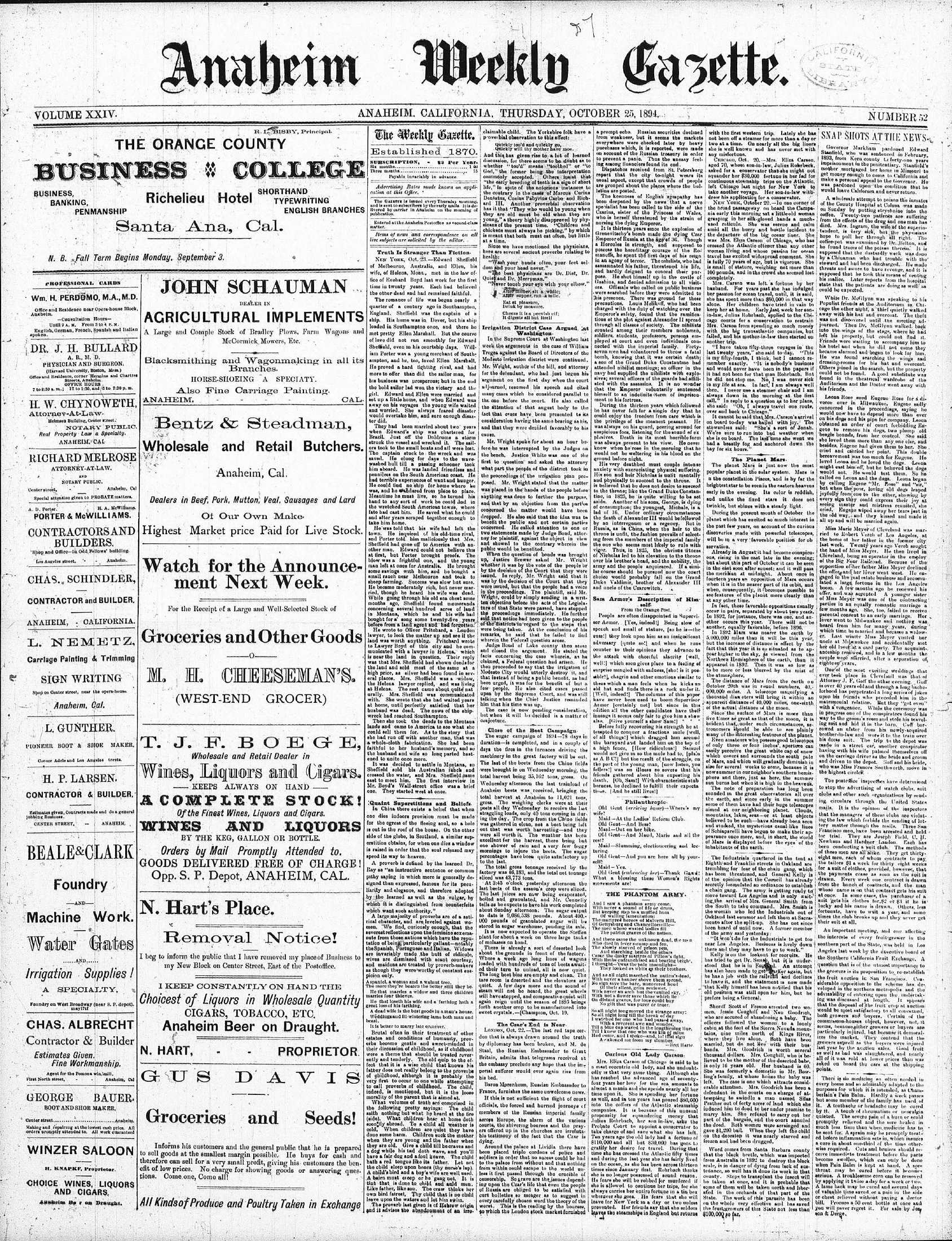
Searchable text
Anaheim
VOLUME XXIV.
R. L. BISBY, Principal.
THE ORANGE COUNTY
BUSINESS COLLEGE
BUSINESS,
BANKING,
PENMANSHIP
Richelieu Hotel
SHORTHAND
TYPEWRITING
ENGLISH BRANCH
Santa Ana, Cal.
N. B. Fall Term Begins Monday, September 3.
PROFESSIONAL CARDS
Wm. H. PERDOMO, M.A., M.D.
Office and Residence near Opera-house Block,
Angheim.
Consultation Hours—
Until 9 A.M. From 3 to 4 P.M.
English, German, French, Spanish and Italian spoken.
DR. J. H. BULLARD
A. B., M. D.
PHYSICIAN AND SURGEON.
(Harvard University, Boston, Mass.)
Office and Residence, corner Hermina and Chartres Streets, Anaheim.
OFFICE HOURS
7 to 8:30 a.m.; 12 to 1:30, and 6 to 7:30 p.m.
H. W. CHYNOWETH,
Attorney-At-Law.
Helmsen Building, Center Street.
NOTARY PUBLIC.
Real Property Law a Specialty.
ANAHEIM, CAL.
JOHN SCHAUMAN
DEALER IN
AGRICULTURAL IMPLEMENT
A Large and Comple Stock of Bradley Plows, Farm Wagons and McCormick Mowers, Etc.
Blacksmithing and Wagonmaking in all branches.
HORSE-SHOEING A SPECIATY.
Also Fine Carriage Painting.
ANAHEIM.
Bentz & Steadman,
Wholesale and Retail Butchers
H. W. CHYNOWETH,
Attorney-At-Law.
Helmsen Building, Center street.
NOTARY PUBLIC.
Real Property Law a Specialty.
ANAHEIM, CAL.
RICHARD MELROSE
ATTORNEY-AT-LAW.
AND
NOTARY PUBLIC.
Center street, Anaheim, Cal.
Special attention given to PROBATE matters.
A. D. Porter.
H. A. McWilliams.
PORTER & McWILLIAMS.
CONTRACTORS AND BUILDERS.
Shop and Office—In Odd Fellow's building.
Los Angeles street, Anaheim.
CHAS. SCHINDLER,
CONTRACTOR and BUILDER.
ANAHEIM, CALIFORNIA.
L. NEMETZ,
Carriage Painting & Trimming
SIGN WRITING
Shop on Center street, near the opera-house.
Anaheim, Cal.
L. GUNTHER.
PIONEER BOOT & SHOE MAKER.
Corner Adele and Los Angeles trests.
H. P. LARSEN,
CONTRACTOR & BUILDER.
Estimates given, Contracts made and do a general jobbing business.
CENTER STREET, ANAHEIM.
BEALE&CLARK
Branches.
HORSE-SHOEING A SPECIATY.
Also Fine Carriage Painting.
ANAHEIM.
Bentz & Steadman,
Wholesale and Retail Butchers
Anaheim, Cal.
Dealers in Beef, Pork, Mutton, Veal, Sausages and Lard
Of Our Own Make.
Highest Market price Paid for Live Stock.
Watch for the Announcement Next Week.
For the Receipt of a Large and Well-Selected Stock of
Groceries and Other Goods
M. H. CHEESEMAN'S.
(WEST-END GROCER)
T. J. F. BOEGE
Wholesale and Retail Dealer in
Wines, Liquors and Cigars
KEeps Always On Hand
A COMPLETE STOCK
Of the Finest Wines, Liquors and Cigars.
WINES AND LIQUORS
BY THE KEG, GALLON OR BOTTLE.
Orders by Mail Promptly Attended to.
GOODS DELIVERED FREE OF CHARGE
Opp. S. P. Depot ANAHEIM, CA
H. P. LARSEN,
CONTRACTOR & BUILDER.
Estimates given, Contracts made and do a general jobbing Business.
CENTER STREET, - ANAHEIM.
BEALE&CLARK
Foundry
AND
Machine Work.
Water Gates
AND...
Irrigation Supplies!
A SPECIALTY.
Foundry on West Broadway (near S. P. depot).
may17tf.
CHAS. ALBRECHT
Contractor & Builder
Estimates Given.
Fine Workmanship.
Agent for the Pomona win'mill.
First North street, - Anaheim, Cal.
GEORGE BAUER
BOOT AND SHOE MAKER.
Center street... Anaheim.
Making and repairing at the lowest cash prices. All orders promptly attended to. All work guaranteed.
WINZER SALOON
H. KNAPKF, Proprietor.
CHOICE WINES, LIQUORS AND CIGARS.
Annaheim Beer on Draught.
KEEPS ALWAYS ON HAND
A COMPLETE STOCK
Of the Finest Wines, Liquors and Cigars.
WINES AND LIQUORS
BY THE KEG, GALLON OR BOTTLE.
Orders by Mail Promptly Attended to.
GOODS DELIVERED FREE OF CHARGE.
Opp. S. P. Depot, ANAHEIM, CAL.
N. Hart's Place.
Removal Notice!
I beg to inform the public that I have removed my place of Business my New Block on Center Street, East of the Postoffice.
I KEEP CONSTANTLY ON HAND THE Choicest of Liquors in Wholesale Quantity
CIGARS, TOBACCO, ETC.
Anaheim Beer on Draught.
N. HART, PROPRIETOR
GUS DAVIS
Groceries and Seeds!
Informs his customers and the general public that he is prepared to sell goods at the smallest margin possible. He buys for cash and therefore can sell for a very small profit, giving his customers the best fit of low prices. No charge for showing goods or answering questions. Come one, Come all!
All Kindsof Produce and Poultry Taken in Exchange
ANAHEIM, CALIFORNIA, THURSDAY, OCTOBER 25, 1894.
THE WEEKLY GAZETTE.
Established 1870.
SUBSCRIPTION, - $2 Per Year.
Six months... 1 00
Three months... 75
Payable invariably in advance.
Advertising Rates made known on application at this Office.
The Gazette is issued every Thursday morning, and is sent to subscribers by the early mails. It is delivered by carrier in Anaheim on the morning of publication.
Entered at the Anaheim Postoffice as second-class matter.
Items of news and correspondence on all live subjects are solicited by the editor.
Truth Is Stranger Than Flotion.
New York, Oct. 23.—Edward Sheffield of Melbourne, Australia, and Ellen, his wife, of Helena, Mont., met in the law office of Evehard Boyd last week for the first time in twenty years. Each had believed the other dead and had remained faithful.
The romance of life was begun nearly a quarter of a century ago in Southampton, England. Sheffield was the captain of a ship. His home was in Dover, but his ship loaded in Southampton once, and there he met pretty Ellen Marshall. But the course of love did not run smoothly for Edward Sheffield, even in his courtship days. William Porter was a young merchant of Southampton, and he, too, loved Ellen Marshall. He proved a hard fighting rival, and had more to offer than did the sailor man, for his business was prosperous; but in the end the bold sailor lad won the victory and the girl. Edward and Ellen were married and set up a little home, and when Edward was away on his voyages the young wife waited and worried. She always feared disaster would overtake him, and sure enough disaster did.
They had been married about two years when Edward's ship was chartered for Brazil. Just off the Doldrums a storm struck the vessel and wrecked it. The sailors took to the small boats and all were lost. The captain stuck to the wreck and was saved. He clung for days to the wave.
claimable child. The Yorkshire folk have a provisional observation to this effect:
Quickly too'd and quickly go.
Quickly will thy mother have moe.
And this has given rise to a lot of learned discussion, for there seems to be doubt as to whether "too'd" means "toothed" or "to God," the former being the interpretation commonly accepted. Others insist that "the early breeding of tooth is a sign of short life," in spite of the notorious instances to the contrary in the cases of Marous Carins Dentatus, Cneius Pabyrinus Carbo and Richard III. Another proverbial observation has it that "They who would be young when they are old must be old when they are young," a theory highly disapproved by physicians of the present time. "Children and chickens must always be picking," by which is meant that both must eat often, but little at a time.
Since we have mentioned the physicians, here are several ancient proverbs relating to health:
"Wash your hands often, your feet seldom and your head never."
"The best physicians are Dr. Diet, Dr. Quiet and Dr. Merryman."
"Never touch your eye with your elbow."
After dinner, sit a white;
Aller supper, run a mile.
Eat at pleasure.
Drink by measure.
Cheese it is a peevish off;
It digests all but itself.
Irrigation District Case Argued at Washington.
In the Supreme Court at Washington last week the arguments in the case of William Trega against the Board of Directors of the Modesto irrigation district were continued. Mr. Wright, author of the bill, and attorney for the defendant, who had just begun his argument on the first day when the court adjourned, resumed his speech and cited many cases which he considered parallel to the one before the court. He also called the attention of that august body to the fact that cases have been presented to its consideration having the same bearing as his, and that they were decided favorably to his cause.
Mr. Wright spoke for about an hour before he was interrupted by the Judges on the bench. Justice White was one of the first to question and asked the attorney a prompt echo. Russian security from weakness, but it seems everywhere were checked later purchases which, it is reported, on account of the Russian treasury to prevent a panic. Thus the ing among financiers found its own Dispatches received from Sir report that the city to-night usual aspect, except that crowd to prevent a panic. Thus the king among financiers found its own Dispatches received from Sir report that the city to-night usual aspect, except that crowd to prevent a panic.
The keenness of English society been deepened by the news that Czarina, sister of the Princess who is herself threatened by the nursing the dying Emperor.
It is thirteen years since the Genovitchy's bomb made the Emperor of Russia at the age of 61 Hercules in strength, and possesses her hereditary courage manoffs, he spent the first days in an agony of terror. The ninth assassinated his father, threatened and hardly deigned to conceal pose. He shut himself up in the Gashina, and denied admission to officials who called on public searched before they were found his presence. There was ground precautions. Louis Molikoff, who charged with the duty of watching Emperor's safety, found that tensions of the plot against Alexander through all classes of society. Counted among their members soldiers, students, professors, played at court and even indulged with the imperial family seven men had volunteered to take bomb, knowing that it was carried on the Grand Duke Count attended nihilist meetings; an officer navy had supplied the nihilists sives; several officers of the guard with the assassins. It is that the Emperor voluntarily himself to an indeterminate term of ment in his fortress.
During the thirteenth year when he has never felt for a single day could enjoy the freedom from control of the privilege of the most honest person was always on his guard, posing suspicious foes, listening for those plows. Death in its most hasty was always present to his view, know when he rose in the morrow would not be weltering in his hindground before night.
He proved a hard fighting rival, and had more to offer than did the sailor man, for his business was prosperous; but in the end the bold sailor had won the victory and the girl. Edward and Ellen were married and set up a little home, and when Edward was away on his voyages the young wife waited and worried. She always feared disaster would overtake him, and sure enough disaster did.
They had been married about two years when Edward's ship was chartered for Brazil. Just off the Doldrums a storm struck the vessel and wrecked it. The sailors took to the small boats and all were lost. The captain stuck to the wreck and was saved. He clung for days to the wave-washed hull a passing schooner took him aboard. He was landed friendless and penniless on the South American coast. He had terrible experiences of want and hunger. He could find no ship for home where he was, and he wondered from place to place. Meantime he must live, so he turned his hand to any sort of work he could do and in the wretched South American towns, where fate had cast him. He saved what he could and after years scraped together enough to take him home.
He was told that his wife had left the town. He inquired of his old-time rival, and Porter told him maliciously that Mrs. Sheffield had gone off to America with another man. Edward could not believe this at first, but Porter brought proofs. The blow was a frightful one, and the young man left at once for Australia. He brought some savings with him, and he bought a small ranch near Melbourne and took to sheep farming. Success was slow but sure. He became moderately rich, but never married, though he heard his wife was dead. While going through his old sea chest some months ago, Sheffield found memoranda concerning several hundred acres of land in Montana, which he and his wife had bought for a song some twenty-five years before from a land agent and had forgotten.
He wrote to Oliver Pritchard, a London lawyer, to look the matter up and see if the land was worth anything. Pritchard wrote to Lawyer Boyd of this city and he communicated with a lawyer in Helena, which is near the land in question. Their reply was that Mrs. Sheffield had shown deeds for the land and sold most of the same at a high price, as silver had been found in several places. Mrs. Sheffield was a widow, the Helena lawyer replied, and was living at Helena. The rest came about quite naturally. Mrs. Sheffield was communicated with. She wrote that she had waited years at home, until perfectly satisfied that her husband was dead. The news of the shipwreck had reached Southampton.
Then she took the deeds to the Montana lands and came to America to see what she could sell them for. As to the story that she had run off with another man, that was a whole-cloth fabrication. She had been faithful to her husband's memory, and so the husband and wife so long parted hastened to unite once more.
It was decided to settle in Montana, so Sheffield sold his Australian stock and crossed the water, and Mrs. Sheffield came east to meet him. The first interview in Mr. Boyd's Wall-street office was a brief one. They started west at once.
Quaint Superstitions and Beliefs
In China there exists a belief that when one dies indoors provision must be made for the egress of the fleeing soul, so a hole is cut in the roof of the house. On the other side of the globe, in Scotland, a similar superstition obtains, for when one dies a window is raised in order that the soul released may speed its way to heaven.
A proverb is defined by the learned Dr. Ray as "an instructive sentence or common mouth saying in which more is generalized."
Mr. Wright, author of the bill, and attorney for the defendant, who had just begun his argument on the first day when the court adjourned, resumed his speech and cited many cases which he considered parallel to the one before the court. He also called the attention of that august body to the fact that oceans have been presented to its consideration having the same bearing as his, and that they were decided favorably to his cause.
Mr. Wright spoke for about an hour before he was interrupted by the Judges on the bench. Justice White was one of the first to question and asked the attorney what part the people of the district took in the proceedings of the irrigation plan proposed. Mr. Wright stated that the matter was placed in the hands of the people before anything was done to further the purpose, and that by an objection would have been dropped. He also said that the idea was to benefit the public and not certain parties concerned. He called attention to one or two statements made by Judge Bond, attorney for plaintiff, against the object in view and showed to the contrary wherein the public would be benefited.
When the question of bonds was brought up, Justice Brower asked Mr. Wright whether it was by the vote of the people or by the decision of the Court that they were issued. In reply, Mr. Wright said that it was by the decision of the Court that they were issued, but that the people had a voice in the proceedings. The plaintiff said Mr. Wright could by simply sending in a written objection before the acts of the Legislature of that State were passed, have stopped the proceedings immediately. He further said that notice had been given to the people of the district in regard to the steps that were being taken. At the conclusion of his remarks, he said that he failed to find whence in the Federal question arose.
Judge Bond of Lake county then arose and closed the argument. He stated the facts concerning the case wherein, as he claimed, a Federal question had arisen. He then proceeded to say that the irrigation of Modesto City would utterly destroy it, and that instead of being a public benefit, had become urged, it was for the benefit of but a few people. He also cited cases passed upon by the Supreme Court, and was still talking when the Chief Justice reminded him that his time was up.
The case is now pending consideration, but it will be decided is a matter of conjecture.
Close of the Beet Campaign
The sugar campaign of 1894-78 days in duration—is completed, and in a couple of days the fires in the furnaces driving the machinery in the great factory will be out.
The last of the beets from the Chino fields were brought in on Wednesday morning, the total harvest being 35,162 tons, gross. On Wednesday afternoon the last trainload of Anaheim beets was received, bringing the total harvest at Anaheim to 11,021 tons, gross.
The weighing clerks were at their posts all day Wednesday to receive the last straggling loads, only 40 tons coming in during the day. The crop from Chino fields was gathered in clean, not a boat being left out that was worth harvesting—and they were all worth it. The weather has been excellent for the harvest, there being but one shower of rain and a very few foggy mornings to injure the beets. The sugar percentages have been quite satisfactory up to the last.
The total gross tonnage received by the factory was 46,183, and the total net tonnage was 46,183.
Sam Armor's Description self
From the Orange Post.
People are often disappointed sor Armor. [Yes, indeed!] Being speech and small of stature, [so uss!] they look upon him as an adversary [quite so!] and when counter to their opinions they are attack with cheerful alas well! which soon gives place to surprise mugged with sadness [such able!] chagrin and other emotions these which a man feels when he old hat and finds there is a root [Well, indeed!] The columns of have never been used to boom Armor [certainly not] but since edition all the other candidates innings it seems only fair to give also. [Give yourself a show Sam]
Philanthropic
Old Gent (arriving home)—W wife?
Maid—At the Ladies' Reform Old Gent—And Bess?
Maid—Out on her bike.
Old Gent—And Maud, Marie rest?
Maid—Slumming, electioneering turing.
Old Gent—And you are here yet!
Maid—Yes.
Old Gent (embracing her)—Thu
STOCK!
LIQUORS
BOTTLE.
Attended to.
E OF CHARGE!
HEIM, CAL.
Notice
ed my place of Business to
at of the Postoffice.
IN HAND THE
wholesale Quantity
O, ETC.
Draught.
PROPRIETOR.
AVIS
Seeds!
public that he is prepared
He buys for cash and
eng his customers the bengoods or answering questions.
Taken in Exchange
The proverb last given is of Hebrew origin
and it advises the abandonment of an irreeast to meet him. The first interview in Mr. Boyd's Wall-street office was a brief one. They started west at once.
Quaint Superstitions and Beliefs.
In China there exists a belief that when one dies indoors provision must be made for the ogress of the fleeing soul, so a hole is cut in the roof of the house. On the other side of the globe, in Scotland, a similar superstition obtains, for when one dies a window is raised in order that the soul released may speed its way to heaven.
A proverb is defined by the learned Dr. Ray as "an instructive sentence or common pithy saying in which more is generally designed than expressed, famous for its peculiarity and elegance, and therefore adopted by the learned as well as the vulgar, by which it is distinguished from counterfeits which want such authority."
A large majority of proverbs are of a satirical character, and are leveled against women. We find, curiously enough, that the severest reflections upon the feminine sexmanate from those nations which have the reputation of being particularly gallant—notably the Spanish, Portuguese and Italian. Widows are invariably made the butt of ridicule, wives are dismissed with scant courtey, and maidens are treated by proverb-makers as though they were worthy of constant suspicion only.
A spaniel, a woman and a walnut tree.
The more they're beaten the better they be.
He that marries a widow and three children marries four thieves.
He that loseth his wife and a farthing hath a great loss of his farthing.
A dead wife is the best goods in a man's house.
Weddings and ill-wintering lame both man and beast.
It is better to marry late on everer.
Brutal often in their treatment of other estates and conditions of humanity, proverbs become gentle and sweet-minded in their discussion of childhood, as if childhood were a theme that should be treated reverently and tenderly. The old quip to the effect that it is a wise child that knows his father does not really belong to the proverbs of childhood, although it is probably the very first to occur to one while attempting to call proverbs of childhood. The child, indeed, is mentioned, but it is the loose morality of the parent that is aimed at.
What volumes of truth are comprised in the following pretty sayings: The child saith nothing but what he heard at the fire (side). What children hear at home doth soonfly abroad. To a child all weather is cold. When children are quiet they have done some harm. Children suck the mother when they are young and the father when they are old. Give a child till he craves and a dog while his tail doth wave, and you'll have a fair dog and a foul knave. The child has a red tongue like its father. Let not the child sleep upon bones (by nurse's lap). A child's bird and a boy's wife are well used. A bairn must creep or he gang not. It is tint that is done to child and aid men. Like father, like son. The craw thinks her own bird farest. Thy child that is no child leave upon the waters and let him swim.
The proverb last given is of Hebrew origin
and it advises the abandonment of an irreeast to meet him. The first interview in Mr. Boyd's Wall-street office was a brief one. They started west at once.
Quaint Superstitutions and Beliefs.
In China there exists a belief that when one dies indoors provision must be made for the ogress of the fleeing soul, so a hole is cut in the roof of the house. On the other side of the globe, in Scotland, a similar superstition obtains, for when one dies a window is raised in order that the soul released may speed its way to heaven.
A proverb is defined by the learned Dr. Ray as "an instructive sentence or common pithy saying in which more is generally designed than expressed, famous for its peculiarity and elegance, and therefore adopted by the learned as well as the vulgar, by which it is distinguished from counterfeits which want such authority."
A large majority of proverbs are of a satirical character, and are leveled against women. We find, curiously enough, that the severest reflections upon the feminine sexmanate from those nations which have the reputation of being particularly gallant—notably the Spanish, Portuguese and Italian. Widows are invariably made the butt of ridicule, wives are dismissed with scant courtey, and maidens are treated by proverb-makers as though they were worthy of constant suspicion only.
A spaniel, a woman and a walnut tree.
The more they're beaten the better they be.
He that marries a widow and three children marries four thieves.
He that loseth his wife and a farthing hath a great loss of his farthing.
A dead wife is the best goods in a man's house.
Weddings and ill-wintering lame both man and beast.
It is better to marry late on everer.
Brutal often in their treatment of other estates and conditions of humanity, proverbs become gentle and sweet-minded in their discussion of childhood, as if childhood were a theme that should be treated reverently and tenderly. The old quip to the effect that it is a wise child that knows his father does not really belong to the proverbs of childhood, although it is probably the very first to occur to one while attempting to call proverbs of childhood. The child, indeed, is mentioned, but it is the loose morality of the parent that is aimed at.
What volumes of truth are comprised in the following pretty sayings: The child saith nothing but what he heard at the fire (side). What children hear at home doth soonfly abroad. To a child all weather is cold. When children are quiet they have done some harm. Children suck the mother when they are young and the father when they are old. Give a child till he craves and a dog while his tail doth wave, and you'll have a fair dog and a foul knave. The child has a red tongue like its father. Let not the child sleep upon bones (by nurse's lap). A child's bird and a boy's wife are well used. A bairn must creep or he gang not. It is tint that is done to child and aid men. Like father, like son. The craw thinks her own bird farest. Thy child that is no child leave upon the waters and let him swim.
The proverb last given is of Hebrew origin
and it advises the abandonment of an irreeast to meet him. The first interview in Mr. Boyd's Wall-street office was a brief once.
Quaint Superstitutions and Beliefs.
In China there exists a belief that when one dies indoors provision must be made for the ogress of the fleeing soul, so a hole is cut in the roof of the house. On the other side of the globe, in Scotland, a similar superstitution obtains, for when one dies a window is raised in order that the soul released may speed its way to heaven.
A proverb is defined by the learned Dr. Ray as "an instructive sentence or common pithy saying in which more is generally designed than expressed, famous for its peculiarity and elegance, and therefore adopted by the learned as well as the vulgar, by which it is distinguished from counterfeits which want such authority."
A large majority of proverbs are of a satirical character, and are leveled against women. We find, curiously enough, that the severest reflections upon the feminine sexmanate from those nations which have the reputation of being particularly gallant—notably the Spanish, Portuguese and Italian. Widows are invariably made the butt of ridicule, wives are dismissed with scant courtey, and maidens are treated by proverb-makers as though they were worthy of constant suspicion only.
A spaniel, a woman and a walnut tree.
The more they're beaten the better they be.
He that marries a widow and three children marries four thieves.
He that loseth his wife and a farthing hath a great loss of his farthing.
A dead wife is the best goods in a man's house.
Weddings and ill-wintering lame both man and beast.
It is better to marry late on everer.
Brutal often in their treatment of other estates and conditions of humanity, proverbs become gentle and sweet-minded in their discussion of childhood, as if childhood were a theme that should be treated reverently and tenderly. The old quip to the effect that it is a wise child that knows his father does not really belong to the proverbs of childhood, although it is probably the very first to occur to one while attempting to call proverbs of childhood. The child, indeed, is mentioned, but it is the loose morality of the parent that is aimed at.
What volumes of truth are comprised in the following pretty sayings: The child saith nothing but what he heard at the fire (side). What children hear at home doth soonfly abroad. To a child all weather is cold. When children are quiet they have done some harm. Children suck the mother when they are young and the father when they are old. Give a child till he craves and a dog while his tail doth wave, and you'll have a fair dog and a foul knave. The child has a red tongue like its father. Let not the child sleep upon bones (by nurse's lap). A child's bird and a boy's wife are well used. A bairn must creep or he gang not. It is tint that is done to child and aid men. Like father, like son. The craw thinks her own bird farest. Thy child that is no child leave upon the waters and let him swim.
The proverb last given is of Hebrew origin
and it advises the abandonment of an irreeast to meet him. The first interview in Mr. Boyd's Wall-street office was a brief once.
Quaint Superstitutions and Beliefs.
In China there exists a belief that when one dies indoors provision must be made for the ogress of the fleeing soul, so a hole is cut in the roof of the house. On the other side of the globe, in Scotland, a similar superstitution obtains, for when one dies a window is raised in order that the soul released may speed its way to heaven.
A proverb is defined by the learned Dr. Ray as "an instructive sentence or common pithy saying in which more is generally designed than expressed, famous for its peculiarity and elegance, and therefore adopted by the learned as well as the vulgar, by which it is distinguished from counterfeits which want such authority."
A large majority of proverbs are of a satirical character, and are leveled against women. We find, curiously enough, that the severest reflections upon the feminine sexmanate from those nations which have the reputation of being particularly gallant—notably the Spanish, Portuguese and Italian. Widows are invariably made the butt of ridicule, wives are dismissed with scant courtey, and maidens are treated by proverb-makers as though they were worthy of constant suspicion only.
A spaniel, a woman and a walnut tree.
The more they're beaten the better they be.
He that marries a widow and three children marries four thieves.
He that loseth his wife and a farthing hath a great loss of his farthing.
A dead wife is the best goods in a man's house.
Weddings and ill-wintering lame both man and beast.
It is better to marry late on everer.
Brutal often in their treatment of other estates and conditions of humanity, proverbs become gentle and sweet-minded in their discussion of childhood, as if childhood were a theme that should be treated reverently and tenderly. The old quip to the effect that it is a wise child that knows his father does not really belong to the proverbs of childhood, although it is probably the very first to occur to one while attempting to call proverbs of childhood. The child, indeed, is mentioned, but it is the loose morality of the parent that is aimed at.
What volumes of truth are comprised in the following pretty sayings: The child saith nothing but what he heard at the fire (side). What children hear at home doth soonfly abroad. To a child all weather is cold. When children are quiet they have done some harm. Children suck the mother when they are young and the father when they are old. Give a child till he craves and a dog while his tail doth wave, and you'll have a fair dog和a foul knave.The child has a red tongue like its father.Let notthechildsleepuponbones(bynurse'slap)Achildbirdandaboywifearewellused.Abairnmustcreeporhegangnot.Itsintthatishdonetocchildandaidmen.Likefatherlikeson.Thecrawthisshearedherentfortuneinwherevershoesgoes.HewearsshowelebornewayforNewYorkindayorprevented.Merriendsmovementsare!
THE PHANTOM ARROW
And I saw a phantom army come.
With never a sound of life or drumm,
But keeping step to a muffled hum
Of walling lamentation:
The smurties heroes of Malvern Hill
Of Greybellsand Chancelleryfillen
The men whose wasted bodies fill
The patriot gravesofthe nation,
And there same the unknown dead,
Who died in fever swamp and fen,
The slowly starved prisoner
And marching beside others
Cause dismay martyrstmysf妇Plows'
With limbs enfragrishedand bearingI thought'wasthe pale moonlight
They lookedaswhitetheirbrace
And so all night long movedthe stranger
So all night long tillthebreakofday
Iwatchedforonewhohadpassedday
WitharevientaweandwoundItila blue cap wavedinthelength
Ikill knewthatonewhowaskinofHadcome,andIspoke-and.lotthatAwakenedmefrommyslumber
CURIOUS Old Lady Carrot
Mrs. Eliza Carson of Chicagoisinamosteccuriousold lady,andshespendsnearlytimeupithe.Sheisspendingherselfasthenverythingthing.Althoughhas reachedtheadvancedageofouryearshortheraduringthesimpandingmyselfasthenverycarryingordemandtakingchargeofandsavewhatshere.Tenyearsagotheold ladyhadbeen$110000andallbut$30000hggratifyherdesirefortravel.DtimehushascrossedtheAtlanticandduringthelastyearshehasfinishedonthecoast,andshehasacrocessortimesinceJanuaryfirst.Robrushheisno longerpossessedofsoundHe fears shewillberobbedformyselfasallowedtocontinuehertrickalwayscarriesher entirefortuneinwherevershoesgoes.HewearsshowelebornewayforNewYorkindayorprevented.Merriendsmovementsare!
CURIOUS Old Lady Carrot
Mrs. Eliza Carson of Chicagoisinamosteccuriousold lady,andshespresentsnearlytimeupithe.Sheisspendingherselfasthenverycarryingordemandtakingchargeofandsavewhatshere.Tenyearsagotheold ladyhadbeen$110000andallbut$30000hggratifyherdesirefortravel.DtimehushascrossedtheAtlanticandduringthelastyearshehasfinishedonthecoast,andshehasacrocessortimesinceJanuaryfirst.Robrushheisno longerpossessedofsoundHe fears shewillberobbedformyselfasallowedtocontinuehertrickalwayscarryingordemandtakingchargeofandsavewhatshere.Tenyearsagotheold ladyhadbeen$110000andallbut$30000hggratifyherdesirefortravel.DtimehushascrossedtheAtlanticandduringthelastyearshehasfinishedonthecoast,andshehasacrocessortimesinceJanuaryfirst.Robrushheisno longerpossessedofsoundHe fears she willberobbedformyselfasallowedtocontinuehertrickalwayscarryingordemandtakingchargeofandsavewhatshere.Tenyearsagotheold ladyhadbeen$110000andallbut$30000hggratifyherdesirefortravel.DtimehushascrossedtheAtlanticandduringthelastyearshehasfinishedonthecoast,andshehasacrocessortimesinceJanuaryfirst.Robrushheisno longerpossessedofsoundHe fears she willberobbedformyselfasallowedtocontinuehertrickalwayscarryingordemandtakingchargeofandsavewhatshere.Tenyearsagotheold ladyhadbeen$110000andallbut$30000hggratifyherdesirefortravel.DtimehushascrossedtheAtlanticandduringthelastyearshehasfinishedonthecoast,andshehasacrocessortimesinceJanuaryfirst.Robrushheisno longerpossessedofsoundHe fears she willberobbedformyselfasallowedtocontinuehertrickalwayscarryingordemandtakingchargeofandsavewhatshere.Tenyearsagotheold ladyhadbeen$110000andallbut$30000hggratifyherdesirefortravel.DtimehushascrossedtheAtlanticandduringthelastyearshehasfinishedonthecoast,andshehasacrocessortimesinceJanuaryfirst.Robrushheisno longerpossessedofsoundHe fears she willberobbedformyselfasallowedtocontinuehertrickalwayscarryingordemandtakingchargeofandsavewhatshere.Tenyearsagotheold ladyhadbeen$110000andallbut$30000hggratifyherdesirefortravel.DtimehushascrossedtheAtlanticandduringthelastyearshehasfinishedonthecoast,andshehasacrocessortimesinceJanuaryfirst.Robrushheisno longerpossessedofsoundHe fears she willberobbedformyselfasallowedtocontinuehertrickalwayscarryingordemandtakingchargeofandsavewhatshere.Tenyearsagotheold ladyhadbeen$110000andallbut$30000hggratifyherdesirefortravel.DtimehushascrossedtheAtlanticandduringthelastyearshehasfinishedonthecoast,andshehasacrocessortimesinceJanuaryfirst.Robrushheisno longerpossessedofsoundHe fears she willberobbedformyselfasallowedtocontinuehertrickalwayscarryingordemandtakingchargeofandsavewhatshere.Tenyearsagotheold ladyhadbeen$110000andallbut$30000hggratifyherdesirefortravel.DtimehushascrossedtheAtlanticandduringthelastyearshehasfinishedonthecoast,andshehasacrocessortimesinceJanuaryfirst.Robrushheisno longerpossessedofsoundHe fears she willberobbedformyselfasallowedtocontinuehertrickalwayscarryingordemandtakingchargeofandsavewhatshere.Tenyearsagotheold ladyhadbeen$110000andallbut$30000hggratifyherdesirefortravel.DtimehushascrossedtheAtlanticandduringthelastyearshehasfinishedonthecoast,andshehasacrocessortimesinceJanuaryfirst.Robrushheisno longerpossessedofsoundHe fears she willberobbedformyselfasallowedtocontinuehertrickalwayscarryingordemandtakingchargeofandsavewhatshere.Tenyearsagotheold ladyhadbeen$110000andallbut$30000hggratifyherdesirefortravel.DtimehushascrossedtheAtlanticandduringthelastyearshehasfinishedonthecoast,andshehasacrocessortime sinceJanuaryfirst.Robrushheisno longerpossessedofsoundHe fears she willberobbedformyselfasallowedtocontinuehertrickalwayscarryingordemandtakingchargeofandsavewhatshere.Tenyearsagotheold ladyhadbeen$110000andallbut$30000hggratifyherdesirefortravel.DtimehushascrossedtheAtlanticandduringthelastyearshehasfinishedonthecoast,andshehasacrocessortime sinceJanuaryfirst.Robrushheisno longerpossessedofsoundHe fears she willberobbedformyselfasallowedtocontinuehertrickalwayscarryingordemandtakingchargeofandsavewhatshere.Tenyearsagotheold ladyhadbeen$110000andallbut$30000hggratifyherdesirefortravel.DtimehushascrossedtheAtlanticandduringthelastyearshehasfinishedonthecoast,andshehasacrocessortime since Januaryfirst.Robrushheisno longerpossessedofsoundHe fears she willberobbedformyselfasallowedtocontinuehertrickalwayscarryingordemandtakingchargeofandsavewhatshere.Tenyearsagotheold ladyhadbeen$110000andallbut$30000hggratifyherdesirefortravel.DtimehushascrossedtheAtlanticandduringthelastyearshehasfinishedonthecoast,andshehasacrocessortime since Januaryfirst.Robrushheisno longerpossessedofsoundHe fears she willberobbedformyselfasallowedtocontinuehertrickalwayscarryingordemandtakingchargeofandsavewhatshere.Tenyearsagotheold ladyhadbeen$110000andallbut$30000hggratifyherdesirefortravel.DtimehushascrossedtheAtlanticandduringthelastyearshehasfinishedonthecoast,andshehasacrocessortime since Januaryfirst.Robrushheisno longerpossessedofsoundHe fears she willberobbedformyselfasallowedtocontinuehertrickalwayscarryingordemandtakingchargeofandsavewhatshere.Tenyearsagotheold lady hadbeen$110000andallbut$30000hggratifyherdesirefortravel.Dtimehus hascrossedtheAtlanticandduringthelastyear she has financed on New York in day or prevented.Her friends say that leaves them steamships in England
OBER 25, 1894
NUMBER 52
a prompt echo. Russian securities declined from weakness, but it seems the markets everywhere were checked later by heavy pursehouses which, it is reported, were run on account of the Russian treasury in order to prevent a panic. Thus the uneasy feeling among financiers found its end.
Dispatches received from St. Petersburg report that the city to-night wears its usual aspect, except that crowds of people are grouped about the places where the bullets are posted.
The keenness of English sympathy has been deepened by the news that a new specialist has been called to the side of the Czarina, sister of the Princess of Wales, who is herself threatened by the strain of nursing the dying Emperor.
It is thirteen years since the explosion of Grenovitschy's bomb made the dying Czar Emperor of Russia at the age of 36. Though a Hercules in strength, and supposed to possess the hereditary courage of the Romanoff, he spent the first days of his reign in an agony of terror. The nihilists, who had assassinated his father, threatened his life, and hardly designed to conceal their purpose. He shut himself up in the castle of Dashina, and denied admission to all visitors. Officials who called on public business were searched before they were admitted to his presence. There was ground for those precautions. Louis Molikoff, who had been charged with the duty of watching over the Emperor's safety, found that the ramifications of the plot against Alexander II spread through all classes of society. The nihilists counted among their members noblemen, soldiers, professors, persons employed at court and even individuals connected with the imperial family. Forty-seven men had volunteered to throw a fatal bomb, knowing that it was certain death; son of the Grand Duke Constantine had attended nihilist meetings; an officer in the navy had supplied the nihilists with explosives; several officers of the guards had affiliated with the assassins. It is no wonder that the Emperor voluntarily sentenced himself to an indisinite term of imprisonment in his fortress.
During the thirteen years which followed he has never felt for a single day that he could enjoy the freedom from care which is the privilege of the meanest peasant. He was always on his guard, peering around for suspicious foes, listening for the sound of oxides. Death in its most horrible form was always present to his view. He now know when he rose in the morning that he would not be weltering in his blood on the round before night.
with the first western trip. Lately she has not been off a steamer for more than a day or two at time. On nearly all the big liners she is well known and has never met with any misfortune.
Chicago, Oct. 20.—Mrs. Eliza Carson, aged 70, whose son-in-law, Julius Rokrback, asked for a conservator that she might not squander her $30,000 fortune in her lad for continuous steamship trips on the Atlantic, left Chicago last night for New York to take another voyage. Her son-in-law withdraw his application for a conservator.
New York, October 20.—In one corner of the broad passageway on board the Campania early this morning sat a little old woman grasping in her silk-gloved hands a much-used reticule. She was serene and calm amid all the hurry and bustle incident to the departure of the big ocean tiner. She was Mrs. Eliza Carson of Chicago, who has crossed the Atlantic oftener than any other woman living and whose passion for ocean travel has excited widespread comment. She is fully 70 years of age, but is vigorous. She is small of stature, weighing not more than 100 pounds, and in the crowd she seemed lost completely.
Mrs. Carson was left a fortune by her husband. For years past she has indulged her passion for ocean travel, until it is said, she has spent more than $80,000 in that way alone. Her children have tried in vain to keep her at home. Early last week her son-in-law, Julius Rokrback, applied to the Chicago courts for a conservation to restrain Mrs. Carson from spending so much money with the big transatlantic companies, but failed, and his mother-in-law then started on another trip.
"I have taken fifty-three voyages in the last twenty years," she said to day. "This is my fifty-fourth, I think, but I cannot remember exactly." "It is nobody's business and would never have been in the papers if it had not been for that man Rohrbach. But he did not stop me. No, I was never sick in my life at sea. In fact, I am always well then. I never use a steamer chair and I am always down in the morning at the first call." In reply to a question as to her plans, she said: "Oh, I always travel one route, over and back to Chicago."
It cannot be said that Mrs. Carson's arrival on board to-day was hailed with joy. The stewardess said: "She's a sort of Jonah. We're sure to run into bad weather when she is on board. The last time she went we had a beastly fog and anchored down the bay for six hours."
The Planet Mars.
SNAP SHOTS AT THE NEWS
Governor Markham pardoned Edward Stanfield, who was sentenced in February, 1893, from Kern county to forty-one years imprisonment in the penitentiary. Stanfield's mother mortgaged her home in Missouri to get money enough to come to California and make a personal appeal to the Governor. He was pardoned upon the condition that he would leave California and never return.
A wholesale attempt to poison the inmates of the County Hospital at Colusa was made on Sunday by putting styrene into the coffeo. Twenty-two patients are suffering from the effects of the drug and one man has died. Mrs. Ingram, wife of the superintendent, is very sick, but the physicians hope to pull her through all right. The coffee-pot was examined by Dr. Belton, and he found traces of the poison therein. It is supposed that the dastardly work was done by a Chinaman who had trouble with the steward and had been discharged. He made threats and swore to have revenge, and it is supposed that he took this means of venting his malice. Later reports from the hospital state that the patients are doing as well as could be expected.
White Dr. McGlynn was speaking to his Populus friends at the Auditorium in Chicago the other night, a thief quietly walked away with his hat and overcoat. The theft was not discovered until the meeting adjourned. Then Dr. McGlynn walked back into the wings of the stage, where he had left his property, but could not find it. Friends were waiting to accompany him to his hotel and when he did not come they became alarmed and began to look for him. He was found searching the wings and dressing-rooms for his hat and overcoat. Others joined in the search, but the property could not be found. A good substitute was found in the theatrewardrobe of the Auditorium and the Doctor went away with his friends.
Leona Rose sued Eugene Rose for a divorce over in Milwaukee. Eugene sadly concurred in the proceedings, saying he would now have to depend more than ever on his dogs and his pipe for company. Leona obtained an order of court for bidding Eugene to remove his dogs, two plump old beagle hounds, from her control. She said she loved them more than any one else, and besides, Eugene had given them to her. She oried and carried her point. This double bereavement was too much for Eugene. He loved Leona and he loved the dogs.
The Planet Mars.
During the thirteen years which followed he has never felt for a single day that he would enjoy the freedom from care which is the privilege of the meanest peasant. He was always on his guard, peering around for suspicious foes, listening for the sound of ox oblivious. Death in its most horrible form was always present to his view. He never knew when he rose in the morning that he would not be weltering in his blood on the ground before night.
His very deathbed must couple intense anxiety with exercising physical suffering. His son and his Nicholas is unit mentally and physically to succeed to the throne. It believed that he does not desire to succeed to the throne; like the Grand Duke Constantine, in 1825, he is quite willing to be set aside. Another of his sons, George, is dying of consumption; the youngest, Michale, is of age 16. Under ordinary circumstances the death of Alexander III would be followed by an interregnum or a regency. But in Russia, as in China, when the heir to the throne is unfit, the fashion prevails of selecting from the members of the imperial family one who seems most likely to rule with vigor. Thus, in 1825, the obvious illness of Nicholas led to his elevation to the throne over his brother's head, and the nobility, the army and the people acquiesced. If a similar course should be pursued now the court choice would probably fall on the Grand Duke Valdimir, brother of Alexander III and uncle of the Czarowitch.
**Sam Armor's Description of Himself**
From the Orange Post.
People are often disappointed in Supervisor Armor. [Yes, indeed!] Being slow of pocech and small of stature, [so he is—the mess!] they look upon him as an insignificant adversary [quite so!] and when he runs counter to their opinions they advance to the attack with cheerful alacacy [well, well!] which soon gives place to a feeling of surprise mungled with sadness, [so!] is it possible? chagrin and other emotions similar to those which a man feels when he kicks an old hat and finds there is a rock under it. Well, indeed! The columns of this paper have never been used to boom Supervisor Armor [certainly not] but since in this edition all the other candidates have their shings it seems only fair to give him a show. [Give yourself a show Sam!]
Before fully recovering his strength he atracted to conquer a fractions mule [well, all things!] which dragged him around the barnyard and landed him on the top of high fence. [How ridiculous!] Samuel could not give in so the mule had to, [plain A B C!] but the result of the struggle, on one part of the young man, [now listen, you tell!] was an illness so severe that his friends gathered about him expecting his death. [Oh, Sam!] With characteristic stubbornness, he declined to fulfill their expecta-tions. [And he still lives!]
**Philanthropic**
Old Gent (arricing home)—Where's my life?
Maid—At the Ladies' Reform Club.
Old Gent—And Bess!
Maid—Out on her bike.
Old Gent—And Maud, Marie and all the rest!
Maid—Slumming, electioneering and lec-ring
Old Gent—And you are here all by your self!
Maid—Yes.
Old Gent (embracing her)—Thank Gawd!
The Planet Mars.
The planet Mars is just now the most popular planet in the solar system. Mars is in the constellation Pisces, and is by far the brightest star to be seen in the eastern heavens early in the evening. Its color is reddish, and unlike the fixed stars it does not twinkle, but shines with a steady light.
During the present month of October the planet which has excited so much interest in the past few years, on account of the curious discoveries made with powerful telescopes, will be in a very favorable position for ob-servation.
Already in August it had become conspicuous, rising in the east late in the evening; but about this part of October it can be seen in the east soon after sunset; and it will pass the meridian at midnight. About once in fourteen years an opposition of Mars occurs when it is in nearer part of its orbit, and when, consequently, it becomes possible to see features of the planet more clearly than at any other time.
In fact, these favorable oppositions usually occur in pairs, separated by about two years. In 1892, for instance, there was one, and another occurrs this year. There will not be another, equally favorable, before 1896.
In 1892 Mars was nearer the earth by 5,000,000 miles than it will be this year, but the increase of distance is effect by the fact that this year it is so situated as to appear higher in the sky, as viewed from the Northern Hemisphere of the earth, than it appeared in 1892. Then it was so low as to be more or less blurred by the mist of the atmosphere.
The distance of Mars from the earth on October 20th was in round numbers, 40,000,000 miles. A telescope magnifying a thousand dieters will bring it within an apparent distance of 40,000 miles, one-sixth of the actual distance of the moon.
Since the surface of Mars is more than five times as great as that of the moon, it is evident that under such circumstances, astronomers should be able to see plainly many of the interesting features of the planet.
Even amateurs who possess good telescopes can easily perceive the great white cap of snow which covers and surrounds the south pole of Mars, and which will gradually diminish in size for several weeks to come, because it is now summer in our neighboring southern hemisphere and there, just as here, the summer sun burns but when it is high in the heavens.
The note of preparation has long been sounded in the great observatories all over the earth, and since early in the summer some of them have had their huge telescopes aimed at our neighboring planet. Clouds, mountains, lakes, seas—or at least objects believed to be such—have already been seen and studied, the mysterious canal-like lines of Schiaparelli have begun to make their appearance once more, and, in short, the world of Mars is displayed before the eyes of the inhabitants of the earth.
The Industrials quartered in the tent at Eighth and Franklin streets in Oakland are trembling for fear of the chain gang, which has been threatened, and General Kelly is
It cannot be said that Mrs. Carson's arrival on board to-day was hailed with joy. The stewardess said: "She's a sort of Jonah. We're sure to run into bad weather when she is on board. The last time she went had a beasty fog and anchored down the bay for six hours."
The Planet Mars.
The planet Mars is just now the most popular planet in the solar system. Mars is in the constellation Pisces, and is by far the brightest star to be seen in the eastern heavens early in the evening. Its color is reddish, and unlike the fixed stars it does not twinkle, but shines with a steady light.
During the present month of October the planet which has excited so much interest in the past few years, on account of the curious discoveries made with powerful telescopes will be in a very favorable position for ob-servation.
Already in August it had become conspicuous, rising in the east late in the evening; but about this part of October it can be seen in the east soon after sunset; and it will pass the meridian at midnight. About once in fourteen years an opposition of Mars occurs when it is in nearer part of its orbit, and when consequently it becomes possible to see features of the planet more clearly than at any other time.
In fact, these favorable oppositions usually occur in pairs, separated by about two years. In 1892 for instance, there was one, and another occurrs this year. There will not be another, equally favorable, before 1896.
In 1892 Mars was nearer the earth by 5,000,000 miles than it will be this year, but the increase of distance is effect by the fact that this year it is so situated as to appear higher in the sky, as viewed from the Northern Hemisphere of the earth, than it appeared in 1892. Then it was so low as to be more or less blurred by the mist of the atmosphere.
The distance of Mars from the earth on October 20th was in round numbers, 40,000,000 miles. A telescope magnifying a thousand dieters will bring it within an apparent distance of 40,000 miles, one-sixth of the actual distance of the moon.
Since the surface of Mars is more than five times as great as that of the moon, it is evident that under such circumstances, astronomers should be able to see plainly many of the interesting features of the planet.
Even amateurs who possess good telescopes can easily perceive the great white cap of snow which covers and surrounds the south pole of Mars, and which will gradually diminish in size for several weeks to come, because it is now summer in our neighboring southern hemisphere and there, just as here, the summer sun burns but when it is high in the heavens.
The note of preparation has long been sounded in the great observatories all over the earth,and since early inthe summer some of them have had their huge telescopes aimed at our neighboring planet.Clouds,mountains,lakes,seas-oratleobjectsbelievedtobesuch-havealreadybeenseenandstudied,themysteriouscanal-likelinesofSchiaparellihavebeginedtomaketheireppearanceoncemore,andinshort,theworldofMarsisisplaybeforetheeyesoftheinhabitantsoftheearth.
The postoffice inspectors have determined to stoptheadvertisingoffwatchclubs,suitclubsandothersuchorganizationsbysendlingcircularsthroughtheUnitedStatesmails.Itistheopinionoftheinspectorsthatthemanagersoftheclubsareviolatingthelawwhichforbidsthesendinglotterymatterthroughthemails.ThreeSanFranciscomonehavenbeen arrestedandheldtrial.Theylearnere JosephField,C.H.NewhausandHarderLandon.Eachhasbeenconducta suitclub.ThemethodsofthemenareallslikeTheygetthirty-eightmencounteachofwhomcontractstopaythetailors$1weekforytenthweeksfora suitclothesprovidedhowthatthepaymentceaseas soonasthesuitis
Philanthropic.
Old Gent (arriving home)—Where's my life?
Maid—At the Ladies' Reform Club.
Old Gent—And Bess.
Maid—Out on her bike.
Old Gent—And Maud, Marie and all the rest!
Maid—Slumming, electionering and lecring.
Old Gent—And you are here all by yourself!
Maid—Yes.
Old Gent (embracing her)—Thank Gawd! What a blessing these Women's Rights movements are!
THE PHANTOM ARMY.
And I saw a phantom army come, with never a sound of life or drum, but keeping step to a muffled hum of walling lamentation:
martyred heroes of Malvern Hill,
Geypure man and wife, the men whose wasted bodies all.
The patrol graves of the nation.
and there came the unknown dead, the men who died in fever and plague, but the slowly starved bodies all.
And marching, beside the others and so all night marched the nation's dead, with never a banner above them spread, sign save the bare, uncovered head Of their alent, grim reviewer, With never an arch but the vaulted sky, With never a flower save those which lie distant graves, for love could buy No gift that was purer or truer.
all night long moved the strange array; all night long till the break of day watched for one and passed away With a reverent sane and waggle ala cap waved in the lengthening line, ill knew that one who was kin of mine and come, and I spoke—and let that sign Awakened me from my slumber.
—Irect Harte.
Curious Old Lady Carson.
Mrs. Eliza Carson of Chicago is said to be most eccentric old lady, and she undoubtedly is that very same thing. Although she is reached the advanced age of seventy-years her love for the sea amounts to most a mania and she spends nearly all her time upon it. She is spending her fortune well, and in ten years has poured $80,000 to the coffers of the Atlantic steamship companies. It is because of this unusual openness for squandering money thatulus Rohrbach, her son-in-law, asks the robber Court to appoint a conservator to take charge of and save what she has left. In nine years ago the old lady had a fortune of 10,000 and all but $30,000 has gone to satisfy her desire for travel. During that one she has crossed the Atlantic fifty times and during the last year she has fairly lived the ocean, as she has been across thirteen miles since January first. Rohrbach thinks he is no longer possessed of sound reason. So fears she will be robbed for murder if she allowed to continue her trips, for she always carries her entire fortune in a tin box wherever she goes. He fears that she will have for New York in a day or two unless vented. Her friends say that she seldom saves the steamships in England but returns
The note of preparation has long been sounded in the great observatories all over the earth, and since early in the summer some of them have had their huge telescopes aimed at our neighboring planet. Clouds, mountains, lakes, seas—or at least objects believed to be such—have already been seen and studied, the mysterious canal-like lines of Schiaparelli have begun to make their appearance once more, and, in short, the world of Mars is displayed before the eyes of the inhabitants of the earth.
The Industrials quartered in the tent at Eighth-and Franklin streets in Oakland are trembling for fear of the chain gang, which has been threatened, and General Kelly is of the opinion that the Council has already secretly formulated an ordinance to establish a chain gang. The army is getting ready to move toward Los Angeles and is only waiting the arrival of Mrs. General Smith from the South to take command. Mrs. Smith is the woman who led the Industrials out of Oakland last summer and left them at Sacramento after the split-up. She has not since been heard of until now. A former member of the army said yesterday:
"It won't do for the Industrials to get too near Los Angeles. Business is lively down there and they may have to go to work."
Kelly is on the lookout for recruits. He has tried to get Dr. Smith, but it is understood that he is in England. An attempt has also been made to get Parker again, but he has a job with the railroad and declines to leave it, and the statement is now made that Kelly himself has been notified that his old position was still open for him, but he prefers being a General.
Sheriff Scott of Fresno arrested two women, Jessie Coughill and Nan Goodrich, who are accused of abandoning a baby. The officers followed the women to a lonely cabin at the foot of the Sierra Nevada mountains, nine miles north of Kings River, where they live alone. Both have been married, but do not live with their husbands. Mrs. Goodrich is worth several thousand dollars. Mrs. Coughill, who is believed to be the mother of the deserted babe, is only 16 years old. Her husband is 60. She was formerly a domestic in Mr. Bowling's family, at whose house the baby was left. The case is one which attracts considerable attention. Mrs. Goodrich has been a defendant in the courts on a charge of attempting to swindle a man named Silas Parther out of forty acres of land which she induced him to deed to her under promise to marry him. She refused to carry out her part of the bargain, and the court annulled the deed. Both women were arranged and gave $1,200 bail. When they left the child on the doorstep it was nearly starved and frozen and had been drugged.
Word comes from Santa Barbara county that the black beetle, which was imported from Australia in 1892 to destroy the black scale, is in danger of dying from lack of sustenance, so well has it done its work in that county. Steps to transplant the insect will be taken at once, and it is probable that some of them will be taken north and liberated in the orchards of that part of the State. The work of this parasite has been on the whole very effective and has saved the fruit-growers of this State not less than $100,000 so far.
The postoffice inspectors have determined to stop the advertising of watch clubs, suit clubs and other such organizations by sending circulars through the United States mails. It is the opinion of the inspectors that the managers of these clubs are violating the law which forbids the sending of lottery matter through the mails. Three San Francisco men, have been arrested and held for trial. They are Joseph Field, C. H. Newhua and Harder Landon. Each has been conducting a suit club. The methods of these men are all alike. They get thirty-eight men, each of whom contracts to pay the tailors $1 a week for thirty eight weeks for a suit of clothes provided, however, that the payments cease as soon as the suit is drawn. Every week one contract is drawn from the bunch of contracts, and the man whose name is on that contract gets his suit at once. In some cases, the purchaser of a suit gets his clothes for $2 or $3 if he is lucky and his name is drawn. Others, less fortunate, have to wait a year, and some times the club breaks up and they never get their suit at all.
An important meeting, and one affecting the interests of every fruit grower in the southern part of the State, was held in Los Angeles last week by the executive board of the Southern California Fruit Exchange. A question is that of the utmost importance to the growers is its proposition to re-establish the fruit auction in San Francisco. Considerable opposition to the scheme has developed in the northern metropolis and the advisability of entering upon the undertaking was discussed at length. It appears that disposal of the fruit crop at auction would be most satisfactory to all concerned, both growers and buyers. Certain of the commission-houses object, however, not it seems, because either growers or buyers are particularly injured, but because it demoralizes the market. They contend that the growers as well as the buyers were injured last year by the auction sales. Good fruit as well as bad was slaughtered, and nearly all of it was sold at lower prices than was asked on board the cars at the shipping points.
There is no medicine so often needed in every home and so admirably adapted to the purposes for which it is intended, as Chamberlain's Pain Balm. Hardly a week passes but some member of the family has need of it. To toothache or headache may be cured by it. A touch of rheumatism or neuralgia quieted. The severe pain of a burn or scald promptly relieved and the sore healed in much less time than when medicine has to be sent for. A sprain may be promptly treated before inflammation sets in, which insures a cure in about one-third of the time otherwise required. Cuts and bruises should receive immediate treatment before parts become swollen, which can only be done when Pain Balm is kept at hand. A sore throat may be cured before it becomes serious. A troublesome corn can be removed by applying it twice a day for a week or two. A lame back may be cured and several days of valuable time saved or a pain in the side or chest relieved without paying a doctor bill. Procure a 50 cent bottle at once and you will never regret it. For sale by Joe son & Dereo.