anaheim-gazette 1894-05-24
Scanned page
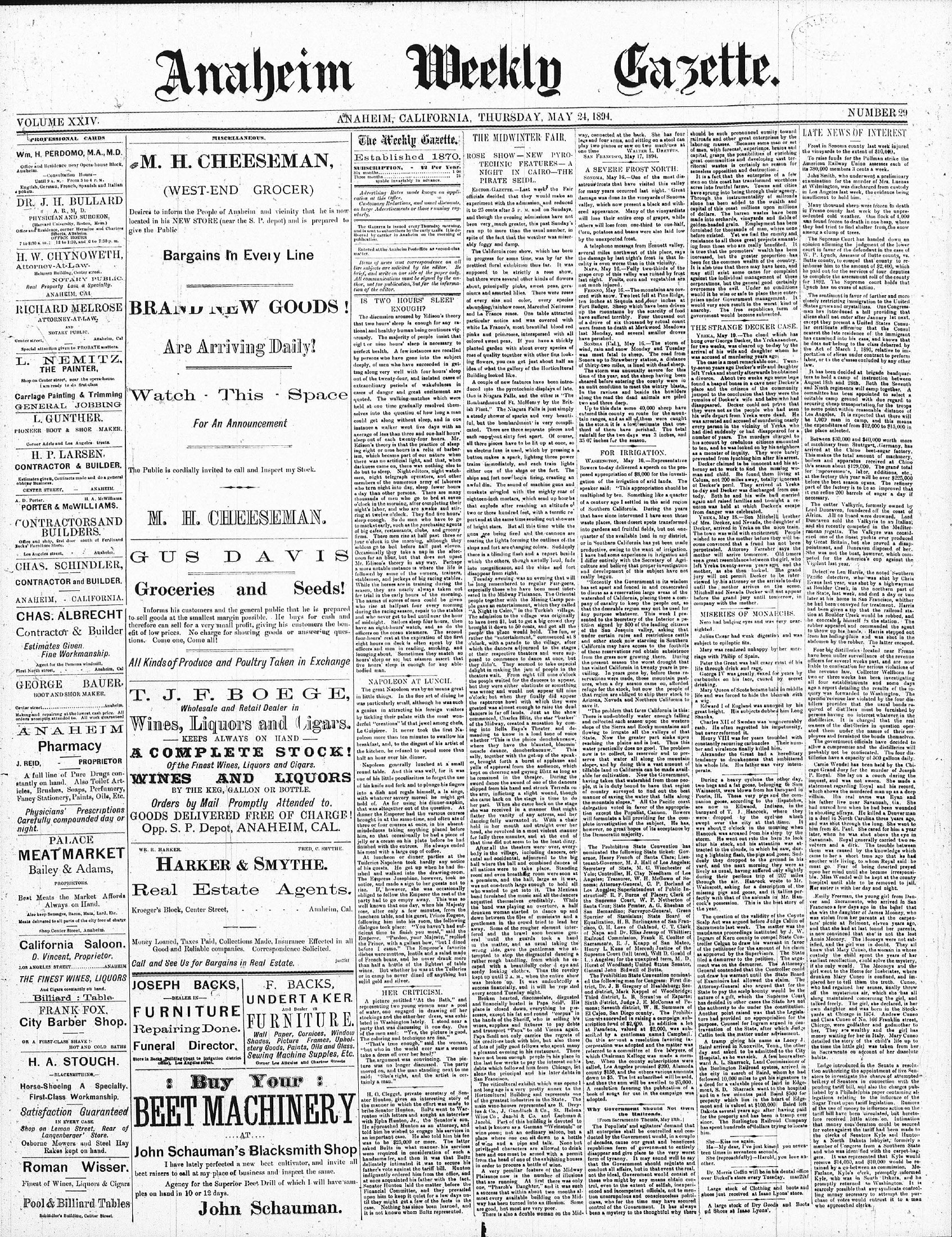
Searchable text
Anaheim
VOLUME XXIV.
PROFESSIONAL CARDS
Wm. H. PERDOMO, M.A., M.D.
Office and Residence near Opera-house Block,
Anaheim.
Consultation Hours—
Until 9 A.M. From 3 to 4 P.M.
English, German, French, Spanish and Italian spoken.
DR. J. H. BULLARD
A. B., M, D.
PHYSICIAN AND SURGEON,
(Harvard University, Boston, Mass.)
Office and Residence, corner Hermione and Chartres
Streets, Anaheim.
OFFICE HOURS
7 to 8:30 a.m.; 12 to 1:30, and 6 to 7:30 p.m.
H. W. CHYNOWETH,
Attorney-At-Law.
Helmsen Building, Center street.
NOTARY PUBLIC.
Real Property Law a Specialty.
ANAHEIM, CAL.
RICHARD MELROSE
ATTORNEY-AT-LAW.
AND
NOTARY PUBLIC.
Center street, Anaheim, Cal
Special attention given to PROBATE matters.
L. NEMITZ,
THE PAINTER,
Shop on Center street, near the opera-house.
I am ready to do first-class Carriage Painting & Trimming
GENERAL JOBBING
L. GUNTHER.
PIONEER BOOT & SHOE MAKER.
Corner Adelo and Los Angeles streets.
H. P. LARSEN,
MISCELLANEOUS.
M. H. CHEESEMAN,
(WEST-END GROCER)
Desires to inform the People of Anaheim and vicinity that he is now located in his NEW STORE (near the S. P. depot) and is prepared to give the Public
Bargains In Every Line
BRAND NEW GOODS!
Are Arriving Daily!
Watch - This - Space
For An Announcement
THE PAINTER,
Shop on Center street, near the opera-house.
I am ready to do first-class
Carriage Painting & Trimming
GENERAL JOBBING
L. GUNTHER.
PIONEER BOOT & SHOE MAKER.
Corner Adele and Los Angeles treets.
H. P. LARSEN.
CONTRACTOR & BUILDER.
Estimates given, Contracts made and do a general obbing Business.
CENTER STREET. - ANAHEIM.
A. D. Porter. H. A. McWilliams.
PORTER & McWILLIAMS.
CONTRACTORS AND BUILDERS.
Office and shop, first door south of Ferlinand Backs' Furniture Store.
Los Angeles street. Anaheim.
CHAS. SCHINDLER,
CONTRACTOR and BUILDER.
ANAHEIM, CALIFORNIA.
CHAS. ALBRECHT
Contractor & Builder
Estimates Given.
Fine Workmanship.
Agent for the Pomona windmill.
First North street. Anaheim, Cal
GEORGE BAUER
BOOT AND SHOE MAKER.
Center street... Anaheim.
Making and repairing at the lowest cash price. All orders wromptly attended to. All work guaranteed
ANAHEIM
Pharmacy
J. REID. - PROPRIETOR
A full line of Pure Drugs constantly on hand. Also Toilet Articles, Brushes, Soaps, Perfumery, Fancy Stationery, Paints, Oils, Etc.
Physicians' Prescriptions Carefully compounded day or night.
PALACE
MEAT MARKET
Bailey & Adams,
Watch - This - Space
For An Announcement
The Public is cordially invited to call and Inspect my Stock.
M. H. CHEESEMAN.
GUS DAVIS
Groceries and Seeds!
Informs his customers and the general public that he is prepared to sell goods at the smallest margin possible. He buys for cash and therefore can sell for a very small profit, giving his customers the benefit of low prices. No charge for showing goods or answering questions. Come one, Come all!
All Kinds of Produce and Poultry Taken in Exchange
T. J. F. BOEGE,
Wholesale and Retail Dealer in
Wines, Liquors and Ligars.
KEEPS ALWAYS ON HAND
A COMPLETE STOCK!
Of the Finest Wines, Liquors and Cigars.
WINES AND LIQUORS
BY THE KEG, GALLON OR BOTTLE.
Orders by Mail Promptly Attended to.
GOODS DELIVERED FREE OF CHARGE!
Opp. S. P. Depot, ANAHEIM, CAL.
WR. R. HARKER.
FRED, C. SMYTHE.
HARKER & SMYTHE.
PALACE MEAT MARKET
Bailey & Adams,
PROPRIETORS.
Beat Meats the Market Affords Always on Hand.
Also keep Sausages, Bacon, Ham, Lard, Etc.
Meats delivered to all parts of the city free of charge
Shop Center Street, Anaheim.
California Saloon.
D. Vincent, Proprietor.
LOS ANGELES STREET...ANAHEIM
THE FINEST WINES, LIQUORS
And Cigars constantly on hand.
Billiard : Table.
FRANK FOX,
City Barber Shop.
OR A FIRST-CLASS SHAVE!
HOT AND COLD BATHS
H. A. STOUGH.
BLACKSMITHING.
Horse-Shoeing A Specialty.
First-Class Workmanship.
Satisfaction Guaranteed
IN EVERY CASE.
Shop on Lemon Street, Rear of Langenberger' Store.
Osborne Mowers and Steel Hay Rakes kept on hand.
Roman Wisser.
Finest of Wines, Liquors & Cigars
Pool & Billiard Tables
Schindler's Building, Center Street.
WINES AND LIQUORS
BY THE KEG, GALLON OR BOTTLE.
Orders by Mail Promptly Attended to.
GOODS DELIVERED FREE OF CHARGE!
Opp. S. P. Depot, ANAHEIM, CAL.
WR. R. HARKER.
FRED, C. SMYTHE.
HARKER & SMYTHE.
Real Estate Agents.
Kroeger's Block, Center Street, Anaheim, Cal.
Money Loaned, Taxes Paid, Collections Made, Insurance Effected in all Good and Reliable companies. Correspondence Solicited.
Call and See Us for Bargains in Real Estate. Jan25th
JOSEPH BACKS,
DEALER IN
FURNITURE
Repairing Done.
Funeral Director.
Store In Backs Building (next to irrigation district office), Los Angeles street.
F. BACKS,
UNDERTAKER.
And Dealer in
FURNITURE.
Wall Paper, Cornices, Window Shades, Picture Frames, Upholstery Goods, Paints, Oils and Glass.
Sewing Machine Supplies, Etc.
Buy Your BEET MACHINERY
AT...
John Schauman's Blacksmith Shop
I have lately perfected a new beet cultivator, and invite all beet raisers to call at my place of business and inspect the same.
Agency for the Superior Beet Drill of which I will have samples on hand in 10 or 12 days.
John Schauman.
ANAHEIM, CALIFORNIA, THURSDAY, MAY 24, 1894.
MAN,
OCER)
nicity that he is now
) and is prepared to
Line
GOODS!
Daily?
Space
nt
The Weekly Gazette.
Established 1870.
SUBSCRIPTION, - $2 Per Year.
Six months... 1 00
Three months... 75
ayable invariably in advance.
Advertising Rates made known on application at this Office.
Customary Reductions, and usual discounts, on large Advertisements or those running regularly.
The Gazette is issued every Thursday morning, and is sent to subscribers by the early rails. It is delivered by carrier in Anaheim on the morning of publication.
Entered at the Anaheim Postoffice as second-class matter.
Items of news and correspondence on all live subjects are solicited by the editor. Be brief, and write on one side of the paper only. All communications must be signed by the author, not for publication, but for the information of the editor.
IS TWO HOURS' SLEEP ENOUGH?
The discussion aroused by Edison's theory that two hours' sleep is enough for any rational and healthy human being continues vigorously. The majority of people insist that eight or nine hours' sleep is necessary to perfect health. A few instances are recalled by persons who have gone into the subject deeply, of men who have succeeded in getting along very well with four hours' sleep out of the twenty-four, and isolated cases of extraordinary periods of wakefulness in cases of danger and great excitement are quoted. The walking-matches which were held at one time gradually resolved themselves into the question of how long a man could get along without sleep, and in one instance a walker went five days with an average of less than three and one-half hours' sleep out of each twenty-four hours. Mr. Edison's theory is that the practice of sleeping eight or nine hours is a relief of barbarism, which became part of our nature when there was no artificial light, and that, when THE MIDWINTER FAIR.
ROSE SHOW—NEW PYRO-TECHNIC FEATURES—A NIGHT IN CAIRO—THE PIRATE SEIDL.
EDITOR: GAZETTE. Last week the Fair officials decided that they would make an experiment with the admission, and reduced it to 25 cents after 5 p.m. and on Sundays, and though the evening admissions have not been very much greater, this past Sunday's ran up to more than the usual number, in spite of the fact that the weather was miserably foggy and damp.
The California rose show, which has been in progress for some time, was by far the prettiest floral exhibition thus far. It was supposed to be strictly a rose show, but there were several other kinds of flowers about, principally pinks, sweet peas, geraniums and assorted lilies. There were roses of every size and color, every species abounding rainbow roses, Marechel Netroses and La France roses. One table attracted particular notice and was covered with white La France's, most beautiful blood red pinks and primroses, interspersed with all colored sweet peas. If you have a thickly planted garden with about every species of rose of quality together with other fine looking flowers, you can get just about half an idea of what the gallery of the Horticultural Building looked like.
A couple of new features have been introduced into the pyrotechnic displays of late. One is Niagara Falls, and the other is "The Bombardment of Ft. McHenry by the British Fleet." The Niagara Falls is just simply a steady shower of sparks and very beautiful, but the bombardment is very complicated. There are three separate pieces and each one about sixty feet apart. Of course, all three pieces have to be lit up at once, so an electric fuse is used, which by pressing a button makes a spark, lighting three power way, connected at the back. She has legs and four arms, and sitting on a stoop play two pianos or sow on two machines one time WALTER L. DREYFELT
SAN FRANCISCO, May 17, 1894.
A SEVERE FROST NORTHESONA, May 16. One of the most astrous frosts that have visited this village for many years occurred last night. (The damage was done to the vineyards of Sonoma valley, which now present a black and dried appearance. Many of the vineyars will lose their entire crop of grapes; others will lose from one-third to one-corn, potatoes and beans were also laid by the unexpected frost.
A telephone message from Bennett vv several miles northwest of this place, the damage by last night's frost in this vicinity is even worse than in this vicinity.
NAPA, May 16. Fully two-thirds of grape crop of this valley was ruined by last night. Fruits, corn and vegetable not much injured.
FIRESOA, May 16. The mountains are erased with snow. Two feet fell at Pine Ridge mountain at Sequoia and four inches Fort Badger. Sheep which have been dug up the mountains by the scarcity of have suffered terribly. Four thousand of a drove of six thousand by actual fire were frozen to death at Markwood Meadow last Monday, and several smaller dogs have persisted.
SONORA (Cal.), May 16. The storm wind, rain and snow Monday and Tuesday was most fatal to sheep. The road Sonora up to Strawberry station, a district of thirty-two miles, is lined with dead trees.
The storm was unusually severe for time of the year, and the sheep having sheared before entering the county was an unfit condition to meet the wintry breeze in the ravines and beside the bow along the road the dead animals are two and three deep.
Up to this date some 40,000 sheep entered this county en route for the main ranges, and as all of them were cured in the storm it is a low estimate that third of them have perished. The rainfall for the two days was 3 inches 35 07 inches for the season.
FOR IRRIGATION.
WASHINGTON, May 16. Reprinted
deeply, of men who have succeeded in getting along very well with four hours' sleep out of the twenty-four, and isolated cases of extraordinary periods of wakefulness in cases of danger and great excitement are quoted. The walking-matches which were held at one time gradually resolved themselves into the question of how long a man could get along without sleep, and in one instance a walker went five days with an average of less than three and one-half hours' sleep out of each twenty-four hours. Mr. Edison's theory is that the practice of sleeping eight or nine hours is a relic of barbarianism, which became part of our nature when there was no artificial light, and that, when darkness came on, there was nothing else to do but to sleep. Night editors, night watchmen, night telegraph operators, and other members of the numerous army of laborers who turn night into day, sleep fewer hours a day than other persons. There are many thousands of men who go to bed at seven o'clock in the morning, after completing their night's labor, and who are awake and stirring at twelve o'clock. They find five hours' sleep enough. So do men who have to go to market early, such as the purchasing agents of big cafes, restaurants, clubs, and grocery firms. These men rise at half past three or tour o'clock in the morning, although they seldom go to bed before half past eleven. Occasionally they take a nap in the afternoon for an hour, but that does not upset Mr. Edison's theory in any way. Perhaps a more notable instance is where the life is followed by some of the owners, trainers, stablemen, and jockeys of big racing stables. While the horses are in training during the season, they are nearly always taken out for trial in the early hours of the morning. The names of scores of men could be given who rise at half past four every morning during the racing season, repair to the stables and who never get to bed until near the hour of midnight. Sailors sleep four hours, then have an eight-hour's watch, and so do the officers on the ocean steamers. The second four-hour's rest at the expiration of the first eight hours on deck is often spent by the officers and men in reading, smoking, and lounging about. Sometimes they snatch an hour's sleep or so; but seamen assert that five hours sleep is enough for any able-bodied man.
NAPOLEON AT LUNCH.
The great Napoleon was by no means great in little things. In the fine art of dining he was particularly small, although he was such a genius in attracting his foreign visitors by tickling their palate with the most wonderful "creations" of that jewel among chefs, Le Guipiere. It never took the first Napoleon more than ten minutes to swallow his breakfast, and to the disgust of his artist of the kitchen, he refused to spend more than half an hour over his dinner.
Napoleon generally launched at a small round table. And this was well, for it was one of his little peculiarities to forget the use of his knife and fork and to plunge his fingers into a dish and regale himself, a la singe, with whatever savory morsel he might get hold of. As for using his dinner-napkin, that was altogether out of the question. At dinner the Emperor had the various courses brought in at the same-time, and often ate of three or four courses at once, in his absent-mindedness taking anything placed before him, so that occasionally he had a piece of jelly or a cream on his plate before he had finished with the entrees. He always ended his meal with a large cup of coffee.
At luncheon or dinner, parties at the Tuileries Napoleon took hardly any notice of his guests. He got up when he had finished and walked into the drawing-room.
A couple of new features have been introduced into the pyrotechnic displays of late. One is Niagara Falls, and the other is "The Bombardment of Ft. McHenry by the British Fleet." The Niagara Falls is just simply a steady shower of sparks and very beautiful, but the bombardment is very complicated. There are three separate pieces and each one almost sixty feet apart. Of course, all three pieces have to be lit up at once, so an electric fuse is used, which by pressing a button makes a spark, lighting three power trains immediately, and each train lights either one of the ships or the fort. The ships and fort now begin firing, creating an awful din. The sound of machine guns and muskets unmingled with the mighty roar of eighteen-inch mortars, which send up bombs that explode after reaching an altitude of two or three hundred feet, with a terrific report at the same time sending out showers of bright stars. But all this time while the guns are being fired and the cannons are roaring the lights forming the outlines of the ships and fort are changing colors. Suddenly there is a blinding flash and a report beside which the others, though awfully loud, fade into insignificance, and the ships and fort disappear from sight.
Tuesday evening was an evening that will be long remembered to regular Fair-goers, especially those who have been most interested in the Midway Plaisance. The Oriental people together with the Mining Camp people gave an entertainment, when they called "A Night in Cairo," in the Turkish village. The admission to the village was originally to be $1, but to get a big crowd they brought it down to 50 cents, and got all the people the place would hold. The fun, or rather the "entertainment," commenced at S o'clock, with a parade to the village, after which the dancers adjourned to the stages of their respective剧院和 were supposed to commence to dance at once, but they didn't. They seemed to take especial delight in making the jam of people in the theater wait. From eight till nine o'clock the people waited for the dancers to appear, but they were either obstruct or something was wrong and would not appear till nine o'clock; but when they finally did appear the rapturous howl with which they were greeted was almost enough to raise the dead dancers in far off lands. Just as the show commenced, Charles Blitz, the star "barker" of the Midway, created a sensation by coming into Bella Baya's Theater and demanding to know in a loud tone of voice whether "This is the ploice donchekneau: where they have the blasted bloomin' muscle daunce, donchereknueau."
This sally, together with the get-up of the speaker, brought forth a burst of applause and yells of approval from the audience, which kept on cheering and guvy Blutz as long as he remained in the theatre. During the sword dance the sword of one of the dancers slipped from his hand and struck Terreda on the arm, inflicting a slight wound, though she came back on the stage in time to do her part. When she came back on the stage she was received in a manner that might flatter the vanity of any actress, and her dancing fully warranted it. With a chair held in her mouth and straight over her head, she revolved in a most violent manner for fully three minutes, and at the end of that time did not seem to be the least dizzy.
After all thetheaters were over everybody in the village, including dancers, oriental and occidental, adjourned to the big hall where the ball and combined dances of all nations were to take place. Standing afloat with no dead bodies around them following State tickets error; Henry French of Santa Clara tenant-Governor; M.J.Hall of Los Angeles Secretary of State; M.C.Winchester Volunteer Controller; H.Clay Needham
FOR IRRIGATION.
WASHINGTON, May 16.-Representatives bowed to-day delivered a speech on this posed appropriation of $8,000 for the introduction of the irrigation of arid land speakers said: "This appropriation showed multiplied by ten. Something like a quarter of a century ago settled in the arid region of Southern California. During this period have since intervened I have seen waste places, those desert spots transform into gardens and fruitful fields, but no quarter of the available land in my district or in Southern California has yet been productive; owing to the want of irrigation I have had some experience in irrigation I differ entirely with the Secretary of Culture and believe that proper investment and development of this subject have really begun.
"Recently the Government in its warts has set apart and fenced in and coursed to disuse as a reservation large areas watershed of California placing there pany of cavalry to keep the people out that desirable region may not be used any purpose whatever. This week sent to the Secretary of Interior titified signed by 800 of leading cities of San Joaquin valley asking under certain rules and restrictions; and other stock now starving in South California may have access to the forts these reservations und obtain subsistence from grass now growing there.
The present season has worst drought visited California in twenty years vailing. In years gone by before these servations were made, those mountain ures when a dry season came on; also refuge for the stock; but now the peat region are obliged to ship their area Arizona, Nevada and Northern California save it.
"The problem that faces California There is undoubtedly water enough collected each season upon; this slope of Sierra Rocky mountains flowing to irrigate all valleys of State. Now greater part sink reaching the plains and is lost. The water practically does no good. The people now is to collect; to reservoir and serve that water all along the mountain slopes; and by doing this a vast amount stillable land in California can be made able for cultivation. Now the Governor having taken that watershed from these plie it is duty bound to have that portion of country surveyed to find out that manner of saving water that fails the mountain slopes." All the Pacific delegation voted for this plot investigation provided for this plot investigation of the subject. However, no great hopes of its acceptance The Democratic majority.
The Probibition State Convention nominated following State ticket error; Henry French of Santa Clara tenant-Governor; M.J.Hall of Los Angeles Secretary of State; M.C.Winchester Volunteer Controller; H.Clay Needham
Attended to.
OF CHARGE!
EIM, CAL.
YTHE.
Agents.
Anaheim, Cal.
Insurance Effected in all incidence Solicited.
state.
BACKS,
ERTAKER.
And Dealer in
Paper, Cornices, Window
Picture Frames, Upholsits, Oils and Glass.
Machine Supplies, Etc.
Angles and Chartre Street
UP 8
Skmith Shop
cultivator, and invite all inspect the same.
of which I will have samhauman.
HER CRITICISM.
A picture entitled "At the Bath," and representing two young women near a pool of water, one engaged in drawing off her stockings and the other her dress, was exhibited in Washington lately. I stood near a party that was discussing it one day. One of the men said: "Yes, the picture is good. The coloring and technique are fine."
"That's true enough," said the woman, "but who in the world ever saw a woman take a dress off her head!"
The argument was convincing. The picture was no longer discussed. The party moved on, and the man standing next to me said: "She's right, and the artist is certainly a man."
H. O. Clegget, private secretary of Senator Hunton, gives an interesting story of the manner in which the effort was made to bribe Senator Hunton. Bultz went to Warrenton with letters and sought an interview with Epha Hunton, Jr., the Senator's son. He approached Hunton as an attorney, and told him he wished to engage his services in an important case. He also told him his fee was to be $25,000 or more. The latter asked Bultz in what manner his services were required in consideration of such a handsome fee, and then it was that Bultz delicately intimated it was to secure his father's vote against the tariff bill. Hunton indignantly ordered him from the office, and at once acquainted his father with the fact. Senator Hunton laid the matter before the Financial Committee, and they prevailed upon him to keep it quiet for a few days until they might get a few of the facts in the case. Nothing has since been learned, and it is not known whom Bultz represented.
At luncheon or dinner, parties at the Tuileries Napoleon took hardly any notice of his guests. He got up when he had finished and walked into the drawing-room. The Empress Josephine, however, took no notice, and made a sign to her guests not to rise. If, however, she was occasionally obliged to follow the Emperor the rest of the party had to go empty away. This was so well known that one day, when his Majesty rose after only a few minutes, from the luncheon table, and his guest, Prince Eugene, following him into his room, the following dialogue took place: "You haven’t had sufficient time to finish you meal," said the Emperor, "Pardon your Majesty," replied the Prince, with a gallant bow, "但 I dined before I came." The Emperor’s favorite dishes were maltown, lentil and a salad made of French beans, and he never drank more than half a bottle of the lightest of table wines. But whether he was at the Tuileries or in camp he never dined off anything but solid gold and silver.
During the award dance the sword of one of the dancers slipped from his hand and struck Terreda on the arm, inflicting a slight wound, though she came back on the stage in time to do her part. When she came back on the stage she was received in a manner that might flatter the vanity of any actress, and her dancing fully warranted it. With a chair held in her mouth and straight over her head, she revolved in a most violent manner for fully three minutes, and at the end of that time did not seem to be the least dizzy.
After all the theater were over, everybody in the village, including dancers, oriental and occidental, adjourned to the big hall where the ball and combined dances of all nations were to take place. Standing room and even breathing room were soon at a premium, and the hall, large as it was, was not one-tenth large enough to hold all who wanted to get into it. The Mexican band furnished the music and all the dancers acquitted themselves creditably. While the band was playing an overture, a half drunken woman started to dance up and down between the files of musicians and a gentleman in the crowd tried to lead her away. Some of the rougher element interfaced and the brawl soon became general until the guards took a band on the matter, and as usual taking the wrong side, gave the gentleman who attempted to stop the disgraceful dancing a rather rough handling, from which he escaped with a beautiful color eye and seedy looking clothes. Thus the revelry kept up until 2 A.M., when the entire show was broken up. It was undoubtedly a success financially, and it will be repeated every second Tuesday night.
Broken hearted, disconsolate, diriguted and financially bustied is Papa Seidl. His place is closed down, everything he possesses, except his fat and round "corpus" in the hands of the Sheriff, who is selling his wines, supplies and fixtures to pay debts and transport "Papa" to old Vienna again. Papa Seidl not only carries the regrets of his creditors back with him, but also those of lots of jolly good fellows who spent many pleasant evening in his restaurant. There have not been enough people in his place in the last few weeks to pay the interest on his debts which followed him from Chicago, let alone the principal and his later debts in San Francisco.
The viticultural exhibit which was opened not long ago is a very pretty annex to the Horticultural Building and represents one of the greatest industries in the State. The main wine-houses represented are B. Dreyfus & Co., J. Gundlach & Co., St. Helena Wine Co., Jacobi & Co., and Lachman & Jacobi. Part of this building is devoted to what is known as a German "Weinstulb" or wine room; not an ordinary saloon, but a place where one can sit down to a bottle of wine and a pipe and talk. None but privileged characters are allowed to drink here and one must be armed with a permit from the head of one of the exhibiting houses in order to procure a bottle of wine.
A very peculiar feature of the Midway Plaissance now is the number of illusions that are running. At first there was only one, "Pharoh's Daughter," and it was such a success that within about two months almost every available building on the Midway has been turned into an illusion. Some are good, but most are very poor.
There is also a double woman on the Mid-
The Probition State Convention nominated the following State ticket error; Henry French of Headland tenant-Governor, M. J. Hall of Los Angeles Secretary of State, M. C. Winchester Yolo; Controller, H. Clay Needham Angeles; Treasurer, W. H. McGowen noma; Attorney-General, C. P. Dorres Los Angeles; Superintendent of Public instruction; R. F. Burus of Placer; Othe Supreme Court, W. P. Nethers Santa Cruz; State Printer, A. G. Shaw San Bernardino; Surveyor-General, Spurrier of Stanislau; State Board Equalization, H. B. Burlingame of Sacrison, O. H. Love of Oakland, C. T. Of Napa and Dr. Ellias Jessup of W.Railroad Commission, Frank E. Coracimento, R. J. Knapp of San Francisco Supreme Court (full term), Will D. C. Los Angeles; for the unexpired term, Hurat of Woodland; United States General John Bidwell of Butte.
The Prohibition State Convention met after the fellowmen for Congress: Dr. J. B Gregory of Hauldaboud district, Mark Kepel of Woodward Third district, L. B. Seraton of Sixth district, Judge J.E. McComas mona; Seventh district, W.H. Sumner El Cajon, San Diego county. The tribunes succeeded in raising a scription fund of $2,000. In addition at Pasadena valued at $2,000, written by a gentleman named Caesar On this account a resolution favor corporation was adopted and the man referred to a committee of five laymen which Chairman Kellogg was made called, Los Angeles promised $200 county $150, and the others various down to $5. The lot subscribed will thus that sum may be swelled to A resolution favoring the publication book of songs for use in the camp adopted.
Why Government Should Not The Railroads.
From Sacramento Themis, May 14
The Populists' and agitators' demons all enterprise shall be controlled by the Government would be deprived cause our great and bad republican form of government to disappear and give place to the very form of tyranny. It may sound that the Government should regulate all affairs, but in that event not the ideal Government would obey those who might by any means control even to the extent of selfishness enceased incompetent officials, notation unsuperulous and conscience clans who for the time may have control of the Government. It has been a mystery to the thoughtful w
Gazette.
1894.
DEVERE FROST NORTH.
MAY 16.—One of the most disastrous that have visited this valley by years occurred last night. Great was done to the vineyards of Sonoma which now present a black and with appearance. Many of the vineyardists use their entire crop of grapes, while will lose from one-third to one-half, potatoes and beans were also laid low unexpected frost.
Phone message from Bennett valley, miles northwest of this place, saysage by last night's frost in that looewer than in this vicinity. May 16.—Fully two-thirds of the crop of this valley was ruined by frost right. Fruits, corn and vegetables are both injured.
NO, May 16.—The mountains are covered with snow. Two feet fell at Pine Ridge, cities at Sequoia and four inches at Judge. Sheep which have been driven mountains by the scarcity of food offered terribly. Four thousand out of six thousand by actual count frozen to death at Markwood Meadows Monday, and several smaller droves erased.
RA (Cal.). May 16.—The storm of rain and snow Monday and Tuesday lost fatal to sheep. The road from up to Strawberry station, a distance two-miles, is lined with dead sheep. Storm was unusually severe for this year, and the sheep having been before entering the county were in condition to meet the wintry blasts, ravines and beside the bowlers the road the dead animals are piled and three deep.
On this date some 40,000 sheep have this county en route for the mounages, and as all of them were caught on it is a low estimate that one of them have perished. The total for the two days was 3 inches, andaches for the season.
FOR IRRIGATION.
WESTINGHOUND. May 16.—Representative should be such pronounced emmity toward railroads and other great enterprises by the laboring masses. Because some man or set of men, with forecast, experience, brains and capital, grasps the possibilities of enriching great communities and developing vast territorial wastes is certainly no reason for senseless opposition and destruction.
It is a fact that the enterprise of a few men on this coast has transformed worthless acres into fruitful farms. Towns and cities have sprung into being through their agency. Through the instrumentality of mail roads alone has been added to the wealth and capital of this coast millions upon millions of dollars. The barren wastes have been made into orchards, vineyards and fields of golden-headed grain. Employment has been furnished for thousands of men, where none before existed. Yet we find the emmity and resistance to all those great projects emanating from those who are really benefited. It is true that the promoters' wealth has been increased, but the greater proportion has been for the common wealth of the country. It is also true that there may have been, and may still exist some cause for complaint against the individual management of these corporations, but the general good certainly overcomes the evil. Under no conditions would it be wise or safe to place these enterprises under Government management. It would very soon result in the worst kind of anarchy. The free republican form of government would become subverted.
THE STRANGE DECKER CASE.
YREKA, May 19.—The cloud which has hung over George Decker, the Yreka rancher, for two weeks, was cleared up to-day by the arrival of his wife and daughter whom he was accused of murdering years ago.
The case is a most remarkable one. Twenty-seven years ago Decker's wife and daughter left Yreka and shortly afterwards he obtained a divorce. About two weeks ago some boys found a heap of bones in a cave near Decker's place and the citizens of the community jumped to the conclusion that they were the remains of Decker's wife and babe who had disappeared. Decker could not prove that they were not as the people who had seen his wife depart from Yreka were dead. He was arrested and accused of murdering nearly every person in the vicinity of Yreka who had died suddenly or had disappeared for a number of years. The murders charged to his account by credulous citizens amounted to ten, and he was looked on by his neighbors as a monster of inquity. They were barely prevented from lynching him after his arrest.
LATE NEWS OF INTEREST
Frost in Sonoma county last week injured the vineyards to the extent of $10,000.
To raise funds for the Pullman strike the American Railway Union assesses each of its 380,000 members 3 cents a week.
John Smith, who underwent a preliminary examination for the murder of Mrs. Luenas at Wilmington, was discharged from custody in Los Angeles last week, the evidence being insufficient to hold him.
Many thousand sheep were frozen to death in Fresno county last week by the unprecedented cold weather. One flock of 4,000 was found frozen to death in one heap, where they had tried to find shelter from the snow among a clump of trees.
The Supreme Court has handed down an opinion affirming the judgment of the lower court in favor of the defendant in the case of W. P. Lynch, Assessor of Batte county, vs. Batte county, to compel that county to reimburse him to the amount of $2,400, which he paid out for the services of four deputies to complete the assessment roll of the county for 1892. The Supreme court holds that Lynch has no cause of action.
The sentiment in favor of further and more closely restricting immigration to the United States grows and crystallizes. One Congressman has introduced a bill providing that aliens shall not enter after January 1st next, except they present a United States Consular certificate affirming that the Consul nearest the late residence of the immigrant has examined into his case, and knows that he does not belong to the class debarred by the Act of March 1, 1891, relative to importation of slices under contract to perform labor, or to the classes excluded by any other law.
It has been decided at brigade headquarters to hold a camp of instruction between August 18th and 28th. Both the Seventh and Ninth regiments will camp together. A committee has been appointed to select a suitable camp ground with due regard to securing cheap transportation for the troops to some point within reasonable distance of Los Angeles. It is expected that there will be 1,000 men in camp, and this means the expenditure of from $12,000 to $15,000 in the place selected.
Between $30,000 and $40,000 worth more of machinery from Stuttgart, Germany, has arrived at the Chino beet-sugar factory. This makes the total amount of machinery, boilers and apparatus received at Chino.
FOR IRRIGATION.
WASHINGTON, May 16.—Representative to-day delivered a speech on the proappropriation of $8,000 for the investigation of the irrigation of arid lands. The
said: "This appropriation should be
billed by ten. Something like a quarter
century ago I settled in the arid region
of Southern California. During the years
have since intervened I have seen those
places, those desert spots transformed
dens and fruitful fields, but not one
of the available land in my district,
southern California has yet been made
aiding to the want of irrigation.
I had some experience in irrigation and
entirely with the Secretary of Agriculture and believe that proper investigation
development of this subject have not
begun.
Recently the Government in its wisdom
apart and fenced in and consecrated
as a reservation large areas of the
hud of California, placing there a comfessional cavalry to keep the people out,
so desirable region may not be used for
purpose whatever. This week I prefect to the Secretary of the Interior a presigned by 800 of the leading citizens
in San Joaquin valley, asking that
certain rules and restrictions cattle
other stock now starving in Southern
California may have access to the foothills
also reservations and obtain subsistence
on grass now growing there. During
present season the worst drought that
established California in twenty years is preg. In years gone by, before these reactions were made, those mountain pastwhen a dry season came on, afforded
for the stock, but now the people of
region are obliged to ship their stock to
Maine, Nevada and Northern California to
The problem that faces California is this:
is undoubtedly water enough falling
collected each season upon the western
of the Sierra and Rocky mountains and
to irrigate all the valleys of that
area. Now the greater part sinks upon
the plains and is lost. Thus this
practically does no good. The problem
is to collect, to reservoir and to prethat water all along the mountain
and by doing this a vast amount of
land in California can be made availiable for cultivation. Now the Government,
again takes that water from those peoplants in duty bound to have that region
country surveyed to find out the best
measure of saving the water that falls along
mountain slopes." All the Pacific coast
votation voted in favor of the appropriacept the Populist, Cannon. Bowyer
formulate a bill providing for the commine investigation of the subject. He has,
ever, no great hopes of its acceptance by
democratic majority.
MISERIES OF MONARCHS.
Nero had bulging eyes and was very nearsighted.
Julius Caesar had weak digestion and was
subject to epileptic fits.
Mary was rendered unhappy by her marriage with Philip of Spain.
Peter the Great was hall crazy most of his life through drink and rage.
George IV was greatly vexed for years by carbuncle on his face, caused by secret drinking.
Mary Queen of Scots became bald in middle life and was forced to hide the blondish with a wig.
Edward I of England was annoyed by his great height. His subjects dubbed him Long Shanks.
Charles XII of Sweden was ungovernably rash. He often regretted his impetuosity, but never reformed it.
Henry VIII was for years troubled with constantly recurring carabances. Their number and virulence finally killed him.
Alexander the Great had a hereditary tendency to drunkness that embittered his whole life. His father was very intemperate.
During a heavy cyclone the other day,
two hogs and a fat goose, belonging to Sam Wainscott, were blown from his barnyard in Peoria, Ill. These very pigs and the companion goose, according to the dispatches, are now in Ellwood, Indiana, in the barnyard of T. J. Hancock, where they were dropped by the cyclone which swept over the city at that time. It was about 2 o'clock in the morning when Hancock was around from his sleep by the storm. He went into the barn to look after his stock, and his attention was attracted to the clouds, in which he saw, during a lightning flash, the pigeon and goose. Suddenly they dropped to the ground in his yard, and the next morning they were as lively as usual, having suffered only slightly
It was about seven years ago Decker's wife and daughter left Yreka and shortly afterwards he obtained a divorce. About two weeks ago some boys found a heap of bones in a cave near Decker's place and the citizens of the community jumped to the conclusion that they were the remains of Decker's wife and babe who had disappeared. Decker could not prove that they were not as the people who had seen his wife depart from Yreka were dead. He was arrested and accused of murdering nearly every person in the vicinity of Yreka who had died suddenly or had disappeared for a number of years. The murders charged to his account by credulous citizens amounted to ten, and he was looked on by his neighbors as a monster of inquiry. They were barely prevented from lyching him after his arrest.
Decker claimed to be innocent and his attorney set to work to find the missing woman and child. He found them living at Colusa, not 200 miles away, totally ignorant of Decker's peril. They arrived at Yreka to-day and Decker was discharged from custody. Both he and his wife had married again and raised families and to-night a reunion was held at which Decker's escape from danger was celebrated.
Yreka, May 18.—Ben Mitchelll brother of Mrs. Decker, and Nevada, the daughter of Decker, arrived in Yreka on the moon train. The town was wild with excitement. People wished to see the mother before they will become convinced that a fraud has not been perpetrated. Attorney Farraher says the mother will arrive tomorrow. Old timers seem a great resemblance between the girl, who left Yreka twenty-seven years ago, and the mother, as she then looked. The grand jury will not permit Decker to be interviewed by his attorney or the arrivals to-day until the mother arrives on the scene. Mitchell and Nevada Decker will not appear before the grand jury until tomorrow, in company with the mother.
MISERIES OF MONARCHS.
Nero had bulging eyes and was very near-sighted.
Julius Caesar had weak digestion and was subject to epileptic fits.
Mary was rendered unhappy by her marriage with Philip of Spain.
Peter the Great was hall crazy most of his life through drink and rage.
George IV was greatly vexed for years by carbuncle on his face, caused by secret drinking.
Mary Queen of Scots became bald in middle life and was forced to hide the blondish with a wig.
Edward I of England was annoyed by his great height. His subjects dubbed him Long Shanks.
Charles XII of Sweden was ungovernably rash. He often regretted his impetuosity, but never reformed it.
Henry VIII was for years troubled with constantly recurring carabances. Their number and virulence finally killed him.
Alexander the Great had a hereditary tendency to drunkness that embittered his whole life. His father was very intemperate.
During a heavy cyclone the other day,
two hogs and a fat goose, belonging to Sam Wainscott, were blown from his barnyard in Peoria, Ill. These very pigs and the companion goose, according to the dispatches, are now in Ellwood, Indiana, in the barnyard of T. J. Hancock, where they were dropped by the cyclone which swept over the city at that time. It was about 2 o'clock in the morning when Hancock was around from his sleep by the storm. He went into the barn to look after his stock, and his attention was attracted to the clouds, in which he saw, during a lightning flash, the pigeon and goose. Suddenly they dropped to the ground in his yard, and the next morning they were as lively as usual, having suffered only slightly
It was about seven years ago Decker's wife and daughter left Yreka and shortly afterwards he obtained a divorce. About two weeks ago some boys found a heap of bones in a cave near Decker's place and the citizens of the community jumped to the conclusion that they were the remains of Decker's wife and babe who had seen his wife depart from Yreka were dead. He was arrested and accused of murdering nearly every person in the vicinity of Yreka who had died suddenly or had disappeared for a number of years. The murders charged to his account by credulous citizens amounted to ten, and he was looked on by his neighbors as a monster of inquiry. They were barely prevented from lyching him after his arrest.
Decker claimed to be innocent and his attorney set to work to find the missing woman and child. He found them living at Colusa, not 200 miles away, totally ignorant of Decker's peril. They arrived at Yreka to-day and Decker was discharged from custody. Both he and his wife had married again and raised families and to-night a reunion was held at which Decker's escape from danger was celebrated.
Detective Len Harris, the noted Southern Precific detective, who was shot by Chris Evans last year, was shot by a highwayman at Boulder Creek, in the northern part of State, last week, and died a day or two later at his home in San Francisco, whither he had been conveyed for treatment. Harris had been given a tip that the railroad station at Boulder Creek would be robbed, and he concealed himself in the station. The robber appeared and commanded the agent to throw up his hands. Harris stepped out from his hiding place and was shot in the abdomen by the robber. The latter escaped.
Four big distilleries located near Fresno have been under surveillance of the revenue officers for several weeks past, and are now liable to confiscation for serious violations of the revenue law. Collector Wellborn for two or three weeks has been investigating all four establishments and some days ago a report detailing the results of the inquiry was forwarded to Washington. The specific revenue law violated by the four distilleries provides that the usual bonds required of distillers must be furnished by persons having no interest whatever in the distilleries. It is charged that the real owners of the distilleries in question operated them under the names of their employees and furnished the bonds themselves.
The government officials have decided to allow a compromise and the distilleries will probably not be conflicated. The four distilleries have a capacity of 500 gallons daily.
Carrie Wendel has been held by the Chicago Grand Jurory for the murder of Joseph P. Royal. She lay on a couch during the inquiry, and was not sworn. She made a statement regarding Royal and his record, which shows the murdered man up as a deep villain. His real name was Ryan and his father live near Savannah, Ga. She had nursed him when he had been wounded in shooting afractions. He killed a Denver man in duel in North Carolina three years ago, and was shot through the lung. She went to him from St. Paul. She cared for him a year later, when he was shot above the eye in Savannah. Royal generally carried two revolvers and a dirk. The trouble between them was caused by the knowledge which came to her a short time ago that he had another wife living, to whom Royla said he must go. Fear of being deserted preyed upon her mind until she became irresponsible.
Prohibition State Convention has issued following State ticket: Governor Henry French of Santa Clara; Lieutenant Governor M. J. Hall of Los Angeles; Secretary of State, M. G. Winchester of Controller H. Clay Needham of Los Angeles
The Prohibition State Convention has issued the following State ticket: Gov. Henry French of Santa Clara; Lieut-Governor, M. J. Hall of Los Angeles; Secretary of State, M. C. Winchester of Controller, H. Clay Needham of Los Angeles; Treasurer, W. H. McGown of Soil Attorney-General, C. P. Dorland of Angles; Superintendent of Public Inquiry, R. F. Burns of Placer; Clerk of Supreme Court, W. P. Netherton of Cruz; State Printer, A. G. Sheehan of Bernardo; Surveyor-General, Greenier of Stanislas; State Board of Administration, H. B. Burlingame of San Francisco, O. H. Love of Oakland, C. T. Clarkapa and Dr. Elias Jesup of Whittier; Road Commission, Frank E. Coulter of Montgomery, R. J. Knapp of Mattoe, L. Kuna of Merced; Justice of the Home Court (full term), Will D. Gould of Angles; for the unexpired term, M. D. Bent of Woodland; United States Senator, General John Bidwell of Batte.
The Prohibition State Convention nominated the following men for Congress: First district, Dr. J. B Gregory of Healdsburg; Second district, Judge J. E. McComas of Poison; Seventh district, W. H. Summers of Jackson, San Diego county. The Prohibitions succeeded in raising a campaign subtotal fund of $2,600. In addition a lot was donated, valued at $2,000, was submitted by a gentleman named Campbell.
This account a resolution favoring imposition was adopted and the matter was referred to a committee of five lawyers, of which Chairman Kellogg was made a memoir. When the county subscriptions were raised, Los Angeles promised $200, Alameda paid $156, and the others various amounts to $5. The lot subscribed will be sold, thus the sum will be swelled to $5,000.
Resolution favoring the publication of a set of songs for use in the campaign was voted.
By Government Should Not Own the Railroads.
[From Sacramento Themis, May 13th.] The Populists' and agitators' demand that enterprise shall be controlled and controlled by the Government would, in a couple decades, cause our great and beneficent publician form of government to entirely appear and give place to the very worst of tyranny. It may sound well to say that the Government should regulate and conduct all affairs, but in that event the real ideal, Government would consist of those who might by any means obtain consent, even to the extent of selfish, inexperienced and incompetent officials, not to men unscrupulous and conscienceless politicians, who for the time may have secured control of the Government. It has always been a mystery to the thoughtful why there
During a heavy cyclone the other day, two hogs and a fat goose, belonging to Sam Waincott, were blown from his barnyard in Peoria, Ill. These very pigs and the companion goose, according to the dispatchers, are now in Ellwood, Indiana, in the barnyard of T. J. Hancock, where they were dropped by the cyclone which swept over the city at that time.
It was about 2 o'clock in the morning when Hancock was around from his sleep by the storm.
He went out into the barn to look after his stock, and his attention was attracted to the cloudy, in which he saw, during a lightning flash, the pigs and goose. Suddenly they dropped to the ground in his yard, and the next morning they were as lively as usual, having suffered only slightly during their parous trip of 207 miles through the air. Hancock wrote to Mr. Waincott, asking for a description of the missing pigs and goose, and it tallies perfectly with that of the animals in Mr. Hancock's possession. This is the best story of the year.
The question of the validity of the Coyote Scalp Act was argued before Judge Caltin of Sacramento last week. The matter was the mandamus proceedings instituted by J.W. Ingram of Kern county to compel State Controller Colgan to draw his warrant in favor of the petitioner for the amount of his claim as approved by the Supervisors. The State filed a demurrer to the petition. The argument was on the demurrer. The Attorney-General contended that the Controller could not draw his warrant until the State Board of Examiners had allowed the claim. The Attorney-General also argued that for the State to pay the scalp bounty would be the nature of a gift, which the Supreme Court has decided in other cases the State has not the authority to do under the constitution. Another point raised was that the Legislature had provided no appropriation for the purpose. Counsel for Ingram argued in contravention of the State, after which Judge Catlin took the matter under advisement.
A trump giving his name as Lacey J. Baird arrived in Knoxville, Tenn., the other day and asked to be admitted to the City Hospital, as he was sick. A few hours afterward A.L.Sharrack,Land Commissioner of the Burlington Railroad systems, arrived in one city in search of Baird whom he had followed 10,000 miles to get his signature to a deed for a valuable piece of land in Edgemont, S.D.Sharrack went to the hospital and in a few minutes paid Baird $500 for property which lies in the heart of Edgemont and is valued at $100,000.Baird left Dakota several years ago after having paid for the property and has been a traump ever since.The Burlington Railroad Company has spent hundreds of dollars trying to locate him.
She—Kiss me again.
He—My dear I've just kissed you seventeen times in seventeen seconds.
She (reproachfully)—Harold, you love another.
Dr.Morris Coffin will be in his dental office over Dickel's store every Tuesday.mar 22f
Large stock of Clothing and boots and shoes just received at Isaac Lyons' store.
A large stock of Dry Goods and Boots and Shoes at Isaac Lyons'.