anaheim-gazette 1893-09-07
Scanned page
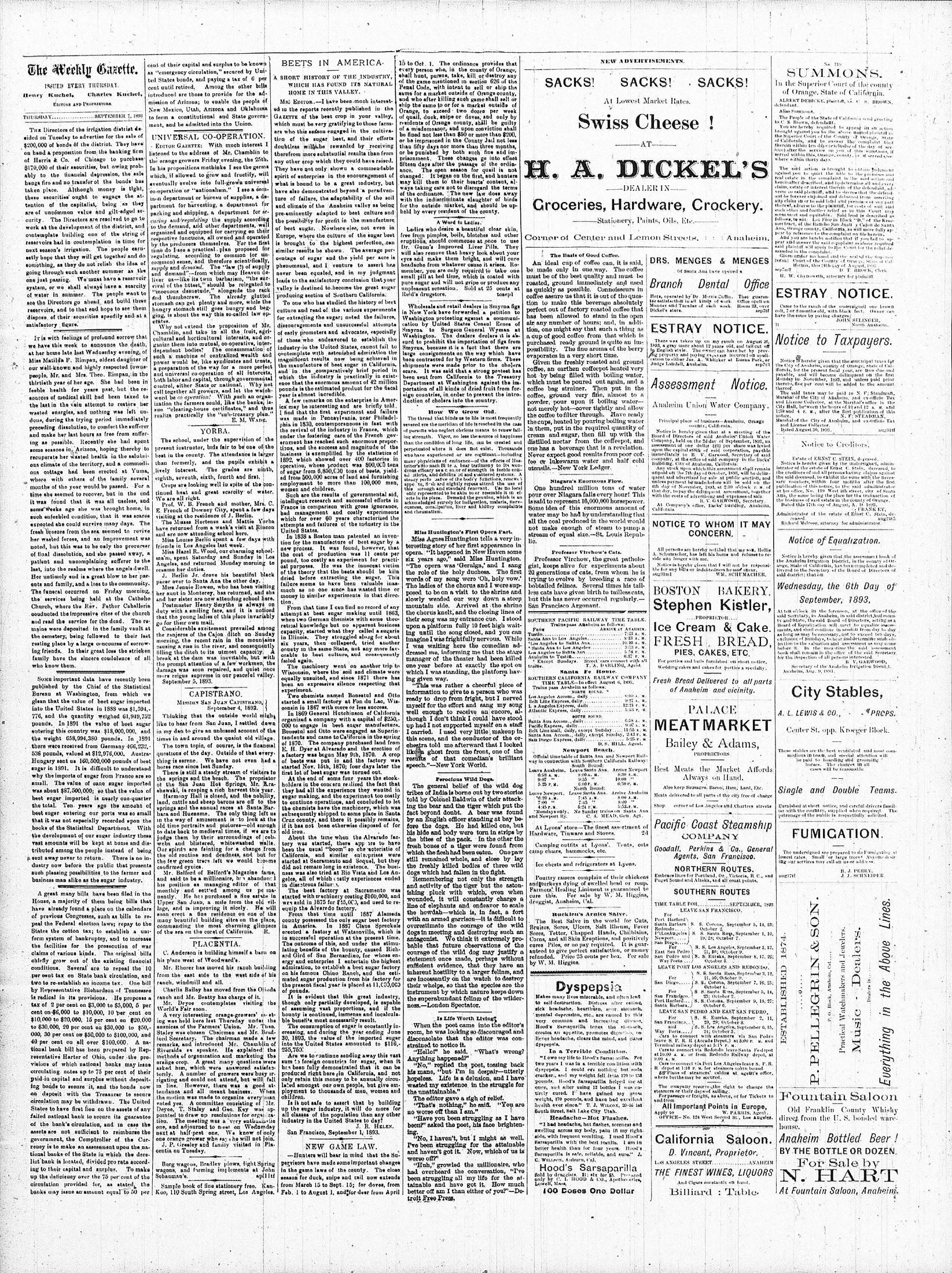
Searchable text
The Weekly Gazette.
ISSUED EVERY THURSDAY.
Henry Kuchol, Charles Kuchel,
Editors and Producers.
THURSDAY... SEPTEMBER 7, 1893
The Directors of the irrigation district decided on Tuesday to advertise for the sale of $200,000 of bonds of the district. They have on hand a proposition from the banking firm of Harris & Co. of Chicago to purchase $170,000 of their securities, but owing probably to the financial depression, the sale hangs fire and no transfer of the bonds has taken place. Although money is tight, these securities ought to engage the attention of the capitalist, being as they are of uncommon value and gilt-edged security. The Directors are resolved to go to work at the development of the district, and contemplate building one of the string of reservoirs bad in contemplation in time for next season's irrigation. The people earnestly hope that they will get together and do something, as they do not relish the idea of going through such another summer as the one just passing. We must have a reservoir system, or we shall always have a scarcity of water in summer. The people want to see the Directors go ahead, and build these reservoirs, and to that end hope to see them dispose of their securities speedily and at a satisfactory figure.
It is with feelings of profound sorrow that we have this week to announce the death, at her home late last Wednesday evening, of Miss Matilda F. Rimpan, oldest daughter of our well-known and highly respected townpeople, Mr. and Mrs. Theo. Rimpan, in the thirtieth year of her age. She had been in feeble health for years past, but the resources of medical skill had been taxed to the last in the vain attempt to restore her wasted energies, and nothing was left undone, during the trying period immediately preceding dissolution, to comfort the sufferer and make her last hours as free from suffering as possible. Recently she had spent some seasons in Arizona, hoping thereby to recuperate her wasted health in the salubrious climate of the territory, and a commodious cottage had been erected at Yuma,
cent of their capital and surplus to be known as "emergency circulation," secured by United States bonds, and paying a tax of 6 per cent until retired. Among the other bills introduced are those to provide for the admission of Arizona; to enable the people of New Mexico, Utah, Arizona and Oklahoma to form a constitutional and State government, and be admitted into the Union.
UNIVERSAL CO-OPERATION.
Editor Gazette: With much interest I listened to the address of Mr. Chamblin to the orange growers Friday evening, the 25th. In his propositions methinks I see the germ which, if allowed to grow and fructify, will eventually evolve into full-grown universal co-operation or "nationalism." I see a common department or bureau of supplies, a department for harvesting, a department for packing and shipping, a department for caring and regulating the supply according to the demand, and other departments, well organized and equipped for carrying on their respective functions, all owned and operated by the producers themselves. For the first time do I see a practical plan proposed for regulating, according to common (or uncommon) sense, and therefore scientifically, supply and demand." from which may Heaven deliver us—like its twin barbarism," "the survival of the hittest," should be relegated to "innocuous desuetude," alongside the rack and thumbscrawl. The already gluttoned stomach can get plenty and more, while the hungry stomach still goes hungry and begging is about the way this so-called law operates.
Why not extend the proposition of Mr. Chamblin, and take in all the fruit, agricultural and horticultural interests, and organize them into mutual, co-operative, interdependent bodies? The consummation of such a machine of centralized wealth and power would be, like syndicates and trusts, a preparation of the way for a more perfect and universal co-operation of all interests both labor and capital, through governmental control, either State or national. Why not call together all growers, and let the watchword be co-operation? With such an organization the farmers could, like the banks, issue "clearing-house certificates," and thus realize practically the "sub-treasury plan."
E. M. WADE.
YORBA.
The school, under the supervision of the present instructor, bids fair to be one of the beat in the county. The attendance is larger than formerly, and the pupil exhibits a lively interest. The grades are ninth.
BEETS IN AMERICA
A SHORT HISTORY OF THE WHICH HAS FOUND IT HOME IN THIS VALLEY.
Mr. Editor.-I have been ed in the reports recently published Gazette of the best crop in which must be very gratifying ers who this season engaged in tion of the sugar beet, and doubtless will be rewarded therefrom more substantial resu any other crop which they coul They have not only shown a spirit of enterprise in the ene what is bound to be a great have also demonstrated beyond ture of failure, the adaptability and climate of the Anaheim pre-eminently adapted to be the possibility for profit in the best sugar. Nowhere else Europe, where the culture of it is brought to the highest similar results be shown.
The contage of sugar and the yi phenomenal, and I venture never be equaled, and in leads to the satisfactory conch valley is deined to become t producing section of Southern.
To one who has studied the culture and read of the variety for extracting the sugar; note disaccruements and unsuccessful early promoters and advocates of those who endeavored to industry in the United States contemplate with astonished magnificent results now being made of best sugar and in the comparatively which the industry is praised because that the enormous amount pounds is the estimated product year is almost incredible.
A few remarks on the entities may be interesting and s I find that the first experiment was made in Pennsylvania phia in 1830, contemporaneously the revival of the industry in under the fostering care of erment has reached such e ntions, and the success and m business is exemplified by 1892 which showed over o operation whose product wof sugar from 6,850,C30 tons
Some important data have recently been published by the Chief of the Statistical Bureau at Washington, from which we glean that the value of beet sugar imported into the United States in 1888 was $1,594,776, and the quantity weighed 61,949,752 pounds. In 1891 the value of beet sugar entering this country was $18,000,000, and the weight 658,994,380 pounds. In 1891 there were received from Germany 466,232,536 pounds, valued at $12,976,000. Austra-Hungary sent us 160,500,000 pounds of beet sugar in 1891. It is difficult to understand why the imports of sugar from France are so small. The value of oane sugar imported was about $87,500,000; so that the value of beet sugar imported is nearly one-quarter the total. Ten years ago the amount of beet sugar entering our ports was so small that it was not especially recorded upon the books of the Statistical Department. With the development of our sugar industry these vast amounts will be kept at home and distributed among the people instead of being sent away never to return. There is no industry now before the public that presents such pleasing possibilities to the farmer and business man alike as the sugar industry.
A great many bills have been filed in the thirtieth year of her age. She had been in feeble health for years past, but the resources of medical skill had been taxed to the last in the vain attempt to restore her wasted energies, and nothing was left undone, during the trying period immediately preceding dissolution, to comfort the sufferer and make her last hours as free from suffering as possible. Recently she had spent some seasons in Arizona, hoping thereby to recuperate her wasted health in the salubrious climate of the territory, and a commodious cottage had been erected at Yuma, where with others of the family several months of the year would be passed. For a time she seemed to recover, but in the end it was found that it was all useless, and some weeks ago she was brought home in such enfeebled condition, that it was scarce expected she could survive many days. The fresh breezes from the sea seemed to revive her wasted forces, and an improvement was noted, but this was to be only the precursor of final dissolution, and she passed away, a patient and uncomplaining sufferer to the last, into the realms where the angels dwell. Her untimely end is a great blow to her parents and family, and a loss to the community. The funeral occurred on Friday morning, the services being held at the Catholic Church, where the Rev. Father Caballeria conducted the impressive rites of the churub and read the service for the dead. The remains were deposited in the family vault at the cemetery, being followed to their last resting place by a large concourse of sorrowing friends. In their great loss the stricken family have the sincere condolence of all who know them.
YORBA.
The school, under the supervision of the present instructor, bids fair to be one of the beat in the county. The attendance is larger than formerly, and the pupils exhibit a lively interest. The grades are ninth, eighth, seventh, sixth, fourth and first.
Crops are looking well in spite of the continued heat and great scarcity of water. We are all right.
Prof. W. B. French and mother, Mrs. C. E. French of Downey City, spent a few days visiting at the residence of J. Berlin.
The Misses Hortense and Mattie Yorba have returned from a week's visit at Rincon and are now attending school here.
Miss Louise Berlin spent a few days with friends in Los Angeles last week.
Miss Hazel R. Wood, our charming school-mam, spent Saturday and Sunday in Los Angeles, and returned Monday morning to resume her duties.
J. Berlin Jr. drove his beautiful black pacer over to Santa Ana the other day.
Miss Jennio Rowen, who has been visiting her aunt in Monterey, has returned, and she and her sister are now attending school here.
Postmaster Henry Smythe is always on duty with a smiling face, and it is noticed that the young ladies of this place invariably go for their own mail.
Considerable excitement prevailed among the zanjeros of the Cajon ditch on Sunday morning, the recent rain in the mountains causing a rise in the river, and consequently filling the ditch to its utmost capacity. A break at the dam was inevitable, but with the prompt attention of a few workmen, the damage was soon repaired, and quiet once more reigns supreme in our peaceful valley.
September 5, 1893.
CAPISTRANO.
MISSION SAN JUAN CAPISTRANO,
September 4, 1893.
Thinking that the outside world might like to hear from San Juan, I settled down in my den to give an unbiased account of the times in and around the quaint old village.
The town topic, of course, is the financial questions of the day. Outside of that everything is serene. We have not even had a horse race since last Sunday.
There is still a steady stream of visitors to the springs and beach. The propriator of the San Juan Hot Springs, Mr. Arasowski, is reaping a rich harvest this year.
Harmony Hall is closed, and the nobility, land, cattle and sheep barons are off to the springs and annual races at Santa Barbara and Huenope. The only thing we use in way of amusement is to look at the old time portraits and pictures—old enough to date back to medieval times; if we are to judge them by their surroundings of cobwebs and blistered, whitewashed walls. Our spirits are fainting for a change from the old routine and deadness, and but for the few green trees left we would become confirmed oynics.
Mr. Belford of Belford's Magazine fame, said to be a millionaire, has abandoned his position as managing editor of that monthly and settled among us peanually. He has purchased a fine estate in which the industry is present that once the first experiment was made in Pennsylvania phia in 1830, contemporaneously the revival of the industry in under the fostering care of its erment has reached such occasions, and the success and business is exemplified by 1892 which showed over its operation whose product was of sugar from 6,850,C30 tons ed from 500,000 acres of land employment to more than women and children.
Such are the results of good intelligent research and success France in comparison with bad management and cost which for over 60 years attempts and failures of the United States.
In 1838 a Boston man petitioned for manufacture of new process. It was found that cost of production was pound too costly an expensive oil purposes. He was thus of the theory that the beets dried before extracting their failure seems to have been much as no one since has money in similar experimentation.
From that time I can find attempt at best sugar mat when two German chemists retrained knowledge but no capacity; started what they in Illinois. They struggled six years; then collapsed county in the same State; no oracle to be culture; an failed again.
The machinery went on Wisconsin; where the soil equally unsuited; and since been an expressive silence experiment.
Two chemists named Boyst started a small factory at K consin in 1867 with more or less organizationized a company with a thousand to engage in best sugar Bonestul and Otto were engaged tents and came to California of 1870. The company purged E. H. Dyer at Alvarado and a factory was begun May 9th of beets put in and started Nov. 15th, 1870; for first lot of best sugar was taken at
At the end of some four holders in the concern reality they had all the experience sugar making, and the expectance to continue operations, and the chemists have made subsequently shipped to some Cruz county; and there it is if it has not been otherwise old iron.
About the time when tory was started there been the usual "boom" so California, and similar it did not remain long in existence was also tried at Rio W geales, all of which costly exis disastrous failure.
The best factory at started with machinary co
A great many bills have been filed in the House, a majority of them being bills that have already found a place on the calendars of previous Congresses, such as bills to repeal the Federal election laws; repay to the States the cotton tax; to establish an income tax. One bill by Representative Richardson of Tennessee is radical in its provisions. He proposes a tax of 2 per cent on $3,000 to $5,000, 5 per cent on $6,000 to $10,000, 10 per cent on $10,000 to $20,000, 15 per cent on $20,000 to $30,000, 20 per cent on $30,000 to $50,000, 30 per cent on $50,000 to $100,000, and 40 per cent on all over $100,000. A national bank bill has been prepared by Representative Harter of Ohio, under the provisions of which national banks may issue circulating notes up to 75 per cent of their paid-in capital and surplus without depositing bonds to secure it, and the bonds now on deposit with the Treasurer to secure circulation may be withdrawn. The United States to have first lien on the assets of any failed national bank to secure its guarantee of the bank's circulation, and in case the assets are not sufficient to reimburse the government, the Comptroller of the Currency is to make an assessment upon the national banks of the State in which the dorelist bank is located, divided pro rata according to their capital and surplus. To make up the deficiency over the 75 per cent of the circulation provided for, as stated, the banks may issue an amount equal to 50 per land, cattle and sheep barons are off to the springs and the annual races at Santa Barbara and Hueneme. The only thing left us in the way of amusement is to look at the old time portraits and pictures—old enough to date back to medieval times, if we are to judge them by their surroundings of cobwebs and blistered, whitewashed walls. Our spirits are fainting for a change from the old routine and deadness, and but for the few green trees left we would become confirmed cynics.
Mr. Belford of Belford's Magazine fame, and said to be a millionaire, has abandoned his position as managing editor of that monthly and settled among us permanently. He has purchased a fine estate in Upper San Juan, a mile from the old village, and is improving it nicely. He will soon erect a fine residence on one of the many beautiful building sites on the place, commanding the most charming glimpses of the area on the coast of California.
PLACENTIA.
C. Anderson is building himself a barn on his place west of Woodward's.
Mr. Rhorer has moved his ranch building from the east side to the west side of his ranch, windmill and all.
Charlie Bailey has moved from the Olinda ranch and Mr. Beatty has charge of it.
Mr. Deyoe contemplates visiting World's Fair soon.
A very interesting orange-growers' meeting was held here last Thursday under the auspices of the Farmers' Union. Mr. Theo Staley was chosen Chairman and Mr. Bradford Secretary. The chairman made a few remarks, and introduced Mr. Chamblin of Riverside as speaker. He explained the methods of organization and marketing the orange crop. A great many questions were asked him, which were answered satisfactorily. A number of growers were busy irrigating and could not attend, but will fall in line. However, there was a good attendance and all meant business. The motion was made to organize every man voted yes. A committee consisting of Mr. Deyoe, T. Staley and Geo. Key was appointed to draw up resolutions for organization. The meeting was a very enthusiastic one, and adjourned to meet on Wednesday next at half past one. We know of only one orange grower who says he will not join.
J.P. Greeley and family visited Placentia on Tuesday.
Burg wagons, Bradley plows, light Spring wagons, and farming implements at John Schaumans's.
Sample book of fine stationery free. Kankoo, 119 South Spring street, Los Angeles.
About the time when the story was started, there been the usual "boom" in California, and similar events started at Sacramento and did not remain long in existence was also tried at Rio Waco, all of which costly enrolment in disastrous failure.
The best factory at startled with machinery cost was sold in 1875 for $45,000; equip the Alvardo factory from that time until county possessed the only one in America. In 1887 erected a factory at Watts in successful operation at that outcome of this, and unloving benefits of the bound Gird of San Bernardino ergy and enterprise I entered admiration, to establish a bounty on his famous Chino Rancho mated sugar production from the present fiscal year is placed of pounds.
It is evident that this though only partially devoid of assuming vast proportions bounty is continued, immense benefit must necessitate the consumption of sugar creasing, and during the year 30, 1893, the value of it into the United States amounts 255,750.
Are we to continue sending sums to foreign countries for has been fully demonstrated produced right here in California retain this money to be laced amongst our own people placement to thousands of children.
Is it safe to assert that up the sugar industry, it will all classes of the population industry in the United States
San Francisco, September
BEETS IN AMERICA
SHORT HISTORY OF THE INDUSTRY, WHICH HAS FOUND ITS NATURAL HOME IN THIS VALLEY.
MRS. EDITOR. — I have been much interested in the reports recently published in the ZAZETTE of the best crop in your valley, which must be very gratifying to those farmers who this season engaged in the cultivation of the sugar beet, and their efforts doubtless will be rewarded by receiving herefrom more substantial results than from any other crop which they could have raised. They have not only shown a commendable spirit of enterprise in the encouragement of that is bound to be a great industry, but have also demonstrated beyond a peradventure of failure, the adaptability of the soil and climate of the Anaheim valley as being pre-eminently adapted to beet culture and the possibility for profit in the manufacture of beet sugar. Nowhere else, not even in Europe, where the culture of the sugar beet is brought to the highest perfection, can similar results be shown. The average percentage of sugar and the yield per acre is phenomenal, and I venture to assert has never been equaled, and in my judgment leads to the satisfactory conclusion that your valley is destined to become the great sugar producing section of Southern California.
To one who has studied the history of beet culture and read of the various experiments for extracting the sugar; noted the failures, miscouragements and unsuccessful attempts of early promoters and advocates, especially of those who endeavored to establish the industry in the United States, cannot fail to contemplate with astonished admiration the magnificent results now being achieved in the manufacture of beet sugar in California, and in the comparatively brief period in which the industry is practically in existence that the enormous amount of 42 million pounds is the estimated product for the fiscal year is almost incredible.
A few remarks on the enterprise in America may be interesting and are briefly told. I find that the first experiment and failure was made in Pennsylvania, near Philadelphia in 1830, contemporaneous in fast with the revival of the industry in France, which under the fostering care of the French government has reached such enormous proportions, and the success and magnitude of the business is exemplified by the statistics of 1892, which showed over 400 factories in operation, whose product was $800,000 tons of sugar from 6,850,000 tons of beets, yield-
16 to Oct. 1. The ordinance provides that every person who, in the county of Orange, shall hunt, pursue, take, kill or destroy any of the game mentioned in section 626 of the Penal Code, with intent to sell or ship the same for a market outside of Orange, to exceed two dozen per week of quail, duck, snipe or doves, and only by residents of Orange county, shall be guilty of a misdemeanor, and upon conviction shall be fined not less than $50 or more than $200, or be imprisoned in the County Jail not less than fifty days nor more than three months, or be punished by both such fine and imprisonment. These changes go into effect fifteen days after the passage of the ordinance. The open season for quail is not changed. It began on the first, and hunts may kill them to their hearts' content, always taking care not to disregard the terms of the ordinance. The new law does away with the indiscriminate slaughter of birds for the outside market, and should be upheld by every resident of the county.
A Word to Ladies.
Ladies who desire a beautiful clear skin, free from pimples, boils, blotches and other eruptions, should commence at once to use Dr. Gunn's Improved Liver Pills. They will also remove that heavy look about your eyes and make them bright, and will cure headache from whatever cause it arises. Remember, you are only required to take one small pill at bed time, which is coated with pure sugar and will not gripe or produce any unpleasant sensation. Sold at 25 cents at Reid's drugstore.
Wholesale and retail dealers in Smyrna figs in New York have forwarded a petition to Washington protesting against a communication by United States Consul Ernes of Smyrna to Surgeon General Wyman at Washington. The dealers declare it is aburd to prohibit the importation of figs from Smyrna, because it is a fact that there are large consignments on the way which have been contracted for by Western firms. These shipments were made prior to the cholera scare. It was said that a strong protest has been sent from California to the Treasury Department at Washington against the importation of all kinds of dried fruit from foreign countries, in order to prevent the introduction of cholera into the country.
How We Grow Old.
The thread that binds us to life is most frequently severed ere the meridian of life is reached in the case of persons who neglect obvious means to renew falling strength. Vigor, no less the source of happiness than the condition of long life, can be created and perpetuated where it does not exist. Thousands who have experienced or are cognizant—including many physicians of eminence—of the effects of Hostetter's Stoch Kittea a bear testimony to its wonderful efficacy as a caustic or strength in feeble conditions.
SACKS!
At Lowest Market Price
Swiss Cheese
H. A. DICC
DEALER IN
Groceries, Hardware
Stationery, Paints, Oil
Corner of Center and Lemon Stain
The Basis of Good Coffee.
An ideal cup of coffee can, it is said, be made only in one way. The coffee must be of the best quality and must be roasted, ground immediately and used as quickly as possible. Connoisseurs in coffee assure us that it is out of question to make this beverage absolutely perfect out of factory roasted coffee that has been allowed to stand in the open air any number of hours; and, in addition, one might say that such a thing as a cup of good coffee from that which is purchased ready ground is quite an impossibility. The fine aroma of the berry evaporates in a very short time.
Given the freshly roasted and ground coffee, an earthen coffeepot heated very hot by being filled with boiling water, which must be poured out again, and a coffee bag strainer. Then put in the coffee, ground very fine, almost to a powder, pour upon it boiling water—not merely hot—cover tightly and allow the coffee to filter through. Have ready cups, heated by pouring boiling water in them, put in the required quantity of cream and sugar, then fill up with the distilled nectar from the coffee pot, and one has a beverage that is a revelation. Never expect good results from poor coffee or lukewarm water and half cold utensils.—New York Ledger.
which the industry is practically in existence that the enormous amount of 42 million pounds is the estimated product for the fiscal year is almost incredible.
A few remarks on the enterprise in America may be interesting and are briefly told. I find that the first experiment and failure was made in Pennsylvania, near Philadelphia in 1830, contemporaneous in fast with the revival of the industry in France, which under the fostering care of the French government has reached such enormous proportions, and the success and magnitude of the business is exemplified by the statistics of 1892, which showed over 400 factories in operation, whose product was 800,000 tons of sugar from 6,850,000 tons of land and furnishing employment to more than 100,000 men, women and children.
Such are the results of governmental aid, intelligent research and successful efforts in France in comparison with gross ignorance, bad management and costly experiments which for over 60 years characterized the attempts and failures of the industry in the United States.
In 1838 a Boston man patented an invention for the manufacture of beet sugar by a new process. It was found, however, that the cost of production was 11 cents per pound, too costly an experiment for practical purposes. He was the innocent victim of the theory that the beets should be kiln dried before extracting the sugar. This failure seems to have been valuable inasmuch as no one since has wasted time or money in similar experiments in that direction.
From that time I can find no record of any attempt at best sugar making until 1863, when two German chemists with some theoretical knowledge but no apparent business capacity, started what they called a sugarie in Illinois. They struggled along for about six years, then collapsed, tried another county in the same State, not any more favorable to beost culture, and consequently failed again.
The machinery went on another trip to Wisconsin, where the soil and climate were equally unsuited, and since 1871 there has been an expressive silence respecting that experiment.
Two chemists named Bonestul and Otto started a small factory at Fon du Lao, Wisconsin in 1867 with more or less success.
In 1869 General Hutchinson of California organized a company with a capital of $250,000 to engage in beest sugar manufacture. Bonestul and Otto were engaged as Superintendents and came to California in the spring of 1870. The company purchased land from E. H. Dyer at Alvarado and the erection of a factory was begun May 9th, 1870. A crop of beets was put in and the factory was started Nov. 15th, 1870; four days later the first lot of beest sugar was turned out.
At the end of some four years the stockholders in the concern realized the fact that they had all the experience they wanted in sugar making, and the experiment too costly to continue operations, and concluded to let the chemists have the machinery, which was subsequently shipped to some place in Santa Cruz county, and there it possibly remains, if it has not been otherwise disposed of for old iron.
About the time when the Alvarado factory was started, there appears to have been the usual "boom" so characteristic of California, and similar enterprises were started at Sacramento and Soquel, but they did not remain long in existence. The business was also tried at Rio Vista and Los Angeles, all of which costly experiences ended in disastrous failures.
The beet factory at Sacramento was started with machinery costing $160,000, and been sent from California to the Treasury Department at Washington against the importation of all kinds of dried fruit from foreign countries, in order to prevent the introduction of cholera into the country.
How We Grow Old.
The thread that binds us to life is most frequently severed ere the meridian of life is reached in the case of persons who neglect obvious means to renew failing strength. Vigor, no less the source of happiness than the condition of long life, can be created and perpetuated where it does not exist. Thousands who have experienced or are cognizant—including many physicians of eminence—the effects of Hostetter's Sto nach Bitte a, bear testimony to its wonderful efficacy as a cause of strength in feeble conditions, and debilita od and scattered systems. A steamy perio sarcite of the body's functions, renewal apppeal to it, and slightly repens attend this through and standard renovant. Use no local otile represented to be skim or to resemble it in its place. Demand the genuine, which is an acknowledged remedy for indigestion, malaria, nervousness, constipation, liver and kidney complaints and rheumatism.
Miss Huntington's First Opera Part.
Miss Agnes Huntington tells a very interesting story of her first appearance in opera. "It happened in New Haven some six years ago," said Miss Huntington. "The opera was 'Geralga', and I sang the role of the holy duchess. The first words of my song were 'Oh, holy vow.' The ladies of the chorus and I were supposed to be on a visit to the shrine and slowly wended our way down a steep mountain side. Arrived at the shrine the chorus knelt, and the closing lines of their song was my entrance cue. I stood upon a platform fully 10 feet high waiting until the song closed, and you can imagine I was frightfully nervous. While I was waiting here the comedian addressed me, informing me that the stage manager of the theater had been killed one year before at exactly spot on which I was standing, the platform having given way.
"This was rather a cheerful piece of information to give to a person who was ready to drop from fright, but I normed myself for the effort and sang my song well enough to receive an encore, although I don't think I could have stood up had I not supported myself on a staff I carried. I used very little makeup in this scene, and the conductor of the orchestra told me afterward that I looked like a ghost from the front, one of the results of that comedian's brilliant speech."—New York World.
Ferocious Wild Dogs.
The general belief of the wild dog tribes of India is born out by two stories told by Colonel Baldwin of their attacking the bear and the tiger which put the fact beyond doubt. A bear was found by an English officer standing at bay before the dogs. He had killed one, but his hide and body were torn in strips by the bites of the pack. In the other fresh bones of a tiger were found from which the flesh had been eaten. One paw still remained whole, and close by lay the freshly killed bodies of three wild dogs which had fallen in the fight.
Remembering not only the strength and activity of the tiger but the astonishing pluck with which even when wounded it will constantly charge a hot by being filled with boiling water, which must be poured out again, and a coffee bag strainer. Then put in the coffee, ground very fine, almost to a powder, pour upon it boiling water—not merely hot—cover tightly and allow the coffee to filter through. Have ready cups, heated by pouring boiling water in them, put in the required quantity of cream and sugar, then fill up with the distilled nectar from the coffeepot, and one has a beverage that is a revelation. Never expect good results from poor coffee or lukewarm water and half cold utensils.—New York Ledger.
Niagara's Enormous Flow.
One hundred million tons of water pour over Niagara falls every hour! This is said to represent 10,000,000 horsepower. Some idea of this enormous amount of water may be bad by understanding that all the coal produced in the world would not make enough of steam to pump a stream of equal size.—St. Louis Republie.
Professor Virchow's Cats.
Professor Virchow, the great pathologist, keeps alive for experiments about 20 generations of cats, from whom he is trying to evolve by breeding a race of bobtalled felines. Several times his tailless cats have given birth to tailless cats, but this has never occurred regularly.—San Francisco Argonaut.
Santa Fe House.
Southern California Railway Company TIME TABLE—In effect August 6, 1860.
Trains pass Anaheim as follows:
From Arrive at Anaheim.
Tustin 7:23 A.M.
Santa Ana to Los Angeles 8:13 A.M.
*Los Angeles to Santa Ana 10:10 A.M.
*Santa Ana to Los Angeles 2:31 A.M.
*Las Angeles to Santa Ana 5:38 P.M.
*Anselm to Tustin 6:17 P.M.
*Except Sundays. Street cars connect with all trains.
T.A. DARLING. Agent.
Newport Bench.
Official time table of Santa Ana and Newport Railway in connection with Southern California Railway: Southbound:
Leave Anaheim. Leave Santa Ana. Arrive Newport
6:58 A.M. 8:09 A.M. 8:20 A.M.
9:07 A.M. 9:10 A.M.
5:25 P.M. 6:50 P.M.
NorthBound:
Leave Newport. Leave Santa Ana.
7:45 A.M. 8:09 A.M.
L.A. Angeles Express. daily
12:24 P.M.
Atlantic Express. daily
5:53 P.M.
SouthBound:
Santa Ana Accom., daily
9:57 A.M.
Pacific Express. daily
7:45 A.M.
Belt Line mail., daily except Sunday.
11:55 P.M.
Santa Ana Accom., daily except Sunday.
24:43 P.M.
San Diego Express. daily
5:25 P.M.
D.S.HILL. Agent.
At Lyons' store—the finest assortment of Hardware, Tinware and Stoves.
Camping outfits at Lyons'. Teents, cots camp chares, hammocks, etc.
Ice chests and refrigerators at Lyons.
Poultry raisers complain of their chickens and turkeys dying of swelled head or roup. Farmers' healing Liniment is guaranteed to cure this. For sale by W.M. Higgins,
Embrace Puget Sound
to continue operations, and concluded to let the chemists have the machinery, which was subsequently shipped to some place in Santa Cruz county, and there it possibly remains, if it has not been otherwise disposed of for old iron.
About the time when the Alvarado factory was started, there appear to have been the usual "boom" so characteristic of California, and similar enterprises were started at Sacramento and Soquel, but they did not remain long in existence. The business was also tried at Rio Vista and Los Angeles, all of which costly experiences ended in disastrous failures.
The beet factory at Sacramento was started with machinery costing $160,000, and was sold in 1875 for $45,000, and used to requip the Alvarado factory.
From that time until 1887 Alameda county possessed the only sugar beet factory in America. In 1887 Claus Spreckels erected a factory at Watsonville, which is in successful operation at the present time. The outcome of this, and under the stimulating benefits of the bounty caused Richard Gird of San Bernardino, for whose energy and enterprise I entertain the highest admiration, to establish a beet sugar factory on his famous Chino Ranch, and the estimated sugar production from his factory for the present fiscal year is placed at 11,000,000 of pounds.
It is evident that this great industry, though only partially developed, is capable of assuming vast proportions, and if the bounty is continued, immense and incalculable benefit must necessarily result.
The consumption of sugar is constantly increasing, and during the year ending June 30, 1893, the value of the imported sugar into the United States amounted to $116,255,750.
Are we to continue sending away this vast sum to foreign countries for sugar, when it has been fully demonstrated that it can be produced right here in California, and not only retain this money to be annually circulated amongst our own people, but give employment to thousands of men, women and children.
Is it not safe to assert that by building up the sugar industry, it will do more for all classes of the population than any other industry in the United States to day?
J. R. HELEN.
San Francisco, September 1, 1893.
NEW GAME LAW.
—Hunters will bear in mind that the Supervisors have made some important changes in the game laws of the county. The close season for duck, snipe and rail now extends from March 15 to Sept. 15; for doves, from Feb. 1 to August 1, and for deer from April
When the poet came into the editor's room, he was looking so discouraged and disconsolate that the editor was constrained to notice it.
"Hello!" he said. "What's wrong? Anything happened?"
"No," replied the poet, tossing back his mane, "but I'm in despair—utterly hopeless. Life is a delusion, and I have wasted my existence in the struggle for the unattainable."
The editor gave a sigh of relief.
"That's nothing," he said. "You are no worse off than I am."
"Have you been struggling as I have been?" asked the poet, his face brightening.
"No, I haven't, but I might as well. I've been struggling for the attainable and haven't got it. Now, which of us is worse off?"
"Huh," growled the millionaire, who had overheard the conversation, "I've been struggling all my life for the attainable and have got it. How much better off am I than either of you?"—Detroit Free Press.
SACKS! SACKS!
At Lowest Market Rates.
Swiss Cheese!
AT
DICKEL'S
DEALER IN
S, Hardware, Crockery.
Stationery, Paints, Oils, Ete.
er and Lemon Streets, Anaheim.
DRS. MENGES & MENGES
Of Santa Ana have opened a
Branch Dental Office
Here, operated by Dr. Morris Coffin. They guartes satisfaction in all kinds of work. Office open on Monday and Tuesday of each week. Room 23, over seprif
ESTRAY NOTICE.
There was taken up on my ranch on August 26, 1833, a gray mare about 12 years old, and tail cut off in English style. The owner can have her by proviperty and paying expenses incurred on application to either Jas. A. Whitaker at Luena Park, or Judge Landell, Anaheim.
Assessment Notice.
Anaheim Union Water Company.
Principal place of business—Anaheim, Orange county, California.
Notice is hereby given that at a meeting of the Board Directors of said Anaheim' Union Water Company, held on the 25th day of September, 1833, an assessment of one dollar ($1) per share was levied upon the capital stock of said corporation, payable immediately to H. V. Garwood, Secretary of said company, at the office of said company in the Backs Building, City of Anaheim, California.
Any stock upon which this assessment shall remain delinable on the 7th day of October, 1833, will be delin-
No 719
SUMMONS.
In the Superior Court of the county of Orange, State of California.
ALBERT DEBICKE, plantiff, N. C. S. BROWN,
defendant.
Alias Summons.
The People of the State of California send greeting to C. S. Brown, defendant.
You are hereby required to appear in an action brought against you by the above named plaintiff in the Superior Court of the County of Orange, State of California, and to answer the complaint filed therein within ten days (exclusive of the day of service) after the service on you of this sentence; if served within this Orange county, or if served elsewhere within thirty days.
The said action is brought to obtain judgment against you to quiet the title to the property and real estate in the complaint in the said action and hereinafter described, and to determine all and every claim, estate or interest therein of the defendant, adverse to said plaintiff, and to decree that the defendant be forever enjoined and delinared from asserting any claim in or to said land and premises or any port thereof; oblige to the plaintiff for costs of suit and such other and further relief as to this complaint may seem meet and equitable. Said land is described as follows: to wit: Loc Five in Block "D," of the Kraemert tract, of the Rancho San Juan y Cabon de Santa Ana, Orange county, California, as will more fully appear by reference to the complaint on file herein.
You are hereby notified that if you fail to appear and answer the said complaint as above required said plaintiff will apply to the Court for the relief demanded in the complaint.
Given under my hand and the seal of the Superior Court of the County of Orange, State of California, this 24th day of August, 1833
estray notice.
Came to the ranch of the undergirded one brown coat, 7 or 8 months old, with black fect. Owner can have the same by paying charges:
JOHN SELINGER,
North Anaheim.
Notice to Taxpayers.
Notice is hereby given that the municipal taxes for the City of Anaheim, county of orange, state of California, for the present fiscal year, are now due and will become delinquent first Monday in November, 1833, and unless paid this notice,
N. F. STEADMAN,
Marshal of the City of Anaheim, and ex-Officio Tax and License Collector.
Lated August 20, 1833,
Notice to Creditors.
Estate of ERNST C. STEIN, deceased.
Notice is hereby given by the undersigned, administrator of the estate of Ernst C. Stein, deceased, to the creditors and all persons having claims against
Assessment Notice.
Anaheim Union Water Company.
Principal place of business—Anaheim, Orange county, California.
Notice is hereby given that at a meeting of the Board of Directors of said Anaheim Water Company, held on the 21st day of September, 1893, an assessment of one dollar ($1) per share was levied upon the capital stock of said corporation, payable immediately to B. V. Garwood, Secretary of said company, at the office of said company in the Backs' Building, City of Anaheim, California.
Any stock upon which this assessment shall remain unpaid on the 21st day of October, 1893, will be paid immediately and advertised for sale at public auction, and unless payment be made before will be sold on the 4th day of November, 1893, at 2:30 o'clock P.M. of that day, to pay the delinquent assessment, together with the costs of advertising and expenses of sale.
B. V. GARWOOD, Secretary.
At Company's office, Backs' building, Anaheim, California.
NOTICE TO WHOM IT MAY CONCERN.
All persons are hereby notified that my son, Hollie A. Schumacher, has left his home and refuses to reside any longer with me.
Notice is hereby given that I will not be responsible for any bills or indebtedness he may incur, august 31st.
BOSTON BAKERY.
Stephen Kistler,
PROPRIETOR...
Ice Cream & Cake.
FRESH BREAD,
PIES, CAKES, ETC.
For parties and bails furnished on short notice, Wedding cakes and cakes for parties a specialty.
Fresh Bread Delivered to all parts of Anaheim and vicinity.
PALACE MEAT MARKET
Bailey & Adams,
PROPRIETORS.
Best Meats the Market Affords Always on Hand.
Also keep Sausages, Bacon, Hanu, Lard, etc.
Meats delivered to all parts of the city free of charge
Shop corner of Los Angeles and Chartres streets
PACIFIC COAST STEAMSHIP COMPANY
Goodall, Perkins & Co., General Agents, San Francisco.
NORTHERN ROUTES.
Embraces lines for Portland, Or., Victoria, R.C., and Puget Sound and Alaska, and all coast points.
SOUTHERN ROUTES.
Notice to Creditors.
Estate of ERNST C. STEIN, deceased.
Notice is hereby given by the undersigned, administrator of the estate of Ernest C. Stein, deceased, to the creditors of all persons having claims against necessary vouchers, within four months after the first publication of this notice, to the said administrator at bus office, No. 119 West 4th street, city of Santa Ana, the same being the place for the transaction of the business of said estate in the county of Orange.
Dated this 17th day of August, A.P. FRY.
Administrator of the estate of Ernest C. Stein, deceased,
Richard Melrose, attorney for administrator.
Notice of Equalization.
Notice is hereby given that the assessment book of the Anaheim Irrigation District, in the county of Orange, State of California, has been completed and delivered to the Secretary of the Board of Directors of said district; that on Wednesday, the 6th Day of September, 1893,
Attach clock in the foremoon; at the office of the said Secretary in Anaheim in said district; and state, the said Board of Directors acting as Board of Equalization will meet to equalize assessments, and shall continue in session from day to day as long as may be necessary, not to exceed ten days; exclusive of Sundays; to hear and determine such objection to the valuation and assessment as may come before it. In the meantime the said assessment book shall remain in the office of the said Secretary for the inspection of all persons interested.
B. V. GARWOOD,
Secretary of the Anaheim Irrigation District.
City Stables,
A. L. LEWIS & CO., PRCPS.
Center St. opp. Kroeger Block.
These stables are the best ventilated and most comfortable in town, and special attention will be paid to boarding and grooming horses. The charges in all cases will be reasonable.
Single and Double Teams.
Earnished at short notice, and careful drivers familiar with the country, supplied when required. The patronage of the public is respectfully solicited.
FUMIGATION.
The undersigned are prepared to do fumigating at lowest rates. Small or large trees. Anyone desiring our services may call on us or address.
B. J. PERRY,
J. J. SCHNEIDER.
PACIFIC COAST STEAMSHIP COMPANY
Goodall, Perkins & Co., General Agents, San Francisco.
NORTHERN ROUTES.
Embraces lines for Portland, Or., Victoria, R.C., and Puget Sound and Alaska, and all coast points.
SOUTHERN ROUTES
TIME TABLE FOR... SEPTEMBER, 1893
LEAVE SAN FRANCISCO.
For Port Harford
S. Santa Barbara, September 5, 14, 23;
Redondo...
S. Santa Rosa, September 1, 10,
Newport...
S. Diego...
S. Los Angeles, September 3, 12,
24, 26; October 9.
For East San Pedro
San Pedro and Way Ports...
S. Eureka, September 8, 17, 20;
October 5.
LEAVE PORT LOS ANGELES AND REDONDO.
For San Diego...
S. Corona, September 7, 16, 25;
October 4.
For San Francisco...
S. Santa Rosa, September 5, 14,
23; October 2.
S. Corona, September 9, 18, 27;
October 6.
LEAVE SAN PEDRO AND EAST SAN PEDRO.
For San Francisco...
S. Eureka, September 2, 11,
20, 29; October 8.
and
S. Los Angeles, September 6, 15,
24; October 3.
Cars to connect via Redondo leave Santa Pedro at 10:00 A.M. or from Redondo Railway depot, at 9:00 A.M.
Cars to connect via Port Los Angeles leave S. P.R. R depot at 1:10 P.M. for steamers north bound.
Plans of steamers' cabins at agent's office, where berths may be secured.
The company reserves the right to change the steamers or their days of sailing.
For passage or freight, as above, or for Tickets to and from All Important Points in Europe,
Apply to W. PARRIS. Agent.
OFFICE – No. 124 West Second St., Los Angeles.
California Saloon.
D. Vincent, Proprietor.
LOS ANGELES STREET...ANAHEIM
THE FINEST WINES, LIQUORS
And Cigars constantly on hand.
Billiard : Table.
FUMIGATION.
The undersigned are prepared to do Fumigation at lowest rates. Small or large trees. Anyone desiring our services may call us or address.
B. J. PERRY,
J. J. SCHNEIDER.
ESTABLISHED 1874.
P. PELLEGRIN & SON.
P.O. Block, Anaheim, Cal.
Practical Watchmakers and Jewelers.
Music - Dealers.
Everything in the Above Lines.
Fountain Saloon
Old Franklin County Whisky direct from the U.S. bonded warehouse.
Anaheim Bottled Beer!
BY THE BOTTLE OR DOZEN.
For Sale by N. HART
At Fountain Saloon, Anaheim.