anaheim-gazette 1893-08-10
Scanned page
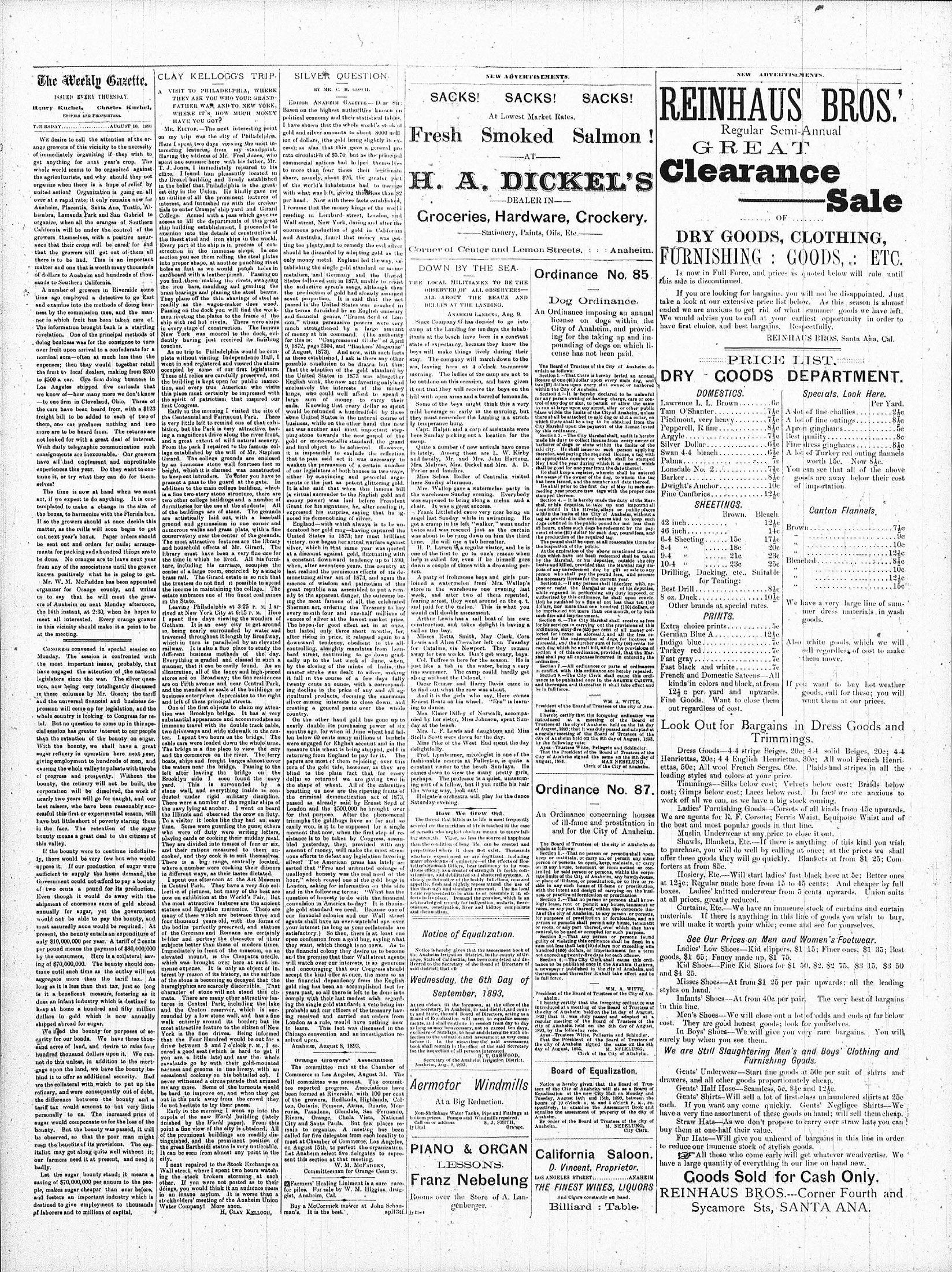
Searchable text
We desire to call the attention of the orange growers of this vicinity to the necessity of immediately organizing if they wish to get anything for next year's crop. The whole world seems to be organized against the agriculturist, and why should they not organize when there is a hope of relief by united action? Organization is going on all over at a rapid rate; it only remains now for Anaheim, Placentia, Santa Ana, Tustin, Alhambra, Lamanda Park and San Gabriel to organize, when all the oranges of Southern California will be under the control of the growers themselves, with a positive assurance that their crops will be cared for and that the growers will get out of them all there is to be had. This is an important matter and one that is worth many thousands of dollars to Anaheim and hundreds of thousands to Southern California.
A number of growers in Riverside some time ago employed a detective to go East and examine into the methods of doing business by the commission men, and the manner in which fruit has been taken care of. The information brought back is a startling revelation. One of the principal methods of doing business was for the consignee to turn over fruit upon arrival to a confederate for a nominal sum—often at much less than the expenses; then they would together retail the fruit to local dealers, making from $200 to $500 a car. Our firm doing business in Los Angeles shipped five carloads that we know of—how many more we don't know—to one firm in Cleveland, Ohio. Three of the cars have been heard from, with a $123 treight bill to be added to each of two of them, one car produces nothing and two more are to be heard from. The returns are not looked for with a great deal of interest. With daily telegraphic communication such consignments are inexcusable. Our growers have all had unpleasant and unprofitable experiences this year. Do they want to con-
CLAY KELLOGG'S TRIP.
A VISIT TO PHILADELPHIA, WHERE THEY ASK YOU WHO YOUR GRAND-FATHER WAS, AND TO NEW YORK, WHERE IT'S HOW MUCH MONEY HAVE YOU GOT?
Mr. Editor.—The next interesting point on my trip was the city of Philadelphia. Here I spent two days viewing the most interesting features, from my standpoint. Having the address of Mr. Fred Jones, who spent one summer here, with his father, Mr. T. J. Jones, I immediately repaired to his office. I found him pleasantly located in the Drexel building and firmly established in the belief that Philadelphia is the greatest city in the Union. He kindly gave me an outline of all the prominent features of interest, and furnished me with the credentials to enter Crampa's ship yard and Girard College. Armed with a pass which gave me access to all the departments of this great ship building establishment, I proceeded to examine into the details of construction of the finest steel and iron ships in the world. Every part of the ship is in process of construction in the immense shops. In one section you see them rolling the steel plates into proper shape, at another punching rivet holes as fast as we would punch holes in cardboard with a leather punch. Passing on you find them making the rivets, swaging the iron bars, moulding and grinding the brass bearings and planning the steel beams. They plane off the thin shavings of steel as readily as the wagon-maker does wood. Passing on the dock you will find the workmen riveting the plates to the framie of the ship with red hot rivets. There were ships in every stage of construction. The famous New York was moored to the dock, evidently having just received its finishing touches.
As no trip to Philadelphia would be complete without visiting Independence Hall, I went in and registered and viewed the chairs occupied by some of our first legislators. These old relics are carefully preserved, and the building is kept open for public inspection, and every true American who visits this place must certainly be impressed with the spirit of patriotism that inspired our first Congress.
Early in the morning I visited the site of the Centennial and Fairmount Park. There is very little left to remind one of that exhibition, but the Park is very attractive, having a magnificent drive along the river front, and a great extent of wild natural scenery. From the park I repaired to the famous college established by the will of Mr. Stephen Girard. The college grounds are enclosed by an immense stone wall fourteen feet in height, which it is claimed was constructed
SILVER QUEEN
BY MR. C. H.
EDITOR ANAHEIM GAZETI
Based on the highest authority political economy and their I have shown that the whole gold and silver amounts to ten dollars (the gold being cess); as also that this gatsby circulation of $5.70, but commercial nations had to more than four times share, namely, about $26, of the world's inhabitants with what was left, giving per head. Now with these I resume that the money kept residing in Lombard street Wall street, New York, due enormous production of gold and Australia, found that too plenty, and to remain should be discarded by adobe only money metal. England tabbing the single gold seal metalum, and Germany States followed suit in 1875: the seductive syrren's song the production of gold has scant proportion. It is as passed in the United States—the terms furnished by auctions and financial genius," Erdon," whose persuasive much strengthened by a lot of money at his command for this is: "Congressions 9, 1872, page 2304, and "Bof August, 1873). And now as these established, I ask possible conclusion to be made That the adoption of the United States in 1875 English work, the new exquisite interests kings, who could well add large sum of money ends. Knowing that ever would be refunded a hundred United States in their business, while on the other act was another and most pressing stone towards the rio gold or mono-metallic state and final object to be achieved is impossible to excel that to pass said act it weaken the persuasion of our legislators of both h
The time is now at hand when we must act, if we expect to do anything. It is contemplated to make a change in the size of the boxes, to harmonize with the Florida box. If so the growers should at once decide this matter, as the rills will soon begin to get out next year's boxes. Paper orders should be sent out and orders for nails; arrangements for packing and a hundred things are to be done. No oranges are to leave next year from any of the associations until the grower knows positively what he is going to get.
Mr. W. M. McFadden has been appointed organizer for Orange county, and writes us to say that he will meet the growers of Anaheim on next Monday afternoon, the 14th instant, at 2:30, when he hopes to meet all interested. Every orange grower in this vicinity should make it a point to be at the meeting.
CONGRESS convened in special session on Monday. The session is confronted with the most important issues, probably, that have engaged the attention of the national legislators since the war. The silver question, now being very intelligently discussed in these columns by Mr. Gosch; the tariff and the universal financial and business depression will come up for legislation, and the whole country is looking to Congress for relief. But no question to come up in this special session has greater interest to our people than the retention of the bounty on sugar. With the bounty, we shall have a great sugar refinery in operation here next year, giving employment to hundreds of men, and causing the whole valley to pulsate with throbs of progress and prosperity. Without the bounty, the refinery will not be built, the corporation will be dissolved, the work of nearly two years will go for naught, and our best raisers, who have been reasonably successful this first or experimental season, will have but little short of poverty staring them in the face. The retention of the sugar bounty means a great deal to the citizens of this valley.
If the bounty were to continue indefinitely, there would be very few but who would oppose it. If our production of sugar were sufficient to supply the home demand, the Government could not afford to pay a bounty of two cents a pound for its production. Even though it would do away with the these old reliars are carefully preserved, and the building is kept open for public inspection, and every true American who visits this place must certainly be impressed with the spirit of patriotism that inspired our first Congress.
Early in the morning I visited the site of the Centennial and Fairmount Park. There is very little left to remind one of that exhibition, but the Park is very attractive, having a magnificent drive along the river front, and a great extent of wild natural scenery. From the park I repaired to the famous college established by the will of Mr. Stephen Girard. The college grounds are enclosed by an immense stone wall fourteen feet in height, which it is claimed was constructed to keep out intruders. To Enter you have to present a pass to the guard at the gate. In addition to the main college building, which is a fine two-story stone structure, there are two other college buildings and a number of dormitories for the use of the students. All of the buildings are of stone. The grounds are artistically laid out, with a baseball ground and gymnasium in one corner and numerous walks and grass plots, with a fine conservatory near the center of the grounds. The most attractive features are the library and household effects of Mr. Girard. The library must have been a very fine one for the time in which he lived. All his furniture, including his carriage, occupies the center of a large room, encircled by a single brass rail. The Girard estate is so rich that the trustees do not find it possible to spend the income in maintaining the college. The estate embraces one of the finest coal mines in the State.
Leaving Philadelphia at 3:25 P.M. I arrived at New York City at 6:15 P.M. Here I spent five days viewing the wonders of Gotham. It is an easy city to get around, being nearly surrounded by water and traversed throughout it length by Broadway, which in turn is paralleled by an elevated railway. It is also a fine place to study the different business methods of the day. Everything is graded and classed in such a manner, that it can be easily found. As an illustration, all of the fancy and high-priced stores are on Broadway; the fine residences are on Fifth avenue and near Central Park, and the standard or scale of the buildings or business enterprises depreciates to the right and left of these principal streets.
One of the first objects to claim my attention was Brooklyn bridge. It has a very substantial appearance and accommodates an immense travel with its double track cable, two driveways and wide sidewalk in the center. I spent two hours on the bridge. The cable cars were loaded down the whole time. The bridge is a fine place to view the city and the commerce on the river. The ferry boats, ships and freight bargains almost cover the waters near the bridge. Passing to the left after leaving the bridge on the Brooklyn side I soon found the navy yard. This is surrounded by a stone wall, and everything inside is conducted under rigid military discipline. There were a number of the regular ships of the navy lying at anchor. I went on board the Illinois and observed the crew on duty. To a visitor it looks like they had an easy time. Some were guarding the guns; others who were off duty were writing letters, playing cards or cooking their midday meal. They are divided into messes of four or six, and their rations measured to them uncooked, and they cook it to suit themselves. There is a big range, centrally located, where a number were cooking their dinners in different ways, as their tastes dictated.
I spent one afternoon at the Art Museum in Central Park. They have a very fine collection of pictures, but many of the best are now on exhibition at the World's Fair. But These old reliars are carefully preserved, and the building is kept open for public inspection, and every true American who visits this place must certainly be impressed with the spirit of patriotism that inspired our first Congress.
Early in the morning I visited the site of the Centennial and Fairmount Park. There is very little left to remind one of that exhibition, but the Park is very attractive, having a magnificent drive along the river front, and a great extent of wild natural scenery. From the park I repaired to the famous college established by the will of Mr. Stephen Girard. The college grounds are enclosed by an immense stone wall fourteen feet in height, which it is claimed was constructed to keep out intruders. To Enter you have to present a pass to the guard at the gate. In addition to the main college building, which is a fine two-story stone structure, there are two other college buildings and a number of dormitories for the use of the students. All of the buildings are of stone. The grounds are artistically laid out with a baseball ground and gymnasium in one corner and numerous walks and grass plates, with a fine conservatory near the center of the grounds. The most attractive features are the library and household effects of Mr. Girard. The library must have been a very fine one for the time in which he lived. All his furniture, including his carriage, occupies the center of a large room, encircled by a single brass rail. The Girard estate is so rich that the trustees do not find it possible to spend the income in maintaining the college. The estate embraces one of the finest coal mines in the State.
Leaving Philadelphia at 3:25 P.M. I arrived at New York City at 6:15 P.M. Here I spent five days viewing the wonders of Gotham. It is an easy city to get around, being nearly surrounded by water and traversed throughout it length by Broadway, which in turn is paralleled by an elevated railway. It is also a fine place to study the different business methods of the day. Everything is graded and classed in such a manner, that it can be easily found. As an illustration, all of the fancy and high-priced stores are on Broadway;the fine residences are on Fifth avenue and near Central Park,and the standard or scale of the buildings or businesses depreciates to the right and left of these principal streets.
One of the first objects to claim my attention was Brooklyn bridge. It has a very substantial appearance and accommodates an immense travel with its double track cable, two driveways and wide sidewalk in the center. I spent two hours on the bridge. The cable cars were loaded down the whole time. The bridge is a fine place to view the city and the commerce on the river. The ferry boats, ships and freight bargains almost cover the waters near the bridge. Passing to the left after leaving the bridge on the Brooklyn side I soon found the navy yard. This is surrounded by a stone wall, and everything inside is conducted under rigid military discipline. There were a number of the regular ships of the navy lying at anchor. I went on boardthe Illinois and observedthe crowinduty.Toa visitorit looks like theyhadan easytime.Somewereguardingtheguns;otherswhowereoffdutywerewritingletters,playingcardsorcookingthemiddaymealTheyaredividedintomessesoffouror six,andtheirrationsmeasuredtothemuncooked,andtheycookittosuitthemselvesThereisabigrange,centrallylocatedwhereanumberwerecookingthedinnersindifferentways.asthetastictdictated.IspentoneafternoonattheArtMuseuminCentralPark.Thetheyhaveaveryfinecollectionofpictures,banyofthebestarenowonexhibitionattheWorld'SFair.ButTheseoldreliarsarecarefullypreserved,andthebuildingiskeptopenforpublicinspection,andeverytrueAmericanwhowisvisitsthisplacemust CertainlybeimprovedwiththespiritofpatriotismthatinspiredourfirstCongress.EarlyinthemorningIvisitedthesiteoftheCentennialandFairmountParkThereisverylittlelefttoremindoneofthatexhibitionbuttheparkisverylittlelefttoremindoneofthatexhibitionbuttheparkisverylittlelefttoremindoneofthatexhibitionbuttheparkisverylittlelefttoremindoneofthatexhibitionbuttheparkisverylittlelefttoremindoneofthatexhibitionbuttheparkisverylittlelefttoremindoneofthatexhibitionbuttheparkisverylittlelefttoremindoneofthatexhibitionbuttheparkisverylittlelefttoremindoneofthatexhibitionbuttheparkisverylittlelefttoremindoneofthatexhibitionbuttheparkisverylittlelefttoremindoneofthatexhibitionbuttheparkisverylittlelefttoremindoneofthatexhibitionbuttheparkisverylittlelefttoremindoneofthatexhibitionbuttheparkisverylittlelefttoremindoneofthatexhibitionbuttheparkisverylittlelefttoremindoneofthatexhibitionbuttheparkisverylittlelefttoremindoneofthatexhibitionbuttheparkisverylittlelefttoremindoneofthatexhibitionbuttheparkisverylittlelefttoremindoneofthatexhibitionbuttheparkisverylittlelefttoremindoneofthatexhibitionbuttheparkisverylittlelefttoremindoneofthatexhibitionbuttheparkisverylittlelefttoremindoneofthatexhibitionbuttheparkisverylittlelefttoremindoneofthatexhibitionbuttheparkisverylittlelefttoremindoneofthatexhibitionbuttheparkisverylittlelefttoremindoneofthatexhibitionbuttheparkisverylittlelefttoremindoneofthatexhibitionbuttheparkisverylittlelefttoremindoneofthatexhibitionbuttheparkisverylittlelefttoremindoneofthatexhibitionbuttheparkisverylittlelefttoremindoneofthatexhibitionbuttheparkisverylittlelefttoremindoneofthatexhibitionbuttheparkisverylittlelefttoremindoneofthatexhibitionbuttheparkisverylittlelefttoremindoneofthatexhibitionbuttheparkisverylittlelefttoremindoneofthatexhibitionbuttheparkisverylittlelefttoremindoneofthatexhibitionbuttheparkisverylittlelefttoremindoneofthatexhibitionbuttheparkisverylittlelefttoremindoneofthatexhibitionbuttheparkisverylittlelefttoremindoneofthatexhibitionbuttheparkisverylittlelefttoremindoneofthatexhibitionbuttheparkisverylittlelefttoremindoneofthatexhibitionbuttheparkisverylittlelefttoremindoneofthatexhibitionbuttheparkisverylittlelefttoremindoneofthatexhibitionbuttheparkisverylittlelefttoremindoneofthatexhibitionbuttheparkisverylittlelefttoremindoneofthatexhibitionbuttheparkisverylittlelefttoremindoneofthatexhibitionbuttheparkisverylittlelefttoremindoneofthatexhibitionbuttheparkisverylittlelefttoremindoneofthatexhibitionbuttheparkisverylittlelefttoremindoneofthatexhibitionbuttheparkisverylittlelefttoremindoneofthatexhibitionbuttheparkisverylittlelefttoremindoneof thatexhibitionbuttheparkisverylittlelefttoremindoneof thatexhibitionbuttheparkisverylittlelefttoremindoneof thatexhibitionbuttheparkisverylittlelefttoremindoneof thatexhibitionbuttheparkisverylittlelefttoremindoneof thatexhibitionbuttheparkisverylittlelefttoremindoneof thatexhibitionbuttheparkisverylittlelefttoremindoneof thatexhibitionbuttheparkisverylittlelefttoremindoneof thatexhibition但The park is very small because it takes up less space than other parks.
On other hand good nearly double its purity months ago, for when I join below 60 cents many more at a discount against gold a constant downward tendency when after seventeen years last realized perennial monetizing silver act of Blessing it fall in the course of twenty cents an ounce;wing decline in price;ring decline in price;raised cultural products;doom silver-mining interests creating a general country.
On other hand good nearly double its purity months ago, for when I join below 60 cents many more at a discount against gold a constant downward tendency when after seventeen years last realized perennial monetizing silver act of Blessing it fall in the course of twenty cents an ounce;wing decline in price;ring decline in price;raised cultural products;doom silver-mining interests creating a general country.
On other hand good nearly double its purity months ago, for when I join below 60 cents many more at a discount against gold a constant downward tendency when after seventeen years last realized perennial monetizing silver act of Blessing it fall in the course of twenty cents an ounce;wing decline in price;ring decline in price;raised cultural products;doom silver-mining interests creating a general country.
On other hand good nearly double its purity months ago, for when I join below 60 cents many more at a discount against gold a constant downward tendency when after seventeen years last realized perennial monetizing silver act of Blessing it fall in the course of twenty cents an ounce;wing decline in price;ring decline in price;raised cultural products;doom silver-mining interests creating a general country.
On other hand good nearly double its purity months ago, for when I join below 60 cents many more at a discount against gold a constant downward tendency when after seventeen years last realized perennial monetizing silver act of Blessing it fall in
nearly two years will go for naught, and our beet raisers, who have been reasonably successful this first or experimental season, will have but little short of poverty staring them in the face. The retention of the sugar bounty means a great deal to the citizens of this valley.
If the bounty were to continue indefinitely, there would be very few but who would oppose it. If our production of sugar were sufficient to supply the home demand, the Government could not afford to pay a bounty of two cents a pound for its production. Even though it would do away with the shipment of enormous sums of gold abroad annually for sugar, yet the government would not be able to pay the bounty, and most assuredly none would be required. At present, the bounty entails an expenditure of only $10,000,000 per year. A tariff of 2 cents per pound means the payment of $80,000,000 by the consumers. Here is a collateral saving of $70,000,000. The bounty should continue until such time as the outlay will not aggregate more than the tariff tax. As long as it is less than that tax, just so long is it a beneficial measure, fostering as it does an infant industry which is destined to keep at home a hundred and fifty million dollars in gold which is now annually shipped abroad for sugar.
We need the bounty for purposes of security for our bonds. We have three thousand acres of land, and desire to raise four hundred thousand dollars upon it. We cannot do this unless, in addition to the mortgage upon the land, we have the bounty behind it to offer as additional security. Had we the collateral with which to put up the refinery, and were consequently out of debt, the difference between the bounty and a tariff tax would amount to but very little personally to us. The increased price of sugar would compensate us for the loss of the bounty. But the bounty was passed, it will be observed, so that the poor man might reap the benefits of its provisions. The capitalist may get along quite well without it; our farmers need it at present, and need it badly.
Let the sugar bounty stand; it means a saving of $70,000,000 per annum to the people, makes sugar cheaper than ever before, and fosters an important industry which is destined to give employment to thousands of laborers and to millions of capital,
There were a number of the regular ships of the navy lying at anchor. I went on board the Illinois and observed the crew on duty. To a visitor it looks like they had an easy time. Some were guarding the guns; others who were off duty were writing letters, playing cards or cooking their midday meal. They are divided into meshes of four or six, and their rations measured to them uncooked, and they cook it to suit themselves. There is a big range, centrally located, where a number were cooking their dinners in different ways, as their tastes dictated.
I spent one afternoon at the Art Museum in Central Park. They have a very fine collection of pictures, but many of the best are now on exhibition at the World's Fair. But the most attractive features are the ancient statues and Egyptian mummies. There are many of these which are between three and four thousand years old, with the forms of the bodies perfectly preserved, and statues of the Greecians and Romans are certainly bolder and portray the character of their subjects better than those of modern times. Immediately in front of the museum, on an elevated mound, is the Cleopatra needle, which was brought over here at such immense expense. It is only an object of interest by reason of its history, as the surface of the stone is becoming so decayed that the biroglophics are scarcely discernible. That character of stone will not stand this climate. There are many other attractive features in Central Park, including the lake and the Croton reservoir, which is surrounded by a low stone wall, and has a fine walk entirely around its border; but its most attractive feature to the citizen of New York is the fine drives. Being informed that the Four Hundred would be out for a drive between 5 and 7 o'clock p.m., I secured a good seat (which is hard to get if you are a little late) and saw the whole cavalcade go by with their gold-mounted harness and grooms in fine livery, with an occasional cockney on his bohtailed cob. I never witnessed a circus parade that amused me any more. Some of the turnouts would be hard to improve on, and when they get out in the park away from the crowd they do not hesitate to try their paces.
Early in the morning I went up into the cupola of the new World building (lately finished by the World paper). From this point a fine view of the city is obtained. All of the prominent buildings are readily distinguished, and the prominent position of the great Bartholdi statue is very noticeable. It can be seen from almost any point in the city.
I next repaired to the Stock Exchange on Wall street, where I spent two hours watching the stock brokers storming at each other. If you were not posted as to their doings, you would think it an audience room in an insane asylum. It is worse than a stockholders' meeting of the Anaheim Union Water Company! More anon.
H. CLAY KELLOCH,
The committee met at Commerce in Los Angeles, full committee was present; reported progress; been formed at Riverside, of the growers; Redlandton, Outario; Pomona, Azarovia; Pasadena; Glendale Rivera; Orange; Chula City and Santa Paula.
Be main to organize. A call for five delegates from meet at Chamber of Commerce on August 15th, to perfect Let Anaheim select five documents this section at that month.
W. M. M.
Committeeman for
Farmers' Healing Liniments for piles. For sale by W. Gigist, Anaheim, Cal.
Buy a McCormick mower man's. It is the best.
SILVER QUESTION.
BY MR. C. H. GOSCH.
EDITOR ANAHEIM GAZETTE—Dear Sir:
Based on the highest authorities known on political economy and their statistical tables,
I have shown that the whole world's stock of gold and silver amounts to about 8000 million of dollars, (the gold being slightly in excess); as also, that this gave a general pro-rata circulation of $5.70, but as the principal commercial nations had helped themselves to more than four times their legitimate share, namely, about $26, the greater part of the world's inhabitants had to manage with what was left, giving them less than $2 per head. Now with these facts established, I resume that the money kings of the world reading in Lombard street, London, and Wall street, New York, during and after the enormous production of gold in California and Australia, found that money was getting too plenty, and to remedy the evil silver should be discarded by adopting gold as the only money metal. England led the way, establishing the single gold standard or mono-metalism, and Germany and the United States followed suit in 1873, unable to resist the seductive syren's songs, although then the production of gold had already assumed scant proportion. It is said that the act passed in the United States was conceived in the terms furnished by an English omnissary and financial genius, "Ernest Soyd of London," whose persuasive powers were very much strengthened by a large amount of money at his command. (The authority for this is: "Congressional Globe" of April 9, 1872, page 2304, and "Bankers' Magazine" of August, 1873). And now, with such facts as these established, I ask is there any other possible conclusion to be drawn but this: That the adoption of the gold standard by the United States in 1873 was altogether English work, the new act favoring only and exclusively the interests of the money kings, who could well afford to spend a large sum of money to carry their ends. Knowing that every dollar so spent would be refunded a hundredfold by these same United States in the natural course of business, while on the other hand this new act was another and most important stepping stone towards the new gospel of the gold or mono-metallic standard, the grand and final object to be achieved. However, it is impossible to exclude the reflection that to pass said act it was necessary to weaken the persuasion of a certain number of our legalists of both houses in two ways,
NEW ADVERTISMENTS.
SACKS! SACKS! SACKS!
At Lowest Market Rates.
Fresh Smoked Salmon!
AT
H. A. DICKEL'S
DEALER IN
Groceries, Hardware, Crockery.
Stationery, Paints, Oils, Etc.
Corner of Center and Lemon Streets, ::: Anaheim.
DOWN BY THE SEA.
THE LOCAL MILITIAMEN TO BE THE OBSERVED OF ALL OBSERVERS—ALL ABOUT THE BEAUX AND BELLES AT THE LANDING.
ANAHEIM LANDING, Aug. 9.
Since Company G has decided to go into camp at the Landing for ten days the inhabitants at the beach have been in a constant state of expectancy, because they know the boys will make things lively during their stay. The company will march down to the sea, leaving here at 4 o'clock to-morrow morning. The ladies of the camp are not to be outdone on this occasion, and have given it out that they will receive the boys on the hill with open arms and a barrel of lemonade.
Some of the boys might think this a very mild beverage so early in the morning, but they must remember the Landing is a strictly temperance hurge.
Capt. Halpin and a corp of assistants were here Sunday picking out a location for the camp.
Quite a number of new arrivals have come in, Among them are L. W. Kirby and family, Mr. and Mrs. John Hartung, Mrs. Melrose, Mrs. Dickel and Mrs. A. D. Porter and families.
Ordinance No. 85.
Dog Ordinance.
An Ordinance imposing an annual license on dogs within the City of Anaheim, and providing for the taking up and impounding of dogs on which license has not been paid.
The Board of Trustees of the City of Anaheim do ordain as follows:
Section 1.—That there is hereby levied an annual license of one $(\$1) dollar upon every male dog, and two $(\$2) dollars upon every slut owned or harbored within the City of Anaheim.
Section 2.—It is hereby declared to be unlawful for any person owning or having charge, care or control of any dog or slut, to permit or allow the same to run a large upon any street, alley or other public place within the limits of the City of Anaheim; unless there shall be attached to said dog or slut a collar on which there shall be a tag to be obtained from the City Marshal upon the payment of the license levied by this ordinance.
Section 3.—The City Marshal shall, and it is hereby made his duty to collect license from every owner or harborer of dogs or sluts within the limits of the said city. He shall issue to each person applying therefor and paying for the required license, a tag with an appropriate number on which shall be stamped May 1 and the year during which it is issued, which shall be good for one year from the date thereof.
He shall keep a register, wherein shall be entered
The United States in 1873 was altogether English work, the new act favoring only and exclusively the interests of the money kings, who could well afford to spend a large sum of money to carry their ends. Knowing that every dollar so spent would be refunded a hundredfold by these same United States in the natural course of business, while on the other hand this new act was another and most important stepping stone towards the new gospel of the gold or mono-metallic standard, the grand and final object to be achieved. However, it is impossible to exclude the reflection that to pass said act it was necessary to weaken the persuasion of a certain number of our legislators of both houses in two ways, either by convincing and powerful arguments or the just as potent glittering gold. It is also said that when this famous bill (a virtual surrender to the English gold and money power) was laid before President Grant for his signature, he, after reading it, expressed his surprise, saying that he ignored its demonotizing of silver.
England—with which always is to be understood her gold ring—having captured the United States in 1873; her most brilliant victory, now began her actual warfare against silver, which in that same year was quoted at a discount against gold, fluctuating with a constant downward tendency up to 1890, when, after seventeen years, this country at last realized the perennial effects of its demonotizing silver act of 1873, and again the essence of wisdom and patriotism of this great republic was assembled to put a remedy to the apparent danger, the outcome being the most famous of all, the celebrated Sherman act, ordering the Treasury to buy every month four and one-half millions of ounces of silver at the lowest market price. The hope for good effect set in at once, but lasted only three short months, for, after rising in price, it relapsed again to a downward tendeny, obedient to the all-controlling, almighty mandates from Lombard street, continuing to go down gradually up to the last week of June, when, by the closing of the mints of India, the master stroke was dealt to silver, making it fall in the course of a few days fully twenty cents an ounce, with a corresponding decline in the price of any and all agricultural products, dooming the enormous silver mining interests to close down, and creating a general panic over the whole country.
On the other hand gold has gone up to nearly double its purchasing power of six months ago, for when in June wheat had fallen below 60 cents many millions of bushels were engaged for English account and in the measure this wheat is being shipped, gold is returning from England to pay for it. The papers are most of them rejoicing over this turn of the gold tide, however, as they are blind to the plain fact that for every dollar so returned we are giving two in the shape of wheat. All of the calamities besetting us now are the ripening fruits of the criminal demonotization act of 1873, passed as already said by Ernest Seyd London and the $500,000 he brought over for that purpose. After the phenomenal triumphs the goldbugs have so far and so easily won, it is to be supposed for a single moment that now, when the first step of resistance is to be taken by Congress, assembled yesterday, they, provided with any amount of money, will make the most strenuous efforts to defeat any legislation favoring silver! The American press has lately assorted that "Free and unlimited coinage of unliquid honesty was the real need of the hour," which roused one of the gold bug in London, asking for information on this side and in the following terms: "What has the intention of honoring to do with the financial morning."
The ladies of the camp are not to be outdone on this occasion, and have given it out that they will receive the boys on the hill with open arms and a barrel of lemonade.
Some of the boys might think this a very mild beverage so early in the morning, but they must remember the Lauding is a strictly temperance harg.
Capt. Halpin and a corp of assistants were here Sunday picking out a location for the camp.
Quite a number of new arrivals have come in lately. Among them are L. W. Kirby and family, Mr. and Mrs. John Hartung, Mrs. Melrose, Mrs. Dickel and Mrs. A. D. Porter and families.
Miss Selma Roller of Centralia visited here Sunday afternoon.
Mrs. Wallop gave a watermelon party in the warehouse Sunday evening. Everybody was supposed to bring along a melon and a chair.
It was a great success.
Frank Littlefield came very near being an angel last Sunday while in swimming. He got a cramp in his left "walker," went under twice and was rescued just as the curtain was about to be rung down on him the third time.
He will use a tub hereafter.
H. P. Larsen is a regular visitor, and he is one of the first to go to one's rescue when help is called for, even if he himself goes down a couple of times with a drowning person.
A party of frolicsome boys and girls purloined a watermelon from Mrs. Wallop's store in the warehouse one evening last week, and after two of them repented, fearing arrest, they went around on the q.t. and paid for the melon. This is what you would call double assessment.
Arthur Lewis has a sail boat of his own construction, and takes delight in having a sail on the bay.
Misses Retta Smith, May Clark, Cora Lisa and Alice Chevalier left on Tuesday for Catalina, via Newport. They remain away for two weeks. Don't get weary boys.
Col. Tuffee is here for the season. He is just like a fish in the water, being a very fine swimmer. The camp could hardly get along without the Colonel.
Oscar Renner and Harry Davis came in to find out what the row was about.
And it is the girls who say. Here comes Ernest Bentz on his wheel. "Ern" is learning to dance.
Mrs. Elmer Dilley of Norwalk, accompanied by her sister, Miss Johnson, spent Sunday at the beach.
Mrs. L. F. Lewis and daughters and Miss Stella Scott were down for the day.
Miss Pike of the West End spent the day delightfully.
Prof. Lymburner, mixologist in one of the fashionable resorts at Fullerton, is quite a constant visitor to the beach Sundays. He comes down to view the many pretty girls, perhaps. The professor is a quiet, unassuming sort of a fellow, but if you rollle his hair the wrong way, look out!
Holgate's orchestra will play for the dance Saturday evening.
How We Grow Old
The thread that blinds us to life is most frequently severed or meridian of life is reached in case of persons who neglect obvious means to renew falling strength. Vigor, no less source of happiness than the condition of lung life, can be created and perpetuated where it does not exist. Thousands who have experienced or are cognizant—including many physicians of enquiry—of the effects of Hostetter's stomach bitters, bear testimony to its wonderful efficacy as creator of strength in feeble constitutions, and debilitated and shattered systems. A steady performance of the bodily functions, renewed appetite, flesh and nightly repose attend the use of this thorough and standard renovation. No local representation is able or remitted in effect from these people to carry out or allow any other person or person to keep open, keep maintain, or carry control within the limits of City of Anaheim, unless there shall be attached to said dog or slut a collar, on which there shall be a tag to be obtained from the City Marshal upon the payment of the license levied therein.
Section 3.-The City Marshal shall, and it is hereby made his duty to collect license from every owner or harborer of dogs or sluts within the limits of said city. He shall issue to each person applying therefor, and paying the required license, a tag with an appropriate number on which shall be stamped May 1 and year during which it is issued, which shall be good for one year from date thereof.
She shall keep a register with her name the name of the owner of the dog, to whom she tag has been issued, and the number and date thereof.
He shall prior to the first day of May in each succeeding year procure new tags with proper date stamped thereon.
Section 4.-It is hereby made the duty of the Marshal, or his deputies, to take up and impound all dogs which have not been redeemed shall be taken by the Marshal, or his deputies outside the city limits and killed; provided that the Marshal may dispose of any undeemed dog by gift or sale to any person who shall pay the pound fees, and procure necessary license for current year.
Section 5.-If any person shall interfere with operation or withdrawal in performing an duty imposed or authorized by this ordinance, he shall upon conviction be punished by a fine of not less than ten (10) dollars nor more than one hundred (100) dollars, or be imprisoned not more than one month, or both such due and imprisonment.
Section 7.-All ordinances or parts of ordinances in conflict with this ordinance are hereby repealed.
Section 8.-The City Clerk shall cause this ordinance to be published once in the Anaheim Gazette, and thereupon it shall take effect and be in full force.
WM.A.WITTE,
President of the Board of Trustees of the city of Anaheim.
I hereby certify that for foregoing ordinance was intended at least once during this day at August 1893; that it was duly passed and adopted at a regular meeting of the Board of Trustees of the city of Anaheim held on 6th July 1893; by this following vote:
Ayes—Trustees Witte, Pellegrin and Schindler.
That the President of the Board of Trustees of the city of Anaheim signed the same on the 6th Day August 1893.
Clerk of the City of Anaheim.
Ordinance No. 87.
An Ordinance concerning houses of ill-fame and prostitution in and for the City of Anaheim
The Board of Trustees of the city of Anaheim do ordain as follows:
Section 1.-That no person or persons shall open, keep or maintain, or carry on, or permit any other person or person to keep open, keep maintain or controlled by said personnel on behalf or place limits of City of Anaheim; any dwabry or place limits of City of Anaheim; any dwabry or place limits of City of Anaheim; any dwabry or place limits of City of Anaheim; any dwabry or place limits of City of Anaheim; any dwabry or place limits of City of Anaheim; any dwabry or place limits of City of Anaheim; any dwabry or place limits of City of Anaheim; any dwabry or place limits of City of Anaheim; any dwabry or place limits
The criminal demolition act of 1813 passed as already said by Ernest Seyd of London and the $500,000 he brought over for that purpose. After the phenomenal triumphs the goldbugs have so far and so easily won, is it to be supposed for a single moment that now, when the first step of resistance is to be taken by Congress, assembled yesterday, they, provided with any amount of money, will make the most strenuous efforts to defeat any legislation favoring silver? The American press has lately assorted that "Free and unlimited coinage of unalloyed honesty was the real need of the hour," which roused one of the gold bug in London, asking for information on this side and in the following terms: "What has the question of honesty to do with the financial convolution in America to-day? It is thus single gold standard we need. Because one of our financial colonies and our Wall street agents shall have an ever-watchful eye over your interest (as long as your collaterals are satisfactory.) So then, there is at least one open confession from a gold bug, saying what they want, which though is no news. As to the financial colony they desire us to become and the promise that their Wall street agents will watch over our interests, is so generous and encouraging that our Congress should accept the kind offer at once, the more so as the financial dependency from the English gold ring has been an accomplished fact for years past, so all there is left to be done is to comply with their last modest wish regarding the single gold standard; a veto being improbable and our officers of the treasury having received and carried out orders from London as a rule, would have nothing new to learn. This fact was discussed in the Chicago convention and an investigation resolved upon.
Anaheim, August 8, 1893.
Orange Growers' Association.
The committee met at the Chamber of Commerce in Los Angeles, August 3d. The full committee was present. The committee reported progress. Associations have been formed at Riverside, with 100 per cent of the growers, Redlands, Highlands, Colton, Outario, Pomona, Azusa, Duarte, Monrovia, Pasadena, Glendale, San Fernando, Rivera, Orange, Chula Vista, National City and Santa Paula. But few places remain to organize. A meeting has been called for five delegates from each locality to meet at Chamber of Commerce, Los Angeles, on August 15th, to perfect the organization. Let Anaheim select five delegates to represent this section at that meeting.
W. M. McFADDEN,
Committeeman for Orange County.
Farmers' Healing Liniment is a sure cure for piles. For sale by W. M. Higgins, drug-gist, Anaheim, Cal.
Buy a McCormick mower at John Schauman's. It is the best.
How We Grow Old.
The thread that blinds us to life is most frequently severed the meridian of life is reached in the case of persons who neglect obvious means to renew failing strength. Vigor, no less the source of happiness than the condition of long life, can be created and perpetuated where it does not exist. Thousands who have experienced or are cognizant—including many physicians of ennui—the effects of Hostetter's Stomach Bitters, bear testimony to its wonderful efficacy as a creator of strength in feeble constructions, and debilitated and shattered systems. A steady performance of the bodily functions, renewed through this thorough and standard renovation. Use no localized representation to be skin to or resemble it in effects in its place. Demand the genuine, which is acknowledged remedy for indigestion, malaria, nervousness, constipation, liver and kidney complaints and theminism.
Notice of Equalization.
Notice is hereby given that the assessment book of the Anaheim Irrigation District, in the county of Orange, State of California, has been completed and delivered to the Secretary of the Board of Directors of said district; that on Wednesday, the 6th Day of September, 1893,
At ten o'clock in the forenoon, at the office of the said Secretary, in Anaheim, in said district, and county and State, the thousand Board of Directors, acting as a Board of Equalization will inspect to equalize assessments, and shall continue in session from day to day as long as may be necessary, not to exceed ten days, exclusive of Sundays, to hear and determine such objection to the valuation and assessment as may come before it. In the meantime the said assessment book shall remain in the office of the said Secretary for the inspection of all persons interested.
B. V. GARWOOD,
Secretary of the Anaheim Irrigation District.
Aermotor Windmills
At a Big Reduction.
Non-Shrinkage Water Tanks, Pipe and Fittings at bottom prices. Pumps and Windmills repaired.
Call on or address
S. J. SMITH
Orange.
PIANO & ORGAN LESSONS.
Franz Nebelung
Rooms over the Store of A. Langenberger.
California Saloon.
D. Vincent, Proprietor.
LOS ANGELES STREET.
ANAHEIM
THE FINEST WINES, LIQUORS
And Cigars constantly on hand.
Board of Equalization.
Notice is hereby given that the Board of Trustees of the City of Anaheim will sit as a Board of Equalization at the new City Hall on Monday and Tuesday, August 14th and 15th, 1893, between the hours of 10 o'clock A.M. and 4 o'clock P.M., respectively, to examine the Assessment Book and equate the assessment of property of the city of Anaheim.
By order of the Board of Trustees of the City of Anaheim.
M. NEBELUNG
Clerk of the City of Anaheim.
An Ordinance concerning houses of ill-fame and prostitution in and for the City of Anaheim.
The Board of Trustees of the City of Anaheim do ordinate all follows:
Section 1.-That no person or persons shall open,
keep or maintain, or carry on, or permit any other person or persons to open, keep, maintain, or carry on in any house, tentment or room owned or controlled by said person or persons, within the corporate limits of the City of Anaheim, any bawdy-house,
or place of ill-fame, or prostitution, with the intent and design of carrying on the business or practice of fornication or prostitution.
Section 2.-That no person or persons shall knowingly lease, rent or permit any house, tentment or room, or any part thereof within the corporate limits of the City of Anaheim to any person or persons for purposes of prostitution or fornication, and no person or persons shall permit any house, tentment or room, or any part thereof over which they have control, to be used or occupied for such purpose.
Section 3.-That any person or persons found guilty of violating an ordinance shall be made a sum not less than ten (10) dollars nor exceeding one hundred (100) dollars; or imprisonment for a term not exceeding twenty-five days for each offense.
Section 4.-The City Clerk shall cause this ordinance to be published once in the Anaheim Gazette, a newspaper published in the city of Anaheim, and thereafter it shall take effect and be in full force.
WM. A. WITTE,
President of the Board of Trustees of the City of Anaheim.
I hereby certify that the foregoing ordinance was introduced at a meeting of the Board of Trustees of the city of Anaheim held on the 1st day of August, 1893; that it was duly passed and adopted at a regular meeting of the Board of Trustees of the city of Anaheim held on the 8th day of August, 1893; by the following vote:
Ayes—Trustees Willie, Pellegrim and Schindler.
Ritter of Presidential ordinance signed on the same on the 8th day of August, 1893.
M. NEBELUNG
Clerk of the City of Anaheim.
Board of Equalization.
Notice is hereby given that the Board of Trustees of the City of Anaheim will sit as a Board of Equalization at the new City Hall on Monday and Tuesday, August 14th and 15th, 1893, between the hours of 10 o'clock A.M. and 4 o'clock P.M., respectively, to examine the Assessment Book and equate the assessment of property of the city of Anaheim.
By order of the Board of Trustees of the City of Anaheim.
M. NEBELUNG
Clerk of Table.
NEW ADVERTISMENTS.
REINHAUS BROS.'
Regular Semi-Annual
GREAT
Clearance
—Sale
OF
DRY GOODS, CLOTHING,
FURNISHING : GOODS, : ETC.
Is now in Full Force, and prices as quoted below will rule until this sale is discontinued.
If you are looking for bargains, you will not be disappointed. Just take a look at our extensive price list below. As this season is almost ended we are anxious to get rid of what summer goods we have left. We would advise you to call at your earliest opportunity in order to have first choice, and best bargains. Respectfully,
REINHAUS BROS., Santa Ana, Cal.
PRICE LIST.
DRY GOODS DEPARTMENT.
DOMESTICS.
Lawrence L. L. Brown...6¢
Tam O'Shanter...7¢
Piedmont, very heavy...7¢
Pepperell, R fine...8¢
Argyle...7¢
Silver Dollar...6¢
Swan 4-4 bleach...6¢
Palma...7¢
Lonsdale No. 2...7¢
Specials, Look Here.
Per Yard.
A lot of fine challies...2£c
A lot of fine outings...8£c
Apron ginghauns...5£
Best quality...8£c
Fine dress ginghauns...8£c
A lot of Turkey red outing flannels worth 15¢. Now 8¢.
You can see that all of the above
DOMESTICS.
Lawrence L. L. Brown...6¢
Tam O'Shanter...7¢
Piedmont, very heavy...7¢
Pepperell, R fine...8¢
Argyle...7¢
Silver Dollar...6¢
Swan 4-4 bleach...6¢
Palma...7¢
Lonsdale No. 2...7¢
Barker...8¢
Dwight's Anchor...10¢
Fine Canbries...12¢
SHEETINGS.
Brown. Bleach.
42 inch...12¢
46 inch...14¢
6-4 Sheeting...15£
8-4 "...18£
9-4 "...21£
10-4 "...23£
Drilling, Ducking, etc., Suitable for Tenting:
Best Drill...8£
8 oz. Duck...10£
Other brands at special rates.
PRINTS.
Extra choice prints...5£
German Blue A...12£
Indigo blue...7£
Turkey red...7£
Fast gray...7£
Fast black and white...7£
French and Domestic Sateens—All kinds in colors and black, at from 12£ per yard and upwards.
Fine Goods. Want to close them out regardless of cost.
Look Out for Bargains in Dress Goods and Trimmings.
Dress Goods—4-4 stripe Beiges, 20¢; 4-4 solid Beiges, 20¢; 4-4 Henriettas, 20¢; 4-4 English Henriettas, 30¢; All wool French Henriettas, 50¢; All wool French Serges, 60¢. Plaids and stripes in all the leading styles and colors at your price.
Timnings—Silks below cost; Velvets below cost; Braids below cost; Gimps below cost; Laces below cost. In fact we are anxious to work off all we can, as we have a big stock coming.
Ladies' Furnishing Goods—Corsets of all kinds from 45¢ upwards. We are agents for R. F. Corsets; Ferris Waist, Equipoise Waist and of the best and most popular goods in that line.
Muslin Underwear at any price to close it out.
Shawls, Blankets, Etc.—If there is anything of this kind you wish to purchase, you will do well by calling at once; at the prices we shall offer these goods they will go quickly. Blankets at from $1.25; Comforters at from 85¢.
Hosiery, Etc.—Will start ladies' fast black hose at 5¢; Better ones at 12¢; Regular made hose from 15 to 45 cents; And cheaper by full boxes. Ladies' knitted underwear from 5 cents upwards. Union suits made the duty of the Markets up and impound all dogs or public places of Anaheim without a finance and to keep such pound for not less than the redeemed by the pay each dog, pound fees, and red tag.
At all reasonable times for above mentioned time all redeemed shall be taken deputies, outside the city that the Marshal may disobey by gift or sale to any pound fees, and procure current year.
She shall interfere with opener or any of his impurities any duty imposed, or he shall upon convicc of not less than ten (10) hundred (100) dollars, or one month, or by both.
She shall receive as fees count the provisions of this or cent of all money collated, and all the fees reof dogs, for licenses as sum of forty (40) cents for under the provisions of the provided that the Marcurred in enforcing the laws or parts of ordinances are hereby repealed.
She shall cause this ordinance in the Anaheim Gazette, or it shall take effect and enforcegoing ordinance was signing of the Board of the Board of the City on the 1st day July passed and adopted at board of Trustees of the 8th day of August, 1893,
allegrin and Schindler. Board of Trustees of the same on the 6th day of MAX NEUBELUNO,
of the City of Anaheim.
WM. A. WITTE,
trustees of the city of Anaheim
Ladies' Furnishing Goods—Corsets of all kinds from 45¢ upwards. We are agents for R. F. Corsets; Ferris Waist, Equipoise Waist and of the best and most popular goods in that line.
Muslin Underwear at any price to close it out.
Shawls, Blankets, Etc.—If there is anything of this kind you wish to purchase, you will do well by calling at once; at the prices we shall offer these goods they will go quickly. Blankets at from $1 25; Comforters at from 85¢.
Hosiery, Etc.—Will start ladies' fast black hose at 5¢; Better ones at 12¢; Regular made hose from 15 to 45 cents; And cheaper by full boxes. Ladies' knitted underwear from 5 cents upwards. Union suits at all prices, greatly reduced.
Curtains, Etc.—We have an immense stock of curtains and curtain materials. If there is anything in this line of goods you wish to buy, we will make it worth your while; come and see for yourselves.
See Our Prices on Men and Women's Footwear.
Ladies' Low Shoes—Kid slippers, $1 15; Finer ones, $1 35; Best goods, $1 65; Fancy made up, $1 75.
Kid Shoes—Fine Kid Shoes for $1 50, $2, $2 75, $3 15, $3 50 and $4 25.
Misses Shoes—At from $1 25 per pair upwards; all the leading styles on hand.
Infants' Shoes—At from 40¢ per pair. The very best of bargains in this line.
Men's Shoes—We will close out a lot of odds and ends at far below cost. They are good honest goods; look for yourselves.
In Boys' Shoes—We will give you very rare bargains. You will surely buy when you see them.
We are Still Slaughtering Men's and Boys' Clothing and Furnishing Goods.
Gents' Underwear—Start fine goods at 50¢ per suit of shirts and drawers, and all other goods proportionately cheap.
Gents' Half Hose—Seamless, 5¢, 8¢ and 12¢.
Gents' Shirts—Will sell a lot of first-class unlaundered shirts at 25¢ each. If you want any come quickly. Gents' Negligee Shirts—We have a very fine assortment of these goods on hand; will sell them cheap.
Straw Hats—As we don't propose to carry over straw hats you can buy them at one-half their value.
Fur Hats—Will give you unheard of bargains in this line in order to reduce our immense stock of stylish goods.
All those who come early will get whatever we advertise. We have a large quantity of everything in our line on hand now.
Goods Sold for Cash Only.
REINHAUS BROS.---Corner Fourth and Sycamore Sts, SANTA ANA.