anaheim-gazette 1893-06-15
Scanned page
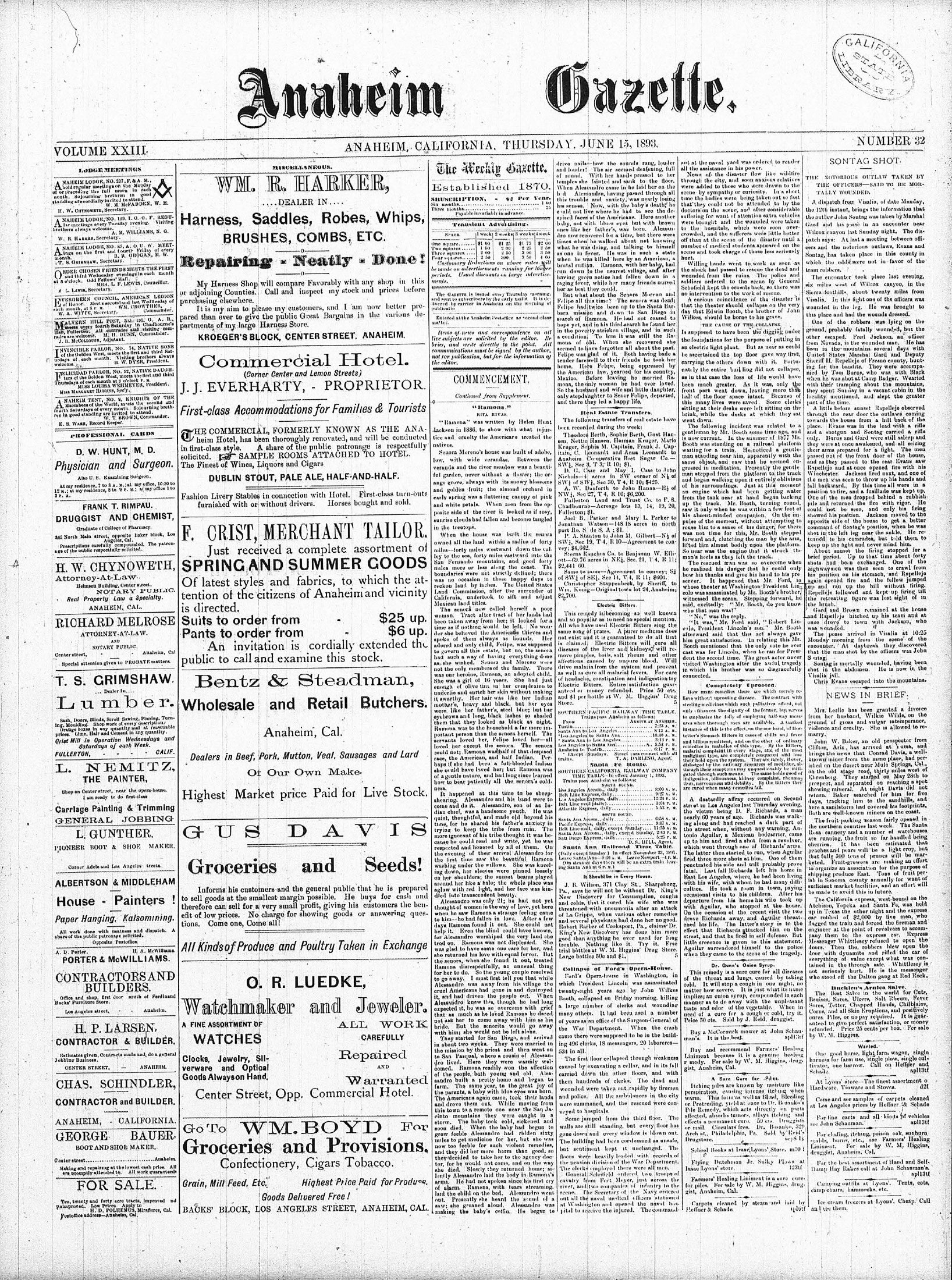
Searchable text
VOLUME XXIII
LODGE MEETINGS
ANAHEIM LODGE, NO. 297, F. & A. M., hold regular meetings on the Monday of or preceding the full moon in each month. Sojourning brethren in good standing are cordially invited to attend.
W. M. McFADDEN, W. M.
H. W. CHYNOWERTU, Secretary.
ANAHEIM LODGE, NO. 199, I. O. O. F. REGU-lar meetings every Tuesday evening. Visiting brothers always welcome.
A. M. WILLIAMS, N. G.
W. R. HARKER, Secretary.
ANAHEIM LODGE, NO. 85, A. O. U. W. MEETings on the first and fourth Friday of every month.
B. R. GROGAN, M. W.
T. S. GRIMSHAW, Secretary.
ORDER CHOSEN FRIENDS MEETS THE FIRST and third Wednesday evenings in each month at 3 o'clock. Odd Follows Hall.
MRS. L. F. LEWIS, Councillor.
A. L. LEWIN, Secretary.
EVERGREEN COUNCIL, AMERICAN LEGION of Honor. Meets second and last Wednesday of each month, at S.P.M.
WM. CROWTHER,
W.A. WITTE, Secretary.
Commander.
MALVERN HILL POST, NO. 131, O. A. R., meets every fourth Saturday in Chalbourne's Hall. Fullerton. All comrades and visiting comrades are welcome.
M. H. DUNN, Commander.
J. B. McCOLLONO, Adjutant.
INVINCIBLE PARLOR, NO. 74, NATIVE SONS of the Golden West, meets the first and third Saturday of each month. Visiting brothers always welcome.
H.W.DYER, President.
ELICIDAD PARLOR, NO. 52, NATIVE DAUGHTERS of the Golden West, meets the first and third Thursdays of each month at 3 o'clock P.M.
MISS LOUISE WEHMEYER, President.
MISS MARGARET HIGGINS, Sec'y.
ANAHEIM TENT, NO. 9, KNIGHTS OF THE Macabees of the World, meets the second and fourth Saturdays of every month. Sojourning brethren in good standing are invited to attend.
W.T.BROWN, Commander.
E.S.WARR, Record Keeper.
PROFESSIONAL CARDS
D. W. HUNT, M. D.
Physician and Surgeon.
MISCELLANEOUS.
WM. R. HARKER
...DEALER IN...
Harness, Saddles, Robe
BRUSHES, COMBS,
Repairing - Neatly
My Harness Shop will compare favorably with or adjoining Counties. Call and inspect my stock purchasing elsewhere.
It is my aim to please my customers, and I am pared than ever to give the public Great Bargains partments of my large Harness Store.
KROEGER'S BLOCK, CENTER STREET
Commercial H
(Corner Center and Lemon Streets)
J.J.EVERHARTY,- PRO
First-class Accommodations for Families
THE COMMERCIAL, FORMERLY KNOWN heim Hotel, has been thoroughly renovated, and in first-class style. A share of the public patron solicited.
SAMPLE ROOMS ATTACHED The Finest of Wines, Liquors and Cigars
PROFESSIONAL CARDS
D. W. HUNT, M. D.
Physician and Surgeon.
Also U. S. Examining Surgeon.
At my residence, 7 to 8 A.M.; at my office, 10:30 to 12 P.M.; at my residence, 8 to 9 P.M.; at my office 1 to 3 P.M.
FRANK T. RIMPAU.
DRUGGIST AND CHEMIST,
Graduate of College of Pharmacy.
265 North Main street, opposite Baker block, Los Angeles, Cal.
Prescriptions carefully compounded. The patronage of the public respectfully solicited.
H. W. CHYNOWETH,
Attorney-At-Law.
Helmsen Building, Center street.
NOTARY PUBLIC.
Real Property Law a Specialty.
ANAHEIM, CAL.
RICHARD MELROSE
ATTORNEY-AT-LAW.
AND
NOTARY PUBLIC.
Center street,
Anaheim, Cal.
Special attention given to PROBATE matters.
T. S. GRIMSHAW.
Lumber.
Sash, Doors, Blinds, Scroll Sawing, Planing, Turning, Holding. Shop work of every description.
Orange boxes in any quantity and at reasonable prices.
Lime, Hair and Cement in any quantity.
Grist Mill in Operation Wednesdays and Saturdays of each Week.
FULLERTON,
CALIF.
L. NEMITZ,
THE PAINTER,
Shop on Center street, near the opera-house.
I am ready to do first-class Carriage Painting & Trimming GENERAL JOBBING
L. GUNTHER.
PIONEER BOOT & SHOE MAKER.
Corner Adela and Los Angeles streets.
ALBERTSON & MIDDLEHAM
House - Painters!
J. J. EVERHARTY, - PROFESSIONAL
First-class Accommodations for Famili
THE COMMERCIAL, FORMERLY KNOWN
Theim Hotel, has been thoroughly renovated, and in first-class style. A share of the public patronized.
SAMPLE ROOMS ATTACHED
The Finest of Wines, Liquors and Cigars
DUBLIN STOUT, PALE ALE, HALF-A
Fashion Livery Stables in connection with Hotel furnished with or without drivers.
F. CRIST, MERCHANT
Just received a complete aSPRING AND SUMMER
Of latest styles and fabrics, to tention of the citizens of Anaheim is directed.
Suits to order from
Pants to order from
An invitation is cordially public to call and examine this s
Bentz & Stead
Wholesale and Retail
Anaheim, Cal.
Dealers in Beef, Pork, Mutton, Veal, Sauce
Of Our Own Make
Highest Market price Paid for
GUS DA
Groceries and
Informs his customers and the general public to sell goods at the smallest margin possible. He
Carrlage Painting & Trimming
GENERAL JOBBING
L. GUNTHER.
PIONEER BOOT & SHOE MAKER.
Corner Adele and Los Angeles treets.
ALBERTSON & MIDDLEHAM
House - Painters!
Paper Hanging, Kalsomining.
All work done with neatness and dispatch. A share of the public patronage solicited.
Opposite Postoffice.
A. D. Porter.
H. A. McWilliams.
PORTER & McWILLIAMS.
CONTRACTORS AND BUILDERS.
Office and shop, first door south of Ferdinand Backs' Furniture Store.
Los Angeles street, Anaheim.
H. P. LARSEN,
CONTRACTOR & BUILDER.
Estimates given, Contracts made and do a general Jobbling Business.
CENTER STREET, ANAHEIM.
CHAS. SCHINDLER,
CONTRACTOR and BUILDER.
ANAHEIM, CALIFORNIA.
GEORGE BAUER,
BOOT AND SHOE MAKER.
Center street... Anaheim.
Making and repairing at the lowest cash price. All ers promptly attended to. All work guaranteed!
FOR SALE.
Ten, twenty and forty acre tracts, improved nd humimproved. Low Prices. Apply to
H. D. POLHEMUS, Miraflores, Cal.
Postoffice address—Anaheim, Cal.
GUS DA
Groceries and
Informs his customers and the general public to sell goods at the smallest margin possible. He therefore can sell for a very small profit, giving him effit of low prices. No charge for showing goods tions. Come one, Come all!
All Kindsof Produce and Poultry Take
O. R. LUEDKIE
Watchmaker and
A FINE ASSORTMENT OF WATCHES
Clocks, Jewelry, Silverware and Optical Goods Always on Hand.
Center Street, Opp. Commer
Go To WM.BOY
Groceries and Pro
Confectionery, Cigars T
Grain, Mill Feed, Etc.
Highest Price
Goods Delivered Free!
BACKS' BLOCK, LOS ANGELES STREET
ANAHEIM, CALIFORNIA, THURSDAY, JUNE 15, 1893.
MISCELLANEOUS.
P. HARKER,
DEALER IN...
Dresses, Robes, Whips,
BIS, COMBS, ETC.
Neatly - Done!
Compare Favorably with any shop in this
and inspect my stock and prices before
my customers, and I am now better prepublic Great Bargains in the various depress Store.
CENTER STREET. ANAHEIM.
Special Hotel.
(Center and Lemon Streets)
ARTY, - PROPRIETOR.
Dedations for Families & Tourists
FORMERLY KNOWN AS THE ANAboroughly renovated, and will be conducted
of the public patronage is respectfully
ROOMS ATTACHED TO HOTEL.
Cars and Cigars
PALE ALE HALE-AND-HALE.
The Weekly Gazette.
Established 1870.
SRUSCRIPTION, - $2 Per Year.
Six months... 1.60
Three months... 75
Payable invariably in advance.
Transient Advertising.
SPACE.
1 week
2 weeks
3 weeks
4 weeks
One square.... $1.00 $1.25 $1.75 $2.00
Two squares... 1.50 2.00 2.25 2.50
Three squares... 2.00 2.50 3.00 3.50
Four squares... 2.50 300 3.50 4.00
Customary Reductions on above rates will
be made on advertisements running for longer
periods. Usual discounts on large advertisements.
The Gazette is issued every Thursday morning,
and sent to subscribers by the early nails. It is delivered by carrier in Anaheim on the morning of
publication.
Entered at the Anaheim Postoffice as second-class
matter.
Items of news and correspondence on all live subjects are solicited by the editor. Be brief, and write directly to the point. All communications must be signed by the author, not for publication, but for the information of the editor.
COMMENCEMENT.
Continued from Supplement.
“Ramona.”
RITA RIVAS
“Ramona” was written by Helen Hunt Jackson in 1886, to show with what injutice and cruelty the Americans treated the natives.
Senora Moreno’s house was built of adobe,
low, with wide verandas. Between the veranda and the river meadow was a beautiful garden, never without a flower; the ordrive nails—how the sounds rang, louder
and louder! The air seemed deafening, full
of sound. With her hands pressed to her
temples she fainted and sank to the floor.
When Alessandro came in he laid her on the bed. Alessandro, having passed through althis trouble and anxiety, was nearly losing his senses. Now, with the baby’s death, he could not live where he had to see the despired faces of the Americans. Here another
baby, not with blues eyes but with brown
ones like her father’s, was born. Alessandro now recovered for a time, but there were
times when he walked about not knowing what he was doing, and talking to himself as one in fever. He was in such a state
when he was killed here by an American, a brutal rutilan. Ramona, with her baby, had run down to the nearest village, and after having given notice had fallen down in a raging fever, while her many friends nursed her as best they could.
But what about the Senora Moreno and Felipe all this time? The senora was dead.
Felipe had twice been up to the Santa Barra mission and dawn to San Diego in search of Ramona. He had not ceased to hope yet, and in his third search he found her in the poverty-stricken village, and in such a condition. To him it was still the Ramona of old. When she recovered she seemed to have forgotten all about the past.
Felipe was glad of it. Both having bade her tender farewell to their friends he took home. Here Felipe, being oppressed by the American law, yearned for his country Mexico. Before leaving he married Ramona, the only woman he had ever loved. So the husband and wife and little daughter only stepdaughter to Senor Felipe, departed and there they led a happy life.
Real Estate Transfers.
The following transfers of real estate have been recorded during the week:
Theodore Berth, Sophie Berth, Gust Hasen, Nettie Hausen, Herman Kruger, MariKruger, Sophia M. Capitsain, Frank J. Capitain, C. Leonardt and Anna Leonardt in Anaheim Cooperative Boot Sugar Co.
-SWJ; Sec 3, T 3; R 10; $1.
D. G. Case and May I. Case to John Nichols—4 acres in SW corner of Na
COMMENCEMENT.
Continued from Supplement.
"Hamona."
RITA RIVAS
"Hamona" was written by Helen Hunt Jackson in 1886, to show with what injustice and cruelty the Americans treated the natives.
Senora Moreno's house was built of adobe, low with wide verandas. Between the veranda and the river meadow was a beautiful garden, never without a flower; the orange grove, always with its snowy blossoms and golden fruit; the almond orchard in early spring was a fluttering canopy of pink and white petals. When seen from the opposite side of the river it looked as if rosy, sunrise clouds had fallen and become tangled in the treetops.
When the house was built the senora owned all the land within a radius of forty miles—forty miles westward down the valley to the sea, forty miles eastward into the San Fernando mountains, and good forty miles more or less along the coast. The boundaries were not strictly defined; there was no occasion in those happy days to reckon land by inches. The United States Land Commission, after the surrender of California, undertook to sift and adjust Mexican land titles.
The senora now called herself a poor woman. Tract after tract of her lands had been taken away from her; it looked for a time as if nothing would be left. No wonder she believed the Americas thieves and spoke of them always as hounds. Her adored and only child, Felipe, was supposed to govern all this estate, but no, the senora had such a way of having everything done as she wished. Senora and Moreno were not the only members of the family. There was our heroine, Ramona, an adopted child. She was a girl of 16 years. She had just enough of olive tint in her complexion to underlie and enrich her skin without making it swarthy. Her hair was like her Indian mother's, heavy and black, but her eyes were like her father's, steel blue; but her eyebrows and long, black lashes so shaded them that they looked as black as night. Ramona was to the household a far more important person than the senora herself. The servants loved her, Felipe loved her—all loved her except the senora. The senora could not; Ramona was half of that despised race, the American, and half Indian. Perhaps if she had been a full-blooded Indian she could have loved her; but Ramona was of a gentle nature, and had long since learned how to bear patiently all the senora's coldness.
It happened at this time to be sheep-shearing. Alessandro and his band were to come and do it. Alessandro, son of an Indian chief, was a handsome youth. He was quiet, thoughtful, and made old beyond his time, for he shared his father's anxiety in trying to keep the tribe from ruin. The more ignorant of his tribe thought it was because he could road and write, yet he was respected and honored by all of them. On the evening of their arrival Alessandro for the first time saw the beautiful Ramona washing under the willows. She was kneeling down, her sleeves were pinned loosely on her shoulders; the sunset beams played around her like a halo; the whole place was aglow with red light, and her face was kindled into transcendent beauty.
Alessandra was only 21; he had not yet Mexico. Before leaving he married Ramauna, the only woman he had ever loved. So the husband and wife and little daughter only stepdaughter to Senior Felipe, departed and there led a happy life.
Real Estate Transfers.
The following transfers of real estate have been recorded during the week:
Theodore Berth, Sophie Berth, Gust Haunsen, Nettie Hansen, Herman Kruger, Marienkruger, Sophia M. Capitain, Frank J. Capitain, C. Leonardt and Anna Leonardt to Anahelant Co-operative Beet Sugar Co.-SW., Sec 3, T 3; R 10; $1.
D. G. Case and May I. Case to John Nichols—4 acres in SW corner of N of SW of SW., Sec 30, T 4, R 10; $25.
A. W. Dauforth to John Hanna—E of NW., Sec 27, T 4, R 10; $8,200.
Fullerton Land and Trust Co. to F.S. Chadbourne—Acreage lots 13, 14, 19, 20; Fulleron $1.
Joel B. Parker and Mary L. Parker to Jonathan Watson—148 18 acres in north part Ro. S de S. A.; $1.
P. A. Stanton to John M. Gilbert—N of SW., Sec 19, T 4, R 10—Agreement to convey; $4,662.
Sterrs Kanchos Co. to Benjamin W. Ellott—69.76 acres in NE., Sec. 21, T 4, R 11; $2,441 60.
Same to same—Agreement to convey; $ of SW of SE., Sec 14, T 4, R 11; $600.
Christopher Stappenbeck, by Sheriff, Twm. Konig—Original town lot 24, Anaheim $2,700.
Electric Bitters.
This remedy is becoming so well known and so popular as to need no special mention. All who have used Electric Bitters sing the same song of praise. A purer medicine does not exist and it is guaranteed to do all that is claimed: Electric Bitters will cure diseases of the liver and kidneys; will move pimples, boils, salt rheum and other affections caused by impure blood. Will drive malaria from the system and prevent as well as cure all malarial fevers. For cure of headache, constipation and indigestion try Electric Bitters. Entree satisfaction guaranteed or money refunded. Price 50 cts and $1 per bottle at W. M. Huggins' Drug Store.
SOUTHERN PACIFIC RAILWAY TIME TABLE
Trains pass Anaheim as follows:
From
Tustin
7:23 A.M.
Santa Ana to Los Angeles
9:13 A.M.
Los Angeles to Santa Ana
10:16 A.M.
Santa Ana to Los Angeles
3:13 P.M.
Los Angeles to Santa Ana
5:58 P.M.
Anaheim to Tustin
6:17 P.P.
Except Sundays. Street cars connect with trains.
T.A.DARLING.Agent.
Santa Fe Route.
SOUTHERN CALIFORNIA RAILWAY COMPANY
TIME TABLE—In effect January 1, 1883.
Trains pass Anaheim as follows:
North bound.
Los Angeles Accom., daily
Belt Line Express, daily
L.s Angeles Express daily
Belt Line mail (daily)
Atlantic Express daily
South bound.
Santa Ana Accom., daily
Pacific Express daily
Belt Line mail daily, except Sunday
Belt Line mail (daily)
D.S.HILL.Agent.
Santa Ana Railroad Time Table.
(Dally except Sunday.) In effect November 21, 1883.
Leave Santa Ana—9:30 A.M.
Leave Newport—4 P.M.
(On steamer days there will be an extra train heading Santa Ana at 6 P.M.)
and Seeds!
and Poultry Taken in Exchange
R. LUEDKE,
饰 and Jeweler.
ALL WORK
CAREFULLY
Repaired
AND
Warranted
Opp. Commercial Hotel.
M.BOYD For
and Provisions.
ery, Cigars Tobacco.
Highest Price Paid for Produce.
Is Delivered Free!
ANGELFS STREET, ANAHEIM, CAL.
come and do it. Alessandro, son of an Indian chief, was a handsome youth. He was quiet, thoughtful, and made old beyond his time, for he shared his father's anxiety in trying to keep the tribe from ruin. The more ignorant of his tribe thought it was because he could read and write, yet he was respected and honored by all of them. On the evening of their arrival Alessandro for the first time saw the beautiful Ramona washing under the willows. She was kneeling down, her sleeves were pinned loosely on her shoulders; the sunset beams played around her like a halo; the whole place was aglow with red light, and her face was kindled into transcendent beauty.
Alessandro was only 21; he had not yet thought of women in the way of love, yet here when he saw Ramona a strange feeling came to him—he had fallen in love. After a few days Ramona found it out. She could not help it. Even the blind could have known, for Alessandro worshiped the very land she trod on. Ramona was not displeased. She was glad to have some one care for her, and she returned his love with equal fervor. But the senora, when she found it out, treated Ramona disrespectfully, an unusual thing for her to do. So the young couple resolved to go away. I must first tell you that while Alessandro was away from his village the cruel Americans had gone in and destroyed it, and had driven the people out. When Alessandro knew this, though he had long expected it, he was so overcome with grief that as much as he loved Ramona he dared not ask her to come away with him as his bride. But the senora would go away with him; she would not be left alone.
They started for San Diego, and arrived in about two weeks. They were married in the mission by the priest and then went on to San Pasqual, where a cousin of Alessandro lived. Here they were warmly welcomed. Ramona readily won the affection of the people, both young and old. Alessandro built a pretty home and began to farm. The same year, to the great joy of the parents, a baby with blue eyes was born. The Americans again came, took their lands and drove them out. While moving from this town to a remote one near the San Jacinto mountains they were caught in a storm. The baby took cold, sickened and soon died. When the baby had begun to grow feeble Alessandro had ridden sixty miles to get medicine for her, but she was now too feeble for such violent remedies, and they did her more harm than good, so they decided to take her to the agency doctor, for he would not come, and on the way she died. Slowly they returned home; silently Alessandro laid the body in Ramona's arms. He had not spoken since his first cry of alarm. Ramona, with tears streaming, laid the child on the bed. Alessandro went out. Presently she heard the sound of a saw; she groaned aloud. Alessandro was making the baby's coffin. He began to come and do it. Alessandro, son of an Indian chief, was a handsome youth. He was quiet, thoughtful, and made old beyond his time, for he shared his father's anxiety in trying to keep the tribe from ruin. The more ignorant of his tribe thought it was because he could read and write, yet he was respected and honoured by all of them. On the evening of their arrival Alessandro for the first time saw the beautiful Ramona washing under the willows. She was kneeling down, her sleeves were pinned loosely on her shoulders; the sunset beams played around her like a halo; the whole place was aglow with red light, and her face was kindled into transcendent beauty.
Alessandro was only 21; he had not yet thought of women in the way of love, yet here when he saw Ramona a strange feeling came to him—he had fallen in love. After a few days Ramona found it out. She could not help it. Even the blind could have known, for Alessandro worshiped the very land she trod on. Ramona was not displeased. She was glad to have some one care for her, and she returned his love with equal fervor. But the senora, when she found it out, treated Ramona disrespectfully, an unusual thing for her to do. So the young couple resolved to go away. I must first tell you that while Alessandro was away from his village the cruel Americans had gone in and destroyed it, and had driven the people out. When Alessandro knew this, though he had long expected it, he was so overcome with grief that as much as he loved Ramona he dared not ask her to come away with him as his bride. But the senora would go away with him; she would not be left alone.
They started for San Diego, and arrived in about two weeks. They were married in the mission by the priest and then went on to San Pasqual, where a cousin of Alessandro lived. Here they were warmly welcomed. Ramona readily won the affection of the people, both young and old. Alessandro built a pretty home and began to farm. The same year, to the great joy of the parents, a baby with blue eyes was born. The Americans again came, took their lands and drove them out. While moving from this town to a remote one near the San Jacinto mountains they were caught in a storm. The baby took cold, sickened and soon died. When the baby had begun to grow feeble Alessandra had ridden sixty miles to get medicine for her, but she was now too feeble for such violent remedies, and they did her more harm than good, so they decided to take her to the agency doctor, for he would not come, and on the way she died. Slowly they returned home; silently Alessandra laid the body in Ramona's arms. He had not spoken since his first cry of alarm. Ramona, with tears streaming, laid the child on the bed. Alessandra went out. Presently she heard the sound of a saw; she groaned aloud. Alessandra was making the baby's coffin. He began to come and do it. Alessandro, son of an Indian chief, was a handsome youth. He was quiet, thoughtful, and made old beyond his time, for he shared his father's anxiety in trying to keep the tribe from ruin. The more ignorant of his tribe thought it was because he could read and write, yet he was respected and honoured by all of them. On the evening of their arrival Alessandro for the first time saw the beautiful Ramona washing under the willows. She was kneeling down, her sleeves were pinned loosely on her shoulders; the sunset beams played around her like a halo; the whole place was aglow with red light, and her face was kindled into transcendent beauty.
Alessandro was only 21; he had not yet thought of women in the way of love, yet here when he saw Ramona a strange feeling came to him—he had fallen in love. After a few days Ramona found it out. She could not help it. Even the blind could have known, for Alessandro worshiped the very land she trod on. Ramona was not displeased. She was glad to have some one care for her, and she returned his love with equal fervor. But the senora, when she found it out, treated Ramona disrespectfully, an unusual thing for her to do. So the young couple resolved to go away. I must first tell you that while Alessandro was away from his village the cruel Americans had gone in and destroyed it, and had driven the people out. When Alessandro knew this, though he had long expected it, he was so overcome with grief that as much as he loved Ramona he dared not ask her to come away with him as his bride. But the senora would go away with him; she would not be left alone.
They started for San Diego, and arrived in about two weeks. They were married in the mission by the priest and then went on to San Pasqual, where a cousin of Alessandro lived. Here they were warmly welcomed. Ramona readily won the affection of the people, both young and old. Alessandra built a pretty home and began to farm. The same year, to the great joy of the parents, a baby with blue eyes was born. The Americans again came, took their lands and drove them out. While moving from this town to a remote one near the San Jacinto mountains they were caught in a storm. The baby took cold, sickened and soon died. When the baby had begun to grow feeble Alessandra had ridden sixty miles to get medicine for her, but she was now too feeble for such violent remedies, and they did her more harm than good, so they decided to take her to the agency doctor, for he would not come, and on the way she died. Slowly they returned home; silently Alessandra laid the body in Ramona's arms. He had not spoken since his first cry of alarm. Ramona, with tears streaming, laid the child on the bed. Alessandra went out. Presently she heard the sound of a saw; she groaned aloud. Alessandra was making the baby's coffin. He began to come and do it. Alessandro, son of an Indian chief, was a handsome youth. He was quiet, thoughtful, and made old beyond his time, for he shared his father's anxiety in trying to keep the tribe from ruin.
The more ignorant of his tribe thought it was because he could read and write, yet he was respected and honoured by all of them. On the evening of their arrival Alessandro for the first time saw the beautiful Ramona washing under the willows. She was kneeling down, her sleeves were pinned loosely on her shoulders; the sunset beams played around her like a halo; the whole place was aglow with red light, and her face was kindled into transcendent beauty.
Alessandro was only 21; he had not yet thought of women in the way of love, yet here when he saw Ramona a strange feeling came to him—he had fallen in love. After a few days Ramona found it out. She could not help it. Even the blind could have known, for Alessandro worshiped the very land she trod on. Ramonia was not displeased. She was glad to have some one care for her, and she returned his love with equal fervor. But the senora, when she found it out, treated Ramonia disrespectfully, an unusual thing for her to do.
So the young couple resolved to go away. I must first tell you that while Alessandro was away from his village the cruel Americans had gone in and destroyed it, and had driven the people out.
When Alessandro knew this, though he had long expected it, he was so overcome with grief that as much as he loved Ramonda he dared not ask her to come away with him; she would not be left alone.
They started for San Diego, and arrived in about two weeks. They were married in the mission by the priest and then went on to San Pasqual, where a cousin of Alessandra lived. Here they were warmly welcomed. Ramona readily won the affection of the people, both young and old. Alessandra built a pretty home and began to farm.
The same year, to the great joy of the parents, a baby with blue eyes was born.
The Americans again came, took their lands and drove them out.
While moving from this town to a remote one near the San Jacinto mountains they were caught in a storm.
The baby took cold, sickened and soon died.
When the baby had begun to grow feeble Alessandra had ridden sixty miles to get medicine for her, but she was now too feeble for such violent remedies, and they did her more harm than good, so they decided to take her to the agency doctor, for he would not come,and on the way she died.
Slowly they returned home; silently Alessandra laid the body in Ramona's arms.
He had not spoken since his first cry of alarm.
Ramona with tears streaming laid the child on the bed.
Alessandra went out.
Presently she heard the sound of a saw; she groaned aloud.
Alessandra was making the baby's coffin.
He began to come and do it.
Alessandro,son of an Indian chief,was a handsome youth。He was quiet,thoughtful,and made old beyond his time,for he shared his father's anxiety in trying to keepthe tribefromruin。
The more ignorantofhis tribethoughtitwasbecausehecouldreadconsumptioneventhree-eightyearsagobyJohnWilksBooth,collapsedonFridaymorning,killingalargenumberofclerksandwoundingmanyothers。它hadbeenusedanumberofyearsasanofficeoftheSurgeon-GeneraltheWarDepartment。Whenthecrasamethereweresupposedtobeinthebuilding496clerks,18messengers,20laboreres534inall。
Thefirstfloorcollapsedthroughweaknesscausedbyexcavatingacellar,andinitsfarcarrieddowntheotherfloors,andwiththehundredsofclerks.Thedeadawoundedweretakenoutrapidlybyfiremenandpolice.Alltheambulancesinthecityweresummed,andtherescuedwerecoveyedtohospital。
Some jumpedfromthethirdfloor.Thewallsarestillstanding,bbutevery floorhouldgonedownandeverywindowisblownout.Thebuildinghadbeencorddemnedasunsafetybutsentimentkeptitunchanged.Theworldseemedtohavesupposedtobeinthebuilding496clerks,18messengers,20laboreres534inall。
June 15, 1893.
Now the sounds rang, louder the air seemed deafening, full with her hands pressed to her painted and sank to the floor. She came in he laid her on the floor, having passed through all and anxiety, was nearly losing how, with the baby's death he where he had to see the de- the Americans. Here another blues eyes but with brown leather's, was born. Alessan- rred for a time, but there were walked about not knowing in- and talking to himself. He was in such a state filled here by an American, a Ramona, with her baby, had the nearest village, and after notice had fallen down in a whirl her many friends nursed by could.
Out the Senora Moreno and time? The senora was dead; once been up to the Santa Bar- and d-wn to San Diego in omaha. He had not coosed to his third search he found her stricken village, and in such To him it was still the Ra- When she recovered she forgotten all about the past. And of it. Both having bade a to their friends he took her Felipe, being oppressed by law, yearned for his country, are leaving he married Ra- woman he had ever loved, and wife and little daughter, to Senior Felipe, departed, led a happy life.
Estate Transfers.
Mortal transfers of real estate have during the week:
North, Sophie Berth, Gust Hanu-sen, Herman Kruger, Marie M. Capitain, Frank J. Cap- ardard and Anna Leonardt to cooperative Beet Sugar Co.— 3; R 10; $1.
and May I. Case to John resins in SW corner of N of
ant at the naval yard was ordered to render all the assistance in his power.
News of the disaster flow like wildfire through the city, and soon anxious relatives were added to those who were drawn to the scene by sympathy or curiosity. In a short time the bodies were being taken out so fast that they could not be attended to by the doctors on the scene, and after considerable suffering for want of attention extra vehicles were brought and the wounded were taken to the hospitals, which were soon over-crowded, and the sufferers were little better off than at the scene of the disaster until a number of medical students appeared on the scene and took charge of those less seriously hurt.
Willing hands went to work as soon as the shock had passed to rescue the dead and wounded from the ruins. The police and soldiers ordered to the scene by General Schofield kept the crowds back, so there was no intervention to the work of rescue.
A curious coincidence of the disaster is that the theater should collapse on the very day that Edwin Booth, the brother of John Wilkes, should be borne to his grave.
THE Cause Of The Collapse
Is supposed to have been the digging under the foundations for the purpose of putting in an electric light plant. But as near as could be ascertained the top floor gave way first, carrying the others down with it. Fortunately the entire building did not collapse, as in that case the loss of life would have been much greater. As it was, only the front part went down, leaving more than half of the floor space intact. Because of this many lives were saved. Some clerks sitting at their desks were left sitting on the brink, while the desks at which they sat went down.
The following incident was related to a gentleman by Mr. Booth some time ago, and is now current. In the summer of 1877 Mr. Booth was standing on a railroad platform waiting for a train. He noticed a gentleman standing near him, apparently with the same object, and saw that he seemed engrossed in meditation. Presently the gentle man stepped from the platform to the track
SONTAG SHOT.
THE NOTORIOUS OUTLAW TAKEN BY THE OFFICERS—SAID TO BE MORTALLY WOUNDED.
A dispatch from Visalia, of date Monday, the 12th instant, brings the information that the outlaw John Sontag was taken by Marshal Gard and his posse in an encounter near Wilcox canyon last Sunday night. The dispatch says: At last a meeting between officers and the notorious outlaws, Evans and Sontag, has taken place in this county in which the odds were not in favor of the train robbers.
The encounter took place last evening, six miles west of Wilcox canyon, in the Sierra foothills, about twenty miles from Visalia. In this light one of the officers was wounded in the leg. He was brought to this place and had the wounds dressed.
One of the robbers was lying on the ground, probably fatally wounded, but the other escaped. Fred Jackson, an officer from Nevada, is the wounded man. He has been in the mountains several days with United States Marshal Gard and Deputy Scriiff H. Repellejo of Freeso n county, hunting for the bandits. They were accompanied by Tom Burgo, who was with Black when he was shot at Camp Badger. Weared with their tramping about the mountains, they spent Sunday in a vacant cabin in the locality mentioned, and slept the greater part of the time.
A little before sunset Rapelleje observed through the rear door the outlaws coming towards the house from a hill back of the place. Evans was in the lead with a rifle and a shotgun and Sontag carried a rifle only. Burns and Gard were still asleep and they were at once awakened, and all seizing their arms prepared for a fight. The men passed out of the front door of the house, and as they passed to the rear Evans saw Rapelleje and at once opened fire with his Chester. Jackson fired next, and one of
Estate Transfers.
ing transfers of real estate have
during the week.
North, Sophie Burth, Gust Hansensen, Herman Kruger, Mario
a M. Capain, Frank J. Capardt and Anna Leonardt to
operative Beet Sugar Co.
3; R 10; $1.
and May L. Case to John
in SW corner of Nj of
Sec 30, T 4, R 10; $425.
North to John Hanna—Ej of
T 4, R 10; $6,200.
Land and Trust Co. to F.S.
Acreage lots 13, 14, 19, 20.
arker and Mary L. Parker to
tonon—148 18 acres in north
S. A.; $1.
ton to John M. Gilbert—Nj of
T 4, R 10—Agreement to conhos Co. to Benjamin W. Elliss in NEJ, Sec. 21, T 4, R 11;
Agreement to convey; S1
Sec. 14, T 4, R 11; $600.
Stappenbeck, by Sheriff,
to Original town lot 24, Anaheim;
Electric Bitters.
is becoming so well known
as to need no special mention.
Electric Bitters sing the ruse.
A purer medicine does
it is guaranteed to do all that
Electric Bitters will cure all
the liver and kidneys will reboils, salt rheum and other
used by impure blood.
Will from the system and prevent
all malarial fevers. For cure
constipation and indigestion try
ers. Entire satisfaction guarney refunded. Price 50 cts.
at W. M. Higgins' Drug
CIFIC RAILWAY TIME TABLE.
pass Anheim as follows:
ARRIVE AT ANHEIM.
7:23 A.M.
Angela.
10:40 A.M.
Los Angeles.
3:13 P.M.
Santa Ana.
4:58 P.M.
Minnesota.
6:17 P.M.
Street car connect with all
T.A. DARLING, Agent.
CALIFORNIA RAILWAY COMPANY
In effect January 1, 1833.
Anheim as follows:
NORTH BOUND.
8:00 A.M.
daily.
9:27 A.M.
daily.
12:24 P.M.
daily.
3:04 P.M.
daily.
Railroad Time Table.
day.) In effect November 23, 1831.
Anheim will be an extra train leave
6 P.M.
Could be in Every House.
371 Clay St., Sharpburg,
will not be without Dr. King's
try for Consumption, coughs
it cured his wife who was
as in that case the loss of life would have been much greater. As it was, only the front part went down, leaving more than half of the floor space intact. Because of this many lives were saved. Some clerks sitting at their desks were left sitting on the brink, while the desks at which they sat went down.
The following incident was related to a gentleman by Mr. Booth some time ago, and is now current. In the summer of 1877 Mr. Booth was standing on a railroad platform waiting for a train. He noticed a gentleman standing near him, apparently with the same object, and saw that he seemed engrossed in meditation. Presently the gentle man stepped from the platform to the track and began walking upon it entirely oblivious of his surroundings. Just at this moment an engine which had been getting water from the tank near at hand began backing up the track. Mr. Booth, turning round, saw it only when he was within a few feet of his absent-minded companion. On the impulse of the moment, without attempting to rouse him to a sense of his danger, for there was not time for this, Mr. Booth stepped forward and, clutching the man by the arm, lifted him almost bodily upon the platform.
Neear was the engine that it struck the man's heels as they left the track.
The rescued man was so overcome when he realized his danger that he could only bow his thanks and give his hand to his preserver. It happened that Mr. Ford, in whose theater at Washington President Lincoln colo was assassinated by Mr. Booth's brother, witnessed the scene. Stepping forward, he said, excitedly: "Mr. Booth, do you know who that man was?"
"No," was the reply.
"It was," Mr. Ford said, "Robert Lincoln, President Lincoln's son." Mr. Booth afterward said that this act always gave him great satisfaction. In relating this Mr. Booth mentioned that the only vote he ever cast was for Lincoln, when he ran for President the second time. The great actor never visited Washington after the awful tragedy in which his brother was so disgracefully connected.
Completely Uprooted.
How many remedies there are which merely relieve without uprooting disease. The contrast with sterling medicines which such palliatives afford, not only enhances the dignity of the former, but serves to emphasize the folly of employing halfway measures when thorough ones are available. A marked instance of this is the effect on the one hand of Clifton's Stomach litters in cases of chills and fever and bilious remilitent, and on the other of ordinary remedies in malalies of this type. By the litters complaint in every stage, and of the most malignant type, are completely conquered and lose their hold upon the system. They are rarely if ever discharged by the ordinary resources of medicine, although their symptoms may unquestionably be mitigated through such means. The same holds good of indigestion, biliousness, kidney complaint, rheum then, nervousness and deblity. By the Bitters they are cured when many remedies fail.
A dastardly affray occurred on Second street in Los Angeles last Thursday evening, the victim being D. F. Richards, a man nearly 60 years of age. Richards was walking along and had reached a dark part of the street when, without any warning, Antonio Aguilar, a Mexican hodcarrier, came up to him and fired a shot from a revolver, which went through one of Richards' arms. The latter then started to run, when Aguilar fired three more shots at him. One of them penetrated his side and will probably prove fatal. Last fall Richards left his home in East Los Angeles, where he had been living with his wife, with whom he had many difficulties. He took a room in town, paying occasional visits to his children. After his departure from his home his wife took up when he was shot at Camp Badger. Wearied with their trampling about the mountains, they spent Sunday in a vacant cabin in the locality mentioned, and slept the greater part of the time.
A little before sunset Rapelleje observed through the rear door the outlaws coming towards the house from a hill back of the place. Evans was in the lead with a rifle and a shotgun and Soutag carried a rifle only. Burns and Gard were still sleep and they were at once awakened, and all seizing their arms prepared for a fight. The men passed out of the front door of the house, and as they passed to the rear Evans saw Rapelleje and at once opened fire with his Winchester. Jackson fired next, and one of the men was seen to throw up his hands and fall backward. By this time all were in a position to fire, and a fusillade was kept up. One of the men dropped behind a rubbish pile and returned the fire with vigor. He could not be seen, and only his firing showed his position. Jackson moved to the opposite side of the house to get a better command of Soutag's position, when he was shot in the left leg near the ankle. He returned to his comrades, but told them to keep up the light and never mind him.
About sunset the firing stopped for a brief period. Up to that time about forty shots had been exchanged. One of the highwaymen was then seen to crawl from his position on his stomach, and Rapelleje again opened fire and the fellow jumped up and ran up the hill without firing. Rapelleje followed and kept up firing till the retreating figure was lost sight of in the brush.
Gard and Brown remained at the house and Rapelleje hitched up his team and at once drove to town with Jackson, who was wounded.
The posse arrived in Visalia at 10:25 Monday morning from the scene of the encounter. At daybreak they discovered that the man shot by the officers was John Soutag is mortally wounded, having been shot in the abdomen. He is now in the Visalia jail.
Chris Evans escaped into the mountains.
NEWS IN BRIEF.
Mrs. Leslie has been granted a divorce from her husband, Wilkie Wilde, on the ground of gross and vulgar intemperance, violence and cruelty. She is allowed to marry.
John W. Baker, an old prospector from Clifton, Ariz., has arrived at Yuma, and brings the news that Conrad Davis, a well-known miner from the same place, had perished on the desert near Mule Springs Cal., on the old stage road thirty miles west of Ehrenberg. They starved on May 28th to prospect and separated on reaching a spot showing mineral. At night Davis did not return. Baker searched for him five days, tracking him to the sandhills, and here a sandstorm had covered his footprints. Both are well-known miners on the coast.
The fruit-packing season fairly opened in the northern counties last week. The Santa Rosa cannery and a number of warehouses are running, the fruit so far handled being cherries. It has been estimated that peaches and pears will be a light crop, but that fully 500 tons of prunes will be marketed. Fruit-growers are making an effort to organize an association for the purpose of shipping produce East." Tons of fruit perish in Sonoma county annually for want of sufficient market facilities, and an effort will be made to avoid this in future.
The California express west-bound on the
In the morning of November 23, 1891, Dr. King's cry for Consumption, coughs, and pneumonia after an attack when various other remedies were used to help him recover, he ever used for lungching like it. Try it. Free W. M. Higgins' Drug Store. 50c and $1.
Dr. Gunn's Onion Syrup.
This remedy is a sure cure for all diseases of the throat and lungs, caused by taking cold. It will stop a cough in one night, no matter how severe. It is just what its name implies; an onion syrup, compounded in such manner as to do away with the unpleasant taste and odor of the vegetable. When in need of a cure for a cough or cold, try it. Price 50 cts. Sold by J. Reid, druggist.
Buy a McCormick mower at John Schauman's. It is the best.
Buy and recommend Farmers' Healing Liniment because it is a genuine healing remedy. For sale by W. M. Higgins, druggist, Anaheim, Cal.
A Sure Cure for Piles.
Itching piles are known by moisture like perspiration, causing intense itching when warm. This form as well as Blind, Bleeding or Protruding, yield at once to Dr. Bosanko's Pile Remedy, which acts directly on parts affected, absorbs tumors, allows itching and affects a permanent cure. 50 cts. Druggists or mail. Circulars free. Dr. Bosanke, 329 Arch at, Philadelphia, Pa. Sold by Reid's Drugstore.
School Books at Isaac Lyons' Store. m20 f
Flying Dutchman Jr. Sulky Flows at Isaac Lyons' store.
Farmers' Healing Liniment is a sure cure for piles. For sale by W. M. Higgins, druggist, Anaheim, Cal.
Carpets cleaned by steam and laid by Heffner & Schade.
The fruit-packing season fairly opened in the northern counties last week. The Santa Rosa cannery and a number of warehouses are running, the fruit so far handled being cherries. It has been estimated that peaches and pears will be a light crop, but that fully 500 tons of prunes will be marketed. Fruit-growers are making an effort to organize an association for the purpose of shipping produce East. Tons of fruit perish in Sonoma county annually for want of sufficient market facilities, and an effort will be made to avoid this future.
The California express, west-bound on the Atchison, Topeka and Santa Fe was held up in Texas the other night and the express car robbed of $2,000 by five men, who flagged the train and forced the fireman and engineer at the point of revolvers to accompany them to the express car. Express Messenger Whittlesey refused to open the doors. Then the robbers blew open the door with dynamite and rifled the car of everything of value except what was contained in the through sale. Whittlesey is not seriously hurt. He is the messenger who stood off the Dalton gang at Red Rock.
Huckleen's Aranica Salve.
The Best Salve in the world for Cuts, Bruises, Sores, Ulcers, Salt Rheum, Fever Sores, Tetter, Chapped Hands, Chilblains, Corns, and all Skin Eruptions, and positively cures Piles, or no pay required. It is guaranteed to give perfect satisfaction, or money refunded. Price 25 cents per box. For sale by W. M. Higgins.
Wanted.
One good horse, light farm wagon, single harness for farm use, single plow, single cultivator, one harrow. Call on Heffner and Schade.
At Lyons' store—The finest assortment of Hardware, Tinware and Stoves.
Come and see samples of carpets cleaned at Los Angeles prices by Heffner & Schado.
For fine carts and kinds of vehicles see John Schauman.
For chafing, itching, poison oak, sunburn scalds, burns, etc., use Farmers' Healing Liniment. For sale by W. M. Higgins, druggist, Anaheim, Cal.
For the best assortment of Hand and Self-Dump Hay Rakes call at John Schauman's.
Camping outfits at Lyons'. Tents, cots, camp chairs, hammocks, etc.
Ice cream freezers at Lyons'. Cheap. Call and tee them.