anaheim-gazette 1893-04-13
Scanned page
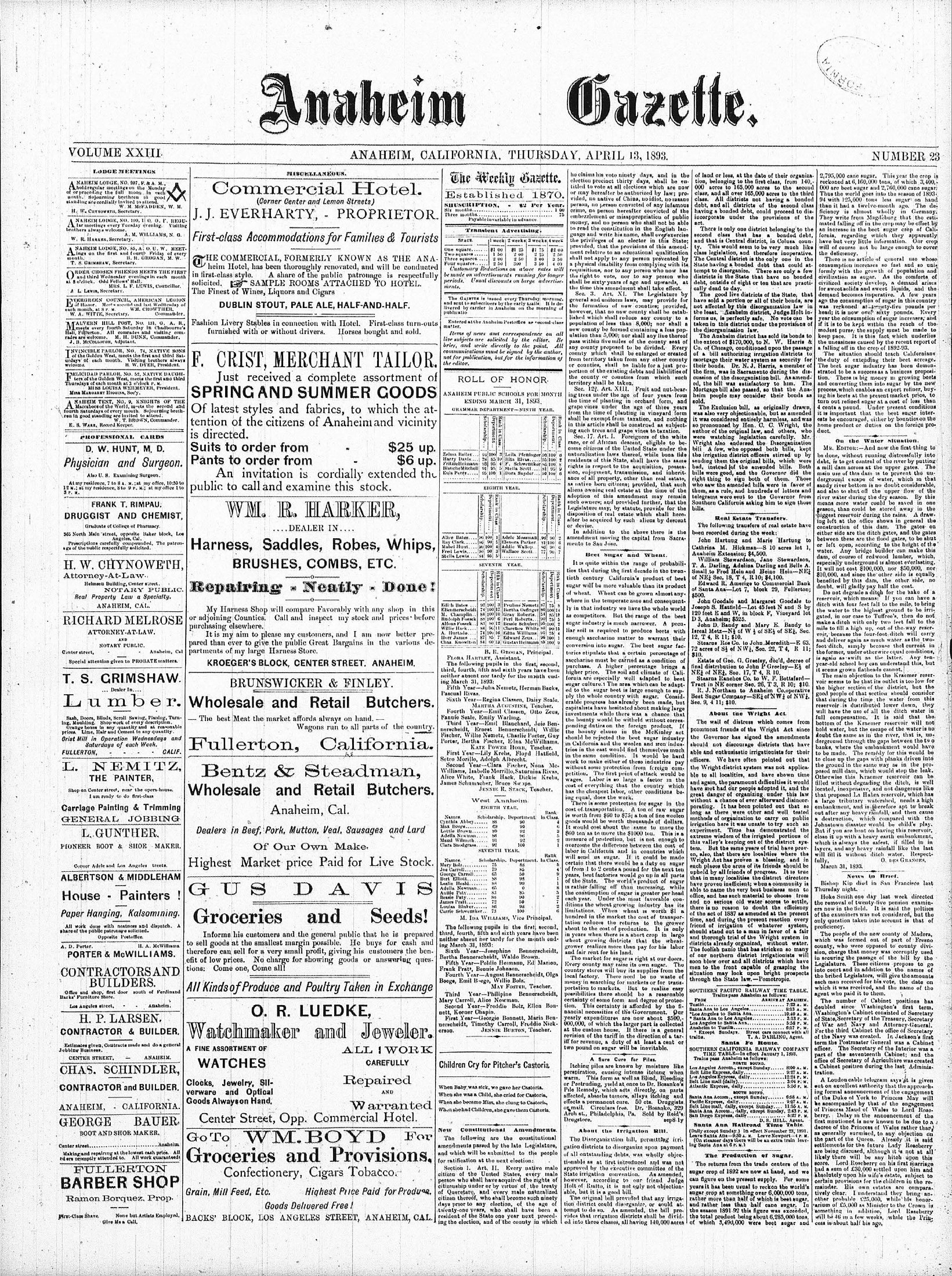
Searchable text
VOLUME XXIII.
LODGE MEETINGS
NAHEIM LODGE, NO. 207, F. & A. M., hold regular meetings on the Monday of or preceding the full moon in each month. Sojourning brethren in good standing are cordially invited to attend. W. H. McFADDEN, W. M. H. W. Chrysoweth, Secretary.
NAHEIM LODGE, NO. 199, I. O. O. P., Regular meetings every Tuesday evening. Visiting brothers always welcome. A. M. WILLIAMS, N. O. W. R. HARKER, Secretary.
NAHEIM LODGE, NO. 85, A. O. U. W., Meetings on the first and fourth Friday of every month. H. R. GROGAN, M. W. T. S. GRINSHAW, Secretary.
ORDER CHOSEN FRIENDS MEETS THE FIRST and third Wednesday evenings in each month at 3 o'clock. Old Fellows' Hall. Mrs. L. F. LEWIS, Councillor. A. L. LAWIS, Secretary.
EVERGREEN COUNCIL, AMERICAN LEGION of Honor. Meets second and last Wednesday of each month, at 3 p.m. WM. CROWTHER, W. A. WITTE, Secretary.
MALVERN HILL POST, NO. 131, O. A. R., meets every fourth Saturday in Chalbourne's Hall, Felerton. All comrades and visiting comrades are welcome. M. H. DUNN, Commander, J. B. McCOLLoun, Adjutant.
INVINCIBLE PARLOR, NO. 74, NATIVE SONS of the Golden West, meets the first and third Saturday of each month. Visiting brothers always welcome. H. W. DYER, President.
FELICIDAD PARLOR, NO. 52, NATIVE DAUGHTERS of the Golden West, meets the first and third Thursday of each month at 3 o'clock p.m. MISS GOUISA WEXHEYER, President.
MISS MARGARET HOUSES, Secy.
NAHEIM TENT, NO. 9, KNIGHTS OF THE Macabbes of the World, meets the second and fourth Saturday of every month. Sojourning brethren in good standing are invited to attend. W. T. BROWN, Commander. E. S. WAKE, Record Keeper.
PROFESSIONAL CARDS
D. W. HUNT, M. D.
Physician and Surgeon.
MISCELLANEOUS.
Commercial
(Corner Center and Lemon Strip)
First-class Accommodations for Fa
THE COMMERCIAL, FORMERLY KNO
theim Hotel, has been thoroughly renovated in first-class style.
A share of the public paid solicited.
SAMPLE ROOMS ATTACH
The Finest of Wines, Liquors and Cigars
DUBLIN STOUT, PALE ALE, HALL
Fashion Livery Stables in connection with Hotel furnished with or without drivers.
F. CRIST, MERCHANT
Just received a complete SPRING AND SUMME
Of latest styles and fabrics, tention of the citizens of Anahole is directed.
Suits to order from Pants to order from
An invitation is cordial
PROFESSIONAL CARDS
D. W. HUNT, M. D.
Physician and Surgeon.
Also U. S. Examining Surgeon.
At my residence, 7 to 8 A.M.; at my office, 10:30 to 12 M.; at my residence, 8 to 9 P.M.; at my office 1 to 3 P.M.
FRANK T. RIMPAU.
DRUGGIST AND CHEMIST,
Graduate of College of Pharmacy.
365 North Main street, opposite Baker block, Los Angeles, Cal.
Prescriptions carefully compounded. The patronage of the public respectfully solicited.
H. W. CHYNOWETH,
Attorney-At-Law.
Helmsen Building, Center street.
NOTARY PUBLIC.
Real Property Law a Specialty.
ANAHEIM, CAL.
RICHARD MELROSE
ATTORNEY-AT-LAW.
AND
NOTARY PUBLIC.
Center street,
Anaheim, Cal.
Special attention given to PROBATE matters.
T. S. GRIMSHAW.
... Dealer In...
Lumber.
Sash, Doors, Blinds, Scroll Sawing, Planing, Turning, Moulding. Shop work of every description.
Orange boxes in any quantity and at reasonable prices. Lime, Hair and Cement in any quantity.
Grist Mill in Operation Wednesdays and Saturdays of each Week.
FULLERTON,
CALIF.
L. NEMITZ,
THE PAINTER,
Shop on Center street, near the opera-house.
I am ready to do first-class Carriage Painting & Trimming GENERAL JOBBING
L. GUNTHER.
PIONEER BOOT & SHOE MAKER.
Corner Adele and Los Angeles treets.
ALBERTSON & MIDDLEHAM
House - Painters!
Just received a complete SPRING AND SUMMER
Of latest styles and fabrics, the tention of the citizens of Anaheim is directed.
Suits to order from Pants to order from
An invitation is cordially public to call and examine this
WM. R. HARR
DEALER IN...
Harness, Saddles, Rob
BRUSHES, COMBS
Repairing - Neatly
My Harness Shop will compare Favorably with or adjoining Counties. Call and inspect my purchases elsewhere.
It is my aim to please my customers, and I prepared than ever to give the public Great Bargains partments of my large Harness Store.
KROEGER'S BLOCK, CENTER STREET
BRUNSWICKER & FIRE
Wholesale and Retail
The best Meat the market affords always on Wagons run to all Fullerton, Cal.
Bentz & Stea
Wholesale and Retail
Anaheim, Cal.
Dealers in Beef, Pork, Mutton, Veal, Salad
Of Our Own Market price Paid for
GUS DA
Carrlage Painting & Trimming
GENERAL JOBBING
L. GUNTHER.
PIONEER BOOT & SHOE MAKER.
Corner Adele and Los Angeles treets.
ALBERTSON & MIDDLEHAM
House - Painters!
Paper Hanging, Kalsomining.
All work done with neatness and dispatch. A share of the public patronage solicited.
Opposite Postoffice.
A. D. Porter.
H. A. McWilliams.
PORTER & McWILLIAMS.
CONTRACTORS AND BUILDERS.
Office and shop, first door south of Ferdinand Backs' Furniture Store.
Los Angeles street,
Anaheim.
H. P. LARSEN,
CONTRACTOR & BUILDER.
Estimates given, Contracts made and do a general Jobbing Business.
CENTER STREET,
ANAHEIM.
CHAS. SCHINDLER,
CONTRACTOR and BUILDER.
ANAHEIM, CALIFORNIA.
GEORGE BAUER,
BOOT AND SHOE MAKER.
Center street...
Anaheim.
Making and repairing at the lowest cash price. All rd ers promptly attended to. All work guaranteed!
FULLERTON
BARBER SHOP
Ramon Borquez, Prop.
First-Class Shave.
None but Artists Employed.
Give Me a Call.
Anaheim, Cal.
Dealers in Beef, Pork, Mutton, Veal, Sa
Of Our Own Ma
Highest Market price Paid fo
GUS DA
Groceries and
Informs his customers and the general publ to sell goods at the smallest margin possible. H therefore can sell for a very small profit, giving effit of low prices. No charge for showing good tions: Come one, Come all!
O. R. LUEDK
Watchmaker and
A FINE ASSORTMENT OF WATCHES
Clocks, Jewelry, Silverware and Optical Goods Always on Hand.
Center Street, Opp. Comme
Go To WM.BOY
Groceries and Pro
Confectionery, Cigars T
Grain, Mill Feed, Etc.
Highest Price
Goods Delivered Free M
BACKS' BLOCK, LOS ANGELES STREET
ANAHEIM, CALIFORNIA, THURSDAY, APRIL 13, 1893.
MISCELLANEOUS.
Commercial Hotel.
(For Center and Lemon Streets)
ARTY, - PROPRIETOR.
Modations for Families & Tourists
FORMERLY KNOWN AS THE ANAthoroughly renovated, and will be conducted
share of the public patronage is respectfully
THE ROOMS ATTACHED TO HOTEL.
Inurses and Cigars
T, PALE ALE, HALF-AND-HALF.
Connection with Hotel. First-class turn-outs
without drivers. Horses bought and sold.
Merchant Tailor.
Used a complete assortment of
D SUMMER GOODS
and fabrics, to which the attizens of Anaheim and vicinity
from $25 up.
from $6 up.
The Weekly Gazette.
Established 1870.
SHRSCRIPTION, - $2 Per Year.
Six months... 1 00
Three months... 75
Payable invariably in advance.
Transient Advertising.
SPACE.
1 week
2 weeks
3 weeks
4 week
One square...
$1 00
$1 25
$1 75
$2 00
Two squares...
1 50
2 00
2 25
2 50
Three squares...
2 00
2 50
3 00
3 50
Four squares...
2 50
300
Customary Reductions on above rates will be made on advertisements running for longer periods. Usual discounts on large advertisements.
The Gazette is issued every Thursday morning,
and sent to subscribers by the early mail. It is delivered by carrier in Anaheim on the morning of publication.
Entered at the Anaheim Postoffice as second-class matter.
Items of news and correspondence on all live subjects are solicited by the editor. Be brief, and write directly to the point. All communications must be signed by the author, not for publication, but for the information of the editor.
ROLL OF HONOR.
ANAHEIM PUBLIC SCHOOLS FOR MONTH
ENDING MARCH 31, 1893.
GRAMMAR DEPARTMENT—NINTH YEAR.
No claims his vote ninety days, and in election precinct thirty days, shall be titled to vote at all elections which are or may hereafter be authorized by law vided, no native of China, no idiot, no person, no person hereafter convicted of embezzlement or misappropriation of money, and no person who shall not be read the constitution in the English language and write his name, shall oversee the privileges of an elector in this province, that the provisions of this agreement relative to an educational qualification shall not apply to any person preventive of a physical disability from complying with requisitions, nor to any person who does not right to vote, nor to any person shall be sixty years of age and upward. The time this amendment shall take effect.
Sec. 3. Art. XI. The Legislature general and uniform laws, may provide the formation of new counties; provide however, that no new county shall be laid which shall reduce any county population of less than 8,000; nor allow new county be formed containing a limitation than 5,000; nor shall any line pass within five miles of the county so any county proposed to be divided. The county which shall be enlarged or created from territory taken from any other county or counties, shall be liable for a just portion of the existing debts and liabilities the county or counties from which it territory shall be taken.
Sec. 127. Art. XIII. Fruit and nut trees under the age of four years; the time of planting in orchard form; grape vines under the age of three; from the time of planting in vineyard; shall be exempt from taxation, and not in this article shall be construed as using such trees and grape vines to taxation.
Sec. 17. Art. I. Foreigners of the race, or of African descent, eligible to come citizens of the United State under naturalization laws thereof, while bona fides residents of this State, shall have the rights in respect to the acquisition, possession, enjoyment, transmission, and importation of goods from Anaheim.
ROLL OF HONOR.
ANAHEIM PUBLIC SCHOOLS FOR MONTH
ENDING MARCH 31, 1893.
GRAEMAR DEPARTMENT—NINTH YEAR.
Zelma Bailey... 94
Harry Daste... 78
Kifitzel Flemman... 95
Blanche Mitchell... 91
Eula Perry... 90
Leila Pfeninger... 96
Rita Rivas... 93
Schwesterk... 92
Stella Scott... 91
Dora Snyder... 90
EIGHTH YEAR.
Alice Bates... 96
Ray Clark... 90
Mabel Hunt... 90
Fred Jumeau... 91
Stella Lewis... 91
Adele Mossman... 96
Elenora Parker... 94
Addie Wallop... 93
Wallace Scott... 91
SEVENTH YEAR.
Ellish Bates... 92
Elberterscheidt M. Champlin... 94
Rudolph Possek... 83
Alfons Seckel... 84
Willie Hack... 84
A. Hurtsalo... 84
Horne Jumeau... 84
Cha Kaowton... 84
Pruline Nomata Hertha Orniger Gray Roberts Perl Roberts Bessie Schuber Clarecce White Edward Zeus Gustaf Heimann
B. R. Grogan, Principal.
Florah Hartley, Assistant.
The following pupils in the first, second, third, fourth, fifth and sixth years have been neither absent nor tardy for the month ending March 31, 1893:
Fifth Year—Julia Nemetz, Herman Backs, Pascual Rivas.
Sixth Year—Regina Classen, Daisy Seale.
Martha Augustine, Teacher.
Fourth Year—Emil Classen, Otto Zeus, Fannie Seale, Emily Warling.
Third Year—Emil Blanchard, Joie Bennerscheidt, Ernest Bennerscheidt, Willie Fischer, William Nemetz, Charlie Porter, Guy Porter, Bertha Fischer, Elna McWilliams.
Kate Power Horn, Teacher.
First Year—Lily Krobs, Floyd Hatfield, Setro Morillo, Adolph Albrecht.
Second Year—Clara Fischer, Nona McWilliams, Isabelle Morillo, Saturnina Rivas, Alice White, Frank Hack, Dickie Krebs, James Schumacher, Bruce Swope.
Jennie R. Stack, Teacher.
West Anaheim.
EIGHTH YEAR.
Names. Scholarship. Department. In Class.
Cynthia Abbey. 88
Max Booye. 90
Lottie Brown. 92
Adela Newman. 90
Maud Wilmoth. 92
Clara Snodgrass. 100
SEVENTH YEAR.
Names. Scholarship. Department. In Class.
Mary Belz. 75
Joan Carroll. 86
George Carroll. 80
Bert Elliott. 80
Leslie Heald. 80
Adella Newman. 0
Annie Paty. 85
Bessie Paty. 85
ROLL OF HONOR.
ANAHEIM PUBLIC SCHOOLS FOR MONTH ENDING MARCH 31, 1893.
GRAMMAR DEPARTMENT—NINTH YEAR.
Zelma Bailey... 94
Harry Daste... 78
Kifitzel Flemman... 95
Blanche Mitchell... 91
Eula Perry... 90
Leila Pfeninger... 96
Rita Rivas... 93
Schwesterk... 92
Stella Scott... 91
Dora Snyder... 90
Eighth Year.
Alice Bates... 96
Ray Clark... 90
Mabel Hunt... 90
Fred Jumeau... 91
Stella Lewis...
Adele Mossman... 96
Elenora Parker... 94
Addie Wallop..Wallace Scott...
Bank in Class.
Rank in Class.
Bank in Class.
Rank in Class.
Rank in Class.
Rank in Class.
Rank in Class.
Rank in Class.
Rank in Class.
Rank in Class.
Rank in Class.
Rank in Class.
Rank in Class.
Rank in Class.
Rank in Class.
Rank in Class.
Rank in Class.
Rank in Class.
Rank in Class.
Rank in Class.
Rank in Class.
Rank in Class.
Rank in Class.
Rank in Class.
Rank in Class.
Sec. 123. Art. XIII. Fruit and nutting trees under the age of four years; the time of planting in orchard form; grape vines under the age of three; from the time of planting in vineyard; shall be exempt from taxation; and not in this article shall be construed as using such trees and grape vines to taxation.
Sec. 17. Art.I. Foreigners of the race, or of African descent, eligible to come citizens of the United State under naturalization laws thereof; while bonares residents of this State; shall have the rights in respect to the acquisition, possession, enjoyment, transmission, and introduction of all property; other than real estate as native born citizens; provided that alien owners real estate at the time of adoption of this amendment may reapply such owners; and provided further that Legislature may, by statute, provide for disposition of real estate which shall after be acquired by such aliens by deed or devise.
In addition to the above there is amendment moving the capital from San Jose.
Beet Sugar and Wheat.
It is quite within the range of probabilities that during the first decade in the twentieth century California's product of sugar will be more valuable than its product of wheat. Wheat can be grown almost everywhere in the temperate zone and consequently in that industry we have the whole world as competitors. But the range of the sugar industry is much narrower. A larger soil is required to produce beets enough saccharine matter to warrant conversion into sugar. The beet sugar tories stipulate that a certain percentage of saccharine must be carried as a condition purchase. A higher percentage brings higher price. The soil and climate of fornia are especially well adapted to sugar culture. The area which can be used to the sugar beet is large enough to apply the whole country with sugar. Cooperable progress has already been made; capitalists have hesitated about making investments while there was a chance that the bounty would be withheld without condoning duties on the foreign product; the bounty clause in the McKinley law should be rejected the beet sugar industry in California and the woolen and iron industries in the cast would find themselves in the same condition. It would be work to make either of these industries without some protection from foreign competition. The first point of attack would wages. Labor is so large a factor in cost of everything that the country has the cheapest labor, other conditions being equal, does the work.
There is some protection for sugar in cost of transportation. A ton of raw sugar is worth from $60 to $75 a ton of fine goods would be worth thousands of dollars. It would cost about the same to move $60 tons as to move the $1000 ton. This measure of protection, but is not enough overcome the difference between the cost labor in California and in countries where will send us sugar. If it could be certain that there would be a duty on sales of from 1 to 2 cents a pound for the next years, beet factories would go up in all parts of the State. The world's product of sugar is rather falling off than increasing, with the consumption of sugar is greater per year. Under the most favorable county or counties from which it may enter the state.
Sec. 123. Art.XIII.Fruit and nutting trees under the age of four years; the time of planting in orchard form; grape vines under the age of three; from the time of planting in vineyard; shall be exempt from taxation; and not in this article shall be construed as using such trees and grape vines to taxation.
Sec.17.Art.I.Foreigners of the race, or of African descent, eligible to come citizens of the United State under naturalization laws thereof; while bonares residents of this State; shall have the rights in respect to the acquisition, possession, enjoyment, transmission, and introduction of all property; other than real estate as native born citizens; provided that alien owners real estate at the time of adoption of this amendment may reapply such owners; and provided further that Legislature may, by statute, provide for disposition of real estate which shall after be acquired by such aliens by deed or devise.
In addition to the above there is amendment moving the capital from San Jose.
Beet Sugar and Wheat.
It is quite within the range of probabilities that during the first decade in the twentieth century California's product of sugar will be more valuable than its product of wheat. Wheat can be grown almost everywhere in that industry we have the whole world as competitors. But the range of the sugar industry is much narrower. A larger soil is required to produce beets enough saccharine matter to warrant conversion into sugar. The beet sugar tories stipulate that a certain percentage of saccharine must be carried as a condition purchase. A higher percentage brings higher price. The soil and climate of fornia are especially well adapted to sugar culture. The area which can be used to the sugar beet is large enough to apply the whole country with sugar. Cooperable progress has already been made; capitalists have hesitated about making investments while there was a chance that the bounty would be withheld without condoning duties on the foreign product; the bounty clause in the McKinley law should be rejected the beet sugar industry in California and the woolen and iron industries in the cast would find themselves in the same condition. It would be work to make either of these industries without some protection from foreign competition. The first point of attack would wages. Labor is so large a factor in cost of everything that the country has the cheapest labor, other conditions being equal, does the work.
There is some protection for sugar in cost of transportation. A ton of raw sugar is worth from $60 to $75 a ton of fine goods would be worth thousands of dollars.
It would cost about the same to move $60 tons as to move the $1000 ton. This measure of protection, but is not enough overcome the difference between the cost labor in California and in countries where will send us sugar. If it could be certain that there would be a duty on sales of from 1 to 2 cents a pound for the next years, beet factories would go up in all parts of the State. The world's product of sugar is rather falling off than increasing, with the consumption of sugar is greater per year. Under the most favorable county or counties from which it may enter the state.
Sec.123.Art.XIII.Fruit and nutting trees under the age of four years; the time of planting in orchard form; grape vines under the age of three; from the time of planting in vineyard; shall be exempt from taxation; and not in this article shall be construed as using such trees and grape vines to taxation.
Sec.17.Art.I.Foreigners of the race, or of African descent, eligible to come citizens of the United State under naturalization laws thereof; while bonares residents of this State; shall have the rights in respect to the acquisition, possession, enjoyment, transmission, and introduction of all property; other than real estate as native born citizens; provided that alien owners real estate at the time of adoption of this amendment may reapply such owners; and provided further that Legislature may, by statute, provide for disposition of real estate which shall after be acquired by such aliens by deed or devise.
In addition to the above there is amendment moving the capital from San Jose.
Beet Sugar and Wheat.
It is quite within the range of probabilities that during the first decade in the twentieth century California's product of sugar will be more valuable than its product of wheat. Wheat can be grown almost everywhere in that industry we have the whole world as competitors. But the range of the sugar industry is much narrower. A larger soil is required to produce beets enough saccharine matter to warrant conversion into sugar. The beet sugar tories stipulate that a certain percentage of saccharine must be carried as a condition purchase. A higher percentage brings higher price. The soil and climate of fornia are especially well adapted to sugar culture. The area which can be used to the sugar beet is large enough to apply the whole country with sugar. Cooperable progress has already been made; capitalists have hesitated about making investments while there was a chance that the bounty would be withheld without condoning duties on the foreign product; the bounty clause in the McKinley law should be rejected the beet sugar industry in California and the woolen and iron industries in the cast would find themselves in the same condition. It would be work to make either of these industries without some protection from foreign competition. The first point of attack would wages. Labor is so large a factor in cost of everything that the country has the cheapest labor, other conditions being equal, does the work.
There is some protection for sugar in cost of transportation. A ton of raw sugar is worth from $60 to $75 a ton of fine goods would be worth thousands of dollars.
It would cost about the same to move $60 tons as to move the $1000 ton. This measure of protection, but is not enough overcome the difference between the cost labor in California and in countries where will send us sugar. If it could be certain that there would be a duty on sales of from 1 to 2 cents a pound for the next years, beet factories would go up in all parts of the State. The world's product of sugar is rather falling off than increasing, with the consumption of sugar is greater per year. Under the most favorable county or counties from which it may enter the state.
Sec.123.Art.XIII.Fruit and nutting trees under the age of four years;the time of planting in orchard form;grape vines underthe ageofthree;fromthetimeofplantinginorchardform:grapevinesundertheageofthree:fromthetimeofplantinginorchardform:grapevinesundertheageofthree:fromthetimeofplantinginorchardform:grapevinesundertheageofthree:fromthetimeofplantinginorchardform:grapevinesundertheageofthree:fromthetimeofplantinginorchardform:grapevinesundertheageofthree:fromthetimeofplantinginorchardform:grapevinesundertheageofthree:fromthetimeofplantinginorchardform:grapevinesundertheageofthree:fromthetimeofplantinginorchardform:grapevinesundertheageofthree:fromthetimeofplantinginorchardform:grapevinesundertheageofthree:fromthetimeofplantinginorchardform:grapevinesundertheageofthree:fromthetimeofplantinginorchardform:grapevinesundertheageofthree:fromthetimeofplantinginorchardform:grapevinesundertheageofthree:fromthetimeofplantinginorchardform:grapevinesundertheageofthree:fromthetimeofplantinginorchardform:grapevinesundertheageofthree:fromthetimeofplantinginorchardform:grapevinesundertheageofthree:fromthetimeofplantinginorchardform:grapevinesundertheageofthree:fromthetimeofplantinginorchardform:grapevinesundertheageofthree:fromthetimeofplantinginorchardform:grapevinesundertheageofthree:fromthetimeofplantinginorchardform:grapevinesundertheageofthree:fromthetimeofplantinginorchardform:grapevinesundertheageofthree:fromthetimeofplantinginorchardform:grapevinesundertheageofthree:fromthetimeofplantinginorchardform:grapevinesundertheageofthree:fromthetimeofplantinginorchardform:grapevinesundertheageofthree:fromthetimeofplantinginorchardform:grapevinesundertheageofthree:fromthetimeofplantinginorchardform:grapevinesundertheageofthree:fromthetimeofplantinginorchardform:grapevinesundertheageofthree:fromthetimeofplantinginorchardform:grapevinesundertheageofthree:fromthetimeofplantinginorchardform:grapevinesundertheageofthree:fromthetimeofplantinginorchardform:grapevinesundertheageofthree:fromthetimeofplantinginorchardform:grapevinesundertheageofthree:fromthetimeOf plantinginorchardform:grapevinesundertheageOf three:fromthetimeOf plantingInorchardForm:grapeVinesUnderTheAgeOfThree:
Sec.Stephen Hillary.....Annual Public School For Month Ending March 31, 1893.
Grammar Department - Ninth Year.
Name(s): Scholarship Department - In Class.
Zelma Bailey.....Curtis Parkinson.....Perl Roberts.....Schwesterk.....Clarecce White.....Edward Zeus.....Gustaf Heimann.....Bank in Class.
Rank in Class.
Rank in Class.
Rank in Class.
Rank in Class.
Rank in Class.
Rank in Class.
Rank in Class.
Rank in Class.
Rank in Class.
Rank in Class.
Rank in Class.
Rank in Class.
Rank in Class.
Rank in Class.
Rank in Class.
Rank in Class.
Rank in Class.
Rank in Class.
Rank in Class.
Rank in Class.
Rank in Class.
Rank in Class.
Rank in Class.
Rank in Class.
Rank
and the general public that he is prepared at margin possible. He buys for cash and small profit, giving his customers the ben-ge for showing goods or answering ques-
and Poultry Taken in Exchange
R. LUEDKE,
Ker and Jeweler.
ALL I WORK
CAREFULLY
Repaired
AND
Warranted
Opp. Commercial Hotel.
M.BOYD For
and Provisions,
mery, Cigars Tobacco.
Highest Price Paid for Produce.
Ds Delivered Free!
ANGELES STREET, ANAHEIM, CAL.
West Anheim.
EIGHTH YEAR.
Names. Scholarship. Department. In Class.
Cynthia Abbey... 88 90 4
Max Booga... 62 90 6
Lottie Brown... 85 92 2
Adela Newman... 80 92 1
Maud Wilhelm... 81 92 1
Clara Snodgrass... 92 100 1
SEVENTH YEAR.
Names. Scholarship. Department. In Class.
Mary Bolz... 75 88 5
Joe Carroll... 79 85 4
George Carroll... 63 50 9
Bert Elliott... 84 98 1
Leslie Heald... 84 90 1
Adella Newman... 63 0 8
Antille Daty... 81 90 3
Bessie Patty... 80 90 3
James Pratt... 72 50 7
Louisa Rinker... 80 98 2
Carrie Schwenker... 73 100 6
M. IDA WILLIAMS, Vice Principal.
The following pupils in the first second, third, fourth, fifth and sixth years have been neither absent nor tardy for the month ending March 31, 1893:
Sixth Year—Josephine Bennerscheidt, Bortha Bennerscheidt, Waldo Brown.
Fifth Year—Poldie Heimann, Ed Marion, Frank Pratt, Bennie Johnson.
Fourth Year—August Bennerscheidt, Olga Booge, Emil Boego, Willie Bolz.
May Foster, Teacher.
Third Year—Philipine Bennerscheidt, Mary Carroll, Alico Newman.
Second Year—Proddie Bolz, Ellen Bonnett, Keener Chapin.
First Year—Georgie Bonnett, Maria Bennerscheidt, Timothy Carroll, Freddie Nickerson.
JENNIE BURTON, Teacher.
Children Cry for Pitcher's Castoria
When Baby was sick, we gave her Castoria.
When she was a Child, she cried for Castoria.
When she became Miss, she clung to Castoria.
When she had Children, she gave them Castoria.
New Constitutional Amendments.
The following are the constitutional amendments passed by the late Legislature, and which will be submitted to the people for ratification at the next election:
Section I. Art. II. Every native male citizen of the United States, every male person who shall have acquired the rights of citizenship under or by virtue of the treaty of Quercetaro, and every male naturalized citizen thereof, who shall become such ninety days prior to any election, of the age of twenty-one years, who shall have been a resident of the State one year next preceding the election, and of the county in which there is some protection for sugar in cost of transportation. A ton of raw sugar is worth from $60 to $75; a ton of fine wool goods would be worth thousands of dollars. It would cost about the same to move $60 ton as to move the $1000 ton. This measure of protection, but is not enough overroome the difference between the cost labor in California and in countries where will send us sugar. If it could be certain that there would be a duty on sale of from 1 to 2 cents a pound for the next years, beef factories would go up in all parts of the State. The world's product of sugar is rather falling off than increasing, with the consumption of sugar is greater per each year. Under the most favorable conditions the wheat growing industry has limitations. When wheat is worth $hundred in the market the cost of transportation reduces the returns to the grower about to the cost of production. It is in years when there is a short crop in wheat growing districts that the wheat grower realizes more than pay for his land and fair rent for his land.
The market for sugar is right at our door. Every county may raise its own sugar country stores will buy its supplies from local factory. There need be no waste money in searching for markets or for transportation to markets. But to realize possibilities there should be a reason certainty of some form and degree of provision. This certainty is afforded by the financial necessities of the Government. Yearly expenditures are now about $500,000, of which the larger part is collected at the custom house. It there is a great revision of the tariff in the direction of aiff for revenue, a duty of at least a cent two pound on sugar will be inevitable.
A Sure Cure for Piles.
Itching piles are known by moisture or perspiration, causing intense itching worm. This form as well as Blind, Bleo or Protruding, yield at once to Dr. Bosam Pile Remedy, which acts directly on piles affected, absorbs tumors, allays itching effects a permanent cure. 50 cts. Drugs on mail. Circulars free. Dr. Bosanko Arch st., Philadelphia, Pa. Sold by Re Drugstore.
About the Irrigation Bill.
The Disorganization bill, permitting districts to disorganize upon payment of all outstanding debts, was wholly objectionable as at first introduced and was approved by the executive committee of State irrigation convention. As amended however, according to our friend Holt of Ralto, it is not ugly not objectable, but it is a good bill.
The original bill provided that any irrigation district could disorganize, or could tempt to do so. As amended, the bill provides that irrigation districts shall be divided into three classes, all having 140,000 acres.
APRIL 13, 1893.
NUMBER 23
this vote ninety days, and in the recinct thirty days, shall be ennote at all elections which are now before be authorized by law; pro- native of China, no idiot, no ussane person convicted of any infamous person hereafter convicted of the event or misappropriation of public land or less, at the date of their organization, belonging to the first class, from 140,000 acres to 165,000 acres to the second class, and all over 165,000 acres to the third class. All districts not having a bonded debt, and all districts of the second class having a bonded debt, could proceed to disincorporate under the provisions of the act.
There is only one district belonging to the second class that has a bonded debt, and that is Central district, in Colusa county. This would seem to be very much like class legislation, and therefore inoperative. The Central district is the only one in the State having a bonded debt that could attempt to disorganize. There are only a few districts in the State that have no bonded debt, outside of eight or ten that are practically dead to day.
The good live districts of the State, that have sold a portion or all of their bonds, are not affected by this disorganization law in the least. Anaheim district, Judge Holt informs us, is perfectly safe. No vote can be taken in this district under the provisions of the disorganization law.
The Anaheim district has sold its bonds to the extent of $170,000, to N. W. Harris & Co. of Chicago, conditioned upon the passage of a bill authorizing irrigation districts to mortgage their water system as security for their bonds. Dr. N. J. Harris, a member of the firm, was in Sacramento during the discussion of the disorganisation bill. As amended, the bill was satisfactory to him. The Mortgage bill also passed, so that the Anaheim people may consider their bonds as sold.
The Exclusion bill, as originally drawn, was also very objectionable, but as amended it was considered entirely harmless, and was so pronounced by Hon. C. C. Wright, the author of the original law, and others, who were watching legislation carefully. Mr. Wright also endorsed the Disorganization bill. A few, who opposed both bills, kept the irrigation district officers stirred up by sending them the original bills, which were bad, instead of the amended bills. Both bills were good, and the Governor did 2,795,000 cane sugar. This year the crop is reckoned at 6,160,000 tons, of which 3,400,000 are beet sugar and 2,760,000 cane sugar; Thus the world goes into the season of 1893-94 with 125,000 tons less sugar on hand than it had a twelve-month ago. The deficiency is almost wholly in Germany. They write from Magdeburg that the estimated falling off in the crop may be offset by an increase in the beet sugar crop of California, regarding which they apparently have but very little information. Our crop will of course not be large enough to cover the deficiency.
There is no article of general use whose consumption increases so fast and so uni-formly with the growth of population and civilization as sugar. As the comforts of civilized society develop, a demand arises for sweet solids and sweet liquids, and the demand becomes imperative. A few years ago the consumption of sugar in this country was reckoned at twenty-five pounds per head; it is now over sixty pounds. Every year the consumption of sugar increases, and if it is to be kept within the reach of the modest purse, the supply must be made to keep pace. It is this fact which underlies the uneasiness caused by the recent report of a falling off in the crop of 1892-93.
The situation should teach Californians the duty of extending their beet acresage. The beet sugar industry has been demonstrated to be a success as a business proposition. There is big money in growing beets and converting them into sugar by the new process, which enables an export refiner, buying his beets at the present market price, to turn out refined sugar at a cost of less than 4 cents a pound. Under present conditions it is important that the beet sugar interests be encouraged, either by bounties on the home product or duties on the foreign product.
On the Water Situation.
Mr. Editor:—And now the first thing to be done, without running distressfully into debt, is to get control of the river by putting a mill dam across at the upper gates. The main use of this dam is to prevent the un-
Art. I. Foreigners of the white African descent, eligible to be one of the United State under the laws thereof, while bona fide of this State, shall have the same aspect to the acquisition, possession, transmission, and inheritance, other than real estate, born citizens; provided, that such real estate at the time of the this amendment may remain; and provided further, that the may, by statute, provide for the real estate which shall hereinafter be acquired by such aliens by descent motion to the above there is the moving capital from Sacramento Jose.
Real Estate Transfers.
The following transfers of real estate have been recorded during the week:
John Hartung and Marie Hartung to Cathrin M. Hickman—S 10 acres lot 1, Anheim Extension; $4,500.
William Stewartson, Jane Stewardson, T. A. Darling, Adelina Darling and Belle A. Small to Fred Hein and Heine Hein—NE₁ of NE₄ Sec. 18, T 4, R 10; $4,100.
Edward R. Amerite to Commercial Bank of Santa Ana—Lot 7, block 29, Fullerton; $500.
John Goodale and Margaret Goodale to Joseph S. Hatfield—Lot 45 feet N and S by 120 feet E and W, in block F, Vineyard lot D3, Anheim; $252.
John D. Bandy and E. Bandy to Ireal Metz—N₃ of W₁ of SE₁ of SE₂, Sec. 12, T 4, R 11; $10.
Stearns Ros Co. to John Moreidith—E 63. 72 acres of S₁ of NW₁, Sec. 22, T 4, R 11; $10.
Estate of Geo. G. Greeley, doc'd, decree of final distribution to John P. Greeley—E₂ of NE₄ of NE₄ Sec. 17, T 4, R 10.
Stearns Ranchos Co. to W. F. Bottaford—Tract in NE corner Sec. 26. T 3, R 10; $10.
R. J. Northam to Anheim Co.operative Beet Sugar Company—SE₂ of NW₁ of NW₁, Sec. 9, 4, 11; $10.
About the Wright Act.
The wall of distress which comes from prominent friends of the Wright Act since the Governor has signed the amendments should not discourage districts that have able and enthusiastic irrigationists for their officers. We have often pointed out that the Wright district system was not applicable to all localities, and have shown time and again, the paramount difficulties it would have met had our people adopted it, and the great danger of organizing under this law without a chance of ever afterward disincorporating. It has been pointed out that so long as there were other and well tested methods of organization to carry on public irrigation here it was unsafe to try such an experiment. Time has demonstrated the extreme wisdom of the irrigated portions of this valley's keeping out of the district system. But the same years of trial have proven also, that there are localities where the Wright Act has proven a blessing, and in such places the arms of its friends should be upheld by all friends of progress. It is true that in many localities the district directors have proven inefficient; when a community is able to name the very best business men to office, and has such material to choose from.
On the Water Situation.
Mr. Editor: And now the first thing to be done, without running distressfully into debt, is to get control of the river by putting a mill dam across at the upper gates. The main use of this dam is to prevent the underground escape of water, which in that sandy river bottom is no doubt considerable, and also to shut off the upper flow of the river water during the dry season. By this means more water could be saved in one season, than could be stored away in the biggest reservoir during the rains. A drawing left at the office shows in general the construction of this dam. The gates on either side are the ditch gates, and the gates between these are the flood gates, to be shut or left open, according to the height of the water. Any bridge builder can make this dam, of course of redwood lumber, which especially underground is almost everlasting. It will not cost $100,000, nor $50,000, nor $10,000, and since the other side is equally benefited by this dam, the other side, no doubt, will gladdly pay half the cost.
Do not degrade a ditch for the sake of a reservoir, which means: If you can have a ditch with four feet fall to the mile, to bring the water to the highest ground to be irrigated, in our case to Tuffree's, then do not make a ditch with only two feet fall to the mile to till a high up, out of the way reservoir, because the four-foot ditch will carry and deliver again as much water as the two-foot ditch simply because the current in the former, under otherwise equal conditions is again as swift as the latter. Any ten-year-old school boy can understand this, but it seems grown flatheads cannot.
The main objection to the Kraemer reservoir seems to be that its outlet is too low for the higher section of the district, but the good people of that section should consider that during the time the water from this reservoir is distributed lower down they will have use of all the ditch water in full compensation. It is said that the bottom of the Kraemer reservoir will not hold water, but the escape of the water is no doubt the same as in the river, that is, underground through the gaps between two banks where the embankment would have to be made. The remedy for this would be to close up the gaps with planks driven into the ground in the same way as in the proposed mill dam, which would stop the leak. Otherwise this Kraemer reservoir can be filled without degrading the ditch, is well located, inexpensive, and not dangerous like that proposed La Habra reservoir, which has a large tributary watershed, needs a high embankment, and is therefore apt to break out after any heavy rainfall, and then cause a destruction, which compared with the Johnstown disaster would be child's play. But if you are bent on having reservoirs close it up with a heavy earth embankment, which is always the safest, if filled in in layers, and any heavy rainfall like the last will fill it without ditch water. Respectfully,
March 31, 1893.
News in Eraser.
Bishop Kip died in San Francisco last Thursday night.
Hoke Smith one day last week directed
some protection for sugar in the transportation. A ton of raw sugar cost $60 to $75; a ton of fine woolen fabric was worth thousands of dollars. But about the same to move the horse to the $1000 ton. This is a protection, but it is not enough to differentiate between the cost of California and in countries which sell sugar. If it could be made there would be a duty on sugar, two cents a pound for the next ten factories would go up in all parts. The world's product of sugar lying off than increasing, while mentioning of sugar is greater per head. Under the most favorable concession growing industry has itsWhen wheat is worth $1 a market the cost of transports the returns to the grower cost of production. It is only when there is a short crop in large districts that the wheat increases more than pay for his labor at his land.
Not for sugar is right at our doors, may raise its own sugar. The bees will buy its supplies from the bee. There need be no waste of searching for markets or for trans-markets. But to realize easy there should be a reasonable some form and degree of protecertainty is afforded by the facilities of the Government. Our authorities are now about $500, which the larger part is collected from house. It there is a general who tariff in the direction of a tariff, a duty of at least a cent or an sugar will be inevitable.
Sure cure for Piles.
Organization bill, permitting irrigations to disorganize upon payment handling debts, was wholly objected at first introduced and was not the executive committee of the convention. As amended, according to our friend Judge Toit, it is not only not objectionable a good bill provided that any irrigation districts shall be divided classes, all having 140,000 acres without a chance of ever afterward disincorporating. It has been pointed out that so long as there were other and well tested methods of organization to carry on public irrigation here it was unsafe to try such an experiment. Time has demonstrated the extreme wisdom of the irrigated portions of this valley's keeping out of the district system. But the same years of trial have proven, also, that there are localities where the Wright Act has proven a blessing, and in such places the arms of its friends should be upheld by all friends of progress. It is true that in many localities the district directors have proven inefficient; when a community is able to name the very best business men to office, and has such material to choose from and no serious old water scores to settle, there is no reason to doubt the efficiency of the act of 1887 as amended at the present time, and during the present reaction every friend of irrigation of whatever system, should stand out to a man in favor of a fair and thorough trial of the Wright system in districts already organized, without water. The foolish panic that has stricken so many of our northern district irrigationists will soon blow over and all districts which have men to the front capable of grasping the situation may look upon bright prospects through the State law.-Pomotropic.
SOUTHERN PACIFIC RAILWAY TIME TABLE.
Trains pass Anaheim as follows:
FROM ARRIVING AT ANAHEIM
Tustin 7:23 A.M.
Santa Ana to Los Angeles 8:13 A.M.
*Los Angeles to Santa Ana 10:40 A.M.
*Santa Ana to Los Angeles 3:13 P.M.
Los Angeles to Santa Ana 5:53 P.M.
Anahiem to Tustin 6:17 P.M.
Except Sundays. Street cars connect with all trains.
T.A. DAIRLING, Agent.
Santa Fe Route.
SOUTHERN CALIFORNIA RAILWAY COMPANY
TIME TABLE-In effect January 1, 1893.
Trains pass Anaheim as follows:
NORTH BOUND
Los Angeles Accom., except Sunday 8:00 A.M.
Belt Line Express, daily 9:27 A.M.
Los Angeles Express, daily 12:24 P.M.
Belt Line mail (daily) 3:04 P.M.
Atlantic Express, daily 5:56 P.M.
SOUTH BOUND
Santa Ana Accom., except Sunday 6:58 A.M.
Pacific Express, daily 9:07 A.M.
Belt Line mail, daily, except Sunday 11:55 A.M.
Santa Ana Accom., daily, except Sunday 2:43 P.M.
San Diego Express, daily 6:57 P.M.
D.S. HILL AGENT.
Santa Ana Railroad Time Table.
(Daily except Sunday.) In effect November 23, 1891.
Leave Santa Ana - 9:30 A.M. Leave Newport - P.M.
On steamer days there will be an extra train leaving Santa Ana at 6 P.M.
The Production of Sugar.
The returns from the trade centers of the sugar crop of 1892 are now at hand, and we can figure on the present supply. For some years it has been usual to reckon the world's sugar crop at something over 6,000,000 tons, rather more than half of which is best sugar, and rather less than half cane sugar. In the season 1891-92 this figure was exceeded, the total product being about 6,285,000 tons, of which 3,490,000 were best sugar and a large tributary watershed, needs a high embankment, and is therefore apt to break out after any heavy rainfall, and then cause a destruction, which compared with the Johnstown disaster would be child's play. But if you are bent on having this reservoir, close it up with a heavy earth embankment, which is always the safest, if filled in in layers, and any heavy rainfall like the last will fill it without ditch water. Respectfully,
O. DES GRANGES.
March 31, 1893.
News in Brief.
Bishop Kip died in San Francisco last Thursday night.
Hoke Smith one day last week directed the removal of twenty-five pension examiners now in the field. It is said the politics of the examiners was not considered, but the only question taken into account is that of proficiency.
The people of the now county of Madera, which was formed out of part of Fresno county, who were opposed to county division, charge that money was corruptly used in securing the passage of the bill by the Legislature. These citizens propose to go into court and in addition to the names of the bribed Legislators, will give the amounts each man received for his vote, the date on which it was received, and the name of the agent who paid it to them.
The number of Cabinet positions has doubled since Washington's first term. Washington's Cabinet consisted of Secretary of State, Secretary of the Treasury, Secretary of War and Navy and Attorney-General. For the third Cabinet the office of Secretary of the Navy was created. In Jackson's first term the Postmaster General was a Cabinet officer. The Secretary of the Interior was a part of the seventeenth Cabinet; and the office of Secretary of Agriculture was created a Cabinet position during the last administration.
A London cable telegram says it is given out on excellent authority that the approaching formal announcement of the engagement of the Duke of York to Princess May will be accompanied by that of the engagement of Princess Maud of Wales to Lord Roseberry. Delay in the announcement of the mentioned is now known to be due to a decree of the Princess of Wales rather than generally surmised, to any objection on part of the Queen. Already it is said settlements for the future Lady Roseberry are being discussed, although it is not at all likely there will be any hitch upon this score. Lord Roseberry on his first marriage had a sum of £30,000 settled upon him and absolutely upon his wife's estate, subject to certain provisions for the children in the remainder. His own estates are comparatively clear. I understand they bring another probable £25,000, while his honorarium of £5,000 as Minister to the Crown is something in addition. Lord Roseberry will be 46 in a few weeks, while the Princess is about half his age.