anaheim-gazette 1893-03-23
Scanned page
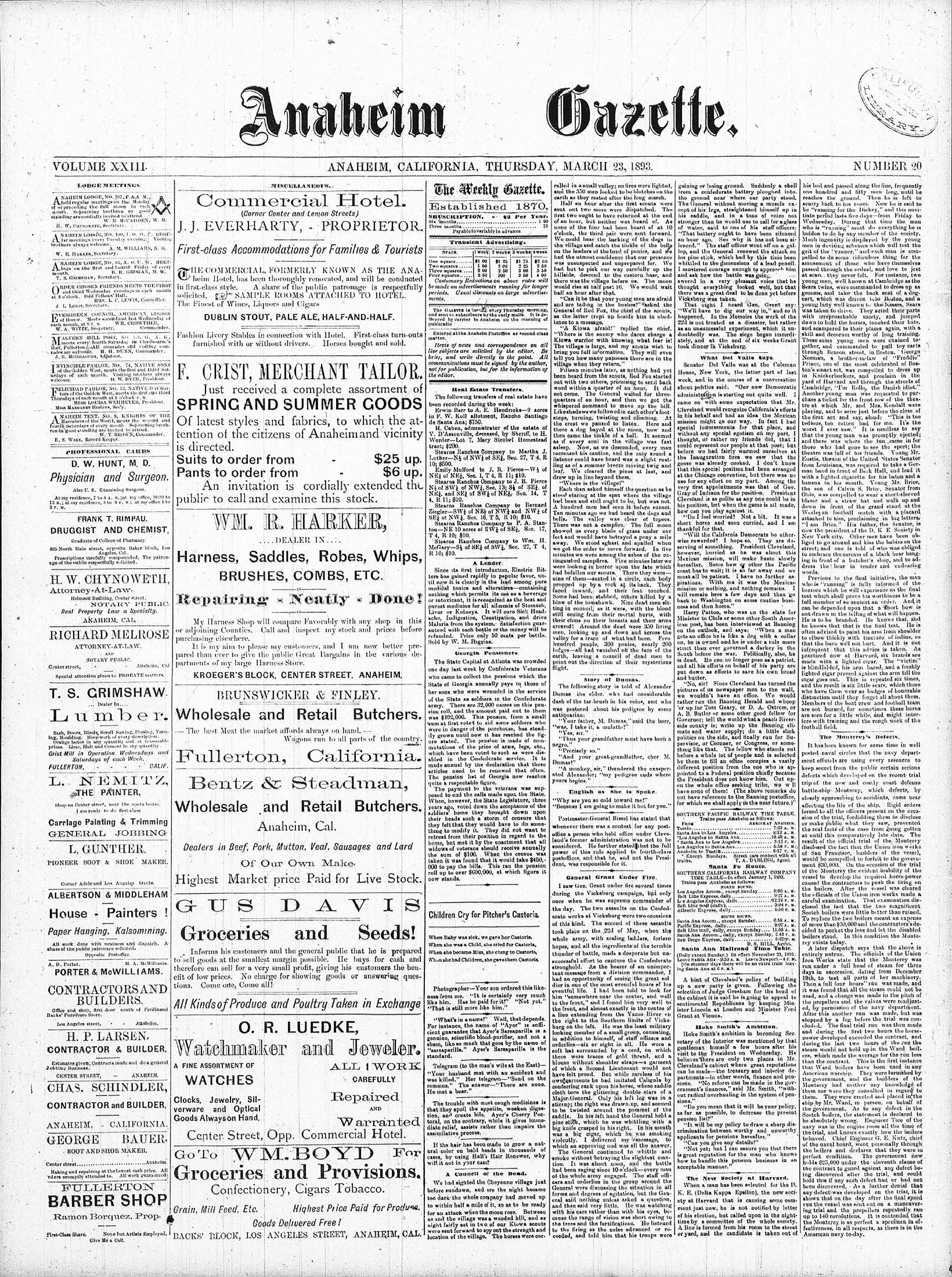
Searchable text
VOLUME XXIII
LODGE MEETINGS
NAHEIM LODGE, NO. 207, F. & A. M., hold regular meetings on the Monday of or preceding the full moon in each month. Sojourning brethren in good standing are cordially invited to attend.
W. M. McFADDEN, W. M.
H. W. CYRKOWITH, Secretary.
NAHEIM LODGE, NO. 190, I. O. O. F., Regular meetings every Tuesday evening. Visiting brothers always welcome.
A. M. WILLIAMS, N. G.
W. R. HARKER, Secretary.
NAHEIM LODGE, NO. 85, A. O. U. W., Meetings on the first and fourth Friday of every month.
B. R. GROGAN, M. W.
T. S. GRIMSHAW, Secretary.
ORDER CHOSEN FRIENDS MEETS THE FIRST and third Wednesday evenings in each month at 3 o'clock. Odd Fellow's Hall.
MRS. L. P. LEWIS, Councillor.
A. L. Lewis, Secretary.
EVERGREEN COUNCIL, AMERICAN LEGION of Honor. Meets second and last Wednesday of each month, at 8 p.m.
WM. CROWTHER, W. A. WITTE, Secretary.
MALVERN-HILL POST, NO. 141, G. A. K., meets every fourth Saturday in Chadbourne's Hall, Fallerton Hall comrades and visiting comrades are welcome.
M. H. DUNN, Commander.
J. B. McCOLLONN, Adjutant.
INVINGIBLE PARLOR, NO. 74, NATIVE SONS of the Golden West, meets the first and third Saturdays of each month. Visiting brothers always welcome.
H. W. DYER, President.
FELICIDAD PARLOR, NO. 52, NATIVE Daughters of the Golden West, meets the first and third Thursdays of each month at 3 o'clock.
MISS LOUISA WEIRMeyer, President.
MISS MARGARET Hobbs, Secy.
NAHEIM TEXT, NO. 9, KNIGHTS OF THE Macabees of the World, meets the second and fourth Saturdays of every month. Sojourning brethren in good standing are invited to attend.
W. T. BROWN, Commander.
E. S. WAKE, Record Receiver.
PROFESSIONAL CARDS
D. W. HUNT, M. D.
MISCELLANEOUS.
Commercial Hotel
(Corner Center and Lemon Streets)
J. J. EVERHARTY, - PROPRIETARY
First-class Accommodations for Families
THE COMMERCIAL, FORMERLY KNOWN Theim Hotel, has been thoroughly renovated, and in first-class style. A share of the public patronage solicited. SAMPLE ROOMS ATTACHED The Finest of Wines, Liquors and Cigars
DUBLIN STOUT, PALE ALE, HALF-AVE
Fashion Livery Stables in connection with Hotel furnished with or without drivers. Horses bo
F. CRIST, MERCHANT
Just received a complete as SPRING AND SUMMER Of latest styles and fabrics, to tention of the citizens of Anaheim is directed.
Suits to order from Pants to order from
FELICIDAD PARLOR, NO. 52, NATIVE DRAUGHTERS of the Golden West, meets the first and third Thursdays of each month at 3 o'clock P.M.
MISS LOUISA WEIMEYER, President.
MISS MARGARET HUBBINS, Secy.
ANAHEIM TENT, NO. 9, KNIGHTS OF THE Macabees of the World, meets the second and fourth Saturdays of every month. Sojourning brethren in good standing are invited to attend.
W. T. BROWN, Commander.
E. S. WAKE, Record Keeper.
PROFESSIONAL CARDS
D. W. HUNT, M. D.
Physician and Surgeon.
Also U. S. Examining Surgeon.
At my residence, 7 to 8 A.M.; at my office, 10:30 to 12 M.; at my residence, 8 to 9 P.M.; at my office, 1 to 3 P.M.
FRANK T. RIMPAU.
DRUGGIST AND CHEMIST,
Graduate of College of Pharmacy.
865 North Main street, opposite Baker block, Los Angeles, Cal.
Prescriptions carefully compounded. The patronage of the public respectfully solicited.
H. W. CHYNOWETH,
Attorney-At-Law.
Helmsen Building, Center street.
NOTARY PUBLIC.
Real Property Law a Specialty.
ANAHEIM, CAL.
RICHARD MELROSE
ATTORNEY-AT-LAW.
AND
NOTARY PUBLIC.
Center street,
Anaheim, Cal.
Special attention given to PROBATE matters.
T. S. GRIMSHAW.
... Dealer In...
Lumber.
Sash, Doors, Blinds, Scroll Sawing, Planing, Turning, Moulding. Shop work of every description.
Orange boxes in any quantity and at reasonable prices. Lime, Hair and Cement in any quantity.
Grist Mill in Operation Wednesdays and Saturdays of each Week.
FULLERTON,
CALIF.
L. NEMITZ,
THE PAINTER,
Shop on Center street, near the opera house.
I am ready to do first-class Carrlage Painting & Trimming GENERAL JOBBING.
L. GUNTHER.
PIONEER BOOT & SHOE MAKER.
Corner Adele and Los Angeles treets.
ALBERTSON & MIDDLEHAM
Just received a complete as SPRING AND SUMMER Of latest styles and fabrics, to tention of the citizens of Anaheim is directed.
Suits to order from - Pants to order from - An invitation is cordially public to call and examine this st
WM. R. HARKIN ... DEALER IN....
Harness, Saddles, Robe BRUSHES, COMBS,
Repairing - Neatly My Harness Shop will compare Favorably with or adjoining Counties. Call and inspect my stock purchasing elsewhere.
It is my aim to please my customers, and I am pared than ever to give the public Great Bargains in partments of my large Harness Store.
KROEGER'S BLOCK, CENTER STREET.
BRUNSWICKER & FINI Wholesale and Retail — The best Meat the market affords always on hand Wagons run to all p Fullerton, Cali Bentz & Stead Wholesale and Retail Anaheim, Cal. Dealers in Beef, Pork, Mutton, Veal, Sausa Of Our Own Make Highest Market price Paid for
Shop on Center street, near the opera house.
I am ready to do first-class Carriage Painting & Trimming
GENERAL JOBBING
L. GUNTHER.
PIONEER BOOT & SHOE MAKER.
Corner Adele and Los Angeles treets.
ALBERTSON & MIDDLEHAM
House - Painters!
Paper Hanging, Kalsomining.
All work done with neatness and dispatch. A share of the public patronage solicited.
Opposite Postoffice.
A. D. Porter.
H. A. McWilliams.
PORTER & McWILLIAMS.
CONTRACTORS AND BUILDERS.
Office and shop, first door south of Ferdinand Backs' Furniture Store.
Los Angeles street, Anaheim.
H. P. LARSEN,
CONTRACTOR & BUILDER.
Estimates given; Contracts made and do a general Jobbing Business.
CENTER STREET, ANAHEIM.
CHAS. SCHINDLER,
CONTRACTOR and BUILDER.
ANAHEIM, CALIFORNIA.
GEORGE BAUER,
BOOT AND SHOE MAKER.
Center street... Anaheim.
Making and repairing at the lowest cash price. All rders promptly attended to. All work guaranteed!
FULLERTON
BARBER SHOP
Ramon Borquez, Prop.
First-Class Shave. None but Artists Employed.
Give Me a Call.
Wholesale and Retail
Anaheim, Cal.
Dealers in Beef, Pork, Mutton, Veal, Sausa
Of Our Own Make-Highest Market price Paid for
GUS DAW
Groceries and
Informs his customers and the general public that to sell goods at the smallest margin possible. He therefore can sell for a very small profit, giving his eft of low prices. No charge for showing goods o tions. Come one, Come all!
All Kinds of Produce and Poultry Taken
O. R. LUEDKE
Watchmaker and J
A FINE ASSORTMENT OF WATCHES
Clocks, Jewelry, Silverware and Optical Goods Always on Hand.
Center Street, Opp. Commercial
Go To WM.BOY
Groceries and Prov
Confectionery, Cigars Tob
Grain, Mill Feed, Etc.
Highest Price P
Goods Delivered Free!
BACKS' BLOCK, LOS ANGELES STREET,
ANAHEIM, CALIFORNIA, THURSDAY, MARCH 23, 1893.
MISCELLANEOUS.
Special Hotel.
(ater and Lemon Streets)
TY, - PROPRIETOR.
ations for Families & Tourists
ORMERLY KNOWN AS THE ANAroughly renovated, and will be conducted
of the public patronage is respectfully
ROOMS ATTACHED TO HOTEL.
and Cigars
PALE ALE, HALF-AND-HALF.
Connection with Hotel. First-class turn-outs
at drivers. Horses bought and sold.
ERCHANT TAILOR.
a complete assortment of
SUMMER GOODS
d fabrics, to which the attoms of Anaheim and vicinity
om - $25 up.
om - $6 up.
The Weekly Gazette.
Established 1870.
SHUSCRIPTION, - $2 Per Year.
Six months. 1 00
Three months. 75
Payable invariably in advance.
Transient Advertising.
SPACE.
1 week 2 weeks 3 weeks 4 week
One square.....$1 00 $1 25 $1 75 $2 00
Two squares...1 50 2 00 2 25 2 50
Three squares...2 00 2 50 2 60 3 50
Four squares...2 50 300 3 40 4 00
Customary Reductions on above rates will
be made on advertisements running for longer
periods. Usual discounts on large advertisements.
The Gazette is issued every Thursday morning,
and sent to subscribers by the early mails. It is delivered by carrier In Anaheim on the morning of publicatio
Entered at the Anaheim Postoffice as second-class matter.
Items of news and correspondence on all live subjects are solicited by the editor. Be brief, and write directly to the point. All communications must be signed by the author, not for publication, but for the information of the editor.
Real Estate Transfers.
The following transfers of real estate have been recorded during the week:
Erwin Barr to A.E. Hendricks—9 acres in F.W. Koll allotment, Rancho Santiago do Santa Anas; $750.
H. Cahen, administrator of the catate of V.D'Assonville, deceased, by Sheriff, to H.Werder-Lot 7, Mary Strobel Homestead tract; $200.
Stearns Ranchos Company to Martha J.Luther-N½ of NW½ of SE¼, Sec. 27, T4, R10; $500.
Emily Mulford to J.B. Pierce—W½ of NE¼ of NE¼, Sec. I.T4.R11; $10.
ralted in a small valley; no fires were lighted,
and the 350 men looked to be blotches on the earth as they rested after the long march.
Half an hour after the first scouts were sent out two more were dispatched. The first two ought to have returned at the end of an hour, but neither was heard of at 10 o'clock, the third pair were sent forward.
We could hear the barking of the dogs in the village and catch the tinkle of the belts on the leaders of the herd of ponies, and we had the utmost confidence that our presence was unsuspected and unprepared for. We had but to pick our way carefully up the billside, descend to the eastern base, and there was the village before us. The moon would rise at half past 10. We would wait half an hour after that.
"Can it be that your young men are afraid and are hiding in the bushes?" asked the General of Red Fox, the chief of the scouts, as the latter crept up beside him in obedience to a message.
"A Kiowa afraid!" replied the chief, "Where is the enemy who dares charge a Kiowa warrior with knowing what fear is! The village is large, and my scouts wish to bring you full information. They will even tell you how many papooses there are in the village when they return."
Fifteen minutes later, as nothing had yet been heard from the scouts, Red Fox started out with two others, promising to send back word within a quarter of an hour. It did not come. The General waited for three-quarters of an hour, and then we got the whispered command to move up the hill. Likeshadows we followed in each other's footsteps, turning, twisting and climbing. At the crest we paused to listen. Here and there a dog bayed at the moon, now and then came the tinkle of a ball. It seemed as if every soul in the village was fast asleep. Now, as we desceded, every man increased his caution, and the only sound a listener could have heard was a slight rustling as of a summer breeze moving twig and leaf. We cleared the pines at last, and dawn in line behind them.
Real Estate Transfers.
The following transfers of real estate have been recorded during the week:
Kevin Barr to A.E. Hendricks—9 acres in F.W. Koll allotment, Rancho Santiago de Santa Ana; $750.
H. Cahen, administrator of the estate of V.D'Assouville, deceased, by Sheriff, to H. Worder—Lot 7, Mary Strobel Homestead tract; $200.
Stearns Ranchos Company to Martha J. Luther—N½ of NW½ of SE½, Sec. 27, T 4, R 10; $500.
Emily Mulford to J.B. Pierce—W½ of NE½ of NE½, Sec. 1, T 4, R 11; $10.
Stearns Ranchos Company to J.B. Pierce N½ of SW½ of NW½, Sec. 13; S½ of SE½ of NE½ and SE½ of SW½ of NE½, Sec. 14, T 4, R 11; $10.
Stearns Ranchos Company to Bernard Ziegler—SW½ of NE½ and NW½ of SE½ of NW½, Sec. 16, T 5, R 10; $10.
Stearns Ranchos Company to P.A. Stanton—NE 10 acres of NW½ of SE½, Sec. 17, T 4, R 10; $10.
Stearns Ranchos Company to Wm.H.McGary—S½ of SE½ of SW½, Sec. 27, T 4, R 10; $10.
A Lender.
Since its first introduction, Electric Bitters has gained rapidly in popular favor, until now it is clearly in the lead among pure medical tonics and alternatives—containing nothing which permits its use as a beverage or intoxicant, it is recognized as the best and purest medicine for all ailments of Stomach, Liver or Kidneys. It will cure Sick Headache, Indigestion, Constipation, and drive Malaria from the system. Satisfaction guaranteed with each bottle or the money will be refunded. Price only 50 cents per bottle. Sold by W.M.Huggins.
Georgia Pensioners.
The State Capital at Atlanta was crowded one day last week by Confederate Veterans who came to collect the pensions which the State of Georgia annually pays to those of her sons who were wounded in the service of the State as soldiers in the Confederate army. There are 32,000 names on this pension roll, and the amount paid out to them was $192,000. This pension, from a small sum at first voted to aid some soldiers who were in danger of the poorhouse, has steadily grown until now it has reached the figure stated. The pension is made of commutations of the price of arms, legs, etc., which have been voted to such as were disabled in the Confederate service. It is made annual by the declaration that these articles need to be renewed that often. The pension list of Georgia now reaches quite a respectable figure.
The payment to the veterans was supposed to end the calls made upon the State. When, however, the State Legislature, three years ago, voted down the acceptance of the soldiers home they brought down upon their heads such a storm of censure that they felt that they would have to do something to modify it. They did not want to retreat from their position in regard to the home, but met it by the enactment that all widows of veterans should receive annually the sum of $100. When the census was taken it was found that it would take $450,000 to pay the bills. This ran the pension roll up to over $600,000, at which figure it now stands.
Story of Dumas.
The following story is told of Alexander Dumas the elder, who had considerable dash of the tar-brush in his veins, and who was pestered about his pedigree by some antiquarian:
"Your father, M.Dumas," said the bore,
"was I take it a mulatto?"
Yes, sir."
Thus your grandfather must have been a negro.
"Precisely so."
And your great-grandfather, cher M.Dumas?
"A monkey, sir," thundered the exasperated Alexander; "my pedigree ends where yours begins."
English as She Is Spoke.
"Why are you so cold toward me?"
"Because I am going to make it hot for you."
Postmaster-General Bissel has stated that whenever there was a contest for any post-office a person who held office under Cleveland's former administration was not to be considered. He further stated that the full power of this rule applied to fourth-class post offices, and that he, and not the President, was responsible for it.
General Grant Under Fire.
I saw Gen. Grant under fire several times during the Vicksburg campaign, but only once when he was supreme commander of
Children Cry for Pitcher's Castoria.
When Baby was sick, we gave her Castoria.
When she was a Child, she cried for Castoria.
When she became Miss, she clung to Castoria.
When she had Children, she gave them Castoria.
Photographer—Your son ordered this likeness from me. "It is certainly very much like him. Has he paid for it?" "Not yet." "That is still more like him."
What's in a name? Well, that depends. For instance, the name of "Ayer" is sufficient guarantee that Ayer's Sarsaparilla is a genuine, scientific blood-purifier, and not a sham, like so much that goes by the name of "sarsaparilla." Ayer's Sarsaparilla is the standard.
Telegram (to the man's wife at the East)—"Your husband met with an accident and was killed." Her telegram—"Send on the remains." The answer—"There are none. He met a bear."
The trouble with most cough medicines is that they spoil the appetite, weaken digestion, and create bile. Ayer's Cherry Pootoral, on the contrary, while it gives immediate relief, assists rather than impairs the assimilative process.
If the hair has been made to grow a natural color on bald heads in thousands of cases, by using Hall's Hair Renower, why will it not in your case?
A Council of the Dead.
We had sighted the Cheyenne village just before sundown, and ere the night became too dark the whole company had moved up to within half a mile of it, so as to be ready for an attack when the moon rose. Between us and the village was a wooded hill, and as night fairly set in two of our Kiowa scouts were sent forward to spy out the strength and location of the village. The horses were cor-
Postmaster-General Bissel has stated that whenever there was a contest for any post-office a person who hold office under Cleveland's former administration was not to be considered. He further stated that the full power of this rule applied to fourth-class postoffices, and that he, and not the President, was responsible for it.
General Grant Under Fire.
I saw Gen. Grant under fire several times during the Vicksburg campaign, but only once when he was supreme commander of the day. The two assaults on the Confederate works at Vicksburg were two occasions of this kind. The second of these assaults took place on the 22d of May, when the whole army, with scaling ladders, forlorn hopes, and all the ingredients of the terrible thunder of battle, made a desperate but unsuccessful effort to capture the Confederate stronghold. As the bearer of an unimportant message from a division commander, I had an opportunity of seeing the great soldier in one of the most eventful hours of his eventful life. I had been told to look for him "somewhere near the center, and well to the front," and I found him very well to the front, and almost exactly in the centre of a line extending from the Yazoo River on the right to the Southern limits of Vicksburg on the left. He was the least military looking member of a small group, consisting in addition to himself, of staff officers and orderlies—six or eight in all. He wore a soft hat surrounded by a cord, on which there were traces of gold thread, and a blouse without shoulder straps—a garment of which a Second Lieutenant would not have felt proud. But while careless of his own garments he had imitated Caligula by conferring rank upon his horse, whose saddle cloth bore the glittering double stars of a Major-General. Only his left leg was in a stirrup; the right was drawn-up, and seemed to be twisted around the pommel of the saddle. In his left hand the General held a pine stick, which he was whittling with a big knife grasped in his right. In his mouth was a big cigar, which he was smoking violently. I delivered my message, to which an approving nod was all the answer.
The General continued to whittle and smoke without betraying the slightest emotion. It was about noon, and the battle had been raging since 10 o'clock—every man of the whole army engaged. The staff officers and orderlies in the group around the General were discussing the situation in all forms and degrees of agitation, but the General said nothing unless asked a question, and then said very little. He was watching with his ears rather than with his eyes, because the range of vision was short owing to the trees and the fortifications. He listened to the firing as the noise advanced or reeeded, and told him that his troops were
MARCH 23, 1893.
NUMBER 20
valley; no fires were lighted,
looked to be blotches on the
tated after the long march.
after the first scouts were
more were dispatched. The
to have returned at the end
neither was heard of. As
he had been heard of at 10
bird pair were sent forward.
the barking of the dogs in
catch the tinkle of the bells
the herd of ponies, and we
confidence that our presence
and unprepared for. We
our way carefully up the
to the eastern base,
and village before us. The moon
if past 10. We would wait
for that.
that your young men are afraid
in the bushes?" asked the Fox,
the chief of the scouts,
sept up beside us in obedience.
fraid!" replied the chief,
enemy who dares charge a
with knowing what fear is!
arge, and my scouts wish to
information. They will even
any papooses there are in the
ey return."
later, as nothing had yet
the scouts, Red Fox started
hours, promising to send back
quarter of an hour. It did
General waited for threehours, and then we got the
band to move up the hill,
followed in each other's foot,
twisting and climbing. At
nursed to listen. Here and
yed at the moon, now and
inkle of a bell. It seemed
all in the village was fast
as we descended, every man
station, and the only sound a
ave heard was a slight rustmeter breeze moving twig and
the pines at last, and
gaining or losing ground. Suddenly a shell
from a confederate battery ploughed into.
the ground near where our party stood.
The General without moving a muscle except of his legs, straightened himself up in
his saddle, and in a tone of voice not
stronger than he would use to call for a glass
of water, said to one of his staff officers:
"That battery ought to have been silenced
an hour ago. See why it has not been silonced." The staff officer went off on a galop, and the General renewed the attack on
his pine stick, which had by this time been
whittled to the dimensions of a lead pencil.
I mustered courage enough to approach him
and ask how the battle was going;
swered in a very pleasant voice that he
thought everything looked well, but that
there was a great deal to be done yet before Vicksburg was taken.
That night I heard Gen. Grant say:
"We'll have to dig our way in," and so it happened. In the Memoirs the work of the 22d is not treated as a disaster, but rather as an unsuccessful experiment, which it undoubtedly was. The siege began immediately, and at the end of six weeks Grant took dinner In Vicksburg.
What Del Valle says.
Senator Del Valle was at the Coleman House, New York, the latter part of last week, and in the course of a conversation about politics said: "Our new Democratic administration is starting out quite well. I came on with some expectation that Mr. Cleveland would recognize California's efforts in his behalf and had an idea the Mexican mission might go our way. In fact I had special indorsements for that place, and without any special egotism on my part, I thought, or rather my friends did, that I could represent our people at that post; but before we had fairly warmed ourselves at the Inauguration fires we saw that the goose was already cooked. I don't know that this special position had been arranged at the Chicago convention, but there was no
his bed and passed along the line, frequently one hundred and fifty men long, until he reaches the ground. Then he is left to acurry back to his room. Now he is said to be "running for the Dickey," and this novi- tiate period lasts five days—from Friday to Wednesday. During that time the man who is "running" must do everything he is bidden to do by any member of the society. Much ingenuity is displayed by the young men in devising schemes which will test the grit of the "runner," and each man is compelled to do some ridiculous thing for the amusement of those who have themselves passed through the ordeal, and love to jeat at scarce they never felt. For instance, two young men, well known at Cambridge as the Sears twins, were commanded to dress up as grooms, and take the back seat of a dog-cart, which was driven into Boston, and a young lady well known to the Kesara, Sears was taken to drive. They acted their parts with irreproachable courtesy, and jumped down to hold the horses, touched their hats, and scampered to their places again, with a skill and decorum worthy of long training. These same young men were chained together, and commanded to pull toy carts through Beacon street, in Boston. George Norman, a brother-in-law of "Freddie" Prince, one of the most celebrated of Boston's smart set, was compelled to dress up in Knickerbockers, and proclaim in the yard of Harvard and through the streets of Cambridge. "I'm Hollo, the Danish idiot." Another young man was requested to purchase a ticket for the front row of the theatre at which Mr. and Mrs. Kendall were playing, and to arise just before the close of the first act and say, aloud: "This is too tedious, too rotten bad for me. It's the worst I ever saw." It is needless to say that the young man was promptly ejected; and there was where the fun came in for those who had gone to see the sport; the theatre was full of his friends. Young Mr. Enustis, son of the United States Senator from Louisiana, was required to take a German band in front of Beck Hall, and lead it
biscimil question as be the spot where the village ill ought to be, but was not. Had seen it before sunset. We had heard the dogs and we clear of tepees. A blade of grass under our have botrayed a pony a mile and agast and apalled when to move forward. In five among the ashes of the ox fires. Five minutes later we horror upon the fate which scour upon the fate which rock at its back. They and their feet touched. Stabbed, others killed by a hawk. Nine dead men sit as it were, with the blood in their mortal hurts, with their breasts and their arms and down and across the face of what had been. Five 300 ponies, nearly 200 vanished off the face of the council of dead men to section of their mysterious story is told of Alexander der who had considerable rush in his veins, and who about his pedigree by some M. Dumas," said the bore, a mulatto."
Gandfather must have been a great-grandfather, cher M., ir," thundered the exasper-"my pedigree ends where She Is Spoke.
cold toward me!" going to make it hot for you."
General Bissel has stated that was a contest for any post-hold office under Cleverministration was not to be further stated that the full rule applied to fourth-class that he, and not the Presidential for it.
Grant Under Fire.
unt under fire several times ksburg campaign, but only was supreme commander of
week, and in the course of a conversation about politics said: "Our new Democratic administration is starting out quite well. I came on with some expectation that Mr. Cleveland would recognize California's efforts in his behalf and had an idea the Mexican mission might go our way. In fact I had special endorsements for that place, and without any special egotym on my part, I thought, or rather my friends did, that I could represent our people at that post; but before we had fairly warmed ourselves at the Inauguration fires we saw that the goose was already cooked. I don't know that this special position had been arranged at the Chicago convention, but there was no use for any effort on my part. Among the very first appointments was that of Gov. Gray of Indiana for the position. President Cleveland is as polite as any one could be in his position, but when the game is all made, how can you play against it.
"Do I feel worried? Not a bit. It was a short horse and soon curried, and I am thankful for that.
"Will the California Democrats be otherwise rewarded? I hope so. They are deserving of something. President Cleveland, however, buried as he was about this Mexican mission, will make haste slowly hereafter. Somehow or other the Pacific coast has to wait; it is so far away and we must all be patient. I have no further aspirations. With me it was the Mexican mission or nothing, and nothing remains. I will remain here a few days and then go back to Washington on some routine business and then home."
Harry Patton, who was on the slate for Minister to Chile or some other South American post, has been interviewed at Banning on the outlook, and says: "When a man gets an office he is like a dog with a collar on, he is owned and he is under a rule more strict than ever governed a darker in the South before the war. Politically, also, he is dead. He can no longer pose as a patriot, and all his efforts on behalf of his party are put down as efforts to save his own bread and butter.
"No, sir! Since Cleveland has turned the pictures of us newspaper men to the wall, we wouldn't have an office. We would rather run the Banning Herald and whoop 'er up for Tom Geary, or D. A. Ostrom, or A. B. Butler or some other good fellow Governor; tell the world what a peach River-side county is; write up the Banning climate and water supply; do a little slick politics on the side, and finally run for Supervisor, or Coroner, or Congress, or something like that. The fellow who stands out before a whole lot of people and is selected by them to fill an office occupies a vastly different position from the one who is appointed to a Federal position chiefly because the President does not know him. Out upon the whole office seeking tribe, we will have none of them! (The above remarks do not have reference to the Banning postoffice, for which we shall apply in the near future.)"
SOUTHERN PACIFIC RAILWAY TABLE.
Trains pass Anaheim follow train arrive at Anaheim.
Tustin 7:23 A.M.
Santa Ana to Los Angeles 8:13 A.M.
Los Angeles to Santa Ana 10:40 A.M.
Santa Ana to Los Angeles 3:13 P.M.
Los Angeles to Santa Ana 5:58 P.M.
Anaheim to Tustin 6:17 P.M.
Except Sundays. Street cars connect with trains.
Santa Fe Route.
SOUTHERN CALIFORNIA RAILWAY COMPANY
TIME TABLE—In effect January 1, 1893.
Trains pass Anaheim as follows:
arm southwest 8:00 A.M.
Belt Line Express, daily 9:27 A.M.
Los Angeles Express, daily 12:24 P.M.
In Knickerbockerers, and proclaim in the yard of Harvard and through the streets of Cambridge, "I'm Rollo, the Danish idiot." Another young man was requested to purchase a ticket for the front row of the theatre at which Mr. and Mrs. Kendall were playing, and to arise just before the close of the first set and say, aloud: "This is too tedious, too rotten bad for me. It's worst I ever saw." It is needless to say that the young man was promptly ejected; and there was where the fun came in for those who had gone to see the sport; the theatre was full of his friends. Young Mr. Eustis, son of the United States Senator from Louisiana, was required to take a German band in front of Beck Hall, and lead it with a light cigarette for his baton and a banana in his mouth. Young Mr. Brice, son of Calvin S. Brice, Senator from Ohio, was compelled to wear a short-sleeved blazer and a straw hat and walk up and down in front of the grand stand at the Wesleyan football match with a placard attached to him, proclaiming "in big letters," "I am Brice." His father, the Senator, is now president of the D.K.E Society in New York city. Other men have been obliged to go around and kiss the babies on the street; and one is told of who was obliged to embrace the carcass of a black bear hanging in front of a butcher's shop, and to address the bear in tender and cudearing words.
Previous to the final initiation, the man who is "running" is fully informed of the horrors which he will experience as the final test which shall prove his worthiness to be a full member of so ancient an order. And it can be depended upon that a short bow is not drawn in the telling of what will happen. He is to be branded. He knows that, and knows that that is the final test. He is often advised to paint his arm from shoulder to elbow thickly with tincture of iodine, so that the burn will not hurt. And it is not infrequent that this advice is taken. As practiced now at Harvard, six brands are made with a lighted cigar. The "victim" is blindfolded, his arm bare, and a freshly lighted cigar pressed against the arm till the cigar goes out. This is repeated six times, and the result is six little scars, which those who have them wear as badges of honorable distinction until they forget all about them. Members of the boat crew and football team are not burned, for sometimes these burns are sore for a little while, and might interfere with training and the rough work of the football field.
The Monterey's Defects.
It has been known for some time in well posted naval circles that the navy department officials are using every resource to keep secret from the public certain serious defects which developed on the recent trial trip of the new and costly coast defense battle-ship Monterey, which defects, by closely approaching to accidents, came near affecting the life of the ship. Rigid orders issued to all the officers present on the occasion of the trial, fording them to disclose or make public what they saw, prevented real facts of the case from being gotten at until this comparatively late date. The result of the official trial of the Monterey disclosed the fact that the Union iron works of San Francisco, builders of the vessel, would be compelled to forfeit to the government $30,000. On the occasion of the trial of the Monterey evident inability of the vessel to develop the required horse-power caused by contractors to push the firing on the boilers. After the vessel was cleared the officials of the Union iron works made a careful examination. That examination dis-
Grant Under Fire.
A grant under fire several times in ksburg campaign, but only was supreme commander of two assaults on the Confed.icksburg were two occasions the second of these assaults. No 22d of May, when the sixth scaling ladder, forlorn with ingredients of the terrible frost, made a desperate but un-able to capture the Confederate bearer of an unimproved division commander. I am of seeing the great solider most eventful hours of his had been told to look for near the center, and well I found him very well to almost exactly in the centre of from the Yazoo River on Southern limits of Vicksburg. He was the least military of a small group, consummating, and eight in all. He wore a banded by a cord, on which pieces of gold thread, and a shoulder straps—a garment and Lieutenant would not. But while careless of his he had imitated Caligula by穿上 his horse, whose saddle bitterting double stars of a Only his left leg was in a belt drawn up, and seemed around the pommel of the left hand the General held a hoe was whittling with a hoe in his right. In his mouth, which he was smoking delivered my message, to nod not was all the answer. continued to whittle and betraying the slightest oomout noon, and the battle since 10 o'clock—every man may engaged. The staff officers in the group around the discussing the situation in all cases of agitation, but the Gen. ung unless asked a question. Very little. He was watching rather than with his eyes, because vision was short owing to fortifications. He listened to the noise advanced or re-claimed him that his troops were affecting the life of the ship. Rigid orders issued to all the officers present on the occasion of the trial, fordidding them to disclose or make public what they saw, prevented the real facts of the case from being gotten at until this comparatively late date. The result of the official trial of the Monterey disclosed the fact that the Union iron works of San Francisco, builders of the vessel, would be compelled to forfeit to the government $30,000. On the occasion of the trial of the Monterey the evident inability of the vessel to develop the required horse-power caused the contractors to push the firing on the boilers. After the vessel was cleared the officials of the Union iron works made a careful examination. That examination disclosed the fact that the two magnificent Scotch boilers were little better than ruined. To replace the two boilers meant an expense of more than $30,000 and the contractors decided to pocket the loss and let the disabled boilers stand. In this condition the Monterey exists today.
A later dispatch says that the above is entirely untrue. The officials of the Union Iron Works state that the Monterey was run under a full head of steam for three days in succession, dating from December 19th, to test all parts of her machinery. Then a full four hours" run was made, and it was found that all the steam could not be used, and a change was made in the pitch of the propellers and the valves were readjusted, by permission of the navy department. After this another run was made, but was stopped by a fog before the trial was concluded. The final trial run was then made and during the first two hours the horsepower developed exceeded the contract, and during the last two hours of the run the steam would not hold up in the Ward boilers, which made the average for the run less than the contract. This is the first instance that Ward boilers have been used in any American warship. They were furnished by the government, and the builders of the Monterey had neither any knowledge of them nor were they consulted in regard to them. They were erected and placed in the ship by Mr. Ward, in person, on behalf of the government. As to any defect in the Scotch boilers, the statement is declared to be absolutely wrong. Engineer Tice of the navy was in the engine room all time of the trial, and knows exactly how the boilers behaved. Chief Engineer G. E. Kutz, chief of the naval board, went personally through the boilers and declares that they were in perfect condition. The government now holds $25,000 under the cloventh clause of the contract to guard against any defect being discovered after the trial, and could hold this if any such defect had or had not been discovered. As a further denial that any defect was developed on the trial, it is shown that on the day after the final speed run the vessel was sent out on a maneuvering trial and the propellers repeatedly ran up to 140 revolutions. It is contended that the Monterey is as perfect a specimen in effectiveness, in all respects, as there is in the American navy to-day.