anaheim-gazette 1892-11-24
Scanned page
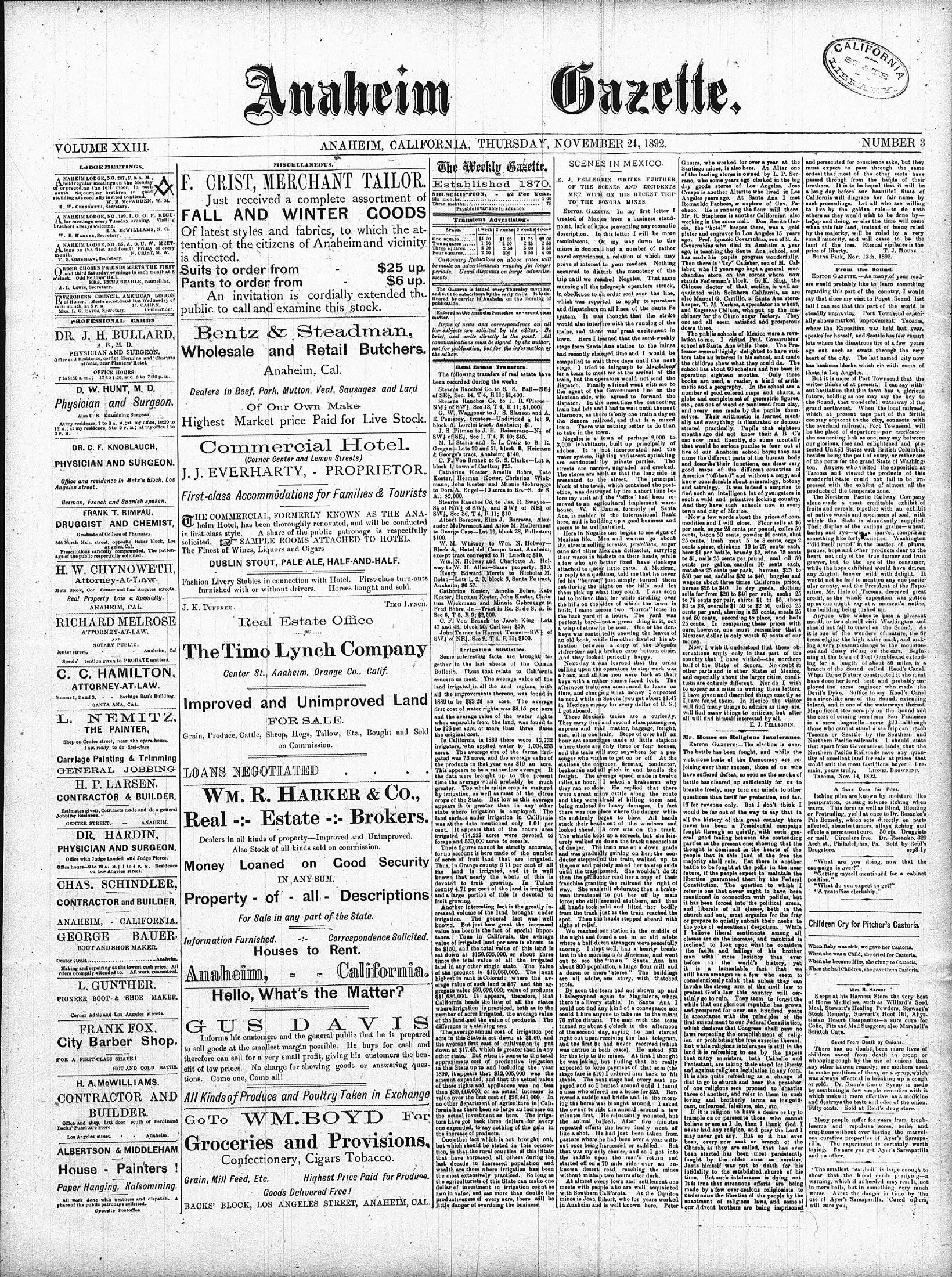
Searchable text
VOLUME XXIII.
LODGE MEETINGS.
ANAHEIM LODGE, NO. 207, F. & A. M., hold regular meetings on the Monday of or preceding the full moon in each month. Sojourning brethren in good standing are cordially invited to attend.
W. H. McFADDEN, W. M.
H. W. CHYNOWETH, Secretary.
ANAHEIM LODGE, NO. 109, I. O. O. F. REGULAR meetings every Tuesday evening. Visiting brothers always welcome.
H. A. McWILLIAMS, N. O.
W. R. HARKER, Secretary.
ANAHEIM LODGE, NO. 85, A. O. U. W. MEETINGS on the first and fourth Friday of every month.
F. CRIST, M. W.
T. S. GRINSHAW, Secretary.
ORDER CHOSEN FRIENDS MEETS THE FIRST and third Saturday evenings in each month at 8 o'clock. Odd Fellow's Hall.
MRS. EMMA SEARLE, Councillor.
A. L. LAWIS, Secretary.
EVERGREEN COUNCIL, AMERICAN LEGION of Honor. Meets second and last Wednesday of each month, at 5 P.M.
H. CAHEN,
MRS. L. G. BATES, Secretary.
PROFESSIONAL CARDS
DR. J. H. BULLARD,
A. B., M. D.
PHYSICIAN AND SURGEON.
Office and Residence, corner Hermine and Chartres streets, near Planters' Hotel.
OFFICE HOURS:
7 to 8:30 a.m.; 12 to 1:30, and 6 to 7:30 p.m.
D. W. HUNT, M. D.
Physician and Surgeon.
Also U.S. Examining Surgeon.
At my residence, 7 to 8 A.M.; at my office, 10:30 to 12 M.; at my residence, 8 to 9 P.M.; at my office 1 to 3 P.M.
DR. C. F. KNOBLAUCH,
PHYSICIAN AND SURGEON.
MISCELLANEOUS.
F. CRIST, MERCHANT
Just received a complete a
FALL AND WINTER
Of latest styles and fabrics, to tention of the citizens of Anaheim is directed.
Suits to order from
Pants to order from
An invitation is cordially public to call and examine this s
Bentz & Stead
Wholesale and Retail
Anaheim, Cal.
Dealers in Beef, Pork, Mutton, Veal, Saus
Of Our Own Make
Highest Market price Paid for
Commercial H
(Corner Center and Lemon Street)
L. I. EVERHARTY, - PRO
D. W. HUNT, M. D.
Physician and Surgeon.
Also U. S. Examining Surgeon.
At my residence, 7 to 8 A. M.; at my office, 10:30 to 12 M.; at my residence, 8 to 9 P. M.; at my office 1 to 3 P. M.
DR. C. F. KNOBLAUCH,
PHYSICIAN AND SURGEON.
Office and residence in Metz's Block, Los Angeles street.
German, French and Spanish spoken.
FRANK T. RIMPAU.
DRUGGIST AND CHEMIST,
Graduate of College of Pharmacy.
365 North Main street, opposite Baker block, Los Angeles, Cal.
Prescriptions carefully compounded. The patronage of the public respectfully solicited.
H. W. CHYNOWETH,
Attorney-At-Law.
Metz Block, Cor. Center and Los Angeles streets.
Real Property Law a Specialty.
ANAHEIM, CAL.
RICHARD MELROSE
ATTORNEY-AT-LAW.
AND NOTARY PUBLIC.
Jenter street, Anaheim, Cal.
Specia tention given to PROBATE matters.
C. C. HAMILTON.
ATTORNEY-AT-LAW.
Rooms 1, 2 and 3, Savings Bank Building.
SANTA ANA, CAL.
L. NEMITZ,
THE PAINTER,
Shop on Center street, near the opera-house.
I am ready to do first-class Carrlage Painting & Trimming GENERAL JOBBING
H. P. LARSEN,
CONTRACTOR & BUILDER.
Estimates given, Contracts made and do a general Jobbing Business.
CENTER STREET, Anaheim.
DR. HARDIN,
PHYSICIAN AND SURGEON.
Office with Judge Landell and Judge Pierce.
Office hours—9 to 12 A. M.; 1 to 4 P. M. Residence on Los Angeles street.
CHAS. SCHINDLER,
CONTRACTOR and BUILDER
Dealers in Beef, Pork, Mutton, Veal, Sausse
Of Our Own Make
Highest Market price Paid for
Commercial H
(Corner Center and Lemon Street)
J. J. EVERHARTY, - PRO
First-class Accommodations for Families
THE COMMERCIAL, FORMERLY KNOWN
Theim Hotel, has been thoroughly renovated, and in first-class style. A share of the public patrons solicited. SAMPLE ROOMS ATTACHED
The Finest of Wines, Liquors and Cigars
DUBLIN STOUT, PALE ALE, HALF-A
Fashion Livery Stables in connection with Hotel furnished with or without drivers. Horses
J. K. TUFFREE.
Real Estate Office
The Timo Lynch Co
Center St., Anaheim, Orange Co
Improved and Unimproved
FOR SALE.
Grain, Produce, Cattle, Sheep, Hogs, Tallow, Etc on Commission.
LOANS NEGOTIATED
Wm. R. HARKER
Real :: Estate ::
Dealers in all kinds of property—Improved and Also Stock of all kinds sold on comm
Money Loaned on Good IN ANY SUM.
Property - of - all - De
Estimates given, Contracts made and do a general Jobbing Business.
CENTER STREET, - ANAHEIM.
DR. HARDIN,
PHYSICIAN AND SURGEON.
Office with Judge Landell and Judge Pierce.
Office hours—9 to 12 A.M.; 1 to 4 P.M. Residence on Los Angeles street.
CHAS. SCHINDLER,
CONTRACTOR and BUILDER.
ANAHEIM, - CALIFORNIA.
GEORGE BAUER,
BOOT AND SHOE MAKER.
Center street... Anaheim.
Making and repairing at the lowest cash price. All rders promptly attended to. All work guaranteed.
L. GUNTHER.
PIONEER BOOT & SHOE MAKER.
Corner Adela and Los Angeles streets.
FRANK FOX,
City Barber Shop.
FOR A FIRST-CLASS SHAVE!
HOT AND COLD BATHS.
H. A. McWILLIAMS.
CONTRACTOR AND BUILDER.
Office and shop, first door south of Ferdinand Backs' Furniture Store.
Los Angeles street, Anaheim.
ALBERTSON & MIDDLEHAM
House - Painters !
Paper Hanging, Kalsomining.
All work done with neatness and dispatch. A share of the public patronage solicited.
Opposite Postoffices.
Real :: Estate :: D
Dealers in all kinds of property—Improved and Also Stock of all kinds sold on comm
Money Loaned on Good
IN ANY SUM:
Property - of - all - De
For Sale in any part of the S
Information Furnished. Corresp
Houses to Rent
Anaheim,
Hello, What's the M
GUS DA
Informs his customers and the general public to sell goods at the smallest margin possible. He therefore can sell for a very small profit, giving him eff of low prices. No charge for showing goods tions. Come one, Come all!
All Kinds of Produce and Poultry Tak
Go To WM.BOY
Groceries and Pro
Confectionery, Cigars T
Grain, Mill Feed, Etc. Highest Price
Goods Delivered Free !
BACKS' BLOCK, LOS ANGELES STREET
ANAHEIM, CALIFORNIA, THURSDAY, NOVEMBER 24, 1892.
MERCHANT TAILOR.
A complete assortment of WINTER GOODS and fabrics, to which the at-tenors of Anaheim and vicinity from $25 up. From $6 up. It is cordially extended to examine this stock.
X. Steadman,
and Retail Butchers.
Anaheim, Cal.
Mutton, Veal, Sausages and Lard
Your Own Make.
Price Paid for Live Stock.
Special Hotel.
(Interest and Lemon Streets)
ARTY, - PROPRIETOR.
The Weekly Gazette.
Established 1870.
SHUSCRIPTION, - $2 Per Year.
Six months.
Three months.
75 Payable invariably in advance.
Transient Advertising.
Space.
1 week
2 weeks
3 weeks
4 weeks
One square... $1 00
Two squares... 1 50
Three squares... 2 00
Four squares... 2 50
300
3 50
4 00
Customary Reductions on above rates will be made on advertisements running for longer periods. Usual discounts on large advertisements.
The GAZETTE is issued every Thursday morning, and sent to subscribers by the early mails. It is delivered by carrier in Anaheim on the morning of publication.
Entered at the Anaheim Postoffice as second-class matter.
Items of news and correspondence on all live subjects are solicited by the editor. Be brief, and write directly to the point. All communications must be signed by the author, not for publication, but for the information of the editor.
Real Estate Transfers.
The following transfers of real estate have been recorded during the week:
Stearns Ranchos Co. to S. S. Ball—NE of SE², Sec. 14, T 4, R 11; $1,400.
Stearns Ranchos Co. to J. B. Pierce—NW¹ of SW², Sec. 13, T 4, R 11; $1,000.
G. W. Waggoner to J. S. Slauson and A. E. Pomeroy, trustees—Undivided lot 9, block A, Lorelei tract, Anaheim; $1.
J. S. Pitman to J. H. Boisserano—N¹ of SW² of SE², Sec I, T 4, R 10; $45.
M. L. Starin and R. L. Craig to B. R. Grogan—Lots 20 and 21, block B, Heimmann & George's tract, Anaheim; $140.
C. F. Von Brunok to G. S. Clarke—Lot 5, block 1, town of Carlton; $25.
Catherine Koster, Amelia Bohrs, Kate SCENES IN MEXICO.
E. J. PELLEGRIN WRITES FURTHER OF THE SCENES AND INCIDENTS MET WITH ON HIS RECENT TRIP TO THE SONORA MINES.
EDITOR GAZETTE.-In my first letter I treated of Mexico from a business standpoint, lack of space preventing any romantic description. In this letter I will be more reminiscent. On my way down to the mines in Sonora I had a number of rather novel experiences, a relation of which may prove of interest to your readers. Nothing occurred to disturb the monotony of the trip until we reached Nogales. That same morning all the telegraph operators struck in obedience to an order sent over the line which was reported to apply to operator and dispatchers on all lines of the Santa Fe system. It was thought that the strike would also interfere with the running of the trains, and there was great excitement in town. Here I learned that the semi-weekly stage from Santa Ana station to the mines had recently changed time and I would be compelled to wait three days until the next stage. I tried to telegraph to Magdalena for a team to meet me at the arrival of the train, but the operators would not send the dispatch. Finally a friend went with me to the agent of the Government line on the Mexican side, who agreed to forward the dispatch. In the meantime the connecting train had left and I had to wait until then no afternoon, as there is only one train a day on the Sonora railroad, and that is a mixed train. There was nothing better to do than take in the town.
Nogales is a town of perhaps 2,000 inhabitants, built up principally adobe. It is not incorporated and the water system, lighting and street sprinkling are conducted by private parties. The streets are narrow, ungraded and crooked The stores are built so that the long side is
MUTTON, Veal, Sausages and Lard
Your Own Make.
Price Paid for Live Stock.
PERCIAL Hotel.
(Center and Lemon Streets)
ERTY, - PROPRIETOR.
Dedations for Families & Tourists
ORMERLY KNOWN AS THE ANAboroughly renovated, and will be conducted
of the public patronage is respectfully
ROOMS ATTACHED TO HOTEL.
Bars and Cigars
PALE ALE, HALF-AND-HALF.
Connection with Hotel. First-class turn-outs
out drivers. Horses bought and sold.
TIMO LYNCH.
Estate Office
Lynch Company
anaheim, Orange Co., Calif.
Unimproved Land
FOR SALE.
Dep, Hogs, Tallow, Etc., Bought and Sold
on Commission.
HARKER & CO.,
state :: Brokers.
Property—Improved and Unimproved.
All kinds sold on commission.
On Good Security
IN ANY SUM:
- all - Descriptions
The following transactions have been recorded during the week:
Stearns Ranchos Co. to S. S. Ball—NE of SE, Sec. 14, T 4, R 11; $1,400.
Stearns Ranchos Co. to J. B. Pierce—NEW of SW, Sec. 13, T 4, R 11; $1,000.
G. W. Waggoner to J. S. Slauson and A. E. Pomeroy, trustees—Undivided lot 9, block A, Lorelei tract, Anaheim; $1.
J. S. Pitman to J. H. Boisserano—NEW of SW of SE, Sec I, T 4, R 10; $45.
M. L. Starin and R. L. Craig to B. R. Grogan—Lots 20 and 21, block B, Heimann & George's tract, Anabim; $140.
C. F. Von Brunek to G. S. Clarke—Lot 5, block 1, town of Carlto; $25.
Catherine Koster, Amelia Bohrs, Kate Koster, Herman Koster, Christina Wickmann, John Koster and Minnie Gobruegge to Dora A. Engel—10 acres in Ro.-S. de S. A.; $2,000.
Stearns Ranchos Co. to Jas. R. Swayze—S of NW of NE of SW of NE 36, T 4, R 11; $10.
Albert Barrows, Eliza J. Barrows, Alexander McDermont and Alice M. MuDermont to George Case—Lot 19, block 28, Fullerton; $100.
W. M. Whitney to Wm. N. Holway—Block A, Hotel del Campo tract, Anabim, except tract conveyed to R. Luedke; $10.
Wm. N. Holway and Charlotte A. Holway to W. H. Allen—Same property; $10.
Henry Edward Morris to Nicholas M. Bolan—Lots 1, 2, 3, block 5, Santa Fe tract, Anabim; $6 57.
Catherine Koster, Amelia Bohrs, Kate Koster, Herman Koster, John Koster, Christina Wickmann and Minnie Gobruegge to Fred Bohrs, Jr.-Tract in Ro. S. de S. A. in Sec 6, T 5, R 9; $2,500.
C. F. Von Brunek to Jacob King—Lots 47 and 48, block 20, Carlton; $50.
John Turner to Harret Turner-SW of SW of NE, Sec 2, T 4, R H; $100.
Irrigation Statistics.
Some interesting facts are brought together in the last sheets of the Census Bulletin. Those that relate to California concern us most. The average value of the land irrigated in all the arid regions, with all the improvements thereon, was found in 1889 to be $83.28 an acre. The average cost of water rights was $8.15 per acre and the average value of the water rights when apparable from the land, was found to be $26 per acre, or more than three times the original cost.
In California in 1889 there were 15,732 irrigators who applied water to 1,004,233 acres. The average size of the farms irrigated was 73 acres, and the average value of the products in that year was $19 an acre. This appears to be a rather low average. It the data were brought up to the present time the average would probably be much greater. The whole rain crop is matured by irrigation, as well as most of the citrus crops of the State. But low as this average appears it is greater than in any other state where irrigation is employed. The land surface under irrigation in California was at the date mentioned only 1.01 per cent. It appears that of the entire area irrigated 474,233 acres were devoted to forage and 530,000 acres to cereals.
These figures cannot be strictly accurate for no account is here made of the number of acres of fruit land that are irrigated. Thus, in Orange county 671 per cent of all the land is irrigated, and it is well known that nearly whole of this is devoted to fruit growing. In Talaro county 4.71 per cent of the land is irrigated and a large portion of this is devoted to fruit growing.
Finally a friend went with me to the agent of the Government line on the Mexican side, who agreed to forward the dispatch. In the meantime the connecting train had left and I had to wait until the afternoon, as there is only one train a day on the Sonora railroad, and that is a mix train.
There was nothing better to do than take in the town.
Nogales is a town of perhaps 2,000 to 3,000 inhabitants, built up principally on adobe. It is not incorporated and the water system lighting and street sprinkling are conducted by private parties. The streets are narrow, upgraded and crooked.The stores are built so that the long side is presented to the street.The principal block of the towns which contained the post office was destroyed by fire a short time before my visit and the "office" had been moved to an agricultural implement warehouse.W.K.James formerly of Santa Ana, is cashier of the International Bank here,and is building up a good business and seems to be well satisfied.
Here in Nogales one begins to see signs of Mexican life.Men and women go about the streets selling tomates,pastellites,sugarcane and other Mexican delicacies,carrying their wares in baskets on their heads while few who are better fixed have donkey attached to queer little carts.A Mexican reply to a question,told me that he never fed his "burros;" just simply turned them out during the night on the hills and let them pick up what they could.I was soon led to believe that,"for while strolling over the hills on the sides of which the town is built,我 came across two "burros" loose in the back yard of a house.The yard was perfectly bare-not a green thing in it,now a wisp of straw to be seen.O one of the doors keys was contentedly chewing the leaves on an old book,而the other divided his attention between a copy of the Nogale Advertiser and a broken cane bottom chainAnd they looked perfectly happy.
Next day it was learned that the order calling upon the operators to stop work was a hoax,and all the men were back at their keys with a rather shame faced look.The afternoon train was announced to leave on time,and changing what money I expect to need while in Sonora (you get about $1.44 in Mexican money for every dollar of U.S.I got aboard.
These Mexican trains are a curiosity They carry first and second class passenger express and mail matter,baggage,freight etc.,all in one train Stops of over half an hour are sometimes made at little station where there are only three or four houses and the train will stop anywhere for a passenger who wishes to get on or off.At these stations the engineer,fireman,conductor brakemen and all pitch in and handle tha freight.The average speed made is twelve miles an hour.I asked a brakeman when they ran so slow.He replied that they were a great many cattle along the route and they were afraid of killing them being mulled for heavy damages.In fact there was one place where the danger whil she suddenly began to blow.All hand stuck their heads out of the windows and looked ahead.A cow was on the track.The whistle kept up a screech,但 she lately walked on down the track unconscious of danger.The train was on a down grad and was gradually gaining on her;the coorductor stopped off the train,走up到the cow and pointely asked her to step aside until the traget passed.She wouldn't do it then,the conductor read her a copy of the franchise granting the railroad the right way.She was still obdurate;then a brakeman threatened to put her off by my force;she still seemed stubborn,and
state :: Brokers.
property—Improved and Unimproved.
all kinds sold on commission.
and Good Security
IN ANY SUM.
- all - Descriptions
in any part of the State.
Correspondence Solicited.
uses to Rent.
California.
what's the Matter?
DAVIS
and the general public that he is prepared
margin possible. He buys for cash and
small profit, giving his customers the benge for showing goods or answering questions!
and Poultry Taken in Exchange
M.BOYD For
and Provisions,
ery, Cigars Tobacco.
Highest Price Paid for Produce.
ids Delivered Free!
ANGELES STREET, ANAHEIM, CAL.
The average annual cost of irrigation per acre in this State is set down at $1.60, and the average first coat of cultivation is put down at $17.48, which is greater than in any other state. But when it comes to the total approximate cost of productive irrigation in this State up to and including the year 1890, it appears that $13,005,000 was the amount expended, and that the actual value of these rights and appliances was no less than $39,446,000, or an actual increase in value over the first cost of $26,441,000. In no other department of agriculture in California has there been so large an increase on the actual investment as here. The irrigators have got back three dollars for every one expended, to say nothing of the gain in the increase of products.
One other fact which is not brought out, but which should be stated in this connection, is that the rural counties of this State that have surpassed all others during the last decade in increased population and wealth are those where irrigation has been the most extensively practiced. So long as the agriculturists of this State can make one dollar of investment in irrigation count as two in value, and can more than double the productiveness of every acre, there will be little danger of everdoing the business.
These figures cannot be strictly accurate, for no account is here made of the number of acres of fruit land that are irrigated. Thus, in Orange county 6.71 per cent of all the land is irrigated, and it is well known that nearly the whole of this is devoted to fruit growing. In Tulare county 4.71 per cent of the land is irrigated and a large portion of this is devoted to fruit growing.
Another interesting fact is the greatly increased volume of the land brought under irrigation. The general fact was well known. But just how great the increased value has been is the fact of special importance. Thus in California, the average value of irrigated land per acre is shown to be $150, and the total value of this land is set down at $150,635,090, or about three times the total value of all the irrigated land in any other single state. The value of the product is $19,080,000. The next highest in rank is Colorado, where the average value of such land is $67 and the aggregate value $59,696,000; value of products $11,686,000. It appears, therefore, that California heads the lists of all the states where irrigation is practiced, both as to the number of acres irrigated, the average value of the land and the value of products. The difference is a striking one.
The average annual cost of irrigation per acre in this State is set down at $1.60, and the average first coat of cultivation is put down at $17.48, which is greater than in any other state. But when it comes to the total approximate cost of productive irrigation in this State up to and including the year 1890, it appears that $13,005,000 was the amount expended, and that the actual value of these rights and appliances was no less than $39,446,000, or an actual increase in value over the first cost of $26,441,000. In no other department of agriculture in California has there been so large an increase on the actual investment as here. The irrigators have got back three dollars for every one expended, to say nothing of the gain in the increase of products.
One other fact which is not brought out, but which should be stated in this connection, is that the rural counties of this State that have surpassed all others during the last decade in increased population and wealth are those where irrigation has been the most extensively practiced. So long as the agriculturists of this State can make one dollar of investment in irrigation count as two in value, and can more than double the productiveness of every acre, there will be little danger of everdoing the business.
At almost every town and settlement omea with people who are well acquainted with Southern California. At the Quintine mines is Jean Dihort, who for years worked in Anaheim and is well known here. Pet
ES IN MEXICO.
GRIN WRITES FURTHER SCENES AND INCIDENTS ON HIS RECENT TRIP SONORA MINES.
IN MY first letter I MEXICO from a business stand-place preventing any romantic In this letter I will be more On my way down to the A I had a number of ratheroses, a relation of which may not to your readers. Nothing disturb the monotony of the enclosed Nogales. That same telegraph operators struck, an order sent over the line, sorted to apply to operators on all lines of the Santa Fe was thought that the strike interfere with the running of the ore was great excitement in learned that the semi-weekly Santa Ana station to the mines managed time and I would be wait three days until the next to telegraph to Magdalene meet me at the arrival of the operators would not send theally a friend went with me to the Government line on the meantime the connecting and I had to wait until the next is only one train a day on railroad, and that is a mixed was nothing better to do than town.
TOWN OF PERHAPS 2,000 TO TUNITS, built up principally not incorporated and the lighting and street sprinkling by private parties. The row, ungraded and crooked, built so that the long side is Guerra, who worked for over a year at the Santiago mines, is also here. At Altar one of the leading stores is owned by L. P. Serano, who some years ago clerked in the big dry goods stores of Los Angeles. Jose Crespo is another Altarite who lived in Los Angeles years ago. At Santa Ana I met Romauldo Pacheco, a nephew of Gov. Paicheco. He is running the flour mill there. Mr. R. Staphenis is another Californian also working in the same mill. Don Benito Garcia, the "hotel" keeper there, was a gold platter and engraver in Los Angeles 15 years ago. Prof. Ignacio Covarrubias, son of S. A. Covarrubias who died in Anaheim a year ago, is teaching the Santa Ana school, and has made his pupils progress wonderfully. Then there is "Jay" Calisher, son of M. Calisher, who 12 years ago kept a general merchandise store on the corner where now stands Federman's block. G.K. Ning, the Chinese doctor of that section, is well acquainted with Southern California, as are also Manuel G. Carrillo, a Santa Ana storekeeper, T. M. Yerkes, a speculator in wheat, and Engineer Chilson, who put up the machinery for the Chino sugar factory. They one and all seem satisfied and prosperous down there.
The public schools of Mexico were a revelation to me. I visited Prof. Covarrubia's school at Santa Ana while there. The Professor seemed highly delighted to have visitors take an interest in his school, and made the children show what they could do. The school has about 60 scholars and has been in operation eighteen months. Only three books are used, a reader, a kind of arithmetic and a geography. In the school are a number of good colored maps and charts, a globe and complete set of geometric figures, etc., out out of wood or fashioned from clay, and every one made by the pupils themselves. Their arithmetic is learned mentally and everything is illustrated or demonstrated practically. Pupils that eighteen months ago did not know their A B C's can now read fluently, do sums mentally that would be serious puzzles to four out of five our Anaheim school boys; they can name the different parts of the human body and describe their functions, can draw very good maps of the different countries of America "off-hand" and without a copy and persecuted for conscience sake, but they must expect to pass through the same ordeal that most of the other sects have passed through from the hands of their brothers. It is to be hoped that it will be a long day before our beautiful State of California will disgrace her fair name by such proceedings. Let all who are willing to live by the golden rule—to do unto others as they would wish to be done by—be up and doing, or else the time will come when this fair land, instead of boing ruled by the majority, will be ruled by a very small minority, and will cease to be the land of the free. Eternal vigilance is the price of liberty.
Buena Park, Nov. 13th, 1892.
From the Sound.
EDITOR GAZETTE—As many of your readers would probably like to learn something regarding this part of the country, I would say that since my visit to Paget Sound last fall I can see that this part of the world is steadily improving. Port Townsend especially shows marked improvement. Tacoma, where the Exposition was held last year, speaks for herself, and Seattle has few vacant lots where the disaster tire of a few years ago cut such as swath through the very heart of the city. The last named city now has business blocks which vie with some of those in Los Angeles.
But it is more of Port Townsend that the writer thinks of at present. I can say without hesitation that this town has a glorious future, holding as one may say the key to the Sound, that wonderful waterway of the grand northwest. When the local railroad, which at present taps part of the fertile county adjacent to the city, connects with the overland railroads, Port Townsend will be the place of departure—par excellence—the connecting link as one may say between our glorious free and enlightened and protected United States with British Columbia, besides being the port of entry, or rather one of the ports for the grand State of Washington. Anyone who visited the exposition at Tacoma and viewed the products of this
operators would not send the really a friend went with me to the Government line on the who agreed to forward the meantime the connecting and I had to wait until the next there is only one train a day on railroad, and that is a mixed was nothing better to do than town.
town of perhaps 2,000 units, built up principally of not incorporated and the lighting and street sprinkling by private parties. The crew, upgraded and crooked, built so that the long side is in the street. The principal town, which contained the post-destroyed by fire a short time before the "office" had been re-agricultural implement ware-James, formerly of Santa of the International Bank building up a good business and well satisfied.
makes one begins to see signs of Men and women go about using tomales, pastellitas, sugar Mexican delicacies, carrying baskets on their heads, while better fixed have donkeys over little carts. A Mexican station, told me that he never just simply turned them right on the hills and let what they could. I was soon that for while strolling over sides of which the town is across two "burros" loose in a house. The yard was—not a green thing in it, not to be seen. One of the donutently chewing the leaves of whiche other divided his at a copy of the Nogales broken cane bottom chair, and perfectly happy.
was learned that the order of operators to stop work was the men were back at their shame faced look. The was announced to leave on aging what money I expected in Sonora (you get about 1.47 money for every dollar of U. S.) can trains are a curiosity, and second class passengers, mail matter, baggage, freight, train. Stops of over half an times made at little stations are only three or four houses, will stop anywhere for a passages to get on or off. At the engineer, fireman, conductor, all pitch in and handle the average speed made is twelve I asked a brakeman why now. He replied that there many cattle along the route afraid of killing them and for heavy damages. In fact place where the danger whisbegan to blow. All handsads out of the windows and A cow was on the track. Spot up a screech, but she leisurely down the track unconscious the train was on a down gradeally gaining on her; the connoff of the train, walked up tooltely asked her to step aside passed. She wouldn't do it; motor read her a copy of their timing the railroad the right of still obdurate; then a brakekeep put her off by main seemed stubborn, and then
Now a few words about the prices of commodities and I will close. Flour sells at $6 per sack, sugar 25 cents per pound, coffee 50 cents, bacon 50 cents, powder 60 cents, shot 25 cents, fresh meat 5 to 8 cents, eggs 2 cents apiece, chickens 10 to 25 cents each, beer 1 per bottle, brandy $2, wine 75 cents to $1, nails 25 cents per pound, coal oil 50 cents per gallon, candles 10 cents each, mattohes 25 cents per pack, harness $25 to $50 per set, saddles $20 to $40, buggies and wagons about three times California prices, horses $25 to $40. In dry goods, clothing sells for from $20 to $40 per suit, socks 25 to 75 cents per pair, shirt $1 to $5, shoes $3 to $8, overalls $1 shirts to $2.50, calico 25 cents per yard, shaving is 25 cents, meals 25 and 50 cents, according to place, and beds 25 cents. In comparing these prices with ours, however, one must remember that a Mexican dollar is only worth 67 cents of our money.
Now, I wish it understood that these observations apply only to that part of the country that I have visited—the northern half of the State of Sonora. No doubt in other parts and in other States of Mexico, and especially about larger cities, conditions are entirely different. Nor do I wish to appear as a crito in writing these letters. I have given and described things exactly as I have found them. In Mexico the visitor will find many things to admire as they are, will find many things to criticise, but after all will find himself interested by all.
E J. PELLGRIN.
Mr. House on Helligens Intolerance.
Editor Gazette:—The election is ever. The battle has been fought, and while the victorious hosts of the Democracy are rejoising over their success, those of us who have suffered defeat, so soon as the smoke of battle has cleared up sufficiently for us to breathe freely, may turn our minds to other questions than tariff protection, and tariff for revenue only. But I don't think I would be far out of the way to say that in all the history of this great country there never has been a Presidential campaign fought through so quietly, with such general good feeling between the contending parties as the present one; showing that the thought is dominant in the hearts of the people that in this land of the free the majority shall rule. But there is another battle to be fought at the polls in the near future, if the people expect to maintain the liberties guaranteed them by the Federal Constitution. The question to which I refer is one that never ought to have been mentioned in connection with politics, but it has been formed into the political zone.
But it is more of Port Townsend that the writer thinks of at present. I can say without hesitation that this town has a glorious future, holding as one may say the key to the Sound, that wonderful waterway of the grand northwest. When the local railroad, which at present taps part of the fertile county adjacent to the city, connects with the overland railroads, Port Townsend will be the place of departure—par excellence—the connecting link as one may say between our glorious free and enlightened and protected United States with British Columbia besides being the port of entry, or rather one of the ports for the grand State of Washington. Anyone who visited the exposition at Tacoma and viewed the products of this wonderful State could not fail to be impressed with the exhibit of almost all the products of the temperate zone.
The Northern Pacific Railway Company alone made a most creditable exhibit of fruits and cereals, together with an exhibit of native woods and specimens of coal, with which the State is abundantly supplied. Their display of the various grains—wheat and rye—was a marvel, comprising something like forty varieties. Washington "did itself proud" in the matter of plums, prunes, hops and other products dear to the heart not only of the true farmer and fruit grower, but to the eye of the consumer, while the hops exhibited would have driven any English brewer wild with delight. It would not be fair to mention any one particular county, and the President of the Exposition, Mr. Hale of Tacoma, deserved great credit, as the whole exposition was gotten up as one might say at a moment's notice, the building being rushed up.
Anyone who wishes to pass a pleasant month or two should visit Washington and should not fail to travel on the Sound. As it is one of the wonders of nature,the fir trees edging high water mark,and making a very pleasant change to the monotonous and dusty riding on the cars.Beginning at the town of Port Gamble and extending for a length of about 80 miles,a branch of the Sound called Hood's Canal.When Dame Nature constructed it she must have done her level best and probably employed the same engineer who made the Devil's Dyke.Suffice to say Hood's Canal is a river-like arm of the Sound,extending island,and is one of the waterways thereof.Magnificent steamers ply on The Sound and cost of coming here from San Francisco is a mere bagatello—some $20--although those who cannot stand a sea trip can reach Tacoma or Seattle by the Southern and Northern Pacific railroads.I should state that apart from Government lands,the Northern Pacific Railroads have any quantity of excellent land for sale at prices that would suit the most fastidious buyer.I remain,yours truly.LIONEL BROWNING.Tacoma,Nov.14,1892.
A Sure Cure for Piles.
Itching piles are known by moisture like perspiration causing intense itching when warm. This form as well as Blind,Bleeding or Protruding,yield at once to Dr.Bosanko's Pile Remedywhich acts directly on parts affectedabsorbs tumors.always itchingand effects a permanent cure.50 cia.Druggists or mail.Circulars free.Dr.Bosanko,329 Arch st.,Philadelphia,Pa.Sold by Reid's Drugstore.sep8-1y
What are you doing now thatthe campaign is over?
Getting myself mentioned for a cabinet position."
What do you expect to get?
A postoffice clerkship."
for heavy damages. In fact, place where the danger whisbegan to blow. All hands had out of the windows and a cow was on the track.opt up a screech, but she leisured down the track unconscious the train was on a down gradeally gaining on her; the conductor the train, walked up to politely asked her to step aside passed. She wouldn't do it; motor read her a copy of their using the railroad the right of still oburate; then a brake is put her off by main arm seemed stubborn, and then hold and lifted her bodily just as the train reached the hands stopped aboard with our station in the middle of found a cot in an old adobe dozen strangers were peacefully kept well, that a hearty breaking a la mexicano, and went the town." Santa Ana hasulation, a large flour mill and more "stores." The buildings are one story, with thatched team had not shown up and again to Magdalena, where very stable. In Santa Ana I any kind of a conveyance nor anyone to take me to the mines day, saying he had started receiving the last telegram, he had never received (which both cases). He asked $35 the mines. At first I thought but finding that he really no money payment of that sum (the 10) I ordered him back to his next stage had every seat on! hunted around until I found me a horse for $25. Borne and bridle and in the morna was brought around. I asked inside the animal around a few He reluctantly mounted, but balked. After five minutes the horse finally went off He had just been taken from the had been over a year with harnessed or saddled. But only chance, and so I got into upon the man's return and a 70 mile ride over an untried road, reaching the mines two hours after dark. Every town and settlement one people who are well acquainted California. At the Oquita Dihort, who for years worked is well known here. Peter
iff for revenue only. But I don't think I would be far out of the way to say that in all the history of this great country there never has been a Presidential campaign fought through so quietly, with such general good feeling between the contending parties as the present one; showing that the thought is dominant in the hearts of the people that in this land of the free the majority shall rule. But there is another battle to be fought at the polls in the near future, if the people expect to maintain the liberties guaranteed them by the Federal Constitution. The question to which I refer is one that never ought to have been mentioned in connection with politics, but it has been forced into the political arena, and liberals of all classes, both in the church and out, must organize for the fray or prepare to quietly submit their necks to the yoke of educational despotism. While I believe liberal sentiments among all classes are on the increase, and mankind is inclined to look upon what he considers the faults and failings of his brother man with more leniency than ever before in the world's history, yet it is a lamentable fact that we still have amongst us a few who seem to invoke the strong arm of the civil law to protect God's law this country will certainly go to ruin. They seem to forget the while that our glorious republic has grown and prospered for over one hundred years in accordance with the principles of the first amendment to our Federal Constitution, which declares that Congress shall pass no laws respecting the establishment of religion or prohibiting the free exercise thereof. But while religious intolerance is still in the land it is refreshing to see by the papers that many ministers, both Catholic and Protestant, are taking their stand for liberty and against religious legislation in any form. It is also quite refreshing as a change of diet to go to church and hear the preacher of one religious sect proceed to chastise those of another, and refer to them in such loving and brotherly terms as insignificant, unlearned, falsifiers, etc., etc.
If it is religion to have a desire or try to trample on or persevere those who cannot believe or see as I do, then I thank God I never had any religion, and pray the Lord I may never get any. But so it has ever been, every new sect or branch of the Church, as they are called, that has ever been started has been most persistently fought by the older ones as heretics. Jesus himself was put to death for his infidelity to the established church of his time. But such intolerance is dying out. It is true that strenuous efforts are being made by a few over-seasonal religionists to undermine the liberties of the people by the enactment of religious laws, and some of our Advent brothers are being imprisoned
Children Cry for Pitcher's Castoria.
When Baby was sick, we gave her Castoria. When she was a Child, she cried for Castoria. When she became Miss, she clung to Castoria. When she had Children, she gave them Castoria.
Wm. R. Harker
Keeps at his Harness Store the very best of Horse Medicines, such as Willard's Seed Meal, Stewart's Healing Powders, Stewart's Stock Remedy, Stewart's Hoof Oil, Abysinian Desert Companion—a sure cure for Colic, Fits and Mad Staggers; also Marshall's Scratch Cure.
Saved From Death by Onions.
There has no doubt, be more lives of children saved from death in croup or whooping cough by the use of onions than any other known remedy; our mothers used to make ponitices of them, or a syrup, which was always effectual in breaking up a cough or gold. Dr. Gunn's Onion Syrup is made by combining a few simple remedies with it which make it more effective as a medicine and destroys the taste and odor of the onion. Fifty cents. Sold at Reid's drug store.
Many people suffer for years from troublesome and repulsive sores, boils, and eruptions without ever testing the marvelous curative properties of Ayer's Sarsaparilla. The experiment is certainly worth trying. Be sure you get Ayer's Sarsaparilla and no other.
The smallest "catboil" is large enough to show that the blood needs purifying—a warning, which if unheeded may result, not in more boils, but in something very much worse. Avert the danger in time by the use of Ayer's Sarsaparilla. Cured others will cure you.