anaheim-gazette 1892-07-14
Scanned page
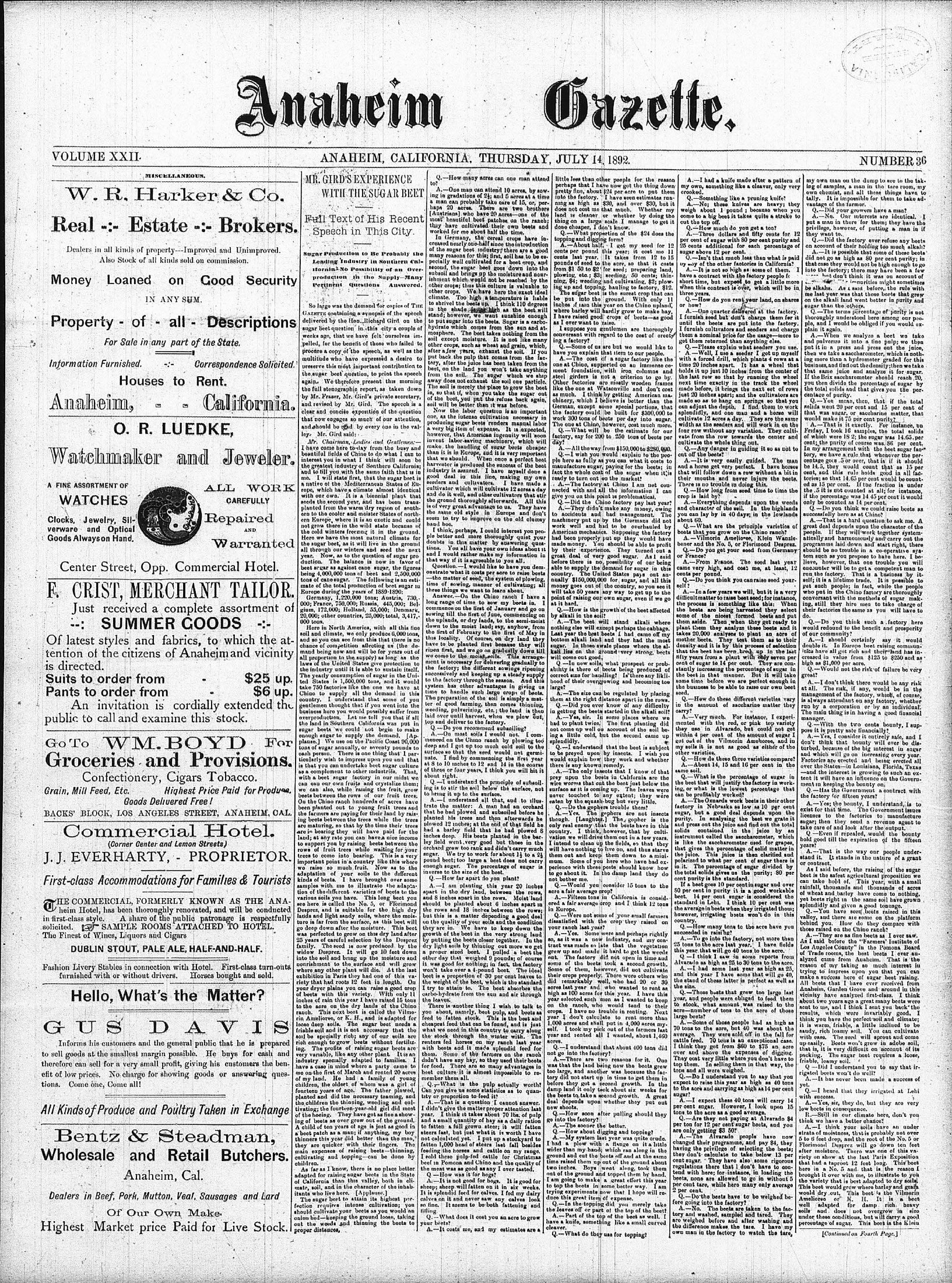
Searchable text
VOLUME XXII.
MISCELLANEOUS.
W. R. Harker & Co.
Real -- Estate -- Brokers.
Dealers in all kinds of property—Improved and Unimproved.
Also Stock of all kinds sold on commission.
Money Loaned on Good Security
IN ANY SUM.
Property - of - all - Descriptions
For Sale in any part of the State.
Information Furnished. Correspondence Solicited.
Houses to Rent.
Anaheim, California.
O. R. LUEDKE,
Watchmaker and Jeweler.
Houses to Rent.
Anaheim, California.
O. R. LUEDKE,
Watchmaker and Jeweler.
A FINE ASSORTMENT OF
WATCHES
Clocks, Jewelry, Silverware and Optical Goods Always on Hand.
ALL WORK
CAREFULLY
Repaired
AND
Warranted
Center Street, Opp. Commercial Hotel.
F. CRIST, MERCHANT TAILOR.
Just received a complete assortment of
--: SUMMER GOODS ---
Of latest styles and fabrics, to which the attention of the citizens of Anaheim and vicinity is directed.
Suits to order from - $25 up.
Pants to order from - $6 up.
An invitation is cordially extended the public to call and examine this stock.
Go To WM.BOYD For Groceries and Provisions.
Confectionery, Cigars Tobacco.
Grain, Mill Feed, Etc. Highest Price Paid for Produce.
Goods Delivered Free!
BACKS' BLOCK, LOS ANGELES STREET, ANAHEIM, CAL.
Commercial Hotel.
(Corner Center and Lemon Streets)
J. J. EVERHARTY, - PROPRIETOR.
First-class Accommodations for Families & Tourists
THE COMMERCIAL, FORMERLY KNOWN AS THE ANA-
BACKS' BLOCK, LOS ANGELES STREET, ANAHEIM, CAL.
Commercial Hotel.
(Corner Center and Lemon Streets)
J. J. EVERHARTY, - PROPRIETOR.
First-class Accommodations for Families & Tourists
THE COMMERCIAL, FORMERLY KNOWN AS THE Anaheim Hotel, has been thoroughly renovated, and will be conducted in first-class style. A share of the public patronage is respectfully solicited. SAMPLE ROOMS ATTACHED TO HOTEL. The Finest of Wines, Liquors and Cigars
DUBLIN STOUT, PALE ALE, HALF-AND-HALF.
Fashion Livery Stables in connection with Hotel. First-class turn-outs furnished with or without drivers. Horses bought and sold.
Hello, What's the Matter?
GUS DAVIS
Informs his customers and the general public that he is prepared to sell goods at the smallest margin possible. He buys for cash and therefore can sell for a very small profit, giving his customers the benefit of low prices. No charge for showing goods or answering questions. Come one, Come all!
All Kinds of Produce and Poultry Taken in Exchange
Bentz & Steadman,
Wholesale and Retail Butchers.
Anaheim, Cal.
Dealers in Beef, Pork, Mutton, Veal, Sausages and Lard
Of Our Own Make.
Highest Market price Paid for Live Stock.
ANAHEIM, CALIFORNIA, THURSDAY, JULY 14, 1892.
MR. GIRD'S EXPERIENCE WITH THE SUGAR BEET
Full Text of His Recent Speech in This City.
Sugar Production to Be Probably the Leading Industry in Southern California: No Possibility of an Overproduction in the Supply—Many Pertinent Questions Answered.
So large was the demand for copies of THE GAZETTE containing a synopsis of the speech delivered by the Hon. Richard Gird on the sugar beet question in this city a couple of weeks ago, that we have felt ourselves impelled, for the benefit of those who failed to procure a copy of the speech, as well as the multitude who have expressed a desire to preserve this most important contribution to the sugar beet question, to print the speech again. We therefore present this morning the full stenographic report, as taken down by Mr. Fraser, Mr. Gird's private secretary, and revised by Mr. Gird. The speech is a clear and concise exposition of the question that now engages so much of our attention, and should be read by every one in the valley. Mr. Gird said:
Mr. Chairman, Ladies and Gentlemen:
I have come here to-day from the busy and beautiful fields of Chino to do what I can to interest you in what I think will soon be the greatest industry of Southern California; and to fill you with the same faith that is in me.
Q. How many acres can one man attend to?
A. One man can attend 10 acres, by sowing in gradations of 2; and 5 acres at a time a man can probably take care of 15, or perhaps 20 acres. There are two brothers [Austrians] who have 20 acres—one of the most beautiful beet patches on the ranch; they have cultivated their own beets and worked for me about half the time.
In Germany, the cereal crops have increased nearly one-half since the introduction of the sugar beet industry; there are a good many reasons for this; first, soil has to be especially well cultivated for a beet crop, and second, the sugar beet goes down into the subsol and brings up the moisture and nourishment which would not be reached by the other crops; thus this culture is valuable to other crops. We have here the exact ideal climate. Too high a temperature is liable to shrivel the beets up. I think 110 degrees in the shade larger high as the beet will stand; however, we want sunshine enough to put sugar into the beets. Sugar is a carbohydrate which comes from the sun and atmosphere. The beet takes nothing from the soil except moisture. It is not like many other crops, such as wheat and grain, which, after a few years, exhaust the soil. If you put back the pulp that comes from the factory, after the juice has been taken from the beet, on the land you won't take anything from the soil. The sugar which we ship away does not exhaust the soil one particle. The soil is merely the place to grow the beet in, so that if, when you take the sugar out of the beet, you put the refuse back again, soil will be better than it was before.
Now the labor question is an important one, as the intense cultivation necessary in producing sugar beets renders manual labor a very big item of expense. It is expected, however, that American ingenuity will soon invent labor-saving machinery, which will make the handling of sugar beets cheaper than it is in Europe, and it is very important that we should. When once a perfect beet harvester is produced the success of the beet industry is assured. I have myself done a little less than other people for the reason perhaps that I have now got the thing down pretty fine, about $2 per acre to put them into the factory. I have seen estimates running as high as $30, and over $30, but it does not cost me that much. Whether my land is cleaner or whether by doing the thing on a large scale I manage to get it done cheaper, I don't know.
Q. What proportion of the $24 does the topping and digging form?
A. About half. I get my seed for 12 cents per pound this year; it cost me 11 cents last year. It takes from 12 to 15 pounds of seed to the acre, so that it costs from $1 50 to $2 for seed; preparing land, plowing, etc.; $3; seeding, 50 cents; thinning, $4; weeding and cultivating, $2; plowing up and tipping, hauling to factory, $12.
The sugar beet is the surest crop that can be put into the ground. With only 11 inches of am this year on the Chino upland, where barley will hardly grow to make hay, I have raised good crops of beets—as good as I ever want to raise.
I suppose you gentlemen are thoroughly conversant with regard to the cost of erecting a factory?
Q. Some of us are but we would like to have you explain that item to our people.
A. The cost of a sugar factory like the one at Chino, supported on an immense cement foundation, with iron columns and steel girders is not a criterion to go by. Other factories are mostly wooden frames like the one at Watsonville and don't cost as much. I think by getting American machinery, which I believe is better than the German, except some special portions, that the factory could be built for $300,000 to work 300 tons of beets per day into sugar. The one at Chino, however, cost much more.
Q. What will be the estimate for our factory, say for 200 to 250 tons of beets per day?
A. All the way from $150,000 to $280,000.
Q. I wish you would explain to me people here as fully as you can what it costs to manufacture sugar, paying for the beets; in fact the whole cost of the sugar when it is ready to turn out on the market!
We therefore present this morning the full stenographic report, as taken down by Mr. Fraser, Mr. Gird's private secretary, and revised by Mr. Gird. The speech is a clear and concise exposition of the question that now engages so much of our attention, and should be read by every one in the valley. Mr. Gird said:
Mr. Chairman, Ladies and Gentlemen: I have come here to-day from the busy and beautiful fields of Chino to do what I can to interest you in what I think will soon be the greatest industry of Southern California; and to fill you with the same faith that is in me. I will state first, that the sugar beet is a native of the Mediterranean States of Europe, which have a climate almost identical with our own. It is a biennial plant that seeds the second year, and has been transplanted from the warm dry region of southern to the cooler and moist States of northern Europe, where it is an exotic and could not grow there in the wild state because of the cold winters freezing it in the ground.
Here we have the most natural climate for the sugar beet, as it will live in the ground all through our winters and seed the next year. Now, as to the question of sugar production. The balance is now in favor of beet sugar as against cane sugar, the figures being 4,000,000 tons of beet and 2,500,000 tons of cane sugar. The following is an estimate of the total production of beet sugar in Europe during the years of 1889-1890:
Germany, 1,220,000 tons; Austria, 730,000; France, 750,000; Russia, 445,000; Belgium, 172,000; Holland, 55,000; Denmark, 20,000; other countries, 25,000; total, 3,417,000 tons.
Here in North America, with all this fine soil and climate, we only produce 6,000 tons, and so you can see from this that there is no chance of competition affecting us (the demand being now and will be for years out of all proportion to the supply) as long as the laws of the United States give protection to the industry until it is able to sustain itself. The yearly consumption of sugar in the United States is 1,500,000 tons, and it would take 750 factories like the one we have at China to supply all the demand in this country. I understand that some of your gentlemen thought that if you went into the business you would possibly suffer from overproduction. Let me tell you that if all the land in Southern California was put in sugar beets we could not begin to make enough sugar to supply the demand.
[Aplause.] We use on the Pacific Coast 90,000 tons of sugar annually, or seventy pounds to each person. There is one thing that I particularly wish to impress upon you and that is that you can undertake beet sugar culture as a complement to other industries. That, with a beet sugar factory in our midst we can can our own fruits and crystallize them; we can also, while raising the fruit, grow beets between the rows of our fruit trees.
On the Chino ranch hundreds of acres have been planted out to young fruit trees and the farmers are paying for their land by raising beets between the trees while the trees are maturing, so that by the time their trees are in bearing they will have paid for the land; at any rate you can have a nice income to support you by raising beets between the rows of fruit trees while waiting for your trees to come into bearing. This is a very important point in a country like this where we raise so much fruit. Now as to the adaptation of your soils to the different kinds of beets. I have brought over some samples with me to illustrate the adaptation of the different varieties of beets to the various soils you have. This long beet you see here is called The No. 5, Florimond
Now the labor question is an important one, as the intense cultivation necessary in producing sugar beets randens manual labor a very big item of expense. It is expected, however, that American ingenuity will soon invent labor-saving machinery, which will make the handling of sugar beets cheaper than it is in Europe, and it is very important that we should. When once a perfect beet harvester is produced the success of the beet industry is assured. I have myself done a good deal in this line, making my own seeders and cultivators. I have made a cultivator which will cultivate 12 acres a day and do it well, and other cultivators that stir the ground thoroughly afterwards. All this is of very great advantage to us. They have the same old style in Europe and don't seem to try to improve on the old clumsy hand hoe.
I think, perhaps, I could interest you people better and more thoroughly quiet your doubts in this matter by answering questions. You all have your own ideas about it and I would rather make my information in that way if it is agreeable to you all.
Question: I would like to have you demonstrate what it costs per acre to raise beets—the matter of seed, the system of plowing, time of sowing, manner of cultivating; all these things we want to learn about.
Answer: On the Chino ranch I have a long range of time to sow my beets in. I commence on the first of January and go on sowing till the first of June, commencing on the uplands, or dry lands, to the semi-moist down to the moist land; say, anyhow, from the first of February to the first of May in this locality. Of course, on dry land they have to be planted first because they will ripen first, and we go on gradually till we come to the moist soils. This arrangement is necessary for delivering gradually to the factory; the different sowings ripening successively and keeping up a steady supply to the factory through the season. And this system has other advantages in giving us time to handle such large crops of beets. The preparation of the soil is simply a matter of good farming; then comes thinning, weeding, pulverizing, etc.; the land is then laid over until harvest when we plow out, top and deliver to the factory.
Q—Do you recommend subsourcing?
A—On most sites I would not. I commenced on the Chino ranch by plowing too deep and I got up too much cold soil to the surface so that the seed would not germinate. I find by commencing the first year at 8 to 10 inches to 12 and 14 in the course of three or four years, I think you will hit it about right.
Q—I understand the principle of subsourcing is to stir the soil below the surface, not to bring it up to the surface.
A—I understand all that, and to illustrate the matter: A man had an orchard that he had plowed and subsolved before he planted his trees and then afterwards he plowed 12 inches; at the end of that field he had a barley field that he had plowed 8 inches deep. His beets planted in the barley field went very good but those in the orchard grew too rank and didn't carry much sugar. We try to work for about 1/2 to a 2/3 pound beef; too large a beef does not carry enough sugar. The percentage of sugar is inverse to the size of the beet.
Q—How far apart do you plant?
A—I am planting this year 20 inches apart in the dry land, between the rows, and 8 inches apart in the rows. Moistland should be planted about 6 inches apart in away does not exhaust the soil one particle.
The soil is merely the place to grow the beet in so that if, when you take the sugar out of the beet, you put the refuse back again, soil will be better than it was before.
Now the labor question is an important one, as the intense cultivation necessary in producing sugar beets randens manual labor a very big item of expense. It is expected, however, that American ingenuity will soon invent labor-saving machinery, which will make the handling of sugar beets cheaper than it is in Europe, and it is very important that we should. When once a perfect beet harvester is produced the success of the beet industry is assured. I have myself done a good deal in this line, making my own seeders and cultivators. I have made a cultivator which will cultivate 12 acres a day and do it well, and other cultivators that stir the ground thoroughly afterwards. All this is of very great advantage to us. They have the same old style in Europe and don't seem to try to improve on the old clumsy hand hoe.
I think, perhaps, I could interest you people better and more thoroughly quiet your doubts in this matter by answering questions. You all have your own ideas about it and I would rather make my information in that way if it is agreeable to you all.
Question: I would like to have you demonstrate what it costs per acre to raise beets—the matter of seed, the system of plowing, time of sowing, manner of cultivating; all these things we want to learn about.
A—How is growth of the beet affected by alkali in the soil?
A—The beet will stand alkali where nothing else will except perhaps the cabbage. Last year the beet beets I had came off my bottom alkali land and they had most sugar. In those swale places where the alkali lies on the ground very strong, beets will come out good.
Q—In new soils, what prospect or probability is there of beets being produced of correct size for handling? Is there any likelihood of their overgrowing and becoming too large?
A—The size can be regulated by placing them at the right distance apart in the rows.
Q—Did you ever know of any difficulty in getting the beets started in the alkali soil?
A—Yes, sir. In some places where we had to plant twice. The first planting did not come up well on account of the soil being a little cold, but the second came up splendidly.
A—I understand that the beet is subject to preyed upon by insects. I wish you would explain how they work and whether there is any known remedy.
A—The only insects that I know of that prey upon the beets in California are the wire worms that cut out the bee just below the surface as it is coming up. The leaves were never touched to any extent; they were eaten by the squash-bug but very little.
Q—Do the gopher trouble them?
A—Yes. The gophers are not insects though.[Laughter.] The gopher is the only real enemy thatthe beests have in this country. I think, however, that by cultivation we will drive them out in a few years. Intend we clean upthe fields so that they will have nothing to live on,and thus starve them out and keep them down to a minimum. Some ofyou here who have had experience with these pests should know howto go about it.Inthe damp land they do not bother me.
Q—Would you consider 15 tons tothe acre a fair average crop?
A—Fifteen tons in California is considered a fair average crop and I think 12 tons
been planted out to young fruit trees and the farmers are paying for their land by raising beets between the trees while the trees are maturing, so that by the time their trees are in bearing they will have paid for the land; at any rate you can have a nice income to support you by raising beets between the trees of fruit trees while waiting for your trees to come into bearing. This is a very important point in a country like this where we raise so much fruit. Now as to the adaptation of your soils to the different kinds of beets. I have brought over some samples with me to illustrate the adaptation of the different varieties of beets to the various soils you have. This long beet you see here is called the No. 5, or Florimond Desprez, and is suitable for the high dry lands and light sandy soils, where the moisture is far from the surface, as this beet will go deep down after the moisture. This beet was perfected to grow on this dry land after 25 years of careful selection by the Desprez family. The seed is now produced by the widow Desprez. It will go 10 feet down into the soil and bring up the moisture and nourishment to the surface and will grow anywhere other plant will die. At the last exhibition in Paris they had one of this variety that had roots 12 feet in length. On your dryer plains you can raise a good crop of beets with this variety. With only 11 inches of rain this year I have raised 15 tons to the acre of rain this year I have raised 15 tons to the acre of rain this year I have raised 15 tons to the acre of rain this year I have raised 15 tons to the acre of rain this year I have raised 15 tons to the acre of rain this year I have raised 15 tons to the acre of rain this year I have raised 15 tons to the acre of rain this year I have raised 15 tons to the acre of rain this year.
The sugar beet to attain its highest perfection requires intense cultivation; you should cultivate your beets as you would an onion bed—keeping the ground loose, taking out the weeds and thinning the beets to proper distances.
A man had an orchard that he had plowed and subsisted before he planted his trees and then afterwards he planted 12 inches at the end of that field he had a barley field that he had plowed 8 inches deep. His beets planted in the barley field went very good but those in the orchard grew too rank and didn't carry much sugar. We try to work for about 1/4 to a 2/3 pound beet; too large a beet does not carry enough sugar. The percentage of sugar is inverse to the size of the beet.
Q.-How far apart do you plant?
A.-I am planting this year 20 inches apart in the dry land, between the rows, and 8 inches apart in the rows. Moistland should be planted about 6 inches apart in the rows and 18 inches between the rows; but this is a matter depending on the quality of your soils and the condition they are in. We have to keep down the growth of the beet in the very strong land by putting the beets closer together. In the dry light soils by thinning out more we get a proper sized beet. I pulled a beet the other day that weighed 9 pounds; of course it was good for nothing; in fact, the factory won't take over a 4-pound beet. The ideal beet is a proportion of 30 per cent leaves to the weight of the beet, which is the standard I try to attain to. The beet absorbs the carbo-hydrate from the sun and air through the leaves.
There is another thing I wish to talk to you about, namely, beet pulp, and beets as feed to fatten stock. This is the best and cheapest feed that can be found, and is just what we need in this country to carry along the stock through the winter with. The renters fed horses on my ranch last year with beets and it made splendid feed for them. Some of the farmers on the ranch didn't have any hay, so they used their beets for feed. There are so many advantages in beet culture it is almost impossible to remember them all.
Q.-What is the pulp actually worth? Can you give us some statistics as to quantity or proportion to feed it?
A.-That is a question I cannot answer. I didn't give the matter proper attention last year. I think it takes about 70 lbs. of pulp and a small quantity of hays as daily ration to fatten a full grown steer; it will fatten steers fast, but just what it is worth I have not calculated yet. I put up a stockyard to fatten 1,000 head of steers last fall besides feeding the horses and cattle on my range. I sold these pulp-fed cattle for Christmas beef in Pomona and Chino and the quality of the meat was as good as any I ever tasted.
Q.-How was it for hogs?
A.-It is not good for hogs. It is good for sheep; sheep will fatten on it in six weeks. It is splendid feed for calves. I fed my dairy calves on it and never saw any calves look so fine. It seems to both fattening and filling.
Q.-What does it cost me, and my estimates are a
Q.-Do the gophers trouble them?
A.-Yes. The gophers are not insects though. [Laughter.] The gopher is the only real enemy that the beets have in this country. I think, however, that by cultivation we will drive them out in a few years. I intend to clean up the fields, so that they will have nothing to live on, and thus starve them out and keep them down to a minimum. Some of you here who have had experience with these pests should know how to go about it. In the damp land they do not bother me.
Q.-Would you consider 15 tons to the acre a fair average crop?
A.-Fifteen tons in California is considered a fair average crop and I think 12 tons in Europe.
Q.-Were not some of your small farmers dissatisfied with the crop they raised on your ranch last year?
A.-Yes. Some were and perhaps rightly so, as it was a new industry, and my contract was made so late that the vegetation grew up and made it hard to get the weeds out. The factory did not open in time and some of the beets took a second growth. Some of them, however, did not cultivate their crops properly. There were others who did remarkably well, who had 20 or 30 acres last year and who wanted to rent as high as 100 acres for this year. I have this year selected such men as I wanted to keep on the ranch, who would tend to their crops. I have no trouble in renting. Next year I don't calculate to rent more than 1,000 acres and shall put in 4,000 acres myself. I took my pick out of the farmers last year and tented about 1,460 acres.
Q.-Understand that about 400 tons did not go into the factory?
A.-There are two reasons for it. One was that the land being new the beets grow too large, and another was because the factory did not start up in time to get them in before they got a second growth. In the damp land it only took about six weeks for the beets to take a second growth. A great deal depends upon whether they put out new shoots.
Q.-How soon after pulling should they go into the factory?
A.-The sooner the better.
Q.-How about digging and tipping?
A.-My system last year was quite crude. I had a plow with a flange on it a little wider than my hands which ran along in the ground and cut the beets off and at same time raised them up out of the ground about two inches. Boys went along, took them out of the ground and taped them by hand. I am going to make a great effort this year to top the beets in some better way. I am trying experiments now that I hope will reduce this great item of expense.
Q.-In the topping did you merely take the leaves off or part of the top of the beet?
A.-Part of the top of the beet as well. I have a knife, something like a small curved cleaver.
Q.-What do they use for tipping?
other people for the reason have now got the thing down but $24 per acre to put them. I have seen estimates run at $30, and over $30, but it is that much. Whether my or whether by doing the large scale I manage to get it don't know.
portion of the $24 does the growing form?
I get my seed for 12 this year; it cost me 11. It takes from 12 to 15 on the acre, so that costs $2 for seed; preparing land, $3; seeding, 50 cents; thinning and cultivating, $2; plowing, hauling to factory, $12. It is the sarest crop that can go ground. With only 11 years on the Chino upland, hardly grow to make hay, and crops of beets—as good to raise.
gentlemen are thoroughly regard to the cost of erecting as are but we would like to add that item to our people. Of a sugar factory like the supported on an immense column, with iron columns and not a criterion to go by are mostly wooden frames Watsonville and don't talk by getting American man believe is better than the some special portions, that did be built for $300,000 to beets per day into sugar, however, cost much more. We be the estimate for our 200 to 250 tons of beets per year from $150,000 to $280,000 you would explain to the people as you can what it costs to pay for the beets; in cost of the sugar when it is market.
I had a knife made after a pattern of my own, something like a cleaver, only very crooked.
Something like a pruning knife?
No; these knives are heavy; they weigh about 1 pound because when you come to a big beet it takes quite a stroke to cut the top off.
How much do you get a ton?
Three dollars and fifty cents for 12 per cent of sugar with 80 per cent purity and 25 cents additional for each percentage of sugar above 12 per cent.
Isn't that much less than what is paid away of the other factories in California?
It is not so high as some of them. I have a contract with the factory people if short time, but expect to get a little more when this contract is over, which will be in three years.
How do you rent your land, on shares or how?
One quarter delivered at the factory. I furnish seed but don't charge them for it until the beets are put into the factory. I furnish cultivators and seeders and charge them a nominal price for the usage—more to get them returned than anything else.
Please explain what seeder you use.
Well, I use a seeder I got up myself with a forced drill, which plants 4 rows at a time 20 inches apart. It has a wheel that holds it up just 10 inches from the center of the last row so that by running the wheel next time exactly in the track the wheel made before, it brings the next set of rows just 20 inches apart; and the cultivators are made so as to hang on springs so that you can adjust the depth. I find them to work splendidly, and one man and a horse will cultivate 12 acres a day. They are the same width as the seeders and will work in on the four row without any variation. They cultivate from the row towards the center and cultivate the whole thing out.
Any danger in guiding it so as not to cut off the beets?
It is very easily guided. The man and a horse get very perfect. I have horses that will follow down a row without a bit in their mouths and pay inurembeats.
my own man on the dump to see to the taking of samples, a man in the tare room, my own chemist, and all these things have to tally. It is impossible for them to take advantage of the farmer.
Did your growers have a man?
No. Our interests are identical. I put a man in there for them; they have the privilege, however, of putting a man in if they want to.
Did the factory ever refuse any beets on account of their holding too much alkali?
It is possible that some of these beets did not go as high as 80 per cent purity; in that case they would not be high enough to go into the factory; there may have been a few but don't think it was on account of impurities might sometimes be alkalis. As I said before, the rule with me last year was that those beets that grew on the alkali land went better in purity and sugar than the others.
The terms percentage of purity is not thoroughly understood here among our people, and I would obliged if you would explain it again.
When we analyze a beet we take and pulverize it into a fine pulp; we then put it in a press and press out the juice, then we take a saccharometer, which is nothing more than a hydrometer graded for this business, and find out the density; then we take that same juice and analyze it for sugar. If the Brix saccharometer should reach 20, you then divide the percentage of sugar by the total solids and that gives you the percentage of purity.
You mean, then, that if the total solids went 20 per cent and 15 per cent of that was sugar, or saccharine matter, that would make it 75 per cent purity.
That is it exactly. For instance, on Friday, I took 16 samples, the total solids of which were 18:2; the sugar was 14.65 per cent; the purity of course was 86 per cent. In my arrangement with the beet sugar factory, we have a rule that whenever the percentage goes .5 or over, that is if it should be 14.5, they would count that as 15 per cent, and this rule holds good in all factories; so that 14.65 per cent would be count-
Watsonville and don't cost much by getting American man believe is better than the special portions, that had built for $300,000 to be per day into sugar, however, cost much more. I be the estimate for our 250 tons of beets on 250 tons of beets away from $150,000 to $280,000. You would explain to the people you can what it costs to pay for the beets; in order of the sugar when it is on the market? At Chino I am not consult all the information I can point to problematical. Chino factory pay last year! It make any money, owing bad management. The up by the Germans did not had to be overhauled by nics. Supposing the factory put up they would have you should be able to profit service. They turned out a very good sugar. As I said no, possibility of our being the demand for sugar in this United States pays out 4000 for sugar, and all this of the country, so you see it any way to get up to the own sugar, even if we go growth of the beet affected soil! will stand alkali where except perhaps the cabbage. but beets I had came off my land and they had the most awake places where the al-ground very strong, beets and what prospect or prob- beets being produced of handling! Is there any likli-growing and becoming too can be regulated by placing distance apart in the rows. ever know of any difficulty starts in the alkali soil! In some places where we see. The first planting did on account of the soil be but the second came up that the beet is subject to insects. I wish you work and whether you remedy. insects that I know of that bees in California are the cut the beet just below the coming up. The leaves were any extent; they were ash-bug but very little others trouble them?
Geophers are not insects [x]. The gopher is the that the beets have in this kink, however, that by cultivate them out in a few years. up the fields, so that they live on, and thus starve up them down to a mini- you here who have had ex- pests should know how on the damp land they do consider 15 tons to the crop!
in California is consid- crop and I think 12 tons in Watsonville and don't cost much by getting American ma believe is better than the special portions, that had built for $300,000 to be per day into sugar, however, cost much more. I be the estimate for our 250 tons of beets on 250 tons of beets away from $150,000 to $280,000. You would explain to the peo- you can what it costs to pay for the beets; in order of the sugar when it is on the market? At Chino I am not consi- try at Chino I am not con- all the information I can point to problematical. Chino factory pay last year! It make any money, owing bad management. The up by the Germans did not had to be overhauled by nics. Supposing the factory put up they would have you should be able to profit service. They turned out a very good sugar. As I said no, possibility of our being the demand for sugar in this United States pays out 4000 for sugar, and all this of the country, so you see it any way to get up to the own sugar, even if we go growth of the beet affected soil! will stand alkali where except perhaps the cabbage. but beets I had came off my land and they had the most awake places where the al-ground very strong, beets and what prospect or prob- beets being produced of handling! Is there any likli-growing and becoming too can be regulated by placing distance apart in the rows. ever know of any difficulty starts in the alkali soil! In some places where we see. The first planting did on account of the soil be but the second came up that the beet is subject to insects. I wish you work and whether you remedy. insects that I know of that bees in California are the cut the beet just below the coming up. The leaves were any extent; they were ash-bug but very little others trouble them?
Geophers are not insects [x]. The gopher is the that the beets have in this kink, however, that by cultivate them out in a few years. up the fields, so that they live on, and thus starve up them down to a mini- you here who have had ex- pests should know how on the damp land they do consider 15 tons to the crop!
in Watsonville and don't cost much by getting American ma believe is better than the special portions, that had built for $300,000 to be per day into sugar, however, cost much more. I be the estimate for our 250 tons of beets on 250 tons of beets away from $150,000 to $280,000. You would explain to the peo- you can what it costs to pay for the beets; in order of the sugar when it is on the market? At Chino I am not con- all the information I can point to problematical. Chino factory pay last year! It make any money, owing bad management. The up by the Germans did not had to be overhauled by nics. Supposing the factory put up they would have you should be able to profit service. They turned out a very good sugar. As I said no, possibility of our being the demand for sugar in this United States pays out 4000 for sugar, and all this of the country, so you see it any way to get up to the own sugar, even if we go growth of the beet affected soil! will stand alkali where except perhaps the cabbage. but beets I had came off my land and they had the most awake places where the al-ground very strong, beets and what prospect or prob- beets being produced of handling! Is there any likli-growing and becoming too can be regulated by placing distance apart in the rows. ever know of any difficulty starts in the alkali soil! In some places where we see. The first planting did on account of the soil be but the second came up that the beet is subject to insects. I wish you work and whether you remedy. insects that I know of that bees in California are the cut the beet just below the coming up. The leaves were any extent; they were ash-bug but very little others trouble them?
Geophers are not insects [x]. The gopher is the that the beets have in this kink, however, that by cultivate them out in a few years. up the fields, so that they live on, and thus starve up them down to a mini- you here who have had ex- pests should know how on the damp land they do consider 15 tons to the crop!
in Watsonville and don't cost much by getting American ma believe is better than the special portions, that had built for $300,000 to be per day into sugar, however, cost much more. I be the estimate for our 250 tons of beets on 250 tons of beets away from $150,000 to $280,000. You would explain to the peo- you can what it costs to pay for the beets; in order of the sugar when it is on the market? At Chino I am not con- all the information I can point to problematical. Chino factory pay last year! It make any money, owing bad management. The up by the Germans did not had to be overhauled by nics. Supposing the factory put up they would have you should be able to profit service. They turned out a very good sugar. As I said no, possibility of our being the demand for sugar in this United States pays out 4000 for sugar, and all this of the country, so you see it any way to get up to the own sugar, even if we go growth of the beet affected soil! will stand alkali where except perhaps the cabbage. but beets I had came off my land and they had the most awake places where the al-ground very strong, beets and what prospect or prob- beets being produced of handling! Is there any likli-growing and becoming too can be regulated by placing distance apart in the rows. ever know of any difficulty starts in the alkali soil! In some places where we see. The first planting did on account of the soil be but the second came up that the beet is subject to insects. I wish you work and whether you remedy. insects that I know of that bees in California are the cut the beet just below the coming up. The leaves were any extent; they were ash-bug but very little others trouble them?
Geophers are not insects [x]. The gopher is the that the beets have in this kink, however, that by cultivate them out in a few years. up the fields, so that they live on, and thus starve up them down to a mini- you here who have had ex- pests should know how on the damp land they do consider 15 tons to the crop!
in Watsonville and don't cost much by getting American ma believe is better than the special portions, that had built for $300,000 to be per day into sugar, however, cost much more. I be the estimate for our 250 tons of beets on 250 tons of beets away from $150,000 to $280,000. You would explain to the peo- you can what it costs to pay for the beets; in order of the sugar when it is on the market? At Chino I am not con- all the information I can point to problematical. Chino factory pay last year! It make any money, owing bad management. The up by the Germans did not had to be overhauled by nics. Supposing the factory put up they would have you should be able to profit service. They turned out a very good sugar. As I said no, possibility of our being the demand for sugar in this United States pays out 4000 for sugar, and all this ofthe country, so you see it any way to get up tothe own sugar, even if we go growth ofthebeetaffectedsoil! willstandalkaliwhereexceptperhapsthecabbagebutbeetsIhadcameoffmylandandtheyhadthemostawakeplaceswheretheal-groundverystrong.beetedsandwhatprospectororprob-beetsbeingproducedofhandling!Isthereanylikli-growingandbecomingtocanberegulatedbyplacingdistanceapartintherows.everknowofanydifficultystartedinthealkalisoil!Insomeplaceswherewesee.Thefirstplantingdidonaccountofthesoilbebutbutthesecondcameupthatthebeetissubjecttoinsects.I wishyouworkandwhetherinremedy.insectsthatIknowofthatbeesinCaliforniaarethecutthebeetjustbelowthecomingup.Theleaveswereanyextent;theywereash-bugbutverylittle.thegeophersarenotinsects[x].Thegopheristhethatthebeetshaveinthiskinkhowthy但byculitivehemoutinafewyears.upthefields,sоthattheyliveon,andthusstarveupthemeatshowinganyextent;theywereash-bugbutverylittle.thegeophersarenotinsects[x].Thegopheristhethatthebeetshaveinthiskinkhowthy但byculitivehemoutinafewyears.upthefields,sоthattheywereash-bugbutverylittle.thegeophersarenotinsects[x].Thegopheristhethatthebeetshaveinthiskinkhowthy但byculitivehemoutinafewyears.upthefields,sоthattheywereash-bugbutverylittle.thegeophersarenotinsects[x].Thegopheristhethatthebeetshaveinthiskinkhowthy但byculitivehemoutinafewyears.upthefields,sоthattheywereash-bugbutverylittle.thegeophersarenotinsects[x].Thegopheristhethatthebeetshaveinthiskinkhowthy但byculitivehemoutinafewyears.upthefields,sоthattheywereash-bugbutverylittle.thegeophersarenotinsects[x].Thegopheristhethatthebeetshaveinthiskinkhowthy但byculitivehemoutinafewyears.upthefields,sоthattheywereash-bugbutverylittle.thegeophersarenotinsects[x].Thegopheristhethatthebeetshaveinthiskinkhowthy但byculitivehemoutinafewyears.upthefields,sоthattheywereash-bugbutverylittle.thegeophersarenotinsects[x].Thegopheristhethatthebeetshaveinthiskinkhowthy但byculitivehemoutinafewyears.upthefields,sоthattheywereash-bugbutverylittle.thegeophersarenotinsects[x].Thegopheristhethatthebeetshaveinthiskinkhowthy但byculitivehemoutinafewyears.upthefields,sоthattheywereash-bugbutverylittle.thegeophersarenotinsects[x].Thegopheristhethatthebeetshaveinthiskinkhowthy但byculitivehemoutinafewyears.upthefields,sоthattheywereash-bugbutverylittle.thegeophersarenotinsects[x].Thegopheristhethatthebeetshaveinthiskinkhowthy但byculitivehemoutinafewyears.upthefields,sоthattheywereash-bugbutverylittle.thegeophersarenotinsects[x].Thegopheristhethatthebeetshaveinthiskinkhowthy但byculitivehemoutinafewyears.upthefields,sоthattheywereash-bugbutverylittle.thegeophersarenotinsects[x].Thegopheristhethatthebeetshaveinthiskinkhowthy但byculitivehemoutinafewyears.upthefields,sоthattheywereash-bugbutverylittle.thegeophersarenotinsects[x].Thegopheristhethatthebeetshaveinthiskinkhowthy但byculitivehemoutinafewyears.upthefields,sоthattheywereash-bugbutverylittle.thegeophersarenotinsects[x].Thegopheristhethatthebeetshaveinthiskinkhowthy但byculitivehemoutinafewyears.upthefields,sоthattheywereash-bugbutverylittle.thegeophersarenotinsects[x].Thegopheristhethatthebeetshaveinthiskinkhowthy但byculitivehemoutinafewyears.upthefields,sоthattheywereash-bugbutverylittle.thegeophersarenotinsects[x].ThegopheristhethatthebeetshaveINthiskinkhowthy但byculitivehemoutinafewyears.upthefields,sоthattheywereash-bugbutverylittle.thegeophersarenotinsects[x].ThegopheristhethatthebeetshaveINthiskinkhowthy但byculitivehemoutINafewyears.upthefields,sоthattheywereASH-BUG BUT VERY LITTLE.The geophers are not insects [x]. The gopher is thereto because anything goes into your hand because everything has got rich and hard since last year has increased in value from $125 to $250 and as high as $1,000 acre per亩 acre.
Q.-Do you think we could raise bees as successfully here as at Chino?
A.-That is a hard question to ask me. A great deal depends upon character of people. If they will work together systematically and harmoniously and carry out their programme laid down and start right there should be no trouble in a co-opative system such as you propose to have here. I believe however that one trouble you will encounter will get to a competent man to run his factory. That is a business by itself; it is a lifetime trade. It is possible to get such people; in fact, while these people put who put in the Chino factory are thoroughly conversant with methods of sugar making still they hire men to take charge of their factories same as you will have to do.
Q.-Do you think there would be any risk at all? The risk if any, would be in its management if he reduces bonded to his benefit and prosperity of our community?
A.-Yes should certainly say it would double it.In Europe bee raising communities have all got rich and their land has increased in value from $125 to $250 and as high as $1,000 acre per亩 acre.
Q.-Would not not risk of failure be very great?
A.-I don’t think there would be any risk at all.The risk if any,the people; in fact,the business here would redound to such benefit as our community?
Q.-I don’t think there would be any risk at all.The risk if any,the people; in fact,the business here would redound to such benefit as our community?
As I said before,the raising of the sugar bee is safe agricultural proposition we can take hold of.At this time,a small rainfall,two thousand and thousands of acres of wheat and barley have come to nothing,yet bees right in sheephurbed and given a good tonnage.
If a bee was our people understand it.At this time,a bird is our people understand it.At this time,a bird is our people understand it.At this time,a bird is our people understand it.At this time,a bird is our people understand it.At this time,a bird is our people understand it.At this time,a bird is our people understand it.At this time,a bird is our people understand it.At this time,a bird is our people understand it.At this time,a bird is our people understand it.At this time,a bird is our people understand it.At this time,a bird is our people understand it.At this time,a bird is our people understand it.At this time,a bird is our people understand it.At this time,a bird is our people understand it.At this time,a bird is our people understand it.At this time,a bird is our people understand it.At this time,a bird is our people understand it.At this time,a bird is our people understand it.At this time,a bird is our people understand it.At this time,a bird is our people understand it.At this time,a bird is our people understand it.At this time,a bird is our people understand it.At this time,a bird is our people understand it.At this time,a bird is our people understand it.At this time,a bird is our people understand it.At this time,a bird is our people understand it.At this time,a bird is our people understand it.At this time,a bird is our people understand it.At this time,a bird is our people understand it.At this time,a bird is our people understand it.At this time,a bird is our people understand it.At this time,a bird is our people understand it.At this time,a bird is our people understand it.At this time,a bird is our people understand它.At this time,a bird是我们的people理解我们会如何处理这些作物。我们会如何处理这些作物。我们会如何处理这些作物。我们会如何处理这些作物。我们会如何处理这些作物。我们会如何处理这些作物。我们会如何处理这些作物。我们会如何处理这些作物。我们会如何处理这些作物。我们会如何处理这些作物。我们会如何处理这些作物。我们会如何处理这些作物。我们会如何处理这些作物。我们会如何处理这些作物。我们会如何处理这些作物。我们会如何处理这些作物。我们会如何处理这些作物。我们会如何处理这些作物。我们会如何处理这些作物。我们会如何处理这些作物。我们会如何处理这些作物。我们会如何处理这些作物。我们会如何处理这些作物。我们会如何处理这些作物。我们会如何处理这些作物。我们会如何处理这些作物。我们会如何处理这些作物。我们会如何处理这些作物。我们会如何处理这些作物。我们会如何处理这些作物。我们会如何处理这些作物。我们会如何处理这些作物。我们会如何处理这些作物。我们会如何处理这些作物。我们会如何处理这些作物。我们会如何处理这些作物。我们会如何处理这些作物。我们会如何处理这些作物。我们会如何处理这些作物。我们会如何处理这些作物.我们会如何处理这些作物.我们会如何处理这些作物.我们会如何处理这些作物.我们会如何处理这些作物.我们会如何处理这些作物.我们会如何处理这些作物.我们会如何处理这些作物.我们会如何处理这些作物.我们会如何处理 these农作物.我们会如何处理 these农作物.我们会 如何处理 these农作物.我们会 如何处理 these农作物.我们会 如何处理 these农作物.我们会 如何处理 these农作物.我们会 如何处理 these农作物.我们会 如何处理 these农作物.我们会 如何处理 these农作物.他们会 如何处理 these农作物.他们会 如何处理 these农作物.他们会 如何处理 these农作物.他们会 如何处理 these农作物.他们会 如何处理 these农作物.他们会 如何处理 these农作物.他们会 如何处理 these农作物.他们会 如何处理 these农作物.他们会 如何处理 these农作物.他们会 如何处理 these农作物.他们会 如何处理 these农作物.他们会 如何处理 these农作物.他们会 如何处理 these农作物.他们会 如何处理 these农作物.他们会 如何处理 these农作物.他们会 如何处理 these农作物.他们会 如何处理 these农作物.他们会 如何处理 these农作物.他们会 如何处理 these农作物.他们会 如何处理 these农作物.他们会 如何处理 these农作物.他们会 如何处理 these农作物.他们会 如何处理 these农作物.他们 会 如何处理 these农作物.他们 会 如何处理 these农作物.他们 会 如何处理 these农作物.他们 会 如何 treatment他们都会 how they will treat them properly.
A.-Yes.I will treat them properly.I will treat them properly.I will treat them properly.I will treat them properly.I will treat them properly.I will treat them properly.I will treat them properly.I will treat them properly.I will treat them properly.I will treat them properly.I will treat them properly.I will treat them properly.I will treat them properly.I will treat them properly.I will treat them properly.I will treat them properly.I will treat them properly.I will treat them properly.I will treat them properly.I will treat them properly.I will treat them properly.I will treat them properly.I will treat them properly.I will treat them properly.I will treat them properly.I will treat them properly.I will treat them properly.I will treat them properly.I will treat them properly.I will treat them properly.I will treat them properly.I will treat them properly.I will treat them properly.I will treat them properly.I will treat them properly.I will treat them properly.I will treat them properly.I will treat them properly.I will treat them properly.I will treat them properly.I will treat them properly.I will treat them perfectly.I will treat them perfectly.I will treat them perfectly.I will treat them perfectly.I will treat them perfectly.I will treat them perfectly.I will Treat them perfectly.Iwill Treat them perfectly.Iwill Treat them perfectly.Iwill Treat them perfectly.Iwill Treat them perfectly.Iwill Treat them perfectly.Iwill Treat them perfectly.Iwill Treat them perfectly.Iwill Treat them perfectly.Iwill Treat them perfectly.Iwill Treat them perfectly.Iwill Treat them perfectly.Iwill Treat them perfectly.Iwill Treat them perfectly.Iwill Treat them perfectly.Iwill Treat them perfectly.Iwill Treat them perfectly.Iwill Treat them perfectly.Iwill Treat them perfectly.Iwill Treat them perfectly.Iwill Treat them perfectly.Iwill Treat them perfectly.Iwill Treat them perfectly.Iwill Treat them perfectly.Iwill Treat them perfectly.Iwill Treat them perfectly.Iwill Treat them perfectly.Iwill Treat them perfectly.Iwill Treat them perfectly.Iwill Treat them perfectly.Iwill Treat them perfectly.Iwill Treat then perfectly.Iwill Treat then perfectly.Iwill Treat then perfectly.Iwill Treat then perfectly.Iwill Treat then perfectly.Iwill Treat then perfectly.Iwill Treat then perfectly.Iwill Treat then perfectly.Iwill Treat then perfectly.Iwill Treat then perfectly.Iwill Treatment then perfectly.Treatment then perfectly.Treatment then perfectly.Treatment then perfectly.Treatment then perfectly.Treatment then perfectly.Treatment then perfectly.Treatment then perfectly.Treatment then perfectly.Treatment then perfectly.Treatment then perfectly.Treatment then perfectly.Treatment then perfectly.Treatment then perfectly.Treatment then perfectly.Treatment then perfectly.Treatment then perfectly.Treatment then perfectly.Treatment then perfectly.Treatment then perfectly.Treatment then perfectly.Treatment then perfectly.Treatmentthen Perfectly.Treatmentthen Perfectly.Treatmentthen Perfectly.Treatmentthen Perfectly.Treatmentthen Perfectly.Treatmentthen Perfectly.Treatmentthen Perfectly.Treatmentthen Perfectly.Treatmentthen Perfectly.Treatmentthen Perfectly.Treatmentthen Perfectly.Treatmentthen Perfectly.Treatmentthen Perfectly.Treatmentthen Perfectly.Treatmentthen Perfectly.Treatmentthen Perfectly.Treatmentthen Perfectly.Treatmentthen Perfectly.Treatmentthen Perfectly.Treatmentthen Perfectly.Treatmentthen PerfectLYTreatthen PerfectLYTreatthen PerfectLYTreatthen PerfectLYTreatthen PerfectLYTreatthen PerfectLYTreatthen PerfectLYTreatthen PerfectLYTreatthen PerfectLYTreatthen PerfectLYTreatthen PerfectLYTreatthen PerfectLYTreatthen PerfectLYTreatthen PerfectLYTreatthen PerfectLYTreatthen PerfectLYTreatthen PerfectLYTreatthen PerfectLYTreatthen PerfectLYTreatthen PerfectLYTreatthen PerfectLYTreatthen PerfectLYTreatthen PerfectLYTreatthen PerfectLYTreatthen PerfectLYTreatthen PerfectLYTreatthen PerfectLYTreatthen PerfectLYTreatthen PerfectLYTreatthen PerfectLYTreatthen PerfectLYTreatthenafter PerfectLYTreatthenafter PerfectLYTreatthenafter PerfectLYTreatthenafter PerfectLYTreatthenafter PerfectLYTreatthenafter PerfectLYTreatthenafter PerfectLYTreatthenafter PerfectLYTreatthenafter PerfectLYTreatthenafter PerfectLYTreatthenafter PerfectLYTreatthenafter PerfectLYTreatthenafter PerfectLYTreatthenafter PerfectLYTreatthenafter PerfectLYTreatthenafter PerfectLYTreatthenafter PerfectLYTreatthenafter PerfectLYTreatthenafter PerfectLYTreatthenafter PerfectLYTreatthenafter PerfectLYTreatthenafter完美XYTreatthenafter完美XYTreatthenafter完美XYTreatthenafter完美XYTreatthenafter完美XYTreatthenafter完美XYTreatthenafter完美XYTreatthenafter完美XYTreatthenafter完美XYTreatthenafter完美XYTreatthenafter完美XYTreatthenafter完美XYTreatthenafter完美XYTreatthenafter完美XYTreatthenafter完美XYTY Treachneafter完美XYTY Treachneafter完美XYTY Treachneafter完美XYTY Treachneafter完美XYTY Treachneafter完美XYTY Treachneafter完美XYTY Treachneafter完美XYTY Treachneafter完美XYTY Treachneafter完美XYTY Treachneafter完美XYTY Treachneafter完美XYTY Treachneafter完美XYTY Treachneafter完美XYTY Treachneafter完美XYTY Treachneafter完美XYTY Treachneafter完美XYTY Treachneafter完美XYTY Treachneafter完美XYTY Treachneafter完美XYTY Treachneafter完美XYTY Treachneafter完美XYTY Treachneafter完美XYTY Treachneafter完美
some of your small farmers the crop they raised on it?
were and perhaps rightly in industry, and my conlude that the vegetation it hard to get the weeds did not open in time and took a second growth. However, did not cultivate by. There were others who well, who had 20 or 30 did who wanted to rent as for this year. I have this man as I wanted to keep who would tend to their trouble in renting. Nextulate to rent more than all put in 4,000 acres my think out of the farmers last all I wanted, about 1,460 that about 400 tons did history?
two reasons for it. One being new the beets grew there was because the faci-nt in time to get them in second growth. In the took about six weeks for second growth. A great on whether they put out after pulling should they the better.
digging and topping?
last year was quite crudle with a flange on it a little which ran along in the beets off and at the same point out of the ground about went along, took them and topped them by hand. e a great effort this year in some better way. I am now that I hope will re-ment of expense.
long did you merely take part of the top of the beet? top of the beet as well. I thing like a small curved use for topping?
factory in Nebraska as low as 10 per cent sugar, but a good deal depends upon the purity. In analysing the beet we grate it and press out the juice and find out the total solids contained in the juice by an instrument called the saccharometer, which is like the saccharometer used for grapes, that gives the percentage of solid matter in the juice. This juice is then clarified and polarized to what per cent of sugar there is in it. The percentage of sugar divided by the total solids gives us the purity; 80 per cent purity is the standard.
If a beet goes 10 per cent in sugar and over 80 per cent in purity it is a good workable beet. 14 per cent sugar is considered the standard in Leht. I think 10 per cent was the average in beets when they irrigated them; however, irrigating beets won't do in this country.
Q.-How many tons to the acre have you succeeded in raising?
A.-To go into the factory, not more than 25 tons to the acre last year. I have fields this year that will go 40 tons to the acre.
Q.-I think I saw in some reports from Alvarado as high as 25 to 30 tons to the acre.
A.-I had some last year as high as 25, and this year I have some that will go 40, the stand of these latter is perfect as well as the size.
Q.-Those beets that grew too large last year, and people were obliged to feed them to stock, what amount was raised to the acre—number of tons to the acre of those large beets?
A.-Some of those people had as high as 70 tons to the acre, but 40 was about the average. They were sold off in the fall for cattle feed. 70 tons is an exceptional case. I think they got from $80 to $75 an acre over and above the expenses of digging. They cost very little where you don't have to top them. In selling them in that way, the tons and all were weighed.
Q.-Do I understand you to say that you expect to raise this year as high as 40 tons to the acre and carrying as high as 14 per cent sugar?
A.-I expect these 40 tons will carry 14 per cent sugar. However, I look upon 15 tons to the acre as a good average.
Q.-Are they not paying at Alvarado $4 per ton for 12 per cent sugar beets, and you are only getting $3 50?
A.-The Alvarado people have now changed their programme, and pay $4, they having the privilege of selecting the beets; they don't calculate to take below 13 per cent sugar. They have also some rigorous regulations there that I don't have to contend with here; for instance, in loading the beets, none are allowed to go in without 5 per cent tare, while here many only average 2 per cent.
Q.-Do the beets have to be weighed before going into the factory?
A.-No. The beets are taken to the factory and washed, sampled and tared. They are weighed before and after washing and the difference makes the tare. I have my own man in the factory to watch the tare,
[Continued on Fourth Page.]