anaheim-gazette 1891-12-17
Scanned page
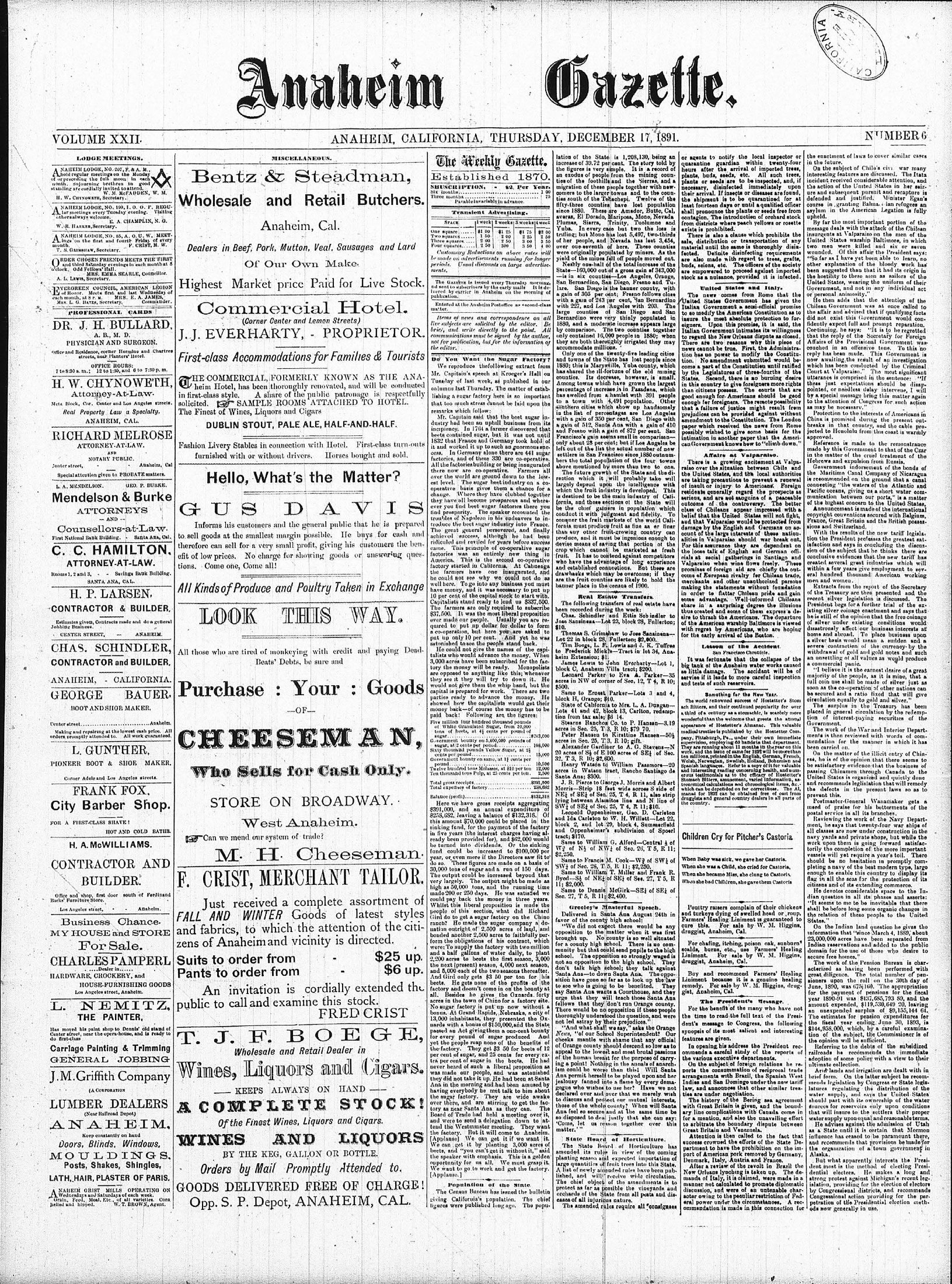
Searchable text
VOLUME XXII.
LODGE MEETINGS.
ANAHEIM LODGE, NO. 207, F. & A. M., hold regular meetings on the Monday of or preceding the full moon in each month. Sojourning brethren in good standing are cordially invited to attend.
W. M. McFADDEN, W. M.
H. W. CHYNOWETH, Secretary.
ANAHEIM LODGE, NO. 199, I. O. O. P. REGULAR meetings every Tuesday evening. Visiting others always welcome.
E. A. CHAMPLIN, N. O.
W. R. HARKER, Secretary.
ANAHEIM LODGE, NO. 85, A. O. U. W. MEETINGS on the first and fourth Friday of every month.
P. CRIST, M. W.
T. S. GRIMSHAW, Secretary.
ORDER CHOSEN FRIENDS MEETS THE FIRST and third Saturday evenings in each month at 8 o'clock. Odd Fellows' Hall.
MRS. EMMA SEARLE, Councillor.
A. L. LEWIS, Secretary.
EVERGREEN COUNcil, AMERICAN LEGION of Honor. Meets first and last Wednesday of each month, at 8 p.m.
MRS. E. A. JAMES.
Mrs. L. G. HATES, Secretary.
PROFESSIONAL CARDS
DR. J. H. BULLARD,
A. B., M. D.
PHYSICIAN AND SURGEON.
Office and Residence, corner Hermine and Chartres streets, near 'Planters' Hotel.
OFFICE HOURS:
7 to 8:30 a.m.; 12 to 1:30, and 6 to 7:30 p.m.
H. W. CHYNOWETH,
Attorney-At-Law.
Metz Block, Cor. Center and Los Angeles streets.
Real Property Law a Specialty.
ANAHEIM, CAL.
RICHARD MELROSE
ATTORNEY-AT-LAW.
AND
NOTARY PUBLIC.
Center street,
ANAheim, Cal.
Special attention given to PROBATE matters.
MISCELLANEOUS.
Bentz & Stead
Wholesale and Retail
Anaheim, Cal.
Dealers in Beef, Pork, Mutton, Veal, Sausage
Of Our Own Make
Highest Market price Paid for
Commercial H
(Corner Center and Lemon Streets)
J. J. EVERHARTY, - PRO
First-class Accommodations for Family
THE COMMERCIAL, FORMERLY KNOWN
Theim Hotel, has been thoroughly renovated, and in first-class style.
A share of the public patron solicited.
SAMPLE ROOMS ATTACHED
The Finest of Wines, Liquors and Cigars
DUBLIN STOUT, PALE ALE, HALF-ALE
Fashion Livery Stables in connection with Hotel.
furnished with or without drivers. Horses b
H. W. CHYNOWETH,
Attorney-At-Law.
Metz Block, Cor. Center and Los Angeles streets.
Real Property Law a Specialty.
ANAHEIM, CAL.
RICHARD MELROSE
ATTORNEY-AT-LAW.
AND
NOTARY PUBLIC.
Center street, Anaheim, Cal.
Special attention given to PROBATE matters.
L. A. MENDELSON.
GEO. P. BURKE.
Mendelson & Burke
ATTORNEYS
— AND —
Counsellors-at-Law.
First National Bank Building. Santa Ana, Cal.
C. C. HAMILTON.
ATTORNEY-AT-LAW.
Rooms 1, 2 and 3, Savings Bank Building.
SANTA ANA, CAL.
H. P. LARSEN.
CONTRACTOR & BUILDER.
Estimates given, Contracts made and do a general Jobbing Business.
CENTER STREET, Anaheim.
CHAS. SCHINDLER,
CONTRACTOR and BUILDER.
ANAHEIM, CALIFORNIA.
GEORGE BAUER,
BOOT AND SHOE MAKER.
Center street... Anaheim.
Making and repairing at the lowest cash price. All orders promptly attended to. All work guaranteed.
L. GUNTHER,
PIONEER BOOT & SHOE MAKER.
Corner Adele and Los Angeles streets.
FRANK FOX,
City Barber Shop.
FOR A FIRST-CLASS SHAVE!
HOT AND COLD BATHS.
H. A. McWILLIAMS.
CONTRACTOR AND
BUILDER.
Office and shop, first door south of Ferdinand Backs' Furniture Store.
Fashion Livery Stables in connection with Hotel.
furnished with or without drivers. Horses b
Hello, What's the M
GUS DAY
Informs his customers and the general public that to sell goods at the smallest margin possible. He therefore can sell for a very small profit, giving his effit of low prices. No charge for showing goods citions. Come one, Come all!
All Kinds of Produce and Poultry Take
LOOK THIS W
All those who are tired of monkeying with credit Beats' Debts, be sure and
Purchase : Your :
OF—
CHEESEM
Who Sells for Cash
STORE ON BROAD
West Anaheim
Can we mend our system of trade?
M. H. Chees
F. CRIST, MERCHANT
Just received a complete a
City Barber Shop.
FOR A FIRST-CLASS SHAVE!
HOT AND COLD BATHS.
H. A. McWILLIAMS.
CONTRACTOR AND BUILDER.
Office and shop, first door south of Ferninand Backs' Furniture Store.
Los Angeles street, Anaheim.
Business Chance.
MY HOUSE and STORE For Sale.
CHARLES PAMPERL
...Dealer in...
HARDWARE, CROCKERY, and HOUSE-FURNISHING GOODS
Los Angeles street, Anaheim.
L. NEMITZ,
THE PAINTER,
Has moved his paint shop to Dennis' old stand of Center street, near the opera-house, and is ready to do first-class Carriage Painting & Trimming GENERAL JOBBING
J.M. Griffith Company
(A CORPORATION)
LUMBER DEALERS
(Near Railroad Depot)
ANAHEIM.
Keep constantly on hand
Doors, Blinds, Windows,
MOULDINGS.
Posts, Shakes, Shingles,
LATH., HAIR, PLASTER OF PARIS.
ANAHEIM GRIST MILLS OPERATING ON Wednesdays and Saturdays of each week.
Grain, Feed, Meal, Etc., of all varieties. Corn bellied and hipped.
W. T. BROWN, Agent.
West Anaheim
Can we mend our system of trade?
M. H. Chees
F. CRIST, MERCHANT
Just received a complete a
FALL AND WINTER Goods of
and fabrics, to which the attentio
zens of Anaheim and vicinity is d
Suits to order from
Pants to order from
An invitation is cordially public to call and examine this store.
T. J. F. BOE
Wholesale and Retail Dealer
Wines, Liquors and
KEEPS ALWAYS ON HAN
A COMPLETE ST
Of the Finest Wines, Liquors and
WINES AND LI
BY THE KEG, GALLON OR BOY
Orders by Mail Promptly Atta
GOODS DELIVERED FREE OF
Opp. S. P. Depot, ANAHE
ANAHEIM, CALIFORNIA, THURSDAY, DECEMBER 17, 1890
MISCELLANEOUS.
Steadman,
and Retail Butchers.
Aheim, Cal.
Mutton, Veal, Sausages and Lard
Your Own Make.
Price Paid for Live Stock.
Corcial Hotel.
Center and Lemon Streets)
TY, - PROPRIETOR.
Dations for Families & Tourists
ORMERLY KNOWN AS THE ANAoroughly renovated, and will be conducted
of the public patronage is respectfully
ROOMS ATTACHED TO HOTEL.
Bars and Cigars
PALE ALE, HALF-AND-HALF.
Connection with Hotel. First-class turn-outs
at drivers. Horses bought and sold.
The Weekly Gazette.
Established 1870.
SHUSCRIPTION. - 82 Per Year.
Six months. 1,00
Three months. 75
Pavable invariably in advance.
Transient Advertising.
SPACE
1 week
2 weeks
3 weeks
4 week
One square..... $1 00
Two squares..... 1 50
Three squares..... 2 00
Four squares..... 2 50
Customary Reductions on above rates will
be made on advertisements running for longer
periods. Usual discounts on large advertisements.
The Gazette is issued every Thursday morning,
and sent to subscribers by the early mails. It is deivered by carrier in Anaheim on the morning of
publication.
Entered at the Anaheim Postoffice as second-class
matter.
Items of news and correspondence on all live subjects are solicited by the editor. Be brief, and write directly to the point. All communications must be signed by the author, not for publication, but for the information of the editor.
Do You Want the Sugar Factory?
We reproduce the following extract from Mr. Capitain's speech at Kroeger's Hall on Tuesday of last week, as published in our columns last Thursday. The matter of establishing a sugar factory here is so important that too much stress cannot be laid upon the remarks which follow:
Mr. Capitain said that the best sugar industry had been an uphill business from its incipiency. In 1764 a farmer discovered that beets contained sugar, but it was not until 1832 that France and Germany took hold of it and worked up to such an enormous success. In Germany alone there are 441 sugar factories, and of these 330 are co-operative. All the factories building or being inaugurated there now are co-operative. Farmers all over the world are ground down to the lowlation of the State is 1,208,130, being an increase of 39.72 per cent. The story told by the figures is very simple. It is a record of an exodus of people from the mining counties of the foothills and the Sierra, and a migration of these people together with new comers to the larger towns and to the councils south of the Tehachepi. Twelve of the fifty-three counties have lost population since 1880. These are Amador, Butte, Calaveras, El Dorado, Mariposa, Mono, Nevada Plumas, Sierra, Trinity, Tuolumne and Yuba. In every case but two the loss is trivial; but Mono has lost 5,497, two-thirds of her people, and Nevada has lost 3,454 over one-seventh of hers. These counts were originally populated by miners. As the yield of the mines fell off people moved out.
Nearly one-half of the total increase of the State—160,000 out of a gross gain of 343,000—is in six counties—Los Angeles, Orange San Bernardino, San Diego, Fresno and Tulare. San Diego is the banner county, with a gain of 305 per cent; Fresno follows close with a gain of 243 per cent; San Bernardino with 227, and Los Angeles with 203. The large counties of San Diego and San Bernardino were very thinly populated in 1880, and a moderate increase appears largely by comparison. The two counties together only contained 16,000 people in 1880; when they are both thoroughly irrigated they may accommodate millions.
Only one of the twenty-five leading cities and towns of the State has lost people since 1880; this is Marysville, Yuba county, which has shared the ill-fortune of the old mininities. Its decrease, however, is small Among towns which have grown the largest percentage of increase is in Pasadena, which has swelled from a hamlet with 391 people to a town with 4,491 population. Other southern cities which show up handsomely in the list of percentages are Los Angeles with a gain of 350 per cent; San Diego with a gain of 512; Santa Ana with a gain of 414 and Fresno with a gain of 872 per cent. San Francisco's gain seems small in comparison-only about 28 per cent; but if Los Angeles be left out of the list the actual number of new settlers in San Francisco since 1880 outnumbers the total population of the four towns above mentioned by more than two to one.
The future growth of the State and the direction which it will probably take wi
What's the Matter?
DAVIS
and the general public that he is prepared
margin possible. He buys for cash and
small profit, giving his customers the benefit for showing goods or answering questions.
Your: Goods
—OF—
SEMAN,
for Cash Only.
BROADWAY.
Anaheim.
em of trade?
Cheeseman.
ERCHANT TAILOR.
a complete assortment of
Tuesday of last week, as published in our columns last Thursday. The matter of establishing a sugar factory here is so important that too much stress cannot be laid upon the remarks which follow:
Mr. Capitain said that the best sugar industry had been an uphill business from its incipiency. In 1764 a farmer discovered that beets contained sugar, but it was not until 1832 that France and Germany took hold of it and worked up to such an enormous success. In Germany alone there are 441 sugar factories, and of these 330 are co-operative. All the factories building or being inaugurated there now are co-operative. Farmers all over the world are ground down to the lowest level. The sugar beet industry on a cooperative basis gives them a chance for a change. Where they have clubbed together they have all become prosperous and wherever you find beet sugar factories there you find prosperity. The speaker recounted the troubles of Napoleon in his endeavors to introduce the beet sugar industry into France. The great general persevered, and finally achieved success, although he had been ridiculed and reviled for years before success came. This principle of co-operative sugar factories was an entirely new thing in America. This is the second co-operative factory started in California. At Cahnnega the farmers have one inaugurated, and he could not see why we could not do as well here. To go into any business you must have money, and it was necessary to put up 10 per cent of the capital stock to lend us $337,500. The farmers are only required to subscribe $37,500. It was the most liberal proposition ever made our people. Usually you are required to put up dollar for dollar to form a co-operation, but here you are asked to put up only 10 per cent. And yet he was astonished to see the people stand back.
He could not give the names of the capitalists who would advance the money. When 3,000 acres have been subscribed for the factory the money will be ready. Monopolists are opposed to anything like this; whenever they see it they will try to down it. He would not give them the whip hand, but the capital is prepared for work. There are two parties ready to advance the money. He showed how the capitalists would get their money back—of course the money has to be paid back! Following are the figures:
Five million four hundred thousand pounds of White Granulated Sugar, from 30,000 tons of beets, at 4½ cents per pound of sugar.
$243,000
Government bounty on 5,400,000 pounds of sugar, at 2½ cents per pound.
109,000
Sixty thousand pounds Yellow Sugar, at 2½ cents per pound.
15,000
Government bounty on same, at 1½ cents per pound.
10,500
Twelve hundred tons Molasses, at 810 per ton.
12,000
Ten thousand tons Pulp, at 25 cents per ton.
Total gross receipts.....$991,000
Total expenses of factory.....258,622
Balance (profit).....$132,318
Here we have gross receipts aggregating $391,000, and an annual expenditure of $258,622 leaving a balance of $132,318. Of this amount $70,000 could be placed in the sinking fund, for the payment of the factory in five years (the interest charges having already been provided for), and $62,000 would be turned into dividends. Or the sinking fund could be increased to $100,000 per year, or even more if the Directors saw fit to do so. These figures are made on a basis of 30,000 tons of sugar and a run of 150 days. The output could be increased beyond that very largely. The output might be made as high as 50,000 tons, and the running time made 200 or 250 days. He was satisfied we could pay back the money in three years. Whilst this liberal proposition is made the
The future growth of the State and the direction which it will probably take will largely depend upon the intelligence with which the fruit industry is developed. This is destined to be the main industry of California, and those sections of the State will be the chief gainers in population which conduct it with judgment and fidelity. Conquer the fruit markets of the world California must produce fruit as fine as er rines than any other fruit-growing country can produce, and it must be ingenious enough to devise means of saving that portion of the crop which cannot be marketed as fresh fruit. It has to contend against competitors who have the advantage of long experience and established connections. But these are drawbacks which may be overcome; if they are the fruit counties are likely to hold this banner place in the census of 1900.
Real Estate Transfers.
The following transfers of real estate have been recorded during the week:
Chas. Schindler and Ettie Sobindler to Jose Sansinea—Lot 23, block 28, Fullerton $10.
Thomas S. Grimshaw to Jose Sansinena—Lot 22 in block 28, Fullerton $2,000.
Tim Boege, L. F. Lewis and J. K. Tuffres to Frederick Mickle—Tract in lot 34, Anaheim Extension; $1.
James Lewis to John Everharty—Lot 1 block C, Anaheim Villa tract; $200.
Leonard Parker to Eva A. Parker—34 acres in NW of corner of Sec. 12, T 4, R 10; $500.
Same to Ernest Parker—Lots 3 and 4 block H, Orange; $10.
State of California to Mrs. L. A. Dungan—Lots 41 and 42, block 13, Carlton redemption from tax sale; $8 14.
Stearns Ranchos Co. to P. Hansen—3.19 acres in Sec. 25, T 3, R 10; $79 70.
Peter Hansen to Kirstine Hansen—50 acres in Sec. 25, T 3, R 10; gift.
Alexander Gardiner to A. G. Stevens—N 20 acres of S¹ of E 100 acres of SE² of Sec. 32, T 3, R 10; $2,600.
Henry Watson to William Passmore—26 acres in Watson tract, Rancho Santiago de Santa Ana; $300.
J. B. Pierce to George J. Morris and Albert Morris—Strip 18 fast wide across S side of NE¹ of SE² of Sec. 25, T 4, R 11; also striving between Alamitos line and N line of SW¹ of SE² of Sec. 25, T 4, R 11; $10.
Leopold Oppenheimer, Geo. D. Carleton and Ida Carletton to W. H. Willett—Lot 22 block 2, and lot 29, block 4, Summerfield and Oppenheimer's subdivision of Spoon tract; $170.
Same to William G. Alford—Central A¹ of N¹ of NW¹ of Sec. 26, T 5, R 11; $2,250.
Same to Francis M. Cook—W¹ of SW¹ of Sec. 26, T 5, R 11; $2,250.
Same to William T. Miller and Frank R Byod—S¹ of NE¹ of SE² of Sec. 27, T 5, R 11; $2,250.
Same to Dennis McGirk—SE¹ of Sec. 27, T 5, R 11; $2,400.
Signals from New York City
At Anaheim.
A team of trade?
Cheeseman.
A complete assortment of
Goods of latest styles
which the attention of the citiand vicinity is directed.
From $25 up.
From $6 up.
It is cordially extended the
examine this stock.
FRED CRIST
BOEGE,
and Retail Dealer in
Liquors and Cigars.
ALWAYS ON HAND —
ETE STOCK!
Wines, Liquors and Cigars.
AND LIQUORS
, GALLON OR BOTTLE.
Promptly Attended to.
RED FREE OF CHARGE!
tot, ANAHEIM, CAL.
$391,000, and an annual expenditure of
$258,682, leaving a balance of $132,318. Of
this amount $70,000 could be placed in the
sinking fund, for the payment of the factory
in five years (the interest charges having already been provided for), and $62,000 would
be turned into dividends. Or the sinking
fund could be increased to $100,000 per
year, or even more if the Directors saw it to do so. These figures are made on a basis of
30,000 tons of sugar and a run of 150 days.
The output could be increased beyond that
very largely. The output might be made as
high as 50,000 tons, and the running time
made 200 or 250 days. He was satisfied we could pay back the money in three years. Whilst this liberal proposition is made the people of this section, what did Richard Gird do to get a sugar factory on the Chino ranch? He made the sugar company a donation outright of 2,500 acres of land, and bonded another 2,500 acres to faithfully perform the obligations of his contract, which were: To supply the factory with two million and a half gallons of water daily, to plant 2,200 acres to beets the first season, 3,000 the next (present) season, 4,000 next season, and 5,000 each of the two seasons thereafter. And Gird only gets $3 50 per ton for his beets. He gets none of the profits of the factory and doesn't come in on the bounty at all. Besides he gives the Oxnards forty acres in the town of Chino for a factory site. No sugar factory is put up now without a bonus. At Grand Rapids, Nebraska, a city of 13,000 inhabitants, they presented the Oxnards with a bonus of $150,000, and the State passed an Act giving them a one-cent bounty for every pound of sugar produced. And yet the people reap none of the benefits of the factory. They get $3 50 for beets of 12 per cent of sugar, and 25 cents for every extra per cent of sugar in the beets. He had never heard of such a liberal proposition as was made our people, and was astonished they did not take it up. He had been at Santa Ana in the morning and had been amused by having everybody he met talk to him about the sugar factory. They are wide awake over there, and are stirring to get the factory as near Santa Ana as they can. The Board of Trade had held a meeting over it, and were to send a delegation down to attend the Westminster meeting. They want the factory. But it will come to Anaheim.
[Applause] We can get it if we want it. We can get it by planting 3,000 acres of beets, and "you can't get it without it," said the speaker with emphasis. This is a golden opportunity for us all. We must grasp it. We want to go to work and get the factory.
[Applause.] Population of the State.
The Census Bureau has issued the bulletin giving California's population. The chief figures were published long ago. The popu-
SW of SE of Sec. 25, T 4, R 11; $10.
Leopold oppenheimer, Geo. D. Carleton and Ida Carleton to W. H. Willlett—Lot 22 block 2, and lot 29, block 4, Summerfield and Oppenheimer's subdivision of Spoon tract; $170.
Same to William G. Alford—Central A owl of N' of NW' of Sec. 26, T 5, R 11; $2,250.
Same to Francis M. Cook—W' of SW' of Sec. 26, T 5, R 11; $2,250.
Same to William T. Miller and Frank R Byod—S' of NE' of SE' of Sec. 27, T 5, R 11; $2,000.
Same to Dennis McGirk—SE' of SE' of Sec. 27, T 5, R 11; $2,400.
Grecoys Masterful Speech.
Delivered in Santa Ana August 24th in favor of the county high school:
"We did not expect there would be any opposition to the matter when it was first brought up. No county is so well situated for a county high school. There is no community but that could send pupils to high school. The opposition so strongly waged it not an opposition to the high school. They don't talk high school; they talk against Santa Ana—to down Santa Ana. The opposition have gone so far as to look up the law to see who is going to be benefited. The say Santa Ana wants a Courthouse, and that urge that they will teach those Santa An fellows that they don't run Orange county. There would be no opposition if these people thoroughly understood the question, and were not led astray by their prejudices."
"And what shall we say," asks the Orange News,"of our School Superintendent? Our cheeks mantle with shame that any officer of Orange county should descend so low as to appeal to the lowest and most brutal passion of the human breast for the purpose of carrying a point! Nothing in the annals of anarchism could be worse than this! Will Santa Ana permit herself to be played upon and her jealousy fanned into a flame by every demon gogue who wishes to use her? Have we not declared over and over that we merely wish to discuss and protect our mutual interests those of the whole county? When will Santa Ana feel so secure and at the same time that we disposed to deal justly that she can say 'Come, let us reason together over this matter.'"
State Board of Horticulture.
The State Board of Horticulture has amended its rules in view of the coming planting season and expected importation of large quantities of fruit trees into this State. A list of newly amended rules have been published, and will receive wide circulation. The chief object of the amendments is to protect as far as possible the vineyards and orchards of the State from all posts and diseases of all injurious nature.
The amended rules require all consignees
State is 1,208,130, being an 12 per cent. The story told by very simple. It is a record of people from the mining councils and the Sierra, and a large people together with new larger towns and to the county Tehachepi. Twelve of the counties have lost population these are Amador, Butte, Cal,ado, Mariposa, Mono, Nevada, Trinity, Tuolumne and very case but two the loss is none has lost 5,497, two-thirds and Nevada has lost 3,454, half of the total increase of the out of a gross gain of 343,000 counties—Los Angeles, Orange, San Diego, Fresno and Tucson is the banner county, with over cnt; Fresno follows close 243 per cent, San Bernardino Los Angeles with 203. The县 of San Diego and San are very thinly populated in moderate increase appears large. The two counties together 16,000 people in 1880; when thoroughly irrigated they may millions.
The twenty-five leading cities State has lost people sincearysville, Yuba county, which full fortune of the old mining decrease, however, is small, which have grown the largest increase is in Pazadena, which has a hamlet with 391 people with 4,491 population. Other which show up handsomely percentages are Los Angeles 850 per cent, San Diego with Santa Ana with a gain of 410 with a gain of 872 per cent. San seems small in comparison percent; but if Los Angeles be list the actual number of new Francisco since 1880 num-ropulation of the four towns and by more than two to one. wealth of the State and the di- it will probably take will or agents to notify the local inspector or quarantine guardian within twenty-four hours after the arrival of imported trees, plants, buds, seeds, etc. All such trees, plants or seeds are to be inspected, and, if necessary, disinfected immediately upon their arrival. If insects or diseases are found, the shipment is to be quarantined for at least fourteen days or until a qualified officer shall pronounce the plants or seeds free from contagion. The introduction of orchard stock from districts where peach yellows or rosette exists is prohibited.
There is also a clause which prohibits the sale, distribution or transportation of any material until the same is thoroughly disinfected. Deinitine disinfecting requirements are also made with regard to trees, grafts, buds, seions, etc. The officers of the society are empowered to proceed against imported stock as a nuisance, provided it is infected.
United States and Italy.
The news comes from Rome that the United States Government has given the Italian Government a semi-official promise to so modify the American Constitution as to insure the most absolute protection to foreigners. Upon this promise, it is said, the Italian Government intimates its willingness to regard the New Orleans dispute as closed. There are two reasons why this piece of news cannot be true. First, the Administration has no power to modify the Constitution. No amendment submitted would become a part of the Constitution until ratified by the Legislatures of three-fourths of the States. Second, there is no burning desire in this country to give foreigners more rights than citizens possess. The courts that are good enough for Americans should be good enough for foreigners. The remote possibility that a failure of justice might result from prejudices can be provided against without amendment to the Constitution. The London paper which received the news from Rome possibly wished to give some basis for the intimation in another paper that the American Government knows how to "climb down."
Affairs at Valparaiso.
There is a growing excitement at Valparaiso over the situation between Chile and the United States, and the local authorities are taking presents to present the enactment of laws to cover similar cases in the future.
On the subject of Chile's civil war many interesting features are discussed. The Itata incident received considerable attention, and the action of the United States in her seizure and subsequent pursuit and recapture is defended and justified. Minister Egan's course in granting Balma can refuges an asylum in the American Legation is fully upheld.
By far the most important portion of the message deals with the attack of the Chilean insurgents at Valparaiso on the men of the United States warship Baltimore, in which two men were killed and six or seven wounded. Of this affair the President says: "So far as I have yet been able to learn, no other explanation of the bloody work has been suggested than that it had its origin in the hostility to these men as sailors of the United States, wearing the uniform of their Government, and not in any individual act or personal animosity."
He then adds that the attentiof of Chilean Government was at once called to the affair and advised that if qualifying facts did not exist this Government would confidently expect full and prompt reparation. Continuing, he says: "It is to be regretted that the reply of the Secretary for Foreign Affairs of the Provisional Government was couched in an offensive tone. To this no reply has been made. This Government is now awaiting the result of an investigation which has been conducted by the Criminal Court at Valparaiso." The most significant utterance is comprised in the sentence: "If these just expectations should be disappointed, or needless delay intervene, I will by a special message bring this matter again to the attention of Congress for such action as may be necessary."
Protection to the interests of Americans in China is promised during the present outbreaks in that country, and the cable projected to Honolulu from this coast is warmly approved.
Reference is made to the remonstrance made by this Government to that of Czar in the matter of the cruel treatment of the Hebrews and expulsion from Russia.
Government endorsement of the bonds of the Maritime Canal Company of Nicaragua is recommended on the ground that armed
Estate Transfer.
Growing transfers of real estate have included the week:
Miller and Ettie Sobindler to Lot 23, block 28, Fullerton;
rimshaw to Jose Sansinena—28, Fullerton; $2,600.
F. Lewis and J. K. Tuffree Dickle—Tract in lot 34, Anatica; $1.
John Everbarty—Lot 1, Sum Villa tract; $200.
Ketterer to Eva A. Parker—35 corner of Sec. 12, T 4, R 10;
Cardiner to A. G. Stavens—N of E 100 acres of SE‡ of Sec. $2,600.
On to William Passmore—20 son tract, Rancho Santiago de
George J. Morris and Albert 187 feet wide across S side of Sec. 25, T 4, R 11; also strip Alamitos line and N line of Sec. 25, T 4, R 11; $10.
Senheimer, Geo. D. Carleton 187 feet wide across S side of Sec. 25, T 4, R 11; also strip Alamitos line and N line of Sec. 25, T 4, R 11; $10.
Senheimer, Geo. D. Carleton 187 feet wide across S side of Sec. 25, T 4, R 11; also strip Alamitos line and N line of Sec. 25, T 4, R 11; $10.
Children Cry for Pitcher's Castoria.
When Baby was sick, we gave her Castoria.
When she was a Child, she cried for Castoria.
When she became Miss, she clung to Castoria.
When she had Children, she gave them Castoria.
Reference at Valparaiso.
There is a growing excitement at Valparaiso over the situation between Chile and the United States, and the local authorities are taking precautions to prevent a renewal of insult or injury to Americans. Foreign residents generally regard the prospects as serious, and are not sanguine of a passable outcome of the controversy. The better class of Chileans appear impressed with a belief that the United States will not fight, and that Valparaiso would be protected from damage by the English and Germans on account of the large interests of these nationalities in Valparaiso should war break out. For this assurance they are dependent on the loose talk of English and German officials at social gatherings in Santiago and Valparaiso when wine flows freely. These promises of foreign aid are chiefly the outcome of European rivalry for Chilean trade, merchants and other unauthorized persons making the statements without foundation in order to flatter Chilean pride and gain some advantage. Well-informed Chileans share in a surprising degree the illusions thus created and some of them express a desire to thrash the Americans. The departure of the American warship Baltimore is viewed with regret by Americans, who are hoping for the early arrival of the Boston.
Lesson of the Accident.
San Francisco Chronicle.
It was fortunate that the collapse of the big tank of the Anahiem water works caused so little damage. The accident will be of service if it leads to more careful inspection and tests of such reservoirs.
Something for the New Year.
The world renowned success of Hostetter's Stomach Bitters, and their continued popularity for over a third of a century as a stomachic, is scarce more wonderful than the welcome that greets the annual appearance of Hostetter's Almanac. This valuable medical treaties is published by the Hostetter Company, Pittsburgh, Pa., under their own immediate supervision, employing 60 hands in that department. They are running about 11 months in their year on this work, and the issue of same for 1992 will be more than ten millions, printed in the English, German, French, Welsh, Norwegian, Swedish, Holland, Bohemian and Spanish languages. Refer to a copy of it for valuable and interesting reading concerning health, and numerous amenable articles in the Journal of Hostetter's Stomach Bitters, amusement, varied information, astronomical calculations and chronological items, &c., which can be depended on for correctness. The Almanac for 1992 can be obtained free of cost from druggists and general country dealers in all parts of the country.
Children Cry for Pitcher's Castoria.
When Baby was sick, we gave her Castoria.
When she was a Child, she cried for Castoria.
When she became Miss, she clung to Castoria.
When she had Children, she gave them Castoria.
Reference at Valparaiso.
There is no burning desire in this country to give foreigners more rights than citizens possesses. The courts that are good enough for Americans should be good enough for foreigners. The remote possibility that a failure of justice might result from prejudice can be provided against without amendment to the Constitution. The London paper which received the news from Rome possibly wished to give some basis for the intimation in another paper that the American Government knows how to "climb down."
Protection to the interests of Americans in China is promised during the present outbreaks in that country, and the cable projected to Honolulu from this coast is warmly approved.
Reference is made to the remonstrance made by this Government to that of the Czar in the matter of the cruel treatment of the Hebrews and expulsion from Russia.
Government endorsement of the bonds of Maritime Canal Company of Nicaragua is recommended on the ground that a canal connecting "the waters of the Atlantic and Pacific oceans, giving us a short water communication between our ports," is a matter of the highest concern to the United States.
Announcement is made of the international copyright conventions secured with Belgium, France, Great Britain and the British possessions and Switzerland.
With the results of the new tariff legislation the President professes the greatest satisfaction and says in concluding the discussion of the subject that he thinks there are conclusive evidences that the new tariff has created several great industries which will within a few years give employment to several hundred thousand American working men and women.
Extracts from the report of the Secretary of the Treasury are then presented and the recent silver legislation is discussed. The President begs for a further trial of the existing silver coinage enactment and says that he is still of the opinion that the free coinage of silver under existing conditions would disastrously affect our business interests at home and abroad. To place business upon a silver basis would mean a sudden and a severe contraction of the currency by the withdrawal of gold and gold notes and such an unsettling of all values as would produce a commercial panic.
"I believe it is the earnest desire of a great majority of the people, as it is mine, that a full coin use shall be made of silver just as soon as the co-operation of other nations can be secured and a ratio fixed that will give circulation equally to gold and silver."
The surplus in the Treasury has been placed in general circulation by the redemption of interest-paying securities of the Government.
The work of the War and Interior Departments is then reviewed with words of commendation for the manner in which it has been carried on.
On the matter of the illicit entry of Chinese he is of the opinion that there seems to be satisfactory evidence that the business of passing Chinamen through Canada to the United States is organized and quietly done and recommends legislation that will remedy the defects in the present laws so as to prevent this.
Postmaster-General Wanamaker gets a meed of praise for his bettlements of the postal service in all its branches.
Reviewing the work of the Navy Department, he says that twenty-four war ships of all classes are now under construction in the navy yards and private shope, but while the work upon them is going forward satisfactorily the completion of the more important vessels will yet require a year's toll. There should be no hesitation in promptly completing a navy of the best modern type, large enough to enable this country to display its flag in all the seas for the protection of its citizens and of its extending commerce.
He devotes considerable space to the Indian question in all its phases and asserts: "It seems to me to be inevitable that there
Children Cry for Pitcher's Castoria
When Baby was sick, we gave her Castoria.
When she was a Child, she cried for Castoria.
When she became Miss, she clung to Castoria.
When she had Children, she gave them Castoria.
Poultry raises complain of their chickens and turkeys dying of swelled head or,oup, Farmers' Healing Liniment is guaranteed to cure this. For sale by W. M. Higgins, druggist, Anaheim, Cal.
For chafing, itching, poison oak, sunburn'calds, burns, etc., use Farmers' Healing Liniment. For sale by W. M. Higgins, druggist, Anaheim, Cal.
Buy and recommend Farmers' Healing Liniment because it is a genuine healing remedy. For sale by W. M. Higgins, druggist, Anaheim, Cal.
The President's Message.
For the benefit of the many who have not the time to read the full text of the President's message to Congress, the following synopsis of its most salient and interesting features are given.
In opening his address the President recommends a careful study of the reports of the various executive departments.
On the subject of foreign relations he reports the consummation of reciprocal trade arrangements with Brazil, the Spanish West Indies and San Domingo under the new tariff law, and announces that other similar treaties are under negotiation.
The history of the Bering sea agreement with Great Britain is given, and the boundary line complications with Canada come in for a mention, and also the unavailing effort to arbitrate the boundary dispute between Great Britain and Venezuela.
Attention is then called to the fact that success crowned the efforts of the State Department to have the prohibition on the import of American pork removed by Germany, Denmark, Italy, Austria and France.
After a review of the revolt in Brazil the New Orleans lynching is taken up. The demands of Italy, it is claimed, were made in a manner not calculated to promote diplomatic discussion, and were of an untenable character owing to the peculiar restriction of Federal power under the circumstances. A recommendation is made in this connection for need of praise for his betterments of the postal service in all its branches.
Reviewing the work of the Navy Department, he says that twenty-four war ships of all classes are now under construction in the navy yards and private shope, but while the work upon them is going forward satisfactorily the completion of the more important vessels will yet require a year's toil. There should be no hesitation in promptly completing a navy of the best modern type, large enough to enable this country to display its flag in all the seas for the protection of its citizens and of its extending commerce.
He devotes considerable space to the Indian question in all its phases and asserts: "It seems to me to be inevitable that there shall be before long some organic changes in the relation of these people to the United States."
On the Indian land question he gives the information that 'since March 4, 1889, about 23,000,000 acres have been separated from Indian reservations and added to the public domain for the use of those who desire to secure free homes."
The work of the Pension Bureau is characterized as having been performed with great diligence. The total number of pensioners upon the roll on the 30th day of June, 1890, was 675,160. The appropriation for the payment of pensions for the fiscal year 1890-91 was $137,685,793.89, and the amount expended, $119,530,649.20, leaving an unexpended surplus of $0,155,144.64. The estimates for pension expenditures for the fiscal year ending June 30, 1893, is $144,958,000, which, by a careful examination of the subject, the Commissioner is of the opinion will be sufficient.
Referring to the debts of the subsidized railroads he recommends the immediate adoption of some policy with a view to their ultimate collection.
Arid lands and irrigation are dealt with in brief form. On the latter subject he recommends legislation by Congress or State legislatures regulating the distribution of the water supply, and says the United States should part with its ownership of the water sources for reservoirs only upon conditions that will insure to the settlers their proper water supply upon equal and reasonable terms.
He advives against the admission of Utah as a State until it is certain that Mormon influence has ceased to be paramount there, and recommends that provisions be made for the organization of a town government in Alaska.
But what apparently interests the President most is the method of electing Presidential electors. He makes a long and strong protest against Michigan's recent legislation, providing for the election of electors by Congressional districts, and recommends Congressional action providing for the perpetration of the Presidential election methods now generally in use.